Showing posts with label seth. Show all posts

Thursday, November 07, 2013

I was not aware of this.

Rather high on the list of subjects I don't know a damn thing about it is botany, and therefore I was quite surprised when I arrived at this passage from the story "Nothing Lasts" from Seth's Palookaville #21 the other night:
It's a passage during which Seth is recounting the various species of animals and plants found by a creek he used to explore and play near when he was a child. Until I reached that fourth panel, I assumed that the trillium was a made-up flower, given that it is the title of cartoonist Jeff Lemire's latest series for DC Comics' Vertigo imprint. 

In it, they're sort of magical flowers found near a temple in South America and a in some other planet that allow those who ingest them to share their thoughts or memories or meld minds or something. There's also some kind of alien race that rather resemble flower people that tend them. 

But no, turns out there's really a real flower called trillium, and Lemire did not invent them nor their science fiction-ready name. 

Trillium, it turns out, is the emblem and official flower and the official symbol of Ontario, the Candaian province where both Seth and Lemire are from.  

And while Ohio's state flower is the scarlet carnation, apparently we also have a state wild flower, and do you know what it is? Go on, guess

Monday, May 03, 2010

My Free Comic Book Day, and reviews of what I got

This past Saturday was the very first Free Comic Book Day I spent in a city other than Columbus, Ohio, so it was the first Free Comic Book Day I didn't observe at my former local comic shop, The Laughing Ogre (which I'd highly recommend to any Columbusites looking for a good comic shop!).

My new "local" comics shop is a bit of a drive from my current base of operations, and since there are only a single comic currently waiting for me in my pull file, I didn't think it was worth a visit just to celebrate my hobby's national holiday this year.

I was thinking I'd probably just sit this one out, but late Saturday morning decided that FCBD might provide a good excuse to visit a new shop, for exploration's sake.

According to the FCBD locator at freecomicbookday.com, the nearest participating shop to me was Comics and Friends in the Great Lakes Mall in Mentor, Ohio. So I decided to take a little field trip.

Mentor is a town of about 50,000 somewhere around 15 to 30 minutes east of Cleveland, and is the one-time home of 20th president of James Garfield, as well as home to the urban-legendary monsters known as the Melonheads (which I've discussed in some detail in this 2008 posts about some Ohio monsters).

I haven't been to The Great Lakes Mall since, I don't know, high school, and I don't recall there having been a comics shop there the last time I was. Comic shops in malls are probably fairly common, but seemed a little...weird to me, and put me in mind of Mallrats. As in the movie, there was a lot of activity around the shop.

Some sort of police show thing was going on, so the center of the mall was filled with police vehicles, and right in front of the comics shop there was a display of various police uniforms and riot gear. Maybe they were recruiting...? Also in front of the shop was a person in some sort of cow furry suit with a young woman passing out fliers. I think they were from that chicken place that has cows encourage people to eat the flesh of chickens instead of the flesh of cows.

Comics and Friends had a comics pro doing a signing this FCBD. Simpsons comics writer Chris Yambar of Youngstown, Ohio (about an hour and twenty minutes south of Mentor) was seated behind a table with plenty of his wares near the entrance (I'm unfamiliar with Yambar's Simpsons writing, but he's a frequent visitor to Columbus' Mid-Ohio Con, and I have a couple of trades he's written, one a licensed comic based on the TV show I Dream of Jeanie, the other a funnybook about El Mucho Grande, a gigantic, rather round lucha libre).

Also near the entrance were two tables, each full of stacks of specially produced Free Comic Book Day free comics. One table was for all-ages stuff, the other for the less kid-friendly stuff. I didn't see every single FCBD offering available—I heard one mother searching in vain for "the Toy Story" comic, and I didn't see the Oni offering, but they sure seemed to have everything else. The signs standing atop the two tables which mentioned the age appropriateness said that visitors could choose any two comics.

A young woman behind the counter was dressed as Harley Quinn, and there was a 50% off sale on trade paperbacks and collections for club members, which I assume are customers with pull-lists there.

That seemed to be the extent of the FCBD celebration there. Like I said, it was my first time at the shop, but it seemed like a pretty nice one. They had a ton of trades, and it seemed like it was more graphic novel oriented than comic book-comic book oriented. A crowded back wall had all of the new single issue comics stuffed on it, and there were some back-issue long boxes, but most of the store was devoted to shelves of trades, as well as some toys and comics-related books and magazines and the like.

I'm no expert on comics retail or anything, but they seemed to have a pretty good set-up in terms of displaying things. I noticed a lot of kid-friendly, all-ages stuff as soon as I walked in and in the most accessible and visible areas, the superhero stuff all shelved along the wall, and some grown-up, pin-up art books behind the counter. There were also some spinner racks in the back with Dell and Gold Key comics in plastic with backing boards, selling above cover price (I saw an Uncle Scrooge comic for about a $11 or so).

If I lived closer to Mentor, and/or had occasion to visit there a couple times a month or so, I'm sure I'd be happy to visit the shop and make it my regular stop, despite not really liking the idea of having to go through a shopping mall to get to it.

Anyway, here are reviews of everything I got there on Free Comic Book Day, including the books that weren't free...


Free Comic Book Day 2010 (Iron Man/Thor #1)

I was kind of torn between the two Iron Man team-up comics Marvel was publishing this year. The Iron Man/Nova book featured a script by EDILW favorite Paul Tobin, and a plot involving The Red Ghost and his Super-Apes, but I ultimately went with this one because a) it featured John Romita Jr. art, and I was curious to see him draw these two characters given that he’ll soon be drawing them monthly as the regular artist of one of Marvel’s 17 new Avengers books and b) I wanted to see how Marvel would be presenting these two characters to a potential new audience excited by the Iron Man movie, as comic book Iron Man has had very, very little in cartoon with movie Iron Man for the bulk of the last four years or so (The main thing Iron Man the movie and The Invincible Iron Man have in common is that they’re both pretty good).

This book is presented in a smaller format than the standard modern comic book; it’s nine-inches high and six-inches wide, rather than the standard ten-inches-by-six-and-a-half-inches.

It sure looks dinky sitting there before you, but once cracked open, it reads just fine; I didn’t notice the lack of an inch here and a half-inch there at all, and realized I could easily get used to reading comics of this size. I suppose it’s too late now, but if Marvel had to start trying to increase their profits by a ridiculous amount in the past few years, saving money by reducing the trim instead of rocketing the price up 33% would have been a less pain-less way to go.

The script is by Invincible Iron Man writer Matt Fraction, which is of course a pretty great choice, considering Invincible Iron Man is certainly the place to point readers who dug the first movie (and, I imagine, the second one). It’s a pretty straightforward, all-ages-friendly, no-continuity-knowledge-needed done-in-one, emphasizing Tony Stark as a cocky, charming genius always seeking to make amends for his time spent developing weapons and Thor’s otherworldliness.

The Earth’s weather system is going a little nutty, and not listening to storm god Thor’s commands. Meanwhile, a bunch of rich folks are terraforming Earth’s moon for condos, using a weather weapon Stark once developed, and the two Avengers team-up to set things right. This includes a whole bunch of robot fighting.

Romita’s art is just as good as I expected, maybe even better. I’ve never really gotten used to the “New Look” Thor, but Romita really sells it, and I love the way his Thor exudes power through his posture, expression and casually flexed muscles.
Romita’s one of the only Marvel artists currently working regularly for the publisher whose work provides a clear, straight-line link back to the work of Jack Kirby, Steve Ditko and, yes, John Romita Sr.; JRJR’s art is Marvel Comics art at its purest, looking both current and classic at the same time.

And damn, he draws some nice Thor-smashing-shit-with-a-hammer panels: House ads: A teaser as for the X-Men vs. vampires thing that Marvel stole from Mark Millar’s dreams while he was sleeping, featuring a blood-splattered X over a yellow background and the cryptic “We are the X-Men, July 2010, Marvel”; an ad for The Art of Iron Man 2 book; an ad for Brian Michael Bendis, JRJR and Klaus Janson’s Avengers series, which launches this month; an ad for a ten-foot-long, $35 poster featuring The New Ultimates by Frank Cho, which seems a silly ad for this audience (if you were going to advertise a ten-foot-long, $35 poster to a “lay” audience, shouldn’t it be one featuring characters the readers are more likely to be familiar with?); an ad for “Brand New Day” collections of Amazing Spider-Man; an ad for Astonishing X-Men: The Motion Comic on iTunes; an ad for Invinicible Iron Man #25, which, like JRJR’s upcoming Avengers, is a natural place for people who dig this to look for more like it; an ad for the first collection of JMS and Olivier Coipel’s run on Thor, and a full-page ad saying “Iron Man and Thor Appear In…Invincible Iron Man #25 On Sale Now!…Thor #610 On Sale 5/26!”


Yow! Drawn & Quarterly Presents A John Stanley Library Grab-Bag for Free Comic Book Day 2010

Yes, that’s the title of D&Q’s offering, according to the fine print. There were a lot of fairly exciting comics out this FCBD, and, honestly, I would have been at least curious to at least scan just about all of them, but this is the one I just plain had to have.

Which is perhaps silly of me, since I imagine many of these stories will be available in the eventual John Stanley Library collections and I’ll read them all eventually anyway, but I really wanted to take the opportunity to read all of these strips in an actual comic book-comic book format for once, rather than in a handsome collection. Just to experience them in their native habitat, I suppose.

Seth’s cover promises a sort of crossover of characters from various Stanley comics—Melvin Monster, Tubby, Judy Jr. and Nancy—all drawn in Seth’s stripped-down, super-simplified, off-model style. I also like the mystery of the cover. Not only am I unsure why Nancy’s so thin and has eyeballs around her pupils, I have no idea what’s going on in this cover. Are they all running and crying? Screaming? Singing?

The contents, printed in full-color on pulpy paper, are as follows: A Nancy strip in which our heroine visits Oona Goosepimple’s crazy house and encounters some of her relatives, a Tubby story in which Tubby wakes up one morning to discover he has grown a real moustache in his sleep, a Judy Junior story in which she terrorizes poor Jimmy Fuzzi (I don’t like Judy Junior strip at all; like Witch Hazel stories in Little Lulu, for some reason I just can’t stand them despite loving everything around them), a second Nancy story in which she flees from tough guy Spike, a Melvin Monster story in which Melvin is followed home by a Thing, and a Choo-Choo Charlie story involving Choo-Choo Charlie and his, um, Choo Choo…?

With the possible exception of the Judy Junior story (and, it’s worth noting, that’s more of a personal taste thing than a These Are Bad Comics kind of thing), they are all a lot of fun, and it’s a nice sampler platter of Stanley’s range. It’s really something to see that last page of the Melvin Monster story next to the first page of the Choo-Choo Charlie one, for example, and realize the same talent is behind two comics with such extremely different visual styles, character designs and types of gags.

This was my first exposure to Choo-Choo Charlie, whom a quick Internet search tells me was actually a mascot for Good and Plenty candies (which I’ve never been able to cotton too; I like the way they look, but I hate the taste of ‘em), and the designs in the comic look very little like those from other Stanley books (although I suppose he didn’t design either the Nancy characters or the Little Lulu one’s himself, huh?). The narrative is also quite random and silly compared to the slow-building, usually grounded in the real world gags found in Stanley’s most popular comics.

But at the end of the day—well, the end of the 45 seconds or so I spent glancing between the tables trying to decide which free comic books to grab—what ultimately sold me on Yow! was the Tubby story.

It might take me some deep thinking and some serious writing to determine and then properly communicate why I love Tubby so much, but, since I met him in a volume of Dark Horse’s Little Lulu reprints, he’s become one of my favorite comic book characters, and this story is just fantastic, featuring scenes of the entire world freaking out because a little boy has grown a mustache, upsetting the balance of nature,and a scene where Tubby’s mom tells him she just doesn’t love him.(By the way, you can download the entire seven-page Tubby story from Yow! here)

I’m sure it doesn’t really make economic sense for D&Q to do so, or they would already be doing it, but, for whatever it’s worth, I would love to be able to read a John Stanley kids comics anthology comic book like this on a regular basis. Preferably monthly, but quarterly would work as well.

Also, more regularly appearing comics along these lines might mean more letters pages like this:

House ads: A full-page ad for the upcoming fifth volume of Tove Jansson’s Moomin (and the publisher’s Moomin line in general), featuring a blurb from Neil Gaiman; a half-page ad for Who Will Comfort Toffle?, the next Tove Jansson storybook set in the world of the Moomins, this oen featuring a quote from Jeff Smith; a half-page ad for Doug Wright’s Nipper 1963-1964, with a blurb from Lynn Johnston; and, finally, a full-page, back cover ad for the John Stanley Library collections, including an upcoming collection I think I may have heard about, rejoiced over, and then forgot about, because when I saw this ad I turned a cartwheel:You know how I said I loved Tubby earlier? He’s my favorite part of the Little Lulu comics. So this? This is kind of like…you know how when you’re a little kid, you love sugar at the exclusion of all else? So a bowl of Lucky Charms with nothing but marshmallows sound delicious rather than disgusting to you? Well, that’s what an all-Tubby collection sounds like to me.

I’m curious about this books existence, as I would assume Dark Horse had the rights to Tubby comics as well as Little Lulu ones, but I guess not.

Anyway, there’s another reason to look forward to summer…


********************


Now, I always end up spending a lot more money than I mean to when I go to the comic shop on Free Comic Book Day, even though it’s usually the second time I’ve been there that week.

I guess I feel guilty for going to a shop and getting something for nothing, especially since I’m already a regular, die-hard comics consumer, rather than the sort of “civilian” or casual reader the day is designed to hook on comics. That is, surely there are people the FCBD organizers, comics publishers and retailers would rather have picking up these The First One’s Free, Kid bait books, and I feel like everyone I get is sort of a waste.

So I usually end up impulse buying a graphic novel or two while I’m in the shop.

This year was no exception. I picked up a couple of things from Yambar’s table, and a cheap graphic novel on my To Buy, Someday list. In an effort to make this already interminably long blog post ridiculously long, I'll review those too...


Lucha Pop! (Airwave Comics)

I would have passed on this 64-page, “prestige format” comic were Yambar selling it at its $8.95 original price, but he’d knocked it down to $5, so it seemed a safe gamble: How bad could a book of stories about Mexican wrestlers be?

Inside are four stories, each written by Yambar, penciled by George Broderick Jr. and inked by Ken Wheaton.

The first features “Major Smackdown, Lord of the Ring” (Who doesn’t have a terribly Mexican sounding name) and his understudy Understudy in “Quest For The Blue Tiger Diamond.” The pair board a plane taking the titular magical diamond to evil figurehead type Fire Dragon’s hideout in the Himalayas, and attempt to stop the bad guy from doing something bad with it. Broderick and Wheaton work in a Bruce Timm-inspired, “animated” style, and the tone of the script is remarkably…straight, given the zaniness of the material.

This art style re-appears in a later story, featuring “Sainto, God’s Own Wrestler” in a two-page origin story and a sci-fi/lucha libre/private eye mash-up entitled “…Then She Walked In,” which has a much lighter tone to the script.

There are also two comedy stories featuring El Mucho Grande, drawn in a much looser, more cartoony style. The first of these features EMG attempting to rescue his pal, a mute Chupacabra, from the clutches of its evil monster-making creator. The second of these teams El Mucho Grande with a couple of other Yambar creations, in which a recurring villain traps El Mucho Grande and company in some old Harvey comics. To avoid copyright infringement, Casper, Lil’ Hot Stuff and the others appear with black bars over their eyes, although Broderick otherwise draws them all spot-on.

Rounding out the volume is a long-ish prose piece entitled “The Secret, Sordid History of Santo USA,” detailing Yambar’s frustrated, ultimately fruitless efforts to get a Santo licensed comic book going, starting with his first introduction to Mexican wrestling and continuing through his efforts to find other real-life luchadores to work with after the Santo thing fell apart. It’s pretty interesting reading, actually, and it also explains the weird tone of the Major Smackdown and El Sainto stories—they are apparently repurposed from the first issue of a completed but never published El Santo comic.

It was a pretty fun read, although if you wanted to start with a Yambar-written Mexican wrestler comic, I’d suggest an all-El Mucho Grande one.


The Muppet Show Comic Book: The Treasure of Peg-Leg Wilson (Boom Kids)

This trade collects the second of cartoonist Roger Langridge’s Muppet miniseries for Boom, the last before they launched an ongoing by the creator.

Give the sub-title and the cover, I expected this to be a very different sort of book than the original miniseries, which essentially recreated The Muppet Show TV show as a comic book (which is, of course, no mean feat, given the difference between puppetry and television and comics). But, remarkably, Langridge was able to maintain the TV-show-as-a-comic-book format, while simultaneously telling a series of plots that carry from issue to issue.

The result is book much like the original miniseries, only instead of one-per-issue storylines broken up by the on-stage sketches, this volume contains bigger, more ambitious storylines between the bits.

Dr. Honeydew and Beaker have been performing a “civilizing” experiment on Animal, which has successfully transformed him into a polite, soft-spoken, well-dressed and intelligent member of society, but with one sad side effect—he’s lost his ability to drum like a wild Animal (This plot is particularly affecting, given the parallels it suggests between Animal’s situation and the challenge that faces a lot of creative folks with mental or behavioral problems when they first consider pharmaceutical treatment). Kermit the Frog has hired the only celebrity impersonator devoted to him, Kismet the Toad, who, despite looking exactly like Kermit, is different from him in almost every other way. And, in the storyline that gave the series its subtitle, Scooter finds a pirate treasure map suggesting there’s treasure buried somewhere in the Muppet Theatre, and Rizzo and his rats begin tearing the place apart to find it.

The treasure storyline is something to behold. Langridge starts it out as a running background gag, with rats in miner’s caps with shovels and pick axes busy behind or off-to-the side of much of the action in the foreground of the panels, and yet he builds it up into something genuinely dramatic and emotionally satisfying.

Boom’s Muppet mini-series casting the characters in adaptations (Muppet Robin Hood, Muppet King Arthur, etc) can be pretty hit or miss, but these Langridge comics are simply great comics. I really can’t recommend this highly enough.


Popeye Picnic #1 (Premium Pop Comics)

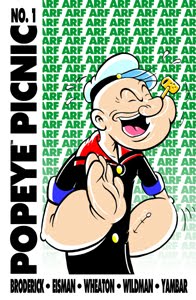
I should really devote more attention to this then a short entry in a multi-comic post like this, given the usual nature of the book. Yambar and his regular co-creators George J. Broderick Jr. and Ken Wheaton created this 30-page, black-and-white comic book in 2009 to mark Popeye’s 80th birthday, and the 30th anniversary of Chester, Illinois’ annual Popeye Picnic celebration.

Chester is the birthplace of E.C. Segar, and thus the birthplace of Popeye.

There are two connected stories within. In the first, Popeye and his supporting cast—Bluto, Olive Oyl, Swee’pea, Wimpy and the Sea Hag—are enjoying a picnic when a can of spinach lands on Popeye’s head and knocks him out. When he loses consciousness, he travels back in time to meet his maker, Segar, who shows him around Chester and introduces him to the real-life residents who inspired Wimpy, Olive and Popeye himself.
In the second half of the book, these half-dozen characters head to modern day Chester for the Popeye Picnic celebration, and there they’re met by Castor Oyl. Alice the Goon, Eugene the Jeep and The Whiffle Hen all cameo.

It’s an interesting book. The history lesson and tour of town have an unfortunate, perhaps unavoidable “edutainment” vibe about them, although there are some funny gags sprinkled throughout (I particularly liked Popeye’s real-life inspiration punching Popeye so hard that he send him into the future or reverse knocks him out, depending on how you want to read his unconscious journey to meet Segar).

Probably the biggest treat is seeing Broderick’s take on the characters. They all look bigger, rounder, smoother, cleaner and more three-dimensional than Segar’s, and its fun to see them interacting with “real” people (who are also cartoony drawings, but done in a different style) and the modern world.

The production values, sadly, leave a lot to be desired. The lettering is pretty poor, and ill-serves the dialogue, which perfectly captures the peculiar voices of each of the characters. Maybe making it look more Segar-like would have been too difficult, but it certainly didn’t have to look so computerized. The balloon tails also make it difficult to tell who’s talking in certain panels. The writing and art are highly professional, but the lettering looks pretty amateurish. So too does the pixelated pin-up art by Hy Eisman, and the ads from local businesses, which are laid out so as to resemble those you’d find in a high school year book, church bulletin or restaurant place mat.

Even still, it’s a one-of-kind comic book experience, and one I imagine anyone terribly interested in comic strip history would enjoy at least taking a look at.


********************

There was a second comic shop listed on the FCBD locator near Comics and Friends which I attempted to also visit that afternoon, but I was unable to locate it, and I ended up just driving around wasting gas in Lake County for a while. My plans for exploring the area's comic shops was only half-successful then.

I did find a fantastic library though, featuring the biggest and most up-to-date manga selection I've ever seen in a single public library location. They had an awful lot of American comics too, mostly of the book publishers YA offerings and classic superhero comics reprints, but there manga section was to die for.

This is what I hauled home from there, as modeled by my new roommate Yogi, The World's Most Active Labrador Retriever:
Expect a lot of manga reviews in the near future, and maybe some posts about Bigfoot drawings.

Wednesday, August 13, 2008

Some of Raymond Briggs' children's books, which are actually comics

As I mentioned yesterday, I have a review of Drawn+Quarterly’s new edition of Raymond Briggs’ Gentleman Jim over at Newsarama.com.

I rather enjoyed the book, which is pretty amusing, but I got more value out of the introduction than the story itself, as it introduced me to the work of Raymond Briggs.

Well, that’s not actually true. My first introduction to Briggs was an animated version of his The Snowman, which my little brother and I stumbled upon while flipping through television channels one winter evening. It was silent, and we thought it was hilarious, because it’s basically about a snowman breaking into this little boys house and then wrecking shit. I think at one point it steals a motorcycle? And then goes flying around with him?

Years later I saw that it was actually a children’s book, and I remember reading it and the similar The Bear and really digging them both. And then I pretty much forgot about Briggs. I certainly didn’t think of him as a comics creator or graphic novelist.

And then I read Seth’s introduction to this new edition of Gentleman Jim, and it got me thinking: Is Briggs a comics creator or is he a children’s book author? Or is he both?

Here’s Seth on Briggs:

It is remarkable that an artist could be such an innovator, so ahead of the crowd and could have produced such an impressive list of comics novels and yet still somehow be overlooked when people talk about “the graphic novel.”

Seth’s point is more of an observation about a weird occurrence rather than a tirade against a grave injustice, as it’s not like Briggs has suffered in obscurity or anything. It’s just that he doesn’t get as much credit as he should, at least not from those of us in comics.

Seth again:

It’s simply the old story of pigeonholing. He started out as a children’s book author, and the label has stuck. Will Eisner’s A Contract With God, published in 1978, is often trotted out as the first official graphic novel (ignoring the fact that it is actually a collection of short stories and not a “novel” at all). Whi is it that no one has ever noticed that Briggs’ The Snowman, which came out the same year, is actually a better candidate for the title? In fact, Briggs had two full length, self contained “graphic novels” published several years earlier: Father Christmas and Father Christmas Goes On Holiday. *

Seth goes on to theorize that perhaps it has something to do with the audience for those works of Briggs’, although, “The fact that these were written for children shouldn’t remove them from the contest.”

As I mentioned in my Newsarama review, it may have as much to do with the publisher, format and presentation as it does with the intended audiences. Since I’ve been blogging, I know I often come across children’s books that look like, are labeled as and published and sold as children’s book, but which are actually straight up comics: sequential images that tell a story in the exact same way that Batman or Maus or Astro Boy does. Sure, a lot of children’s books are in a gray area between comics and not-comics—for example, if there are no panels, but every page functions as a panel, is that comics or not?—but some are clearly comics. Although, if you didn’t know what comics were exactly, if you weren’t familiar with that medium, you might not notice that hey, this picture book is actually a comic book.

And until quite recently, there was no profit in selling a children’s book as a comic book, because “graphic novel” wasn’t even a word in the publishing industry’s lexicon in the late ‘70s. If a book had a spine and a hard cover and was sold in a bookstore rather than a drugstore, it was probably a children’s book and not a comic book, regardless of if it had panels or contained sequential art and was devoid of prose.

So suddenly curious to read (and, in a few cases, re-read) Briggs’ work to see if what he did was comics or kids books, I rounded up as many of his works as our local libraries carried, excluding quite a few in which he was simply listed as the illustrator and another writer as the author (And there are actually a lot of these; Briggs had had a hand in what I’d guess is somewhere around 17 million books during his career).

My conclusion? Hell yeah, Briggs makes comics. A lot of the time. He also makes kids’ books. And he makes some books that are hybrids between the two; mostly comics, with a few pages that are illustrated prose.

Let’s take a look at a few of them in the comics category.


Let’s start with The Snowman, because its Briggs’ signature work. As you’re probably aware, it’s the story of a little boy who makes a snowman during the day (one with a golem-like body, rather than the three big snow spheres format). When he wakes up in the middle of the night, he checks on his snowman only to discover that he’s come to life. The snowman comes in and they get up to some hijinx together.

I didn’t notice when I had read it some ten years or so ago, but now it seems like one big long dark joke. Throughout the whole thing there’s this heartwarming vibe, as the two friends play together, and on the very last page, there’s only a single, tiny panel, of the boy standing over the puddle that used to be the snowman, now melted in the sunlight. Ha! His friend is dead! Get it? Wow.

There doesn’t seem to be anything equivocal about this: This is comics/a graphic novel/sequential art/whatever you want to call it. The pages are almost all broken up into panels, save for a handful of splash pages. The story is silent, so there’s zero prose to this at all.

I just reread the publisher’s text on the flaps for the book, and it doesn’t mention comics at all. The summary on the front cover flap says “Raymond Briggs uses more than 175 subtly colored, neatly arranged picture frames to tell” his story, and the back flap says “Briggs showed illustrators a new way to expand the limits of a picture book from within.”


The Bear is from 1994, but it’s extremely similar to The Snowman, in its story and its visuals. Another ginger-haired little kid—this one a girl—receives a big white visitor into her house, and has some fun with him before he leaves.

It’s not a snowman, but a giant polar bear. Her parents don’t believe her, and think her talk of a bear in the house is simply her imagination, and so for a few days they seem to keep missing the bear until it eventually goes away.

The big difference between the two works is the words. While Snowman was silent, The Bear is not.

I suppose you could say this was a hybrid book, though. Much of it is told just like Snowman, with the actions occurring in panels, and there’s even dialogue bubbles.

There are a few pages that resemble illustrated prose though; splashes in which the page is dominated by one large picture, and then words are written in straight lines in a white space nearby. This usually only happens in scenes with a lot of dialogue in them.


Now let’s jump way back to 1973 for Father Christmas, Briggs' book about the guy we call Santa Claus here in America.

This one is comics all the way; there’s no ambiguity about it at all. The images are all in panels, there are multiple panels per page, and the only words that aren’t in dialogue bubbles are the words “Father Christmas” across the top of the first page.

This book is also hilarious. It’s probably my favorite Briggs book, in part because the lines and colors are all so bold and solid, unlike his Snowman and Bear, with their soft lines and colors, and in part because it’s just really funny.

Father Christmas doesn’t live in a magical wonderland with a Mrs. and a cadre of elves suchlike; he seems to be an old bachelor who lives alone with his cat and dog. And man, he doesn’t even seem to be all that into Christmas.

He wakes up pissed, and we follow him through his longest day in great detail (his morning chores, his breakfast, getting ready for the day, making his rounds, et cetera). He swears at the weather, the snow, the winter, chimney, aerials, cats, stairs and soot. He sees he’s left a bottle of coke at one stop and says, “Hm, better than nothing I suppose;” when he opens his own presents at night, he complains about the blooming terrible tie and socks he’s given.

In other words, Santa’s pretty much just a cranky old man. He’s not totally bitter all day; he’s nice to his pets, and smiles quite a bit and enjoys some of the things he’s given (well, the alcohol only, actually) and sings a Christmas carol while showering, but he’s not the maniacally jolly caricature we’re used to. This is Father Christmas’ job after all, and Briggs has him relate to it the way pretty much everyone relates to their own jobs.

Here’s the very first page:


Here’s Santa leaving the house (I love the panel of the dog looking out the window):


And here’s the very last page, as Santa calls it a night:


(There’s also a panel of Father Christmas on the toilet with his pajama pants pulled down, a piece of toilet paper in his hand as he scowls at the toilet paper roll and shouts “I hate winter!” to it, but I lost the scan I made of that page, unfortunately. Oh, hey, someone else posted it on their blog already).

There’s a sequel to this book, mentioned in the quoted passage from Seth above, but I couldn’t find it; I wonder if it’s even in print anymore, as the copy of this book I got from a library had an “Out of Print” sticker affixed to the front, apparently to warn librarians not to discard it.

Interestingly, the comic Father Christmas reminds me of the most is Seth’s own Clyde Fans Book 1, or at least the first part of it. Both feature old men going about their days in minute detail; in Clyde Fans the old man is talking to the reader about the titular business and salesmanship, while the old man in Father Christmas is just muttering to himself and pets about shit.


Another of Briggs’ funnier books is Ug: Boy Genius of the Stone Age. It is about a boy named Ug and his search for soft trousers (“trousers” is a much funnier word than “pants,” although I’m not entirely sure why that is).

Here’s the first page:


Life really sucks in the Stone Age, as you can see. The folks back then lived a lot like us, but were missing a lot of the things that make modern life less sucky.

As you can see, they sleep on beds under blankets, but the beds are stone, as are the pillows and blankets. And they word pants, but they were stone pants.

Ug’s a dreamer though, and wishes he had soft trousers; he dad tries to talk him out of it, but Ug is always looking at life and wishing it could be different.

For example, his mother serves him bits of dead animals for breakfast, and he wishes they could have something different, like hot dead animal bits.

The kids play soccer, baseball and tennis with rocks, which isn’t as much fun; Ug wishes they had something that could bounce to play with.

He thinks about boating, the wheel, fire, animal agriculture, building houses to live in instead of caves, but his mother is hardly supportive: She thinks he’s slowly going insane, and keeps yelling at him (and his henpecked father) about all these crazy ideas.

Ultimately, nothing comes of them, but he and his father come awfully close at the end:

That last panel is so heartbreaking, isn’t it? They’re almost there, they just need someone to invent sewing and they’ve got it. That's actually the second to-last-page, above. This one also had a darkly amusing ending, but not nearly as dark as The Snowman.

One of the running gags in the book is all the anachronisms in it; the characters refer to increments of time like the week, minute or lunch, and Briggs dutifully explains them with footnotes:


This book is also unequivocally a comic book.


The most recent Briggs book I could find was 2004’s The Puddleman, which is a bit of a hybrid comic/picture book, along the lines of The Bear. Most of it is told with panels and dialogue bubbles, but there’s a page or two in which the large amounts of dialogue are presented as prose floating in white space above the characters.

The title character is an old man in a raincoat who carries puddles on his back and delivers them to the holes where one would find puddles. The little boy who stars in the story meets the puddleman while on a walk with his grandfather, although not until his grandfather gets distracted by a neighbor and the boy rounds the corner to talk puddles with the puddleman.

While the puddleman gives the book its name and makes for the most magical event in the book, the story is really about the relationship between the inquisitive, rambunctious little boy and his somewhat put-upon grandfather.

It’s a rather sweet little story, and one I imagine anyone who’s spent much time around a little kid would find sweeter.


The final book I read was When The Wind Blows, a 1982 book that blew me away. Seth refers to it in his Gentleman Jim introduction (it stars the Jim and Hilda Bloggs characters that are in Gentleman Jim). “Certainly his lasting importance is alone assured by the critical attention he received for When The Wind Blows…the book is almost universally recognized as one of the most touching and powerful treatments of nuclear war.”

And yet that didn’t really prepare me for the book at all. By the time I was finished, I was downright shocked that I had never heard of it—or Briggs in terms of a graphic novelist—before. Why wasn’t this mentioned in the same breath as Watchmen, Maus and The Dark Knight Returns, the holy trinity of transformative works that people are always citing as the tectonic shift in the comics medium?

Like all three of those books, When The Wind Blows is a deceptively mature** work that addresses the major anxiety of its day, captures the zeitgeist of its era, and deal with some of the same subject matter as those other three works.

If you haven’t read it, I highly suggest you look for it at your local library. It’s definitely a comic/graphic novel; it’s all panels.

Most of the action concerns the Bloggs; retired Jim and his stay-at-home wife Hilda, and is set at their home in the English countryside. Neither is very political or even interested in world politics; he goes to the library to read about current events, but seems to retain very little, while she isn’t interested at all.

That doesn’t mean they’re exempt from nuclear war though. When a man on the radio warns that the Cold War is about to get hot, Jim goes about preparing their home for a nuclear attack, following the guidelines in a pamphlet he got at the library, with Hilda barely understanding what’s going on.

The first half of the book is downright comical, as the Bloggs are very much like naïve, grown-up children (something played for laughs in Gentleman Jim). In fact, there was a great deal of suspense about whether there would be a war, because a nuclear missile going off at some point just seemed so dissonant from the tone Briggs establishes around the Bloggs household.

The pages are jam-packed with little panels—20 to 30 per page, more often than not—but would occasionally give way to a double page splash, of a dark missile or a dark submarine, and a caption like “Meanwhile, on a distant plain…” or “Meanwhile, in a distant ocean…” slowly building suspense.

At the risk of spoiling it if you haven’t read it, the bomb goes off (in an incredible sequence, involving an all-white flash on a double-page spread, one that temporarily destroys the comics grid on the following pages, and we watch as the sequence of panels gradually return to normal after being bathed in hot white light and shaken violently.

From there, the rest of the book is the Bloggs coping with what’s going on, trying to keep a stiff upper lip and encourage one another, and it is just heartbreaking stuff. Neither seems to know what’s going on exactly, not even recognizing the onset of deadly radiation poisoning (or refusing to recognize it), and throughout the entire narrative they keep comparing the Cold War (and the threat of nuclear war) to the World War they lived through, which has become completely romanticized by the early ‘80s in their minds. They also keep forgetting to say “Ruskie,” but keep slipping back to talk of “The Jerries.”

We all know, at least in an abstract sense, than all wars inevitably cost the lives of innocent civilians, but it’s one thing to know that as a faceless fact, and quite another to see innocent civilians caught up in a conflict they don’t understand, know anything about, or particularly care about. Briggs doesn’t really delve into things like who shot first or why, and the Bloggs are totally out of it; they don’t even know who their prime minister is, or what’s going on with the Russians and the Americans at the time. And yet they still have to pay the same price as those that do.

Reading this last week was a strange experience, because I haven’t really thought about horrifying the prospect of nuclear war—something I used to actively worry about as a little kid—actually is for so long, and I actually felt a bit of relief reading this; a “Whew, well at least that’s over.”

But then I thought about the fact that, nuclear conflict or not, there were probably thousands of people like the Bloggs in Iraq, people that were completely ignorant of their government and that of the United States and the powers in the region and whatever conflicts the rest of the world might have with their leader, people who were more than content to live their own lives as they were. And those people got destroyed anyway.

And now it’s Tuesday night as I type this, and between reading When The Wind Blows and thinking about the Cold War and our current hot wars, Russia and Georgia have gone to war, and the Cold War seems less over than it did last week.

So, if you haven’t, read When The Wind Blows. It will make you feel horrible, which is as good a testament to how effective a work it is as anything else.


*Here I should note that if Contract With God should be disqualified from being called a “graphic novel” simply because it’s a collection of short stories instead of a novel, so should all three of these Briggs works, as they are more “graphic short stories” or, perhaps if one’s generous, “graphic novellas.” But little good ever comes out of arguments over what to call these damn things we read; “graphic novel” is what the most people call them, and language is ultimately democratic. The mob says “graphic novel,” and the mob rules.


**I am allowed to call a Frank Miller book “mature” without losing all my comics blogger cred right? To clarify, I mean mature as in dealing with subject matter beyond what people off the street might expect, be it a Batman comic book that has child-molester Joker breaking his own neck and Batman and Superman beating each other to death, or a book about cartoon mice that is actually about the holocaust.

Tuesday, June 27, 2006

Delayed Reaction: Wimbledon Green


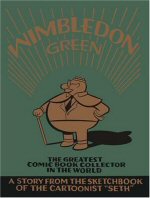
Wimbledon Green: The Greatest Comic Book Collector in the World (Drawn and Quarterly), by Seth

Why’d I Wait?: Sheer ignorance. I honestly had no idea this book even existed until I saw it sitting on a cart at the library I work part-time at, waiting to be put back on the shelf.

Why Now?: With a title like that, what comic book enthusiast could pass it up once they were made aware of its existence?

Well?: Thank Daniel Clowes for coining a term we can use to discuss this work—like Clowes’ Ice Haven, Wimbledon Green is a “comic strip novel,” comprised of individual comic strips of varying length and style which each contain a small part of a an overall, novel-length story.

The technique is not used as successfully here as it was in Ice Haven, yet if this doesn’t exactly feel like an extremely important work, that may be because it wasn’t supposed to be: The cover proclaims it “A Story From The Sketchbook of the Cartoonist ‘Seth’,” and in his foreword, said cartoonist Seth explains “it’s just a send up of comic book collectors.”

And while it lacks the power and depth of Clowes’ best work—and the acid zing of Clowes’ sense of humor—if Wimbledon Green is Seth’s idea of a dashed-off lark, it’s certainly not apparent from the quality of the art. It’s a beautiful looking book, most of the well-designed pages are simply jam-packed with 20-panel grids and colored in different shades.

The title character is a sort of Scrooge McDuck-type of wealthy eccentric, traveling the world on quests to find the oldest, rarest and most valuable comic books. Seth invents plenty of rival eccentrics for him to race to issues of fictional books like The Green Ghost #1 and Corns Bunion. The rich subculture Seth invents feels both real and charmingly alien at the same time, with his comic book aficionados all having collecting pseudonyms that recall the handles of old gangsters—Ashcan Kemp, R. Saddlestitch, “Cuts” Coupon, Pulpy Wise, and so on.

Most of the book is done in a mockumentary style format (a format that’s grown tiresome from it’ over-usage in film comedy), dealing with a legendary collecting scandal and the collectors’ flailing attempts to connect Wimbledon Green to one “Don Green.”

These are broken up with adventure-style strips that include an epic battle over the Green Ghost #1, a detailed account of Wimbledon Green’s queer, Howard Hughes-like personal habits and a delightful section where Green elucidates the virtue of fictional hobo humor series Fine and Dandy (I’m a sucker for hobo humor).

If the whole of Seth’s “comic book novel” is less than transcendental, and it’s overall story rather mediocre, some of the strips that make up that whole are pretty fantastic in their own right. Seth’s natural audience, the comic book community, will especially appreciate “Young ‘Cuts’ Coupon –1949” and “Jonah: A Brief Profile by Ashcan Kemp.”

In the former, a young, foreward-thinking Coupon tells the readers that he understood that “there was deep meaning in these tales of masked men and anthropomorphic animals…while on the surface ‘comic books’ appear to be half-witted stories for sub-normal boys…my ten years of study has revealed much more.” In just 16 panels, Seth distills all the joys and frustrations that come with a life dedicated to comics about as perfectly (and certainly as humorously) as anyone before him as managed.

In the latter, Kemp has equally true, if more cynical, thoughts on the community itself: “For a bunch of guys who like good-over-evil stories…you sure meet a lot of morally bankrupt assholes.”

But its worth the feelings of frustrated societal misunderstanding articulated by Coupon and the morally bankrupt assholes Kemp sees for those brief feelings of nostalgic peace Don Green found in used bookstores and dusty attics. And of course, top notch hobo humor.

Would I travel back in time to buy it off the rack?: Funny I should mention time travel at all, as there’s an intriguing undercurrent of melancholy to the work, about the collectors’ desire to reclaim pieces of their childhood, and how that impulse, in the case of the single-named character “Jonah,” the world's greatest comic book theif, turned him from collecting to villainy.