Showing posts with label scarecrow. Show all posts

Monday, March 31, 2025

DC Versus Marvel Omnibus Pt. 17: Batman/Daredevil: King of New York #1

DC and Marvel might not have gotten to every conceivable crossover of interest. But between all of the one-shot crossovers in the pages of DC Versus Marvel Omnibus and the various event miniseries collected in DC Versus Marvel: The Amalgam Age Omnibus, I think it's safe to say that, by the end of the '90s, the two publishers had released comic books featuring many of the configurations of characters that their audiences were likely to be most interested in (Save, of course, for the failed Justice League/Avengers crossover, which they would eventually get around to in 2003). 

In fact, by the time the decade ended, DC and Marvel were even repeating particular pairings, publishing a second meeting between Batman and Spider-Man and, of course, a second Batman/Daredevil pairing, which would end up being the last DC/Marvel crossover...with the exception of that JLA/Avengers one a few years later.

While 1997's Daredevil and Batman was created by a previous Daredevil team, that of D.G. Chichester and Scott McDaniel, this time it's a DC team at the helm: Alan Grant, who wrote various Batman titles throughout the '90s, and Eduardo Barreto, an incredibly gifted artist who had worked steadily for DC throughout the '80s and '90s, working on several Batman specials in the latter decade.

His art is always welcome, and it's a special treat in this particular collection, where his contribution is one of the best drawn in the entire tome (up there alongside Jose Luis Garcia-Lopez and Dick Giordano's DC Special Series #27 and Steve Rude and Al Milgrom's The Incredible Hulk Vs. Superman). 

As was the case with the Titans/X-Men crossover that immediately preceded the last cessation of DC/Marvel crossovers, the quality of this particular one doesn't seem to be to blame for the temporary end to the cooperation. It's just about as good as the best of any of the 18 earlier DC/Marvel crossover, and far better than a few. 

Rather, if the blame isn't the changes in leadership at the two publishers, as various prose pieces in the collection seem to suggest, it may just be as simple as fan and market exhaustion of the crossovers, which had been coming at a pretty steady clip since they resumed with Batman/Punisher in 1994. 

While that's just a guess, I have to imagine that, at the very least, the DC/Marvel crossovers had lost that feeling of being rare or special during the course of those six years or so, given how many of them were published in such a relatively short span of time.

But anyway, back to this crossover. 

Grant seems to have constructed the entire thing around one particular meeting of two characters...and not those whose names are in the title. Rather, Grant seemed to want to pit Daredevil, who is nicknamed "The Man Without Fear", against Batman villain The Scarecrow, the self-proclaimed master of fear, whose entire modus operandi is to attack his victims by scaring them ("Modus operandi", by the way, is a term I first learned from reading another Alan Grant-written inter-company crossover that also featured The Scarecrow as its villain) . 

That scene plays out in a short, five-page sequence at the climax of the book. The Scarecrow sprays Daredevil directly in the face with an aerosol bottle containing his fear gas, exposure to which subjects a victim to his or her greatest fear.

"Taste fear, my friend!" The Scarecrow grins, the border of his dialogue balloon wavy and jagged to suggest his spooky voice.  

And in the next panel Daredevil covers his eyes and wheels backward. 

A big panel that dominates the bottom two-thirds of the page is then devoted to Daredevil with his eyes and mouth wide open, various fears apparently running through his mind, Barreto's art depicting five different DD villains, one of whom I didn't recognize, while Grant's melodramatic narration notes just how powerful the gas is ("Another man-- any other man--would crack beneath that onslaught of pure, untainted fear--").

A turn of the page finds Daredevil apparently angrily laughing at the dark sky above, while the narration box reads, "But Daredevil is the Man Without Fear. Defiantly, he throws back his head and laughs in its face!"

"Taste fear yourself, creep!" Daredevil then quips, kicking The Scarecrow over the railing of the torch on the Statue of Liberty, where the four-way battle at the end of the book plays out. 

Of course, Daredevil has his own rogue—or rogues plural, I guess, as he's become a legacy character—who use fear gas as a weapon, the simply named Mister Fear (The first of whom appeared in 1965, well after The Scarecrow debuted).

I wonder, then, if such a scene has previously occurred in Daredevil history, just as I wonder why Grant didn't use any of the various versions of Mister Fear (provided any of them were alive at that point in 2000) to pair with The Scarecrow. Instead, Grant resorted to DD's archenemy, The Kingpin (Who, as we saw, already appeared in a pretty good DC/Marvel crossover, one that also featured Batman). 

(Other decent Batman/Daredevil rogue combinations that would remain unexplored? The Joker and The Jester, and The Penguin and The Owl.)

In this particular story Batman oddly, even counter-factually describes The Scarecrow as a villain who "dabbles in organized crime when the mood takes him" (I've read all of The Scarecrow's appearances throughout the decade of the '90s, most of which were written by Grant himself, and he never once showed any real interest in organized crime beyond hiring thugs to do manual labor or protect him). The conflict driving the book basically rests on that description, though, as this is a story in which Gotham City mad scientist-turned-terrorist The Scarecrow attempts to muscle in on Kingpin's New York City turf, using his prowess with mind-altering chemicals to essentially mind-control criminals into following him. 

The story opens with Daredevil on the trail of Catwoman, the latter of whom Barreto draws a particularly svelte and sexy version of, as she essentially resembles a nude female form that happens to be colored the purple and black of her then-costume. She has apparently stolen a particularly important thing from the Manhattan safe of New York law firm Shane, Murdock and Nelson: Their files on Kingpin of Crime Wilson Fisk's operations. That means, in Daredevil's words, 

Details of meets, associates, businesses owned. Suspicions concerning his activities. Everything a lawyer would need if he were putting a brief together!

Why would anyone want that? Well, that's precisely why Daredevil has followed Catwoman back to Gotham. He's about to bust up her rooftop meet with a pair of criminals, when his senses pick up on Batman about to foil it, so he intercepts the Dark Knight mid-air. Batman naturally fights back and the pair of vigilantes—as well as the head of a stone gargoyle—crash to the rooftop. 

Catwoman gets away with the case as Batman and Daredevil beat up the remaining bad guys. The criminals refuse to talk, but they give up a clue that Batman's Batcave computers manage to decipher anyway: They were apparently subjected to the The Scarecrow's fear gas. And, indeed, readers see Catwoman meet up with Scarecrow on another roof top after losing the vigilantes. 

(If, like me, you have a particular interest in how different artists depict The Scarecrow, I suppose I should here note that his design here is basically that which was seen in the 1993 Shadow of The Bat arc "The God of Fear" drawn by Bret Blevins, only with straw "hair" reminiscent of the Tim Sale design. Or, perhaps even more closely, Barreto's own take on the Batman: The Animated Series design...that of Scarecrow's second appearance in the series, but well before the redesign with the hat noose around his neck.) 

Despite their rough meeting at the beginning of this one-shot, the two heroes decide to work together again, while both the narration and their dialogue will refer back a few times to their initial meeting, in 1997's Daredevil and Batman #1. (Is it worth noting again that their previous crossover bore an "Elseworlds" logo, while this one does not...?).

They follow what clues they can find to a trap set by The Scarecrow, who has apparently been shipping guns to New York...guns covered with a version of his fear chemicals that allows him to instantaneously hypnotize almost anyone who comes into contact with it. In this manner, he takes over Kingpin's operation. 

"Scarecrow's the King of New York now!" as an underling reports to Kingpin about the Gotham criminal having taken over his opeartion...just before Kingpin throws said underling out a window.

Daredevil and Batman soon come calling, trying to urge Kingpin to cooperate, as they've found evidence that Scarecrow has brought cannisters of fear gas with him, and thus has his sights set on something other than becoming New York's new Kingpin of Crime. He wants to attack the city with his fear gas.

Kingpin doesn't just refuse to cooperate with the heroes, but he apparently climbs into an attack helicopter off-panel and then tries to gun them down on a rooftop, before piloting it towards the high point where he assumes The Scarecrow will go to release his gas on the city: The Statue of Liberty.

Scarecrow shoots his chopper down, but the huge Kingpin forces his way through the tiny windows in the statue's crown...just as Batman and Daredevil arrive via speedboat, making awfully good time, considering Kingpin's head start and his, you know, being in a helicopter.

This leads to the climactic battle, in which the two heroes take on one another's villains, leading to the scene between Daredevil and Scarecrow detailed above, which occurs as Batman goes hand-to-hand against Kingpin (As the two didn't come to blows in the earlier Batman & Spider-Man, I suppose this gives readers a chance to see the two fight one another, although the fight is inconclusive, with Kingpin simply deciding to stop fighting after he learns DD has taken out Scarecrow).

In the end, as is ever the case with such books, the status quo for all of the characters essentially resets itself, with The Scarecrow being captured and apparently being taken back to Arkham Asylum (Daredevil of course caught him with his billy club-on-a-wire thingee after kicking him over the railing), and Kingpin walking, as the masked vigilantes can't really accuse him of any wrong-doing without unmasking and personally testifying against him. 

And as the two heroes pointed their boat towards the New York City horizon, the era of DC/Marvel crossovers drew to a close...

Well, almost. 

There was still the aforementioned JLA/Avengers yet to go. That wouldn't ship for another three years (although I wouldn't be surprised to learn that it was at least being discussed and maybe even developed at the time that this crossover was published), and it would differ in some key ways from the other, previous DC/Marvel crossovers collected in this omnibus, the most obvious of which being that it was given an entire four-issue miniseries, rather than occurring in a single, oversized one-shot, making it more similar to the three crossovers collected in the other, second DC/Marvel omnibus, DC Versus Marvel: The Amalgam Age Omnibus. 

I'll be circling back to review its contents in three future posts, detailing 1996's DC Versus Marvel (every other issue of which was called Marvel Versus DC) and its attendant Amalgam Comics tie-ins, 1996-1997's DC/Marvel: All Access (and its Amalgam tie-ins) and, finally, 1997-1998's Unlimited Access. 


Next: 1996's DC Versus Marvel

Monday, July 07, 2014

The Batman/Judge Dredd Collection Part 1, Judgment on Gotham

One of the first comic books I ever read, probably among the first dozen at the most, was the 1991 "prestige format" special Batman/Judge Dredd: Judgement On Gotham, a fully-painted, seemingly once-in-a-lifetime meeting between the most prominent and popular American superhero (who just had a major motion picture in theaters a few years ago, and had another one due the following year) and a character I was told was his British equivalent. That sure sounded like something to read!

It was one of my earlier exposures to comic book Batman, my first exposure to Batman villain The Scarecrow and, of course, my very first exposure to Judge Dredd and the members of his supporting cast that appeared within the story: Psychic fellow officer of the law Judge Anderson, archenemy Judge Death, and less-arch eneemy Mean Machine Angel.

I loved it, although re-reading it many years later, I see that I missed a lot of elements of it, particularly the fact that Dredd and the comics world that emanates around him isn't meant to be a straight one in the manner that Batman and his Gotham are. If Batman comics were usually meant to be read as serious, Judge Dredd comics weren't necessarily meant to be un-serious, but they were often written, drawn and intended with tongue-in-cheek, with parodic elements, with jokes. Not that it mattered to 14-year-old Caleb, who was mainly entranced by the art of Simon Bisley, who presented an exaggerated, heavy metal album cover world of Gotham City and Mega-City One, with garish, cartoony characters covered in realistically rendered muscles, flesh and textures. It looked like Dave McKean's Arkham Asylum, but read like a regular Batman comic from the era (Thanks, in large part, to the fact that it was written by John Wagner and Alan Grant, a writing team with plenty of Dredd and Batman experience; Wagner, of course, was Dredd's co-creator, and while he and Grant started out co-writing Batman comics for DC; Grant later went solo, becoming one of the more prolific and longer-tenured Batman writers).

I suppose Bisley's images of a topless Anderson didn't hurt...
Nor did a rather bravura splash page in which Bisely illustrates what Anderson sees when she takes a peak in Batman's head:

This, remember, was among my earliest exposure to DC Comics' Batman, and the suggestive painting of a strange, scary, brightly-colored world seen in that splash went a long way toward selling me on Batman comics. If that image was representative, what was I missing by not reading Batman comics...?

(It's interesting to look at again now, after having read hundreds of the damn things. The Joker, Penguin and Catwoman are all prominent; dig The Joker's bottle-green suit and Catwoman's peculiar costume, which echoes Batman's own, particularly as drawn by Bisley in this book). There's Judge Dredd and Judge Death, so recently on his mind. There's Robin, whose 1988/1989 death Batman was still rather pointedly mourning. There's a repeat of the shooting death of the Waynes, and a monster at crashing through glass, as in Frank Miller and David Mazzucchelli's version of Batman's origin. There's Judges Death and Dredd, obviously quite fresh in Batman's mind. There's a couple of nasty-looking guys in the upper-right hand corner that could be Batman villains of some sort, the one on the right looks a bit like Clayface III, but given Bisley's style of goon, it is likely just a random bad guy. The character I'm most intrigued by is the one just below that pair, who looks like Wildcat with a cooler, more articulated mask than he's usually given. I'm not sure if that's meant to be Catman, as he doesn't at all resemble the character as he appeared in a 1990 Alan Grant-written encounter with Batman, or Wildcat, who he does closely resemble but who at that point wasn't conceived of as having played any real role in Batman's life. I'm assuming its just Bisley's version of Catman, drawn from his own memory or imagination, or just his response to a script calling for the drawing of "a bunch of weird, dramatic, traumatic Batman stuff" as he saw fit. Cool drawing though).

As much as I liked the book, and as much as it served as a gateway into the world of Batman comics (and DC superhero comics in general), I never read the three sequels. Each of these was also written by Alan Grant and John Wagner, but none of them were painted by Simon Bisley (the major draw of the first one for me) and, by 1995 the very words "Judge Dredd" caused me to recoil in terror, having seen a movie by that title that...didn't really help sell that particular brand to me.

It is now 2014, of course, and in the (jeez) 23 years since Judgment On Gotham, there have been seven more Batman films, one more Judge Dredd film and I've read hundreds and hundreds of comics, including plenty of Judge Dredd comics (though still nowhere near as many as I have Batman comics) and learned the names and work of almost all of these other guys who made all of these other Batman/Dredd crossovers.

So remembering Judgment On Gotham the other day, I thought it was well past time I read all those sequels, and thought I'd see if they had ever all been collected and, naturally enough in our Golden Age of Collections, they have been!

In 2012 DC published The Batman/Judge Dredd Collection, featuring all four of the two characters' crossovers, with Lobo/Judge Dredd: Psycho-Bikers Vs. The Mutants From Hell thrown in as a sort of epilogue; despite its complete lack of Batman, it does feature Dredd crossing paths with a DC Universe character, and it is written by Grant and Wagner.

The collection is rather recent in vintage, coming after the New 52 reboot and after the intro of the new new DC Comics logo (which "2000 AD" appears directly beneath) in the upper right corner. They used Mike Mignola's cover for the Vendetta in Gotham, the second Dredd/Batman get-together, and the only one in this book that isn't painted (save the Lobo cover). I woulda used the Judgment cover, which both came first and looks a bit more prestigious, but I suppose Mignola is a bigger name than Bisley, and one that's moved more trades from the shelves of US book stores and comic shops over the years. On the right, all of the titles of the stories are listed (note how you can determine the particular Batman villains used in the final stories based solely on their titles), and, in a column on the left, the creators, with Wagner and Grant getting top-billing, followed by artists Simon Bisley, Glenn Fabry and, surprising to me at least, Val Semeiks (who only contributes the Lobo story) and then Cam Kennedy, who I would have thought a bigger name than Semeiks.

The tone of the collection seems to hew closer to that of 2000 AD than DC Comics, with the dust jacket issuing such warnings from the "Justice Department" as Warning: Explosive Contents—Handle With Care and Contains excitement levels that may cause unexpected side effects.

I considered reviewing the whole she-bang in one interminably long post, interminably long posts being, of course, the only kind of long posts I do here at EDILW, but I figured I would split them up, story by story, in part to make the piece more reader-friendly and, in greater part, so that I could kill the better part of a week reviewing a single book.

So let's start with 1991's Wagner, Grant and Bisley production, Judgment on Gotham.

The book opens with what must be one of the weirdest openings to any Bamtan comic I've read, the familiar Bat-symbol slowly morphing, over the course of four panels, into two people making out, and then we see a monster's POV sequence as the main villain of the piece sneaks up on his first victims:
Also, there's honest-to-God nudity in a DC comic!

Batman, who Bisley draws to look sort of like Kelley Jones' Batman—extremely long, horn-like ears, huge cape constantly curling its serrated edges like it has a life of its own, muscles bulging through the costume as if it were bodypaint rather than body armor, exaggerated emotion in every expression—but with the careful, painterly detail of Brian Bolland's Batman, hears the screams and reacts. He arrives to find the ghoulish Judge Death, a lisping creature with his own personal dialogue bubble style who "Jjjudgges" every living thing he comes across, plunging his bony claws into the victims, sentencing them to death, and then facing off against a few Gotham police officers.

After a brief melee in which Batman first impales Death upon a wrought-iron fence ("Impaled! I didn't mean to kill it--!") and then incinerates him in an accidental explosion involving stray gunfire at a gas station, Batman examines the corpse of Judge Death after its spirit flies away, screaming "Jjudggmenttt will be carried out ALLLL WILLL DIEEEEEEEeeeeeee", and our hero finds a strange belt, which—FAZZZT!—teleports him to Mega-City One.

There he meets Mean Machine Angel and after a fight that leads to Batman saving Angel from plummeting to his death, Judge Dredd assumes the pair to be in cahoots. Angel escapes using the "D-belt" device that allows for travel from the pages of 2000 AD publications into the DC Universe, leaving Batman to meet Judge Dredd.
He doesn't get along with this particular lawman nearly as well as he does Commissioner Gordon.

Unarmed and un-masked, Batman's being interrogated by Dredd and risking a fifteen year sentence just for the weapons in his utility belt, when Anderson arrives. After exposition explaining what the hell Judge Death is exactly—one of four extra-dimensional "Dark Judges" that believes since all crime is committed by the living, all life must be eradicated to prevent crime—Dredd and Anderson argue over whether they should journey back to Gotham with Batman to save the city and capture Death, or throw Batman in a cell and then throw away the key.

I loved and still love this scene where Batman punches Dredd in the face:
I'm not sure if this is what Grant, Wagner and Bisley intended, but it reads like Batman gets so angry and desperate to save Gotham that he's able to snap the ropes binding him to a chair and punch dread hard enough to shatter his visor and knock him on his knees, all in one single, fluid motion.

"Make it twenty!" is a pretty good, Hollywood action movie-like line, too. I think I'd rather watch a Batman V. Dredd: Punching and More Punching than a Batman V. Superman: Dawn of Justice movie...

Back in Gotham, the now ghost-like Death is seeking a new host body, and happens across Batman villain The Scarecrow in a morgue. In retrospect, I find it curious that Wagner and Grant chose to use The Scarecrow as their Batman villain, in large part because, in 1991, The Scarecrow not only wasn't Batman's archenemy, he might not have even made the top-ten list of most readers.

The two strike a deal and, before long, The Scarecrow and his henchman are providing a new host body for Death and doing their level best to come up with a costume that vaguely resembles the one he was wearing.
In Mega-City One, Anderson and Batman strike a deal of their own, which involves Anderson breaking Batman out and escaping with him back to Gotham, with Dredd hot on their heels.

It all culminates at a heavy metal concert in Robinson Park, where Scarecrow and Judge Death are drawn because of the huge crowd's number of potential victims. Mean Machine Angel is drawn there because he hears the band's name—Living Death—and assumes it refers to Judge Death, who stole the D-Belt from him and with whom he now has a score to settle. And Batman and the Judges show up because, well, that's where the bad guys are.

After a brief musical performance by Judge Death—a parody of the Rolling Stones' "Sympathy for the Devil," which I hadn't recognized as a teenager because I hadn't actually heard
any Rolling Stones songs as far as I knew at that point—everyone fights, and the good guys win.

Bisley gives both of the title heroes pretty bad-ass splash pages:


Dredd wants to take Batman back to Mega-City One with him in order to serve his time, but Anderson intervenes, convincing Dredd to back off for now, and he complies, noting of Batman once the Dark Knight is well out of earshot, "Bit of a tough guy."

Wagner and Grant naturally get the voices of their heroes and villains just right, and Dredd and Batman make particularly good foils for one another. Despite the fact that both are crime-fighters, the fact that Batman is a vigilante with a perhaps-unusual-given-his-vigilantism faith in the 20th century's legal system and Dredd is a completely uncompromising police officer, judge and jury all in one is more than enough to keep them bickering for as many pages as their publishers will allow them to share.

Re-reading this now, I'm also struck by how well the tones of the two strips match-up. The Batman side of things might be slightly more humorous than usual (The Scarecrow's fear gas comes out of a spray can labeled "Fear-O-Sol, Guaranteed Ozone Unfriendly" for example, and there's that awesome scene where Scarecrow shows Judge Death that which he fears the most), but, for the most part, the gag elements come from the Gothamites reacting to the invading characters. The sober, serious Batman more than once refers to the denizens of the Dredd strip as madmen.

But, as I said earlier the greatest attribute this story had, at least as far as I was concerned, was Bisley's art.

There's not a whole lot of difference between his Mega-City One and his Gotham in terms of lighting and texture, but his Gotham is certainly more cartoony and futuristic-looking than usual. There are collage elements used in providing signage, the cops tool around in a big, silver sports car and carry Cable-sized pistols, and most are extremely exaggerated in build and/or design, wearing out-sized blue hats.

I particularly like Bisley's Death when the character is incorporeal, at which point he has his regular head and sometimes hands, but otherwise looks like a rather filthy specter, composed of fluid, flowing ectoplasm.
The effect of his trying to enter other characters, like The Scarecrow here, is similarly neat.
And Bisley's portrayal of the "D-jumps," when characters move from one dimension to another, are pretty cool:
I sure have aged since the last time I read this story, but, surprisingly, it doesn't seem to have done likewise.

Tuesday, October 08, 2013

Arkham Vs. Blackgate, Round One: Softball

Tomorrow DC will release Forever Evil: Arkham War #1, the first issue of a six-part miniseries by Peter J. Tomasi, Scot Eaton and far more inkers than typically necessary. It will detail the conflict between Bane, who has raised an army of soldiers from his prison nation of Santa Prisca and by rallying those held in Gotham City's Blackgate Prison, and the significant portion of Batman's rogues gallery that are usually held in Arkham Asylum.

Following the events of the first two issues of Forever Evil—Batman, Nightwing and Red Robin taken off the board, the world's super-criminals all freed to run riot, worldwide blackouts, a permanent eclipse of the sun—the denizens of Arkham have split Gotham City between themselves, under the kinda-sort leadership of Secret Society of Super-Villains go-between The Scarecrow and the new mayor of Gotham City, The Penguin.

It's going to be the sane criminals versus the criminally insane criminals, basically.

This isn't the first time that the regular, old, not-so-colorful criminals of Blackgate came into conflict with the maniacal theme villains of Arkham Asylum, of course. It's likely to be a lot more violent (and long) though, as the last Blackgate vs. Arkham war was fought on a softball diamond.
Kyle Baker's cover for Showcase '94 #4
That conflict played out in writer Alan Grant, pencil artist Tim Sale and inker Jimmy Palmiotti's "Madmen Across The Water," a 36-page story that was split into two chapters and ran in 1994's Showcase '94 (It has since been collected in Tales of the Batman: Tim Sale, which collects all of the shorter Batman comics that aren't available in trade form; in other words, everything Batman comic he drew that Jeph Loeb didn't write).

The story takes place shortly after the events of the big "Knightfall" crossover, in which Bane blew open the doors of Arkham Asylum, armed the inmates and let them tire Batman out for him. It worked, and Bane defeated Batman and broke his back—only to have one of Batman's many allies, Jean-Paul Valley, put on a bat-suit and some high-tech claw gauntlets, and beat him into a near vegetative state.

This story, narrated by Grant's Jeremiah Arkham character, details where the Arkham inmates went while the asylum was being rebuilt. Against their wishes, his wishes and those of Blackgate warden Governor Zehrhard and those of all of the Blackgate prison population, they are to be kept at Blackgate.

Here's the cast of inmates Grant and Sale were working with:
It's worth noting that in the early '90s, Batman's rogues gallery was a lot tamer, and while I don't think anyone on that page (save for Sarter, one of the two characters Grant created specifically for this story) never killed anyone, they weren't all Joker-level homicidal maniacs taking multiple lives in every appearance. In fact, with The Joker missing from this story, Mr. Zsasz plays the role of alpha murderer, and he is therefore absent from most of the story (he's tossed into solitary after biting the nose off on a prisoner on page six).

(It's probably also worth noting that of the 11 inmates mentioned there, Grant co-created four of them).

For the most part, these guys are safe enough to be around that they aren't handcuffed or shackled on the way there, and Arkham and others mix more or less freely among them. The current fashion is to treat everyone Batman fights as a hardcore serial killer, but Grant writes and wrote many of these guys as merely colorful criminals with bad-wiring that lead to their quirks and incarceration (That is probably even more evident in this particular story, given that the Arkham inmates are the "heroes" of the story, of a sort, and it's more of a dark, humor piece than a crime or horror story).
Suffice it to say that the two different populations of career criminals don't get along all that great. And because Zerhard is himself greatly revolted by the "criminally insane," thinking them all cowards hiding behind their costumes and feigned mental illness in order to avoid paying for their crimes, his attitude prevails. Arkham, of course, is rather sympathetic to his charges (Both men suffer from a sort of reversed Stockholm syndrome).
Each conflict—bullying in the cafeteria, predilection for turning tools into instruments of evil, a successful suicide attempt, a riot—leads to the Arkham group losing more and more rights. It finally culminates with a bet between Arkham and Zerhard: If the Arkham inmates, none of whom have ever even played softball, can defeat Blackgate's team, they get all privileges restored, daily use of the main exercise yard and their own segregated canteen.

It doesn't go well, at first:
But Dr. Faustus, the other character Grant created specifically for this story, a Satanist who believes himself immortal, proves to be quite a coach, and soon he whips them into fine shape.

It helps that they've all got...unusual talents.
Cornelius Stirk, yet another Grant creation (along with Norm Breyfogle, who also co-created Amygdala and Mr. Zsasz), proves to adept at pitching, for example. Upon laying hands on a softball for the first time, he remarks, "Why, how like a human heart it feels...!" And, when his first practice pitch whizzes right past The Scarecrow, he brags, "They're well-exercised, those muscles...That's my stabbing arm, you know!"

Firefly's proves a pretty good outfielder:
As the only woman on the island, Poison Ivy doesn't really need any chemicals or pheromones to get men to do what she wants:
Making her good at both defense and offense:
And here's one of my favorite moments, as Scarecrow makes it to first base by scaring the first baseman into missing the catch, no fear gas or chemicals necessary:
At the risk of spoiling any part of this almost 20-year-old story, the "Crims Vs. Kooks" game never reaches it's proper ending, thanks to first another riot, this one involving baseball bats, uniforms and more team spirit:
And multiple escape attempts.

I expect a much bigger body count and much fewer sports action in Forever Evil: Arkham War. Sadly, I don't think we can expect to see art quite as good as that of a younger, less experienced and confident Tim Sale, and darker, muddier coloring than that provided by Bernie Mireault.

Here are some of my other favorite images from the story, both involving my favorite Bat-villain, who Sale would go on to perfect a version of in his various "Year One" era collaborations with writer Jeph Loeb.

As Sarter threatens to kill himself in the cafeteria, The Scarecrow eggs him on, oblivious to The Mad Hatter's designs on his juice:
And I love this image of him running in the background of this particular argument:
Oh, and here's the cover for Showcase '93 #3, which contained the first half of the story, by Mike motherfucking Mignola, in case you want to see Mignola drawing a bunch of Bat-villains (And who wouldn't?):

Tuesday, September 03, 2013

Some notes on Batman: The Dark Knight Vol. 2—Cycle of Violence

•This is the second volume (as in collection) of the second volume (as in times they've published a comic book with this exact same title) of Batman: The Dark Knight, collecting issues #10-#15 and #0, rearranged so that the zero issue follows the story arc formed by the other issues (as originally published, the "Cycle of Violence" story arc was interrupted by a month for the zero issue, which had to be published during DC's "Zero Month," which happened to fall exactly between the first and second halves of "Cycle of Violence")

•You may recall that The Dark Knight was the new Batman title launched specifically to be a David Finch showcase book. It was to be written and drawn by Finch, and its manifesto was basically "Whatever Finch wanted." That first volume lasted only long enough to fill a single collection (Batman: The Dark Knight Vol. 1—Golden Dawn).

Then the book was relaunched along with the rest of the DCU line during the "New 52" reboot, and the book's raison d'etre shifted slightly, so that now Finch would be co-writing the book with the experienced, veteran writer Paul Jenkins. Their short collaboration filled the previously discussed Batman: The Dark Knight Vol. 1—Knight Terrors, during which you could actually witness it dissolving by reading the credits for each issue. That storyline was essentially David Finch's "Hush," a guest-star, guest-villain filled story arc in which Batman bounced off of various presumably fun-to-draw characters for the length of an extremely convoluted plot.

With this arc, new writer Gregg Hurwitz teams with David Finch, who is just drawing rather than co-writing or co-plotting, and the focus of the book seems to have shifted again. This arc is a six-issue story arc about The Scarecrow, re-telling his origin amidst a present-day battle with The Batman. It would be followed with a yet-uncollected arc featuring The Mad Hatter. The issues currently on the racks feature Clayface (and new artist Alex Maleev). So apparently at about the one-year point, Dark Knight became a sort of villain showcase book under Hurrwitz's instigation.

•It's actually rather impressive how disconnected this collection is from the one it follows, as Hurwitz dropped all of the Finch/Jenkins sub-plots like they were burning coals. The White Rabbit, whose secret identity was dating Bruce Wayne, has disappeared and is never mentioned again. A sub-plot involving an Internal Affairs investigation of Commissioner Gordon by an over-zealous IA officer? Evaporated. Batman's concerns about pushing the aging Alfred too hard? Gone. There isn't even mention of what Batman just went through, the over-complicated plot by Bane to conquer Gotham City using a super-drug developed and distributed with he help of The Scarecrow, Poison Ivy and The White Rabbit.

•Most impressive of all though is the fact that this story arc is about The Scarecrow, who Batman just fought, defeated and one imagines sent to Arkham Asylum about four issues ago. Is that a record for a recurring Bat-villain to recur? It's gotta be awful close.

•This is the first page of the first issue contained herein (it was the one with this gross cover). Check it out:
That's kind of weird and gross, right?

The guy who sewed his lips shut while singing to himself then approaches a crying little girl who sobs to him to leave her alone and then asks why he's doing this and who he is. He answers, "I'm the Bogeyman," and I thought, for a second, that perhaps this was a new villain with a fear schtick called "The Bogeyman," and that The Scarecrow would show up to come into conflict with him for stepping on his turf, right? That's something that happens in comics more often than you might imagine; villains, like heroes, care a lot about turf and branding and their spheres of influence.

But then he goes ahead and says he's going to teach her about "FEAR" and shoots gas at her, and I got a sinking feeling.

So this is The Scarecrow, now sewing his own lips shut and kidnapping little kids. Awesome.

•We turn the page and see Bruce Wayne hanging out with a lady post-coitus. David Finch draws her to resemble Jaina Hudson, the woman Bruce Wayne was dating in the previous story arc (and who was secretly The White Rabbit), that I assumed it was her. But it's actually a new character (I think; or at least new to this comic), a Ukranian concert pianist named Natalya.
I think it speaks to Finch's lack of fundamental comics making skills (like, you know, character design) that he's tasked with drawing two different girlfriends for Bruce Wayne within the space of a few issues, and the half-English, half-Indian Jaina and the Ukranian Natalya look so similar.

It's probably asking a little much that he give them, say, mildly different body types or figures, but I don't know, different color hair? Glasses? Something?

•Bruce breaks off his date when the Gotham City Police Department recovers "another" little girl. Apparently the bad guy (whom they don't yet know is The Scarecrow) has been kidnapping little kids off playgrounds and the like, which is certainly different than his usual M.O.

•Here's another example of Finch not being very good:
How does that giant Batman fit into that tiny window? And he manages to get uncontorted fast enough to stomp on that break and bring that car to a complete stop, before it hits the maternity ward of a local hospital, which is in a street-level, glass encased storefront right off of the street, for some reason.

•When we next see Scarecrow, he's wearing a beard of blood from the self-inflicted wounds to his lips. At first I was curious as to why having his lips sewn together didn't seem to effect his speech at all, but then I started wondering why he hadn't bled to death yet.

•Oh hey, is that why Scarecrow's so skinny? Because he shows his mouth shut?

•This story arc offers an all-new, all-different origin for The Scarecrow.

I thought that was kind of funny because not long ago DC released a miniseries entitled Year One: Batman Scarecrow that was a new, retconned version of The Scarecrow's origin story, and, at the time, I thought that was pretty completely unnecessary (though it turned out to be a pretty good comic, thanks largely to the contributions of artist Sean Murphy).

Now here's an even unnecessarier one—er, more unnecessary—origin.

At least in this case, Hurwitz has the excuse of having had a universe-wide continuity reboot between his origin and the previous one (written by Bruce Gordon). While Hurwitz doesn't deal with the first encounter between Batman and Scarecrow, he does deal extensively with Jonathan "The Scarecrow" Crane's childhood.

In this version, his father was a mad scientist studying fear, and using his own son as a guinea pig, which resulted in some pretty serious and extensive child abuse, mostly involving throwing him down a dark trapdoor for long periods of time.

•Hurwitz contrasts these experiences of the child Crane's with those of the child Bruce Wayne, and adds some wrinkles to familiar elements of the "Batman: Year One" origin that don't exactly sit all that well, including a part where young Bruce has his parents leave the showing of The Mark of Zorro early because he was scared of it, and, therefore, his own fear contributed to them being in the wrong place at the wrong time and getting murdered.

•And that is why Scarecrow is apparently capturing kids for subjects now. As his father discovered, the sweat of horrified children has something special in it, and can be used as a potent secret ingredient in fear toxins, I guess.

•My favorite part is when one of the little girls he's collected fear sweat from diagnoses the villain with a severe case of loneliness, and draws him a picture:
Seriously; that's my favorite part of this comic.

•So eventually The Scarecrow captures Batman, strips him down to his cowl (which he can't remove, because Batman's so damn clever he rigged it so his cowl couldn't be removed), subjects Batman to a new fear gas, and there's about an issue's worth of Batman processing his worst fears, which are dramatized much differently than usual here, and in a way that is rather dramatically conveyed, although in a way that is perhaps not the best match for Finch's skill set.

Eventually, Batman manages to escape, just as The Scarecrow goes to get a rather wicked looking scythe, which has a spinal column on the handle.

An incredibly brutal battle ensues, in which Batman gets stabbed rather deeply in his right shoulder blade with the scythe, which then breaks, leaving the blade coming out the other side of his arm.

So Batman shoots him in the face with his grappling hook gun.
Remarkably, no one dies. Batman crawls away with a scythe blade in his shoulder, stumbling through the city until Robin picks him up.

The Scarecrow hangs from his jaw for a while, then rips himself off the ceiling, his jaw almost completely torn off. He rescues his super toxin and his captive, and manages to escape his hideout before it explodes.

•The Scarecrow, his almost severed jaw still bleeding profusely, goes to The Iceberg Lounge, where he interrupts The Penguin in the middle of his destroy-your-whole-world-around-you schtick that Jason Aaron inserted in a one-shot to show how wicked The Penguin could be, and which Hurwitz later made as integral to The Penguin's crime career as umbrellas and birds.

•The Penguin has built an admittedly cool-looking airship with which The Scarecrow can distribute his new super fear gas during the Gotham City Christmas Parade (During his first appearance in the Batman: The Animated Series, the episode "Nothing To Fear," The Scarecrow also seeks to distribute his gas en masse via blimp; I'm not sure if Hurwitz's using that scheme here is a nod to the show, or if the fact it's now turned up in two such different places means it has its origins in a much older comic book that predates both of these uses). The whole city's going nuts, rioting and suchlike, and there doesn't seem to be any antidote, since the only person who has ever metabolized this particular super-toxin is Batman.

•This is a nice place to pause and remind ourselves not to think about Batman comics as being things that necessarily take place in, say, the Batman line of comics, or in the DC Universe.

Like, right now I'm reading another Batman collection called Batman: Night of the Owls, in which the Court of Owls unleash an army of assassins on Gotham City, and Alfred sends out a "Calling all Bats, Calling all Bats!" signal that has Nightwing, Batgirl, Robin, Red Hood and The Outlaws, The Birds of Prey and I don't know, maybe even Red Robin and the Teen Titans (I haven't finished it yet).

This seems like a good time to maybe call in some former sidekicks doesn't it? Or your pals in The Justice League? Superman and/or Green Lantern could suck up all that gas and down that ship lickety-split.

It was a little harder to try to read this particular comic while making that mental act of recontextualizing the setting, however, because in the story arc immediately preceding this one Batman called on The Justice League to help him deal with a break out of Arkham Asylum, but here he goes solo.

•His plan doesn't really make a lot of sense to me, but then, I'm not a doctor. It involves hooking tubes into his arms and then flying the Batplane over Gotham City, dusting it in a cloud of his own blood (presumably incredibly diluted and mixed with, you know, stuff) to serve as a makeshift cure for the toxin.

Once a cloud of Batman blood lands on the fear-crazed populace, they go back to normal.

•When Batman gets better and the GCPD are able to find The Scarecrow, Batman kicks in the door to apprehend his foe, who collapses at the site of him. Perhaps he's scared, perhaps he feels defeated because the little girl who drew him the picture and understood his loneliness helped lead the cops to him, or perhaps it's simply because of blood loss: He's still pouring blood from that grappling-hook wound to his face and, before having his jaw nearly torn off, he spent most of the arc bleeding from his own self-inflicted needle wounds.

In addition to their use of fear as a weapon and their conquering their childhood fears by wearing costumes, that's another thing Batman and The Scarecrow have in common: The ability to survive incredible amounts of blood loss.

•The zero issue is written by Hurwitz, and drawn by a trio of different artists. Mico Suayan and Juan Jose Ryp penciled it, and Vicente Cifuentes inked at least half of it (with one of the pencil artists presumably inking their own work).

•It opens with a pretty neat image, of pearls falling all over Gotham City like rain in a rain storm, in young Bruce Wayne's imagination.

•This is the story of young Bruce's childhood investigation of his parents' murder, and his confrontation as an angry 18-year-old with their killer, who is once again Joe Chill.

Whether or not Bruce Wayne/Batman would ever discover the identity of his parents' killer and/or confront the killer has changed a few times over the years, and been a surprisingly heated point of debate, with some arguing that not knowing is a prime motivator for Batman to continue fighting crime, as any criminal he apprehends may be the one who started him on this path.

I think he confronted Joe Chill back in the Silver Age, that was written out of continuity during Denny O'Neil's tenure as Batman editor, and Grant Morrison restored it during his run. Obviously, in New 52 continuity, teenage Wayne did find Joe Chill, and even considers shooting him to death(as in Batman Begins), but opts not to.

•It was weird spending so long—although it was just 20 pages—with Bruce Wayne as a child in Gotham City. I guess I never really considered what happened between the few weeks after his parents' murder and his going to walk the world; I assumed he left Gotham almost immediately to start studying and training, but, according to this, he was in Gotham City at least through high school graduation.

Monday, September 05, 2011

Review: Year One: Batman Scarecrow

Despite the couple hundred words I spent talking about how Year One: Batman Scarecrow featured some rather wonky continuity, highlighted and underlined by DC’s decision to collect it alongside a Batman miniseries with completely contradictory continuity, the two-issue miniseries is perhaps most notable for its artwork.

It was drawn by Sean Murphy, who would go on to draw the higher-profile 2010 miniseries Joe The Barbarian, Grant Morrison’s only non-superhero work that year. In a way, it’s too bad Murphy collaborated with Morrison on that particular project instead of one Morrison’s many Batman comics, with the latter was writing while the former was drawing Joe. Murphy is an incredible Batman artist.

Murphy’s art, at least as it was in 2005, when this miniseries was published, was a pitch-perfect balance between the “cartoony” Bruce Timm-designed work of Batman: The Animated Series (a style which, outside of Timm’s own comics work, and that of Darwyn Cooke, has hardly ever really seen outside of DC’s own animated-style, detached-from-the-DCU comics),) and a more realistic, more detailed approach.

Murphy’s Batman is a big, hulking superhero, with a bulky build, but free of steroidal muscle bulges and veins—he’s built like an old DC Silver Age character, complete with square jaw, barrel chest and arms like tree branches.

Murphy keeps the character highly abstracted though, particularly in the cape and cowl area. His eyes are white triangle, his mouth a white wall of gritted teeth or a simple line for a frown and, when in action, he gets slightly more abstracted, his cape stretching and pointing to make him look a bit like a black and gray comet.

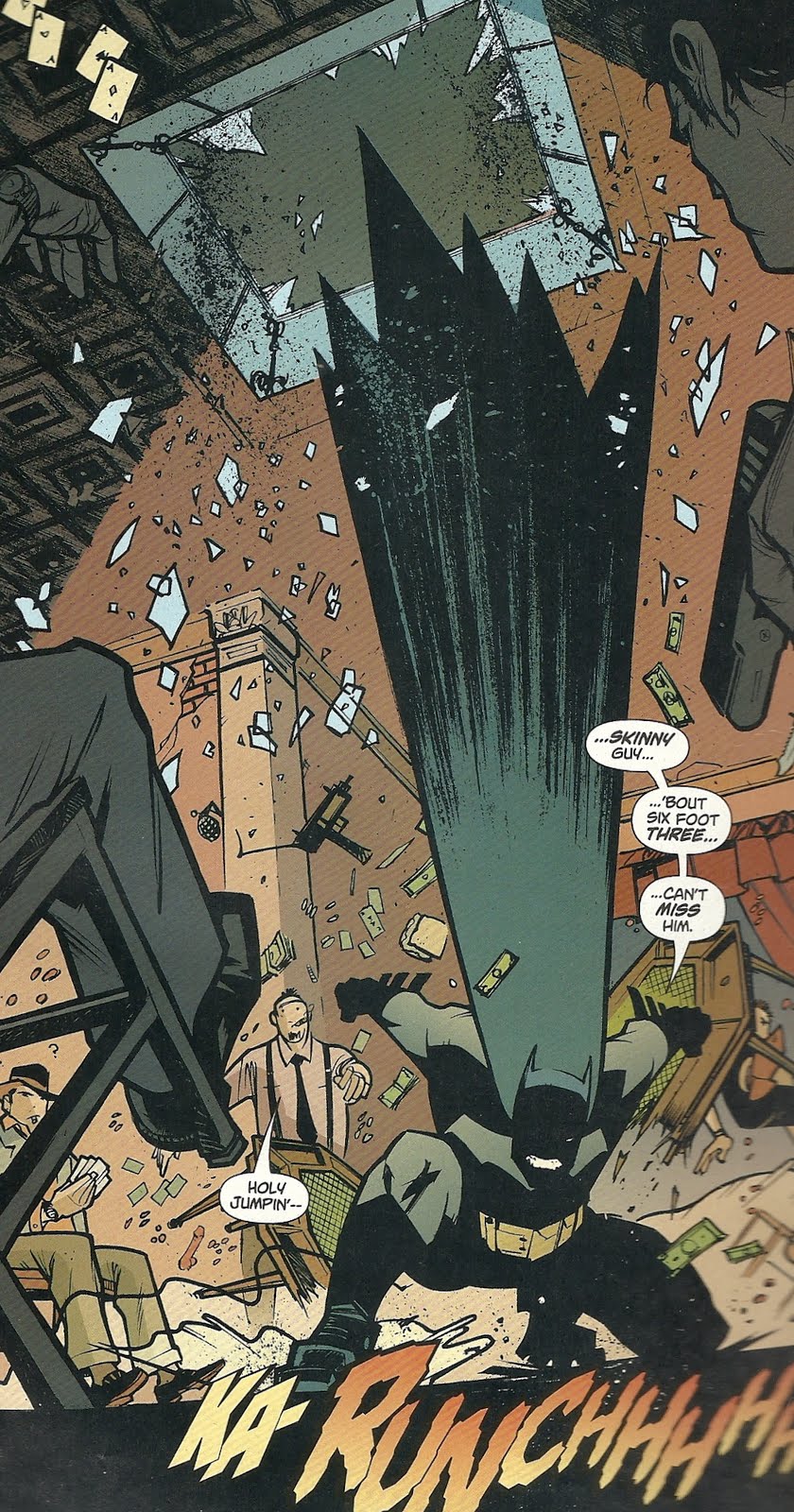
Look at this image, in which an angry Batman crashes through a skyline and hits the floor of a bad guy hideout, essentially blowing the entire room up.As I mentioned in the previous post on this series, though this tells the tale of Batman’s first encounter with the villain The Scarecrow, it is now set after Dick Grayson became Robin.

Murphy’s Robin is equally inspired and, as Murphy exaggerates Batman’s height and girth and Robin’s size, they clash and compliment one another visually in their size, shapes and lines in the same way that the colors of their costumes clash and compliment (and, in Bruce Jones’ script, the way their personalities and Good Cop/Bad Cop approach to crime-fighting do).

Murphy’s Robin is tiny.And so’s his cape.

While artists went out of their way to design darker, tougher, more realistic and even more badass costumes for future Robins——Murphy accentuates the original Robin’s little-kid-who-just-got-out-of-the-circus look.

Robin and his costume look completely ridiculous, a little kid playing dress-up, but then, so do Batman and his costume, or The Scarecrow in his costume.

Dressing up in an elaborate costume to fight or commit crime is essentially ridiculous, and Murphy’s art embraces it proudly, rather than half-assing it.

Speaking of The Scarecrow, I’ve devoted a lot of time and space to that character on my blog (as you’ll see if you click on the “Scarecrow” tag and back your way through my archives), so it’s worth taking a moment to look at Murphy’s: This miniseries was produced to capitalize on any Scarecrow interest associated with 2005’s Batman Begins release (DC produced a Year One: Batman/ Ra’s al Ghul at the same time), but Murphy’s Scarecrow doesn’t take any clues from Cillian Murphy’s banker-with-a-bag-on-his-head look.

Beyond the mask and color scheme, and perhaps some tattered edges and the ropes around his armpits, it’s not all that Scarecrow-like (Cover artist Zach Howard gave Scarecrow straw “hair” between his hat and mask, but Murphy doesn’t). There’s a short cape with a jack o’ lantern clasp, fingerless hobo gloves, and a jacket with an awful lot of buckles.Their Scarecrow spends an awful lot of time outside of his mask too; when menacing his villains, he relies on various chemicals to keep them immobile and or scared, and unmasks to lecture them on his life, Jones’ way of having the character tell the reader much of his origin story.

That story keeps the basic sketch of Scarecrow’s origin, that as psychology professor Dr. Jonathan Crane he was kicked out of school for his radical teaching methods on the subject of fear, and so adopted a costume and fear-inducing chemicals to seek revenge on those who wronged him, but Jones goes, much, much further back into his personal history. To his birth, actually.

Jones' Crane was abandoned by both his parents, and left in the care of his great-grandmother. A batty old lady, she moved him into a crumbling, southern mansion where she punished him by a rather elaborate method that involved keeping him in an atrium overnight, to be pecked at by a flock of ravenous crows she’d trained to attack people.

One he’s all grown-up, he journeys to Gotham to revenge himself on one of his old colleagues and then his own father, before going after his mother.

Batman and Robin are, of course, set on trying to stop him. Batman, as is so often the case, sees a lot of himself in villain—they both experienced childhood trauma that lead them to dress up in funny costumes and try to scare people—and is particularly driven to catch him. Robin, meanwhile, tries to convince Batman that they’re very different, and to deflate Batman’s obsession and self-doubt.

As I mentioned previously, the inclusion of Robin in this story seemed like a decision made for the very same reason the original Batman creators added a boy partner in the first place—it gives Batman someone to talk to, and thus moves the story along more briskly and enjoyably.

It’s kind of weird, given how many decades Batman and Bruce Wayne and Robin Dick Grayson were a team, to say this, but seeing them like this was fresh for me, presumably because I didn’t start reading Batman comics until about the time Tim Drake had come along, and DC very rarely published comics set during this particular time-period (The vast majority of Batman stories set in the past, including most of Legends of The Dark Knight, a third Batman monthly that was dedicated precisely to telling stories set in Batman’s past, focus on his pre-Robin days).

As both Batman and Robin and Bruce Wayne and Dick Grayson, Jones portrays their relationship as more of a big brother/little brother, or two friends with very different personalities, relationship, rather than the mentor/student, father/son, obsessed lunatic/voice of reason relationship we usually see.

Their banter is often surprisingly funny, something that Murphy’s artwork really helps sell.Note, for example, the word “shove” hand-written into the panel above, in which the two take turns trying to break through a bureaucrat’s wall of blasie bureaucracy, each thinking they know the best way to do it.

And Murphy sells them in action even better. I highlighted that panel of Batman attacking a room above. Murphy also often tilts a whole room to show falling and movement, as in this panel, wherein a hallucinating Robin turns on Batman, thinking he’s The Scarecrow.I was also particularly impressed with the way Murphy drew the pair swinging through the air on what used to be called their “bat-lines.”If you’ve read many, hell any, old Batman comics, you’re probably familiar with the site of Batman and Robin swinging over Gotham City from ropes, the ends of which and what they’re attached to rarely if ever shown (From the ‘90s and forward, when I started reading current Bat-comics, the various Gotham guardians had all adopted grappling hook guns with diamond tipped grapples that hook into stone walls, and are fired with some sort of pneumatic or explosive device imbedded in the handle; in Grant/Breyfogle books, they used to make a little PAF sound effect, and The Animated Series featured a similar little gun device).Here we never see where the ropes come from, how they’re attached, or what they’re attached to, we just see Batman and Robin, often reduced to silhouettes or abstracted shapes, attached to little lines that pull them off into the distances or out of panel, as if they were attached to speeding, unseen zeppelins or something.

Finally, here’s another of my favorite panels of Murphy’s work. The Scarecrow has captured and sprayed his father with his fear gas. His father, it turns out, is phobic about bugs.

When Batman and Robin intervene, and Robin tries to rouse the victim, this is what Murphy gives us:I’m not sure exactly what it is, the combination of thick and thin lines, I think, but that image of Robin as a giant cockroach really reminds me of a Bill Watterson drawing from a Sunday Calvin and Hobbes strip, one of those where we see inside Calvin’s imagination.

Note too how even Scarecrow’s dad gets slightly more abstracted and exaggerated in that panel, the lines of his face and body looking rougher, the shape looser.

(In the next panel, which I didn’t scan, Scarecrow’s dad responds by headbutting Robin, sending the Boy Wonder sprawling across the room with the sound effect “DOOF.”)

So that’s Year One: Batman Scarecrow by Bruce Jones and Sean Murphy. It’s a pretty great Batman comic with really great art, and I’d highly recommend it to anyone who likes Batman comics (although check the back issue bins if you can, as it’s collected with Two-Face: Year One in the trade Batman: Two Face and Scarecrow Year One, and the latter story is no damn good, but I’ll save complaining about that until tomorrow).