Showing posts with label prose publishing. Show all posts

Monday, April 18, 2016

The one passage in Luke Skywalker Can't Read that I did not care for at all

Becky Cloonan makes history in 2012's Batman #12, by being the first woman to draw an issue of Batman. The character was around 73 years at that point. 
I've been reading author Ryan Britt's Luke Skywalker Can't Read and Other Geek Truths (Plume; 2015), a fun, funny collection of essays addressing modern geekdom's greatest touchstones–Star Wars, Star Trek, Lord of The Rings, Doctor Who, etc–from various, sometimes rather quirky angles. Like how he learned the birds and the bees from Barbarella and dinosaurs, how discovering the modern Doctor Who helped him overcome depression and whether or not anyone in the Star Wars universe is functionally literate or not (The title answers that question, actually).

I've been greatly enjoying the book, and I assume it must be a pretty good, for the simple reason that many of his subjects are ones I know very little about (Sherlock Holmes, Harry Potter) or have zero first-hand experience with (Star Trek, Doctor Who), and I've still found the pieces all engaging and interesting.

The penultimate essay involves superheroes, something I do know quite a bit about and have quite a bit of first-hand experience with, however. It's entitled "Nobody Gets Mad About Hamlet Remakes: Rise of the Relevant Superheroes," and it is a discussion of the current boom in comic book superhero films and various complaints about them, from fans and critics.

It's a fine essay, but I was actively irritated by this passage:
The idea that the movie isn't as good as the source material because it contradicts the author's vision is another criticism of comic book movies. We might claim Batman was "created" by Bob Kane, but most people will tell you he was co-created by Bill Finger. So, are we seeing a vision of Batman that is true to Kane's or Finger's original conception of him when we go see the latest Batman movie? Absolutely not. From Alan Moore to Frank Miller to Jeph Loeb to Gail Simone to Marguerite Bennet to artists like Neal Adams, Alex Ross, Jim Lee, Tim Sale, Lee Bermejo, Becky Cloonan, and countless more, the image and words of Batman aren't the purview of any one sacred person. And this is true for every single other superhero, too.
The point he makes there is correct (even if there are examples that can be found to make the last sentence incorrect; I would have suggested he changed it to "for almost every other superhero"), but it's the specificity of the character and the creators that bugged me.

Because if you've seen "the latest Batman movie"–which, at the time of his writing, was The Dark Knight Rises and not Batman V. Superman: Dawn of Justice–and are familiar with Batman comics, than you know that list of creators is complete bullshit.

But before we pick it apart, I should note that this is just a portion of a single paragraph in an essay, and not even the focus of the essay. So maybe I should also quote what follows, so as to at least contextualize the passage.

Britt goes on:
Comics have always had several different narrative voices behind the scenes, which means that by the time the stories get translated into big, watchable movies, all of those narrative voices are condensed down into a single composite story. Because there's probably a lot of good stuff left over, who wouldn't want to make another movie?
Now let's look at that list of Batman creators, shall we?

First, the writers. Frank Miller's Batman output is far from the greatest in terms of volume (The Dark Knight Returns, "Batman: Year One," Spawn/Batman, Batman: The Dark Knight Strikes Again, All-Star Batman and Robin, The Boy Wonder), but he remains probably the single most influential Batman writer (and that just for "Year One" and The Dark Knight Returns). Fair enough. Jeph Loeb has also written a lot of very popular Batman comics (Three Legends of The Dark Knight Halloween specials, Batman: The Long Halloween, Batman: Dark Victory, "Hush").

Alan Moore's a little tricky, as he really only wrote a single Batman comic of any note, although, because he's Alan Moore, it is a perennial-seller and a touchstone for a lot of readers: Batman: The Killing Joke (That it set the stage for the transformation from Batgirl Barbara Gordon into Oracle, and that it was one of the ultimate Joker stories, certainly helped keep it relevant for a long time, too).

The other two on the list, Gail Simone and Marguerite Bennet are both spectacularly poor choices, and I'm baffled as to why they were included at all. I know Simone has written the character Batman in the pages of her long run on Birds of Prey and in at least one Justice League comic, and it's certainly possible he popped up in the pages of her relatively short run on the current volume of Batgirl, but I honestly don't remember her ever writing a Batman story for any of the many Batman titles, or doing a miniseries or original graphic novel. Please correct me if I'm wrong.

Bennett is a relative newcomer to comics, and while she has written Batman–co-writing 2013's Batman Annual #2 with Scott Snyder–he's not someone I would even think of including as an influential Batman writer. she's there instead of Denny O'Neil, Chuck Dixon, Alan Grant, Grant Morrison and Snyder, for example. And remember that Dark Knight Rises was a 2012 film; she didn't write any Batman until well after the release of the last Batman movie.

It's possible–all right, probable–that Britt includes the pair because they are both female writers (Something that seems like a pretty good possibility, seeing as he includes the only woman to ever draw Batman when listing artists, even though she drew just a handful of pages, which were likewise published after the last Batman film).

I think that's too bad. Firstly because it gives a mistaken impression to his readers that the Batman comics aren't as inexplicably dominated by male writers and artists as they actually are. And, secondly, there are better choices, or at least a better choice: Devin K. Grayson, who wrote parts of "No Man's Land" before eventually earning her own Batman title, the 2000-launched Batman: Gotham Knights , which she wrote for 32 issues. She also had substantial runs on Batman-adjacent titles Nightwing and Catwoman.

If the idea were to mention writers who influenced the The Dark Knight Rises, and/or the entire Christopher Nolan cycle of films, then that list looks even more questionable. If that were the point of the list, then you'd keep Miller, of course, as not only did his late-80s Batman comics influence just about everything to follow (and, along with Moore's writing, the entire direction of the superhero comics industry), but director Christopher Nolan and company drew plenty of inspiration from Miller's "Year One." Hell, maybe Loeb is an okay fit, too, as he did so much work within Miller's "Year One" milieu in his Long Halloween and Dark Victory comics.

But what about Chuck Dixon, who co-created Bane and wrote swathes of the "No Man's Land" arc that dominated the second half of Rises? Or Dixon's peers on the "No Man's Land" era of Bat-books, like Greg Rucka and the aforementioned Grayson? What about Denny O'Neil, who created Batman Begins heavy Ra's al Ghul and Rises player Talia? Or Len Wein, creator of Lucius Fox?

As for the artists he mentions, Neal Adams is largely credited with making Batman darker and more reaslitic, in addition to creating the first villain in the Nolan cycle–Ra's al Ghul. Alex Ross is kind of an outlier in that he's only really ever drawn a single Batman comic of any length, his 1999 collaboration with writer Paul Dini, Batman: War On Crime, but through his work on Kingdom Come and his paintings of Batman on covers, posters and merchandise, it's certainly easy to see how many could consdier him an influential Batman artist/

No questioning the inclusion of Sale, either, who drew all of the above-mentioned, Loeb-written comics save "Hush," and whose design for Two-Face in Long Halloween was taken almost directly for usage in 2008's The Dark Knight.

Jim Lee seems an odd choice, despite the continued popularity of "Hush" and the fact that the New 52 era of DC Comics was so beholden to his style.

Bermejo just boggles my mind, as his main Batman credits are Batman/Deathblow, the not-very-good 2008 original graphic novel The Joker and the almost-as-bad Batman-ized version of A Christmas Carol, 2012's Batman: Noel; the former featured a character that resembled The Dark Knight's Joker visually, but Bermejo was inspired by the film, not the other way around.

Cloonan has the dubious distinction of being the only woman to ever draw Batman, a fact that sounds shocking at first, and becomes depressing when one starts trying to find a single example to prove it wrong and comes up blank. Listing her there is like listing Dan DeCarlo or Steve Mannion; yeah, they technically drew a few pages of Batman comics, but so what?

Better inclusions would have been David Mazzucchelli (Miller's collaborator on "Year One"), Jerry Robinson (long-time Batman artist and creator of Dark Knight villain The Joker, as well as Alfred) and pretty much anyone who drew Batman for a reasonable length of time: Dick Sprang, Sheldon Moldoff, Carmine Infantino, Marshall Rogers, Jim Aparo, Norm Breyfogle, Greg Capullo and so on.

Aside from the names on those two lists, however, the rest of Britt's book is just fine.

Friday, March 25, 2016

Meanwhile, at Comics Alliance...

I interviewed Tim Hanley, author of Wonder Woman Unbound, about his new book, Investigating Lois Lane: The Turbulent History of The Daily Planet's Ace Reporter. It's a fascinating book about one of the most fascinating characters in pop culture, and I enjoyed having the opportunity to ask Hanley more about it and its subject matter.

Regarding his cryptic clues about who or what he might right about next, I'm going to guess Catwoman, as she's the most prominent female character in the Batman story, and Hanley's already covered Wonder Woman and Superman (through Lois), so Batman seems like the natural progression (Well that, and he did say something about a villainous perspective).

The other clues were a little more intriguing. When he mentioned legacies, I thought most immediately of Robin, who would present another avenue through which to discuss Batman's history in pop culture, but, if he sticks with the female comics characters, maybe we'll get a book about Supergirl (who is naturally discussed a bit in the Lois Lane book), her inspiration Mary Marvel and Batgirl.

I have no idea, really, but whatever Hanley writes next, I'll be interested in reading it.

Friday, October 12, 2012

I know I shouldn't laugh at the misfortune of others...

...even those who are long-extinct, but I found the cover image of Dinosaur Art: The World's Greatest Paleoart hilarious. It's that WoahHeyHolyShitAAAA!!! face on that Tyrannosaurus Rex, its stumbling half-jump, half-faint and the pratfall-like set-up of the piece; the implication that the split-second before that image, the T-Rex was all walking along the water's edge, thinking he's the invincible top of the food chain and, next thing you know, "Aaa! Where that giant fucking crocodile come from?!"

Oh, it's a pretty nice painting, too.

I borrowed it from the library on the strength of the cover image, and tried really hard to read the book, but it was crazy wonky; in addition to a collection of great "paleoart," it consists of Q-and-A interviews with the artists, and these are all artists/scientists, and they talk like it. I'm familiar enough with art that I can kinda sorta follow discussions of that end of things, but my casual interest in dinosaurs was no match for the science talked about here.

The only part that really grabbed me was the introduction, a brief history of the evolution of paleoart, and the transition of human understanding of dinosaurs as huge, dumb, slow-moving, cold-blooded, swamp-dwelling reptiles to the dynamically varied, agile, probably warm-blooded class of creatures we now consider them to have been.

I would love to read an entire book on that particular aspect of dinosaurs—a sort of cultural history of popular cultural conception of dinosaurs and how it has changed over the decades in science and fiction and film and art(centuries, I suppose, although a few centuries ago we didn't really know what dinosaurs were, despite seeing their bones and suchlike). Someone should really get on that.

In the mean time: Ha ha, look at that Tyrannosaurus Rex about to get eaten! Hee hee hee! Tyrannosaurus Rexs are the funniest.

Monday, April 02, 2012

Some quick thoughts on a couple of prose and prose-related books I've seen (but not read) recently

Comics writer G. Willow Wilson, who has written Air and Cairo for Vertigo and a Vixen miniseries for DC Comics proper, has a new novel out. That's the cover above. The cover design is very cool and appealing, and I really like the way the old-school shapes and letters are coated in the electronic, circuit board-looking pattern.

Wilson's name and the strong cover design, along with the timely subject matter (Arab Spring-like uprising, computer stuff, allusions to 1001 Nights) got me to contemplate picking it up at the library the other day, despite my aversion to prose fiction. And then I saw this blurb from Gregory Maguire on the back cover:
Driven by a hot ionic charge between higher math and Arabian myth, G. Willow Wilson conjures up a tale of literary enchantment, political change, and religious mystery. Open the first page and you will be forced to do its bidding: To read on.
It's high praise, but I'm afraid of a book that's going to boss me around and make me its slave. I'm just not looking for that sort of relationship with a book at this point.

Here's some more info on it, however, if it sounds like something you might be into.

I have no idea what this novel might be about, but that' s a hard title to completely ignore, isn't it? I like the cover design on it, as well, which gives the book two eye-catching elements.

This here's a good title too,but I was disappointed to learn upon flip-through that the "sights" were rather heavily related to the sounds, so there weren't many drawn images or...well, I don't know what I expected from the title, really, but I was hoping there would have been a lot of drawings and posters. There weren't. Still! Putting "whitey" in a title seems like a good strategy for attracting a reader's eyes to linger over your book, too.

Finally, I saw this in the library the other day:I haven't read those books or watched that TV show, but both seem extremely popular these days, thanks, I assume, to the widespread success of the TV show.

I flipped through the graphic novel adaptation in part to see if it looked anywhere near as terrible as the graphic novel adaptation of Jonathan Kellerman's Silent Partner that I recently suffered through (That had me thinking about the difficulties in adapting prose to comics).

I am pleased to report that no, the Game of Thrones gn did not look to be as poor of an adaptation as the Silent Partner one...at least, my flip-through revealed no pages that looked like walls of narration boxes, and while I saw more scenes of conversing than anything else in it, it didn't look as "talky" as your average Brian Michael Bendis Avengers franchise comic.

I'd be interested in reading a good, solid review of it at some point, hopefully from someone familiar with comics in general and the books and TV show (Sean T. Collins would be ideal), as I think it makes for a curious sort of prose-to-comics adaptation. Because the original, prose version has already been adapted into the highly visual format of television, the graphic novel creators would therefore have probably had access to that adaptation for suggestions on visualizing and staging aspects of it. In other words, this might be an adaptation that could adapt parts of a previous adaptation if the adapters so chose.

Tuesday, November 29, 2011

Discovered: New source of Bryan Lee O'Malley comics (Also, some Hope Larson comics)

Did you know that in August of 2009, 11 months before the highly anticipated release of Bryan Lee O'Malley's sixth and final Scott Pilgrim comic and a year before the film adaptation of his seriesScott Pilgrim Vs. The World debuted in theaters, Little, Brown and Company published a short story anthology featuring seven full-page, black and white comics drawn by O'Malley? (And seven comics drawn by Larson?)

I did not know this until just a few days ago, when I happened to flip through a copy of Geektastic: Stories from the Nerd Herd, edited by two popular YA writers who have dabbled in comics: Holly Black, who has written a series of graphic novels entitled The Good Neighbors that were drawn by Ted Naifeh, and Cecil Castellucci, who wrote the Jim Rugg-drawn ogn The Plain Janes for the (too-)short-lived Minx imprint of DC Comics.

I'm a little confused and mildly annoyed that I did not know about this, as a fan of O'Malley's and Larson's work, and as someone intensely curious about what O'Malley would be doing next, after Scott Pilgrim ended. Did the comics blogosphere (including me; I was writing thrice-weekly link-blog posts for Blog@Newsarama back then) fall down on its job of reporting any and all new comics work from O'Malley? Or did people cover this, and I just tuned it out because it's a book primarily devoted to prose by prose authors?

Well if, like me, you did not know about the existence of this book and its comics content, and find that it is information you would like to have, allow me to inform you of it now: Geektastic features 14 pages worth of comics, drawn by O'Malley and Larson.

They are all so short that I don't want to scan and post any of them, so here's a simple sampling of some of the images.

First, O'Malley:

And here's some Larson:Neither of the two writer/artists wrote the comics that appear in here; Black and Castellucci are responsible for that part of equation, while O'Malley and Larson do the drawing.

I should also note that none of the comics are really that great either. They are all kind of silly and meant to be funny, but I personally didn't find myself rolling around on the floor while reading any of them. (Actually, the text beneath the Larson panel featuring the two monsters, pictured above, did make me smile).

After reading them, I also wasn't terribly sure if they all count as comics, exactly. They have panels, and contain both words and pictures, but they read a bit more like charts. Essentially they all seem like the sort of sidebar, infographic type features you might find in a magazine, with the subjects revealed in the title, and the panels devoted to listing the answers through a series of words and illustrations.

For example, "How Look Cool and Not Drool in Front of Your Favorite Author," "How to Cosplay with Common Household Objects," "What Kind of Geek Are You?" and so on.

I can't vouch for the prose contents at all. There are 14 stories in here, from very popular YA writers whose names I recognize but whose work I've never read, including Scott Westerfeld, Garth Nix, Lisa Yee, Barry Lyga, M.T. Anderson and Sara Zarr. The only one I've read so far was Black and Castellucci's "Once You're a Jedi, You're a Jedi All the Way," about a young Klingon cosplayer and a young Jedi cosplayer who hook up at a convention. It was rather amusing, but having never watched a single episode of any Star Trek ever*, I was acutely aware of the fact that I was not getting a lot of the jokes.

I might try a few more of the short stories when I get done with the other not-comics books I'm reading, but YA fiction, even YA short fiction, isn't really something I'm terribly interested in.

Certainly not as much as I'm interested in comics by O'Malley and Larson!

By the way, each story ends with a pixilated sprite portrait of the author, with a comic book dialogue bubble in which their bio appears. Here's what O'Malley and Larson look like:

*******************

Wait, I didn't want to print any whole comics, but this one is only one panel long, and I wanted to share it because it has naked elf girls, skulls, a bat and a 20-sided die, and is thus an all-around perfect piece of art:


*And I've never seen any episodes of Doctor Who either, although I can pick a Dalek out of a police line-up, if it ever comes to that. I am not a very good nerd, I know.

Sunday, November 27, 2011

In addition to writing great comics, short stories, novels, picture books and blog posts...

...Neil Gaiman also writes pretty great blurbs.

That's from the back cover of That Is All, the recently-released new prose book by John Hodgman, who pictured wearing a mustache and ascot, below Gaiman's blurb.

Friday, September 30, 2011

Meanwhile, at Robot 6...

...I have a review of Grant Morrison's Supergods: What Masked Vigilantes, Miraculous Mutants, and a Sun God from Smallville Can Teach Us About Being Human. It's a really amazing read—the book, not the review—and well worth the time you spend with it for the conversation Morrison initiates between his text and the reader's brain on the subject of superheroes. If superheroes are your thing as much as comics. The writer has a surprisingly limited view of comics, essentially amounting to DC, Marvel and the Image Comics of the '90s, as well as the British superhero comics he's read (A Dark Horse super-comic gets mentioned, but moreso because of Morrison's friendship with the author Gerard Way then because of the work itself).

I'm going to come back to Sueprgods here on EDILW in the very near future, in order to share some of the funny and controversial bits about the book , but, in the mean time, give my review a read if you'd be so kind (Actually, you don't have to read it. Just click over and give my employers your page views, please) , and give Morrison's book a read. You might hate a lot of it, but it's still worth reading.

Thursday, July 07, 2011

The Importance of Covers:

I've never read anything by Georgette Heyer, and know next to nothing about her (only that she seems popular enough to have novels published with some frequency, and to focus on historical novels). And stories in which people dress like these guys and hang out in places like that don't really interest me all that much. Hell, prose fiction in general doesn't generally interest me all that much.

Nevertheless, when I saw that cover on a copy of the book at the library, I was sorely tempted to bring the book home and start reading, just so I could learn what the hell was going on in that cover image, with the guy on the left reacting to the gentleman walking down the stairs as if the second man had been sprayed by seventy skunks. Or maybe the first man had taken a ton of acid and was having some crazy bad trip, and is hallucinating that the second man was made of writhing cockroaches or...Well, I can't imagine why that dude is reacting to the other dude like that, which is why I was tempted to pick it up, take it home and read it.

That used to be the whole idea of comic book covers, didn't it, before the days where characters posing or otherwise trying to be presented as iconic became the norm...?

Saturday, July 02, 2011

It had to happen

So is that everything? Has the randomly-adding-supernatural-characters-to-pre-existing-literary-characters-and-concepts publishing trend now covered everything? Or are there still easily recognizable, public domain works that need zombies and vampires added to them yet?

And on the subject of prose publishing and inevitably, congratulations to Elizabeth Rudnick to be the first out the gate with this title:

Tuesday, January 25, 2011

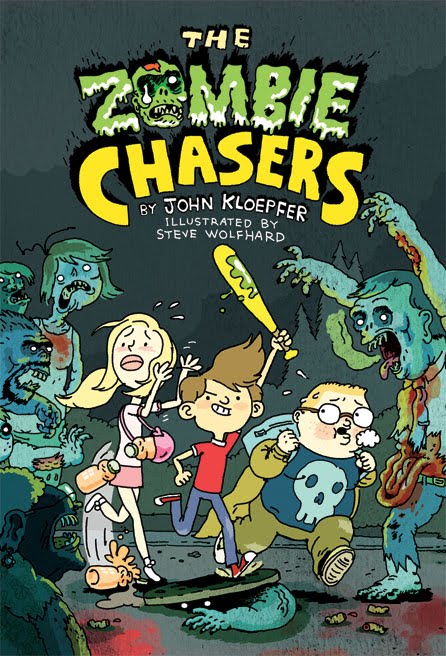
Steve Wolfhard's Zombie Chasers cover and illustrations

I recently had a conversation with a former co-worker of mine, a children's librarian, and asked her if she'd read any good kids books lately. She recommended a few, I placed holds on 'em at my local library, and when I picked them up I was slightly dismayed to find that they weren't picture books, which I usually think of when I hear the phrase "kids books," but prose fiction chapter books.

I may or may not have discussed this on EDILW before, but I read very, very, very little prose fiction anymore. Part of it is because of the volume of comics I read, which more than fulfills my fantasy and escapism quota, part of it is because as I writer myself I have a hard time turning off the writing parts of my brain and really losing myself in prose fiction and part of it is because I simply prefer non-fiction at this point in my life (I do read a lot of fairy tales and mythology, which I guess is fiction, but libraries put them in the non-fiction sections with Dewey Decimal numbers).

Still, this friend has pretty good taste in just about everything, so I thought I'd give the books a chance. One of them was the book whose cover is pictured above, John Kloepfer's The Zombie Chasers. The other is David Lubar's Nathan Abercrombie, Accidental Zombie Book 1: My Rotten Life: (My friend is fond of zombies, as you could probably tell).

I picked up Zombie Chasers first, in part because of the intriguing title—kids who chase zombies? But zombies are usually the chase-ers, not the chase-ees!—and party because I liked the cover so much.

Those are some great, kid-friendly zombies, with their little, beady, blank-white eyes lumpy, bumpy, green skin and abstracted, cartoony gore. Here's the entire jacket, sans the plot summary and the UPC symbol and price tag, which will give you a better look at the sorts of zombies that populate the outside of the book: (Click to enlarge, and check out the bearded zombie with a rotten drumstick stuck in its beard, or the zombie with the fishbowl over its head).

As it turned out, it was a pretty good book. It's about Zack Clarke, a middle-school kid who returns home after a hard day to have a hard evening, thanks to his older sister's slumber party and the mean girls she invites to it. And then things get really bad, when a zombiepocalypse scenario occurs in his suburban Arizona neighborhood. Together with one of those girls, Madison, the prettiest girl in the eighth grade, Madison's boggle Twinkles, Zack's best friend Rice, and, eventually, school jock and bully Greg Bansal-Jones must navigate their zombified hometown on a quest to safety.

I'm well out of the target audience for this book, and there were certainly aspects I didn't care for—Kloepfer's writing is clever and funny, but the dialogue he writes for his kid stars is often too clever and humorous in the face of deadly danger, for example (The kids all sort of annoyed me whenever they talked to one another).

On the other hand, it was a really quick and engaging read, which tackled many of the regular zombie literature tropes and still managed to feel fresh. This was my first exposure to zombie lit of any kind aimed at younger kids—back in my day, zombies were strictly the providence of R-rated horror movies—and while there's a lot of implied death and gore in this story, I was sort of surprised at how kid-friendly zombies actually are.

In makes sense in retrospect, but rotting corpses certainly fall lend themselves to the sorts of icky, gross-out things that interest kids, Kloepfer focusing on the grody aspects of zombies, with dripping mucus and slime, bad breath, stinky smells and, in artist Steve Wolfhard's art, lots of flies and bugs circling around the dead.

Also kid-friendly was the fact that this zombiepocalypse may not necessarily be the end of the world; a few characters are brought back from being undead—becoming un-undead, as the characters start to stumble upon a cure. It was also refreshing to see that while Kloepfer including personal takes on familiar scenes and events—a trip to the grocery store, amusing forms of zombies, creative ways of destroying them, a fight in a graveyard—he also works with a few of his own, individual contributions to zombie lore, like a possible "zombie garlic," a popular vitamin/nutritional supplement that is (maybe) to zombies as garlic is to vampires, and hints at a unique source of the zombie plague—a fast food chain with a gimmick sandwich that seems to violate the order of nature (BurgerDog, which serves a hotdog that looks like a hamburger).

The source of the plague, and one of its possible cures, conform quite nicely to my personal dietary beliefs, so I suppose that contributed quite a bit to my enjoyment of the book.

Well that, and the artwork.

Wolfhard draws great zombies, and is a great zombie designer. He's a great character designer too. And BurgerDog mascot designer. He had a really nice, thin line that he applies to abstracted and exaggerated characters—the skinny kids are really skinny, the fat kid is really fat, the athletic guy is really athletic—and his line gets jagged and incredibly busy when it comes to the undead. They often look a bit like the work of a different artist, that's how strong the clash in design is between his live humans and dead ones.

His zombies are also generally pretty funny. I had a hard time finding a good crowd shot to scan that the crease between pages didn't render un-scannable, but his bigger and more detailed drawings reward looking long at, and the 100 or so interior illustrations that he fills the book with are often pretty inspired, and show initiative, illustrating things not discussed in the prose (Zack's ant farm, and the fact that the ants started eating one another when he quit feeding them, is mentioned, for example, but Wolfhard provides a bunch of illustrations of the ants battling one another, in one case with weapons, and a bunch of ant heads end up on spikes at the end of the battle).

As much as I dug Wolfhard's work, it also sort of bugged me as I was reading the book, as both the name Wolfhard sounded familiar (due to it's awesomeness; WOLF + HARD adds up to one badass name) and artwork looked extremely familiar. The bio of him in the back just mentioned that he "ha been drawing comics since he graduated from animation college," without naming any of his work, so it wasn't until after I finished the book and took to the Internet that I was able to find out why exactly Wolfhard's work and name seemed so familiar.

Steve Wolfhard is responsible for the excellent Cat Rackham comic, which I recommended on EDILW last fall after reading every story I could find on Wolfhard's Cat Rackham site (Man, that Cat Rackham Gets Depression comic is sooooooo good...>!)

Let's look at some of his Zombie Chasers art:


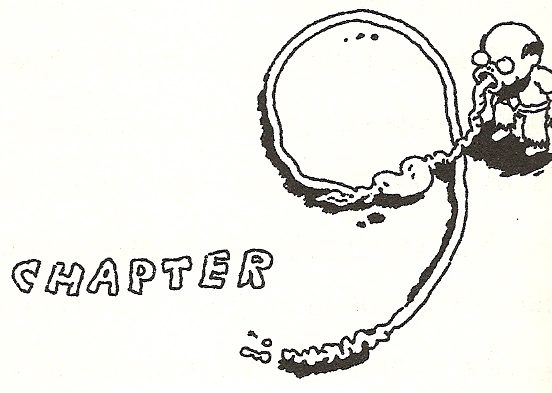
Wolfhard also draws little illustrations at the beginning of each chapter, with some sort of zombie forming the shape of the number of the chapter. Here are a few of the more creative examples:


***********************

Zombie Chasers is going to be a series of books, with the second volume, Zombie Chasers: Undead Ahead due out in March. If you're a grade-school kid, you should definitely have your parents buy this for you from a locally-owned brick and mortar bookstore, if such a thing still exists near you. And then you should stop reading this blog, because it's full of swears.

If you're a grown-up who likes reading neat kids books, or likes reading about zombies and don't mind reading things written for kids, you might like this.

And if you like looking at really neat drawings of zombies and kids running around, then you should definitely check this out, if only to look at the pictures.


**********************

Wolfhard talks a little bit more about his work for the book, and shares some images, on this 2010 post from his blog (And hey, check out his crazy-ass squirrel family tree while you're there). You can also see more of his zombies at thezombiechasers.com.

*************************

I should note that at no point during this book do any of the character actually chase zombies, but they are themselves constantly chased by zombies. The title is thus completely inaccurate, and perhaps false advertising. Of course, they do seem to be figuring out a zombie antidote of some sort by the end of the book, so perhaps there will be actual zombie-chasing in future volumes.

Saturday, November 21, 2009

How is it possible that no one has ever used this title for anything before?

And is the title stupid, awesome or awesomely stupid? I can't quite make up my mind.