Showing posts with label lemire. Show all posts

Sunday, June 05, 2016

These are some Marvel Comics collections that I've read recently:

Daredevil: Back In Black Vol.1–Chinatown

So here's a problem with trade-waiting. I had every intention of buying this trade paperback collection of the first five issues of the new Daredevil comic, because I liked the writer, I liked the artist, I liked the character and the new direction seemed particularly promising. But then I saw it just sitting there in the library, waiting for me to take it home and read it for free, and suddenly paying $16 for it didn't seem like all that great of an idea.

I would not envy either writer Charles Soule or artist Ron Garney the task of doing a new Daredevil comic on the heels of the Mark Waid's work on the character, which spanned 57 issues, five years and a relaunch. Not only did Waid manage to find new–or at least long-abandoned–territory to cover with the character and offer such a lengthy, thorough examination of him, but Waid's artistic collaborators like Chris Samnee, Paolo Rivera and Marcos Martin regularly delivered one of mainstream comics' best-drawn books. Not only would Soule and Garney find themselves competing with Frank Miller-era Daredevil the way just about everyone since has been forced to do in the imaginations of Daredevil readers (in fact, a large part of what made Waid and company's run so instantly appealing is the way in which it read as a reaction to the Miller take), but they would be doing so immediately following one of the best-received mainstream superhero comics of the decade (so far).

Soule and Garney do just fine, however, and I guess I envy them for their talent, then, and their ability to tell high-quality comic book stories. It certainly helps that some pains are taken to distance their new book from Waid's two volumes of Daredevil. The title character has relocated back to New York City, he has a new day job as an assistant district attorney for the city, the genie of his secret identity is firmly back in the bottle, he's got a brand-new (awesome) costume and he's working with an apprentice, a new character named Blindspot.

In other words, almost everything about the comic is new, even the most familiar elements–the Hell's Kitchen setting, The Hand–are new in contrast to immediately preceded them, or the twist Soule brings to them.

Both Murdock and Daredevil are pursuing a new crime lord, a Fu Manchu-style villain who is also a Chinatown cult-leader. His name is Tenfingers and he has, um, ten fingers on each hand. It's an incredibly effective visual, as rendered by Garney. Daredevil isn't fighting alone, but alongside an apprentice of sorts named Blindspot, an illegal Chinese immigrant who has invented his own invisibility suit with which to protect his neighborhood...although the fact that he's not a U.S. citizen frustrates his ability to, like, patent and sell his miraculous invention. Or even get a good job.

This collection reads like an actual graphic novel, with a beginning, middle and end, a completely complete story of Daredevil and Blindspot's battle against Tenfingers...and their mutual foes, which I already spoiled (The Hand, if you missed it).

Garney's art is all big, muscular figures rendered in precise, sometimes sketchy lines, although it's impossible to talk about the visuals of this book without mentioning the coloring, by Matt Milla. It's not quite black and white, but close to it, in the manner of the millennial, Greg Rucka-written run on post-"No Man's Land" Detective Comics. Most of the pages have a single color applied to them like a wash, with each portion of the page appearing either black, white or some gradation of that color–red, blue, green, etc. The one exception is the bright, bold red of the highlights of Daredevil's new costume: The eyes, the belt, the boots, the fists.

It's a really rather beautiful comic, immediately striking when compared to almost anything its sharing space with, and appropriate given the fact that color is something completely foreign to our protagonist (along with several other aspects of a visual universe, like, in one dramatic scene, the digital numbers on the countdown clock attached to a bomb).

I really like the new Daredevil costume quite a bit, as I know I've said before; I really prefer it to what Marvel Studios and Netflix outfitted the hero with in the last few episodes of the first season, and the entirety of the second. Not only does the black look make more tactical sense (like, if I were a teenager and still thought as seriously about the interior logic of such comics, I would think a red costume would be super-dumb compared to the option of a black one), but it looks so much closer to the costume Daredevil wore on the show before he officially took the name "Daredevil."

In the comic, it's a nice, striking, emphatic change from the red of the Waid-written years, although there are enough details to the costume to allow room for Ol' Hornhead's signature color. Those details include wrapped up fists and laced-up boots, that give him the look of a guy who made his own suit, while simultaneously echoing the fact that he was the son of a boxer.

I'm not terribly crazy about the exact shape of the "DD" on his chest, but I'm not a fan of the "DD" in general (Rule of thumb for superhero costumes: Cool heroes have one letter on their costume, lame ones have two or more).

Blindspot's costume is somewhat generic, but that very simplicity is it's strongest aspect...especially given the fact that it was created in-story to be functional rather than thematic. The cover doesn't provide a very good look at it, but it's basically a full black bodysuit with a hole for Blindspot's hair at the top, some white stripe hightlights up and down it's sides, and a very distinct mask that shows a stylized, frozen face from the top lip to the hairline. The character's name might be a little on the nose–"We're all the same," he says of his fellow illegal immigrants, "Smack in the middle of society's blind spot. Invisible–but what the hell, this is a superhero comic, after all.

The first give issues of the new Daredevil are followed by a short, eight-page story that originally appeared in a ridiculously-titled anthology All-New, All-Different Point One #1 and introduces the character of Blindspot to readers and to Daredevil. It's rather awkwardly stuck on to the end of the book, as we had just finished a 100-page story featuring the character and already met him and knew most of this information, but it wouldn't make sense at the front of the book either, since Daredevil #1, now the first chapter of this collection, also thoroughly introduces the character and his relationship to Daredevil.

The best strategy would have probably been not to collect it at all. It's interesting to see how various books handle these shorts, though. The first trade collections of All-New, All-Different Avengers and the new New Avengers also have awkward preview type stories from a similar anthology (Avengers #0) to attach to their stories, but both put them in the front of the book, and they work a bit better. The former is a short story featuring The Vision and setting up his status quo before the start of the team he will be joining, while the latter is a series of pre-cognitive visions about the events of the first few issues of that series, delivered via a villain's extracting them from a psychic.

Anyway: Daredevil is still great, but in a completely different way than it was great before.


Extraordinary X-Men Vol. 1: X-Haven

The unfortunate thing about Jeff Lemire's mainstream superhero comics writing is that he came to it only after he achieved a degree of acclaim as an excellent graphic novelist. So when he turns out merely mediocre work, there's an element of frustration associated with it; you know there are better things he could be doing with his time.

Not that I can fault the man, of course. I imagine turning out scripts for various Marvel or DC franchises pays much better than creator-owned work, and I know it's a hell of a lot easier than writing and drawing original graphic novels. It doesn't appear as if Lemire's first story for the X-Men franchise caused any undue stress, as there wasn't even a whole lot that seemed to have gone into this first story arc for the new title: It's simply a reorganization of familiar, too-often repeated X-Men plot points, with only a few specific details changed.

It's basically a new coat of paint Lemire and the art team of Humberto Ramos and Victor Olazaba are applying, but it's not like they're even changing the color from, say, white to eggshell or ivory; it's just off-white.

How much of that is Lemire's fault versus Marvel's is something only Lemire or editors Daniel Ketchum or Mark Paniccia could answer; certainly a lot of the foundational elements of this series were probably decided by someone other than Lemire, including the status quo of mutantkind in the current Marvel Universe and which characters could be used...and which were mandated.

Some months after the events of Secret Wars, after Cyclops has apparently done something terrible that has made the whole world hate and fear mutants as hard as they ever had before (something that is never explained, but it must be pretty bad, since he had previously conquered the world in Avengers Vs. X-Men), mutantkind gets some more bad news. Actualizing Marvel Entertainment's film rights-driven attempts to make Inhumans the new mutants (even though the Inhumans are, as I'm sure someone has already pointed out, just like fetch), the two groups are in a life-or-death existential struggle: The Terrigen mists that empower Inhumans are apparently poisoning mutants, sterilizing them and preventing the creation of new mutants...and even causing some to lose their powers or get sick.

This is problematic for the obvious reason that Marvel's mutants have always been born to non-mutant human beings, and I don't want to think about what exactly the differences are between mutants and Inhumans in the Marvel Universe, genetically speaking–culturally, it's difficult to believe that human beings would be racists (or speciest?) against mutants, but be totally cool with Inhumans. Marvel has always had this problem, as the difference between, say, Spider-Man and The Fantastic Four and Wolverine and the X-Men is simply the source of their extraordinary powers and appearances, but hell, giving the Marvel Universe another race/species mutated/evolved/misted from homo sapiens is just underlining and emphasizing that tension.

As a reader, the bigger problem is simply that we've seen this before, and recently too. Mutants are hated and feared, they are once more a tiny, dwindling population facing extinction (as they were after the events of House of M and the "No more mutants" spell) and so they retreat to a secure and fortified hideaway (as they did during their House of M to "Schism," "Utopia" phase).

As I said, only the specifics have changed. They are still operating a school/refugee camp, but now it is located in Limbo (like, the part of Hell in Marvel's universe that mutant sorceress Magik is linked to), which keeps them safe from humans and Inhumans, but is a pretty dumb place to set up shop, as any time Magik loses focus–as she does in these issues–they will besieged by an infinite horde of demons.

Storm, given a new, terrible costume with a nonsensical pair of belts and a shiny top with a weird texture, is the headmistress and leader. Her superhero team is assembled throughout this first story arc. There's Iceman, also given a new, terrible costume–a red and black, turtleneck adult onesie, and, obviously, Magik. Their recruitment drive includes gathering Colossus (who has grown a beard and started farming, Kingdom Come Superman-style), Nightcrawler (in a state of prolonged shock and only speaking in Bible passages), the still time-lost Marvel Girl Jean Grey (who is trying to live a normal life and go to college, until she encounters anti-mutant hatred from a guy she kissed) and the Old Man Logan version of Wolverine (imported during the events of Secret Wars, and, for all intents and purposes, just plain old Wolverine with different hair, which is kind of a dumb cheat regarding the death of the "real" version).

Back at the school/camp, Forge is a sort of behind-the-scenes member of the team, taking Beast's place as the tech guy and interacting with the outside world mainly via a reprogrammed Sentinel.

They all come together in time for a climactic battle against The Maurauders and Mister Sinister, one of, like, the five or six villains The X-Men seem to be constantly fighting. This time his half-assed plan is kinda sorta related to the new status quo, as he claims to be trying to invent a new, disease-resistant version of mutantkind, but it's basically just Mister Sinister Mister Sinister-ing as always.

If these first five issues were all about putting together a team, then it's possible Lemire will move on to focusing on something fresh, new or at least interesting in future issues, but this first arc was in incredible disappointment, and one that seems like a waste of everyone's time; Lemire's, Ramos and Olazaba's, and, of course, the reader's.

Worse still, I think this is meant to the be the "A" book in the post-Secret Wars X-Men franchise, with All-New X-Men (the time-lost, original X-Men plus a few teenage hangers-on) and Uncanny X-Men (Magneto leading a team that is basically just a renamed X-Force) are the apparent B books.

It's readable, so it's far from the worst X-Men comics ever made or anything, but that's not an exactly high bar for quality superhero comics in the year 2016, is it?


Guardians of The Galaxy: New Guard Vol. 1–Emperor Quill

So it says on the spine and in the fine print, anyway; the cover simply identifies the book as Guardians of The Galaxy, with no mention of this "New Guard" business. That extra clause is presumably there to separate this volume one from all the other books called Guardians of The Galaxy Vol. 1 out there; this is the second one by Brian Michael Bendis (or third, if you count the oversized hardcovers). As I've noted before, Guardians of The Galaxy is a particularly difficult book to try and follow in trade, given the number of relaunches and the number of collections that don't have any volume numbers attached at all.

This particular volume one collects the first five issues of the current incarnation of the series, which, like the previous incarnation, is written by Bendis. It begins in medias res, as did the entire Marvel line, some months after the events of Secret Wars, the event series which lead to the cancellation of all of Marvel's comics and the temporary replacement of the line with fill-in miniseries for some months before everything relaunched with new number one issues.

The major change to Guardians is the addition of The Fantastic Four's Benjamin Grimm/The Thing–who, like fellow FF member Johnny Storm, is team-less and in need of a new running crew following the ending of Secret Wars. Less major is the fact that Kitty Pryde has started wearing Peter Quill's mask and jacket and going by the apellation "Star-Lord," while the former Star-Lord has assumed his late father J'son's role as elected emperor of Spartax, and...well, that's a bout it really. Gamora is missing from the cover and the first issue, but returns shortly, and Bendis picks up right where he left off, following story threads from "The Black Vortex" storyline (I could here note that it therefore doesn't really make any sense to have completely relaunched the title with a new #1 issue, but, well, why bother?)

Now re-teamed with artist Valerio Schiti for the length of this collection (at least), Bendis is in fairly fine form here. For the most part he eschews his propensity for over-explaining and filling the pages with dialogue balloons, and his script is fast-paced, fun and funny. It's also pretty forgettable, and even as a regular Wednesday visitor of a comic shop, I have a hard time imagining anyone dishing out $20 to read a story like this in $4, 20-page installments over the course of five months or so.

So: The Guardians steal something from The Chitauri, and since it may be a dangerous space-weapon of some kind, they take it to Spartax, currently ruled by their friend Peter. Then Gamora falls out of the sky, fighting Hala, a Kree warrior who survived the destruction of her home world during "Black Vortex" and blames the Guardians for that destruction. They all fight her.

Then a big, scary space barbarian shows up on Drax The Destroyer's trail, calling himself a "Destroyer of Destroyers." They fight him too.

And that takes five issues. Fighting, jokes, catchprhases. It's all written well, and Schiti's art, colored by Richard Isanove, is simultaneously smooth and sharp. It's easy to read and flows nicely, making it well-suited to Bendis' breezy script. His Rocket looks more like an mid-century Hanna-Barbera animal character than usual, and his Groot gets a little redesign, but other than that there's not much separating his Guardians from any other artist's version of them.

But if you ever hear anyone speaking dismissively of "fight comics" and find yourself wondering what they mean by that, Guardians of The Galaxy: The New Guard is exactly what they're talking about. Five issues, two fights and no plotting aside from what is necessary to generate and execute those fights, let alone anything like, say, a point-of-view or a message or a theme or anything.

In fact, there's so little going on in this book that at least one character has literally nothing to do. Poor Flash Thompson/Venom, the latest Guardian to earn his own spin-off series, has all of 17 lines. These include "Drax! Drop it!!!" and "Oops" and "On it" and "Totally" and "Hurry. He ain't easy to hold on to."


Hawkeye Vs. Deadpool

Want to play one of these things is not like the other? Okay, let's. Did you figure it out yet? That's right, it's this comic! While all of the other collections discussed in this post are recent releases collecting the first issues of various post-Secret Wars relaunches, this is a 2015 collection of a five-issue miniseries that launched in late 2014. Reflective of my general apathy towards the Deadpool comics, I apparently took a year or so to get around to actually taking the time to read the damn thing.

It was surprisingly good. The work of rather frequent Deadpool writer Gerry Duggan and artists Matteo Lolli and Jacopo Camagni, it finds a rather reasonable excuse to team two characters that have just about nothing to do with one another–this pre-dates Deadpool's place on the Avengers Unity Squad (in, like the second or third reboot of Uncanny Avengers, and I think that was his first stint as an Avenger of any kind, but I may be wrong). Well, other than the fact that this is the Marvel Universe, so 99% of all the superheroes live in the same city.

It opens on Halloween night, where Deadpool is taking his wife and kids (?) trick or treating, and they stop by Hawkeye's building. They get a message from a hacker who has a flash drive filled with a roster of SHIELD agents that a criminal organization would quite literally kill to get their hands on, and soon find themselves embroiled in chases and fights to get the maguffin–er, drive before the bad guys can put it to nefarious uses.

These bad guys are Black Cat, her two henchmenpeople (one of whom is Tyhpoid Mary, whose face is rarely colored correctly) and a mad scientist brainwashing very large victims and dressing them as superheroes. The other Hawkeye, Kate Bishop (or Lady Hawkguy, as I prefer) joins the title characters.

There's a lot going on in here, but all of it is very light-hearted, and it's mostly excuses for fights, jokes and two (or three) title characters to bicker with one another. The book's relative age is apparent in several pointed parodies of the more inventive work that writer Matt Fraction and artist David Aja put into the Hawkeye monthly at the time, before it went off the rails schedule-wise.

There's a neat sequence involving sign language, as Hawkeye being deaf is played up here in a way it usually isn't, and there's a fun scene where the creators slip into a Fraction/Aja style sequence that is part diagram, part silent comics, in which Deadpool stands outside of the panel borders, railing against what he's looking at:
What the hell is going on?! This is taking forever!

Are we waiting for the dog to solve the crime? I don't understand what's happening!!
This isn't just Hawkeye vs. Deadpool in terms of the characters fighting–once while Clint is in his right mind, later when he's not–but also a conflict between the two modes of storytelling that their respective books employed at the time.

...WAIT. I just now got why Kate was wearing a stethoscope and olive green jacket on Halloween night. She was dressed as Hawkeye from M.A.S.H.. Huh. That is a terrible costume for a 20-something to wear in 2016.


New Avengers: A.I.M.–Everything Is New Vol.1

Writer Al Ewing has assembled a particularly hodge-podge Avengers line-up including Roberto De Costa (formerly Sunspot) and P.O.D. from Jonathan Hickman's Avengers run, Young Avengers Hulkling and Wiccan, leftovers from Ewing's own short-lived Mighty Avengers and Captain America and The Mighty Avengers run Power Man II and White Tiger, long-time Avenger Hawkeye and, apparently chosen at random, Songbird and Squirrel Girl.

Ewing is following up on at least one element of Hickman's pre-Secret Wars Avengers saga, that in which mutant superhero Sunspot had infiltrated, purchased and completely taken over bad guy mad science organization A.I.M. (Advanced Idea Mechanicas) and begun to transform it into a force for good, Avengers Idea Mechanics. They operate from an artificial island, and their remit is global rescue operations...of a particularly weird, almost Doom Patrol-like variety, based on the contents of this trade (which collects the first six issues and a few pages from the anthology Avengers #0.

As for the whys of the team Da Costa has assembled, they seem to be here solely because either Ewing likes them a lot (as must be the case for his hanging on to the new Power Man and White Tiger through so many relaunches) or they drive the plot, as is the case with the two Young Avengers.

As for that plot, the team is in the middle of bizarre attack on Paris in which a large gorilla/scorpion hybrid with a floating gem for a head is turning civilians into zombies of a sort by replacing their heads with floating gems. This monster works for W.H.I.S.P.E.R., a new agency with a new acronym lead by Ultimate Reed Richards, who apparently landed in the post-Secret Wars Marvel Universe just like his Ultimate Universe bro Miles Morales did. While this is going on, they are being visited/audited by SHIELD's robot Dum Dum Dugan and Hawkeye, who SHIELD is forcing Da Costa to take on as New Avenger so that he can spy on them for SHIELD (Which everyone is super-up front about; "SHIELD Agent Clint Barton reporting for duty," Clint says upon exiting the helicopter, "I'm the super-secret traitor on your team. Sorry.")

That's the first two issues. The next four involve the two Young Avengers, as Hulkling is captured by a campaign party of Kree/Skrull hybrids who want to make him "The King of Space," and the rescue attempt involves the team fighting Cthulhu-in-everything-but-name (At least Ewing lets a character refer to the obvious, letting us know he knows how derivative the villain is, when Songbird catches sight of the creature and says "Oh, good. There's a giant space Cthulhu in the space castle.") Space Cthulhu doesn't go down easy, infecting Wiccan and, in the final section of the book, forcing the Avengers of the year 20XX to come back in time to try and stop the infected Wiccan before he becomes too powerful to stop (Spoiler alert: Luke Cage and Jessica Jones' baby grows up to be the Captain America of the year 20XX. That's cool.)

Ewing's scripting is pretty fun, and he does his damnedest to try and marry Hickman's sense of the outrageous to a cool, just-another-day sense of casualness among all the characters. The result is something akin to a poor man's Jason Aaron in terms of tone. It's self-consciously zany, with all of the characters constantly referring to the zaniness.

It may be too self-conscious though, which sucks some of the fun out of it, and, like too many of Brian Michael Bendis' team books, everyone seems to have the same personality and the same speech patterns. Squirrel Girl and Songbird don't talk exactly alike–the former talks like Ewing's impression (or is it parody?) of Ryan North's writing–but they are on the same spectrum, and not even all that far apart on the spectrum.

Perhaps Ewing will get to it eventually, but I found myself curious and then frustrated by the peculiar make-up of this team. In a way, it was rather refreshing to simply skip the recruiting-the-team sequences of a superhero book, but given just how weird and random this line-up is, it seems like some form of explanation would have been helpful. While most of these characters have been in or around various Avengers squads in the past, they certainly don't seem like anyone that would have been on Da Costa's radar, and it's unclear why some of them would even be the least bit interested in working with a private, mad science branch of the Avengers...here based on an artificial island off the coast of California, which is very, very far away from where all these New Yorkers live, you know? (If the team was merely the remnants of the Hickman Avengers who aren't busy elsewhere, or the characters fighting alongside Sunspot during the last arc of his Avengers/New Avengers, then this let's-just-get-to-the-action-and-jokes approach would make more sense.)

The majority of the artwork is provided by Gerardo Sandoval, and it's a very striking style, looking to be about 65% manga-inspired and 45% 1990s super-comics inspired. There's something very Street Fighter or Capcom about that cover above, and I don't think it's a coincidence.

I like the art in general, or at least I did until I started reading. Any single panel or page looks pretty cool, but it doesn't flow very well, and actually reading the six issues worth of it can be a bit of a challenge. By the third issue I found myself wishing for more traditional grids and more static, less muscular and poised-to-explode figures.

He does a neat thing with Reed Richards/The Maker's weird helmet, making the lens in the middle of it look like a large, sinister, emotive eye, but it's also disconcerting to see his Reed grinning like a demon and being so, well, buff, not a word traditionally associated with the guy named "Reed."

He does a pretty good job with Tippy-Toe, who Ewing always labels as if she were an equal member of the team, always posing her as close to Squirrel Girl in terms of positioning and body language as possible (When Squirrel Girl has her head turned into a gem, the same fate befalls Tipp-Toe; when the team goes into space, Tippy-Toe gets a little space helmet). That said, his squirrels look more like Pomeranian/Ewok hybrids, and his Squirrel Girl is pretty awful. Not only does she have gigantic teeth that fill her whole mouth, but she's wasp-waisted and thin-limbed in a way that seems in direct contrast to the fuller-figured Squirrel Girl from Squirrel Girl, which may be one of Marvel's best comics at the moment.

When other artists finally arrive in issue six, they are artists whose work looks absolutely nothing like Sandoval's. At least they are employed strategically. Phil Noto draws a four-page section in which Wiccan confront Cthulhu inside his own mind, while Mark Bagley and Scott Hanna draw a two-page epilogue set in the year 20XX, where we get to see Hulkling and Wiccan's happily ever after.

This last issue in the collection has a couple of pretty great moments, particularly regarding the defeat of the bad guy, who ends up being pretty damn small once Wiccan sees the cosmic monster for what it really is (The kiss scene could have used a panel where Teddy/Hulkling reacts to the taste of Billy/Wiccan's mouth, given that a space squid just wriggled out of it, but maybe that's just the way I would have written the scene).

There are a lot of pretty fun bits in this comic (See "Champagne Robot"), but my favorite was probably Power Man confronting Wiccan about the codename "Wiccan" in the cafeteria:
Well...are you a Wiccan? Do you practice Wicca?

...

I'm not talking about self-help guides or magic systems. I mean, on the most basic level--is this your faith?

'Cause I don't know if you get to wear someone else's belief system like a cape, you know?
Right on, Power Man! I hate Wiccan's hero name too! Is it worse than Asgardian? Sort of! Asgardian is only worse in that it leads to a pretty obvious joke, which you would think everyone involved would have thought better of before assigning it to a gay character. Billy does give himself a new name during the course of this book–Demiurge–but that's while he is possessed by the tentacle monster, so I'm not sure if it will stick or not.

Originally, he was given the name Asgardian because each of the Young Avengers was supposed to correspond to an Avenger character, and readers were meant to think he was perhaps somehow related to Thor. As it eventually turned out, he was kinda sorta the son of Scarlet Witch though. I suppose "Wiccan" was meant to reflect that fact, but as Power Man says, it's kind of weird to be a superhero named Wiccan, just as it would be to go by the code name Jewish or Catholic.

Given that he's the son of a character who goes by the name Scarlet Witch, maybe Warlock would be best...? Or something along those lines...?

I guess we'll see if "Demiurge" is a temporary or permanent(-ish) replacement (Note: I also don't like that name).

Finally, I'd just like to note that New Avengers had some of the best variant covers. Michael Cho produced a particularly strong one, there's a great Chris Burnham variant, and Ed Piskor of Hip-Hop Family Tree fame did the "hip-hop variant cover," and I don't know if there's a better candidate for hip-hop variants than Piskor; Piskor should have done all of those. And, in a perfect world, drawn the interiors of this series while he was at it.


******************

This is probably as good as place as any to mention that I reviewed All-New, All-Different Avengers Vol. 1: The Magnificent Seven for Good Comics For Kids the other day. If you want to read yet one more review of a new collection of a new Marvel series by me, then you can do so here.

Tuesday, October 06, 2015

Some notes on Cartoon Crossroads Columbus, which I attended only very little of (but got an awful lot out of)

This weekend was the very first of what will hopefully be many Cartoon Crossroads Columbus conventions. If you missed it entirely this year, I'd definitely urge you to consider attending next year.

I have a kind of weird relationship with the city of Columbus, which I lived in from 2000-2010, and have only been back a handful of times in the last five years; now doing so has the same sort of surreality of returning to your old high school or college campus years after graduating. Because of that, and the fact that when CXC was first announced, this year's version was expected to be a somewhat small, trial balloon-like scrimmage of a convention, I had only planned on attending one of the three days. I decided to go on Saturday, as that was the day Kate Beaton was going to be there, and she was the first announced guest that I was most interested in seeing and hearing (and had not seen or heard previously).

Well, I regretted not better planning my trip almost immediately upon arrival. As I said, I only attended one day–four events total, which was less than half of those that occurred on that day–and they were all great. There were at least two instances where, when an event ended, I felt like running out of the room, jumping in my car, speeding the two hours and five minutes it takes me to get from my current home in northeast Ohio to Columbus (and vice versa) and leaping to my dust-covered drafting table to start making comics (This was in sharp contrast to the way my relationship with comics started that very day; I woke up at 8:30, took a quick click around the comics Internet, and was so disgusted by much of what I saw that I seriously reconsidered what I was doing with my life, exactly, and maybe just quitting writing and reading about comics altogether. The lesson? Maybe I should only read the comics Internet once a year, or attend events like CXC daily; one.)

Now, because I lived in Columbus for such a large percentage of my life, and because I haven't been there for any great length of time for so very long, I keep getting tempted to write about the city, and myself and how both have changed, which I realize isn't really of any great interest to anyone, particularly in this post. So I keep starting and re-starting this post in my head (I started this post on Saturday; I am just now posting it at 2 a.m. Monday night/Tuesday morning, though; I expect it to be riddled with typos). I'll try my best to stick to comics here, though, and do it in a lazy, bullet-point format.

But the most important thing I wanted to stress is that I attended just a fraction of the events, and even that small sub-division of the event was one I found enormously rewarding and inspirational, so I can only imagine what the entire package would be like...especially if, unlike me, you are more of a socializer (I introduced myself to one of the two people I know of only as presences online; I almost introduced myself to Tom Spurgeon a couple of times, but in each case he was talking to someone else. I've never spoken to Spurgeon, but I read his site daily, and it's like, one of the last places on the Internet devoted to comics exclusively...in addition to being well-written and a good resource of comics news. There were a couple of parties planned though, where you could presumably tell Art Spiegelman you like his vest or that he's been spelling word "mouse" wrong for years now and mingle with cartoon and comics enthusiasts and professionals).

So, bullet points:

–This was my first visit to the Billy Ireland Cartoon Library & Museum. When I was based in Columbus, I went to the Ohio State University's cartoon library exactly once, when the Wexner Center and the museum collaborated on a big Jeff Smith/Bone/cartooning exhibit (Jeff Smith: Bone and Beyond). I remember it feeling like the library was, at the time, a rather crowded hallway piled high with stuff. Now it's a nice, big, modern-looking building, named after a Columbus newspaper cartoonist who I wrote about at least once before on the blog (and who information on was incredibly hard to come by in public libraries and/or the Internet at the time).
There's a replica of Billy Ireland's signature–a shamrock–in a stone on the floor right by the entrance. There's a reading room, for research purposes. There's a big gallery, where there are currently two shows going on (What Fools These Mortals Be: The Story of Puck, Seeing The Great War and an ongoing Treasures From The Collection... exhibit), and a few classrooms, one of which (named The Will Eisner Seminar Room) was being used for a series of presentations they were calling "Talk and Teach Classroom Presentations").

–I attended the second "Talk and Teach" presentation, presented by cartoonist Katie Skelly, an emerging favorite of mine, whose work includes Nurse Nurse, Operation Margarine, a mini-comic my friend brought me back from SPX last year entitled My Pretty Vampire and a mini-comic my friend brought me back from SPX this year, Agent 9. The subject of her talk was "Influence As Education."

–I always expect cartoonists to look like their drawings, whether they are autobiographic cartoonists or not, at least until I see them (Yes, when I used to imagine "Rob Liefeld" I saw a hulking, screaming figure in spandex sitting at a drawing table, a gigantic gun leaning in the corner while he drew). Skelly therefore did not meet my mental picture at all. She did was not smoking a cigarette, wearing a leather jacket or bad-ass boots; she did not enter on a motorcyle.

–After a brief intro by OSU's Jared Gardner, mostly consisting of Skelly's bibliography, Skelly plunged into her presentation, which included a few slides, but was mostly a talk-talk. If you've read her works, you'll note that they are all rather heavily inspired and influenced by other works, mostly from other mediums. She talked a bit about the process of using influcene as it's applied to those works; for example, with Nurse Nurse, she took the "shell" of something she really liked (Barbarella), but then hollowed it out, and injected stuff she liked better, stuff that was her stuff into it, transforming it.

–Much of what she discussed is the sort of things that everyone does somewhat subconsciously, but she broke it down into a somewhat rigorous, step-by-step process, that one can apply and follow in a conscious manner: Looking at things you like and figuring out what you like about them, so you can borrow that element; looking at things you don't like and figuring out what you don't like about them, so you can avoid those elements; looking at two examples, one thing you like and one you don't, side-by-side (She chose Female Trouble and The Royal Tennenbaums) and picking out what you like about one vs. the other, to help narrow down your approach to making your own stuff.

–She recommended looking at fashion photography. Those are very powerful images specifically created to communicate a direct and convincing message to the viewer ("Buy this stuff"), and thus good examples of direct, visual communication.

–She also jokingly referred to how it's totally okay to steal from fashion photography, since they're trying to sell you a $3,000 coat or something, so to hell with them.

–She shared an anecdote about being 13 and working in her parents' newsstand and looking at the magazines, struggling to make sense of the fashion lay-outs. She would see the sequences of related images, but would always have trouble finding a "story" in what was happening between the images, that lead from one to another. At the time, she didn't know that "buy this stuff" pretty much was the story, and approached them as sorts of frustrating visual puzzles to be mulled over.

–I didn't do a headcount as I likely would have if I were covering this event for the paper I used to work for when I lived in Columbus, but it seemed like an okay crowd. We almost filled the room. It seemed to be rather equally divided to people like me (grown-up cartoon/comics enthusiasts), art teacher of one kind or another and art students, identifiable by their extreme youth and colorful fashions. Most of these were sketching. I noticed that I was probably the only person in the room without an open notebook and writing utensil. Almost everyone else, particularly the younger folks, were scribbling notes and sketches throughout the entire presentation.

–Skelly was immediately followed by Dylan Horrocks, whose presentation was on "creative blockage." The Museum's Caitlin McGurck facilitated, although once more this mostly consisted of an introduction, during which she praised Horrocks' Hicksville as an all-time great work, and noting that she and her fellow Billy Ireland employees have found a way to essentially live in a version of Eltingville (just in case you weren't already convinced they had someof the best jobs in the world). Horrocks also wrote a decent run on Batgirl (Cassandra Cain version) and one of Vertigo's several attempts to spin an ongoing out of The Books of Magic. He referred to Hunter: The Age of Magic as "Harry Potter on steroids" and Batgirl as "pretty much just steroids."

–Horrocks, who hails from New Zealand, had a rather soft-spoken voice with a hint of an accent. He didn't look much like his drawings either, but maybe a little closer to his character designs than Skelly to hers. I really liked the sound of his voice, and it made his mostly deadpan jokes all the funnier.

–He presented seven points, each illustrated with examples from his own career, which I really wished I would have taken notes on, as that would make this "report" all the more valuable. Let's see if I can remember them:

1.) You can draw

2.) You might not be able to draw the way you'd like, but you can draw.

3.) No one else can draw exactly like you.

4.) You draw with your whole body.

5.) Drawing is a collaboration.

6.) Nope, I can't do it...I forget this one...Maybe it was "draw comics"...? (See below).

7.) Enjoy.

As for five, he was referring to the fact that drawing isn't just something that takes place between your head and hand, but also involves your body, your pen, your paper, your desk, your mood, the room you're in and so on. There are innumerable factors that can impact and effect your drawing, for better or worse.

As for the final one, he pointed out that if you're not enjoying what you're doing, don't do it. It takes an incredible amount of time and energy to draw, and it shouldn't be something that makes you miserable to do. Otherwise, why are you doing it.

–He noted that he sees lots of students who, when he asks to see their work, will show him their portfolio–or, more often than not these days, open up Deviant Art or Tumblr on their phones–and they show him character drawing after character drawing. These are often great drawings, but they're not comics. And if you want to draw comics, you should draw comics, meaning you should draw image after connected image, telling stories.

–He shared some advice from a comic...that I was sure I would remember the name of and the creator of, but I do not. In it, a young girl character is upset because she wants to read a particular book that doesn't exist, so she realizes it's up to her to write it, but she doesn't think she's good enough a writer to attempt it. Her older brother advises her, "If something's worth doing, it's worth doing badly." This, like Horrock's "You can draw" bit, reminded me of what James Kochalka wrote in his Cute Manifesto. This was the first time of the day I felt like rushing home to just start making comics.

–When Horrocks opened it up for questions, I was tempted to start asking a bunch of questions about Batgirl, because I thought that would be funny, but I did not.

–I retreated to a few blocks north, looking to see the few places that hadn't been eaten, digested and transformed by the super-gentrification that's occurred in the area over the last decade–Used Kids is still there, so's Bernie's–to Buckeye Donuts, one of the places I miss most about Columbus. I drank coffee, ate doughnuts, read from a book about Bigfoot and looke dout the window at college kids rushing back and forth in the cold rain for about two hours.

–The next event I attended was one of the few ticketed events (and the only one I attended). It costs $5 to see Tom Spurgeon in conversation with Jeff Lemire–or a dollar more than most of Lemire's superhero comics cost.

–I was a little surprised to find the auditorium, the Film/Video Theater in the Wexner Center From The Arts, a one-minute walk from The Billy Ireland, wasn't fuller than it was. Lemire got his start as an indy/art/literature/non-genre cartoonist, but has since become a prolific writer of sueprhero and science-fiction comics for DC, Marvel and Valiant. I therefore expected to see a lot of folks here who might not have been interested in the other stuff, but, now that I think of it, while Lemire has written a lot of genre stuff, it's mostly been second or third-tier: pre-New 52 Superboy, New 52 Frankenstein, Agent of SHADE, Green Arrow, post-Fraction Hawkeye and so on. With a pair of X-Men-related books in the wings, Lemire's profile might rise even higher, but for whatever reason–time of day, focus of the festival–this audience was more of an Essex County than an Animal Man one.

–Lemire did not look like I imagined him to look (the protagonist of The Underwater Welder, basically), but was well-dressed, quiet, humble and handsome. Spurgeon looked almost exactly like the Sam Henderson drawing on Comics Reporter, which is awfully damn weird, as Henderson's style isn't exactly representational. That's a testament to Henderson's cartooning skills, I guess.

–Lemire did not have a Canadian accent. I'm always disappointed that Canadians aren't as exotic in real life as they seem in my mind.

–Spurgeon asked several questions about Lemire's incredible workload, which has included working on as many as eight monthly books at a time (as a writer), plus drawing. Lemire's output does seem incredible, and the number of books he writes or has written at various points was large enough that he had to count on his fingers when answering which book's he's writing at the moment, or how many he was writing at the height of his output, and so on. When an audience member asked which books Lemire had written for DC, other audience members had to chime in to remind him of a few he had written.

–Lemire seemed awfully ambivalent about a lot of the writing he did, saying he usually only has about one good story for each superhero that he's written, and would prefer to get to write that one and get out, when it comes to such assignments.

–He noted the difficulty involved in writing for corporate superheroes, and that the importance of getting a good editor. There can be two kinds: The editor that wants you to be you and write your story, and the editor who would rather be the writer themselves, and, obviously, the latter can be very difficult to work with, as everything is a struggle. (For Sweet Tooth, Lemire had three different editors; he wasn't talking about that book in particular, but the question arose because Spurgeon noted that seemed like a lot of different editors to work with on a book).

–He also noted that the way DC Comics is set up now is very writer-oriented, and that a book would first go to a writer, and then the writer might have to fight to get a good artist, as if they get a bad one, it can really sink the book. He used Andrea Sorrentino, his Green Arrow partner, as an example of a good artist he worked well with, and one he had to fight to get on that particular book. I was kind of surprised to hear that, only because I dislike Sorrentino's art so much, and find the books he's drawn (including Green Arrow with Lemire), all but unreadable.

–Regarding the number of books he writes, he said it's not a financial decision to simply take as much work as he can, and that he does in fact turn work down if he can't think of a good take on a character. There was one really big book he recently turned down, one that he thinks a lot of people would think he was crazy for turning down. Spurgeon asked what it is, and while Lemire considered for a few seconds, he eventually said he'd better not say.

–The corporate superhero books, despite some of the hassles, are easy and fun to write, Lemire said, because as a writer you get a good amount of the story already done. Like, the character already exists, is pretty well defined, and so on. He liked inheriting the pieces, and then trying to assemble them into something he found interesting. He didn't use this expression, but the way he was describing the process, I thought of it as something like a Lego kit.

–He did say he's getting close to the point where he won't take on so many superhero books and hopes to, eventually, be like Warren Ellis, where he just writes six issues of a Marvel comic every five years for fun.

–Spurgeon and he both conjured an image of Warren Ellis jumping up in bed in the middle of the night and declaring, "That's it! Karnak! I have to write Karnak for six issues!"

–Lemire is drawing a graphic novel for Scott Snyder–Scott Snyder's first original graphic novel, and his first non-genre comic–that Lemire says Snyder is writing specifically for him, and that plays to the strengths of both creators. I don't think I had heard this before, nor had I realized how rare it is for Lemire to draw for another writer, but he said he'd only done it once or twice, and the Legends of the Dark Knight 10-pager he did with Damon Lindelof.

–After that event, I power-walked the mile and half between the Wexner Center and a flower shop my friend works at in the Short North in the cold and rain to visit her, marveling at the changes in that stretch of High Street. The entire city block that the house I lived in for much of my time in Columbus–the setting of my first mini-comic–has been leveled, and is now a construction site. I stopped for bubble tea (if they sell that anywhere in Cleveland, I don't know where), to buy a new man-purse from Cousins Outdoor Army Navy Store (I bought my last one there 15 years ago, and it's just now falling apart) and to check and see if Adriatico's was still on campus (It is, thank God).

–I took advantage of some downtime to look at the museum's exhibits. Man, the drawings in the Puck exhibit were just plain amazing. Presidents Taft and Theodore Roosevelt are some of the best damn political cartooning subjects in the history of U.S. Presidents, I should think. I mean, George W. Bush and Barack Obama have big ears, but those two had everything. I particularly enjoyed the few cartoons they appeared in together. The above image is a 1910 one by Joseph Kepler Jr. entitled "Goodness Gracious I Must Have Been Dozing!" Kepler has another great one from 1912 called "Stop! Look! Listen!" in which a giant Taft sits upon a throne like a Buddha while a giant Roosevelt runs at him, head down, like The Flash; the gag is something about an irresistible force and an unmovable object.

–The final event I attended was the evening presentation, "A Conversation With Kate Beaton and Craig Thompson." This was held in Mershon Auditorium, connected to the Wexner Center. I had previously seen Ani DiFranco and Belle and Sebastian play in the venue, which is a pretty decent sized one with folding, theater-like seating.

–When I arrived, a man that turned out to be Craig Thompson was seated at a table signing books for a handful of people, while a woman who turned out to be Kate Beaton was standing at the front of a sizable line of people of all ages, clutching books. Apparently, Beaton stood and went to the line, in order to work through it faster as the time of the talk approached (from what I heard, she did sign everyone's stuff).

–Before the scheduled event, some representative of the U.S. Postal Service were there to unveil the Peanuts Christmas special forever stamps, on sale now.

Note to self: Bring your camera next year, too
–Jeff Smith conducted the talk, so it was essentially Smith, Beaton and Thompson. Those are three very different cartoonists with three very different perspectives, careers and modes of work. All three were groundbreakers of different kinds though, and it was interesting to see how they happened to be staggered in terms of where they fall in the recent history of the industry and medium.

–Kate Beaton is short. Her feet did not touch the ground when she sat in the big comfy chair, and so she scooted a coffee table in front of her to hide her shame. She did not have an accent either.

–Smith started out asking them each specific questions related to their work, and then they sort of all three started reflecting on the same subjects.

–Beaton was a very fun and funny presence, even when she wasn't talking. It was interesting to watch her face, as she tended to make very big expressions in reaction to what Smith and Thompson said. When Smith was talking about how exhausting cartooning can be, describing his process, she interjected at one point, "Wow, you guys work too hard."

–Smith said that when they were casting about for names for CXC, one they thought of and rejected early on was "Arch City Comics," as Columbus has been trying to re-brand itself with the nickname "The Arch City," which it was once referred to long ago. But after saying "Arch City Comics" out loud about ten or fifteen times, they noticed the problem with that name.

–Thompson talked a little about the creation of his Carnet de Voyage, which he drew on what was supposed to be his post-Blankets vacation. His plan was to spend a few months in Europe resting and recharging, but his European publishers co-opted his travel plans to turn them into what was essentially a three-month book tour. When he talked to his U.S. publishers about doing Carnet de Voyage, they apparently loved the idea–and solicited it almost instantly, before Thompson had even started. He ended up assembling and proof-reading it with two people who didn't speak English as a first language before sending it to the states for publication, thinking that it probably should not be published. It turned out really well though, I thought, especially given the circumstances.

–This was the second event of the day in which Warren Ellis came up. Beaton, in talking about her career trajectory, noted that he mentioned her on his blog or newsletter or whatever one day, and suddenly she had 7,000 more followers. That's all it takes to get famous in comics, a nod from Warren Ellis, they noted.

–In talking about how they each got into comics, Beaton shared an anecdote about how small her school was, and the fact that everyone there knew everyone. She recalled being in kindergarten and trying to read a Calvin and Hobbes collection there, but being told by a classmate that it was "for boys only," and she couldn't read it. Same went for Mad magazine, so she had to read Cracked instead. Because she's still friends with some of her classmates, she asked one of them if he remembered not letting her read these comics because she was a girl and he said, 'No, I was a five-year-old. But that's cool you've kept a weird grudge about it all these years.'

–Smith apparently got into comics as a young adult at Monkey's Retreat in the Short North. He didn't mention it by name; just a seedy comic shop in the Short North with a cat in the widow, some porn over here, some weird art books over there and comics in the back. Monkey's Retreat jut closed down within...what, the last two years?

–Plenty of time was left for questions. The point I found most interesting was when someone asked a general question about where the three thought comics were going, which lead to Smith reflecting on the battles he himself had seen in comics, as when he started comics–comics like Bone–could only be sold in comics shops. Librarians and book stores had to be gradually, slowly won over and, one of the last battles was with literary critics (that is, book critics outside of the comics press), which they did (and which Smith credits Blankest with). This lead to a moment where all three said they appreciated comics as a scrappier, outsider medium and, for the first time, I really found myself thinking about the fact that comics is losing, if it hasn't already lost that. Is that important to the medium? The art form? The industry? I don't know. I guess we'll see...

–As time ran out, Smith announced they would take three more questions, then added, "Well, four more, as I see the last one's a kid." Two microphones were set up on stands, and questioners had stood in the aisles before the microphones waiting to ask questions. Hearing that, a pre-teen stood up and went to stand in the other line.

–The first last kid's question was if they ever drew a character really well the first time, but then had trouble drawing it as good the second time. I was surprised to find I knew exactly what he was talking about from being his age. They each said a few encouraging words about practicing, and sympathizing with that frustrating feeling, with Thompson rather seriously saying that sometimes it takes a lot of drawings just to figure out what a character will look like, and you might have to draw them for 500 pages before you know what they look like, and then you have to go back and re-draw their faces on all the earlier pages.

"But you won't have to worry about that for a while," Beaton said.

–The last last kid, the one who stood up upon hearing Smith was making an exception for kid questions, asked the trio about Marvel's Secret Wars, but he did so without ever actually saying Secret Wars, just that Marvel was "flipping over" all their characters and starting over again.

Smith had started to say "Well, that's all we have time for," after the previous last kid's question, but Beaton had noticed this kid and said, "Wait, wait, we have one more." There was a second where I'm sure they wished they had not called on the Secret Wars kid.

Thompson asked if this had something to do with Thor being a lady, and the kid clarified yes, but that they would be doing it for all of the characters. They all struggled to answer rather charmingly. Thompson said something about continuity, which he pronounced "continue-itty." Smith said, "Well, what do you think?" And Beaton asked if they were making Wolverine a lady too, and when the kid responded that yes, actually, they were, she said "All right!" and Smith stood up, faux indignant, and ripped off his microphone, throwing it to the ground.

–Then I went back to Buckeye Donuts, bought a hummus falafel, french fries, large coffee and chocolate frosted doughnut, ate it in my car and drove two hours and five minutes back to Mentor, missing all the cool shit that went on the next day (including a tabled event where there was going to be a bunch of stuff for sale, so it's probably good I didn't go) and Smith repeating the format of Friday night's event with Art Spiegelman and Francoise Mouly about Raw, as well as spotlight talks with Grace Ellis, Jaime Hernandez, Horrocks, Thompson and Derf Backderf.

–While at the flower shop, I asked my friend if I could stay with her for the whole weekend next year. You should look into it to. Not staying with my friend–they've only got the one guest bedroom, and I've called dibs–but visiting Columbus for the weekend.

UPDATE: Spurgeon has started assembling his "Collective Memory" post of links regarding the show, which you can find here. That should provide a good source to better posts than the one you just got done reading here.

Thursday, November 07, 2013

I was not aware of this.

Rather high on the list of subjects I don't know a damn thing about it is botany, and therefore I was quite surprised when I arrived at this passage from the story "Nothing Lasts" from Seth's Palookaville #21 the other night:
It's a passage during which Seth is recounting the various species of animals and plants found by a creek he used to explore and play near when he was a child. Until I reached that fourth panel, I assumed that the trillium was a made-up flower, given that it is the title of cartoonist Jeff Lemire's latest series for DC Comics' Vertigo imprint. 

In it, they're sort of magical flowers found near a temple in South America and a in some other planet that allow those who ingest them to share their thoughts or memories or meld minds or something. There's also some kind of alien race that rather resemble flower people that tend them. 

But no, turns out there's really a real flower called trillium, and Lemire did not invent them nor their science fiction-ready name. 

Trillium, it turns out, is the emblem and official flower and the official symbol of Ontario, the Candaian province where both Seth and Lemire are from.  

And while Ohio's state flower is the scarlet carnation, apparently we also have a state wild flower, and do you know what it is? Go on, guess

Monday, September 30, 2013

Review: Animal Man Vol. 3: Rotworld: The Red Kingdom

I thought Animal Man was supposed to be one of the good New 52 books, one of the best comics DC is currently publishing? It's probably the comic I see cited most often in the comments that occasionally attach themselves to pieces I write at Robot 6, or under articles on various blogs about some dumb editorial decision DC has made; you know, things like, "Ugh, DC is the worst, Animal Man is the only book I'm still reading" or "That it, I'm dropping everything but Animal Man" or "Wow, I guess I can drop Batwoman too now, so Animal Man is my last DC comic."

And it's written by Jeff Lemire, a very talented cartoonist and pretty decent super comics-script writer that everyone seems to like, in this volume occasionally collaborating with Scott Snyder, who seems to be the universally accepted Best Writer At DC.

And yet this comic is sort of awful. Granted, I started the series with volume 3 instead of volume 1 (my only previous encounter with New 52 Animal Man being this summer's annual), but what I found wanting about it had absolutely nothing to do with not being able to follow the plot or recognize and understand the characters and their conflicts (all of which were pretty similar to how I remember them from 1990s Vertigo stories); Lemire and Snyder do a fine job of making this volume stand on its own and serve as an easy enough entry point.

Rather, I just found the whole endeavor repetitive (of older, better comics I read as a teenager), and bloodless and cold. It was plain old generic superhero comics, without any interesting or fresh ideas boiling under the surface; the art was occasionally very creepy and weird, and kept my eyes from drifting up from the page to the carpet or wall paper, but it was inconsistent (seven artists were involved in the volume), and rarely inspired enough to make up for the overall deficiencies of the comic.
Steve Pugh's "Rot Queen Maxine" is scary as fuck. Good job, Steve Pugh!
This volume contains eight issues of Animal Man and two of Swamp Thing; despite the 200-page contents, a sizable chunk of the narrative seems to be missing, as the two DC-to-Vertigo-and-back heroes are separated when arriving in Rotworld and go on separate quests that converge; we see the start and climax of both, but Swamp Thing is otherwise MIA, returning with a bunch of characters that weren't introduced and with a deus ex machina not mentioned int his volume until it appears (Given the title, I suspect there's a volume of Swamp Thing out there with the sub-title "Rotworld: The Green Kingdom," but if issues of this aren't reprinted there as well, I have a hard time imagining how complete that story must read).

Buddy Baker, aka Animal Man, is on the run with his family: Wife Ellen, be-mulleted teenage son Cliff, power-sprouting young daughter Maxine, and his mother-in-law. Both she and Ellen are pretty unhappy with Buddy about all the dangerous craziness he brings into their lives, an unhappiness that ultimately culminates with Ellen leaving him. I read issues written by Jamie Delano featuring these very conflicts and events, some of which were drawn by artists Steve Pugh, who drew the lion's share of this volume, increasing the sense of deja vu (The greatest change is that Animal Man's costume is quite different, and he looks like a minor X-Men character. While these issues were being published, there are Animal Man collections written by one of the most popular writers to work with DC in the last twenty years for sale on bookstore shelves, and short cartoons featuring Animal Man on Cartoon Network; he looks completely different. Synergy!).

What they are running from are agents of The Rot, which is the equivalent of The Red, the mystical lifeforce web that binds all animals that Animal Man draws his powers from, and The Green (Replace "animals" with "plants" and "Animal Man" with "Swamp Thing").  Cliff has been injured and seems to be near death, and while the adults argue about how best to help him, ultimately Buddy convinces them they have to stop the problem at its root, by visiting the swamp with a talking cat and allying themselves with Swamp Thing and Abby Arcane, both of whom have slightly different haircuts, but seem to be otherwise immediately recognizable as their mid-nineties Vertigo selves.

The two character with books bearing their names dive into a fetid pool that is a portal into The Rot, and something something, Arcane is the Avatar of The Rot, they end up in a post-apocalyptic, possible, so-sure-to-be-immediately-reversed-this-might-as-well-be-an-Elseworlds-world future in which The Rot has conquered the world, save for a handful of heroes in need of Animal Man and Swamp Thing's leadership to win the day.

In this respect, it reads a lot like (what I've read of) Age of Ultron or sections of Grant Morrison, Howard Porter and John Dell's "Rock of Ages" storyline; there are no consequences, and thus no import, to anything that happens (In fact, a reset button is pushed by cosmic forces near the end, sending the characters back in time to prevent Rotworld from ever coming to pass.

But what it reminded me most of was Jeph Loeb's "Hush" story arc in Batman: A series of cameos, strung together like beads. Many of these are indeed cool, several are completely out-of-left-field (Would Medphyll be in many readers' list of The Top Ten Green Lanterns Most Likely To Appear In a crossover...?*). That is at least one virtue to the parade of Geoff Johns-like guest-star reveals; many of them are relatively minor characters, fan-favorites (as in, like, one fan likes them a whole lot) that probably don't appear as often as they should.

They get a chance to shine, and some cool stuff happens, like Frankenstein joining The Green Lantern Corps.
Black Orchid can morph her hands into big scary monster claws, just like her namesake flower
So Buddy teams up with New 52 Black Orchid, who wears purple cabbage leaves, can change shape and generally looks infinitely worse than the original DCU version or the later version reinvented by Neil Gaiman and Dave McKean (And why would you want her to resemble the version of her appearing in that graphic novel by Neil Gaiman? It's not like millions of people like to read books that guy writes or anything); Beast Boy, who is now red and doesn't look anything like the version in Teen Titans, Young Justice or the new Teen Titans Go cartoons that are on television;  Steel, who is now a robot with his consciousness uploaded; and John Constantine, who apparently must appear in every single comic featuring more than two superheroes in it.

Together they pick up some more allies, like Frankenstein and his Patchwork Horde, an army of sewn together cavalry on sewn-together horses that the Rot can't rot and the aforementioned Medphyll, and fight some villains, like Blackbriar Thorn and Gorilla Grodd and his gorilla army (which Mallah and The Brain are in).
Pugh's cover to Animal Man #13, I think, featuring an awesome Rotworld Hawkman
At Arcane's castle, they meet Swamp Thing's team—a Batgirl who looks like a female Man-Bat, Mister Freeze, a giant Batman robot with the power to fix everything—and get in a big fight with the various forces of The Rot, most of which are corrupted, badly deformed versions of DC superheroes and villains behaving a bit like zombies, only much more fucked-up looking.

A lot of them die horribly, but who cares? It reboots at the end, as is clear from the pages.

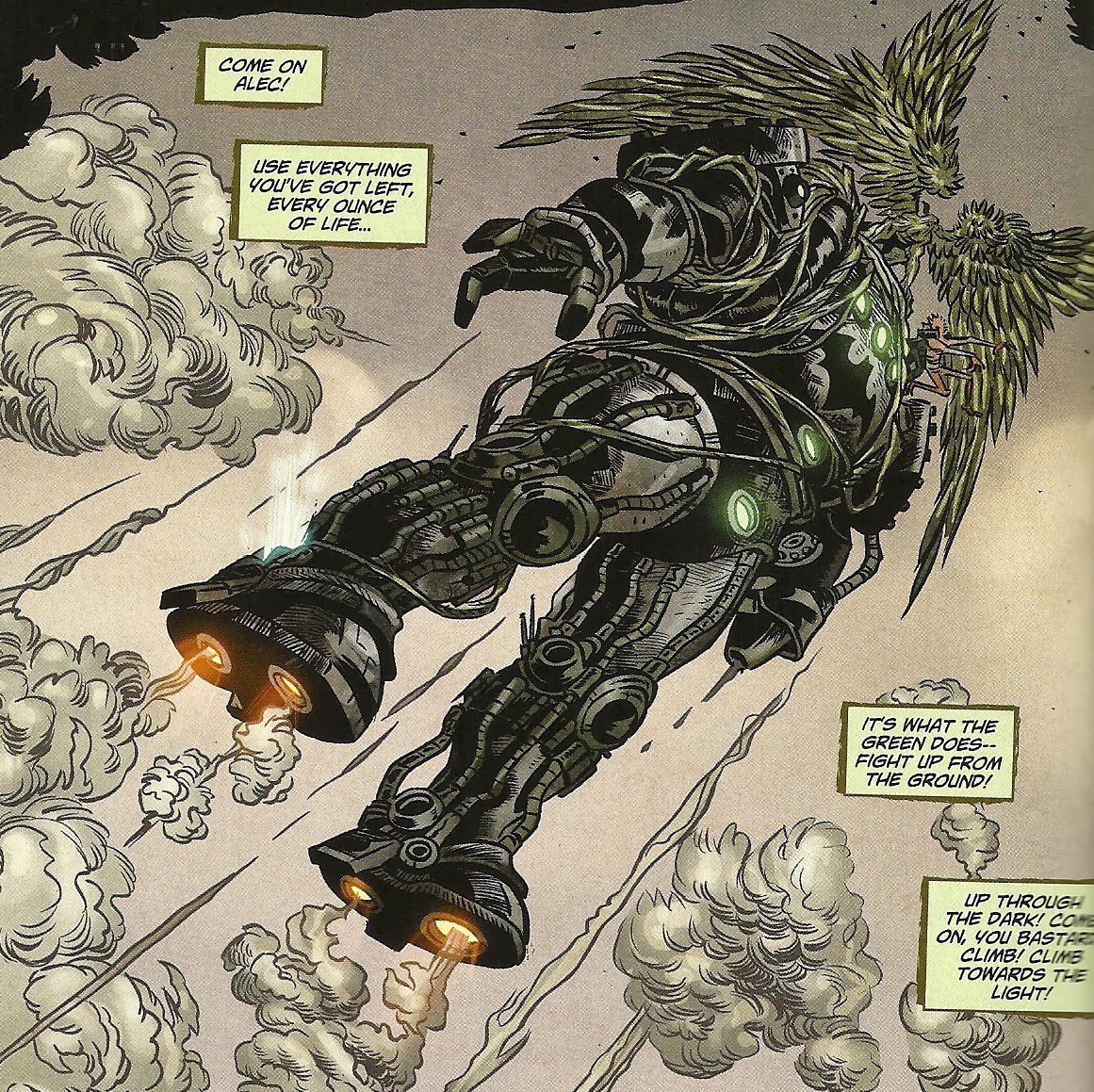
In order to win the day, they have to get the Batman robot-thing up into the clouds, where it will make it green Fix Stuff juice, that will fix stuff. Because this is an Animal Man/Swamp Thing crossover, it falls on them to get it up into the sky, by having Swamp Thing grow wings made of plants (?) and fly it, while Animal Man fights Arcane atop it.
Artist Andrew Belanger takes over for the climax, because that's when you wanna see a different artist come in. I'm no botanist, so I don't know how much metal a pair of leaf wings can carry
This is sort of weird, since Green Lantern Frankenstein, who has a magic ring that specializes in allowing its bearer to fly and in lifting heavy objects, usually in green spheres or giant green hands, keep the hordes at bay. This would be a little like a Justice League story where Superman is like, "Batman, I'll keep these thugs off your back while you  fly that nuclear missile up into space where it won't hurt anyone when it goes off in thirty seconds!"

And then, back in the past, Cliff dies, which is actually more funny and sigh-inducing than tragic, given the fact that Grant Morrison, the writer who salvaged Animal Man from DC trivia obscurity and made him a character capable of supporting his own book (and serving as a pillar for DC's adult reader Vertigo imprint), a writer whose work apparently so inspired both Lemire and Snyder that they are here near-constantly echoing and quoting aspects of characters Morrison wrote, whether from Morrison's runs or from those that preceded or followed Morrison, did a whole story arc decrying cheap shock tactics like killing off Buddy Baker's family as pretty shitty things for writers to do.

I liked seeing so many characters I like—particularly Steel, whose presence isn't what I would have hoped in a rebooted DCU—and much of the artwork is fine, but it all felt quite soulless, like a plot for a comic book with a first-draft of a script that got illustrated, before the writers could work in any real drama, or any fresh, big, new ideas that can justify the otherwise generic Heroes Go To a Shitty Possible Future Then Avert It storyline.

If those Internet comment leavers are right, and this is the best DC Comic, than the publisher is in much greater creative trouble than I could have imagined.

Luckily, Internet comment-leavers are never, ever right about anything.**

*On the other hand, he has appeared in Swamp Thing before, so, again, we have that repetitive, recycling element.

**Um, except for all you guys who leave comments on EDILW, of course. You guys are the best. You've discerning taste in writing-about-comics, you smell divine and, is that a new shirt? Or did you lose weight? Something looks different about you.

Monday, December 03, 2012

"This graphic novel is like a television show" is the nicest thing guy who works in television can think to say about graphic novel.

You can tell how far cartoonist Jeff Lemire has come since his Top Shelf-published Essex County graphic novels by the names of the guys he's got offering blurbs on the back cover of The Underwater Welder, an original graphic novel of Lemire's that Top Shelf published this summer. Between Essex County and Underwater Welder, Lemire launched a series at DC's Vertigo imprint, dabbled in some DC Comics and then rode "The New 52" wave to becoming one of the super-publisher's most well-regarded writers, his Animal Man managing to hang onto its inflated audience longer and stronger than many of the other 51 new books DC launched at the same time.

"Jeff Lemire has created a moving, brilliant and fiercely original work about loss, longing and love," writes Scott Snyder, Lemire's fellow Veritgo-turned-DCU writer, the undisputed champion of the "New 52" launch. Snyder goes on for a few more sentences in his blurb, concluding with calling Underwater Welder "A masterpiece of visual storytelling."

The other blurb is from Damon Lindelof, and it's a few sentences pulled from Lindelof's introduction. It starts like this:
You guys like The Twilight Zone?

Yeah, of course you do. Because read cool graphic novels like the one you're currently holding in your hands. And because The Twilight Zone is undeniably awesome.

Well, ladies and gentleman, you are about to read the most spectacular episode of The Twilight Zone that was never produced.
Lindleof, like Lemire and Snyder, is something of a comics writer, although unlike Lemire and Snyder, he's not very good at writing comics.

In comics circles, he's perhaps most famous for taking three years to rewrite Len Wein's Incredible Hulk #181, although he also wrote a short story about Superman's dad for Action Comics #900 and a short Batman story that was illustrated by...Jeff Lemire! (Hey, maybe Lindelof might be slightly biased in his assessment of Lemire's work, then...?)

He's also been involved in the writing of the movies Cowboys and Aliens and Prometheus, but he's best known for the TV show Lost. His introduction to Underwater Welder does not start off strong, with a particularly grabby hook, nor does it wander off on strange tangents for a really long time before reaching a goofy conclusion long after many of those who started it stopped paying attention.

His introduction to Underwater Welder isn't the worst thing he's been involved with, is what I'm saying.

But it's not that great, either. After comparing it to The Twilight Zone and making a joke about Lemire being Canadian, Lindelof then descries three ways in which the graphic novel under discussion is like that particular old TV show: It's strange and creepy, it had deeply flawed and profoundly real characters who often made mistakes and suffered for them and, "finally, and most importantly," there's a broader theme, "a lesson to be learned without being overtly preachy."

There's another joke about Lemire being Canadian and then a groan-inducing concluding paragraph in which Lindelof riffs on the opening of The Twilight Zone, applying details from Lemire's comic: "Picture if you will, a man named Jack. Occupation: Underwater Welder...there is a doorway. And on the other side? Memories, just as dark...and the cold, wet embrace of the Twilight Zone."

So this 200+ original graphic novel that Lemire wrote, drew and lettered over the course of what must have been years of his life? Kinda like a half-hour television show from the early 1960s.

Now, Lindelof does have a point; there are similarities. There are the three "key ingredients" of classic episodes that Underwater Welder shares, which Lindelof describes at some length in the body of his introduction.

Lemire's story does feature some magical realist-like sci-fi aspects, including the title character's lost time, time travel (effected by coming into contact with a pocket watch, of all things) and a temporary detour into a strange, hellish version of his world; the sort of weird shit that might happen in an episode of that old TV show I guess.

And, um, it's black and white, like the show was...?

Still, it seems like a backhanded compliment at best to reduce Lemire's work down to a comparison with some old TV show, regardless of who well-regarded that particular TV show is. It's not only reductive, but also dismissive and even a bit ignorant; Lindelof sells Underwater Welder incredibly short, and if I weren't already a fan of Lemire's work, I might have stopped reading by the time I finished the introduction, as a 200-page comic that's greatest attribute is that it's like some a TV show my mom watched when she was a kid doesn't exactly sound like a great way to spend one's time.

Hell, Lindelof doesn't even mention Lemire's artwork. But hey, who am I to talk? Here I am reviewing the introduction to Underwater Welder rather than Underwater Welder itself.

The plot is awfully gimicky; "high concept" with finger quotes around the term. Jack is a relatively young diver who makes his living as an underwater welder on a rig off the shore of his tiny home town. He's about to become a father, although he's not quite ready yet—he's still haunted by the disappearance of his own father, an unreliable alcoholic who used to dive for salvage and, one day, just never came back up.

Lemire slowly teases Jack's backstory out in an organic, leisurely way, through significant moments, pregnant pauses and silent beats, as well as through the dialogue, a great deal of which takes the form of an argument of some kind between the various characters.
His linework has always been loose, his characters designed with slightly cartoony proportions, their slightly too-big heads riddled with lines that give them all a haggard, tired look. The delicate, looping lines on Jack's father's face, his droopy mustache and eyes retreating into his face, define his pathetic nature just as surely as any line of dialogue he speaks or any disappointing action he takes.
Lemire divides the story into two settings, two worlds. On land, there are few grays, the stark black lines drawn on the bright white of the paper. Underwater, the blacks are thicker and blotchier, and washes of grays fill the pages and panels. Near the climax, when Jack's life is no longer easily divided between above and below the surface aspects, the gray washes encroach more and more, so that the streets and skies seem to take on the water-color gray of the sea.

While much of the conflict is dramatic, the conclusion crosses the line into melodrama, and it's hard to say if it goes too far over that line. A different artist working in a different style might not have been able to sell this story quite so effectively, as it could quite easily slide into saccharine territory, but Lemire's beat-up, run-down looking figures and settings give it a genuine look, a sense of credibility that defies the incredible elements of the plot and the manipulative aspects of the story.
You know: Television.

Thursday, June 07, 2007

June 7th's Meanwhile in Las Vegas...

This week's Las Vegas Weekly column features reviews of Howard Chaykin and Mike Mignola's excellent Fafhrd and the Gray Mouser trade


and Jeff Lemire's excellent Essex County Vol. 1: Tales From the Farm.


That's an awful lot of excellence, right there.

And be sure to check out the sketches and samples and Lemire's website when you get a chance.

Why?


That's why.