Showing posts with label sam humphries. Show all posts
Showing posts with label sam humphries. Show all posts
Tuesday, September 27, 2016
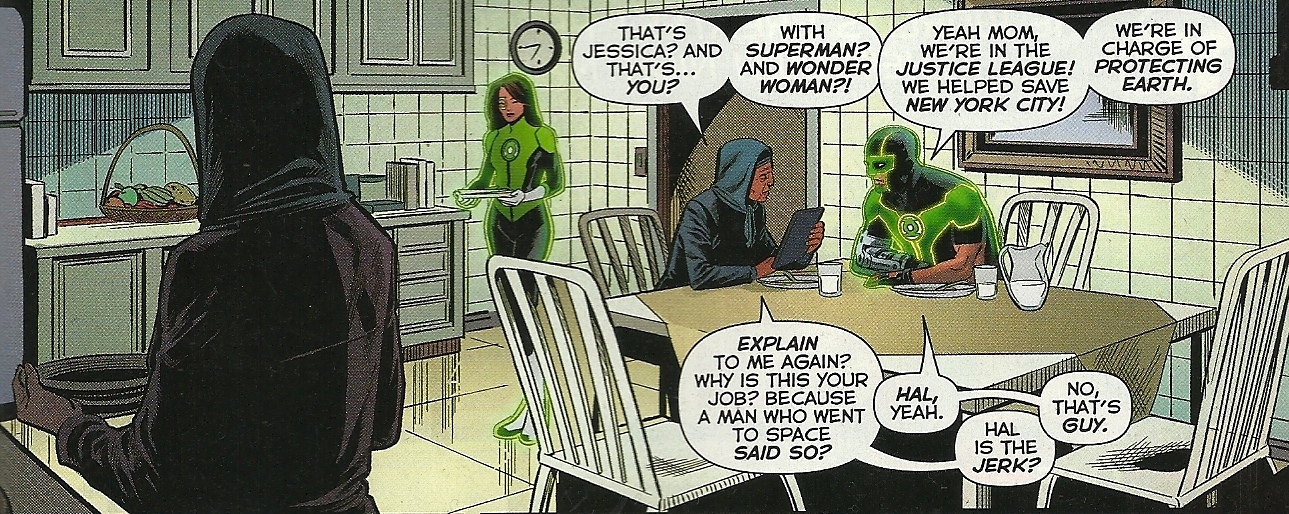
Actually, they're both kinda jerks, aren't they?


Monday, January 25, 2016
Review: Planet Hulk: Warzones!

For some of these mini-series with familiar titles, the stories are set in slightly re-jiggered versions of the settings of those stories, but in others they simply seem to be attaching themselves to the titles, but otherwise having little to nothing to do with source material. Planet Hulk is one of the latter sorts. That doesn't make it a bad comic, of course, but it perhaps makes it a poor comic book to bear the title Planet Hulk.
In fact, it's just as much a Captain America or a Devil Dinosaur comic book as it is a Hulk comic, which, incidentally, gets to a key to the appeal to many of the better Secret Wars tie-ins: The publisher and its creative teams took the temporary status quo as an opportunity to tell stories featuring as unlikely combinations as, say, Captain America, Devil Dinosaur and Hulks.
The original "Planet Hulk" was a 2006-2007 Incredible Hulk storyline by Greg Pak. It involved The Hulk being tricked and shot into space by some of Bruce Banner's besties, and crashlanding on a planet of monsters and super-strong folks where he was forced into gladiatorial combat.
What does the Sam Humphries-written, Marc Laming-drawn Secret Wars version of Planet Hulk share in common with "Planet Hulk"...?
Well, let's see. There's a character called "The Red King," Captain America uses the term "Warbound" a few times (that is what The Hulk called his gladiator pals in the original), there's at least one scene and a back-story involving gladiatorial combat and...well, I think that's about it. There's a bunch of Hulks in it, but, oddly, none of Marvel's many Hulks, with the exception of a new and different version of a smart Hulk that goes by the name "Doc Green" (but he's not the Doc Green from the Hulk comics, though).
The most difficult difference between the two to get around is the fact that the miniseries is naturally set in a "domain" of Battleworld, one of the alternate reality-based nations that form the new, Doctor Doom-created and controlled patchwork version of Earth and not, you know, on its own planet. I guess Domain Hulk or Land o' Hulks just didn't have the same marketing cachet as Planet Hulk, and they must have thought better of using the actual name of the domain as the name of the series.
See, the domain in which Planet Hulk is set in is called...wait for it...Greenland.
So our hero is not a Hulk at all, but a version of Steve Rogers, who is here to Devil Dinosaur as Moonboy was to the original Devil Dinosaur in Devil Dinosaur. Dressed in a barbarian version of his star-spangled costume, Rogers and his "warbound" DD have just defeated a half-dozen Wolverines in Arcade's Killisieum, where Doom provides the bread and circuses for the citizens of Doomstadt. This is also where Ghost Racers is set, but apparently the Killisieum has room for more than one kind of bloodsport.
A rather big deal is made out of how awesome "The Captain and The Devil" are for winning their latest match, but I don't know; I think if you're partner is a Tyrannosaurus Rex, you're usually going to have the advantage in most bouts of hand-to-hand combat. (Don't bring bone-claws to a T-Rex fight, I believe the old saying goes.)
The Captain and Devil have a pretty awesome plan for capturing Arcade and forcing some information out of him–where their pal Bucky is–but their attempted revolt is thwarted, and Cap ends up before a silent god-king Doom and his mouthpiece, Sheriff Strange. (I really wish they had given Doctor Strange a badge in Secret Wars, maybe even a whole sheriff's uniform.) They give Cap the precise information he tried to scare out of Arcade, and then send Cap and DD on a mission into Greenland: They are to kill The Red King, who is keeping Bucky captive there.
That's the first issue, which ends with Cap meeting his contact and guide in Greenland, Doc Green. From there, the trio make their way through a harsh, sword-and-sorcery inspired world where everything is saturated by gamma rays, so there are deadly forms of Hulk flora and Hulk fauna everywhere, and even a battle axe-wielding Captain America and a fucking T-Rex occasionally find themselves in deadly danger. Genre-wise, this is actually fairly close to Weirdworld, the other barbarian comic that was part of the suite Secret Wars tie-ins. It's a comparison emphasized by the fact that Weirdworld artist Mike del Mundo drew the excellent covers for this series.
Among the various battles are flashbacks to this Steve Rogers' past, detailing his relationship with Bucky, and debates between The Captain and Doc Green about the true nature of all living things, and how the gamma of Greenland informs every aspect of the world, changing it for, if not the better, than at least the truer.
There are a few twists at the end, one more predictable than the other, but like many of the less-ambitious Secret Wars tie-ins, it is basically an exercise in time-killing, a simple Point A-to-Point B plot, with an unusual cast of characters taking readers through the sights of an unusual alternate reality, with the creative team trying to pack in as much cool shit as they can. They succeed; it is cool, but there's not much to it.
"Hulks and dinosaurs," the back cover reads. "What more do you want?"
It's a very honest assessment of the contents, because that's pretty much all there is here, but, let's be honest, for most of us, that's enough...provided the hulks and dinosaurs are drawn well (they are) and the writing isn't bad (it isn't).
Stuck almost at random in the story is an eight-page "back-up" story that appears to have been a back-up for the first issue of the series, so it appears after the first 20 or so pages. Entitled "Phoenix Burning," because it's set in Phoenix, Arizona, it's the origin of Greenland. It stars Bruce Banner and Amadeus Cho (neither of whom appear in the main storyline), as they find Phoenix being targeted by gamma bomb-carrying missiles. Cho makes a daring attempt to save the city and all its people amd sicceeds, but only by saturating them all with gamma and essentially Hulking out the whole city and the surrounding environs. This is written by Pak, providing another little link to the original "Planet Hulk," and drawn by Takeshi Miyazawa, whose are is as great as always, but a strange page-neighbor for that of Laming.
Wednesday, September 09, 2015
Review: Guardians of The Galaxy & X-Men: Black Vortex

For that pair of characters in particular, this story is potentially a big, game-changing deal–although given what happened the last time an X-Lady married a character from outside the franchise, perhaps it's really not all that big a deal after all. Storm and The Black Panther's marriage simply fizzled in the corner of a panel of a crossover story having little to do with either of them, and their temporary union is already on its way to becoming a minor footnote in both characters' Official Handbook of the Marvel Universe entries.
Regardless of how the plot point plays out, however–and we won't know for sometime, thanks to Secret Wars preempting any and all other non-Secret Wars ongoing plots–it certainly didn't need a 300-page story involving far more characters than the storyline's primary writers Sam Humphies and Brian Michael Bendis can even keep track of, let alone find things to keep them occupied (For the sake of comparison, Avengers & X-Men: Axis is only 264 pages, Original Sin 240 pages and X-Men: Battle of The Atom about 250 pages). One might expect Marvel to be much better at crafting crossover stories at this point, given the fact that they are almost always engaged in at least one line-wide story of that nature, but this one is noticeably poorly put-together, reading more like one from the '90s, when they were transparent boosts to flailing and failing titles. Which explains the participation of not only Guardians of The Galaxy, Legendary Star-Lord, Guardians Team-Up and All-New X-Men (the X-Men book currently featuring Kitty Pryde), but also Cyclops, Captain Marvel and, most random of all, Nova.
The story would be big and unwieldy without the extra books, but it would also be a lot tighter, a lot less meandering and a lot less transparent in its mercenary conception. It would also significantly reduce the numbers of cooks in the kitchen. Star-Lord writer Humphries scripts six of the 13 issues (makes sense; this is basically a Star-Lord story arc gone mad), and Bendis four (the issues of his regular titles Guardians and All-New X-Men), while the inclusion of the hangers-on titles mean John Layman, Gerry Duggan and Kelly Sue DeConnick also script about 20 pages apiece. There are nine primary artists (not counting the inkers), a number which could have reduced by at least two without the less necessary tie-ins. Of course, the artists are so numerous and so varied, it hardly matters: Ed McGuinness, Kris Anka, Valerio Schiti, Andrea Sorrentino...there was no way that this storyline would have looked like it fit together visually, anyway.
 |
| McGuinness... |
 |
| ...and Sorrentino, who aren't exactly on the same page when it comes to drawing Rocket. |
So, what's a "Black Vortex," anyway...?
Well, it is a full-length mirror seemingly created by a black Celestial referred to as "Godhead" 12 billion years ago in answer to the prayer of an alien named Gara who looked like final-form Frieza with breasts and capri pants. If you look into the mirror, you see a redesigned, more powerful and somehow vaguely "cosmically enhanced" version of yourself. If you "submit" to the mirror, you turn into that version of yourself.
In other words, it's a character-redesigning maguffin, capable of giving the way-too-many characters new, temporary looks, but, more importantly, it's something for the huge cast to chase around for 13 issues. It had fallen into the hands of Star-Lord and Guardians villain Mister Knife/J-Son and his new ally, Thane, son of Thanos. Kitty Pryde, on a space-date with her long-distance boyfriend Peter Quill, made a post-coital decision to steal it from Knife (Peter's dad) mainly to annoy him. Naturally, this gets them in trouble, as Knife sends his already-upgraded team of mercenaries The Slaughter Lords after them.
To their aid come the X-Men and The Guardians.
The former are Kitty's current "class," the time misplaced original teenage X-Men Angel, Beast, Iceman and Jean Grey, plus X-22, as well as Magik, grown-up Beast and Storm. Magik and the kids make sense, as they are all Kitty's close allies at Grown-Up Cylops' New Xavier School (I'm not sure of the publishing order, and if this was published before, after or simultaneous to its dissolution in the pages of Bendis' Uncanny X-Men), but Beast and Storm seem particularly random. I'd say they were wholly unnecessary and simply clutter up the cast, but Beast at least has something to do in the story, which is more than many of the other characters get.
As for the latter, they are Rocket, Groot, Gamora, Drax, Venom/Flash Thompson and Captain Marvel. So that's sixteen heroes so far, and we haven't even got to Teen Cyclops or Nova yet! A brief argument breaks out over whether or not to use the magic mirror, with Kitty and Peter finding themselves on opposite sides of the argument, testing their relationship (Kitty says no, because evil magic artifacts probably have bad side-effects; Peter says why not, because why not?) When The Slaughter Lords and Gara arrive to take it by force, the fighting and transforming starts...and pretty much doesn't let up for the next 280 pages or so.
Gamora and Beast immediately submit, the former getting a better new look, the latter getting a much worse (and thankfully temporary) one; she wants power to beat up the bad guys, he want cosmic understanding to help him fix time and space, which he's afraid he sort of broke when he brought the teenage X-Men forward in time a few years ago our time (that gets a full two panels worth of explanation, so look close!). Angel follows right behind them, getting a weird skull-shaped mask and fire wings.
Fearing the 16 heroes might not be enough to stop the cosmically enhanced bad guys, Peter makes an emergency broadcast for help, and turns up exactly one more character: Nova. He'll hang around for the duration.
Then things get complicated.
The transformed Beast, Gamora and Angel take off with the mirror, which Gara, The Slaughter Lords and our heroes all want to get back from them. Meanwhile, Knife and Thane are making a deal with the Brood, in which a cosmically-enhanced Thane promises to freeze a planet in amber (that's his super-power, by the way, covering things in amber) for The Brood so they can eat and breed in its population at their leisure. Hala, homeworld of the Kree Empire, gets attacked, and Ronan looks in the mirror and submits, getting a not-too-severe new look, in order to defend it; he fails though, and it's destroyed. Cyclops and his dad, space pirate Corsair, show up. The Collector briefly shows up. There's a lot of fighting, shouting and flying around. Other characters get upgrades. The narrative takes over-long detours to accommodate the participation of other books (There's 20 pages of Nova visiting Earth with the Vortex and The Collector meeting his family, because it's an issue of Nova, for example; later Carol Danvers get something to do, and rather than spending a panel or four on it, they spend 20 pages on it, because now it's an issue of Captain Marvel and so on).
 |
| This particular team-up is referred to as a "Locket Heedcoon." |
At the end, all that really matters is that the characters who submitted get a chance to de-submit and resume their normal forms, and most of them do (I believe just Ronan and Gamora remain completely enhanced), while a handful of characters get mild, lasting redesigns: Teen Iceman is no longer made of snow when iced-up, but made of ice, looking as he did in Spider-Man and his Amazing Friends; Groot looks like a slightly different type of tree-man (I think); and Angel keeps his fire wings and his dumb new costume, sans mask. The latter is the only one I really hate; partly because as far as X-Men go, Angel is one of the few perfect superheroes whose codename, appearance and powers all reinforce one another, and in part because the earthbound angel with fire wings schtick was already done in the pages of Peter David's Supergirl (and was fairly dumb then).
The important thing, though, is that Kitty and Peter get past their argument–regarding whether submitting to ancient magical artifacts is good or bad or not–and Kitty makes a realization about space (Earth is in space, it turns out!) and he gets down on one knee and proposes.
 |
| I did choke up a little on this page; I'm a critic, not a stone. |
Humprhies and Bendis are both fun writers, and despite what weaknesses there are in the plotting of both, they are both on pretty solid ground when writing dialogue and witty repartee, of which there is a lot, given this book's cast of thirty or so smart-asses.
I liked some of the art (particularly McGuinnesses'; dude draws the best Rocket) and hated some of it (particularly Sorrentino's photorealistic work, which couldn't be more out of place here among the cartoonier style of most of the other artists).
All in all, it's a complete mess though, and an at-times challenging slog. It's actually a decent argument for not waiting for the trade, as this likely would have read better if readers had a chance to self-currate it, and were savvy enough to skip the unimportant chapters...but then, the first and last chapters are really the only important ones. Everything else is just filler. And that's a lot of filler.
Subscribe to:
Posts (Atom)