I have been meaning to read John A. Keel's
The Mothman Prophecies for a long time now; ever since I'd first heard about it, really, which I guess makes it somewhere in the neighborhood of 15 years or so. I've been encountering Mothman pretty regularly ever since I was old enough to start reading grown-up books, as he's a pretty unique character in cryptozoology, UFOlogy, modern monster lore, Fortenalia and the like, and would always turn up in various encyclopedias on such topics.
I was both really attracted to such subjects and extremely repelled by them when I was growing up, the usual pattern being that I would be excited to read about them during the daylight, and then be terrified all night and wish I hadn't read about them, and then the next day the cycle would repeat. Mothman seemed particularly scary to me, as it seemed pretty likely he was tied up with UFOs and space aliens, and that stuff used to just plain scare me silly. Bigfoot, Loch Ness Monster, Jersey Devil—I could generally deal with that stuff, even at night, knowing I was unlikely to find any of 'em in small town Ohio (or medium-sized town Pennsylvania, or big-town Ohio), but aliens? They could pretty much appear wherever, paralyze you or whatever and then abduct the fuck out of you, and what could you do about?
That's right. Nothing.
So I was more scared of Mothman than a lot of the other monsters usually found in his menagerie, and I was scared a little longer, as when I hit adolescence I began to realize it was logically pretty silly to be scared of, say, a dinosaur scooping me out of my bedroom window if I was upstairs alone, or bumping into a Bigfoot in the hallway at night when I went to the bathroom, but maybe I could still go crazy and
think I saw Mothman or a Gray Alien or the Dover Demon or something, right? Irrational fear, hallucinations and a lack of control seemed to be a big part of the Mothman anecdotes I had read.
On the other hand, despite the fact that Mothman HQ Point Pleasant is in West Virginia, it's just on the other side of the Ohio river, and the monster didn't seem to observe state geography, appearing on
both sides of the rivers. So Mothman is, technically, one of
ours too, so as an Ohioan I've always felt a niggling duty to read about that scary son-of-a-bitch. Eventually. When I was a grown-up. Say, in my thirties.
So the last time I was in the Mentor Public Library, perusing the 00's of the Dewey decimal system for books I haven't read about lake monsters and Bigfoots (I've been devouring this stuff a lot over the past decade since now I can do so with no fear of being up all night scared silly...another of the many advantages of adulthood!), I was somewhat surprised to find an original, hardcover of the book from 1975 (
Thirty-five years without being discarded from a public library collection?!).
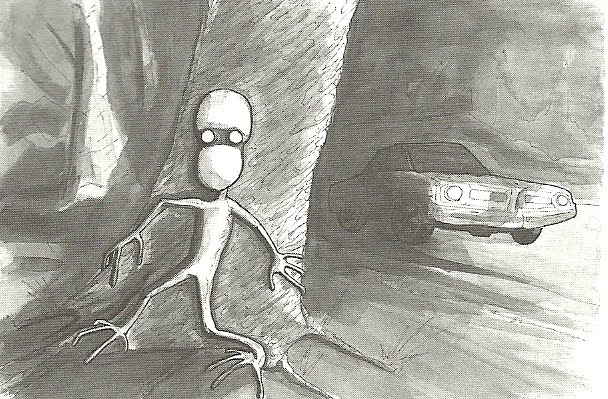
Like I said, I've been meaning to read this book forever, but it was the cover that really sold it to me.
Check it out:

There's no credit for who drew the image, but there is one crediting Peter Parnall with the jacket design, so I assume he's responsible for it.
I liked how incredibly different it is from the Mothman depiction I'm most familiar with, the one that usually shows up in encyclopedias of the strange:

That's a drawing based on witness descriptions, and is part of the Fortean image library. Having now read
The Mothman Prophecies, I know that there is extremely little known about it's appearance...in fact, the "new" information I learned from the book regarding its appearance was simply that there was no additional information about its appearance that I hadn't seen quoted elsewhere.
It was big, between around six-feet at the smallest and 12 feet at the tallest. It was gray in color...or sometimes brown or black. It had huge, red, glowing eyes that were sometimes described as being like bike reflectors, or like lamps, and
unlike the eyes of deer, raccoons and the like when light reflects off them in the light. It apparently had no head, or at least no neck. It had a huge wingspan of ten-feet, which isn't really very big at all if the creature was actually six-feet tall or taller, which it kept folded along its back. It had two legs, and stood upright, and when it walked on them it shuffled, or waddled or, in one instance, glided along the ground. When it flew, it's wings didn't move. And no one saw its face, or, if they did, they couldn't describe it, beyond such vagaries as "no mouth" or "no beak" or "a science fiction face" or simply being too terrible to describe.
Put it all together, and it sounds to me like a gigantic owl with crazy eyes that flies like a spaceship.
The above image from the Fortean image library
does accurately fit the descriptions of all the witnesses. Here's what I came up with:

Depending on how tall it was, with its wings out I guess it would have to look either sorta like this

or like this

So the cover of the book above is really rather endearing in its depiction of the title character: A humanoid body, arms ending with hands and fingers, a human-looking butt, feathers, bat-like wings sprouting from it's back so that it has
six limbs instead of the more standard four. And then there's that head.

The head is
inspired. It may just be an accident, given how little the rest of the creature resembles anything mentioned in the Keel's book, but it accounts for the fact that the monster seemingly had no head and/or no neck, while still giving him a head and neck. It's just shaped really weirdly.
Me being someone who was born in the late seventies, the head of course reminded me of
this guy from
Star Wars,

of course, the
Mothman cover predates the cantina scene in
Star Wars by two years.
Anyway, I thought it was a pretty cool cover. I also like how Mothman's sort of sneaking around too, like he's either going to peep on that young couple in the background while they make out (a significant number of modern American monsters seem to have voyeurism kink), or he's hiding from them while they go looking for him, which seems like a sort of silly thing for them to be doing, since he's a giant monster man.
Now curious about depictions of Mothman, I spent some time looking around for other versions of the cover Keel's original book on the subject.
Here's the one that I suppose is now the standard one:

It's fairly similar to the movie poster for the 2002 film "adaptation" starring Richard Gere, and is an enormously unappealing design. There's nothing about the image that grabs me, or tells me anything about what the book is about.
Also, the tagline "based on true events" doesn't seem like great salesmanship. The edition I read had no such qualifier, and was presented as a true story, with the only room for wiggling being that Keel himself was being manipulated or hallucinating certain things—the bulk of it consists of him recording what other people are telling him, which don't have to be presented as objectively true, so long as they're all cited as things he was told rather than things he personally knew to be true.
Here's one I found on Goodreads.com; the publication information is identical to that of the version I posted the cover of above, but the cover's quite different:

Accurate, sure, but not very sexy (Er, accurate in that it has some people looking up on it, as occurs a lot in the book; obviously neither of those figures there is supposed to be Mothman). I can't imagine a gray image of a couple pointing at the small, white font on the cover really leapt off the shelves in 1975 any better than it does now.
Sexiness isn't a problem with the cover of this paperback version, however. Behold, the power of Frank Frazetta:

Here's a better look at it:

Okay obviously this isn't a very accurate depiction of what goes on in the book. Sure, there's a big guy with big red eyes and wings, and some flying saucers, and a man and a woman, but the Mothman looks more like a Japanese superhero with butterlfy wings, and that couple sure doesn't look much like John Keel and the Mary Hyre he describes in the book.
It sure is a striking image though, and I can imagine it moved a lot of paperbacks. The central focus on the weird figure and his butterfly wings make the image stand out even among other Frazetta images that you'd see on paperbacks.
And that's about it for
Mothman Prophecies covers.
Loren Coleman's 2002 book
Mothman and Other Curious Encounters uses a version of the witness-inspired look, as seen in the drawing from the Fortean gallery near the top of the post, on its cover:

It was created by artist William Rebsamen, based on witness descriptions, under Coleman's supervision.
Keel's follow-up book, 1976
Visitors From Space: The Astonishing, True Story of the Mothman Prophecies, features what has to be the
least accurate depiction so far:

Even Frazetta's had red eyes. This dude looks like he's just passing over
Visitors From Space, having just left a heavy metal album cover and on his way to a
Dungeons & Dragons source book.
Here's a portion of one of the only images of Mothman I have sitting around my house, from 2005's
Weird Ohio's chapter on "Bizarre Beasts":

It's by Cathy Wilkins, who contributed a couple of monster paintings to
Weird Ohio (and whose work you can find
here). It's another very moth-y version...clearly the name dictates the portrayal more often than not.
And, finally, I don't have a copy of Fantagraphics'
Beasts! Book 2 on hand to scan, but artist Jon Vermilyea contributed a two-page spread featuring Mothman—

—which you can find on his site
here. Rest assured it looks much better in person.
********************
As for the
Mothman Prophecies book itself, I had a lot of fun reading it, and had trouble putting it down—I think I finished it in two, maybe three sittings tops. Keel's a fine writer, and comes across as someone with a very healthy amount of both skepticism and credulity, neither dismissing all of the crazy stuff he hears and experiencse nor taking it all at face value.
The book is still enormously unsatisfying though, in large part because it amounts to little more than a collection of anecdotes, with each chapter being broken up into little sub-chapters marked by roman numerals. It seemed part Fortenalia and part memoir, and while Keel searched for connections between a ton of seemingly unrelated (except by setting, geographical and temporal) phenomena, he never really comes up with anything definitive, or even a good theory.
It's especially frustrating because as the book nears its end, he mentions being in daily contact with the entities—the weird, awkward "men in black" characters that populate the book—through a variety of means:
I could ask [Mr. Apol, one of the men in black Entities] any kind of obscure question and receive an instant and accurate answer, perhaps because my own mind was being tapped just like my telephone. Where was my mother's father born? Cameron Mills, New York, of course. Where had I misplaced my stopwatch? Look in the shoebox in the upper right-hand corner of the bedroom closet (it was there).
Why he doesn't ask what's up with the big, gray winged creature or all the UFOS or where the MIBs were from or what they were doing exactly is never explained.
And his unified theory of the craziness of West Virginia and Long Island at the time is mentioned only in passing, never presented as, like, an
answer to the questions this book is a chronicle of his investigation of.
After reading this, I have no real sense that Keel learned anything or had anything to share from his experiences; rather it's a long laundry list of crazy shit. Which is a lot of fun, of course, but I guess I was expecting something more. Maybe I have to read the follow-up for that?
I found a few things particularly noteworthy:
—Keel dismisses the two most obvious vague explanations for all the crazy phenomena he, his partner Mary Hyre and everyone else in the book experiences (Mothman sightings, lights in the sky, encounters with aliens, men in black who behave strangely, strange phone calls, cattle mutilation, electrical and appliance malfunctions). He thinks neither aliens nor the government are at all responsible, which actually kind of blew my mind. Space aliens with the technology to get here would presumably have the technology to commit all of the acts of strangeness he recounts, and if we want to be generous towards the U.S. government's capabilities and less-than-generous in our assessment of their scruples in the mid-sixties, then they would at least have the money to attempt some sort of huge thought experiment to discredit UFO researchers while testing out, I don't know, fear guns and telephone disruptors or even war-gaming mass UFO sightings.
His own theory seems no more or less wild: That the entities are from a higher dimension and are clumsily interacting in our own, either to guide humanity in a particular direction, or else just fucking with humanity for reasons they themselves don't understand. That, or it's all some sort of psychic phenomena that we don't understand yet, and people interpret their experiences within contexts they
do understand. I could buy that last one easily enough, but Keel doesn't seem to be trying to sell it here.
—The Men In Black encounters seem downright disturbing in isolation, but taking all together like this, they seem almost...wacky. And once you decide they are neither agents of the government or aliens of some kind, they even appear a bit silly, like a conspiracy with no purpose other than to appear conspiratorial.
—It was awfully hard to put myself in Keel's place in most of these scenes, simply because times have changed so much since 1967. Hardly anyone seems suspicious of anyone else—nowadays a stranger comes up to talk to you, the first thing you assume is that he's probably going to mug, rape and or kill you, whereas the folks in the book are always inviting strangers into their homes, cars and personal space. And, of course, there's the technology. I grew up before the Internet and cellphones were parts of every day life, but it's still hard for me to imagine things like tampering with the mail or phone lines. There's a scene where Keel tries to follow his phone line from his apartment all the way back to the phone company to see if anything's wrong with it at any point along it's length, and I could barely follow the scene. (It makes me pretty curious to see the movie version now though, as I understand it's set in modern times).
—It was pretty weird reading about pre-
Communion alien/UFO contact and abduction experiences. There are a ton of aliens in this that appear to be perfectly human-looking, and many of them speak English, have Earth-like names and come from planets and stars I've heard of. Keel mentions more sinister abduction experiences, but only lays out one in any great detail, and the aliens involved sound awfully different than the flat-faced, almond-eyed ones I grew up reading about/being scared of. These hostile aliens were gray and short, but they had wrinkly skin, pointed ears and crab claws for hands.
********************
Anyway, that's more than enough talking about things-that-aren't-actually-all-that-comics-related. If any of you have suggestions of any comic book appearances by Mothman—I know he appeared in
Cryptozoo Crew, and I assume he's had to show up at some point in
Proof and
The Perhapanauts, for example—please let me know in the comments section.


 It's an extremely accurate depiction of the composite descriptions: No face or head, big glowing eyes that resemble bicycle reflectors, huge wings, whether or not it has arms remaining vague and so on. Pretty detailed and remarkably buff legs, though.
 He depicts the Mothman as particularly moth-like, which doesn't really jibe with the descriptions, but I guess if those big, buggy eyes glowed it could be seen as accurate. I guess it depends on what the rest of this Mothman looks like.
 The book doesn't list the sources for individual images, and the image caption just reads, "Above: Mothman was said to lack any visible arms or head, to have luminous red eyes and huge wings, and to be bigger than a man." The above image is presumably a sketch based on a witness report.
 Somehow the fact that the creature is well-lit enough that we can see details on it, and see that it completely lacks all detail makes it even scarier. The little, shapely legs are kind of intriguing though; I can almost see that version of the monster dancing on them...

 The Monster Spotter's Guide to North America (How; 2007) is one of those books that has such a strong book design that the design itself was enough to get me to pick it up off the shelf and give it a looksee (Grace Rign gets credit for the design). The conceit of the book is a rather simply one, and rather simply executed, but it's a fun one. As the back cover says, it's "Like a bird-watching guide...only for monsters."
 Patrick gives it a Tyrannosaurus-like appearance, with which I can't quibble. Despite growing up—and currently living—on the coast of Lake Erie, I've never seen the beast, which is more locally known as South Bay Bessie and said to dwell further east, closer to Cleveland. She did inspire the name of the Cleveland-based minor league hockey team, the Lake Erie Monsters (they have a pretty sweet logo, by the way).


 If you've read many books on cryptozoology in the U.S., you've no doubt heard of the Devil Monkeys, which seem to reside in the overlap in a Venn diagram with "hairy humanoids" in one circle and "phantom kangaroos" in the other.
 It's a folkloric monster from Kentucky. It's a shape-changer, so Patrick depicts it in a state of potential, as any of three different forms simultaneously. It's a good way to approach the subject, and it also looks pretty weird and scary in that form.

 Despite the demonic moniker, early theories as to just what the hell the creature actually was have gravitated toward some sort of UFO or alien explanation. Maybe it came from a flying saucer, or is some sort of ultraterrestial from a different dimension. Others have wondered if it might not be some sort of creature native to this world, as it bears some resemblance to the fairy-like, mythological Mannegishi of Cree legend. Among the more mundane explanations are that it was perhaps a misidentified newborn moose calf or, of course, a hoax.
 Obviously it was a ninja.
 The illustration for this particular edition was drawn by Greg Dearth, so that's his take on Mothman.


 A book I would like to read but that doesn't, to my knowledge, exist yet is one about Point Pleasant, West Virginia today, and the way in which the community has apparently embraced Mothman. A sort of Mothman Prophecies Revisited, I guess.
 There's no credit for who drew the image, but there is one crediting Peter Parnall with the jacket design, so I assume he's responsible for it.
 That's a drawing based on witness descriptions, and is part of the Fortean image library. Having now read The Mothman Prophecies, I know that there is extremely little known about it's appearance...in fact, the "new" information I learned from the book regarding its appearance was simply that there was no additional information about its appearance that I hadn't seen quoted elsewhere.
 Depending on how tall it was, with its wings out I guess it would have to look either sorta like this
 or like this
 So the cover of the book above is really rather endearing in its depiction of the title character: A humanoid body, arms ending with hands and fingers, a human-looking butt, feathers, bat-like wings sprouting from it's back so that it has six limbs instead of the more standard four. And then there's that head.
 The head is inspired. It may just be an accident, given how little the rest of the creature resembles anything mentioned in the Keel's book, but it accounts for the fact that the monster seemingly had no head and/or no neck, while still giving him a head and neck. It's just shaped really weirdly.
 of course, the Mothman cover predates the cantina scene in Star Wars by two years.
 It's fairly similar to the movie poster for the 2002 film "adaptation" starring Richard Gere, and is an enormously unappealing design. There's nothing about the image that grabs me, or tells me anything about what the book is about.
 Accurate, sure, but not very sexy (Er, accurate in that it has some people looking up on it, as occurs a lot in the book; obviously neither of those figures there is supposed to be Mothman). I can't imagine a gray image of a couple pointing at the small, white font on the cover really leapt off the shelves in 1975 any better than it does now.
 Here's a better look at it:

 It was created by artist William Rebsamen, based on witness descriptions, under Coleman's supervision.
 Even Frazetta's had red eyes. This dude looks like he's just passing over Visitors From Space, having just left a heavy metal album cover and on his way to a Dungeons & Dragons source book.
 It's by Cathy Wilkins, who contributed a couple of monster paintings to Weird Ohio (and whose work you can find here). It's another very moth-y version...clearly the name dictates the portrayal more often than not.
 —which you can find on his site here. Rest assured it looks much better in person.
 During my recent visit to the Mentor Public Library, I found Tales of the Cryptids: Mysterious Creatures That May or Many Not Exist (Darby Creek Publishing; 2006) shelved right where the title page suggests it be shelved in libraries that use the Dewey decimal system—001.94, with the cryptozoology books. Oddly, it was in the adult non-fiction section, under about two whole shelves of UFO books and next to a couple of Bigfoot books, all save one of which I'd already read (The one I hadn't already read and thus also checked out was Jeff Meldrum's Sasquatch: Legend Meets Science, which is a so science-y it can be awfully dry in certain chapters, but is interesting nonetheless).


 Those are, in order, a Sasquatch, a yeti, an orang-pendek, the skunk ape, the Australian Yowie and the Chinese Yerren.




