Showing posts with label gaiman. Show all posts
Showing posts with label gaiman. Show all posts
Thursday, December 12, 2013
Meanwhile...
This week I interviewed writer Sholly Fisch about his new bi-monthly book Scooby-Doo Team-Up for Good Comics For Kids, and reviewed Chip Kidd's bookification of Gaiman's May 2012 "Make Good Art" commencement speech, Make Good Art, for Robot 6.


Sunday, July 21, 2013
Some picture books of note:

The fine-print summary on the first page sort spoils the entire story, which I will strive not to do, as the species and specific identity of that "big guy" are quite a surprise, and the main narrative pleasure of this entry in Willems' long-running series. Suffice it to say that the big guy isn't just big in comparison to the rather diminutive Piggie, he's also big in comparison to Gerald who is, remember, an elephant ("That is a BIG guy," Gerald tells Piggie, "You did not say how big he was. He is very BIG").
So what kind of animal is that much bigger than an elephant? Well, the options are limited, and it's neat to see Willems draw this new animal in his series, and to see it sharing page space with Gerald and Piggie, who Willems must render very, very small. I also like the way the big guy's dialogue is all in large font, all-caps.
There's likely a lesson in here about getting along with others who are different from you, not judging books by their covers (metaphorically; you can literally judge this very good book by its very good cover) and sharing and playing together. If you're still young enough to need those lessons. For the rest of us, its instructive in the same way most Willems books are—as an example of world-class cartooning, a demonstration of how one can tell a great story for an audience of any age and for a lesson on the effectiveness of timing in comedy.

Its inspiration comes, of course, from the story of the boy who cries wolf, only this boy, Ben, cries the name of a much a more exotic mammal than that of wolf.
Magoon sets most of the story at the edge of a little wood, where Ben and his little dog set up shop. Ben repeatedly cries "Bigfoot!" (sometimes in big, hairy lettering) and his family and neighbors and passersby come to the edge of the wood to see the imaginary Bigfoot, and Ben continues to do things to drum up interest and belief in his tales of Bigfoot, including hoaxing footprints.
As with the boy who cried wolf, Bigfoot eventually does show up, but at a point at which no one believes Ben. Rather than eating all his sheep or killing the boy like the wolf did—the wolf did kill and eat the boy too, right? It's been a while since I've read or had that story read to me—he just steals Ben's bike and dog (Naturally "Bigfoot is stealing My Bike! And my dog!" didn't bring anyone running).
It imparts pretty much the same story as its inspiration, with the same lesson, only with less violence, less aspersions cast toward any poor wolves and with the added benefit of Bigfoot, whose inclusion in pretty much any story of any kind generally improves it. I really like Magoon's artwork, and it's nice to see it applied to some human characters, the natural world and, of course, to the title character, who fits a nice, cartoony, child-friendly version of the most popular descriptions of the legendary beast.
I'd be really interested to hear what a real Bigfooter or enthusiast or believer thought of the book, and if they found the parallels between them and Ben that Magoon suggests as innocent, amusing coincidences, or as jibes (I'm assuming it's the former, as Magoon seems to have a place in his heart for such cryptid creatures; he's previously illustrated a book about the Loch Ness Monster too).

Here, a trio of cats are about to open up and read or discuss the contents of a big, red, locked book entitled Cat Secrets, but before they do, they have to make sure no one other than cats are reading the book the reader is holding in their hands. To do this, they present a small battery of tests to prove that they are actually cats, the surprise final test being "taking a cat nap."
Apparently, then, this book is really one meant to be read to a small child right before they (probably reluctantly) go to take a nap. That's kind of brilliant, actually, and I do wonder if it would work. Probably the first time, but I wonder how many kids will request the book they know leads directly to a nap the second time.

"Which big race?" Cheetah asks the little orange and blue kittens, whose dialogue appears in blue and orange type, or when they both say the same thing at the same time, in words that alternate blue and orange capital letters, "The one I always win because I am big and fast and you always lose because you are little and cats? That big race?"
The cats have "lots of races so everyone can win," but Cheetah sees it as an opportunity for him to win them all...and he does! But some of them are pie-eating and ice-cream eating races, and some have prizes like "special winner shoes"/cardboard boxes, so by the time comes for the actual big race, the good old-fashioned who-can-run-the-fastest race, Cheetah's not really in any shape or dressed properly to beat anyone, whether he's the fastest land animal on earth or not.
Luckily, absolutely no lessons are learned—well, other than maybe an implied lesson about brains being as important as size and speed, or to not be too arrogant or too much of braggart—and Cheetah remains Cheetah throughout, suffering no real comeuppance that he's even aware of. There's a twist following the twist, making it a doubly charming story.

Such is the case with Chu's Day, which Gaiman wrote and artist Adam Rex (responsible for the incredibly illustrated Frankenstein Takes the Cake and Frankenstein Makes a Sandwich, among a bunch of other stuff) illustrated. Chu is the name of a little panda in a world of gorgeously-rendered anthropomorphic animal.
While the title is a kinda clever play on Tuesday, I'm afraid the joke of Chu's name is of much older, less amusing and potentially even offensive vintage. See, Chu is quite a prodigious sneezer, to the extent that he wears a little old-fashioned aviator's helmet and goggles, which he securely places over his little eyes when he begins to "aah- aaah-" before a sneeze.
That's right: He's named Chu, as in "Ah Chu"...although the "Ah" is never assigned to him explicitly in the book.
The story is, as the title says, of his day, which includes going to a series of three places with his parents, being exposed to a potential sneeze-trigger, and managing to stifle two of the three sneezes, the third of which meets the promise of the first line of the story: "When Chu sneezed, bad things happened."
It is, of course, beautifully illustrated, and, as a guy who works in a library, I really appreciated the two-page spread of what the library looks like...

I particularly liked the ladder on wheels though. My dream library job entails one where I get to climb up and down such a ladder.
The lame old Asian stereotype gag of Chu's name aside, the story is a decent one, but is rather disappointing, knowing it's source. Gaiman is a great writer, one of the best, in more than one medium, and this is, from him, a rather pedestrian effort.
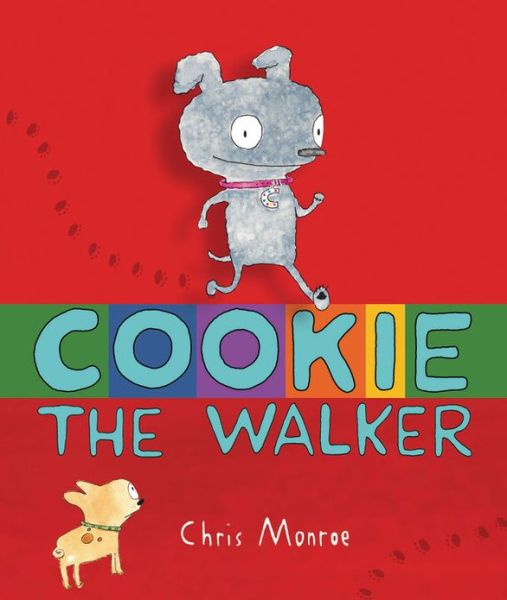

What's more, people really seem to like looking at her walking on two legs ("It is pretty cute I guess...")
Soon, her walking on two legs draws the attention of a famous dog trainer, and Cookie gets a job, which brings with it fame and treats. One gig leads to another—a dog show, the circus, reality TV—and the more famous she gets, the more treats she gets, but all that fame and all those treats come at a great price, as she misses aspects of her life before she became Cookie The Walker, something Kevin reminds her of whenever he comes to visit.
Will Cookie throw it all away to walk on all four-legs again? That's the drama of the story, which is wonderfully illustrated with thin, slightly wiggly lines and delicate water-colors. Monroe excels at montages, and filling them either with a great deal or detail, or simply funny little riffs. Here's a page in which we see Cookie as "a big TV star," appearing in various generic reality TV roles:

Cookie The Walker is another great book from a great maker of great books. If you're only going to read one book discussed in this post, well, that's a silly and arbitrary rule to follow, but this might be the one you should choose to read.
Well this one, more maybe this next one...

Snicket quite elegantly writes every single, simple line, and he does so in such a way that most of them can have two meanings, so that what he writes is, in one way, quite literally true, but also sounds semi-mythological (like everything does in childhood).
Klassen's art pulls off a very neat trick, depicting Laszlo and the dark's house as "a big place with a creaky roof...and several sets of stairs" as a place unmoored from a particular temporal or geographical setting (this could be your house, and probably is), and of depicting the same locations within the house during the day and during the night, in the dark, in the light, and the dimness in between, transforming them as the dark transforms things, usually for the worse when you're a child. The words are arranged just so on many of the pages, the lettering itself shifting from black to white (depending on whether the page is light or dark, for a sort of perfection of impact (the line "it did," for example).
It's rare to read a book as an adult that speaks so directly and eloquently to the little kid you used to be. It's rarer still for me to read a book, wish I would have read it when I was a little kid and spend very much time at all wondering how that book and that act of reading it might have changed me for the better.

It's a cute "gossip is bad" sort of story, one that offers a lesson that's probably as important to folks that work at libraries as it will prove amusing to little kids who visit libraries for picture books, elevated further by artist Joung Un Kim's delightful artwork, which seems to be assembled of mostly-painted over, re-used papers and cut-up shapes of wallpaper, so type-written words or the music from sheet music will appear along the edges or show through the art. Here are some examples, clipped from the pages and thus, unfortunately, alienated from their context.


The crocodile snuck into a family's house at night through the pages of an innocent-looking picture book called The Kindhearted Crocodile (Hey! That's this book!) and proved how helpful he would be by picking up, washing the dishes and suchlike. Curious to see who the mysterious, night-time housemaid was, exactly, the family hid, and were surprised when rather than the expected elf or goblin, a crocodile crawled out of a book to do the housework again.
The kids were immediately cool with the croc, as they knew him from his book, The Kindhearted Crocodile, but what was the story of that book, if it deviated so much from the story of the story book, which features the book itself in a pivotal role so very early on? And is the premise that there's only one such book, rather than a bunch? Because, otherwise, would the crocodile be able to crawl out of any copy of The Kindhearted Crocodile? If so, why didn't he crawl out of my copy? While I don't have any toys lying around that need picked up, I pretty much always have dirty dishes that need doing and laundry in need of folding, and I sure wouldn't object to a large reptile bringing me toast and jam and a cup of coffee every morning. What's the deal, crocodile? (And did he aks Panzieri and Ferrari to put him in this book, as a means of sneaking into the family or familes' homes...?
So many questions!
No question it's a great looking book though. Ferrari has a slightly sketchy style and composes figures with sharp, bold, energetic lines. The coloring isn't exactly haphazard, but it's not exact, either, and the crocodile's skin color changes like that of a chameleon, usually some form of speckled green, but sometimes he adopts very un-crocodilian colors, particularly when doing something domestic.
There are a few night scenes which are colored almost all black (the only color being the characters), while the lines the make up the house and furniture are drawn in white (and the color of type is white as well). It's a great-looking book.

I hesitate to say anything more about the plot, but it is, in one way, an echo to Munro Leaf's The Story of Ferdinand, only from the perspective of a bullfighter who doesn't want to fight bulls, rather than that of a bull who doesn't want to fight bullfighters.
Hector's artwork doesn't look much like that in the story of Ferdinand, of course, being much simpler and more abstract, and with very warm colors.

"Impossible," Otter tells himself, "I am in love with my food source."
Naturally, complications arise, although they mostly consist of otter society gossip and Myrtle's pleading with her otter not to eat her friends and family. Despondent, he swims off until he meets a wise beaver, who offers him an apple, which Otter refuses, asking Beaver if he's ever eaten a fish: "No," said Beaver, "but I suppose I might if I ever fell in love with an apple."
I suppose you can guess where writer James Howe's story goes from there, the writing is simple, but also clever and rather elegant, with almost every word chosen for usage being a word that really counts. After a few complications, it does finally reach a "happily ever after," presumably because neither Otter nor Myrtle want children.
The most striking aspect of the book is artist Chris Raschka's artwork, which is of a very studied, child-like look, in which the fish are triangle-on-oval simple, and the otter's head and body are a figure eight, his tail another, smaller figure eight. The entire thing looks done in crayon, as as if by a child (although the consistency of the imagery and design from page-to-page would make that fairly impossible. Even more simple shapes are used for backgrounds and animals without speaking parts.

This non-Gerald & Piggie, pigeon-free* book from Willems is told in a form inspired by a silent movie, a particularly odd choice for a children's book, but then, getting that particular reference isn't necessarily necessary when it comes to enjoying the plot of the book, which revolves around a big, shocking (no seriously; I was genuinely shocked) ending.
A page of art, starring a well-dressed fox and a goose, will be followed by dialogue in an old-timey font, the white text atop a black, silent movie-style title card. The artwork featuring the goose and fox is in full-color, deviating somewhat from the illusion of a silent movie.
As the male fox courts the female goose, inviting her back for a walk in the woods, and then back to his place, and then for soup, a group of goslings, which Willems draws like yellow tennis balls with beaks, dot eyes and triangle wings, yell back at the movie, variations of the title.
For example, when the fox asks the goose, "Would you care to continue our walk into the deep, dark woods?" and the goose replies, "Sounds fun!", Willems will shows us a two-page spread of the goslings, one of them shouting "That is REALLY not a good idea!" at the "screen," as if they're watching the movie the fox and goose are starring in. Kinda like people watching a horror movie and yelling to the protagonist not to go into the basement alone.
The ending is something of a surprise, although there are actually a couple of surprises all braided together into it, none of which I should even think about spoiling here.
Suffice it to say that this is a new Mo Willems picture book, and it's hard to imagine anyone needing much more information than that to know if this is a book for them or not.

First, it's told from the perspective of the thief, rather than the victim. Second, it takes place under water, the cast including only the thief (a fish), the victim (a much bigger fish) and a witness (a crab). And third, the hat is a little, blue derby rather than a little red, conical hat.
Like, I Want, it is very funny, and Klassen does an incredible job of showing big or slight shifts in emotion with slight variations of the drawings of the characters, as when the large fish, for example, wakes up, realizes his hat is missing and we see his immediate reaction.


*Save for the now customary, half-hidden cameo, of course
Sunday, November 27, 2011
In addition to writing great comics, short stories, novels, picture books and blog posts...
 ...Neil Gaiman also writes pretty great blurbs.
That's from the back cover of That Is All, the recently-released new prose book by John Hodgman, who pictured wearing a mustache and ascot, below Gaiman's blurb.
Monday, July 27, 2009
"The biggest news of Comic Con International in San Diego was revealed moments ago and jaws are still on the floor"

So the biggest superhero news to come out of this year's San Diego Comic Con International was, what, that Joe Quesada drew a crappy picture of Marvelman that some colorists finised on a computer for him, and he's unlikely to get sued by Todd McFarlane or Neil Gaiman or anyone for doing so?
When I first saw the headlines about the announcement, I caught my breath, as the legal tangle surrounding Marvelman was so tangled I assumed I wouldn't ever be able to read those damn books...or at least not until I was a very old man. Had Marvel somehow managed to untangle it all, and to have done so on the down-low to the extent that no one even noticed until their announcement?
And then I read the actual press release, which actually doesn't say much of anything about anything. Only that Marvel bought the rights to the character from creator Mick Anglo. But then, last I knew, he's only one of the people claiming the rights to various Marvelman comics stories, and he wasn't even the most likely victor in the struggle for "the good stuff" (i.e. the superhero deconstructionist stuff by Alan Moore and Gaiman, the stuff people talk about when they talk about Marvelman).
Other than that, the only news in the initial announcement was that Marvel was "talking to" Alan Moore, Neil Gaiman and Mark Buckingham, and that more news would follow at some point in the future.
It's hard to get too excited about the announcement that there might be an exciting announcement at some point in the future.
For now then, the "big news" regarding Marvel and Marvelman is simply that the company is selling that ugly Quesada image as a 24-by-36 inch, $9 poster, and that they are selling Marvelman logo T shirts for $20 through their website.
Tuesday, March 31, 2009
Review: Blueberry Girl
 At the beginning of the fairy tale, a baby girl is born, and the fairies or wise women of the kingdom visit to bestow their blessings and gifts upon the child.
 It should come as no surprise to anyone familiar with the work of singer Tori Amos that, when about to have a baby girl of her own, might think of such stories, and ask a friend to write a prayer to bless her baby.
Nor should it come as a surprise that Neil Gaiman, put in that fairy/wise person role, would see it through that Sleeping Beauty frame of reference. “Keep her from spindles and sleeps at sixteen,” reads a line in Blueberry Girl (Harper Collins; 2009), the picture book that resulted from the prayer Gaiman wrote for his friend’s daughter.
What is a bit surprising is how something with such personal origins, written for such a single person in such a specific situation, could end up being so universal. But then, that’s one of the mysteries of fiction, isn’t it, that the more personal something is, the more people who can relate to it?
And there’s a disarming universality to Blueberry Girl. Simply put, it’s an instant classic, almost certainly destined to a long life as a gift given to friends upon the birth of their daughters or to the daughters themselves for years (generations?) to come.
“Ladies of light and ladies of darkness and ladies of never-you-mind,” the book opens, “This is a prayer for a blueberry girl.”
 Those words appear in a blueberry juice-colored font, trickling down the right half of a two-page, single image, then, hitting the bottom of the page, rushing right to left. The image is a Charles Vess illustration, which looks to be a watercolor painting. A little, long-haired girl in a flowing green dress walks down a path, while a flock of various birds fly low over her head. Towering in the background are three giant women, the “ladies” of the lyric, a trio that falls roughly into the maiden/matron/crone triad that Gaiman so consciously employed throughout Sandman, their robes trailing off into the pink clouds of the gauzy sky.
 These ladies are to whom the prayer is addressed. “First, may you ladies be kind,” the next page reads, and a series of requests are made throughout the remainder of the book. “Let her go places that we’ve never been” and “Her joys must be high as her sorrows are deep” and so on.
A second and third time he addresses “the ladies,” as those of grace, of favor and merciful night, of paradox, of measure, “of shadows that fall.” If it’s a prayer, or a supplication, its not of actual goddesses, but of symbolic ones; figures who, like Gaiman’s Endless, are not gods but like gods. Forces, aspects given faces and names so that they can be spoken to in a story or poem rather than worshipped. The actual prayer here is a wish uttered out loud to whoever’s listening, as much to the speaker-reader-parent as to the girl herself as to any abstract ladies.
The form of the piece is a poem, although it doesn’t look it (on account of each line begin given its own page, and the words not lining up in the tight, military formation of a poem) and although I can’t name the form (my formal schooling in matters of poetry and literature are too far back for me to remember the differences between a sonnet and a ballad, a septolet from a sestina).
Vess is of course an artist whose style, sensibility and general aesthetic has always meshed well with Gaiman’s, particularly when Gaiman’s at his most formal and fantastical, as evidenced in his contributions to Sandman and in The Books of Magic and Stardust.
His illustrations race with the lyrics throughout the book, following the ever-changing little girl as she walks, swings, swims, flies, marches and skps through the book, accompanied by the flock of birds and a series of animals, arriving at, last, as tiny baby girl again, in the arms of her mother, on a tiny island, in a whirlpool, circled by marine life, with land animals crowded around and birds flying in a circle around her.
 As a visual set of parentheses, before the book actually begins, we see an image of a Vess-ified, Tori-like woman with a big pregnant belly, and, after it ends, we see the same woman, now looking up at her baby as she lies in a field of blueberries.
It’s really beautiful work, as is to be expected from Vess, but it’s quite a treat to see him working at a larger scale than a comic panel. (With the book opened, the page-space is 18-inches wide and ten-inches high). It’s also a treat to see him working outside of the fairy tale/fantasy realm one probably thinks of when they think of Vess’ work, even if it’ sonly just (Some of the girls where tennis shoews for example, one wears a weird little dancer’s outfit).
In each image, the Blueberry Girl herself changes size, shape, shade and age, although she stays on the same winding path through the book, accompanied by the trouping birds and animals. The metaphor is perhaps a bit obviously delivered—all little girls are Blueberry Girls—but I can’t think of a better, more subtle way to make the point visually.


There are times when I really miss Neil Gaiman the comic book writer. The occasional Eternals or “Whatever Happened to the Caped Crusader?” are fine and all, but the Gaiman who gave us a new issue of The Sandman once a month? I think the field is poorer for him not being in it, and I sometimes wish The Sandman #300 or whatever were coming out this month.
But then I encounter a work like Blueberry Girl, and am glad that Gaiman has moved on. Not that prose is necessarily any better than comics or anything, but he clearly has things to say in other media, and some of those things are so worthwhile that not having them said would make those media poorer.
Saturday, February 16, 2008
Satellite Era Spotlight: Justice League of America Annual #1

Justice League of America Annual #1 (1983), by Paul Levitz, Len Wein, Rick Hoberg and Dick Giordano
Twenty-two thousand and three hundred miles above the Earth, a handful of Justice Leaguers are in pitched battle against massive, armored aliens that seem to each be as powerful as Superman. While Ralph "Elongated Man" Dibny struggles to hold one, it's fist punches a hole in the JLA Satellite's plasteel walls, and

But it turns out it was all just a dream!

Whew.
Hmm, and it turns out I was wrong about Ralph’s favorite ice cream. But who could have guessed guacamole ice cream? I didn't even know such a thing existed...
Sue offers to talk about his nightmare with him, but Ralph laughs it off and she rolls over to go back to sleep. He stares out his bedroom window, thinking dark thoughts, and worrying that maybe some day someone will get hurt because of his choice to become The Elongated Man. Ha! Like that would ever happen!
Then we cut to...

Hey, when the credit box on the first page referred to Wein as "wordsmith," it wasn't kidding! Man, this is some nice narration. It almost sounds like a poem...
Elsewhere, in a room
Without number
In a place
Without name
A shadowy figure sits before a
Massive Materioptikon
His gloved fingers flying across
The control board as if playing
Some perverted calliope
But his is not a happy song
But who is this shadowy figure? Hobbers' panels slowly tease out his idenity. Why, it's...

...Skeletor!

Alright, alright, Doctor Destiny.
Special guest star Commissioner Gordon notices that Destiny escaped from his cell at Arkham Asylum, leaving an illusion of himself in his cot. Gordon can't reach Batman, who is busy invading Markovia in the pages of the then-just launched Batman and The Outsiders (The Showcase Presents volume of which is totally worth $16.99). So Gordon turns to the League, apparently inviting them all down to his kitchen for a meeting.

No, I guess that's actually the Justice League's meeting room. Hoberg just draws it like a kitchen. Anyway, after Gordon tells them about Destiny, the League decides that they'll split up into teams to search for the villain.
Firestorm, The Atom, Hawkman and Hawkgirl head to a psych-lab at Ivy University, using a Thanagarian cerebrumeter to follow a trail of unusually high concentrated delta-waves.
Using his molecular restructuring powes, Firestorm creates a revolving door in the wall of the building, and a mustachioed scientist immediately shows off his deductive skills:

“Sorry, I didn’t recognize you at first. The hawk-shaped helmet, the giant hawk-wings and the symbol of a hawk on your chest confused me. I thought you might be Batman and Batwoman.”
Destiny's not there, but when he sees that the League is, he uses the Materioptikon to summon green monsters from the dreams of slumbering test subjects to attack his foes.

What, you didn’t believe me this was from 1983?
Fresh out of quips with short shelf-lives, Firestorm manages to awaken the students whose dreams are generating their foes, thus ending the battle.
The Leaguers then show off what good teammates they all are, by all speaking one fourth of the same sentence

Now that's teamwork!
Meanwhile, the all-blonde squad of Aquaman, Black Canary and Green Arrow journey to a Greenwich Village art fair, because several of the artists participating have disappeared.

Note that when alone, the nearest civilians a good twenty feet away, these three Leaguers, all of whom know each other’s secret identities, even the two of them who are living together, don’ use their eal names. Even their nicknames are based on their codenames: "Arrow," "Archer," "Pretty Bird."
Now, one of ex-Justice League of America writer Brad Metlzer’s most obvious and annoying affectations was to always have the heroes calling each other by their first name, whether or not the character's knew each other's real names, or if there were villians around, or if they were out in public, or if no one reading the damn comic knew the characters' first names (See "The Lightning Saga;" surely fewer readers are on a first-name basis with the fantasy Legion of Super-Heroes that Meltzer and Geoff Johns created for the story than people reading the book, right?)
But what's the source of Meltzer's weird habit? Obviously the so-called Satellite Era has had a huge influence on Meltzer; these are the characters he likes most, the stories he references the most and all of the mistakes and continuity gaffes he made tended to come about from him trying to honor this Pre-Crisis (on Infinite Earths) continuity rather than the Post-Crisis continuity (It could even be argued that the sole reason DC rejiggered their continuity in Infinite Crisis was to realign it with Meltzer's vision of how it should be).
But here we have a Satellite Era comic, and the characters aren't calling each other Ollie and Arthur and Dinah.
Back to the story, the Blonde Batallion's investigation goes a lot like that of Firestorm's team. Destiny's not there but he's watching, and uses the Materioptikon to summon something for them to fight, which they do.
Meanwhile, Wonder Woman and The Flash race to Gotham City to search for Destiny, where they meet a surprise guest star...

Aw, come on, Wonder Woman! I was just complimenting you guys on your restraint and discretion regarding your real names, and there you are blurting John’s full name out in public!
(Actually, does John have a secret identity? I remember he made a big deal about not wanting to wear a mask, so maybe he's always been out? Short of one issue in the GL/GA trades, the one in which he first gets his power ring, this is the earliest story featuring him I’ve read, I think.)
Now, why is Flash so unhappy to see him? Why does Barry Allen hate black people?
John makes with some exposition (and refers to his costume as "cockamamie") before conjuring up a gigantic, glowing, green blood hound to sniff out delta-wave radiation.

Is the dog just for show, and the ring's detecting the delta waves? Or did GL use the ring to create a delta-wave detector and put it in the dog's nose or...?
Anyway, I like the fact that Wonder Woman's all, "This should get us upstairs unnoticed," and then they float up the shaft in a glowing green bubble attached to a giant, glowing green blood hound.
Anyway, you know what happens by this point, right? Destiny's not there, but he's watching, summons some dream foes for the Leaguer to fight, and they fight them off.
Meanwhile, Zatanna uses her magic to find Doctor Destiny, thus proving the last 20 pages or so a huge waste of everyone's time. First she and the League leftovers of Elongated Man and Red Tornado magic to the dream realm for their own version of the same scene we've already seen three times.
Then she summons the League, and they splash page their way forward.

I really like the top half of this panel, and the way all the fliers have their own flying style. Particularly John. He really looks like he’s being propelled through the sky by a force, instead of adopthing the gegneric Superman flying pose, and in fact, he isn’t really posing at all, just flying. Heck, that’s how I’d fly if I could fly. Good job, Hoberg!
And where are they splash-paging off, too? Why, to this familiar setting:

Oh wow, no way! It's the Kirby-created Sandman! The one that came long after Wesley Dodds, but long before Morpheus of The Endless! I honestly did not see that coming. With The Sandman and hsi servants Brute and Glob captured, Destiny controls the realm and all the nightmares and dream monsters within it, which he sics on the League.
They beat back the bad guys, however, and are closing in on their nemesis, when he decides to fight dirty, and thorw sand in their eyes

And not just any sand, but "The Sandman's somnolent sand," which puts them asleep. Ralph's the last one to go down, but he's able to stretch a finger to the eject button on The Sandman's tube, shooting him into the Dream-Stream. Doctor Destiny's all like, "Ha, who cares if I lose The Sandman; I've got the whole Justice League!" So he puts them all in glass collector's cases and gloats.
The Sandman uses his newfound freedom to journey to Earth and wake up a napping Clark Kent, who ripss off his suit to become Superman, and, in short order, they're in the Dream Dimension, kicking ass and opening glass cases:

With Destiny successfully defied, the League and their new ally retire to the Satellite for a post-mortem of the adventure. And then Firestorm pops the question:

Now, I'm sure it didn't occur to Levitz and Wein when they were writing this scene, and it may not even look like it now at first glance, but this is actually a momentous moment in comics history right here. The JLA is asking The Sandman to join their team here and, no exaggeration, which way Levitz and Wein decide to have him answer this question would have had a gigantic impact on the medium's creative and commercial growth.
To back up for a second, I should note there’s no real reason for The Sandman to say no here. He fits in perfectly well, even more so than Elongated Man or Firestorm or Red Tornado, in terms of Justice League worthiness. He's an iconic character and household name kind of hero of hero (Like Uncle Sam, he's a DC-owned superhero whose name alone makes him as familiar as Batman or Superman, even if he's not as popular as a comic book character).
While he's not Kirby's most inspired creation, not even his most inspired DC creation, he's not a bad character. Hes costume's decent and seems to fit in among the rest of the Leaguers, his powers are interesting and unique and, like the vast majority of the heroes on the League at the time, he works far better on a tea than he would alone. His book didn't last very long, but, like Elongated Man or Green Arrow or Zatanna or Red Tornado, eve if he couldn't support a book of his own, he could certainly help support a team book.
Long sory short, Levitz and Wein could have easily made him say yes and join the Justice League.
Now, imagine if he did. Imagine if he becomes a character like Elongated Man, Red Tornado, Firestorm or Zatanna, a member of the League's B-team who is forever associated with the team. That means he’s not in limbo and half-forgotten for the remainder of the '80s, and then, come 1989, maybe he’s joining on the JLI instead of lending his name and an element or two to Neil Gaiman’s dramatic reimagining of him in The Sandman.
Then what? Hard to say for sure, but, at the very least, there's no Neil Gaiman's The Sandman, one of, if not the, best American comic books produced (I once read an article that that said it wasn't just one of the best comics of the latter half of the 20th century, but it was one of the best works of fiction of that period, and I’m inclined to agree).
But the quality of Gaiman's Sandman series aside, it undoubtedly had a huge impact on our pop culture, and a hard to over-estimate one on comics.
Without The Sandman, what would become of Neil Gaiman’s career? Would he have simply taken over Swamp Thing after Alan Moore left? Would he have turned Books of Magic or Black Orchid into a sufficeintly Big Thing to replace The Sandman? Does he find success elsewhere?
What about all the superstar artists that came out of iThe Sandman, finding much bigger and more appreciative audiences than they had before working on it?
What about Vertigo, foundation of which was certainly laid by Moore, Grant Morrison and others, but the spine of which has long been Gaiman's little Sandman universe. It was his Death The High Cost of Living that was the first official Vertigo book. WithoutThe Sandman, is there a Vertigo? (At the very least, there wouldn't be that or the Death book and other Endless and Dreaming related spin-offs, and probably not Sandman Mystery Theater or The Books of Magic or Lucifer and all those The Sandman Presents books.
Without Vertigo, think of all the creators who might not have found their way into U.S. pop comics, or at least not in the same way or at the same level of popularity that they ultimately did—Morrison, Peter Milligan, Garth Ennis, Mark Millar...
Without The Sandman and Vertigo, does the graphic novel revolution ever get here? Does it just come a little bit later, or does it take a different form entirely? Is it pushed along by manga, and Western companies are rushing to reach this new bookstore audience at the beginning of the aughts?
Talk about a nightmare world! A world where The Sandman joined the Justice League is a world where The Sandman was never published, a world where Vertigo may never have existed, where graphic novels never became the prominent format ath athey are now and AAAAAAAAAAAaaaaaaaaaaaaaaaaaaaaaaaa!!!!!!!!!

Whew! It was all just a dream. The Kirby Sandman turned the offer of Justice League membership down, and thus entered limbo to be transformed into Gaiman's Sandman at the end of the decade.
It’s a good thing that when The Sandman said that his condition of only being able to leave the Dream-Dimension for an hour at a time would make joining the team impractical, nobody was like, "Oh, that's cool. Aquaman had the same problem with being out of water, and he founded the team, and has been with us for years now."
Subscribe to:
Posts (Atom)