Maybe it's just because I've watched the Scott Pilgrim Vs. The World trailer hundreds of times since it first appeared online, but when I see this
I can't help but think of this
Now, I don't follow superhero TV and movie news all that closely, but from what I can tell, it appears that Warner Brothers is launching a new movie called Legends of Tomorrow, in which Michael Cera's Scott Pilgrim has to defeat the eight-or-nine evil exes (depending on how you want to count Firestorm) of Earth-0's Ramona Flowers in order to date her? And on Earth-0 Todd Ingram is The Atom...? Have I got that right...?
Man, this movie sounds awesome!
Showing posts with label scott pilgrim. Show all posts
Friday, January 29, 2016
Friday, August 13, 2010
So you guys should probably go see Scott Pilgrim Vs. The World at some point this weekend.
Today Scott Pilgrim Vs. The World, director Edgar Wright's 112-minute film based on Bryan Lee O'Malley's six-volume, 1,200+-page action/comedy/romance/slice-of-life comics epic, was officially released. I went to see it.Part of me sort of wishes I had never read any of O'Malley's comics, if only to have experienced the movie as a movie, but it's way too late for that. Because I've been living with O'Malley's Scott Pilgrim story in its original form for some six years or so (Well, off an on, anyway), it would be impossible (well, pretty hard) to separate the experience of the film from my experience with the comics and assess the film on its own, so I'm not going to bother trying to offer a review-review here (especially since no one's paying me to do so here).
I will say that I liked the film an awful lot, and neither my affection for the source material nor my excitement for the film lead to any form of disappointment.
I'll also note that despite how closely some of the scenes resemble those in the comics, and how much of the dialogue comes right out of the bubbles O'Malley drew over his characters' heads, it is a very, very different story than that of the comic.
Much of that is due to the hyper-compression of the plot; what covered years in the comics occurs in about a week here, and a lot of the sub-plots and character arcs involving Scott's web of friends and foes is whittled down to fit into a single, less-than-two-hour film. The tag line for the film is "an epic of epic epicness," but it's remarkably small in scope. There are fewer characters, fewer appearances by those characters, fewer conflicts, less time covered.
The story suffers somewhat because of that, or at least changes focus, so that it's a little less about growing up and thinking of others than it is a twentysomething music hipster kung fu movie (And man, it's pretty amazing to think that there's a big summer action movie in which the climax is Michael Cera kung fu-fighting Jason Schwartzman). Which is fine; I have the comics to tell the comics' story, I don't need a film version of the same thing done in the exact same way.
As a companion to the graphic novel, the film is pretty great. As a replacement? Well, there's no reason a film based on a comic needs to be considered in terms of a replacement of a comic, is there?
Added: Color, sound, movement, a ton of fighting
Missing: Mr. Chau, Joseph, Mobile, the Katayanagi Twins' robots, The Glow, "Last Song Kills Audience," Scott and company's orchestrated dance defense against Matthew Patel and his mystical powers, Ramona's handbag of holding, all reference of Ramona being a ninja, The Clash at Demonhead's drummer's bionic arm, Lisa Miller and the high school flashback (although you can see that here)
Could have used more of: Wallace Wells, Stacey Pilgrim, Envy Adams
Thursday, July 22, 2010
Comic shop comics: July 14-July 20
Atlas #3 (Marvel Comics) Poor, old Atlas. Doesn’t anyone even care that Gabriel Hardman is just getting better and better with every issue of an Atlas comic he draws? 
Because he is.
Batman #701 (DC Comics) This is a pretty strange comic, one that essentially only exists because of the fact that Grant Morrison wrote two “deaths” of Bruce Wayne—the real one in the pages of Final Crisis and a fake, temporary one at the end of “Batman R.I.P.” in Batman, simply because the eventual trade collection needed a proper climax, whether the story Morrison was writing actually ended there or not.
So here’s part one of “R.I.P.: The Missing Chapter,” by the “R.I.P.” creative team of Grant Morrison and Tony Daniel, explaining what Bruce Wayne got up to between not dying in a helicopter crash and then not dying in a shoot-out with Darkseid.
It’s existence is especially odd, given that this would have been so much more necessary back around the time Final Crisis was still going on, and it seems to exist now simply to remind readers about Dr. Hurt/Mangrove Pierce/Thomas Wayne/The Devil and what he did the last time he fought a Batman, since he just came back to Gotham City in the pages of Morrison’s Batman and Robin.
But I’ll take it; I’m not about to say no to any new Morrison-written Batman comic, even if it’s drawn by an artist I don’t care for.
Daniel is inking himself again here, and it’s probably his strongest Morrison collaboration to date—much better than his section in Batman #700. He seems to be going for a more Quitely-like design to Bruce Wayne, and both Batman and Superman (in his brief appearance) look rather Quitely inspired.
It’s not perfect, but it’s not bad either.
Birds of Prey #3 (DC) It’s all downhill after Cliff Chiang’s rather charming Birds of Prey-doing-Penguin-themed-burlesque cover.
Like, immediately after.
The first three pages consist of a Penguin dream sequence in which he fantasizes about the heroines stripping and getting ready to pleasure him.
I think writer Gail Simone’s intent here was probably two-fold. First, to give pencil artist Ed Benes (once again splitting duties with Adrian Melo) a logical opportunity to do what he does best—draw buxom, muscular ladies jutting their butts and boobs out. And second, to do so with a sense of humor.
It doesn’t really work out all that well since there’s not a whole lot of difference between the way the women appear in the fantasy sequence and the way they’re normally dressed and posed. Here, can you spot which panel is the one from The Penguin’s fantasy, and which is just a random panel from the book?
Not all that far apart, are they?
Additionally, since most of the ladies are about as scantily clad as DC will let any character this side of the Vertigo demilitarized zone appear, the differences between a stripping Black Canary or Lady Blackhawk and a not stripping Black Canary or Lady Blackhawk are basically something for the colorist to worry about—Nei Ruffino just colors parts of their breasts flesh-colored instead of black.
And as for the second possible motive, well, the punchline isn’t really all that funny. Three pages of set-up leads to an image of The Penguin making out with thin air, saying “My dear child, my lithe and lovely lutefish! Penguin party in my pants” aloud.
Maybe it’s just me, but I thought the suggestion of the cover—that The Penguin fetishizes monocles, top hats, umbrellas and cigarette holders—a lot funnier than the long, drawn-out detailing of the fact that he wants to fuck all the women in the book.
The next 19 pages aren’t any better, ranging from poor writing to incompetent art.
For example, here’s a scene of Hawk looking out the window of the Iceberg Lounge.
What floor would you say he’s on, given the buildings in the background?
Probably not the ground floor, right? But then a SWAT team tank drives through that very window, and Hawk runs out the whole it creates, on the ground.
As for the writing, well, remember how in the last issue Gail Simone had two minor supporting characters from her previous run on the book killed off, and readers all over the Internet reacted with eye-rolls, sighs and sadly shaken heads that Simone was the 485th DC writer to pull a kill-off-characters-in-sad-attempt-to-gain-attention stunt, in such numbers that Gail Simone herself felt compelled to let readers know the characters probably aren’t really dead?
Well—surprise!—they’re not really dead.
I realize I’m not a professional comics writer or anything and thus my opinion may not pull much weight with those who are, but I’m pretty sure if you have to talk readers through your attempts at building suspense and surprises to let them know your scripting isn’t as clichéd as it appears, well, you’re probably not writing a very good script in the first place.
Brightest Day #6 (DC) Martian Manhunter gets the most pages this week, which means this issue is probably one of the better-looking ones, as the Martian Manhunter storyline has been the best illustrated by far (so far).
J’onn continues to track down that weird alien monster thing that violently, graphically kills folks and which sorta resembles a Green Martian, but calls J’onn “the last” at one point so, um, I’m not sure what’s up with it yet.
There are some more Firestorm scenes over those hideously unnatural photo/model backgrounds, a little bit of Aquaman and Mera, and Hawk, Dove and Deadman messing around with the white power ring.
There’s a scene late in the book where J’onn visits Barbara Gordon for help, and it was a nice reminder of what is (potentially) cool about books like this set in shared universes—it’s just kind of exciting to see two such diverse characters borne from two such vastly different sources of inspiration sharing a story, a panel or a conversation. It reminded me of the Morrison JLA (which included the pair on the roster, although I think Mark Waid made more use of them together than Morrison ever did during a fill-in story he wrote), only partly because it referenced a few plot points from that run.
Also Patrick Gleason draws a fantastic Barbara Gordon; his really puts that of Benes and Melo to shame.
Check out Barbara Gordon from Brightest Day, in the first two panels, then Barbara Gordon from Birds of Prey:


So still digging this series a lot more than I’m not digging it. It’s rather 52-like, although less concerned with reinvention and creation than in revitalization. It’s a little like Geoff Johns smushed his Aquaman: Rebirth, Martian Manhunter: Rebirth and Firestorm: Rebirth into a Hawk and Dove pitch and tied it into the Green Lantern franchise.
I can certainly see how the appeal of such a book would be rather limited, but I’m well within the target audience, and my only complaints about it are that one of the half-dozen story segments is terribly illustrated (the Firestorm one) and that it can be crazy violent (The alien killings in this issue are a lot more artfully staged than earlier ones, although it does end with a short-skirted Teen Titan being discovered brutalized. Those poor, doomed kids can’t catch a break…even outside of their book, I guess).
Fullmetal Alchemist Vol. 23 (Viz) I tried rather unsuccessfully to watch this anime series a few times over the years, both on Cartoon Network back when I had cable and later through library-borrowed DVDs, but I never got all that far.
Earlier this year I noticed my new local library had a whole shelf of the manga, and figured if I had such a difficult time watching it, maybe I’d have better luck reading it.
It didn’t take me long to get completely hooked, and I had made it through all 22 volumes in a month or so, only to realize with shock and dismay that the series hadn’t actually ended yet, meaning I’d have to wait around for the next volume to be released.
Well, the next volume came out yesterday.
The epic series, an often quite funny action/adventure series about two young alchemists on a quest in a world that resembles our own around the time of World War I, only in that world alchemy is a real science, is clearly reaching its climax, as this volume was little more than fighting. I’m okay with that.
Alphonse vs. Kimblee and Selim/Pride! The Armstrongs vs. Sloth! Mustang vs. Envy…to the death! Briggs vs. Central! Everyone vs. those weird one-eyed doll soldier things!
I realize the twenty-third volume of a manga series probably isn’t the best place to start reviewing it, but I brought it home from the comic shop this week, so, by the rules of this column, I have to include it here.
If you’re interested but haven’t attempted it yet, see if your library has the first two or three volumes. If you’re not hooked by the second volume, then you’ll know whether or not this is something you’re going to end up loving madly.
I love it. Madly.
Gorilla Man #1 (Marvel) This is a comic book that contains this panel:
I wouldn’t imagine additional information is needed. You either want to read a comic book in which a gorilla pops a flying wheelie on a motorcycle while firing machine guns with his feet, or you do not. Details, like the fact that the head in the jar is that of Lucrezia Borgia and the soldiers being fired upon work for “Borgia Omega,” a sort of Borgia family cyborg.
I’m not sure the six-page reprint of “It Walks Erect!” from 1974’s Weird Wonder Tales #7 justifies this comic being $4 instead of $3, but I appreciate Marvel at least attempting to justify the outrageous cover price.
Justice League: Generation Lost #5 (DC) Five issues! I’ve read five consecutive issues of a Judd Winick-written comic book! And I haven’t dropped it yet!
Thinking it over, I’m not sure how much this comic book actually has to offer anyone who isn’t already a fan of either this particular group of characters or a fan of some of them as individual characters. I fall into both categories, so as long as a comic featuring them is competently created, I’m going to sufficiently engaged enough to keep my eye on it.
And this is competently created. The artwork on the series has its ups and downs depending on who’s drawing it that week, but this is definitely an up issue (Aaron Lopresti pencils over Giffen’s breakdowns, while Matt Ryan inks). Winick hasn’t written anything too terrible yet.
Er, I guess I endorse this product. I would probably like it less if it were monthly instead of bi-weekly, sure, and, if I didn’t have such affection for the characters, it would probably bore me to tears. So, if you more-often-than-monthly comics and the JLI aren’t things that make you particularly happy, well, take that into account, when considering my endorsement, I guess.
Neko Ramen Vol. 1 (Tokyopop) This came out a while back, but I had to special order it from the shop I’ve been getting my comics from, and it just arrived this week.
As the title indicates, this is a manga about a cat that runs his own ramen shop. That probably sounds like a one-joke premise, but Kenji Sonishi finds endless variations on the cat-that-runs-a-ramen-shop gag, while finding plenty of other direction to go in with Taisho, the cat who puts the neko in Neko Ramen. (I particularly enjoyed those about his strained relationship with his father, who’s disappointed Taisho didn’t follow him into the family business of being a cute kitty model).
Despite several other cat characters, Taisho lives in, works in and interacts with the human world, with his best (and just about only) customer, salary man Tanaka, playing straight man.
Sonishi’s manga is a series of four-panel gag strips, the panels tacked atop one another, although it occasionally shifts into longer form, more standard manga format to tell stories of Taisho’s past (Azumanga Daioh is the only other manga of this exact format I can remember reading off the top of my head).
Sonishi’s designs are particularly broad and cartoony, and he has a rough, somewhat shaky line that gives the strips a certain dashed-off charm.
Orc Stain #4 (Image Comics) Good God can James Stokoe draw. Here’s a terrible scan of a not-quite two-page splash of an orc city, built on a mountain that houses a drugged and slumbering giant spider-like monster:
Now that is a splash that deserves the space it takes up, and uses all of it. Wow.
This is a fairly uneventful issue compared to the earlier ones,as orc architecture and telecommunications get an awful lot of focus, but there’s still a pretty insane fight scene, involving One-Eye’s rescuer, a human “poison thrower” named Bowie, and a couple of those weird super-orc guys who were chasing our protagonist previously. Several bizarre organic weapons are, of course, employed.
Orc Stain is an increasingly complex and crazy fantasy, of the sort it’s easy to imagine one-day cultivating a somewhat Star Wars-esque devotion, in which fans seek to catalog all the strange creatures and cultural elements of Stokoe’s world as a way of interacting with it.
And have I mentioned Stokoe’s drawing ability yet? I have? Okay, the above is what he did with slightly less than two-pages.
Here’s what he does with two full-pages. Well, I can't show the whole thing, due to the inadequate size of my scanner, so here's about half of it:
Jesus. I wonder how many Big Two comics artists look at splash pages like those in this book and then feel ashamed of themselves for the way they waste ‘em on things like two super-guys punching each other in front of a blank field that the colorist fills in with a pattern for them…
Scott Pilgrim Vol. 6: Scott Pilgrim’s Finest Hour (Oni Press) As one of the biggest comics publishing events of the year and as the conclusion of a massive (and massively influential), multi-book graphic novel story some six years and 1,200 pages in the telling, Bryan Lee O’Malley’s now complete Scott Pilgrim deserves a lot more space and consideration that it’s going to be able to give it in this particular column and, since I want to avoid spoilers for the time being, I’ll try to keep this short and personal anecdotal, returning to discuss the story in greater detail at some point in the near future.
Tuesday night I re-read the first five volumes back-to-back (to-back-to-back-to-back) in preparation for the arrival of the sixth, and I think the fact that I could and did stay up until 3 a.m. reading almost 1,000 pages of a single comic book artist’s singular work says something about the quality of that work.
I’m not normally someone who cares about spoilers, and am therefore pretty cavalier with discussing plot points here on my blog, and not terribly careful about avoiding them. When I buy new comics, I always flip through them; I didn’t care if I found out who died in Countdown to Infinite Crisis or Civil War before reading the comics; I’m the same with movies and TV. For most escapism or entertainment, I’m more concerned with the execution of the creative endeavor than the specific plot.
There are exceptions of course (I didn’t want to find out why all the dudes died in Y: The Last Man until I read it myself, for example), and this was one such exception. I was afraid to flip through it and accidentally see something before reading my way to it.
So how was it?
I’m quite tempted to say perfect, even though I still had some unanswered questions, and at least one of the mysterious things I was extremely curious about remained unanswered (a second thing remained under-answered).
O’Malley managed to wrap up this gigantic plot in a way that was enormously satisfying without being predictable; that is, it felt right, it felt like what I wanted, even though it’s not how I would have thought it would have ended (nor is it how I would have ended it if it were up to me). That is some serious storytelling chops, to know (or guess, I guess) what your audience wants, even better than they themselves do.
Early in the fifth volume, O’Malley seemed to be taking his story in a much less obvious direction, but if he seemed to be leaning in an unpredictable, more subversive direction, he ends up going even further. This isn’t the conclusion the first few volumes suggested, nor is it any of the conclusions the later volumes suggested as alternates to that conclusion.
Er, I’m being awfully vague now I know; I just wanted to say that it was both satisfying and surprising.
It was, of course, fun and funny, but ultimately, it was, like about stuff. Important stuff. I wish I had Scott Pilgrim to read when I was as young as Young Neil; I could have used it.
O’Malley’s artwork here is downright amazing. In many ways, the first and sixth volumes look like the work of two completely different artists. I’ve read a good half-dozen sizable interviews with O’Malley in the past few days, and even the most creatively focused has zeroed in only on O’Malley’s writing and the creation of the plot-side of the story. I haven’t yet read the interview I most want to read, and I’m not sure if anyone’s conducted it yet, the one focusing on O’Malley’s art, and how he’s refined it over the course of drawing this story.
Anyway, I’ve been looking forward to this comic since reading the last page of Vol. 5, and I wasn’t disappointed—if anything, my expectations were exceeded.
Good job, Bryan Lee O’Malley!
If anyone deserves a big Hollywood movie, a video game adaptation, crazy-popular release parties and phenomenal sales, it’s O’Malley.
Super Friends #29 (DC) Well, if they had to cancel the book, I guess this is the sort of issue you’d want to go out on. It’s one of Sholly Fisch’s better scripts, and pencil artist Stewart McKenny’s best work on the series. It’s also a perfect example of the book’s potential to appeal to both kids and adults (the latter through in-jokes, with which this issue is bursting).
It’s “Super-Con,” the Super Friends-iverse equivalent of Comic-Con International (Hey, nice timing, DC!), and the biggest superhero fans in all existence have decided to attend—Bat-Mite and the Super Friends’ various magical imps.
Is it unfair that everyone has an imp except Green Lantern? Don’t worry; they draft someone to even up the Super Friend/Imp roll call:
The premise here is that Bat-Mite makes Mr. Mxyzptlk promise not to use his magic, a promise he sticks to, but as the only imp he isn’t also a superhero fan, he decides to make trouble, tricking the others to use their magic to mischievous ends.
This eventually leads to the Super Friends having to step in to save the day once Bat-Mite gives every con attendee powers, but, leading up to that, the book basically consists of the imps being comics fans. You know, Mopee and a Flash fan arguing over whether Mopee giving the Flash his powers originally is a dumb idea or not and Quisp arguing whether Aquaman is lame or awesome and so on.
McKenny’s imps are all fantastic looking, and he has a ton of fun filling out crowd scenes with unusual cameos: Baba Yaga, Stanley and his Monster, The Queen of Fables, a zombie, Bouncing Boy, Blue Devil, George Washington, Sam Simeon, you name ‘em, they’re probably in here.
Also, I never realized how rugged and handsome Stewart McKenny is, but I guess he’s basically the Doc Savage of people who work on Super Friends comics:
At least according to Stewart McKenny.
Oh, this issue naturally had a craft project, which I tested out. It’s a make-your-own-imp-name-name-tag thing. Here’s mine:
My 5th-dimensional imp name is "Mr. Jclbmzzcc," and I imagine if I could figure out how to properly pronounce that backwards, I should be able to visit the fifth dimension.
Oh, and they have a new paper stock with this, the final issue but I’ll complain about that in the next review.
Tiny Titans #30 (DC) Aaaa! This “Johnny DC” title has a new, slick paper stock as well! I hate it! Hate it! Haaaaate it!
Well, “hate” is a strong word, but at least some of the pleasure I derived from DC’s Johnny DC books was from the paper stock. I liked the way those comics looked and felt and smelled, and, while this month’s Tiny Titans has the same great Art Baltazar art, it doesn’t feel or smell the same at all, and the look is different enough that it may take me a few issues to get comfortable reading it again. (Also, I think it’s slightly less writing-utensil friendly than the old stock; pen seems to work okay, but pencils and crayons not so much, so activities could be a concern).
As the cover details, the theme of this issue is curly hair, so most of the gags revolve around curly hair in some way. Kid Flash and new character Peek-A-Boo (Note: I have no idea who she is or where she comes from. Is she a Titan character?) use their super-speed to give various characters new hairstyles, mostly inadvertently.
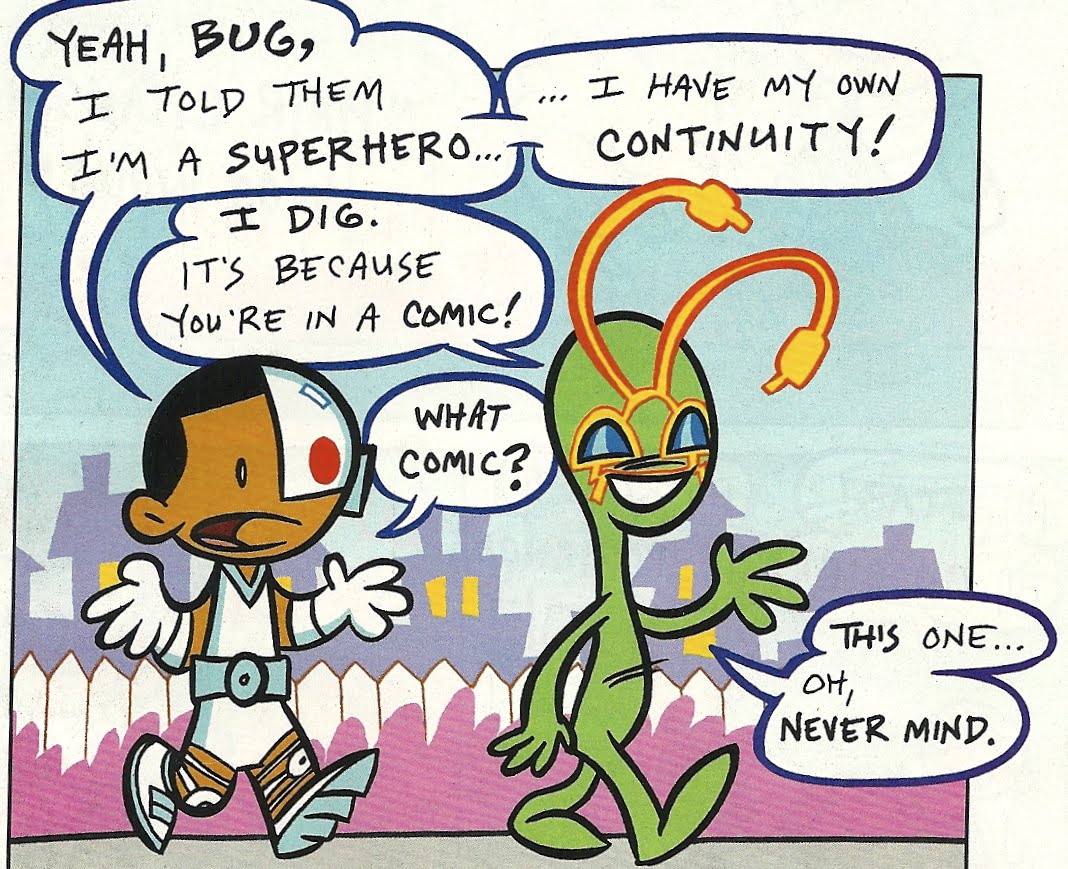
There’s another running gag involving Cyborg and Ambush Bug (What’s he doing here? And Tiny instead of grown-up sized?) talking about continuity, a gag I did not get at all. I seriously pondered the opening panel for minutes, and I just couldn’t get what Cyborg’s first sentence refers to exactly.
Am I too close to the material? Or (gulp!) is Tiny Titans over my head? Oh God, I’m not that stupid am I?!

Because he is.
Batman #701 (DC Comics) This is a pretty strange comic, one that essentially only exists because of the fact that Grant Morrison wrote two “deaths” of Bruce Wayne—the real one in the pages of Final Crisis and a fake, temporary one at the end of “Batman R.I.P.” in Batman, simply because the eventual trade collection needed a proper climax, whether the story Morrison was writing actually ended there or not. So here’s part one of “R.I.P.: The Missing Chapter,” by the “R.I.P.” creative team of Grant Morrison and Tony Daniel, explaining what Bruce Wayne got up to between not dying in a helicopter crash and then not dying in a shoot-out with Darkseid.
It’s existence is especially odd, given that this would have been so much more necessary back around the time Final Crisis was still going on, and it seems to exist now simply to remind readers about Dr. Hurt/Mangrove Pierce/Thomas Wayne/The Devil and what he did the last time he fought a Batman, since he just came back to Gotham City in the pages of Morrison’s Batman and Robin.
But I’ll take it; I’m not about to say no to any new Morrison-written Batman comic, even if it’s drawn by an artist I don’t care for.
Daniel is inking himself again here, and it’s probably his strongest Morrison collaboration to date—much better than his section in Batman #700. He seems to be going for a more Quitely-like design to Bruce Wayne, and both Batman and Superman (in his brief appearance) look rather Quitely inspired.
It’s not perfect, but it’s not bad either.
Birds of Prey #3 (DC) It’s all downhill after Cliff Chiang’s rather charming Birds of Prey-doing-Penguin-themed-burlesque cover. Like, immediately after.
The first three pages consist of a Penguin dream sequence in which he fantasizes about the heroines stripping and getting ready to pleasure him.
I think writer Gail Simone’s intent here was probably two-fold. First, to give pencil artist Ed Benes (once again splitting duties with Adrian Melo) a logical opportunity to do what he does best—draw buxom, muscular ladies jutting their butts and boobs out. And second, to do so with a sense of humor.
It doesn’t really work out all that well since there’s not a whole lot of difference between the way the women appear in the fantasy sequence and the way they’re normally dressed and posed. Here, can you spot which panel is the one from The Penguin’s fantasy, and which is just a random panel from the book?

Not all that far apart, are they?Additionally, since most of the ladies are about as scantily clad as DC will let any character this side of the Vertigo demilitarized zone appear, the differences between a stripping Black Canary or Lady Blackhawk and a not stripping Black Canary or Lady Blackhawk are basically something for the colorist to worry about—Nei Ruffino just colors parts of their breasts flesh-colored instead of black.
And as for the second possible motive, well, the punchline isn’t really all that funny. Three pages of set-up leads to an image of The Penguin making out with thin air, saying “My dear child, my lithe and lovely lutefish! Penguin party in my pants” aloud.
Maybe it’s just me, but I thought the suggestion of the cover—that The Penguin fetishizes monocles, top hats, umbrellas and cigarette holders—a lot funnier than the long, drawn-out detailing of the fact that he wants to fuck all the women in the book.
The next 19 pages aren’t any better, ranging from poor writing to incompetent art.
For example, here’s a scene of Hawk looking out the window of the Iceberg Lounge.
What floor would you say he’s on, given the buildings in the background? Probably not the ground floor, right? But then a SWAT team tank drives through that very window, and Hawk runs out the whole it creates, on the ground.
As for the writing, well, remember how in the last issue Gail Simone had two minor supporting characters from her previous run on the book killed off, and readers all over the Internet reacted with eye-rolls, sighs and sadly shaken heads that Simone was the 485th DC writer to pull a kill-off-characters-in-sad-attempt-to-gain-attention stunt, in such numbers that Gail Simone herself felt compelled to let readers know the characters probably aren’t really dead?
Well—surprise!—they’re not really dead.
I realize I’m not a professional comics writer or anything and thus my opinion may not pull much weight with those who are, but I’m pretty sure if you have to talk readers through your attempts at building suspense and surprises to let them know your scripting isn’t as clichéd as it appears, well, you’re probably not writing a very good script in the first place.
Brightest Day #6 (DC) Martian Manhunter gets the most pages this week, which means this issue is probably one of the better-looking ones, as the Martian Manhunter storyline has been the best illustrated by far (so far). J’onn continues to track down that weird alien monster thing that violently, graphically kills folks and which sorta resembles a Green Martian, but calls J’onn “the last” at one point so, um, I’m not sure what’s up with it yet.
There are some more Firestorm scenes over those hideously unnatural photo/model backgrounds, a little bit of Aquaman and Mera, and Hawk, Dove and Deadman messing around with the white power ring.
There’s a scene late in the book where J’onn visits Barbara Gordon for help, and it was a nice reminder of what is (potentially) cool about books like this set in shared universes—it’s just kind of exciting to see two such diverse characters borne from two such vastly different sources of inspiration sharing a story, a panel or a conversation. It reminded me of the Morrison JLA (which included the pair on the roster, although I think Mark Waid made more use of them together than Morrison ever did during a fill-in story he wrote), only partly because it referenced a few plot points from that run.
Also Patrick Gleason draws a fantastic Barbara Gordon; his really puts that of Benes and Melo to shame.
Check out Barbara Gordon from Brightest Day, in the first two panels, then Barbara Gordon from Birds of Prey:


So still digging this series a lot more than I’m not digging it. It’s rather 52-like, although less concerned with reinvention and creation than in revitalization. It’s a little like Geoff Johns smushed his Aquaman: Rebirth, Martian Manhunter: Rebirth and Firestorm: Rebirth into a Hawk and Dove pitch and tied it into the Green Lantern franchise. I can certainly see how the appeal of such a book would be rather limited, but I’m well within the target audience, and my only complaints about it are that one of the half-dozen story segments is terribly illustrated (the Firestorm one) and that it can be crazy violent (The alien killings in this issue are a lot more artfully staged than earlier ones, although it does end with a short-skirted Teen Titan being discovered brutalized. Those poor, doomed kids can’t catch a break…even outside of their book, I guess).
Earlier this year I noticed my new local library had a whole shelf of the manga, and figured if I had such a difficult time watching it, maybe I’d have better luck reading it.
It didn’t take me long to get completely hooked, and I had made it through all 22 volumes in a month or so, only to realize with shock and dismay that the series hadn’t actually ended yet, meaning I’d have to wait around for the next volume to be released.
Well, the next volume came out yesterday.
The epic series, an often quite funny action/adventure series about two young alchemists on a quest in a world that resembles our own around the time of World War I, only in that world alchemy is a real science, is clearly reaching its climax, as this volume was little more than fighting. I’m okay with that.
Alphonse vs. Kimblee and Selim/Pride! The Armstrongs vs. Sloth! Mustang vs. Envy…to the death! Briggs vs. Central! Everyone vs. those weird one-eyed doll soldier things!
I realize the twenty-third volume of a manga series probably isn’t the best place to start reviewing it, but I brought it home from the comic shop this week, so, by the rules of this column, I have to include it here.
If you’re interested but haven’t attempted it yet, see if your library has the first two or three volumes. If you’re not hooked by the second volume, then you’ll know whether or not this is something you’re going to end up loving madly.
I love it. Madly.
Gorilla Man #1 (Marvel) This is a comic book that contains this panel:
I wouldn’t imagine additional information is needed. You either want to read a comic book in which a gorilla pops a flying wheelie on a motorcycle while firing machine guns with his feet, or you do not. Details, like the fact that the head in the jar is that of Lucrezia Borgia and the soldiers being fired upon work for “Borgia Omega,” a sort of Borgia family cyborg.I’m not sure the six-page reprint of “It Walks Erect!” from 1974’s Weird Wonder Tales #7 justifies this comic being $4 instead of $3, but I appreciate Marvel at least attempting to justify the outrageous cover price.
Justice League: Generation Lost #5 (DC) Five issues! I’ve read five consecutive issues of a Judd Winick-written comic book! And I haven’t dropped it yet! Thinking it over, I’m not sure how much this comic book actually has to offer anyone who isn’t already a fan of either this particular group of characters or a fan of some of them as individual characters. I fall into both categories, so as long as a comic featuring them is competently created, I’m going to sufficiently engaged enough to keep my eye on it.
And this is competently created. The artwork on the series has its ups and downs depending on who’s drawing it that week, but this is definitely an up issue (Aaron Lopresti pencils over Giffen’s breakdowns, while Matt Ryan inks). Winick hasn’t written anything too terrible yet.
Er, I guess I endorse this product. I would probably like it less if it were monthly instead of bi-weekly, sure, and, if I didn’t have such affection for the characters, it would probably bore me to tears. So, if you more-often-than-monthly comics and the JLI aren’t things that make you particularly happy, well, take that into account, when considering my endorsement, I guess.
As the title indicates, this is a manga about a cat that runs his own ramen shop. That probably sounds like a one-joke premise, but Kenji Sonishi finds endless variations on the cat-that-runs-a-ramen-shop gag, while finding plenty of other direction to go in with Taisho, the cat who puts the neko in Neko Ramen. (I particularly enjoyed those about his strained relationship with his father, who’s disappointed Taisho didn’t follow him into the family business of being a cute kitty model).
Despite several other cat characters, Taisho lives in, works in and interacts with the human world, with his best (and just about only) customer, salary man Tanaka, playing straight man.
Sonishi’s manga is a series of four-panel gag strips, the panels tacked atop one another, although it occasionally shifts into longer form, more standard manga format to tell stories of Taisho’s past (Azumanga Daioh is the only other manga of this exact format I can remember reading off the top of my head).
Sonishi’s designs are particularly broad and cartoony, and he has a rough, somewhat shaky line that gives the strips a certain dashed-off charm.
Orc Stain #4 (Image Comics) Good God can James Stokoe draw. Here’s a terrible scan of a not-quite two-page splash of an orc city, built on a mountain that houses a drugged and slumbering giant spider-like monster:
Now that is a splash that deserves the space it takes up, and uses all of it. Wow. This is a fairly uneventful issue compared to the earlier ones,as orc architecture and telecommunications get an awful lot of focus, but there’s still a pretty insane fight scene, involving One-Eye’s rescuer, a human “poison thrower” named Bowie, and a couple of those weird super-orc guys who were chasing our protagonist previously. Several bizarre organic weapons are, of course, employed.
Orc Stain is an increasingly complex and crazy fantasy, of the sort it’s easy to imagine one-day cultivating a somewhat Star Wars-esque devotion, in which fans seek to catalog all the strange creatures and cultural elements of Stokoe’s world as a way of interacting with it.
And have I mentioned Stokoe’s drawing ability yet? I have? Okay, the above is what he did with slightly less than two-pages.
Here’s what he does with two full-pages. Well, I can't show the whole thing, due to the inadequate size of my scanner, so here's about half of it:
Jesus. I wonder how many Big Two comics artists look at splash pages like those in this book and then feel ashamed of themselves for the way they waste ‘em on things like two super-guys punching each other in front of a blank field that the colorist fills in with a pattern for them…
Scott Pilgrim Vol. 6: Scott Pilgrim’s Finest Hour (Oni Press) As one of the biggest comics publishing events of the year and as the conclusion of a massive (and massively influential), multi-book graphic novel story some six years and 1,200 pages in the telling, Bryan Lee O’Malley’s now complete Scott Pilgrim deserves a lot more space and consideration that it’s going to be able to give it in this particular column and, since I want to avoid spoilers for the time being, I’ll try to keep this short and personal anecdotal, returning to discuss the story in greater detail at some point in the near future. Tuesday night I re-read the first five volumes back-to-back (to-back-to-back-to-back) in preparation for the arrival of the sixth, and I think the fact that I could and did stay up until 3 a.m. reading almost 1,000 pages of a single comic book artist’s singular work says something about the quality of that work.
I’m not normally someone who cares about spoilers, and am therefore pretty cavalier with discussing plot points here on my blog, and not terribly careful about avoiding them. When I buy new comics, I always flip through them; I didn’t care if I found out who died in Countdown to Infinite Crisis or Civil War before reading the comics; I’m the same with movies and TV. For most escapism or entertainment, I’m more concerned with the execution of the creative endeavor than the specific plot.
There are exceptions of course (I didn’t want to find out why all the dudes died in Y: The Last Man until I read it myself, for example), and this was one such exception. I was afraid to flip through it and accidentally see something before reading my way to it.
So how was it?
I’m quite tempted to say perfect, even though I still had some unanswered questions, and at least one of the mysterious things I was extremely curious about remained unanswered (a second thing remained under-answered).
O’Malley managed to wrap up this gigantic plot in a way that was enormously satisfying without being predictable; that is, it felt right, it felt like what I wanted, even though it’s not how I would have thought it would have ended (nor is it how I would have ended it if it were up to me). That is some serious storytelling chops, to know (or guess, I guess) what your audience wants, even better than they themselves do.
Early in the fifth volume, O’Malley seemed to be taking his story in a much less obvious direction, but if he seemed to be leaning in an unpredictable, more subversive direction, he ends up going even further. This isn’t the conclusion the first few volumes suggested, nor is it any of the conclusions the later volumes suggested as alternates to that conclusion.
Er, I’m being awfully vague now I know; I just wanted to say that it was both satisfying and surprising.
It was, of course, fun and funny, but ultimately, it was, like about stuff. Important stuff. I wish I had Scott Pilgrim to read when I was as young as Young Neil; I could have used it.
O’Malley’s artwork here is downright amazing. In many ways, the first and sixth volumes look like the work of two completely different artists. I’ve read a good half-dozen sizable interviews with O’Malley in the past few days, and even the most creatively focused has zeroed in only on O’Malley’s writing and the creation of the plot-side of the story. I haven’t yet read the interview I most want to read, and I’m not sure if anyone’s conducted it yet, the one focusing on O’Malley’s art, and how he’s refined it over the course of drawing this story.
Anyway, I’ve been looking forward to this comic since reading the last page of Vol. 5, and I wasn’t disappointed—if anything, my expectations were exceeded.
Good job, Bryan Lee O’Malley!
If anyone deserves a big Hollywood movie, a video game adaptation, crazy-popular release parties and phenomenal sales, it’s O’Malley.
Super Friends #29 (DC) Well, if they had to cancel the book, I guess this is the sort of issue you’d want to go out on. It’s one of Sholly Fisch’s better scripts, and pencil artist Stewart McKenny’s best work on the series. It’s also a perfect example of the book’s potential to appeal to both kids and adults (the latter through in-jokes, with which this issue is bursting).It’s “Super-Con,” the Super Friends-iverse equivalent of Comic-Con International (Hey, nice timing, DC!), and the biggest superhero fans in all existence have decided to attend—Bat-Mite and the Super Friends’ various magical imps.
Is it unfair that everyone has an imp except Green Lantern? Don’t worry; they draft someone to even up the Super Friend/Imp roll call:
The premise here is that Bat-Mite makes Mr. Mxyzptlk promise not to use his magic, a promise he sticks to, but as the only imp he isn’t also a superhero fan, he decides to make trouble, tricking the others to use their magic to mischievous ends. This eventually leads to the Super Friends having to step in to save the day once Bat-Mite gives every con attendee powers, but, leading up to that, the book basically consists of the imps being comics fans. You know, Mopee and a Flash fan arguing over whether Mopee giving the Flash his powers originally is a dumb idea or not and Quisp arguing whether Aquaman is lame or awesome and so on.
McKenny’s imps are all fantastic looking, and he has a ton of fun filling out crowd scenes with unusual cameos: Baba Yaga, Stanley and his Monster, The Queen of Fables, a zombie, Bouncing Boy, Blue Devil, George Washington, Sam Simeon, you name ‘em, they’re probably in here.
Also, I never realized how rugged and handsome Stewart McKenny is, but I guess he’s basically the Doc Savage of people who work on Super Friends comics:
At least according to Stewart McKenny.Oh, this issue naturally had a craft project, which I tested out. It’s a make-your-own-imp-name-name-tag thing. Here’s mine:
My 5th-dimensional imp name is "Mr. Jclbmzzcc," and I imagine if I could figure out how to properly pronounce that backwards, I should be able to visit the fifth dimension.Oh, and they have a new paper stock with this, the final issue but I’ll complain about that in the next review.
Tiny Titans #30 (DC) Aaaa! This “Johnny DC” title has a new, slick paper stock as well! I hate it! Hate it! Haaaaate it!Well, “hate” is a strong word, but at least some of the pleasure I derived from DC’s Johnny DC books was from the paper stock. I liked the way those comics looked and felt and smelled, and, while this month’s Tiny Titans has the same great Art Baltazar art, it doesn’t feel or smell the same at all, and the look is different enough that it may take me a few issues to get comfortable reading it again. (Also, I think it’s slightly less writing-utensil friendly than the old stock; pen seems to work okay, but pencils and crayons not so much, so activities could be a concern).
As the cover details, the theme of this issue is curly hair, so most of the gags revolve around curly hair in some way. Kid Flash and new character Peek-A-Boo (Note: I have no idea who she is or where she comes from. Is she a Titan character?) use their super-speed to give various characters new hairstyles, mostly inadvertently.
There’s another running gag involving Cyborg and Ambush Bug (What’s he doing here? And Tiny instead of grown-up sized?) talking about continuity, a gag I did not get at all. I seriously pondered the opening panel for minutes, and I just couldn’t get what Cyborg’s first sentence refers to exactly.
Am I too close to the material? Or (gulp!) is Tiny Titans over my head? Oh God, I’m not that stupid am I?!
Wednesday, July 21, 2010
I just noticed something from a five-year-old comic
Last night I re-read the first five volumes of Bryan Lee O'Malley's Scott Pilgrim in preparation for the release of the sixth and final volume today, and just noticed something for the first time. In 2005's Vol. 2, Scott Pilgrim Vs. The World, there's a scene where Scott and Ramona walk through a playground (above), and the little ride-y spring things there bear the faces of title characters from some of O'Malley's peers' comics.
Namely, Salamander from Hope Larson's 2005 Salamander Dream
and Kean Soo's character Jellaby, who appeared online and in Flight anthologies before appearing in 2008's Jellaby from Hyperion.Today a new trailer for the Scott Pilgrim Vs. The World video game apparently made it online, in connection with Comic-Con no doubt, and the playground Ramona and Scott are walking through in the panel at the top of the post shows up in the game, complete with Salamander and Jellaby ride-y spring things.
They're at the forty-second second mark or so: Surreal.
Labels:
hope larson,
jellaby,
kean soo,
o'malley,
scott pilgrim
Wednesday, July 14, 2010
Does Scott Pilgrim's band Sex Bob-Omb sound like...Times New Viking?

Bryan Lee O'Malley, Edgar Wright and Beck say yes, according to a recent LA Times article:O'Malley recalled some of his early discussions with Wright on the sound of Sex Bob-Omb. He said he tried to sell the director on Times New Viking, a Midwest punk band signed to Matador and steeped in rudimentary, low-fi noise. Wright, however, wasn't having it, at least not until the pair met with Beck in his tour bus at San Francisco's Outside Lands music festival.—From Todd Martens' article on how director Edgar Wright went about finding the right sound to give Sex Bob-Omb in his film adaptation of Bryan Lee O'Malley's Scott Pilgrim series, from the LA Times' Hero Complex blog.
"We wanted them to sound like a garage band," O'Malley said. "We wanted them to sound rough and really distorted. There's this band called Times New Viking who had just released an album, and I was like, 'These guys are perfect.'"
"Edgar wasn't completely taken with them," O'Malley continued. "So we start down with Beck, and the first thing he said was, 'I think they should sound like Times New Viking.' So Beck totally understood what we were going for. Edgar and I just kind of looked at each other."
Columbus readers may recognize the band name Times New Viking, as the "Midwest punk band" is actually Columbus-based (That's them above, playing at the Wexner Center in 2007).
You can hear a handful of their songs here ("My Head" is my favorite).
And you can see the unfortunately Times New Viking-less but (otherwise quite strong) soundtrack play list on blog The Playlist, and check out Bryan Lee O'Malley's discussion of who picked what and why on his blog, Radiomaru.com.
Tuesday, July 13, 2010
All of a sudden, I regret being such a Luddite
I remember shortly after E3 a lot of comics blogs posting and linking to preview footage of the Scott Pilgrim Vs. The World game play, but I don't think I've seen this trailer for the game, which I came across by accident the other day. Kinda makes me wish I still played video games/knew anyone who did and owned the appropriate gaming machine. I think the last time that happened was the release of Lego Batman. Maybe there will be an arcade version of it, with a Gauntlet-style four-joystick set-up in movie theater lobbies...?
Anyway, here are some details about the game; the character designs are remarkably close to Bryan Lee O'Malley's as they appeared in the comics, aren't they?
Friday, June 18, 2010
In which I babble about three comics-based movies I haven't even seen yet
I've been a terrible comics fan this summer. Despite being mildly interested to rather excited about each of them, I have yet to see Kick-Ass, The Losers or Iron Man 2...and now we can add Jonah Hex to the list of Comics Movies You'd Think Someone Big Into Comics Would Maybe See On Opening Weekend.
I don't have any reason for having not seen any of those movies yet, I guess I just don't get the movies as much as I used to now that no one pays me to watch movies and then write a few hundred words about whether I thought they were any good or not. I hope to at least see Iron Man 2 on the big screen, and hopefully Jonah Hex, which I am honestly quite curious about.
There have been tell-tale signs that things weren't going so hot with Jonah Hex throughout the production, and I got a sinking feeling when I saw that first trailer, in which they revealed that Jonah Hex apparently had a super-power of some sort other than simply being Jonah Hex.
The reviews I've seen so far haven't been pretty. In fact, they've been so not pretty that Jonah's profile might actually be prettier than the reviews.
Keith Phipps' review for The Onion's AV Club, summed up the movie rather pithily: "Jonah Hex is what happens when someone promises to deliver a releasable movie by a certain date, and then doesn’t." Phipps notes the stitched-together, at-conflict-with-itself nature of the movie ("[E]very once in a while, a film limps into theaters so stitched together, it’s a wonder it doesn’t rip apart in the projector.") The AV Club, by the way, gives the movie the letter grade of "F." Marmaduke earned a D.
I'm still curious. In fact, maybe now I'm a little more curious than I was before I started seeing reviews. (Phipps' review also says the movie's only 81 minutes long. How the hell do you make an 81-minute feature film in 2010? The average comic book superhero movie is like five hours now, isn't it?)
Part of the reason for that curiosity is simply I don't understand how exactly one can screw up making a Jonah Hex movie. He's not all that complicated a character. He's a Clint Eastwood-style cowboy hero, a bounty hunter with a heart of gold (or at least a heart much less black than one might expect him to have) and a hell of a visual hook. Jonah Hex is pretty much tailor-made for a 21st century Western, since he wears the ugliness of the era right there on his face. He's a poke-in-the-eye-obvious metaphor for an exciting, adventure-filled but ultimately quite ugly period of American history. He could have quite literally been the face of the modern, post-deconstructionist western.
And I'm not talking about the character's potential or anything. That's just who and what he is, in terms of visual design. His back-story and the details of his life are awfully unimportant—and, in fact, factor in to very few of the Hex stories I've read over the years—so he's not like Batman or Spider-Man where a filmmaker needs to make a lot of decisions about how much of a specific story to tell, which of the hundreds of characters to include and how to deal with the audience's preexisting understanding of the character from all the other media examples they've seen of him. (By the way, how many cartoon appearances does Hex have? I know he was in Batman: The Animated Series and Batman: The Brave and The Bold. Wasn't there a time-traveling episode of one of the Justice League cartoons, too? Is that it? Anyway, the point is, he's not like Superman or Batman or Spider-Man or even The Hulk).
A studio could take just about any Western script they have in their script slush pile, change the protagonist to a horribly-scarred bounty hunter, and hey, what do you know, it's suddenly a Jonah Hex movie.
I realize my words have very little weight here, given that I'm going off of a couple of reviews rather than the movie itself, but it sounds to me like Jonah Hex may have gone wrong by trying to turn a character who was little more than a generic cowboy with an interesting look into superhero character, complete with super-powers and a plot involving saving the day. Hex comics were and are almost all straight Westerns, not superhero comics, so bending his home genre toward another simply because of a faulty perception that the medium of comics automatically equals superhero seems like a pretty huge, fundamental problem that it would probably be pretty difficult to recover from.
Or hell, I don't know, maybe the folks who made the movie were just incompetent. I guess I'll go see it at some point and find out for myself.
*******************
Maybe Keith Phipps just hates ugly cowboys, though? Let's check another of my favorite sources for film criticism, The Village Voice. Oh shit, "Bracingly inept, Chef Boyardee spaghetti western Jonah Hex is the rare 80-minute movie that you can’t even call 'taut.'" Heh. "Chef Boyardee spaghetti western."
Okay, they can't all be like this. Let's just head to Rottentomatoes.com. Yeesh, as of this writing it's got a 14% positive rating. "There isn't a single reason to see this movie...Director Jimmy Hayward fails to establish a viable reason for this movie to exist..." ah, wait, here are a couple of positive reviews.
Kevin Carr says "Jonah Hex is not a good movie. Not by a long shot...But that didn't stop me from having a hell of a lot of fun watching it." And Amy Biancolli says: "I think Jonah Hex could have exceeded 80 minutes to make room for some real visual invention. And three-dimensional characters. And a plot. A plot would have been nice."
Those are the positive reviews? Because those are not very positive things to say about a film.
*******************
The bad news, of course, is that if opening weekend box office reflects the buzz and reviews the film is getting then that means a Jonah Hex 2 isn't terribly likely, and even a "reboot" would be a long shot (It didn't take long for Punisher and Hulk reboots, of course, but I think both of those characters/franchises were perceived as a lot more exploitable than Jonah Hex).
So I guess that means we're unlikely to see Hex vs. the undead or Hex vs. Lovecraftian monsters movies in the near future, and a movie about a Hex wandering around a post-apocalyptic future is definitely out of the question, as is a feature-length, live-action adaptation of the recent episode of Batman: The Brave and The Bold where Mongul hires Jonah Hex to capture Batman to use as a gladiator on War World.
********************
I'm curious what, if any, impact the (presumed) failure of the film might have on DC Comics' publishing plans for the character. It's no secret that the book sells pretty abominably in the direct market. According to the monthly Beat analysis, the Jonah Hex monthly comic moved a little over 11,000 units, and that's about the neighborhood it's been hanging around in for most of the past year, with occasional fluctuations in response to particular artists (#50 was charted at just over 15K for example).
That's generally around cancellation levels for DC, but Hex has continued to hang on. There are several possible reasons for this, of course, including the fact that those numbers are pretty rock solid (it may only sell around 11K a month, but it always sells around 11K a month, instead of dropping drastically each month) and that the collected trade editions may do just fine in bookstores, regardless of how many serialized issues direct market retailers buy to sell their customers.
I suppose it's also possible that writers Jimmy Palmiotti and Justin Gray have compromising photos of Dan DiDio (that would explain why DC's launching a Freedom Fighters ongoing monthly from the pair all of a sudden!).
Or perhaps DC's kept publishing the monthly so long in order to have plenty of Hex material to sell civilians when the movie came out. If that is the case, and the movie has now come and gone (and if it does end up being a flop and thus not birthing a healthy film franchise), then perhaps DC will pull the plug on the monthly?
That's a lot of if's, I know.
Personally, I don't read Jonah Hex, save for a random issue here and there when I like the artist involved, or in the form of a trade paperback I randomly find at a library, but I do kind of hope it sticks around. Regardless of the state of my personal pull-list, I like knowing that DC is publishing the sort of book that anyone can pick up at almost any time and get a complete, done-in-one story, and I love the idea that they're publishing a book in which a Jordi Bernet-drawn issue will be immediately followed by a Darwyn Cook-drawn issue, and that in any given month you might see J.H. Williams III, Val Semeiks, Paul Gulacy or Phil Noto under its cover (And the covers themselves have all been from a who's who of great comics talents). Whatever else it may be, Jonah Hex is a pretty great showcase of comics artists.
*******************
As lax as I've been about getting to the movie theater this summer to see the latest crop of based-on-a-comic movies, one film I can guarantee I'll be at on opening day (barring some unforeseen tragedy) is Scott Pilgrim Vs. The World.
I was kind of worried when star Michael Cera was first announced, as I have a hard time matching him to Bryan Lee O'Malley's comics character, and the first trailer left me kind of nervous. But the second trailer, and now the new "international trailer," have dispelled all my worries and I find myself super-excited about the prospect of a live-action Scott Pilgrim movie.
Seriously, this looks so good:
If you're reading this blog at all, chances are you've already seen that trailer somewhere, as I think just about everyone who writes about comics on the Internet has either posted it or posted a link to it (You're welcome for the free marketing, people who made Scott Pilgrim Vs. The World!)
Director Edgar Wright posted it on his blog the other day, and I can't tell you how happy I was that he also listed the songs featured in the trailer, solving a problem that's been plaguing me since the second trailer was released: What is that goddam song that starts at around the 1:50 mark with Kim Pine pretending to shoot her self in the head and plays throughout the rest of the trailer?
I can't tell you how many times I've watched that second trailer, because even if I was counting, I would have lost count pretty quickly, as it was a very high number. At least part of that was due to the fact that the song played throughout the back half of the trailer got stuck in my head, which meant I had the trailer stuck in my head, and ended up compulsively re-watching it over and over, in a half-conscious attempt to get the song out of my head by getting over it.
Since I didn't know what the song was, I had no choice but to watch the trailer a billion times or so. (So great job whoever put that trailer together! You pretty much hypnotized me at one point!)
Well now I know that the song is "Invaders Must Die" by The Prodigy, from the 2009 album of the same name. Like the song that plays over the opening of the second trailer, "Great DJ" by the Ting Tings
But whatever, I finally knew the name of the song, and could listen to it over and over to break its hold on me! I was somewhat shocked to learn I actually kind of liked a Prodigy song, given how much they used to irritate me in the mid-to-late-'90s. I think I like "Invaders Must Die" slightly more with explosions, cymbals and the clanging of metal weapons mixed in over top of it though.
Oh, and the song that plays just before the "If we're going to date, you may have to defeat my Seven Evil Exes" bit is from "It's Getting Boring By The Sea" by Blood Red Shoes, which is a pretty damn awesome song. (Actually, I've liked all of the Blood Red Shoes songs that I've heard so far).
So hooray for the Scott Pilgrim Vs. The World trailers, I love everything about them, and particularly like the way they seemingly improve on some gags from the original comic (like Scott's terrible drawing of Ramona's hair when he asks Comeau if he knows a girl with hair "like this," and the fact that Comeau immediately recognizes her; in the comic Scott just dangles his fingers to evoke Ramona's hair). I'm still kind of nervous about this, as I think some of the idiosyncratic humor of the comic's characters' dialogue delivery gets lost when it's polished up and spoken by professional actors, but so far it looks so great.
********************
I was surprised to learn that Sony's adaptation of the Smurfs comics—or, more likely their adaptation of the cartoon adaptation of the comics—is going to be a horror movie.
At least, I assume it's going to be a horror movie. That would explain why all I feel when I see this
is confused terror.
Sunday, November 18, 2007
I finally found something about Scott Pilgrim Vol. 4 to complain about
The fourth volume of Bryan Lee O'Malley's Scott Pilgrim is, like the first three, totally awesome. In fact, it might be a little more awesome than the previous ones, as O'Malley's art is getting better and better.
It's pretty much the perfect comic book, having a little bit of everything I read comics for—action, humor, romance, strong characters, nice art, cool designs—all in one story, and it was probably the most fun I've had reading a comic all year. Were there better comics published in 2007? Sure, yeah, of course. But was there a more fun one? I don't know; the closest thing I can think of off the top of my head right now is Black Metal.
In fact, after reading Scott Pilgrim Gets It Together Wednesday night, I couldn't think of a single bad thing to say about it.
At least, not until now!
Check it out:

It might not jump right out at you because I took the picture with my laptop, and there's some weird mirror action that goes in the camera in it, but note that for this fourth volume, publisher Oni Press has changed up the design of the book, so that when you file it away next to the three previous volumes on your book shelf, it's now totally incongruent.
The first three had a uniform design, with "Scott Pilgrim" in a cowboy looking font, O'Malley's name in a arcade font, little slim numbers, and a headshot of a character. But for the fourth volume, the fonts are reversed, they ditched the character headshots, the number is bigger and the "Oni Press" logo is different too.
Man, I hate when that happens. I don't know if it's just because I'm so incredibly anal about books, or if it's because a lot of what I like about graphic novels is the way the best designed of them serve as art objects in addition to readable stories, but it always drives me nuts when publishers change the design of serial graphic novels, particularly the first time through.
Like, when I started collecting Ranma 1/2, Viz was still publishing it in the older, bigger format, at $15.95 to $16.95 a pop. Each volume was a different color, and as I amassed them, a rainbow of Ranma 1/2 slowly began to assert itself on my bookshelf. But after 21 volumes in that format, the now-standard, smaller, slimmer $9.99 manga digest arrived, and Viz changed the design of their Ranma trades, so now volumes 22-36 are all uniform and are all navy blue, with a different spine design than that of the first 21. They don't look as nice as the old ones, but, more frustratingly, they're totally different, so a little more than half of the run looks one way on my shelf, while the rest looks the other way.
This has happened with a couple manga series I was reading, as well as some Vertigo series, although in the case of the latter, it was more subtle (Like, Y: The Last Man and Fables spine design has incorporated the newer Vertigo logo, changing the spine in later volumes slightly from those of earlier volumes).
And now it's happened with Scott Pilgrim. Do newer printings of the first three volumes have a spine design similar to that on the fourth volume, so future readers will be able to have a shelf full of Scott Pilgrim that look like they were designed to be set next to one another on the shelf? Am I being punished for having read it right from the start? I don't know, I haven't looked into it.
But anyway, that's the only thing I can think of to complain about Scott Pilgrim Vol. 4: Scott Pilgrim Gets it Together.
Wednesday, November 14, 2007
Weekly Haul: November 14th
Man, when it rains it pours. This Wednesday saw a downright daunting confluence of comic book releases and events I’ve been waiting on for months. And, in some cases, years. There was so much great stuff on the shelves this week that the conclusion of Marvel’s blockbuster World War Hulk was pretty damn low on my list of things I was excited about.
There was a new volume of Scott Pilgrim, which always automatically transforms any Wednesday into Christmas. And not just normal Christmas, but Christmas from when you were a kid.
There was the long anticipated, years in the making new League of Extraordinary Gentleman, this time released in a graphic novel, sparing the months of waiting between chapters.
Gail Simone’s run on Wonder Woman began, about a year and half after it should have (If DC had any sense—and, as you know, they don’t—Simone would have relaunched the title “One Year Later,” while Allan Heinberg and Jodi Picoult would have been given original graphic novels to work on).
And Anima, one of sixteen-year-old Caleb’s favorite DCU characters, makes her first appearance since her own book was cancelled (Too bad it was written by my least favorite writer, drawn by one of my least favorite artists, and that it was only to get killed off anyway).
Man, so many comics came out that I reluctantly left a ton on the shelf. Perhaps I’ll be back for you some day, Meatcake #16, Courtney Crumrin and the Fire Theif’s Tale, Yakitate Japan, Doc Frankenstein and others. Captain Carrot and “Resurrection of Ra’s al Ghul,” step up your game, guys! And Wonder Girl, stop tying into crappy comics! Why are you making it so hard for me to enjoy Sanford Greene’s art?!
Okay, well, that’s enough talking to the comics I didn’t buy; it’s time to start talking to you about the comics I did…
All-Star Superman #9 (DC Comics) The best Superman book—hell, the best superhero boo— is still the best. In this issue Superman meets another alternate version of himself, in the form of two Kryptonians who have appeared on Earth while he was stuck in Bizarro World. I think we’ve all seen several thousand stories in which Superman meets other Kryptonians only to discover that they’re an awful lot more evil than him, but Grant Morrison and Frank Quitely still make the concept seem fresh, mostly in the way these two ridicule Superman and his peculiarities. The last two pages are just a brilliant sequence, with a dramatic 1-2-3 beat, building to an explanation point bit of punctuation to a poetic, one-issue run-on sentence of a story.
Plus: Jimmy Olsen’s overpants.
Only three issues left of the originally announced 12-issue Morrison/Quitely run. And then what? Hopefully an announcement regarding 12 more.
Avengers: The Initiative #7 (Marvel Comics) Wow, did Dan Slott ever pack a lot of story into this issue! Seriously, there is a lot going on here, and in a more-bang-for-your-buck kinda way then a too-much-story-crammed-into-too-little-space kinda way. We’ve got The Vulturions vs. The Scarlet Spiders in the skies of New York City, with a still angsting over “One More Day” Peter Parker getting involved. We’ve got Justice and Cloud Nine trying to get to the bottom of the “Why isn’t that dead guy dead?” mystery that keeps getting interrupted by crises. And we’ve got some office politics at Camp Hammond, plus a look at Kentucky’s Avengers team and Slott cleverly trying to un-reveal Spider-Man’s secret identity in a way that seems very Silver Age DC, but still more satisfying than a cosmic continuity reboot of the sort Marvel seems to be in the middle of executing. Now that Jeff Parker seems to have left Marvel Adventures Avengers, this is by far my favorite comic with the word “Avengers” in the title.
Batman and the Outsiders #1 (DC) Okay, let’s see if I can remember this all correctly. Originally, DC editor-turned-writer Peter Tomasi was going to write a new Batman and the Outsiders series, replacing Judd Winick’s plain old Batman-less Outsiders, but he wasn’t happy to be paired with artist Koi Turnbull. Tony Bedard was then named the new series’ new writer, and he helped mastermind a five-issue weekly event called Outsiders: Five Of A Kind to explain who would be on the new line-up, a line-up which a DC house ad spoiled weeks ahead of time anyway. Then Bedard and Turnbull were replaced by Chuck Dixon and Julian Lopez and the line-up changed, again being revealed in a DC house ad, this time a retouched version of the previous one, which swapped out a few characters for a few other ones.
And now after three writer changes, two artist changes and a line-up changed, #1 finally hits the stands.
Honestly, curiosity over the tumultuous (and incredibly public) development hell was a pretty big determining factor in deciding to pick this up at all, particularly since it was being written by Dixon. Now Dixon is one of the better Batman-centric action writers, despite the fact that there’s usually not much to the stories other than plot and banter, but I was more curious in how he’d write a book with two lesbians on the cast, given his boneheaded public remarks about gay people in comic books (So what’s this make Dixon? A professional who sets aside his personal views in service of the characters he’s writing? Or a hypocrite who will write stories he finds morally objectionable for a paycheck?)
As for the book, it’s about what I expected, and certainly better looking than a Turnbull-drawn one probably would have been. Batman and Thunder (Lesbian #1!) sit around in a dark room talking about their mission, while Batman’s other agents—Metamorpho, Katana, Catwoman, Martian Manhunter and Grace (Lesbian #2!)—infiltrate a creepy corporation that is studying something I was sick of reading comic books about two years ago (Here’s a hint: its initials are OMAC).
Dixon is on pure potboiler mode here, his usual setting, and he doesn’t do a bad job of reintroducing all the characters. He does mention the relationship between Thunder and Grace, which I was a little surprised of, actually. Lopez’s art is quite nice, and inker Bit and colorist Marta Martinez load it up with welcome details, giving the whole thing a slick feel, full of images that really pop (Sure, the first three pages are wasted on a one-page splash followed by a two-page splash that simply establishes that two characters are parachuting, but at least this waste of space is nicer looking that similar wastes of space). They’ve even given Katana a new costume that doesn’t hurt my eyes (that’s not it on the cover), for which I applaud them, although I do wish Metamorpho and Martian Manhunter would get their heads back to normal sometime soon.
All in all, it’s a respectable team super-book. Nothing revolutionary or particularly interesting so far, but it’s a very well done sort of uninteresting, which is by far the best kind.
Booster Gold #4 (DC) Booster, Rip Hunter and even Skeets all meet their opposite numbers in this fight scene issue, as the six combatants slug it out in the lightning storm outside police scientist Barry Allen’s office window, the same storm that will turn him into The Flash—if the good guys beat the bad guys. Writers Geoff Johns and Jeff Katz reach deep, deep into their longboxes to pull out the identities of the bad guys, and this was the first I’ve heard of either of them (Sorry, I wasn’t reading comics in the ‘80s). This is probably the most serious and least zany of the issues so far, but it definitely has its fun moments, mostly revolving around Skeets.
League of Extraordinary Gentleman:The Black Dossier (DC/Wildstorm) I haven’t read this yet, but I did haul it home form the comics shop, so I figured I better mention it here. Given that this is Alan Moore’s last work for Wildstorm, and the last LOEG book that DC/Wildstorm will be publishing, I wonder if he was able to resist the urge to just totally phone it in, and, if so, how. Flipping through it so far, it looks almost too pretty to mess with. I’m really reluctant to detach the 3-D glasses, for example. Of course, I had the same problem with Lost Girls—the package was just so nice, I was kinda reluctant to handle it at first. Look for a full review in next week’s Las Vegas Weekly.
The New Avengers #36 (Marvel) In this issue, the Republican Avengers defeat the Venom-ized Democrat Avengers in the space of a six-page recap, which seems like quite a waste of a Venom-ized Avengers story, but perhaps that’s because the actual story will play out in writer Brian Michael Bendis’ other Avengers book, the one that’s like four years behind schedule at this point. Meanwhile, Luke Cage talks to his wife while their darling baby is dressed in Iron Fist’s colors, Wolverine invades Jessica Drew’s shower (You know what? I don’t even want to read a Newsarama interview explaining what’s happening in the last two panels of page 14, Bendis, you pervert), and Luke Cage rallies The Initiative, Thor, The Punisher and Howard the fucking Duck to take on The Hood.
As Bendis issues go, this one is pretty jam-packed with events, and I really love artist Leinil Yu’s lay outs, scratchy character designs and the way he draws the rims of characters’ eyes. He also gets to draw a lot of boobs this issue. There’s, like, at least two boobs on every single page. Also, the entire city of New York is naked at one point. You know, Bendis sure writes a lot of scenes in which large groups of people are totally naked in this book. I wonder what the nanke people-per-issue ratio of New Avengers is compared to the industry average…?
Scott Pilgrim Vol. 4: Scott Pilgrim Gets It Together (Oni Press) Now on its fourth volume, you either already love Bryan Lee O’Malley’s action-packed arcade logic romantic comedy about Canadian twentysomething hipsters, or you’ve yet to experience, or there’s something deeply wrong with you.* At this point, I can’t imagine there’s anything you’d read in a review that’s going to make you love it more or less or try it if you haven’t already. But, for the curious, this issue is aptly named, as our dense young hero must pause from his quest to defeat his girlfriend’s Seven Evil Ex-Boyfriends to get his life in order, which means getting a job, a better living situation and deciding just how committed he is to Ms. Ramona Flowers (while she must decide just how committed to him she is). In that respect, things get a bit more dramatic than they have in previous issues—with whether some of Scott’s more noble behavior is due to his morals or his being a huge pussy being a theme binding much of the volume’s over all story together—but that familiar mixture of crazy-ass action, whimsical silliness, character-based comedy and lighthearted romance is still present throughout. New to the series are some inspired gags making fun of the book’s manga format, like the “Stop!” page at the back of the book, and the color-section in the beginning.
Number of times I laughed out loud: Five.
The one spoiler I’ll give here: Holy shit! That dude cut a whole streetcar in half…with a sword!!!!!
Suicide Squad #3 (DC) Writer John Ostrander seems to finish up the “How come Rick Flag is still alive?” portion of the story, bringing us up to the present in the DCU. I’m pretty lost at this point, mostly because I haven’t been reading Checkmate or Countdown, and I’m having trouble reconciling the business of The General with the only other comics featuring him I remember, Morrison’s JLA stories. This is about the point I’d probably check out, but I’ll be damned if the exchanges between Flag, Waller and Deadshot on the last few pages didn’t get me excited about what comes next, now that the backstory is all out of the way.
Wonder Woman #14 (DC) Well, without even cracking the cover, one thing seems clear—this is bound to be the best issue in the new volume of Wonder Woman so far, judging by the credits. New writer Gail Simone finally comes on board, following a brief stint by J. Torres, who stalled for her by tying into Amazons Attack for a couple of months. Unlike the series’ first writer, Allan Heinberg, Simone is capable of writing at least 22 pages of comics every month, and, unlike superstar author Jodi Picoult, Simone has actually read Wonder Woman comics before. So, even if this is Simone at her absolute worst, it’s bound to be quite an improvement.
And it is although, in all honesty, I still wish it were a lot better.
Part of the problem is the amount of baggage Simone has to deal with. Her Wonder Woman has the same status quo as Heinberg’s—working for a United States government agency devoted to policing meta-humans, hiding under a secret identity with the exact same name as her Wonder Woman identity and disguised only by a pair of glasses**—and the Amazons are currently pretty tainted by Amazons Attack/Countdown (I read the opening scenes with Hippolyta with question marks dancing over my head, unsure of how any of this makes sense…a feeling that resurfaced during “The Society” talk…is this different than “The Injustice League” currently in JLoA?).
Now, dealing with baggage is part and parcel to working on big comic book characters like Wonder Woman, and a good writer will always find a way to make it work, but it seems almost inherently unfair that George Perez got the greenlight to completely rebuild Wonder Woman from the ground up after Crisis On Infinite Earths and Heinberg to do the same after Infinite Crisis, while Simone, a more accomplished writer than either were when they were working on Wonder Woman, is now the fourth writer in just 14 issues, stuck trying to tell a logical story after illogical messes like Picoult’s run and Amazons Attack.
With all those qualifiers out the way, I’m happy to say Simone does an okay job here. The narration on the first five pages, set on the Amazons’ island, is overdone and kind of unnecessary, but the scene itself rings with mythic import. From there, we get Diana mixing it up with a cell of Gorilla City terrorists and defusing the situation in Wonder Woman fashion, some DEO sitcom stuff, and then the appearance of a Captain Marvel villain which sets up a conflict between Wondy and her traditional foes—Nazis.
Terry and Rachel Dodsons’ art is quite nice—I really like their Wonder Woman bottoms compared to Ed Benes’ barely there ones—but they seem stuck in redesign mode, continually redesigning characters that don’t really need it. Captain Nazi, for example, just had a nice redesign in the pages of JSoA, and yet here he gets another new look, this one making him almost indistinguishable from Nemesis, unless you scrutinize the symbols on their chests.
I was pretty disappointed in their Etta Candy, too. I know she’s slimmed down since the Golden Age, but man, here she’s looking positively svelte, the only thing really distinguishing her figure from Wonder Woman’s being that she has slightly bigger cheeks. Come one Dodson, let’s get some meat—er, candy—on Etta’s bones!
World War Hulk #5 (Marvel) There is only one way this series could have featured better onomatopoeia sound effects, and that would have been if writer Greg Pak had enlisted Doug Moench as a consultant. In this issue, the inevitable fight scene that’s been foreshadowed since the first issue finally occurs: The Sentry vs. The Hulk. And it sounds awesome. First contact? “KWAGLOOOOOM!” Hulk punching Sentry’s face? “SPAKOOM!” The resulting explosion? “SPRACHOMMM.” And man, that’s before Sentry even breaks out the crazy energy powers, and we get stuff like “VJJJWOMMMVVVVVVB” and “SPPPPJJZZZZZ.”
I know I’ve said this about every issue, as has just about everyone else who has read it and said anything about it on the Internet, but this was just a ton of fun—a good old-fashioned superhero slugfest, one that’s helped tremendously by the simple selling point and widescreen art by John Romita Jr. and Klaus Janson, with Pak and letterer Chris Eliopoulos doing their best to evoke Dolby surround sound in comic book format.
As for the ending, neither Pak nor Marvel managed to mess it up—while Civil War’s last chapter left me confused, angry and irritated, this gave me a sense of relief and closure—it’s predictability being more of the satisfying sort that comes with a perfect ending, rather than a cynical one. (I should note “Best Shots” colleague Troy Brownfieldhad privately called the “surprise” ending somewhere between World War Hulk #1 and #2).
Now, as for the three continuations of this story, in new ongoing Hulk, The Incredible XXXX (Formerly The Incredible Hulk) and the new, never before-announced 2008 series? I’m only at all interested in the middle one, because the name, which is revealed in the house ad in WWH #5, makes me laugh. A Jeph Loeb-written red Hulk sounds like the worst idea ever***, however, and that last one seems more for “Planet Hulk” enthusiasts than anything else. (Confidential to the person in the image: Get a haircut, hippie!)
*And that something is that you and I have extremely different tastes.
**Yeah, yeah, Superman too on the “disguised by glasses” part. There are several dozen reasons why it’s different, which I don’t care to get into now, other than to say Superman’s “secret identity” is widely known—It’s Kal-El—so no one’s expecting him to have a “secret identity” post-Crisis, he has such powers as super-ventriloquism to super-speed to disguise himself, and he’s always had a secret identity (that is, there’s always been a Clark Kent), he didn’t just suddenly adopt one as an adult and have to fake a backstory, the way Wonder Woman apparently must.
***With the possible exception of having Jeph Loeb write the Ultimate Universe.
There was a new volume of Scott Pilgrim, which always automatically transforms any Wednesday into Christmas. And not just normal Christmas, but Christmas from when you were a kid.
There was the long anticipated, years in the making new League of Extraordinary Gentleman, this time released in a graphic novel, sparing the months of waiting between chapters.
Gail Simone’s run on Wonder Woman began, about a year and half after it should have (If DC had any sense—and, as you know, they don’t—Simone would have relaunched the title “One Year Later,” while Allan Heinberg and Jodi Picoult would have been given original graphic novels to work on).
And Anima, one of sixteen-year-old Caleb’s favorite DCU characters, makes her first appearance since her own book was cancelled (Too bad it was written by my least favorite writer, drawn by one of my least favorite artists, and that it was only to get killed off anyway).
Man, so many comics came out that I reluctantly left a ton on the shelf. Perhaps I’ll be back for you some day, Meatcake #16, Courtney Crumrin and the Fire Theif’s Tale, Yakitate Japan, Doc Frankenstein and others. Captain Carrot and “Resurrection of Ra’s al Ghul,” step up your game, guys! And Wonder Girl, stop tying into crappy comics! Why are you making it so hard for me to enjoy Sanford Greene’s art?!
Okay, well, that’s enough talking to the comics I didn’t buy; it’s time to start talking to you about the comics I did…
All-Star Superman #9 (DC Comics) The best Superman book—hell, the best superhero boo— is still the best. In this issue Superman meets another alternate version of himself, in the form of two Kryptonians who have appeared on Earth while he was stuck in Bizarro World. I think we’ve all seen several thousand stories in which Superman meets other Kryptonians only to discover that they’re an awful lot more evil than him, but Grant Morrison and Frank Quitely still make the concept seem fresh, mostly in the way these two ridicule Superman and his peculiarities. The last two pages are just a brilliant sequence, with a dramatic 1-2-3 beat, building to an explanation point bit of punctuation to a poetic, one-issue run-on sentence of a story. Plus: Jimmy Olsen’s overpants.
Only three issues left of the originally announced 12-issue Morrison/Quitely run. And then what? Hopefully an announcement regarding 12 more.
Avengers: The Initiative #7 (Marvel Comics) Wow, did Dan Slott ever pack a lot of story into this issue! Seriously, there is a lot going on here, and in a more-bang-for-your-buck kinda way then a too-much-story-crammed-into-too-little-space kinda way. We’ve got The Vulturions vs. The Scarlet Spiders in the skies of New York City, with a still angsting over “One More Day” Peter Parker getting involved. We’ve got Justice and Cloud Nine trying to get to the bottom of the “Why isn’t that dead guy dead?” mystery that keeps getting interrupted by crises. And we’ve got some office politics at Camp Hammond, plus a look at Kentucky’s Avengers team and Slott cleverly trying to un-reveal Spider-Man’s secret identity in a way that seems very Silver Age DC, but still more satisfying than a cosmic continuity reboot of the sort Marvel seems to be in the middle of executing. Now that Jeff Parker seems to have left Marvel Adventures Avengers, this is by far my favorite comic with the word “Avengers” in the title.
Batman and the Outsiders #1 (DC) Okay, let’s see if I can remember this all correctly. Originally, DC editor-turned-writer Peter Tomasi was going to write a new Batman and the Outsiders series, replacing Judd Winick’s plain old Batman-less Outsiders, but he wasn’t happy to be paired with artist Koi Turnbull. Tony Bedard was then named the new series’ new writer, and he helped mastermind a five-issue weekly event called Outsiders: Five Of A Kind to explain who would be on the new line-up, a line-up which a DC house ad spoiled weeks ahead of time anyway. Then Bedard and Turnbull were replaced by Chuck Dixon and Julian Lopez and the line-up changed, again being revealed in a DC house ad, this time a retouched version of the previous one, which swapped out a few characters for a few other ones. And now after three writer changes, two artist changes and a line-up changed, #1 finally hits the stands.
Honestly, curiosity over the tumultuous (and incredibly public) development hell was a pretty big determining factor in deciding to pick this up at all, particularly since it was being written by Dixon. Now Dixon is one of the better Batman-centric action writers, despite the fact that there’s usually not much to the stories other than plot and banter, but I was more curious in how he’d write a book with two lesbians on the cast, given his boneheaded public remarks about gay people in comic books (So what’s this make Dixon? A professional who sets aside his personal views in service of the characters he’s writing? Or a hypocrite who will write stories he finds morally objectionable for a paycheck?)
As for the book, it’s about what I expected, and certainly better looking than a Turnbull-drawn one probably would have been. Batman and Thunder (Lesbian #1!) sit around in a dark room talking about their mission, while Batman’s other agents—Metamorpho, Katana, Catwoman, Martian Manhunter and Grace (Lesbian #2!)—infiltrate a creepy corporation that is studying something I was sick of reading comic books about two years ago (Here’s a hint: its initials are OMAC).
Dixon is on pure potboiler mode here, his usual setting, and he doesn’t do a bad job of reintroducing all the characters. He does mention the relationship between Thunder and Grace, which I was a little surprised of, actually. Lopez’s art is quite nice, and inker Bit and colorist Marta Martinez load it up with welcome details, giving the whole thing a slick feel, full of images that really pop (Sure, the first three pages are wasted on a one-page splash followed by a two-page splash that simply establishes that two characters are parachuting, but at least this waste of space is nicer looking that similar wastes of space). They’ve even given Katana a new costume that doesn’t hurt my eyes (that’s not it on the cover), for which I applaud them, although I do wish Metamorpho and Martian Manhunter would get their heads back to normal sometime soon.
All in all, it’s a respectable team super-book. Nothing revolutionary or particularly interesting so far, but it’s a very well done sort of uninteresting, which is by far the best kind.
Booster Gold #4 (DC) Booster, Rip Hunter and even Skeets all meet their opposite numbers in this fight scene issue, as the six combatants slug it out in the lightning storm outside police scientist Barry Allen’s office window, the same storm that will turn him into The Flash—if the good guys beat the bad guys. Writers Geoff Johns and Jeff Katz reach deep, deep into their longboxes to pull out the identities of the bad guys, and this was the first I’ve heard of either of them (Sorry, I wasn’t reading comics in the ‘80s). This is probably the most serious and least zany of the issues so far, but it definitely has its fun moments, mostly revolving around Skeets.
League of Extraordinary Gentleman:The Black Dossier (DC/Wildstorm) I haven’t read this yet, but I did haul it home form the comics shop, so I figured I better mention it here. Given that this is Alan Moore’s last work for Wildstorm, and the last LOEG book that DC/Wildstorm will be publishing, I wonder if he was able to resist the urge to just totally phone it in, and, if so, how. Flipping through it so far, it looks almost too pretty to mess with. I’m really reluctant to detach the 3-D glasses, for example. Of course, I had the same problem with Lost Girls—the package was just so nice, I was kinda reluctant to handle it at first. Look for a full review in next week’s Las Vegas Weekly.
The New Avengers #36 (Marvel) In this issue, the Republican Avengers defeat the Venom-ized Democrat Avengers in the space of a six-page recap, which seems like quite a waste of a Venom-ized Avengers story, but perhaps that’s because the actual story will play out in writer Brian Michael Bendis’ other Avengers book, the one that’s like four years behind schedule at this point. Meanwhile, Luke Cage talks to his wife while their darling baby is dressed in Iron Fist’s colors, Wolverine invades Jessica Drew’s shower (You know what? I don’t even want to read a Newsarama interview explaining what’s happening in the last two panels of page 14, Bendis, you pervert), and Luke Cage rallies The Initiative, Thor, The Punisher and Howard the fucking Duck to take on The Hood.
As Bendis issues go, this one is pretty jam-packed with events, and I really love artist Leinil Yu’s lay outs, scratchy character designs and the way he draws the rims of characters’ eyes. He also gets to draw a lot of boobs this issue. There’s, like, at least two boobs on every single page. Also, the entire city of New York is naked at one point. You know, Bendis sure writes a lot of scenes in which large groups of people are totally naked in this book. I wonder what the nanke people-per-issue ratio of New Avengers is compared to the industry average…?
Scott Pilgrim Vol. 4: Scott Pilgrim Gets It Together (Oni Press) Now on its fourth volume, you either already love Bryan Lee O’Malley’s action-packed arcade logic romantic comedy about Canadian twentysomething hipsters, or you’ve yet to experience, or there’s something deeply wrong with you.* At this point, I can’t imagine there’s anything you’d read in a review that’s going to make you love it more or less or try it if you haven’t already. But, for the curious, this issue is aptly named, as our dense young hero must pause from his quest to defeat his girlfriend’s Seven Evil Ex-Boyfriends to get his life in order, which means getting a job, a better living situation and deciding just how committed he is to Ms. Ramona Flowers (while she must decide just how committed to him she is). In that respect, things get a bit more dramatic than they have in previous issues—with whether some of Scott’s more noble behavior is due to his morals or his being a huge pussy being a theme binding much of the volume’s over all story together—but that familiar mixture of crazy-ass action, whimsical silliness, character-based comedy and lighthearted romance is still present throughout. New to the series are some inspired gags making fun of the book’s manga format, like the “Stop!” page at the back of the book, and the color-section in the beginning.Number of times I laughed out loud: Five.
The one spoiler I’ll give here: Holy shit! That dude cut a whole streetcar in half…with a sword!!!!!
Suicide Squad #3 (DC) Writer John Ostrander seems to finish up the “How come Rick Flag is still alive?” portion of the story, bringing us up to the present in the DCU. I’m pretty lost at this point, mostly because I haven’t been reading Checkmate or Countdown, and I’m having trouble reconciling the business of The General with the only other comics featuring him I remember, Morrison’s JLA stories. This is about the point I’d probably check out, but I’ll be damned if the exchanges between Flag, Waller and Deadshot on the last few pages didn’t get me excited about what comes next, now that the backstory is all out of the way.
Wonder Woman #14 (DC) Well, without even cracking the cover, one thing seems clear—this is bound to be the best issue in the new volume of Wonder Woman so far, judging by the credits. New writer Gail Simone finally comes on board, following a brief stint by J. Torres, who stalled for her by tying into Amazons Attack for a couple of months. Unlike the series’ first writer, Allan Heinberg, Simone is capable of writing at least 22 pages of comics every month, and, unlike superstar author Jodi Picoult, Simone has actually read Wonder Woman comics before. So, even if this is Simone at her absolute worst, it’s bound to be quite an improvement.And it is although, in all honesty, I still wish it were a lot better.
Part of the problem is the amount of baggage Simone has to deal with. Her Wonder Woman has the same status quo as Heinberg’s—working for a United States government agency devoted to policing meta-humans, hiding under a secret identity with the exact same name as her Wonder Woman identity and disguised only by a pair of glasses**—and the Amazons are currently pretty tainted by Amazons Attack/Countdown (I read the opening scenes with Hippolyta with question marks dancing over my head, unsure of how any of this makes sense…a feeling that resurfaced during “The Society” talk…is this different than “The Injustice League” currently in JLoA?).
Now, dealing with baggage is part and parcel to working on big comic book characters like Wonder Woman, and a good writer will always find a way to make it work, but it seems almost inherently unfair that George Perez got the greenlight to completely rebuild Wonder Woman from the ground up after Crisis On Infinite Earths and Heinberg to do the same after Infinite Crisis, while Simone, a more accomplished writer than either were when they were working on Wonder Woman, is now the fourth writer in just 14 issues, stuck trying to tell a logical story after illogical messes like Picoult’s run and Amazons Attack.
With all those qualifiers out the way, I’m happy to say Simone does an okay job here. The narration on the first five pages, set on the Amazons’ island, is overdone and kind of unnecessary, but the scene itself rings with mythic import. From there, we get Diana mixing it up with a cell of Gorilla City terrorists and defusing the situation in Wonder Woman fashion, some DEO sitcom stuff, and then the appearance of a Captain Marvel villain which sets up a conflict between Wondy and her traditional foes—Nazis.
Terry and Rachel Dodsons’ art is quite nice—I really like their Wonder Woman bottoms compared to Ed Benes’ barely there ones—but they seem stuck in redesign mode, continually redesigning characters that don’t really need it. Captain Nazi, for example, just had a nice redesign in the pages of JSoA, and yet here he gets another new look, this one making him almost indistinguishable from Nemesis, unless you scrutinize the symbols on their chests.
I was pretty disappointed in their Etta Candy, too. I know she’s slimmed down since the Golden Age, but man, here she’s looking positively svelte, the only thing really distinguishing her figure from Wonder Woman’s being that she has slightly bigger cheeks. Come one Dodson, let’s get some meat—er, candy—on Etta’s bones!
World War Hulk #5 (Marvel) There is only one way this series could have featured better onomatopoeia sound effects, and that would have been if writer Greg Pak had enlisted Doug Moench as a consultant. In this issue, the inevitable fight scene that’s been foreshadowed since the first issue finally occurs: The Sentry vs. The Hulk. And it sounds awesome. First contact? “KWAGLOOOOOM!” Hulk punching Sentry’s face? “SPAKOOM!” The resulting explosion? “SPRACHOMMM.” And man, that’s before Sentry even breaks out the crazy energy powers, and we get stuff like “VJJJWOMMMVVVVVVB” and “SPPPPJJZZZZZ.” I know I’ve said this about every issue, as has just about everyone else who has read it and said anything about it on the Internet, but this was just a ton of fun—a good old-fashioned superhero slugfest, one that’s helped tremendously by the simple selling point and widescreen art by John Romita Jr. and Klaus Janson, with Pak and letterer Chris Eliopoulos doing their best to evoke Dolby surround sound in comic book format.
As for the ending, neither Pak nor Marvel managed to mess it up—while Civil War’s last chapter left me confused, angry and irritated, this gave me a sense of relief and closure—it’s predictability being more of the satisfying sort that comes with a perfect ending, rather than a cynical one. (I should note “Best Shots” colleague Troy Brownfieldhad privately called the “surprise” ending somewhere between World War Hulk #1 and #2).
Now, as for the three continuations of this story, in new ongoing Hulk, The Incredible XXXX (Formerly The Incredible Hulk) and the new, never before-announced 2008 series? I’m only at all interested in the middle one, because the name, which is revealed in the house ad in WWH #5, makes me laugh. A Jeph Loeb-written red Hulk sounds like the worst idea ever***, however, and that last one seems more for “Planet Hulk” enthusiasts than anything else. (Confidential to the person in the image: Get a haircut, hippie!)
*And that something is that you and I have extremely different tastes.
**Yeah, yeah, Superman too on the “disguised by glasses” part. There are several dozen reasons why it’s different, which I don’t care to get into now, other than to say Superman’s “secret identity” is widely known—It’s Kal-El—so no one’s expecting him to have a “secret identity” post-Crisis, he has such powers as super-ventriloquism to super-speed to disguise himself, and he’s always had a secret identity (that is, there’s always been a Clark Kent), he didn’t just suddenly adopt one as an adult and have to fake a backstory, the way Wonder Woman apparently must.
***With the possible exception of having Jeph Loeb write the Ultimate Universe.
Subscribe to:
Posts (Atom)