Showing posts with label luke mcdonnell. Show all posts

Wednesday, April 29, 2026

Two posts on Armageddon: Inferno is probably at least one post too many, huh?

Three things that occurred to me while rereading Armageddon: Inferno the other day that I couldn't really easily fit into that last post...

1.) Hey, I know all these guys now...! When I first read Armageddon: Inferno in 1992, as a child of 15, I knew most of the characters...at least the superhero ones, anyway. 

I mean, I had watched television before, so of course I knew of the likes of Superman, Batman, Wonder Woman and The Flash (Although I don't think I had yet realized this Flash was a different one in the costume than the other guy). And having read a handful of the Armageddon 2001 annuals (including the bookend specials) the previous year and having been in a comics shop on a semi-regular basis by then, I had a decent lay of the land of the DC Universe, and thus who knew Waverider, Lobo and Martian Manhunter were. And I wasn't shocked to see that Green Lantern was some guy with a bad haircut and comically large boots instead of the guy from The Super Powers Team cartoon. Hell, I could even identify Power Girl, Troia and the modern Hawkpeople, even if I couldn't tell you what their whole deals were, like, who exactly they were and where they came from (Fun fact: I still can't! Have any of their origins been settled in the last 34 years?).

As a teenager who used to check out copies of the Overstreet Price Guide from the public library just to look at the titles and names of characters and creators (There weren't a whole lot of comics in the libraries back then), I also knew the various Golden Agers who made up the Justice Society of America (well, maybe not Sandy the Golden Boy) and most of the other players in the book; not sure if I recognized Sgt. Rock's name from the guide, or from the closing credits of the original Predator movie, where Shane Black's Hawkins is shown reading an issue of his comic. 

Still, this particular miniseries introduced me to several characters, like Jo Nah/Ultra Boy from the Legion of Super-Heroes, World War I's Enemy Ace Hans von Hammer and World War II heroes Gunner, Sarge and Pooch and Johnny Cloud, The Navajo Ace.

Most of those guys were minor enough that even now, after decades of reading DC Comics, I still haven't read many stories featuring them, and those that I have tend to be ones in which they just make cameos or are name-dropped. (Enemy Ace is an exception though, as I've read hundreds of pages of his adventures at this point, thanks to a Showcase Presents collection (as well as a few other appearances, including miniseries War Idyll and War in Heaven). (Oh, and I'm sure there have been plenty of Ultra Boy appearances since 1992, but for the most part I try to avoid Legion comics; for whatever reason, they just seem intimidating to me.)

This recent re-read of Armageddon: Inferno hit completely different than the series did when I had originally read it. Back then, I was still just dipping my toes into the DC Universe, whereas now I have spent years and years swimming in it and plumbing its depths. This time around, not only did I know all these guys' identities, but in most cases, I now know all about them, what their stories were before John Ostrander wrote them into this time-travel series and where they would go afterwards. Likewise, the names and careers of creators like "John Ostrander" and "Tom Mandrake" and "Art Adams" and "Walt Simonson" are pretty well known to me.

So, this time I was really able to appreciate the comic as something of a Who's Who in the DC Universe by way of a fight comic, and the all-star nature of the creative team.

I even recognized the cameos by The Unknown Soldier and Mademoiselle Marie, who I guess Luke McDonnell drew in that second panel above, although the rendering is awful rough. (The tank also resembles The Haunted Tank, although without a ghostly Civil War general floating around it, I can't be 100% sure that's what McDonnell meant to draw there, or if it's some random American tank with a star on it).

2.) I know the prices of goods and services rise over time, but still...!  I was shocked to learn that each of these issues only cost $1.00. I could have sworn comic books were $2 or $2.50 when I had started reading them. I just checked dc.com, and it looks like the average comic book of theirs today is still $3.99 for 20 pages, which is what they cost when I stopped buying single issues and switched to trades a few years back (I had to double-check, because with the price of everything else seemingly going up in the last five years or so, I couldn't be sure comics weren't even more than $4 a pop now).

While it is not at all surprising that comic books cost a lot more today than they did in 1992, I still thought it worth noting that dang, you could really get a whole four-issue, 88-page mini-series back then for the cost of a single, 20-page chapter of a story arc today (plus an extra penny).

I can't imagine being a 15-year-old in 2026 and going into a comic shop and thinking to myself, "Yes, I would like to spend $3.99 on this issue of Batman, which, if I understand how comics work correctly, will get me one-fourth or one-sixth of a single story." I mean, not when I can get...well, let's see the page-count and price of the last manga volume I bought...about 200 pages for $14.99 on a different shelf of the shop (Or a big box bookstore or online, I guess).

3.) Oh yeah, comics used to have ads in them, didn't they? I have now been reading comics in trade format for so long now that I forgot what it's like to see ads in comic books. And in the last comics I was reading, the ads were mostly house ads for other books from DC or Marvel or IDW or whoever the publisher of the particular book containing them was. 

It was therefore something of a novelty to read this series in back issues pulled from a long box (It's never been collected in trade, which is how I generally revisit old comics now) and to see any ads at all, let alone the specific ads of 1991. 

They offer a rather interesting window into who DC and the companies who purchased the ads thought must be buying comic books at the time, too. As far as I can tell, it seemed to be kids...and some adults who were comic book fans and/or collectors.

Just out of curiosity, I took note of all the ads in here. The one above was the most surprising, I thought, as that sort of page filled with a checkboard of a bunch of small ads, complete with an ad for a Charles Atlas body and live sea horses, is something I would have guessed would have been in Silver and Bronze Age comics, rather than something from the early '90s. 

Anyway, Armageddon: Inferno contained ads for movies (Cool World, Encino Man and Honey, I Blew Up The Kid, plus one for the video release of Frankenweenie), candy (Three Musketeers, Skittles and Starbursts), collectible cards (Score and Upper Deck's Major League Baseball cards, Fleer's basketball cards, "The Official Trading Car of Super Bowl XXVI" and some kind of parody baseball cards called "Flopps"), videogames (Super Smash TV, Super WrestleMania, Kid Chameleon, Krusty's Fun House, Top Gear and the Game Genie), upcoming comics conventions (John Byrne, Moebius, Tom Lyle, Steve Bissette and more in Boston! Rob Liefeld in New York!) and back issues (East Coast Comics, Mile High Comics, Twin City Books, Kingpin, American Comics & Entertainment), plus Palladium role-playing games, Topps' Batman Returns souvenir magazines, Wyler's drink mix, Estes brand precision rockets and Kiss' Revenge album. 

Oh, and one for the Constitution of the United States from the Ad Council which, if you mailed-in for it, would get you a free informational kit including your very own copy of the constitution.

I suppose the presence of such ads is what helped DC be able to sell these things for only a buck back then.

As for house ads, they were fairly few and far between relative to the DC comics of the past few decades. There was one for Justice League Spectacular #1, another for "The Blaze/Satanus War" in the Superman books, one for the four-book Superman line with a blurb from Comic Buyer's Guide, and another for DC Comics Cosmic Cards ("From Clark Kent to Hell-Bent" the ad read, showing a picture of a Superman card and Lobo card), one offering subscriptions to 31 different DC books (ranging in price from $12 to $21),  and a half-page black-and-white ad for imprint Impact Comics' The Web #10 and The Crusaders #1 (I wouldn't mind DC collecting their Impact books, if they could straighten out the rights, nor would I mind stumbling upon some of those series in a discount back issue bin).  

None of the ads for particular books mentioned the names of the creators involved with producing them. 

**********************

By the way, when Googling something for my post about Armageddon: Inferno, I stumbled upon this five-year-old post at Steve Mollmann's Sciences' Less Accurate Grandmother blog, if you'd like another take on the miniseries. I seem to have liked it far more than he did. I was heartened by the fact that he chose to illustrate the post with one of the best sequences, that in which Simonson draws Enemy Ace gunning down a pterosaur. I didn't include that in my post, but only because I had already posted it on Bluesky. 

Monday, April 27, 2026

On 1992 miniseries Armageddon: Inferno

If you happened to find a copy of 1992's Armageddon: Inferno 2001 #1 in a back issue bin today, you would have no idea that the story it would begin, one that would span four monthly issues, was a fairly pivotal one in the history of the first superhero team, the Justice Society of America.

The logo and title link it to Armageddon 2001, DC's1991 crossover event storyline that spanned some dozen annuals and two bookend issues and centered on the new hero Waverider travelling back in time to try to determine which superhero would become a despotic masked villain in his future.

And, of course, the image on the cover of the first issue prominently features Waverider...as does the corner box, a sure indication of who a book's star is meant to be. The Justice Society, meanwhile, wouldn't make the cover until the fourth and final issue.

Even once one starts reading the series, it doesn't seem like it's meant to be any sort of Justice Society story.  They are briefly mentioned in the second issue, when Superman suggests to Waverider that their old headquarters is no longer in use, and thus could make for a good place to host a gathering of superheroes. Other than that, they don't appear until the third issue.

Rather, the focus of the book seems to be to gather a whole bunch of DC's most popular characters, as well as some fan-favorite ones who might have been out of the spotlight for quite some time, and a murderers' row of artists to draw them. 

In fact, that seems to be the major selling point of the book, and the JSoA's return from the limbo they had been stuck in for a half-dozen years or so is somewhat incidental.

Writer Jon Ostrander and primary pencil artist Luke McDonnell spend only nine pages setting the whole adventure up, moving quite fleetly to introduce the premise. 

Waverider follows a disturbance in the timestream to a strange ritual in a Wyoming desert, where a dozen diverse people summon an extra-dimensional entity they call Abraxis. A bolt of lightning seems to split the sky, but rather than fading, it remains, and the slit of energy opens into a titanic staring eye. This is, a voice in a red-rimmed, tail-less dialogue balloon declares, Abraxis.

Abraxis plans to conquer this dimension by transforming his twelve supplicants and empowering them as his "daemen" servants. He will then send them in groups of three to four different points in time, where they will build for him giant "simulacra" which he can then inhabit. To aid them in their work, he will give them armies of "husks", hordes of all-black figures that evoke the shadow demons of Crisis on Infinite Earths. 

Realizing that his own time-travelling shenanigans—in either Armageddon 2001 or its sequel mini-series Armageddon: The Alien Agenda—seems to have allowed Abraxis to breach the wall between dimensions, Waverider realizes that means he can also stop him.

Using his time powers, he finds the locations in time and space the daemen have went to and then finds the precise heroes he will be able to send to these battlegrounds without causing irreparable harm to the time stream.

They turn out to be about whom you would expect, many of the primary heroes of the DC Universe circa 1992, including the most popular heroes, although Ostrander also includes various period heroes from the past, characters that don't turn up all that often in DC Comics, and a couple of oddball choices, current heroes from points in their own past or, in one case, the future.

The adventures of each of the four teams, which are essentially just fight scenes against the daemen and husks, are each drawn by a different artist, including some big names that one might think would have been featured a little more prominently on the cover, but then, maybe in 1992 comics were still more event-driven and character-driven than artist driven...? (Or DC thought so, at least...?)

Each team is announced on a full-page splash by the artist who will be drawing the sequences featuring them, which I'll scan and share here.

First, there's Arthur Adams drawing present-day heroes Superman, Wonder Woman, Martian Manhunter, The Flash (Wally West), Power Girl (here wearing her worst costume, the yellow and white one) and Donna Troy (Here going by "Troia", and rocking the shorthair and short skirt look). This team is being sent to a future that I think appeared in a Superman comic I never read. (You know, this line-up wouldn't make a half-bad Justice League if you gave them one more hero to hit the magic number seven...)

Second, Michael Netzer draws World War II-era heroes Sgt. Rock and Easy Company, Johnny "The Navajo Ace" Cloud, the team of Gunner, Sarge and Pooch (although on first mention "Gunner" is spelled "Gunnar") and the modern day Thanagarian Hawkman and Hawkwoman (here outfitted in what I believe are their Hawkworld costumes). This team will fight their battle during World War II, so it's a short commute for most of them.

Third, Walt Simonson draws Orion, Lobo, Green Lantern Guy Gardner, Enemy Ace (!!!) and Starfire in dinosaur times (As you stare in appreciation of Simonson's take on these various characters, do note the zig-zag of reddish orange in the lower left corner; that too is part of Starfire's weird hair trail). 

And, finally, Tom Mandrake draws Batman, The Spectre, a plainclothes Jo Nah/Ultra Boy from the Legion of Super-Heroes, a Firestorm "from his earlier years" and The Creeper "from the recent past"; this team is sent to the recent past. 

The second half of this first issue features Mandrake's sequence, which lasts 11 pages. Its event will be repeated in each of the other three sequences not drawn by McDonnell.  

1.) The heroes will gather. 

2.) Ostrander will do a decent job of introducing most of them in a way that feels quite natural to them. (Case in point, Starfire is in the midst of using her energy bolts to keep Lobo and Guy Gardner from fighting one another when Orion boom tubes in with the line "I have the word--it is battle!" And then Hans Von Hammer appears, dueling with a huge pterosaur while brooding about "the killer skies"; Enemy Ace doesn't really interact with the superheroes at all and, interestingly, thinks they and the bad guys and the prehistoric reptiles are all part of a nightmare he's having).

3.) They will fight the daemen, each of which Ostrander seems to have done far more work on than was probably necessary, given that this series is the only place they will ever appear, as he gives them each a civilian name, backstory and motivation for selling their souls as well as a new, demonic name and a super-power of some sort that makes them a threat to the heroes they face. I suspect the designs for each of these villains was likely provided by the artists, given how much they seem to reflect the stylistic sensibilities of whoever is drawing them (My favorites are Mandrake's Zhazor, who looks vaguely  Nazgul-like and throws bolts of flame; Netzer's Feth Sudol, who can transform himself into groups of different scary black animals; and Adams' Arquol, who can transform into a variety of cool vehicles; Adams' Inztuk has a somewhat generic eye-beam power, but his design, featuring a Styracosaurus head atop a humanoid body, is pretty cool). 

4.) Abraxis will inhabit the simulacrum. (Abraxis is also a pretty great design, which every artist draws the hell out of; he's a black-colored giant with diabolical horns and fangs that looks a little like Chernabog from Fantastia's "Night on Bald Mountain" sequence blended with a Thanos-like supervillain). 

As you can probably imagine, each of these extended fight sequences are great, and it's hard to overstate how fun it is to see these particular artists drawing these weird groupings of characters, most of whom seem to have been chosen by asking the artists which characters they might most like to draw (In fact, I wonder if that's how Ostrander went about assembling the characters to be featured). 

By the third issue, The Spectre sends a duplicate of himself to confront Waverider in the timestream to tell him the plan doesn't seem to be working, and suggest that they throw another group of heroes at Abraxis in his home dimension, thus stretching the demon/supervillain's attention across five conflicts in two different dimensions to further weakine him.

When Waverider says that he has already recruited all of the heroes he can without endangering the timestream, The Spectre volunteers a group of superheroes who area already outside of time and space: The Justice Society of America, who are still in some limbo dimension fighting Ragnarok from the events of 1986's Last Days of the Justice Society of America. 

Ostrander also writes a sequence from the point-of-view of one of the natives on Abraxis' home world, a hairy hominid that looks like he could be an ancestor to modern homo sapiens. Because Abraxis feeds on souls, he basically treats the native population of his world as cattle, their reproduction providing him with new souls. They are ruled by their most base instincts, and have no real concept of things like bravery, selflessness or heroism...at least, not until the Justice Society appears and awakens a light within them.

Dick Giordano pencils the Justice Society sequences in the fourth issue, so there's one more name to add to the who's who of this particular art team. 

That final issue includes four more splashes from Adams, Mandrake, Netzer and Simonson, each showing their assigned team of heroes battling Abraxis and his minions. These echo the splashes from the first issue, but each is a little stronger, I think, as it shows the heroes in triumphant action, rather than simply posing for a group shot. 

They are all great, but this one's my favorite:

As I noted on Bluesky when I was rereading this, I love that image of Orion manhandling the poor daemon's face. And Abraxis' melodramatic, operatic posing. And, especially, Guy's boots. I don't think anyone has ever drawn Guy's old giant boots better than Simonson does here. 

Naturally, the good guys win, and Abraxis is defeated, never to threaten the DC Universe again (Which is maybe unfortunate, given what a cool design he has). The modern-day heroes are all debriefing in the JSoA's old HQ, where they had met prior to embarking on this mission, when Superman laments the fate of the Justice Society, and Flash says, "Jay--all of them--deserve better!"

"You're correct, Flash," a voice says from off-panel. It belongs to Waverider, who appears suddenly, and the Justice Society materializes right behind him.

"It would be small thanks to such heroes as they to consign the Justice Society back to limbo," Waverider says. "That is why the daemen now fight the eternal battle of Ragnarok and the Justice Society is here instead."

The last panel is a big one, filling most of the last page, and in it, McDonnell draws all the modern day heroes from the series chatting with the newly returned Justice Society. Ostrander pens four narration boxes, the last of which reads, "Every once in a while, the good guys actually win."

The very next month, DC would launch a new ongoing Justice Society of America series by writer Len Strazewski and pencil artist Mike Parobeck, though it would only last ten issues before being cancelled. That book has never been collected, and I've never been able to find it in back issue bins, so I've never actually read it (and I keep hoping DC will collect it at some point). 

As for Waverider and the Armageddon-branding, well, the character would remain a mainstay in the DC Universe, but never got his own series again, and was mostly employed when a narrative called for time-travel or a character to explain time travel. Following the previously mentioned Armageddon 2001 and Armageddon: Alien Agenda, this was the last time DC used that title and/or logo. Inferno has never been collected...and neither have those other Armageddon books.  I know I've said this repeatedly before, but I hope DC will eventually collect Armageddon 2001 into a couple of DC Finest collections...maybe they can throw the sequels into one of them. 

Thursday, March 24, 2011

Suicide Squad, starring Ronald Reagan

I finally got a copy of Suicide Squad Vol. 1: Trial By Fire, the long-delayed collection of DC's fan-favorite 1980s action/espionage series by writer John Ostrander. I've read much of it in bits and pieces out of back-issue bins over the years, but generally out of order, and with months or years between issues—not the best way to read a serial comic book.

Reading the first eight issues (plus Secret Origins #14, which serves as a sort of bridge between the Squad's first appearance in Legends and the start of their monthly ongoing), I was repeatedly struck by how far ahead of its time it seemed—or, perhaps more accurately, how far behind Suicide Squad the current time is (in terms of Big Two super-comics, anyway).

If you look at the Marvel Universe comics over the last decade or so, for example, one can see that a great swathe of them have been mainly concerned with telling the same sorts of espionage and political intrigue in a continuity-lade, fantasy superhero setting that Ostrander and company were doing in 1987 (Brian Michael Bendis' Secret War for example, or Secret Warriors, or Secret Avengers; bits of Ed Brubaker's Captain America run and Matt Fraction's Invincible Iron Man; read one way, the entirety of the Civil War/Secret Invasion/Siege cycle of events was bascially little more than the story of who was in charge of SHIELD).

DC's tried recapturing this particular type of lightning in bottles over and over over the years, but nothing ever really caught on.

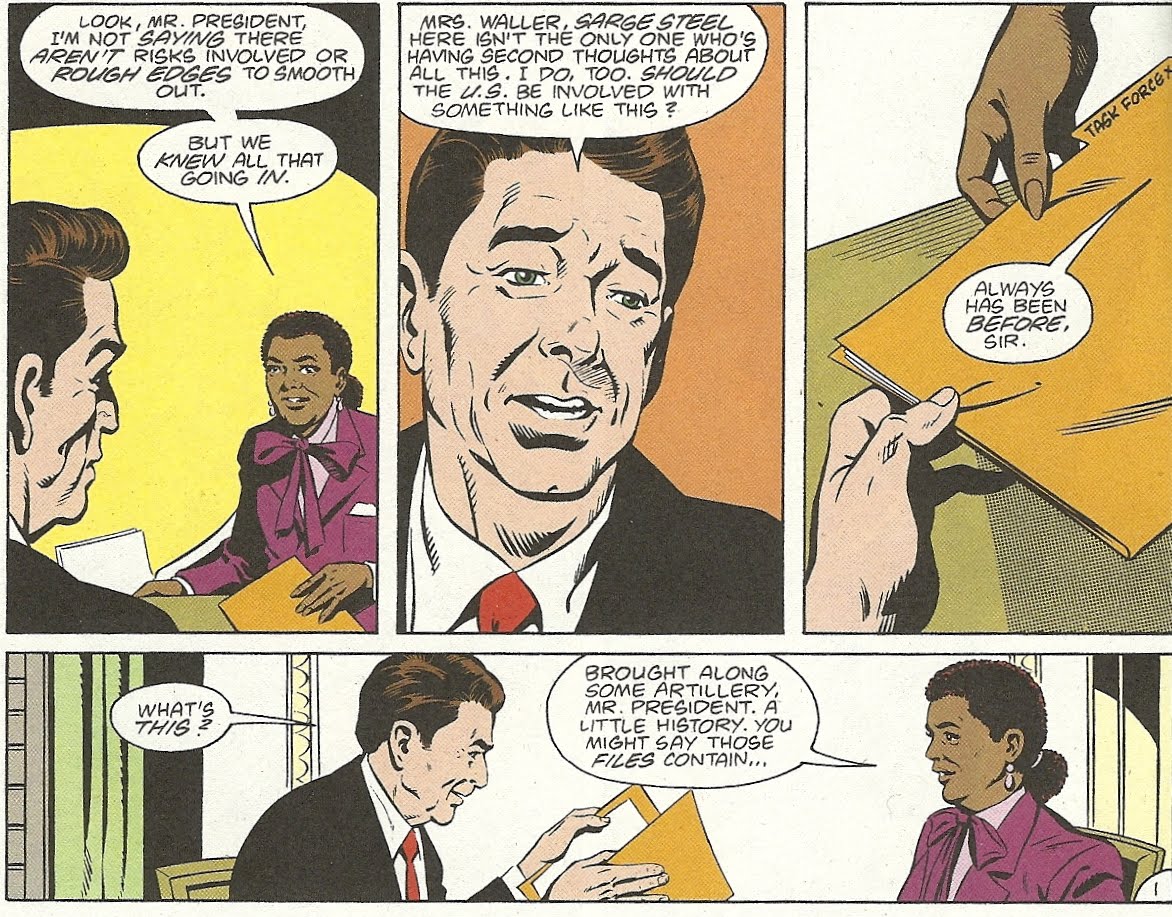
One of the many, many striking elements about the series I noticed while reading this book, in fact, the very first one, was that Ostrander and artists Luke McDonnel and Dave Hunt just straight up used President Ronald Reagan as one of the main characters in their first story, "The Secret Origin of the Suicide Squad" (From the aforementioned Secret Origins special).

The entire premise of the story is a meeting, which sounds deadly dull and like the sort of thing that Bendis might do in a random issue of one of his Avengers issues, but there are generous cutaways into flashbacks, with the meeting action in the premise merely the springboard for telling a 40-year story of the Suicide Squad.

The meetings participants are Amanda Waller, who is pitching a revamped version of the Squad, Sarge Steel and Reagan. There's no obfuscation about the president's identity, either. He's there, he's asking questions, he's making decisions, he's reacting to what he's heard, he's a character.That's a pretty sharp contrast to the way presidents are generally handled in Big Two comics today. DCU presidential history split off from that of the real world in the 2000 election, when Lex Luthor was elected president, Pete Ross finished his term, and then a fictional president or two held office. DC's US never had a George W. Bush or Barack Obama in its White House.

Bush and Obama and some members of their cabinets have shown up in Marvel Comics, but generally in safe, oblique ways, where they are so highly fictionalized that it barely matters who they are. President Obama acts just like President Bush I or Bush II or President Taft; whatever the story calls for. (Obama did get plenty of face-time in a particular issue of Amazing Spider-Man, but that was sort of a gimmick election collectible, not really a Marvel Universe story).

While it was strange to see so many drawings of Ronald Reagan, not with his head just out of panel, or a carefully positioned plant or deep shadows obscuring his face, but sitting there on-panel in a brightly lit office, it was even more strange that Ostrander made some effort to portray him as the real Ronald Reagan.

At two different point, Amanda Waller, who apparently works for a Democaratic congressman, makes remarks about Reagan's politics, which he responds to by gently chastising her to stay on-topic, with a, "Now, now..."The "shameful incident," revealed in the next two panels, is, of course the McCarthy hearings and "Red Scare" period that, in the DC Universe, also targeted costumed superheroes.

The result was that the members of the Justice Society of America publicly declared their intention to retire from crime-fighting in lieu of revealing their secret identities. Reagan was a friendly witness in the House Un-American Activities Committee hearings seeking to root out the perceived/feared influence of Communism in Hollywood.

Later, when discussing her own background, Waller says this to the president:The meeting ends with Reagan giving his conditional approval of the project, and, when Waller leaves, Ostrander even assigns some less-than-noble motivations to his Reagan.I'm not exactly sure what's changed between 1987 and the 21st century that made it more permissible for DC Comics to use real, public figures in their stories back then—the increasing litigiousness of our culture? Easy access to mass communication making it easier to offended parties to make a lot of noise? The fact that more people seem to pay more attention to comics, and that it doesn't take much to generate negative publicity these days?—but the story was in sharp contrast to, say, 2008's DC Universe: Decisions, in which a slate of made-up candidates campaign for the presidency of the DC USA.