Showing posts with label christos gage. Show all posts

Thursday, August 21, 2025

Review: Invaders Now!

Not wanting to repeat the mistake I had made with last week's review of a Marvel comic, wherein I accidentally re-reviewed a book I had reviewed years previously, I took the time to search and see if I had already written about 2010-2011 miniseries Invaders Now!, which I know I had read before. I couldn't find a review of the collection on my site, so I guess I had either read it in single issues and reviewed it as part of my columns reviewing new releases, or I had read it in trade and never actually wrote about it.

The series was a collaboration between writer Christos Gage and cover artist Alex Ross, who share a "story" credit, and artist Caio Reis. Interestingly, the cover bears the logos for both Marvel and Dynamite Entertainment, and the credits page lists five folks from Dynamite. This, despite the fact that all of the characters are, of course, Marvel characters. At this remove, I couldn't even guess why Dynamite would be involved in a series like this; was Ross perhaps under some kind of contract with the publisher that necessitated their involvement...?

The stars are, of course, The Invaders, a Golden Age super-team retconned into Marvel Universe history by Roy Thomas and Sal Buscema in a 1969 Avengers story. Though some of the characters shared covers and occasionally crossed over—especially in regards to Namor and The Human Torch— in various Timely comics, they never really operated as a team during the war years. These days, they are basically Marvel's answer to DC's Justice Society of America. 

For this particular series, Ross and Gage have essentially reassembled the 1970s line-up, and added the Golden Age Vision, who functions as much as a plot device as a character. Of course, it picks up those various characters where they were in the Marvel Universe circa 2010, and so Bucky is serving as the "official" Captain America, Steve Rogers has a new, maskless costume and is the leader of SHIELD, The Torch and Toro are recently-ish resurrected, Namor is hanging out with the X-Men on Utopia and Union Jack is the Joseph Chapman version.

The story is pretty straightforward. There's a bizarre, terrifying attack at a hospital in the Netherlands, wherein a muscular, badly deformed man stumbles in seeking aid, and then attacks with what seems like super-stength and rage, his bite infecting others and transforming them into creatures like himself. Somewhat zombie-ish then, although the victims look a bit more like Hulked-out versions of Quasimodo than the undead.

Shown footage of the incident, Steve Roges, serving as Boss of All Super-Heroes, folds his hands and says, "I know what this is." Just as he's in the midst of ordering Maria Hill to alert various heroes, The Golden Age Vision and the other characters from the cover appear, Vision declaring, "Only The INVADERS can save this world now," the team's name appearing in a giant, stylized font as it does on the cover. (Though this Vision is an extra-dimensional alien rather than an android, his yellow-colored dialogue balloons are square in shape, with rigidly straight lines connecting them, which visually suggests a mechanical nature to his voice.)

We then get a series of flashbacks, showing Vision as he gathers the others in groups of two—the fact that the various Invaders were spending time with one another at this point of crisis, he intimates, was no coincidence, but part of the pull of a magical force being marshalled against them).

And then a more substantial flashback, revealing the truth behind a bombshell Steve drops at the end of the first issue. 

"She's talking about the darkest chapter in our history," Steve says of something that Spitfire breaks up while recalling, "...WHEN THE INVADERS MURDERED A TOWN FULL OF INNOCENT PEOPLE."

Pretty strong cliffhanger, right?

As for that story, it takes places in the Netherlands in 1945, wherein The Invaders were battling "the full roster of the Uberkommando", all of Hitler's superhumans: Master Man, U-Man, Baron Blood and Warrior Woman. The Nazi super-people are defending a nearby castle containing the laboratory of Arnim Zola, who was, at that particular point, still entirely human.

In that lab, he had cooked up weaponized disease glimpsed at the beginning of the first issue, the thing that turns civilians into deformed, muscular killer monsters and drives the to bite others, spreading the disease zombie apocalypse style.

Once they learn that there is absolutely no cure, and that the disease causes incredibly pain for those suffering from it, the heroes make a terrible judgement call, one that the original Union Jack refused to be a part of, even if he also said he wouldn't try to stop them from implementing it: The Invaders kill all of the infected civilians, burning down their village and flooding the whole area.

And now these same characters (with a new Union Jack in for the old) are forced to face that situation again, as the infection seems to have resurfaced and, when they return to the town, they see it magically being rebuilt and find themselves facing the new iteration of the team of super-Nazis they fought during the war (Master Man, Warrior Woman and U-Man all seem to still be around, and are here joined by a huge robot battle-suit going by the name Iron Cross and two identical skinheads in matching shirts with swastikas on them; I didn't catch their names).

So, what exactly is going on?

Well, the villain is revealed to be a survivor of the town, one whose infection resulted in his being deformed, but not becoming a mindless killer like the others. He blamed the Invaders for the deaths of his family, and has spent his life studying the occult, trying to find a way to bring his family back to life...and hating these heroes the whole time.

It certainly didn't help that almost all of the Invaders have, one way or another, not only survived the war, but also cheated death and lived, young and vital as ever, into the 21st century. Hell, several of them have literally died and been resurrected through extraordinary means. (It must be unusual for those who lose a loved one to regard death in the Marvel Universe, where there are so many famous examples of people returning from the dead, and almost as many different ways to achieve those resurrections; one imagines the loss lacks the finality that it does here in our universe.)

Using his occult knowledge and the Spear of Destiny, the vengeful old man has summoned a Lovecraftian deity associated with the area (the word "fhtagn" is repeated a lot) and attempts to trade the Invaders' lives for those of the townspeople...a bargain the Invaders themselves seem willing to make, to his own surprise. (Two quick points of interest. First, when the magic-user holds aloft the Spear, he says that it was "lost during the closing days of the war," and an editorial note points readers to 2010's WWII-set one-shot The Twelve: Spearhead, completely ignoring the fact that a kid lifted it from a German museum during the events of 1994's Wolverine: Evilution; this is Evilution erasure! Second, that Lovecraftian entity, a one-eyed ball of tentacles, is Shua-Gorath; I didn't recognize it as a pre-existent character the first time I read this, but now recognize it from the film Doctor Strange and the Multiverse of Madness.)

Naturally, despite long odds and the surprise appearance of the now weird-looking, robot-bodied Zola, the heroes end up saving the day, defeating the various villains and even providing a cure to the new crop of infected victims, something they were unable to do in 1945, back before they had the likes of super-scientists like Reed Richards and Hank Pym in their contact lists.

The story is fairly simple, and of the plot-over-character variety, but it is quite well-told, moving quite swiftly through pages with very few panels on them and driven by some particularly hooky cliffhangers. Despite Ross' predictably realistic covers, the interior art occasionally leaves something to be desired.

Reis' art is fine so long as it involves super-people in costumes posing, of which there is a fair amount here, but he's much less able to sell the scenes of various civilians, even when it involves our heroes out of costume. I'm not quite sure about his female figures, either. Spitfire, who wears a full-body yellow suit with little ornamentation, essentially looks like she's naked in every panel she appears in, color artists Vincius Andrade protecting her modesty, and there's at least one panel of Maria Hill weirdly jutting her breasts out Steve in their office (Page 20, panel 1, should you have a copy in front of you).

The whole affair reads like it was meant to be a pilot series for an Invaders ongoing, ending with a two-page spread featuring eight-person team posing, flashbacks to past adventures appearing in the clouds of mist seeming to emanate from The Vision, who declares, "Should freedom ever again be threatened... The INVADERS will answer the call." 

The Invaders did indeed get a short-lived ongoing a few years later, with 2014's All-New Invaders by James Robinson, Steve Pugh and others, but it only featured half of this line-up—Steve Rogers (back to being Captain America), Namor, The Human Torch and Bucky Barnes (back to being The Winter Soldier)—and picking up a few other characters before its cancellation 15 issues later. Then in 2019, Chip Zdarsky helmed another short attempt at an ongoing featuring the same four heroes (Where was poor Toro in all of this?), this one only lasting 12 issues.

I think Invaders Now! was an effective enough reunion sort of comic, and could have served for a decent launchpad for something like a Marvel answer to DC's JSA, so I'm kinda curios why Marvel didn't commission such an ongoing from Gage, but instead waited a few years and had Robinson, who had actually co-written DC's millennial JSA for a bit, try his hand at a version of the team. 

Revisiting it today, I think it provides a fun opportunity to see some of the original, pre-Marvel Marvel characters interacting and see some of the lesser-used characters like The Vision and Toro doing anything at all.

There's also a particularly fun bit hanging on some Marvel Universe lore, as when Namor takes The Torch back to Utopia, and a couple of shy young mutants blurt out, "IS IT TRUE YOU KILLED HITLER?"

After a silent, beat panel, where The Torch looks taken aback and Namor smiles at him smugly, two of the boys looking like they realize they said something they shouldn't have, and another flashing back to The Torch setting Hitler ablaze, he finally answers:

It's all right, son.

The answer is yes... ...I killed Hitler. 

And I don't mind talking about it at all. There are plenty of things I did in the war I'd rather forget... ...but setting that monster on fire and watching him burn...

...I regret I could only do it once.

On the following page, Namor tells The Torch that his willingness to set Hitlers on fire is part of the reason the world of the 21st century needs someone like Jim Hammond around:

What you said to those boys, Jim Hammond... You must understand that is why you're needed.

The warriors of today...The Avengers, The X-Men...They adhere to a different code. One perhaps appropriate to the modern world...but limited

They are reluctant to kill...even the likes of Hitler. Those who are not averse tend to relish bloodshed. Often too much.

The world needs men like you. Who will do what is necessary without hesitation, but recognize that war and peace are different states of being.

With the short life spans of these humans, such men are swiftly fading from the Earth.

Namor sold me...which makes it kinda too bad we don't see more of this Torch in Marvel comics these days. 

And it makes me wonder, were Spider-Man in Hitler's bunker 80 years ago, would he have killed Hitler? Would Cyclops? Iron Man? Daredevil? Hawkeye?

Monday, November 14, 2016

Review: Deadshot: Bulletproof

In 2005 DC published a five-issue Deadshot solo mini-series. This was well after the character's hey-day as a regular member of the 1987-1992 Suicide Squad cast, and just as writer Gail Simone was beginning to use him as a member of her Secret Six, a Suicide Squad-inspired villain team that began in the pages of a Villains United miniseries and eventually lead to an ongoing monthly.

Perhaps because of the higher-profile nature of the Villains United/Secret Six comics, which began as a lead-in to DC's big Infinite Crisis crossover event series, that Deadshot miniseries tends to get overlooked. Which is a damn shame, as it is pretty excellent, and writer Christos Gage found a way to use a character that was always best-suited as either a villain or a member of an ensemble of such characters as a solo protagonist.

Deadshot: Bulletproof includes that entire miniseries, a story entitled "Urban Renewal" in the table of contents, as well as a one-issue story tied to those events that Gage penned at the time for the still extant Batman: Legends of The Dark Knight.

In retrsopect--that is, read in 2016--there's an aura of the unfortunate about the book. Not only did it offer a viable take on the character as anti-hero and solo protagonist that didn't quite catch on (although it certainly influenced the portrayal of the character in this year's live-action film), and not only did it present a nice, clean "more realistic" redesign of his costume that is pretty much infinitely better than the one he was given in the publisher's 2011 "New 52" initiative (and still wears today), but this was apparently Gage's first comics work. After working for DC's long-suffering WildStorm imprint, on one of its many re-focusings, Gage went on to do a bunch of pretty good stuff for Marvel and other publishers, but nothing else for DC.
For the miniseries that fills most of the trade, he was paired with the art team of pencil artist Steve Cummings and inker Jimmy Palmiotti, and, while serviceable, clear and easy to read, the art is the weakest part of the package. Mike Zeck penciled and Jerry Ordway inked all of the cover though, which surely didn't help Cummings and Palmiotti look good; it's hard to turn the page from one of those great covers to find work that lacks the heft and tension of those images.

Gage opens with Deadshot Floyd Lawton in a familiar situation, working with a group of supervillains--Killer Frost, a new version of minor Gotham villain Firebug and new character The Closer--only this time as a mercenary, rather than as part of a government task force. During the opening action scene and its aftermath, we learn some relevant information about Deadshot regarding his late child, and establish a few character dynamics that will payoff later in the series.

When Lawton finds out he actually has a young daughter, conceived with a prostitute without his knowledge, he attempts to play the role of a father in some fashion. The mother refuses his duffel bag full of blood money, and so he instead tries to clean up the poor, crime-ridden neighborhood that his daughter and her mother live in. He is essentially forced into the role of a hero, or at least anti-hero, a Punisher-like criminal-killing vigilante doing bad things for a basically good reason.

That neighborhood is located in Star City rather than Deadshot's original stomping grounds of Gotham, which accomplishes two important things. First, it means Gage doesn't have to worry about introducing Batman into the narrative, which can be problematic, given that character's track record with taking down villains and his unbending, uncompromising moral stances and the fact that Deadshot is supposed to be a cold-blooded killer that never misses. When Batman encounters Deadshot, one of them has to lose, which usually means Deadshot, which kinda makes a Deadshot comic book difficult to continue too long after Batman enters the picture.

The other thing is that it allows for an easy introduction of a different Batman-lite like character, Green Arrow Oliver Queen, who has the additional benefit of being a preternaturally gifted super-marksman not unlike Deadshot. They have a pretty spectacular battle, which basically involves blocking one another's shots with shots of their own, so that Deadshot shoots Green Arrow's arrows out of the air just as fast as he can fire them, and so on. This is just one of several mini-boss fights though; the big showdown is the one alluded to on the cover of the collection, in which Deadshot must take on a whole host of supervillains he's worked with in the past who all want him dead.

The story ends as it must, but certainly serves as a rejuvenation of the character, one that offers a particularly appealing take on him that obviously attracted and influenced the movie makers, if not most of those working on the characters since 2011's New 52 revamp.

There's also that pretty great costume, which is basically a 21st century update of his rather '80s look. Sure, it's still busy, and does still look a little goofy when Floyd "hides" it under a trench coat, but compared to all other possible Deadshot costumes? Not bad; not bad at all. Note too that here the mask is more of a helmet than the silvery fabric ski mask that it was usually drawn as previously.
As for the Legends of The Dark Knight story, for that Gage is joined by artist Phil Winslade, and he puts Deadshot back in his classic costume and back in Gotham City, where he does face Batman this time. Deadshot's been hired to kill a criminal before that criminal can testify, and Batman wants to prevent the assassination so that the testimony can go forward. The two fight a little and circle one another, but Batman is unable to go full-force at Deadshot, and Deadshot either won't or can't kill Batman, who here Gage has repeat something from an older encounter in which Batman explains Deadshot unconsciously pulls his shot around Batman because, deep down, he doesn't really want to kill him.

It's a nice exploration of the two characters' peculiar characterizations, and how they relate to one another. It's a done-in-one, and a rare one that does a pretty exemplary job of defining both of them equally well. I know I just said previously Batman and Deadshot don't always work well together, as the fact that one must lose puts and end to their conflicts pretty quickly, but they do work in small doses like this; if you read it, you'll see their stand-off works, but it's not the sort of standoff that would work indefinitely.

The story is definitely one for any sort of greatest hits collection of Deadshot stories, though (and, for fans of the Suicide Squad movie, likely one that served as inspiration, given the nature of Deadshot's assignment here and in the opening scenes of the film).

Sunday, October 06, 2013

I think I might have found my favorite Justice League.

In the last few years, I've read the first three collections of the Geoff Johns-written Justice League comic, drawn by various artists. I've read the first collected volume of Dan Jurgens' Justice League International. I read the first issues of Justice League Dark and Justice League of America, plus those handful of issues that were part of the "Trinity War" crossover story.

But I think my favorite Justice League comic in recent years may just be that in the new Batman Beyond Universe comic, a split-book that features a Batman Beyond story by Kyle Higgins and Thony Silas (the latter of whom's work was so Breyfogle-y that I had to double-check to make sure Breyfogle wasn't doing breakdowns or lay-outs for the story) and a Justice League story by Christos Gage and Iban Coello.

The Justice League story takes place in the same setting as Batman Beyond, a few decades into the future, when Bruce Wayne is still alive, but way too old to be dressing up as a Bat and fighting crime personally.

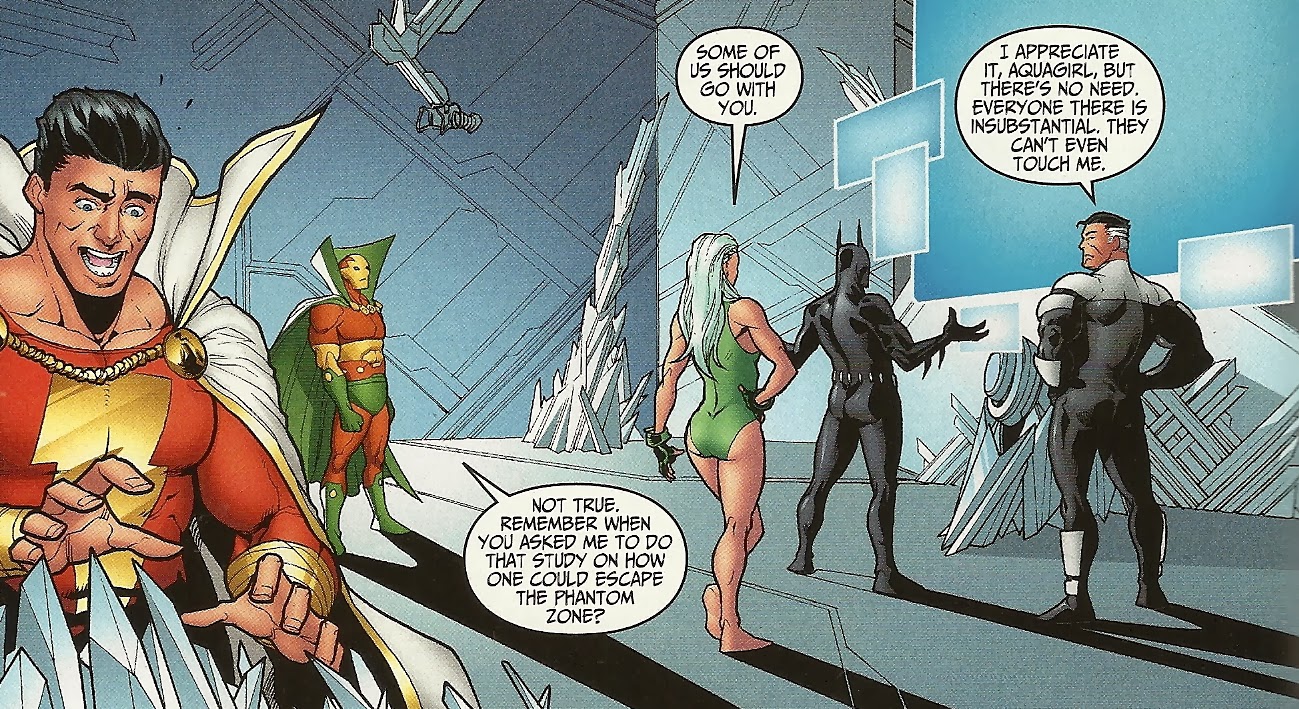
The line-up is built on the core one introduced in the Batman Beyond cartoon series: Barda, straight from Jack Kirby's original Mister Miracle comic, wearing the outfit he designed for her when she wasn't wearing her pangolin-like armor; Warhawk, a more aggressive, hard-headed version of Hawkman (a characterization that the "real" Hawkman has drifted towards and even surpassed in recent years) whom is apparently the son of Green Lantern John Stewart and Hawkgirl Shayera Hol; Aquagirl, a white-haired young woman who is apparently Aquaman's daughter with Mera (although she looks more like Dolphin); Green Lantern Kai Ro (a little Asian boy and the current GL of Sector 2814); and Superman, still alive and as strong as ever,  although wearing a new costume (one that looks based on the John Byrne version of Krypton, made TV animation friendly), graying at the temples and going under the new secret identity of fireman Kal Kent, after the death of his wife Lois Lane.

Oh, and Batman II Terry McGinnis, of course.

The line-up has since been expanded to include Micron, a shrinking-and-growing superhero whose costume looks like that of The Atom spliced with Spider-Man's; Mr. Miracle, Barda's husband; The Flash, who is now a black woman with a different costume and whom I know pretty much nothing about; and Captain Marvel, who is the original version in name, costume, powers and personality.

Ex-Batman Bruce Wayne is apparently just a holographic communique away, and the Wizard Shazam even appears a couple of times to lend a hand in a couple of very different situations in Batman Beyond Universe #2.

So between Superman, Captain Marvel, Barda and Mirster Miracle, this League has four original League members who are barely changed from their pre-New 52 conceptions; Superman's costume is very different, as is his secret ID, but his personality and characterization seem much more like that of "our" Superman than of the new Superman.

I found the plot of the first issue of the new series to be sort of generic, as Superman's powers start acting wildly out of control, suddenly fluctuating to increase his powers to dangerous levels at unexpected (and often inconvenient) moments. They temporarily solve the problem by taking away Sueprmans' powers, which lead to the cliffhanger ending: Remember, now he's not hiding his super-powers beneath the identity of a mild-mannered reporter, but that of a firefighter, a profession in which being invincible would naturally come in handy every once in a while.

In the second installment, Gage continues with this plot, gradually revealing the identity of a villain responsible for getting Superman into this particular predicament, but much of the attention falls on a conflict Kal has no idea how to go about addressing, and his teammates efforts to help him:
His co-worker Rita has asked him to ask her out, and he's a bit out of practice, as he hasn't gone on a date since the good old days, when glasses had frames that held them to your face, rather than these weird Beyond glasses that apparently just stick to the bridge of your nose or something.

He asks each member of his team in turn for advice, and it is all, naturally enough, bad, but it's generally funny, and Gage is clever enough to root the humor in the contrast of characters, so each little scene, some as short as a single panel, go a ways toward defining Superman and the character he's talking to, from Warhawk, Green Lantern and Aquagirl's predictably impractical advice to Wayne's "Dating advice. You must be joking. Wayne out."
Is "shway" future slang? Man, I hate future slang. I think I hate that piece of future slang more than most future slang, though.

What say you, Mr. and Mrs. Free?

And how about the guys on the Rock of Eternity?
Ancient wizard and his mystically-empowered, human super-champion...what's so hard to wrap one's head around with these guys? I honestly don't get the attempts to revamp the "Shazam" franchise; playing them straight, as Gage does here, seems to work just fine.

Not that Gage does it all by himself. Here's another small detail, but a neat one, which artist Coello pulls off. Check out Cap in the Fortress of Solitude:

Kal goes on his date and, naturally, a villain attacks him with a super-weapon, reveling that the villain in question (who isn't named until the last, cliffhanger panel) both knows Superman's secret identity and has a connection to Krypton of some sort. Here we get to see the Leagures doing super-stuff:
I've only read about 40 pages of this League, of course, so perhaps I'll grow to be less enthusiastic about it, but, unlike all those other League comics I mentioned above, I liked this one from page one, rather than being repelled by it immediately.

In addition to the sharp writing and clear, communicative artwork, this Justice League comic seems the most comfortable, familiar, genuine and nostalgic of all the others. Which is kind of weird, when you consider this one is the out-of-continuity League set in a possible near-future, rather than a canonical one set in the present DC Universe.

Anyway: Gage and Coello's League half of Batman Beyond Universe? It's good and I like it.

Monday, February 18, 2013

Young Avengers Catch-Up: Siege: Young Avengers #1 (2010)

This one-shot by writer Sean McKeever, pencil artist Mahmud A. Asrar and inkers Scott Hanna and Victor Olazaba was a brief check-in type story tied to Marvel's completely nonsensical event series Siege, a bizarrely written story by chief Marvel Universe architect Brian Michael Bendis that, as I've previously noted, doesn't make a lick of sense on its own.

The event was climax of the "Dark Reign" period of the Marvel Universe, in which former Green Goblin Norman Osborn has donned a red, white and blue Iron Man suit to become Iron Patriot and lead his own team of Avengers made up of villains-posing-as heroes and his own SHIELD-like government agency HAMMER. For reasons never explained, Osborn decides he needs to conquer Asgard, which he attacks in defiance of the his boss President Barack Obama, and ends up in an all-the-heroes vs. all-the-villains fight on the floating city of Norse-derived Kirby space-gods.

The Young Avengers special was apparently intended as a part of a suite of one-shots, as its cover is part of a single, multi-part image by Marko Djurdjevic, and it gets collected along with four more one-shots in Siege: Battlefield, which is where I found and read it. (We'll look at those other comics in a bit).

One rather admirable aspect of writer Allen Heinberg and artist Jim Cheung's creation of the Young Avengers characters is how many aspects of the wider Marvel Universe he was able to tie into the various characters, as it makes them incredibly easy to plug into just about every Marvel event series imaginable. This event, for example, revolves around Asgard, and one of the Young Avengers characters was inspired by Thor to kinda sorta pose as a Thor-like sidekick at the outset, even going so far as to go by the name Asgardian (Changed later, of course, to "Wiccan," which can't so easily be corrupted into "ass-guardian").

The plot consists entirely of what the various team members are doing during the Everyone Vs. Everyone fight on Asgard, specifically after the part of the battle (which was not a siege) where The Sentry knocked the floating city down.

Wiccan and Hulkling, whose magic and gross green veiny pterodactyl wings spared them from the crash, find The Wrecking Crew trying to super-loot the ruins for Asgardian treasure, and fight them. Patriot and Hawkeye, meanwhile, are trapped in the rubble and fighting for survival, ala Red Arrow and Vixen in that one Meltzer issue of Justice League of America, ala Nicolas Cage and The Guy Who Wasn't Nicolas Cage in World Trade Center. And Speed runs around looking for survivors in the rubble. No sign of Stature and Vision.

It's a fairly well constructed fight comic, with each of the three character or character groups going through a distinct arc in which they reach a point of hopelessness and than rally, the issue ending with a splash page of Speed leading the charge to have them rejoin the fight.

It's completely inessential of course, but then, that's what it was supposed to be all along, the answer to a question a certain sub-set of Marvel readers might have wanted to know the answer to (Hey, what were the Young Avengers doing during the Battle of Asgard?), and a bone thrown to the would-be Young Avengers audience awaiting the return of the characters creators/re-creators to finish up their story.

The artwork is quite impressive and, in certain panels, looks like the work of Cheung (particularly on a re-flip-through. If Marvel had decided to go forward with a Young Avengers monthly sans Heinberg and Cheung in 2010, this would have been a fine creative team to do so with.

******************

As I said, this issue was collected in Siege: Battlefield, which contained a handful of Siege one-shots, connected only by their interlocking cover images and the fact that they had something or other to do with Siege. These are they...

Siege: Loki #1 by Kieron Gillen and Jamie McKelvie

This particular creative team is of particular note for this particular series of reviews, as these are the guys who will go on to create the next volume of a Young Avengers ongoing series, the one that sparked this endeavor on my part.

The star is Loki, part of Osborn's cabal of villains secretly running the "Dark Reign", who is here restored to his original, male form, after having spent much of the previous "Dark Reign" cycle in the form of a buxom woman, for reasons I never understood (It happened in an issue of a Thor comic I didn't read, I imagine).

In the Gillen/McKelvie Young Avengers, he appears in the form of a little kid. I think they should probably keep him male and grown-up, personally because a) McKelvie draws him so well and b) all the ladies I know who dug the Avengers movie  really seemed to like sexy Tom Hiddleston's sexy Loki.

Their story is set before and behind the scenes of the battle that occurs in Siege,basically showing Loki as a wicked and clever manipulator moving in a world of Marvel's evil power players—we see him taking a call from Doctor Doom and meeting with Mephisto and Hel, for example—to get what he wants, which here seems to be the destruction of Asgard and release from his destined place in Hel's hell (which may be spelled "Hel").

It's pretty great stuff, light on the superhero business (Osborn appears on one page) and heavy on the mythological and, tonally, it felt like an early issue of a pre-Vertigo Vertigo series: Mature storytelling devoted to mythology and fantasy extrapolated from old-school trashy super-comics which were themselves inspired by classical mythology. While reading, I kept thinking this creative team would probably do a knock-out Doctor Strange series.

I can't say enough good things about McKelvie's clean, smooth, pristine, perfectly-acted artwork: That guy's the best. This is by far the best-looking chapter of the book.

Props go to the pair also for their five-panel sequence involving Loki and Osborn. That's the first time that it was made clear to me that it was Loki speaking to Osborn through his Green Goblin mask, as his Green Goblin persona, in an effort to convince Osborn to attack Asgard because that's what Loki wants him to do. In a lot of the other "Dark Reign" and Siege related comics I've read, this isn't at all clear, and Osborn is usually presented as either a complete lunatic attacking Asgard just-because, or being talked into it by Loki, who doesn't really offer any compelling reason to convince him to do so. Here, it seems the compelling reason is that Osborn thinks his dominant if buried persona is telling him to do so.

Siege: Spider-Man #1 by Brian Reed and Marco Santucci

Spider-Man and Ms. Marvel fight Venom, who, at the time, was former Scorpion Mac Gargan in the alien symbiote suit, who spent the majority of "Dark Reign" (and the Bendis-written series Dark Avengers) disguised as Spider-Man.

That, obviously, annoyed Spider-Man.

This issue, then, is devoted to the climax of their fight over that particular conflict, with the pair tumbling out of the still airborne Asgard to the city below (Broxton), where Ms. Marvel swoops in to give Spidey an assist and fly him back up to Asgard so he can participate in the events of Siege.

It's a decent enough story and the art is similarly decent. It is about as pure a fight comic as you can get without excising the dialogue, which hear consists mainly of Spider-Man quips and Venom's chatter about eating people.
The most striking and memorable image is a panel in which Ms. Marvel separates Venom from Gargan by sticking her hand down the former's throat and yanking the naked latter out its mouth.

Siege: Captain America #1 by Christos N. Gage and Federico Dallocchio

The artwork on this one made it very hard for me to read. It was clear enough that it was easily legible, I just didn't like looking at it. Very photo-reference-y, with poses and renderings that look, if not traced from photos, then at least rigorously imitating images of real people, with costumes and fantastic action set atop of them.

It's all very awkward looking, as in a terribly uninspired two-page splash page of a bunch of heroes fighting a bunch of villains. One of the Captains America, in this image, appears to be both simultaneously kicking Taskmaster's shield and firing his gun at the shield, and seems badly in danger of literally shooting himself. Also, Dr. Fate seems to be there, for some reason.

Gage deviates from the all-fighting, all-the-time mandate that dominates most of these stories by introducing a family of civilians on the outskirts of the conflict, who provide an element of extra danger for the Captains, as well as some folks to be inspired by them.

Then current Captain America James "Bucky" Barnes and returned-to-life former Captain America Steve Rogers are participating in the big fight on Asgard and, after Sentry knocks it down, they find themselves fighting Razorfist, perhaps the least believable of all of Marvel's many fantastical villains (He's the guy who has had both of his hands replaced with huge, razor-sharp blades, and his costume consists of a sort of skin-tight ski mask with ear holes that I can't imagine how he puts on—dude must have an intern to dress him. (Also, Razorfist...? Dude can't make a fist, as he doesn't have hands).

The Captains beat the shit out of him, and then run back to the crossover story. See a pattern forming? These are kind of fun in how straightforward they are, as the majority of them are little narrative cul de sacs, where the characters leave the events of Siege, run through the conflict of a single issue tie-in, and then return to the events of Siege, usually declaring, "Well, that's the end of our one-shot tie-in; back to the main series!" (I'm paraphrasing; here it's actually "Let's go... ...We're needed."

This one's followed by Siege: Young Avengers.

Siege: Secret Warriors #1 by Jonathan Hickman and Alessandro Vitti

This series, Secret Warriors, is a kinda sorta years-later spin-off of that weird Bendis-written Secret War miniseries that truly kicked off his Avengers and Marvel Universe writing, and ended with one of the worst and laziest issues of a comic book I've ever read.

The premise of Secret Warriors was that an off-the-grid Nick Fury was leading his own team of secret superheroes, all of whom eschewed costumes in favor of classic SHIELD uniforms, for maximum boring-looking character design. I never read any of it, but Marvel might have tempted me to read the first issue had they instead titled it Nick Fury and his Howling Secret Warriors (I'm a big fan of howling).

So did you read Siege...? If not, there's this one gross-looking panel where Sentry grabs Ares the god of war and rips him vertically in half, just like She-Hulk did to Vision in "Avengers Disassembled," except Ares isn't a robot, so there's a bunch of gore and viscera in the panel (Bendis wrote both scenes, so he's not stealing from another writer, just repeating himself).

Well, on of the Secret Warriors is Phobos, the son of Ares (who is also a little kid). The issue opens with him watching a bank of monitors in which panels from Siege appear, including the gross one of his dad getting torn in half.

While Nick Fury joins Captain America for the assault on Asgard, Phobos flashes back to hanging out with his dad, then picks up a couple of swords, enters the White House through a secret passage, and silently slaughters Secret Service agents throughout the issue in order to, as he finally explains once President Barack Obama is safely aboard Marine One and flying towards safety, "to deliver a message."

The message isn't metaphorical, but literal though, as the last panel of the issue sees him sitting down at Obama's desk, the Oval Office littered with dead agents, to write a letter:
It's not every day that a human finds himself responsible for the death of a god and then on that very same day escapes facing another...
But before you wash your hands of my father's blood, I would encourage you to reflect on what brought us to this point: You sacrificed honor for expediency. You traded intent for quick action. You were wrong...and we all suffered for it.
It's a pretty weird comic. At least when Garth Ennis had The Punisher threaten to kill President George W. Bush, he did so without killing a bunch of innocent guys, and the president was a little more directly tied to the crime.
Obama's guilt for the death of Ares is fairly indirect, in that he put Osborn in charge of the superheroes, Osborn hired Sentry and Ares and Osborn ordered them both to attack Asgard, where Ares rebelled against Osborn and got torn in half. I realize the buck stops with the president and all, but Siege made it pretty clear that Osborn had "gone rogue" and was acting against the will of the president and, um, the entire United States government when he attacked Asgard, acting on the advice of his Green Goblin mask/other personality/Loki.I'm not a fan of the art in this one, although there's nothing really wrong with it. The style just didn't do much for me. There is a pretty neat panel of Obama sitting behind a desk, his face in shadow, his hands calmly folded in front of him, with the Joint Chiefs of Staff lined up behind him and a small army of gun-toting Secret Service agents between them and the reader. It's maybe the clearest image of Obama-as-supervillain I've seen in a comic book.

You know, between Bush's handling of the events of Civil War, "The Initiative" and Secret Invasion and Obama's handling of "Dark Reign" and Siege, as horrible as the choices these guys make in our universe might so often seem, they're both a hell of a lot better than their 616 counterparts...

Saturday, August 18, 2012

Review: World War Hulk: X-Men

Despite the title, the three-issue World War Hulk: X-Men miniseries only accounts for the first 66 pages of this 240-page trade paperback. Also included are two issues apiece of Avengers: The Initiative, Ghost Rider and Iron Man, with one issue of The Irredeemable Ant-Man. Each of these tied into the "World War Hulk" event/story, and are supposedly not alluded to at all in the title of the collection for the same reason they put Wolverine on the cover instead of the rest of the X-Men. It's what they think will sell the most volumes.

If you've never read it, World War Hulk was a 2007 five-issue crossover miniseries that pitted a righteously angry Hulk versus Civil War heavies Iron Man and Reed Richards, plus Blackbolt, Dr. Strange and the rest of the Marvel Universe, who wanted to keep the Hulk and his army of space-alien invaders from wrecking the world in their pursuit of the Iron Man. While it was plotted by group-think, with the Brian Michael Bendis-invented "Illuminati" getting the ball rolling a few years ahead of time, it was written by Greg Pak and drawn by John Romita Jr and Klaus Janson.

Unlike the similarly-sized Marvel crossovers that preceded (and followed) it, World War Hulk was pretty straightforward: Everyone fights the Hulk, although it was given a little more dramatic complexity by the fact that the guys he wanted to punish totally deserved it. After Civil War, who didn't want to see Iron Man and Reed Richards get their faces punched in? Also unlike the other Marvel event series, this one featured characters who acted like themselves, and thus much of it rang true.

This collection if basically just a big handful of the many tie-in series, seemingly chosen at random, and the stories themselves are fairly repetitive. In each one, the title characters fight the Hulk without defeating him; each ends either in a draw or the Hulk victorious, as the real story was of course occurring in World War Hulk itself, not some random issue of the tertiary Avengers book or an Ant-Man comic, and any and all major, dramatic beats would necessarily have to occur there.

I read three of these issues before, and talked about them before, so I won't talk abou them again here (Irredeemable Ant-Man in this column, if you wanna read what I had to say about it when it first came out, and the two Avengers: The Initiative books...aw, I don't feel like looking 'em up. There on the blog somewhere in some 2007-era editions of "Weekly Haul").

The sub-titular story is by writer Christos Gage and artist Andrew Divito, both of whom are pretty great at these sorts of superhero comics.

Gage has to engage into some labored set-ups to even involve the X-Men. Because Charles Xavier sometimes hung out with "The Illuminati" group that decided to shoot The Hulk into outerspace, the thing he's so damn mad about that he's returned for vengeance, The Hulk wants to track down Chuck and ask him how he would have voted on the issue of shooting Hulk into space, and punish him for it if he says he would have said yes.

Charlie could have always just said, "Oh no way Hulk, I totally would have voted to not shoot you into space," at which point the Hulk would go away, but, well, that wouldn't fill 66-pages with fighting.

And so after invading Manhattan and issuing an ultimatum to the world that they deliver Iron Man, Richards and Dr. Strange, The Hulk goes on a side trip to X-Men HQ in Westchester. He fights The Beast and the "New X-Men" characters for one issue—these are the new, teenaged heroes who go to school at the Xavier Institute—in order to get at Chuck (Who does offer to surrender, but the kids won't let him). Then, in issue two, the real X-Men swoop in to fight the Hulk—these are the guys who were then starring in Astonishing X-Men; you know, Cyclops, Wolverine, Colossus, Kitty Pryde and Emma Frost. The Hulk beats them all up, too.

Finally, the other X-Teams all come in to try and help out, so we get one more issue of The Hulk fighting the cast of X-Factor, The Juggernaut, Nightcrawler, Native American Stereotype Man and that space-cat lady someone at The Beat really likes for some reason. The Hulk wins, but is ultimately shamed into just going back to the Manhattan to continue with the plot of World War Hulk after he's shown a graveyard full of dead mutant kids.

As fight comics go, it's about as pure as you can get. Highlights, for me, included The Hulk throwing one character's limbs into Connecticut, punting another character to New Jersey, and removing some special Vibranium knives from his arms simply by flexing really hard and making them pop out.
The artwork looks particularly gorgeous when read in 2012, as Marvel's coloring hadn't gotten as computer effect-dominated at that point as it has today.

Daniel Way, Javier Salteres and Scott Hanna's Ghost Rider story is a fairly standard one about a human host wrestling for control with the parasitic spirit of vengeance housed in his body (well, standard for superhero comics, anyway). The Ghost Rider wants to continue chasing a demon or whatever from the previous issues of Ghost Rider (not collected here), while Johnny Blaze wants to use the Ghost Rider's powers to stop The Hulk.

They fight in a big, splashy brawl of the sort only The Hulk and a flaming skeleton demon thing on a flaming motorcycle can. Ghostie uses the Brooklyn Bridge as a ramp to fly into town and drops a building on The Hulk; The Hulk retaliates by throwing a subway car at him and then jumping off the top of the Empire State Building and landing on him. Eventually, the Ghost Rider takes control of Blaze, and rides away from the crossover and back to his own title.

The artwork is again quite nice, although the computer flame effects are a bit much, distracting from the otherwise very drawn, very comic book-y look of the illustrations. Salteres' Hulk looks especially human scaled and even handsome compared to the more gigantic, monstrous Hulk we see in the other stories, which is also a little on the distracting side. With five different artists—more if you count cover artists like Ed McGuinness—no two Hulks look a like in this book.

Finally, Gage and artist Butch Guice provide the Iron Man issues, which span a time period that begins before the other stories that precede it in this collection and ends after them. Since Iron Man is, at this point, Boss Of All The Superheroes and Hulk's target, this story should be the most important in this collection—it's certainly the most relevant one to the events of World War Hulk, so it's rather surprising to find it at the end of the collection, a collection which doesn't even mention Iron Man, but whose sub-title and cover makes it appear that this is simply a collection of a single miniseries.

At this point in the Marvel Universe, Iron Man was something of a high-tech, superhero-flavored espionage series, and this story is mainly concerned with how SHIELD responds to their director Tony Stark flying off to fight Hulk, and what they do when Stark is taken down and captured. It's serious in tone, much more so than the light-hearted, almost-silly X-Men mini also written by Gage, and Guice's realistic art is perfectly appropriate for that focus.

And that's that. As a collection, it's a real quilt of characters, art styles and storytelling, and the presentation's a bit of a head-scratcher, but it's not a bad batch of old-school fight comics, and none of the art is bad, nor any of the stories poorly-written.

It's been about five years since I first read that Ant-Man issue and was perplexed by all the Old Spice product placement (Old Spice billboards fall in the fighting, a shrunken Ant-Man finds bottles of Old Spice body wash in The Hulk's stomach for some reason), and it's still super-weird to me.

Tuesday, July 24, 2012

Review: Spider-Man/Fantastic Four

This four-issue, 2010 miniseries looks at Spidey’s relationship with Marvel’s First Family as it has evolved through the years, with each issue checking in at various points in the two franchise’s history and where they intersected, hanging untold stories in between told stories and forming an overall narrative goosed along by a time-traveling villain’s plot.

It bears a great deal of similarity to the 2005 series Spider-Man/Human Torch, which has the exact same remit, albeit that series focuses in on Spidey’s relationship with the Torch, with the rest of the FF merely playing supporting roles. The comic it bears the most resemblance to, however, is 2009’s X-Men/Spider-Man, by the same creative team of Christos Gage and Mario Alberti. The FF-focused sequel even used the same cover design as the X-Men mini when published serially.
The book opens “Years Ago,” less than a month after Dr. Doom fought Daredevil and the FF in their headquarters, which probably puts it in context to those who know FF history very, very well (a glance at the first page's worth of FF covers on comics.org seems to indicate it must be a reference to this 1965 issue). Doom is secretly visiting the campus of Empire State University to help negotiate peace treaties among his neighboring European countries, and he has insisted the FF provide security for him.

Why? It’s all a ruse to that he can switch bodies with the Human Torch. This being ESU though, Spidey shows up and, randomly but welcomely, Namor and the Atlantean army arrive to avenge themselves upon Dr. Doom.

On the last page, a mysterious villain in a green hood and cape who appears to be Doom (Spoiler: It isn’t!) arrives on the scene, to plot out loud. This villain then appears breifly in each of the following issues doing…stuff, until he reveals himself and his plot in the fourth issue, set in modern times, for a climactic battle.

In the next issue, it’s already the 1980s, and Spidey turns to Reed for help with his living black costume, which possesses Sue and Reed before ultimately being defeated. And then it’s the 90s, maybe, when there was a She-Thing and Spidey, Wolverine, The Hulk and Ghost Rider were the Fantastic Four for a little bit, and a Skrull gets fought, and Mole Man and the First Issue Monster hanging around too.

And then we get to the big villain reveal and it’s…easy enough to understand, even though I’ve never heard of the guy. He makes sense in the context of the overall story, which is the idea of the Fantastic Four as a family (hardly novel, I know) and whether or not Spider-Man fits into it, and how important family is to keep super-powered loners from becoming supervillains.

Gage’s writing is sharp and funny, and it no doubt helps that he’s dealing with some of the best-defined characters with the most unique voices in superhero comics—you have to try awfully hard to get, say, The Thing or Doctor Doom or Namor wrong, to have them say things that don’t sound like the characters themselves are writing their own dialogue (It can be done though! I’ve seen Brian Michael Bendis do it, for one!).

His invention of stories between other stories seems to work just fine, too . I haven’t read, let’s see, any of the stories these ones are built on top of, but they definitely felt as if they were part of a bigger narrative, without alienating me or punishing me for not having read all of the comics Gage has read.

I enjoyed Alberti’s artwork much less. He’s a strong artist, and one with a very individual, very present art style, but not one that necessarily fits with his subject matter. He’s certainly not an artist who does a Silver Age Marvel pastiche well, for example, and makes no attempts to do anything cute light calibrate his style to match the look of the various decades being depicted (Oddly enough, none of the characters seem to age at all either, but then perhaps that is due to the fact that Marvel’s timeline is constantly compressed).

He draws a pretty cool Venom-possessed Mr. Fantastic, all elongated and bendy, and he does fine work on a huge, strong and sexy She-Hulk and the finely detailed armor of Doom and…the other guy, but the guys with their name on the marquee? They don’t quite look like themselves, and perhaps it’s simply that he didn’t draw the series like I would have liked to have seen him draw the series, but it would have been nice if the art reflected the constantly changing settings in time and relative history in the same way that Gage’s writing did.

It’s certainly not a bad book by any stretch of the imagination, of course, but it’s not the first or second one I’d recommend to anyone who wants to read a trade paperback featuring Spider-Man teaming up with the FF.

Because it would simply be monstrous for Marvel to charge $15 for an 88-page comic, this trade also includes two issues worth of a "classic" Spidey/FF team-up from 1980 written by Bill Mantlo, with Mike Zeck and Jim Mooney drawing the half that was published in Peter Parker, The Spectacular Spider-Man and the half that ran in FF by John Byrne and Joe Sinnott. These mainly serve to demonstrate how off-model Alberti's versions of the characters are (not that Marvel or DC even attempt to have artists stay on-model anymore when it comes to character design), and how badly comic book coloring has devolved; the back-matter is so bright you can read it in the dark, while the 2010 storyline that fills the bulk of the book is so dark I got seasonal affective disorder while reading it.

Thursday, December 20, 2007

And yet it's still more exciting then Mark Millar's original ending...


(From What If? Civil War #1's "What If Iron Man Lost the Civil War?" by Chrstos Gage and Harve Tolibao)