Showing posts with label alan grant. Show all posts

Monday, December 22, 2025

Review: 1996's Lobo/Demon: Helloween #1

The most striking image in this one-shot special is also one that marks it as a product of the 1990s. That would be the caricatured visage of one William Jefferson Clinton drawn atop the familiar yellow-skinned, red tunic-and-blue-caped body of Jack Kirby's Etrigan, The Demon.

This strange composite figure appears in two panels. The first is a splash page, in which it pounces upon Lobo from behind (above). 

In the second, the figure leaps back from the now prone bounty hunter, bathing him in flames spat from its mouth with a "FWOOOSH!"
It's only then that Etrigan pushes back his President Clinton mask and declares "Trick or Treat, Lobo!" For, as the subtitle of this 1996 one-shot denotes, it's set around Halloween (and was originally published in October of that year). Lobo was on his way to celebrate "Hallowe'en on a planet so rude it doesn't have a name" but lacking the funds to buy booze to bring with him, he takes a last-minute job on Earth...or thereabouts. 

He has come to Earth's moon to meet his new employer. And as for The Demon? Well, he's on the moon to meet his new employee. You can probably guess where this is going. 

The two wildly different characters might seem an odd match from a 30-year remove, but then, writer Alan Grant was associated with them both. He had written Etrigan for about 35 issues of the character's longest ever ongoing series, between 1990 and 1993 and, as of that October, he was on his 34th issue of the Lobo ongoing (after having written or co-written several Lobo miniseries and one-shots before that had ever even launched). Lobo had guest-starred in two different Demon arcs, during the course of which the characters developed a sort of grudging respect for one another. While Grant's The Demon and Lobo were often tonally quite different, they did share a similar sense of dark humor.

How tight are the two at this point? Well, Lobo doesn't even seem upset that Etrigan attacked him from behind and then set him ablaze, responding only to the attack with, "Etrigan--Th' Demon! I might've fraggin' knowed it!"

The specifics of the job that Etrigan has hired Lobo to perform are kind of complicated, and, indeed, a half-dozen pages of the 24-page book are devoted to flashbacks of the backstory...it's a long enough sequence that Grant has Lobo interrupting Etrigan's telling of that backstory more than once, the sequence only ending when Lobo finally puts his hand over Etrigan's mouth to stop him from going on and offers to simply guess the rest.
Briefly, there is an ancient giant monster that emerges from imprisonment every 10,000 years or so, "on th' night o' some ancient pagan festival" and then seeks to destroy the world. Lobo assumes Etrigan has hired him to help stop the monster, but he assumes wrong. Etrigan has hired Lobo to help the monster destroy the world, by fighting off the ancient guardian warrior that awakens at the same time as the monster, ritualistically battling it to keep it from destroying the world. 

While these two characters generally play the role of hero (or at least anti-hero) in their appearances, I suppose it's worth remembering that Etrigan is a demon from Hell, and Lobo is a bounty hunter and mercenary who basically does whatever he's paid to do, there being only a few lines he won't cross (Like going back on his word, or allowing harm to come to space dolphins).

So yeah, the guys with their names in the title of this comic book are here bent on destroying the world, not saving it. 
Of course, circumstances are such that they end up with no choice other than to slay the monster themselves. After they defeat the guardian, the monster looks them over and perhaps encouraged by some taunting from Lobo, swallows them both alive. In order to save themselves, they have to kill it. 

The world is thus saved...by a couple of guys who were, moments before, trying to destroy it.

As I said when I mentioned this book in passing the other day, I had bought and read this when it was originally published...and forgot almost everything about it, which is what prompted me to reread it now.

The reason I had picked it up back then was that, if I recall correctly, there wasn't much else that caught my eye during that particular trip to the comic shop. That and, of course, I was a fan of Alan Grant's writing. And this particular Alan Grant comic was drawn by Vince Giarrano. 

I'm sure I've mentioned him on EDILW before, but I was and am a big fan of Giarrano's. He drew some Batman stuff here and there, and had his own short-lived, 13-issue title in the form of the post-Zero Hour volume of Manhunter. If you ever come across anything he's drawn in a back issue bin, I'd recommend snapping it up. 

His style is very '90s, but in a way that always struck me as somewhat ironic, perhaps even sarcastic, the work of someone who saw what was popular at the time and attempted to do his own version of it. His work was highly expressive, and exaggerated to the point of cartoony, sometimes even silly (In this regard, he reminds me a bit of Kelley Jones; their artwork would never be mistaken for that of the other or anything, but both had a tendency to always go as big as possible). 

He was thus a perfect choice for this book, and I was curious to see how he would handle the two characters. 

Unfortunately, I don't think there's necessarily any particularly potent imagery in this particular comic, the mythological aspects are all more or less generic in conception, though well drawn in a loose, exaggerated, cartoony style (There is a neat splash page where the world-ending monster escapes from a volcano and its tail is all smoke while it seems to solidify as it emerges).

Giarrano's Lobo is pretty much standard issue, the character's hair maybe being a bit bigger and pointier than other artists have drawn it, but his Etrigan is a rather unique one: Big but squat, with sharp facial features, huge ears and a severe underbite. There's something of a bulldog about him. 
Perhaps because Lobo's appearance here is tempered by that of Etrigan, this particular story didn't seem as Lobo-y as many other Lobo appearances of the '90s. That is, it doesn't rely so heavily on the one basic Lobo gag and, given that he's in a story where every other character is as powerful as him or more so, his tendency towards ultra-violence is a non-factor. He can't really kill, maim or bully anyone in this small cast. 

In that regard, I wonder if this isn't a decent place for someone who doesn't particularly care for Lobo—or doesn't really have any prior experience with or interest in the character—to meet him...? 

At any rate, it's a well-made if unremarkable comic from Alan Grant, a man who could by this point write these characters in his sleep (and, perhaps, was doing so here), and an extremely interesting artist. 

Of course, this book, like Lobo/Deadman, has never been collected anywhere, so I don't suppose anyone particularly interested will have an easy time tracking it down anyway...

I'd love to see DC collect Grant's Demon run at some point, as I had only read a handful of issues from it, and maybe, if they did, this would end up with it (That, and Grant's 1989 Action Comics Weekly story featuring The Demon...? And/or maybe his 1989 Detective Comics arc, that culminates with the best Batman/Demon fight ever...?)


*********************

If you are interested in the work of Vince Giarrano, here are some of the Batman books he drew for DC in the '90s that I read an enjoyed:

•Batman Annual #16 This was a tie-in to the Eclipso: The Darkness Within annual crossover event, with writers Alan Grant and John Wagner (And a cover by Sam Kieth!) It's never been collected, but I hope DC will get around to collecting The Darkness Within eventually, maybe in a couple of volumes of DC Finest, as they did with Zero Hour...

•Batman: Seduction of the Gun #1 This 64-page one-shot special was written by John Ostrander and addresses the issue of gun violence. It's strident enough that I have a hard time imagining DC having published such a book in the 21st century, for fear of offending someone. It's never been collected.

•Batman: Shadow of the Bat #11-12, #19-20, #24 and #48-50 These were all written by Alan Grant. The first two issues introduced teenage villain The Human Flea, a character I loved but who never reappeared; it's been collected in 2016's Batman: Shadow of the Bat Vol. 1. The next two introduced the minor villain The Tally Man, pitting him against then-Batman Jean-Paul Valley, and #24 was a single-issue story also featuring Valley as Batman; all three of these issues have been collected in 2017's Batman: Knightfall Omnibus Vol. 2 or 2018's Batman: Knightquest: The Crusade. Issues #48-49 were chapters of the "Contagion" crossover, and #50 was an anniversary issue with multiple artists; all three issues are collected in 2016's Batman: Contagion.

•Batman: Legends of the Dark Knight #0 This is a "jam" issue with about a dozen writers and even more artists, and was released during the "Zero Month" that followed the Zero Hour crossover event. Giarrano drew the framing sequence, if I recall correctly. You can find this one collected in 2017's Batman Zero Hour.

•Batman Annual #20 This annual was a "Legends of the Dead Earth" tie-in; that year, DC's annuals were thematically tied together by telling stories set in a far-flung post-apocalyptic future but were all otherwise standalone stories rather than chapters of a bigger mega-story. It was written by Doug Moench. It has never been collected.

Scanning through his credits on comics.org tonight, I see plenty more from Giarrano at DC, some from the later 1980s as well as the 1990s. In addition to his work there, he also drew comics for Marvel, Dark Horse and First. I would certainly be interested in tracking a lot of these down...I'm especially interested in how his style might have changed between the '80s and '90s. His last DC credit seems to be 2002's Batgirl #26. I understand he has long since left comics and gone on to devote himself to painting. He's left a great body of work, though.

Thursday, December 11, 2025

Review: 1995's Lobo/Deadman: The Brave and The Bald

I quite clearly remember seeing the house ads for this 1995 one-shot—that sub-title is a memorable one—but I passed on paying $3.50 on a Lobo one-shot. A fan of writer Alan Grant and artist Simon Bisley, I had previously read the 1990 miniseries the pair did with the character's co-creator Keith Gifffen, as well its 1992 sequel, Lobo's Back and 1991's Lobo Paramilitary Christmas Special. I had read a few of the one-shots (like 1993's Lobo Convention Special, drawn by Kevin O'Neill) and, of course, by the early '90s the character was regularly appearing in DC's crossover events. 

By the time The Brave and The Bald had hit stands, I had heard the character's one-note played often enough—that he is, get this, really, really violent—and would have needed something sort of extraordinary to get me to plop down some of my then precious few dollars on another Lobo comic. (And by that point, Lobo had graduated from miniseries and an endless string of one-shot specials to his own ongoing series, also written by Grant. There was no shortage of Lobo comics available for those who were interested.)

I was reminded of this particular one-shot's existence recently when looking up Deadman titles on comics.org for something else I was blogging about. Since I have been writing about so many '90s comics in the past few months anyway, I figured why not check this book out now? After all, is there anything more '90s than a Lobo one-shot...? 

Now, looking back at this comic from a remove of 30 years, I see there are a couple of things that are sort of unusual about it.

First, Lobo was sharing billing with another character here, something that was a bit rare. In the '90s, the only other times this happened was in 1996's Lobo/Judge Dredd: Psycho-Bikers vs. The Mutants from Hell (by Grant, John Wagner, Val Semeiks and John Dell), Lobo/Demon: Hellaween (by Grant and Vince Giarrano) and 1997's Lobo/Mask (by Grant, John Arcudi, Doug Mahnke and Keith Williams). It wouldn't be until after the turn of the century that we got further Lobo team-ups, featuring Hitman, The Authority, Batman, The Roadrunner and Superman. 

And, as you can see, Lobo/Deadman actually predates all of those, so this was his first team-up comic.

Second, the comic's art was by New Zealand artist Martin Emond. He had a handful of prior Lobo credits, and while his art here differs from that of Simon Bisley in quite a few ways, it very much is following in Bisley's conception of the character as something of a compromise between a cartoon and a heavy metal album cover. 

Finally, Deadman seems like a completely random character to pair with Lobo, the two characters literally coming from different worlds (Earth and Czarnia), different sub-genres (supernatural superhero and sci-fi superhero) and different tones (serious melodrama and brash, broad parody). I don't think they had ever crossed paths before this, and I don't think they ever crossed paths since (Although given all the crisis comics DC has published in the last 40 years or so, chances are they both appeared in crowd scenes within the same issue of some comic or other).

Grant and Emond divide their story into three distinct chapters, and there are several surprises of one sort or another, although I will go ahead and spoil the last and biggest surprise, as you've already had 30 years to read this comic unspoiled.

In this first chapter, Lobo is speeding towards Earth on his flying space motorcycle (or a "far-out fragger of a space hawg," in Lobo's words), talking to the reader through the device of a little alien hitchhiker he has picked up (and will ultimately leave hanging from its tied-together antennae from a satellite. This being a Lobo comic, the setting is very much of a painted-looking Looney Tunes sort, with a floating sign pointing an arrow toward Earth.

Lobo is headed to Earth on a bounty-hunting job, and if he's not excited, then at least his interest in piqued:
This guy I gotta arrest sounds like a real hard dude--an' I ain't never met no hard dudes from Earth afore!

'Ceptin' Etrigan The Demon, of course. But he ain't really from Earth...

An' he ain't all that hard, either!
By this point, Lobo has thrown hands with Green Lantern Guy Gardner, Captain Marvel and Superman before, so apparently none of those powerhouses count as hard dudes. As for Etrigan, it's worth noting that Grant wrote The Demon for about 40 issues between 1990 and 1993, and if Lobo and Etrigan weren't exactly friends, they were at least frenemies, showing up in one another's books (And sharing that Hellaween one-shot mentioned above, which I had bought and read for Grant's name and Giarrano's art, although it must not have been very good, as I don't remember anything at all about it now; maybe taht's another old '90s comic I should revisit...). 

Meanwhile, Deadman is floating above a map of the United States, in a very uncomfortable looking, folded-up position. (He is, of course, the "Bald" in The Brave and The Bald). Emond's Deadman looks a bit like Carmine Infantino's original design for the character, and a bit like the emaciated corpse version Kelley Jones drew in 1989's Deadman: Love After Death. He's extremely boney, maybe even skeletal, but doesn't quite look rotten in the same way Jones' does. Also, Emond's version of his long, pointed collar trails off into thread thin curlicues.
Emond's work with Deadman is perhaps the most visually interesting aspect of the book. 

I found his rendering of the ghost a little off-putting, as, in terms of color and texture, Deadman seems to be made of the same "stuff" as everyone and everything else in the comic. There's no visual indicator that he may actually be a ghost, or made of ectoplasm or something, so it looks kind of weird and wrong when Emond draws him climbing into a particular body to possess it. It looks a bit more like they are just being smoothed together, rather than Deadman going inside the person.
You can also see this on the cover, where Deadman's arm is extending through Lobo's chest, but Lobo's flesh also seems to be poking out along with the arm, suggesting some sort of stretchiness to Lobo's body, rather than Deadman simply sticking his insubstantial arm through Lobo's quite substantial chest.

While Emond's Deadman may look as solid as Lobo and the other non-ghost characters, he's unnatural looking in the way he moves, constantly stretching and bending, his limbs often extending behind him and resembling long strings of spaghetti or, perhaps given the red of his suit, licorice. More than once while reading this I found myself wishing Emond had drawn a Plastic Man comic before he had passed away.  

According to his narration, Deadman's therapist has said he needs a vacation, and so he heads for Pismo  Bizmo Beach. He proceeds to take over the body of an apparently good-looking "skurfer" (That's "sky" + "surf") and is in the process of enjoying having oil rubbed on him by various beach babes when their boyfriends from the Steroid Biker gang arrive. A fight ensues, Deadman body-hopping in order to defeat the bad guys.

After a few pages of Lobo wandering around the beach, giving Grant a few scenes to play the hyper-violent "Main Man" off of Californian beachgoers, he arrives at the fray, and we begin chapter two, and the first of those surprises.

Deadman is the bounty that Lobo is hunting! I suppose that should have been obvious from the title, huh? But it still surprised me. This panel, by the way, features what is my favorite joke in the comic, the "Wanted: Alive!!" poster for Deadman.

Okay, maybe it's not much of a joke, but I liked it...

Lobo is armed with a spook-detector and a spook-collector with which to find and capture Deadman, but it is ultimately Deadman who captures Lobo, taking over his body...although not without some difficulty, due to Lobo's alien physiology and single-minded will ("His mind is a seething cauldron of undifferentiated rage, hatred and boredom...Somewhere, really ugly heavy metal music is playing.") 

In order to find out who put a price on his head, Deadman-in-Lobo's body flies to the meet point in outer space...only to be Boom Tube-ed to Apokolips, which is the other, bigger surprise: It is Darkseid who hired Lobo to capture Deadman!

Well, in actuality, it is one of Darkseid's minions. Not Desaad, but a new, original-to-this-book one, a Doctor Kroolman. (If you're wondering why Grant made up a new New God for this story rather than using Desaad or someone, well, this is a Lobo comic, so you can probably guess how it will ultimately turn out for the villain, and obviously this isn't the place to lose valuable IP). 

What does Kroolman want with Deadman? Well, his is a rather weird, though amusingly audacious, plan and, refreshingly, it isn't just another attempt to secure the Anti-Life Equation. We'll get to said plan in a moment.

As Deadman-in-Lobo fights his way through hordes of Parademons—which Emond draws as bat-winged demons from his own imagination, rather than hewing to Jack Kirby's designs—he accidentally uses the gun on his hip, which is the spook-collector, and thus Deadman gets sucked out of Lobo and trapped, ready for delivery to Kroolman. 

The trapped Deadman is a great image, by the way. Here are the first few images of him in the collector, a tiny little head, pair of hands and a mass of red squiggles:
It's only after Kroolman tricks Lobo into accepting a hit on himself—which, unable to ever go back on his word, he goes through with, killing himself to complete the contract—that Kroolman finally explains his plan to Lobo:
Both you and Deadman have been to Heaven. Therefore, you must know your way back--not consciously, perhaps, but deep down inside you--on the spiritual level.

By interrogating Deadman, and matching his buried knowledge with yours, I will be able to locate it with pinpoint precision!
And why does Kroolman want to get to Heaven? Well, he explains, in order for Darkseid to be "the one true God", he has to unlock the secrets of the old gods, secrets that can be found in Heaven. 

So Apokolips plans to make war on Heaven. (I have to assume in an earlier draft of the script, Grant had Kroolman saying something about Darkseid trying to bump off God and take his place, which seems more direct than this business about finding secrets, but maybe DC balked at that). 
Once they're both dead, Lobo and Deadman finally meet face to face, and they do not get along. Kroolman uses his special equipment to start disassembling the pair's spirits but, as the stars of superhero comics so often do, they manage to escape the— Well, I was going to say "death trap", but I suppose that's not quite the right word, since at that point they are both already dead.

Suffice it to say that the guys whose names are in the title are not erased from existence, and the villains' plans to conquer Heaven never come to pass. This is thanks to a pep talk from Lobo ("'S loser talk...dude!"), Deadman's possession abilities and the stupidity of a henchman (Although to be fair to that henchman, I would have done the exact same thing had I found myself in his circumstances).

In the end, Kroolman dies, Lobo flicks off Darkseid and gives him the business and, after a few more neat images of Deadman, he walks off into the background of a panel, one ridiculously long leg trailing behind him as a raincloud forms above his head. 
While there are definitely some fun elements to the book—and I suppose it's something of a must-read for fans of Deadman, if only to see Emond's rather unique take on him—it's still very much one of Alan Grant's Lobo comics, and thus your mileage may vary, depending on how funny you happen to find Lobo. 

Do take that into consideration if you decide you might want to track this book down. It hasn't been collected, so doing so would require either finding a back issue or turning to Amazon's Comixology. 

I do feel it is something of a waste of the "Brave and The Bald" joke, though. I think that might have been better suited to a Lex Luthor team-up book, as baldness is associated with Lex in a way that it isn't with Deadman, even if, yes, Deadman is technically bald...

Monday, October 13, 2025

When Batman Met Spawn Pt. 1: On 1994's Batman/Spawn: War Devil #1

DC Comics and Image Comics collaborated on a Batman/Spawn crossover in 2022, a book that seemed likely to have been occasioned by the fact that artist Greg Capullo, once primarily known as the artist of Spawn, had since had a long run as the primary artist on Batman. In other words, the popular artist had become pretty much the ideal candidate to draw a Batman/Spawn crossover. 

Spawn creator Todd McFarlane rounded out the creative team for that one-shot special, writing the script and inking Capullo's pencil art (Despite the fact that, as quickly becomes evident when reading the resultant book, McFarlane is not the greatest of writers).

I went ahead and bought it, because hey, how often does Batman meet Spawn? (Three times. The answer is three times.) 

While I didn't really care for it, it did make remind me of the first two times the characters met, in a pair of one-shots from 1994, and I thought about revisiting those comics to see how they compared...and, of course, to see how they had aged over the course of some three decades.

DC and Image made it easy to do so, collecting those comics into the hardcover Batman/Spawn: The Classic Collection...although I missed it upon its initial release, and just remembered it recently (Perhaps put in the mind of 1990s crossovers by recently writing about the two Teenage Mutant Ninja Turtles/Flaming Carrot team-ups here and here, or perhaps being reminded of the each-publisher-does-its-own-version style of crossover by hearing folks on social media discuss Marvel's recent Deadpool/Batman, with a DC-produced Batman/Deadpool to follow).

Regardless, I finally got around to revisiting these 31-year-old comics via their 2022 collection. That collection looks surprisingly slim at just 112-pages—Of course, the two one-shots in collects weren't very long, so that does make sense—but it's a nicely designed package.

It looks like it features new cover art by Capullo and McFarlane, featuring the two characters confronting one another, bathed in the sickly green of Spawn's hell-spawned magical powers. And I see they used one of the Batman logos of the 1990s for the cover, the same style logo that was atop the cover of the DC crossover, entitled Batman/Spawn: War Devil (the wraparound cover of which is atop this post).

There's not much in the way of additional features, either, just a pin-up "gallery" of two images. One is a double-page splash featuring a tight close-up of the two heroes flying through the sky, drawn by Greg Capullo (and dated with a "'93"). It's certainly interesting to see how much Capullo's art has changed over the years, particularly his Batman. 

The other pin-up is a "jam" piece by the Spawn/Batman creators, Frank Miller and McFarlane, depicting the two heroes kinda sorta standing in air, a big full moon and a city skyline in the background, and bats flocking everywhere. McFarlane obviously drew Spawn and Miller Batman, and as for the rest, I'd guess those were Miller's buildings and McFarlane's bats (His bats are prominently featured on the cover of Spawn #1 and #3, for compaison's sake). 

I'm going to tackle each of the two crossovers in two separate posts. This one will be devoted to the DC-produced Batman/Spawn: War Devil #1. 

I always found the creative team for this book, which I had of course bought and read upon its initial release, to be a curious one. It has not one writer, not two writers, but three writers. These are Doug Moench, Chuck Dixon and Alan Grant, who were at the time writing the three ongoing Batman titles, Batman, Detective Comics and Shadow of the Bat. 

Why did DC, or perhaps the book's editor Denny O'Neil, decide to enlist the entire Batman line's writing staff for a relatively short and extremely straightforward 48-page story? I didn't know then and I still don't know for sure, as certainly any one of these gentlemen could have handled the assignment and done an admirable job of it. If I had to guess, I would guess that O'Neil, and probably the writers themselves, wanted them all to share in what I imagine must have been fairly decent royalties accompanying what I have to assume was a potentially very good selling book. 

I have no idea how popular Spawn was in 1994, of course. The character's book launched in 1992, and in May of 1994, the month War Devil was released, the most recent issue of Spawn was February's #18, which I see was written by Grant Morrison (!) and drawn by Capullo and Art Thibert. (Me, I had dropped the book after the first five issues, then returned for 1993's #8-11, those written by Alan Moore, Neil Gaiman, Dave Sim and Frank Miller. Other than the three Batman crossovers, I don't think I ever read another issue of Spawn*.) The character's not-very-good live-action film was still three years away, as was the HBO animated series, so I assume the character's popularity had then yet to climax.

As for the art on War Devil, it was provided not by one of the then-regular artists of the Bat-titles (or all of them, as with the writers), but by Klaus Janson, who also colored his work (with Steve Buccellato).  Janson wouldn't have been my first choice for the project at the time. I thought (and still think) Norm Breyfogle would have been perfect. In addition to being my favorite Batman artist, I always thought there was some aesthetic similarity between he and McFarlane when it came to drawing their caped heroes, particularly in terms of their dynamism (In fact, one of the things that attracted me to McFarlane's Spawn originally was that it looked somewhat Breyfogle-esque to my teenage eye). 

Those two artists could tend towards the cartoony in their expressions sometimes, they sometimes drew similar bats (compare the one to Harold's right on this cover to those on those Spawn covers I linked to earlier, for example), and there's this one trick they would both occasionally employ, which I don't have any examples to point to in front of me, nor the words to describe it; basically, when something exciting, shocking or extremely dramatic might happen, the panel itself would sort of "scream", with jagged white lines biting into the image (Next time I see examples, I'll try to post some). 

But by 1994, it had been almost a year since Breyfogle's last issue of Shadow of the Bat, and he was about a year into his series Prime for Malibu, a series I never read and, unfortunately, may never read, given who Breyfogle's collaborator was on that series and what became of him...somehow, I don't see any publisher collecting any of his work ever again. 

My other choice to draw a Batman/Spawn crossover would have been my other favorite Batman artist, then Batman cover artist Kelley Jones, whose preference for drawing gigantic capes, billowing and flapping as if they were alive, makes him a perfect artist for Spawn, a character I don't think he's ever officially drawn (Not even, I was surprised and disappointed to find, on one of the coves for the 2022 crossover, accompanied as it was by variant covers from so many Batman artists). 

Instead, they went with Janson, who even then was a veteran artist with a long list of solid, quality comics on his resume (At the time, I knew him best as the guy who inked Miller on The Dark Knight Returns, though).

Whoever DC went with, though, I think it would have been interesting, given that the Spawn character was so associated with the art of his creator. I'm not sure how many other artists might have actually drawn Spawn by spring of 1994 (Capullo had done a few issues of Spawn by then, but perhaps the character appeared in pin-ups by other artists, or had guest-appearances in other Image books...? Not sure if Hilary Barta's Stupid cover counts or not...). But I can't imagine it was very many, and thus seeing any other artist drawing Todd McFarlane's Spawn character would have probably been something of a novelty.

I think Janson does a decent job with Spawn. He honors the massive cape and streaming chains of McFarlane's version, although they do tend to look a little off at times. Though Batman's cape is similarly sometimes unrealistically big and billowing, Janson's style is realistic enough to make the exaggerated, expressive flourishes feel less than natural. 

I also think seeing Janson's take on Spawn somewhat underlines some of the weaknesses in the design. As striking as the character might look, it's pretty clear he wasn't designed to be a character that could be drawn over and over again by anyone, the many fussy details—the skulls, the randomly-placed spikes, the white stripes—making him a figure an artist has to linger one, and a reader's eye might get stuck on. 

What surprised me most about re-reading the book today, however, was the discordant clash of the various lettering styles. The book was lettered by Todd Klein, who, in addition to being one of the handful of names of letterers most comics readers will actually know is, I think it's safe to say, one of the best in the business. As a reader, he is who I would want to be lettering the comic I'm reading. And, were I producing a comic book, he's the letterer I would want handling it.

Klein honors the exact style of Spawn's signature dialogue balloons and narration boxes. The former have a very specific font with bigger than usual sized letters, the border of the balloon thick and black, and surrounded by a second, thicker, gray-colored border. The tails are also quite distinct, dramatically hooking like little sickles in Spawn's direction. 

As for the latter, these are the customary yellow, but feature the same too-big type size, jagged irregular borders and an underlying layer of green that make them look somewhat 3D. (Tom Orzechowski lettered the first issue of Spawn, and I assume is responsible for the distinct style of Spawn's visual "voice"). 

The intent, I think it's safe to say, is to suggest that Spawn's voice doesn't really sound like anyone else's and, given what else we know about the character, it's probably meant to sound a little deeper, a little louder and perhaps spookier than the voices of normal people.

But now, after decades of communicating via email, text and social media, long, long after we all agreed that writing in all-caps suggested shouting or yelling, reading panels of Spawn in conversation with Batman, wherein the Image Comics hero's dialogue is so much bigger and bolder than Batman's, it now looks like Spawn is always talking in an inappropriately loud voice, like perhaps he's hard of hearing or something. 
The most fun aspect of the book for me in 2025, though, was reading a script written by Moench, Grant and Dixon, three writers who, by this point, I have read untold hundreds of pages of comics by and have long since become familiar with their individual styles and personal tics. 

I didn't notice at all in 1994, but now it seems apparent that, if they all collaborated on the plot, they apparently took turns scripting the pages, as some read as obviously the work of Dixon, for example, while others sound just like Grant or Moench. (The first clue that they are taking turns is in the lettering, too; one page will feature the regular bolding and italicization of certain words in the sentence, as some comics writers practice, while the facing page will hardly have any bolded, italicized words at all.)

I'm not saying I could necessarily tell who was writing each page in all 48 cases—a Grant script and a Moench script are closer to one another than either is to a Dixon one, for example—but it's often quite clear when the baton is passed, and it's a lot of fun trying to parse who's writing which page. 

There are, of course, some obvious tells. For example, when the two heroes fight a literal demon from hell at the climax, there's a panel in which Batman throws three objects in the direction of the monster, and, in his thought cloud, he thinks, "Percussion caps!". Grant would often have Batman announce, either to himself or his opponent or the reader, what weapon he might be pulling from his utility belt to use. 

Earlier, when the Dark Knight is fighting a couple of security guards over the course of a mostly word-less page, the sound effects are all pure Moench: KUNCH, TUNCH, THROK, HWOK, SWUKK.

And so on.

Perhaps unsurprisingly given the writers, War Devil is a pretty good Batman story, and a fairly weak Spawn one (I do wonder how it might have read if the Batman writing staff added a fourth writer, in the form of McFarlane). Re-reading it today, I didn't really get any sense of who Spawn actually was. What's his status quo? What's his background? What exactly are his powers, and how do they work? There are few clues here. From this particular comic, all that is evident is that he is a semi-amnesiac former hitman who now has undefined magic powers he uses when encountering supernatural opponents sent to attack him. 

That, and that he is somewhat new to being a superhero. "You're new at this, aren't you?" Batman asks, after beating "the living crap" out of Spawn. And, in the last panels of the comic, Spawn watches as Batman swings away, thinks about the kind of man Batman is and, in the story's very last words, thinks "The kind of man I'll be."

It would take very little retooling to adjust this script so that, instead of Spawn, it featured pretty much any supernatural hero helping Batman on a case involving the forces of the underworld: Doctor Fate, The Spectre, John Constantine, whoever.

The comicopens in the Roanoke colony in 1587 North Carolina, with the birth of Virginia Dare, the first British child born in America, and the mysterious disappearance of the 100 people who lived there, the only clue as to what might have happened being "a single word carved or burned into the trunk of a tree, far higher than a man could reach: 'Croatoan'."

In this telling of the real-life historical mystery, though, there's also a second clue, "although no one could see it." Janson draws the settlement from above, and it's clear the trees of the surrounding forest have been cut down in a very specific pattern, forming a five-pointed star around its walls and buildings.

In modern Gotham City, beneath a sky full of blimps, Batman is looking for a Virgil Dare, who has something to do with a shipment of explosives and Gotham real estate ("Bombs and buildings," Batman thinks to himself, "A bad combination... ...if ever the twain are permitted to meet"). The search for Dare leads him to eccentric architect Simon Vesper, a man who has been missing for years, a man who, in fact, Batman had seen shot to death before his eyes, although the body immediately disappeared. Vesper resurfaces suddenly, just as Gotham Tower, a long-time project of Vesper's, is about to be completed and opened for the public.

Meanwhile, Spawn, who we meet sitting among the boxes at the back of an alley, has a newspaper blown into his lap, and its front page has a story and image about Gotham Tower, which prompts his memory of being hired to kill Vesper, back when he was still Colonel Al Simmons. He strides off towards Gotham.

Batman visits the tower, where he finds a blood-splattered elevator ("It looks like a slaughterhouse"), and the body of Virgil Dare, his throat cut, laying in the middle of a five-pointed star drawn in blood, the word "Croatoan" written in blood on the floor.

As Batman is leaving the tower through a window and swinging away, Spawn spots him, drops on him from several stories above, delivering a flying kick to the Dark Knight's abdomen on a two-page splash.

"So, he sent another of you losers?" Spawn says, while Batman responds with a pained, "UNNH!" 

When they reach the ground, Spawn talking the whole way down, his fist glows green and he points it at Batman, who has broken his fall by grabbing a flagpole and landed atop a nearby parked car. 

In maybe the book's only funny moment, Spawn is surprised to find that nothing has happened to Batman.
Apparently, Spawn saw Batman's costume and assumed he was some kind of demon from Hell (In this story, Spawn has apparently never heard of Batman, despite the fact that they share the same world, rather than, like, coming from different dimensions or realities or whatever). He had tried to magic him back to Hell, but it doesn't work, because Batman is not actually a demon from Hell. 

Batman then flying kicks Spawn, punches him in the face three times, and ultimately kicks him through a nearby store window. The fight part of the fight-and-then-team-up ritual is short, and decidedly one-sided. Though Spawn readers will know that the character has genuine super-powers that would make him more than a match for Bats, here Spawn finds no reason to prove himself, simply pointing at Batman from the ground, and saying, "You don't know how close you came." 

It's not super-clear, but I think that Spawn's powers somehow shut themselves off when he was confronting a regular human being and then turned themselves back of when the fight was over. Is that how they work? It's not how they work in this book's sister publication, Spawn/Batman #1, which we'll discuss in the next post. 

Wait, I guess this part is actually kind of funny too:
Once on the two heroes get on the same page, they head back to Gotham Tower. There, the undead Vesper has gathered Gotham City elite for his diabolical plan. He's blacked out all of the city save for Gotham Tower, had fires set all over in order to create a burning pentagram around the tower, and magically emptied the graveyard, its revived corpses shuffling towards the tower in order to feed on the rich and powerful who Vesper had gathered there.

The plan is, apparently, to open a gateway to hell, offer the souls of all his victims to the/a devil (Vesper rants about "him who is more evil than you can even begin to imagine!", "my dark master," and "the armies of Satan!"), in the hopes of garnering his own corner of Hell to rule.

Vesper tosses Batman around while Spawn is busy investigating the gateway to Hell in the basement, the apparently undead businessman soon transforming into a big, red brute that grows out of Vesper's suit, Hulk-style. When Spawn then arrives to confront him, "Vesper" says, "You're confusing the clothes with the man, Spawn...Vesper is a shell I'm wearing."

He then transforms again, growing bigger still, and taking on a green, vaguely reptilian humanoid form, with a big head and bent limbs and posture that kinda sorta suggests that of McFarlane's Violator from the Spawn comics. The creature then introduces itself, talking in a special, unique font and dialogue bubbles suggesting someone big, ancient and powerful: "BEHOLD THE ARCHFIEND IN EXILE! HE WHO WAITED BUT WAITS NO LONGER-- THE DEMON CROATOAN!"

The fight is mostly Spawn's, Batman's sole contribution being the aforementioned "Percussion caps!", which explode THOOM! THOOM! THOOM! behind Croatoan, distracting it long enough for Spawn to gesture with his hands, shooting sickly green fire that first shrinks and then seems to kill the demon, while he narrates cheesily, remembering the vision of his ex-wife Wanda that he had seen through the portal of Hell earlier: "I pour it out, the hate-- the lust for revenge. Then I remember her face-- --and it's love that finally tears him apart."
Did whoever write this particular page—my guess is Grant, but maybe Moench—want the reader to think of Joy Division at this point? I don't know, but "Love Will Tear Us Apart" was certainly stuck in my head for the rest of the night after reading it.

The day saved, Spawn's powers sending the army of undead to crawl back into their graves, the two heroes stand atop a nearby rooftop to debrief. Batman asks Spawn what happened, and McFarlane's hero responds, "Something evil...If you need a name, call it...'Terrorism of the soul.'"

He then proceeds to ask Batman a rather philosophical question: "You know the darkness, Batman...What is it that makes one man good, the next man evil?"

Batman responds with an unattributed quote that I can't find by plugging into Google, although all the results that did come up were of things written by Nietzsche:
That's beyond me. 

But somebody once said--"Good and evil are not determined by the intercourse of people with one another, but entirely by a man's relationship with himself."
Then the Dark Knight politely excuses himself—Literally saying, "Now if you'll excuse me"—and Spawn has his moment of reverie regarding Batman as a role model.

When the two would next meet, in Spawn/Batman #1 by Frank Miller and Todd McFarlane, they wouldn't be nearly as polite, nor would Spawn find much to admire in Batman, nor would there be any mediation on the nature of good and evil.

There would be a lot of tough guy narration and posturing and a lot of violence, though...


*What about you guys? Have any of you read the Morrison-written Spawn? Should I seek out those issues? As I assume most of you know, I am a fan of Morrison's comics-writing.

Monday, March 31, 2025

DC Versus Marvel Omnibus Pt. 17: Batman/Daredevil: King of New York #1

DC and Marvel might not have gotten to every conceivable crossover of interest. But between all of the one-shot crossovers in the pages of DC Versus Marvel Omnibus and the various event miniseries collected in DC Versus Marvel: The Amalgam Age Omnibus, I think it's safe to say that, by the end of the '90s, the two publishers had released comic books featuring many of the configurations of characters that their audiences were likely to be most interested in (Save, of course, for the failed Justice League/Avengers crossover, which they would eventually get around to in 2003). 

In fact, by the time the decade ended, DC and Marvel were even repeating particular pairings, publishing a second meeting between Batman and Spider-Man and, of course, a second Batman/Daredevil pairing, which would end up being the last DC/Marvel crossover...with the exception of that JLA/Avengers one a few years later.

While 1997's Daredevil and Batman was created by a previous Daredevil team, that of D.G. Chichester and Scott McDaniel, this time it's a DC team at the helm: Alan Grant, who wrote various Batman titles throughout the '90s, and Eduardo Barreto, an incredibly gifted artist who had worked steadily for DC throughout the '80s and '90s, working on several Batman specials in the latter decade.

His art is always welcome, and it's a special treat in this particular collection, where his contribution is one of the best drawn in the entire tome (up there alongside Jose Luis Garcia-Lopez and Dick Giordano's DC Special Series #27 and Steve Rude and Al Milgrom's The Incredible Hulk Vs. Superman). 

As was the case with the Titans/X-Men crossover that immediately preceded the last cessation of DC/Marvel crossovers, the quality of this particular one doesn't seem to be to blame for the temporary end to the cooperation. It's just about as good as the best of any of the 18 earlier DC/Marvel crossover, and far better than a few. 

Rather, if the blame isn't the changes in leadership at the two publishers, as various prose pieces in the collection seem to suggest, it may just be as simple as fan and market exhaustion of the crossovers, which had been coming at a pretty steady clip since they resumed with Batman/Punisher in 1994. 

While that's just a guess, I have to imagine that, at the very least, the DC/Marvel crossovers had lost that feeling of being rare or special during the course of those six years or so, given how many of them were published in such a relatively short span of time.

But anyway, back to this crossover. 

Grant seems to have constructed the entire thing around one particular meeting of two characters...and not those whose names are in the title. Rather, Grant seemed to want to pit Daredevil, who is nicknamed "The Man Without Fear", against Batman villain The Scarecrow, the self-proclaimed master of fear, whose entire modus operandi is to attack his victims by scaring them ("Modus operandi", by the way, is a term I first learned from reading another Alan Grant-written inter-company crossover that also featured The Scarecrow as its villain) . 

That scene plays out in a short, five-page sequence at the climax of the book. The Scarecrow sprays Daredevil directly in the face with an aerosol bottle containing his fear gas, exposure to which subjects a victim to his or her greatest fear.

"Taste fear, my friend!" The Scarecrow grins, the border of his dialogue balloon wavy and jagged to suggest his spooky voice.  

And in the next panel Daredevil covers his eyes and wheels backward. 

A big panel that dominates the bottom two-thirds of the page is then devoted to Daredevil with his eyes and mouth wide open, various fears apparently running through his mind, Barreto's art depicting five different DD villains, one of whom I didn't recognize, while Grant's melodramatic narration notes just how powerful the gas is ("Another man-- any other man--would crack beneath that onslaught of pure, untainted fear--").

A turn of the page finds Daredevil apparently angrily laughing at the dark sky above, while the narration box reads, "But Daredevil is the Man Without Fear. Defiantly, he throws back his head and laughs in its face!"

"Taste fear yourself, creep!" Daredevil then quips, kicking The Scarecrow over the railing of the torch on the Statue of Liberty, where the four-way battle at the end of the book plays out. 

Of course, Daredevil has his own rogue—or rogues plural, I guess, as he's become a legacy character—who use fear gas as a weapon, the simply named Mister Fear (The first of whom appeared in 1965, well after The Scarecrow debuted).

I wonder, then, if such a scene has previously occurred in Daredevil history, just as I wonder why Grant didn't use any of the various versions of Mister Fear (provided any of them were alive at that point in 2000) to pair with The Scarecrow. Instead, Grant resorted to DD's archenemy, The Kingpin (Who, as we saw, already appeared in a pretty good DC/Marvel crossover, one that also featured Batman). 

(Other decent Batman/Daredevil rogue combinations that would remain unexplored? The Joker and The Jester, and The Penguin and The Owl.)

In this particular story Batman oddly, even counter-factually describes The Scarecrow as a villain who "dabbles in organized crime when the mood takes him" (I've read all of The Scarecrow's appearances throughout the decade of the '90s, most of which were written by Grant himself, and he never once showed any real interest in organized crime beyond hiring thugs to do manual labor or protect him). The conflict driving the book basically rests on that description, though, as this is a story in which Gotham City mad scientist-turned-terrorist The Scarecrow attempts to muscle in on Kingpin's New York City turf, using his prowess with mind-altering chemicals to essentially mind-control criminals into following him. 

The story opens with Daredevil on the trail of Catwoman, the latter of whom Barreto draws a particularly svelte and sexy version of, as she essentially resembles a nude female form that happens to be colored the purple and black of her then-costume. She has apparently stolen a particularly important thing from the Manhattan safe of New York law firm Shane, Murdock and Nelson: Their files on Kingpin of Crime Wilson Fisk's operations. That means, in Daredevil's words, 

Details of meets, associates, businesses owned. Suspicions concerning his activities. Everything a lawyer would need if he were putting a brief together!

Why would anyone want that? Well, that's precisely why Daredevil has followed Catwoman back to Gotham. He's about to bust up her rooftop meet with a pair of criminals, when his senses pick up on Batman about to foil it, so he intercepts the Dark Knight mid-air. Batman naturally fights back and the pair of vigilantes—as well as the head of a stone gargoyle—crash to the rooftop. 

Catwoman gets away with the case as Batman and Daredevil beat up the remaining bad guys. The criminals refuse to talk, but they give up a clue that Batman's Batcave computers manage to decipher anyway: They were apparently subjected to the The Scarecrow's fear gas. And, indeed, readers see Catwoman meet up with Scarecrow on another roof top after losing the vigilantes. 

(If, like me, you have a particular interest in how different artists depict The Scarecrow, I suppose I should here note that his design here is basically that which was seen in the 1993 Shadow of The Bat arc "The God of Fear" drawn by Bret Blevins, only with straw "hair" reminiscent of the Tim Sale design. Or, perhaps even more closely, Barreto's own take on the Batman: The Animated Series design...that of Scarecrow's second appearance in the series, but well before the redesign with the hat noose around his neck.) 

Despite their rough meeting at the beginning of this one-shot, the two heroes decide to work together again, while both the narration and their dialogue will refer back a few times to their initial meeting, in 1997's Daredevil and Batman #1. (Is it worth noting again that their previous crossover bore an "Elseworlds" logo, while this one does not...?).

They follow what clues they can find to a trap set by The Scarecrow, who has apparently been shipping guns to New York...guns covered with a version of his fear chemicals that allows him to instantaneously hypnotize almost anyone who comes into contact with it. In this manner, he takes over Kingpin's operation. 

"Scarecrow's the King of New York now!" as an underling reports to Kingpin about the Gotham criminal having taken over his opeartion...just before Kingpin throws said underling out a window.

Daredevil and Batman soon come calling, trying to urge Kingpin to cooperate, as they've found evidence that Scarecrow has brought cannisters of fear gas with him, and thus has his sights set on something other than becoming New York's new Kingpin of Crime. He wants to attack the city with his fear gas.

Kingpin doesn't just refuse to cooperate with the heroes, but he apparently climbs into an attack helicopter off-panel and then tries to gun them down on a rooftop, before piloting it towards the high point where he assumes The Scarecrow will go to release his gas on the city: The Statue of Liberty.

Scarecrow shoots his chopper down, but the huge Kingpin forces his way through the tiny windows in the statue's crown...just as Batman and Daredevil arrive via speedboat, making awfully good time, considering Kingpin's head start and his, you know, being in a helicopter.

This leads to the climactic battle, in which the two heroes take on one another's villains, leading to the scene between Daredevil and Scarecrow detailed above, which occurs as Batman goes hand-to-hand against Kingpin (As the two didn't come to blows in the earlier Batman & Spider-Man, I suppose this gives readers a chance to see the two fight one another, although the fight is inconclusive, with Kingpin simply deciding to stop fighting after he learns DD has taken out Scarecrow).

In the end, as is ever the case with such books, the status quo for all of the characters essentially resets itself, with The Scarecrow being captured and apparently being taken back to Arkham Asylum (Daredevil of course caught him with his billy club-on-a-wire thingee after kicking him over the railing), and Kingpin walking, as the masked vigilantes can't really accuse him of any wrong-doing without unmasking and personally testifying against him. 

And as the two heroes pointed their boat towards the New York City horizon, the era of DC/Marvel crossovers drew to a close...

Well, almost. 

There was still the aforementioned JLA/Avengers yet to go. That wouldn't ship for another three years (although I wouldn't be surprised to learn that it was at least being discussed and maybe even developed at the time that this crossover was published), and it would differ in some key ways from the other, previous DC/Marvel crossovers collected in this omnibus, the most obvious of which being that it was given an entire four-issue miniseries, rather than occurring in a single, oversized one-shot, making it more similar to the three crossovers collected in the other, second DC/Marvel omnibus, DC Versus Marvel: The Amalgam Age Omnibus. 

I'll be circling back to review its contents in three future posts, detailing 1996's DC Versus Marvel (every other issue of which was called Marvel Versus DC) and its attendant Amalgam Comics tie-ins, 1996-1997's DC/Marvel: All Access (and its Amalgam tie-ins) and, finally, 1997-1998's Unlimited Access. 


Next: 1996's DC Versus Marvel

Wednesday, July 27, 2022

On Alan Grant

Alan Grant has died. He was my first favorite comics writer, having been one of the first comics writers whose work I read and enjoyed—on 1991's Batman/Judge Dredd: Judgement on Gotham, which he co-wrote with John Wagner, and on the Norm Breyfogle-drawn issues of Detective Comics I started pulling from back-issue bins when I first got into comics. In fact, for the longest time, Grant seemed to write all of my favorite Batman comics.

Perhaps owing to his relative unfamiliarity with the character at the start of his association with him, perhaps owing to his background in British comics, Grant's Batman differed sharply from the versions of the character that writers before and after him produced. 

Grant's Batman stories tended to be very plot-heavy and their character work to focus on defining the character in broad strokes or symbolically, rather than on interpersonal melodrama, of which there tended to be very little. Rather than the ongoing soap opera that many superhero comics had become by the late 1980s/early 1990s, Grant's Batman comics were more often than not standalone affairs, chronicling distinct, discrete adventures with their own beginnings, middle and ends, and all were remarkably new-reader friendly.

Grant's Batman was a sort of independent, freelance policeman who would swing around Gotham City finding trouble, usually in the form of muggers and drug dealers, the scourge of drugs being something of an obsession of Grant's Batman. While Grant would go on to write pretty much every villain in Batman's expansive and colorful rogue's gallery, he more often than not created his own unique villains, many of which "felt" like classic Batman rogues, having some sort of outward visual component that mirrored an inner psychosis. Some of them caught on, many of them didn't.

Grant's Batman writing included stints on Detective Comics (1988-1992) and Batman (1990-1992), followed by his own title created especially for him, Shadow of The Bat (1992-1997), which he wrote for 82 issues. He began his career as a Batman writer co-writing with John Wagner, and he was most often teamed with pencil artist Norm Breyfogle. Indeed, Breyfogle was his partner on Shadow of The Bat as well for the first few issues (the first arc has been collected as The Last Arkham), before departing, after which point Grant worked with such artists as Vince Giarrano, Bret Blevins and Tim Sale. 

During his run on the character, Grant co-created the villains Mr. Zsasz, Jeremiah Arkham, Scarface and The Ventriloquist and Anarky, the last of whom graduated to his own short-lived solo series for a time. Granted scripted portions of several big storylines, including "Knightfall," "Knightquest", "Legacy," and "Catacylsm."

The other DC character Grant is most associated with is Roger Slifer and Keith Giffen's character Lobo, a perfect fit for Grant's sensibilities and ability to write on multiple levels at once, making Lobo into a comedic character. The approach helped popularize the character, whom Grant wrote repeatedly in collaboration with Giffen. In addition to many miniseries and one-shots—Lobo: The Last Czarnian, Lobo's Back, Lobo Paramilitary Christmas Special, etc—Grant wrote a Lobo ongoing series fhat lasted or 65 issues.

In addition to the Batman and Lobo work he's best known for, Grant also wrote 41 issues of L.E.G.I.O.N.  and he wrote the first 39 issues of  The Demon (1990-1993). He also co-wrote two more Batman/Judge Dredd crossovers, 1995's The Ultimate Riddle and 1998's Die Laughing and The Batman/Spawn crossover, War Devil (a re-release of which is expected soon). He also wrote Superman/Terminator: Death To The Future and Batman/Daredevil: The King of New York.  

That may seem like an awful lot of comics, but it's just what he did for DC Comics, and represents just a very small fraction of his work.. This is the stuff I had access to as an American reader. Grant is an even bigger name in British comics, thanks to his work in 2000 AD, stretching back all the way to 1979. There he wrote many Judge Dredd stories, as well as Judge Anderson, Tharg's Future Shocks, Mazeworld, Ace Trucking Company and much, much more. 

While DC hasn't really organized any collection efforts around Grant personally, it's not hard to find some of his best work. 

The two volumes of Legends of The Dark Knight: Norm Breyfogle and the collections of The Caped Crusader and Dark Knight Detective include some of Grant's best Batman work. Four volumes of Shadow of The Bat have also been collected and may still be findable on Amazon or at your local library and there are two volumes of Lobo By Keith Giffen and Alan Grant. Some of his Dredd and Anderson work has also been made available in trade in the U.S. as well.

If I were to recommend a place to start, it would be with his Breyfogle collaborations for his Batman, the Lobo collection for his humorous, parodic writing, and maybe the Batman/Judge Dredd Collection,  which shows two of the characters he's most associated with, and two of the modes he worked in, essentially crashing into one another. 

Sunday, April 10, 2022

Finally, a superhero comic book about a plague outbreak: Re-reading "Contagion" in the time of Covid

Comic books, like all forms of entertainment, offer consumers escapism, so it is therefore perhaps not too terribly surprising that neither of the two big superhero universe fictional settings, DC Comics' DC Universe and Marvel Entertainment's Marvel Universe, have reflected the ongoing COVID-19 pandemic in their pages. People are living the pandemic in their every day lives, after all, does anyone really want to read about it in their superhero comics as well?

On the other hand, it's gone on long enough and been persistent enough that it's sort of odd that we never saw, say, civilian background characters in Amazing Spider-Man street scenes wearing masks, for example; the Marvel Universe is, after all, as a recent trade collection pointed out, supposed to be the world outside your window*. 

Interest in how superhero comics would portray the outbreak of a deadly disease is not what lead me to pickup Batman: Contagion, a 2016 collection of the 1996 crossover between the Batman family of books. Rather, I had come upon a complimentary collection of Batman: Cataclysm in my big, unwieldly, dust-covered To-Read pile, and I so enjoyed it that I sought out other, similar collection of late-'90s Batman epics. Still, it occurred to me "Contagion" is perhaps as close as we're going to get to pandemic-specific superhero comics, and, like 1995 film Outbreak or 2011's Contagion, it can be viewed in retrospect as a sort of fictive prediction for what might happen given an outbreak in a major city, and can now be sort of graded on its accuracy. 

The disease at the center of "Contagion" is a mutated strain of Ebola Gulf-A, referred to as "The Apocalypse Virus" or, colloquially, as "The Clench."

Early in the adventure, Batman infiltrates a military facility 50 miles from Gotham, dons a head-to-toe protective suit, and enters a cell where an infected general has isolated himself to await death. The military man gives a brief profile of the disease, one so dangerous he had the few samples they had destroyed:
Ebola Gulf-A...Incubation period, 48 hours. Flulike symptoms, when the virus spreads in airborne mucus. Blood leaks from the eyes.

Gulf-A dessicates the muscles, shrinking and deforming them...turning the victim into a gnarled, misshapen cripple. Eventually, the bones themselves splinter and break...under the incredible pressure.
A far nastier disease then the novel coronavirus currently circulating, then, in every respect. Because the disease mutates so fast, Batman is told, the U.S. government was never able to develop a cure for it. The only way to do so would be to find a survivor, and then use that survivor's blood to concoct a vaccine. 

This, then, gives our heroes something to do while they face the virus. The interesting aspect of the disease as a threat, from a super-comics standpoint, is that it's not a villain that can be confronted and defeated in the normal fashion. A disease is a faceless threat of the sort that's rather novel to the genre; DC's Batman writers would explore such threats later and to greater effect when Gotham City is struck by an earthquake in the aforementioned Cataclysm, leading to the year-long epic "No Man's Land." 

The Apocalypse Virus is concocted in a lab—so, either unlike COVID-19, or just like it, depending on whether you believe the conspiracy theories or not—by The Order of St. Dumas, a villainous organization in the background of the Batman comics for a few years in the '90s. A radical medieval Christian organization, their plan was to use it to purge the world of sinners and non-believers, i.e. anyone they didn't want to share the cure with, but one of their members jumped the gun, testing it in Scandinavia and then infecting an unwitting member on his way back go Gotham City, thus bringing one of the world's biggest (if fictional) cities to its knees with an incurable disease.

Batman sends Robin and Azrael to seek out the survivors of original outbreak,  a hunt Catwoman joins in, thanks to the reward being offered by wealthy infectees for a cure. Meanwhile, Batman joins Nightwing and Huntress in quelling a massive riot that broke out at Babylon Towers, an exclusive, fortress-like enclave for the city's ultra-rich that also happens to be ground-zero for the outbreak (As in Poe's "Masque of the Red Death," the city's princes sought to lock themselves in, safe from the plague, only to discover too late that it's locked in with them.)

Though the true threat, the disease, is not a villain that can be hunted down, punched out and tied to a lamppost for the police to collect, the writers—Chuck Dixon, Alan Grant and Doug Moench—have still managed to find reasons to keep the heroes running around and fighting. 

As the action reaches its climax, Robin Tim Drake is infected, and spends some time in a hospital bed within the bowels of the Batcave, dying...until a cure is miraculously found. The search for survivors ended up being a dead end—none of the three actually had the disease in the first place, they just miraculously managed to avoid catching it—but in the pages of an issue of Azrael, one of the supporting characters happens to find a cure for the disease in some books stolen from the Order off-panel (well, in a previous issue of Azrael not collected here, anyway), and simply faxes the formula for the cure to several institutions within Gotham. "One was Wayne Tech," Tim explains to a relived Nightwing, "Bruce cooked some up in the lab."

As is often the case with such sprawling storylines—"Contagion" featured 11 official chapters running through issues of Azrael, Batman, Batman: Shadow of The Bat, Detective Comics, Catwoman, Robin, and an unofficial tie-in chapter in the anthology title The Batman Chronicles—the art styles range dramatically from story to story.

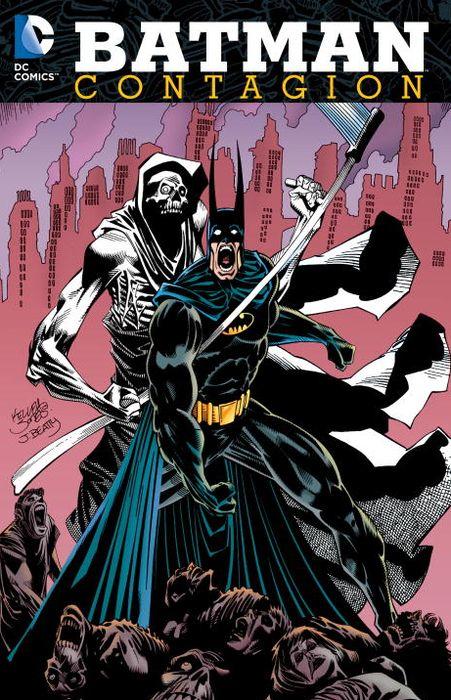
The participating issue of Batman, drawn by Kelley Jones and John Beatty, is perhaps the most dramatic, hell, melodramatic work in the book. It's the cover of that issue that graces the cover of the collection, in which batman stands atop a pile of corpses, held back by the Grim Reaper himself—that's not a Batman villain like The Reaper, by the way, but the symbol of death, appearing metaphorically (Graham Nolan would draw a Grim Reaper on the cover of  one of  his issues of Detective Comics, while Vince Giarrano would also draw the Grim Reaper in a splash page of one of his contributions). Jones also provided the trade dress on the covers of the individual issues, a border full of skulls and insects, presided over by the skeleton of a bat just above the word "Contagion."

Jones is an excellent Batman artist, his conception of the character an always posing, dramatic figure that hunches, lurks and gestures operatically, a living gargoyle haunting pages filled with settings that seem inspired by silent films and Golden Age Hollywood horror movies. Batman's Batcave is filled with tech that wouldn't seem out of place in a mad scientist laboratory, for example, save, perhaps, for the fact that it is a little more elaborate than what might be expected in a B-movie, and his Gotham features piles of bricks rising from the ground, serving as stages and platforms for the vigilantes to pose upon.

Despite what a tremendous Batman artist he is, he's not really a superhero artist, which makes this particular issue of interest because in addition to Batman, who is almost always all cape, cowl and hands when ones draws him, Jones is also tasked with drawing villain Poison Ivy (whose depiction a college-aged Caleb wrote a letter to the editor about, as it reflected what he was then learning in art class)  as well as heroes Azrael, Nightwing, Robin and Huntress, some of whom are well outside his usual, exaggerative sweet spot, with little or nothing to accentuate (the streamlined Nightwing is a particular challenge for Jones, it seems, as he has nothing but his musculature to exaggerate; Huntress, at least, has a cape, and gets a nice entrance image with her cape swirling about her; neither holds a candle to his Batman, though, who perches on a pile of bricks just as Huntress did and commands a crowd to disperse, his massive, wing-like cape devouring his perch and much of the setting.)

The collection also features a few issues drawn by Vince Giarrano, an artist whose style I've always thought of as "sarcastic '90s." I don't know how sarcastic Giarrano was being in his art, of course, but I always got the sense that he looked around what was popular at the time and said to himself, "Is this what people like? I can do this" and then proceeding to draw, say, a huge Batman with devil horn-like ears and a spreading cape full of jagged points and a Poison Ivy with claw-like hands and a body like a female silhouette on a mud flap. 

There's a lot of other great art in the book, though none with the same confrontational energy as Jones and Giarrano's. Graham Nolan draws the cleanest, most realistic chapter in his work on Detective Comics. Jim Balent lays out the pages of Catwoman, but Dick Giordano finishes them. Barry Kitson pencils the Azrael pages. The Robin issues are drawn in the familiar, manga-inspired lines of Mike Wieringo (inked by Stan Woch). There's also art by John McCrea**, Frank Fosco and Woch, and Matt Haley and Mike Sellers, all of whom contribute to the Batman Chronicles issue (Interesting also for its cover, which has Jones finishing a Balent piece, bringing Jones' intense, apocalyptic linework to the more realistic Balent figure-work). 

As for the story's relation to our current contagion, it's interesting how little it reflects it.

Despite learning in the earliest chapters that the disease is spread through airborne mucous, Batman and his fellows continue to wear their cowls and domino masks, none of which cover their nostrils or mouths. Huntress does adopt a plastic mask that covers her eyes, nose and mouth in the Batman Chronicles short story "Exposure," written by Christopher Priest and drawn by the previously mentioned Haley and Sellers team. She also worries after tears in her costume, which is sort of interesting given that this story arc features a new costume for her, one that covers her neck to toe; previous to this arc, she was wearing what amounted to a long-sleeved bathing suit with boots and a cape, with a plunging neckline and lots of exposed flesh. The new suit is definitely better protection against catching a virus—and against just about everything else.

Robin, who is infected, is spit on during the riot, and, it would seem, might have been spared infection had he worn a mask similar to Huntress'. There seems to be a feeling of inevitability to infection among the characters, which is, perhaps, to be expected given the severity of the disease. One can't social distance and fight crime at the same time, after all, but it is still striking that there are no attempts at using any sort of personal protective equipment beyond that one short Huntress story, which only serves to underscore that the other heroes aren't doing it too (Given how much comics creators like giving their characters new costumes, it would seem a perfect time to debut a new, contagion-fighting Batman with a full-face mask; Catwoman does debut a new, all-white winter camouflage costume in this very story, but never something suited to avoiding airborne disease).

The National Guard is called in, by the governor of whatever state Gotham is in (New Jersey, I think, officially), but they are there to seal off the city, enforcing a stricter quarantine than any seen in the real world during the coronavirus, with no one getting in or out of the city. One exception? Refrigerated trucks come in near the end of the story; they're needed to store the bodies piling up, one of the apocalyptic details that we did see in the COVID-19 outbreak, as such trucks were needed in the real Gotham City of New York City at one, early point in the outbreak.

The end of the plague came about awfully quickly, far quicker than our own, as hospitals got the cure faxed to them and, in one case, hand-delivered by a blockade-breaking Azrael. And then the hospitals just went ahead and manufactured and distributed it ASAP, without any sort of testing period and certainly none of the vaccine hestitancy or outright resistance we saw in the real world.*** 

Oddly enough, once "Contagion" proper has ended, the collection just keeps going. The storyline did continue, as I recall, but not until after taking a bit of a break, and then picking up in the sequel crossover storyline, "Legacy."

 At first the collection's post-"Contagion" continuation might seem somewhat natural, as the final issue of the crossover Robin #28 ends with a cliffhanger, complete with a "To Be Continued" box, albeit a minor cliffhanger: Tim's girlfriend Ariana has just dyed her hair blonde.

So the collection includes the next two issues of Robin, in which the title character contends with Maxie Zeus. And then there's a three-issue story arc from Batman by the Moench/Jones/Beatty creative team, "The Deadman Connection," in which Batman and guest-star Deadman follow a trail of stolen Incan treasures and ghost-possession to South America. And then there's a three-issue Batman: Shadow of The Bat arc by Alan Grant, Dave Taylor and an assortment of guest-artists, the storyline that intoduced villain Narcosis and kicked off in SOTB #50.**** 

None of these stories have anything at all to do with "Contagion", and it is thus weird to see them here. Not that they are unwelcome, of course. All are good stories with their own virtues—I'm particularly fond of the Batman story, as Jones work on that series remains as remarkable today as it was in the mid-1990s—it's just strange to see them here. 


*The exception that proves the rule, however, is Zeb Wells and Gurihiru's 2020 Heroes At Home one-shot, a collection of short, funny strips in which various Marvel heroes must deal with the new realities of the COVID-19 pandemic, ranging from amusing themselves while stuck indoors, to trying to get a piece of cake while social distancing, to dealing with a shortage of toilet paper. 
This is, I believe, the only comic book in which I have seen any heroes wearing cloth masks to protect themselves from contracting the coronavirus. I reviewed the book upon its initial release here. 

**That McCrea-drawn story is, of course, "Hitman" and it is written by Garth Ennis. It serves as a sort of unofficial zero issue to their Hitman monthly, bridging the character's appearances in The Demon and his own new title. I'm not sure if it was collected in the most recent round of Hitman trades or not, but one would certainly hope so, as it is a direct lead-in, mentioning the plot of Hitman's first arc and Batman's desire to capture Tommy Monaghan no matter what. He is, of course, distracted by the plague to devote his full attention to that task at the end of this story. 

At this point, Ennis was still writing Monaghan more as a super-powered hitman than just a regular old hitman, so he uses his mind-reading abilities and X-ray vision to great effect, with a pretty fantastic introduction of Batman to the scene. I'd scan it if I could, but the trade I'm working from is too thick to allow for decent scans. 

***I find myself curious what the notoriously conservative Dixon thinks about the aspects of the pandemic that have become political—masking, vaccine, mandates—given how apolitical "The Clench" and its fighting was in the pages of the comic book he wrote some 15  years ago, and what so many of his fellow conservatives think of those elements of our current pandemic.  

****I mentioned this story briefly in my post about Pagan, as she has a cameo appearance in it.