In 2018, DC Comics published
Justice League Task Force Vol. 1, collecting the first 12 issues of the 38-issue, 1993-1996 series. I was late in purchasing it, obviously, but I had a pretty good excuse—I had previously read the series in single issues (albeit from back-issue bins, so I read it in small chunks at a time, and mostly out of order).
When the series was originally launched, it seemed to be part of DC's attempts to expand the Justice League franchise into an entire line of books in the early '90s. Not too long after Keith Giffen and J.M. DeMatteis' five-year run had ended, their two ongoing monthly series,
Justice League America and
Justice League Europe, were still going, albeit under different creative teams.
Task Force would be the third book, and it would be followed by 1995's
Extreme Justice, which...is an interesting book. (If DC ever collects
that into trade, I promise to buy, read and write about it; from what I remember of the issues of that series I read, the art was very much in the vein of "Kids like Image, let's make it look like an Image comic!", while the writing wasn't nearly as bad...although did early '90s Image Comics even
have a writing style...?). That proved a book too many, though, and the franchise collapsed, only to be restarted almost immediately by Grant Morrison, Howard Porter and John Dell's "back-to-basics" take on the team in
JLA.
As for
Task Force, it offered a fairly direct break from the ongoing Justice League saga that started post-
Crisis; it shared a continuity with the other Justice League books, but only occasionally tied directly into the goings-on of the franchise, and the stories collected in this first volume were basically all standalone ones. Beyond that, it was distinct in two ways. First, it didn't have a set character line-up, so each story arc would bring together a new batch of heroes, with only two mainstays. Second, the writers would change with every story, only the artist remaining the same—with the exception of fill-ins, of course.
That artist was Sal Velluto, and, looking back, the book was extremely lucky to have him. DC Comics art in 1993 could be fairly hit-or-miss, as certain books attempted to borrow the aesthetics of more popular Image and Marvel comics, whether the stories, characters or artists were particularly well-suited to that look or not (see
Extreme Justice). Velluto had a highly-detailed style, his characters' faces full of details. He excelled at babes and beefcake in a way that was somewhat reminiscent of Bart Sears, who made his own mark on the Justice League previously during a
Justice League Europe run, but his style was a bit more grounded than Sears'. His muscle-bound characters might be chiseled like Green statues, but the world they moved in, and the "civilians" they interacted with seemed to be as real as can be, at times almost mundanely so.
I really liked the way Velluto drew the characters in action, his flying Martian Manhunter sometimes looking as if he were swimming, his obsessively-rendered body seemingly being hurled around the scene. Even the characters bound by gravity—Aquaman leaping out of the water to land atop of a foe, Bronze Tiger executing a flying kick—appear to move with a purpose and grace, even if it's a violent purpose and grace.
Because this book varied so great from story to story, I thought that would be the best way to examine it.
•
#1-3, "The Tyranny Gun!", "Split Hit" and "Twisted Glass"
By David Michelinie, Sal Velluto, Jeff Albrecht and Glenn Whitmore
State department bureaucrat Hannibal Martin, who looks a bit look John Goodman, is called to the Pentagon, expecting to finally be appointed the U.S. ambassador to France, his dream job. Instead, he's briefed on a conflict in the strategically vital but completely fictional island nation of Sanobel.
Apparently, rebel forces are planning to assassinate President Ramos, the island's dictatorial leader, who looks a bit like Fidel Castro. The military want to send in some American superhero support, but because Ramos is such a brutal dictator with a history of killing his opposition, sending in the Justice League would be problematic.
Suicide Squad's cancellation the previous year apparently meant that team, which regularly dealt with stuff like this, weren't available, and apparently neither were the similar sorts of government-sponsored super-teams the Squad would occasionally cross paths with. So the plan is to create a "hand-picked strike force of League members-- --sent in on a 'surgical' mission to remove Ramos's enemies without undue publicity."
Martin doesn't want the job of leading this team, but he's got it.
Making this something more than a potential civil war is a high-tech weapon that is being sold to the rebels, a death ray apparently powered by a sliver of ore recovered from the Tunguska event, a weapon that's capable of turning anything organic in a sizable area to goo in a matter of moments. It's being sold to the rebel group's leaders by sadistic British weapons dealer Count Glass. He's on the island demonstrating the efficacy of the weapon with his bodyguard Blitz, who is outfitted in a suit of super-armor that allows him to fly and has various offensive weapons.
Let's take a moment to recall the state of "the Justice League" that the Pentagon agents were referring to in the spring of 1993, when this issue was on the stands. The two extant Justice League teams, Justice League America and Justice League Europe, were established in 1992's
Justice League Spectacular #1. Both of the teams, and the books they starred in, were in flux at the moment, though.
Justice League America, by Dan Jurgens and Rick Burchett, had just scrambled the line-up of the US-based League following the death of Superman and the grevious injury of Blue Beetle at the hands of Doomsday, and had introduced characters Black Condor, The Ray and Agent Liberty to the team. In June of 2003 though, Jurgens and Burchett were on the final chapter of their "Destiny's Hand" arc, involving an alternate universe version of the Satellite Era League (that storyline was collected in
Superman and Justice League America Vol. 2, if you're curious).
Justice League Europe, by Gerad Jones, Ron Randall and Randy Elliott, meanwhile, was just re-titled that very same month
Justice League International, and changed its line-up a bit, adding Tasmanian Devil and Maya, while losing Aquaman (Jones'
Justice League Europe/
International comics haven't been collected, and likely never will be, for
the obvious reason).
Martin's first choice (meaning, of course, Michelinie's), is Martian Manhunter, who he meets by waiting for him in what is apparently J'onn's own small house in "upstate New York," after a five-page sequence in which J'onn foils the plans of extremist French separatists in Montreal. (I'm unsure how J'onn's appearance here squares with what Jurgens was doing with him in
Justice League America at the time, but it's not like it matters, reading this book today.)
J'onn then recruits Gypsy from the old "Detroit Era" Justice League, who he catches in the act of using her illusion-casting powers to steal new clothes from a mannequin (Her previous status, as part of the corporate super-team The Conglomerate from the Giffen/DeMatteis run, is mentioned in passing). Aquaman and Flash Wally West are recruited from Justice League Europe (so this is apparently set just before the final issue of the series under that title), and while Martin had hoped to get Batman to join them, they instead get the next best thing: Nightwing.
Let's pause for a moment to note that this isn't the best line-up for a strike force that can't be associated with the/a Justice League. Four-fifths of it are Justice Leaguers, including two founding members of the team, and while yeah, J'onn, Gypsy and Nightwing are pretty good at stealth, you've still got The Flash and Aquaman. Everyone wears their iconic super-suits, too (Unlike Joe Kelley, Doug Mahnke and company's 2004-2005
Justice League Elite series, which also featured a sort of "black ops" League faction, wherein the more well-known characters like The Flash and Green Arrow had new, cool black "stealth" costumes).
Regardless, after an issue spent gathering and briefly introducing the individual members of the team and introducing the threat, the remaining two issues have the team in Sanobel, attempting to track down the death ray weapon and stop it from being used on a populated area, like President Ramos' headquarters. There are a couple of physical confrontations with Blitz, Glass, the rebel forces and their allies, culminating in a final battle in which things work out remarkably well for our heroes: The death ray is destroyed, the dictator is killed by one of the noble rebel leaders, and the rebels take over the island, humbled by their temptation by Glass into becoming better leaders than Ramos was In other words, the task force were sent there in part to suppress a rebellion and prop up a dictator, which they seemed a little too okay with, but everything worked out for the best, I guess.
One of the odder character bits that sticks out comes from what is also the most interesting dynamic in the book. That is, how Nightwing would interact with his former mentor's colleagues in the Justice League. Michelinie writes that relationship as frostier than one might expect, in large part because he seems to be trying to portray Martin as manipulating the heroes, but Aquaman and Martian Manhunter repeatedly object to Nightwing as a showboat and a poor team player, stemming from the fact that he's used to bossing the Titans around, and he doesn't defer to J'onn as instinctively as the others do.
I don't think it really works, particularly when one considers the fact that The Flash (at least,
this Flash) and Nightwing grew up together, and The Flash should be more used to working with Nightwing (and following his orders) than he is with J'onn, Aquaman or Gypsy, the last of whom he has literally just met.
Additionally, I know Dick Grayson didn't spend as much quality time with Martian Manhunter and Aquaman as he did with Superman back when he was Robin, but they seem to treat him as more of a stranger than a reader might expect, given how long they worked with Batman. (I'm not sure if Aquaman and J'onn are meant to know that Nightwing is the same guy who used to be Robin or not here, but J'onn, being both a detective
and a mind-reader, should be able to figure it out even if neither Dick or Batman ever explicitly pointed it out to him).
Michelinie spends a great deal of time on the villain, Glass, and his henchman, really getting inside their heads and explaining their motivations. Both get away at the end, and it made me curious if perhaps DC's plan at one point was to have Michelinie stay on as the series' writer and they changed their minds at some point for some reason, or if the plan was
always to have rotating writers working with a single artist (an unusual set-up for a comic book series, then as now, really).
Reading it this comic in 2020, it's rather remarkable how
weak the various characters all are. I mean, that's an awful lot of superheroes to deal with some regular, non-powered dudes with guns and one (1) guy in a super-suit.
In the first issue, there's a scene where we see Justice League Europe in action, and it's weird to see all of
these guys tackling a single giant mutant rat monster...
...I mean,
most of them should be able to deal with it solo, you know...?
And once we get to Sanobel, there are still more examples. The Flash races to rescue Gyspy from the presidential palace before the death ray can kill everyone inside, and he is winded by the effort, lamenting the fact that he can't similarly save everyone in the palace. I know I've seen him empty sky scrapers and whole cities a few years later in various
JLA stories, though.
Similarly, there's a moment where J'onn tries to fight through an aura of...death energy, I guess?...to hit the off-button on the death ray, and it's...weird to see him collapse. Why didn't he just blast the thing with his Martian vision? (J'onn won't use eye-beams as a weapon until issue #9 of the series, and I found myself wondering if he even
had that power in 1993 or not.) Why did he try walking through the energy, rather than going intangible and attacking the thing from below? Hell, J'onn could have really just floated above Sanobel from orbit, used his vision powers to locate the machine, and then blasted it from space with his eye-beams, or hurled himself down onto it and smashed it to bits with a single blow; he shouldn't really need any task force to help him locate and destroy a single machine.
There's a fairly long tradition of writing characters like Superman, The Flash and, especially, Martian Manhunter as much weaker than they
should be in service to the conflicts writers face them with, something which has always irritated the hell out of me, as it seems like a shortcut to make the process of telling the stories easier. It feels like cheating, you know? That's why I've always enjoyed Morrison's Justice League comics; he writes them all as god-like entities with incredible powers, but never seems to cheat the way that, say, Michelinie does here.
Of course, it also occurred to me that that this story likely was just written at a time when these heroes
weren't all presented as powerfully as they would be in the coming years. I'm not sure what was going on in
The Flash at this point, so I don't know how fast he was in 1993. Certainly
this Aquaman predates the Peter David's volume of
Aquaman (note the short hair, left hand and lack of beard), during which he expanded the character's strength, speed, endurance and psychic powers, something that Morrison picked up on and continued in
JLA. By the time Geoff Johns got a hold of the character for
his volume of
Aquaman, he had made Aquaman so strong he was basically Golden Age Superman.
The other strange thing about revisiting this story is how overtly political the Justice League is...or, at least, political within the DC Universe. The characters not only work with the United States government but, here, work
for them, noting the difficult reality of the situation and the moral pitfalls, but basically shrugging them off. This is, I suppose, understandable, given that the post-
Crisis Justice League worked so closely with the United Nations, but it reads so strangely today, after dozens and dozens of stories about the League and various Leaguers talking about their reluctance or outright refusal to get involved with conflicts between nation states and the politics of sovereign governments.
By far the
most striking thing in this issue, however...?
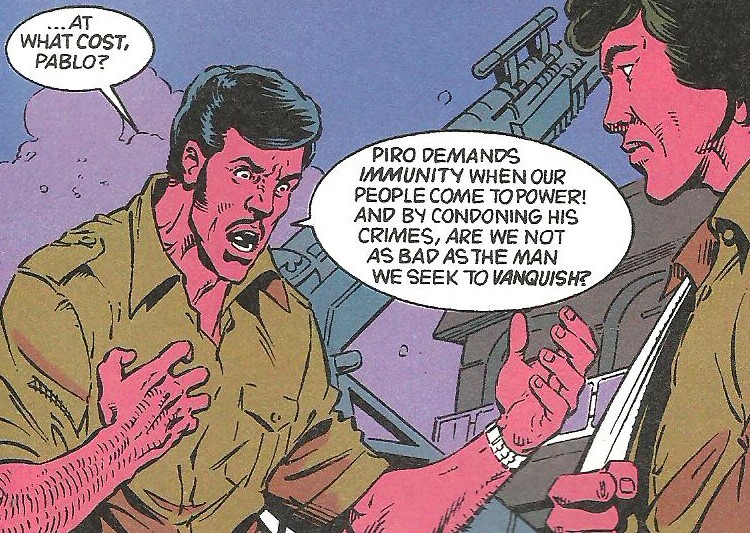
Gypsy, more often than not, has pink skin. Not white skin nor peach skin nor flesh-colored skin, not the pink skin of a young piglet nor the carnation pink found in a Crayola crayon box, but like, bright, radiant, almost neon pink skin. Like, the very same shade of pink that is used to color Green Lantern villain Sinestro who is, remember,
an alien being from another planet where the people have evolved pink skin.
Gypsy, for what it's worth, explains in issue #11 that "Gypsy" isn't just her code name, but her ethnic identity:
Being a gypsy hasn't historically been much fun, you know. My family came over from Romania nearly a hundred years ago to feel from prejudice in Europe.
With the disintegration of the Soviet state and the merging of the Germanies, anti-Gypsy sentiment s more rampant than ever. Or at least, people are more obvious about it now.
The more commonly accepted term these days would be "Romani" or "Roma" (which is what writer Devin Grayson would use when talking about Dick Grayson's ethnic identity in a 21st century retcon of the character), as many view the term "Gypsy" to be pejorative, but whatever the case, it doesn't explain why she's fucking
pink. (She
can change her skin color though, so maybe she
chooses to be pink?)
Also pink? The people of Sanobel, which I imagine is supposed to be situated in the Atlantic ocean somewhere in between the North American and South American landmasses. But I don't know, maybe it was settled by ancient Kourgarians...?
I don't want to blame colorist Glenn Whitmore for this, because it's not exactly isolated to these issues, or this series. I also noticed re-reading collections of John Ostrander and Kim Yale-written
Suicide Squad comics of the '80s and early '90s that there were a lot of questionable choices regarding skin color. For example, the white people and the Black people are generally colored realistically, whereas people of Latin extraction or, I guess, Romani people like Gypsy are often bright pink (but not always). South Asian and Middle Eastern people are sometimes colored gray. I...don't get it, but I imagine it must have something to do with the coloring technology of the day...? (The fact that Gypsy's skin on the original covers is generally just a shade or two darker than Aquaman's, but that in the interiors she's bright pink, makes me suspect it has something to do with the way comics were colored).
At any rate, while I often dislike when old comics are recolored for collection purposes, I think there's a very good argument to be made for doing so in cases like these.
In the end, these three issues are interesting, and seem to suggest a series that is going to be something of a cross between
Suicide Squad and
Justice League, but, of course that won't really prove to be the case: With writers changing each story, the types of plots as well as the tone will similarly change.
Look no further than the second story, for the first example...
•
#4, "The Arsenal of Souls"
By Chuck Dixon, Gabriel Morrissette, Dick Giordano and Glenn Whitmore
The book's second arc introduces a second writer, Chuck Dixon, and the first fill-in artist, penciller Gabriel Morrisestte, who is inked by Dick Giordano. It's a pretty interesting departure from what
seemed like the direction the book was going in, offering a rather early breath-catching break of a story, set between official missions.
Denny O'Neil and Ric Estrada's Lady Shiva character, from
Richard Dragon,
The Question and ultimately the Bat-books, is shown dismantling opponents in a street fight, looking for someone named "Sa'ar." It will eventually be revealed that he is the leader of a mysterious New York City cult with aggressive recruiters and, we will discover, he's a metahuman with abilities that allows him to drain the life energy form his followers as if they were batteries. He has used this power to live for centuries and, as he tells Shiva during their inevitable confrontation, "I learned every martial arts form at the feet of their creators...I have slain ten thousand men."
Shiva, who Dixon wrote in his original
Robin mini-series and elsewhere, has devoted her life to tracking down the world's most skilled martial artists and challenging them to barehanded fights-to-the-death. An immortal master of every martial art in existence sure sounds like a more promising fight than Batman or King Snake.
Meanwhile, Gypsy overhears a neighbor complaining to a gray-skinned man at a convenience store that her boyfriend has gone missing...and she notices that the neighborhood is suffering from an unusually high number of missing persons cases. She takes her concerns to J'onn and Martin, although the latter blows her off...and then asks J'onn to secretly trail her as she investigates on her own, as this might be a good test of her abilities.
Somewhere between issues, it was apparently decided that J'onn and Gypsy would be the Task Force's two permanent employees, I guess.
Dixon then basically crafts a serviceable story starring Lady Shiva, in which Gypsy and J'onn happen to converge with her as she gets the death match she wants. Sa'ar is able to use his formidable abilities to defeat J'onn mentally with a single psychic blow of sorts, and he is on the verge of killing Shiva with his martial arts abilities when Gypsy manages to use her illusion-casting abilities to break his hold on his followers, at which point Sa'ar crumbles to dust, apparently resuming his biological age in a matter of panels.
It's a pretty decent Shiva story, particularly in the context of her then rather clear character motivations, and it also works as the closest thing we'll get to a Gypsy solo story in these 12 issues. I think I appreciate it even more now that I've completely lost track of Shiva on this side of the
Flashpoint/The New 52—I'm pretty sure the last time I saw her she had on what was by far the worst costume of her 45-year career, the one with a spiked-ball at the end of her braid and a bizarre mask.
It's also noteworthy by today's standards by having a few actual fights in it, with characters exchanging blows for longer than two panels.
It was probably the last page that was the most exciting though, as it ended with Martin receiving a phone call for J'onn—"He says you'll know his voice"—from Batman who, at that point, had just recently had his back broken by Bane.
Bruce and Alfred were about to embark on a globe-trotting search for Dr. Shondra Kinsolving and Jack Drake. They were kidnapped by Benedict Asp, who hopes to use Kinsolving's psychic powers as a weapon, and her patient Drake was brought along as leverage (This story line appeared under the label
Knightquest: The Search). Bruce left Gotham City under the protection of new Batman Jean-Paul Valley and Robin Tim Drake (This part of the story line was branded
Knightquest: The Crusade).
And, indeed, a "Knightquest" crossover is explicitly what's promised in the last panel's next issue box.
•#5-6, "Knightquest: The Search"
By Dennis O'Neil, Sal Velluto, Jeff Albrecht and Glenn Whitmore
Justice League Task Force returns to a small fictional island nation south of the border for a two-issue sequence in "The Search" branch of DC's
Knightfall/
Knightquest/
KnightsEnd sequence, this one scripted by then-Batman editor Denny O'Neil. This time the island is a notorious one in Batman lore, Santa Prisca, setting of O'Neil's 1991
Legends of The Dark Knight arc "Venom" and Bane's place of origin.
Bruce and Alfred are presented as the protagonists, with several heroes apparently sent by Martin or J'onn gradually appearing as the Gothamites land on the island, make their way to their hotel and start to fend off assassination attempts. These are, in order, Bronze Tiger (
another O'Neil creation from his
Richard Dragon days), Gypsy and Green Arrow. Tiger gets the most panel-time and the most dialogue. Oddly, O'Neil writes Gypsy as if she's almost mute. She only speaks a single line in the entire 44-page story—"We gotta
help 'em!"—and precisely because it's her only line, it almost seems like it might have been a mistake. Tiger repeatedly points out that she never seems to talk.
As for GA, he only appears once from afar in the first issue, putting an arrow into a would-be gunman's shoulder from another rooftop, and doesn't introduce himself or get any dialogue until about midway through the second issue.
The heroes get close to rescuing Kinsolving and Drake, but lose them at the very last minute, as Asp manages to get the sick Drake onto a departing helicopter, and Kinsolving decides to break away from Tiger and join him, in order to keep him alive. They're pretty bummed about this, of course, but it's all for the best: If they rescued them this early, "The Search" would be way too short (Next stop? Alan Grant and Bret Blevins'
Shadow of The Bat #21-#23 and England, where we're introduced to British hero The Hood, who Grant Morrison will make use of during his run).
Aside from Velluto's art (which pairs perfectly with the muscular build and raw physicality of the Tiger, who does lots of punching, kicking and tossing), what might be the most interesting part of the story these days is seeing a wheelchair-bound Bruce Wayne commanding a handful of more street-level heroes on an action movie-esque mission. In a lot of ways, this felt like a precursor to
Birds of Prey, a concept that wouldn't be introduced for a few more years, in a 1996 one-shot.
Like the first
Task Force arc, this two-parter
also felt somewhat reminiscent of
Suicide Squad, not only in the type of mission and the one-off assemblage of diverse characters, but because also because of the Tiger's prominent role.
I think my favorite part of these issues though, was this (badly-scanned) bit:
Yes, that's Bruce Wayne
disguising himself as someone disguised as Bruce Wayne, so that if the others suspect that he's far too competent to be the Gotham City billionaire playboy, they'll instead suspect he's Batman or someone
pretending to be Wayne. That's the sort of depiction of Batman as a lunatic that I like, his being so over-the-top hyper-competent that he takes ridiculously baroque precautions to avoid simply trusting a couple of allies.
The story ends with Bruce, Alfred and the Task Force on a yacht, which was one of the four possible ways to get away from the island he had planned. I don't remember how the
Shadow of the Bat arc opens, and if there was a cameo of these characters or mention where Bruce and Alfred dropped them off, but now I kinda want to reread it just to check...
•
#7-8, "Valley of The Daals!"
By Peter David, Sal Velluto, Jeff Albrecht, Aaron McClellan and Glenn Whitmore
I remembered liking a lot about this one when I first read it, probably not too long after it was published, but oh man, did it not age well. Peter David is the writer, and while he's obviously quite talented at writing comics and knows what he's doing about as well as anyone who writes comics, he has a notorious penchant for injecting humor into his scripts...at times to the detriment of his own story. This one is definitely light-hearted, and rather in the spirit of the Giffen/DeMatteis League comics, but because 95% of the jokes are gender-based, and David (and every other person involved with the production of the comic) is a man, it now feels a little like the tired set of a stand-up comedian telling jokes about women drivers or women be shopping.
A plane carrying Agent Henry R. Haggard (
get it?) and a bio-weapon called the McGuffin Virus (
GET IT?!) has gone down over Africa, and Haggard found himself in a hidden underground kingdom of scantily-clad, green-skinned warrior women. Via a "transportable broadcast rig" he sends out a call for help, and the demands of his captors, The Daals: They will only negotiate with ambassadors from the outside world for Haggard's release, but only if the ambassadors are women.
This provides a good excuse for an (almost) all-female Task Force line-up. And so Gypsy is joined by Maxima, Wonder Woman, Vixen (the jacket of her then-current costume unzipped to her navel) and Dolphin (this issue of
JLTF was cover-dated about eight months before the first issue of David's
Aquaman series, in which Dolphin would play a big part).
But, at Martin's insistence, J'onn will be joining them, and he'll be doing so by using his shape-shifting abilities to take the form of a sexy lady version of himself, his costume adjusted ever so slightly so that his red "X"-shaped harness covers his breasts (For some reason, he also turns his boots into thigh-highs, wears his belt very loose, and gets golden shoulder pads, which help drape his cape in such a way to reveal more of his body).
J'onn is portrayed as extremely childish about having to adopt a female form for some reason (I suppose this was a couple of years before the John Ostrander/Tom Mandrake
Martian Manhunter series, where we learned he kept all sorts of different secret identities, of various genders), and he whines and pouts as if he were a particularly sensitive high school jock made to wear a dress in front of the whole school or something. He's immediately given a new appellation: J'oann J'onnz.
The action-adventure portion all works just fine, with the characters making their way to the hidden kingdom and engaging in a short battle before the queen of the Daals sets eyes on J'onn and declares her desire to marry him. J'onn, more for the purposes of David's script than anything else, plays along (This, like the first arc, is another story that, realistically, J'onn could solve himself in about a page if he used his powers). Meanwhile, David squeezes in all the gender comedy he can find room for.
For example, J'onn picks out a movie to entertain the gathered super-heroines while he and Martin apparently go over the mission, and he picks what he assumes five women would want to watch:
An Affair To Remember. Gypsy, Vixen and Maxima hate it, while Wonder Woman and Dolphin are moved to tears.
When J'onn, in his female form in the hidden kingdom, complains that the form is making him feel achy and irritable, Gypsy offers him a couple of Midol. And so on.
The climactic joke involves the revelation that when it comes time for the queen and J'onn to consummate their marriage, she doffs her loincloth to reveal a penis (off-panel, of course, but the script makes it obvious...including a reference to
The Crying Game). Like I said, this story did
not age well (And, I think, it really reveals who the intended audience for comics like this in 1993 was: Juvenile male readers).
While this is probably a comic worth forgetting, it
does have
some virtues, including Velluto's art, the appearance of a couple of relatively rarely used female heroes, and this now-classic scene in which Wonder Woman is asked about sex in an all-female society:
It was a rare piece of canonical evidence that the Amazon society was just as sapphic as one might imagine it was, at least, in a time before lesbian relationships on Themyscira were openly, canonically acknowledge in some 21st century stories, but given all of David's other gender-based jokes in the story, it's just as likely Wonder Woman is referring to how much better it is not to have to share a society with the opposite sex.
In fact, it's pretty equivocal. Maxima's prompt makes it seem as if Wonder Woman is referring to lesbian relationships, while Vixen's retort makes it seem like she's referring to the absence of men.
That said, it's a little depressing now to imagine young women who might have been excited to see an all-female Justice League team in this comic, only to find jokes about PMS, or a young trans person reading J'onn's panic at encountering a woman with a penis.
•
#9, "Saturday Night's All Right For Fightin'!"
By Jeph Loeb, Greg Larocque, Kevin Conrad and Glenn Whitmore
This is another more comedic-focused issue of the series in the vein of Giffen/DeMatteis'
JLI (In fact, writer Jeph Loeb even dedicates the issue to "
Keith Giffen who told these kinds of tales better than anyone!"). Though the humor aged better than that in David's story, it is, in some ways, even more dated, in that it teams J'onn up with a trio of New Blood characters, a class of about 30 then-new superheroes who, with the exception of Garth Ennis and John McCrea's Hitman, didn't really make much of a mark in the years following the "Bloodlines" event that introduced them.
In this story, two of the Gotham City-based New Bloods, Alan Grant and Norm Breyfogle's
Joe Public and Chuck Dixon and Jim Balent's
Geist, meet one another while making their crime-fighting rounds, and the pair of novice heroes decide to join forces.
(That...is actually a pretty good idea. DC eventually published
a four-issue miniseries starring a team of New Bloods, revolving around a reality show premise, but one imagines a team consisting of the Gotham New Bloods set in Gotham City might have had better success, given that they could always rely on a Batman cameo or a fight with The Joker to goose sales. In addition to Geist and Joe Public, there was also Doug Moench and Mike Manley's Ballistic, Dixon and Kieron Dwyer's Razorsharp and The Psyba-Rats and Denny O'Neil and company's Samaritan and Cardinal Sin, although the last of those was a villain. As a teenager, I recall liking Geist's costume and powers and disliking Joe Public's, although the character has since grown on me as a sort of local, municipal version of Captain America; I never read the
Batman annual that introduced Ballistic, which is one of the reasons I now kinda wish DC would collect all the Bloodlines annuals and
Bloodbath into a series of trades).
The pair decide that, because they are so new at this whole superhero-ing thing, they should seek out a mentor, and so they decide to travel to New York City and, um, knock on the door of the/a Justice League headquarters.
J'onn answers, but he's in no mood for any sort of interruptions, as he had planned on a peaceful evening alone with a huge tray of junk food and a televised boxing match. Eventually an impossible-to-ignore interruption comes, however, in the form of Wildman, a newly-introduced, size-changing New Blood villain who wants to fight the League in order to make his reputation.
J'onn's the only one home, though, so Wildman ends up fighting J'onn and the two New Bloods...plus Loose Cannon, a hairy, Hulk-type that Loeb introduced with artist Lee Moder in
Action Comics Annual #5 (like The Hulk, he gets stronger the angrier he gets, but he
also changes color as he reaches new levels of anger and strength, turning from blue to purple to red). Loose Cannon just happens to be in town to appear on Geraldo, and gets swept up in the big fight.
Despite Loeb hitting on the neat (and marketable!) idea of some of the Gotham New Bloods joining forces, the issues doesn't really make an argument for any of these characters.
•
#10-12, "The Purification Plague"
By Michael Jan Friedman, Sal Vaelluto, Jeff Abrecht and Glenn Whitmore
For the final story arc, writer Michael Jan Friedman creates a white supremacist militia type with a high profile leader and backer, a United States Senator, a missile carrying a designer virus that will kill off anyone with non-Norther European DNA
and a team of super-powered enforcers with codenames ranging from the sort a white supremacist might pick out for himself (Iron Cross, Golden Eagle) to the sort a comic book writer might assign such characters (Blind Faith, Backlash and, my personal favorite, Heatmonger).
The Task Force plans to infiltrate the group, The Aryan Brigade, before bringing them down, which mean J'onn and Gypsy are joined by a team that could pass for members, which means, um, an all-white line-up of heroes: The Elongated Man, Black Canary, original Hourman Rex Tyler and Peter Cannon, Thunderbolt (in a new costume I can only describe as snazzy).
This is the story I had previously mentioned in which Gypsy talks about the fact that she's an
actual gypsy, or Roma, and I'm not entirely sure why she's there, given her darker (well, pinker) skin color; throughout this story she's continually drawn with sunglasses and a scarf, which I guess are meant to hide her ethnicity, somehow...?
Perhaps also of note, Black Canary hadn't yet started dying her hair blonde, so she has a short black buzz cut (I always like this better, personally, as it at least gave her the pretense of a secret identity when not being Black Canary).
As for J'onn, he just uses his shape-changing powers to assume the identity of a white supremacist that is arrested, while everyone else pretend to be friends of his.
Friedman engages white supremacist ideology a bit, with Cannon meeting a guy he used to know in the camp and having a conversation about why and how Cannon's former colleague was radicalized, and Ralph Dibny wondering how many of the people he used to know might share similar beliefs and so on.
Perhaps the most interesting bits involved Tyler, though, who was recruited specifically because he was a chemist, but who was reluctant to suit-up and superhero again...until he learns who the enemy this time out is. He has a frustrated exhaustion about the fact that he and his peers went to war 50 years previous to defeat this sort of ideology, and yet he was
still finding himself having to fight against it. It's actually kind of depressing to read this story 27 years
after that, knowing that we're
still fighting white supremacists and home-grown Nazis.
It's a little disconcerting how directly this literal comic book white supremacist villain's words prefigure Donald Trump's "Make America Great Again" campaign slogan:
It should come as no surprise that the heroes manage to stop the virus from being spread, but not before just a bit of it gets out for a twist ending involving the villain. I don't think we ever saw any of those Aryan Brigade villains again, nor do I recall ever seeing Thunderbolt with the Justice League again after this story was published, which was after the conclusion of his short-lived DC Comics series. (It looks like Dynamite has since published comics featuring him, but DC was also able to republish these comics in this collection, which just goes to show...I don't know how comic book licenses work, exactly...?).
DC still hasn't solicited a second volume of
Justice League Task Force, and while I'd personally like to see the rest of the series collected, I'm not entirely sure they will do so (it
has been about two years since this volume came out, after all), or, if they do decide to do so, how they would.
"The Purification Plague" arc included several panels of bad news about natural disasters coming out of various radios, and there's an appearance by T.O. Morrow predicting imminent disaster involving the League, all of which is actually foreshadowing for the upcoming "Judgement Day" crossover between the various Justice League books (That arc was collected in 2017's
Wonder Woman and The Justice League America Vol. 2). Indeed, the next issues of
Justice League Task Force are parts two and five of "Judgment Day" (written by Mark Waid and penciled by Velluto), and then there's an epilogue issue, followed by the second issue of a three-part Justice League book crossover (the "Zero Hour" tie-in introducing Triumph, by writer Christopher Priest and pencil artist Larocque; I don't think that's been published yet, but it probably should be) and then, finally,
Justice League Task Force #0, introducing a regular line-up for the title.
The book will then, at that point, become a more traditional superhero team title, somewhat to its detriment. Priest takes over as the ongoing writer, and I recall it being pretty solid for the remainder of its existence, as J'onn takes on a mentor roll for the likes of younger and newer heroes like Gypsy, The Ray, Triumph, Mystek and, um, the robot L-Ron's consciousness-transplanted-into-Despero's body. They'd face off against Vandal Savage, Ray villain Death Masque and intergalactic bounty hunter Glenn Gameron. They'd get new, matching costumes that J'onn and L-Ron/Despero would eschew. They'd journey to Skartaris, briefly team-up with Damage and Impulse, and tie-in to 1995's "Underworld Unleashed" line-wide crossover. There would be a few guest artists who would go on to become superstars, like Ed Benes and Jim Cheung, but Ramon Bernado would follow Velluto as the series' regular artist. Bernado had a very dramatic, distinct style that I didn't much care for back then, but I'd be interested in reading his work now that I am a grown-up, and have more sophisticated tastes.
The downside to Priest's tenure, in which the book became just one more Justice League book, was that it lost its rotating, mission-specific line-up premise, as well as the rotating writers, which, as this volume demonstrates, definitely kept the book fresh and interesting from issue to issue. I think that premise still has a lot of potential, and I think it would be fun to see DC revisit it for a secondary Justice League book in the future, whether they used rotating creators to go with the rotating characters or not (2014-2016
Justice League United, written by Jeffs Lemire and Parker,
did go the rotating character route, but because it followed so closely on the heels of the New 52-boot, I think it failed to work in the same way the New 52
Suicide Squad did; brand-new versions lacking any sort of history that makes mixing and matching them engaging in the way it might have on the other side of the reboot. That series only lasted 19 issues.)
At any rate, there are 26 more issues left of
Justice League Task Force, so regardless of how the publisher wanted to handle the "Judgment Day" and "Zero Hour" crossovers with the other Justice League books, two more volumes should finish up the series. I can guarantee at least one sale of each potential collection.