Kevin Eastman's relationship with IDW Productions would seem to be a rather fruitful one. In addition to allowing him to keep a hand on the rudder of their Teenage Mutant Ninja Turtles ongoing comic–though he is the "Eastman" of "Eastman and Laird's Teenage Mutant Ninja Turtles" fame, Nickelodeon has own the franchise for a while now–IDW also indulge Eastman's far less commercially promising projects, like Fistful of Blood.
They published the comic as a four-issue miniseries a few months back and then collected it into this 120-page trade paperback, but the back-story of the comic is a bit more convoluted. Eastman and his friend and one-time studio mate Simon Bisley originally created it for Heavy Metal magazine circa 2001, and it looks like it was previously collected in 2002. This version isn't that version, at least, not exactly. Eastman refers to it as a "re-mastered version" in the ample back matter included after the actual story, noting that he redrew every page (and colorist Tomi Varga turned the once black-and-white comic into the full-color version that fills these pages).
Even without knowing that, it's evident that Eastman and Bisley both had a great deal of creative input on the pages of this book, and while their precise working method isn't exactly defined, the results reminded me quite a bit of Eastman's early collaborations with Peter Laird, where they both seemed to have written, penciled and inked every panel together, and it was difficult to tell exactly who did what. This is a little like that, as there's a lot of Eastman and a lot of Bisley on almost every page and, interestingly, some pages look a lot like the work of Bisley. In the behind-the-scenes section, Eastman says that they discussed the book together, he did the lay-outs (many of which are included), Bisley did the pencils and then they both worked on finishing the pages together...and now, of course, they've been re-finished and colored.
It's an unusual kind of collaboration, really, more like the construction of rock music by a band than the normal, strict division of duties often associated with comics: It can be hard to tell where Eastman ends and Bisley begins, and, as a fan of either or both artists, it's a blast to try and pick out who drew which line, and who designed which background character throughout (Do note that the cover of the book, above, is clearly all Eastman).
As the title and the Western setting allude to, the comic was created as a deliberate reference to 1964
s A Fistful of Dollars. Eastman writes that it was mean to be a parody of the classic Eastwood Western, but its more of a high-concept riff, "with Zombies, Vampires and Aliens...long before they became all the rage." A quick couple of keystrokes confirms that this genre mash-up predates Platinum Studios' controversial Cowboys & Aliens comic book by a half-decade, and the resurgence of the zombie genre with 28 Days Later by a year.
The basic plot construction is borrowed directly from A Fistful of Dollars. A woman with no name stumbles into town. She is comically well-endowed in the way that only a comic book character could be–and clearly designed and drawn by Bisley–and dressed only in a bra and underpants.* She is immediately set upon by one of the two local gangs, and dispatches them all pretty quickly. Later, she's attacked by a member of the rival gang, and kills him handily as well.
One gang is a bunch of zombies, the other a bunch of vampires, and they've turned an abandoned Western movie set into a literal tourist trap, where their human servant helps them lure visitors in with the promise of a Western theme experience, and then the two warring gangs of ghouls divide up the blood and flesh of their victims.
The woman with no name, the taciturn character sometimes called "Blondie," eventually agrees to help each gang dispatch the members of the other, but it all ends with a huge battle in which her true nature is revealed (Eastman's quote above spoils it; if you didn't catch it, let's just say she's a very strange stranger indeed) as is the real reason she wandered into this particular town in the first place.
The relative slightness of the plot, and the fact that it is borrowed from a movie (which, of course, borrowed it from another movie) means how much fun a reader will have with the book likely revolves around how much one enjoys the work of the two artists. (Personally, I'm a big fan of both.) That, and, perhaps, how much affection one might have for horror creatures like these.
They are very Hollywood in their conception. The zombies walk and talk and are all-around sentient, and they're always all dressed up in cowboy style; they look a bit like Jonah Hex all of him was as ugly as the one half of his face. The vampires, by contrast, all look like variations of the title character from Nosferatu: Bald, big ears, eyes and fangs, billowing black robes, long skeletal fingers ending in claws. A few of them are more colorful, dressed in Asian exotica fashions and looking pretty bizarre.
The designs are all fairly cartoonish, and bear Bisley's general aesthetic. Eastman shares his original designs for the characters, and it's amazing how different (and different for the better) they ended up, with the main character being the one with the least bit of redesign. That back-matter I keep referring to fills 32 pages of this collection, and there's plenty of commentary from Eastman, along with sketches, lay-outs, character designs, storyboards for a movie adaptation that was never made (at least, not yet) and so on. Apparently Eastman adapted it into a film script with a few friends (one of whom was comics writer Paul Jenkins), and came up with ideas for a pair of sequels based on For a Few Dollars More and The Good, The Bad, and The Ugly, which "will see the light of day...one day, either as a comic series or some other form."
I don't know about movies–this particular story is scant enough that it looks like the sort of narrative that could very easily be ruined by filmmakers trying to fix it**–but I'd be interested in seeing those ideas as comics. Particularly if Eastman could re-team with Bisley, because their collaboration is a large part of what made this book so much fun.
In fact, it's kind of hard to imagine this book without Bisley, as his style incorporates so much caricature into the cartooning that it keeps one from ever taking the proceedings too seriously. As high-concept as this might be, it's a rather low-brow form of high-concept, with meant to be laughed with. Despite the horror tropes, it's much more of a B-movie splatter-stick kind of affair than an actual work of horror meant to scare a reader. Under the pencils and pens of different artists, this could be anywhere from terrible to offensive. Under those of Eastman and Bisley, however, it's a damn good time.
*I was going to write "panties" but it has recently come to my attention that women don't like, or even use the word "panties." Is that true, ladies? Or only true of the women I talk to...?
**Well, unless Quentin Tarantino, or someone who similarly loved the source material and was similarly talented at "sampling" other films in their work were was the filmmaker doing the adaptation. But one imagines that From Dusk Till Dawn is the last horror/western mash-up Tarantino will be involved in. For what it's worth, the plot of this comic is far superior to that of From Dusk Till Dawn though.
Showing posts with label zombies. Show all posts
Tuesday, May 03, 2016
Wednesday, February 03, 2016
"The traditional methods"...?
It was my understanding from every zombie movie I've ever seen and every zombie comic I've ever read that the way to kill a zombie was to destroy or severely damage its brain, usually by shooting or somehow smashing its head. Not so, according to The Shade in this week's Swamp Thing #2 by Len Wein and Kelley Jones. Filling a zombie's mouth with salt and then sewing it tightly shut sounds infinitely harder, even if we're talking about the slow, shambling zombies of Romero's movies or The Walking Dead, rather than the "fast" zombies of more modern movies.
I mean, I've never held a firearm, nor am I an expert in hand-to-hand combat or anything, but I'm pretty confident I could pull a trigger or swing a baseball bat or shovel in the general direction of a walking corpse's head. But sewing...? I mean, I can barely thread a needle, and I always forget how to tie off the other end once you're done stitching. Think how hard surviving the zombie apocalypse would be if The Shade is right!
Also, think how boring all those movies, TV shows and videogames premised on the killing of zombies would be...
I mean, I've never held a firearm, nor am I an expert in hand-to-hand combat or anything, but I'm pretty confident I could pull a trigger or swing a baseball bat or shovel in the general direction of a walking corpse's head. But sewing...? I mean, I can barely thread a needle, and I always forget how to tie off the other end once you're done stitching. Think how hard surviving the zombie apocalypse would be if The Shade is right!
Also, think how boring all those movies, TV shows and videogames premised on the killing of zombies would be...
Saturday, February 07, 2015
Review: Marvel Zombies Destroy!
My initial reaction to this book was to make a joke about the fact that they have now made so many Marvel Zombies comics that they decided to quit numbering them, but looking at that Wikipedia page I mentioned in my recent review of Marvel Zombies 5, I see this is hardly the first Marvel Zombies-branded book to be published sans a number (That would be their third outing, Dead Days, and Destroy! was also preceded by the non-numbered Return, Evil Evolution and Supreme).
This five-issue, 2012 miniseries seems to follow Marvel Zombies 5 rather closely in that it features Howard The Duck fighting zombies in an alternate dimension, but it is not the work of Marvel Zombies 3-5 scribe Fred Van Lente; rather this miniseries rather unusually has two different writers, with a Frank Marraffino (Marvel Zombies Supreme) writing the first two issues, and veteran writer Peter David taking over for the final three issues. The unusual change seems to suggest a problem of some kind, or at least a story behind it, but perhaps it was a schedule thing as much as anything else; there's a little editorial in the back by editor Jake Thomas that mentions the difficulties the team went through in getting it out, and how the project was a dream come true for him, and how heavily involved he was.
The art team is more stable, but it still required a fill-in artist, which is, again, pretty unusual in a miniseries, and the fill-in falls on issue #3, which is right where the writers change. A Mirco Pierfederici draws all of the issues save for #3, which is penciled by Al Barrionuevo and inked by Rick Magyar. It's worth noting that the change isn't terribly disruptive; I wouldn't have noticed a change in either writer or artist while reading if I hadn't read the credits page first.
I think that says less about the styles and skills of the creators than the fact that they were working on a franchise with such specific sensibilities. Does it have zombies in it? Are there a lot of jokes, a dark sense of humor and a great deal of horror? Okay, fine, it's Marvel Zombies then. Like a few other offerings to date, this one doesn't really feature the "real" Marvel Zombies, the ones from that alternate dimension first introduced by Mark Millar which was basically just the Marvel Universe if all the superheroes had turned into zombies, but it does feature plenty of zombified Marvel superheroes (from another alternate dimension full of zombies), and cast is split between Golden Age characters and the most obscure Marvels this side of Woodgod. Howard the Duck gets top bill (Ha! Bill!), and Dum Dum Dugan is the next biggest star, if that tells you anything about the cast.
Howard, Agent of ARMOR, recruits Dum Dum, Agent of SHIELD, to be a part of his crack strike force nicknamed "Ducky's Dozen." It appears that ARMOR, the acronym for government agency Alternate Reality Monitoring and Operationl Response, has discovered a reality where the Nazis won World War II (like DC's pre-Crisis Earth-X, then), and they accomplished this by becoming zombies. Worse yet, the Nazi zombies are preparing to invade the Marvel Universe, unless Howard's team can journey there first and wreck their mode of conveyance. Dugan has been recruited specifically for his Nazi-fighting expertise, but he suspects there's some other reason Howard wants him along and isn't telling him...and he's right!
As for The Dozen, they're a huge group of totally awesome-weirdos, only a few of whom I had ever even heard of, or could tell you much of anything about: Battlestar, Blazing Skull, Breeze Barton, Red Raven, Dragoon, Dynaman, Eternal Brain, Flexo, Gur and Taxi Taylor. How many of these guys are super-old, super-obscure characters, and how many were invented specifically to be killed off in this series? There's only one way to find out, and it's a good 15 minutes of Wikipedia-ing fun!
Spoiler alert: 3/4th of them don't make it back home, but somehow I doubt some of these deaths will stick, given the tongue-in-cheek nature of the entire series.
The dozen heroes journey into Nazi zombie-controlled territory and attempt to fight their way up a Mount Rushmore-style Nazi base with the heads of Hate-Monger, Zola, Red Skull and Baron Von Stucker, and they immediately find unexpected heavy resistance in the form of the zombified, Nazi-fied Invaders. And then they get some unexpected assistance from some lady superheroes going by the name "The Sufragists," and lead by Miss America, who has picked up this world's fallen Captain America's shield and legacy.
As the story progresses, new unlikely allies and unlikely enemies join the fray, with Loki siding with Earth-616's good guys and a zombified Thor and the rest of a zombified Asgard siding with the Nazis whose ancestors used to worship them.
There's a nicely strange aura about the entire book, owing in large part to its big, odd-ball cast, almost all of whom are completely disposable on account of their being either created specifically for this book, so rarely seen it's hard to imagine they would be missed (I had no idea Red Raven was even still alive to be killed!) or alternate reality characters, in which case anything goes, as we've got our own perfectly good Thor or Zola or whoever back in the "real" Marvel Universe.
Some gags work a lot better than others. I thought the riffs on Namor's catch-phrase didn't really work, as they were coming from Namor—well, a Namor—himself, but I did sort of love the armband worn by Dum Dum's alternate dimension, Nazi zombie doppelganger:
Yes, that's a handlebar mustache where the swastika should be and, yes, they did think to rename him Dead Dead Dugan, which is the title of this particular issue's story.
Marvel Zombies Destroy! certainly has its moments and, I think, more moments than many of the other Marvel Zombies efforts. It appears that there's still some life in this franchise after all.
*********************
One of my favorite parts was Thomas' editorial, as in it he shares some of the concept art he came up with for covers, which looked a lot different and a lot better once Michael Del Mundo got a hold of it:
*********************
So have we all agreed to just ignore what Original Sins revealed about the true nature of Dum Dum Dugan, because it's stupid? Will Secret Wars/Battleworld un-retcon that away? Because I couldn't get it out of my mind while reading this, and it really made me wish I'd read Destroy before Original Sin or Original Sins.
This five-issue, 2012 miniseries seems to follow Marvel Zombies 5 rather closely in that it features Howard The Duck fighting zombies in an alternate dimension, but it is not the work of Marvel Zombies 3-5 scribe Fred Van Lente; rather this miniseries rather unusually has two different writers, with a Frank Marraffino (Marvel Zombies Supreme) writing the first two issues, and veteran writer Peter David taking over for the final three issues. The unusual change seems to suggest a problem of some kind, or at least a story behind it, but perhaps it was a schedule thing as much as anything else; there's a little editorial in the back by editor Jake Thomas that mentions the difficulties the team went through in getting it out, and how the project was a dream come true for him, and how heavily involved he was.
The art team is more stable, but it still required a fill-in artist, which is, again, pretty unusual in a miniseries, and the fill-in falls on issue #3, which is right where the writers change. A Mirco Pierfederici draws all of the issues save for #3, which is penciled by Al Barrionuevo and inked by Rick Magyar. It's worth noting that the change isn't terribly disruptive; I wouldn't have noticed a change in either writer or artist while reading if I hadn't read the credits page first.
I think that says less about the styles and skills of the creators than the fact that they were working on a franchise with such specific sensibilities. Does it have zombies in it? Are there a lot of jokes, a dark sense of humor and a great deal of horror? Okay, fine, it's Marvel Zombies then. Like a few other offerings to date, this one doesn't really feature the "real" Marvel Zombies, the ones from that alternate dimension first introduced by Mark Millar which was basically just the Marvel Universe if all the superheroes had turned into zombies, but it does feature plenty of zombified Marvel superheroes (from another alternate dimension full of zombies), and cast is split between Golden Age characters and the most obscure Marvels this side of Woodgod. Howard the Duck gets top bill (Ha! Bill!), and Dum Dum Dugan is the next biggest star, if that tells you anything about the cast.
Howard, Agent of ARMOR, recruits Dum Dum, Agent of SHIELD, to be a part of his crack strike force nicknamed "Ducky's Dozen." It appears that ARMOR, the acronym for government agency Alternate Reality Monitoring and Operationl Response, has discovered a reality where the Nazis won World War II (like DC's pre-Crisis Earth-X, then), and they accomplished this by becoming zombies. Worse yet, the Nazi zombies are preparing to invade the Marvel Universe, unless Howard's team can journey there first and wreck their mode of conveyance. Dugan has been recruited specifically for his Nazi-fighting expertise, but he suspects there's some other reason Howard wants him along and isn't telling him...and he's right!
As for The Dozen, they're a huge group of totally awesome-weirdos, only a few of whom I had ever even heard of, or could tell you much of anything about: Battlestar, Blazing Skull, Breeze Barton, Red Raven, Dragoon, Dynaman, Eternal Brain, Flexo, Gur and Taxi Taylor. How many of these guys are super-old, super-obscure characters, and how many were invented specifically to be killed off in this series? There's only one way to find out, and it's a good 15 minutes of Wikipedia-ing fun!
Spoiler alert: 3/4th of them don't make it back home, but somehow I doubt some of these deaths will stick, given the tongue-in-cheek nature of the entire series.
The dozen heroes journey into Nazi zombie-controlled territory and attempt to fight their way up a Mount Rushmore-style Nazi base with the heads of Hate-Monger, Zola, Red Skull and Baron Von Stucker, and they immediately find unexpected heavy resistance in the form of the zombified, Nazi-fied Invaders. And then they get some unexpected assistance from some lady superheroes going by the name "The Sufragists," and lead by Miss America, who has picked up this world's fallen Captain America's shield and legacy.
As the story progresses, new unlikely allies and unlikely enemies join the fray, with Loki siding with Earth-616's good guys and a zombified Thor and the rest of a zombified Asgard siding with the Nazis whose ancestors used to worship them.
There's a nicely strange aura about the entire book, owing in large part to its big, odd-ball cast, almost all of whom are completely disposable on account of their being either created specifically for this book, so rarely seen it's hard to imagine they would be missed (I had no idea Red Raven was even still alive to be killed!) or alternate reality characters, in which case anything goes, as we've got our own perfectly good Thor or Zola or whoever back in the "real" Marvel Universe.
Some gags work a lot better than others. I thought the riffs on Namor's catch-phrase didn't really work, as they were coming from Namor—well, a Namor—himself, but I did sort of love the armband worn by Dum Dum's alternate dimension, Nazi zombie doppelganger:
Yes, that's a handlebar mustache where the swastika should be and, yes, they did think to rename him Dead Dead Dugan, which is the title of this particular issue's story.
Marvel Zombies Destroy! certainly has its moments and, I think, more moments than many of the other Marvel Zombies efforts. It appears that there's still some life in this franchise after all.
*********************
One of my favorite parts was Thomas' editorial, as in it he shares some of the concept art he came up with for covers, which looked a lot different and a lot better once Michael Del Mundo got a hold of it:
*********************
So have we all agreed to just ignore what Original Sins revealed about the true nature of Dum Dum Dugan, because it's stupid? Will Secret Wars/Battleworld un-retcon that away? Because I couldn't get it out of my mind while reading this, and it really made me wish I'd read Destroy before Original Sin or Original Sins.
Tuesday, February 03, 2015
Review: Marvel Zombies 5
You know, I think Marvel may have published too many Marvel Zombies comics. I say this for two reasons. First, looking at this page on Wikipedia, I realize that they published about three times as many of the damn things than I would have guessed they did. Second, they published so many of them that I actually lost track of which ones I read.
Last week I was at Half Price Books, and found hardcovers of both Marvel Zombies 4 and Marvel Zombies 5 for less than $5 apiece. Those were both written by Fred Van Lente, a favorite writer of mine, and both had solid artists attached (4 was drawn by Kev Walker, while 5 had a different artist attached to each issue, including the likes of Kano Michael Kaluta). I snapped them both up, took 'em home and read them both.
The first, a direct sequel to Marvel Zombies 3, features Morbius, The Living Vampire's new A.R.M.O.R.-sponsored Midnight Sons strikeforce of Werewolf By Night's Jack Russell, Son of Satan's Daimon Hellstrom, Man-Thing's Jennifer Kale and Man-Thing himself trying to foil the zombified head of Deadpool and his leg-man Simon Garth (from Tales of The Zombie) from spreading the zombie virus further...or letting it fall into the hands of The Hood or the dread Dormammamu. So basically, the stars of all my favorite Marvel Essentials editions (minus Godzilla) teaming up to fight zombies. Sold.
The second, rather randomly, features Howard The Duck and Machine Man, the latter the hero of Marvel Zombies 3, here being written along the lines of Warren Ellis' winning Nextwave: Agents of H.A.T.E. characterization, traveling the Marvel multiverse in search of blood samples from various zombie incursions.
It wasn't until about five minutes ago, when I prepared to write a review of Marvel Zombies 4, that I realized I had actually already done so, having previously bought and read it in trade paperback! That was in 2010, but apparently I had no memory of ever having read it. While I was in the act of reading it, the only thing that struck me as particularly familiar were the godawful Greg Land covers, which I was positive I had seen and written about before, but I just assumed I did so during the regular looks at Marvel solicitations, where my eyes would have first been assaulted by them, and my belief in a just world would have been insulted by the fact that the biggest comic book publisher in North America had paid Greg Land actual money in exchange for a drawing of a woman whose breasts were each as wide as her thighs.
So either it was a terriblly unmemorable story, I have a shitty memory or Marvel has published way too many Marvel Zombies comics. I'm going to go with the latter.
Anyway, Marvel Zombies 5. This is the third and final of the Van Lente-written Marvel Zombies books dealing with A.R.M.O.R., a S.H.I.E.L.D.-like military organization whose acronym stands for Altered-Reality Monitoring and Operational Response); they are at least conveniently numbered 3, 4 and 5, since Marvel also apparently published some other Marvel Zombies material between 4 and 5. (Seriously, the franchise is getting X-Men complicated here).
Due to a "Planestorm," A.R.M.O.R. has banned its agents from traveling between realities, for fear of spreading zombie infections, but our protagonists Machine Man and Howard The Duck are breaking regulations to travel into different zombie-afflicted areas to collect samples from each form of ghoul, each of which is given the designation of a particular director of a zombie movie (a Romero, a Boyle, a Raimi, etc). The reason for their mission is that Morbisu, The Living Vampire hopes to discover a cure for the virus by comparing alternate strains. As to what brought these two together, Machine Man is immune (being a robot) and Howard...maybe it was just time for Marvel to put Howard The Duck in another comic, before people forgot they owned him...? He says in-story that he needed a new job after his Avengers Initiative team was shuttered; Howard, a Clevelander, was part of the Ohio Avengers, a team I sorely wanted to know the roster of ever since Marvel first introduced the Fifty State Initiative plan, one of the few good ideas to come out of Mark Millar's Civil War.
The format of the five-issue series finds the characters traveling to a different reality in each issue, interacting with the inhabitants there as they fend off a different form of zombie, and then moving on to another world.
The first reality is the Kano/Tom Palmer-drawn Earth-483, "designated The Territory,'" where all of Marvel's Western heroes apparently live. Or lived. A mysterious green meteorite passing over Boot Hill in Rango causes the dead—all of 'em Marvel Western heroes—to rise from the grave to seek the flesh of the living. A "Romero" infestation, some of the zombies have enough muscle memory from their years among the living that they can still work their guns, and it's up for the old, bitter, besotted Hurricane and his super-speed to re-kill them all.
Before he dies, he passes his powers on to his daughter, Jackie Kane, who takes the superhero name "Swift Cloud." She's rescued by Machine Man and Howard, who arrive only on the 22nd page of the 23-page first issue. Van Lente's entrance line for Howard falls pretty flat, as it doesn't really make any sense, but he recovers immediately with this in the very next panel:
The premise of this series is a pretty good one, even if the execution varies widely from issue to issue. As far as Multiverses go, Marvel just doesn't have a very big or very interesting one...or, at least, many of the more exciting and familiar locales aren't visited during this particular jaunt. This first Earth benefits from some great art and from being chock-full of Marvel heroes, albeit some of the most rarely scene ones.
In the next chapter, still drawn by Kano and Palmer, but with Alvaro Lopez joining Palmer in inking, our threesome visits the near-future world of Kilraven, Earth-691. There they fight against, with and then against again Kilraven and his crew and their Martian-sponsored foes. The zombies here aren't actually undead zombies, but "Infected;" that's right, this type as known as a "Boyle." (The grandest, grand guignoil scene involves zombie fetuses exploding out of pregnant zombie ladies' bellies, which strikes me as more of a "Jackson" kind of thing, but why split hairs?).
From there it's off to somewhere medieval, where Kaluta presents a four-page story of Marvel's Black Knight character which involves an evil book that makes evil dead, and here our heroes naturally faced the loud-mouthed, giggling, wise-cracking type of zombie known as a "Raimi." Van Lente does a pretty good Army of Darkness pastiche here, although by this point, the artwork is getting a little unfocused—after Kaluta's contribution, we get 10 pages of Kano/Palmer and six by Felix Ruiz, whose work looks nothing like theirs—and it's becoming clear that the book is all premise and not plot.
Kano and Fowler disappear for the rest of the book. The fifth issue is drawn by Fernando Blanco and Felix Ruiz, and sees our heroes in a cyberpunk future where zombie infection spreads via data (and a grown-up Amadeus Cho and his gorgon girlfriend Delphyne from Incredible Hercules meet a gruesome end (and Swift Cloud wears Matrix drag). This issue deals most heavily with Machine Man's heartbreak over losing Jocasta, who is a bad guy in this future world, but that was really only interesting in that it generated this image earlier in the series:
And, finally, the series just sort of peters out in the last issue/chapter, drawn almost entirely by Blanco (save for one page by Frank Brunner), which is apparently set in "our" world, and allows Marvel to make fun of two of its favorite targets: DC Comics and Marvel Comics readers.
The jab at DC Comics is just this, which appears at the top of the top of the first page of the story:
That's...interesting...? It's also how the zombie infection is spread in this particular reality, as a fanboy stereotype character who reads superhero comics just so he can constantly complain about how terrible they are ("If I don't keep following 'em," he tells his local comic shop owner, "How will I know when they stop sucking?"). We spend the majority of this final section with this character Wendel, who is thoroughly annoying and unlikeable, and yet still not as annoying and ulikeable as Van Lente, Blanco and company spending so many pages erecting this particular straw man to beat on.
There's a sort of neat twist near the end, where this zombie, occurring as he does in the "real" world, suffers from rigor mortis, and Howard rattles off a whole list of reasonable questions about zombies that are perfectly logical reasons why they wouldn't really work in the real world, but rarely if ever get raised in zombie narratives, as the point of such stories is to have zombies in them, rather than be realistic.
Does Morbius come up with his zombie cure? The story leaves us hanging, but then it turns out to not have ever really been a story at all. Sure, it had all the component parts, and there are plenty of interesting ideas in there, but ultimately Marvel Zombies 5 read like an illustrated and published version of a story meeting between writer and editor, a first or second draft that somehow went to press instead of a final script.
Or does saying so make me sound too much like Wendel, who, you won't be surprised to learn, also reviews the comics he reads on the Internet!
...
I just hope I remember reading this one, so I don't accidentally buy it again in a few years...
Last week I was at Half Price Books, and found hardcovers of both Marvel Zombies 4 and Marvel Zombies 5 for less than $5 apiece. Those were both written by Fred Van Lente, a favorite writer of mine, and both had solid artists attached (4 was drawn by Kev Walker, while 5 had a different artist attached to each issue, including the likes of Kano Michael Kaluta). I snapped them both up, took 'em home and read them both.
The first, a direct sequel to Marvel Zombies 3, features Morbius, The Living Vampire's new A.R.M.O.R.-sponsored Midnight Sons strikeforce of Werewolf By Night's Jack Russell, Son of Satan's Daimon Hellstrom, Man-Thing's Jennifer Kale and Man-Thing himself trying to foil the zombified head of Deadpool and his leg-man Simon Garth (from Tales of The Zombie) from spreading the zombie virus further...or letting it fall into the hands of The Hood or the dread Dormammamu. So basically, the stars of all my favorite Marvel Essentials editions (minus Godzilla) teaming up to fight zombies. Sold.
The second, rather randomly, features Howard The Duck and Machine Man, the latter the hero of Marvel Zombies 3, here being written along the lines of Warren Ellis' winning Nextwave: Agents of H.A.T.E. characterization, traveling the Marvel multiverse in search of blood samples from various zombie incursions.
It wasn't until about five minutes ago, when I prepared to write a review of Marvel Zombies 4, that I realized I had actually already done so, having previously bought and read it in trade paperback! That was in 2010, but apparently I had no memory of ever having read it. While I was in the act of reading it, the only thing that struck me as particularly familiar were the godawful Greg Land covers, which I was positive I had seen and written about before, but I just assumed I did so during the regular looks at Marvel solicitations, where my eyes would have first been assaulted by them, and my belief in a just world would have been insulted by the fact that the biggest comic book publisher in North America had paid Greg Land actual money in exchange for a drawing of a woman whose breasts were each as wide as her thighs.
So either it was a terriblly unmemorable story, I have a shitty memory or Marvel has published way too many Marvel Zombies comics. I'm going to go with the latter.
Anyway, Marvel Zombies 5. This is the third and final of the Van Lente-written Marvel Zombies books dealing with A.R.M.O.R., a S.H.I.E.L.D.-like military organization whose acronym stands for Altered-Reality Monitoring and Operational Response); they are at least conveniently numbered 3, 4 and 5, since Marvel also apparently published some other Marvel Zombies material between 4 and 5. (Seriously, the franchise is getting X-Men complicated here).
Due to a "Planestorm," A.R.M.O.R. has banned its agents from traveling between realities, for fear of spreading zombie infections, but our protagonists Machine Man and Howard The Duck are breaking regulations to travel into different zombie-afflicted areas to collect samples from each form of ghoul, each of which is given the designation of a particular director of a zombie movie (a Romero, a Boyle, a Raimi, etc). The reason for their mission is that Morbisu, The Living Vampire hopes to discover a cure for the virus by comparing alternate strains. As to what brought these two together, Machine Man is immune (being a robot) and Howard...maybe it was just time for Marvel to put Howard The Duck in another comic, before people forgot they owned him...? He says in-story that he needed a new job after his Avengers Initiative team was shuttered; Howard, a Clevelander, was part of the Ohio Avengers, a team I sorely wanted to know the roster of ever since Marvel first introduced the Fifty State Initiative plan, one of the few good ideas to come out of Mark Millar's Civil War.
The format of the five-issue series finds the characters traveling to a different reality in each issue, interacting with the inhabitants there as they fend off a different form of zombie, and then moving on to another world.
The first reality is the Kano/Tom Palmer-drawn Earth-483, "designated The Territory,'" where all of Marvel's Western heroes apparently live. Or lived. A mysterious green meteorite passing over Boot Hill in Rango causes the dead—all of 'em Marvel Western heroes—to rise from the grave to seek the flesh of the living. A "Romero" infestation, some of the zombies have enough muscle memory from their years among the living that they can still work their guns, and it's up for the old, bitter, besotted Hurricane and his super-speed to re-kill them all.
Before he dies, he passes his powers on to his daughter, Jackie Kane, who takes the superhero name "Swift Cloud." She's rescued by Machine Man and Howard, who arrive only on the 22nd page of the 23-page first issue. Van Lente's entrance line for Howard falls pretty flat, as it doesn't really make any sense, but he recovers immediately with this in the very next panel:
The premise of this series is a pretty good one, even if the execution varies widely from issue to issue. As far as Multiverses go, Marvel just doesn't have a very big or very interesting one...or, at least, many of the more exciting and familiar locales aren't visited during this particular jaunt. This first Earth benefits from some great art and from being chock-full of Marvel heroes, albeit some of the most rarely scene ones.
In the next chapter, still drawn by Kano and Palmer, but with Alvaro Lopez joining Palmer in inking, our threesome visits the near-future world of Kilraven, Earth-691. There they fight against, with and then against again Kilraven and his crew and their Martian-sponsored foes. The zombies here aren't actually undead zombies, but "Infected;" that's right, this type as known as a "Boyle." (The grandest, grand guignoil scene involves zombie fetuses exploding out of pregnant zombie ladies' bellies, which strikes me as more of a "Jackson" kind of thing, but why split hairs?).
From there it's off to somewhere medieval, where Kaluta presents a four-page story of Marvel's Black Knight character which involves an evil book that makes evil dead, and here our heroes naturally faced the loud-mouthed, giggling, wise-cracking type of zombie known as a "Raimi." Van Lente does a pretty good Army of Darkness pastiche here, although by this point, the artwork is getting a little unfocused—after Kaluta's contribution, we get 10 pages of Kano/Palmer and six by Felix Ruiz, whose work looks nothing like theirs—and it's becoming clear that the book is all premise and not plot.
Kano and Fowler disappear for the rest of the book. The fifth issue is drawn by Fernando Blanco and Felix Ruiz, and sees our heroes in a cyberpunk future where zombie infection spreads via data (and a grown-up Amadeus Cho and his gorgon girlfriend Delphyne from Incredible Hercules meet a gruesome end (and Swift Cloud wears Matrix drag). This issue deals most heavily with Machine Man's heartbreak over losing Jocasta, who is a bad guy in this future world, but that was really only interesting in that it generated this image earlier in the series:
And, finally, the series just sort of peters out in the last issue/chapter, drawn almost entirely by Blanco (save for one page by Frank Brunner), which is apparently set in "our" world, and allows Marvel to make fun of two of its favorite targets: DC Comics and Marvel Comics readers.
The jab at DC Comics is just this, which appears at the top of the top of the first page of the story:
That's...interesting...? It's also how the zombie infection is spread in this particular reality, as a fanboy stereotype character who reads superhero comics just so he can constantly complain about how terrible they are ("If I don't keep following 'em," he tells his local comic shop owner, "How will I know when they stop sucking?"). We spend the majority of this final section with this character Wendel, who is thoroughly annoying and unlikeable, and yet still not as annoying and ulikeable as Van Lente, Blanco and company spending so many pages erecting this particular straw man to beat on.
There's a sort of neat twist near the end, where this zombie, occurring as he does in the "real" world, suffers from rigor mortis, and Howard rattles off a whole list of reasonable questions about zombies that are perfectly logical reasons why they wouldn't really work in the real world, but rarely if ever get raised in zombie narratives, as the point of such stories is to have zombies in them, rather than be realistic.
Does Morbius come up with his zombie cure? The story leaves us hanging, but then it turns out to not have ever really been a story at all. Sure, it had all the component parts, and there are plenty of interesting ideas in there, but ultimately Marvel Zombies 5 read like an illustrated and published version of a story meeting between writer and editor, a first or second draft that somehow went to press instead of a final script.
Or does saying so make me sound too much like Wendel, who, you won't be surprised to learn, also reviews the comics he reads on the Internet!
...
I just hope I remember reading this one, so I don't accidentally buy it again in a few years...
Tuesday, November 25, 2014
I think Yusaku Hanakuma's Tokyo Zombie is the greatest comic of all time ever (at the moment, anyway)
About two weeks ago I was working on a review of weird zombie manga Magical Girl Apocalypse, Seven Seas' translation and publication of Kentaro Sato's Mahō Shōjo of the End. It was a fairly typical zombie apocalypse type of story, starting out in a Japanese high school (like Highschool of the Dead, with which it shared a few other things in common), with its one big twist being the source of the zombie outbreak: "Magical Girl" stereotype characters, whose victims return to life as fast zombies...wearing frilly dresses.
At the time, it seemed to be about as weird a zombie manga as I could have imagined. While I was working on the article, I spent some time Googling Kentaro Sato and Mahō Shōjo of the End, and ran across a couple of lists of recommended zombie manga which included something with the rather prosaic, even generic title of Tokyo Zombie. It seemed to come up enough that I saw if it was something I would be able to order from the library, and it was.
It turned out to be much, much weirder than Magical Girl Apocalypse which, after all, basically only had that one twist making it so weird, and, in fact, one of the weirder Japanese comics I've laid eyes on in a while. In style and sense of humor, it seemed to have an awful lot in common with weird-ass humor comics of the West, and, well, as strange as zombies wearing frilly dresses killing people all over Japan might seem, Magical Girl Apocalypse doesn't have any scenes like, say, this:
Now, if you haven't read Tokyo Zombie (yet, and you totally should, if it sounds like your sort of thing by the time you finish this post), you'll know that there's context to the panel. It's not just an incredibly weird scene of a one-armed guy with a pitchfork riding a wave of angry pigs.
The guy is a slave kept by the rich in the post-apocalyptic society that arose from the ashes of the zombiepocalypse; he loves his pigs, which the brutish guards abuse for fun. When he tries to stand up to them, they chop off his arm. As the book reaches its climax and the slaves revolt, he begs his pigs forgiveness, sticks each of them in the butt with his pitchfork to enrage them, and then rides the tsunami of angry pigs into the guards with a "Huh?" and a "!?" before he stabs one in t he face with his pitchfork, back flips over the fallen guard and gets machine-gunned to death. His pigs fight on though, eating the rich.
The thing is that even in context, the panel still stands out as a really fucking weird panel, which is one of the great things about Tokyo Zombie. So many of the gags are just as funny if you're flipping through and seeing them out-of-context (or, say, seeing them posted on a blog), or if you read the story panel-by-panel and page-by-page. It's just that kind of comic, where crazy shit happens constantly, and while there's an often strong element of the non sequitur about the jokes, they are just part of the presentation. The book does tell a story, a funny, sweet, dramatic story, a sweeping epic narrative of honor in the ruins of civilization.
According to the fine print, Tokyo Zombie was originally entitled Tokyo Zonbi and was serialized in Ax Magazine in Japan in 1998-1999, which seems like an even longer time ago when I remember where I was in 1988-1999 (still in college), and just where pop culture was at the moment, vis a vis its zombie obsession (28 Days Later was still three or four years away).
The afterword by Yusaku Hanakuma explains that he was originally planning on a 16-page story in which his usual character Afro and Hage fought some zombies (Afro is distinguishable by his afro, Hage, which is Japanese for "bald," as I learned after befriending a Japanese girl, is, of course, bald). I grew in the telling, and so, he wrote:
Chapter 1***, "Dark Fuji," introduces us to our star/s and the source of this particular zombie apocalypse. These are, of course, the Afro and Hage characters (the former referred to by the latter as "Fujio"), two laborers who are practicing martial arts on their break from...whatever their factory/wareshouse job is. A note on the martial arts: It's not the sort of spectacular kung fu one might be used to seeing in comics or films, but rather some form of grappling-like martial art. Whenever we see the pair training, they are on their backs or knees on the ground, putting one another in some form of hold, or trying to escape from a hold.
"Fujimoto from main office," a man in a suit, shows up and belittles his underlings: "Heh, you guys spend your breaks rolling around on the floor? You two sure are close, huh?"
This sequence features my favorite panel ever, due to its utter randomness: Man, "What the fuck! Think you're hot shit because you're bald?" beats out "#$%@! Werewolves! I don't get it!", another recent favorite for completely random dialogue.
When Afro/Fujio clocks him on the back of the head with a two-by-four, killing him, the pair take his body up to Dark Fuji for burial. This is a mountain made of trash, where people would dig holes to hide trash and bodies, "And sometimes the ones that got buried weren't even dead yet."
As our protagonists leave, corpses start to emerge from the ground, one of whom is a naked lady who bites the penis off a gym teacher, who was there burying the body of a student he accidentally killed. She's one of a crowd of zombies to climb out of the ground atop Dark Fuji, and then wander down into Tokyo.
Here's how the television pundits try to explain the situation...
...but those panels are followed immediately with other responding, "You don't say," and "What kind of ridiculous mumbo jumbo is this?"
Whatever's going on, there are zombies all over. Hage and Afro continue to train until zombies break into their barricaded makeshift dojo. They make a break for it in a truck, but when Hage stops to save a little dog, he gets bitten, and throws himself into he sea before he can turn into a zombie and attack his friend, instructing him to keep training and to take care of the dog.
From there, the story jumps five years into the future, with the narrator returning to tell us about the shape of the new, post-apocalyptic world, which resembles that from George Romero's 2005 Land of the Dead quite a bit.
The surviving humans have built a big city protected by a wall and a brutal, armed militia, both of which serve to keep the zombies out and the slave labor taken from the ranks of the not-rich in. And what do the idle rich do all day? Well, as the narration puts it:
It's here that Afro (and his little dog) rejoins the narrative.
Having apparently completed his training—he now wears a gi with a black belt—he is one of the better if least popular zombie fighters, as he always wins his matches, but he does so in as boringly efficient a manner as possible.
Everything comes to a head when the crowd calls for his head, the fight promoter tries various ways to get him killed in the ring and the revolution rages outside...the various conflicts overlapping into a human vs. human war, with zombies, pigs and the little dog joining the fray:
As shit gets real, the dog starts jumping from the arena floor, and pulling rich, old, bloodthirsty ladies into the pit, where they are then attacked by zombies (Meanwhile, pigs attack the rich, old, bloodthirsty ladies up in the seats).
It's madness and mayhem, with the forces of powerful martial artists and animals eventually triumphing over both the corrupted living and the corrupt dead. In other words, it ends quite happily, for everyone who doesn't die horribly, anyway. But hey, most of those who died horribly either deserved it, or gave their lives doing something noble, like saving a little dog or killing those who would chop off his arm and "pig surf" on his pigs (i.e. stand on a pig's back, adopt a surfing pose and say: "Check it out. Pig surfing!")
If you like zombies, professional wrestling and/or martial arts and things that are funny, and don't mind gore and occasional crude sexual humor in service of a joke, then Tokyo Zombie is a, no the book for you. I haven't read every zombie manga ever created, but I'm tempted to call it the best zombie manga ever. Just as I haven't read every comic book ever, and find myself tempted to call it the best comic ever.
*Calpis is a terrible-sounding Japanese beverage, which you can read about on Wikipedia if you want. I should note that it sounds terrible to me personally; I don't mean to sound judgmental of you and your love of Calpis if you dig it.
**That's a breaded, deep-fried pork cutlet, which a pair of guards plan to turn one of the pig keeper's pigs into.
***Interestingly, while the book is called "Tokyo Zombie," each chapter page features a full-page illustration with the title of the chapter, the words "Tokyo Zombie" at the top (in both English and...Japanese. I can't tell if it's kanji or hiragana any more, because my knowledge of Japanese culture is atrophying the longer I spend away from my Japanese friend. But I assume its kanji), but, along the bottom, these pages always have the words "Tokyo of The Dead," which is hand-lettered in an approximation of Dawn of the Dead font.
At the time, it seemed to be about as weird a zombie manga as I could have imagined. While I was working on the article, I spent some time Googling Kentaro Sato and Mahō Shōjo of the End, and ran across a couple of lists of recommended zombie manga which included something with the rather prosaic, even generic title of Tokyo Zombie. It seemed to come up enough that I saw if it was something I would be able to order from the library, and it was.
It turned out to be much, much weirder than Magical Girl Apocalypse which, after all, basically only had that one twist making it so weird, and, in fact, one of the weirder Japanese comics I've laid eyes on in a while. In style and sense of humor, it seemed to have an awful lot in common with weird-ass humor comics of the West, and, well, as strange as zombies wearing frilly dresses killing people all over Japan might seem, Magical Girl Apocalypse doesn't have any scenes like, say, this:
Now, if you haven't read Tokyo Zombie (yet, and you totally should, if it sounds like your sort of thing by the time you finish this post), you'll know that there's context to the panel. It's not just an incredibly weird scene of a one-armed guy with a pitchfork riding a wave of angry pigs.
The guy is a slave kept by the rich in the post-apocalyptic society that arose from the ashes of the zombiepocalypse; he loves his pigs, which the brutish guards abuse for fun. When he tries to stand up to them, they chop off his arm. As the book reaches its climax and the slaves revolt, he begs his pigs forgiveness, sticks each of them in the butt with his pitchfork to enrage them, and then rides the tsunami of angry pigs into the guards with a "Huh?" and a "!?" before he stabs one in t he face with his pitchfork, back flips over the fallen guard and gets machine-gunned to death. His pigs fight on though, eating the rich.
The thing is that even in context, the panel still stands out as a really fucking weird panel, which is one of the great things about Tokyo Zombie. So many of the gags are just as funny if you're flipping through and seeing them out-of-context (or, say, seeing them posted on a blog), or if you read the story panel-by-panel and page-by-page. It's just that kind of comic, where crazy shit happens constantly, and while there's an often strong element of the non sequitur about the jokes, they are just part of the presentation. The book does tell a story, a funny, sweet, dramatic story, a sweeping epic narrative of honor in the ruins of civilization.
According to the fine print, Tokyo Zombie was originally entitled Tokyo Zonbi and was serialized in Ax Magazine in Japan in 1998-1999, which seems like an even longer time ago when I remember where I was in 1988-1999 (still in college), and just where pop culture was at the moment, vis a vis its zombie obsession (28 Days Later was still three or four years away).
The afterword by Yusaku Hanakuma explains that he was originally planning on a 16-page story in which his usual character Afro and Hage fought some zombies (Afro is distinguishable by his afro, Hage, which is Japanese for "bald," as I learned after befriending a Japanese girl, is, of course, bald). I grew in the telling, and so, he wrote:
I made sure to give the fans what they wanted (or at least I tried). I crammed in zombies, rucks, pro wrestling, martial arts, factories, Mt. Fuji, pigs, intense battles, wealthy people, slaves, porno, gym teachers, a little dog, Calpis*, tonkatsu**, a prince, a professor, and so on, to try an created a comic that was a sort of fin de siècle celebration of manliness.The result was a nine-chapter, 155-page half-serious comic presented in deadpan fashion, rendered in a rough, somewhat amateur-ish looking style more suggesting of the modern American mini-comic than what we modern Americans tend to think of as "manga style." The artwork flows beautifully, but is almost universally stage in middle-distance or long-shot images, the rare close-ups reserved for acts of gory, NSFW violence (a man's penis is bitten off by a zombie on page 11, with the sound effect CHOMP) or reaction shots from the previously mentioned little dog and/or pigs.
Chapter 1***, "Dark Fuji," introduces us to our star/s and the source of this particular zombie apocalypse. These are, of course, the Afro and Hage characters (the former referred to by the latter as "Fujio"), two laborers who are practicing martial arts on their break from...whatever their factory/wareshouse job is. A note on the martial arts: It's not the sort of spectacular kung fu one might be used to seeing in comics or films, but rather some form of grappling-like martial art. Whenever we see the pair training, they are on their backs or knees on the ground, putting one another in some form of hold, or trying to escape from a hold.
"Fujimoto from main office," a man in a suit, shows up and belittles his underlings: "Heh, you guys spend your breaks rolling around on the floor? You two sure are close, huh?"
This sequence features my favorite panel ever, due to its utter randomness: Man, "What the fuck! Think you're hot shit because you're bald?" beats out "#$%@! Werewolves! I don't get it!", another recent favorite for completely random dialogue.
When Afro/Fujio clocks him on the back of the head with a two-by-four, killing him, the pair take his body up to Dark Fuji for burial. This is a mountain made of trash, where people would dig holes to hide trash and bodies, "And sometimes the ones that got buried weren't even dead yet."
As our protagonists leave, corpses start to emerge from the ground, one of whom is a naked lady who bites the penis off a gym teacher, who was there burying the body of a student he accidentally killed. She's one of a crowd of zombies to climb out of the ground atop Dark Fuji, and then wander down into Tokyo.
Here's how the television pundits try to explain the situation...
...but those panels are followed immediately with other responding, "You don't say," and "What kind of ridiculous mumbo jumbo is this?"
Whatever's going on, there are zombies all over. Hage and Afro continue to train until zombies break into their barricaded makeshift dojo. They make a break for it in a truck, but when Hage stops to save a little dog, he gets bitten, and throws himself into he sea before he can turn into a zombie and attack his friend, instructing him to keep training and to take care of the dog.
From there, the story jumps five years into the future, with the narrator returning to tell us about the shape of the new, post-apocalyptic world, which resembles that from George Romero's 2005 Land of the Dead quite a bit.
The surviving humans have built a big city protected by a wall and a brutal, armed militia, both of which serve to keep the zombies out and the slave labor taken from the ranks of the not-rich in. And what do the idle rich do all day? Well, as the narration puts it:
For them (the wealthy), life without TV, radio, Jacuzzis, or cultural arts centers was incredibly stressful. From that stress, a new pastime was born...ZOMBIE FIGHT!And Zombie Fight is almost exactly what it sounds like: Humans fighting zombies, in a walled-off arena from which the rich can look down on them. The fight is run almost exactly like professional wrestling, with the human zombie fighters taking on the flamboyant personalities, showmanship and moves of today's pro-wrestlers, and, the fight organizer building drama by putting zombies in luchadore masks and other such nonsense.
It's here that Afro (and his little dog) rejoins the narrative.
Having apparently completed his training—he now wears a gi with a black belt—he is one of the better if least popular zombie fighters, as he always wins his matches, but he does so in as boringly efficient a manner as possible.
Everything comes to a head when the crowd calls for his head, the fight promoter tries various ways to get him killed in the ring and the revolution rages outside...the various conflicts overlapping into a human vs. human war, with zombies, pigs and the little dog joining the fray:
As shit gets real, the dog starts jumping from the arena floor, and pulling rich, old, bloodthirsty ladies into the pit, where they are then attacked by zombies (Meanwhile, pigs attack the rich, old, bloodthirsty ladies up in the seats).
It's madness and mayhem, with the forces of powerful martial artists and animals eventually triumphing over both the corrupted living and the corrupt dead. In other words, it ends quite happily, for everyone who doesn't die horribly, anyway. But hey, most of those who died horribly either deserved it, or gave their lives doing something noble, like saving a little dog or killing those who would chop off his arm and "pig surf" on his pigs (i.e. stand on a pig's back, adopt a surfing pose and say: "Check it out. Pig surfing!")
If you like zombies, professional wrestling and/or martial arts and things that are funny, and don't mind gore and occasional crude sexual humor in service of a joke, then Tokyo Zombie is a, no the book for you. I haven't read every zombie manga ever created, but I'm tempted to call it the best zombie manga ever. Just as I haven't read every comic book ever, and find myself tempted to call it the best comic ever.
*Calpis is a terrible-sounding Japanese beverage, which you can read about on Wikipedia if you want. I should note that it sounds terrible to me personally; I don't mean to sound judgmental of you and your love of Calpis if you dig it.
**That's a breaded, deep-fried pork cutlet, which a pair of guards plan to turn one of the pig keeper's pigs into.
***Interestingly, while the book is called "Tokyo Zombie," each chapter page features a full-page illustration with the title of the chapter, the words "Tokyo Zombie" at the top (in both English and...Japanese. I can't tell if it's kanji or hiragana any more, because my knowledge of Japanese culture is atrophying the longer I spend away from my Japanese friend. But I assume its kanji), but, along the bottom, these pages always have the words "Tokyo of The Dead," which is hand-lettered in an approximation of Dawn of the Dead font.
Tuesday, November 13, 2012
Review: High School of The Dead Vol. 1
I can’t help but appreciate how seemingly easy it is to come up with the premise of a zombie story these days. Just think of a noun, preferably one that can double as a setting, add the words “of the Dead” and BAM! you’re half way there.
Comic Shop of the Dead. Library of the Dead. Barbershop of the Dead. Doughnut Shop of the Dead. Precinct of the Dead. Sorority House of the Dead. Girls Locker Room of the Dead. Zoo of the Dead. Museum of the Dead. Circus of the Dead. Amusement Park of the Dead. United States House of Representatives of the Dead. You get the idea; hell, at least half of those are probably comics or direct-to-DVD movies and, if they’re not, then surely some artist is working on self-publishing comics with those titles, or some wannabe screenwriter is polishing up their scripts with the same titles.
Writer Daisuke Sato and artist Shouji Sato went with High School, and thus we get the manga series High School of the Dead, in which a zombie plague breaks out at the gates of a Japanese high school.
Our hero is Takashi Komuo, a somewhat delinquent student who first notices the arrival of the undead because he was skipping class, and he manages to save his one-time childhood girlfriend Rei, whose membership in the school’s spear club comes in handy.
Focus shifts to a few other survivors in the school—an arrogant honors student and her chubby, male helper, a strong and silent member of the kendo club, a ridiculously busty school nurse—fighting their way through the school and to a bus, upon which they escape the school grounds and find things no better on the outside world.
The artwork is sharp and energetic, the kids’ faces cartoony in the expected manga way, while the zombies are rendered a more realistically, giving the gore and violence an appropriate flinchy repulsiveness. I genuinely winced looking at some of the panels, like the one where kendo clubber Saeko Busujima dents the head of a zombie with her wooden blade, or any of the many in which the living dead take big, bloody mouthfuls out of victims’ limbs.
The exploitive nature of the book doesn’t end at the violence; the short school uniforms give Sato plenty of opportunities for panty shots and other fan service-framed page layouts, opportunities that are rarely passed up.
By its end, the characters are on a highway, headed into town—some on foot, some by bus—so I expect future volumes may move the narrative into even more standardized zombie story territory, but for the first volume at least, there was a unique-ish setting and costuming to the inventive writer and talented writers run through the paces.
A few things I saw here that seemed unique to the book.
One, Takashi and Rei fighting off a zombie horde with a high-power fire hose. I haven’t seen that in a zombie movie or comic before.
Two, a character theorizes that the zombie invasion will only last as long as it takes for the dead’s flesh to rot off, as without muscle tissue they won’t be able to move their skeletons. Another counters that would be true only if these dead do rot as per normal, and the fact that they’re walking around gives one reason to think they may not. I never thought about natural forces like entropy and biodegradation putting a time limit on zombie apocalypses. It got me thinking about birds and zombies; would vultures, crows and other scavengers eventually eat all the zombies…? In the event of a zombie apocalypse, would carrion eaters evolve to be the dominant life forms…?
And, finally, there’s a neat bit where the smart girl figures out the zombies can’t really see any more, and thus track their prey by sound.
That’s hardly enough to reinvent the genre or anything, nor do I imagine this turning on anyone already turned off by the deluge of zombie material out there, but it’s different enough that those already into zombies should find something to like in it.
Comic Shop of the Dead. Library of the Dead. Barbershop of the Dead. Doughnut Shop of the Dead. Precinct of the Dead. Sorority House of the Dead. Girls Locker Room of the Dead. Zoo of the Dead. Museum of the Dead. Circus of the Dead. Amusement Park of the Dead. United States House of Representatives of the Dead. You get the idea; hell, at least half of those are probably comics or direct-to-DVD movies and, if they’re not, then surely some artist is working on self-publishing comics with those titles, or some wannabe screenwriter is polishing up their scripts with the same titles.
Writer Daisuke Sato and artist Shouji Sato went with High School, and thus we get the manga series High School of the Dead, in which a zombie plague breaks out at the gates of a Japanese high school.
Our hero is Takashi Komuo, a somewhat delinquent student who first notices the arrival of the undead because he was skipping class, and he manages to save his one-time childhood girlfriend Rei, whose membership in the school’s spear club comes in handy.
Focus shifts to a few other survivors in the school—an arrogant honors student and her chubby, male helper, a strong and silent member of the kendo club, a ridiculously busty school nurse—fighting their way through the school and to a bus, upon which they escape the school grounds and find things no better on the outside world.
The artwork is sharp and energetic, the kids’ faces cartoony in the expected manga way, while the zombies are rendered a more realistically, giving the gore and violence an appropriate flinchy repulsiveness. I genuinely winced looking at some of the panels, like the one where kendo clubber Saeko Busujima dents the head of a zombie with her wooden blade, or any of the many in which the living dead take big, bloody mouthfuls out of victims’ limbs.
The exploitive nature of the book doesn’t end at the violence; the short school uniforms give Sato plenty of opportunities for panty shots and other fan service-framed page layouts, opportunities that are rarely passed up.
By its end, the characters are on a highway, headed into town—some on foot, some by bus—so I expect future volumes may move the narrative into even more standardized zombie story territory, but for the first volume at least, there was a unique-ish setting and costuming to the inventive writer and talented writers run through the paces.
A few things I saw here that seemed unique to the book.
One, Takashi and Rei fighting off a zombie horde with a high-power fire hose. I haven’t seen that in a zombie movie or comic before.
Two, a character theorizes that the zombie invasion will only last as long as it takes for the dead’s flesh to rot off, as without muscle tissue they won’t be able to move their skeletons. Another counters that would be true only if these dead do rot as per normal, and the fact that they’re walking around gives one reason to think they may not. I never thought about natural forces like entropy and biodegradation putting a time limit on zombie apocalypses. It got me thinking about birds and zombies; would vultures, crows and other scavengers eventually eat all the zombies…? In the event of a zombie apocalypse, would carrion eaters evolve to be the dominant life forms…?
And, finally, there’s a neat bit where the smart girl figures out the zombies can’t really see any more, and thus track their prey by sound.
That’s hardly enough to reinvent the genre or anything, nor do I imagine this turning on anyone already turned off by the deluge of zombie material out there, but it’s different enough that those already into zombies should find something to like in it.
Monday, October 01, 2012
Review: Zombies Calling
I was a little uncomfortable while reading Faith Erin Hicks' Zombies Calling, and was made so by an argument going on in my skull. I was of two minds about it; one of those minds was really into it, and one of those minds was pretty cynical about it.
(The cynical mind, I should probably note, had nothing to do with the subject matter; it’s hardly the fault of the 2007 book or its talented creator, who began working on it at least as far back as 2004, that I didn’t read it until 2012, and thus have experienced a dozen or two more zombie narratives than I would have if I read it upon its original release).
It’s the story of a trio of Canadian college students, each with a somewhat pretentious and unlikely-sounding name (to my cynical mind, anyway). There’s the heroine Joss (short for Jocelyn), who is obsessed with Britain and zombie movies; there’s Robyn, a fairly stock slacker dude; and then there’s Sonnet, who is naturally into poetry.
One day, zombies attack their school, and only Joss and Robyn’s intricate and extensive knowledge of zombie movies, including the oft-referenced “rules” of the genre, can get them out of this mess alive.
And that’s where I started feeling a bit uncomfortable, even more so than the self-consciously cool aspects of the characters made me. The graphic novel is a sort of meta-narrative, but it’s a meta-narrative specifically dealing with the conventions of film, not comics, and the results are therefore somewhat muddled, even confusing.
If a character in a zombie movie suddenly realizes “Oh holy cow, I am in a zombie movie!”, then I suppose that would be pretty “meta,” and a clever way to play with the typical zombie movie conventions (if the Scream movies got there a decade or so previous), but when a character in a comic book declares that she’s in a zombie movie…? Well, that just seems wrong: No, you’re not in a zombie movie. You’re in a zombie comic. I know because I am reading you in it as you speak.
It’s entirely possible this bothered me more than it would you, but the comic is so conscious of the conventions it’s riffing on, and it references them so often, that it seems to be the organizing principle, and the fact that it’s about an entirely different media doesn’t quite work…at the very least, it doesn’t work quite as well as it would if Zombies Calling was a film that Faith Erin Hicks wrote and directed, rather than an original graphic novel she wrote and drew.
(That said, however, it’s not quite structured like a film and, were what’s in these panels and pages put on a screen unchanged, it would be a very, very short film…like, 75 minutes long).
Beyond that somewhat fundamental difficulty, however, it’s actually a pretty fun comic.
(Above: So I guess you can have fast zombies, or you can have slow zombies, but you can't have fast and slow zombies. Not without traffic issues, anyway)
Hicks’ zombies are of the Return of The Living Dead variety, capable of saying “Braaains!”, although they’re maybe even a bit smarter that that movie's zombies, as they are also able to communicate with one another and follow the directions of their master, who is the only other character introduced before the zombies attack, so it’s not exactly a big surprise when he reveals his hand in their creation and his grand plan:
It was a kick seeing Hicks’ art from this period in her career. I like it quite a bit, as it was then and as it is now, although it’s a noticeably less refined and more fussy here than it has since become (There’s a making of section of the book showing earlier sketches of various characters, demonstrating how much Hicks art had changed before she even drew the first panel of Zombies Calling)
(Above: From the sketchbook section at the back. Hicks' art style has changed a lot, as you can see from the above examples and several others included)
If you're unfamiliar with her work for some reason (you should rectify that), her characters have big heads and big eyes, and, design-wise, look like a compromise between manga and turn-of-the-millennium Cartoon Network original series characters. The black and white artwork and the tankōbon-esque digest SLG published the book in probably further suggests manga, but it’s a format that perfectly suits Hicks’ designs and staging. The book is packed to the point of hyper-compression with action.
I’m of two minds about the book, but they both kind of liked it. One mind a lot more than the other mind, though.
(The cynical mind, I should probably note, had nothing to do with the subject matter; it’s hardly the fault of the 2007 book or its talented creator, who began working on it at least as far back as 2004, that I didn’t read it until 2012, and thus have experienced a dozen or two more zombie narratives than I would have if I read it upon its original release).
It’s the story of a trio of Canadian college students, each with a somewhat pretentious and unlikely-sounding name (to my cynical mind, anyway). There’s the heroine Joss (short for Jocelyn), who is obsessed with Britain and zombie movies; there’s Robyn, a fairly stock slacker dude; and then there’s Sonnet, who is naturally into poetry.
One day, zombies attack their school, and only Joss and Robyn’s intricate and extensive knowledge of zombie movies, including the oft-referenced “rules” of the genre, can get them out of this mess alive.
And that’s where I started feeling a bit uncomfortable, even more so than the self-consciously cool aspects of the characters made me. The graphic novel is a sort of meta-narrative, but it’s a meta-narrative specifically dealing with the conventions of film, not comics, and the results are therefore somewhat muddled, even confusing.
If a character in a zombie movie suddenly realizes “Oh holy cow, I am in a zombie movie!”, then I suppose that would be pretty “meta,” and a clever way to play with the typical zombie movie conventions (if the Scream movies got there a decade or so previous), but when a character in a comic book declares that she’s in a zombie movie…? Well, that just seems wrong: No, you’re not in a zombie movie. You’re in a zombie comic. I know because I am reading you in it as you speak.
It’s entirely possible this bothered me more than it would you, but the comic is so conscious of the conventions it’s riffing on, and it references them so often, that it seems to be the organizing principle, and the fact that it’s about an entirely different media doesn’t quite work…at the very least, it doesn’t work quite as well as it would if Zombies Calling was a film that Faith Erin Hicks wrote and directed, rather than an original graphic novel she wrote and drew.
(That said, however, it’s not quite structured like a film and, were what’s in these panels and pages put on a screen unchanged, it would be a very, very short film…like, 75 minutes long).
Beyond that somewhat fundamental difficulty, however, it’s actually a pretty fun comic.
(Above: So I guess you can have fast zombies, or you can have slow zombies, but you can't have fast and slow zombies. Not without traffic issues, anyway)
Hicks’ zombies are of the Return of The Living Dead variety, capable of saying “Braaains!”, although they’re maybe even a bit smarter that that movie's zombies, as they are also able to communicate with one another and follow the directions of their master, who is the only other character introduced before the zombies attack, so it’s not exactly a big surprise when he reveals his hand in their creation and his grand plan:
Universities are overrun by zombies, taught by zombies, financed by zombies. And if that is figuratively what they are, then that is literally what they shall become…pretty ingenious way to make a point, eh children?That’s not the only zombies-as-flexible-horror-metaphor instance in Hicks’ story, though; Joss is terrified by her student loans, and, in fact, she’s so scared that she suspects her fear of that is what helps her overcome her fear of actual zombies—compared to a lifetime of crippling debt, what’s so scary about a horde of rotting cannibals trying to eat you alive, you know?
It was a kick seeing Hicks’ art from this period in her career. I like it quite a bit, as it was then and as it is now, although it’s a noticeably less refined and more fussy here than it has since become (There’s a making of section of the book showing earlier sketches of various characters, demonstrating how much Hicks art had changed before she even drew the first panel of Zombies Calling)
(Above: From the sketchbook section at the back. Hicks' art style has changed a lot, as you can see from the above examples and several others included)
If you're unfamiliar with her work for some reason (you should rectify that), her characters have big heads and big eyes, and, design-wise, look like a compromise between manga and turn-of-the-millennium Cartoon Network original series characters. The black and white artwork and the tankōbon-esque digest SLG published the book in probably further suggests manga, but it’s a format that perfectly suits Hicks’ designs and staging. The book is packed to the point of hyper-compression with action.
I’m of two minds about the book, but they both kind of liked it. One mind a lot more than the other mind, though.
Tuesday, January 25, 2011
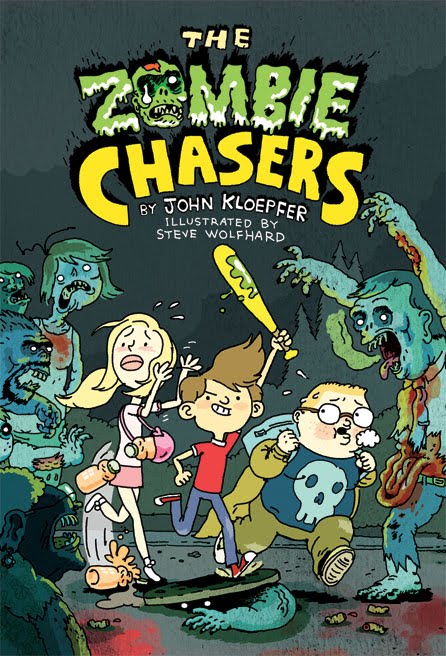
Steve Wolfhard's Zombie Chasers cover and illustrations
I recently had a conversation with a former co-worker of mine, a children's librarian, and asked her if she'd read any good kids books lately. She recommended a few, I placed holds on 'em at my local library, and when I picked them up I was slightly dismayed to find that they weren't picture books, which I usually think of when I hear the phrase "kids books," but prose fiction chapter books. I may or may not have discussed this on EDILW before, but I read very, very, very little prose fiction anymore. Part of it is because of the volume of comics I read, which more than fulfills my fantasy and escapism quota, part of it is because as I writer myself I have a hard time turning off the writing parts of my brain and really losing myself in prose fiction and part of it is because I simply prefer non-fiction at this point in my life (I do read a lot of fairy tales and mythology, which I guess is fiction, but libraries put them in the non-fiction sections with Dewey Decimal numbers).
Still, this friend has pretty good taste in just about everything, so I thought I'd give the books a chance. One of them was the book whose cover is pictured above, John Kloepfer's The Zombie Chasers. The other is David Lubar's Nathan Abercrombie, Accidental Zombie Book 1: My Rotten Life:
(My friend is fond of zombies, as you could probably tell).I picked up Zombie Chasers first, in part because of the intriguing title—kids who chase zombies? But zombies are usually the chase-ers, not the chase-ees!—and party because I liked the cover so much.
Those are some great, kid-friendly zombies, with their little, beady, blank-white eyes lumpy, bumpy, green skin and abstracted, cartoony gore. Here's the entire jacket, sans the plot summary and the UPC symbol and price tag, which will give you a better look at the sorts of zombies that populate the outside of the book:
(Click to enlarge, and check out the bearded zombie with a rotten drumstick stuck in its beard, or the zombie with the fishbowl over its head).As it turned out, it was a pretty good book. It's about Zack Clarke, a middle-school kid who returns home after a hard day to have a hard evening, thanks to his older sister's slumber party and the mean girls she invites to it. And then things get really bad, when a zombiepocalypse scenario occurs in his suburban Arizona neighborhood. Together with one of those girls, Madison, the prettiest girl in the eighth grade, Madison's boggle Twinkles, Zack's best friend Rice, and, eventually, school jock and bully Greg Bansal-Jones must navigate their zombified hometown on a quest to safety.
I'm well out of the target audience for this book, and there were certainly aspects I didn't care for—Kloepfer's writing is clever and funny, but the dialogue he writes for his kid stars is often too clever and humorous in the face of deadly danger, for example (The kids all sort of annoyed me whenever they talked to one another).
On the other hand, it was a really quick and engaging read, which tackled many of the regular zombie literature tropes and still managed to feel fresh. This was my first exposure to zombie lit of any kind aimed at younger kids—back in my day, zombies were strictly the providence of R-rated horror movies—and while there's a lot of implied death and gore in this story, I was sort of surprised at how kid-friendly zombies actually are.
In makes sense in retrospect, but rotting corpses certainly fall lend themselves to the sorts of icky, gross-out things that interest kids, Kloepfer focusing on the grody aspects of zombies, with dripping mucus and slime, bad breath, stinky smells and, in artist Steve Wolfhard's art, lots of flies and bugs circling around the dead.
Also kid-friendly was the fact that this zombiepocalypse may not necessarily be the end of the world; a few characters are brought back from being undead—becoming un-undead, as the characters start to stumble upon a cure. It was also refreshing to see that while Kloepfer including personal takes on familiar scenes and events—a trip to the grocery store, amusing forms of zombies, creative ways of destroying them, a fight in a graveyard—he also works with a few of his own, individual contributions to zombie lore, like a possible "zombie garlic," a popular vitamin/nutritional supplement that is (maybe) to zombies as garlic is to vampires, and hints at a unique source of the zombie plague—a fast food chain with a gimmick sandwich that seems to violate the order of nature (BurgerDog, which serves a hotdog that looks like a hamburger).
The source of the plague, and one of its possible cures, conform quite nicely to my personal dietary beliefs, so I suppose that contributed quite a bit to my enjoyment of the book.
Well that, and the artwork.
Wolfhard draws great zombies, and is a great zombie designer. He's a great character designer too. And BurgerDog mascot designer. He had a really nice, thin line that he applies to abstracted and exaggerated characters—the skinny kids are really skinny, the fat kid is really fat, the athletic guy is really athletic—and his line gets jagged and incredibly busy when it comes to the undead. They often look a bit like the work of a different artist, that's how strong the clash in design is between his live humans and dead ones.
His zombies are also generally pretty funny. I had a hard time finding a good crowd shot to scan that the crease between pages didn't render un-scannable, but his bigger and more detailed drawings reward looking long at, and the 100 or so interior illustrations that he fills the book with are often pretty inspired, and show initiative, illustrating things not discussed in the prose (Zack's ant farm, and the fact that the ants started eating one another when he quit feeding them, is mentioned, for example, but Wolfhard provides a bunch of illustrations of the ants battling one another, in one case with weapons, and a bunch of ant heads end up on spikes at the end of the battle).
As much as I dug Wolfhard's work, it also sort of bugged me as I was reading the book, as both the name Wolfhard sounded familiar (due to it's awesomeness; WOLF + HARD adds up to one badass name) and artwork looked extremely familiar. The bio of him in the back just mentioned that he "ha been drawing comics since he graduated from animation college," without naming any of his work, so it wasn't until after I finished the book and took to the Internet that I was able to find out why exactly Wolfhard's work and name seemed so familiar.
Steve Wolfhard is responsible for the excellent Cat Rackham comic, which I recommended on EDILW last fall after reading every story I could find on Wolfhard's Cat Rackham site (Man, that Cat Rackham Gets Depression comic is sooooooo good...>!)
Let's look at some of his Zombie Chasers art:


Wolfhard also draws little illustrations at the beginning of each chapter, with some sort of zombie forming the shape of the number of the chapter. Here are a few of the more creative examples:


***********************
Zombie Chasers is going to be a series of books, with the second volume, Zombie Chasers: Undead Ahead due out in March. If you're a grade-school kid, you should definitely have your parents buy this for you from a locally-owned brick and mortar bookstore, if such a thing still exists near you. And then you should stop reading this blog, because it's full of swears.
If you're a grown-up who likes reading neat kids books, or likes reading about zombies and don't mind reading things written for kids, you might like this.
And if you like looking at really neat drawings of zombies and kids running around, then you should definitely check this out, if only to look at the pictures.
**********************
Wolfhard talks a little bit more about his work for the book, and shares some images, on this 2010 post from his blog (And hey, check out his crazy-ass squirrel family tree while you're there). You can also see more of his zombies at thezombiechasers.com.
*************************
I should note that at no point during this book do any of the character actually chase zombies, but they are themselves constantly chased by zombies. The title is thus completely inaccurate, and perhaps false advertising. Of course, they do seem to be figuring out a zombie antidote of some sort by the end of the book, so perhaps there will be actual zombie-chasing in future volumes.
Sunday, January 02, 2011
Some second volumes
Awakening Vol. 2 (Archaia) The great strength of Nick Tapalansky and artist Alex Eckman-Lawn’ 2009 story “zombie noir” was, I thought at the time, was the moment at which Tapalansky decided to start telling a story of the overly familiar “zombiepocalypse” scenario, and the pace at which he was telling it: The zombies here are quite gradually “awakening,” and the world doesn’t fall in a day, or weeks or even months.The Awakened are, at first, oddities and pests, deadly facts of life, but hardly the end of the world. That gives the ensemble casts of characters plenty of time to come to grips with what is starting to happen, and to have their own, personal dramas and character arcs play out. It also allows for a zombie comic or movie unlike most every other zombie comic or movie—and, at last count, there were a lot of fucking zombie comics and movies.
Well, that was one of the book’s great strengths. The other was Eckman-Lawn’s artwork, full of strange, jittery lines over unnaturally shifting character designs that inhabit a poorly lit, photo-collage world.
(A page from Awakening; note the photos of birds shopped out and recontextualized into the panels)This volume concludes the story, and so while we witness police investigations of the Awakening phenomenon and of a string of serial murders conducted by the living, a thorough medical and scientific study of the undead and what makes them tick, the blossoming of a faith movement, the fate of the town crazy lady and the evaluation of some of her ranted claims, we also witness the zombie tipping point.
For all of idiosyncrasies of Tapalansky and Eckman-Lawns approaches, the point of view their story ultimately offers is as bleak and hopeless as most zombie stories, but once the dead start returning to life, the only note on which to end the story is probably predictably down.
The journey there is interesting though, and I particularly enjoyed Tapalansky’s explanations of the what behind the phenomenon and some of the unique details about it.
It’s still kind of weird, of course, and probably not for everyone, but it’s unique and interesting enough to warrant a look from most everyone interested in comics at some point, I should think.
In this volume, the title characters have less to do than in the first. After a color opening in which the trio compile an article on the way Christmas is celebrated around the world for the “World W Academy” newspaper and a sequence in which “Grandpa Rome” visits Germany while Italy sleeps, Italy and Germany are largely absent.
Instead, Himaruya explores Greece and Japan’s relationship (And Turkey’s interference with it), Lichtenstein and Russia’s relationships with their sisters, America and Japan’s attempts to understand one another’s cultures, England and France’s rivalry over which of them will become little America’s big brother in the 17th century, and a couple of pieces about how everyone either ignores Canada or mistakes him for America (Cuba, for example, loves Canada and hates America, but has trouble distinguishing them).

(Since the bulk of you live in one of these two countries, here are brief outlines of how your country-characters appear in the series)
Miss Don’t Touch Me Vol. 2 (NBM) Perhaps the most surprising thing about this volume is its very existence. The 2009 translation and publication of the Hubert-written, Kerascoet-drawn graphic novel was a perfectly-constructed, tightly-plotted mystery thriller set in a Parisian bordello in the 1930s. The title came from the role played by the heroine, who goes undercover there in order to solve the murder of her sister, and is lucky enough to get the job of the official bordello dominatrix/virgin, who no one is allowed to touch.Because of the complete-ness of that first book, with no dangling plotlines and the mystery solved, it wasn’t exactly a book that seemed to demand—or would even be able to sustain—a sequel, and yet here’s that second volume, collecting two stories originally published in France as Le Prince Charmant and Jusqu’a ce que La Mort Nous Separe.
On the first page, our heroine discovers that because of the way the bordello charges its employees for certain expenses—clothing, food, rent—she’s still in debt and must work it off by continuing to be Miss Don’t Touch Me.
Most of her co-workers are less-than-fond of her—and I suppose if you were a prostitute that had to do it with dudes all day, you’d probably resent the gal who only has to beat them with a riding crop and yell at them while remaining unmolested too—and her life becomes more and more unbearable.
At least until two people enter her life, each promising to make it much, much better in different ways. Her mother comes to Paris, and the pair renew something resembling a shared domestic life as much as possible, and she meets a young, rich, well-respected young man who seems to be her prince charming—even if he does seem interested in her mainly because of how much his dating a high-class, well-renowned prostitute seems to completely infuriate his mother.
Neither relationship works out all that well for anyone involved, and Blanche ends up suffering terribly…to the point that I began idly imagining if there was enough suffering in her story to make her comparable to a Lars von Trier heroine.
As a romantic tragedy tinged with crime elements, this second volume lacks the narrative punch inherent in the murder mystery genre the original belonged to, but it is similarly suspenseful and compelling (When I first read it, I intended to read ten or twenty pages before turning in for the night, and ended up staying up much later than expected, unable to quit reading until I’d finished it).
Despite some of the differences in the type of story, the art is still by the Kerascoet team, and everything I said about their work in the first volume holds true here too—each and every panel is a delight to study, although it’s all so breezy and effortless-looking that one’s eyes are propelled to dance along the panels.
Visually then, this is the exact sort of comic I like the most, the sort that reads super-smoothly, and then can be returned to over and over in order to be flipped through to a random page full of a panels to be studied or adored.
(Hey, here's a random page full of panels; let's study and adore it!)
Subscribe to:
Posts (Atom)