Showing posts with label bush. Show all posts

Monday, March 09, 2009

Happy Birthday, Freddie Prinze Jr.!

Do you know what yesterday was?

Er, yeah, it was Sunday. But do you know what else it was?

Yes, it was March 8. And what is March 8?

Why, it’s Freddie Prinze Jr.’s birthday!

EDILW favorite Freddie Prinze Jr.* turned 33 yesterday, and I’m afraid I’m a little late in wishing him a happy birthday, on account of not being near a scanner this weekend.

So I guess we’ll just have to celebrate FPJ’s B-Day one day late this year. And there’s probably no better way to celebrate Freddie Prinze Jr.’s birthday on a comics blog then by blogging about his most famous comics appearance, in Mark Millar, Bryan Hitch and Andrew Currie’s 2002 series The Ultimates, in which he fought the Hulk.


Sorta.

It can be kinda hard to remember way back then, back before Mark Millar became the megalomaniac we all know and love/loathe today, the self-aggrandizing parody of the writer he was in those pre-Wanted: The Movie and Civil War days. Back then he was just a very talented craftsman who had segued from an impressive if underappreciated run at DC Comics to the opportunity to reinvent Marvel’s icons with Brian Michael Bendis for the new Ultimate line.

While Bendis focused on character and personal melodrama in Ultimate Spider-Man and Ultimate Marvel Team-Up, Millar tackled the X-Men and Avengers franchises, reinventing them as big special effects-laden action movies that just happen to be on paper instead of film (Essentially taking Warren Ellis’ approach to the Justice League in The Authority, which he had taken over after Ellis left, and applying it to Marvel’s heroes).

Both Bendis and Millar went about the process of updating the forty-year-old concepts for the new millennium, in part by peppering references to modern pop culture (which, at the rate pop culture now refreshes, now tend to make those stories seem oddly dated). Millar took things a bit further than Bendis did by not only dropping verbal references to whatever the popular TV shows and bands were, but by inserting celebrities and their likenesses into the narrative of The Ultimates, making the story’s future place in comics held somewhat hostage to the successes and failures of those celebrities.

In the first Ultimates story arc, collected as a trade under the name The Ultimates Vol. 1: Super-Human, for example, not only did Millar and Hitch “cast” Samuel L. Jackson as Nick Fury, and indulge in the common practice of inserting real-life news personalities into the story (Larry King interviews Iron Man in one scene), but we also have celebrity cameos of
American Pie/Thir13en Ghosts star Shannon Elizabeth,

this goofball, and, of course, the subject of this post, Mr. Freddie Prinze Jr.

FPJ figures rather prominently in the story arc’s climax. After being beaten down by circumstance and regularly shown up by the likes of Hank Pym and Tony Stark, Dr. Bruce Banner decides to do something kind of stupid, and reinjects himself with the serum that had previously transformed him into The Hulk.

In Ultimates #4, he calls his ex-girlfriend and the Ultimates’ press agent Betty Brant to warn her that he’s about to turn into a big, scary monster that will probably attack her. When he calls, she’s in the middle of having dinner with Freddie Prinze Jr.


See?

As we now know, FPJ didn’t get the role in the Iron Man movie, which, as much as I like his work, is probably for the best, given how Robert Downey Jr. owned the role. Nor did FPJ ever get to join The Ultimates (But only because Marvel rejected my pitch for Ultimate Freddie Prinze Jr. One-Shot).

Banner collapses in mid-phone call, and is in the back of an ambulance when the serum kicks in, and he bursts out of the ambulance, in one of my favorite Hulk panels ever, the “HULK WANT FREDDIE PRINZE JUNIOR!” one above.

The issue ends with the team suiting up for action for their first mission, and in a very Millar cliff-hanger ending, Ultimate Captain America poses in front of his posing team and announces the plan for defeating the Hulk: “We just hit him until he drops."

In Ultimates #5, The Hulk finds Betty and FPJ, and attacks the restaurant they’re in:


Hulk shouting Freddie Prinze Jr.’s full name will never stop being funny to me.

From there, the Ultimates each attack the Hulk one-on-one and get defeated, because that’s exactly what would happen in a big dumb action movie. As the Hulk is finishing up on Thor, whose worst blows with Mjolnir “just make Hulk horny for Betty,” Freddie “gets all Hollywood” while he and Betty are being airlifted to safety.


The Hulk manages to jump up to their helicopter, where he makes his final plea with Betty:


Oh man, hanging off a helicopter by our fingers screaming at the girl we loved and who we thought loved us back that Freddie Prinze Jr. can’t love them the way we can…who hasn’t been there before?

And then The Wasp climbs through Hulk’s head and applies a wasp sting to his frontal lobes, which makes him fall out of the helicopter and transform back into Bruce Banner and then Captain America sucker-kicks the scientist in the face because Ultimate Cap is a total dick, the end.

So happy birthday Freddie Prinze Jr., and thank you for all the many hours of entertainment you’ve helped provide me with over the years!

And for either giving permission to use your name to Marvel (or just not suing them for using it), so that The Ultimates’ origin story included you cock-blocking The Hulk.


*No, seriously. She’s All That is one of my all-time favorite movies. I’m serious! I swear to God. Look, see this?
That’s She’s All That in two different formats. And while it is by far my favorite of his romantic comedies, I have seen every single one of FPJ’s movies. Repeatedly.

Friday, December 19, 2008

My four favorite single panels from David Rees' Get Your War On


When I saw the new Get Your War On collection, the one shaped like an American flag, had the phrase "the definitive account of the war on terror, 2001-2008" on the cover, I assumed that was just some of author David Rees' humorous hyperbole. Rees is, after all, quite enamored of hyperbole, as his rather uncomfortable blog demonstrates on a pretty much daily basis.

But then I sat down and read it. Or re-read it actually, since I had read almost every one of these strips as they originally appeared online, and I realized that even if there is some sarcasm in the boastful "definitive account" subtitle, I'm certainly hard-pressed to think of a better account of the last seven years of the "War on Terror." (Or should that be "war" on "terror"...?)

As I reread these, I was reliving every horrible, hilarious, infuriating, unbelievable event of the Bush administration prosecution of the War (uppercase-W) and the wars (lowercase-w's) that it quickly devolved into. Reading these, I remembered where I was the first time I read them and where I was and what I was thinking when I read the news or watched the speech or interview that they were reacting to. It's seven-years of bad news, seven years of my life and your life and the nation's life, in 250 pages.

It's amazing to reread them at this point in history too, after the majority of the country finally—finally!—came around to seeing things Rees' way, and to look back at what he was writing back in 2001 and see how little has actually changed on some very important fronts. It was still fall of 2001 when his clip art cubicle-jockeys were howling about the fact that the United States couldn't seem to find Bin Laden, or catch whoever was mailing the anthrax, counting down the days until Bush went into Iraq for no reason and wondering after Vice President Dick Cheney's fear of light.

And you know what? Rees was right like, 95% of the time (One thing he got wrong was when one of his characters, shocked that eight weeks of bombing Afghanistan had yet to kill bin Laden, said that U.S. bombing raids must be like the elixir of eternal life, and that Saddam Hussein would therefore live to be 400-years-old). He was certainly more right more often than, say, The New York Times or NBC News or Newsweek or Time or Bob Woodward, and therefore deserves the right to put "definitive account" on his book more than just about anyone else who consistently commented on the war.

That said, something is lost by reading the book in this format, rather than the individual strips as they came out. Like after Bush's state of the union speech, in which he suddenly brought up doping in baseball as a major issue, the next day GYWO featured Black Guy and Standing Up White Guy with their shirts torn off revealing body builder bodies, and flexing their free hand while they talked on the phone. Without the context of having just heard the same speech, it's not all that funny, and it's a particular strip that may not age all that well say, for future generations. (Ditto the ones where Black Guy suddenly starts wearing a space helmet for a half-dozen strips or so, after Bush brought up prioritizing a mission to Mars for...some reason). I guess I'll reread this in 25 years and let you guys know how it holds up.

I was going to write an actual serious, considered review of the book in this post—the kind where I start the title of the post with the word "review" and a colon—but I honestly don't see much of a point. By December of 2008, you've either been reading Rees or you haven't, and I don't think there's anything I could say here that's going to encourage anyone who hasn't to give it a chance now. I honestly, 100-percent sincerely now, believe this strip is one of the most important and relevant documents of the last seven years of American history, and I don't have much else to add to that, beyond pointing to certain strips and saying, "Ha ha, remember this one? That one was funny."

So instead of a review-review, I offer my four favorite individual panels from strips:


Not that the panels above are any funnier out of context than they are in, or that the strips they're part of themselves aren't funny. I just really, really like these panels, and I think they stand up all by themselves without even needing to be embedded in a strip.

The smoking gun panel isn't even the punchline panel in the October 2003 strip it's from (That one's "You mean die of boredom, waiting for a goddam real smoking gun?"), it's simply the middle of a three-panel strip. And there's the argument for the Iraq War, as sold by the administration and re-sold by the entire mainstream media in one simple sentence.

The third one down, "Holy shit— that guy was the PRESIDENT???" is probably the greatest single encapsulation of President Bush's overall performance I've ever seen. It's from a February 2004 strip, one that came right after Bush gave an interview to the late, great Tim Russert (who softball-ed the hell out of him). Again, that's not even the punchline...it's simply the second of a four-panel conversation. (The very next panel? "You got it. Remember Abraham Lincoln? This guy has the same job.")

Likewise, the two panels featuring Standing Up White Guy also refer to Bush; the definition of "elitist" offered in the second panel is one that's stuck with me ever since I read that strip. I've never understood how exactly "elitist" came to be an insult in politics. We saw it in this just-ended presidential campaign, where Obama being perceived as an elitist was supposed to be a bad thing; call me crazy, but I kind of thing the most powerful man in the United States government, one of—if not the—most powerful men in the world should be something of an elite.

Finally, and perhaps a little more timely, here's the final panel of a three-panel strip from way back in April of 2006, which I offer only as an example of Rees' predictive prowess:


The strip was responding to McCain giving a speech at Jerry Falwell's college, despite having called Falwell and his ilk "agents of intolerance" in 2000. This was one of the first big zigs in McCain's two-year march to losing the White House, during which he constantly strove to de-maverickify himself and return to his pre-2000 conservative roots. The previous panel was the black guy saying "Someone should ask Mcain if he agrees with Falwell that 9/11 was caused by teh ACLU and lesbians. Because if he does, he'll have to support bombing Lilith Fair."

Anyway, here we are two and a half years later, and what's become of McCain since then? Why he's turned into a complete fucking joke. David Rees wins again!

Thursday, July 31, 2008

Why so ridiculous?

When I got home from seeing The Dark Knight last week, one of the observations I made was that I was pretty surprised by the Batman-as-Bush-administration analogy, and that I was unsure what to make of it.

A week’s passed, and I’m still not entirely sure what director and co-writer Christopher Nolan meant by it, beyond pointing out the obvious fact that facing absolute evil is hard, and forces one to compromise their own ethics and morals.

If he was comparing Batman, Gordon and Harvey Dent’s fight with the Joker over the soul of Gotham City to the U.S. government’s fight against the specter of terrorism over the soul of America, then the point seemed to be that terror wins, even when it loses.

It’s a bleak, bleak outlook and, as I mentioned, The Joker seems triumphant in the film.

Now viewers often see what they want to see in movies, particularly viewers who are also writers looking for material and are canny enough to realize Hot Topic of Conversation This Week + Political Issues of Our Day = Guaranteed Sale of Piece Discussing Them.

Often, we even see things that aren’t there.

An aside: The conventional wisdom among critics, commentators and most fans regarding 2007’s 300 was that it was not-so-thinly-veiled pro-America propaganda, with heroic, western, white, freedom-loving democracy-havers standing up against the Middle Eastern hordes. And sure, there was a lot of that in there, but my own reading was that the political analogies were horribly confused. While in some ways Sparta seemed like an analogue for the U.S., in just as many ways, the Persian Empire (i.e. the bad guys) seemed more like the U.S. After all, they were the largest, most powerful army in the world, with the most advanced weapons technology, and fighting in the name of a decadent country formed by a co-mingling of all the peoples of the known world. But that was last year’s big comic book movie with a debt owed to Frank Miller.

I was keeping an open mind, and was even somewhat skeptical of the Joker = terrorism interpretation I’d heard.

In a lot of ways, Nolan and Ledger’s Joker is something even scarier than a terrorist, as he seems to have no agenda. He’s not fighting for a homeland or against another country or people or for or against a particular religion. We don’t know where he’s come from or where he wants to go; the little he says about his motivations—in the hospital bed speech to Harvey Dent, for example—could be so much bullshit, like the shifting stories of his scars.

On the other hand, he champions asymmetrical warfare (the line about how he likes gunpowder and dynamite), his weapon of choice is the bomb, he’s not afraid to blow himself up, and, of course, there’s the fact that everyone keeps calling him a terrorist.

I was willing to resist the Batman-as-Bush metaphor for awhile, even past the point where it was clear the doing-bad-things-for-the-greater-good emerged as an issue (Batman asking Dent not to torture that Joker henchman, Batman breaking Maroni’s legs, Batman using enhanced interrogation techniques against the Joker, etc.)

But man, when Batman walks Morgan Freeman into the room with the all those monitors in it and tells him he plans on eavesdropping on telephone calls, Nolan might as well have had Batman look into the camera and tell the audience he thinks the Bush administration was right to support warrant-less wire-tapping.

Again, I don’t know what exactly Nolan is trying to say, beyond, “Man, life sure sucks, doesn’t it?” Batman’s not really right, and he doesn’t win; the Joker gets caught at the end and the Gothamites on the boat choose not to murder to save their own lives, believing in the inherent goodness of their fellow Gothamite, but that doesn’t have a whole hell of a lot to do with Batman torturing or spying on anyone.

And that’s the only “victory” we get; he’s resigns himself to an endless war on crime, devoid of the love of the woman he loved, the successor and partner he saw in Harvey Dent, and even the hope that he could be an inspirational force bettering people’s lives, as he becomes a vigilante (Little James Gordon still believes, though!).

Andrew Klavan didn’t have the same problems I did trying to figure out Nolan’s message. Klavan, an author responsible for many works of fiction I never read, got it all right away: It’s about how Bush is awesome, and he wrote an opinion piece in the July 25th Wall Street Journal.

I’m pretty sure he saw an entirely different movie than me. Since the theme for today is apparently long-winded responses to poorly-written opinion pieces, let’s parse Klavan’s words, shall we?

The piece was called “What Bush and Batman Have in Common,” and the answer is not merely that they both inherited a great deal of wealth, work out a lot, have access to cutting edge military technology and occasionally hang out with old men in hidden underground bunkers.

No! Both of them of them also fight the War on Terror in person with their fists. Or something. Let’s see what Klavan has to say…


A cry for help goes out from a city beleaguered by violence and fear: A beam of light flashed into the night sky, the dark symbol of a bat projected onto the surface of the racing clouds . . .

Oh, wait a minute. That's not a bat, actually. In fact, when you trace the outline with your finger, it looks kind of like . . . a "W."

There seems to me no question that the Batman film "The Dark Knight," currently breaking every box office record in history, is at some level a paean of praise to the fortitude and moral courage that has been shown by George W. Bush in this time of terror and war.


Actually, I have a question about whether it’s a paean of praise to the fortitude and moral courage of Bush: Are you fucking serious?


Like W, Batman is vilified and despised for confronting terrorists in the only terms they understand. Like W, Batman sometimes has to push the boundaries of civil rights to deal with an emergency, certain that he will re-establish those boundaries when the emergency is past.


Okay, let’s stop there. Batman is vilified and despised by…whom, exactly?

His confidante and close friend Lucius Fox tells him domestic spying is wrong, and only reluctantly helps him with it, but it’s a disagreement in their friendship, not the end of it. His friend and one-time lover Rachel Dawes likes him, but also thinks he’s a crazy, selfish asshole and would rather be with another man. Harvey Dent doesn’t really seem to give a shit about Batman; he supports him enough to take a fall for him in good times, and, when things eventually go wrong for Dent, he seeks revenge on Gordon, not Batman. The Joker loves Batman, because Batman does exactly what he wants and “completes” him.

Batman doesn’t become a popularly despised scapegoat until the end of the film, when he says he’ll take the blame for something he didn’t even do.

So I don’t see the equivalency between the vilification of Batman vs. that of Bush.

Also, while both Batman and Bush (and by “Bush” I mean the Bush administration, because say what you will about the president, he’s only one man, and it’s not like he’s personally doing everything wrong himself) do “occasionally push the boundaries of civil rights” (and by “push the boundaries” I mean exceed the boundaries) Bush and Batman hardly both confront terrorists in the only way they understand.

For one, Batman doesn’t kill, something that has been oft-noted about this Bat-film versus the Tim Burton ones. He fights terrorism as if it were a matter of law enforcement. He’s not above breaking the law, but he is above going to war.

Obviously, Bush’s U.S. has chosen to treat terrorism as something to be solved militarily rather than as an act of law enforcement, and certainly has no compunctions against killing terrorists (and, unfortunately, thousands of innocent folks who happen to live around the people they’ve deemed terrorists).

It’s one place where the Batman/Bush comparison falls apart. Bush is waging a war on terrorism; Batman is trying to arrest terrorism.


And like W, Batman understands that there is no moral equivalence between a free society—in which people sometimes make the wrong choices—and a criminal sect bent on destruction. The former must be cherished even in its moments of folly; the latter must be hounded to the gates of Hell.

"The Dark Knight," then, is a conservative movie about the war on terror. And like another such film, last year's "300," "The Dark Knight" is making a fortune depicting the values and necessities that the Bush administration cannot seem to articulate for beans.

Conversely, time after time, left-wing films about the war on terror—films like "In The Valley of Elah," "Rendition" and "Redacted"—which preach moral equivalence and advocate surrender, that disrespect the military and their mission, that seem unable to distinguish the difference between America and Islamo-fascism, have bombed more spectacularly than Operation Shock and Awe.


Oh, Jesus. I don’t even know what he’s trying to say in that last paragraph.

In The Valley of Elah is a murder mystery about post-traumatic stress disorder that has few big gong-clashing Important Morales about the Iraq War, but it hardly “disrespects the military.” Rather, it says they bear unfair burdens the rest of the country is exempt from, and that the Iraq war was all fucked up. Do people still disagree with the notion that the Iraq War is pretty fucked up?

I didn’t see the other two; an Oscar-season drama that fizzled (Hey, so did Lions for Lambs) and a documentary. But that’s three movies of the, oh, let’s say ten thousand or so that have been made about the War on Terror in the past seven years, some of which have been pretty damn successful (To stick with ’07 examples like the ones Klavan cited, there’s Oscar-nominated documentaries Operation: Homecoming and No End In Sight, both of which are really great and fairly apolitical; the former consists of filmed stories written and told by Iraq war vets, the latter of which is a politics-free examination about how the post-war phase was mismanaged).

He also said they “bombed as spectacularly as Operation Shock and Awe.” Did he mean that the operation was a failure like Rendition was, or was that simply a tasteless joke?

Let’s move on…


Why is it then that left-wingers feel free to make their films direct and realistic, whereas Hollywood conservatives have to put on a mask in order to speak what they know to be the truth? Why is it, indeed, that the conservative values that power our defense—values like morality, faith, self-sacrifice and the nobility of fighting for the right—only appear in fantasy or comic-inspired films like "300," "Lord of the Rings," "Narnia," "Spiderman 3" and now "The Dark Knight"?


Wait, is he honestly asking why conservative values are only espoused in fantasy films set in completely different worlds then our own? How does that help his argument, to ask why films showing the superiority of conservative values always have to have orcs and supervillains in them?

I get a little lost here, to be honest, because his examples kind of bewilder me. I mentioned 300 up top; I think it’s worth noting that the story was created in 1998, and reflected Frank Miller’s worldview at the time, and, since the director was so faithful, much of what we think it says about the current state of the world is the fact that the context changed. Also, I’m not entirely sure if it’s about “morality” (the good guys killed their own young) or “faith” (the bad guys are the religious ones, even if they worship their own king).

The story of Lord of the Rings was written decades ago, before, during and after World War II so, again, a large part of its worldview is informed by J.R.R. Tolkien’s own worldview, in It’s also pretty cartoonish: the giant flaming eye, the prehistoric monsters, the disembodied black cloaks and the goblins are bad guys. There’s not a lot of gray area in it.

“Narnia” is based on a series of novels written by a contemporary of Tolkien’s, one who also happened to be a Christian theologian. It’s not like Hollywood conservatives had to Jesus the material up any; if anything, the films seem less overtly religious than the books. And again, the villains are fairy tale bad guys: Witches, wolves, and monsters.

“Spiderman 3”—without the hyphen fuck you Wall Street Journal spell-check proper names!—is…Jesus, how is that film conservative, exactly? J. Jonah Jameson and Eddie Brock represent the liberal media, the Sandman is made of sand…there’s and in the Middle East…so he’s a symbol of the Israeli-Palestinian conflict…or…what man, what?

I don’t know; maybe I’d have to re-watch it, but I don’t recall any real political or liberal/conservative values being espoused.
Wait, the villain was Catholic, right? Isn’t it anti-faith then?


The moment filmmakers take on the problem of Islamic terrorism in realistic films, suddenly those values vanish. The good guys become indistinguishable from the bad guys, and we end up denigrating the very heroes who defend us. Why should this be?

The answers to these questions seem to me to be embedded in the story of "The Dark Knight" itself: Doing what's right is hard, and speaking the truth is dangerous. Many have been abhorred for it, some killed, one crucified.


Here’s where I wonder if we saw the same film. Doing what’s right is hard in the world of The Dark Knight, but “speaking the truth is dangerous”?

The hero of the piece wears a mask and keeps his identity secret, refusing to come forward even when lives are the line. Everyone lies almost constantly throughout the film; the Joker lies to his own men about his plans and to everyone about his origins; Alfred withholds Rachel’s last words from Bruce Wayne; Gordon fakes his own death making his wife and kids think he has died; Harvey Dent lies about his coin-flipping trick to his lover, and so on.

And the “heroes” of Dark Knight and the villains are fairly indistinguishable, are they not? The best of the good guys all must compromise themselves to differing degrees, one of the crooked cops goes crooked for a very good reason, Harvey Dent is both the best of the good guys and the worst of the bad guys (by the end he’s both, with a flip of coin deciding which).

One of Joker’s many tricks is to confuse his enemies as to who’s the good guy and who’s the bad guy (think of the scene where his men are disguised as hostages and doctors, while the actual hostages are disguised as his henchmen).


Leftists frequently complain that right-wing morality is simplistic. Morality is relative, they say; nuanced, complex. They're wrong, of course, even on their own terms.

Left and right, all Americans know that freedom is better than slavery, that love is better than hate, kindness better than cruelty, tolerance better than bigotry. We don't always know how we know these things, and yet mysteriously we know them nonetheless.

The true complexity arises when we must defend these values in a world that does not universally embrace them—when we reach the place where we must be intolerant in order to defend tolerance, or unkind in order to defend kindness, or hateful in order to defend what we love.


This just seems purely jingoistic, and I’m not even sure how to address it. The “all Americans know” paragraph would be fine, if it weren’t immediately followed by one which says the world does not universally embrace such values. It just turns the rest of the world into cartoon villains like the wicked wizards and witches of the fantasy films he cites.

Do people in countries other than America really think “freedom is better than slavery?” (America spent almost 100 years as a nation that permitted slavery, and it took a war to finally abolish it.) Slavers may prefer slavery to freedom, but slaves don’t. Do people in countries other than America really think hate is better than love? They hate their friends, family and lovers there?


When heroes arise who take those difficult duties on themselves, it is tempting for the rest of us to turn our backs on them, to vilify them in order to protect our own appearance of righteousness. We prosecute and execrate the violent soldier or the cruel interrogator in order to parade ourselves as paragons of the peaceful values they preserve. As Gary Oldman's Commissioner Gordon says of the hated and hunted Batman, "He has to run away—because we have to chase him."


And here’s an essential difference. Batman deliberately chooses to work outside the law, even sundering his relationship with his ally and taking the blame for crimes he didn’t even commit—those Dent murdered—and heroically face the consequences.

When has the Bush administration ever stepped up and said, “Look, this is illegal and morally repugnant; but it has to be done, so we’re going to do it and face the consequences”? The exact opposite has happened in every case, with administration lawyers constructing arguments to make what was previously thought to be illegal legal (the post-9/11 dragnet, enemy combatant detentions, torture), and laws being rewritten and passed after the fact to give immunity to those who broke the laws (regarding domestic eavesdropping, for example).


That's real moral complexity. And when our artistic community is ready to show that sometimes men must kill in order to preserve life;


Batman doesn’t kill anyone; not even the Osama bin Laden of the piece. He goes out of his way to save the terrorist so he can face his crimes in the court of law.


that sometimes they must violate their values in order to maintain those values; and that while movie stars may strut in the bright light of our adulation for pretending to be heroes, true heroes often must slink in the shadows, slump-shouldered and despised—then and only then will we be able to pay President Bush his due and make good and true films about the war on terror.


Okay, now it sounds like you’re talking about Vice President Cheney rather than President Bush, dude. Since when has Bush avoided the bright light and kept to the shadows?


Perhaps that's when Hollywood conservatives will be able to take off their masks and speak plainly in the light of day.


And you lost me again. There are conservatives in Hollywood then? Huh. Nolan is a disguised conservative because he equates Batman in this film to the Bush administration? Even if he’s criticizing the Bush administration, and showing the ultimate failure of moral compromise to defeat terror, which cannot be defeated?

Batman doesn’t win his fight against terror; he simply ties it, and prepares to spend the rest of his life fighting it. He won’t kill the Joker, the Joker won’t kill him and, as the film’s avatar of terrorism says in his last scene with Batman, he could see this going on indefinitely—and is looking forward to their endless cycle of indecisive fighting.

How does that make Bush seem like a hero, exactly? If anything, it makes him seem like a noble but deeply flawed tragic figure.

Tuesday, April 10, 2007

The Current State of Political Cartooning: Is it as bad as Best Editorial Cartoons of the Year—2007 Edition makes it seem?


I was quite eager to dive into The Best Political Cartoons of the Year—2007 Edition (Pelican Publishing Company; 2007) because there's really no better way to sum up a year's worth of national news than through a couple hundred pages of cartoons (at least, not in my book), and I'm woefully out-of-touch with political cartoons now that my full-time job is not as a newspaper writer and/or editor.

Having read through the book, part of an annual collection edited by Charles Brooks, I immediately found some problems with the title, which is more than a little misleading. First, there's the year "2007." Astute readers will of course note that it's only April of 2007, so it can't possibly contain the best political cartoons of this year. The number refers to the year the collection was published; the 'toons themselves are all from 2006.

The second problem is that word "Best," which can't possibly be true. I say this not simply based on the quality of the cartoons inside, but because of what' s not inside. The funniest, angriest and most insightful political cartoon in the universe, one that's handicap of having almost no real art at all involved in its creation, Get Your War On, is notably absent. (This could be that it's multi-panel format makes it more of a strip than a cartoon, though, which would also explain the absence of The Boondocks and Doonseberry). So too is the work of Ann Telnaes, who owns one of the best, cleanest, most elegant lines in cartooning at the moment, and whose depiction of Dick Cheney is the absolute apex of Cheney art.

Also, a lot of these cartoons are pretty bad. Like I said, I haven't been reading political cartoons as religiously as I used to—I cancelled my subscription to Newsweek, which generally printed some of the better ones each week, and I live in a city with one of the worst newspapers in the country which I avoid coming into contact with at all costs—so maybe this is where political cartooning has gotten to as of 2006, but somehow I doubt it.

The contents of Best Editorial Cartoons... is pretty illustrative of everything wrong with political cartooning in general. Specifically, a lot of them looked an awfully lot like The Onion's intentionally bad parody of bad political cartoons, by doing the exact same thing as The Onion 'toons (namely, taking the opposite of the funny side of an issue, illustrating it poorly, and then using big-ass labels on the various elements to make the joke as obvious as possible.

I'm of the opinion that these labels, are bad for political cartoons, and a large part of the reason why nobody loves them, not even people like me, who love combinations of drawings and words to the point that I obsess about them publicly online. The labels are, more often than not, unnecessarry (if the drawing is done well enough and properly captures the zeitgeist of the newscycle, a newspaper reader will know what the heck's going on without needing them), and generally just serve to telegraph the joke, or over-explain it. And, if you have to explain a joke, then chances are it wasn't all that funny a joke to being with.

Let's look at some examples, though. (Apologies for the bad scans and, as always, just click on 'em to make them nice and big).


This one's by Michael Ramirez, whose easily one of my favorite cartoonists included. It's really a hell of a drawing. The shark and fish both look great, and he gives it about 510%; clearly he didn't have to draw the coral on the bottom so well, or do that cool underwater light effect on the sharks back, but he does it because it looks awesome. The shark's tale is what really grabbed me though; that's pretty much the definition of brilliant. He symbolically transforms what is recognizably a shark into a symbol of the Soviet Union.

So why's the shark wearing the word "Putin" on it? This cartoon would have appeared in papers the same week that Putin and his governement were revealing themselves to be a much greater danger (a shark) than what they had presented themselves to be (a dolphin), which the dialogue and tail-shape lay-out. I don't know that it has to say "Putin" to hammer it home.


Similarly, this Jake Fuller cartoon doesn't gain anything from the labels, and wouldn't lose anything if it lost them. (Add, oddly enough, features a great drawing of a brilliant symbol and is also set underwater). Note the fact that the congressional jelly fish doesn't have the word "congress" on it, because it's completley unnecessarry. It's recognizably both a spineless jellyfish and congress, and the fish's dialogue sets up the joke—it's spineless, it won't do anything, don't worry. Does it matter that the fish are Gas Prices, Immigration and the Deficit? Not really. Because I assume the cartoonist's point wasn't just that congress is too spineless to tackle these three issues specifically, but just spineless to tackle any big issues in general.


Steve Sack's cartoon is a perfect example of one that works perefectly without the labels. He doesn't put anything in the panel that doesn't need to be there to get the point across, and yet it still slugs you with it's meaning. This is due in large part, I think, to the fact that he chose his symbols so well. The Noah's Ark story is one so familiar that you notice any variations on it almost immediately. The fact that all the animals on the ship are mammals, all the ones on the raft are birds, and the looks on everyone's faces tells the whole story, with Noah's dialogue as extra insurance. A caption saying "If Noah Built His Ark Today" or whatever would have been totally overkill, and Sack realized it. I also really dig Sack's style. This is one of several 'toons in the book that just really stand out as unique-looking.


Not that the labels are always bad in all instances, as long as their done wth restraint, as in these two cartoons from Mike Luckovich, whose cloudy, line-filled style is another of my favorites from the book. He needs to label the cookie jars because, well, how else would you know what kind of jar it is (It's worth noting that, in real life, an awful lot of cookie jars are actually labled "Cookies").


He doesn't have to have "G.O.P." or "Republican Party" on the elephant's side, and he doesn't put it there.


Similarly, anyone who's ever seen a picture of Richard Nixon whould be able to tell what Nixon looks like, so there's no need for a "Nixon" placard hanging around the shadow's neck. The "W" is a little less necessary, but short of drawing the groundhog more Bush-like (and thus risk losing his groundhogishness), there's no way around it.


This image didn't really strike me as a particularly successful cartoon; it's not terribly insightful or funny. But damn, it is a nice drawing, and one that looks completely different than anything else in the book. Or just about any political cartoon I've ever seen. It really looks like something out of an art-first indy comic of some sort, and to see the style applied to Putin makes him look all the creepier and the cartoon all the more unique. I suspect the hand-written lettering, resembling actual hand-writing rather than comic strip/cartoon lettering, also contribute a lot to it's aura of weirdness.


Finally, another of the reasons I sincerely doubt that these are in actuality the best political cartoons of last year? The number of repeats. Check out these two, for example.


Despite the fact that these two images are almost word for word, image for image the exact same joke, I doubt either cartoonist stole the idea from the other. There's just so many cartoonists making fun of the same current events at the same time that overlap is inevitable, and this is just an example of it. It's a decent gag and all, but the fact that two cartoonists had the exact same idea probably disqualifies either as one of the "best" cartoons of the year, doesn't it? After all, it's quite clearly not that original or unique an idea, it's not something that seperates itself from the pack, and the evidence is right there in the very same chapter. So what the hell are these cartoons doing here, exactly?

It's not the only example of repeating jokes either. Gags involving the NSA wire-tapping in relation to Americans talking loudly and publicly on their telephones and plays on the word "habeaus corpus" as "habeas corpses" are repeated, and I lost count of the nuber of times I saw Cheney and Bush drawn as rats gnawing on the Constitution or Don Knotts in heaven.


Superman's Adventures in Political Cartooning: The Man of Steel popped up a coule of times in the book, probably driven by the release of Superman Returns making Superman even more prominent in "civilian" culture's collective mind.


Here we see Superman leaving a screening of United 93 and shedding a tear. The cartoonist uses him hear to make a statement about the people depicted by the film and their real world heroism. It's not a funny cartoon by any means, but it gets it's point across well, and in a way only a cartoon could.

Do note the tear on Superman's cheek though, whch should qualify this as another image to file under Super-Crying (Rachelle has what is probably the single greatest image of Superman blubbering).

Super-nerds should also note the graying hair. That's right, this is Earth-2 Superman.


Okay, remember Steve Sack's bird flu cartoon above? If that's the top of the heap of avian flu gags, this is definitely the bottom. First of all, I totally don't get it. I mean, Superman's not a bird. If this were Hawkman, it might be funny. But it' snot. It's Superman. Why would he be in contact with birds? Because he runs a chicken farm? (If it were Colonel Sanders, it might be funny, since he's, you know, a recognizable icon associated with beign around birds). Because he works with carrier pigeons? What? Oh, he flies. So maybe he flew by a bird. And thus got the bird flu. Is that the joke? Is that it? Because it's not at all funny.

Also, Superman can't get the bird flu. Not only because he's not a bird, but because he's fucking Superman. He's invulnerable to everything this side of kryptonite. He sure as hell doesn't get sick.

Thursday, February 01, 2007

Sucky Sketchbook: The Bush Administration

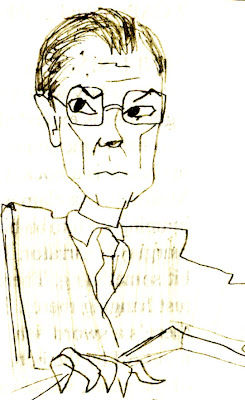
In last week's post about Impeach Bush! I mentioned an interview with cartoonist Mike Leffel, pertaining to the difficulty of drawing Ex-Secretary of Defense Donald Rumsfeld vs. the difficulty of drawing President George W. Bush. Leffel said he got his Bush rather quickly, but struggled for a while with Rumsfeld. I found the opposite to be true; I got a Rumsfeld I was happy with fairly quickly, but still haven't gotten a Bush I can stand the sight of.

But wait, Caleb, you're not a political cartoonist, you're a comics blogger and freelance writer, it says so right in the upper right hand corner of the page—why on earth would you be drawing members of the Bush administration?

Well, when getting started on Caleb's Incomplete Self-Published Comicbook #1, I would practice drawing by going through an issue of Newsweek and drawing everything in it as a sort of, like, artistic work out (kinda like push-ups for my pencil hand, to get in better shape). It was a good way to force myself to draw things I wouldn't normally think to draw, like sports utility vehicles and Rush Limbaugh's jowls and Angelina Joilie dressed up as Alexander's mum. Naturally, photos of powerful members of the Bush administration were always popping up in the magazine, so I ended up trying to draw them a lot.

I've since cancelled my subscription to Newsweek out of abject poverty and thus don't do that particular sketch work out anymore, but the Impeach Bush! story got me thinking about drawing presidents and their administrations, so I thought I'd dig out an old sketchbook and take it to a scanner.

So, are you ready for a peek inside my sketchbook? Scroll ahead, dear reader, and see why I'm a freelance writer rather than a freelance artist...


Then National Security Advisor Condoleeza Rice, from a Newsweek photo. This is the typical first step in the old workout, where I'd look at the picture and try to draw every line. Note the complete lack of understanding of anatomy, perspective or dimension...it's really just lines trying to imitate a picture of reality, rather than an illustration or interpretation of reality.


I'd typically follow it up with the second step of trying to reduce the number of lines, making for a more simplified flatter image that disguises my weakness as an artist under the figleaf of "style."


Self-portrait (with previous haircut) with Rice; did I mention I had a crush on Rice? Because I did. She seems unappreciative though. Perhaps it's because she didn't care for the way I drew her arms (That's what those weird angled lines are in front of her torso...or what they're supposed to be).


Then Secretary of Defense Donald Rumsfeld at a press briefing.


Rumsfeld removing his glasses to shoot eyebeams at a reporter at a press briefing.


Rumsfeld demonstrating his formidable powers of telekenisis by causing a tea cup, spoon and saucer to float in the air at a press briefing.


From a page of head-shots. Clock-wise starting at six-thirty, that's then Secretary of State Colin Powell, Rumsfeld, a character from Incomplete Self-published Comicbook #1, a floating President Bush head, a slightly better Bush head attached to a pair of shoulders. another character from Incomplete Self-published Comicbook #1 and Rice.


Self-portrait, with current haircut/facial hair arrangement.