Showing posts with label civil war. Show all posts

Monday, February 25, 2013

Young Avengers Catch-Up: Civil War: Young Avengers & Runaways (2006) and Secret Invasion: Runaways/Young Avengers (2008)

Marvel's big line-wide event/crossover stories generally provide the publisher with the opportunity to pump up their output for a few months, and a positive side effect of that is that it allows for book-less characters to appear. That was the case with the Young Avengers characters during both Mark Millar and Steve McNiven's super-successful Civil War (in which heroes fight heroes over 9/11 metaphors) and Brian Michael Bendis and Leinil Francis Yu's less-successful Secret Invasion (in which heroes fight Skrulls over gross, clumsily executed fear-of-Muslims metaphors). In both instances, the characters met up with Marvel's other team of young, created-this-century heroes, The Runaways.

Their very first meeting came during the so-called Civil War, during which Iron Man wanted every single super-powered person in the United States to register with the government and then be drafted/press-ganged into a huge superhero army to make sure Speedball never accidentally makes an explosion-powered supervillain blow-up near a school again. And he felt so strongly about it that he was willing to murder his former teammates and imprison them without trial in extra-dimensional concentration camps.

Captain America disagreed.

The Young Avengers sided with Captain America (although Stature would eventually come around to Iron Man's position, after the conclusion of this series), while The Runaways were essentially conscientious objectors, seeking to avoid this conflict as they generally seek to avoid all of the Marvel Universe's conflicts. Conflict finds them, of course, as it usually does—otherwise, Runaways wouldn't have been much of a Marvel comic.

So when a TV camera catches The Runaways being attacked by SHIELD agents and their android member Victor Mancha is badly injured, the Young Avengers track them down and try to recruit them to Cap's side. In the might Marvel manner, they fight before realizing there's been a misunderstanding, and they're all on the same side.

Meanwhile, a sinister SHIELD agent sics a brainwashed and reprogrammed Marvel Boy (the Grant Morrison/J.G. Jones version from 2000's Marvel Boy) on both teams, but instead of capturing them all, he's ordered to simply retrieve a handful of aliens for his controller to experiment upon.

Zeb Wells wrote this one, and Stefano Caselli drew it. Typically of Wells, it was very well-written (Or is that Wells-written..? Ha!), and organically funny. There are jokes in here, but they are jokes made by the characters—it's funny because the characters are being funny, not because the writer is manipulating them.

The story doesn't really go anywhere in terms of status quo, at least not in terms of the Civil War. The Young Avengers are still with Cap at the end of the story, and The Runaways remain determined to stay out of it. Wells does manage to come up with some interesting suggestions for relationships between some of the characters—most unexpected being the friendship between Speed and Molly—and to move a few emotional arcs forward. Similarly, Marvel Boy is put right back where Morrison left him at the end of Marvel Boy, but in a rather triumphant manner.

Caselli's art is excellent, and he handles the straight superhero designs of the Young Avengers and the street-clothes of the Runaways with equal aplomb. He does a fine job of juggling some dozen or so characters, and making each distinct. He also does remarkably strong work with his "acting" through the characters.

This was an odd one to re-read after reading Young Avengers #1, as Marvel Boy is apparently being added to the cast of the new, ongoing Young Avengers title, and, in fact, the book opens with Hawkeye Kate Bishop waking up in Marvel Boy's bed after having spending the night with him.

She casually refers to the events of this series—she apparently didn't recognize Marvel Boy until she sobered up the next morning with "Oh, yeah! You kicked all our asses that one time! Billy, Teddy, everyone!"
In fact, he beat the living hell out of both teams, killing one of the Runaways (who was a shape-shifting Skrull, and thus able to recover from a broken neck), capturing Billy, Teddy and Karolina and delivering them to his boss for a few hours of torture and he began strangling Kate until he was interrupted by Nico, and started strangling her instead.

In other words, whatever Kate was drinking the night before Young Avengers #1, it must have been some strong stuff.

In Secret Invasion: Runaways/Young Avengers, the two teams once again meet, this time on the Avengers' home turf of New York City (The Runaways were still visiting there after recently returning from the 19th century with a new member in tow).

The actual events of Secret Invasion are so nonsensical that I don't think I can recount them in a way that makes a whole lot of sense. Essentially, a bunch of religious fanatic Skrulls think their gods promised them Earth as their homeland, and want to take it over; they've been taking it over by secretly infiltrating it for years, and then they simultaneously try a PR push to convince the Earthlings to join their religion while also violently invading New York City with spaceships and an army of Super-Skrulls.

The two teen teams are there when the Super-Skrulls attack and, as it turns out, both teams have their own Super-Skrulls on their teams. Teddy/Hulkling of the Young Avengers is a half-Skrull, half-Kree who was prophesied as a savior meant to unite the various warring factions of Skrulls, while Xavin of the Runaways was a Skrull prince and Super-Skrull in training who ran away.

The plot of this series focuses on Xavin's efforts to infiltrate the infiltrators, providing cover for his superhero team to get safely out of New York City, and to try and rescue Hulkling. Both Xavin and Hulkling are targeted for special attention by the invading Skrulls, since the former betrayed them and the latter's existence could maybe sway some Skrulls from their Skrullegion.

Despite the prominent roles played by several characters from both teams—mainly Xavin, Hulkling, Wiccan and Speed—this isn't really much of a Young Avengers comic. Many of the team barely cameo, with Patriot and Hawkeye barely getting a line or three. The Runaways don't fare much better, but they are certainly more of the focus of this story, as their Xavin is the de facto star, and the story starts with their point of view.This one is written by Christopher Yost, and features art by Takeshi Miyazawa. It's Miyazawa's art that is probably the most noteworthy aspect of this collection. It's rare to see teenage superheroes actually look this young, but Miyazawa actually draws them all to resemble children, rather than shorter than usual adults.

That the Secret Invasion mini seems the weaker of the two in terms of its scripting may have something to do with how short it is (it's just three issues), and the fact that the premise of the story its tied to makes it more difficult to expand the focus too far from the Skrull-related characters.

Yost's effort isn't as all around strong as Wells', but there are some fun moments in this—Speed's rescue of Molly and the Runaways' newest recruit is particularly memorable—and Miyazawa's charming art goes a long way towards making this well worth a read.

Thursday, December 20, 2007

And yet it's still more exciting then Mark Millar's original ending...


(From What If? Civil War #1's "What If Iron Man Lost the Civil War?" by Chrstos Gage and Harve Tolibao)

Wednesday, February 28, 2007

Weekly Haul: February 28th


52 #43 (DC Comics) With the Ralph Dibny and Steel/Everyman plotlines a wrap, the remaining storylines that feed into one another are all steaming toward a conclusion. This issue, we check in with Buddy Baker and Lady Styx, but spend most of our time looking in at a very intense meeting between the Marvel Family and the Black Marvel Family. I’ve really dug the concept of a reverse Marvel family, right down to their own talking animal mascot, but the writing’s been on the wall all along that their existence as a unit was never more than temporary. Still, I was pretty surprised at just how grisly their break-up is. I sometimes wonder what would have become of Geoff Johns if he weren’t a comics writer…a serial killer, maybe? Nice art by Giffen, Jurgens and Rapmund, even if the panel-to-panel mis en scene is a little jumpy. Ethan Van Sciver joins Waid for the back-up origin, featuring EDILW favorite Plastic Man, and it’s a complete mess, but we’ll look at that later in this week’s edition of “Actually Essential Storylines.” Line of the week? I’m gonna have to go with: “I’m about to lose the space dolphin powers I sampled…”

Action Comics #846 (DC) The oft-delayed next installment of Donner, Johns and Kubert’s Superman II-tastic story arc finally arrives, and my immediate reaction was along the lines of, “For this I waited so long?” (How late is it? Well, the Next Issue Box mentions the weeks-old Action Comics Annual, which was itself a stop-gap to the late issues). Kubert’s art is great, yeah, but he’s hardly the only artist capable of rendering a punch ‘em up between Superman and the escaped Phantom Zone criminals. Johns and Donner get props for the scale of the threat, though—just as I was nodding off seeing Superman trade blows with P.Z. escapees for the ten millionth time in my lifetime, Zod answered Supes' “You and what army, General?” comment with a well-timed “This one.” I know we’ve seen that very exchange in different situations repeatedly over the years in DC comics, but just like references to “fastball specials” in Marvel comics, it still makes me smile every time.

Black Panther #25 (Marvel Comics) Okay, add this issue of BP to the list of “Civil War” tie-in issues that do a much better job of concluding the main Civil War series’ story far better than Civil War #7. I know I (and much of the Internet) had a lot to gripe about regarding CW #7, but one of my many complaints was the one I made over at this week’s "Best Shots” column—that Millar and company spent six issues (and almost a year) lining up all of Marvel’s toys for a big superhero fight, and then neglected to actually show the superhero fight (Seriously, go flip through #7 again if you don’t believe me; there are exactly two splash pages of more than one name superhero exchanging blows with another, and neither occurs during the Battle of Manhattan).

After Storm tells Reed Richards off and T’Challa and Captain Marvel/Photon/Monica Rambeau figure out how to bust into 42, we flash forward to the big fight scene. It doesn’t match up with what actually occurs in CW #7 terribly well at all (but hey, how many of the tie-ins actually do?), but it’s full of fun little moments, like Falcon and Nighthawk mixing it up, Storm and Clor dancing before first Sue Richards (“You’re my husband’s abomination… And I’m here to abort you!”) and then Hercules cut in to help finish him off. The last page includes two pretty awesome moments, one which makes fun of the ridiculousness of the news media (I’ve got to assume writer Reginald Hudlin is making fun of their tendency to exaggerate when he has an anchorman reporting that, “The streets of New York were as violent as the fields of Gettysburg as the final battle of the ‘Civil War’ between superheroes seems to have peaked today”), and of Millar and company’s story, when Storm responds to the news of Caps’ surrender with an incredulous, “What? You can’t be serious.”

Marcus To’s pencil art is pretty strong, even if there are some oddly static panels of the fighting heroes all just kind of standing around talking in the middle of the big battle, and colorist J. D. Smith gives everything a nice painted veneer.

Civil War: Frontline #11 (Marvel) The relative strength of Paul Jenkins’ Frontline series has been overshadowed by certain sucky elements pretty much all along. I found the “Here are the ways in which our superhero crossover is just like real world wars” back-ups clumsy, repetitive and more than a little offensive; the Dark Speedball story’s last chapter was a weird U-turn of the narrative; and issue #10 was a horribly embarrassing exercise in on-panel time-wasting. Now we finally learn who the traitor on the Pro-Reg side was (it’s the only person it could be) and learn Tony Stark’s true motivation (which is the only mildly heroic one he could have, and, it’s worth noting, is a completely different one than he gave in Civil War #7). The plot involves Ben Urich and Sally Floyd interviewing the incarcerated Captain America (which turns into Sally, The Worst Reporter Ever, yelling at him), and confronting Tony Stark with what they’ve learned, essentially a parlor scene for the ten issues that preceded this one. I’m not sure I understood what the hell all that was about Atlantis and how it benefited Tony Stark or the ideal of Pro-Registration, but the rest of the speech at least makes the idea of Iron Man as a hero in the Marvel Universe going forward somewhat palpable (although, again, this is a case that Millar probably should have been made in Civil War, since it is, essentially, the character’s entire motivation for everything that he did in that series after #1). Three things really stood out, however, and I will proceed to list them numerically, because this is already a pretty long paragraph.

1.) In the Battle of Manhattan, there were apparently “fifty-three killed…only six of them super-powered.” That’s one-twelfth of those killed at Stamford, and more than the Hulk killed before Stark and the Illuminati decided to shoot him into space for the good of earth. Who are these dead heroes? (Other than Typeface, of course, whose body we've seen, and maybe Triathalon and Coldblood, whom Amazing Spider-Man said were among the missing). Who are the heroes who accidentally killed people? And why didn’t Millar and Marvel think it might be important to show us any of this?!

2.) We learn that “Three days after the end of the war, the Sentry publicly announced his support of the Registration Act, much to everyone’s surprise.” Except for readers, who saw him register twice in different comic, and will therefore not be even slightly surprised to see him take a stand again. And this is the first John Q. New Yorker has heard of where Sentry stands? Did he not even make it out of the Negative Zone fight in CW #7 then? God, what a pussy.

3.) I love that the story ended with Tony Stark crying. It provided a nice sense of balance to Captain America crying over in CW proper.

Connor Hawke: Dragon’s Blood #4 (DC) Connor Hawke’s heterosexuality so firmly confirmed last issue, writer Chuck Dixon gets back to what he does best—big action and plenty of action movie-style banter. This issue was a lot of fun, and, as I’ve said at least three times before, I totally love Derec Donovan’s art.

Doctor Strange: The Oath #5 (Marvel) Brian K. Vaughan, Marcos Martin and Alvaro Lopez bring their wonderful Dr. Strange story, by far the best I’ve ever read (but then, I’ve only read a relative few Strange stories), to a close. The ultimate fate of Wong and even that last panel were predictable enough, but it was certainly pleasurable to see them occur anyway. I hope this thing sold like hotcakes, and that BKV has more Strange stories to tell, because I would love to read a book like this every month. Confidential to Brian Michael Bendis: I do hope you’ve been reading this series, and plan on incorporating the last few pages worth of changes in Doc’s status quo into your New Avengers title.

Eternals #7 (Marvel) Worst. Neil Gaiman-written series based on a lesser Kirby creation. Ever. Of course, the other Gaiman-written series based on a lesser Kirby creation was The Sandman, so perhaps expecting a repeat here was a little too optimistic. The long delays, slow pace and ponderous inclusion of “Civil War” into the proceedings didn’t help endear Gaiman’s latest visit to the Marvel Universe sandbox, but with the series finally wrapped, and reconsidering the story in it’s entirety, it’s not a bad set-up for a Marvel series to follow at some point. Although I get the feeling it will be someone other than Gaiman that’s assigned to write a potential Eternals monthly, and someone other than John Romita Jr. drawing it, so I can’t imagine such a series would interest anyone. I’d almost certainly pass.

Firestorm: The Nuclear Man #33 (Marvel) Okay, the thirty-third issue of a series which has already been announced as cancelled probably isn’t the best place to start reading, but, well, they didn’t have Dwayne McDuffie on scripting duties until this very issue, did they? That and the appearance of the New Gods, whom I’m currently completely confused about (I can’t make heads or tails of how Seven Soldiers: Mister Miracle fits into New God-itunity), were more than enough to get me to try out this series for a second time (I tried the “One Year Later” issue. I didn’t like it). McDuffie is in top form here, as he was in FF #542, and this feels like good, plain, fun superhero comics. We get nice, solid intros of both Mister Miracle (still Shiloh Norman; no clue where Scott Free is here, either, although he’s repeatedly mentioned, so he obviously still exists on this New Earth) and the title character, plus Orion showing up to punch them both, and then the Female Furies doing the same.

Green Lantern #17 (DC) Panel two shows us J’onn J’onnz using his super-powerful telepathy to de-brainwash the Global Guardians at what I assume is a JLA headquarters of some sort (We’ll have to wait until Brad Meltzer gets around to finishing their origin story to let us know where that may be). I’d really like to hear what follows that scene, once J’onn’s finished up: “Well, I’ve used my completely unique Martian power of telepathy to deprogram these superheroes so that they will no longer do the bidding of the Faceless Hunters for you. I guess since I’m not on your Justice League anymore, I’ll just go hang out with all my friends and family, maybe stop by the office and get some work done. Oh wait, I’m the last surviving member of my race! And my only friends are members of the Justice League! And my fucking job is just saving the world with the Justice League once a month! But you guys didn’t want me on the team because Meltzer already assigned the green narration boxes to Hal or some such bullshit. Guess I’ll just go sit by the phone and wait for you guys to call me the next time you need some telepathic help. Dicks.” The rest of the book? Batman gets offered a place on a brand-new team he wants no part of (sweet costume though!), John Stewart finally makes the scene, Hal punches an alien in the face and the newest, sluttiest Star Sapphire appears. (Stupid question—Why does she wear pink if her name is Star Sapphire?)

Helmet of Fate: Black Alice #1 (DC) Missed it! I love exactly two things about Black Alice, the teenaged goth girl magic-stealer that writer Gail Simone introduced in one of her earlier Birds of Prey stories. One, she’s from Ohio, which really, more superheroes oughta be from. And two, she’s a character that lends herself to almost constant character redesign and riffs on classic DC costumes, as each time she borrows a characters’ abilities, she gets a personalized version of their costume (My favorite thus far was her “Black Lantern” Alan Scott get-up in the Villains United Infinite Crisis Special). Simone joins artist Duncan Rouleau for Alice’s turn in the Dr. Fate spotlight, and while Rouleau’s design style is well suited to the character, the outfits aren’t exactly inspired (I didn’t even know Giganta’s powers were magical). This was probably the weakest of the Helmet one-shots so far, but is still competently done; after all, those first three one-shots were pretty damn good. Confidential to colorist Mike Atiyeh: Goth kids just dress and act like vampires, they’re not actually vampires, so they should be pale, but not chalk-white with a hint of blue like week-old drowning victims.

JLA: Classified #35 (DC) This is the fourth chapter of “The Fourth Parallel,” but it’s labeled “Part 2C” because, for the third issue in a row, we explore a possible sequence of events that is occurring at the exact same time as the last two chapters, only in a parallel dimension (and with a third “finisher” inking scripter and lay outer Dan Jurgens’ art). Pretty clever, huh? On this world, villain the Red King kills the members of the Justice League, but he accidentally destroys the Earth in the process. That’s all there is to it really, a complete routing of the Justice League in a reality that doesn’t really exist. But hey, it could have been worse—J’onn J’onnz could have had a conical head, for example.

Justice #10 (DC) Fight, fight, fight! That’s the plot of this superhero and supervillain-packed issue, which brings this totally awesome series—which has been little more than gloriously illustrated fan service—close to climax. The League, many of them wearing cool new costumes and/or the Metal Men, launch their strikes against the Legion and their own brainwashed sidekicks and second bananas, the Joker shows up and the League keeps pulling secret plans out of their collective ass. I dig the Plas/Ralph rivalry, the Superfriends-style seating arrangement at the Legion of Doom’s after party, the Riddler’s power suit and going around that table and imagining what Black Manta, The Scarecrow and the Toyman intend to do with their glasses of wine. In fact, the only things I didn’t like about this issue were a few clunky lines of dialogue, Green Arrow’s narration, and Braithwaite and Ross’ Clayface design, which resembles a horribly deformed, naked old lady-cum-burn victim. Yeee-uck!

Runaways #24 (Marvel) Creators BKV and Adrian Alphona bring their second volume of Runaways to a close, and they do so in a nice, circular fashion, giving us a conclusion that recalls the conclusion of the first volume, and checks in with at least one character we didn’t expect to see again. I’m pretty bummed that the pair are leaving, and while Joss Whedon is the perfect BKV successor (Vaughan’s dialogue on this series has long been peppered with Whedon-esque invented slang), I’m not sure how and Alphona-less Runaways will read. I aim to find out next month though. Also, while there’s a lot to bitch about the characterizations in Marvel’s “Civil War” event, I kind of like the thought of Iron Man being a villain…he’s certainly used to swell effect as such in this issue.

X-Factor #16 (Marvel) It’s issues like this that make me wish Peter David were writing Madrox, The Multiple Man instead of X-Factor. The storyline involving Jamie tracking down a dupe that’s gone off to marry and start a family was wonderful, and the sub-plot involving Siryn and Monet busting out of a Parisian prison and rescuing a French mutant was fine, but was something of an unwelcome intrusion compared to the A story.

Thursday, February 22, 2007

Civil War's Crimes Against Logic


After reading this week's concluding chapter of Civil War and before writing my contributions to next week's Best Shots column, I re-read the "Marvel Event in Seven Parts" cover-to-cover in one sitting. See, I was pretty disappointed with the conclusion of the story, and thought that may have been in large part do to how long we were kept waiting for it, thanks to several delays. The longer you wait for something, the higher your expectations get, naturally.

But even read as a whole instead of in gradual installments, there are problems with the story. Ignoring the steady drop-off in the quality of the art (and number of characters per panel and existence of backgrounds), the story itself seemed to get worse and worse as time went on.

There were several rather glaring, logic-defying holes in the story (And I don't mean things like Reed Richards protesting the Mutant Registration Act a decade ago in a different comic book, I mean within the seven issues of Civil War proper). And such holes seemed to appear more and more frequently with each passing issue.

Here are the ones I noticed, along with some other story problems that make it hard for me to believe that this Mark Millar is the same guy who did that amazing run on Superman Adventures back in the day:


1.) In Civil War #1, Goliath refers to the Stamford disaster as “the straw that broke camel’s back.” Eight pages later, Daredevil says, “Stamford’s the straw that broke the camel’s back. That’s kind of a weird coincidence isn’t it? (By the way, does Spider-Man have a villain called “The Camel?”)


2.) Why does Maria Hill have her SHIELD “Cape Killer” squad attack Captain America in #1? I can see him being angry with her and refusing to follow the order to take down his friends and allies just because she says so, but at the beginning of the scene, she says that registration “could be law in as little as a month.”

Or, in other words, it’s not the law yet. And even if it were, Captain America is an Agent of SHEILD; they already know his "secret" identity, and probably have his W-9, forwarding address, social security number and a couple of years' worth of performance evaluations on file. The man’s pre-registered for the hypothetical future law.

So what’s Hill busting him for, exactly? Refusing in advance to obey a potential order that she might make a month or so from now?


3.) When Captain America lands on the cockpit of a jet plane, the pilot says, “Jeezus!” Captain America responds by saying, “Keep flying son— And watch that potty mouth!”

A few pages earlier, Captain America says “Damn you to hell for this, Hill…”

Later he says, “Damn SHIELD Units” in CW #5 and “What the hell is going on here, Diamondback?” in CW #6.

Just saying.

4.) In Civil War #3, Reed Richards travels to Wakanda to ask King T’Challa, the Black Panther, to come back to the U.S. with him to help him hunt down Anti-Registration heroes. When the Panther points out that he’s the head of a foreign state, Reed says, “The president requested this of you personally…”

Let’s pause to think about this for a moment. Not simply that the federal United States government is approaching a foreign head of state to help them enforce a law, but that President George W. Bush is personally behind the request. Mr. Go-It-Alone. Mr. With-Us-Or-Against-Us. Mr. “Old Europe.” Mr. "Eat It, Kyoto!" Why am I having a hard time believing this? (If I were going to point out the ways in which Civil War doesn't match-up with the rest of the Marvel line, I might point out that relations between the U.S. and Wakanda are strained; the former invaded the latter recently, and is currently performing war games near its borders while plotting an invasion. But if you're not reading Black Panther, you wouldn't know that).

5.) I think my favorite part of the entire series is the panel where Hercules reveals that his secret identity is of “an I.T. consultant for a major international finance corporation,” despite the fact that he still uses the word “thou” instead of “you.” Good luck keeping that identity secret, Herc. This is one of two points in the series where I think Mark Millar's just screwing around. The other, oddly enough, also involves Hercules:


6.) Also in Civil War #3, Captain America’s entire “Secret Avengers” movement shows up at a burning chemical plant because they heard there are “three or four hundred” people trapped inside it. They mill around the empty factory, which harbors no trapped workers or emergency personnel or vehicles. Couldn't Millar have come up with a rationale that would trick me into thinking superheroes were needed there, let alone Captain America? Maybe something like The Red Skull and Dr. Doom are meeting there or something?

7.) During their fight, Iron Man totally knocks one of Captain America’s teeth out, but in the next shot we see of Cap’s mouth, all of his pearly whites are still there. Long-time Marvel fans can bitch about continuity all they want over this series, but how about a little panel-to-panel continuity between the pages of the same comic book story? Like, if you lose a tooth in one panel, it’s still lost in the next panel?


(Above: Please note Cap's teeth)


8.) After that dramatic splash-page appearance in the end of #3, Civil War #4 explains how it is that Thor is alive and teaming up with Iron Man to beat up his former friends. It turns out, he’s not actually Thor, but a clone of Thor spliced with cyborg technology.

Let’s stop and think about this for a moment. Not that Tony Stark and Reed Richards built this Clor character; cyborgs, androids and clones are a given in the Marvel Universe. But federally-funded clones created for use by the United States government? There’s suspension of disbelief, and there’s suspension of disbelief.

The Bush administration (all pictured on the last pages of Civil War #1) is against stem cell research, of course they’re against cloning too. Hell, President Bush has specifically mentioned his opposition to cloning research. There’s no way that the United States government would greenlight the creation of Clor.

Now, go ahead and tell me it’s just a comic book—I fucking dare you!

Oh, it’s just a comic book, and not about current U.S. politics, you say?

That’s funny, because in Marvel’s house ad for Civil War #7, they chose to run a quote from The Miami Herald saying, “Civil War is intriguing because of its pointed, albeit allegorical, exploration of a question that faces us in the present era of surveillance, detention and the Patriot Act.” During his high profile appearane on The Colbert Report, Marvel Editor-in-Chief Joe Quesada framed the story as one premised on the very relevant debate of security vs. liberty. Additionally, Mark Millar and Paul Jenkins (in Frontline) have repeatedly called upon the imagery and language of 9/11, the Patriot Act, Guantanamo Bay, Cindy Sheehan and the Iraq War protests.

Now, there’s absolutely nothing wrong with that. It’s a great idea for a comic book story, and it’s definitely one I’d like to read. But if you’re going to create such a political story, why not at least take some time to get the politics right?


9.) In Civil War #4 we see a blue-eyed man in a ski mask and trenchcoat holding a pistol and hiding on a fire escape, looking down at a couple of defecting heroes. It turns out this The Punisher, as we learn in #5. So, why on earth is The Punisher wearing a mask? His entire career has been one of murdering people; he’s a wanted man who breaks dozens of laws a day, and yet he’s never felt the need to hide his face from the authorities before—in fact, he even wears a gaudy uniform with a skull on his freaking chest to clearly identify himself. So, who’s he disguising his identity from here exactly? Us. The readers. Why? Who knows. The fact that Punisher sides with Captain America was common knowledge about four months before this issue was released, and there are other ways to show a mysterious stranger lurking around without revealing their identity. Why not a sillhouette, or a close-up of his feet in the foreground and the people he's spying on in the background, either of which would imply someone standing there, without revealing their identity and without having to resort to cheating the readers.

10.) Susan Richards is upset with her husband because he helped build a killer clone of one of their friends that killed another of their friends. She also thinks he’s being “fascistic” and doesn’t pay attention to the kids (“[I] beg you to give them the time you have so often denied them in the past”).

So she does the only sensible thing she can think of; she has a romantic dinner with him, does it with him, then splits to join the team fighting against him, leaving the children in his care.

Now, what exactly is Susan Richards’ plan for the future at this point? Best case scenario is that she evades capture and lives the rest of her life on the run from the law until such point as it’s overturned and a president promises to pardon her or something. Worst-case scenario is that she gets arrested and spends forever in a Negative Zone prison. Either way, she’s not going to get much quality time with the kids.

11.) The New Thunderbolts are a bunch of mass-murderers who have had microscopic nanobots injected into their bloodstream. If they get out of line (try to kill a good guy, for example), the nanobots can fire off an electric shock. Ignoring the ethical and legal implications, it is a very odd move for Richards and Starks to make pages after their las technological achievement malfunctioned and killed one of their peers. If the “don’t blow holes in people” program in their clone/cyborg hero didn’t work, what makes them so sure their nanobots won’t similarly malfunction, and they’ll be turning Venom, Bullseye and Taskmaster loose on their former friends, allies, teammates and, um, Reed’s wife and brother-in-law?

12.) Perhaps the biggest head-scratcher of the series occurs in Civil War #5, when we see Spider-Man and Iron Man arguing in front of a huge hole in a wall for some reason.

Seriously, what the fuck is happening?

We went from Peter Parker expressing doubts to shouting at Tony about something. If you don’t read Amazing Spider-Man, you won’t realize that they’ve already come to blows over the Negative Zone prison. Of course, if you do read Amazing Spider-Man, you’ll see that there it was Tony Stark who was the aggressor, while as in CW it was Spider-Man. Just as in ASM Tony tells Spider-Man that the NZ prison is permanent solution, while in CW he says it’s temporary.

13.) SHIELD arrests Daredevil and take him to prison, but they don’t take him out of his devil suit, unmask him, or even identify him as anyone other than Dardevil (Tony calls him “Daredevil” while talking to him). So, why not? Do they let you keep your secret identity a secret up until you register? And if you don’t volunteer to register and they catch you, they hold you indefinitely without a trial in an alternate dimension…but they let you keep your secret?

14.) Underwater visiting Namor, Susan Richards stands completely erect, with both feet on the floor. Even though the room is full of water. Her hair and Namor’s billowing robe sometimes float in the water, and sometimes don’t. I know this is comic books, but I demand that they at least adhere to the science I knew by the time I was in sixth grade. If they want to make up a bunch of crazy physics that’s fine, I won’t know any better, but people and objects not floating in water, like people talking in space, is one of those things that just bugs the hell out of me.

15.) So, what is Captain America’s plan in #6 and #7 exactly? He’s supposedly a brilliant tactician and field leader, right? What’s he up to? It appears that he’s gathered his entire force and brought them with him to the Negative Zone prison. Why? Presumably to rescue the prisoners there, but then, he had Hulkling impersonating Hank Pym, and Hulkling has already managed to free the prisoners all by himself anyway, so Cap and his forces aren’t needed for that.

Of course, Cap knew Tigra was a mole, so perhaps his plan was to feint like he was attacking the prison, have Iron Man’s forces show up (Of course, he didn’t even tell Spidey about it, if that was the plan), and then surprise Iron Man in a pincer attack, with Cap’s forces attacking from the front and the rescued prisoners attacking from the rear.

But then what? Say Cap’s team totally beats the hell out of Iron Man’s, what do they do with them then? It’s not like Captain America was going to summarily execute each and ever Pro-Reg hero, right? And it’s not like he has his own giant prison complex he could throw Iron Man and the rest in. So why would Cap ever bother pressing the offensive against Iron Man? I just don’t get what the hell is going on here.


16.) In the climactic battle, Black Panther sends Cloak coordinates to teleport everyone to the Baxter Building, which is located in downtown Manhattan. Why does the Panther do this? Why not just fight it out in the Negative Zone? Or why not teleport them all to Wakanda and let his forces make the difference? Or why not teleport them to a desert, where no innocent bystanders will get hurt? Better yet, why not have Cloak teleport all of his team out, and leave Iron Man’s team stuck in the Negatize Zone until SHIELD can get the portals open for them?

17.) Why is the Sentry such a total pussy? I thought he had “the power of a million exploding suns!” He should be able to wipe the floor with Cap’s team all by himself. But he only appears in one panel, in which Hulkling and Hercules punch him in the face simultaneously. And that’s the end of Sentry. Even Bishop got up again to keep fighting after Cap stomped his head into the ground.

18.) What happens to Namor in the fight? He makes a big splashy apperance, She-Hulk refers to how Namor and Atlantis will be enough to turn the tide of battle, and then Namor completely disappears. We don’t see him at all throughout the rest of the issue. Did he and the forces of Atlantis retreat or surrender when Cap told everyone to stand down? (As if!) Why didn’t Namor take Iron Man’s head off like he almost did in New Aventers: Illuminati? Is Atlantis at war with the U.S. now?

19.) Seven ethnically diverse policeman, fireman and EMTs rush through the big superhero battle and tackle Cap simultaneously. He says he doesn’t want to hurt them, and when they point out it’s a little late for that, Cap looks around and sees sompe property damage and realizes he’s not fighting for the people, he’s just fighting.

Apparently, being tackled by uniformed emergency response people is the wake-up call Cap needs to see he’s gone too far.

In the first issue, he beats up at least 15 SHIELD agents escaping from the SHEILD Helicarrier.

In the second issue, he throws a SHIELD agent through the door of a speeding truck while on the highway in front of a few speeding police cars, causing a three-car pile-up and almost certain injuries to New York City police officers (one of the cars goes airborne and sideways in the crash).


20.) What happened to Storm? She was in the big about-to-fight two-page spread in #6, but she doesn’t appear at all in #7.

21.) In Reed Richards’ letter to his estranged wife, we learn that she has accepted the “general hero amnesty given in the wake of Captain America’s surrender.”

Who else took the amnesty? Was it offered to every Marvel hero? If the latter, what was the point of all the fighting, anyway?

The series doesn’t answer this question. We know that Lady Deathstrike, Taskmaster and Captain America are in jail, and that Luke Cage, Spider-Man, Doctor Strange and Spider-Woman “remain readicalized in the underground movement.”

As for everyone else on the anti-reg side that got significant panel-time—Cloak and Dagger, the Young Avengers, Hercules, Falcon, Dardevil, Black Panther, Monica Rambeau—no word.

22.) And on the subject of that letter, did Reed Richards really write the words "old school?"

23.) Hank Pym was named “Man of the Year” in Time magazine. Not Tony Stark, but Hank Pym. Okay, fine, whatever. What makes this so weird is that the cover shows an image of Pym shaking hands with the Black Panther, who not only fought against Pym in the “Civil War,” but did so specifically because Pym, Stark and Richards’ side killed Black Panther’s friend Goliath. (Bonus: Does this mean the story wrapped up in December after all?)

24.) As Tony Stark, the new director of SHIELD, brags about his accomplishments in the last scene of the story, he smiles, “Do you really think I’d let anyone else guard my friends’ identities?”

So, is that what this was all about? If so, I’ve got two questions.

How many of Stark’s (former) friends and allies even have secret identities? Seriously, think about the number of old, New or Mighty Avengers with secret identities. All I can come up with are…Sentry and Spider-Woman...maybe?

And if that was Stark’s motivation, why on earth did he push Spider-Man to unmask on live television?


Well, that's only 24 problems with the story, or less than four per issue. Huzzah!

Wednesday, February 21, 2007

Weekly Haul: February 21st


52 #42 (DC Comics) This issue brings a conclusion to another of the series’ ongoing storyline—that of Ralph Dibny. After he and the Helmet of Fate journey to Fate’s tower and perform a ritual, they lay all their cards on the table in a wonderful, exposition-filled sequence that’s chockfull of surprises, even if some of them were so obvious that Newsarama posters have been correctly guessing them for months now (And editor Michael Siglain totally lied about one of those things just last Friday). It was an enormously satisfying conclusion though, one that takes us all the way back to the first appearance of Ralph in 52 and shows us that nothing was really as it seems. While I’m a big Elongated Man fan, even more so after wending my way through Showcase Presents: Elongated Man and now 52, after the events of Identity Crisis, he’s a little like Batman without Robin or Superman without Lois Lane—just not as much fun as he was. If he doesn’t get back up in the next ten issues—and remember, time is broken, and there’s magic and metafiction afoot—I’m okay with it. The only other storyline touched on in this issue is Montoya’s, which includes some more first-person narration, and hint # 2,765 that she might become the Question II (Please don’t maker her the Question II, please don’t make her the Question II, please don’t make her the Question II…). Stronger than usual art is provided by Darick Robertson, and Green Arrow penciller Scott McDaniels joins Waid for the origin of GA in the back-up slot.

Amazing Spider-Man #538 (Marvel Comics) Writer J. Michael Straczynski and penciller Ron Garney have given us the “Civil War” story of the week, an issue that devotes much less space to the climactic Battle of Manhattan than Civil War #7 did, but gets much more mileage out of it. On pages three and four Garney gives us the sort of money shot that was completely missing from CW #7—sure, it’s not as slickly drawn, inked and colored as anything in CW, but at least it’s dynamic and seems to be depicting an actual battle consisting of many heroes, rather than a few random characters posing. In the next few pages, we even see an acrobatic Captain America blocking one of Iron Man's repulsor rays with his shield—you know, the sort of thing you’d expect to happen in a fight between the two. JMS gives us some interesting reactions to the battle as well, including Wilson Fisk’s and J. Jonah Jameson’s, but it’s the last panel that is the biggest moment in the world of Spidey—the sniper assassin paid to kill either Peter Parker or Mary Jane and Aunt May takes his shot and tags one of them. It's a wound rather than a deathblow, but that doesn't mean the victim won't die in the next issue. Spidey's gotta be wearing black for some reason, right?

Aquaman: Sword of Atlantis #49 (DC) Thus concludes the two-part story reinventing The Fisherman as a scary customer, and Kurt Busiek’s too-short run on the title. Busiek was on to something with his reinvention of Aquman as a swordfish and sorcery story, but he never went anywhere with it, and seems to be bailing way to early; if the story of the transformed and amnesiac Orin and the new Arthur “Aquaman” Curry is going anywhere, it will be up to someone else to see it get there. This issue is full of dream sequences from the various hosts of the Fisherman’s sentient hood, which is revealed to be a sort of scout for the old gods of H.P. Lovecraft’s cosmology. Lovecraft and Aquaman go together surprisingly well (see JLA: Seven Caskets, and the Aquaman episodes of Justice League Unlimited), as do artists Mike Manley and Ricardo Villagran.

Birds of Prey #103 (DC) Writer Gail Simone takes a step back to reveal the past between Barbara Gordon and Katarina Armstrong, the lame-ass new Spy Smasher. Not sure about the ending, though—if Oracle doesn’t want to break her dad’s heart by getting arrested, how about she just avoid getting arrested and beat Katarina at her own game? Hero up, Babs! I haven’t been into the re-relaunch much (though I really dig new artist Nicola Scott) and would probably finally drop the book with this issue, but with Ragdoll and Catman on the cover of next issue, how can I quit now?

The Brave and the Bold #1 (DC) The ultimate team-up title gets relaunched with the ultimate creative team at it’s helm, writer Mark Waid and artist George Perez. It’s classic, old-school comic book writing with modern sophistication, paired with the best art you’ll find in any superhero comic book on the shelves this week. Perez simply draws the hell out of everything; each character is as unique and distinct as a real person, no details are skimped on (even full-page splashes have crazy amounts of detail in them), and most pages have panel counts that would make most superstar artists cry just thinking about. As for the story, Waid plays it as a sort of cosmic cop show, with Hal Jordan calling Batman in to consult. It’s simply packed with awesomeness; the scene of Batman whipping exploding Batarangs in rapid succession is remarkable, but it’s eclipsed by the one in which undercover Bruce Wayne and Hal Jordan visit a casino looking for clues. In this new era of event comics, this is the series I’m suddenly the most excited about, the one that promises strong characterization, interesting stories and wonderful art on a monthly basis.

Cable/Deadpool #37 (Marvel) This is only my second issue of this series. Fabian Nicieza delivers another witty, fast-paced, Cable-free script with a fairly wacky plot—The Rhino has Deadpool shrunk to keychain-size and uses him as a keychain—but penciller Staz Johnson’s work is rather unremarkable, and I’m not exactly sure what this title offers that She-Hulk and now Punisher War Journal don’t already offer.

Civil War #7 (Marvel) To wildly inappropriately co-op a line from T.S. Eliott, this is the way Civil War ends, not with a bang but a whimper. After almost a year of build-up throughout the Marvel line, there was precious little blow-up in this climactic issue, and even less by way of resolution to, well, anything (After finishing #7, it’s clear that Marvel hasn’t scheduled all those codas and epilogues simply to cash-in, but because readers might like a little clarification on what exactly happened at the end of this story). Millar brings Sue and Reed back together just as lazily and clumsily as he broke them up, announces Tony Stark's new role in the Marvel Universe (Um, didn’t we all see him get the job offer a couple months back in New Avengers #25?), and three characters go to jail. Other than that, it’s unclear which heroes end up where and why. What’s more disappointing, however, is how poorly written and drawn the action is, which means even the visceral thrills one might expect from an 18-page fight sequence are missing. Penciller Steve McNiven is joined by a small army of inkers again, but things still seem sparse and unclear—there isn’t a single panel along the lines of the two-page spread in #6 that set up this battle (reprinted on the recap page), no single image that grabs your eye and forces you to look at the battle and consider its enormity (Even the unfinished, ugly-ass spread of the Battle of Metropolis in Infinite Crisis #7 featured an actual army of characters). Most panels just have a half-dozen heroes or so in random poses punching one another, and then trading partners at random. In one panel, for example, Captain America literally smashes Bishop’s face into the pavement, but six pages later he's up and getting kicked in the face by Spidey. A whole background-less splash page is devoted to Namor appearing (in the company of Atlanteans who seem to be literally falling out of the sky), and then he promptly disappears for the rest of the issue. When Cap orders his team to stand down, why the hell would Namor or the Atlanteans obey him? What happens to Cap’s forces, anyway? We know a couple end up on the run in New Avengers (and this issue shows four of them), but where are Falcon, or Hercules, or the Young Avengers now? Why didn’t Sentry or Captain Marvel (whose one-panel cameo among Hank Pym's artificially created heroes must have been quite the “What the fuck--?!” moment if you skipped Civil War: The Return) do anything in the course of the fight? Shouldn’t the “power of a million exploding suns” be worth a little more in a fight than, say, Spider-Man’s flying kicks? I enjoyed exactly three panels of this issue, and those were the ones featuring Hercules’ goofy god-speak political allusion.

The Immortal Iron Fist #3 (Marvel) Writers Ed Brubaker and Matt Fraction have a hell of an art team to work with. Flashbacks come courtesy of Travel Foreman and Russ Heath (!), with the bulk of the issue being drawn by David Aja, whose graceful page lay out is a beauty to behold. The way Danny Rand leaps through the nine-panel grid on page 14? Simply sublime. Unfortunately, it’s right next to a big, garish ad for Hellboy Animated, which isn’t even the most obnoxious ad in the book (Who in God’s name is the Amazing Spider-Man Express for, exactly? The same people who are going to go see a month-old horror movie that’s advertised in this issue for some reason?). I’ve really dug Aja’s character designs and action sequences, as well as the string of guest artists contributing flashbacks, but I think I’d prefer to enjoy them in an ad-free trade collection, so I’ll be bidding this book farewell for now.

Marvel Adventures Avengers #10 (Marvel) Ah, just what I needed to cleanse my soul after Civil War #7. It’s another action, story and joke-packed issue of Jeff Parker’s Avengers series, still the best Avengers series Marvel is currently publishing. Cap, Iron Man, Bruce Banner and Wolverine journey to a nearby Renaissance Fair (“Yon newbs have confused Ren Fair with a Hero Con,” a regular remarks) to investigate a strange energy signature. Could it have something to do with the presence of Morgan Le Fay and the Black Knight? That's probably a safe assumption. While it can’t compete with the all-MODOC issue (can anything?), this was still a really fun story, from the image of Wolverine seemingly threatening his steed with his claws on Cameron Stewart’s cover image to Tony Stark’s revelation that in college he “majored in making battle suits.”

The New Avengers: Illuminati #2 (Marvel) The Marvel heroes turned mass-murderers who make up the Illuminati take a break from wholesale slaughter to split into teams and quest for the Infinity Gems. This issue contained the best sound effect of the week, called upon to simulate the sound of a mentally-created sea monster snapping at Namor: “KACHOMP!” Question: Does Doctor Strange’s cape appear when he’s in his astral form? I thought the cape didn’t follow him into the astral realm, as its shown to do here. Maybe we should wait for Neilalien to weigh in on this important matter.

Punisher War Journal #4 (Marvel) Okay, so we’ve seen villains all gather to mourn the passing of one of their own before (most recently in Geoff Johns’ Flash), and we’ve seen the bar where all the loser villains hang out together before (Identity Crisis, JLI and JSA leap most immediately to mind), but it’s always fun to see the likes of The Prowler, The Gibbon, The Armadillo, The Rhino, The Eel, The Grizzly and a reprogrammed Doombot all in the same room at the same time, isn’t it? That’s the rough plot of this issue of PWJ, as the villains all gather to pay their respects at a wake for Stilt-Man, and Punny takes advantage of the situation to cross some more names off his “to kill” list. The story is very well done, but the art, by Mike Deodato, seems dark, murky and a little too serious—tonally, it doesn’t fit the characters or the story well at all.

She-Hulk #16 (Marvel) Okay, so I know Greg Horn does nice cheesecake pin-up art, but is there any chance we can get Rick Burchett to handle covers as well, so we can avoid future images like this? The insides of the book are much, much prettier, thanks to Burchett’s wonderful line work. Shulkie continues to hunt down Hulk’s rogues in “Planet Without a Hulk,” and she and SHEILD journey to the frozen north to tackle the Wendingo. Wolverine is tracking the beast too, which leads to a hell of a team-up and the least gay fastball special in a while. Plus, back in the city, Two-Gun Kid cleans up for a night on the town, and we learn the truth about whether or not Shulky and Juggy ever hooked up or not.

The Spirit #3 (DC) Darwyn Cooke retells the origin of the title character in this installment, which gets inside the various characters heads to allow each of them to narrate a scene or so from their own perspective. I’m not a big fan of this novelistic approach to comics (particularly after seeing Brad Meltzer abuse it so bad in JLoA), but if Cooke can do wrong, I’ve yet to see it.

Superman #659 (DC) Is Superman really an angel sent from God? That’s what church lady and neighborhood activist Barbara Johnson sincerely believes when Superman coincidentally answers a few of her prayers in this well-told done-in-one by regular Superman writer Kurt Busiek and his occasional collaborator Fabian Nicieza.

Wonder Woman #4 (DC) Writer Allan Heinberg and artists Terry and Rachel Dodson deliver only their fourth issue in eight months (The series debuted in June of last year). What’s taken them so long? No clue, as this issue of WW, like the three before it, is hardly very complex, but is rather pretty much as straightforward as a superhero comic can get (Terry Dodson’s costume redesigns continue to be the strongest attribute, and in this ish he gives us Circe an Evil Wonder Woman costume). The timeline makes zero sense, but perhaps editor Matt Idelson didn’t want to point that out to Heinberg, for fear that rewrites might take a few more months. Check it out, in JLoA #0, Diana is all decked out as Wonder Woman and meets with Superman and Batman for the very first time since Infinite Crisis. In JSoA #1, she, Superman and Batman meet with the elder statesmen of the old JSA and ask them to build better superheroes, which results in their creating a bigger team, including the likes of Liberty Belle, and getting a new headqurters. In this issue, set before JLoA and JSoA, Diana, who has yet to regain her Wonder Woman powers and costume, visits the new JSA headquarters and the new team, including Liberty Belle. No wonder DC’s decided to give up on this story altogether.

Thursday, November 16, 2006

Stream-of-Consciousness Review: Civil War #5


Cover: This scene, cool as it is, doesn’t actually occur within the book, although Spider-Man does run afoul of some of the new Thunderbolts, and there is a flaming jack o’ lantern involved. Pages 1-2: The Storms, currently on the run from their husband and brother-in-law Reed “Mr. Fantastic” Richards, are being pursued by SHIELD agents, whho, we’re told, have flooded the streets of New York City with all their crazy hoverbikes, helicopters and tank thingees (What, no flying convertibles? I thought all SHIELD had was helicarriers and flying convertibles?) Page 3: Outside Stark Tower, former Defenders LVP Nighthawk and Young Avenger Stature are meeting with Happy Hogan, about to make good on their promise to defect from the Anti-Reg side last issue. This third panel is a great example of why Steve McnNiven, Dexter Vines and Morry Hollowell are and unfuckwithable art team. Tell me that’s not the absolute coolest Nighthawk’s ever looked. And yet, this page is the first time in the series I’ve really felt let down by McNiven. Check out all those passersby. Yeah, they’re New Yorkers, but they’re not even glancing at these two masked super-people. Weren’t we lead to believe that the United States was in the grip of some anti-superhero hysteria that resulted in the Registration Act? These civilians aren’t even phased by seeing super-people, which seems a little odd. Nighthawk’s rationale for changing sides doesn’t make a whole lot of sense, either. “We’re living in a different world now, sir. I guess it took Goliath to make me realize that,” he says. Yeahbuwha? It took the Pro-Reg side unleashing a killer clone of Thor to blow a whole in Goliath to make you realize you should be on the side of the people blowing the holes into people, not the side getting holes blown into them? So, is ‘hawk just a big coward or what? Well, maybe he and Cassie are just trying to infiltrate the Pro-Regs….Page 4: If you haven’t been reading Amazing Spider-Man, this scene picks up right after ASM#535, which ended with Iron Man flying through six walls of his own building to flying tackle Spider-Man because he heard Spidey tell Aunt May and MJ, “I realize I’ve been on the wrong side.” And what are Iron Man’s first words to Spidey afterwards, according to this scene? “Peter, you’re acting like a lunatic. Why can’t we just sit down and discuss this like grown-ups?” Iron Man also says of the Negative Zone detention camp that it’s “only a temporary measure,” whereas he told Peter that it was permanent in ASM (or permanent until the detainees decide to sign on the dotted line). Page 5: Iron Man makes an argument I wish he would have made earlier—essentially saying it’s this lousy status quo, or an even worse one—but he takes it a bit too far by mentioning May and MJ. It didn’t sound all that threatening to me, but Spider-Man must have though so, as he puts Iron Man through a wall over it. Page 6: Tony breaks out the repulsor rays, and we get a nice display of spider agility. Odd that Iron Man has to shoot rays at Spidey though, isn’t it? I mean, he built that “Iron Spidey” suit, and he didn’t include some kind of failsafe device in it? Stark kept a hair of Thor’s from their very first meeting just in case he ever needed to clone him, and yet he didn’t think to put a failsafe of some sort into Spidey’s costume? I do hope Iron Man has a means of tracking the costume, otherwise I’ll lose respect for his scheming abilities. Page 7: Avengers Tower has reinforced glass strong enough to stop men in metal spider costumes from jumping through it, but not stong enough to stop men in metal spider costumes being shot through it by a barrage of bullets, as the SHIELD capekillers demonstrate when they come in guns blazing. Page 8: Okay, here’s the second time this issue in which McNiven lets me down, the second panel, which shows us the Thunderbolts. So, what, they’re all just standing around a huge empty room in their costumes posing, waiting to be activated? Page 9-10: The Jester and Jack O’ Lantern are the first to find Spidey, and they come in with yo-yos and gas pellets blazing. Page 11: Did I mention how awesome this art team is? I know I pointed out a few panels where they didn’t seem to think the psychology of the crowds through very well, but man, just look how totally bad-ass Jack O’ Lantern is. Even The Jester looks really cool. Man I could really get used to these villains; they seem pretty cool here. I hope we see more of them in the future. Page 12: Oh, so that’s why two such relatively low-level villains were grouped with the A-List villains on the last panel of Civil War #4. I admit I laughed aloud when I saw Jack’s head smashing, and the pumpkin goop shooting out the exit wound, but, um, that means his head was really a flaming pumpkin? I guess I should look him up on Marvel.com, but I was fairly certain that was just some kind of mask, and that he was a human being in a costume. Guess not. Good news for Jester, it looks like his headshot was just a glancing blow. He might live to throw exploding yo-yos another day. Mark Millar is playing coy with who Spidey’s savior is in this scene so far, with Spidey referring to him as “Skull-face guy” and seeing his chest emblem through a cloud of hallucinogen, but the Michael Turner variant cover has already spilled the beans: It’s The Punisher. Now, what I want to know is, how did he keep those white boots so white while running around the sewer? Page 13: I’m glad Johnny and Sue said it in panel 3, because I started thinking it as soon as I read it in panel 2. By panel four, we’re inside "Captain America’s New HQ”, and we get a look at an Anti-Reg meeting. I have no idea who some of these people are, like the lady talking (a Hero For Hire, right?), or the two women on the far left hand side of the panel. Little help here...?Page 14: Some tantalizing bits of foreshadowing, as Cap talks strategy with his team. Page 15: Okay, now his boots are dirty. Thankfully, it’s just Spider-Man’s blood staining them and not, you know, the other sort of stains one can expect to pick up while stalking the sewers. If he’d just wear black boots, he could avoid this whole problem. Page 16: Some more costumes I don’t recognize, but Punisher seems to, or at least he recognized Ultra Girl. Falcon’s not happy to see Punisher there, and says so: “Since when were you on this team, Punisher?” (No, I don’t know why he didn’t say “Castle” either). Punny responds, “Sine the other guys started enlisting known thieves and multiple killers.” Wait, Punisher spends his time punishing “known thieves?” I thought he was more of an organized crime/drug trade/murderer-oriented vigilante. Page 17: Nope, no idea who that guy with the red and white arrow motif going on is. “Who do you figure’s been running around in a ski mask and covering your backs these past few weeks?” Punisher says, implying that the answer is him. That’s right, Ski Mask Guy is actually…the Punisher? Of all the Big Dumb Moments in “Civil War” so far, this is by far the Biggest and Dumbest. The Punisher was wearing a disguise? He was wearing a ski mask? What on earth for? The Punisher has been breaking laws throughout his entire vigilante career—the dude’s whole M.O. is that he runs around the city avoiding the cops and putting bullets in the heads of bad guys, murdering them. And he’s never done it in a ski mask until Civil War #4 . Why on earth would he be wearing a ski mask then? Is he suddenly afraid that he might be recognized now that the Registration Act has gone into effect? He had no compunctions about breaking all those other laws and doing so without a mask or attempting to conceal his identity, but he’s afraid SHIELD will bust him for running around in a costume murdering people? What the fuck?! It's not the mass murder charges that scare Punishr, it's the SHRA violation? Oh Man, if I think about the Punisher suddently starting to wear a ski mask to conceal his identity for one more second my head will explode like Jack O’ Lantern’s…Okay, let’s pretend that panel didn’t exist and that there never was a Ski Mask Man. Let's just move on to the next panel. What do we have here? Oh, it’s Punisher telling the Anti-Regs that only he has the black ops training necessary to get them into the Baxter Building. Not Captain America, who’s been doing the same shit Punisher’s been doing, only on a grander scale, for even longer, but only the Punisher. Hmm, I wonder if Invisible Woman and the Human Torch, who have lived in the Baxter Building for years, wouldn’t be able to pull that off better than the Punisher? But wait, the craziness of this page isn’t over yet! In the last panel, we see Tigra hiding in the corner, using a Stark-brand cell phone. Since the last time we saw her, she was on Stark’s side, I guess we’re to assume that she simply infiltrated the base, rather than pretended to defect to spy on them for Stark. But what strikes me as even weirder is her tool—a cell phone. Stark, Reed Richards and Hank Pym can build a Negative Zone prison, Thuderbolt-controlling nanites and so on, but the best spy tech they could come up with is a cell phone? I’d ask where Tigra keeps her cell phone when she’s not using it, but I don’t want our discussion to go there. Page 18: Meanwhile, in Hell’s Kitchen, it looks like Daredevil got busted. Hopefully She-Hulk and Mr. Fantastic helped take him down, because if SHIELD did it without their help, DD went out like a punk—or did he allow himself to be captured to free the prisoners from the Negative Zone Guantanamo they’re being kept in? Shulkie rearticulates Iron Man’s argument from earlier on in the book to Reed, who seems pretty bummed out. Page 19: Tony Stark, wearing a suit and tie instead of his armor, talks to DD as he’s being frog-marched into the Negative Zone, essentially asking him to join his side, and dangling his very own super-team in front of Dardevil. Pages 20-21: A two-page spread of the N-Zone facility. I’d prefer not to think about this too long, as I’ll get that same annoying itch in the back of my head that occurs whenever I think too long about the Death Star in Star Wars, regarding who the hell actually builds things this big, and how they do it…Page 22: Daredevil gives Tony his answer. As the Internet might say, “Pwned!”

Thursday, September 21, 2006

A Eulogy for Bill "Goliath" Foster


(Text of speech delivered by the 616 version of J. Caleb Mozzocco on Thursday, September 21, 2006, at a New Jersey cemetery)

Friends, we are gathered here today to say good bye to Barrett Foster, known to those of us who knew him best as Bill, and, to the world as, Goliath, the really big superhero who wasn’t Yellowjacket, Giant Man, Atlas or that other Goliath…who’s really Hawkeye…and also dead now. I think.

I didn’t know Foster as well as some of you. In fact, I didn’t know him at all. I even had to wiki him and re-read my copy of Civil War Files while preparing these remarks this morning. But Tony Stark asked me to say something here because, well, he felt someone should, and everyone else who knew Foster better than me either feels partly responsible for his death, or is a wanted criminal who’s afraid they’ll get killed themselves if they show up here today. So I guess it’s down to me.

Foster may have become most famous as a superhero, but he was also a scientist, and, by all accounts, a rather brilliant one. When Dr. Henry “Hank” Pym, a.k.a. Ant-Man, a.ka. Giant-Man, a.k.a. Yellowjacket became stuck at his giant size, it was Foster who helped with his research, becoming close enough to Pym and experienced enough with the usage of Pym Particles that Foster developed his own superhuman identity, taking the name of “Black Goliath.”

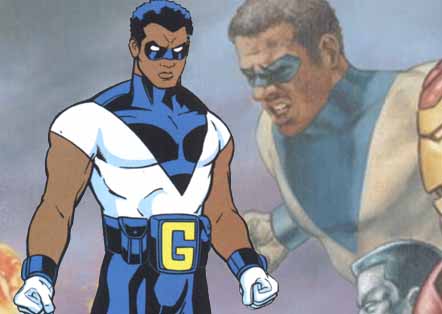
Why he chose that particular name, I’ll never know and, sadly, will now never be able to ask him. This was back in the day when there were fewer black heroes than there are today, of course, but even then few seemed to need to identify themselves by announcing their race in their codename. After all, it’s not like Luke Cage was calling himself Black Power Man, or his highness King T’Challa was going by Black Black Panther, and certainly the white heroes never felt the need to call themselves White Thor or White Giant-Man.

And what was with “Goliath?” I mean, he was a bad guy in the Bible, wasn’t he? A bad guy who got taken out by a slingshot.

Now it hardly matters, of course. As time went on, Foster would take on other names, including “Giant-Man” and just plain old “Goliath,” which is what he was going by when the Superhuman Registration Act was passed. It was in resisting to register with SHIELD and become a federal employee that Goliath became branded a criminal, and banded together with fellow outlaws Captain America and the Falcon to form a team that the papers have been calling “The Secret Avengers.”

They were responding to a distress call when they came across the government’s registered super-heroes, lead by Tony “Iron Man” Stark. Foster and the others were told there was a petrochemical plant on fire, with three or four hundred innocents trapped inside. So Foster did what heroes do: He rushed there to see what he could do to help.

There was a chemical plant on fire, but it was empty—Stark put the call out to lure the Cap, Foster and their allies into one place so they could talk it out. Stark showed up with a veritable army of super-people behind him, not to mention hundred of SHIELD soldiers and a soulless clone of his fallen friend Thor. He brought them all along not because he was looking for a fight, but rather to show the rebels how strong support for the Registration Act actually was among their peers.

It was raining, just like it is this morning, when things turned ugly, and the Thor clone started shooting lightning and swinging his mechanical Mjolnir—did I pronounce that right? Reed? Is it “muh-jol-nur” or “yolnir,” or “mo-yol-nur?” His mechanical hammer.

Foster, showing the bravery we’ve come to expect from a man who saved the lives of every one of us standing here—and billions of others—when he risked his own against the Nth Man—Reed? Is it “Enth” Man? Did I say that one right?—stood up to Thorzarro, attacking him head on, and paying the price for resisting arrest at the hands of a soulless clone created in a government laboratory.

Goliath’s death seems all the more tragic because things were really starting to look up for him. He’d had more cover appearances in these last few months than he has since his own short-lived title, and he has been appearing regularly shoulder to shoulder with the greatest hero in our universe, Captain Ameri—well, second greatest hero, behind Iron Man, of course. And Mr. Fantastic. And Yellowjacket. And, of course, the lovely Wasp.

There’s also been some talk, gossip really, about an all-black superteam recently. And Goliath’s death means we may not ever get to see a Black Avengers team, featuring Josiah X, Black Panther, Storm, War Machine, Goliath, Falcon, Cage and Blade.

But instead of focusing on the negatives, we should try to focus on the positives, as hard as it might be to do so, under the circumstances. I know that’s what Bill would have wanted. Well, I assume that’s what he would have wanted--his entry on Marvel.com doesn’t really say what he would have wanted us to focus on in the event of his death.

If nothing else, Goliath’s death should serve as a reminder to us all of what happens when you refuse to follow the letter of the law, even laws passed within a week’s time of a horrible, traumatic tragedy, by lawmakers who certainly didn’t have time to read the whole thing, let alone debate it. And this is what will happen: You will be arrested and sent to a prison in an alternate dimension, or you will be killed by lightning while resisting arrest.

Goliath has taught us a very important: No man, no matter how big he can grow, is bigger than the law.

I know it’s going to be hard living without Goliath. He was always there for us, whether we needed him to get our kitten out of a tree, fiddle with the TV attenae, put the star on top of the Christmas tree, reach something on the top shelf of the grocery store, or saving us from Stilt-Man or Atom-Smasher.

But keep in mind, just because he’s dead and gone now, doesn’t mean he’ll be dead and gone forever. Death isn’t always final, and dead doesn’t always mean dead—unless you’re related to Peter Parker of course. Heh heh, just kidding, Pete.

I’m sure we’ll see Bill again someday. Maybe it will just be as a ghost or zombie, or resurrected to join the Legion of the Unliving. Or maybe we’ll see him while journeying through the past, or heaven or some weird astral dimension. Maybe Kang The Conqueror or Immortus will bring him back, pulling him out of the time stream before the lightning hit him. Maybe an alternate Bill Foster from a different dimension will come here to our universe, and make a home for himself here.

At the very least, I’m sure Tony and Reed will be able to grow another Bill Foster, just as they grew another Thor. It’s not like we don’t have enough genetic material, I mean, just look at the size of that thing!

Yes, Tony and Reed can grow us another Bill Foster, one that’s just as good as the original—no, better than the original! One that will obey the Superhuman Registration Act, one that won’t resist arrest and one that would never swing a truck at a federal agent. So dry your eyes, friends and family of Bill Foster, now that we’ve perfected the fine art of cloning superheroes for government usage, the sky’s the limit.

I can’t speak for Tony and Reed, of course, but I’m sure they’d be happy to make you another Bill. After all, it’s the least they could do, given the fact that it was their clone that—I’m sorry Tony, what did you say? “Audio-blocks?” What do you mean by—wait, does anyone else hear that? Like a buz--Aaaaa! Aaaa! Make it stop! I surrender! I surrender! Oh God, the pain!

(End transcript)

Sunday, September 17, 2006

Things I Learned from Reading Marvel's Civil War Files


--Tony Stark is an arrogant dick. He’s offered dozens of example of his arrogance and dickishness throughout his appearances in the Marvel Universe lately, but man, he even comes across like an arrogant dick in his writing.

--Atlantean history makes for inadvertently hilarious reading. Particularly any and all off-handed references to the Seal People.

--The Marvel character whose physique mine most closely resembles is Speedball. We’re the exact same height, and he only outweighs me by five pounds. The next closest is reporter Sally Floyd. So I guess I either need to start working out more, or get myself some kinetic energy-based powers.

--Just because you’re an arrogant dick doesn’t mean you can’t also be funny sometimes. For example, “In retrospect, I'd have to say that was pretty much the most humbling alien robot fight I’ve ever had.”

--No Marvel artist ever draws Wolverine correctly to scale, if this 5’3 height statistic is accurate.

--Susan “Invisible Woman” Storm is the curviest 120-pound woman in the world. Does she have hollow bones , or what?

--Robbie “Speedball” Baldwin’s powers are really fucking confusing. Even when simply written about in straightforward prose, I still can’t understand them: “The energy permeated Robert’s body, creating a kinetic energy field that enabled him to absorb any impact without harm, but with the disadvantage that sufficient force would activate the field, bubbles of pure and weightless kinetic force surrounding his person, with or without intent. The energy also saturated his clothing, possibly setting up the same atomic-level transfiguration phenomenon integral to unstable molecutles but shaped on the subconscious psionic level, with the result that the field’s activation also transformed his clothing into, for all intent and purposes, a super-hero costume and mask.”

Um, what? And this is part of a daily intelligence briefing for President George W. Bush? Good luck getting him to understand all of that.