Showing posts with label tim sale. Show all posts

Saturday, June 25, 2016

Miscellaneous Batmannery

This was one of the variant covers for June 16's Batman #1, by artist Tim Sale. While Sale has never had a regular run as an interior artist on any Batman ongoing series, he has done so many limited series and one-shots featuring the character that, at this point, he's got a gigantic body of Batman work built up. It's a body of work that I imagine eclipses that of many artists who have had regular runs on various Batman ongoing series, in terms of the volume of pages.

I was a little surprised to see him contributing a variant to the new, "Rebirth" era Batman at all, and more surprised still by its content. Sale doesn't draw the current, "Rebirth" Batman, but his own, "Year One" era Batman from his many collaborations with writer Jeph Loeb (Long Halloween, Dark Victory, the Legends of The Dark Knight Halloween specials, etc). Even Neal Adams, an even more classic Batman artist, decided to draw the Rebirth-ed Batman on his variant.
The villains sharing the cover with Sale's Batman are similarly the particular versions from Sale's "Year One" Batman adventures, none of whom look much at all like the New 52 versions and a few of which don't look much at all like the versions other artists draw from any period  (Poison Ivy and The Penguin in particular). Of note is the inclusion of Clayface, who hasn't previously appeared in any of Sale's Batman comics (at least, not this version; I'm pretty sure that Clayface III was in his Showcase story with writer Alan Grant), and whose design Sale seems to have based on that from Batman: The Animated Series (which, in fact, is also the basis for The New 52 version).

The presence of the blond lady baffled me for a while, but I'm like 80% sure she's supposed to be Gotham City District Attorney Janice Porter from Dark Victory, which is a really, really weird choice, considering the villains from the series Sale didn't include, like The Joker, The Riddler, Calendar Man, Carmine Falcone or any of the mob guys. Or a major Batman villain he hasn't drawn before, like, I don't know, Man-Bat or Ra's al Ghul or Harley Quinn or Bane or Killer Croc.

Anyway, it's an interesting piece I enjoyed staring at and picking apart. And much better than the regular cover by the regular artist:
Boo David Finch!


Did any of you read The Dark Knight Returns: The Last Crusade? That was the recent prestige format one-shot in which Batman teams up with Sean Connery to find the Holy Grail before the Nazis can. No, it's the latest of DC release that makes me wonder what on Earth Brian Azzarello is doing with his life (If I had to guess, it would be working on Maus fan-fiction, just to complete the trifecta).

This is his prequel to The Dark Knight Returns, which he is currently writing the second sequel too, as drawn by John Romita Jr. and Peter Steigerwald and featuring vague, nebulous contributions from Frank Miller (He shares a "story by" credit with Azzarello, although "Based on The Dark Knight Returns by Frank Miller" is the first credit; no one is credited with the script). It is a 57-page answer to a question nobody needed an answer to, which is "What exactly happened to the Robin that the old, mustachioed Batman was narrating about at the opening of Dark Knight Returns like 30 years ago?" The answer, of course, was "The Joker killed him," but then, everyone already knew all that.

This is essentially a retelling then; "A Death In The Family" without all the globe-trotting, international intrigue, adventure, super-scary death scene or heroic sacrifice. It's just an older Batman with graying temples and Robin Jason Todd fighting crime in Gotham City together, until The Joker kills Todd. Sort of. Todd is on the escaped Joker's trail when some guys who apparently work with or for The Joker beat him with pipes until red coloring effects fill the bottom of the panels, and The Joker says "Oh, the fun we're going to have little boy... The fun."

Finis!

If it's a worthwhile read at all, it's mostly because it's still kind of fresh and new and exciting to see JRJR draw DC characters, and here he gets to draw classic (or, if you prefer, the real) version of Batman and Robin, rather than the New 52 versions JRJR's been stuck with since leaving Marvel to play with DC's iconic super-characters for a few years.

It served as a pretty good reminder that there was nothing really wrong with the original Robin costume that Jason Todd wore; it's not like it couldn't look cool when drawn really well, and JRJR draws it really well and puts it and the guy wearing it in some very dramatic scenes, that red, yellow and green popping in contrast to the blues, blacks, grays and browns of Batman and everything else around Robin.

I know that a lot of people–myself included–have wondered about how much of this new suite of Dark Knight Returns material is really Miller and how much of it is Azzarello, and to what degree Azzarello is simply trying to do a pastiche of Miller. It was with some amusement that I noticed a line that either demonstrates Miller's involvement or that Azzarello was really asking himself "What Would Frank Miller Write?" during this process.

The above panel is from a scene in which Bruce Wayne visits former Catwoman Selina Kyle, whom his narration tells us he visits whenever he's feeling unsure of himself.

Check out the last two panels at the end of the scene, though:
Superheroes having sex in their costumes for kicks! You don't get a whole lot more Frank Miller than that.


The above panels are the last few in a downright shocking scene in Detective Comics #935, the second issue of the relaunched series, which is numbered #935 instead of #2 because...reasons.

What was so shocking about that scene? It's 13 panels spread across two pages. Red Robin Tim Drake is in Spoiler Stephanie Brown's apartment, taking off his costume in front of her like it's NBD. They're talking about Tim's college plans, when Batgirl Black Bat Orphan Cassandra Cain enters the window holding a plastic bag and wearing an expression of surprise.

"Hey Cass...do you think I could have the place to myself tonight?" Spoiler says. "I need to give my boyfriend a lot of crap for not being honest with people."

That's right, Tim and Stepahnie are dating. They are going steady. They are actually in a relationship.

When did this happen? Off-panel, apparently.

Stephanie Brown was only rather recently introduced into the current, post-Flashpoint continuity during the year-long weekly series Batman Eternal, and she did not meet Red Robin until one of the epilogues of the very last issue. Stephanie walks into her roommate Harper Row's bedroom to see Harper talking with Red Robin. Harper introduces them, and they shake hands...and stare silently at one another for an entire panel before Harper coughs to wake them back up from their apparent reverie, and Red Robin makes a lame, awkward excuse about needing to leave. "Um...Okay. I should go,: he says, rubbing the back of his head "Probably some kind of um...mischief going on."

And as far as I can remember, that's pretty much, like, the extent of their relationship up until this point. Stephanie is in the earliest issues of the sequel series, Batman & Robin Eternal, and shares a scene with Tim. In Batman & Robin Eteranl #2, Red Robin climbs in the window of the apartment Stephanie shares with Harper and Cullen Row and finds Dick Grayson and Stephanie, in her Spoiler costume, standing over a badly injured Harper.

How did he know to show up? He says he bugged the house with cameras and censors, which infuriates Spoiler. "I'm just monitoring for trouble," he says. "I mean, have you met yourselves?" They spend a little more time together with other Batman allies at the Rows' apartment and then in the Batcave, before Stephanie and Cullen get stashed in a safe house while everyone goes off to have an adventure that lasts most of the series (Steph and Cullen both reappear at the end).

And that's about it in terms of Tim Drake/Stephanie Brown interactions.

It therefore feels like a bit of a cheat that writer James Tynion, who is writing Detective and co-wrote the two Eternal limited series, just jumped ahead and we missed all of their flirting, Red Robin's revelation of his secret identity, whether or not it was awkward for Harper and all the humor and drama one would expect in a relationship. I mean, I feel cheated. I liked the idea of Bluebird and Spoiler as roommates, and of a possible love triangle between them and Red Robin. I liked the gradual way Tim and Stephanie's relationship played out in the pre-Flashpoint DCU (under writer Chuck Dixon, who co-created Stephanie and wrote both characters almost exclusively during the various incarnations of their relationship to one another).

I wanted to see Tim and Steph date dammit, not just move from meet-cute to one panel of bickering to suddenly being an item and banging in Steph's new apartment (She no longer lives with the Rows, as she says Batman set both her and Cassandra up with their own places, although Cassandra apparently chooses to instead crash at Harper's or Stephanie's).

I can only assume that Tim and Stephanie are going to break up pretty soon, as otherwise there doesn't seem to be much point of suddenly introducing them as a couple, and that Tynion will focus on that drama rather than the drama of their coming together.

Anyway, note their costumes touching each other on the floor of Stephanie's apartment in that last panel. Symbolism!

Sunday, November 10, 2013

My favorite part of that Alan Grant/Tim Sale Shadow of The Bat arc

I scanned this for the post I did on Tales of The Batman: Tim Sale that I did the other day, but I ended up not having any room for it. In this scene, Catman has just brought new recruit Chancer back to the hideout to meet the rest of the gang, which, of course, includes Calendar Man.

I love everything about that sequence, from Calendar Man's explanation that the reason he screamed  was that he doesn't like cats (and not that a huge black panther just snuck up on him roared in his ear), to Catman's puns, to Calendar Man's framing of costume choice as something akin to a civil right (and the fact that he gets angry at Catman rather than firing back with cat-puns) to the way Sale draws those wonderful costumes and looks on their faces.

It occurs to me that this kind of story is something of a casualty in an era of more "realistic" comic books, wherein supervillains now generally have complicated motives involving revenge and life and death situation and psychological trauma (rather than, you know, "I happen to like dates"), and they've largely abandoned goofy costumes in favor of body armor and the like (See The Wrath from the 1980s and The Wrath from the current story arc of Detective Comics for a good example).

While this Catman's costume is still fairly bad-ass (and itself a more serious revision of his original costume, with a big C on the chest), the Catman of Secret Six wore one with obvious signs of tinkering: He didn't have a big cat face on his chest, but instead a bloody claw wound symbol. He fought with vicious, razor weapons he used like claws, and had an incredibly bleak origin story involving child abuse. He also didn't hang out with a panther named Sasha.

The last Calendar Man story I read, in the digital-first-and-then-print Legends of the Dark Knight, featured an iteration the tattooed version of the character (ironically, designed by this very artist) wearing an Uncle Sam suit appropriate to his Fourth of July terrorist plot.

The storyline this image is from, "The Misfits," was about a group of minor, sad-sack Silver Age villains trying to gain respect in a world that's left them behind. Tonally, it has some overlap with that Neil Gaiman/Bernie Mireault Riddler story from 1989's Secret Origins Special #1, or an issue of one of the JLI-era League books guest-starring Flash villains Captain Cold and Heatwave.

I suppose these sorts of stories haven't completely gone away, Superior Foes of Spider-Man is definitely telling a long-form version of one (although their costumes are all pretty updated and cool-looking, save for The Shocker), but I do lament DC's knee-capping of their possibility.  I understand the drive to make every villain more modern, more serious, more evil and more like something you might see in a video game or movie adaptation, but there's certainly something to be said for, say, just letting Kite Man be Kite Man, you know?

Sunday, November 03, 2013

Review: Tales of The Batman: Tim Sale

Despite the somewhat awkward title, this collection is a pretty valuable one, compiling all of the odds and ends of artist Tim Sale's work on the Batman character that aren't already available in standalone graphic novels. His two long-form, "Year One" era mysteries with writer Jeph Loeb—The Long Halloween and Dark Victory—are both available in various collected forms, and the trio of Legends of the Dark Knight Halloween specials that lead up to those—1993's Batman: Legends of the Dark Knight Halloween Special #1, 1994's Madness and 1995's Ghosts—have all been compiled into Batman: Haunted Knight. The Long Halloween/Dark Victory sorta  spin-off, Catwoman: When In Rome, has also been collected.

This, then, is everything else, including Sale's earliest work on the character and rare examples of his work on the modern Batman, rather than the solo "Dark Knight" era Batman, so we get to see him draw the likes of Robin Tim Drake, Bane, Mr. Zsasz and Batgirl Cassandra Cain.

I've already read all of these stories repeatedly, and own them all in their original, serially-published format, but as I wanted to take a look at the "Madmen Across The Water" story from Showcase '94, I borrowed the trade for the library the other day and, as long as I had it, thought it might be worth re-reading some of those stories and discussing them here for anyone who wasn't an active Batman consumer in the early '90s, and/or love Time Sale but haven't got around to this trade yet (It does feature some pretty great work the artist and a few shorter works of particular note, but Long Halloween and Dark Victory, despite some of their plot flaws and logical shortcomings, remain Sale's must-read Batman work).

As an added bonus, each story has an individual introduction by Sale, and it's so thorough that it contains his runs as the cover artist for Detective Comics and Batgirl (Correct me if I'm wrong when I reach the end of this post, but I'm pretty sure this is everything Batman-related that Sale's done that hasn't been collected elsewhere, with the exception of covers from the line-wide 2001 "Last Laugh" crossover story).

Let's look at it, bit by bit.

COVER

This is a really strong image of Batman in action. I like how Sale draw's Batman so that his cape becomes a sort of flat, planar, design element, here trailing him like the tail of a black comet, and he's so small in all that red that he really pops out as a human in action in a big city (If you look at it from a distance though, it looks a little like he's swinging and trying to reach that DC Comics logo in the lower right corner).

Like I said, I don't really like that title much, but I'm not sure how to improve it. The Rest of Tim Sale's Batman Comics..? The Brave and The Bold: Batman and Tim Sale...? I don't know.

I feel a little bad that Sale is billed as "The Artist of BATMAN: THE LONG HALLOWEEN and TV's HEROES." That's a hell of a thing to have your entire career reduced to, contributing a tiny bit of work to that dumb-ass, boring, already mostly-forgotten show.

I'm somewhat embarrassed to say that I spent quite a bit of time trying to puzzle out the credits of his co-writers at the bottom there, which, if you can't read the cover so well, say "with Darwyn Cooke, Alan Grant, Kelley Puckett, James Robinson."

Now, there were, in my mind, two basic ways to credit Sale's collaborators: Either by the amount of their contributions, or their perceived statue (You know, whose name would sell the most comics).

Grant wrote the most of any of the four, scripting three issues of Batman: Shadow of the Bat and the two shorter stories that make up "Madmen Across The Water" (about 90-ish pages, all together) closely followed by James Robinson, who wrote three issues of Legends of the Dark Knight (66 pages). Cooke and Puckett, meanwhile, only contribute one short story apiece.

And yet Cooke gets top-billing. So surely the relative fame or market value of the creator was their criteria, but, hold on, if so, why is Robinson billed fourth, below Grant and Puckett, two talented writers, to be sure, but neither of whom have amassed a body of works including as many hits as Robinson.

And then I realized they were simply listed alphabetically, and that I was an idiot.

"Madmen Across The Water"

This is the Arkham vs. Blackgate story from Showcase '94 I discussed a few weeks ago, written by Grant, inked by Jimmy Palmiotti and colored by Bernie Miereault.

For our purposes here, I just wanted to note Sale's introduction to the piece, in which he rather diplomatically discusses his trepidation about unearthing such early work of his for the purposes of the book. He does note that as much as his style might have changed over the years, he notes several instances where the choices he made penciling this early nineties story are the same ones he would make were he drawing it today.

This story is also, apparently, the last time anyone has inked Sale's work, which for some reason I found sort of astounding. He compliments Palmiotti's work, saying that he gave Palmiotti a lot less to work with than pencilers usually give inkers, and he calls Palmiotti's work "manly" here. Which...well, I have to admit, as much as I liked the art in this story, when I read it in 1994 and when I reread it a few weeks back and every time I've read it between, I never really noticed any particularly manly aspect to the lines in it.

"Blades"

This is a 1992 three-issue Legends of the Dark Knight arc that Sale drew, working with writer James Robinson and colorist Steve Oliff (who, for trivia's sake I will point out, is the first colorist whose name I noticed, due to his skill and my curiosity about why the colors in a particular comic book were noticeably better than those in others; Todd Klein was the first letterer's credit I ever noted, although he didn't letter this comic. I'm just saying. He did letter the next one).

This is also one of the earlier LDK comics to earn collection, along with two other shorter arcs in 1994's Batman: Collected Legends of The Dark Knight, and also the only comic in this book that's already been collected elsewhere (to my knowledge).

I reviewed the arc recently enough that I don't want to re-review it here, but t I will simply point out the plot revolved around Robinson and Sale's reinvention of minor Batman villain The Cavalier in the continuity-light milieu of LDK's "Year One" setting. The character was distinct enough from the other Cavalier that it could be read as a retcon, making this guy Cavalier I, and the villain who looks more like one of the Three Musketeers Cavalier II.

The art in the story looks so much like Sale's that, at this point, it's easy to see that this is the very same artist who would go on to do Long Halloween.

"The Misfits"

The Alan Grant/Norm Breyfogle creative team was my gateway into Batman, the DC Universe and superhero comics in general, and when Shadow of the Bat launched in 1992, I was extremely excited: Not only was this the first new Batman title in forever (at the time), it was apparently going to be one completely devoted to showcasing the work of that particular creative team month in and month out; at the time, I was still buying whatever I could find of theirs from the back issue bins, so I was happy to know I'd be able to get a fresh, new book from the pair every month...one that didn't smell quite so...aged.

Unfortunately, Breyfogle only drew the first five issues (The four-part "Last Arkham" arc that introduced Jeremiah Arkham and Mr. Zsasz, and "The Black Spider," which killed off the 1970s Bat-villain), and, eight issues later, would return for Shadow of The Bat #13, his last issue on the title.

I didn't generally like the other guys they got to draw Shadow arcs as much as Breyfogle, particularly at that time as a young, unsophisticated reader of comical books—Dan Jurgens, Joe Stanton, Brett Blevins—with a few exceptions. One was Vince Giarrano, and the other was this Tim Sale guy, who drew the title's second, multi-issue storyline, "The Misfits." (This is the one Todd Klein lettered; Adrienne Roy colored it).

The misfits of the title were a trio of minor, then little-seen old Batman villains—Killer Moth, Calendar Man and Catman (The latter of whom was appearing here for the second of his three post-Crisis, pre-Brad Meltzer appearances. Grant wrote him in a Breyfogle-illustrated issue of Detective Comics, and then later in a rather messy crossover between this title and Catwoman which involved Batman, Catwoman, Catman and The Ratcatcher).

Unable to make it big on their own, they join forces to execute an ambitious kidnapping plot, their targets being Bruce Wayne, Commissioner Gordon and the mayor. Grant and Sale introduces a pair of new characters, neither of whom I think ever reappeared: One was Chancer, a super-villain with a dice logo on his chest who claimed to be lucky, and the other was Nimrod The Hunter (it's in the Bible), a vigilante with a Predator-style, light-bending invisibility suit and a vendetta against Chancer.
This story really instilled in me a curiosity about and love for Calendar Man, wearing a stream-lined version of his awesome costume (this was well before Sale would design a fey, tatoo-ed version of the character for Dark Victory, a version that seems to have become the preeminent one), and Catman, who was still wearing the Breyfogle-designed costume.

Killer Moth was portrayed as the least charming of the characters involved, and working on living up to his name. I didn't get his costume at all, which Sale really struggled with, essentially giving him some kind of big monster head (To be fair, his is a super-goofy costume, one few artists actually draw well).
As a showcase of Sale's work, I think this is a particularly interesting story because it was a pretty rare example of the artist working in-continuity; this is the only time I've seen him draw Robin Tim Drake, for example. You can see a bit of the later, Long Halloween Sale in the work here, particularly in the posing of the characters, and the urban playground look of Gotham City's rooftops and alleys: There are all kinds of balconies and ledges and fire escapes and fences and chimneys to run on, jump off or pose upon.

"Date Knight"

This is the Cooke-scripted short from Tim Sale's issue of the short-lived (and much-missed) Solo series; an 11-page romp in which Batman chases Catwoman all over Gotham City, which is exactly what she wanted him to do when she planned a crime to get his attention. It's a fun little story, one that is almost all Gotham-as-playground setting, despite a few instances of Cooke trying a little too hard for a joke (The story would work perfectly well without any dialogue).

It's also a pretty ideal demonstration of the Batman/Catwoman relationship, particularly as it's evolved over the last two decades, where she's become less of a criminal and supervillain and more of a Robin Hood-style thief and super-frenemy.

According to Sale's introduction to this piece—which was colored by Dave Stewart and lettered by Richard Starkings—this was the very first comic that Cooke had written for another artist to draw (The pair would later reunite for a problematic six-issue, 2007-2008 story arc in the short-lived Superman Confidential title, that I'm pretty sure they helped sink; it's perhaps most memorable for running in Confidential #1-#5 and then finishing in #11, with two other story arcs running between the penultimate and final chapters of their story).

This story is also noteworthy for featuring Sale's Catwoman in her current costume, rather than the modified "Year One" version he gave her in Long Halloween and Dark Victory. It is a costume that Darwyn Cooke of course designed, for the Catwoman title that preceded the current volume.

"Night After Night"

This was Sale's 2001 contribution to the second volume of Batman: Black and White, which he worked on with Batman Adventures writer Kelley Puckett. An eight-page Batman vs. Joker story, it is about as perfect a distillation of the pair's relationship as the preceding story was for Batman and Catwoman.

Aside from Joker's clever takedown of Batman ("You've really got to stop sneaking up on me. It's so predictable"), there's a bravura six-panels sequence in which Batman is caught in death trap with a bragging, braying Joker trying to goad him for a few panels, in which a silent Batman quickly turns the tables on him completely, Sale using only variations in the angles of Batman's eyes and frown to communicate his initial irritation with The Joker and then his smug triumphalism.

COVER GALLERY

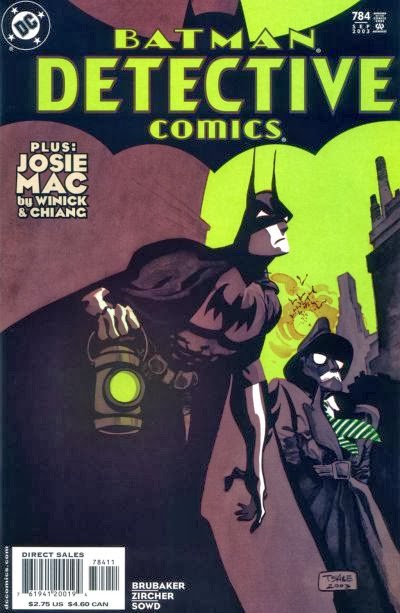
Included in the back of the book are Sale's covers for Solo, Detective Comics (11 of those he contributed in 2003 and 2004, during Ed Brubaker's run) and for Batgirl.
The ones chosen are certainly the strongest, and it's interesting to note that with the exception of Catwoman, who appears in her Cooke costume, the villains he draws are his own versions, including the Joker with gigantic, domino teeth and the tiny little Penguin with too-few fingers and a mouth full of tiny pointy teeth.

Here are a few of the TEC covers that didn't make the cut and thus aren't included:


They're of note, I think, because they show Sale working farther afield than his normal place of strength, drawing characters he's not really associated with (Green Lantern Alan Scott, Stephanie Brown as Robin, Mr. Zsasz again, the female version of Tarantula that was briefly a supporting character in Nightwing and thus the rest of the Batman line; not sure why they didn't include the Mad Hatter cover, with its nice cover version of John Tenniel's of Jabberwocky)

There are also a handful of covers from the end of the 2000-2006 (Cassandra Cain-starring) Batgirl series, for which Sale drew the last five covers. Oddly enough, Sale did not provide the best covers of that series, as James Jean had a wonderful, 17-issue run as cover artist. Still, that's one of the weirder places I've seen Sale's cover work show up at DC, with the exception of, say, this:

Tuesday, October 08, 2013

Arkham Vs. Blackgate, Round One: Softball

Tomorrow DC will release Forever Evil: Arkham War #1, the first issue of a six-part miniseries by Peter J. Tomasi, Scot Eaton and far more inkers than typically necessary. It will detail the conflict between Bane, who has raised an army of soldiers from his prison nation of Santa Prisca and by rallying those held in Gotham City's Blackgate Prison, and the significant portion of Batman's rogues gallery that are usually held in Arkham Asylum.

Following the events of the first two issues of Forever Evil—Batman, Nightwing and Red Robin taken off the board, the world's super-criminals all freed to run riot, worldwide blackouts, a permanent eclipse of the sun—the denizens of Arkham have split Gotham City between themselves, under the kinda-sort leadership of Secret Society of Super-Villains go-between The Scarecrow and the new mayor of Gotham City, The Penguin.

It's going to be the sane criminals versus the criminally insane criminals, basically.

This isn't the first time that the regular, old, not-so-colorful criminals of Blackgate came into conflict with the maniacal theme villains of Arkham Asylum, of course. It's likely to be a lot more violent (and long) though, as the last Blackgate vs. Arkham war was fought on a softball diamond.
Kyle Baker's cover for Showcase '94 #4
That conflict played out in writer Alan Grant, pencil artist Tim Sale and inker Jimmy Palmiotti's "Madmen Across The Water," a 36-page story that was split into two chapters and ran in 1994's Showcase '94 (It has since been collected in Tales of the Batman: Tim Sale, which collects all of the shorter Batman comics that aren't available in trade form; in other words, everything Batman comic he drew that Jeph Loeb didn't write).

The story takes place shortly after the events of the big "Knightfall" crossover, in which Bane blew open the doors of Arkham Asylum, armed the inmates and let them tire Batman out for him. It worked, and Bane defeated Batman and broke his back—only to have one of Batman's many allies, Jean-Paul Valley, put on a bat-suit and some high-tech claw gauntlets, and beat him into a near vegetative state.

This story, narrated by Grant's Jeremiah Arkham character, details where the Arkham inmates went while the asylum was being rebuilt. Against their wishes, his wishes and those of Blackgate warden Governor Zehrhard and those of all of the Blackgate prison population, they are to be kept at Blackgate.

Here's the cast of inmates Grant and Sale were working with:
It's worth noting that in the early '90s, Batman's rogues gallery was a lot tamer, and while I don't think anyone on that page (save for Sarter, one of the two characters Grant created specifically for this story) never killed anyone, they weren't all Joker-level homicidal maniacs taking multiple lives in every appearance. In fact, with The Joker missing from this story, Mr. Zsasz plays the role of alpha murderer, and he is therefore absent from most of the story (he's tossed into solitary after biting the nose off on a prisoner on page six).

(It's probably also worth noting that of the 11 inmates mentioned there, Grant co-created four of them).

For the most part, these guys are safe enough to be around that they aren't handcuffed or shackled on the way there, and Arkham and others mix more or less freely among them. The current fashion is to treat everyone Batman fights as a hardcore serial killer, but Grant writes and wrote many of these guys as merely colorful criminals with bad-wiring that lead to their quirks and incarceration (That is probably even more evident in this particular story, given that the Arkham inmates are the "heroes" of the story, of a sort, and it's more of a dark, humor piece than a crime or horror story).
Suffice it to say that the two different populations of career criminals don't get along all that great. And because Zerhard is himself greatly revolted by the "criminally insane," thinking them all cowards hiding behind their costumes and feigned mental illness in order to avoid paying for their crimes, his attitude prevails. Arkham, of course, is rather sympathetic to his charges (Both men suffer from a sort of reversed Stockholm syndrome).
Each conflict—bullying in the cafeteria, predilection for turning tools into instruments of evil, a successful suicide attempt, a riot—leads to the Arkham group losing more and more rights. It finally culminates with a bet between Arkham and Zerhard: If the Arkham inmates, none of whom have ever even played softball, can defeat Blackgate's team, they get all privileges restored, daily use of the main exercise yard and their own segregated canteen.

It doesn't go well, at first:
But Dr. Faustus, the other character Grant created specifically for this story, a Satanist who believes himself immortal, proves to be quite a coach, and soon he whips them into fine shape.

It helps that they've all got...unusual talents.
Cornelius Stirk, yet another Grant creation (along with Norm Breyfogle, who also co-created Amygdala and Mr. Zsasz), proves to adept at pitching, for example. Upon laying hands on a softball for the first time, he remarks, "Why, how like a human heart it feels...!" And, when his first practice pitch whizzes right past The Scarecrow, he brags, "They're well-exercised, those muscles...That's my stabbing arm, you know!"

Firefly's proves a pretty good outfielder:
As the only woman on the island, Poison Ivy doesn't really need any chemicals or pheromones to get men to do what she wants:
Making her good at both defense and offense:
And here's one of my favorite moments, as Scarecrow makes it to first base by scaring the first baseman into missing the catch, no fear gas or chemicals necessary:
At the risk of spoiling any part of this almost 20-year-old story, the "Crims Vs. Kooks" game never reaches it's proper ending, thanks to first another riot, this one involving baseball bats, uniforms and more team spirit:
And multiple escape attempts.

I expect a much bigger body count and much fewer sports action in Forever Evil: Arkham War. Sadly, I don't think we can expect to see art quite as good as that of a younger, less experienced and confident Tim Sale, and darker, muddier coloring than that provided by Bernie Mireault.

Here are some of my other favorite images from the story, both involving my favorite Bat-villain, who Sale would go on to perfect a version of in his various "Year One" era collaborations with writer Jeph Loeb.

As Sarter threatens to kill himself in the cafeteria, The Scarecrow eggs him on, oblivious to The Mad Hatter's designs on his juice:
And I love this image of him running in the background of this particular argument:
Oh, and here's the cover for Showcase '93 #3, which contained the first half of the story, by Mike motherfucking Mignola, in case you want to see Mignola drawing a bunch of Bat-villains (And who wouldn't?):

Friday, August 26, 2011