Showing posts with label new gods. Show all posts

Tuesday, October 07, 2014

Green Lantern franchise's "Godhead" arc seems to be off to a good start.

I've frankly been rather surprised by the state of DC's Green Lantern line since the departure of Geoff Johns in 2013, which of course came after about eight years of Johns helming a franchise that grew up around the success of his Green Lantern: Rebirth and his run on the subsequent Green Lantern monthly.

When Johns left the then four-book franchise, so too did all the other creators, and DC had some of it's then-expected PR pratfalling regarding some of the new creators (Remember Joshua Fialkov being announced as the writer for both Green Lantern Corps and Red Lanterns and, within a matter of weeks, leaving over creative differences?). I haven't followed the line that closely since—I used to read Green Lantern monthly, and Peter Tomasi and Patrick Gleason's Green Lantern Corps in trade—but I generally check out the beginnings of each crossover story, and, creatively at least, the franchise seems pretty healthy.

There aren't any writers of Johns' star status in the stable, nor any artists I personally like as much as pencil artists Doug Mahnke and Gleason, but the books never look that bad and, surprisingly, the writers have been quite emulative of the types of stories that Johns and the previous crew of writers used to tell: Big, sweeping, cosmic space stories involving the variously-colored Lantern corps that occasionally (alright, usually) take over all the books to serve in chapters of one big mega-story.

Fans of the characters or concepts who didn't care for the way Johns and company handled the book were probably dismayed that their style of Green Lantern story persisted even after they left, but the franchise did not go in any particularly new directions. It's still set almost entirely in space—in fact, Green Lantern's Green Lantern Hal Jordan is now based in space, and isn't even in the Justice League any more*—big crazy changes are a constant (Kyle Rayner is believed dead! Guy Gardner's mustache is insane!) and all the colors of the rainbow are always involved.

You'd have to ask a Green Lantern fan how exactly this stay-the-course course has been received. Sales have been slipping, but the franchise is still the same size. When it was announced that Larfleeze (the book starring the "Orange Lantern") was to be canceled, a new Sinestro book was put on the schedule immediately, and, for a month or two, the franchise swelled to six books as the last few issues of Larfleeze shipped.**

As for "Godhead"—which, yes, does indeed have a pretty dumb name—there's a pretty good chance that this is a storyline that could interest regular DC readers and DCU watchers who don't normally read any Lantern titles. It features the universe's many Lantern characters coming into conflict with the New 52 version of the New Gods, but that in and of itself isn't much of a selling point (Me, I thought that was a weird move, as no one writer seems to be in control of the New Gods in the current, rebooted universe; they pop up almost at random in many unconnected titles).

Rather, it seems like it will have more than a little to do with...whatever DC's up to with its Multiverse now (See the last few pages of Forever Evil, the last page of Superman: Doomed #2, Booster Gold: Futures End #52, and, Futures End and Earth 2: Worlds End for more). The plot involves Highfather and The New Gods, who see themselves as a vast army protecting the Multiverse from the forces of Darkseid, seeking an ultimate weapon with which they will be able to defeat the evil god should he ever find the Anti-Life Equation (So, an Anti-Anti-Life Equation, I guess).

Metron and Highfather think they've found it in the main DCU Universe of the New 52 version of the Multiverse (What Earth are we on now? I've just been calling it Earth-New 52; is it Earth-1 or Earth-O or New Earth or what?), a notable universe because this is where seven individuals repelled Darkseid five or six years ago in the first arc of Justice League (and they did so much, much more violently in that animated direct-to-DVD movie, Justice League: War. Did you see that? Holy shit man, there was swearing! And Barry Allen took a crowbar to pry out one of Darkseid's eyeballs!).

Also, the Source Wall has appeared in previous Green Lantern crossover epic "Lights Out" (and, more recently, in Futures End: Green Lantern #1).

The ultimate weapon the New Gods have their eyes on? The White Light of Creation/Life that comes from unifying the whole rainbow of rings, currently held by White Lantern Kyle Rayner, who was able to travel to the other side of the Source Wall and back.

So, to put it as simply as possible, it's The New Gods vs. The Lanterns, for ring-power.

The story kicks off in Green Lanterns/New Gods: Godhead #1, a 38-page, $4.99*** special written and drawn by just about every one. Look how Hal Jordan recoils in horror at the list of credits he's faced with!
Don't worry, Hal! Most of those are writers; it looks like all the Lantern writers collaborated on the story, while Van Jensen and Justin Jordan wrote the script for this issue. There are only ("only"...?) five artists involved in drawing the damned thing, and none of them have a remarkable enough style that there's any visual whiplash involved. I'd actually have trouble pointing out who drew what, although I think I'm pretty certain which pages are Ethan Van Sciver's and which are Pete Woods' pages.

By the way, the text-heavy cover featuring a pull-quote from the book's dialogue is apparently the cover design for the whole she-bang, based on the fact that the second part—labeled on the cover as "Act I, Part 2," is similar in design. I can't say I like the design, but it is distinctive, and thus I imagine it will pop off the comics racks, differentiating the books from their neighbors. It's also funny; the "Act I, Part 2" is Green Lantern #35, and it also features a character reacting in horror to the credits:
As for Godhead #1, it begins with a recap of the New 52 New Gods, who are an awful lot like Jack Kirby's original conception in a lot of ways, but quite different in design (Also, the good guys are total assholes, too).

If you've read Wonder Woman, you've already met Orion and Highfather and visited New Genesis, here a floating city orbiting a ruined planet destroyed in the war between the gods. If you've read Justice League, you've already met Darkseid and his new, weird football player design. I always thought he was scarier in a mini-dress than in shoulder pads, but what do I know?
There's a four-panel DCU creation story (still involving the giant hand), a two-page summary of New God history/mythology and then a fancy four-page fold out of The Source Wall, before which stand Highfather and Metron (well, stand and sit, respectively).

Highfather, like Commissioner Gordon, looks much younger and more virile in The New 52 than in the...old, pre-New 52 comics. He still has an Amish or Lincoln style beard, but it's now dark and clipped short. Rather than a robe, he wears military-style armor that looks a lot like Imperiex's, and instead of the cane/staff he used to carry, he now wields a megarod-esque mace, more suitable for hitting.

Metron looks pretty much like he always has, but he's got some circuit boards or something in his face...?

They chitchat about the rings and Darkseid and The Multiverse and such before deciding to make a super-weapon out of the rings, with Highfather dispatching various New Gods to take a ring from each Corps, a feat they accomplish quite quickly. In general, it takes about a page to steal a ring from, say, a Star Sapphire or Larfleeze, while the Sinestro Corps and Green Lantern Corps put up a bit more fight.

Here's a panel of Hal Jordan getting his stupid ring construct smashed by Orion:
Hal's shaft has no hold over Orion.
Highfather stuffs all the rings into a new mega-mace that his super-blacksmith makes for him, and then visits a planet in the hopes of hyper-evolving everyone that lives there into gods. Instead, it turns all the space goat-people that live there into monsters, and Highfather sighs and is like, "Well, we'll have to destroy this planet and everyone on it."

It's decided that they miscalculated, and can't make their own white light, but need the white ring that Kyle Rayner is posing with on the last page, apparently recreating the creation story scene from the second panel.
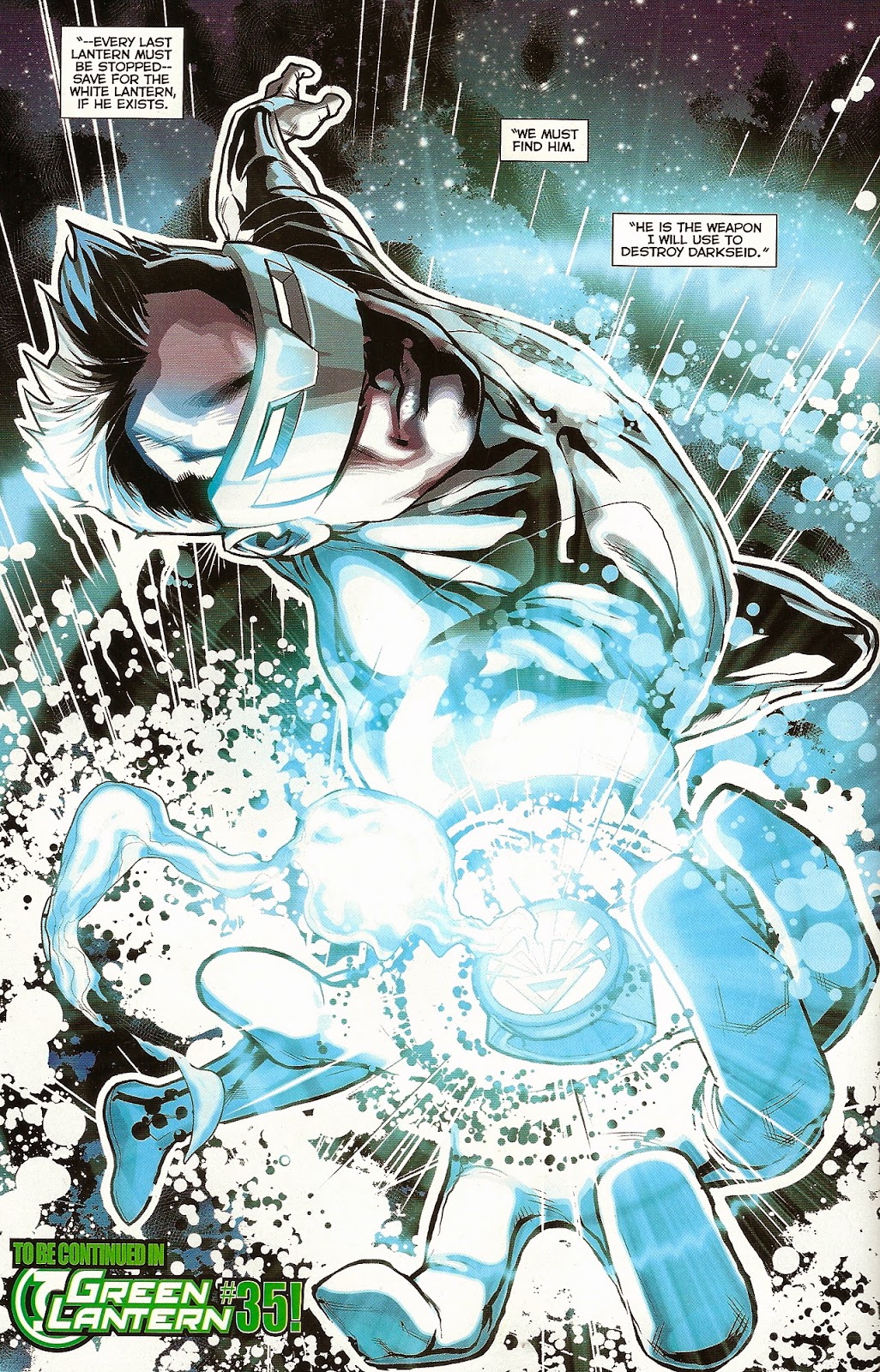
Coincidence?

And if you found that intriguing, or just happen to read Green Lantern, it's on to part 2 of Act I of "Godhead," by writer Robert Venditti, pencil artist Billy Tan and three inkers.

These are the opening panels:
Just in case you weren't sure if you were reading a DC Comic or not. And don't worry, dismemberment fans! That scene of a ripped-off arm floating through space, tumbling away from its former owner is set "Soon;" the story will then jump back in time so you get to see the arm getting torn off as well!

Hal Jordan and his Green Lantern bros are on Mogo, the Alan Moore-created sentient planet GL that DC has gotten a ridiculous amount of mileage out of, who is slowly dying or losing sentience or whatever, because the GL ring Orion took was Mogo's ring (Oh, and the GL Corps are based on Mogo now. Did you know that? Well, they are). They are staring intently at computer screens and freaking out a little when they hear that the New Gods got the whole ring collection super-fast and made a weapon out of them and then destroyed a palent with 84.6 billion people on it.

That's right. The New Gods of New Genesis, the good guys in the New Genesis/Apokolips conflict, killed 84.6 billion people testing a weapon. So it will be kind of hard to root for Highfather, Orion and Lightray in the future, then.

The Green Lantern Corps confront the New Gods at the Source Wall, and Hal Jordan gets punched in the face:
And that's really all I want from a Green Lantern comic.

And then Highfather's stormtroopers chop up the Lanterns' ring constructs with their magic spear things, and Green Lantern The Wolfman gets his arm chopped off while a bunch of other Lanterns are likewise stabbed, cut and dismembered.
Metron tracks the White Lantern Ring and then Boom Tubes to New Genesis, and the decimated Lanterns decide to "rendezvous" on the last place anyone would look for them, Sinestro's planet...although the next issue—Part 3 of Act I, I guess—is actually Green Lantern Corps #35 rather than an issue of Sinestro.

So years after Johns left, DC is still producing Green Lantern epics, just the way Johns and company wrote them, and just the way you (likely) like them (if you liked the Johns ones).

How closely does the new class of Green Lantern writers follow the Johns template? Close enough that the good guys are still mostly a bunch of unlikeable assholes, and arms can be expected to regularly be removed.

Huzzah...?


*DC really needs to put one of their many Earthling GLs on the League roster, preferably John Stewart at this point, but Simon Baz works fine too. I suppose whichever Lantern they end up using in the eventual Justice League movie—John or Hal—will eventually re-join the Justice League. In the meantime, Johns seems to have replaced the team's need for a character with a green power ring by adding a new Power Ring to the ranks.

**I'm actually curious to see if and when the Green Lantern line takes a note from the Batman line and cancels its lower-selling books in order to launch a Batman Eternal-style weekly series. As has been the case with their many crossovers, the Green Lantern line is pretty much written as a weekly-ish book many months anyway, so it would hardly effect the storytelling. But I don't know, perhaps there are readers who read Red Lanterns every month and stubbornly refuse to follow the rest of the line, even if every couple of issues the book is subsumed into a crossover.

***Still a dollar less than DC is considering charging for Batman, by far its best-selling title, and maybe the only title posting such huge numbers based solely on the quality of the work of the creative team, rather than gimmicks and market massaging. I guess they're thinking if they sell over 100,000 copies of the book a month, and they raise the price from $3.99 (which I thought was a ridiculously inflated price as is) to $4.99, they can make an extra $100,0000 every month? If that logic is sound, maybe they should charge $51.99 for each issue of Batman and make each issue 1,040 pages, with the rest of the DCU line being back-up stories to the Batman cover feature....?

Saturday, February 07, 2009

Twelve thoughts about Superman/Batman: Torment

I’m either a glutton for punishment, or have some crippling addiction to Superman and Batman that I cannot resist reading about them, but despite how little I enjoyed Michael Green and Shane Davis’ Superman/Batman: The Search for Kryptonite, I didn’t let that stop me from reading the next available Superman/Batman trade from a local library, Superman/Batman: Torment by Alan Burnett, Dustin Nguyen and Derek Fridolfs.

This one collects a six-issue arc that ran right before Search For Kryptonite (Well, right before the fill-in issue right before Search for Kryptonite), and right after Mark Verheiden’s short, nine-issue run that kept up title founder Jeph Loeb’s crazy shit happening at random formula, but was somehow even worse, operating with an attitude that wasn’t merely continuity-lite, but continuity-adverse. Although it was Pat Lee’s artwork on the Metal Man retcon/reboot that finally caused me to drop the title).

So, given what came before and what came after, I just sort of assumed that this was going to be a rough read and expecting the collection’s title to be more or less literal.

But, to my great surprise, this was actually pretty decent. I’m pretty sure I wouldn’t have liked it nearly so much as it was originally being serialized, as it does have to do with Jack Kirby’s New Gods, which, at the time, were in a weird state that varied from title to title (DC hadn’t used any of them for a while, to get ready for Final Crisis, but then apparently decided to use them everywhere during Countdown, killing them all off in preparation for Final Crisis). And also, if I read it in that format, I would have been paying for the privilege.

But as a trade, after Final Crisis, read for free from the library? It’s really not bad at all. It’s probably Burnett’s best DCU work (not that he’s done much) and maybe, just maybe, the best arc of the series’ existence, but it’s hard to say—I mean, Loeb’s the good writer on this book, so quality is pretty relative.

Although this was much, much better than The Search For Kryptonite, I am going to address it in the same format as I addressed the last collection of the series, and continue this weekend’s lazy, list-making review technique (I did write at least one real, paragraphs-and-everything review this weekend though! There’s a Hotwire: Requiem for the Dead #1 review at Blog@).

1.) Dustin Nguyen is a really good artist. Superman/Batman has been blessed with some of the industry’s more popular artists, many of whom are actually quite good at what they do. That’s why Shane Davis or Pat Lee’s work kind of stuck out as being particularly bad, I think. I don’t know that Nguyen is quite as popular as, say, Ed McGuinness or Carlos Pacheco, but he’s certainly good at what he does. I haven’t got a single complaint about the art end of things here; it’s easy to read, many of the designs are rather inspired, the action is lively.

Nguyen seems to have taken some cues from Mike Mignola, as his Darkseid has the bulk and square-ish shape Mignola gave him in Cosmic Odyssey. Nguyen’s Batman also occasionally reminds me of Mignola’s, in certain medium to long shots of Batman in costume.

2.) Hey, how come this collection doesn’t get an introduction? Green’s Search For Kryptonite had an introduction to it, as did Green’s Lovers and Madmen, but here? Nothing. Lame.

3.) That’s Killer Croc? Okay, well, there’s one design I’m not overly fond of, and that's Nguyen’s Croc. He doesn’t look much like himself, although perhaps that’s not as much Nguyen’s fault as DC’s somewhat lax stance on character design. Croc was pretty radically transformed in Batman: Hush, either given plastic surgery or somehow mutated by Hush to make him look more like a crocodile, and that look has mostly stuck. Nguyen’s version seems like something of a compromise between the pre- and post-Hush looks, but his Croc also has craggy, stalactite-like spines all over his back that make him look like an entirely different character.

Burnett refers to him as reptilian too, which didn’t use to be the case—he was just a big, strong guy with a skin disease, not a crocodile/human hybrid—and uses him in a somewhat strange way. He’s hired by a mysterious villain to steal something from Lex Corp, which is more of a Catwoman-y job than a Croc one, you know?

4.) I like the messy hair Nguyen draws on Clark Kent.

5.) There’s a really nicely-executed page of Superman freaking out while sitting at his desk, seemingly beat-down by his own narration boxes. I thought that was a very effective scene. And kind of amusing, given this title’s traditional over-use of narration boxes, although I doubt that was the intent here.

6.) The Scarecrow working with the Desaad and traveling to outer space just doesn’t seem right. I love The Scarecrow, and the prospect of him taking on Superman is kind of interesting, but he doesn’t quite seem to fit in well with the sci-fi aspects of the story. Once he’s on a planet-sized warship in outer space, the clash between Superman and the New Gods and this rag-wearing Bat-villain seemed particularly discordant.

7.) Oh hey, this is the book with that cover. I’m not sure if you remember or care or not, but issue of this series was originally solicited with an image of Batman standing behind Bekka, his right hand resting between her throat and her breasts. When it finally came out, however, the hand was removed, and was now hidden by Batman’s cape. Apparently, his hand was too close to brushing her breasts on the cover for DC’s comfort.


The pair do make out and maybe more in the story. Batman does strip her naked and lay atop her on the floor kissing her for a while. But apparently the cover was a little risqué. In the back of this trade, there are a series of pages showing Nguyen’s roughs for the covers, and there are four different versions of the cover, with Batman’s hand on her neck, her stomach or simply on his batarangs.

8.) Wait, Bekka? I had no idea Orion was even married. I guess he doesn’t talk about his wife very much in his appearances in other books, does he?

9.) Batman is “aroused beyond all reason.” When I got to this part, I remembered that Batman’s secret Canadian girlfriend Rachelle Goguen had a pretty amusing review of this issue (With lots of scans! Check it out!). In a nutshell, Bekka is a goddess and, like all of the New Gods and New Goddesses she has a power of some sort, and hers doesn’t seem all that useful—the men around her really, really want to have sex with her, and she really, really wants to have sex with them. The more hardened the heart, the stronger it is, which is why she married Orion. And you know, Batman sure is heard-hearted, so the pull is strong. The only way they can get past it is to have sex, which they don’t want to do.

This whole conflict is kind of interesting, in a Well I’ve never seen THAT before kinda way, and Burnett does try to use this as an opportunity to describe how sad and lonely Batman is in life, but man, is it ever silly. Plus I guess Batman must have an erection for, like, the whole second half of this book? I guess it’s a good thing he wears that long, flowing cape.

10.) Oh yeah, Superman dies. So what’s Desaad up to here? Well, Darkseid lost his Omega powers, and is kind of sad and depressed and sort of losing it now. When we first see him, he trips. Desaad has found the late Highfather’s magic cane embedded in the Source Wall, and the plan is to have a brain-wiped Superman retrieve it for them and use it restore Darkseid’s eye beams. Once that’s occurred, they zap Superman with it, and he finds himself in The Source. But first he has this crazy hospital scene where various characters appear and pay their respects. Starro brings him a basket of cupcakes.

It’s pretty amusing, but seems pretty out of place with the rest of the story, which is about the evil of the evil New Gods and Batman’s unreasonable arousal.

11.) The second to last page is pretty awesome. After Desaad and Darkseid are defeated and the heroes make it back to Earth, Orion picks Bekka up on the flying elliptical machine he travels around on, and gives Batman a pretty dirty look.

Once they’re back home on New Genesis, they apparently sex it up for a while, and there’s a neat couple panels of Orion putting his belt and helmet on, and Bekka lying naked in bed, asking when he’ll be back from making war on the gods of Apokolips.

I really like the banal domesticity of their life, as if Orion’s a neglectful husband about to go on a business trip again. Except his business if flying over to the next planet to beat up Kalibak and Granny Goodness.

12.) The last page is super-dumb. Once Orion flies off to work, Bekka thinks to herself, “As long as he returns, all will be right. Thoughts of Batman will pass. They must.”

And then she notices a pair of white, triangular eyes I the shadows of her room. A black hand stretches out of the shadows, and there’s a “CCHHHOOOO” sound that makes Bekka glow and say “AAAARRHHH!” while a “FSSSSS” appears. In the very last panel, a burning scrap of the sheer cloth she had wrapped herself in floats out the window, and someone off panel says “So begins the end.

Because I read a lot of DC comics and a lot of reviews of them and pay attention to creator and editor interviews on Newsarama, I knew that around this time some mysterious stranger was going around killing all the New Gods characters in the DCU. I didn’t read Death of the New Gods or Countdown, so I don’t remember who it actually was—it was revealed to be Infinity Man in one comic I read, but maybe it was Darkseid posing as Infinity Man…or something…?

But there’s nothing in this book to give the scene any context; there’s no “To be continued in Death of the New Gods” or anything, no foreword or afterword to make sense of the scene.

If this was the only DC comic you read in trade, I can’t imagine how this scene plays out. Did Batman, who was in her thoughts in the previous panel, who wears black gloves, who sticks to the shadows, and who has white, triangle-shaped eyes, travel to New Genesis to take care of their problem by incinerating Bekka? Did Darkseid, the villain of the book, return from what could have been his death to get revenge on Bekka?

I thought it was the latter for a while, and then remembered the whole New Gods Killer plotline from a year or so ago. At any rate, a pretty strange note to end a book on.

Friday, February 29, 2008

Eleven Things You Can Learn From Tales of The New Gods

The recently released Tales of The New Gods trade paperback is a pretty well-timed collection of short stories dealing with the characters created during Jack Kirby's late-seventies experiments with pop mythology for DC Comics.

With Death of the New Gods putting the characters front and center in the current DCU line, and that big, gorgeous, multi-volume Kirby omnibus project making sure the original stories are readily available, the New Gods iron is probably as hot as it's ever going to get.

Tales of the New Gods consists almost exclusively of short stories highlighing different characters and different eras of their fictional histories by different creators. Most of the stories are either written and drawn by John Byrne or written and drawn by Walt Simonson, as the bulk of the material comes from bits and pieces of Byrne's Jack Kirby's Fourth World and Simonson's Orion, but there's a real who's who of talent involved.

The list of those providing art is as varied as Erik Larsen, Arthur Adams, Howard Chaykin, Dave Gibbons and John Paul Leon. There are some real "gets" in terms of creators, like a short Frank Miller-illustrated piece, and a never before published story featuring Darkseid and his court written by Mark Millar (presumably from back in the day when he was doing whatever DC work he could get) and drawn by Steve freaking Ditko.

I was actually a little surprised there wasn't more in it, as it doesn't really strive to be a complete collection of short-pieces featuring the Fourth World characters. For example, I remember there being a tale of the young (and suprisingly hot) Granny Goodenss meeting Darkseid for the first time in a Secret Origins 80-Page Giant*, and if I were putting the thing together, I would have been sure to include the few pages of "Lost Pages" from Grant Morrison's JLA that appeared in 1998's New Gods Secret Files and Origins #1. Not because it was any good at all—it's just a couple of pages, and read like a scene cut from a movie to steamline it—but simply to add one more big creator name to the credits.

How worthwhile the reader will find the book will ultimately depend on how interested he or she is in Byrne, Simonson and/or Kirby's Fourth World characters. Personally, I didn't really need to see Darkseid and Desaad as young men, for example, or Mister Miracle and Metron hanging out in the Old West disguised as cowboys. I think the book's major value is in its ability to satiate a reader's curiosity over how well various creators tackle the Kirby characters.

And its educational value, of course. You can learn a lot of things from Tales of The New Gods.

At least eleven different things.

For example...


1.) That if anyone could make a Mister Miracle comic really work, it’s Steve Rude and Mark Evanier. Seriously, Tales of The New Gods is worthwhile for the nice reprint of their 1987 Mister Miracle Special alone.

Check out some of Rude's art from the story:


(Above: Big Barda in her action bikiki, plus Oberon and Scott performing at the circus. Quick rule of thumb: Rude + the circus = awesome)


(A full-page spread of Scott thinking on his past while locked in a safe that's about to be run over by a steamroller driven by a clown)


(Mister Miracle vs. a robot in a trap-filled funhouse erected by Granny Goodness and Darkseid)


2.) Mister Miracle had a previous wife, who had the unlikely name of Fancy Goodbody. And, despite her funny name, she was from England, not Planet Kirby


3.) That John Workman really is the greatest letterer


4.) How much sillier Darkseid’s outfit looks when, instead of a big, gray, craggy-faced, rock-looking guy, there’s a normal, human-looking dude in it:


(Byrne's drawing of the big D's brother, rocking Darkseid's look)


5.) Why Kanto dresses like someone from a medieval court


6.) The secret origin of Kanto’s moustache. Come on, you know you've always wondered.


7.) How long the Forever People have been wearing those particular outfits


8.) Just how bad a combination of John Byrne art and computer-generated graphics can look:


9.) That the whole evolution of Frank Miller’s art style seems to have been in service to drawing the most perfect Darkseid visage of them all:


10.) Baby Orion’s first utterance was “RAAAA!”


11.) If the Jeph Loeb and Rob Liefeld team can do Kirby’s creations any justice. Here's a hint:


*Update: I have it on reliable authority that the Granny Goodness story from that comic, "Goodness and Mercy" by Simonson, Jon Bogdanove and Bill Reinhold, was reprinted in the trade collection of Simonson's Orion, which may explain why it wasn't re-reprinted here, despite it fitting in so well with the contents of this collection.

Tuesday, February 26, 2008

A really good Mister Miracle story, in its entirety

I got a lot of interesting feedback from Friday's post about Mister Miracle's seeming inability to carry an ongoing monthly for very long, despite the fact that he's both a superhero and an escape artist, the former vocation being shared with the stars of a lot of successful book, the latter being shared with the stars of a lot of awesome comic books.

A lot of attention seemed to foucs on the nature of Mister Miracle's escapes, which often depended on his high-tech doodad-ery rather than the sorts of physical prowess and skill shown in, say, Houdini: The Handcuff King.

Given the tricky nature of so many of the traps he escapes from, I think downplaying Mother Box's role is probably the best way to depict them. For a good example of how to handle the escapes, I'm hard-pressed to find a better one than Mike Allred's story from Solo #7.

I certainly can't think of a more succint example. Here's an entire Mister Miracle story revolving around his miraculous escape artistry, told in just two pages. (As always, click to enlarge).


Man, it must be hard being friends with Orion. He seems just a little too quick to bash Scott over the head with a large rock, and a little too slow to have second thoughts about throwing him into a volcano.

I especially like that Allred drew him scratching his hemlet in the last panel...

Saturday, November 03, 2007

Why I'm not reading Death of the New Gods


I really like Mister Miracle and Big Barda and Orion and, as a glance around the joint will attest, I'm awfully fond of the DC Universe in general. You know what one of my favorite non-Jack Kirby Fourth World stories of all time is? Cosmic Odyssey, written by Jim Starlin. And yet, I just can't bring myself to try an issue of Death of the New Gods, an eight-part series written (and drawn) by Jim Starlin, which promises to close out the saga of Kirby's New Gods characters and give the original Mister Miracle his first extended shot in a spotlight since...when, 1996?

Why is that?

I think a large part of it is that Death Of... is part of the larger, line-wide story DC's been telling lately, mostly through Countdown. That's where New Gods and other Fourth World hangers-on have been seen getting killed for the last six months or so, although a few of the New Gods characters have also played pretty big roles in Amazons Attack!, a book so bad I still can't believe DC published it. And part of it is just how poorly DC's handled the New Gods characters for the last few years. I remember during convention season in '05, reading Dan Didio answering questions about the relative lack of New God-age or Darkseid in Infinite Crisis, and the intimation was that there was a plan. In fact, the characters did seem to be missing altogether for a while in the DCU, conspicuous in their absence, and then all of a sudden they were everywhere again, with little thought to why or wherefore.

The Grant Morrison-penned Seven Soldiers: Mister Miracle series was ignored just about everywhere, and it was unclear how it fit into the larger DCU (Were Shiloh Norman and Scott Free both Mister Miracle now, or what?). Jeph Loeb was constantly using Darkseid in Superman/Batman, and it appears he and Orion and others are in the current arc of the now Loeb-less series. Metron and others popped up in Blue Beetle. Lightray was in Kurt Busiek's "Camelot Falls" storyline in Superman. Big Barda joined Oracle's team in Birds of Prey. The Female Furies were in issues of Hawkgirl and Firestorm the same week, looking completely different in each sereis. Countdown is and has been completely lousy with Fourth World characters, including the death of Lightray early on...an event that was pretty much ignored everywhere else.

In short, DC seems to have a plan, but to not be following that plan all that well, which is something I as a reader find extremely frustrating, a worst-of-both-worlds kind of scenario, where you get the sense you're reading about editorially mandated plot points jammed clumsily into stories where they don't really fit, and the creators responsible for trying to make the mandates work are kind of flying by the seat of their pants, serving someone else's plot rather than a story they want to tell.

Beyond that, however, is the fact that death in the DCU has been so devalued, that the idea of a huge chunk of that fictional universe being (clearly temporarily) destroyed couldn't be any less dramatic or appealing to me. I mean, they brought Ice back to life, it's not like they're going to leave Jack frigging Kirby creations dead. They brought Jason Todd back to life, without much of a plan or story to tell with him (Under The Hood, Countdown, a cameo in World War III, that one issue of Teen Titans and that one Nightwing arc don't cratively justify undoing portions of the last 20 years worth of Batman comics, do they?). Why would anyone believe that they're actually going to permanently kill off the New Gods?

My disinterst is further compounded by the fact that DC is being so upfront about how meaningless and unimportant Death of... and the related Countdown books really are. I mean, they're calling the book Countdown to Final Crisis; other titles are called Countdown to Mystery and Countdown to Adventure. How about just some mystery, adventure and a final crisis? Why must we readers shell out time and (a lot) of money just to mark time until Final Crisis?

If the creators of Final Crisis, Grant Morrison and J.G. Jones, were at all involved in Countdown/Death of the New Gods, the investment of time, money and interest might make more sense. But they're not; Morrison's not co-showrunning Countdown, and Death of... isn't "based on concepts and ideas by Grant Morrison" (as the credits for Metal Men, Uncle Sam and the Freedom Fighters and The All-New Atom read). Starlin, Paul Dini and the small army of people involved with the Countdown story are merely moving pieces around the board, getting ready for Morrison to do whatever he wants in Final Crisis, something that will almost certainly involve a continuity reboot of some kind—at the very least, it will involve resurrecting Barda, Lightray and the other major New Gods, if they're not brought back to life before then.

Didio promises as much in this week's "DC Nation" column: "And while we may be closing the book on the Fourth World, fear not: soon, very soon, I will be able to tell you more about Final Crisis and the coming of the Fifth World."

Which reminded me of this seven-year-old comic, also by Morrison:


Check out Metron's dialogue in the second panel in particular. "When the Fourth World universe of us New Gods is made complete and put away the gods of the Fifth World will arise from this planetary cradle."

The return of the New Gods in Final Crisis (again, if not sooner) is as inevitable as their deaths in a book entitled Death of the New Gods, which makes watching that death not seem all that dramatic, unless you're the sort who wants to know how they die, or what a dark Mister Miracle looks like, or how well-suited Starlin is to draw Kirby characters (not as well-suited as Mignola, from what I've seen).

Of course, knowing the ending before you get there is endemic to superhero comics, isn't it? For the most part, when The Joker breaks out of Arkham, we can be fairly certain he's going to fail to kill Batman, and get sent back to his cell by the time the story's over. When Lex Luthor develops a new device to finish Superman once and for all, we know full well that Superman will survive and triumph over his foe. But we read anyway, interested in how it turns out the way we know it will end up turning out. And, while The Joker won't kill Batman, he did kill Robin that one time, and cripple Batgirl that other time. Luthor was elected President of the United States, something readers didn't see coming. At their best, superhero can still surprise jaded, cynical, adult readers who grew up reading them, which is why the comics industry, as represented by The Big Two, continues to focus almost exclusively on catering to jaded, cynical adult readers who grew up reading them.

The problem with Death of the New Gods, I think, is not just how predicatable its ending is (they all die and, eventually, all come back), but just how prosaic everything leading up to it seems. Maybe Starlin has brougth the cool and cosmic craziness missing in the earlier parts of the story that I've read (In Countdown, Birds of Prey, etc.), but so far we've just seen an unknown killer (who looks like Infinity Man), blowing holes in people's chests (I was struck by the fact that this week's JSoA features an unknown killer stalking and killing minor DC characters. And that the first JSoA arc had the exact same set-up. And that the first JSA arc, when James Robinsin and David Goyer relaunched it in 1999, had the exact same plot as well).

Even worse? Countdown gave an explanation for what lies on the other side of the Source Wall.


In Kirby's mythology, that was a pretty big game-ending mystery, right up there with the exact formula of the Anti-Life Equation. The other side of the Source Wall was some big secret the gods were always trying to discern, but it could never be breached, and those that tried and failed were imprisoned forever in it (Although some, like Ares and Darkseid would escape). Coutndown has come out and told us what it is. Not ultimate knowledge, not God, not a tantalizing never-to-be-revealed Maguffin, but just the multiverse. If Darkseid had ever breached the wall, he simply would have found himself on Earth-15, the place where Jason Todd became Batman. Or Earth-3, the world that's like "Earth-2" in the Anti-Matter Universe or like Earth-3 in the old, pre-Crisis multiverse, only slightly different.

That's it. That's the big mystery. Man, would Metron and Darkseid be pissed if they found away around the wall and ended up meeting Captain Carrot and His Amazing Zoo Crew for their troubles.

What's lame about this, other than solving a mystery posed by Kirby that was better left unsolved (It's like when we finally found out who killed Laura Palmer; after that, there's nowhere to go but down) is that a) It doesn't make any goddam sense (The Source Wall and the Source obviously existed long before the current iteration of the multiverse, which is about a year old at this poing) and b) Jason Todd, Donna Troy, Kyle Rayner, Good Monitor, Bad Monintor, Captain Atom, Monarch, Forerunner and apparently Ray Palmer have all been jumping around the Multiverse, somehow crashing the Source Wall without even realizing it, and thus doing something that Darkseid himself has never been able to do, no?

Why is DC turning something as crazy and potent as Kirby's Fourth World saga into such mediocre super-comics? I think I have a clue. In reading Didio's column this week, I was really struck by this part, in which he talks about how he first discovered Kirby's Fourth World comics:


I remember picking up my first MISTER MIRACLE; it had an incredible two-page spread where our hero was about to be crushed in a pair of giant pliers. Certain death, but Scott Free wasn't called the greatest escape artist for no reason. No sooner than the cylinder he placed himself in was crushed, he was found standing and smiling behind his two closest friends (and no, I still have no idea how he made it out of there alive). Okay, as silly as it sounds, I was hooked.


Did you hear that? The "Okay, as silly as it sounds" part? Man, it doesn't sound silly at all, and to kind of confess sheepish embarassment at it is tantamount to confessing not really getting what it was that hooked you (and plenty of others, young and old, in the first place).

It doesn't sound silly; it sounds awesome!

If a pair of giant pliers sounds silly to you, how are you going to take seriously a planet called "Apokalips" With a K, ruled by an evil god named "Darkseid," which has the likes of Vermin Vunderbarr on it? How can you take seriously the Black Racer, or an escape artist named Scott Free? That "silliness"—or gonzo, stream-of-conscious pop mythology made on the fly—is what makes the Fourth World characters, like just about everything else Kirby created, so appealing in the first place. It's not something to feel guilty for liking, and made darker, more adult and more realistic in order to feel less guilty about; it's something to be celebrated, magnified and multiplied.

It's just six words, but, whether he meant it or not, I think Didio let slip one of the main problems with the current state of the DCU. One of its main architects and caretakers, the one behind so many of the other architects and caretakers, too often forgets what he liked most about it himself as a kid, and wants to make the universe he oversees something that would appeal to him now, if he'd never read comics as a kid. He seems to regard DC Comics as they were back in the day as a guilty pleasure. But what's there to feel guilty about? Why can't they just be a pleasure?

Tuesday, August 14, 2007

Dream Trades: The Complete Super Powers by Jack Kirby and Others

(Click the above image to enlarge, and freak out about how cool Kirby's Penguin is)

DC produced three miniseries based on the Super Powers TV show and toy line, one a year between ‘84 and ’86. The creative teams involved might have just been happy to get some relatively high-profile work at the time, but looking back from 2007, it’s pretty remarkable just who it is that DC had making these things.

The first two series heavily involved one Jack Kirby. The five-part 1984 series, which the above house ad advertises, featured covers and a plot by Kirby, with Joey Cavlieri scripting, Adrian Gonazles penciling and a handful of inkers finishing the art. The six-part 1985 series featured covers and interior pencils by Kirby, though this time around Paul Kupperberg apparently plotted, in addition to scripting.

Take a look at the covers:


The four-part 1986 series is Kirby-less (aside from involving characters he created), although the penciler wasn’t exactly a slouch. This series was drawn by Carmine freaking Infantino.

Here are his covers:


Now, I've never read a single issue of these stories. So they may be horribly written and illustrated; after all, comics giants involved with comics based on toys didn’t always do their best work (Check out Rachelle’s discovery of Ditko drawn Go-Bots comics). But based on that ad and those covers, I’m inclined to think Kirby at least did a hell of a job, even if it wasn’t the best work of his career.

It’s weird to see that patented Kirby energy applied to DC icons, isn't it>. Sure, we’ve all seen the Kirby Superman before, but the Kirby Batman? Aquaman? Robin? Wonder Woman? Flash? These are the first time I’ve seen any of them. And I love his Brainiac, Penguin and Joker in that house ad.

Collecting these series—even the Kirby-less third one, just for completeness’ sake—seems like a sales slam-dunk to me, for several reasons.

First and foremost, it’s Jack freaking Kirby. As recent shipping lists bear out, there’s as much interest in Kirby’s work right now as there’s ever been before. It’s not just DC’s new, complete Fourth World omnibus collection. It’s everything. The exact same week that Marvel put out a Devil Dinosaur collection, Image published a Silver Star one. It’s really only a matter of time before everything Kirby’s ever done gets trade-collected, and the iron seems to be particularly hot at the moment, DC, so go ahead, strike already!

A Super Powers collection need not be a big omnibus or absolute style thing. Hell, a nice cheap, black and white collection, even a slightly slimmer than the norm Showcase Presents collection (Including all three series, Super Powers only hits 330 pages...although to make it closer to 500, DC could always see about adding these into a Showcase Presents collection), would be welcome, and perhaps serve the art better anyway (I really liked seeing Kirby’s art in black and white in the previous Fourth World-related trades).

And while these stories might not count as official Fourth World or DCU continuity, it’s still Kirby himself doing Darkseid and New Gods characters, while at the same time drawing just about every single major DC character.

Secondly, these comics are based on a toy line from the early ‘80s. And really, that’s all you need to publish a comic book these days. While they haven’t all done gangbusters, we’re currently descending a wave of comics-based-on-toys-from-the-‘80s. Everything I played with as a little boy except Super Powers toys—G.I. Joe, Transformers, He-Man, Thundercats—have had comic books based on them in the last few years. Some were more successful than others, but there’s obviously a pretty huge market interested in this sort of thing, and certainly the Transformers movie and accompanying marketing tsunami demonstrates the size and passion of that market.

Thirdly and perhaps least compellingly are the characters involved. Superman, Batman, Wonder Woman, Aquaman, Green Lantern Hal Jordan, Hawkman, J’onn J’onnz, Firestorm, Red Tornado—it’s basically the Justice League of America. What’s your very best-selling title by a wide margin at the moment, DC? That’s right. Justice League of America.

So come on DC, make my dream trade come true.

Saturday, August 04, 2007

Seven Things I Learned From Justice League of America #183-185

A while back a friend gave me some old late-'70s issues of Justice League of America, from the so-called "Satellite Era" of League history, an era which Crisis on Infinite Earths knocked large chunks of out of continuity, which DC has precious few stories from available in trade form, and which current JLoA writer Brad Metlzer and current Action Comics/Green Lantern/JSoA writer Geoff Johns seem to have particular affection for.

I started using them as raw material for EDILW feature "Satellite Era Spotlights", of which there will likely be no end, as a few weeks ago I acquired a big box full of JLoAs stretching from #180 to #247 or so, with some holes here and there (Did the Secret Society of Super-Villains kill the Justice League and Justice Society? I'm missing the end of that arc!).

That's an awful lot of Justice League comics. (See Fig. 1.1)


(Fig. 1.1. See DC? Look what you made me do! Look what I bought! Now I don't even need your stupid trade collections of the Satelllite Era! You just lost a sale, DC trade collection editors!*)

Anyway, up until recently, all I've been getting out of these comics is an idea that Hostess snack cakes are probably the greatest achievement of human history, that Len Wein has a new Swamp Thing comic coming out featuring our favorite "muck-encrusted mockery of a man" and that there's no stopping the new DC now.

And then I got to 1980's Justice League of America #183-185 by Gerry Conway, Dick Dillin, George Perez and Frank McLaughlin, the annual team-up between a couple Justice Leaguers and a couple Justice Socialites. As was often the case, a third group was involved with this story, and this time it was the New Gods.

This story proved quite educational, particularly compared to some of the previous stories I'd read, and I learned a lot while reading it.

And, as is my habit, I will now proceed to share those lessons with you dear readers.


1.) Orion went through more than one phase where he wore a really stupid looking costume. Yes, that's Orion in the middle there with the big "O" on his chest. The O is, presumably, for Orion.


2.) New Genesis used to be presented as a truly awesome place. And by "awesome" I mean really awesome, as in "inspiring awe"-awesome and not, you know, the other kind of awesome that is more frequently talked about here. I guess 1980 was still early enough in Jack Kirby's DC mythology's existence that every superhero hadn't visited the home of the New Gods three to eight times, and Darkseid had yet to appear in every single comic book.

So rather than being just another well-trod DC space setting like Rann or Mars, New Genesis was still being presented as a fantastic place that could cause even superheroes to gasp. This double-page spread by Dillin and McLaughlin goes a long way towards conveying the nature of the place, but Conway's scripting helps immensely too.

Superman talks wistfully to Power Girl (while standing creepily close to her the whole time, talking directly into her lips) about the temptation to stay there instead of returning home, since he feels like one of many supermen on New Genesis.

Later, Conway tells us this about the size of the place: "Distances are almost impossible to measure on a world where cities average a thousand miles wide, and where the Earth would barely dispace the waters of a small lake"


3.) Earth-2 Wonder Woman is...Christian? Or Jewish. Or possibly Muslim. Or a Deist? But since this panel appears in an American comic book created by Americans in New York City for mass consumption by America's youth in the year 1980, I'm going to assume she's meant to be espousing a crypto-Christian belief. Or maybe a Jewish one. And how weird is that?

She doesn't deny the existence of her own gods, who she should be pretty darn sure exist (seeing as how they she's hung out with and fought so many of them), but she does say there's only one "true 'God,'" which would imply that all of her gods are false ones, wouldn't it?

I wonder, does this mean Diana's gods also believe in the existence of "He who is the only true 'God'-- whose nature remains unknown," and do they worship him too? Did the gods of ancient Greece convert to Christianity (or Judaism or Islam or possibly Deism)? Are they agnostic?

Man, this is a heavy panel....


4.) Even as far back as 1980, George Perez totally ruled. Click to marvel at the majesty of a Perez-drawn splash page revealing one of Granny Goodness' orphanages.


5.) Darkseid used to be totally bad-ass. Like the planet he lives on and the planet he's always trying to conquer, Darkseid has been greatly diminished by over-exposure in the DCU over the last few decades.

But in 1980, he was still a god. In this scene, we're told that even though Orion has killed Darkseid, the force of the evil god's will is so powerful that it reaches into another world, bends the earth to serve him. That's a city street transformed into a giant Darkseid simulacrum up there, being used toterrorize a trio of Earth-2 villains into raising him from the dead.


6.) Hawkman doesn't care about Hostess cupcakes. Hawkman's flying around one day when he notices a skydiver whose chute fails to open, right?

So Katar swoops in and saves the day, but all this lunatic cares about is his cupcakes.

"Hawkman, you've saved me," he observes, opening a bag to show off a couple packages of Hostess cupcakes (Wait, is that why his chute didn't open? Because he didn't pack it? He filled his bag instead with cupcakes?!) "And the Hostess Cup Cakes. And I'm ready for some right now."

The guy's pals are already chowing down and Hakwman's already on his way before the ingrate gets around to thanking Hawkman for saving his sad, pitiful, cupcake-centric life.

And Hawkman doesn't give a shit. He doesn't stick around to see if anyone wants to give him one of their cupcakes, he just flies away, pronouncing "Hostess Cup Cakes" in a way that looks pretty sarcastic to me.


7.) While he may prefer navy blue, Darkseid looks pretty good in purple too.


*Aw, who am I kidding? I'll buy the trades as fast as you put 'em out, DC. I've just gotta know if they beat the Ultra-Humanite's Secret Society or not...
