Tuesday, October 31, 2023

Some Kickstarter campaigns of note

I feel weird about Kickstarter, the crowd-funding site that some comics folks use to bring their projects to life, instead of going the traditional route of securing a publisher. 

I've backed a couple projects there before (some Jim Lawson comics, Mystery Science Theater 3000*) and been pleased with the results, so I'm not, like, opposed to it or anything, I just think it's weird when certain creators or certain projects show up there, given the fact that they seem like they should be the exact sorts of comics that publishers should be fighting one another to publish, rather than something that the creators have to turn to crowd-funding to produce. (That said, I suppose it just might be a weird prejudice of mine against crowd-funding as a publication model; perhaps there are reasons Kickstarter is more appealing to a creator than working with a publisher, I don't know. I didn't ask any of these creators.)

Case in point? Jeff Smith, the Eisner and Harvey-winning cartoonist extraordinaire whose resume includes Bone, RASL, Tuki: Save the Humans, Shazam! The Monster Society of Evil and Little Mouse Gets Ready, an artist who was on the pointy end of the spear of getting comic books in libraries and re-popularizing comics for kids again, is seeking to publish his early, pre-Bone (proto-Bone, in his words) college comic strip, Thorn, which used to run in the Ohio State University school paper The Lantern when Smith was a student there. (I've seen some of these in the 2008 book Before Bone, published in conjunction with his Wexner Center for the Arts show Jeff Smith: Bone and Beyond, and they're pretty fascinating to read in the context of the Bone that later saw print). 

One would think an artist of Smith's stature would have his pick of publishers, but Thorn: The Complete Proto-Bone Comic Strips 1982-1986 and Other Early Drawings is on Kickstarter. Again, maybe this is Smith's first choice, and he didn't even consider going with a publisher, but it strikes me as...wrong that a major publisher wouldn't want involved with the project, as relatively niche as it might be. 

As of this writing, there are 16 days left to go on the campaign. For $30, you can get a trade paperback version of the book, for $75 you can get a hardcover. 

If you've been a regular reader of EDILW for a long time now, you probably know my love of Kelley Jones' art knows no bounds, and little has excited me more than getting a new Kelley Jones comic, especially a new Kelley Jones Batman comic. In fact, I'm so fond of Kelley Jones that if Kelley Jones walked up to me on the street and asked me for, say, $50, I'd gladly give it to him. So obviously I was onboard with a Jones-related Kickstarter.

And this one looks like a doozy, as it also involves Dracula and cartoonist Matt Wagner (best known his Mage and Grendel, but, like Jones, he has plenty of great Batman comics to his name as well). Dracula Vol. 1—The Impaler is written by Wagner, drawn by Jones and will be the first in a series of graphic novels telling the life story of one of fiction's most famous characters. 

It seems like a perfect project for Dark Horse Comics or DC Comics, both of which have worked extensively with the creators in the past, or even Dynamite, where Wagner has been writing the adventures of other famous pop culture icons, like Zorro, The Shadow, The Spirit and the Green Hornet. Whatever though. Like I said, I would be happy to hand Jones money if he asked for it; if I got a Dracula comic by Jones and Wagner in exchange, well, who could ask for more?

As of this writing, there are 16 days left on the campaign. For $45 you get a hardcover version of the book, with either a Jones or a Wagner cover (I chose the Wagner cover, since I'd be getting all that Jones are on the inside).  

Finally, there's something that's only kinda sorta comics that is nevertheless near and dear to my heart, and was a big part in my falling in love with comic books in the first place: The old Palladium role-playing game based on Kevin Eastman and Peter Laird's original, Teenage Mutant Ninja Turtles comics, Teenage Mutant Ninja Turtles and Other Strangeness

I and a friend of mine had played a little Dungeons & Dragons around the time we discovered these books, which featured black-and-white illustrations by Mirage Studios artists Eastman and Jim Lawson (in addition to being based on the early, Mirage issues of TMNT, they also included some short comics from Eastman and Laird, all of which I believe have since been collected repeatedly, including by IDW). 

Palladium quickly overtook D&D in our affections, and between us we had all five of the TMNT sourcebooks, plus a few of the related After The Bomb books, which also involved mutant animal characters. We were playing these as I was buying my first TMNT comics, which brought me into a comic shop and well, here we are thirty-some years later. 

I'm delighted to see that Palladium is bringing the books back in a pair of collections, even though I have some reservations about the way they're doing it; mainly, there will be new covers and everything will be color-ized, which, in addition to never looking quite right to my eyes (I didn't care for the colorized versions of some Mirage comics that IDW has published over the  years), means the Turtles will be wearing their cartoon colors, rather than all wearing red, as in the original color covers of the original black and white covers.

Luckily, they seem to have thought of the exact sort of snob that I am, as in addition to the new, colorized versions, they're also publishing black, white and red editions: "For those who want to enjoy a blast to the past version of the books more akin to the originals, this is for you." Neat! I backed at the level that would get me those versions of the two collections, Teenage Mutant Ninja Turtles and Other Strangeness and TMNT Transdimensional Adventures. 

As of this writing, there are 28 days left in this campaign, and there's a huge swathe of options of what you can get, from $50 for the Other Strangeness Collection all the way up to special dice and miniature figures. 

This is the end of this blog post, so you can now leave EDILW and head over to Kickstarter where you can support any or all of these worthwhile projects. I hope you will; I'd like to see them all reach all their stretch goals. 


*They're currently trying to raise funds for a fourteenth season, by the way, and they're doing it here, rather than through Kickstarter this time. 

Wednesday, October 04, 2023

A Month of Wednesdays: September 2023

BOUGHT:

G'nort's Swimsuit Edition #1 (DC Comics) Fare like this from my favorite superhero publisher doesn't exactly make me regret not visiting the comic shop every Wednesday any more. Originally solicited as G'Nort's Illustrated Swimsuit Edition (you can still see the original cover at comics.org, which I've posted below), DC apparently backed off too closely echoing Sports Illustrated, changing the title and its font before publication. 

Unlike most of DC's seasonal specials, 80-page giants containing eight to ten short stories, this one is mostly recycled material, collecting all of the publisher's swimsuit variant covers from earlier in the year. Variant galleries like this are, I think, not a bad idea, and there are certain titles and certain themes I wouldn't have minded a nice collection like this of, however the downside is that, because all of these have been previously solicited as individual comics covers, none of the images are really new or surprising.

They are all mostly okay, and they do feature the work of some of my favorite comics artists, including Mike Allred, Nicola Scott and Babs Tarr, among plenty of other DC regulars. The images are all mostly stately and tasteful, often to the point of sterility, with few really provocative images, with the possible exceptions of the contributions by Frank Cho, Tarr and maybe Scott (who approaches brokeback in her posing of Dick Grayson). 

More problematic are the pair of new comics included within. These are, to put it as blandly as possible, not very good.

The first is entitled "Baewatch" (get it?) and is the work of writers Julie Benson and Shawna Benson and artist Meghan Hetrick. It features a rather random assortment of supeheroines—Black Canary, Vixen, Poison Ivy, Batgirl Barbara Gordon and a Huntress—enjoying a day at Gotham City Beach, which the city made from land reclaimed from The Penguin. No sooner does someone remark that The Penguin is likely to retaliate somehow then the heroines note the presence of a nearby oil pipeline, and scouting reveals a bunch of SCUBA goons under the direction of the villain, wearing a one-piece swimsuit and floating in a bubble.

They save the day, make some jokes at the Penguin's expense, and return to enjoying a day at the beach.  What's problematic about that? Well, if you've read a comic book featuring Vixen since, say, the turn of the century, you'll be aware that artists generally depict her power—which is to mimic the abilities of animals—by drawing an image of the animal she's channeling in the background. It saves the writer having to have her explain in dialogue that she's flying using the abilities of an eagle every time she takes flight. 

The problem is that the Bensons, Hetrick and apparently even editor Katie Kubert have been misreading her powers, and thinking that, rather than artistic flourishes that appear in panels featuring Vixen using her powers, those flourishes are her powers, and that she creates images of the animals she's channeling, which she then can control, kind of like a Green Lantern manipulating light constructs. How else to explain the fact that, when Vixen uses the powers of a shark to investigate the pipeline, she's surrounded by a glowing yellow shark shape, a shape that she later uses to "bite"—again, she's not using the power of a shark's bite to let her bite like a shark, but the shark-shape does the biting—and, later still, Black Canary rides on the shark shape. 

It's weird.

And sure, this story is just an eight-page lark and yes, perhaps I am being the stereotypical nerd reader nit-picking a trivial aspect of it, but, on the other hand, knowing a superhero's super-powers is pretty much the most basic aspect of making a superhero comic, and it's unusual to see one of the biggest superhero publishers in the world dropping this particular ball in such an embarrassing fashion.

The second story reads so much like an inventory story, that I wonder if it was actually commissioned for this special, or if it was cut from one of the previous summer or Pride specials and just got used here. It's by writer Steve Orlando and artists Paul Pelletier and Norm Rapmund and entitled "Out There." 

The Authority's Midnighter and Apollo are enjoying a day at the Coast City beach in one another's arms—a sign in the background of one panel says its Coast City Pride—when Midnighter picks something up on the military bands. They don their super-suits over their bathing suits and head into action. It seems the ship the USS Incredulous is being attacked by a great ape. 

Apparently, the entire ship is one big prison for Doom Patrol villain The Brain, and his long-time ally Monsieur Mallah is trying to free him, making a point of telling the "World's Finest Couple" that Mallah and The Brain are a couple themselves—somewhere along the line, Grant Morrison's old Doom Patrol joke got taken seriously enough that the pair became a romantic coupling, so desperate for gay representation was the publisher once upon a time.  

Our heroes solve the villains' problem, but not in the way Mallah initially envisioned. And that's it. Orlando doesn't do anything particularly funny with the set-up—remember, there's a French-speaking gorilla in its eight pages—are anything particularly clever with the characters' super-powers. It's mainly notable as a superhero power couple vs. a supervillain power couple. Nice art by Pelletier and Rapmund, though. 

Also included in the collection is a prose piece that's supposed to be a journalist's interview with G'nort and the team at the magazine talking about his centerfold, followed by some magazine-like stats on G'nort and a repeat of the cover image, featuring G'nort in what appears to be a Justice League locker room. There's also a fold-out image which I guess is the real centerfold, but it's Poison Ivy by Jen Bartel, not G'nort.  

The whole affair is a great deal cheaper than the usual $9.99 that the seasonal special generally cost, but still, this was not $5.99 well-spent. 


BORROWED: 


Batman/Superman World's Finest Vol. 2: Strange Visitor (DC Comics) The second volume of Mark Waid and Dan Mora's Batman/Superman team-up title opens with a one-shot story resolving the issue of Robin Dick Grayson being lost in time during the events of the first volume; here, he ended up in the late 19th century, where he joined a circus, and where he has a mysterious murder to solve before he can let Superman and Batman return him to his own time. This issue is drawn by Travis Moore.

From there, the second volume begins in earnest with the next  full story arc (if you're wondering about the devil Nezha from the first volume, his story continued in Batman Vs. Robin, reviewed in the previous installment of this column). 

A teenager with a familiar origin story—his dying world is about to end, so his parents put him in a special shuttle and shoot him to safety on the planet Earth, where the sunlight gives him super-powers—enters Superman, Batman and Robin's world, although his origin story has a few notably twists from that Superman's, the first of which is that he's not from another planet, but from another Earth in the Multiverse. 

The heroes take him under their wing, as he adopts the persona Boy Thunder, and they take turns training him, while Supergirl talks to him about survivor's guilt and trauma, and Robin introduces him to the Teen Titans, as Waid and Mora continue to grow the new Silver Age their depicting in this title. (There's also a nice, surprising but very welcome appearance from another minor hero, called on for his specialty). Meanwhile, a team-up between The Key (who here resembles his 1997 JLA #8 makeover, rather than his real Silver Age appearance) and The Joker threatens Gotham City...and then the strange visitor himself, when they get him in their clutches, and seek to exploit the darkness in him for their own purposes. 

Boy Thunder, whose real name is David, ends up being another modern DC superhero, one who, as an adult, plays a key role in a Waid-written classic (This revelation, which might not have been completely necessary given the end of the book, is somewhat clumsily communicated). So if you're wondering why Superman had a Silver Age sidekick that no one remembers, well, that is of course explained as well.

As with the first volume of the series, this is pretty much perfect DC Comics superhero story-telling, from one of the writers who is best at it, and a tremendously exciting artist who breathes exciting new life into DC's stable of characters. 


Superman Vs. Meshi Vol. 1 (DC) Daily Planet reporter Clark Kent gets an hour for his lunch break, but given that he can go anywhere on Earth almost instantaneously thanks to flying at super-speed in his guise as Superman, he can have lunch anywhere in the world he wanted to. And lately he’s been really into Japanese food, flying to Japan–a three-second trip from Metropolis–to dine at chain restaurants there. That is the entire premise of Superman Vs. Meshi (that’s "Superman Vs. Food"), a delightfully weird new manga featuring the culinary adventures of the Man of Steel.

Clark Kent is in the middle of being scolded by boss Perry White when they’re interrupted by Clark’s grumbling stomach. He's dismissed to go get lunch, and he asks office crush Lois Lane to join him. She declines, and while he would normally be heart-broken, he's actually kind of happy. See, there's an all-you-can-eat yakitori lunch special at Torikazoku in Japan, and while it would be crazy for Clark Kent to fly there in an airplane to eat, it's no big deal for Superman.


"One Superman for lunch," he says, striding confidently into the restaurant, where they treat like any other customer ("They’re very welcoming here, even to someone who's clad in tights from the neck down," Superman thinks. "Maybe it's because cosplay culture has become prevalent in Japan, too.") As he waits for his order, the thinks of the first time he tried Japanese food, being gifted with some yakitori during a super-battle in Japan, and the flavor was so good it set-off his heat-vision. Since then, he's been coming to Japan for lunch as often as he can.


Each chapter of Superman Vs. Meshi, subtitled Superman Vs. Something-or-Other, finds Superman indulging in a new Japanese meal, spending most of the time talking to himself about how good the food is, how the components of the meal come together and work on his palette and so on. There's some traditional superhero action and Superman mythos maintenance in the set-ups, but the meat of each story is Superman's meal.


And so after an early-morning, rather boring meeting with the Justice League–the version here apparently inspired by that of the feature film–Superman flies to Japan for an "all-star tempura bowl," the "Justice League of tempura bowls," in which various ingredients are compared to each of the superheroes.


 In perhaps the most unusual World's Finest team-up ever, Superman whisks Batman from the high-end Gotham City traditional Japanese restaurant Bruce Wayne rented out so they could talk about justice (seriously) to Japan, where Superman orders for him. ("You're the Dark Knight… …so the black-vinegar-sauce chicken and vegetable set meal is obviously the only choice.")


When he arrives for lunch one day to find all the restaurants closed, he settles for a Japanese convenience store, only to discover they are nothing like those in Metropolis ("I thought I just stepped into an amusement park!").


And, in maybe the weirdest story of the batch, he goes to a sushi restaurant, only to find Aquaman loudly carrying on talking to the sushi; apparently fish can still speak to him after they've been cut up and prepared with seaweed and rice into lunch ("It’s a little hard to explain," Aquaman tells him. "It's like the ocean tells me everything. So I can hear the voices of the fish.")


One may not be all that interested in Japanese cuisine–that’s certainly not why I picked the book up–but chances are Superman's enthusiasm for the subject, and the slightly surreal juxtaposition of the world's most famous superhero acting as a point-of-view character introducing his unexpected new obsession, will win one over. It's a comic book unlike any that Superman has ever appeared in, and given the character’s 80+ years of comics adventures–not to mention television and movies–that in itself is something of a feat.


Sure, it's occasionally pretty silly–as when Superman tries his movie trick of reversing time to stop his crunchy noodles from getting soggy–but in the context of a standalone manga like this, it works perfectly well.


The artwork, by Kai Kitago, is a nice compromise between traditional Western style superheroes and manga, the story-telling following the rhythms and patterns of the latter; his Superman and Clark look like they are rather heavily influenced by Christopher Reeve. Whether one is already an experienced manga fan–and this does read right-to-left–or used to American Superman comics, this should prove a pleasant amusement. (Note: I had planned on reviewing this for Good Comics For Kids, but Johanna beat me to it; she seems to have liked it as much as I did, so there's two recommendations for you).


Zom 100: Bucket List of the Dead Vol. 11 (Viz Media) If you were worried the book was becoming a little too religious during the "Pilgrimage of the Dead" story arc, which started last volume and wraps up with two more chapters in this volume, writer Haro Aso and artist Kotaro Takata course-correct rather quickly with "Cruise Ship of the Dead," a two-part arc that finishes out this volume. In fact, the shift from the spiritual to the carnal is so sharp that a reader might be forgiven for experiencing a bit of whip-lash.


In the concluding chapters of "Pilgrimage," our heroes continue on their walk to visit 88 temples, running into trouble midway through when some escaped convicts discover that they are "rich" with canned goods and seek to rob them—and take Bea captive. Though they intend to rape her, they first interrogate her about the source of their wealth, which puts her in a bind, as she's not supposed to lie at all during the pilgrimage. Don't worry, everything works out okay for our heroes...and even one of the villains, who is visited by a kindness he doesn't seem to deserve, and may have restored his faith in humanity (gradually lost after a life-time of being taken advantage of).


And then, that arc, done, our heroes visit Onomichi City, where they take in the calm inland sea, half expecting to see a luxury liner cruising by...and then they do. A fancy yacht filled with scantily-clad hedonist invites them aboard ("Our only rule is that you like to party!"), an invitation Kencho is quick to accept, and the others more reluctantly do, since the boat's apparent captain mentions some researchers on an island, the object of our heroes' quest (when they're not ticking items off their bucket list, of course).


They're mostly all terribly out of place on the yacht's ongoing bacchanal, until a fairy tale-like twist introduces zombies into the previously zombie-free safe space of the boat (Oh, and apparently the water is no escape from zombies...not if they are close enough to you when they hit the water, anyway). There's some advancement of the barely simmering romance between Akira and Shizuka, and a cliffhanger that should force them to deal with their feelings for one another, as they wash up on a seemingly deserted island together, separated from the rest of the group.


I've seen what I assume are more than enough zombie apocalypses to last me a life-time, in manga and in other media alike, but I've yet to tire from Akira and company's adventures through this one.

Monday, September 18, 2023

A Month of Wednesdays: August 2023

BOUGHT:

Teenage Mutant Ninja Turtles #8
(Remastered) (Waverly Press)
I absolutely did not need to buy this, having the original, Mirage TMNT #8 collected in the old Mirage Publishing trade paperback I have of the first eleven issues of the series (plus the four "micro-series"). That said, perusing the Kickstarter page for the issue, a "remastered" version of it so excited me that I ended up ordering a $25 copy of a comic I've already read at least a dozen times (and used to try to redraw pages of into a sketchpad). 

Much of that excitement came from seeing the various variant covers; I kinda wish they sold a "gallery" version that just collected all of these. You can see them yourself at the Kickstarter page. They include a Jim Lawson/Steve Lavigne image featuring Cerebus hanging out in the Turtles' sewer lair and a nice Michael Dooney image of Cerebus, the Turtles and Renet, as well as covers from EDILW-favorite artists Kyle Hotz and Simon Bisley and one-time favorite, now-problematic artist Brandon Graham. 

I just ordered one of the Dave Sim covers, however, which is a "cover" version of Kevin Eastman's original cover for the original comic, with a few minor changes (some unnecessary flashes of light on some of the metal, a new lightning effect on bad guy Savanti Romero, Cerebus is wearing a helmet instead of bare-headed). 

As for the remastering, I can't tell you how effective it is. I didn't pull out my old Mirage collection and lay the pages side-by-side, but everything looked familiar, perhaps more crisp and clear then I remember, and thee was definitely a starker contrast between black and white than then the yellowing pages of my collection.

In addition to a Cerebus crossover of sorts, this is actually a pretty significant issue in TMNT history, as it also introduces the apprentice Time Lord and henceforth recurring character Renet and recurring villain Savanti Romero, who I'm fairly certain logged more appearances in the original Mirage series than The Shredder did*. 

The story, by Kevin Eastman, Peter Laird, Dave Sim and Gerhard, finds Renet absconding with her master Lord Simultaneous' magic scepter to New York City, circa 1986 (which was, at the time of publication, "the present"). There she meets the Teenage Mutant Ninja Turtles, who had just returned to Earth after the first real arc of their own book.  Lord Simultaneous tracks Renet down, prompting her to make another time jump to "anyplace on this Earth before humans recorded time!"

That, of course, means the setting of Cerebus comics (1406, according to an editorial box), and, in fact, Renet and the Turtles land right on top of Cerebus. As he and Leonardo cross swords, the master of the nearby fortress Cerebus had been planning on breaking into comes out with soldiers to retrieve the scepter; this is Savanti Romero, the goat-legged, horn-headed sorcerer. 

Cerebus then raises an army to invade the fortress, which Romero defends with an army of the risen dead. After some medieval adventure for our time-travelling heroes, it all works out, thanks to the timely, deus ex machina intervention of Lord Simultaneous, who easily out-matches Romero, even with his possession of the scepter, and returns everyone to their status quo, shunting Romero off to prehistoric times and chaining-up the rebellious Renet with a feather duster and list of chores.  

Read today, it's remarkable for how big a comic it is. It's just 45 pages, but it's a very full 45 pages, devoting to telling a big, rather epic story that introduces plenty new concepts and characters into the TMNT narrative and, because it tells a complete story with a beginning, middle and end in its pages, reads a bit more like an original graphic novel, or at least an oversized annual, compared to simply the next issue of an ongoing comic book series. 

It also boasts the pleasures of the series it is a part of, in which there's unusual alchemy regarding the who-did-what of the proceedings, as at that point with the Eastman and Laird partnership, they both seemed to have done a little bit of everything, but the inclusion of Sim and Gerhard among the creators mean that Cerebus and his dialogue look like they came out of the pages of the Cerebus comic, plopped down into the pages of Eastman and Laird's comic book. It's an unusual inter-property crossover, in large part because the creators of the characters are so involved with the making of the comic book. 

Growing up, I used to wonder why it was that Stan Sakai's Usagi Yojimbo character, who also had some early, if minor, crossovers with the TMNT (in 1987's Turtle Soup #1 and 1988's Usagi Yoimbo #10, became embraced by the franchise once it went mainstream and multimedia, while Cerebus, who had a bigger, more expansive comics crossover—actually appearing in an issue of the main TMNT series—did not. Now I realize that likely had much to do with Sim himself, but it's interesting to imagine an alternate world where in Cerebus appeared in the original toy line, in the original kids' cartoon and would later appear in video games like Usagi did.

I'm not sure what backmatter might have existed in the original TMNT #8, but this remastered edition includes a March 1986 letter from Eastman to Sim, a full-page ad featuring Cerebus and the Turtles in medieval fantasy gear, and a 2012 print by Sim and Eastman featuring "Matisse The Unknown Turtle", Cerebus with a shell and TMNT-style mask, surrounded by the four ninja turtles. 


BORROWED:

Batgirls Vol. 2: Bat Girl Summer (DC Comics) This second volume of Becky Cloonan, Michael W. Conrad and company's new Batgirls title seems to be on much surer footing than the first one. This might be in part because it relies more heavily on pre-existing Batman villains (Killer Moth, The Riddler, The Penguin, The Mad Hatter and even the KGBeast all make appearances, and the identity of the Hill Ripper turns out to be an extant, if minor, villain) than the originals that filled the first volume (Seer, The Saints, Tutor, Spellbinder III, The Hill Ripper). 

It's...not a great argument for using original villains, unfortunately, but I think it may have something to do with the way they were used rather than the simple notion that existing Bat-villains are always preferable to original creations. In the first volume, Cloonan and Conrad threw all of them at the Batgirls at the same time in a way that felt confused, whereas here they deal with the threats in a more orderly fashion: After two issues wrapping up the Seer and the Saints storylines (which did seem awfully anti-climatic, given how many issues were spent building up Seer as some sort of evil anti-Oracle), the remaining issues of the volume are devoted to the hunt for The Hill Ripper. That, at least, felt like a normal Batman-adjacent comic, with a single, focused conflict occupying our heroes.

The first two-issue story, "Bad Reputation", finds Seer working with the Batgirls to take down The Saints, who turned on Seer after they realized she had tricked them into thinking Simon Saint was still alive (these villains hail from the ranks of the Peacekeepers from James Tynion IV and company's "Fear State" story arc/Bat-event...another problem with the first volume, I thought).  This takes them to Seer's secret hideout, in the basement of the Iceberg Lounge, which leads to a Penguin appearance. Barbara Gordon decides to enter through the front door, with date Dick Grayson, so Nightwing and all three Batgirls are there for the climax, which basically just fizzles, in regard to the threat Seer was built up as. Guest artist Robbi Rodriguez drew this storyline.

That's followed by the four-part title arc, "Bat Girl Summer," with chunkier, smoother art by Neil Googe, which, stylistically is more in keeping with that of original series artist Jorge Corona (who, for this volume at least, simply contributes covers, like the one that shows up on the collection). 

When grumpy neighbor Mr. Green turns up dead, Stephanie Brown lost her number one suspect in the Hill Ripper case, thanks to some Rear Window-like shenanigans. His death does lead to a new clue, though, a fake eyeball containing an elaborate, Riddler-like code clue. While Steph and Cass run that down, Barbara suits-up again to contact new Gotham City Police Commissioner Renee Montoya to talk about the possibility of an alliance; Babs is reluctant to hack the police department for their files on the Ripper without their permission. (Montoya, somewhat oddly for someone who has been a Gotham City vigilante, is opposed to working with vigilantes, and wants to do everything by the book; at least Cloonan and Conrad have Montoya mention her time as The Question.)

During their sleuthing at the library, Steph and Cass run into one Kyle Mizoguchi, from the pages of Cloonan and company's long-canceled Gotham Academy book. He helps the girls with their research, and gives Steph his number; they even make a date for the Gotham Zoo, where the clues point, and where Cass teams up with Maps Mizoguchi for some "Batman stuff" while Kyle and Steph talk. Based on the dialogue, it doesn't look like anything will come of Kyle and Steph, but I guess I'll have to read the next volume to be sure; it's an interesting pairing, and one with a lot of potential to bring Gotham Academy's favorite characters closer into the world of Batman (and back in the spotlight), although I confess I have lost track of how old Steph, Cass and the other Batman sidekicks are actually supposed to be now. (From the end of Tynion's 'Tec run, it seemed like Tim was ready to go off to college, and he and  he and Steph were together at that point, driving off together into the sunset, and were still together into the pages of  Brian Michael Bendis' rebooted Young Justice. If Steph is Tim's age, than I guess that would make her 18-ish, and ready for college...and thus an older woman to Kyle. She doesn't seem to be in any kind of school in the pages of Batgirls, though). 

The hunt brings in a few other Bat-villains, as traditional Batgirl foe Killer Moth is working with the Hill Ripper (and here he's got a web-gun as well as a pretty cool redesign; I guess moth caterpillars do secrete sticky stuff when they get ready to make cocoons, but this seems a bit of a stretch for Killer Moth, thematically),  and The Riddler, who is also trying to "solve" the Ripper case, apparently by leaving Riddler-style clues with the bodies for others to follow, since the Ripper himself does not (As for the Ripper, he is, spoiler alert now, Mr. Fun, who first appeared in 2002's—Gah! He's over 20 years old at this point!—Batman: Family by John Francis Moore, Rick Hoberg, Stefano Guadiano and Steve Lieber, an eight-issue miniseries that I mostly remember for introducing a bunch of new, minor villains for the Bat-Family to tangle with (I don't think it's been collected yet). 

It's still not the Batgirls comic book I thought I wanted, exactly, but, with this second volume, it seems to be getting there. I'm hopeful the third volume is even better, and then I guess that's it for the book, as it's already been cancelled. 


Batman Vs. Robin (DC) This Mark Waid-written event comic is actually the continuation of two different threads of recent Batman-related goings-on, only one of which evolves from Waid's own writings. One of these is the most recent Robin series, the one written by Joshua Williamson and finding Damian on a new costume entering a fighting tournament on Lazarus Island. The other is Waid's first arc of Batman/Superman: Worlds Finest (reviewed in this post), in which the pair encounter an ancient Chinese sorcerer/demon capable of possessing his foes. So foundational are these two stories to the Batman Vs. Robin miniseries, indeed, that the collection includes a six-page excerpt from the final issue of Robin and the nine-page finale of World's Finest #6; a reader is expected to be familiar with these stories, and the collection goes out of its way to make sure they are (Also of some import is probably the Batman story arc "City of Bane", in which Alfred was killed off, given that he here reappears alive for a time, although DC's editors don't weigh its importance as such that it needed excerpted before the beginning of this new story.)

Oddly, there's another comic of great importance that isn't included in this collection; that's "The Lazarus Planet Event", as an asterisk and editorial box refers to it. I'm not sure the exact issue title or number of books, but it apparently occurred between the fourth and fifth issues of this very series. The events are pretty important, even if the story sort of glides over them. I'm not sure how DC wants one to read them, exactly; based on this collection, it doesn't seem like one needs to, the narrative road just gets awfully bumpy between the penultimate and ultimate chapters of this story.

As for that story, Batman returns to the now disused Wayne Manor, where he finds a few surprise guests. The first is Alfred, seemingly himself and returned from the dead in some mysterious fashion that he himself is ignorant of. The second is the now semi-estranged Robin Damian Wayne, in the company of Tim Hunter and Jakeem Thunder and his thunderbolt (Hey, I like those characters! Just as I like Waid's ability to remember and willingness to use many cool characters from throughout DC's long history, minor and major). While Alfred isn't quite sure what he's doing there, Robin and friends are there to kill Batman.

Obviously, Damian is being controlled and, obvious to readers from the comics sampled before the start of that story, the being doing the controlling is the Devil Nezha, last seen being imprisoned by Batman on a mysterious island...and island that ended up being Lazarus Island.

Batman and Alfred escape to see Zatanna, only to find her trapped between death and life, and telling them that all of his magical allies are in similar straits. She tells him to use the magic key she gave him to seek answers, and this his does through a wild visit to past DC horror hosts like Cain and Able, here in their reimagined-by-Neil-Gaiman roles as caretakers or real estate in The Dreaming. After expositionary dreams, Batman and Alfred learn what they need to know about Damian and his recent history and his alliance with Nezha and a new-to-me character named Mother Soul.

Batman must then travel to Lazarus Island, where Damian and his new, bad guy masters are busily draining magic users and magical items into a single, powerful reliquary through the captured Black Alice's powers. 

Batman is forced to run a gauntlet of all his former Robins, each now armed with a powerful magical item of some sort, before facing Damian himself, with Nezha and Mother Soul looking on. Does Batman have a plan for dealing with this situation? Well, he is Batman.

It's a pretty straightforward but fun adventure in the mode of Waid's lore-heavy World's Finest storytelling, a Batman and Robin comic with global stakes. But then things get weird, climaxing in the fourth issue, then leading into the "Lazarus Planet " event/story/comic/whatever, and then picking up where some time and action has passed. 

Suddenly, Robin is the narrator and protagonist, and Nezha is bodily possessing Batman's fatally  wounded-and-dying body in Gotham City. With an assist from The Monkey Prince, Zatanna, Enchantress and the Bat-Family, Robin must find a way to beat Nezha, exorcise him from Batman's body and somehow replace him with the necessary soul energy to restore Batman to life. It's not surprising that Robin finds a way to do the impossible, of course, but, as ever, it's the how that's interesting. 

The structure is, obviously, a little weird; the miniseries is essentially a story with two different, distinct, consecutive climaxes, and I'm not sure to what degree it might be informed, and thus changed, by reading the missing Lazarus Planet piece. It's satisfying enough as is, though.

Mahmud Asrar provides the majority of the art, with Scott Godlewski drawing the final issue, the second climax. The art is all fine, if petty unremarkable. 


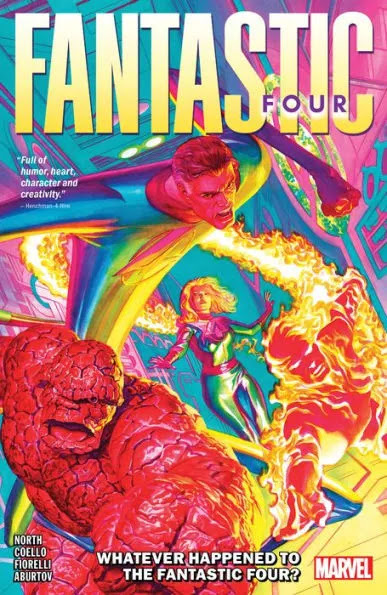
Fantastic Four By Ryan North Vol. 1: Whatever Happened to the Fantastic Four?
(Marvel Entertainment)
I consider writer Ryan North—who, in Marvel's current dunderheaded way of naming their graphic novel collections, sounds like he is a cartoonist entirely responsible for the creation of the books within—a genius in the field of comics-making and book-writing, and that's not a term I use lightly (Or, like, very often). If all he was responsible for was The Unbeatable Squirrel Girl, I think that might be true, that comic being the best Marvel comic I've ever read (Granted, I've only started reading Marvel comics around the turn of the millennium). But that's not the only book to his credit, and what the works of his I've read have all shared is wild imagination, clever premises and, at times, an almost insane-seeming dedication to a bit (See Dinosaur Comics).

That said, I haven't read his handful of non-Squirrel Girl  Marvel comics, which tended to either not be up my alley (The Darkhold, Power Pack) or seem like all around bad ideas in general (a new Secret Invasion). But the Fantastic Four? That seemed right up the writer of Squirrel Girl's alley, what with the book's traditional focus on science-adventure as much as superheroics, its propensity for humor, and its family narrative.

And Ryan North does do a good job on the book, it's just...well, it's a weird book, feeling more like a fill-in arc than the start of a brand-new era for the Fantastic Four. Which it technically is, given the new #1 it launched with (Of course these days, every time there's a new writer it's supposedly a brand-new era, as the books relaunch to accommodate the change in creative teams).  It's basically a series of fun, clever, done-in-one adventures in which members of the FF are faced with a creative conundrum they must solve, but it finds the team unmoored from a particular place—not only do they have no home or headquarters, they're not even in their hometown of New York for much of it—and unmoored from one another, as the first three issues feature the various members of the isolated from the rest of their family.

Each issue is, in itself, a well-written, perfectly competently-drawn comic book (more on North's artistic collaborators Iban Coello and Ivan Fiorelli in a bit), but adding them all together only gets us a series of unrelated vignettes, kinda sorta explained via flashback at one point (Although, at another, the now solo, secret-identity having Johnny Storm seems to allude to events in  an unrelated Marvel crossover event: "So, yeah, being a hero's 'illegal' in New York now.") They're each substantial reads, something North has always seemed to deliver on, but they feel weightless and ungrounded, like they belong in another book, rather than the first volume of a new run on FF.

So the first issue of a new volume of Fantastic Four, for example, only features one member of that team, The Thing. Ben Grimm and his now-wife Alicia are on the road for some reason, and they check into a motel in 1947, and, were that weird enough, they soon discover the next day that it's still the same day of 1947—Indeed, they've stumbled into a town trapped in time, whose citizens have been unknowingly reliving the same day of 1947 for decades now, with no hope of escape. Until our heroes come around, of course, and then it's up to Ben and Alicia to figure out what the heck is going on and break the cycle to save the town. 

See? Perfectly fun, clever Fantastic Four story. It just doesn't seem like a Fantastic Four #1 does it? I mean, it's missing 3/4ths of the team. The art on this issue, and for the first four of the series, is by Iban Coello, a talented artist whose work I first read in Tom Taylor's Dark Ages series. He's a perfectly accomplished in what we could call the Marvel house style (and, of course, he's drawn books all over their house over his career), but I'm of two minds about his appropriateness on North's FF

On the one hand, it's so different a book from what one might expect from previous volumes of the series, that one might wish for an artist whose style is that different, whose very presence communicates that this is something off-beat, something quirky, something that's not your average superhero comic (As North's Squirrel Girl collaborators, Erica Henderson and Derek Charm did). 

On the other, Coello's style's very adherence to a basic, even generic superhero book so ground this in the modern Marvel Universe that it makes the difference between it and other books sharper and more subversive. It doesn't advertise what it is, but, visually at least, is your standard Marvel book.

The rest of the book basically follows the set-up of the first issue. After a last page hint that the FF did something to make New Yorkers hate them, the second issue finds Reed and Sue also on the road, stopping at a diner, where they discover another weird town with another interesting dilemma in need of solving: The entire population of the town appears to be Doombots, although they are Doombots programmed to imitate regular American townsfolk going about their normal, human lives (unless they see a member of the FF, of course). 

Next we check in with the solo Johnny Storm, currently dying his hair, rocking a mustache, working  a day job and going by the name of "Jonathan Fairweather." He's still in New York, and isn't faced with a weird town trapped in a weird form of peril. Rather, he has to deal with an evil businessman making life miserable for the put-upon employees at Johnny's super-store.

It's not until the fourth issue that we get the reveal of what exactly the FF did to split them up and send them out of New York City—Reed comes up with a very Reed, cold but scientifically sound solution to an alien invasion that shifted a chunk of NYC real estate, including the Baxter Building, through time, so that it will arrive safe and sound back where it was originally...in one year's time (relative to those who weren't shifted; for those that were, it will seem instantaneous).

I'm surprised an editor didn't push for this to be the first issue. I don't know, maybe they did. Even it occurs in flashback though, as Ben and Alicia are trapped in a crazy circumstance, and the others must reunite to save them.

The final two issues, for which writer Ian Fiorelli comes on board to take the artist reigns from Coello (and their styles are similar enough that there's no real aesthetic turbulence, although the same issues I have with Coello's presence on the book are operative with Fiorelli's), sees a brief appearance by Salem's Seven who attack the reunited Fantastic Four in a novel way: With extradimensional bacteria, which first just threatens to painfully kill them, but, in the next issue, threatens the world.

And that's the first volume of the Fantastic Four by Ryan North: Clever, imaginative, occasionally funny and featuring the familiar characters in well-written and drawn appearances, but in a weird format, something that's so episodic it feels a bit like a TV show more than a modern comic book. 

I don't know. I enjoyed it enough to read volume two, but it's a pretty weird read. 

  
The He-Man Effect: How American Toymakers Sold You Your Childhood (First Second) "I am not a hater of these toy properties at all," Brian "Box" Brown writes in the afterword of his latest non-fiction comic. "I, like many of my generation, have been hypnotized by Star Wars, He-Man, Transformers and G.I. Joe...The nostalgia for these toys is a strong and powerful emotion for me. This is what led me to make this book, to do the research. I just don't think that feeling I have now was put there by accident. It was done by force."

The He-Man Effect is his book-length exploration of how nostalgia for various toy brands was put in his head, and the heads of his entire generation (myself included) by force. 

Brown, in his infographic-simple art-style, starts his tale at the beginning of human history, noting the power of human imagination and jumping ahead to Julius Caesar, who created "one of the first recorded pieces of military propaganda, though it had surely existed as a concept as long as war has." 

He then spends some time on propaganda as a means of persuasion, moving quickly through the twentieth century from World War I to the selling of cigarettes to Disney and Mickey Mouse mania to the subject of hand, the selling of toys to kids, particularly in the period from the late 1970s to the early 1990s, when the franchises he mentioned were at their height. 

It's a smart, rhetorically sound book and a fascinating history, one with clever echoes I had never thought of, like, for example, that Orson Welles, the man who made Citizen Kane, a film about nostalgia as symbolized by a particular childhood toy, would, later in his life, play the voice of a toy in the original Transformers movie, featuring a franchise that could very well be full of other children's Rosebuds.

I didn't know most of this, despite being on the receiving end of a lot of the marketing for these properties, which, indeed, defined my childhood, from the toys I played with to the shows I watched to the things I imagined. I also never thought of the power of nostalgia, and the fact that I still like things like Star Wars or Transformers owes a deal to nostalgia, to the way I associate them with the happy, carefree days of childhood, and the fact that the marketing forces of my youth are still acting on me today (I will here pause to note that I was a fan of He-Man before the cartoon; I remember reading, and in fact still have the little storybooks that came with the first wave of He-Man guys in which He-Man and Eternia had different origins than those presented in the cartoon, stories that predated the introduction of the Prince Adam identity. [And I have them in multiple formats; both the original books and comics which I saved, and the Dark Horse collection of the same]. Apparently I didn't need interest in He-Man "burned" into my "little pea brain"; the toy sold itself to me...well, it sold itself to my grandmother and my parents, who bought me my first Masters of the Universe toys for one magical Christmas in the '80s...and how much is tied up in that! My interest in the franchise, sure, but it was also my first, non-newspaper introduction to comics, and I still think of my late grandmother when I think of He-Man...)

(What was I talking about...?)

As wonderful a read as it is, to relive my childhood while learning about the not-exactly-benign forces that shaped the world of my imagination, there's a great pleasure in seeing Brown's simplified style devoted to drawing the toys themselves, as well as famous scenes from the cartoons, from movies and things like the first Star Wars novels or Noelle Stevenson's She-Ra. This book is a pleasure not just to read, but also to look at.

I can't possibly recommend it enough, especially if you were a child in the 1980s. 


Komi Can't Communicate Vol 26 (Viz Comics) I can't tell you how relieved I am that this book didn't end when Tadano and Komi finally got together. Now I'm wondering if it won't instead end when they graduate high school, and/or Komi meets her goal of making 100 friends...and perhaps those two things will happen simultaneously. As it turns out, there is still plenty of room for awkward miscommunication problems involving the pair and those around them that has nothing to do with the unspoken of romantic tension that existed between them for so many volumes. Here, for example, Tadano invites Komi over and introduces her to his mom and sister as his girlfriend, and they are confused; why is Komi dating Tadano, who they thought liked boys...? 


REVEIWED:

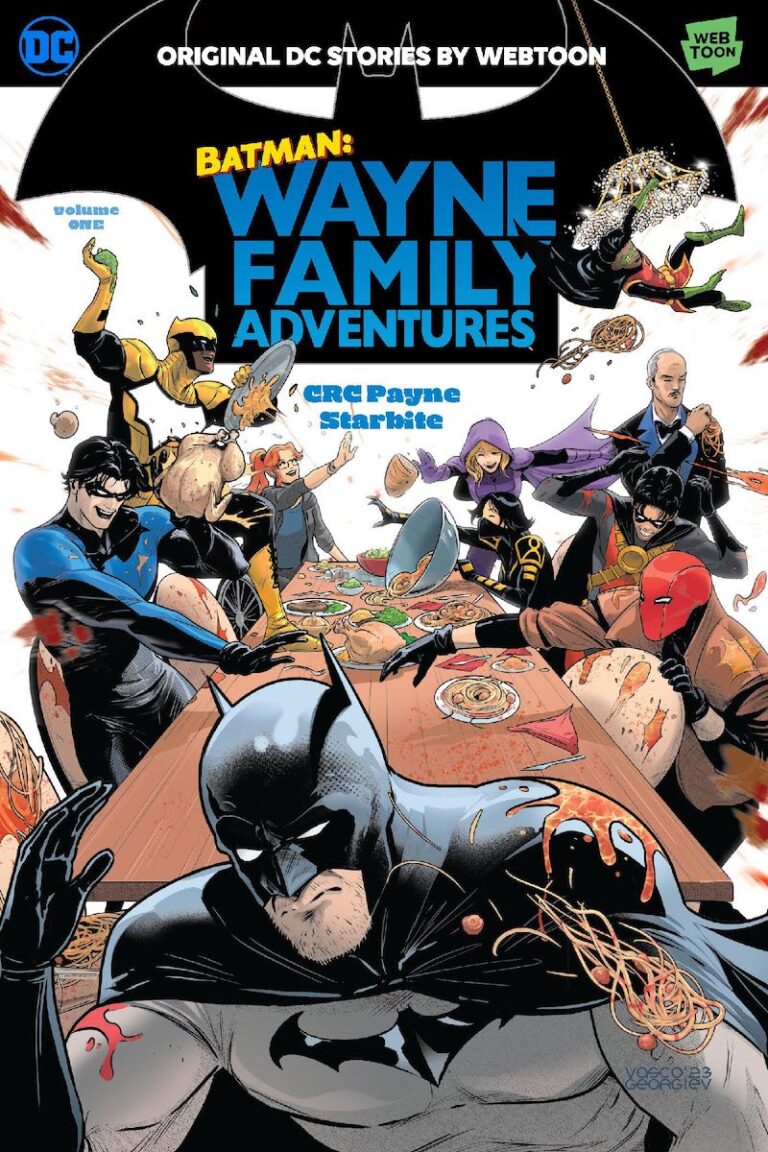
Batman: Wayne Family Adventures Vol. 1 (DC Comics) So it turns out that this is what I wanted from the pages of Batgirls: Cassandra Cain, Stephanie Brown and Barbara Gordon hanging out with one another and the extended Bat-Family. In fact, that's the entire focus of this comic, which began as a Web Toon series of online comic strips. Despite being right up my alley, I didn't dig the experience of reading it online. Now it's been collected into book form, the individual strips edited to fit the format, and done so well enough that it seems like the strip was always meant to be read in comic book, rather than online. This is an ideal comic for fans of the extended Bat-Family, and a template for what more Batman comics could be, rather than a monthly beat 'em up of the same stable of recurring villains. More here


Paul Bunyan: The Invention of an American Legend (Toon Books) Cartoonist Noah Van Sciver retells the story of Paul Bunyan while providing necessary, rarely-discussed context in a fictionalized story of a lumber company ad man trying to entertain fellow passengers on a stalled train. Further context is provided in an introduction and generous back-matter, all coming from indigenous voices, which are heretofore always missing from the story of the manufactured myths of America's most famous lumberjack. More here


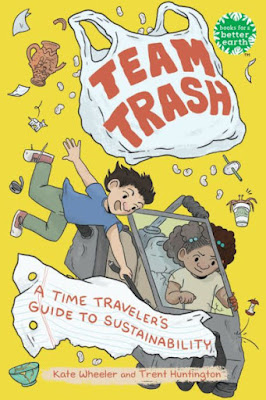
Team Trash: A Time Traveler's Guide To Sustainability (Holiday House) This is a message book, meant to teach young readers about recycling, its history, its present and its future. Despite its rather naked advocacy and educational nature, the premise is entertaining enough that it never seems preachy. More here


*I guess Shredder only actually appeared once; The Shredder who appeared in Leonardo #1 and "Return to New York" was one made of magic ninja worms, and thus not the "real" Shredder. 

Thursday, August 03, 2023

A Month of Wednesdays: July 2023

So this is weird. This is the first month since I've been writing this blog that I bought absolutely zero new comics in a single calendar month. None. I've switched to graphic novels for my reading, and have been consciously trying to buy fewer and fewer books, as the space in my apartment reaches its maximum ability to accommodate new books, but I was still surprised to find zero new comics come in this month. That kind of defeats the purpose of this column, in which books I deemed exciting or interesting enough to buy instead of borrow from the library are highlighted by their place in the Bought, Borrowed or Reviewed hierarchy, and, if it keeps up, I may need to rethink the format of my now monthly-ish posts.

In the mean time, here's the (fewer than ever!) books I read this month....not counting Batgirls Vol. 1, which I gave its own post.


BORROWED:

Komi Can't Communicate Vol. 25 (Viz Media) Komi, Tadano and Najimi are starting their third and final year of high school, which means Komi's goal of making 100 friends is now on a deadline. The trio are in a new class, one in which almost no one they know has joined them in. That gives Komi the opportunity to make a whole new batch of friends, of course, but this group all has their own communication disorders of various kinds, and none seem eager to sign Komi's notebook.

The volume is dominated by a weird beginning-of-the-year ceremony, an every year vs. every year battle royale performed with Nerf, er, "Enough" guns. In the midst of the battle, Komi has an argument with one of her classmates, whose cynical and adverse to doing things in groups or following others. 

With lots of new characters, and a weird, standalone storyline, this actually feels like a good jumping-on point in a long-running narrative, although with manga, there's no real need for jumping-on points, as that's what the first volume is. Still, Komi remains a really fun regular read. 


Teenage Mutant Ninja Turtles: Armageddon Game—Opening Moves (IDW Publishing) I had been planning on completely ignoring IDW's TMNT event story "Armageddon Game," as I've ignored the majority of the publisher's expansive "Volume 5" of the TMNT (at least the parts not written and/or drawn by EDILW favorite Sophie Campbell). I didn't get much of a choice though, as the events intruded on Campbell's TMNT ongoing in its latest collection (Game Changers, reviewed here), which included the Tom Waltz-written, Campbell-drawn TMNT FCBD 2022: The Armageddon Game, a carefully created remix of Kevin Eastman and Peter Laird's original 1984 TMNT #1.  That so intrigued me that it actually interested me in the event series, as big and unwieldly as it seems, and this seems to be the start of it. 

A Marvel-style trade collection presumably compiled specifically for those interested in the crossover who haven't been following IDW's massive TMNT publishing slate since the beginning (I only lasted nine volumes of the series before wandering away, picking up the occasional crossover or miniseries only until Campbell took the reins with the re-branded "Reborn" run). The 160-page tome includes not just the two-issue "Armageddon Game" prequel series Opening Moves, but also the 2020 and 2021 annuals, all written by Tom Waltz,  as well as issues #84 or the regular TMNT series by Waltz,  Eastman and Bobby Curnow, and something called "Kingdom of Rats Prelude," by Curnow. Six different artists are responsible for the contents: Pablo Tunica, Dave Wachter, Adam Gorham, Casey Maloney and Maria Keane and Fero Pe.

The throughline is the Rat King, who, in IDW's iteration, is a god of mischief, part of a pantheon of gods that includes a version of the old Archie Comics character Jagwar and other, original creations. The Turtles have apparently had dealings with all of these before, with the Rat King being a particularly frequent antagonist. 

The stories here establish the character through his interactions with the Turtles, The Shredder and his fellow pantheon members. There's a battle with the Turtles, which happens simultaneously on the physical and astral planes, an attempt to recruit a reformed Shredder, a visit to Krang, who is somehow stuck in Leatherhead's abdomen and in semi-control of the character, followed by visits to many of his siblings, trying to interest them in the resumption of the titular Armageddon Game, some sort of game of gods involving real  people (and/or mutants and/or aliens) as pawns, the rules of which aren't laid out with the same attention as the players and potential players.

He ends up recruiting from the Turtles' villain pool: Evil scientist-turned-mayor Baxter Stockman, interdimensional warlord Krang and alien businesswoman Null. Meanwhile, the Shredder, who is in a relationship with the Rat King's sister Kitsune, is warned of the impending game, and he and Kitsune assume astral form to investigate the new players in astral form, revealing the same hodgepodge of pre-extant characters from various continuities and original concepts that was a hallmark of Waltz's long run on the series (Triceratons from Mirage, the Neutrinos from the original cartoon series, Cherubae, Cudley and the Turnstone from the Archie comics). 

As a read, it definitely achieved its goals. As a relative novice, I now know the Rat King, his pantheon and some of their interests in (or lack thereof) the Turtles and other players in IDW's Turtle universe. I know about the existence of the Game, and I know the identities and something of the histories of the new players, and their various enemies beyond just the Turtles. 

I can't say it was terribly engaging though. Waltz in particular writes the Rat King as an interesting character, but there was a degree to which volume felt a bit like homework, like studying comics in order to enjoy an upcoming comic, which, I guess it is. The Turtles are mostly absent from the proceedings,  their most heavy involvement being the single issue from the TMNT series that is collected, and comes quite early in the proceedings.

The visuals match the quality of the writing. The art is all serviceable, but nothing really knocked my socks off, and it was most interesting to see how characters and concepts I was familiar with from various earlier iterations reinterpreted my new artists for a new universe of stories. This likely betrays my own prejudices about TMNT stories, but the moments of the book that most interested me were Eastman's variant covers for the proceedings. It was interesting—read weird—seeing things like Eastman's style, so familiar from the earlier, grittier, alternative comics version of the Turtles, applied to characters from a later, kid-friendly iteration like Cherubae. 

This dampened my excitement for Armageddon Game a bit, elevated though it was by the last volume of Campbell and company's TMNT, but at least now I feel thoroughly prepared to read it. This was a bit of a slog, but then, it was practically designed to be such, a semi-necessary cram session of a trade paperback. 


REVIEWED: 

Fann Club: Batman Squad (DC Comics) Prolific kids' book creator Jim Benton (Dear Dumb Diary, Franny K. Stein, Cat Wad) produced a graphic novel kinda sorta about Batman, or at least Batman through the eyes of Batman mega-fan Ernest Fann, who starts a Batman fan club with those closest to him (his best friend, his babysitter, his dog) in order to bring justice to his world. It's really funny; trust me. More here

Wednesday, July 12, 2023

On Batgirls Vol. 1: One Way or Another

Well this certainly sounded like a slam-dunk of an idea for a Batman-adjacent series. 

Batgirl Cassandra Cain starred in a solo series that lasted 73 issues between 2000 and 2006; in it, original, retired Batgirl Barbara Gordon served as her mentor. That was later followed by a new Batgirl series in which Stephanie Brown, aka Spoiler, took up the mantle from her friend Cassandra (this required some unconvincing hand-waving to get the costume off of Cass and forcing her into story limbo for awhile). In that volume of Batgirl, which lasted 24 issues between 2009 and 2011, original, retired Batgirl Barbara Gordon once again served as the new Batgirl's mentor. 

Then, when "The New 52" happened, Gordon returned to the Batgirl role for awhile, starring in a series that lasted 53 issues between 2011 and 2016, and then immediately relaunching for a new volume that lasted another 50 issues, into 2021. By that time, both Cassandra and Stephanie were both reintroduced into the Batman universe, with Cassandra resuming her Batgirl codename and costume after going by "Orphan" for a while. 

What to do with all these Batgirls? Why not put them all together in a new series, the premise of which would be the obvious one, of the older, original Batgirl Barbara—who had been gradually drifting back towards her pre-New 52 status quo as computer expert and information broker Oracle—serving as the mentor of the two teenage vigilantes? 

That was the idea behind the new series Batgirls, which launched in 2022 after the team-up concept was tried out in some back-up stories in the pages of Batman, during writer James Tynion IV's big "Fear State" crossover storyline. As I said, it sounds like a good one, and given the relative success of the three heroines in solo series throughout the 21st century, putting them all on a Birds of Prey-like team together seemed like an obvious move, one that would bring with it three different fandoms.

Oddly, it only lasted 19 issues, fewer than any Batgirl's solo series to date. 

What went wrong? I don't know, beyond the obvious fact that it's pretty hard to sell an ongoing comic book series these days.

I was a faithful reader of the original Batgirl series, a big fan of the Cassandra Cain iteration of the character, and an advocate for this very premise for a book, and I wasn't reading it, for a variety of reasons (The New 52 essentially having broken the contract between me as a reader and the DCU as an ongoing setting, comics costing more than $3 a pop now, my not reading enough titles to justify journeying to a comic shop each Wednesday any more, etc). 

I can't speak for the rest of the potential Batgirls readership, though.

The title had officially been cancelled by the time I got around to reading the first volume of the series, Batgirls Vol. 1: One Way or Another, by the creative team of writers Becky Cloonan and Michael W. Conrad and artist Jorge Corona. Having finally done so, I suppose I can offer some guesses, the main one of which the title just wasn't very good. 

Extremely plot-heavy with little attention to character, characterization or ideas, it wasn't really a book about anything more than our heroes fighting some villains, the sort of comic of which there is and has always been dozens and dozens of similar books, many of which offer more than just fight scenes. 

(I wonder to what extent the series' launch being tied to "Fear State" might have been a factor. That was a fine storyline by Tynion and company, but it's credibility-straining villains weren't so great as to justify much in the way of tie-ins or the involvement of characters from throughout the extended Bat Family. That said, Bat events have long been used to introduced new Batman-adjacent titles, including the original Batgirl series, which came in the wake of "No Man's Land".)

The Magistrate from "Fear State" are hunting Batgirl Cassandra Cain and Spoiler Stephanie Brown, the latter of whom has apparently recently altered her costume so that he has a purple bat on her chest and is also going by "Batgirl" now (Should Stephanie have resumed wearing her own Batgirl costume if she was resuming the Batgirl name...? I don't know; I personally prefer her original Spoiler costume to this more ninja-like, detail-heavy version.). The Magistrate are presumably doing so because of doctored footage showing a Batgirl killing someone that was released to them.

This leads to The Magistrate, which you presumably already know all about because you were reading Batman—remember, the series started in the pages of Batman as back-ups, which, again, may or may not have been a factor in the series' failure to catch ontargeting sometimes-Batgirl, sometimes-Oracle Barbara Gordon's clocktower headquarters. At the same time, an anti-Oracle of sorts, known as Seer, has targeted Babs, corrupting her information network.

This leads to the two teens having to lie low for a few days, while Barbara sets-up a new status-quo for them and, of course, the new series: The three of them move into a loft together in a new neighborhood, The Hill, and become something similar to a Batgirl-only version of the Birds of Prey, with Stephanie and Cass going out and doing the leg-work of Batgirling, while Babs stays behind-the-scenes, doing the Oracle-ing.

They're immediately set upon by a series of villains, none of whom, I'm afraid, are terribly engaging, which is sort of unfortunate, as Cloonan and Conrad focus on these and their conflict above characterization of the girls and their relationships with one another. (Where were Cass and Steph living before they moved in with Babs? What were their previous status quos? I have no idea; the book offers no clues). 

There's the aforementioned Seer, who can hack his or her way into Oracle's networks and seems to have an unexplained grudge against Babs and the Batgirls. There's Tutor, a prolific spray-paint artist with an anti-society bent and some sort of mind-control abilities that turn victims into mindless zombies that do his bidding. There's Tutor's patron, the latest villain to go by the name Spellbinder (The third, by my count). And there's The Saints, former, radicalized members of The Magistrate who resemble cartoonier versions of Peacekeeper-01 (you did read "Fear State", right?) and are each named after a different saint: Tarsus, Valentine and Assisi. And then there's the Hill Ripper, an unknown, unseen serial killer who seems to be stalking the girls' new turf, though they don't come into direct contact with him or her this volume, despite Steph's certainty that it is a neighbor, based on some Rear Window-esque suspicions. 

If that seems like a lot of moving pieces for the first six issues of a new series, it's mostly just Tutor and Spellbinder who are involved. Seer makes an attack and some taunts but is mainly a background player until they're surprise appearance at the cliff-hanging ending, and the Saints, seemingly manipulated by Seer, attack a couple of times, but they aren't the focus of the storyline either. 

It's all...fine, but it's also light on substance, and what I'd expect from the series, with, as I said, no real focus on the characters or their relationships with one another. 

The art by Corona is pretty great, and it's hard to imagine fans being turned off by it. His Cass highlights her visual characteristics, of being something of a creepy cross between Batman and Spider-Man, in a tight, little, slightly feminine package (There's one great splash panel, near the climax, where her arms blend into her cape, giving the appearance of a monstrous bat). The other two Batgirls are less visually interesting in conception, but nevertheless well-rendered, as are all three characters when they are out of costume. 

I'm curious about what went wrong with the tile, exactly, and interested enough in the characters  to follow the rest of the series in trade, but, with only the first third to go on, I would guess the low-calorie approach to comic book storytelling didn't retain enough eyeballs on the book to make it as successful as any of the girls' solo outings to date. 

Tuesday, July 04, 2023

A Month of Wednesday: June 2023

BOUGHT:  

Teenage Mutant Ninja Turtles, Reborn, Vol. 6—Game Changers (IDW Publishing) The roughest going volume of the Sophie Campbell-penned "Reborn" era of the title, this felt a lot like a Big Two super-comic tied to an event that one isn't reading, and is only dimly aware of—the feeling of interruption of an ongoing plot, the suspicion that something important is going on somewhere else that is impacting the story, the dependency on deep lore that pre-dates the run itself...it was a familiar, and not totally welcome feeling.

That said, it's still pretty good comics, even if I don't know what exactly "The Armageddon Game" is (this trade paperback is labeled "Road To The Armageddon Game") or why exactly former Shredder Oruku Saki is a helpful ghost (to be fair, he's appeared in this form throughout the "Reborn" run, and I've just kinda rolled with it, as it hasn't seemed to terribly important to the goings-on thus far). 

This volume opens with a pretty great done-in-one by cartoonist Juni Ba, who both writes and draws it. It's the sort of evergreen story that seems like it could have been an inventory one, or appeared at any point in most any continuity tied to any incarnation of the TMNT...even if it would have had to been set in "the future" of some of those continuities. 

The four original turtles, "wearing old gear" (i.e. not wearing clothes, as they've long since taken to doing), are going on a mission that narrator Leonardo doesn't feel terribly confident about, and, in fact, they all seem to be out of rhythm with one another, as evidenced by their bumping into one another while rooftop-hopping on their way to their destination.

This proves to be a somewhat simple mission, a visit to their old, original sewer home, where they are intent on leaving a flower and a photo of themselves with their late father, Splinter. On the way, however, they encounter a "leech spirit", that, according to Donatello, "haunts cemeteries and tracks the grief and despair of those who lost someone to war." It's a powerful monster, and Donatello theorizes that the mutagen bomb that made Mutant Town in the first place must have affected one of the slugs that follow the spirit, and the spirit possessed the slug. 

To complete their mysterious mission, which I've already spoiled, the team will have to get by the spirit, which will mean letting go of all the craziness that has driven them apart over the last several dozen issues of their series and get back to their roots (there have been over 130 issues of the main series so far, making this the longest-running of the various TMNT narratives by far, once all the miniseries and specials are factored in). The precise way they do this—relying on red paint to resume their matching, red bandanas of their origins, as well as sharing weapons—is a little silly, but cool-looking, and immediately effective as a visual story-telling tactic. 

According to the fine print, this volume contains two issues of the main series, plus a 2022 annual and last year's Free Comic Book Day offering; the standalone nature of this story, which seems like a Tales Of The... tale as much as a standard TMNT issue, makes it seems like it could be either of the latter, but I'm guessing it's the annual (Update: Comics.org tells me I'm right).

Ba is a great artist, and has a nice, simple, stripped-down version of the characters; the depiction of action, through kinetic angles and shaky action line-defined poses, is devastatingly effective. The annual is a nice argument for IDW having a sister Tales Of The... title, giving artists like Ba an opportunity to tell Turtles story, regardless of what's going on in the main title.  

From there, we pick up with the Splinter Clan in conflict, over whether or not they should trust their one-time mortal enemy to help train them in preparation for some coming conflict (The "Armageddon Game," I presume). The five turtles all agree, and go off into the woods to train with the former Shredder, who proposes to teach them all secret, advanced ninja techniques, techniques that brush up against black magic, and thus leads to a difficult cost in terms of weird, nightmare visions for all of them...except Leonardo, who must meet, fight and master his own, dark self from earlier in the series. 

These issues are written by Campbell, and drawn by Pablo Tunica; I wasn't as fond of the art in this passage of the collection, as it seemed a little too realistic for my personal tastes (coming after the Ba-drawn section, it looked a little like a "live-action" version of the Turtles, versus a comic book or cartoon version, if that makes sense).

Finally, there's a 10-page story that I assume came from the FCBD special, as it features something weird going-on, and effectively teases the answer to that weirdness with a narration box, "Find out answers to this and much more soon in... Teenage Mutant Ninja Turtles The Armageddon Game!" While I'd been assuming the storyline was something of an annoyance or inconvenience, a distraction to Campbell's Mutant Town story arc, I was sold on it by these ten pages, which tap into the dynamite-potent images and storytelling of Teenage Mutant Ninja Turtles #1....not the 2011 #1 that kicked off IDW's successful series, but the 198 #1 from Mirage that introduced the characters in the first place.

Written by long-time TMNT writer (and current story consultant) Tom Waltz and faithfully, exquisitely drawn by Sophie Campbell, it is essentially a cover story of Kevin Eastman and Peter Laird's original Turtles tale, or, at least, the fight against the Purple Dragons gang that introduced the characters. Waltz borrows snatches of narration and dialogue, and Campbell recreates the lay-outs and art within each panel to re-tell the story (these panels are all burned into my memory from reading, re-reading and re-re-re-re-reading the collection of the first dozen issues of the Mirage series I pored over in the early '90s).

There are some slight differences, drawn into sharper relief by how similar the compositions and poses are. First, rather than their regular masks—all red, back then, but appearing in black and white—the four turtles are here all wearing white masks that cover their noses, mouths and throats, but leave their yellow, pupil-less, triangle eyes exposed. Secondly, their weapons are all scrambled, so that they all have a different weapon than the one they are usually associated with (Campbell draws the same characters in the same poses, but their weapons are different; this is most evident in her recreation of the iconic cover). Finally, rather than fighting a generic comic book street gang, they are heer fighting soldiers of the "Earth Protection Force," and, when they disappear into a sewer to the words "...into the night," there is a long-shot of the city, and it features a huge wall that looks foreign to New York.

It is here, on the tenth page, that we see Venus, the new kinda-sorta turtle introduced in the previous collection of the series, asking aloud, "...what the hell is going on?!", only to be answered by a narration box teasing "The Armageddon Game."

Like I said, I wasn't exactly looking forward to that story, but after this teaser by Waltz and Campbell, I'm downright excited. 

As ever, the collection is full of the book's many covers, showing the Kevin Eastman-drawn variants and main cover for each issue as it appears in the volume (Eastman does a particularly trippy one for TMNT #131), and then a mini-gallery at the end. The one I was most intrigued by, and happiest to see, was a double-page spread by Jim Lawson and Steve Lavigne, two old Mirage hands who still obviously have a lot to offer. It depicts the five turtles fooling around atop a church steeple on a city street. I wish IDW could find a project for Lawson's talents, preferably of the letting-him-do-whatever-he-wants variety (Here again a Tales Of The TMNT anthology title would be welcome). 


BORROWED: 

Spider-Man: Fake Red (Viz Media) High-schooler Yu feels about as different from New York City's preeminent superhero and social media darling Spider-Man as he can be. He's falling behind at his elite school, he's not making any friends and lately he's taken to skipping classes. Worse, when he sees a classmate being bullied by others, he thinks of rushing in to help ("What would Spidey do?" he asks himself), but his courage fails him, and he instead stands by while the kid takes a beating in front of him.

The only time Yu feels at all like his hero is when he's on the climbing wall at his local gym, which is where he goes to escape his day-to-day travails (a better-than-average climber, he's still not as good as the gym's champion, his classmate and crush, Emma Pearson). 

Yu's life takes a dramatic and unexpected turn when he finds a Spider-Man suit in the garbage in an alley, Spider-Man having apparently discarded it during an Amazing Spider-Man #50, "Spider Man No More!" moment (an extended flashback sequence in which Spider-Man tries to get to the theater in time to see MJ's performance, but keeps getting side-tracked by crime-fighting, including an extended battle with The Scorpion, explains why he decided to trash his Spider-Man career...at least temporarily). Taking it home and trying it on, Yu still might not be all that much like Spider-Man, he still might not feel like Spidey, but he at least looks the part.

"Guess I'll just go about my day and hope I miraculously bump into Spidey," Yu thinks, hoping to return the suit to its owner, while realizing that's pretty much impossible; how would he even recognize the real Spidey if he's not wearing his familiar suit? (This is actually a plot-point that will come up later). 

When he tries the costume on again on a rooftop, he sees smoke, and people start pointing and telling him to hurry. A building is on fire, and a small child is trapped on the third floor. It's up to this counterfeit Spider-Man to save him; luckily Yu's not a bad climber. 

Thus begins Yu's career as the new Spider-Man. He lacks super-strength and the other spider-powers, and, though he has the web-shooters, he can't exactly web-sling; there's apparently a lot more to it than simply pointing one's wrist and pushing the button. But now that he has the suit, he feels responsible to help people...especially when it becomes clear that the real Spider-Man is MIA, and not simply because he's missing his laundry (Manga-ka Yusuke Osawa shows us scenes of a worried MJ, who has been unable to contact Peter for days, and an unseen villain watching the real Peter wrestle with the Venom symbiote in the sewers, trying not to succumb to its monstrous influence).

After his second outting as Spider-Man, when he saves Emma from bank-robbers who kidnap her when they're taking the car she's in, the young woman discovers Yu's secret, or at least thinks she does: Yu is Spider-Man! Now he's got to keep the lie going, pretending to have a secret identity that's not really even his, or risk losing the new attention and friendship of his crush...and his first real friend at school.

This means engaging an actual, honest-to-God supervillain in the form of Screwball, and answering to Silk, who comes calling when she too can't find the real Spider-Man, and wants to know the imposter's story. 

Everything comes to a head when Silk faces off against the Venom-possessed Peter Parker, and Yu makes the scene in the Spider-Man costume, reminding Peter of who he really is and helping him get the symbiote under control, and into a new, cool-looking Spider-Man costume for Parker...just in time for the villain behind the plot to turn the real Spidey into a bad-guy arrives to challenge them both.

By giving us a "new" Spider-Man, Osawa manages to tell a Spider-Man story that feels both classic and completely fresh at the same time, meditating on the "with great power comes great responsibility" theme. Even though Yu lacks great power, he's obviously got an opportunity, and he uses it to do good, the costume giving him the push he needs to do the good he wanted to but lacked the courage to do earlier when he saw a classmate being bullied (echoing Spider-Man's own origin, which goes unrepeated in this volume, when he let a thief go because he thought it wasn't his problem). 

In addition to a well-told Spider-Man tale that feels both faithful to the original while also being original, Osawa gives a fresh coat of paint to a bunch of Spider-Man villains, including those already mentioned (Scorpion's costume becoming much more of a technological-feeling one), as well as The Sinister Six, who appear for the climax: Mysterio, Kraven, Electro, Doctor Octopus, The Vulture and The Sandman. Some of their updates are actually pretty radical, especially Mysterio's scary new look. Spidey himself is updated slightly, with an original costume (plus an updated all-black costume at the climax, and another new costume in the final pages). 

It's not a Peter Parker story—at least, not primarily and not all the way through—but it is a great Spider-Man story, one perfectly suited to those interested in the character but leery of the official Marvel version with all its decades worth of continuity baggage. I'd highly recommend it to the casual Spider-Man fan, or a reader who wants to read a Spider-Man comic but doesn't know where to start.


Zom-100: Bucket List of the Dead Vol. 10 (Viz) Haro Aso and Kotaro Takata certainly have a penchant for dramatic cliffhangers, with last volume's ending in which Akira's crew dare to play the 50/50 game of can or zombie, where you either double your amount of canned goods fall into a pit full of zombies, the most recent example (The earlier one? When the evil version of Akira's crew put him in the position of having to sacrifice himself to zombies in order to save his father).  The resolution doesn't always live up to the promised drama, of course, but then, wiggling out of a seemingly-impossible scenario is the easiest way of dealing with a big cliffhanger. 

Here, new cast-member and master of gambling Takeru takes the challenge, betting on Akira's remaining empathy to save him...and then breaking the system with such a huge bet and huge winnings that it becomes impossible not to win, as long as he keeps betting. 

That concludes the "Millionaire of The Dead" arc that began last volume, and once again our heroes have found an okay place to permanently settle and ride out the apocalypse with a relatively nice style of life, but there's their promise to look for a cure—and the premise of the series—to think of, so they take off again, now with canned good millionaire Takeru as part of the team.

The volume contains two more arcs. There the two-part "Geisha of the Dead," where the boys patronize the surviving geisha of Kyoto, who have moved their business to the upper-floors of the buildings, accessible to patrons by ladder (and not to zombies at all).  And the "Pilgrimage of the Dead, wherein Beatrix convinces the others to take on a traditional pilgrimage of 88 temples. 

Neither gets them any closer to finding a cure, of curse, but they do manage to scratch a few more items off of their bucket list which is, of course, the point of the series, and their post-apocalyptic adventures.


REVIEWED: 

Spider-Man: Animals Assemble! (Amulet Books) Cartoonist Mike Maihack takes on the Marvel Universe in this delightful little tale of Spider-Man pet-sitting for his fellow superheroes—seemingly all of his fellow superheroes—as they investigate a super-villain threat. Predictably, the art is great, and the story is a fun one, geared towards young readers but perfectly satisfying for grown-ups too. More here


Squire & Knight (First Second) Scott Chantler's fantasy story about a bookish squire and a boisterous knight facing a rather standard knightly deed—dealing with a dragon—is full of surprises. It's no surprise, given i's creator, that it's great, though. More here


Tegan and Sara: Junior High (Farrar, Straus and Giroux) The Canadian pop duo (and, incidentally, one of my favorite bands) make their comics-writing debut in this wonderful collaboration with prolific cartoonist Tillie Walden. A rather fictionalized coming-of-age memoir that moves their childhood from the early '90s up into the present day and moves a few events around to make for a more narratively satisfying story, Junior High is a sharp, insightful and awfully dramatic look at maybe the hardest year of any kid's life, seventh grade. More here