Thursday, August 03, 2023

A Month of Wednesdays: July 2023

So this is weird. This is the first month since I've been writing this blog that I bought absolutely zero new comics in a single calendar month. None. I've switched to graphic novels for my reading, and have been consciously trying to buy fewer and fewer books, as the space in my apartment reaches its maximum ability to accommodate new books, but I was still surprised to find zero new comics come in this month. That kind of defeats the purpose of this column, in which books I deemed exciting or interesting enough to buy instead of borrow from the library are highlighted by their place in the Bought, Borrowed or Reviewed hierarchy, and, if it keeps up, I may need to rethink the format of my now monthly-ish posts.

In the mean time, here's the (fewer than ever!) books I read this month....not counting Batgirls Vol. 1, which I gave its own post.


BORROWED:

Komi Can't Communicate Vol. 25 (Viz Media) Komi, Tadano and Najimi are starting their third and final year of high school, which means Komi's goal of making 100 friends is now on a deadline. The trio are in a new class, one in which almost no one they know has joined them in. That gives Komi the opportunity to make a whole new batch of friends, of course, but this group all has their own communication disorders of various kinds, and none seem eager to sign Komi's notebook.

The volume is dominated by a weird beginning-of-the-year ceremony, an every year vs. every year battle royale performed with Nerf, er, "Enough" guns. In the midst of the battle, Komi has an argument with one of her classmates, whose cynical and adverse to doing things in groups or following others. 

With lots of new characters, and a weird, standalone storyline, this actually feels like a good jumping-on point in a long-running narrative, although with manga, there's no real need for jumping-on points, as that's what the first volume is. Still, Komi remains a really fun regular read. 


Teenage Mutant Ninja Turtles: Armageddon Game—Opening Moves (IDW Publishing) I had been planning on completely ignoring IDW's TMNT event story "Armageddon Game," as I've ignored the majority of the publisher's expansive "Volume 5" of the TMNT (at least the parts not written and/or drawn by EDILW favorite Sophie Campbell). I didn't get much of a choice though, as the events intruded on Campbell's TMNT ongoing in its latest collection (Game Changers, reviewed here), which included the Tom Waltz-written, Campbell-drawn TMNT FCBD 2022: The Armageddon Game, a carefully created remix of Kevin Eastman and Peter Laird's original 1984 TMNT #1.  That so intrigued me that it actually interested me in the event series, as big and unwieldly as it seems, and this seems to be the start of it. 

A Marvel-style trade collection presumably compiled specifically for those interested in the crossover who haven't been following IDW's massive TMNT publishing slate since the beginning (I only lasted nine volumes of the series before wandering away, picking up the occasional crossover or miniseries only until Campbell took the reins with the re-branded "Reborn" run). The 160-page tome includes not just the two-issue "Armageddon Game" prequel series Opening Moves, but also the 2020 and 2021 annuals, all written by Tom Waltz,  as well as issues #84 or the regular TMNT series by Waltz,  Eastman and Bobby Curnow, and something called "Kingdom of Rats Prelude," by Curnow. Six different artists are responsible for the contents: Pablo Tunica, Dave Wachter, Adam Gorham, Casey Maloney and Maria Keane and Fero Pe.

The throughline is the Rat King, who, in IDW's iteration, is a god of mischief, part of a pantheon of gods that includes a version of the old Archie Comics character Jagwar and other, original creations. The Turtles have apparently had dealings with all of these before, with the Rat King being a particularly frequent antagonist. 

The stories here establish the character through his interactions with the Turtles, The Shredder and his fellow pantheon members. There's a battle with the Turtles, which happens simultaneously on the physical and astral planes, an attempt to recruit a reformed Shredder, a visit to Krang, who is somehow stuck in Leatherhead's abdomen and in semi-control of the character, followed by visits to many of his siblings, trying to interest them in the resumption of the titular Armageddon Game, some sort of game of gods involving real  people (and/or mutants and/or aliens) as pawns, the rules of which aren't laid out with the same attention as the players and potential players.

He ends up recruiting from the Turtles' villain pool: Evil scientist-turned-mayor Baxter Stockman, interdimensional warlord Krang and alien businesswoman Null. Meanwhile, the Shredder, who is in a relationship with the Rat King's sister Kitsune, is warned of the impending game, and he and Kitsune assume astral form to investigate the new players in astral form, revealing the same hodgepodge of pre-extant characters from various continuities and original concepts that was a hallmark of Waltz's long run on the series (Triceratons from Mirage, the Neutrinos from the original cartoon series, Cherubae, Cudley and the Turnstone from the Archie comics). 

As a read, it definitely achieved its goals. As a relative novice, I now know the Rat King, his pantheon and some of their interests in (or lack thereof) the Turtles and other players in IDW's Turtle universe. I know about the existence of the Game, and I know the identities and something of the histories of the new players, and their various enemies beyond just the Turtles. 

I can't say it was terribly engaging though. Waltz in particular writes the Rat King as an interesting character, but there was a degree to which volume felt a bit like homework, like studying comics in order to enjoy an upcoming comic, which, I guess it is. The Turtles are mostly absent from the proceedings,  their most heavy involvement being the single issue from the TMNT series that is collected, and comes quite early in the proceedings.

The visuals match the quality of the writing. The art is all serviceable, but nothing really knocked my socks off, and it was most interesting to see how characters and concepts I was familiar with from various earlier iterations reinterpreted my new artists for a new universe of stories. This likely betrays my own prejudices about TMNT stories, but the moments of the book that most interested me were Eastman's variant covers for the proceedings. It was interesting—read weird—seeing things like Eastman's style, so familiar from the earlier, grittier, alternative comics version of the Turtles, applied to characters from a later, kid-friendly iteration like Cherubae. 

This dampened my excitement for Armageddon Game a bit, elevated though it was by the last volume of Campbell and company's TMNT, but at least now I feel thoroughly prepared to read it. This was a bit of a slog, but then, it was practically designed to be such, a semi-necessary cram session of a trade paperback. 


REVIEWED: 

Fann Club: Batman Squad (DC Comics) Prolific kids' book creator Jim Benton (Dear Dumb Diary, Franny K. Stein, Cat Wad) produced a graphic novel kinda sorta about Batman, or at least Batman through the eyes of Batman mega-fan Ernest Fann, who starts a Batman fan club with those closest to him (his best friend, his babysitter, his dog) in order to bring justice to his world. It's really funny; trust me. More here

Wednesday, July 12, 2023

On Batgirls Vol. 1: One Way or Another

Well this certainly sounded like a slam-dunk of an idea for a Batman-adjacent series. 

Batgirl Cassandra Cain starred in a solo series that lasted 73 issues between 2000 and 2006; in it, original, retired Batgirl Barbara Gordon served as her mentor. That was later followed by a new Batgirl series in which Stephanie Brown, aka Spoiler, took up the mantle from her friend Cassandra (this required some unconvincing hand-waving to get the costume off of Cass and forcing her into story limbo for awhile). In that volume of Batgirl, which lasted 24 issues between 2009 and 2011, original, retired Batgirl Barbara Gordon once again served as the new Batgirl's mentor. 

Then, when "The New 52" happened, Gordon returned to the Batgirl role for awhile, starring in a series that lasted 53 issues between 2011 and 2016, and then immediately relaunching for a new volume that lasted another 50 issues, into 2021. By that time, both Cassandra and Stephanie were both reintroduced into the Batman universe, with Cassandra resuming her Batgirl codename and costume after going by "Orphan" for a while. 

What to do with all these Batgirls? Why not put them all together in a new series, the premise of which would be the obvious one, of the older, original Batgirl Barbara—who had been gradually drifting back towards her pre-New 52 status quo as computer expert and information broker Oracle—serving as the mentor of the two teenage vigilantes? 

That was the idea behind the new series Batgirls, which launched in 2022 after the team-up concept was tried out in some back-up stories in the pages of Batman, during writer James Tynion IV's big "Fear State" crossover storyline. As I said, it sounds like a good one, and given the relative success of the three heroines in solo series throughout the 21st century, putting them all on a Birds of Prey-like team together seemed like an obvious move, one that would bring with it three different fandoms.

Oddly, it only lasted 19 issues, fewer than any Batgirl's solo series to date. 

What went wrong? I don't know, beyond the obvious fact that it's pretty hard to sell an ongoing comic book series these days.

I was a faithful reader of the original Batgirl series, a big fan of the Cassandra Cain iteration of the character, and an advocate for this very premise for a book, and I wasn't reading it, for a variety of reasons (The New 52 essentially having broken the contract between me as a reader and the DCU as an ongoing setting, comics costing more than $3 a pop now, my not reading enough titles to justify journeying to a comic shop each Wednesday any more, etc). 

I can't speak for the rest of the potential Batgirls readership, though.

The title had officially been cancelled by the time I got around to reading the first volume of the series, Batgirls Vol. 1: One Way or Another, by the creative team of writers Becky Cloonan and Michael W. Conrad and artist Jorge Corona. Having finally done so, I suppose I can offer some guesses, the main one of which the title just wasn't very good. 

Extremely plot-heavy with little attention to character, characterization or ideas, it wasn't really a book about anything more than our heroes fighting some villains, the sort of comic of which there is and has always been dozens and dozens of similar books, many of which offer more than just fight scenes. 

(I wonder to what extent the series' launch being tied to "Fear State" might have been a factor. That was a fine storyline by Tynion and company, but it's credibility-straining villains weren't so great as to justify much in the way of tie-ins or the involvement of characters from throughout the extended Bat Family. That said, Bat events have long been used to introduced new Batman-adjacent titles, including the original Batgirl series, which came in the wake of "No Man's Land".)

The Magistrate from "Fear State" are hunting Batgirl Cassandra Cain and Spoiler Stephanie Brown, the latter of whom has apparently recently altered her costume so that he has a purple bat on her chest and is also going by "Batgirl" now (Should Stephanie have resumed wearing her own Batgirl costume if she was resuming the Batgirl name...? I don't know; I personally prefer her original Spoiler costume to this more ninja-like, detail-heavy version.). The Magistrate are presumably doing so because of doctored footage showing a Batgirl killing someone that was released to them.

This leads to The Magistrate, which you presumably already know all about because you were reading Batman—remember, the series started in the pages of Batman as back-ups, which, again, may or may not have been a factor in the series' failure to catch ontargeting sometimes-Batgirl, sometimes-Oracle Barbara Gordon's clocktower headquarters. At the same time, an anti-Oracle of sorts, known as Seer, has targeted Babs, corrupting her information network.

This leads to the two teens having to lie low for a few days, while Barbara sets-up a new status-quo for them and, of course, the new series: The three of them move into a loft together in a new neighborhood, The Hill, and become something similar to a Batgirl-only version of the Birds of Prey, with Stephanie and Cass going out and doing the leg-work of Batgirling, while Babs stays behind-the-scenes, doing the Oracle-ing.

They're immediately set upon by a series of villains, none of whom, I'm afraid, are terribly engaging, which is sort of unfortunate, as Cloonan and Conrad focus on these and their conflict above characterization of the girls and their relationships with one another. (Where were Cass and Steph living before they moved in with Babs? What were their previous status quos? I have no idea; the book offers no clues). 

There's the aforementioned Seer, who can hack his or her way into Oracle's networks and seems to have an unexplained grudge against Babs and the Batgirls. There's Tutor, a prolific spray-paint artist with an anti-society bent and some sort of mind-control abilities that turn victims into mindless zombies that do his bidding. There's Tutor's patron, the latest villain to go by the name Spellbinder (The third, by my count). And there's The Saints, former, radicalized members of The Magistrate who resemble cartoonier versions of Peacekeeper-01 (you did read "Fear State", right?) and are each named after a different saint: Tarsus, Valentine and Assisi. And then there's the Hill Ripper, an unknown, unseen serial killer who seems to be stalking the girls' new turf, though they don't come into direct contact with him or her this volume, despite Steph's certainty that it is a neighbor, based on some Rear Window-esque suspicions. 

If that seems like a lot of moving pieces for the first six issues of a new series, it's mostly just Tutor and Spellbinder who are involved. Seer makes an attack and some taunts but is mainly a background player until they're surprise appearance at the cliff-hanging ending, and the Saints, seemingly manipulated by Seer, attack a couple of times, but they aren't the focus of the storyline either. 

It's all...fine, but it's also light on substance, and what I'd expect from the series, with, as I said, no real focus on the characters or their relationships with one another. 

The art by Corona is pretty great, and it's hard to imagine fans being turned off by it. His Cass highlights her visual characteristics, of being something of a creepy cross between Batman and Spider-Man, in a tight, little, slightly feminine package (There's one great splash panel, near the climax, where her arms blend into her cape, giving the appearance of a monstrous bat). The other two Batgirls are less visually interesting in conception, but nevertheless well-rendered, as are all three characters when they are out of costume. 

I'm curious about what went wrong with the tile, exactly, and interested enough in the characters  to follow the rest of the series in trade, but, with only the first third to go on, I would guess the low-calorie approach to comic book storytelling didn't retain enough eyeballs on the book to make it as successful as any of the girls' solo outings to date. 

Tuesday, July 04, 2023

A Month of Wednesday: June 2023

BOUGHT:  

Teenage Mutant Ninja Turtles, Reborn, Vol. 6—Game Changers (IDW Publishing) The roughest going volume of the Sophie Campbell-penned "Reborn" era of the title, this felt a lot like a Big Two super-comic tied to an event that one isn't reading, and is only dimly aware of—the feeling of interruption of an ongoing plot, the suspicion that something important is going on somewhere else that is impacting the story, the dependency on deep lore that pre-dates the run itself...it was a familiar, and not totally welcome feeling.

That said, it's still pretty good comics, even if I don't know what exactly "The Armageddon Game" is (this trade paperback is labeled "Road To The Armageddon Game") or why exactly former Shredder Oruku Saki is a helpful ghost (to be fair, he's appeared in this form throughout the "Reborn" run, and I've just kinda rolled with it, as it hasn't seemed to terribly important to the goings-on thus far). 

This volume opens with a pretty great done-in-one by cartoonist Juni Ba, who both writes and draws it. It's the sort of evergreen story that seems like it could have been an inventory one, or appeared at any point in most any continuity tied to any incarnation of the TMNT...even if it would have had to been set in "the future" of some of those continuities. 

The four original turtles, "wearing old gear" (i.e. not wearing clothes, as they've long since taken to doing), are going on a mission that narrator Leonardo doesn't feel terribly confident about, and, in fact, they all seem to be out of rhythm with one another, as evidenced by their bumping into one another while rooftop-hopping on their way to their destination.

This proves to be a somewhat simple mission, a visit to their old, original sewer home, where they are intent on leaving a flower and a photo of themselves with their late father, Splinter. On the way, however, they encounter a "leech spirit", that, according to Donatello, "haunts cemeteries and tracks the grief and despair of those who lost someone to war." It's a powerful monster, and Donatello theorizes that the mutagen bomb that made Mutant Town in the first place must have affected one of the slugs that follow the spirit, and the spirit possessed the slug. 

To complete their mysterious mission, which I've already spoiled, the team will have to get by the spirit, which will mean letting go of all the craziness that has driven them apart over the last several dozen issues of their series and get back to their roots (there have been over 130 issues of the main series so far, making this the longest-running of the various TMNT narratives by far, once all the miniseries and specials are factored in). The precise way they do this—relying on red paint to resume their matching, red bandanas of their origins, as well as sharing weapons—is a little silly, but cool-looking, and immediately effective as a visual story-telling tactic. 

According to the fine print, this volume contains two issues of the main series, plus a 2022 annual and last year's Free Comic Book Day offering; the standalone nature of this story, which seems like a Tales Of The... tale as much as a standard TMNT issue, makes it seems like it could be either of the latter, but I'm guessing it's the annual (Update: Comics.org tells me I'm right).

Ba is a great artist, and has a nice, simple, stripped-down version of the characters; the depiction of action, through kinetic angles and shaky action line-defined poses, is devastatingly effective. The annual is a nice argument for IDW having a sister Tales Of The... title, giving artists like Ba an opportunity to tell Turtles story, regardless of what's going on in the main title.  

From there, we pick up with the Splinter Clan in conflict, over whether or not they should trust their one-time mortal enemy to help train them in preparation for some coming conflict (The "Armageddon Game," I presume). The five turtles all agree, and go off into the woods to train with the former Shredder, who proposes to teach them all secret, advanced ninja techniques, techniques that brush up against black magic, and thus leads to a difficult cost in terms of weird, nightmare visions for all of them...except Leonardo, who must meet, fight and master his own, dark self from earlier in the series. 

These issues are written by Campbell, and drawn by Pablo Tunica; I wasn't as fond of the art in this passage of the collection, as it seemed a little too realistic for my personal tastes (coming after the Ba-drawn section, it looked a little like a "live-action" version of the Turtles, versus a comic book or cartoon version, if that makes sense).

Finally, there's a 10-page story that I assume came from the FCBD special, as it features something weird going-on, and effectively teases the answer to that weirdness with a narration box, "Find out answers to this and much more soon in... Teenage Mutant Ninja Turtles The Armageddon Game!" While I'd been assuming the storyline was something of an annoyance or inconvenience, a distraction to Campbell's Mutant Town story arc, I was sold on it by these ten pages, which tap into the dynamite-potent images and storytelling of Teenage Mutant Ninja Turtles #1....not the 2011 #1 that kicked off IDW's successful series, but the 198 #1 from Mirage that introduced the characters in the first place.

Written by long-time TMNT writer (and current story consultant) Tom Waltz and faithfully, exquisitely drawn by Sophie Campbell, it is essentially a cover story of Kevin Eastman and Peter Laird's original Turtles tale, or, at least, the fight against the Purple Dragons gang that introduced the characters. Waltz borrows snatches of narration and dialogue, and Campbell recreates the lay-outs and art within each panel to re-tell the story (these panels are all burned into my memory from reading, re-reading and re-re-re-re-reading the collection of the first dozen issues of the Mirage series I pored over in the early '90s).

There are some slight differences, drawn into sharper relief by how similar the compositions and poses are. First, rather than their regular masks—all red, back then, but appearing in black and white—the four turtles are here all wearing white masks that cover their noses, mouths and throats, but leave their yellow, pupil-less, triangle eyes exposed. Secondly, their weapons are all scrambled, so that they all have a different weapon than the one they are usually associated with (Campbell draws the same characters in the same poses, but their weapons are different; this is most evident in her recreation of the iconic cover). Finally, rather than fighting a generic comic book street gang, they are heer fighting soldiers of the "Earth Protection Force," and, when they disappear into a sewer to the words "...into the night," there is a long-shot of the city, and it features a huge wall that looks foreign to New York.

It is here, on the tenth page, that we see Venus, the new kinda-sorta turtle introduced in the previous collection of the series, asking aloud, "...what the hell is going on?!", only to be answered by a narration box teasing "The Armageddon Game."

Like I said, I wasn't exactly looking forward to that story, but after this teaser by Waltz and Campbell, I'm downright excited. 

As ever, the collection is full of the book's many covers, showing the Kevin Eastman-drawn variants and main cover for each issue as it appears in the volume (Eastman does a particularly trippy one for TMNT #131), and then a mini-gallery at the end. The one I was most intrigued by, and happiest to see, was a double-page spread by Jim Lawson and Steve Lavigne, two old Mirage hands who still obviously have a lot to offer. It depicts the five turtles fooling around atop a church steeple on a city street. I wish IDW could find a project for Lawson's talents, preferably of the letting-him-do-whatever-he-wants variety (Here again a Tales Of The TMNT anthology title would be welcome). 


BORROWED: 

Spider-Man: Fake Red (Viz Media) High-schooler Yu feels about as different from New York City's preeminent superhero and social media darling Spider-Man as he can be. He's falling behind at his elite school, he's not making any friends and lately he's taken to skipping classes. Worse, when he sees a classmate being bullied by others, he thinks of rushing in to help ("What would Spidey do?" he asks himself), but his courage fails him, and he instead stands by while the kid takes a beating in front of him.

The only time Yu feels at all like his hero is when he's on the climbing wall at his local gym, which is where he goes to escape his day-to-day travails (a better-than-average climber, he's still not as good as the gym's champion, his classmate and crush, Emma Pearson). 

Yu's life takes a dramatic and unexpected turn when he finds a Spider-Man suit in the garbage in an alley, Spider-Man having apparently discarded it during an Amazing Spider-Man #50, "Spider Man No More!" moment (an extended flashback sequence in which Spider-Man tries to get to the theater in time to see MJ's performance, but keeps getting side-tracked by crime-fighting, including an extended battle with The Scorpion, explains why he decided to trash his Spider-Man career...at least temporarily). Taking it home and trying it on, Yu still might not be all that much like Spider-Man, he still might not feel like Spidey, but he at least looks the part.

"Guess I'll just go about my day and hope I miraculously bump into Spidey," Yu thinks, hoping to return the suit to its owner, while realizing that's pretty much impossible; how would he even recognize the real Spidey if he's not wearing his familiar suit? (This is actually a plot-point that will come up later). 

When he tries the costume on again on a rooftop, he sees smoke, and people start pointing and telling him to hurry. A building is on fire, and a small child is trapped on the third floor. It's up to this counterfeit Spider-Man to save him; luckily Yu's not a bad climber. 

Thus begins Yu's career as the new Spider-Man. He lacks super-strength and the other spider-powers, and, though he has the web-shooters, he can't exactly web-sling; there's apparently a lot more to it than simply pointing one's wrist and pushing the button. But now that he has the suit, he feels responsible to help people...especially when it becomes clear that the real Spider-Man is MIA, and not simply because he's missing his laundry (Manga-ka Yusuke Osawa shows us scenes of a worried MJ, who has been unable to contact Peter for days, and an unseen villain watching the real Peter wrestle with the Venom symbiote in the sewers, trying not to succumb to its monstrous influence).

After his second outting as Spider-Man, when he saves Emma from bank-robbers who kidnap her when they're taking the car she's in, the young woman discovers Yu's secret, or at least thinks she does: Yu is Spider-Man! Now he's got to keep the lie going, pretending to have a secret identity that's not really even his, or risk losing the new attention and friendship of his crush...and his first real friend at school.

This means engaging an actual, honest-to-God supervillain in the form of Screwball, and answering to Silk, who comes calling when she too can't find the real Spider-Man, and wants to know the imposter's story. 

Everything comes to a head when Silk faces off against the Venom-possessed Peter Parker, and Yu makes the scene in the Spider-Man costume, reminding Peter of who he really is and helping him get the symbiote under control, and into a new, cool-looking Spider-Man costume for Parker...just in time for the villain behind the plot to turn the real Spidey into a bad-guy arrives to challenge them both.

By giving us a "new" Spider-Man, Osawa manages to tell a Spider-Man story that feels both classic and completely fresh at the same time, meditating on the "with great power comes great responsibility" theme. Even though Yu lacks great power, he's obviously got an opportunity, and he uses it to do good, the costume giving him the push he needs to do the good he wanted to but lacked the courage to do earlier when he saw a classmate being bullied (echoing Spider-Man's own origin, which goes unrepeated in this volume, when he let a thief go because he thought it wasn't his problem). 

In addition to a well-told Spider-Man tale that feels both faithful to the original while also being original, Osawa gives a fresh coat of paint to a bunch of Spider-Man villains, including those already mentioned (Scorpion's costume becoming much more of a technological-feeling one), as well as The Sinister Six, who appear for the climax: Mysterio, Kraven, Electro, Doctor Octopus, The Vulture and The Sandman. Some of their updates are actually pretty radical, especially Mysterio's scary new look. Spidey himself is updated slightly, with an original costume (plus an updated all-black costume at the climax, and another new costume in the final pages). 

It's not a Peter Parker story—at least, not primarily and not all the way through—but it is a great Spider-Man story, one perfectly suited to those interested in the character but leery of the official Marvel version with all its decades worth of continuity baggage. I'd highly recommend it to the casual Spider-Man fan, or a reader who wants to read a Spider-Man comic but doesn't know where to start.


Zom-100: Bucket List of the Dead Vol. 10 (Viz) Haro Aso and Kotaro Takata certainly have a penchant for dramatic cliffhangers, with last volume's ending in which Akira's crew dare to play the 50/50 game of can or zombie, where you either double your amount of canned goods fall into a pit full of zombies, the most recent example (The earlier one? When the evil version of Akira's crew put him in the position of having to sacrifice himself to zombies in order to save his father).  The resolution doesn't always live up to the promised drama, of course, but then, wiggling out of a seemingly-impossible scenario is the easiest way of dealing with a big cliffhanger. 

Here, new cast-member and master of gambling Takeru takes the challenge, betting on Akira's remaining empathy to save him...and then breaking the system with such a huge bet and huge winnings that it becomes impossible not to win, as long as he keeps betting. 

That concludes the "Millionaire of The Dead" arc that began last volume, and once again our heroes have found an okay place to permanently settle and ride out the apocalypse with a relatively nice style of life, but there's their promise to look for a cure—and the premise of the series—to think of, so they take off again, now with canned good millionaire Takeru as part of the team.

The volume contains two more arcs. There the two-part "Geisha of the Dead," where the boys patronize the surviving geisha of Kyoto, who have moved their business to the upper-floors of the buildings, accessible to patrons by ladder (and not to zombies at all).  And the "Pilgrimage of the Dead, wherein Beatrix convinces the others to take on a traditional pilgrimage of 88 temples. 

Neither gets them any closer to finding a cure, of curse, but they do manage to scratch a few more items off of their bucket list which is, of course, the point of the series, and their post-apocalyptic adventures.


REVIEWED: 

Spider-Man: Animals Assemble! (Amulet Books) Cartoonist Mike Maihack takes on the Marvel Universe in this delightful little tale of Spider-Man pet-sitting for his fellow superheroes—seemingly all of his fellow superheroes—as they investigate a super-villain threat. Predictably, the art is great, and the story is a fun one, geared towards young readers but perfectly satisfying for grown-ups too. More here


Squire & Knight (First Second) Scott Chantler's fantasy story about a bookish squire and a boisterous knight facing a rather standard knightly deed—dealing with a dragon—is full of surprises. It's no surprise, given i's creator, that it's great, though. More here


Tegan and Sara: Junior High (Farrar, Straus and Giroux) The Canadian pop duo (and, incidentally, one of my favorite bands) make their comics-writing debut in this wonderful collaboration with prolific cartoonist Tillie Walden. A rather fictionalized coming-of-age memoir that moves their childhood from the early '90s up into the present day and moves a few events around to make for a more narratively satisfying story, Junior High is a sharp, insightful and awfully dramatic look at maybe the hardest year of any kid's life, seventh grade. More here

Wednesday, June 07, 2023

A Month of Wednesdays: May 2023

BOUGHT: 

Nancy Wins at Friendship (Andrews McMeel Publishing) Olivia Jaimes' latest collection of her reinvented Nancy run includes strips from the Covid shut-in days, and, after all of the superhero comics seem to have ignored the fact that Covid was ever a thing, it was interesting to see an iconic comic character deal with the pandemic in any meaningful way. 

For Nancy, a little girl, this mainly meant dealing with going to school over the Internet for a series of strips, and how the always inventive Jaimes found ways to build gags around it (Sluggo, whose uncles were apparently on the road, moved in with Nancy and Aunt Fritzi for the duration of the shut-in). 

Fun, funny and relentlessly inventive, always finding creative ways to tell new versions of stock jokes or view the world in new ways, Nancy remains a high point of the modern American newspaper comic strip, and an absolute pleasure to encounter in a collection like this. 


BORROWED:


Baby Bear's Bakery, Part 1 (Denpa) This darling manga from creator Kamentotsu is about a baby bear cub who knows how to bake delectable cakes and desserts...and almost nothing else. In the very first strip—each page consists of a single, standalone four- or five-panel strip—his most regular customer has to haggle him far upwards, as he's only charging 20 yen for two desserts. Later, when another gives him a credit card to pay for his order, Baby Bear thinks he gets to keep the cool-looking card. 

Eventually, that regular customer who appears in the first strip begins working for Baby Bear, and he teaches him about business and modern human life in general. Most of the humor of the series comes from Baby Bear's complete naivete, and his learning of something new: Santa Claus and Christmas celebration, New Year's celebrations, lunch delivery, how money works, the library, where milk comes from and so on. 

While Kamentotsu's human character is highly abstracted, even children's picture book-like in his simplicity, Baby Bear himself is rendered highly realistically...and cute. That cuteness and that ignorance are the twin engines that drive the delightful little comic.

At the end of the volume, there's a fairytale-like comic that tells just how it is that Baby Bear learned to make cakes, which is in a more comic-like format rather than the little few-panel towers that dominate the pages of the book. 


Batman/Superman: World's Finest Vol. 1: The Devil Nezha (DC Comics) Writer Mark Waid does that thing he (and, to a great extent, Grant Morrison) does so well here: Writing what is essentially a Silver Age comic book story, but shorn of its excess narration and thought balloons, with modern story-telling sensibilities and rocket-like pacing.

Set in "the not-too-distant past", back when Batman wore blue and had a yellow oval around his bat-symbol and Dick Grayson was still his partner Robin, the story finds the World's Finest team battling Poison Ivy and Metallo in Metropolis...although the villains are working for another, unseen foe. 

When Superman is given a deadly cocktail of  Red Kryptonite, Batman takes Robin's advice and calls in "a doctor who specializes in freakish transformations!", Dr. Niles Caulder and his Doom Patrol. Soon Supergirl is called in too, and the various heroes split up to track down elements of the mystery bad guy behind the other bad guys: An ancient, immortal Chinese warlord now known as the Devil Nezha (see the title of the volume).

The book focuses on big, crazy moments within a more-or-less typical day for the heroes, including casual time-travel, encounters with various other Justice Leaguer heroes and villains and the creation of a new, very temporary version of the Composite-Superman. There are also fun, character defining moments, like answering the question of how Superman would address the concept of hell, or Batman's penchant for detecting things and planning ahead.

It will be interesting to see if the book moves into the future/present at some point, and whether doing so will cramp Waid's storytelling style too much, given the concerns of continuity and more twenty-first century comics conventions (It's harder to imagine Supergirl and Robin traveling into the distant past to question important witnesses in a modern story than a Silver Age one, for example). For this volume, at least, it presented the sort of big, crazy elements that have always punctuated Superman/Batman team-up books, coupled with Waid's sharp, smart writing and familial-like familiarity with the characters and their traditional lore. 

The story is not just a lark, as much as it reads like a satisfying, done-in-one adventure. It leads directly into another Waid-written story, Batman Vs. Robin, which the very last page sets up "Years later," with Damian in his current Robin costume investigating something on Lazarus Island which we now see was the island-setting of the adventure we just got done reading.

Dan Mora is the artist, and he does a phenomenal job. One of the best superhero artists working right now, Mora gets the opportunity to draw not only Superman, Batman and their supporting casts, but also the Doom Patrol, much of the original Justice League, some classic villains, and to design some great new villains and heroes (and that Composite Superman, which really sings, despite the fact that the original design would have worked pretty well in this context).

I finished the book, which includes two cliffhangers (what happens with current Robin on Lazarus Island and what happened to original Robin Dick Grayson, who becomes lost in time), not wanting to wait to see what happens next. That is, I believe, the ideal way one should feel after putting down a piece of serial story-telling of any kind. Unfortunately, because I decided to read in trade instead of by issue, I've got longer than a month to wait for that more of this. 


Jurassic League (DC) There's a pretty solid, if somewhat silly, joke at the center of this project, apparently inspired by the fact that "Jurassic" and "Justice" both start with the letter J: What if the familiar Justice Leaguers were all dinosaurs? That idea, which seems to have belonged to co-writer Daniel Warren Johnson and writer/artist Juan Gedeon, could easily sustain a short story or a one-shot, but it was stretched into a six-issue miniseries, which, unfortunately, resulted in the same basic gag being repeated over and over, while the narrative was a pretty basic, generic Justice League story of Earth's heroes rallying together to fend off an invasion by Darkseid. Except, of course, they're all dinosaurs.

In the most obvious example that the series was a little too ong for its own crazy concept, artist Gedeon couldn't draw the whole thing, and fill-in artist Rafa Garres, who has a strong, but very different and ultimately rather incompatible, style is needed to draw the third issue. I obviously don't know the ins and outs of serial super-comics publishing, but it strikes me as silly to need a fill-in artist on a miniseries, which only leads to an aesthetic problem that could have easily been solved by a greater lead time offered to the primary artist, something that should have been easy enough to do with a series like this one (It's not like this is a big crossover  event serving as the lynchpin for the whole line; it's a lark of a book, and a completely standalone one). 

In a prehistoric past where human, dinosaur and humanoid dinosaur all live alongside one another, there are a group of extraordinary humanoid dinosaurs with familiar sounding origins: One with super-powers hails from a dying planet and was adopted and raised by humans, one is a warrior from a secluded island of legendary martial might, one dresses as a bat and fights to avenge his parents (Yes, that last one is a dinosaur that dresses like a bat, which I guess must exist at the time after all, if humans do). 

These are Supersaur, Wonderdon and Batsaur, and together with Aquanyx, Flashraptor and Green Torch they fight to save little, defenseless humans from the likes of Jokerard, Brontozarro, Blackmantasaurus and the Reverse-Slash. The bad dinosaurs are gathering them to give sustenance to their master, yet unhatched from a titanic egg. This is, obviously, Darkyloseid. They team up in twos and threes  until they finally all unite against the major threat, although rather than the result of teamwork, the bad guy is defeated by Supersaur's unique might alone. 

Gedeon's designs are all a lot of fun, as is the over-the-top action between the dinosaur-ized heroes and villains and the overall big, dumb idea of the premise, it's just not enough to power 120 pages without ever feeling tiresome or relying on tired genre cliches. I lied it well enough, I just can't help but wish it was better.

DC doesn't rate their graphic novels, but the individual issues were rated for readers 13-and-up. It's honestly a little weird that a comic book in which superheroes are dinosaurs is meant for older readers; I at first approached this as a comic book that might be a good one for kids (that is, something I might review for Good Comics For Kids), but the level of violence in the first issue/chapter was pretty surprising.

Much of the book has the appropriate professional wrestling level of violence in its battles (seriously, the dinosaur-men use wrestling moves on one another; see above), but the first encounter between Batsaur and Jokerzard is pretty brutal. So brutal it took me aback, and it certainly earns its older-teen rating, which, again, is kind of weird for a book mixing two of little kids' favorite things in the world, you know? One imagines there is a whole audience for this book that won't find it because it was, like so much Big Two output, made by grown-ups for other grown-ups. 


INTERVIEWS: 

Danger and Other Unknown Risks (Penguin Workshop) This new collaboration from the reunited Unbeatable Squirrel Girl team of Ryan North and Erica Henderson, has the kind of story that it is difficult to talk too much about, given that there's a...turn in the narrative that impacts the entire story. It's not exactly a twist ending so much as a new way of looking at the story that will change it for readers. It seemed a hard book to review, then, as it was hard to talk too much about the plot without spoiling anything. Even saying that it's easy to spoil seems to spoil it to a certain degree. So rather than reviewing it at all I sought an interview with the creators. It turned out, perhaps unsurprisingly, to be a lot of fun. Check it out here, and make sure you read Danger and Other Unknown Risks, either before or after my spoiler-free conversation with the creators. 

Girl Taking Over: A Lois Lane Story (DC Comics) This new, original graphic novel starring a young, coming-of-age, pre-Superman/Clark Kent Lois Lane differs from other Lois Lane stories in one dramatic, if perhaps superficial way: This Lois is Japanese-American. I spoke with writer Sarah Kuhn and artist Arielle Jovellanos about the change in the character and their book in general in this interview at Good Comics For Kids

Friday, May 05, 2023

A Month of Wednesdays: April 2023

BOUGHT: 

DC's Legion of Bloom #1 (DC Comics) The theme for this DC seasonal 80-page giant—the by-now familiar prestige format anthology—is, as the pun title sort of alludes to, spring. This means appearances by plant-related characters like Swamp Thing, Poison Ivy and the Floronic Man*, and stories that have something to do with the arrival of the new season. 

My favorite of the eight stories is probably the final one, written by Dave Wielgosz and drawn by the great Riley Rossmo. A Superman story entitled "We Just Have To Make It To Spring," it opens with Clark Kent's farmer father confiding in him what a hard time of year winter is, and then speaking the title of the story. Flashforward to Clark's adulthood as Superman, and a look at  how stressful his life is. This is conveyed through pages broken into calendar-like grids, and filled with snippets of mostly off-panel adventures that seem to be typical Superman stories, but all, like, good ones that I wouldn't mind reading more of: A visit from Mr. Mxyzptlk, Booster Gold and Blue Beetle hijinks causing trouble, the menace of Titano, an appearance of a Luthor-lead Superman Revenge Squad, a battle with a Starro-controlled Captain Marvel, and so on. There are also plenty of guest-stars, ranging from Steel to Plastic Man to Superboy. 

The point is, of course, Superman has a hard time sometimes too, but as rough as things may get, he just has to make it to spring.

The other stories are all competently written and drawn, but none of them really rose to the level of being great superhero stories. These include Poison Ivy going incognito to work at a floral shop but betraying herself by using her powers; Batman dealing with an especially creepily rendered (by artist Hayden Sherman) Floronic Man; Blue Beetle and friends having their spring break interrupted by "Florida Man" Anima-Vegetable-Mineral Man (which seems a bit of a waste of a great villain);  the very unofficial team of Titans West** going up against a cult lead by The Queen Bee; a Swamp Thing and Flash team-up; Captain Carrot's many babies accidentally getting into his special carrots; and, finally, Wonder Woman's friend Sig having a reunion with Jack Frost, who is delaying the arrival of spring. 

All in all, it's not a bad way to spend $10 on superhero comics. 

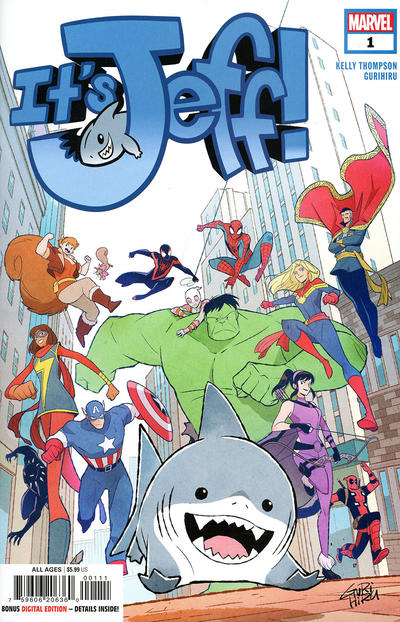
It's Jeff #1 (Marvel Entertainment) I've a simple rule regarding comics: If the art team of Gurihiru draws a comic, I buy it. I have not been let down so far. This is a collection of short comics ranging from just a few panels to a few pages in length, all featuring the baby quadrapedal landshark from writer Kelly Thompson's brief West Coast Avengers revival (where he was adopted by Gwenpool, but seems, like Snoopy in Peanuts, to belong to everyone in the gang to a certain extent). 

The comics in It's Jeff, which I believe all appeared online somewhere I don't read previously, are written by Thompson and drawn, as I earlier alluded to, by the incomparable team of Gurihiru, who draw some of the best versions of the Marvel superheroes, a huge swathe of whom appear in this issue. 

The stories are all short and sweet, and really show off by Gurihiru and Thompson's story-telling chops, given that there are no dialogue or narration in the stories, with the sole exception of  Hawkeye Kate Bishop calling "Jeffrey!" and  "Jeff!" a couple of time, and Jeff saying some version of "Mrrrrr" a couple of times.

My favorite is probably "Pool Party", which seems to feature the entire Marvel Universe sharing a pool and all wearing their own individualized swim wear. As someone who adores Gurihiru's art, it's great getting to see them draw so many different characters. There's also a Thanksgiving story, "Jeffsgiving", which features a whole bunch of Marvel characters in cameos (Including one character I didn't recognize; who's the blue-haired girl sitting between Tony and America Chavez?). 

I can't recommend this book highly enough for Marvel fans, and I hope Thompson and Gurihiru do more.


BORROWED:

Komi Can't Communicate Vol. 24 (Viz Media) Komi and Tadano go on a date...but not until after Komi's Komi-like father press-gangs Tadano into going on an aquarium date with him (and Shosuke) to test if he's really worthy of his daughter or not. It's as much fun as always.


INTERVIEWS: 

A First Time For Everything (First Second) I interviewed children's book author and graphic novelist Dan Santat about his extraordinarily fun and funny coming-of-age memoir, in which he travels to Europe and falls in love for the first time. You can read it here. 


Shazam! Thundercrack (DC Comics) If you've read EDILW for a while now, you probably know that I'm a guy with a lot of opinions about the Captain Marvel character, like the fact that he should be called "Captain Marvel" and not "Shazam." So it was a great pleasure to talk to cartoonist Yehudi Mercado, who did a kid-friendly story featuring the character set in the continuity of the original movie (and who managed to work in a version of Mr. Tawky Tawny). You can read our conversation here.


*But not, oddly, plant-like Green Lantern Medphyll, who is the only character on Juan Gedeon's cover who is not also featured in a story within the book. Perhaps he was intended to be featured and his story got cut in favor of the Captain Carrot or Superman story, as neither of them appear on the cover.  

**Consisting of Bumblebee, Flame Bird and Hawk and Dove.

Wednesday, April 12, 2023

A Month of Wednesdays: March 2023

 BOUGHT: 

Batman: The Dark Knight Detective Vol. 7 (DC Comics) Writer Louise Simonson earns top billing on this seventh collection of late 1980s/early1990s Detective Comics, which includes 'Tec #634-638, plus #641 and #643 and Annual #4, as well as an issue apiece of Batman and Legends of The Dark Knight. (As for issue #640, that was part of the "Idiot Root" crossover, and #642 was part of "The Return of Scarface," both collected elsewhere). The period covered was after the Alan Grant/Norm Breyfogle team moved to Batman, and there was no regular creative team, giving the book something of an anthology feel.

Simonson writes a three-part story arc in addition to the annual, which amounts to the lion's share of the work within. The three-parter, drawn by Jim Fern and Steve Mitchell, concerns a young boy with the metahuman ability to bring video games to life, an ability he seemingly uses to track down and kill an Arkham escapee, and then uses more and more, engulfing more of Gotham. 

Commissioner Gordon and Sergeant Essen get wrapped up in the video games the boy uses as his inspiration, which they play for research, while Batman is guided by Robin Tim Drake, himself a video game aficionado. 

I'm no gamer, in fact I probably haven't really played a non-Pac-Man video game since this comic was originally released, but it's fun and funny to see old men like Alfred and Gordon talking about video games at all. There's a real senior citizen rapping quality to some of the story, and it's interesting to see Fern and Mitchell and colorist Adrienne Roy try to affect now old-school video games intruding on reality.

Simonson's other contribution, Detective Comics Annual #4 (the cover of which they probably should have used for the collection; it was so potent an image that it sold me on the issue, one of the very first Batman comics I ever read, and one of my earlier comics period) is the Armageddon 2001 annual.

I'm glad it's included, as it was a pleasure to read again, and to read it from the perspective of someone who has no read hundreds and hundreds of Batman comics, but it really does interrupt the flow of the book, which is otherwise a fine Batman anthology of shorter comics. If you don't remember, Armageddon 2001 concerned a hero from that far-flung future date travelling a decade back in time to discover which 20th Century hero would turn out to be the fascist masked tyrant "Monarch" in his dystopian era. To do this, the hero, Waverider, would touch a particular character and use his powers to "read" their future. This mainly meant a series of  Dark Knight Returns-style dark future stories starring each of the DC heroes; some of the strongest, he explains, need tested repeatedly, which explains the multiple encounters that Batman and Superman get in their multiple titles (The participating Batman annual also had a pretty great cover, and was another I read from the series, along with a Superman one that was an earlier example of the Superman-gone-bad genre which has long since ballooned).

DC doesn't seem to have figured out a way to collect their annual crossover events, which would likely necessitate an unwieldly omnibus of some sort, or else a series of trades, but I would eagerly buy collection of the events, particularly this one, which I missed so much of.

Anyway, Simonson is partnered with the great Tom Grindberg, who colored his own work as well as drew that great cover, for what is essentially another, if final, go-round with the Al Ghul family.

Opening in media res, with Batman fighting Ra's over a vat growing a plague virus, the adventure ends unusually enough, with Batman's bat-rope giving way as he rappels down a mountain, and he falls, breaking his back. While Batman mopes, the Gotham of about-ten-years-in-the-future spirals out of control, enough so that an adult Tim Drake takes up the mantle of Batman to fill-in. 

When he's gunned down on the job, the crippled Bruce Wayne is forced to get his shit together to seek vengeance. This he does by building new versions of the sort of cyborg braces we see an elderly Alfred Pennyworth wearing; after a trial-and-error and training montage, Batman eventually builds a sort of cyborg suit he can wear under his normal costume. 

The new, bullet-proof, super-strong Batman takes to the streets to find out who killed the boy in the Batman costume, with the answer leading him back to the Al Ghuls. At the climax, Batman finds himself stripped of his cyborg suit and dying again, this time about to be lowered into the Lazarus Pit himself. He chooses a rather unBatmanly way to escape, albeit one that fits with the idea of a "last" Batman story. 

It's a pretty compelling story, and, of course, brilliantly drawn. It colored the way I saw Batman for a while, I think, but then, Frank Miller's Dark Knight Returns left such a long shadow over the Batman of the early '90s, with a Batman more aware of his mortality, more concerned with his mission than things like his life as Bruce Wayne and more invested in the pose as a terrifying monster of the night meant to scare criminals straight that it's hard to disentangle Simonson's use of these tropes from those of her peers and from Dark Knight in general, which, as I said, seems to have been an influence of sorts on the entire event.  (I'd need to read more of it to be sure, though, DC, so get collecting! Checking Wikipedia; it seems there are only a dozen participating annuals, plus the book-ending chapters of the stories, so I think a pair of thick trades would handle the whole series nicely).

The book also collect "Destroyer", a multi-book crossover (here's where those issues of Batman and Legends of The Dark Knight come in). The real-world rationale for the book was to bring the Gotham City of the comics more in line with the Gotham City of the movies, with Batman '89 production designer Anton Furst's designs being imported into the comics. The in-comic rationale for this was a demolitions expert obsessed with old Gotham architecture executing a series of bombings, brining down newer, boxier, more real-world looking buildings, revealing the older, weirder designs they were hiding.

The story, by Grant and Breyfogle and Denny O'Neil, Chris Sprouse and Bruce Patterson and Grant, Aparo and DeCarlo, marks an official turning point in the way Gotham appeared in the comics. I'm not sure it was necessary, per se; like, I can't imagine Kelley Jones not drawing weird-looking towers brimming with bizarre gargoyles when he took over Batman a few years later, but it was a story concerned with Gotham's architecture. (Interestingly, this came out in 1992, the same year that Grant Morrison's "Gothic," also concerned with the spiritual aspects of Batman's home town's architecture, was released). 

The rest of the book is done-in-ones by a variety of creators. Perhaps the best of these, one I remember making me very uncomfortable after I fished it out of a back-issue bin some time ago, was the Peter Milligan-written "The Bomb," drawn by Jim Aparo and Mike DeCarlo. It was basically a new take on The Human Bomb character from the Golden Age; that guy doesn't appear, but someone with his bizarre super-powers of blowing himself up and causing explosions does, and they are treated quite differently than the war-time superhero was.

Milligan and Aparo re-teamed for another done-in-one, this one a murder mystery entitled "The Library of Souls," about a librarian gone bad who treats his victims like books, and tries to organize them thusly. 

And, finally, the collection begins with "The Third Man," by Kelly Puckett and Luke McDonnell, in which Batman must try to solve a particularly perplexing series of murders...a case also being pursued by a pair of old ladies who are also gifted amateur detectives. 


BORROWED:

Zom 100: Bucket List of The Dead Vol. 9 (Viz Media) Among Akira and company's 100-item bucket list of things they want to do before becoming zombies in the zombie apocalypse they're currently navigating is to run a bar, which doesn't seem the most feasible of ambitions, what with the whole zombie apocalypse thing. 

That changes when our heroes arrive in Osaka, however, and Akira and Kencho reconnect with their college friend Takemina there. They discover a thriving market, and a weird economy where cans of food serve as the monetary unit, complete with an elite enclave that lives in the castle and host elaborate gambling nights. These include one particularly dire game, in which one can bet all their cans on a 50/50 game of running through one of two doors. Behind one door is a pit full of cans, behind the other is a pit full of zombies.
Our heroes struggle a bit with their bar's concept, and thus finding business, but things really start to turn around when they incorporate the bucket list into the bar itself, using it to scratch off some of the items on it, and help patrons achieve some of their own dreams. 

Things take a weird turn when they become super-successful, though, and Akira finds himself something of a millionaire, at least in the canned food economy. As the book reaches its climax, he seemingly betrays his friends to join the elite in the castle, prompting them to announce their attention to take the two-door gamble.

As ever with this series, it's a nice, fun romp on the surface, with interesting ideas—here on the concept of money, the economy, and what wealth can do to a person—boiling underneath. It remains one of my favorite manga series. 


REVIEWED: 
Nayra and the Dinn (Viking) Iasmin Omar Ata tells the tale of Nayra's Ramadan, which brings with it some struggles and complications, mainly in the form of a djinn that has escaped its home realm and sought refuge with Nayra.  Things go differently than they usually do in such stories of a supernatural entity intruding in the mundane everyday world. It's a pretty great comic from a talent to watch. 


Walt Disney's Donald Duck: Donald's Happiest Adventures (Fantagraphics) The creative team of Lewis Trondheim and Nicolas Kerimidas reunite for a sequel of sorts to their 2017 Mickey's Craziest Adventures album, which is also presented as a "lost" classic-era Disney comic that they found. This one involves Donald embarking on his most challenging quest for Uncle Scrooge ever: Finding true happiness. It is, predictably, good stuff

Sunday, March 19, 2023

A Month of Wednesdays: February 2023

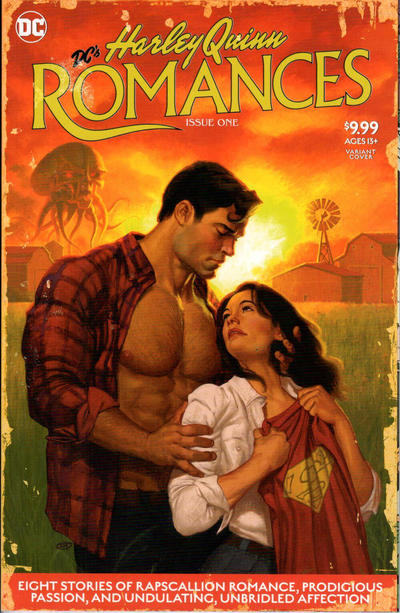
DC's Harley Quinn Romances (DC Comics) I ordered my copy of DC's Valentine's Day month special from an online retailer, so I didn't get to pick the cover. I ended up with the Superman and Lois variant cover (above), which to its credit, does look like a trashy paperback romance cover, but for which the joke of the title doesn't work quite as well as it would if Harley Quinn were literally on the cover, as she is for the main cover by Amanda Conner (Along with Aquaman, who co-stars in a story with Harley and a bunch of other heroines within the pages of the book; Superman and Lois just play supporting roles in someone else's romance within the issue). 

Contained within are eight 10-page stories featuring a refreshingly wide array of DC super-characters. 

The first story, featuring the couple of Harley Quinn and Poison Ivy, is by writer Alexis Quasarano and artist Max Sarin, and is perhaps the most noteworthy. Not for the couple that it stars, but more so for its narrative and style. Poison Ivy is in a gown at an event for rich Gothamites, "working", and Harley appears to present her with a Valentine's gift, a sort of homemade fan-fiction Elseworlds story imagining the pair as fellow high school students on the eve of a big dance.

Also of particular note are a Constantine story by Frank Allen and John McCrea which finally gives John a much needed wardrobe update (the romantic element of the story is something of a surprise, with a mate of John's who is not exactly who he appears to be trying to have coffee with a woman while John holds off a demonic intrusion),  a Fire and Ice galentines story by Raphael Draccon, Carolina Munhoz and Ig Guara that is heavy on guest-stars and cameos, and, of course,  Ivan Cohen and Fico Ossio's Harley Quinn and Aquaman story, in which the supervillain-turned-superhero crashes a heroic galentines day and finds that a wide variety of super-ladies, many of whom you would never suspect, have all dated, or at least shared a special moment with, the King of the Seven Seas.

Rounding out the book are stories of Batman saving a couple on the night they got engaged, Superman setting his cousin Power Girl up on a date with Jimmy Olsen (although as Karen Starr, not Power Girl), Midnighter and Apollo in their typically generic appearance and Kite Man's unhealthy romantic fixation on...his own kite...?

An overall middling anthology, there's nevertheless enough of interest here to make it worth the purchase of a casual DC Comics fan like me. 


DC Power: A Celebration #1 (DC) Like 2021's DC Festival of Heroes and various DC Pride specials, DC Power: A Celebration is a prestige format, 80-page giant featuring heroes from a traditionally underrepresented community, all written and drawn by creators of that same community. In this particular instance, that community is, of course, Black, which explains the February release. 

I was heartened to see that the heroes starring in the nine stories were a fairly healthy mix of original heroes (Amazing-Man, Black Lightning and his daughters Thunder and Lightning, Bumblebee, Cyborg and Vixen) and legacy heroes, which David Brothers once astutely and memorably referred to as diverse heroes who came to be because the publisher gave them some other white heroes' laundry (Green Lanterns John Stewart and Jo Mullein, Nubia, Aquaman Jackson Hyde, Kid Flash Wally West, Batman Jace Fox). 

It is perhaps understandable why so many characters of the latter type exist, as it's easier to sell readers on a new Green Lantern than it is to come up with a concept that will achieve the same sort of traction with fans that the Green Lantern one has already proven to be able to do, but it also seems a little like cheating, and that these characters can seem somehow lesser than the white peers they either replaced or stand along side. Over the decades since his introduction 1971 introduction, for example, it's been too easy to think of John Stewart as the black Green Lantern, or a back-up Green Lantern, whereas, say, Cyborg or Black Lightning stand out as their own heroes with their own names and powers, heroes who happen to be black.

On the other hand, I imagine it's cool for a young black reader to see that there's now a Black Batman, Superman, Wonder Woman, Aquaman or Flash now, to think that a you as a black kid could grow up to be any DC superhero. 

If nothing else, Power proves DC is capable, and successful, at telling the stories of both kinds of Black superheroes. 

My favorite of the stories was probably the first, Evan Narcisse and Darryl Banks' story of retroactive "Golden Age" hero Amazing-Man (actually introduced in 1983 in the World War II-set All-Star Squadron), a character who recently reappeared in Injustice: Gods Among Us: Year Zero, where he was a member of that alternate universe's Justice Society, and who Julian Totino Tedesco  drew a nice image of punching out Hitler, an image that reappears. Admittedly, that's probably due as much to my affection for the character as the quality of the story, wherein a post-war Will Everett is lying low, as all super-people were during the period, but comes out of retirement to deal with housing issues...and a reprise of a villain from the pages of his All-Star debut arc. 

The artwork is universally good, with all but perhaps one story featuring better-than average art. I was particularly struck by that of Natacha Bustos, who draws the John Stewart story, and Valentine De Landro, who draws the Cyborg story. Olivier Coipel's art on the Batman Jace Fox story, written by I Am Batman regular writer John Ridely, is pretty impressive too, in large part because it's in black and white, and thus looks so different from everything else around it. 

Each story ends with a profile of the characters starring in it in the style of the old Who's Who In The DC Universe, but with different, usually high-profile art attached (An old Jim Lee image of Stewart is recycled for his profile, for example). These were fun, and I actually appreciated them in several cases, given that there are heroes I had either long ago lost track of  (like new Aquaman Jackson Hyde, who I understand is no longer Aqualad but sharing the Aquaman codename with Arthur Curry) or met here for the first time (like Batman Jace Fox). 

The book includes a prose introduction by Ridley, focusing on the importance of representation in comics and his work in that area), and pin-ups of some of the black heroes who didn't get featured in a story of their own (like Steel and Natasha, extra-dimensional Supermen Val-Zod and Calvin Ellis, The Signal and someone named Bolt...from the pages of Black Adam, I think...?) and a few who did (like GL Jo Mullein, Vixen and Bumblebee). 

At $10, it's a great value, featuring lots of solid superhero comics from rock-solid creators. 


BORROWED: 

Ant-Man: Ant-iversary (Marvel Entertainment) This collection of the recent Al Ewing-written Ant-Man miniseries takes a clever approach to time travel, depicting various points in time as particular comic book stories from the period being visited. This is achieved in large part though some tremendous art-work by artist Tom Reilly (colored by Jordie Bellaire), whose work for each of the four issues/chapters of the series is so different in style it looks like the work of a different artist. 

As for why there's time travel involved, that allows for the series to focus on each of the Ant-Men, from original, Silver Age Ant-Man Hank Pym to second and current Ant-Man Scott Lang to "Irredeemable" Ant-Man Eric O'Grady.

And so the first chapter looks like an old Tales To Astonish Ant-Man/Wasp adventure (a couple of original stories from the series from 1959 are included in the back of this collection, which drives this home), and is written in such a manner to evoke Stan Lee. In the second chapter, featuring O'Grady, the art style changes to look like an incredibly convincing approximation of Irredeemable Ant-Man pencil artist Phil Hester's work, the layouts  evoking that of the old series and even featuring a narrator ant, the way each issue of Irredeemable did. 

As for the third and fourth chapters, the third is set in the present, featuring Lang and his daughter Cassie "Stinger" Lang, and is the only one without a noticeable attempt to reflect the work of another series, and the fourth is set in the future, with text boxes attempting to evoke a more futuristic, interactive reading experience (similar to Grant Morrison's DC One Million comics, from 1998). 

That future's Ant-Man has to, for somewhat contrived reasons, travel back in time to scan the ants of his predecessor Ant-Men, in the process of fighting against a powered-up Ultron who, regular Marvel readers will remember, is currently fused with Hank Pym. He/They also appear in the story, in a fairly big role, so that this series isn't just about the Ant-Man legacy, but where its progenitor currently stands as well (as to where Pym/Ultron end up, however, it's left as a cliffhanger to be resolved...somewhere).

Cleverly created and quite well-written, it's a pretty great comic celebrating one of the Marvel Universe's longest-lived, if most unlikely, heroic lineages. 


Komi Can't Communicate Vol. 23 (Viz Media) This is it! This volume contains the moment that manga-ka Tomohito Oda has been teasing since the series began, a moment I've been sort of dreading for a while, fearful that it might mean the series is starting to wind down and, as I've said  many times before (maybe 22 times now?), it's my favorite current manga series. 

Tadano finally confesses his feelings to Komi, and she reciprocates! It all happens surprisingly fast given the hundreds and hundreds of pages of build-up. First Manbagi confesses to Tadano, and asks him out. He's all set to accept when he suddenly thinks of Komi, and admits to himself and Manbagi he has feelings for Komi. And then, surprisingly, rather than drawing it out for a few more volumes, Oda has Tadano boldly confront and confess to Komi!

There's a pretty great series of splash pages in which she receives and processes the information. 

As much as I fear the dispelling of this central tension will spell the end of the series in the near-ish future, given how slow Komi and Tadano have taken things so far—that is, about 23 volumes to admit they like each other—I suppose there's still a long, awkward way to go as their new relationship develops. At least, that's my hope. 


REVIEWED: 

The Archie Encyclopedia (Archie Comics) Archie Comics' output, from the publisher's creation to its latest offerings, gets the encyclopedia treatment. I had some quibbles with some of the information included and the book's usefulness as a reference tool, but overall I enjoyed it. I'm a big fan of character encyclopedias in general, and read this one straight-through like a book. 


INTERVIEWED: 

Beaky Barnes: Egg on the Loose (Penguin Workshop) I interviewed children's author David Ezra Stein, perhaps best known for his Interrupting Chicken books, about his debut graphic novel for Good Comics For Kids


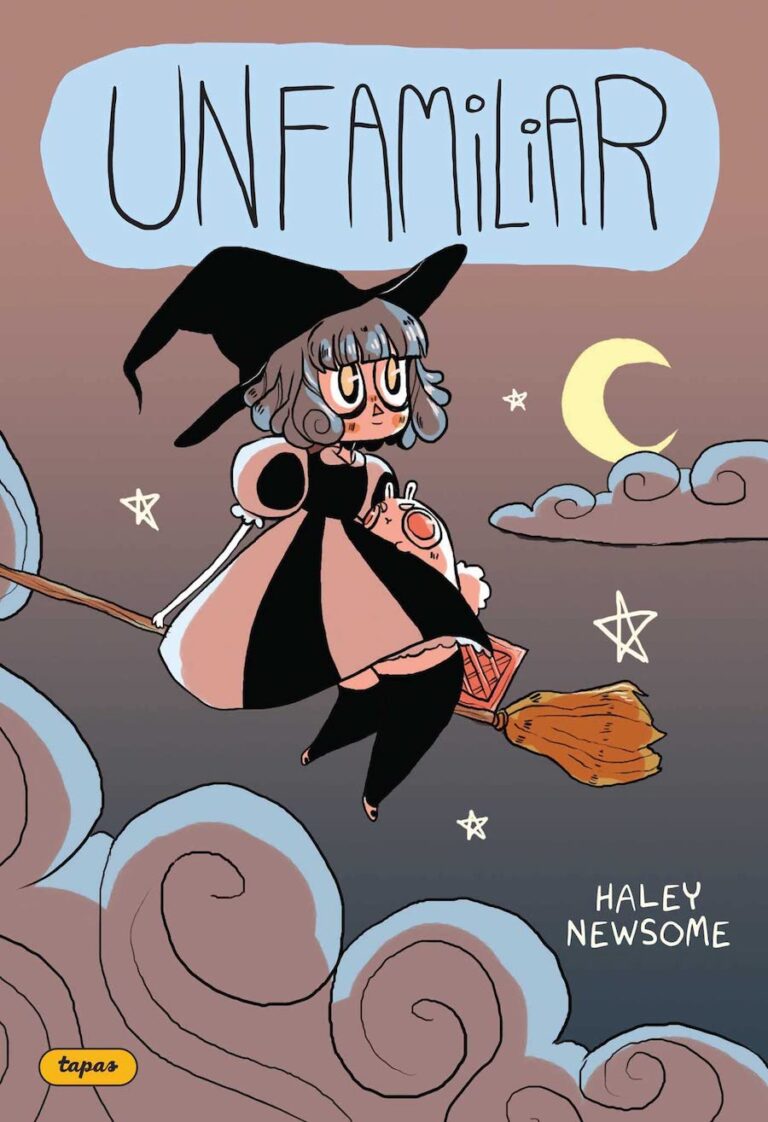
Unfamiliar Vol. 1 (Andrews McMeel) I interviewed cartoonist Haley Newsome about her web-comic turned graphic novel for Good Comics For Kids