Saturday, October 29, 2022

A Month of Wednesdays: September 2022

BOUGHT:

Batman '89 (DC Comics) Imagine there was a third Batman film in the original cycle, one that introduced both Robin and Two-Face. Okay, yes, I know, but not like that; imagine that there was no recasting of Batman or Harvey Dent and, more importantly, that this third Baman film was more strict in its adherence to the first two...or, at the very least, was written by the same guy. That's what DC's Batman '89 is, a sort of comics adaptation to a film that didn't really exist, written by Sam Hamm, who was responsible for writing the original 1989 Batman film and got a story credit for 1992's Batman Returns (this comic, which is set after the events of Returns, is really more like Batman '93, I guess, but they're using the naming rubric established by their Batman '66 comics and carried on in the short-lived Wonder Woman '77 and this book's sister project, Superman '78). 

Hamm is joined by artist Joe Quinones, who is about as perfect an artist for such a project as one could wish for, doing a fairly masterful job of modulating celebrity references for the characters who appeared in the previous films so that Batman, for example, looks like Michael Keaton, but not too much like Michael Keaton, to the point where it's distracting, or to the point that he stands out as being more realistically rendered than any of the other characters on the page. 

I enjoyed the heck out of this, and it's a great read, particularly for fans of the original film who at least imagined what the potential of the franchise would have been like if Warner Brothers zagged instead of zigged.

That said, it's a thought-provoking comic too, in that I wasn't sure, once I'd finished reading it, how best to evaluate it (I'm glad I didn't have to write a formal review of it anywhere, to be honest). How, really, should one think about it?

Should we approach it as a movie, or, at least, judge it on how movie-like it is? In that respect, it has its weaknesses. Though clearly set in the continuity of the films and featuring the general likenesses of the original film's cast—especially in the case of District Attorney Harvey Dent, who hear resembles Batman's Billy Dee Williams—it doesn't quite read as a movie would play. It's not as visual as it could be, and certainly lacks the action scenes that would have been necessitated by a big-screen outting, with only one real action scene of any length of complexity, and that occurring early in the story. 

It's also extremely verbal and character-driven...hardly a bad thing, but it reads very much like a movie script rather than a movie. That is, it's not hard to imagine scenes and chunks of scenes that would have been chopped out to make more room for visual story-telling and big, dramatic moments, or even just a change in focus; I've seen enough Batman movies at this point to know, for example, that the introduction of the Bat-cycle would have been given far more play than some of the long conversations in the final product.

So should we approach it as a comic? (Yes, I can hear you say; it is a comic, you idiot. No need for name-calling, imaginary voices in my head). It's a little weak in that regard too. I know Hamm isn't a comics writer—although he has a pretty solid comics story on his resume in the form of "Blind Justice in 1989's Detective Comics #598-600 , which was published in conjunction with the original film's release—and it's obvious from reading this that he's still relatively new to the production of comics.

Remember what I said about how verbal and character-driven this is? It's very talky, and reads like the work of a prose writer whose work has been adapted into a comic rather than a comics writer. The visuals, though masterfully rendered, don't ever take over for the words, and the balance between the verbal and visual seems off in a way that's hard to pinpoint.

(As an aside, I also wondered about how Tim Burton-esque this was; if this is a theoretical third Batman film by Hamm, is it also directed by Tim Burton? It doesn't look like it, Two-Face's Beetlejuice-like striped suit aside; it's not as funny as either Batman film is, nor as over-the-top in its cartoonish visuals, the way Batman Returns was. Comparing Batman to Batman Returns, it is easy to see a trajectory in Burton's visual stylings, and easy to imagine how pronounced they might have been with a theoretical third go-round). 

Nevertheless, I enjoyed revisiting this particular version of Batman's world, and especially enjoyed it's extension into the comics. I even enjoyed with wrestling with these ideas of how to approach the book. I definitely wouldn't mind reading more, whether they're presented as epic-length "movies" like this one was, or more traditional comic books simply set in the world of the film (which is what DC did with Batman '66 really, rather than trying to emulate the feel of episodes of the TV show). 


Walt Disney's Donald Duck: Baloonatics
(Fantagraphics)
 I'm trying to catch up on the many volumes of the Complete Carl Barks Library that I missed, and it's not easy; many books seem to be out of stock at the moment. 

This later—latest?—volume is notable for it inclusion of Barks-written-and-pencilled, but Daan Jippes-finished Junior Woodchuck stories featuring the nephews and their fellow club-members vs. Uncle Scrooge, who acts as their opponent, always intent on destroying something in the name of progress or profit that the Woodchucks would prefer to preserve (their woodland stomping grounds, a beached whale, a fossil find).  The stories are repetitive and, as one of Fantagraphics' panel of Barks experts notes, regressive, casting Scrooge as the unenlightened villain that they do, but even if they're not as strong as the stories that precede them in the volume (and the series), they're still Barks, meaning they're still pretty well-made comics. 

As for those preceding stories, they include the title one, in which Gyro's new balloon fuel causes havoc for Donald, the boys' attempts to train a falcon who can't fly and an investigation into sabotaged rocket tests that puts Donald in mortal danger. 


BORROWED: 

I Belong to the Baddest Girl at School Vol. 1 (One Peace Books) Unoki has been bullied for so long that he's gotten used to troublemakers at school forcing him to follow them and run their errands and so forth. So when his new high school's number one trouble-maker, the hard-fighting, stick-carrying boss Toramu one day pulls him aside and says "Hey, Unoki. Be mine. Well? How about it?", he naturally assumes that she wants him under her thumb, to be her personal property, to bully him, even if she is a girl.

Toramu, on the other hand, thought she was declaring her love, and asking him out. 

Thus begins their relationship built on misunderstanding; Unoki thinks she thinks of him as a pliant victim, Toramu thinks they're a couple. Obviously, Unoki can't make sense of certain things, like why she makes him lunch rather than demanding he go buy lunch for her. He only gradually begins to consider the possibility that she might actually like him, and things come to a head at the climax, when a typically manga situation occurs: He falls on top of her.

The moment is broken by a visitor to Unoki's house, in a pretty perfect cliffhanger ending: It's Toramu's older brother, there to collect her.  


Mickey Mouse: The Greatest Adventures (
Fantagraphics Books)
Reading Regis Loisel's  Floyd Gottfredson-inspired Mickey Mouse: Zombie Coffee (reviewed in this column) made me want to read more, similar stories of the scrappy, two-fisted Mickey Mouse and his adventures, but I was leery of jumping into the Gottfredson collections, which are of daily newspaper strips, a reading experience I'm not necessarily fond of, and take a degree of dedication I wasn't sure I was ready for.

As it turns out, Fantagraphics has a perfect book for someone in exactly that set of circumstances: Mickey Mouse: The Greatest Adventures  offers a smattering of Gottfredson's comics in a single volume.

The collection begins with "Mickey Mouse In Death Valley," a very early story in which a particularly rambunctious Mikey and Minnie are involved in a series of Hollywood-inspired, almost stream-of-consciousness adventures involving a gold mine and the crooks that want to cheat them out of it. 

It's followed by later, more tightly-plotted, more sophisticated stories like "Island In the Sky", in which Mickey and Goofy discover the titular island and the world-changing secret that keeps it afloat, "The Gleam," in which Mickey must try to foil a particularly clever hypnotist/jewel thief, "The Atombrella and The Rhyming Man", featuring Mickey's friend Eega Beeva, and "Mickey's Dangerous Double," featuring an evil opposite of Mickey Mouse.

If one wants a place to stat with Gottfredson's masterful Mickey comics, this is it. 

Mickey Mouse: The Ice Sword Saga Book 2
(Fantagraphics)
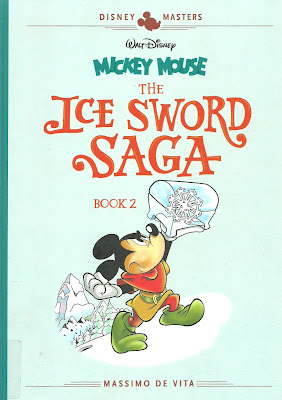
This sequel to the Disney Masters edition focusing on Massimo De Vita's Ice Sword saga includes two more Christmastime adventures of Mickey and Goofy in the fantasy world of Argaar. 
In "The Prince of Mists Strikes Back," Pluto is accidentally sent to the dimension of fantasy adventure just as the Prince of Mists, the villain of the original Ice Sword story, seems to have made a comeback. Mickey and Pluto must take an alternate route to arrive there and find the lost dog...and save the world in the process. 

And in "Sleeping Beauty in the Stars" the world of Argaar is afflicted with a sleeping spell, and our heroes must journey underground, up a mountain and into space to break it. 

The two tales account for about half of the book, so the rest is filled with two non-"Ice Sword" stories. The first of these is "Donald Duck and the Secret of 313," a sort of origin story for his little car that takes a seemingly-odd but grounded in the animated cartoons detour to Mexico, and the latter is "Arizona Goof and the Tiger's Fiery Eye," in which Mickey accompanies Goofy's Indiana Jones-like archaeologist cousin on a treasure hunt. 

With De Vita's biography already being told in book one of the series, the backmatter here talks about the Ice Sword saga itself. 


Uncle Scrooge: King of the Golden River (
Fantagraphics)
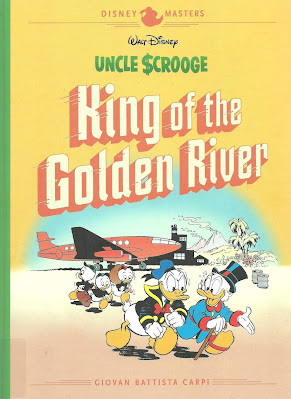
This Disney Masters volume devoted to the work of Giovan Battista Carpi has a rather unusual and somewhat convoluted Duck tale as its title story. 
It begins with both Donald and the boys independently seeking ways to counteract gravity, and leads to the summoning of a Donald lookalike Dondorado, the so-called king of the golden river, who amassed a huge treasure in his ancient Amazon home country, so huge that the riches flowed to him like a river (Despite the title, the story has nothing at all to do with John Ruskin's 19th century fantasy of the same name). 

Somewhat coincidentally, Uncle Scrooge has his sights set on the same treasure, and the ducks all decide to team-up to search for it together and split it...despite the fact that greedy Uncle Scrooge and Donald both plan on double-crossing one another, and attempt to do so at nearly every opportunity. The quest is saved from doom by the innocence and good nature of the nephews, as Dondorado stays with them in a variety of magical disguises, using his powers to judge the morals of the questers every step of the way. 

The rest of the volume contains two more stories. The first of these is "Mickey The Kid and Six-Shot Goofy," which tells the tale of the Wild West ancestors of our modern day Mickey and Goofy (and, for all intents and purposes, these seem to be the same characters, as if Mickey and Goofy are simply "playing" their own ancestors, like actors cast in new roles). The story also features an appearance by Scrooge McDuck, reminding us just how old the old miser really is. It's the first of what would be a series featuring these versions of the characters, some told by Carpi and some told by other cartoonists. 

Finally, there's the weird and not at all legally sound "Me, Myself—and Why?", in which Scrooge decides on a course of action to avoid paying massive taxes: He'll split his vast fortune three ways between three different personalities, each of whom will then only have to pay a third of the taxes. I guess. Being three different people—each with his own hat and name to distinguish him—proves exhausting though, and eventually Donald and the nephews seek out professional help. The advice given by psychiatrist Professor Dingledorf is about as medically sound as Scrooge's scheme seems legally sound, but in keeping with the strip's cartoon roots: A mallet to the head should fix the problem. 

The comics are followed by a nice, concise biography of the late Carpi, which emphasizes his importance as one of the two leading lights of Italian Disney comics, alongside Romano Scarpa. 


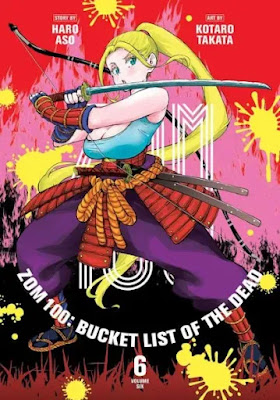
Zom 100: Bucket List of the Dead Vols. 6-7 (Viz Media) I somehow fell behind on this series, one of my favorite ongoing manga, but no worries; it just meant I got to read two volumes back-to-back this month. 

Volume 6 picks up on a cliffhanger in which Akira is put in an impossible position by the evil opposite version of his group: Allow himself to be bitten and become a zombie, or forfeit his father's life. Writer Haro Aso and artist Kotaro Takata have him wriggle out of the circumstances in an interesting way, the cliffhanger/resolution reminding me of something Mark Waid once said during a talk on comics writing about writing cliffhangers so dramatic even you, the writer, don't know how they will be resolved in the following issue. 

I suppose it's no surprise to reveal Akira, the hero of the series, survives though, and, as idyllic as his hometown village has become, even taking into account the zombie infiltration and the machinations of the bad guys, he and his friends can't just stay there and settle down. If they did, we wouldn't have a series. Or, at least, not much of one, as it would be more about farming life than traveling through a post-apocalyptic, zombie-filled Japan. 

And so they decide to leave, adding an item on their to-do list, the bucket list of things to do before dying or becoming zombies themselves that gives the series its name: Find a cure for the plague.

Volume 7 finds Akira and friends back on the road, searching for a cure—which looks a lot like sight-seeing—before the story takes a weird and interesting detour, wherein they find a luxury hotel completely operated by still-functioning robots that cater to their every whim. Is it too good to be true...? Yes, yes it is. But it's pretty good for a while, and the sequence ends with a zombie bear, the coolest zombie monster faced since the zombie shark in volume 2. 

Volume 7 also includes a 12-page crossover between Zom 100 and Alice in Borderland entitled "Akira in Borderland", which is no doubt a bit more exciting for readers of both series, as opposed to just Zom 100. Still, it does a neat job of displaying Akira's core, comedic motivation: He hated his soul-crushing job so very much that anything, even the end of the world via zombie apocalypse, is a welcome respite. Borderland's building full of deadly traps? No sweat! Beats working!


REVIEWED: 


Big Ethel Energy Vol. 1
(Archie Comics)
Artist Siobhan Keenan's ability to draw attractive young people seems to work against a core conceit of her collaboration with writer Keryl Brown Ahmed: That Ethel Muggs, the "Big Ethel" of classic Archie Comics, was an ugly duckling who bloomed into a beautiful swan after graduating high school and moving away from Riverdale. She's still awfully swan-like in high school flashbacks, not only looking nothing like her classic cartoonish counterpart, but also not looking all that different than she does as a grown-up, when the dialogue tells us she's suddenly a stunner. 

That nitpick aside, I was caught up in the story and its several mysteries—like, for example, what's up with Jughead, exactly—pretty quickly, and eager to find out what happens next. The comic plays an awful lot like a young adult TV drama, but of a more gentle, melodramatic variety than the more bonkers Riverdale show. The stars of the comics are all present—Archie, Betty, Veronica, Reggie, Moose, even Mr. Weatherbee and Mrs. Grundy—but now we're seeing them as grown-ups, and from an outsider's point-of-view. It's a well-made comic, and one that should be appealing to readers regardless of their foreknowledge of or experience with Archie Comics. I reviewed it here


Revenge of the Librarians
(Drawn & Quarterly)
If one way to judge a cartoon or comic book collection is how often one encounters a strip that one feels compelled to show a loved one—cutting it out of the newspaper, for example, or now simply forwarding it—than Tom Gauld's latest collection of literary-themed cartoons is as successful as can be. Tackling books and their writers, almost every strip is a delight, and one that screams to be shared with one's writer friend or book-obsessed relative. As a guy who works in a library and writes when I am not there, this could hardly be more up my alley. Highly recommended for anyone who likes books. 


Marvel's January previews reviewed

Think Jason Aaron's Avengers book has drifted too far from the core concept of the franchise, what with its prehistoric Avengers and multiversal Masters of Evil and infinite versions of Mephisto? If so, Marvel's got a tonic for you in the form of Avengers: War Across Time #1, the first issue of a five-part series featuring the original Avengers line-up vs. The Hulk (and Kang), by Paul Levitz (wait, Paul Levitz? At Marvel?!) and Alan Davis. Yes, Alan Davis, so you know it's gonna be something to look at).

How classic-feelling is it going to be? Well, they're using the old time-y Avengers font on the logo, so I'm assuming it's going to be pretty classic-feeling. 


Just out of curiosity, when you hear Captain America: SOL, what do you think of first? Captain America: Shit Out of Luck? Captain America: Satellite Of Love? Or Captain America: Sentinel of Liberty? It's that last one, if you couldn't tell, which is the official title of one of Marvel's two ongoing Captain America titles. 

In Captain America: Sentinel of Liberty #8, they introduce a new MODOC-with-a-C, a Mental Organism Designed Only for Control. I think it's hard to be the original acronym of MODOK, the Mental Organism Designed Only For Killing, but I think the gentler MODOC, Mental Organism Designed Only for Conquest worked well too for the all-ages Avengers comics Jeff Parker wrote for a time, but I don't know, maybe "Conquest" is considered too super villainous for today's more realistic Marvel comics, so they're going with "Control" instead...


Tradd Moore's Doctor Strange: Fall Sunrise #3 deserves credit for looking so different from everything else Marvel is publishing in  January. Scrolling through all the covers, it's one of the only times I stopped to think, "Wait, what's this?"

Wait, they really haven't done this cover homage with Miles Morales just yet? January's Miles Morales: Spider-Man #2 will really be the very first time? Huh. Weird.


How common is this particular homage? So common that Savage Avengers #9 isn't the only Marvel comic doing it in January. So too is Marauders #10:
One of the themes for this month's variants is "Classic Homage", which is why there are so many homage covers in the solicits, but still, you'd think they could all at least do different homages, wouldn't  you...?


Gene Luen Yang's Shang-Chi comic gets yet another new #1 with this month's Shang-Chi: Master of The Ten Rings #1. Despite reading the first trade paperback collection or two, I have completely lost track of the series, which has had way too many relaunches than a healthy series should need. This is actually the end of the series though, not another new start, at least according to the solicitation copy, which reads "Gene Luen Yang's Shang-Chi saga comes to its shocking conclusion!" It's an oversized one-shot, which one imagines will eventually make it's way into a big, fat hardcover titled "Shang-Chi by Gene Luen Yang," which is the way to read the story, I suppose, rather than trying to keep up as Marvel published it, in fits and starts. 

Thursday, October 27, 2022

DC's January previews reviewed

I confess that I'm not really feeling the matching jackets that the Superman family seems to be adopting on the cover of Action Comics #1051, although it is a nicely rendered cover. 

Also, should I recognize those two little kids behind Superman..?.


What kind of maniac eats with gloves on...? 

That's one of the covers for Batgirls #14. I prefer this one, as it doesn't include anything as crazy as people eating hamburgers and french fries while wearing gloves:
That's nice. 


Brian Bolland draws Bane, for the cover of Batman—One Bad Day: Bane #1, part of a series that is one of DC's stealthier attempts to wring blood out of Alan Moore's brief career writing for them decades ago. 

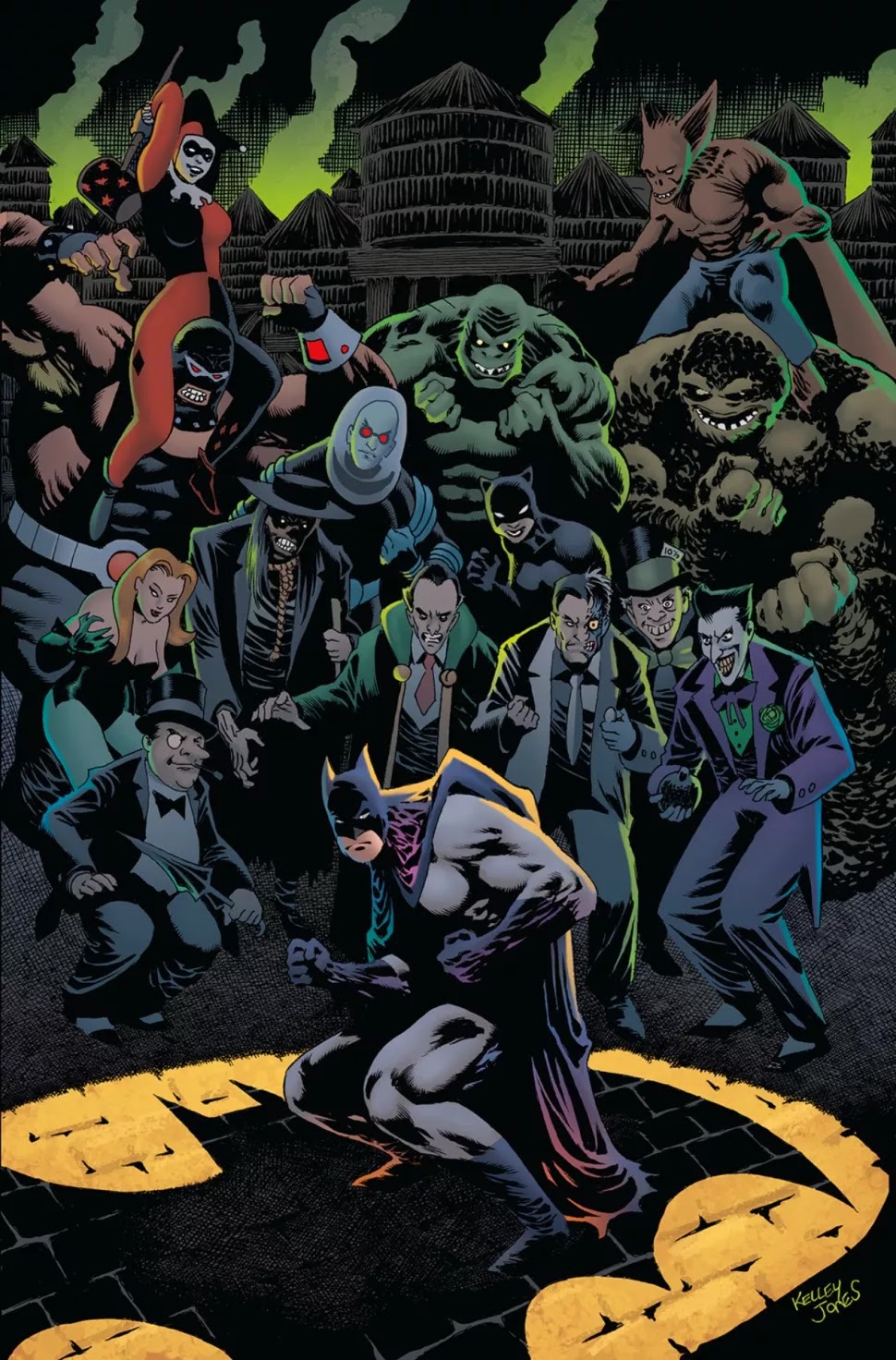
DC's doing another season of their book set within the continuity of the old Batman: The Animated Series cartoon, written by B:TAS alumni Paul Dini and Alan Burnett, and they got Kelley Jones to draw, well, everybody for the cover of Batman: The Adventures Continue Season Three #1. It's interesting to see the show's Bruce Timm designs in Jones' style; look how small Batman's ears are!

There's also a variant cover in which Kevin Nowlan draws not everybody, but a lot of folks, that allows for the same sort of pleasure:
Neat. Interiors will be drawn by Jordan Gibson. 


After one-shot specials devoted to heroes of Asian descent and LGBTQ+ heroes, DC's finally getting around to a special focused on their black heroes, DC Power: A Celebration #1

This particular cover shows the difficulty of creating diversity among characters in the superhero market, as the easiest strategy is to just give a black character someone else's laundry, as David Brothers wrote so memorably years ago. Thus we have a Black Superman, a Black Batman, a Back Wonder Woman, a Black Aqualad and Kid Flash and not one but two Black Green Lanterns.

Far harder is to come up with original characters with their own names, power-sets and stories that aren't related to one of the handful of successful franchises like, on this cover, Black Lightning, Vixen and Cyborg. 

According to the solicitation copy, we can expect stories featuring Cyborg, John Stewart, Aqualad, Kid Flash, Batwing, Vixen, Amazing-Man "and more." I'll be curious to see how many of those within the book are legacy characters vs. original ones, and I'll be curious to see which version of Amazing-Man shows up; I always liked that character, and while his costume colors aren't the greatest, he's an interesting enough hero with plenty of potential and, again, isn't just a lieutenant version of a white hero. 

This is one of the few books I'll be pre-ordering (Along with, if you're keeping score at home, Harley Quinn Romances, Batman: Dark Knight Detective Vol. 7 and mmmmaaaybe Batgirls Vol. 2. Everything else I can trade-wait at the library). 

Kind of amazing that DC has done so many Valentine's Day-themed romance specials over the years and they're just now getting to one with the obvious-in-retrospect name of Harley Quinn Romances #1. All of the covers are pretty great, but I liked this one the best, as it feels the most like a romance paperback...albeit with Brainac's ship in the background.

It sounds like it will start the predictable usual suspects (Harley and Ivy, Apollo and Midnighter, John Constantine), but there will be some unexpected characters appearing, like Fire and Ice (are they a couple now?) and Power Girl. 

What's this on the cover of Nightwing #100? Is Nightwing...taking off Batgirl's costume...? I see bare shoulder! I know we're all adults here, and obviously this is a Babs Tarr image, but I have to ask: Is it too sexy? 

It's one of several great variants for the issue, which also include these:


See? Nice.


I really like this cover for Tim Drake: Robin #5. I hope the series is really good.

Friday, October 07, 2022

Marvel's December previews reviewed

This is the cover of Miles Morales: Spider-Man #1, in which the hero is apparently a cat. Maybe this new series is really a What If...Miles Morales Were a Cat? series...? No, wait a minute, this is just a cover for Miles Morales: Spider-Man #1; there are several others where he appears as a normal, non-cat human being. Apparently one of the new variant schemes is "cats." 

That sort of explains the cover of The Fantastic Fur, er, Fantastic Four, where the heroes appear as furries, then:

Seriously, Comics. Why are you so weird?


The cover on this seems a bit weird to me, with Iceman looking off-model even if they were going for his first-appearance look, but regardless, this is a pretty nice package. Origins of Marvel Comics: Marvel Tales #1 offers reprints of the first issues of Fantastic Four, X-Men and The Avengers by Stan Lee and Jack Kirby, and Amazing Fantasy #15 by Lee and Steve Ditko Those are four single-issue stories that became founding pillars of what would eventually be known as the Marvel Universe, all yours for just $7.99. 

If you have reservations about the cover, it also comes in one more appropriate for furries fans too:


Monica Rambeau: Photon #1 by writer  Eve L. Ewing and artist  Michael Sta. Maria seems oddly timed to me—it's been a few years since Rambeau debuted in the Marvel Cinematic Universe, we're still a few years out from when she'll presumably reappear in The Marvels—but I guess it will be good to have a trade paperback starring the character available if and when future would-be readers come into the shop and ask if there are any Monica Rambeau comics. 


The cover for Peter Parker & Miles Morales: Spider-Men Double Trouble #2 a few more than six sinister foes of Spider-Man, so it looks like we'll get to see art team Gurihiru's takes on a whole bunch of other Marvel characters. That's great; Gurihiru's Green Goblin in Spider-Man & Venom was a delight, and these all look fairly delightful too. 


X-Treme X-Men #2 has a legitimately awesome homage cover tom 1963's X-Men #1. In fact, one might even say it's extremely awesome. 

Friday, September 23, 2022

DC's December previews reviewed

There are too many great variant covers for Action Comics #1050 to even point to in this post. I'm going to go with this one by Mike Allred as an all-around favorite though, given that it's not only a nicely rendered image, but it also compresses, like, the whole history of Superman comics into a single, crazy-looking image. 


This month's variant cover scheme is apparently holiday-themed covers, like this one for Batman #130 by Laura Braga, seemingly displaying what a terrible gift-giver Bruce Wayne is. 


You can never have too much Mike Allred. This is his variant for Batman: The Audio Adventures #4. I don't really know what that series is, but I like the version of Batman Allred draws for it. 


Dang, no Kelley Jones variant cover on Todd MacFarlane and Greg Capullo's one-shot crossover Batman/Spawn #1. I'd really like to see what Jones could do with Spawn's cape. Anyway, here's a pair of the 15—15!—variant covers that are shipping with the book, which is actually the third go-round between the pair, but the first written by MacFarlane. 


Whatever else one might say about the Batman—One Bad Day series of comics, at least they are giving us nice, portrait-style images of various rogues by the great Brian Bolland. Here's his cover for Batman— One Bad Day: Catwoman #1, by G. Willow Wilson and Jamie McKelvie.


The latest continuity/cosmology mucking ends with Dark Crisis #7. Let's hope, likely in vain, that this is the last one for a few decades and DC has finally picked a status quo they can live with and just make good comics set within. 


So that's where he gets those wonderful toys...

That's Jim Lee and company's holiday variant cover for Detective Comics #1067. I suspect these holiday images are old ones being recycled for this purpose, as several of them have out-of-date elements, like Batman getting his car from the Christian Bale movies, for example. Others feature out-of-date costumes on characters. For example...


Here's a weird mix of characters on the holiday cover for Flash #789 by Sean "Cheeks" Galloway; both Wonder Woman and Flash are clearly sporting their New 52 duds. It's a little less clear what's going on outside, but is that supposed to be the kid from Sweet Tooth caroling with Batman and...I want to say Cyborg...? . 


I guess this is supposed to be Lois Lane on the cover of Superman: Son of Kal-El #18...? It scares me. 


Well this is as interesting as it is unexpected. Tales From Earth-6: A Celebration of Stan Lee revisits the 2002 Just Imagine... event in which Stan Lee, paired with one great artist or another, re-created an iconic DC character to reflect his own sensibility. Apparently Earth-6 is the place in the DC Multiverse where the various Just Imagine... characters now all dwell. The $9.99, 96-page one-shot revisits the various characters, with all-stars among DC's current contributors doing the creative honors. 

DC hasn't done much with these versions of their characters, so it will be interesting to see what they pull off here, particularly to see if the characters stand-up without Lee and the caliber of talent he was working with to prop them up. 

Wednesday, August 31, 2022

A Month of Wednesdays: August 2022

BOUGHT:

Walt Disney's Donald Duck: Terror of the Beagle Boys (Fantagraphics) It was with great surprise and more than a little delight that I realized just how far I was behind on new releases from Fantagraphics' Complete Carl Barks Library. Guys, I'm super far behind. But that is actually excellent news. It means I have a great many of the best comics in the world yet to look forward to. 


BORROWED: 


Crazy Food Truck Vol. 1 (Viz Media) Post-apocalypse, the food truck business isn't great, but that doesn't stop the mysterious Gordon from trying to ply his trade. He finds at least one incredibly hungry mouth to feed when his tricked-out food truck—nitrous and hidden cannons are a must in this world—nearly runs over a mysterious naked girl named Arisa. She's on the run from a heavily-armed militia, and Gordon adopts her, doing his best to protect her...not that she seems to need much in the way of protection, given her formidable fighting skills. Together they roam the wastelands, attempting to sell sandwiches, avoid pursuit and even stand-up for the oppressed.

Crazy Food Truck is an action-packed adventure, with recipes. 


JLA: Riddle of the Beast (DC Comics) DC Comics doesn't use the "What If...?" formulation in the titles of their alternate universe stories—that's a Marvel thing—but the premise of this Elseworlds story could be articulated as "What If...the DC Universe was set in a Tolkein-esque fantasy realm?" The creation of writer Alan Grant, the 2001 fully-painted hardcover begins, as all good fantasy stories do, with a map.

That map imagines a world bigger than the one actually presented in the comic that follows, with more suggestive place names than are ever actually visited by the characters, but includes the kingdoms of Amazonia, Kryptonia and The Gotham Crags, in which medieval versions of familiar DC superheroes dwell. (In this respect, Riddle of The Beast seems to be one of several Elseworlds stories to prefigure Tom Taylor and company's Dark Knights of Steel, which I've yet to read).

The story is a fairly simple one, its oomph coming more from its reimaginations of familiar characters in a new setting rather than intricate or inventive plotting. After a world-wide battle against the ultimate evil in the form of The Beast—here, Etrigan the Demon—the various rulers and warriors retreated to their own corners and their own concerns. When the Beast begins to stir again, the young Robin Drake is summoned by the wise old Riddler, who gives the boy three riddles and the task of reuniting the reluctant world against the threat.

Along the way, Robin encounters familiar names in peculiar new designs. Zatanna, a girl with a mysterious power travelling with her father; Green Arrow, a lion-faced archer and bounty hunter; Katar Hol and Shayera Tal, bird-headed, winged hawkpeople and so on. After several adventures in several different cities and wildernesses, Robin is successful. The various heroes all unite against The Beast and his undead army, and they are more powerful than ever, thanks to Robin's solution to the cryptic riddles.

Such Elseworlds projects tend to live and die by their artwork, and this book has some great art in its DNA, thanks to the character designs of Michael Wm. Kaluta. If a Kaulta-drawn, Grant-written epic fantasy sounds amazing, I hate to disappoint you, but Kaluta only offers character designs. The plan for the book was apparently always "to showcase many different painting styles" and thus be the work of "a diverse group of artists." That's according to the backmatter which shows off Kaluta's designs. 

As for the artists, there are 15 of them, some of whom I have heard of (Andrew Robinson, Carl Critchlow, Glenn Fabry), some of whom I have not (Hermann Meija, Martin T. Williams, Doug Alexander Gregory) and at least one of whom I think I know by a different name (Liam McCormack-Sharp). Each is an accomplished artist, and every single page looks pretty great, although some sequences are, admittedly, hard to read (I couldn't make sense of the encounter with Doomsday, for example, and needed the dialogue to explain what happened to me). The problem is that everyone's style, as well as their fidelity to Kaluta's designs, varies sharply, and so the book seems to change every few pages. Sometimes the artistic torch is passed at less than ideal times, too, as in the middle of a single action sequence. It's a bit like watching a movie that's recast every five to ten minutes, and a new director and cinematographer taking over each time it is; one has no choice but to grasp the script for dear life, as it's the only constant in the storytelling. 


Komi Can't Communicate Vol. 20 (Viz) Tadano and Manbagi spend the night together! Not like that, but they do end up sharing a very large bed in a hotel after they miss the bus home from the gang's snowboarding trip. During the intense, but obviously chaste, night, Manbagi confesses her love, er, her like to Tadano in her sleep. This leads to a climactic chapter where the incredibly dense Tadano reviews the entirety of their relationship, and still can't quite bring himself to think that Manbagi might really like him. 

That's the big event in this twentieth volume of the series, which I'm happy to say doesn't seem to have resolved the Komi/Tadano/Manbagi love triangle as I thought and feared it had earlier, meaning maybe there is yet a long, long life left in this series. I hope so. As I've said before, it's my favorite current manga series. 


Mickey Mouse: The Ice Sword Saga Book 1
(Fantagraphics)
I was looking at Fantagraphics' Disney offerings of late (see above), and curious if there was anything like Byron Erickson and Giorgio Cavazzano's Donald Duck and Uncle Scrooge: World of the Dragonlords, in which the ducks find themselves plunged into an alternate dimension of fantasy adventure, and this one seemed to fit the bill. Part of the publisher's Disney Masters collection celebrating the work of cartoonist Massimo De Vita, it's a Christmastime epic in which Mickey Mouse and Goofy journey to an alternate dimension of fantasy adventure.

That dimension is the world of Argaar, and it's vaguely based—or at least heavily inspired by—Norse mythology. It's ruled over by the literal iron fist of The Prince of Mists, a neat character creation whose very body was once destroyed in a past conflict, and he must now wear a metal apparatus to hep give himself form and interact with his lackeys.

The story of The Prince is told to readers—and retold to the poor, over-taxed villagers of Ululand, by the conical-hatted, white bearded sage Yor. Apparently the Prince was bested once before by a legendary hero from another world named Alph, who wielded the equally legendary ice sword. If they are to thwart the Prince again, Yor reasons, they will need to send an emissary to another world in search of Alph.

A hapless volunteer is chosen to operate the world-travelling doohickey, and he promptly lands in Mickey's yard on Christmas Eve, soon returning to his world with Mickey and Goofy in tow. Too scared and embarrassed to try another attempt, he's willing to settle for the pair as otherworldly heroes, and they feel badly enough for the villagers to go along, even if it means telling a lie—that Goofy, the taller and thus the most likely to be heroic of the two, is actually Alph's cousin.

Elaborate backstory and set-up handled within the first 30-page chapter, our heroes become the core of an ever-changing campaign party that must travel the world laid out on a map, pursued by the Prince's forces as they encounter various challenges. 

It's a fleetly moving, practically singing, light-hearted adventure story full of incident but light on actual violence, prodded along by De Vita's jaunty character designs, energetic linework, and elaborately detailed backgrounds and location. It reads like Tolkein by way of Peyo, without any of the drag on the action that can characterize Tolkein's own epics. 

The book actually features two distinct adventures in the world of Argaar. In the first Mickey and Goofy quest for the titular sword to defeat the Prince of Mists with the help of a handful of locals. In a sequel, set on the following Christmas Eve, Yor summons them back to his world in order to save Ululand from a massive volcano, a feat what will involve once again passing Goofy of as a great hero, and he must compete in a series of games against other knights and champions from around the world in order to win the prize, a special volcano-stopping maguffin.

As with the other books in the series, there's backmatter that includes a four-page biography of De Vita...and, perhaps more appealing to a reader whose enjoyed what they just read, an ad for other Disney Masters volumes and Fanta's various Disney offerings. I'm assuming I'll be talking about some of these in next month's column.  


Mickey Mouse: Zombie Coffee (Fantagraphics) French cartoonist and animator Regis Loisel presents a brand-new Mickey Mouse adventure, set in the character's 1930s golden age and presented in a format that evokes the daily comic strips of Floyd Gottfredson.

Down on their luck and out of work, Mickey and best friend Horace Horsecollar can't seem to get hired by the local tyrannical foreman, and so they take off for the country to spend some time camping with Minnie, Clarabelle and friend Donald Duck (making a rare-ish appearance in a Mouseton story arc). When they return, they find a whole bunch of trouble.

Upstate banking tycoon Rock Fueler has diabolical plans for the city, including razing their neighborhood to build a golf course. He's not exactly playing fair in his plans to convince the locals to go along, either. Among his employ are not only perennial Mickey villains Pete and Sylvester, but also a pair of clever chemists who have created a new brew of coffee, Zomba Coffee, that zombifies their male employees (females and children are dispossessed of their homes, and sent to live in a free boarding house).

Upping the ante, the chemists also come up with a stupefyingly aromatic burger recipe that victims will pay anything to acquire, meaning the workers paychecks end up back in the pockets of their employer Mr. Fueler, not unlike the way certain employers used to operate, taking care of all the needs of their workers in what amounted to a form of indentured servitude.

Luckily for Mouseton, this is the two-fisted, hard-fighting version of Mickey Mouse, and he and his friends aren't about to let Fueler and his cronies get away with their plans. Many rollicking fist-fights and a few cartoonish twists and turns punctuate an adventure that instantly reads as much like a classic as the many works of Gottfredson, Carl Barks, Don Rosa and many other Disney masters that Fantagraphics publishes. For fans of great comics, I'd give it my highest possible recommendation.


Nightwing: Fear State
(DC Comics)
"This is bad timing," writer Tom Taylor has Nightwing narrating in the first issue of the second collected volume of the still-new series.  He's referring to the fact that he just had Dick Grayson publicly announce his commitment to Bludhaven—and, one imagines, all the work he did to set up the premise and plotting of the series—in the first volume, only to have the character drop everything and leave for Gotham City to participate in a Batman event crossover, the one that gives this volume its sub-title: "Fear State."

At least the book admits that it gets it.

While the volume doesn't advance any of the plotting of the first—accept, perhaps, as regards the relationship between Nightwing and sometimes-Batgirl Barbara Gordon—it does, taken as a whole, work as an exploration of Nightwing's place in the Batman family and how he relates to his various brothers and sisters.

The first three issues are the official "Fear State" tie-in, which functions as a sort of B-plot explaining what much of the Bat-family was up to while Batman was tackling the Peacekeepers and Scarecrow. Nightwing is tricked into a trap by a corrupted Oracle message, and rescued by Batman. From there he teams up with Barbara, and then Robin Tim Drake and then Batgirls Cassandra Cain and Stephanie Brown. Their after the person who attacked and took over Oracle's system, which leads them to Simon Saint's airborne HQ (the results of this attack show up briefly in the Batman issues of "Fear State"). These issues are all drawn by Robbi Rodriguez.

That's followed by Nightwing Annual 2021 #1 by Taylor and artists Cian Tormey, Daniel HDR and Raule Fernandez. Entitled "Blood Brothers," it features an extended team-up with Red Hood Jason Todd, including a flashback to a time when Jason was Robin and the two also teamed-up. There's footage of Todd attacking and killing a gangster who had just turned FBI informant, and killing several undercover agents in the process, and Nightwing needs to make sure it wasn't actually Jason and, once that's done, figure out who it was. 

It is, rather unimaginatively, Clayface, who posed as Jason during "Hush". Well, it's a Clayface. It's not Basil Karlo or Matt Hagen or Sondra Fuller, the Clayfaces with the shape-shifting powers, but Preston Payne, Clayface III and the one without such powers. Taylor assigns him the look of Karlo and Hagen, and the artists draw him as Batman: The Animated Series' Hagen. I suppose Taylor made the choice because he wanted  

The final story in the collection isn't by Taylor but rather by Tini Howard, working with artist Christian Duce. Rather than the pages of Nightwing, this one comes from an issue of Batman: Urban Legends, but it fits in perfectly with the collection, its plot semi-related to "Fear State" (some Scarecrow henchmen are using a truck full of fear gas to continue the incarcerated Scarecrow's agenda) and focuses on Nightwing as a member of the Bat-Family.

It's Christmas Eve, and the Bat-Family is all gathered at Bruce Wayne's brownstone to celebrate...all except Nightwing, whose after the Scarecrows. He's extra-focused on work, and not too excited about Christmas this year, as it's the first without Alfred. Howard uses the fear gas' hallucinatory effects to plunge Nightwing into a Charles Dickens' "Christmas Carol" riff, as he's visited by the Batgirls of Chrimstmas Past, Present and Future. 

Howard accomplishes a nice balance between the mandatory superhero action and the more fun, less-often seen Bat-family-doing-family-stuff-stuff. Its' a great story, and, in quality as well as subject matter, seems to be of apiece with what Taylor was doing with the monthly series. 


Superman: Action Comics Vol. 1: Warworld Rising (DC) Writer Phillip Kennedy Johnson does an effective job of making old Superman villain Mongul seem like a new, fresh and genuine threat, essentially Darkseid-izing him by simply taking his time in revealing aspects of the character and his world, building up a religious-like fervor among his followers and the impression of omnipotence. 

It helps that Superman's son Jon Kent, who lived for a time in the far future with the Legion of Super-Heroes, knows from the future historical records that his dad disappears sometime soon-ish, implying that this adventure may be the Man of Steel's last.

As for the plot, a refugee ship from Warworld crashlands on Earth; a girl aboard it has the Superman symbol tattooed onto the palms of her hands and is overheard whispering an ancient Kryptonese prayer. Could she and her people somehow be survivors of Krypton? The crash causes another conflict too, as its mysterious, dangerous power source is claimed by Atlantis—the ship having crashed into the sea—but the United States wants it too, and the two nations are on the brink of all-out war for it. 

Superman resolves to go to Warworld to rescue its slaves, and he wants to bring the Justice League with him, but they're reluctant to leave the planet given the tensions between the U.S. and Atlantis. Luckily, Superman built up his own, new team in the pages of Superman and The Authority

I read the Grant Morrison-written, Mikel Janin-drawn Superman and The Authority first, and though they're technically supposed to interlock, they don't quite line-up tonally or in the little details. Though Superman is shown to be weakening for some mysterious reason in Action, he still seems much stronger than he is in Superman and The Authority, and Janin's design for the character is so radically different, including gray temples and a brand-new costume, that I at first took that book to be out-of-continuity. In the pages of Action, Superman looks like his regular self, complete with his classic costume and jet-black hair. 

Both books are good, I'd even say great, but they don't align too terribly well. 


Superman and The Authority (DC) This is an extremely curious book, reading very much like the first arc of a series that doesn't actually exist. Technically it continues into the pages of Action Comics, and takes place between scenes of that series, but writer Grant Morrison and artist Mikel Janin have created a book so thoroughly divorced from the regular old DC Universe that feels and looks out-of-continuity, complete with a scene of Superman having a meeting with President John F. Kenney (he was time-lost, he explains, allowing it to technically fit into continuity or to fit into a continuity where Superman's been around since 1938, whichever the reader prefers) and has a completely different look than in his other comics, including gray temples and a new costume ("Like the dog dug up my dad,"  Lois describes his "fading powers look").

The connection to Action doesn't become apparent until the very end of the book; Morrison presents Superman's assembling of a new, non-Justice League team as the fulfillment of his promise to Kennedy, and that he has a grand project to make the world a better place in mind with them. 

He recruits his old enemy Manchester Black, himself an analogue to The Authority's Jenny Sparks, and the leader of the faux-Authority team known as The Elite from Joe Kelly's classic "What's So Funny About Truth, Justice and The American Way?" from 2001's  Action Comics #775, and together they assemble a team consisting of Steel Natasha Irons, Midnighter and Apollo and The Enchantress, with two new characters, a new version of OMAC and a new version of Lightray, appearing only at the climax. 

While Superman's putting together his team, two classic enemies of his have teamed up in an attempt to destroy him once and for all, and recruited several other villains and anti-heroes to their cause. 

Despite the title, the comics it most reminded me of were Morrison's All-Star Superman (perhaps given how much of it is set in a Fortress of Solitude, here re-named "Fort Superman" and Janin's clean lines and simple, spacious backgrounds) and Seven Soldiers (particularly The Enchantress section, where Morrison essentially recreates the character to suit himself). If that's not a recommendation to check out a super-comic, I don't know what it. 

It's just too bad this is only a miniseries, and that it continues elsewhere, by a different creative team. Morrison's take on Superman is always a charming one to visit, and it would make for a heck of an ongoing series. 


REVIEWED: 

Secret Reverse (Marvel Etertainment/Viz Media) Before his tragic and somewhat mysterious death, Yu-Gi-Oh! creator and manga-ka Kazuki Takahashi created an Iron Man/Spider-Mann team-up for Marvel, his attempts at making a Western-style comic book leading to a sort of American super-comic/manga fusion. You can read more about it here