BOUGHT:
Batman & Scooby-Doo Mysteries Vol. 1 (DC Comics) What's that you say? Haven't I been reading
Batman & Scooby-Doo Mysteries serially? Well, I've been
trying to do so. This first volume collects the first six issues of the monthly series, of which my local comic shop was unable to secure two issues of for me (they generally blame DC Comics not being with Diamond for their difficulty in filling my pull-list with this particular title). So what's that, mathematically? I've gotten about two-thirds of the series? Is that a good average, for a comic?
I thought not, so I went ahead and bought the whole trade, rather than simply trying to track down the single issues I missed, #4 and #5. While there are some single issues here and there I've ordered and may or may not actually get, this was the last series on my pull-list, as I'm being forced to give up on single issues for trade collections in general because, I don't know, the supply chain? Joe Biden's America? Gremlins? (I'm kidding of course. I'd much rather live in Joe Biden's America than that other guy's; remember, when
he was president comics actually stopped publishing for a while altogether).
So what have we got here?
The fourth issue has The Scooby Gang going up against Black Mask's False Face Society, a whole criminal enterprise in which every participant wears a mask and can, at least theoretically, be unmasked. That issue is by Sholly Fisch and Dario Brizuela and has the False Face Society selling "monster insurance" before Gotham City's answer to New York's mermaid parade; Batman is working undercover, which means it's up to Nightwing and Batgirl to help Fred, Daphne and Velma save the day from Black Mask and some more minor Batman villains, who also happen to wear masks.
Nightwing's appearance is somewhat...fraught. For one thing, he tells the teenage sleuths that he got older and grew out of the Robin role but, um, they didn't age at all during that same time, despite being around his age...? Also, Robin Dick Grayson is in #1 and, more troublingly, #6 (Robin Tim Drake is in #2).
As for #5, it's by Ivan Cohen and Randy Elliott and rather randomly involves The Huntress. Bane has apparently captured Ra's al Ghul, and so Talia goes looking for the World's Greatest Detective to help her track them down—Velma Dinkley (Batman, Talia says, has too much history with her father, which might cloud his detective abilities in a case involving him).
All isn't quite what it seems in this globe-trotting adventure, which is perhaps most noteworthy for the presence of Huntress, in her Jim Lee-designed Birds of Prey costume, which reveals an awful lot of flesh for a Scooby-Doo comic.
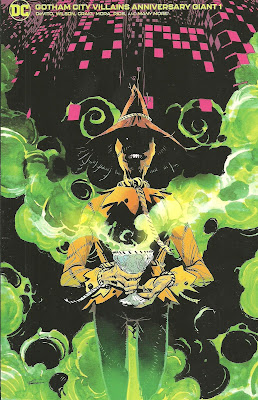
Gotham City Villains Anniversary Giant #1 (DC) The Penguin first appeared in 1941, making this his 80th anniversary, but DC apparently decided he didn't deserve his own 80th anniversary one-shot anthology special like The Joker and Catwoman did, and so he's sharing what should be his turn in the spotlight with a host of other villains whos first appearances fell in other years. These include The Scarecrow (1941), The Mad Hatter (1948), Killer Moth (1951), Poison Ivy (1966), Ra's al Ghul (1971), Talia al Ghul (also 1971) and, in the most perplexing inclusion, The Red Hood (1951).
As you see, some are celebrating their 80th anniversary, a few their 70th and a few others their 50th, while the other characters are there mainly by dint of, I don't know, basically by being Gotham City villains but not being The Joker or Catwoman...? Well, that's not quite true. Several of the short stories end with boxes explaining where the characters will appear next, which perhaps goes some way toward explaining why, for example, both Ra's and Talia are included in their own individual stories.
Personally, I would have been a-okay with The Penguin and The Scarecrow each getting their own 80th anniversary anthology one-shot. I'm sure it wouldn't be difficult to find the talent to provide ten or so short stories featuring each of those characters and, given their various depictions over the decades, having stories distinct enough from one another to make for a compelling special. (I'm not much of a fan of the al Ghuls as characters, but I'm sure they could have also easily have inspired a collection of their own; Killer Moth and The Red Hood? Maybe not.)
But whatever; I'm a reader, not an editor.
As such, I found the contents of the book always interesting, if not always great.
The format is essentially a short story featuring each villain, usually running around 12 pages, but with some exceptions (The Mad Hatter and Killer Moth stories only run six pages apiece). Each villain is also spotlighted in a pair of pin-ups; one is a recycled image, usually from a past cover, the other is an original piece (The Scarecrow, for example, is featured on a Tim Sale splash page from Batman: The Long Halloween, as well as an original image by Khary Randolph and Emilio Lopez).
The most noteworthy creator involved is probably actor Danny DeVito, the only actor to portray The Penguin in a feature film so far. He pens a weird story called "Bird Cat Love" in which the criminal mastermind is paramour to The Catwoman and, together, they use their genius for crime to forge a relationship and a better world, curing the coronavirus pandemic in the mean time. I kept waiting for a dream-sequence reveal, but it never comes. It features some nice art by Dan Mora.
My favorite stories were Wes Craig's Scarecrow story and G. Willow Wilson and Emma Rios' Poison Ivy story. The former features the the fear-obsessed villain turning his attention from his fellow king of fear Batman to a more fearless opponent, Nightwing, while the latter has Ivy in pure-ecoterrorist mode; both feature some really gorgeous artwork. (The latter also features Rios drawing a prehistoric creature which I am pretty sure is meant to be a Chalicothere, which looks a bit like a cross between a horse and a gorilla. They're rad-looking animals).
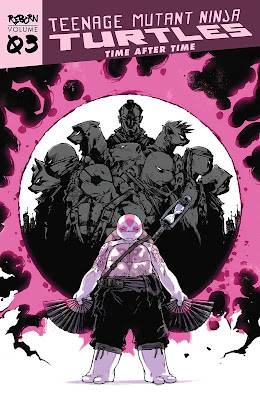
Teenage Mutant Ninja Turtles: Reborn, Vol. 3—Time After Time (IDW Publishing) This was a less-than-ideal reading experience for me, as it collects books from during the time I was transitioning from reading the book serially to reading it in trade. It collects issues #112-#117; I had previously read three issues of it as they were individually published, but the rest was new to me (This being IDW, I'm not sure why my shop wasn't ever able to get me this on a monthly basis, but whatever; I'm officially all-trade now).
The bulk of the volume is drawn as well as written by Sophie Campbell; just the first collected issue is drawn by Jodi Nishijima, whose style complements Campbell's quite well.
While the Splinter Clan and their allies continue to try to make a difference in Mutant Town and make it a proper, livable community, they keep getting interrupted by what Mona Lisa derisively refers to as "ninja baloney." Here that ninja baloney involves Lita from the future stealing the time scepter from Renet and travelling back to the present—in a scene that nicely echoes Renet's own introduction way back in 1986's TMNT #8—in order to stop the Splinter Clan from, um, splintering, which leads to a nightmare future for them all. The key? Jennika must form a band (And, um, some other stuff).
Meanwhile, Campbell finally gets to introduce her versions of Tokka and Rahzar from 1991's TMNT II: The Secret of the Ooze into the IDW continuity. First they fight the Turtles, then Rocksteady and Bebop show up for a fight that I'm sure plenty of old-school TMNT fans dreamed of seeing for a long time.
While there's a big fight, the conflict is ultimately resolved in a battle of the bands.
I like the way Campbell draws music. There are white motion lines around the instruments and, because for Jennika being good at guitar means channeling her darkest feelings into the music and releasing them that way, there are, like, waves of flashback imagery that flow out of her instrument. It's a neat way to depict something notoriously difficult to communicate in comics, and I'd recommend checking out Campbell's strategy for anyone trying to figure out how comics can depict music.
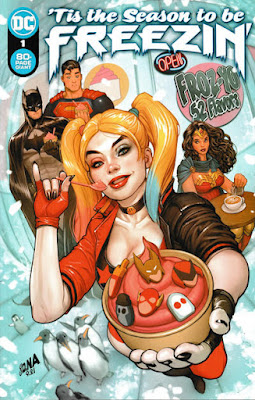
'Tis the Season to Be Freezin' #1 (DC) The theme for this year's DC holiday anthology special seems to be stories featuring characters with freezing powers (Mr. Freeze, Killer Frost, Polar Boy, Blue Snowman, Captain Cold, Minister Blizzard and Icemaiden), except when it doesn't (Vixen and The Super-Pets vs. The Penguin, Bizarro World)
There are eight, ten-page stories in all.
The Batman: The Adventures Continue writing team of Alan Burnett and Paul Dini and artist Jordan Gibson collaborate on story set in the Animated Series continuity, in which Robin Tim Drake is looking for a perfect gift for his billionaire farther figure when Mister Freeze launches an attack for a typically sentimental reason. This is probably my favorite story in the collection.
The Tee Franklin/Yancey Labat story that follows seems...wrong in one weird respect; so much so that I'm not sure how it made it all the way into print. It pulls from the DC Super-Pets continuity, but is drawn in realistic, DCU house style, rather than Art Baltazaar's style. The Penguin has captured The Super-Pets—with the line-up here including Krypto, Streaky, Beppo and Flexi—and put them in tubes, through which he plans to drain their super-powers and give them to Waddles, his penguin hench-bird (It's a set-up reminiscent of the first appearance of Amazo). But when Waddles attacks a town and Vixen and Ace, The Bat-hound swoop into the rescue, Waddles is using...Green Lantern's energy powers? For some reason? (Probably shoulda put Bad'g in one of those tubes, right?).
This one honestly just confused me.
Similarly disappointing was Amedeo Turturro and Jason Howard's "Bizarro V. Seasonal Depression: Dawn of Climate Change" story set on htraE that I honestly couldn't get through. It's heavily narrated by Lex Luzorr in bizarro-speak, and as much as I love that gag, I couldn't stand the tsunami of it that filled those panels. I only got about three pages through that story before I gave up.
Jeff Trammell and Justin Mason collaborate on "Stay Frosty," in which Firestorm (The Ronnie Raymond/Jason Rausch combination version) shares Justice League monitor duty with former Leaguer Killer Frost, and he remains suspicious of her change of heart the whole time. It's a nice portrait of Ronnie as a big dummy, and a reminder that Steve Orlando's short-lived Justice League comic actually happened, I guess.
Rich Bernatovech, Travis Mercer and Norm Rapmund present a Polar Boy story in which he goes on a date with Comet Queen and encounters a villain with the ability to control, but not create, ice, which must be a little underwhelming as a power in the 31st century, especially if we failed to fix climate change in the centuries between now and then. I liked the art okay on this, but Legion stories don't generally do much for me; I've never really been at home with the milieu.
Writer Tara Roberts and artist Eric Battle present the story I was most looking forward to, a Harley Quinn story featuring a team-up with minor Golden Age Wonder Woman villain The Blue Snowman, who I've been intensely curious about since I first heard of her...or them, as she's pronoun-ed in this story. Unfortunately, Battle's art is a bit messy and hard to follow, something not helped at all by the relatively small panels that make up a majority of the story. This one seems to sacrifice some legibility while trying to fit a slightly too-long story into the space of just ten pages. The Snowman is drawn in a version of the snowman-themed robot battle suit she/they first had in...I want to say an issue of Power Girl, maybe?...and seems to have rather generic freezing powers associated with it. This story is also, weirdly, a Hawkman team-up, and also features Poison Ivy...it's doing a lot, really, in too little space.
The Bobby Moynihan/Pop Mhan story that follows, featuring Captain Cold and The Flash, is so-so, but I did love the last two panels, in which Santa Claus himself offers his opinion on the so-called Fastest Man Alive.
The final story is another anthology outing for The JLQ by writer Andrew Wheeler, here paired with artist Meghan Hetrick. I kinda like the concept of the JLQ as an unofficial non-team, a community of friends that kinda hangs out together and then gets attacked by supervillains (as any gathering of two or more superheroes inevitably must), rather than as an official team with a headquarters and such, though I get the feeling if DC every greenlit a JLQ series, they could easily become an official team.
I'm still confused by the line-up—I have a hard time seeing The Ray as queer, for example; the last Ray issue I read was an "Underworld Unleashed" tie-in where he had a pretty "no homo" moment—but I suppose that comes in part from seeing so many of the characters name-dropped more than actually depicted.
The concept has potential, and I wouldn't mind seeing it developed, especially if Green Lantern Alan Scott and Obsidian are involved*. Here Minister Blizzard attacks them with Icemaiden (not Ice, but Icemaiden, whose adventures with Justice League America will never get reprinted based on their writer); she gets a new look and a new codename in this story.
So this was a rather typical hit-or-miss anthology, but I'm thankful to DC for publishing it, and publishing all the similar comics. They give me a reason to go to the comic shop, and will continue to do so as I transition to trades-only comics reading, I guess.
BORROWED:
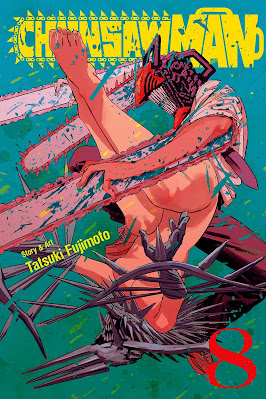
Chainsaw Man Vol. 8 (Viz Media) The increasingly long and detailed section at the beginning featuring a character guide and the story so far is becoming more valuable as the series goes on and gets more complicated. This volume continues a battle royale between Denji and Public Safety and the several bizarre assassins who have come to hunt Denji down.
Here a huge swathe of characters get sent to hell, depicted as a wide open field with a sky made completely out of doors, where they face the Darkness Devil, a bizarre looking foe who is ridiculously powerful, taking away all of their arms from them with but a gesture, for example.
Back on Earth, Denji and the others face a newly, bizarrely empowered Doll Devil, who reminded me quite a bit of the Masters of The Universe action figure Modulok...in a good way. Something of a puzzle of limbs, bodies and heads a kid could build into various forms, Modulok was a cool and slightly terrifying toy; the Doll Devil is an extremely cool and even more terrifying character.
It's a pretty metal comic. As the Doll Devil receives power from the Darkness Devil, our hero—who, remember, is made of chainsaws—douses himself with gasoline, lights himself on fire and then attacks as a guy made of chainsaws
and also on fire.
Justice League: Endless Winter (DC Comics) This book collects the recent "Endless Winter" storyline by writers Andy Lanning and Ron Marz, a sort of mini crossover event that ran through a handful of specials (
Justice League: Endless Winter #1-2,
Superman: Endless Winter Special #1,
Black Adam: Endless Winter Special #1,
Teen Titans: Endless Winter Special #1) and a handful of issues of ongoing titles (
Aquaman #66,
Flash #767,
Justice League #58,
Justice League Dark #29).
The point of the exercise seems to have been to give the Justice League something to do while the book was in a thumb-twiddling phase between the conclusion of Scott Snyder's run and before the beginning of Brian Michanel Bendis'. The story reads very much like the sort of fill-in stories that appeared in previous Justice League collection Galaxy of Terrors, but I suppose an editor somewhere noticed that it involved the whole world in peril, and decided it could be expanded a bit into an event of sorts.
It reads that way, too; one could read the two Justice League: Endless Winter specials back-to-back and get essentially the entire story, perhaps only missing some the nuances of the flashback storyline; the somewhat flabby middle of the book involves a lot of the various heroes chasing their tails and dealing with side-quests as they seemingly await the climax.
The story is pretty simple. An evil corporation (Stagg Industries, now run by Simon's son Sebastian...say that five times fast!) is doing exploratory drilling in the Arctic Circle at the site of Superman's old, destroyed Fortress of Solitude. During the process, they awaken the Frost King, a millennium-old super-powered threat who has been super-charged by his proximity to Kryptonian technology. He promptly unleashes a worldwide global blizzard that threatens the Earth, and makes it more dangerous still by filling it full of monsters made of ice (I wonder if there were Republican politicians in the DCU who used this event as an excuse to say there's no such thing as global warming...?).
The Justice League—Superman, Wonder Woman, Aquaman, The Flash, Green Lantern John Stewart and Arctic Action Batman—prove no match against the Frost King during their first encounter, and then they lose him. They'll spend most of the rest of the volume looking for him and dealing with the symptoms of the his threat, before finally locating him in the book-ending issue of Justice League: Endless Winter to defeat him.
Meanwhile, the Frost King's extensive origin is told in a flashback sequence that runs throughout the collection. He was a 10th century Norseman who developed ice and cold manipulation powers, and when his fellow villagers turned on him and tried to kill him, they succeeded only in accidentally killing one of his young sons. This so enraged him that his powers grew in magnitude and he essentially threatened the world with his powers. A sort of Medieval proto-Justice League is formed to stop him, consisting of Hippolyta, Black Adam, Swamp Thing and The Viking Prince (and yes, I did half wonder if this entire storyline wasn't premised on keeping the copyright on Viking Prince going, but I don't really know how copyright works with superhero comics; it just seems like they need to use their most obscure characters every once in a great while).
I'm not sure how it would have read in single issues, particularly if one felt free to skip anything that looked superfluous (the Superman special stands out as not very important) and didn't interest them (I haven't really read anything featuring the current Teen Titans), but, as it is in the collection, it's a nice, refreshingly simple Justice League story that doesn't quite manage to justify its huge page-count and the number of digressions it takes in its many tie-ins.
The art is, naturally, all over the place. An awful lot of it (the first Justice League special and much of the second one) is drawn by Howard Porter, who at this point is about as definitive a Justice League artist as there is. Marco Santucci draws the flashback sequences to Hippolyta and company's first battle with the Frost King. There are ten other credited artists, all of whom are good, but each of whom works in their own style, so the book can't help but look confused and visually incoherent; readable, sure, but without a single voice or aesthetic.
Oh, and Catman's in it. I always liked that guy.
Little Lulu: The Little Girl Who Could Talk To Trees (Drawn & Quarterly) This third collection of John Stanley's
Little Lulu comics work takes its name from one of the rambling stories the heroine occasionally tells little neighbor kid Alvin, usually to shut him up or to distract him from some sort of unwanted behavior. I'm not really a fan of those stories within the stories, of which this collection seems to contain more than the previous two. I prefer Lulu's frequent battles with the neighborhood boys and, especially, her interactions with Tubby. There are still more than enough of those contained within to make this book worthwhile.
In fact, it's hard to imagine any way to spend time that is more worthwhile than reading or re-reading old Little Lulu comics...
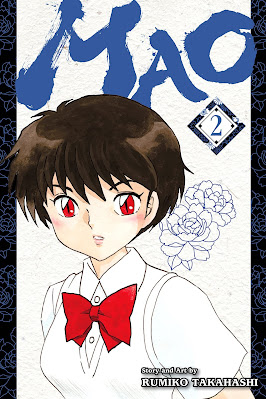
Mao Vol. 2 (Viz) The second volume continues time-traveling school girl Nanoka and early 20th century exorcist Mao's investigation into a deadly cult lead by a priestess who may or may not have actual supernatural powers.
The other menaces encountered include giant flea monsters that disguise themselves as Christian nuns—a great, slightly unsettling image—and little flaming heads that appear during the great Kanto earthquake.
The quake seems like it may be part of the mystery regarding Nanoka's strange past and hinted-at powers and her connection to Mao, but manga-ka Rumiko Takahashi is still just slowly, carefully distributing clues as to the greater story regarding her characters, while the focus of the manga appears to be their day-to-day adventures.
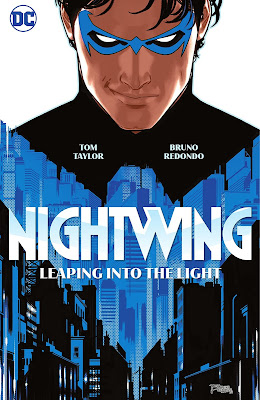
Nightwing Vol. 1: Leaping Into the Light (DC) The former
Injustice team of writer Tom Taylor and artist Bruno Redondo's new volume of
Nightwing features a few returns to familiar status quos for the character (he's back in Bludhaven, Blockbuster is once again Kingpin to his Daredevil) plus a few new plot points of the sort one might expect at the beginning of a new run (Dick has adopted a new dog, there's a colorful new villain, the daughter of Tony Zucco has just been elected mayor of Bludhaven and, thanks to an unexpected inheritance from the late Alfred Pennyworth, Dick is now a billionaire).
While all of that is necessary and keeps the comic moving at a quick clip, none of it is what makes the book such a refreshingly fun read. Rather, Taylor writes the hell out of the character of Dick Grayson—which, granted, is a little easier post-Death Metal, with continuity, and thus the character's history, restored. Dick's a likeable character with lots of connections, some of which we see explored at length here—Barbara Gordon and Tim Drake are essentially supporting characters in this first chunk of the series—others just in passing (a brief rooftop visit with Superman, a three-panel phone call from Batman, an attempted rescue from the Titans), making him something of the heart of the Batman franchise and the DC Universe in general, if he's allowed to be. Taylor allows it.
Taking some inspiration from Scott McDaniel, probably the artist most associated with a Nightwing solo title, Redondo's portrayal of Dick's urban acrobatics involves lots of scenes where the character is depicted in various stages of his jumps and attacks all in the same image. Unlike McDaniel, however, Redondo has a much more realistic style, and his depiction of Dick Grayson, in street clothes or in costume, is handsome, even sexy, and highly expressive; it's not hard to see what the book has delighted so many fans.
Me, I found the little touches Redondo and Taylor add to be the most appealing—Dick and Babs' embrace of irony regarding pop culture's depiction of their mentor, the revelation of a Bat family group chat (and, in particular,
the way Cass uses it) and so on. I've always liked these characters, and Taylor writes them in such a way that they feel like themselves, and they have time to breathe and just...be themselves that gives the reader the impression that they're just hanging out with them, even if that just hanging out tends to be brief. (There are still, of course, plenty of fights and superhero stuff, but the focus of the book isn't on that business; those are sub-plots in the ongoing story of what Dick Grayson is going to do with his life to help his adopted city, given that he now has the power to do more than just hit bad guys on the head with his sticks).
This is, you'll note, in the "borrowed" column, because I wasn't sure I would like it enough to own it. Now I kinda regret not buying the trade though. It's really good super-comics.
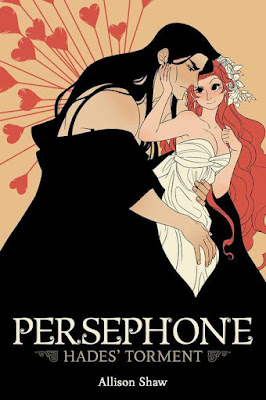
Persephone: Hades' Torment (Seven Seas Entertainment) Artist
Allison Shaw's gorgeous, slightly horny remix of various Greek myths has something of an aura of fan fiction about it, particularly of the shipping variety, but then, that's me reading it in the 21st century; one could just as easily note that the particular ship at the heart of the book is a centuries-old myth, and it has the aura of literary homage to it. There's just something about how...sexy she makes dark, brooding, sensitive-but-closed-off Hades and bubbly, earthy, open Persephone.
Shaw's designs for all of the characters—which includes Diana, Apollo, Eros, Aphrodite, Zeus, Hermes and Demeter—are exquisite, having the bright, bold, simplified look of animated characters, and most having a thoughtful design that differentiates them from merely generic portrayal of Greek gods and goddesses (I was particularly fond of her Diana; the title characters are also both great**).
The book follows something of romance novel rules in terms of the number of sex scenes and how they fall, but I should note that as erotically charged as those scenes are, the book is far more classy than smutty, and shouldn't cause too great a stir on a library shelves unless the wrong people get a hold of it and focus on the wrong page or two.
I'd highly recommend it, and highly recommend keeping an eye on this Allison Shaw character; I think she's going places.
Suicide Squad Vol.1: Give Peace a Chance (DC) Well this is just a
mess.
I think the main problem is that the first two issues of the collection aren't actually the first two issues of writer Robbie Thompson and too-many-artists' new volume of Suicide Squad, but rather are unlabeled Future State: Suicide Squad #1 and #2 (the fine print on the title page doesn't mentioned them at all; according to that, this book actually just contains Suicide Squad #1-6, which it clearly doesn't); I just happened to remember one of the covers for that two-issue miniseries because I read the solicitations pretty closely each month they come out to write about them.
These are actually the first Future State comics I've read, and I'll be damned if I can explain them. There's a text box that has some meaningless words in it—"From the ashes of Death Metal comes new life for the Multiverse--and a glimpse into the unwritten worlds of tomorrow..."—and from what I can gather these comics were meant to be the next chapter of the DC Universe (the proposed then scrapped "5G" business), but most writers recycled many of their proposed ideas anyway, making them into something of a possible near-future that contain elements that will play out in the main series that followed them...? Is that right?
Making the Suicide Squad Future State comics even more confusing is that the story is set on Earth-3...but a new Earth-3 unlike any of the others we've seen before, and one that seems to have lost its defining characteristic of being the opposite of the DCU Universe's Earth-1/Earth-O/Whatever. And also now people can't survive outside their own Earth very long without succumbing to a melodramatic coughing death....except when they can...?
So we meet The Justice Squad, a faux Justice League that the "real", DCU Amanda Waller set-up on Earth-3, consisting of former Superboy Conner Kent as Superman and a half-dozen or so villains posing as Justice Leaguers (If this is Earth-3, then why there would be the need for a faux League rather than a faux Crime Syndicate is lost on me). They are pursuing a few villains, who may or may not be villains (this is Earth-3, remember) and may or may not be from this Earth: Sinestro, Brainiac and Mongal.
Then the Suicide Squad, the one from the the Earth that the DCU mainly occupies shows up to bring Waller back to their own Earth. It's 40 pages during which I had no idea which Earth anyone was from, or why Thompson was using the Earth-3 concept the way he was.
Then Thompson's Suicide Squad run starts for real. On page 41 of the book.
I'd like to say it gets a great deal better, but that's not entirely the case. The new point-of-view character is Peacemaker, chosen, presumably, because he's in the movie.
Most of the first six-issues of the new series involve him and a few mainstays—Superboy Conner Kent, Nocturna and brand-new character Culebra—attempting to get new recruits. They invade Arkham Asylum to get one of the Court of Owls' Talons during the events of "A-Day" as seen in Batman and Infinite Horizon #0. They go to Titans Island from the pages of whatever Teen Titans books is being written to resemble Grant Morrison's X-Men now (Teen Titans Academy?) to get someone named Bolt (who was The Flash in the Future State's Justice Squad), but end up nabbing Red X instead (that occurs in a crossover issue that's not collected here (but we're told to "see Teen Titans Academy #3" in a text box).
The scene then shifts to Earth-3, where Bloodsport, also presumably included because he's in the new movie, takes over as narrator. He's outfitted in his movie costume, and says he's Waller's interdimensional operative, seeking potential recruits in alternate dimensions. He's about to snag Earth-3's Black Canary Black Siren when he runs afoul of the new Ultraman—the Crime Syndicate is all-new again—and needs the rest of the Squad to save him.
And that's the first volume of Thompson's Suicide Squad. There's an intriguing last-page cliffhanger, but I'm not so intrigued that I would want to wade through any more of this to see what it's all about.
The art is as messy as the plot and presentation, with three pencil artists, four inkers and two colorists for the eight issues. It's readable, but sometimes only just.
Zom 100: Bucket List of the Dead Vol. 4 (Viz) Akira, his best friend Kenichiro and the gradually mellowing out survivalist Shizuka add a new member to their party when they meet Beatrix Amerhauser, a young German Japanophile who was in the process of fulfilling her lifelong dream to visit Japan when the apocalypse broke out.
They interrupt their quest to check on Akira's family in the country to help Beatrix with a side-quest—delivering fresh fish to what may be the last surviving master sushi chef in Japan—that also happens to fulfill one of items on Akira's apocalyptic bucket list.
The inclusion of the new recruit gives a greater emphasis on some of those items on the list that are particular to Japan, like visiting a hot springs resort, as they do in this volume, and gives them the teams necessary muscle they need to fight off groups of, and in one case, a whole horde of, zombies.
By volume's end, they arrive at the remote village where Akira's parents live, and find it's so remote that it's more or less a perfect place to spend the rest of one's life when the world is overrun by zombies. However, such refuges are always imperiled by malcontents in the movies, and that appears to be the case here, too. The tropes of zombie movies drive the background action of
Zom 100, after all, while the completion of the list drives the heroes through the milieu.
REVIEWED:
Batman & Scooby-Doo Mysteries Vol. 1 (DC Comics) No you're not experience deja vu; this book is appearing twice in this particular post, because I bought a copy of it for myself, an thus it fell under the "bought" portion of the column, and
I also reviewed it for Good Comics For Kids, and thus it now falls under the "reviewed" portion of the column.
As I mentioned in that review, the Batman/Scooby-Doo team-up tradition is now 49-years-old, stretching back to 1972's New Scooby-Doo Movies two episodes featuring the Dynamic Duo. That means next year is the 50th anniversary of the Batman/Scooby-Doo team. I wonder what DC is planning to do to celebrate? After all, they devoted a year-long series to the team-up this year, so it would have to be something bigger than that, right?
If I had a genie that granted only very specific, comic book-publishing wishes, here's what I would wish that DC would do next year: A big, huge original graphic novel in which the greatest and/or most popular Batman creative teams contributed original stories teaming Batman and Scooby-Doo, with the artists drawing the Scooby gang in their own particular styles.
So, for example, you'd have Scott Snyder and Greg Capullo, Grant Morrison and Andy Kubert, Jeph Loeb and Tim Sale, James Tynion IV and Guillem March, Paul Dini and Ty Templeton, Scott Peterson, Kelly Puckett and Damion Scott, maybe Neal Adams, someone (Sholly Fisch? Devin Grayson?) and Kelley Jones, and so on, all under an Alex Ross-painted cover. Or maybe a Frank Miller cover; a Frank Miller Scooby-Doo would be something I'd certainly like to see. Wouldn't that be fantastic?
Anyway, it's always struck me as weird that DC Comics has the license to publish Scooby-Doo comics and they are always, always, always visually in the style of the cartoons and never anything more fun or adventurous, as one sees with, say, Simpsons comics or SpongeBob comics, you know? Given the popularity of the Scooby-Doo characters across generations of fans, I'm kinda surprised we don't have, like, Scooby-Doo: Black and White-style anthologies, you know? Surely there are dozens of artists who would love to get paid to do Scooby-Doo and company in their own style professionally, right?
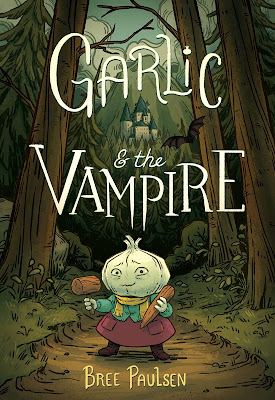
Garlic & the Vampire (Quill Tree Books) Cartoonist Bree Paulsen presents a well-made, gentle fairy tale about facing your fears that stars a little bulb of animated garlic confronting what may or may not be a blood-thirsty vampire who may or may not mean ill for her community. More
here.
*They do
make a cameo in a panel here, and I'm not sure I can make sense of why Alan seems to be dressed like a reindeer. It is very hard for me to imagine either of my grandfathers doing that, which is basically how I judge the realism of the behavior of the Golden Age heroes.
**I've personally always imagined Persephone as more goth, pale and with dark hair and eyes, but Shaw's depiction of her as opposite of Hades in almost every imaginable makes sense to me, especially in a story about their unlikely attraction to one another.


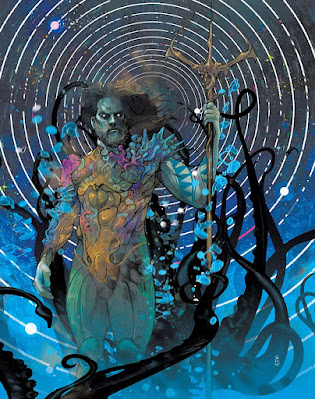 So CBR's headline for their posting of DC's May solicits said "Aquaman Goes Adults-Only", which sure made it sound like we'd be getting some kind of Aquaman porn comic, but apparently they were simply referring to Aquaman: Andromeda #1, a prestige-format, 17+ sci-fi horror comic starring the Atlantean Ace.
  One of the stories in Batman anthology Batman: Urban Legends #15 is, as artist Riley Rossmo's variant cover makes clear, a Batman/Plastic Man team-up. I'm pretty tempted to buy the issue just for that, even though it's not clear whose responsible for it (Rossmo's not listed as an interior artist, but he does a pretty neat Plas, huh? I bet he'd be well-suited to the character, based on what I've seen of his work elsewhere). I suppose it will show up in a trade I could just borrow from the library eventually though, huh?
 I find this genuinely interesting. DC is publishing a $35, 360-page trade collection entitled Black Adam: Rise and Fall of an Empire that is essentially all of the Black Adam bits from 52 extracted from that series and then reassembled to tell just that one storyline from the ensemble book.
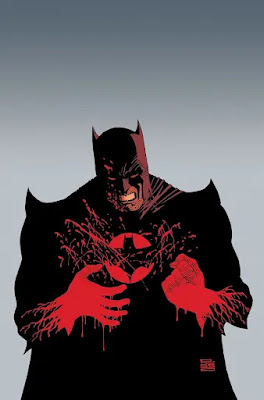
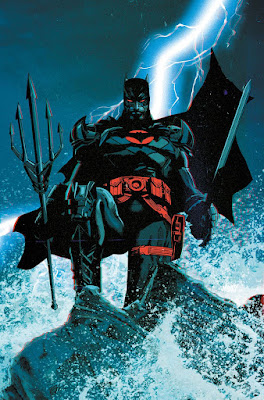
  Based on Howard Porter's cover for Batman #123, it looks like Prometheus has a role of some kind to play in the ongoing Batman event, "Shadow War." Poor Prometheus. The guy took on—and almost took down—the entire JLA in one of his first appearances, and he's been fairly ill-used ever since the last time his co-creator Grant Morrison wrote him, in JLA arc "World War III". Now the one-time anti-Batman and League-level threat appears to be just another Batman villain.
  I've been waiting a long time for Sam Hamm and Joe Quinones' collected Batman'89. Not simply since it was announced, but more like 33 years.
 This Earth-Prime series starring the heroes of the CW TV shows based on DC Comics is not for me, but, again, I'm a big fan of cover artist Kim Jacinto's work. If Jacinto were drawing the interiors, I might actually be tempted to pick one of these up. (Who is the scary-looking alien on the Legends of Tomorrow issue, by the way?)
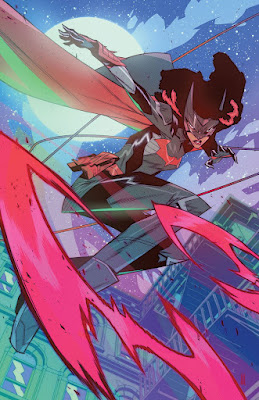
 Rossmo draws a pretty great Batwoman, too. This is his cover for Harley Quinn #15.
 Juan Gedon and Daniel Warren Johnson achieve a sort of perfect balance between incredibly dumb and totally awesome with Jurassic League #1, the first issue of a miniseries which casts the Justice League as anthropomorphic dinosaurs. It's a genuinely great idea for a one-shot, but this sucker is going to be six issues long. Its going to have to be extremely well-made then, to justify its continued existence after the shock of the title and concept wears off.
  They're really embracing the Nightwing-as-a-source-of-beefcake thing, huh? This is a variant cover for Nightwing #92.
 Robin #14 is the seventh chapter of the "Shadow War" event. I'm not sure if Connor Hawke is even in the story or not, but he is on this Dexter Soy variant cover for the issue, and I like that Connor Hawke fellow.
 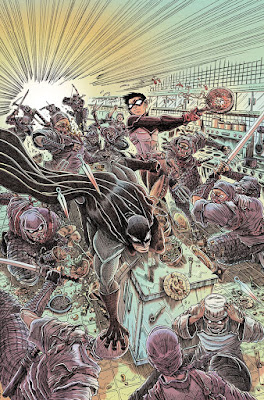 The great James Stokoe provides a cover for the goofily titled Shadow War: Omega #1. He provides just the cover though, so don't get too excited.