Sunday, November 15, 2020

A Month of Wednesday: August 2020


BOUGHT:

The Harrowing of Hell (Iron Circus Comics) I've been fascinated by the story of the harrowing of Hell ever since I first heard of it. Cartoonist Evan Dahm mentions in his brief afterword that he grew up reciting a version of the story in church, in a few vague snippets of the Apostle's Creed: "[Jesus Christ] suffered under Pontius Pilate,/was crucified, died and was buried:/he descended into hell; on the third day he rose again..." 

Although it is a tenet of Christian faith, the story doesn't appear in any of the canonical books of the Bible; in the four gospels, the action never leaves the plane of Earth, and whatever happened to Jesus between his death and resurrection is left to the imagination of the reader. The apocrypha is another matter, and there are accounts of Jesus' descent into Hell in such writings as The Gospel of Nicodemus. In the Middle Ages, passion plays built up a whole tradition around Jesus time among the dead, in which he descended into Hell, freed the virtuous pagan dead and, in some tellings, defeated and chained Satan and the demonic jailers. 

I suppose that's why the stories have fascinated me; they are among the ultimate untold stories embedded within perhaps the best-known, oft-told story in human history, and they feel like secrets, or, perhaps, deleted scenes. Or, to use comic book terminology, they feel a little like Biblical Elseworlds or Imaginary Stories, you know? 

I first heard of Evan Dahm's graphic novel while writing about Jeff Loveness and Jakub Rebelka's Judas, which follows the most problematic disciple into the afterlife, and rather unexpectedly intersects with a version of the harrowing story (If you liked Judas, I'd recommend this book, and if you like this, I'd recommend Judas; they both cover some similar ground in terms of Christianity as story).   

Dahm's book opens with a pair of quotes that encapsulates the contradiction that it will spend its page count chronicling and wrestling with. The first is from Tolstoy's The Kingdom of God is Within You, regarding how Christianity abolishes the concept of government; the other is from Eusebius Pamphilus' The Life of The Blessed Emperor Constantine,  and notes what is ultimately the turning point in Christian history, when the emperor adopts Christianity, making it the official religion of the government that once tried to stamp it out, a government that ultimately shaped Western history:
He saw with his own eyes the trophy of a cross of light in the heavens, above the sun, and bearing the inscription, Conquer By This. 
That spelled out, Dahm will shift from scenes on Earth and in Hell, those on the former plane each set in a particular city, its name spelled out over a two-page establishing shot. The first of these is Jerusalem, wherein we see Pontius Pilate's questioning of Jesus, followed immediately by the crucifixion and Jesus awakening in Hell.

Dahm's Christ is a small, unimposing man, less Samson than David from the Goliath story, with big, wide eyes, messy, curly hair, a beard and a round nose; he's drawn in quite sharp contrast to the smooth-faced, almost statuesque Pilate and the Roman soldiers that attend him. 

The art is all presented in black and white and red, with that last color used for emphasis; the robes of Roman soldiers, the cross, the round wounds on Jesus' wrists, the landscape of hell, Lucifer and, ultimately, the red on the banner of heaven a militant Jesus waves in a scene in which the devil explains how humanity will want to see Christ, these are all rendered in red; red, then, is the color of opposition to Jesus. 

After his death, on his way down toward the red hellmouth, Jesus sees a valley of churches and temples, each topped with a cross, a symbol of his death, and the world's rejection of him. His journey through Hell, facing the creatures that live there and freeing, or attempting to free, all those imprisoned there, is intercut with scenes from his ministry on Earth: Talking in parables about why he talks in parables to his disciples on the sea of Galilee, healing a faithful blind man in Bethsaida, clearing the moneychangers from the temple and then arguing with the Pharisees there. 

The crux of the conflict comes when Jesus stands before the devil figure, the one he calls "adversary" (and thus we'd call Satan), who looks like larger, redder, more abstracted Pilate. It is he who names Jesus "Christ," which Jesus doesn't want to be called, and through this Satan Dahm draws a connection between Jesus' temptation in the wilderness, when the devil takes Jesus to a mountain top, shows him all the kingdoms of the world, and tempts him, "All this I will give you, if you bow down and worship me." 

Jesus refused in the Bible, of course, but, as The Harrowing of Hell notes, through the events of history, Jesus received "all the kingdoms of the world" as his own anyway...or at least all of the Western world's  kingdoms for a time, and, indeed, much of the world still belongs to Jesus. 

Theology as comic book, I don't think Dahm necessarily comes to a conclusion regarding whether Jesus was wrong or Jesus had failed, certainly not so much as he comes to various observations, pointing out the ironies of history, and humanity's blockheadedness, something Jesus faced during his earthly ministryas we see during Thomas' questioning of him, or that of the Pharisees or Pilate in this bookand which his message continues to run up against today.

 Dahm's story, with all of its heady ideas, is beautifully, elegantly, simply told. The subject matter may be extremely weighty, but the book is a deceptively fleet read, and one that requires and rewards re-readings. I was quite struck by much of the imagery, and how it integrates element of the Bible and later Christian tradition (many of the demons of Hell resemble giants with clams for heads...although their heads echo Dahm's design of the hellmouth Jesus entered; they are, then, literal citizens of Hell and, it turns out, all mouth, no eyes or ears). 

Similarly, there's a great moment where Jesus rends a veil of fabric as he prepares to ascend back to Earth, awakening in a sort of large stone coffin as if it were a horizontal doorway to and from the land of the dead; this image is from the crucifixion narrative, as when Jesus dies the veil in the Temple, the one between most of mankind and the Holy of Holies, was torn in half. It's just a panel, but it's a great one. 

I'm curious how much resonance this will have with readers without Dahm's, or even my, background with Christianitythat is, people who didn't grow up reciting the Apostle's Creedand I'm equally curious about how certain Christians, the sort who might be distressed to hear that every twist and turn in history wasn't necessarily part of God's plan, and that we humans seem to fuck up a lot when it comes to making sense out of what Jesus was telling us, will receive the questions Dahm raises.

Wherever you fall on that spectrum, I think this was a very thoughtful, very well-made comic, and one of the better ones I've read this year. 


Jack Kirby: The Epic Life of The King of Comics (Ten Speed Press) I had pitched a review of Tom Scioli's Jack Kirby biography to The Comics Journal, but it had already been assigned to someone else, a fact that I ended up being rather glad of. First, I think Matt Seneca is probably a better comics critic than I, and his piece ended up better than mine would have; secondly, it meant I could enjoy reading a review of the book; and, finally, it meant I could turn my critic's brain off (to the extent that doing so is ever entirely possible; perhaps turning it down is more accurate) and enjoy Scioli's loving biography as a comic book meant simply to be read and enjoyed, rather than a work that had to be analyzed and eventually critiqued. 

And I did enjoy it quite a bit. In fact, I suppose there's another reason to be glad I didn't get assigned a review of itmy review would likely have been embarrassingly gushing, I dug the book so much. Tom Scioli should need not introduction to readers of this blog, as if you've been reading EDILW for very long, you've seen me ranting and raving about each and every issue of Transformers Vs. G.I. Joe and The Go-Bots for IDW and his Super Powers back-up in the first few issues of DC's Cave Carson Has a Cybernetic Eye book. Scioli's also responsible for American Barbarian (which was my introduction to his work), as well as the more straightforward Kirby riffs Godland and The Myth of 8-Opus

That last book was actually the first I had ever heard of Scioli, having seen him selling it at comic conventions, and it was his very earliest work. It is therefore pretty safe to say that Scioli has been a Kirby fan all his professional life and, beyond that, Kirby's work has informed his own in an even more direct fashion than Kirby's work has informed most American comics artists (It is nigh impossible to overstate Kirby's influence on the American comics industry, and I'm quite sure there are artists whos work owes great debts to Kirby's who aren't even aware of his influence on them, so much has he permeated the field at this point).

In short, it's hard to think of a better, or more interesting, choice for a cartoonist to tackle a Jack Kirby biography. Not only does Scioli's own particular style mean that there is a lot of Kirby style in the book about Kirby, but there are countless instances of Kirby's art appearing within the panels of the book, instances where Scioli's ability to work as a Kirby clone when necessary or desirable is perfect for the book. Sure, many talented artists can ape Kirby's style, but Scioli can inhabit it. 
In terms of tackling the subject matter, of which there is a lot, Scioli chooses the interesting route of having Kirby serve as narrator. The very first panel begins with narration, "My folks were from a part of the Austro-Hungarian Empire called Galacia," and the entirety of the book is basically formatted around Kirby telling the reader his life story, hitting all of the more important bits, but without getting too deep into any particular rabbit holes.

So, for the most part, it reads like a string of anecdotes, reassembled into a narrative. Many of the stories were familiar to me, and will be to other readersscanning the bibliography, I recognize books I've read like David Hadju's The Ten-Cent Plague, for exampleand, indeed, may be stories you've heard second- and third-hand repeatedly, like how much Kirby's experiences with neighborhood kid gang battles influenced the big city-as-urban playground nature of the rooftop-running superhero, or of Nazi-sympathizers calling into the offices of Timely/Marvel and Kirby offering to meet them outside to fight them, the creations of characters and books and genres, the first meeting with Stan Lee, an annoying office boy who played a flute, the bitter struggles with Stan Lee and Marvel near the end of his career and so on.

There was also a great deal I had never heard, and I had never really read these stories in this sort of context or in the shape of a story before. It would be too easy to say that Kirby lived the sort of life that was every bit as dramatic as those of the heroes who he created, and it wouldn't be accurateso many of his characters were so over-the-top that of course Kirby's own life couldn't compare with their cosmic doings, but there are four or five different book's worth of life story in Kirby's life, and Scioli does a fine job of compressing them into a single, relatively short (at 190-pages) and fast-moving story.

The Kirby telling his life story directly to the reader conceit is only broken three times. Twice it was broken to allow for other narrators to tell their side of the story. The first is a page devoted to Rosalind Goldstein, who would become his wife Roz Kirby; the gets a six-panel page in which she tells of how they met one another, and how he invites her up to his room to see his etchings: "I was disappointed," she narrates. "I thought he wanted to fool around. It was the first time I saw Captain America. I'd never seen a comic book in my life." (She'll return later to tell another anecdote)

The other goes to Stan Lee, who gets four pages to tell the reader what had become of Timely after Kirby left and before he returned. "That's how Jack remembers it, but neither one of us has a good memory," the Lee section begins, and it's a rather poignant passage, showing Lee's side of things. Because we mostly see Lee through Kirby's eyes, and the two would have such conflicts over the years, it was nice to see Scioli, and thus Scioli's Kirby, giving Lee, or at least Scioli's Lee, space to tell some of the story, even though we don't check back in on Lee much throughout, at least, he doesn't regain command of the narration boxes. As much as their stories intertwine, after all, this is Kirby's story.

I laughed out loud twice during the book, both times during Lee scenes. The first is of the flute scene, which I vividly recalled from Hajdu's book. I just love the idea of Lee irritating co-workers like Joe Simon and Jack Kirby at that early state, something that seems funnier when one realizes the antagonism that would follow.
The second scene I wouldn't share now, if this book hasn't already been out for months, for fear of spoiling it. When we see the adult Stan Lee, he looks like a balding, middle-aged, unremarkable man, completely unrecognizable as the guy who would go on to cameo in dozens of superhero movies over the course of the last few decades, looking infinitely more ordinary, and, oddly enough, older in the 1950s than he would look in the '00s (I had first learned who Stan Lee was in the early 1980s, so I had never known a mustache-less, bald Stan Lee).

Then there's this panel:
The final breaking of the format comes when Kirby dies, his death presented as an all-black panel with the date in the corner, after which the six-panel format changes to a 12-panel per-page one, and then Kirby returns for two more panels to speak an epilogue directly to the reader. 

Those 12-panel pages begin with a couple of immediate tributes to him, including a panel from Stan Lee and two of Frank Miller's euology, followed by images of the Dan Turpin-as-Kirby from Superman: The Animated Series, Stan Lee being a bastard/being Stan Lee, and then image after image of Kirby created or co-created heroes in films, demonstrating just how many goddam billions of dollars Hollywood had made off of Kirby characters in the past 20 years or so.

It's a really great book, and I think everyone should read it. 

...

(You know, as I am re-reading this post one last time before I hit the publish button, it occurs to me that I read three superhero comics in August, and all of them are based on Kirby's work. He co-created the Avengers, whose current line-up includes his co-creations Captain America, Thor, Iron Man, Black Panther and a distaff version of The Hulk; their base is in a Kirby-created Celestial; in one of the volumes they encounter The Silver Surfer, in another the Deviants from The Eternals appear. The Unkillables doesn't feature any Kirby creations among its many characters, although the premise for the entire DCeased franchise is that Kirby's Anti-Life Equation lead to a zombie apocalypse on Earth when his Darkseid and Desaad tried to control it.)


BORROWED:

Avengers By Jason Aaron Vol. 5: Challenge of the Ghost Riders (Marvel Entertainment) The focus shifts to Avenger Robbie Reyes, the newest Ghost Rider, in this volume of Jason Aaron's Avengers run, which is, for this collection at least, now mostly drawn by Stefano Caselli (Luciano Cecchio draws issue #24). I've mentioned before how it's kind of lame that the writer gets their name in the title of the collections, but the artists do not, right? It's kind of lame, but it's also kind of unavoidable, at least as long as Marvel never lets any books have a "regular" artist, instead switching them up every few issues.

After the events of the the third volume, The War of The Vampires, Robbie's not so sure about his Ghost Rider gig, and is ready to give it up for good after a strange, evil disembodied voice comes out of his hellchargernot that of his late, serial killer uncle Eli, but a new, different evil disembodied voicethreatening his little brother.

Turning to his super friends, Robbie hopes they can perform an exorcism on his car and free him of the his Ghost Rider curse, and they call in a specialist, The Son of Satan/Daimon Hellstrom, whom Caselli draws in a terrible new design that includes a bald head, pointy-ears and a long-red goatee sans mustache (To be fair, I don't know if this design is Caselli's, or that of a previous artist who drew Hellstrom in the recent past. Whatever the case, it's far from his original and best look).

The results of the ritual are to 1) Send Robbie and his car to Hell, where current king of hell and former Ghost Rider Johnny Blaze challenges Robbie to a race, and 2) Release the mysterious spirit from the car into the Avengers Mountain itself which, remember, is built within the body of a dead Celestial.

As the action in the mountain resolves itself, the identity of the mysteriously powerful spirit is revealed, and it won't come as much of a surprise to anyone who looked at the cover before reading the book: It's the so-called Cosmic Ghost Rider, writer Donny Cates and artist Geoff Shaw's surprisingly popular creation. I say "surprisingly" simply because CGR is just a blending of a couple of different characters. He's an alternate universe version of The Punisher, Frank Castle, who has bonded with the spirit of vengeance to become an alternate universe version of Ghost Rider, and he has The Silver Surfer's power cosmic. So "What if...The Punisher was also Ghost Rider, with Silver Surfer's powers...?", basically (Unfortunately, he's not as ridiculous looking as he sounds; he doesn't ride a flaming surfboard, for example, but a simple flying space motorcycle).

Having never read any previous appearances of the characterCosmic Ghost Rider, Cosmic Ghost Rider Destroys Marvel History, Revenge of The Cosmic Ghost RiderI was quite surprised to find that he's basically just a Marvel Universe answer to DC's Lobo, at least as Aaron writes him here. His personality is not anything at all like any Frank Castle I've ever read. Instead he's loud-mouthed, belligerent, flippant and incredibly chatty. I half-expected him to say "frag" at any moment (The fact that he can go toe-to-toe with the universe's strongest heroes, rides a flying space motorcycle that comes when he calls it and fights with a chain only solidifies the resemblance).

So while Robbie races against Johnny across the landscape of Hell, with Johnny cheating as much as possible and Robbie receiving aid from all the Ghost Riders past (many of whom, I have to assume, appeared in Aaron's earlier Ghost Rider run), until the Avengers come to a detente with CGR and descend to Hell in order to aid Robbie in his race.

It's as over-the-top crazy as one would expect, given the previous four volumes of Aaron's Avengers, and I liked Caselli's take on all of the characters (Hellstrom aside) quite a bit. Caselli doesn't seem to have hit any plateau, as his art generally looks better each time I see it.

The book ends with what looks like a preview of what's to come, featuring Iron Man stuck in the distant, prehistoric past (Iron Man was off on his own while the others all dealt with the Ghost Rider business), and then a reprinting of Felipe Smith and Tradd Moore's All-New Ghost Rider #1 from the short-lived monthly introducing the Reyes version of the character. It's a somewhat odd inclusion, given that this is the fifth volume of the Avengers comic in which Reyes is one of the main characters, and presumably curious fans would have sought out All-New Ghost Rider Vol. 1 some time ago, but hell, reprints save Marvel money by adding to the page count of the their trade paperback collections, so what are you going to do...?


Avengers By Jason Aaron Vol. 6: Starbrand Reborn (Marvel) This volume kicks off with a one-issue story introducing the prehistoric Avengers' Starbrand, who has previously been portrayed as their answer to The Hulk, one of the occasional origin stories of that team's members that, if the book had a regular artist, might give said regular artist some time off to catch up. That issue, the series' 26th, is mostly penciled by Dale Keown, well-known for his Hulk comics. I suspect he didn't get enough of a head start on it, though, as Andrea Sorrentino draws a two-page sequence, and there are three inkers credited in addition to Sorrentino.

In this story, there appears to be a male Neanderthal and a caveman who are in love, named Vnn and Brrkk (I woulda named them "Adm" and "Stv", because I'm an asshole). They have found a special garden and are happy there...until The Deviants from Jack Kirby's Eternals comics invade. One of the pair of of prehistoric men dies, the other becomes Earth's second Starbrand, following the heels of the first, who was a Tyrannosaurus Rex.

After that issue, Ed McGuinness returns to draw the collection's four remaining issues. It is about as pure a "fight comic" as you can get, with Aaron himself seemingly finding some of the set-up boring, and skipping past a few key scenes to go from Point A to Point C.

Gladiator's people detect a huge swathe of destruction ravaging planets throughout a prison galaxy and the mohawked, caped strongman goes to investigate, leaving instructions to call The Avengers if he doesn't return in a given amount of time. He doesn't, and so Captain America recruits Black Widow to join himself, Thor, Hulk, Captain Marvel, Ghost Rider, Blade and Boy-Thing for a space adventure (Black Panther stays behind on Earth, searching for the now-lost Iron Man).

The source of the destruction is, of course, the birth of the latest Starbrand. Gladiator wants to find and kill said Starbrand. So too do Silver Surfer, Terrax and Firelord, referred to collectively as "The Heralds"  The Avengers have to fight their way through the prison galaxy and then fight all those guys in order to get to and save the Starbrand, an Earthling whose reveal is unexpected in a couple of ways.
McGuinness and Aaron reveal new, if temporary, looks for many of the characters throughout. Hulk gets a new purple-and-black bikini that looks like something Jack Kirby might have designed for Big Barda, although it's supposedly has a new function: It helps her focus her gamma energy into blasts. Captain Marvel gets too close to a white hole, which somehow triggered her old Binary form ("so...my head's on fire now"). Thor was infected by the Brood during the time-jump, and now looks like a particularly humanoid Brood in a Thor costume. Captain America's costume got wrecked in his fight with Thor, and so he wears some Starjammers hand-me-downs. Widow and Blade also get some new threads donned in moments of necessity, but they're kind of cool surprises, and not worth spoiling, nor is Ghost Rider's new, temporary ride (although it is something I was thinking about while reading the previous volume of this series). 

As is usually the case with Aaron and company's Avengers, there's not much to it, really, but what's there is a lot of fun. 


Komi Can't Communicate Vol. 8 (Viz Media) While the bulk of this volume is devoted to a class trip, and all of the hijinks that entailsincluding bathing together, the sleepover-like scene of the students in the hotels and Komi separated from Tadano for long periods of timethe opening pages reveal the aftermath of the rather romantic encounter in which Komi nurses a delirious-with-fever Tadano from the end of volume seven, and introduces a new character with a new quirk, narcissist Naruse (as a boy, his addition to the cast means there's finally enough weird boys that the scene in the boys' bath later in the volume is even funnier than that in the girls' bath). There's also a genuinely tender scene set on the train-ride home that swelled my heart a bit. 

This is still my favorite ongoing manga by far. 


DCeased: The Unkillables (DC Comics) I didn't much care for Tom Taylor, Trevor Hairsine and Stefano Guadiano's 2019 series DCeased, which was basically DC's answer to Marvel Zombies, an Elseworlds-like story which fused elements of Jack Kirby's New Gods comics with Stephen King's Cell for a story in which DC's heroes fought a losing battle against a zombie apocalypse. 

I therefore would have skipped this sequel series, were it not for the most fan-ish of reasons: It featured Batgirl Cassandra Cain, apparently the version from the 2000-2006 Batgirl series, as opposed to the "Orphan" iteration that replaced her in 2015 and hell, I like and miss that character. (As for her presence here, it points to one of the awkward elements of the book; unlike most good Elseworlds/Imaginary Story/What If...? sorts of comics, DCeased didn't start with a familiar status quo and depart from it, but was set in a sort of muddled version of the DCU that seemed to blend the pre- and post-Flashpoint continuity at random).

This, it turns out, is much better than the original series, for a variety of reasons. Firstly, pencil artist Karl Mostert's work is far superior to that of Hairsine. It's crystal clear yet incredibly detailed, and the action sings. Mostert inks some of his pencils himself, although there are three other inkers credited. Rex Lokus colors the book, and it is similarly clear and refreshingly bright; it's not as dark or murky as the original DCeased was, nor, indeed, the majority of DC's current line. 

While the plot isn't any more original than that of the first seriesin fact, in many ways it is even more familiar to the standard zombie survival plotI found it more compelling, perhaps because it slots more easily into the genre.

DCeased showed us how Superman, Batman, The Flash and the other Justice Leaguers dealt with the Anti-Life Equation's zombification of Earth, and how they ultimately fled the planet. Unkillables focuses on the villains, and a handful of other characters who didn't appear in the original series.

So we open with Deathstroke on a job when the plague hits, and he finds his healing factor saves him from zombificationor, at least, when he becomes infected, its temporary. He's recruited by Vandal Savage to join a cabal of villains (and The Creeper) who are essentially waiting things out on a secret island (These include Solomon Grundy, The Cheetah, Captain Cold, Lady Shiva, Bane, Deadshot and Mirror Master, whose powers are used for transportation). 

Meanwhile, Red Hood Jason Todd, Commissioner Gordon, Batgirl Cassandra Cain and Ace the Bathound team-up in Gotham City and make their way to Bludhaven, where they find a boarded up school full of orphans they endeavor to protect from the zombie hordes.

When Savage betrays Deathstroke, and Zombie Wonder Woman attacks the island, the survivors of the two groups unite, train the orphans and make a last-ditch effort to escape the school and  head for sanctuary. 

Oh, and Mary Marvel is in it, too. Taylor does a pretty good job of finding little-used, fan-favorite characters and giving them a bit of spotlight in his books (Like, I honestly can't remember the last time I've seen The Creeper in a comic; this version felt way off from the version of the character I thought I knew, but it was still just kind of nice to know the guy still exists, you know?). 


REVIEWED:

Beetle & The Hollowbones (Atheneum Books) There are a lot of little things about Aliza Layne's debut graphic novel that I likeda limited shape-changing character who keeps a theme in each form, a character who "talks" in comics within the comic, a really cool skeleton cat design, a world full of neat monster background characters like some kind of scary Richard Scarrybut the whole thing is good, too. It was a surprise of a book, as I wasn't familiar with Layne and it wasn't on my radar until it was right in front of me, but it was a very pleasant surprise. 


The Contradictions (Drawn & Quarterly) Sophie Yanow's coming-of-age semi-autobiographical webcomic is now a graphic novel. I wrote about it at The Comics Journal. 


Shirley & Jamila Save Their Summer (Dial Books) Gillian Goerz's charming graphic novel about a pair of grade-schoolers who team-up to rescue one another from their respective summer camps is a fun little mystery comic, but beyond the case of the kidnapped gecko they embark on solving, there's also the mystery of what, exactly, is up with Shirley and her interest in Jamila. That is, why, exactly, is she so weird? And is she just using Jamila, or does she want to be...friends...?

Saturday, November 14, 2020

DC's February previews reviewed

Yikes, is it that time of the month again already? Apparently so. February of 2021 will look an awful lot like January of 2021 at DC Comics, as the Future State event continues. Some of the miniseries that began in January will continue into February, and there's at least one new one-shot. It's all very hard to pre-judge, and I mostly just feel curiosity about it rather than any genuine excitement. However curiosity is a feeling, so there's that!

I didn't do the math this time, so I'm not sure how much of DC's comic book-comics this month will be taken over by Future State, but it seems to be quite comparable to January, with future issues of the same books that weren't part of Future State being solicited this month, as well as a handful of intriguing original graphic novels I didn't mention at all and a couple of cool-looking trade collections.

Anyway, here's what jumped out at me, aside from Brian Bolland's fantastic cover for Future State: Dark Detective #4, of course...


I can't believe we're getting a Batman: Arkham: Talia Al Ghul trade before one featuring Calendar Man, Catman, Anarky or Killer Moth. 


I'm trade-waiting the new Batman: Black and White series, but February's Batman Black and White #3 is going to be particularly hard to not buy off the rack, as it's going to have a Kelley Jones-drawn story in it.


Warren Ellis might be (rightly!) cancelled, but his latest major work for DC sure isn't! In February you can buy the $40 The Batman's Grave: The Complete Collection, but can you actually go through with the purchase, knowing you may be financially supporting Ellis? And can you actually read it without getting icked out thinking about its creator and the damage he's done to untold women...? 


The perhaps oddly-titled Black Canary: Bird of Prey collects some 300-pages of Black Canary comics from the Golden Age to the Bronze Age, from creators like writers Gardner Fox, Robert Kanigher, Denny O'Neil and artists Murphy Anderson, Carmine Infantino and Alex Toth. That is a lot of talent, and a lot of comics starring a character probably best known as supporting character or member of an ensemble cast like on teams like the JSA, JLA and, of course, the Birds of Prey. This is one I'm definitely pre-ordering. 


Oh, now this is a good one. The 1996 weekly event series The Final Night, written by Karl Kesel and penciled by Sutart Immonen, was somewhat unusual for a superhero crossover series. The four-issue main series focused on the latest threat to Earth, a "sun-eater" that was consuming our solar system's sun, and, as the sun slowly began to extinguish, the world grew steadily darker, colder and more chaotic. The heroes, which here included some time-lost Legionnaires an eager-to-help Lex Luthor, raced to save the day, but what was most intriguing about the series was the idea that this time was really it, and while many heroes were involved with the threat, many more tried to lessen its damage, doing temporary, disaster-relief like tasks. Many of the tie-in issues just worked the dimming sun and growing cold into what were obviously pre-planned plots, but others basically addressed the question of how would a particular hero spend their last night...?

The day is obviously eventually saved, by Hal Jordan, who was then Parallax and rather fresh off his mad attempt to de-create all of time and space and then recreate it without the destruction of Coast City in Zero Hour. He does it, but at the cost of his life. This collection includes Parallax: Emerald Night #1 (by Ron Marz and Mike McKone) and Green Lantern #81, so the focus here is on the main series and its plot, but, if I recall correctly, most of the best bits of the crossover occurred in the many tie-ins. (GL #81, by the way, was the funeral of Hal Jordan, and it included a then very rare appearance of Swamp Thing and John Constantine in the DCU). 

Scanning the Wikipedia page, it looks like there are 18 tie-in issues, and some of those include some all-but forgotten books like Takion and Soviergn Seven. Collecting the entire event might take another book or two, but I suppose they could always do something like they did with Zero Hour, and just collect the tie-in issues of the popular families of books, like the Bat-books (Batman, Detective, Robin, maybe Gotham City-based Hitman and Green Arrow or something for filler) or Super-books (Superboy, Supergirl and the four Superman books).

I know I read several of the tie-ins, but the one that I remember best is Garth Ennis and John McCrea's Hitman #8, in which Tommy Monaghan and his friends boarded up the doors and windows at Noonan's Sleazy Bar and decided to spend the last night on Earth drinking and swapping stories until either the superheroes saved the world or it really ended this time. 

As for Superboy and Robin?


They spent their time smooching. 


I don't know; I think future Superman aged a hell of  a lot better in DC One Million than he does in Future State, based on this cover for Future State: Superman: House of El #1...


This cover for Future State: Kara Zor-El, Superwoman #2 featuring giant space eels seems to be by artist Paulina Ganucheau, and it is definitely awesome. Ganuchea is not drawing the interiors, but Marguerite Sauvage is, so this should be a very nice looking comic book, inside and out. 


The solicitation for Future State: Shazam #2 mentions the "deadly new threat" Raven, so I am guessing that's supposed to be Raven there on the cover, ripping Billy Batson out of Shazam's lightning hole. I feel like we've seen a Raven-embracing-her-father's-side-of-the-family enough times in the past for it now to seem kind of boring, but I guess this look is a bit different; she usually has red skin, right...? 


Here's Jenny Frison's variant cover for Future State: Wonder Woman #2. I really like this costume design, and that breast plate looks really cool, although I confess I don't understand how practical it is. I mean, what if she drops her sword and has to pick it up? Can she bend at the waist, or would her breast point poke her in the tummy too hard? Or am I overthinking the practicality of a super hero costume, which doesn't have to be practical, given that the person wearing it and her adventures aren't even real? I think that one. 


We've already seen Kyle Hotz's cover for Man-Bat #1, but it's worth sharing again because oh my God is it awesome and horrifying. Sadly, Hotz is just drawing the cover. I'm not super familiar with the work of Sumi Kumar, but this seems to be one of those cases where having a cover artist who is different from the interior artists might be a bit of an anti-incentive, as now I really just want to read Kyle Hotz's Man-Bat, rather than Kumar and writer Dave Wielgosz's...


It looks like DC will begin doing what they've been doing with older, based-on-a-cartoon Justice League (Galactic Justice, Time After Time) and Batman (BatgirlA League of Her Own, Nightwing Rising) comics lately with Superman ones next, judging by Superman Adventures: Lex Luthor, Man of Metropolis. That is, publishing thematic collections. This will feature five issues culled from the 1996-2002 all-ages companion series to Superman: The Animated Series. These issues all feature Luthor prominently, obviously, and will include some unlikely writing credits, like Mark Millar, Evan Dorkin and Sarah Dyer. 

If you weren't reading much DC back in around the turn of the millennium, it might be hard to believe now, but Mark Millar wrote an extremely good Superman, and probably the best writing of his entire career was on this title. His Superman Adventures comics have been collected previously, and I have them, but this is definitely a book for any Superman fan of any age to check out. And at just $9.99, it's about as perfect a value as one can get in comic books these days. 


DC published a Superman Vs. Shazam trade paperback collection in 2013, and while this one will contain a swathe of the same material1978's All-New Collector's Edition, 1981-1982's DC Comics Presents #33, #34 and #49, 1984's DC Comics Presents Annual #3this new volume is about 50 pages longer, and contains some far newer material. These are  1997's Kingdom Come #4, 1999's The Power of Shazam #46 by Jerry Ordway and Dick Giordano and 2005's Superman #216, in which Judd Winick has an Captain Marvel combat an Eclipso-possessed Superman, in a repeat of a plot point from the 1992 annual event, Eclipso: The Darkness Within. I'm not sure what the providence of the new Andy Kubert cover is (the 2013 volume used Rich Buckler's cover from the Collector's Edition), and I'm curious if it's a new, original piece or not. 


This is the first I am hearing of Truth and Justice, a digital-first "new team-up series." But! That's a pretty good title for a Justice Leaguer-centric team-up title, and this debut issue will have an extremely interesting team-up: Vixen, and Impala of The Global Guardians, a pretty cool team full of pretty cool international superheroes that I don't think we've heard much from (certainly nothing much good from) since the days of Keith Giffen and J. M. Matteis' Justice League run. (One of my dream comics is a Jack O'Lantern miniseries by Garth Ennis and John McCrea). 

I'm not familiar with the writer, Geoffery Thorne, but I like the work of artist Chrisscross quite a bit. 


Good news? DC is collecting their Who's Who, which is pretty much the ideal book for me, as I love both encyclopedias of stuff and DC superheroes. The bad news? Their Who's Who Omnibus Vol. 1 will cost $150. That's actually not that much considering the value, but I always have a hard time parting with such a large chunk of change; hopefully the Republican Senate will get off their asses and pass another stimulus bill so I can pre-order this and stimulate the economy; it is my patriotic duty!

I imagine this will make strange reading, as the information produced in the book was all current between 1987-1989 or so, meaning immediately post-Crisis. That was...God knows how many reboots ago (Having not read Doomsday Clock or Dark Nights: Death Metal, I honestly don't know if those contained reboots or not), and man, I 'd have a hard time telling you the history of my one-time absolute favorite characters or teams since 2011 at this point, continuity/DC Comics history is so goddam muddled. (Personally, I've always thought if DC isn't prepared to do a Who's Who and/or a timeline like that at the end of Zero Hour, then they shouldn't bother with any cosmic continuity reboots at all; like, if it isn't worth doing the work and figuring out, then it's not really worth doing). 

That said, I remain the sort of person who enjoys reading fake histories of fictional characters, and I know enough from what I've seen online and in the backs of various trades that these character profiles will be illustrated by a, well, a who's who of great artists. 

So yeah, this might be the most exciting offering in this month's solicitations. I guess I better start saving up now...


I don't think I even knew Grant Morrison and Yanick Paquette had a third volume of Wonder Woman: Earth One in the works. I assumed DC had dropped the Earth One initiative some time ago, as it seems to overlaps awkwardly with their YA-focused original graphic novels, most of which do a far better job of presenting alternate takes on the heroes that the Earth One books do. In retrospect, the Earth One books all seem like pitches for expensive TV shows featuring the characters more than anything else, although I thin Morrison and Paquette's Wonder Woman books were the best of them all, based largely on the fact that they seem so devoted to doing William Moulton Marston/H.G. Peter's Golden Age Wonder Woman for a modern audience. 

Wednesday, November 04, 2020

Marvel's January previews reviewed

Well, if you're not interested in Marvel's Donny Cates-spearheaded King In Black event, then you might have some trouble finding something to read from Marvel in January. If I counted correctlyand there's no reason to believe I did!—the event accounts for 14 of their 70 or so comics release for the month. Of the remaining 53 comic book-comics release, 13 of those are X-Men titles, and 40 of those fall into all into the not-a-King In Black tie-in and not-an-X-book category. 

The publisher, which has the Alien/s license for some reason now, is doing Aliens crossovers...on their variant covers, if not within any actual comic books. Yet. Most of these Aliens crossover variants are not too terribly interesting looking, but there were at least a couple of them that jumped out at me as kinda cool.

What else jumped out at me...? Read on!


So Joshua Cassara's "Marvel Vs. Alien" cover is probably the best of the lot, at least among those that have been released so far. While I'm not crazy about every aspect of the rendering or anything, it at least has something to say, plopping an Alien-with-a-capital-"A" down into a "cover" version of one of the publisher's more famous covers. 


Kim Jacinto provides this pretty cool Iron Fist vs. Alien cover, a variant for the first issue of  a six-issue Iron Fist: Heart of the Dragon miniseries written by Larry Hama and drawn by David Wachter. That's right! Larry Hama, of G.I. Joe fame!


In other Marvel martial arts hero news, the Shang-Chi miniseries won't have even ended by January, but Marvel will already launching a new one, The Legend of Shang-Chi, by writer Alyssa Wong and artist Andie Tong, who is responsible for the pretty nice-looking cover image above. The overlapping of new miniseries makes sense; Marvel's going to want a lot of Shang-Chi product to sell when the movie eventually comes out (provided we ever get to the point that new movies start coming out again), and I don't think they have a ton of high-quality comics featuring the character, certainly not recent ones free of potentially problematic tropes and legally gray issues featuring the character's dad, lying around waiting to be collected into easily marketable trades.


Is it just me, or does MODOK look...handsome, in this Cully Hamner cover for MODOK: Head Games #1, by writers Jordan Blum and Patton Oswalt and artist Scott Hepburn...? I can't tell if this is a one-shot or the first issue of a series; if the former, I would order it. 


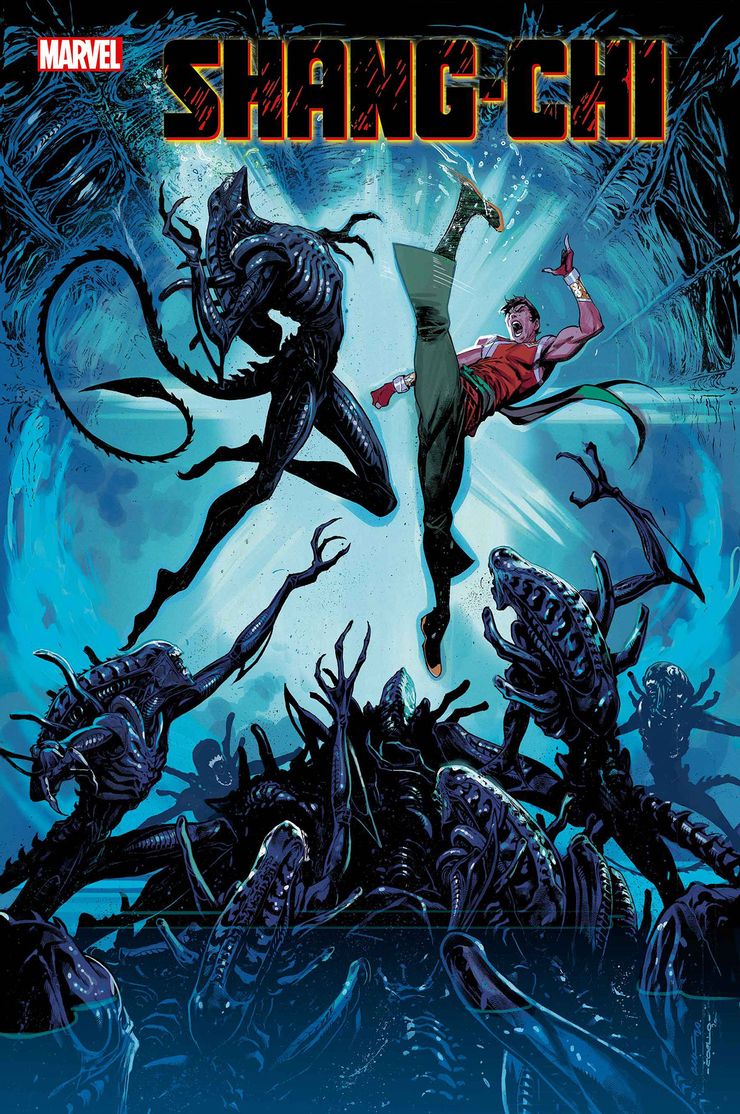
Artist Iban Coello's "Marvel vs. Alien" variant cover for Shang-Chi #5, the final issue of writer Gene Luen Yang's Shang-Chi miniseries, is the rare cool-looking one. I like the dynamism of the image, how human the Aliens look in their posing and their figures and the fact that, at the point in time the image depicts, things look completely hopeless for our hero while he remains defiant, seemingly winning in an ultimately losing battle. 


The latest Star Wars franchise push is going to be "The High Republic," a setting centuries before the time of the original Star Wars film. How does this differ from the Old Republic setting? I have no idea; I only read a handful of issues of a Dark Horse comics et during that time.

On the comics front, this means a new ongoing series under the Star Wars: The High Republic title, by writer Cavan Scott and artist Ario Anindito; Scott has written lots of Star Wars stuff, although I'm unfamiliar with the work of the artist. 

I'm sure I'll interact with the "High Republic" setting somewhere eventually, either in comics or in an audiobook, but I'd be lying if I said the existence of this comic book alone made me extremely eager to do so.  


Russel Dauterman draws X-Men #17's "Marvel Vs. Aliens" cover, which depicts what is probably the least interesting potential conflict between some of their characters and the Aliens that Marvel could possibly publish, given the existence of The Brood. Like, readers have already seen the X-Men fight "Aliens" repeatedly, haven't they...?  

DC's January previews reviewed

Well it looks like DC has finally decided to pull the trigger on that "5G"/fifth-generation related initiative that had been teased for what feels like forever no, the one that would include a theoretical new generation of superheroes, with Luke Fox as a new Batman in comics written by John Ridley and Wonder Woman as a particularly long-lived superheroine who kicked off the age of heroes.

How long were rumors of that floating about? Well, Dan DiDio was still working for DC. 

Of course, while the clues that can be gleaned from the titles and solicitations that will be part of January and February's "Future State" seem to indicate that it is being built out of the remnants of the 5G-thingee (Seriously, that was the name they were gonna go with? Not even "Fifth World"...?), it has obviously been pared down to a very temporary event, taking over the bulk of DC's line for a month or two. In this respect, it seems somewhat evocative of such past events as 1998's DC One Million, wherein most of the ongoing series interrupted their usual goings-on to release one-millionth issues of each series as they might have theoretically appeared in the 853rd century setting of the main miniseries, or even an annual event, like 1991's Armageddon 2001 or 1996's Legends of the Dead Earth, both of which featured temporary looks at possible futures that will never actually come to pass, as you can only screw with the DC Universe so much before it reverts to a more familiar and popular shape (as the New 52 experiment proved). 

While the event seems to very much be one of the your-mileage-may-vary types, what I found particularly encouraging about it is that, unlike the New 52 initiative, some real effort seems to have been put into finding new and different creators to tackle various characters and books. So not only will we see a bunch of brand-new characters with familiar-sounding codenames, and a bunch of new costumes and roles for extant, favorite characters, but we'll also get to see fresh voices chronicling their adventures. At least for now. 

For a rundown of the format of the various Future State books, I'd point you to DC's official PR here. It's probably worth noting that if you're a regular DC Comics reader and you're not excited about this event, you're probably not going to enjoy the publisher's first months of 2021, as the event is pretty literally taking over their offerings. I counted 25 different Future State-branded books, compared to just 14 non-Future State comic book-comics.

As for the too-small League pictured aboveseriously guys, everyone knows that you need at least seven heroes to be a leaguethey are Green Lantern Jo Mullein (from the pages of Far Sector), Superman Jonathan Kent, Aquawoman Andy Curry, Wonder Woman Yara Flor, "a new Flash from the Multiverse" and "[REDACTED] as Batman." Not sure why they are acting like the news that Luke Fox was going to be the new Batman, and the first Black Batman, hasn't been rumored for as long as rumors of DC's 5G plans have been circulating.

Future State: Justice League is going to be written by Joshua Williamson with art by Robson Rocha and Daniel Henriques, with a Justice League Dark back-up by Ram V and Marcio Takara. That "Dark" team sounds fairly identical to the current one, but I haven't read an issue of Justice League Dark in forever, so I'm not sure if all those characters are around in the present or not. Like, the last Ragman I saw was a brand-new one from the 2017 miniseries, a character that I just assumed would be immediately ignored and forgotten, like the New 52 versions of The Ray and The Human Bomb


Batman: Black and White #2 will feature a Sophie Campbell Batman and Catwoman story. I hope it's super well-received, as I would love to see a Campbell-created standalone Batman/TMNT crossover, in which she gets to do whatever she wants with the Turtles and the Bat-characters, rather than adhering to the continuity established in James Tynion IV and company's three previous crossovers with the current IDW TMNT.


Sadly there aren't many trade collections in this round of solicitations, and I already own the single issues of Batman: Gotham Knights: Contested, which collects Gotham Knights  #14-24 and #29 from 2001-2002These issues are mostly by writer Devin K. Grayson and pencil artist Roger Robinson, and will feature heroes Nightwing, Oracle, Spoiler, Azrael, Superman and, most out-of-left-field, Aquaman  (in a favorite issue of mine, in which Batman basically tries to invent an excuse to hang out with a fellow Justice Leaguer, and gets called out on it). and villains Poison Ivy, The Scarecrow, Double Dare, Ra's al Ghul and The Penguin. 

This batch will include the introduction of Sasha Bordeaux, the professional bodyguard assigned to protecting Bruce Wayne (which Greg Rucka would do some pretty dramatically weird things with later), a Joker's Last Laugh tie-in featuring a Jokerized version of the brand-new villain Kafka. If you're wondering why issues #25-#28 aren't included, those are chapters of the crossover events "Bruce Wayne: Murderer?" and "Bruce Wayne: Fugitive", and have thus been collected elsewhere. 

I liked this series quite a bit as it was being published, and I'd definitely recommend the trade collection. 


I was rather surprised to see a solicitation for Batman: The Adventure Continues #8, as I was fairly certain it was a miniseries, and eight issues is certainly longer than usual for a miniseries. This issue is by the same creative team as the earlier issues of the series, though, writers Paul Dini and Alan Burnett and artist Ty Templeton. That's not Templeton's cover, of course, by Mirka Andolfo, who has had plenty of experience drawing different versions of these characters during her time on DC's Bombshells series. 


Current Aqualad Jackson Hyde will be the Aquaman of the near-future, training the teenage Andy Curry in the Aquaman miniseries by Brandon Thomas and Daniel Sampere. Based on Andy's place as Aquawoman in the Justice League book, I guess this is set sometime before that book. 


Future State: Batman/Superman #1 is noteworthy for being written by the great Gene Luen Yang, the writer responsible for one of the best Superman comics I've read (Superman Smashes The Klan) as well as one of the best comics I've read so far this year (Dragon Hoops). His in-continuity Superman comics haven't been all that good, however, as he was writing Superman during a post-Flashpoint period where the character had given up his secret identity and been de-powered, but maybe the Future State milieu will give Yang enough freedom to do something interesting with the World's Finest...? He'll be working with artist Ben Oliver, and it's probably worth noting that this Superman and Batman are the old ones, Clark Kent and Bruce Wayne, ss this is set during "the early days" of Future State, before Jonathan Kent and [REDACTED] assumed the mantles.  


Don't worry about original Batman Bruce Wayne, though. His sleeves might not have made it into the Future State, but he seems to be okay, starring as he does in Future State: Dark Detective, by Mariko Tamaki and Dan Mora. Each issue of the series will have a back-up, one featuring Jason Todd and the other feature former WildStorm character and WildCAT Grifter, for some damn reason. 


Guys, I'm really worried that's supposed to be a big, buff, grim and gritty version of G'Nort on this cover for Future State: Green Lantern, and I am very much not okay with a big, buff, grim and gritty version of G'Nort, even in temporary near-future setting.

On the other hand, I like Salaak's space horse on this cover. I'm big into space horses, really. 

The Green Lantern title looks like it will be another anthology, and this one's got a pair of back-ups entitled "The Book of Guy," which safe money says will feature Guy Gardner, and "The Taking of Sector 123", which will star Jessica Cruz fighting off Sienstro Corps yellow Lanterns and, one imagines, take its inspiration from The Taking Of Pelham One Two Three


In the future, Harley Quinn will...be even younger than she is now? At least, based on this cover for Future State: Harley Quinn. The solicitation doesn't mention that there's a new Harley, so shruggy emoji, I guess. 


Team Marguerite returns for Future State: Kara Zor-El, Superwoman, starring "Superman's hot-tempered cousin." Written by Marguerie Bennett and drawn by Marguerite Sauvage, this should be one worth checking out, and it's been a long, long time since I've thought that of a Supergirl-related book. 


I haven't read any of Brian Michael Bendis' Legion of Super-Heroes revival yet, but I like the way Riley Rossmo, who joins him for this, draws things, so this should, at the very least, be very interesting to look at. 


The solicitation for Future State: The Next Batman by John Ridley and Nick Derington (one of the best Batman artists drawing for DC at the moment, as Batman Universe proves ) continues to play it mysterious, mentioning only "a new Dark Knight" with "a connection to former Batman weaponeer Lucius Fox." The identity of said mysterious new Dark Knight is, dollars to doughnuts, that of Luke Fox, who was rumored to be the star of a new Batman series written by John Ridley for some time now.

Nighwing Dick Grayson, Robin Tim Drake, Jason Todd and on-again, off-again Batgirls Cassandra Cain and Stephanie Brown are all mentioned in other solicitations, so Damian Wayne and Duke Thomas are the only unaccounted for sidekicks who would be potential inheritors of the mantle. I'm assuming one of them is dead, killed in various incidents mentioned in the world-building ("A-Day," "The Final Battle of  Titans Island"), while the other  might be appearing under a different name, like Red X in the pages of Future State: Teen Titans, but I guess we'll see. 

Laura Braga draws the second issue of the series. 

Both issues of The Next Batman feature two ack-up stories: "The Outsiders", which mentions only Katana; "Arkham Knights," which features the DCU Arkham Knight, Astrid Arkham, and random-sounding group of inmates; "Gotham City Sirens", which mentions Catwoman, Poison Ivy and "a new Siren" (Harley Quinn, the third Siren in the Gotham City Sirens series, will of course have her own series); and "Batgirls", featuring Stephanie Brown and Cassandra Cain, which is a very good idea, and I think what a lot of people wanted from a Batgirl series after a certain pointthat is, Oracle Barbara Gordon leading Stephanie and Cassandra as a Team Batgirl (actually, I think there was probably a better version of Birds of Prey to be written at some point, wherein Oracle, Black Canary, Huntress, Stephanie and Cassandra would have been the line-up, with schoolteacher Huntress helping  Babs teach Cass how to read, write and function as a normal human being, Canary helping Stephanie learn to fight, and the two girls helping each other. Alas...).


In the near future, and older, wiser Nightwing will suddenly start worrying about getting hurt and start wearing knee-pads and a chin-guard. Kinda like how I decided it was time to quit skating when my 30th birthday approached. 


Supermen look weird without capes, don't they? This younger, slimmer Superman is Jonathan Kent, son of Superman Clark Kent and Lois Lane. Where is Conner Kent, the Superboy from the pages of Young Justice? Like some of his fellow teammates, he's MIA in the solicits. 

The Future State: Superman of Metropolis book is another of the anthology books,  featuring extant legacy versions of Mister Miracle (Shilo Norman) and The Guardian (Jake Jordan). 


Oh, actually Jonathan Kent does get a cape eventually, as seen in both the above cover and the variant for Future State: Superman/Wonder Woman. Whew!

Say, do you think they used "Steal" instead of "Steel" on the cover on purpose...? Like, did Jonathan steal his dad's codename and role, or is that just a very embarrassing typo...? 


The solicitation copy for writer Tim Sheridan and artist Rafa Sandoval's Future State: Teen Titans sounds vaguely X-Men-like, although there have been periods in recent-ish Teen Titans history in which the older, adult Titans sought to mentor younger, still-teen Teen Titans (Devin Grayson's too-short run being the first that leapt to my mind, although Geoff Johns did something similar not too long afterwards).

"When the original New Teen Titans formed a school to mentor and train young heroes," it reads, before noting that Nightwing, Starfire, Raven, Beast Boy, and, notably, Cyborg return to the scene of "their greatest failure." That group of characters, particularly the inclusion of New 52 Justice League founding member Cyborg among them, certainly seems to indicate a post-Death Metal reversion to pre-New 52 continuity. So too does Nightwing's costume on the cover, which echoes one of his earlier Nightwing costumes from the pages of New Titans

The solicit also mentions "the mysterious Red X," noting that he is a former student and that this is the comics debut of a character "previously seen only in the hit animated TV Series Teen Titans Go!" (which he wasn't; he was previously seen in the hit animated TV series Teen Titans). Based on the characters on the cover, who include Crush and Red Arrow, the best bet for this Red X's identitywould be Damian, as Red X was an identity adopted by Robin in that Teen Titans cartoon, although perhaps the Desthstroke mask is a clue, and this Red X is actually Rose or Jericho. Damian is one of the characters who appears to be MIA (Tim Drake apparently having reclaimed the Robin name, as he appears alongside Stephanie Brown in Future State: Robin Eternal). 


Look, I know Jim Lee is popular and all, but of all the images DC could have possibly chosen for the cover of their Green Arrow: 80 Years of The Emerald Archer The Deluxe Edition collection, they really chose to go with Lee's cover for 2012's Justice League #8, which addressed the question of whether or not Green Arrow would join the new Justice League (no, he would not). 

That's an incredibly short-lived look for the character, even if it does echo that of the television versions of Arrow and Smallville and, in fact, the New 52 version of Oliver Queen grew his more iconic beard and mustache back fairly quickly. It's such a strange image to choose too, given that the character is one who is particularly strongly associated with artists Neal Adams and Mike Grell, both of whom are no slouches when it comes to moving books (Jack Kirby also had a noteworthy run on the character, although that was before Green Arrow's later, more popular and durable redesign). 

You won't find 2012's Justice League #8 collected herein, but you will find the character's 1941 introduction in More Fun Comics by creators Mort Weisinger and George Papp; a pair of late 1950s stories from Adventure Comics; the "My ward is a Junkie!" issues from 1971's Green Lantern/Green Arrow team-ups by Denny O'Neil and Adams; the first issue of Grell's 1987 series Green Lantern: The Longbow Hunters; Chuck Dixon, Jim Aparo and company's 1995 Green Arrow #100 and #101, featuring Oliver Queen's death (don't worry; he eventually gets better); 1997's JLA #8-#9, in which new Green Arrow Connor Hawke must use his late father's trick arrows to try and rescue the League from The Key; a trio of issues from the Kevin Smith/Phil Hester/Ande Parks relaunched 2001 Green Arrow series (#1, #17 and #75, written by Smith, Brad Meltzer and Judd Winick, respectively); 2008's Green Arrow/Black Canary #4, in which Winick and Cliff Chiang maybe kill of Conner or something? I forget, as I quite paying attention at that point; a short from 2014's Secret Origins #4 detailing Oliver Queen's post-Flashpoint/New 52 origin story; 2016's Green Arrow: Rebirth #1 by Benjamin Percy and Otto Schmidt ; and Arrow Season 2.5 #1, a tie-in to the TV series. 

It's not a terrible list by any means, and certainly points one towards good Green Arrow comics to seek out in trade (the Green Lantern/Green Arrow stuff, Grell's Longbow Hunters and anything else from his run, Smith and company's "Quiver" and his surprisingly good run, Meltzer's surprisingly good "Archer's Quest"). I didn't care for much of anything from Winick's run onward, but I guess the idea of these isn't just to present the best stories so much as to give one a sense of what the character's eight decades worth of comics were like.

Still, I think I would have included a Kirby-drawn comic featuring pre-beard GL, and probably a Justice League story from the characters long tenure on during the Satellite Era, when Justice League of America was his home comic. 

This also makes me curious about how much of Dixon's run on Green Arrow, starting with Ollie and then transitioning into Connor, is even available in trade. I've read relatively little of it, but I always liked Conner and, in particular, the comics comparing and contrasting him with Green Lantern  Kyle Rayner, Robin Tim Drake and Flash Wally West. DC seemed to have been making a big push to get a lot of their '90s content into trade paperback collection, and then to have too-suddenly abandoned it...


Amanda Conner and Jimmy Palmiotti's Harley Quinn and The Birds of Prey series gets collected as Harley Quinn and The Birds of Prey: The Hunt For Harley. I didn't care much for the pair's take on Harley in her own book, but I was nevertheless pretty curious about this weird-looking book, which seems to take the comic book version of the characters who were all randomly chosen to plop into a Harley Quinn movie entitled Birds of Prey, and to smoosh them into a new narrative that I think is meant to be set in the comics continuity, rather than the movie continuity...? 

That is, there's so much distance between, say, comic book Cassandra Cain and movie Cassandra Cain, that I was curious how this comic handled her, for example. I was waiting for this trade, though, which means I was waiting until January.

Am I going to be disappointed...? 


(So, how did this go, do you think? The format is different than it has been in all previous installments, as the new version of blogger makes cutting and pasting a nightmare. I managed to get almost everything I wanted to cover into here by avoiding cutting and pasting in general though, I only had to excise the bit about The Immortal Wonder Woman due to some weird format stuff. Just asking, as I was considering abandoning doing these altogether, given how irritating they are to do now, but enough of you indicated you enjoyed them on Twitter that I figured I should keep it up. Anyway, any input is appreciated!).