Tuesday, May 14, 2019

Some notes on IDW's Teenage Mutant Ninja Turtles: The Ultimate Collection line

Eastman's cover for Ultimate Collection Vol. 5
I was looking for a particular image from Kevin Eastman and Peter Laird's original Teenage Mutant Ninja Turtles comics the other day, and checked out one of IDW's Ultimate collections from the library and, before long, I fell into something of a rabbit hole--well, turtle hole, I guess. I ended up reading the first six volumes of the publisher's Ultimate line--there's a seventh volume, apparently just featuring covers, on the way--as well as re-reading Mirage's full-color, short-lived second volume of TMNT in comic book form.

These ultimate collections are nice-looking books, and I'd certainly like to own copies of my own some day, but I'm at the point in my life where I think I need to buy a house in order to fill it with bookshelves in order to fill those with graphic novels. My one-bedroom apartment is just about at capacity now, and I really shouldn't try to squeeze six or seven atlas-sized collections of comics I already own in several formats in here if I can avoid it.

The books are about 8.5-by-12 inches in size, so the comics within are presented at a notably larger size than usual. The many splash pages and double-page splashes of the earliest TMNT comics are basically big enough to be placed in frames and hung on walls like piece of fine art. Only the covers for the individual issues aren't blown-up within these collections, which I found to be sort of irritating (although if that seventh volume is going to be devoted to collecting the covers, maybe that was the reason why they are presented so small within).

Each collection features a new, original wraparound cover by Kevin Eastman, who is still working surprisingly closely with IDW on their fifth volume of the comic. These covers are all essentially collages of the contents of the volume. These are kind of fascinating in that they reveal the way Eastman draws the characters now, without the visual input of Peter Laird or any of the other Mirage artists he would collaborate with (like Jim Lawson and Eric Talbot, for example), and while his style hasn't changed too drastically over the last three decades or so--that is, Kevin Eastman's artwork is still immediately recognizable as Kevin Eastman's artwork--it is interesting to note those changes.
Also, it's fun to see him draw characters he had no or little input into before. So, for example, the cover for the second volume features his drawing of the Kirby character from 1986's Donatello, which Laird did much of the work on (and comparing the Kirby in the comic to that on Eastman's cover makes this clearer still), and the third volume (above) has Eastman's "cover" versions of Doctor Dome, the Domeoids and the Justice Force superheroes from 1988's TMNT #15, an Eastman-free Laird and Lawson issue.

Aside from the blown-up size and the original covers though, the comics are also all annotated by Eastman and Laird, with every issue being followed by a page or more of memories, reactions and behind-the-scenes notations from the two creators. If you've read these comics at least once before, then the ultimate collection probably provide the ideal way to re-read them, as the effect is a little like having Eastman and Laird reading along over your shoulder, and volunteering their commentary.

All of that stuff is pretty fascinating, and, I'll be honest, sometimes a little shocking. For example, when I was reading these comics as a teenager--I think 1991's TMNT #37 was the first issue I bought new at a comic shop, and after that point I started hunting for back issues while keeping up with new stuff as it was released--I had no idea the pair ever had a falling out of any kind.

They don't detail the ins and outs of their disagreements herein, although they allude to not speaking to one another or being unable to be in the same room with one another quite a bit. That was pretty surprising to hear, although I guess it explains why their collaborations dwindled to almost nothing for a while.

So after 11 issues of Teenage Mutant Ninja Turtles (and the four character-specific one-shot "micro-series" and sundry short stories)  published over the course of  three years in which the pair worked as an exceptionally entwined creative team, Teenage Mutant Ninja Turtles #12 was a Laird solo issue. TMNT #13 an Eastman solo issue (with Talbot assisting on inks). TMNT #14 was the first of many fill-in issues,  and then  #15 was Laird and Lawson, #16  was another fill-in issue and then #17 was Eastman and Talbot. It wasn't until #19-#21 that Eastman and Laird collaborated again--that was the "Return To New York" story arc--and even then it wasn't just the two of them, as Lawson and Talbot were heavily involved in those issues.

Despite the now decades-old disagreements though, the pair seem quite effusive in their praise for one another's respective skills throughout (although Laird never seems to miss an opportunity to point out when there's a typo), and neither seem too terribly eager to re-litigate their conflicts. I guess I'll wait to their biographies (And man, I do hope someone is writing their biography, and that they are both gradually working on their own autobiographies, because what a fascinating story those two lived!).

A couple of things that occurred to me while reading this volumes, and re-reading the comics within for, like, the hundredth time...

Laird's inks on Lawson's pencils over Eastman's layouts in 1989's TMNT #19
I've talked before about the fact that one of my favorite aspects of these comics were how homemade they feel, and the fact that the particular, long-mysterious-to-me system that Eastman and Laird employed in their creation meant that each issue had a sort of alchemical style, a fusion of each of their significantly different personal styles...sometimes with those of other studio mates also transmuted into the resultant comics.

Sometimes it's quite clear who did what, and thus how each artist's style might have impacted the art--the three-chapter "Return to New York," for example, were inked by Laird, Talbot and Eastman respectively--other times, it seems like two-to-four pencils and pens were involved with every page, and a comic might have a "Mirage Studios" style rather than anyone's personal style.

The notes detail that Eastman and Laird did have a system, although it is interesting to hear them discussing the very earliest issues, particularly TMNT #1, in which neither is exactly clear on who inked a particular page, and it seems that both of them contributed pencils and inks to each page.

The system they ultimately settled on seemed to be this, according to Laird:

1.) They would initially "write" the story in conversation with one another, hammering out a plot together.
2.) Eastman would handle the layout, on which he would include rough dialogue.
3.) Laird would do finished dialogue.
4.) They would pencil the comic based on Eastman's layouts and, after the final dialogue was lettered--originally by them, later by Steve Lavigne--they would ink the art and add toning (that last bit is something I never realized was involved with the construction of these comics, and helps explain the gritty, textured look of the black and white art).
As Laird explained it, they were ideally communicating throughout the entire process, so even though layouts might have been Eastman's "job" and finished dialogue Laird's, they both had and took opportunities to address any and all concerns as they were going.

In the earliest issues especially, Laird said, they tried to make sure they each penciled and inked a piece of each page or panel, and that this would take place by the pair literally handing pages back and forth between them in order to get a true blend of their styles.

Repeatedly throughout these annotations they each note that when they would meet readers at conventions, they were always being asked about how they worked together and who did what. Comics readers in the early 1980s apparently couldn't get their heads around the idea of two writer/artists working on a comic book together as writer/artists, perhaps because so much comics production fell into either the assembly-line method established in the Golden Age (with a writer handing a script to a penciler, who handled his pencil art to an inker, who then gave the finished art to the colorist, etc) or a solo cartoonist doing everything herself.

It is an unusual method, though, one that requires pretty much constant proximity to one another--which I suppose was likely a factor in the eventual strain in their relationship.


Eastman and Laird's final page of 1984's TMNT #1
•The focus of these books is the issues of the original series that Eastman and Laird worked on, to the exclusion of all the fill-in issues. It was striking to see how many times throughout that relatively short run of comics by the pair themselves--just 38 issues total including the one-shots, out of the 62 issues that the first volume of TMNT ultimately ran--that Eastman and Laird seemed to reach natural, organic would-be, could-be endings for their series.

It's pretty common knowledge that they never really anticipated TMNT lasting longer than a single issue, and despite the fact that they both desperately wanted to succeed as comics creators, they were caught off-guard by how successful that lark featuring a silly idea and elements of parody and homage of Frank Miller's Daredevil work ended up being, and how much market demand there was for what such a weird concept.

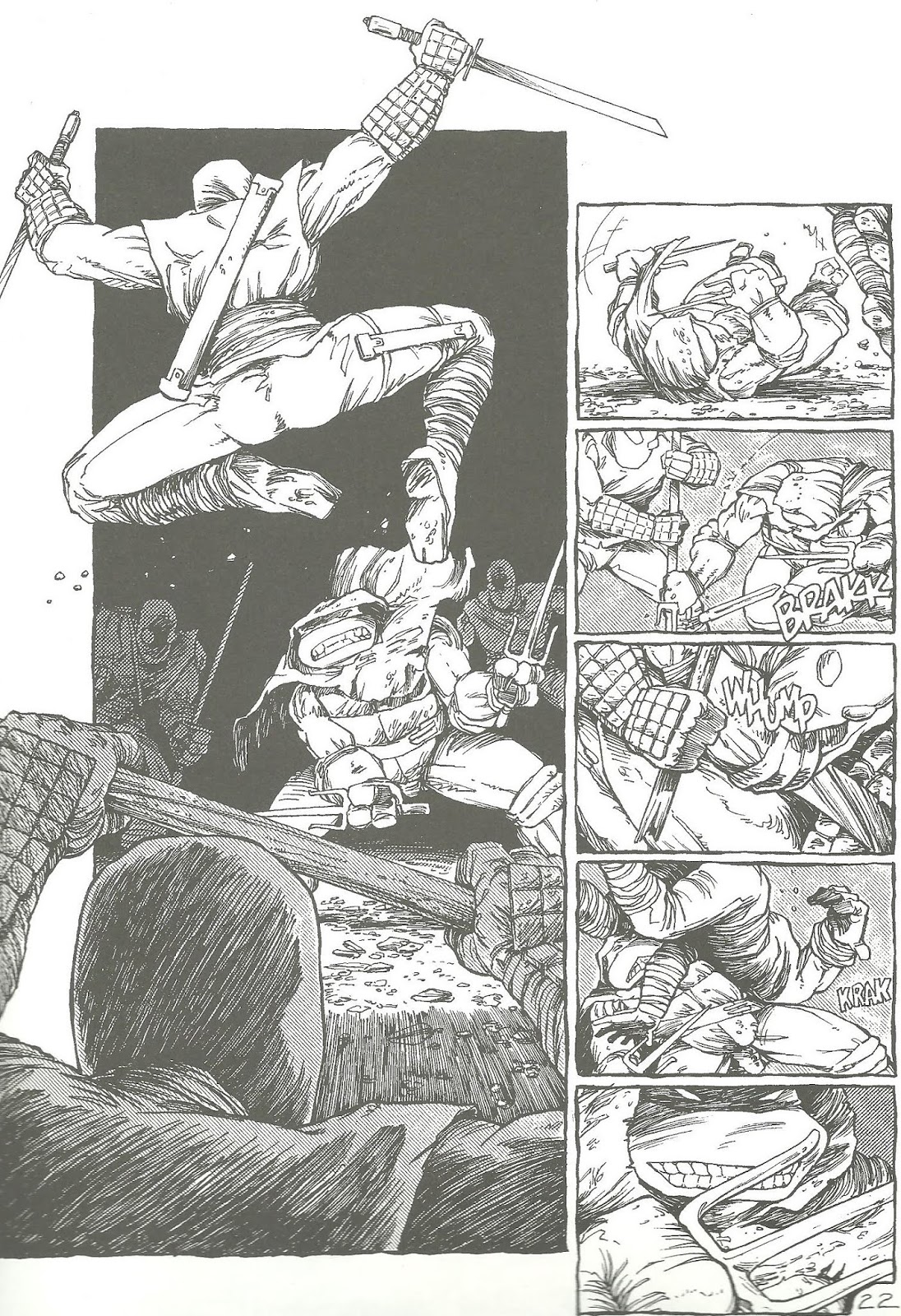
Re-reading 1984's TMNT #1 with that thought placed in your mind, it's abundantly clear that the comic was created as a 40-page complete story unto itself. There's no cliffhanger, no dangling plot lines, no questions yet to be addressed. In those pages, the pair thoroughly introduce and explain the characters' origins (built atop the origin of Marvel's Daredevil, of course), the history of the enmity between their master and his archenemy and then there's a huge, action-packed, 10-page ninja battle ending with the death of their enemy and the resolution of the conflict that we are told was their life's mission.

Yeah, it's a pretty complete story, and it's not hard to imagine that, had it not caught the imagination of comics readers and, eventually, cartoon-watchers and toy-players-with, it might have just ended up being a strange stepping stone to other endeavors by two talented creators.

Once they committed to a second issue though, a story arc quickly emerged. In issue #2, the TMNT met their first human friend April O'Neil and their father/sensei Master Splinter went missing, all a result of villain Baxter Stockman's robotic mousers. In the following five issues, the guys move in with April and search for Splinter, unwittingly uncovering details about their origins, travelling to outer space and having a rather wild, pulpy adventure that concludes with a reunion with Splinter and the formation of a new configuration of a family, now including April.

It is very easy to imagine Eastman and Laird's TMNT ending with issue #7 then, too, as #1-#7 tell a pretty complete story that ends happily (Raphael, which came out between #2 and #3, doesn't really play into that arc at all, but is more of a side story focusing on his personality...and introducing Casey Jones, who wouldn't play a part in the series for a while yet).

After that, there are some done-in-one stories, including the Michaelangelo and Donatello one-shots, the epic 45-page TMNT #8 featuring a crossover with Dave Sim's Cerebus (and introducing Renet and Savanti Romero), and a rather Splinter-centric flashback to the Pre-Teenage Mutant Ninja Turtles in #9.

A continuing story arc reemerges in Leonardo, the most action-packed issue up until that point, as it is basically one long fight scene, which leads directly into #10, an unexpected rematch with the supposedly dead Shredder and the Foot Clan, featuring a last-minute save by Casey Jones, who at that point joins the team and their narrative on a permanent basis.
Eastman's cover for 1987's TMNT #11
TMNT #11, set at the farmhouse in Northhampton, is another natural "ending" to the story, as it has the various characters struggling to process what just happened to them in New York City, and, gradually, all making their peace with it to some extent. It has a pretty happy ending, and it's not a bad place to end the story, really, although it does suggest that our heroes have lost...at least in terms of their battle against the Foot Clan, if not at life in general.

The first time I read these comics--hell, the first 40 times I read these comics--it was in a big, fat, phone book-sized collection featuring the four micro-series and the first 11 issues of TMNT. It's easy to see why they collected them in this fashion, as they do read as a complete (even completed) unit.

Then, after a series of adventures mostly set in rural New England as opposed to New York City--the previously mentioned efforts by the then sort of split-up Eastman and Laird team of #12, #14, #15 and #17, plus fill-in issues  by Michael Dooney, Mark Martin and Mark Bode that aren't included in the ultimate collections--Eastman, Laird and their Mirage Studios partners reunite for "Return To New York." That three-issue arc really resolves our heroes' defeat at the hands of the Foot in #11. They have re-killed The Shredder, this time once and for all--the resurrected Shredder isn't quite the same one they killed in #1, of course, as is explained--and they have re-fulfilled their mission in life and are able to move on. At that stories end, the four brothers are in New York, burning the body of The Shredder, and are apparently now free to go wherever they like or do whatever they want.

Again, this too seems like a natural ending point for Eastman an Laird's TMNT narrative. And, in a way, it was. The title kept going, of course, but it would be another three years and 26 issues before Eastman and Laird returned to the book, and for the rest of the 62-issue volume they would only draw a single issue issue together and then share writing credits on 14 issues, the job of drawing the turtles now falling to Lawson, with new inker Keith Aiken, and assists from Talbot and a few others.

The end of that epic storyline would, of course, be another natural ending point--and finally was. The book ended when the 12-issue "City At War" did, only to be relaunched for an ill-starred, 12-issue, full-color run that now seems to be even more forgotten than the Image series was.


Veitch's cover for 1989's TMNT #24
•Because the focus of the ultimate collections is the Eastman and Laird issues of Eastman and Laird's Teenage Mutant Ninja Turtles, that means that many issues of the series are left out. So Dooney's #13 Martin's #16 and Bode's #18 aren't here. And none of the issues that fell between the end of "Return To New York" and  the two-part "City At War" lead-in story arc "Shades of Gray" are included here. That's a lot of TMNT, and a lot of great comics: Two more Mark Martin issues, Rick Veitch's three-issue "The River" arc and a later done-in-one, Michael Zulli's gorgeous but weird "Soul's Winter" story arc, a three-issue arc by Rich Hedden and Tom McWeedy, comics by Steve Murphy, Michael Dooney and Keith Aiken, Dan Berger, Rick Arthur, A.C. Farley, Mark Bode and, my favorites, #37 and #42 by Rick McCollum and Bill Anderson and #41 by Matt Howarth.

There is some reason to quibble with the curation of these ultimate collections.

Some of these guest comics are pretty far afield of those told by Eastman and Laird, the more "canonical" ninja turtles stories, and are best read as the Mirage equivalents of Marvel's What If...? or DC's Elseworlds or Silver Age "imaginary stories." Just before and for a long time after "Return to New York," TMNT was basically an anthology series, akin to Legends of The Dark Knight. Like LDK though, if some stories strayed too far to be considered in continuity, others fit in perfectly well with Eastman and Laird's stories. Many of the above stories are set in and around the New England farmhouse, for example, and others have the characters re-encountering characters from earlier in the series, like Renet, Savanti Romero, Romero's previously unrevealed wife and the superheroine Radical and supervillain Carnage.

By excising all of these from the ultimate collections, there is a rather strange compressing of time, and a reader doesn't get the sense that the characters were ever really lost in the wilderness, trying to figure out their next move after their defeat in #10. When Raphael starts fighting with his brothers in the first chapter of "Return," complaining about how long they have been hiding out in New England while Shredder and The Foot are alive and well in New York City, here only some 186 pages and four issues, instead of twice that.

And even less time passes between the conclusion of "Return To New York" and the beginning of "City At War"; in fact, because "Shades of Gray" is basically an unofficial first two chapters of "City At War," both of the big, Eastman and Laird-written storylines about the turtles returning to New York City to sort out matters with the Foot Clan happen back-to-back in these collections.

I don't know what, exactly, would have been a better solution, I just know the series reads very differently when presented with all of the fill-ins excised like this.

Talbot's cover for 1988's TMNT #17
That said, I thought the inclusion of #17 was somewhat surprising. That's the Eric Talbot solo issue, the bulk of which is a rather weird, random stream-of-conscious fantasy story set in in feudal Japan and starring a version of Michaelangelo....although it turns out to be a dramatization of a story Michaelangelo himself is writing. Eastman is credited as a writer on it, both in the collection and on Mirage's website, but Eastman himself seems surprised by the credit in his annotations of the issue, and doesn't remember having done enough work on the book to have deserved the credit.

Meanwhile, Eastman did contribute to the Mark Bode issues--#18, which he co-wrote and helped ink, and #32, which he helped ink--but neither of those are included herein (Those are both really fun ones, too, sending the Turtles overseas to Hong Kong, where they kinda sorta team-up with a Bruce Lee stand-in, and to Egypt, where they fight Anubis and other characters of Egyptian mythology. I really liked Bode's Turtle designs, and the way he handled dialogue, the balloons and sound effects all appearing above the panels).

I suppose both of those issues lean pretty hard away from the canonical Turtles, of course, but if the organizing principle here is the complete Eastman and Laird TMNT and co-writing #17 was enough, to qualify, well...


Splash page by Lawson and Aiken from 1992's TMNT #51
•When we get to #48 in Ultimate Collection Volume 4, Jim Lawson has become the official Teenage Mutant Ninja Turtles artist and, in fact, it is his art we will see for every issue included in the next two volumes, with the brief exception of the 42 pages of TMNT #50, in which Eastman and Laird reunite on both story and art.

I remember it being a real treat at the time the book came out--I had signed up for a subscription of the book at the time, and that was and remains the only time I ever had a subscription to a comic book series--although looking at it now, it sure is jarring to see the Lawson art get replaced by the infinitely darker, busier, more textured Eastman/Laird art, only to give way almost immediately to Lawson's more streamlined, abstract and expressive art (Confession: I used to hate Lawson's TMNT art. Now he's one of my favorite TMNT artists).
Lawsons' cover for 1987's Tales of The TMNT #2, introducing Nobody
"Shades of Gray" sticks out a bit in this curation of the series, if only because the character Nobody plays a rather significant role. A more traditional vigilante/superhero based in Springfield, he was introduced in Tales of The Teenage Mutant Ninja Turtles #2 (written by Eastman and Laird and drawn by Lawson and Ryan Brown), and, because no issues of Tales are collected here, isn't really introduced to the narrative properly, but rather just appears.

Still, those two issues--TMNT #48 and #49--are pretty important, as they include the events that kick off the splintering of the TMNT family that sets up "City At War." The first official chapter of which, #50, is silent.


Eastman and Laird's cover for 1992's TMNT #50
•"City At War" is an extremely unusual story arc for even this extremely unusual comic, lasting 12-14 issues, depending on if we count "Shades", and dwarfing the longest sustained story arcs from the book's previous 50 issues. (Remember, "Return to New York" was just three issues, albeit 40-ish page issues, and the unofficial search for Splinter arc was just about six issues).

It was also probably the most emotionally mature of the TMNT stories, with Eastman, Laird and Lawson splitting the characters up into four different units, each experiencing their own story arcs. In the case of the two human characters, their storylines are positively mundane--Casey moves away, meets a woman, falls in love and tries to settle into a normal-ish domestic relationship with her, while April moves to Los Angeles to live with her sister and start a life free of mutant ninjas and their attendant secrets.

Meanwhile, Splinter finds himself in extremely dire straits and faces death alone, and the Turtles themselves return to New York City and find themselves trying to sort out a massive gang war involving warring factions of The Foot Clan...the result of their having cut off the head of the organization when they killed Shredder for the second time.

And then there's a random New Yorker who was caught in an explosion during the Foot's initial war against itself, and we follow his recovery throughout, a somewhat frustrating element because a reader keeps expecting him to turn out to be someone important to the plot somehow, but he is instead just there to dramatize a real person who suffers during wars in general--a point that was made in the first issue, and thus didn't really need 11 more issue's worth of example.s

I recall finding the story somewhat frustrating the first time through, read in monthly installments--again, this story was a huge change from the 50 or so TMNT comics that preceded it, as they were mostly big done-in-one adventures--and even the second time through, but this time I found it pretty engrossing. I started it late at night, with the intention of reading the first few chapters, and ended up staying up late enough to read the whole thing in a fit of pure can't-put-it-down-ism, blowing way past my bedtime.

It's kind of striking how unusual the story felt for a TMNT comic, given how basic, even generic elements of April and Casey's plot lines were, and how simple what Eastman, Laird and Lawson ended up doing really was. While the A plot was basically that of the ninja turtles doing ninja turtle stuff and questioning their purpose in life more than ever, starting to come of age in a way that felt uncomfortable in the context of everything that came before, the overall purpose of the story was simply to break up the characters' extended family, send them off in different directions to learn why they are together in the first place, and then reunite them via soap opera like events and coincidences.

This storyline gave us the character Karai, who isn't too terribly well-developed here, but would play a pretty large role in TMNT mass media adaptions in the 21st century, and Shadow, who would be a recurring character in Laird's fourth volume of the TMNT title...a character with a lot of potential that I don't think ever ended up being met (Actually, I suspect there's a lot of unrealized potential in the space between the time jump of TMNT Vol. 2 #12 and TMNT Vol. 4 #1, a great deal of which was explored in Tales... Vol. 2, which ran alongside TMNT Vol. 4. (I mean, a teenage girl named Shadow raised by sports equipment-wielding vigilante Casey Jones, with four ninja masters for uncles and a fifth ninja master as her grandfather...? She'd basically be a blend of the Casey and April characters, with skills on par with the mutant ninjas).


Eastman and Laird's cover for 1987's Anything Goes #5
•Now Eastman and Laird made a lot of comics between the time 1984's TMNT #1 became a hit and when issue #62 shipped in 1993. Even if one ignores all the comics they merely had a hand in, while other Mirage Studio artists did the heavy lifting, the early days of their characters saw them contributing short stories to a variety of anthologies and original content to the Teenage Mutant Ninja Turtles and Other Strangeness role-playing games source books (which I liked better than Dungeons & Dragons back in the day; it's been a while since I looked closely at RPGs, but I remember the Palladium system being a lot easier and more intuitive than what was then the TSR Advanced Dungeons & Dragons system).

In figuring out how to collect all that stuff, IDW apparently opted to publish it all after the stories that ran in the main TMNT title (and the four one-shots). Thus, the first five volumes collect the most Eastman and/or Laird-heavy issues of TMNT, while the sixth, epilogue-like volume is stuffed with about 30 short comics of various short lengths, all produced between 1985 and 1989.

They're culled from all over, too: Back-ups from TMNT reprints, the Palladium source books, the Mirage-published anthologies like Turtle Soup, Shell Shock and Gobbledygook, a Grimjack back-up, the Fantagraphics-published Anything Goes and some benefit books.

In addition to the guys who have their name on the cover, there are comics included in here from many Mirage Studios regulars, like Lawson, Talbot, Michael Dooney and Ryan Brown, all working in various configurations in terms of who was doing what and with whom. There are also some stories by artists not as closely associated with the characters, like Stephen Bissette, who writes and draws an extremely eight-page story entitled "Turtle Dreams" (and those dreams are much scarier than the those in Matt Howarth's TMNT #41); Michael Zulli, working solo on one story and with his Puma Blues partner Steve Murphy on another; and Richard Corben, who inked a four-page Eastman-written and -penciled story that was created specifically so that Eastman could work with Corben (Zulli and Corben would both later do more TMNT, of course; the former drawing the aforementioned "Soul's Winter" arc featuring the most dramatically distinct version of the Turtles to ever appear in their own comic, and Corben collaborating with Jan Strnad on TMNT #33).

I've read many of these, but there were a few that were brand new to me, and thus quite welcome surprises. For example, there's a 10-page turtle-less Triceratons story by Laird that appeared in a Mirage anthology entitled Grunts that I had never heard of, and an Eastman and Laird collaboration entitled "Casey Jones, Private Eye" from a Mirage mini-comics project that I was similarly ignorant of. The latter's nothing special, really, and the format doesn't flatter artwork obviously created to be read much smaller, but the Triceratons story was pretty interesting, and introduces a race of humanoid bears that oppose the Triceraton Empire. I'm actually a little surprised they didn't show up in the last TMNT cartoon, given how diligently it scoured the comics for inspiration.

While the first six volumes of this series were devoted to following the canonical Turtles story of their creators as closely as possible, focusing on the work they themselves did more than the many, many comics they simply had a hand in or sanctioned, this volume really gives a good sense of what the title was like for a portion of its run, what the studio's output was like, and just how fertile the characters and concept were as a springboard, and how generous Eastman and Laird were with their creations and their work.

In a sense, this is actually a good volume to start with, as it is the one that gives the best idea of what the original Teenage Mutant Ninja Turtles comic was like and what Mirage Studios was like. I mean, it's probably a pretty lousy place to start in terms of the story of the TMNT, but it's a perfect place to get a feel for the Turtles and the guys that made them.

And to return to that aspect of the Mirage Studios comics that I mentioned earlier, regarding the who-did-what-where nature of their output, and how first Eastman and Laird and then as many as a dozen different collaborators would conceive of a flexible Mirage "house style" that slid along a particular spectrum, this is practically a text book for that, as there are so many different combinations of the Mirage Studios artists, all appearing within the same covers.

Some of these shorts absolutely fit into the "real" TMNT story, being the work of Eastman and Laird and tied closely to the events of the monthly--there are several set during their time in space, for example--others are of the sort of off-to-the side larks or riffs of Tales or the micro-series, and some need to be massaged into the narrative, but nothing herein seemed to really not fit in with the extremely broad mandate of the Mirage Studios Teenage Mutant Ninja Turtles comics which, at it's most basic was basically just, "Whatever, just so long as it has at least one teenage mutant ninja turtle in it."

Among the stories I most enjoyed reading or re-reading in the sixth volume were the Eastman/Laird Anything Goes story in which the guys go on a secret stealth mission...to see Aliens at the drive-in, which I long ago managed to find at a garage sale in Ashtabula after many summer afternoons of studying the Overstreet Price Guide for TMNT appearances; the Eastman/Laird Grimjack back-up story which I recalled similarly looking for but never actually finding; the Eastman/Corben collaboration; the Laird story "Technofear" from 1986's Gobbledygook, which featured what I guess is now vintage computer art; and Zulli and Bissette's strange versions of the characters.

I'm looking forward to the seventh volume, and am curious if there will be a volume eight or beyond. After all, for volume four, Laird did much of the writing, and, for IDW's volume five, Eastman was rather heavily involved, although IDW has plenty of collections of that already...

Anyway, let's meet back here to discuss volume seven once that's released, and maybe we can talk about the 12-issue TMNT series that immediately followed the conclusion of this one, since that's still pretty fresh in my head.

Saturday, May 11, 2019

Ouch.

That quip actually kinda hurt, Spider-Man. (Panel from 2017's Spidey #12, written by Robbie Thompson, drawn by Nathan Stockman and colored by Jim Campbell.)

Monday, April 29, 2019

Three reviews of Marvel collections I found in my drafts:

Avengers: Unleashed Vol. 2--Secret Empire

Although the second collection of writer Mark Waid and primary artist Mike Del Mundo's Avengers ongoing, this is actually the fifth volume of Waid's run on the primary Avengers team; his All-New, All-Different Avengers was relaunched after about 15 issues, because...because Marvel, that's why.

The turning point presented at the end of this volume, then, in which particular elements of the status quo introduced just last volume shift, may seem somewhat violently sudden, but it is perhaps best read in the context of the writer reacting to the goings-on in the Marvel Universe beyond his control, and as simply the latest necessary course correction rather than Waid quite suddenly thinking better of decisions he just made. As with the events of Civil War II, which took Iron Man Tony Stark out of the cast and helped shunt the younger Avengers off into their own team and their own book, Secret Empire presents Avengers with a big change, and Amazing Spider-Man apparently deals it another.

The first two issues, co-written with Jeremy Whitley of the sadly canceled Unstoppable Wasp, feature Doctor Victor Von Doom, currently wearing Iron Man-like armor and calling himself "Iron Man," teaming up with the Avengers, who are pretty frosty to the alliance. Only Wasp Nadia Pym is really into the idea, in part because of her fan girl fervor for Doom's brilliance.

Both are done-in-ones, with the Nadia/Victor relationship the most notable throughline. In the first issue, Doom stops by for tea, and then recruits Nadia's help in infiltrating a Lumberjanes camp. In the second, the Avengers are on the ropes, thanks to a power-stealing villain, but the Nadia/Victor team are able to save the day, with their science.

Both of these issues are drawn by Phil Noto, whose painterly style is a good fit with Del Mundo's. It was refreshing to finally see this post-Secret Wars Doom drawn at some length by someone other than Mike Deodato, who just draws him as Vincent Cassel for some reason (Still not sure why that is allowed to go on; can't he sue Marvel? Shouldn't Marvel be worried he might sue them for using his likeness like that?). I got lost among the relaunches of writer Brian Michael Bendis' Iron Man books, so I haven't read any of Infamous Iron Man, which Alex Maleev is drawing.

After those, Waid scripts three more done-in-one stories, two of which are set during the events of Secret Empire, and one of which is an epilogue. Oddly enough, they barely refer to the events of the event series, and make sense as tie-ins only if you've read it. If not, well, they stand alone fine, but they likely seem to be extremely odd choices for the title.

First, there's a Thor solo issue, which apparently details where she went after she was zapped away at the beginning of Secret Empire. Narrated by a native being to the dimension she was sent to, it's a nice, solid story of the character's heroism, with a fair degree of humor derived from the clashing cultures thrown in.

Then, Doctor Octopus narrates an adventure featuring Bad Cap's Hydra Avengers line-up of reprogrammed Vision, (possessed by a demon) Scarlet Witch, former Thor Odinson and mercenaries Deadpool, Taskmaster and The Black Ant. It's a very short story, but one that sends them all on a mission they see through to completion, while highlighting the self-serving villainy of some of the members and the tensions inherent in a character like The Odinson working alongside former bad guys.

The final story takes place after Secret Empire and whatever has been going on in ASM, as Peter Parker has apparently lost Parker Industries and possession of The Baxter Building, which is where the team's HQ has been for all of, well, all of just 10 issues. The six Avengers split up into pairs to have conversations with one another. The Vision and Hercules go out for coffee, and the synthezoid expresses his concerns about learning that he is immortal, and gets some surprisingly sage life-coaching from Herc. Spidey tries to find some common ground with The Wasp by inviting her to a science fair, but they get side-tracked by superhero stuff. And Sam Wilson, who here has already surrendered the shield and title of Captain America back to Good Cap but hasn't yet put on his new Falcon costume, pulls Thor aside and tries to convince her to lead the team, since he's no longer Captain America. It's a nice between-arcs breather issue, but then, because so much of the title has been reactive to line-wide crossovers, Waid's Avengers series has, more often than not, been a whole series of these sorts of relaxed breather issues.


Black Panther: The Man Without Fear--The Complete Collection

I'm glad Marvel gave prose novelist David Liss' Black Panther comics "The Complete Collection" treatment, putting all 18 or so issues of the T'Challa-starring comics he wrote between a single pair of covers, because Liss' run on the character might be murder to try to assemble through single issues (The run was previously collected into a trio of trade paperbacks under two different titles). This is because of how weird Marvel is at selling their damn comic books.

After Daredevil event storyline "Shadowlands" and Black Panther-centric "Doomwar," both Matt Murdock and T'Challa need to rediscover themselves. And so Murdock goes away, but he asks T'Challa to become the new guardian of Hell's Kitchen, where the now de-powered Panther decides he will be able to prove to himself whether he's still a total bad-ass without his former magic Panther powers and all the resources of a sci-fi fantasy kingdom to call upon.

And, for whatever damn reason, Marvel decided to make Black Panther the new star of the Daredevil comic book series, changing the title of the series to Black Panther: The Man Without Fear, but keeping Daredevil's numbering, so that the first issue of the new series was Black Panther: The Man Without Fear #513. And then, after about 12 issues, they changed the title again but kept the numbering, so the book was then Black Panther: The Most Dangerous Man Alive for a while. Oh, and then there was one of those dumb decimal-point issues, Black Panther: The Most Dangerous Man Alive #523.1. (As for Daredevil, when Matt Murdock returned, he got a whole new title with a new #1; I honestly have no idea how any of this works.)

Anyway, none of that really matters for the purposes of this collection, which reads as a complete, 400+-page graphic novel. What little one might need to know about what happened in Daredevil and Black Panther and Doomwar before gets quickly and efficiently explained in a conversation between Murdock and T'Challa in the first issue, and then referred back to organically throughout the story. And, if you're reading the entire Black Panther saga in preparation for the movie (UPDATE: I guess that's a pretty  clue as to just how dang long ago I wrote this review, huh?), well just know that this falls between Black Panther: Doomwar and the beginning of Ta-Nehesi Coates and Brian Stelfreeze's Black Panther: A Nation Under Our Feet.

What will be most immediately evident about Liss' run is the way it looks. Artist Francesco Francavilla draws and colors the majority of it, and his art is highly, highly stylized. It is heavily "drawn" looking in a way that stands out from the bulk of Marvel's comics. His designs are realistic, but stripped down and abstracted in the rendering, with well-placed lines of shading and a lot of usage of darks and shadows. The artist whose work might most immediately jump to mind when reading Francavilla's Black Panther book is, fittingly, that of long-ago Daredevil artist David Mazzucchelli.

Even when Francavilla's not drawing, Liss' Black Panther was fortunate to have some pretty great artists involved. Jefte Palo does a lot of the non-Franacavilla art, and he draws big, bold, exaggerated, muscular figures perfect for all the skulking and brawling in the book's action scenes. As the book nears its conclusion and Man Without Fear turns to Most Dangerous Man Alive, the comic gets more and more Daredevil-y, and Michael Avon Oeming and Shawn Martinbrough do much of the art. Both are great, and neither are too far removed from Francavilla's style, although Oeming is the artist who most sticks out as different from the others; his highly cartoony take calling to mind that of that other famous Daredevil creator, Frank Miller.

So after Daredevil gives T'Challa permission to be the new vigilante in town and then bugs off to wherever, Foggy Nelson helps set T'Challa up with a new identity. Under a goatee and pair of glasses, he is now Mr. Okonkwo, a Congolese immigrant who quickly finds a new gig as the manager of The Devil's Kitchen diner and a not-so-great apartment, the better to keep an eye on the neighborhood. Because he lacks Vibranium and his fancy gadgets, he basically fights crime as a sort of cape-less Batman or color-swapped Daredevil; wearing a bullet-proof vest over his togs and punching and kicking people. He occasionally busts out a gadget he made himself with equipment from the hardware store. Storm of the X-Men, who was still T'Challa's wife at this point, is limited mostly to Skype-ing with him, as he wants to go it alone as part of his proving-himself thing, and he's afraid if his storm goddess/queen/mutant superhero hangs around too much, his cover might be blown.

The six-part "Urban Jungle" features an escalating war between the new vigilante in town, The Panther--oddly, hardly anyone ever recognizes The Black Panther as The Black Panther, superhero, Avenger and former King of Wakanda, but just call him "Panther"--and a new would-be Kingpin of Crime in town, Vlad "The Impaler". It's low-level and low-stakes for a Black Panther comic, but then, scaling his world down from the world to a New York City neighborhood is part of the entire remit of the series. It's all-around super-solid superhero crime comics, with Luke Cage and Spider-Man both briefly dropping by only to be rebuffed (Palo draws the issue with Spider-Man in it, and he draws Panther a few heads taller and a few torsos wider than Spidey, giving them a nice physical representation of their attitudes in relation to one another).

That's followed immediately by the two-part, Palo-drawn "Storm Hunter," that follows on a dangling plot point from the previous arc. This issue pits T'Challa up against Kraven The Hunter, and he gets an unwelcome assist from his wife Storm.

Next is the Francavilla-drawn "Fear and Loathing In Hell's Kitchen," a Fear Itself tie-in of sorts...although one need not know much of anything about Fear Itself to follow the story, which features the rise of a new Hatemonger and the debut of "American Panther," a star-spangled, Panther-themed version of Black Panther to provide an America First answer to the foreign-born, immigrant hero, whose "accent" is referred to repeatedly. This three-issue arc actually reads incredibly uncomfortably in 2018, as the sorts of things The Hatemonger's followers say about immigrants sound way too familiar and, well, real today. At the time Liss was writing this story in 2011 or so, he was basically taking real attitudes of bigoted and/or racist and/or nationalist assholes and turning their words and actions up from, like, an 8 to an 11. Now that exaggerated-for-superhero-comics 11 is, like, part of the national discourse. If a guy showed up in a purple Klan hood with a big "H" on the forehead for "Hate" and demanded that immigrants return America to Americans in real life today, well, the actual president of the United States might say there were fine people on both sides of the argument, or that there were violence on both sides of the torch-wielding mob marching through New York (I guess the geography of the story is dependent on mind-control and the influence of a supernatural fear god, as it's difficult to imagine the events of Charlottesville in 2017 occurring in New York City, but still...)

Then there are two done-in-ones, a "Spider-Island" tie-in drawn by Francavilla (In which Panther has six arms and fights Overdrive and Lady Bullseye...Panther's extra arms being the only thing really making this a "Spider-Island" story) and a Palo-drawn "Point One" issue in which T'Challa fights The White Wolf again, this time getting an important assist from his waitress-turned-confidante Sofija.

Finally, there's "The Kingpin of Wakanda," drawn by Martinbrough, Oeming and Palo. This story arc is the Daredevil-iest of them all, in its villains if not its tone. Kingpin Wilson Fisk has taken over The Hand, and he makes a play for Wakanda. Faced with these foes and Kingpin's two top assassins--Lady Bullseye and Typhoid Mary--T'Challa finally accepts help from his fellow super-heroes Luke Cage and The Falcon, and even reaches out to allies in Wakanda.


Star Wars: Journey to Star Wars: The Last Jedi--Captain Phasma

Yes, that is actually the actual title of this comic book, at least according to the fine print on the title page. As you can see from the cover, the actual title looks like it might actually be a little different, but, well, whichever is the case, I think we can all agree that it features all of those words in one arrangement or another, and that "Star Wars" is in there one time too many.

I recently listened to the audiobook version of Delilah S. Dawson's Phasma novel and, as a result, know way more about the new trilogy's fascinating and mysterious character than I need to, or even want to. One thing that was particularly striking about Dawson's Phasma, which is for all intents and purposes a novel-length secret origin story for the character, is that she is constantly presented as the ultimate, undefeatable badass in it, but her relatively little screen time in Force Awakens and Last Jedi hardly matches up with her reputation from the book (In Force Awakens, she rolls over for a septuagenarian Han Solo and friends then lets them toss her down a garbage chute; in Last Jedi she's quickly defeated--and maybe even killed!--by a former subordinate after a few seconds of hand-to-hand combat). Of course, I soon realized that is generally the case with Star Wars bad guys in the expanded universe stuff: Boba Fett, General Grievous, even Darth Vader himself, all of them are infinitely more skilled, powerful and dangerous in comics, cartoons and novels than they are in the actual films, where they are generally blundering boobs that are almost ridiculously easy to take down by our heroes (Vader's appearance in Rogue One notwithstanding; that Vader seemed a lot more like the comic book Vader than the one from the original trilogy).

As for Phasma's first comic book miniseries, it echoes Dawson's novel in several ways that I found somewhat disappointing. The majority of the series takes place on a planet that is so similar to her home planet of Parnassos that it's weird that her comic book is set there at all--she does make reference to the fact that this planet reminds her "too much" of one she used to know--and there's even a brief flashback to her time spent there, including the namedropping of a character from the novel, but I couldn't quite make sense of it.

The relatively short story--it's only 80-pages long--is written by Marvel rising star Kelly Thompson and drawn by artist Marco Checchetto, with colors by Andres Mossa. It follows immediately from the climax of Force Awakens, beginning with her exit from the trash compactor and detailing how she spent the rest of the film's run-time, at one point rather comically walking past Kylo Ren and Rey as they light saber-fight in the snowy woods. She has her own, desperate mission to complete ASAP: To cover up the fact that she's the one that gave Han Solo and company access to Super Death Star Starkiller Base's computer systems and thus pretty much doomed The Empire The First Order's battle against The Rebel--er, The Resistance (See, I'm getting the hang of it!).

As only one person in the First Order knows she was the one who did so, a rando officer who checked the logs, she gives chase to him, eventually commandeering a TIE fighter, its pilot and its BB-8-esque droid to chase him to the Parnassos-like planet. There she and her partner navigate a sort of civil war between the humans living there and a race of aquatic beings who have captured her prey. Because she has to make sure he's dead herself, that means she first has to rescue him.

As I said, it's a pretty short, even slight story, one that reiterates something that is made extremely clear in Dawson's novel: Above all else, Phasma is a survivor, and a ruthless one at that, willing to sacrifice and kill anyone that threatens her survival. It is, however, the very definition of nothing special, which was something of a disappointment to me, based on how much I've liked the last few Thompson-written comics I've read.

Chechetto's artwork is similarly just okay, about on par with the level of quality and general visual style of the bulk of Marvel's Star Wars comics. The pages are very photo reference-y, perhaps unsurprising given how many costume and vehicles are being visually cut and pasted from the film into a comic book spin-off, and so aside from a few different creatures--humanoid and monstrous--living on the planet Phasma hunts her prey on, he's not called on to come up with much that's new or different from what we've seen in Force Awakens anyway.

Phasma's shiny chrome armor doesn't really seem to pop in the over-colored artwork, either. Again, it looks to be consistent with the bulk of Marvel's Star Wars comics, but the result of all the different lights reflecting off of Phasma is that she sometimes just look transparent, or else just badly colored white, rather than shiny and polished, which loses her most striking visual identifier. I can't help but wonder how much better this comic might have looked--although perhaps I'm just speaking from my own personal aesthetic preferences here--were it drawn by Elsa Charretier, who was drawing Marvel's Unstoppable Wasp, and has been doing some truly superlative work on IDW's Star Wars comics. In general, I think Phasma's look would be better served by something that looks more drawn than photographic.

Saturday, April 27, 2019

Some manga reviews that have apparently been in my drafts for 3-4 years now:

Akuma no Riddle: Riddle Story of Devil Vol. 1-2 (Seven Seas Entertainment; 2015): There's a special class of 13 girls at Myojo Academy, almost all of them transfer students from elsewhere. What's so special about the class, Class Black? Of those 13 girls, 12 of them are assassins, and they are all there to kill the 13th.

There are some peculiar, particular rules that don't get clearly laid out until fairly late in the story as it appears in these first two volumes. The girls' motivations are mostly pretty clear: Whoever successfully eliminates the target is essentially granted a wish as a form of payment; they can make any request and it will be granted. Each assassin has to declare in advance that she's going to make her attempt, and from the point of declaration she gets 48 hours. If she fails to kill the target during that time frame, she is expelled.

There are a couple of complicating factors to that otherwise straightforward set-up. One is our protagonist, Tokaku Azuma. A skilled, misanthopic, remote assassin proficient in knives, she's apparently a "virgin" who has yet to actually take anyone's life. For precise reasons not yet articulated, she decides to serve as the target's bodyguard, defending her from the other 11.

The other is that the target, Haru Ichinose, is aware of the situation, but wants to try to enjoy the boarding school experience as much as possible, which means constantly putting herself in danger as the girls try to befriend her in order to get within striking distance. While Haru seems completely guileless and child-like, referring to herself in the third person like The Hulk or Cookie Monster, she actually knows the score, is capable of defending herself (of the three attempts on her life in these issues, it's not entirely clear that she wouldn't have survived without Akuma's interference) and has some incredibly mysterious past she won't discuss with anyone (the clues, however, include horrible scars all over her body and a passing reference to a spell that keeps her from dying, even though others are often giving their lives to defend hers).

The story takes a while to get get going, as a lot of the pages of the initial volume are devoted to Akuma's own weird school and her strange relationship with a bizarre teacher figure there--he sends her impossibly subjective fill-in-the-blank questions on her cellphone, which may be where the title comes from--but once it gets going, there's a reassuring, almost arcade-like episodic quest-structure, one that will likely be interrupted as the volumes progress, given the various motivations of the assassins, and the attention spent on some of them more than others.

Aside from the girls school dramedy (much of it presented as rather straightforward, if tinged with the sinister), the fight-scenes and melodramatic origin stories of the teenage girl assassins, there's still enough kept mysterious that there's a lot of motivation to keep going once you start. It's compelling, even if one wants to read for answers as much as for the pleasures of the story itself.


The Ancient Magus' Bride Vol. 1 (Seven Seas Entertainment; 2015) The set-up of Kore Yamazaki's fantasy manga is a bit on the icky side. Fifteen-year-old Japanese girl Chise Hatori is sold in a modern day slave auction, wherein the bidders are all monsters of various types. For five-million dollars she's purchased by the ancient mage of the title, Elias Ainsworth. And, as the title suggests, he purchased her to be his bride.

That's the icky part. In reality, whatever his marital or sexual intentions, they are never mentioned beyond Ainsworth's occasional references to the pair of them one day marrying. In reality, he's training her to be his apprentice, and he pursued her in part because she is something called a "Sleigh Beggy;" I've no idea where Yamazaki found the term, but basically Chise is a rare human with the sort of second sight that allows her to see supernatural entities. There's a flashback that shows her in a school yard, teased by other kids while her attention is seized by a yokai.

Later, when she arrives in Ainsworth's home somewhere in the United Kingdom, she can see and converse with somewhat traditional fairies (although designed in a rather peculiar way by Yamazaki to make them at once both cuter and more horrifying than traditional British fairies). The business regarding their marriage and their relationship, including what they know and what they gradually learn of one another's past, is more premise than the focus of the series...at least as I can judge from this first volume.

After Ainsworth gets Chise somewhat settled in her new home and introduces her to the world of mages, alchemists and the supernatural, he begins taking her on a series of missions, apparently embarked upon as favors to the Catholic church (which has back channel communication with the mage through his friend, a local priest).

These include a visit to Iceland to investigate recent, restless dragon activity, and then a trip to Ulthar, a city of cats where there is some particularly potent evil magic going down. That second mission ends with a cliffhanger, with our protagonists discovering the source and coming face-to-face with the dangerous entities behind it, but not resolving their conflict with them.

Yamazaki's world-building is pretty top-notch, and is perhaps particularly impressive in that it requires her to come up with a sort of unified theory of the occult world, and designing and re-creating everything so that it fits together visually, despite the various traditions separated by continents here.

Ainsworth himself is a particularly great design. While he appears like a perfectly normal human being from the neck down, his head is that of some sort of animal skull, with long, twisting horns, and little lights in the back of his eye-sockets to indicate a flicker of consciousness. He sometimes wears a veil of sorts over his face, which has the interesting effect of only making him look more disturbing, as he clearly has a long, pointed snout and a pair of animal horns, even when the specific details are hidden, and someone seeing him would then have to imagine what inhuman form his face is in (As has so often been noted, it's what you can't see that's always scarier than what you can).

It's a cool design, but what's even cooler is that Yamazaki is able to wring so much emotion out of what is essentially a frozen fossil.


Citrus Vol. 1 (Seven Seas Entertainent; 2014): The back cover of NTR: Netsuzou Trap Vol. 1 reads, "For fans of Citrus, comes an all new yuri series!" So I took the back cover's advice, and tried Citrus; there were already five volumes in print, so it seemed like a good thing to read while waiting for future volumes of NTR.

It too is an erotic-but-not-exploitative love story involving two high school girls, but its premise is so much more labored than the straightforward set-up of NTR. In fact, it's so weird, yet played completely straight (er, maybe not the best choice of word) rather than as some sort of comedy, that it can be somewhat comic.

Fun-loving Aihara Yuzu is transferring to a very strict, all-girls school as a result of her mother's re-marriage, to the son of the man who owns and runs the school. Conveniently, he has gone on a mysterious trip to the other side of the world as soon as she and her mom are set to move in, so he's written out of the narrative immediately. Yuzu doesn't fit in at her new school at all, and racks up myriad violations as soon as she walks through the door, as her hair color, make-up, skirt-length and so on don't adhere to the uniform policies. She tries to argue against them, but is immediately put in her place by the cool, cold student council president Mei.

Yuzu comes home from her stressful first day at school, where her mother introduces her to her step-father's daughter, her new little sister. Who just so happens to be...Mei!

So the two girls, who are so different and have such conflicting personas at school, are now forced into even closer proximity--even sharing a bed--after school. Complicating things even further is their apparent, if equivocal, attraction to one another. Their first kisses are all acts of surprise and aggression. The first time Mei kisses Yuzu, it's because Yuzu asks her if a teacher she is seemingly having an affair with is a good kisser, and she angrily forces a kiss on her to show her what it felt like. The next time they kiss, it's when they are in the bath together, and Mei sees Yuzu looking at her, and when asked why she kissed her that time, Mei simply responds that it Yuzu looked like she wanted Mei to kiss her.

Yuzu is clearly curious about her new little sister sexually, but whatever is going through Mei's head is kept from the readers in the first volume. She is mysterious, and acts with a whiplash spontaneity whenever she temporarily switches from proper and business-like to passionate. For Yuzu's part, not only does she have to struggle with her sudden and upsetting sexual attraction to Mei, but with her desire to actually be a good big sister to her, two mutually exclusive forms of relationship that cause her a degree of angst--and should help keep a will they, won't they narrative in place.

Despite the overheated premise and the clear promise of sexuality offered by the covers, it's interesting the way magna-ka Saburouta navigates the labored premise, focusing on plot and emotion over scenes of the girls fooling around. The actual sexual content of this first volume is no more than one nude scene in the bath, which is basically "TV nude," meaning their nipples and genitals are always covered by hair or limbs or water or whatever. Additionally, they each throw the other down and kiss them once, but that's the extent of it.


Shigeru Mizuki's Kitaro: Kitaro Meets Nurarihyon (Drawn & Quarterly; 2016): The second volume of Drawn & Quarterly's new series collecting and reprinting Shigeru Mizuki's Kitaro comics takes its title from the first of the seven stories. It's not necessarily the biggest or most important of these, all of which are from 1967 or 1968 issues of Shonen Weekly (save for a somewhat random seeming story from a 1978 issue of Shuken Jitsuwa), it's simply the first to appear in the collection.

Nurarihyon, according to the "Yokai Files" feature that appears in the back, is "an urban yokai with a mysterious air of authority." He "comes into your house and orders you around, acting like an important guest...Only after he is gone and the spell is broken do you realize you have been a victim of Nurarihyon." As Mizuki draws him, he looks a somewhat squishy-headed old man, his design a mix of cartoon and traditional Japanese art, leaning more heavily toward the former than some of the other yokai in the book (particularly Odoro Odoro, who looks like he could have come right off a painting or scroll).

Here Nurarihyon doesn't "attack" in the method described, but does decide to do away with the smug yokai Kitaro, who hunts bad yokai himself. He ingratiates himself with Kitaro's greedy sidekick Netzumi Otoko, and lays a trap for them both. Only Kitaro's hand manages to escape, but that is enough to deal with Nuarihyon and save Kitaro and Netzumi.

As with the previous volume, all of the stories contained within are fairly simple, stand alone ones in which Kitaro and his allies, which include his detachable eyeball which is also his reincarnated father, become embroiled in conflict with a bad guy yokai of some kind, and ultimately triumph...generally through Kitaro's weird powers. Each story is a lesson in Japanese folklore and ghost stories, punctuated with Mizuki's extremely detailed artwork and sketchy cartoon characters, the tone shifting from somber to silly just as the visuals shift from hyper-detailed to highly abstracted. Everyone who likes comics should check out at least one volume of Kitaro.


My Monster Secret Vol. 1 (Seven Seas Entertainment; 2016): Kuromine Asahi is a high schooler with a very specific problem: He can't keep a secret to save his life. He has the worst poker face of all time, and anyone who looks at him can generally tell exactly what it is he's thinking. That's why his friends have given him the nickname "The Holey Sieve," as he is apparently completely unable to hold anything back.

So when he develops a crush on his mysterious classmate Shiragami Youko, the cool, quiet, loner who no one ever sees arriving to or leaving from school, his friends encourage him to confess his love to her immediately before she sees through him and figures it out for herself (which is what usually happens; he gets pre-rejected by girls he likes before he can say anything because they can see what's coming from the guileless Asahi). "Don't be the Holey Sieve anymore," one of his friends encourages him. "Pour it all out before you spill."

But when he confronts Youko in an empty classroom after school, he discovers that she's hiding a secret much bigger than his: She's totally a vampire, as her outstretched bat-wings and visible fangs reveal.

And so suddenly the guy compulsively unable to keep a secret is saddled with the biggest secret of all: He can't tell or let on to anyone that one of their classmates is really an actual vampire or she will be forced to leave the school forever.

The plus side, of course, is that suddenly all of her strange behavior makes sense to Asahi, and now that he knows her secret, they become the best of friends. A little on the clueless side, Youko doesn't even pick up on the fact that Asahi is in love with her, and he manages to keep that secret from her as well (All the times she caught him staring at her in class, she thought it was because he might have suspected her true nature).

So that's the set up of manga-ka Eiji Masuda's school comedy manga, in which the two good-hearted but slightly dim kids strike up a platonic friendship based around the concealment of a fantastic secret, all while the boy continues to pine for the girl without either making explicit any feelings they might have for one another beyond friendship, meaning this is a narrative that could go on for a while.

Complicating matters further is Asahi's old friend Akemi Mikan, the completely unhinged editor of the school paper who will do anything for a juicy story and who hounds the new friends for proof that they are dating one another, unaware of the even bigger secret they are hiding. And then, near the end of the first volume, there's the appearance of the Class Rep, who has a monster secret of her own that Asahi and Youko accidentally discover: She's actually a human-sized robot that a tiny alien that looks just like her pilots (The give away? The huge fucking screw-shaped capsule sticking out of the back of her head).

This was actually pretty fun, I thought, although it is kind of bizarre that the most unbelievably over-the-top character isn't the vampire or alien, but the girl from the school paper.


School-Live! Vol. 1 (Yen Press; 2015): So here's a pretty interesting take on the zombie apocalypse scenario, which in and of itself is something of an accomplishment, given the hundreds of riffs on said scenario that have appeared in pop culture so far this millennium. The "School Living Club" is the sort of school club that is so prevalent in Japanese manga and anime (and, I would assume, Japan itself?), but their specific interest is a particularly unusual one: They literally live at school. Why they do so is teased out in the first chapter by artist Saroru Chiiba and writer Norimitsu Kaihou/"Nitroplus", although if you've read the first sentence of this review, or the back of the manga, then you've already figured out that the characters are trying to survive a zombie apoclaypse, and they are living at school because they can't go outside of the school, or they will be eaten by zombies.

The conceit isn't just for the sake of the comic, though. Three of the four members use it to keep their youngest, most innocent, most naive (and thus most cheerful) member from trying to leave the school and/or perhaps from breaking down. Yuki Takeya seems to have not entirely noticed that the world has ended and there are zombies eating people just beyond the school walls. When she's on the roof with the others, tending to their garden, she sees living corpses shambling around on the baseball field, and waves, saying that the baseball team seems to be practicing very hard. When a zombie gets into the school halls, she's told to be quiet and hide, as there's a bad kid there to cause trouble.

That first chapter is pretty devastatingly effective, and the rest of the first volume details how the members survive day-to-day and keep their elaborate ploy going, although it's pretty clear that Yuki may have already lost her mind, as through her eyes the school looks totally normal and is full of students, who she occasionally talks to as if they weren't just in her head. Perhaps then the others aren't just keeping the gag going to preserve her innocence or fragile state of mind, perhaps they are afraid of causing her some sort of dangerous psychotic breakdown.

These others include Kurumi, who never goes anywhere without her shovel, which seems a weird quirk to Yuki ("Heh heh! Don't you know? The weapon used to kill the most people in the trenches in World War One Was--" Kurumi tries to explain, but Yuki interrupts her by waving the shovel around, "You really like shovels, don't you?); Yuki's big sister-like friend Yuuri; and club adviser Megumi Sakura. They don't all make it to the end of the first volume--damn those bad kids!--but there's a pretty dramatic cliffhanger, in which the girls send out a message on helium balloons, and it's found by someone on the outside who appears to be a potential new club member.

Meanwhile, there are flashbacks to the characters' lives before they were forced to join the School Living Club, and hints of what happened to get them in their current predicament, providing one more source of ongoing drama to the series.

Friday, April 26, 2019

DC's July previews reviewed

BATGIRL #37
written by CECIL CASTELLUCCI
art by CARMINE DI GIANDOMENICO
cover by GIUSEPPE CAMUNCOLI and CAM SMITH
...
Eager to prove himself as a guardian for the criminals of Gotham City, Killer Moth has set his sights on taking out one of Gotham’s finest heroes…Batgirl! Does this insect menace really stand a chance against Batman’s smartest ally? Meanwhile, after their daring escape, the Terrible Trio is on the hunt for new ways to cause trouble for Batgirl. Little do they know, Lex Luthor has already beat them to it and is about to bring Batgirl’s worst possible nightmare to life! Oracle is back online. And she’s angry.
ON SALE 07.24.19
$3.99 US | 32 PAGES
CARD STOCK VARIANT COVER $4.99
FC | RATED T


I've always liked the Killer Moth character, ever since I first met him in Alan Grant, Tim Sale and company's "Misfits" arc from Shadow of The Bat. I like his funny name. I like his original costume. I like that he's one of the "loser" type villains that fights Batman, the type of villain that only seemed to appear to be greater losers over the years as Batman and his a-list villains were depicted as increasingly hyper-competent. I liked his original scheme of being the Batman of bad guys--something James Tynion recently referenced in his referenceiriffic run on Detective Comics--and the way he was linked to Batgirl's (original) origin. I like his Teen Titans/Teen Titans Go redesign. I did not care for his becoming "Charaxes" during Underworld Unleashed (In fact, I believe I wrote a letter to the editor of Robin to convey my distaste for that development). I did not care for his weird New 52 redesign, which was apparently just a gas mask and, um, nothing at all moth-related...? But despite that, I did like his role in Keith Giffen and Bilquis Evely's Sugar & Spike, in which his enmity for Batman had a rather specific, rather moth-like source.

When I was a teenager, I really wanted to grow up to write Batman comics, an interest that has waned quite a bit over the years--although I'd be totally cool doing shorter, funnier stories for holiday specials and anthologies and the like, if there are any DC editors in the reading audience!--but Killer Moth is one of the few Gotham City residents I still get ideas about and whose inner life I am most curious about. I mean, I don't love him as much as The Scarecrow (a character I have next to no interest in writing, I just like hanging around him) or The Calendar Man (whom I also met in "Misfits"!), but he's a pretty great character.

Anyway, the point is, I am glad to see him appearing in Batgirl and getting back to his roots of losing to one of Batman's sidekicks--who beat him on her very first day on the job!

I just hope he looks moth-y. The cover seems to indicate he will.

...

Have I mentioned that I don't like Batgirl's current costume much? I have? Oh. Well, I still don't like it very much.


BATMAN: CURSE OF THE WHITE KNIGHT #1
written by SEAN MURPHY
art and cover by SEAN MURPHY
...
In this explosive sequel to the critically acclaimed blockbuster BATMAN: WHITE KNIGHT from writer/artist Sean Murphy, The Joker recruits Azrael to help him expose a shocking secret from the Wayne family’s legacy—and to run Gotham City into the ground! As Batman rushes to protect the city and his loved ones from danger, the mystery of his ancestry unravels, dealing a devastating blow to the Dark Knight. Exciting new villains and unexpected allies will clash in this unforgettable chapter of the White Knight saga—and the truth about the blood they shed will shake Gotham to its core!
ON SALE 07.24.19
$4.99 US
1 of 8 | 32 PAGES
FC | RATED T+


Sean Murphy's White Knight has been on my "To Review, Eventually" table for a very, very long time now--pretty much since it was released in trade. I am and have long been a big fan of Murphy's artwork, and always thought he was a particularly good fit for Batman, so I was happily surprised to find out that he's also pretty dang good at writing Batman comics. That said, I found the book sort of uncomfortable and awkward in terms of its premise.

I think it took me a while to realize what, precisely, felt strange about the book's very existence to me, but I eventually realized that it was that unlike most Elseworlds/What If...? style super-comics, Murphy didn't just take an extant element of the character or point of their history and change it or diverge from it, nor did he transplant the narrative to a different setting.

Rather, he just changed various things at random, while leaving many of them the same. So, for example, Jason Todd's fate was very, very different, and, for another, Mister Freeze was a Nazi war criminal who had worked with Wayne's parents. There are other ones, but I think it was when we got to Jason Todd that I first realized that what Murphy was doing was basically rebooting Batman to tell a specific story; it wasn't a simple "What If The Joker Went Sane? (And This Time In A Sean Murphy Comic)", but "What If a Rather Random, Specific Version of The Joker in a Specific Version of Gotham Went Sane?"

And that just made it feel strange and off to me. I really enjoyed the art, and the story was structured well and mostly moved the way a story should, but it was so off-brand that I couldn't find it truly compelling. I did dig all of his rogue's gallery redesigns though, and particularly liked the incredibly implausible scene where The Joker and Harley trick them all into drinking mind-controlling nanobots or whatever simultaneously (Who drinks something the fucking Joker hands you?).

So I certainly see why people seemed to dig this as much as they did, and it's cool they're going to let Murphy do whatever he wants to do in that version of that world he's created, but it feels uncomfortable to me as a reader.

And, if I'm being perfectly honest, it also kinda disappoints me that a really great Batman artist like Murphy is drawing an out-of-continuity Batman miniseries that is just pretty okay--I should note, too that it's not just that it's not canon or a traditional non-canonical story that disappoints me about White Knight, it's also that it isn't so good that it justifies the changes it makes--every time a mediocre or simply not-as-good-as-Murphy artist draws Batman or Detective.


BATMAN: UNIVERSE #1
written by BRIAN MICHAEL BENDIS
art by NICK DERINGTON
new cover by NICK DERINGTON
Available to comics shops for the first time! Following the theft of a priceless Fabergé egg, the Riddler leads the Dark Knight on a wild hunt after its true owner: Jinny Hex, descendant of Jonah Hex! Guest-starring Deathstroke, Green Arrow and dozens of Riddler look-alikes in stories by Brian Michael Bendis with art by Nick Derington, originally published in BATMAN GIANT #3 and #4!
ON SALE 07.10.19
$4.99 US | 1 of 6 | 32 PAGES
FC | RATED T


Starting in July, the original content that was appearing in those bargain-priced Walmart-exclusive anthologies--that is, the stuff that might conceivably entice existent DC comics readers--will finally arrive in comic shops. I will confess to being slightly surprised that it will be appearing in serialized-comic book format first, rather than going right to trade. But that surprise only lasted for a few seconds, because of course DC is going to try and make as much money off of this content as they can, so they will re-sell it to the direct market as a comic book before going to trade, where I look forward to eventually reading this comic.

Bendis' Superman comics have been surprisingly good, although I assumed the character that would lure him to DC Comics would be not Superman, but Batman. And here he is, writing him for the first time! Outside of a few appearances in those Superman books! Frankly, I'm more exicted to see Derington's artwork though, as from what little I've seen of his Batman comics, they have been amazing.

As for the theft of the egg, I'm going to guess The Penguin. As it's an egg. And he steals bird stuff.

This month DC will also being selling the Tom King-written Superman comic and the Amanda Conner and Jimmy Palmiotti-written Wonder Woman comic, neither of which seem particularly interesting, although I'm sure I'll at least borrow the Superman one from the library when it eventually gets here. King's Superman and Lois have been pretty good in the pages of his Batman, but from what little I've seen of his Heroes In Crisis, I just don't know about his take on the wider DC Universe of superheroes...


DC BOMBSHELLS: MARY SHAZAM! STATUE
designed by ANT LUCIA
sculpted by TIM MILLER
She’s the drum major of the most electrifying marching band on Earth! Mary Shazam! is the newest addition to the DC Bombshells statue line. This whimsical piece, designed by Ant Lucia, features Mary in mid-marching action, having a spectacular time.
This polyresin statue is sure to become an iconic look, and one you don’t want to miss!
• Limited to 5,000 pieces and individually numbered
• Statue measures 12.35" tall
• Allocations may occur
• Final product may differ from image shown
ON SALE DECEMBER 2019
$125.00 US


Mary Shazam...? That's not her name. I quite clearly remember that when Miriam Bätzel says the magic word "Shazam" she is gifted with superpowers and the abilities of Jewish heroines Shiphrah, Huldah, Abigail, Zipporah, Asenath and Miriam, becoming Miri Marvel, or sometimes just "Shazam." She was one of the more interesting imports into the Bombshells-iverse, I thought, and I really loved her costume (As drawn by Sandy Jarrell and others in DC Comics Bombshells, she looked more small, slim, girlish and less, well, bombhsell than this, though. Also, I don't remember that hat).

Although, I suppose it's possible that "Mary Shazam" is meant to be the name of her DCU character nowawdays, and that's why the statue is listed as it is here...?

I'm trade-waiting Geoff Johns' Shazam ongoing, so I still don't know: Has the hero formerly known as Captain Marvel officially adopted "Shazam" as his name yet...? What about Mary, Freddy and the rest of their siblings...?


EVENT LEVIATHAN #2
written by BRIAN MICHAEL BENDIS
art and cover by ALEX MALEEV
variant cover by JASON FABOK
“The Detectives”! EVENT LEVIATHAN, the new miniseries by the award-winning team of writer Brian Michael Bendis and artist Alex Maleev, continues! As the mystery of Leviathan continues to rock the very foundations of the DC Universe, the world’s greatest detectives gather for the first time anywhere to solve the mystery before it’s too late! Lois Lane leads Batman, Green Arrow, Plastic Man, Manhunter, the Question and a couple of genuine guest sleuths in the search for who Leviathan is and how their plans have already unfolded. This issue also guest-stars Red Hood, Batgirl and more!
ON SALE 07.10.19
$3.99 US | 2 of 6 | 32 PAGES
FC | RATED T+


Plastic Man...? You guys sure you got the right stretchy superhero? Because there just so happens to be a similarly-powered DC superhero renowned for his detective skills...


THE FLASH BY GEOFF JOHNS BOOK SIX TP
written by GEOFF JOHNS
art by ETHAN VAN SCIVER, SCOTT KOLINS and others
cover by ETHAN VAN SCIVER
It’s a new era for the Flash as Barry Allen returns to a world he doesn’t recognize anymore. Then, Barry Allen and Wally West must battle the undead Rogues! But can even two super-speedsters stop these unbeatable foes? Plus, the Rogues reassemble to remind the world why no one should mess with them! Collects The Flash: Rebirth #1-6, Blackest Night: The Flash #1-3 and FINAL CRISIS: rogues revenge #1-3.
ON SALE 08.21.19
$29.99 US | 344 PAGES
FC | ISBN: 978-1-4012-9263-8


Ugh, poor Geoff Johns. It must suck to have some of one's early, career-making works forever linked to an artist who has since become radioactive among non-asshole comics readers with Internet connections...


HITMAN’S GREATEST HITS TP
written by GARTH ENNIS
art and cover by JOHN McCREA
The cult hit from writer Garth Ennis (PREACHER) returns in a brand-new “greatest hits” collection! These tales include the introduction of super-powered gun for hire Tommy Monaghan, his encounters with Superman, Batman and the Justice League of America and more! Includes stories from THE DEMON ANNUAL #2, HITMAN #4-7, #13-14, #34 and JLA/
HITMAN #1-2.
ON SALE 08.14.19
$19.99 US | 320 PAGES
FC | ISBN: 978-1-4012-9963-7


Well this is certainly a surprise. Those comics are the first appearance of Tommy Monaghan (with kicky red scarf) in The Demon's tie-in annual to 1992's "Bloodlines" event; the four-issue "Ten Thousand Bullets" story arc; the two-part "Zombie Night at the Gotham Aquarium" (from which the collection's cover comes from...don't worry, that baby seal is a zombie); the Superman team-up issue "Of Thee I Sing" and then the weird JLA/Hitman miniseries, which sort of follows up on the events of "Of Thee I Sing" and, to a lesser extent, other books not included in this collection.

It's a strange package, really. Some of it seems geared toward DCU hero team-ups (Demon Annual, "Of Thee I Sing", JLA/Hitman), but not "Ten Thousand Bullets" or "Zombie Night" and, of course, more obvious stories with more prominent DCU guest-stars aren't included, like "Local Hero", "Ace of Killers" and the Lobo "team-up" one-shot. Some of these are among the book's--which, might I remind is, still one of DC's best ongoing series and my personal favorite series--greatest hits, like "Zombie Night" and "Of Thee I Sing", while others are among the lesser Hitman stories.

I'm honestly not sure why this book exists at all--did the individual Hitman trades all go out of print?--but there are certainly worse ways to spend $20 than this...


This is the cover for the Justice League Dark Annual, by Riley Rossmo. And it's got Guillem March art on the inside! Those are two artists whose work I like quite a bit, although there's almost never an alignment of their work plus a project I am interested in (beyond their involvement) on a sizable or sustained comic.

I really like Zatanna, Wonder Woman and even Floronic Man's faces on this image, and Detective Chimp and Man-Bat look downright cute (if distressed).

I've only read a handful of issues of this series, but, for the most part, it struck me in much the same way that writer James Tynion's Detective Comics run did--I really liked the concept, and wanted to like the book, but it just didn't connect with me.


JUSTICE: THE DELUXE EDITION HC
written by JIM KRUEGER and ALEX ROSS
art by ALEX ROSS and DOUG BRAITHWAITE
cover by ALEX ROSS
The best-selling 12-issue series illustrated by Alex Ross is now available as a new deluxe edition hardcover! The villains of the Legion of Doom—led by Lex Luthor and Brainiac—band together to save the world after a shared dream that seems to be a vision of the Earth’s demise. They are confronted by the Justice League of America, who doubt their motives—and as their true plans unfold, the two teams do battle. Contains over 100 pages of bonus material!
ON SALE 08.07.19
$49.99 US | 7.0625” x 10.875”
496 PAGES | FC
ISBN: 978-1-4012--9343-7


I liked this quite a lot. As I recall, it was basically Challenge of The Super Friends for grown-ups. The Justice League line-up was essentially the one of Alex Ross' personal head canon, which is a pretty good one that I heartily approve of, but the Legion line-up was pretty much exactly that of the cartoon, although obviously some of them had some weird redesigns and updates (I recall The Riddler's costume being particularly strange).

I am blanking on many of the specifics of this though, so maybe revisiting it in a collected format like this wouldn't be the worst idea in the world. I think that fans of the current Justice League who missed Justice the first time around might be particularly interested in it, as its conceit as an all-out war between the two super-teams from the cartoons is pretty similar.


SCOOBY-DOO TEAM-UP #49
written by SHOLLY FISCH
art and cover by DARIO BRIZUELA
With his chemical shape-shifting powers, Metamorpho the Element Man is more than a match for pretty much any super-villain…except maybe a huge elemental monster with shape-shifting powers of its own! It’s up to the gang to solve the mystery and unmask the monster—once Scooby and Shaggy stop running in terror from both the monster and Metamorpho, that is!
ON SALE 07.24.19
$2.99 US | 32 PAGES
FC | RATED E


To recap: Scooby-Doo and the gang are teaming up with Metamorpho, The Element Man. That is all.


I'm sure I've mentioned it before, but I find it weird that Billy Batson/Captain Marvel/Shazam's current costume appears to have Kirby dots permanently embedded in the emblem, even though that is one of the, like, 15 superheroes currently appearing in monthly super-comics that Jack Kirby didn't create.


SWAMP THING BY NANCY A. COLLINS OMNIBUS HC
written by NANCY A. COLLINS
art by TOM MANDRAKE, SHAWN McMANUS, JAN DUURSEMA, SCOT EATON and others
cover by MICHAEL ZULLI
In these 1990s tales written by critically acclaimed Bram Stoker Award-winning horror novelist Nancy A. Collins, a mad priest has come to Houma to test his followers with a fatal poison, and Swamp Thing must stop him before things go too far. Then, Swamp Thing finds himself a surprise candidate for governor of Louisiana. And when Swamp Thing must save Abigail Arcane and their daughter, Tefé, from the murderous dream-pirates of Dark Conrad, who’s he gonna call? John Constantine! Collects SWAMP THING #110-139 and ANNUAL #6 and #7, BLACK ORCHID #5, and a story from VERTIGO JAM #1, plus never-before-published behind-the-scenes material.
ON SALE 01.08.19 | $125.00 US | 968 PAGES
FC | 7.0625” x 10.875”
ISBN: 978-1-4012-9709-1
MATURE READERS


This sizable chunk of comics comes from quite late in the run of the Swamp Thing comic run that people think of when they think of Swamp Thing--the series would finally ship its last issue in 1996 with Swamp Thing #171, written by some guy named Mark Millar. I've only read a handful of these, but some of them--like the piece from Vertigo Jam--was my first introduction to Swamp Thing outside of the USA live action TV series. I would certainly be interested in reading this complete run, although it's hard to imagine a book that huge being one I want to bring into my apartment, put on a book shelf, have to pack and move some day. I guess that's what libraries are for...?

That sure is a gorgeous Mike Zulli cover, isn't it...?


YOUNG JUSTICE #7
written by BRIAN MICHAEL BENDIS
art and cover by JOHN TIMMS
...
Young Justice—lost in the Multiverse! After the explosive conclusion to their Gemworld adventure, the team is having a tough time finding their way back to their Earth. No, we can’t tell you where they end up, but rest assured, you will be surprised! But as exciting as all that is, we have bigger problems to deal with as Tim Drake is about to do something he has only done...lots of times before. He is about to announce his new alias...a new superhero name. A Young Justice name. And this time, it’s permanent. Like, forever.
ON SALE 07.03.19
$3.99 US | 32 PAGES
FC | RATED T+


Wait. I keep re-reading those last few sentences because I'm not sure I understand them. Tim Drake has announced new superhero names lots of times before? What? Red Robin and...um...I'm drawing a blank. In continuity, I think that's it, isn't it? (I guess he was Batman briefly during Battle For The Cowl, and...actually, all the other superhero identities I can think of for Tim have all been Batman in various alternate futures).

Anyway, is this still good? I thought those first few issues were quite good, and then I went into trade-waiting mode on it.

Oh, speaking of artist Riley Rossmo, as I was a few entries ago, here's his variant cover for this month's issue of Young Justice. I think that book, written by Bendis, would be one that would be a good fit for the artist, and one that I would be happy to read.