I finally gave in and bought myself one of those DC Walmart exclusive 100-page giants last weekend, which, based on the number of stories The Beat has devoted to the subject, is one of the biggest stories in comics right now. This one was the Swamp Thing Halloween Horror Giant #1, which appears to be a holiday special, as opposed to the four ongoing series devoted to Superman, Batman, the Justice League and the Teen Titans. It had its own little cardboard display case set up right next to the usual one that I see on my biweely-ish trips to the Ashtabula County Walmart.
Unlike the other Walmart giants, I wasn't immediately sure I had read all of the reprint stories within this (although it turned out that I had), and I wasn't as confident that the all-new Swamp Thing story advertised on the cover would show up in a collection, as I am confident the Brian Michael Bendis-written Batman story and the Tom King-written Superman story will. And hell, it's only $5--that's significantly less than most of the magazines they shelve near check out aisles in supermarkets to entice impulse buys.
I don't want to get too deep into the logic and ethics of these things again, nor to play armchair publisher regarding them, although I think in general that extremely cheap, mostly reprint comics marketed to a mass audience of civilians is a pretty good idea, especially around holidays like Halloween and, even more so, Christmas. I remain a little baffled as to who exactly these are meant for, though. As with the Batman one I had previously read, this seemed to be geared toward an adult--or at least older teen--audience, rather than an all-ages one. There's some blood, some unnecessary swearing, a particularly gratuitous dark and an oddly out of place story from the 1970s with barely veiled drug humor (Unlike the comics DC sells to the direct market, there's no rating on this one).
And the contents are extremely haphazard, although, in general, the idea seems to be popular-ish DC characters with one foot in the world of horror and the other in the traditional world of DCU superheroics. Off the top of my head, I feel like I could come up with 100-pages of better Halloween comics to fill this thing with, and I got the sense that after the new Swampy story that kicks off the anthology and the Swamp Thing-related reprint that closes it out, the stories were chosen more for the characters featured or their ability to hit the pre-determined page count than for their quality or their accessibility to new readers or their likelihood of selling brand-new readers on particular characters, concepts or comics.
So here's what we've got.
*Swamp Thing in "Hollow" This 12-page short is the "Brand-New Swamp Thing Story! Written by Brian Azzarello and Art by Greg Capullo!" That...doesn't sound, right, and makes me suspect that story selection is hardly the only issue with editing that went into this thing. Anyway, if people who ever visit comic book shops by this, chances are this is the reason they will be buying it. The story itself is kind of simple, and echoes one that appears later in the collection, as well as dozens or even scores of other comics stories. The basic idea is that there are good monsters that fight bad monsters, and that there are places in this world where bad things from other dimensions try to enter when the veil between the worlds is weak enough, and some noble, self-sacrificing types must endlessly keep a lonely vigil for the good of all.
Swamp Thing fights a giant, eye-less, albino crocodile-monster from hell, and there's a pretty neat reveal regarding some other monsters. Azzarello does his usual cute word play, which is either clever or annoying depending on the generosity of the reader, but I imagine Capullo is the big draw here. Indeed, it's the art that sells the reveal, and it was fun seeing his big, scary Swamp Thing, which is much bigger than usual, although I did find myself a little disappointed by one of his entrances (There's a bunch of dead leaves that seem to stir from the wind, and then form into Swamp Thing, but he just looks like he always does, rather than being made out of fall leaves; I've always liked when artists tweaked his design to reflect the type of plants he made his body from in a particular appearance).
*The Enchantress and Blue Devil in "The Pumpkin Sinister" This is the first of the four shorts taken from either the 2007 DC Universe Infinite Halloween Special #1 or 2008's DCU Halloween Special #1. The premise for those was that various villains all sat around telling scary stories starring DC heroes, and so when you remove an individual story from those books and present it by itself, it doesn't quite make sense, as each includes at least a panel of a supervillain, who then serves as narrator (To be honest, DC probably could have just reprinted one of these in their entirety here behind the Swamp Thing stories, and it would have made for a smooth and more comprehensible read). The Scarecrow narrates two of them, and he also appears in them, so those mostly work, but this one is particularly weird in that the villain narrator isn't someone I recognize by sight and never gets named, and he's awkwardly introduced, so the first panel of the story seems to include a giant in goofy '90s Image Comics-style armor, sitting near a house that he dwarfs with his immense size, and then the story begins (In actuality, he's regular-sized, by the creative team of Dan DiDio and Ian Churchill weren't exactly masters of comics storytelling, and it reads much worse removed from its original context).
I actually sighed out loud when I saw this was included, as it is one of the few stories I remember from either of those specials...not because it was good, but because it was so bad. Blue Devil and The Enchantress, who were back then both co-starring in pre-Justice League Dark Justice League Dark book Shadowpact, are giving out candy to trick-or-treaters while, across town, grown-up Peanuts characters Linus and Charlie Brown have just sacrificed Snoopy in a pumpkin patch in order to raise The Great Pumpkin The Pumpkin Sinister, which Charlie Brown sics on Blue Devil because, long ago, BD kissed The Little Red-Haired Girl.
I suppose there's a way to read this in which DiDio was parodying his own direction for the DCU line, which was progressively darker, gorier and more violent, despite the fact that the characters were all created to entertain children, but it is so clumsily executed that there's no textual basis to make that argument.
*Zatanna in "Kcirt ro Taert" Get it? That's "trick or treat" spelled backwards! And Zatanna casts spells by saying words backwards! Another short from the Infinite Halloween special, this one was written by Paul Dini and arted by Dustin Nguyen. The Scarecrow's head appears at the beginning--Nguyen draws a nice Scarecrow head--and he proceeds to tell of a recent Halloween in which he tried terrorize children by putting his chemical concoctions in candy, only to have Zatanna track him down and take her revenge. Nguyen's art is nice on a panel by panel basis, but the story's flow is difficult to read, and I honestly would have had no idea what the fuck was happening at the climax if I haven't read a dozen Scarecrow stories before (So not only can I recognize him without his costume, but they all tend to end the same way). It's an unusual case of great art not quite working right.
*Superman in "Strange Cargo" The last of the Infinite Halloween shorts, this one is a pretty simple Superman vs. Zombies story by horror comic writer Steve Niles and artist Dean Ormston, as told by Poison Ivy (who only appears in the first panel). Jimmy Olsen and Lois Lane are at the docks, as they suspect Lex Luthor has just imported something illegal. They open the shipping crates to find a bunch of zombies, and when Superman arrives to fight them, he finds that they are infused with magic or Kryptonite, as they are kicking his ass. When the reporters point out that they are already dead and thus Superman doesn't have to go easy, he rallies and says, "So, they are...Well that changes everything." But rather than pulverizing them all or burning them to ash with his heat vision, he tosses them back in their shipping containers and flies them to the moon, where they are free to stagger around harmlessly. So, it changes nothing, I guess. Those two lines of dialogue really bugged me, because they have no impact on what is otherwise a pretty strong story that would demonstrate how much Superman respects life/abhors killing and violence...and that he's so powerful he never actually has to resort to it. Also, Poison Ivy's presence feels sort of random. It's frustrating because it's almost a perfect Superman story, but makes a few unfortunate unforced errors that keep it from reaching perfection.
*Batman and The Scarecrow in "The Ballad of Jonathan Crane" This is the last of the villains-telling-stories stories, and the only one from the DCU Halloween Special. Once again it's The Scarecrow's turn to tell a story--it occurs to me that there are at least 100 pages worth of solid Scarecrow short stories that DC could have easily done an all-Scarecrow Scarecrow Halloween Horror Giant #1 had they so chosen--and he basically just remixes "The Legend of Sleepy Hollow" with himself as Ichabod Crane and Batman as The Headless Horseman. I do love the latter.
Plus, you know, Batman on a horse.
In fact, I love that image so damn much that I was thinking I wouldn't mind seeing a whole Elseworlds-like tale of a Batmanified Legend of Sleepy Hollow, although I guess writer Mikey Way and artist Mateus did the whole thing in just eight pages...the page of which reveals just how it is that what looks so Elseworldsy is actually canonical.
*Aquaman and The Demon in "Night Gods" This unlikely team-up by writer J. Michael Straczynski and artist Jesus Saiz is from the 32nd issue of the 2007-2010 Brave and The Bold revival, long after the book stopped being very good (as it was the first year or so, when writer Mark Waid and artist George Perez, and then Scott Kolins, were using it to tell compelling team-up stories that served as chapters in an overarching, universe-spanning story arc). This isn't bad, though. It is basically the two unlikely allies fighting Cthullhu on the ocean floor with the same basic set-up as the Swampy story--monster hero, portal between two worlds, little-known guardians performing thankless task for an ignorant world--framed like so many of these stories as a story one character tells another. It's structured a bit like an old horror comic too, with a surprise ending that is anything but surprising. Saiz is a remarkably solid artist, and he does stately superheroics quite well, but his Demon looks a little...boring compared to so many other artists' takes on the character, and while I liked his (unnamed) Cthullhu design, in general the monsters and settings lacked the weirdness and expressionistic energy I would want in a story in which a guy who is caught in the middle of robbing a grave explains that he recently got magic gills and journeyed with Aquaman and a rhyming demon to the bottom of the ocean and watched an army of sea creatures do battle with undead aqua-zombies and Lovecraft mythos monsters.
*Batman and Robin in "Night of The Reaper!" This one is something of a Halloween classic, set as it is during the Rutland, Vermont annual Halloween parade and featuring the talents of a pretty all-star creative team: Writer Denny O'Neil and artists Neal Adams and Dick Giordano, "from an idea by Bernie Wrightson with an assist from Harlan Ellison." As you can probably guess by the credits and my use of the word "classic," it's an old one, originally appearing in Batman #237 from 1971...the year my father graduated from high school! So, it's that old.
Obviously that means the Robin in question is Dick Grayson, who, at the time, was a college student. He and some guys go to take in the parade and party scene, and one of them is stoned out of his mind from "gulping coffee and who-knows-what-else" to keep his eyes open while studying. In a strange running gag, he is obsessed with parade floats, and spends the rest of the story talking about them to anyone who will listen.
As likely happens to Dick Grayson a lot, he goes out to have fun and ends up stumbling into a strange murder plot by someone dressed as The Grim Reaper. Not The Reaper, but, like, the generic one, with a scythe. Kind of like a murderous Scooby-Doo plot. Involving Nazis. There's lots of rather strong Adams art in this fairly lengthy and substantial comic, showing off his abilities to draw incredibly realistic characters and dramatic Batman poses and action. It's also kind of neat to see so many Marvel superheroes appear in a DC Comic, as many of the revelers are dressed as superheroes from both sides of the DC/Marvel rivalry. There's at least one cameo by a comic book creator too, but I'll be damned if I can recognize who it's meant to be: I was like -7-years-old when this came out, after all.
*Swamp Thing in "The Origin of Swamp Thing!" Like the previous story, this is a decades-old story that I've read before--multiple times, actually--although I'd actually be hard-pressed to tell you where exactly I've encountered it. This is, of course, the original, eight-page Swamp Thing story by his creators Len Wein and Bernie Wrightson, from 1971's House of Secrets, the one with the famous-ish cover (not included).
Rereading it today, after spending so much time looking so closely at Kelley Jones art in the past few weeks, it is really striking how evident Wrightson's influence on Jones was. Not just in certain elements of his rendering or style, but even in the layouts and storytelling. Jones' current style and Wrightson's from later in his career don't really look all that similar, but one can see how the Wrightson of the early 1970s influenced the Jones of the 1990s.
This one seems a bit out of place in this anthology, despite starring the title character. Those last two from 1971 are kinda sorta evergreen DCU Halloween story classics, ones that standalone, whereas so much of what preceded them begs a degree of familiarity with the characters, and tend to be fairly forgettable. Like, I've read all of them before, but don't really remember doing so...only that I fucking hated that Blue Devil/Peanuts comic. Just as it would be easy to imagine a DC Halloween 100-page giant that was all Swamp Thing stories or all Scarecrow stories, it's also easy to imagine one that is all short, "classic" scary stories by some of the greatest creators in DC history from the 1970s and '80s.
For those who care--given that one of the ways in which DC was trying to sell these at the time they were announced was that they would push the comic shop locator and be a way to herd Walmart shoppers into their local comic book shops--I'll mention the ad content. There are shockingly few, given how cheap this comic is. There's just two in the interior of the book, in fact: One for DC/Vertigo's series of Alan Moore-written, Stephen Bissette and John Totleben-drawn Swamp Thing collections and the Comicshoplocator.com one featuring an image of the Trinity drawn by Jason Fabok, which I recall seeing from the last Walmart exclusives I looked at. And then the back cover has an ad for Grant Morrison and Liam Sharp's upcoming Hal Jordan book, the one which is will be about Hal's core workout, based on his abs in that image.
I'm curious to see if there will be a #2 next year, and kind of excited to see what happens in December, as I kind of love Christmas comics. I'm not sure what they would call a Christmas giant though, as I can't think of a DC super-character associated with the holiday spirit in the same way that Swamp Thing (or a dozen or so other characters) is associated with horror/scary business...
Tuesday, October 09, 2018
Sunday, October 07, 2018
I should really just relax: Mystery Science Theater 3000: The Comic #1
In an episode from the first season of Mystery Science Theater 3000, Joel and his robot friends take a break from viewing The Slime People and Joel tries to explain how amazing it is that the film actually got made at all, as it means someone was able to convince others to allow it to be made. That is the true wonder of terrible films. As the 'bots begin to realize that there's no idea so stupid as to be completely unworthy of production as long as you can persuade someone to produce it, Tom Servo (then still voiced by J. Elvis Weinstein), says:
"How about two evil commodores send the shows to them?" Crow chimes in.
Those were, of course, early days in the show's 11-season, 30-year run (with a very, very long break between seasons 10 and 11, of course), and the first time the idea of transferring the MST3K formula to another media came up on the show itself.
Much later, the idea resurfaced in the season 9 premiere, just as Pearl Forrester and her henchmen relocated to her ancestral home, Castle Forrester.
There she discovers the "ancient diary of the Forrester Clan," and learns that her ancestors have long been involved in "odd experiments." One trapped a man in a cave and pushed in bad paintings of the hunt. Another trapped a man on an island and forced him to read poorly done parchments. Another trapped a man in a tree and read him really bad sagas.
Those moments in the series were on my mind as soon as Mystery Science Theater 3000: The Comic from Dark Horse Comics was first announced.
The heart of the show--my very favorite television show ever, for what it's worth--is a very specific formula: Protagonists watching bad movies, and riffing on them as they, and the viewer, watch the movies. While that part could be replicated--most successfully by the creators and alumni of the show itself in Cinematic Titanic, The Film Crew, RiffTrax and so on--there was a lot more to MST3K, which made it superior to all of those spiritual spin-offs. The characters, the back-story, the host segments, the home-made, local TV channel aesthetic, the gradually emergent "mythology" of the show...those things were all important, and added together, they made the show into something more or less impossible to replicate outside of the umbrella of the show, which was actually closer to a half-dozen or so different shows, evolving one from the next to accommodate different actors and different demands.
So, how do you take a TV show that is all about the watching of movies, and turn it into a comic book? Comics and film (and thus film's cousin TV) are two forms of media that certainly have things in common between them, but that very heart of MST3K's premise, which includes the visual of silhouettes in theater seats, taken from Golden Age cartoon shorts...? What of that?
While that pretty perfectly captures the feeling of watching a movie behind others, there isn't really any equivalent of reading a comic book over someone else's shoulder, and, presumably, any such attempt to transpose the idea of the captives of the Satellite of Love riffing over bad movies into a comic book would need to find a way to remove the movie and replace it with a comic, right?
Maybe.
Probably.
There were a couple different directions to go with this whole MST3K: The Comic idea.
First, the creators could have replaced the idea of MST3K as a TV show with the idea of MST3K as a comic book, and the subject matter--the thing being riffed upon--could remain bad films. This would likely entail publishing repeating two- or four-panel grid pages, with each panel featuring a still from a single film, "playing" in its entirety throughout those panels, while the silhouettes riffed from bottom of each page. It would probably be a weird and not entirely pleasurable reading experience--think of an old school fumetti comic, but with repeating borders of strangely-shaped silhouettes with dialogue balloons emanating from one or more of them each panel--but it would probably work, in terms of transferring the experience of watching the show into a comic book reading experience.
Secondly, they could have forgone the bad movie element entirely, and instead done something using just the characters-- a comic book that is nothing but host segments, essentially. There were certainly storylines that played out through all the segments of particular episodes of the TV show, for example, especially during season eight, which was basically one big adventure in which Mike and the 'bots were pursued through time and space by Pearl Forrester and her henchmen...I suppose it would be possible to string all of those particular host segments together and it would be a very cheap-looking sci-fi comedy more-or-less independent of the watching of bad movies.
I don't know if that is necessarily what the audience for a potential MST3K comic would want, of course. I've heard that there are people who don't care for the host segments, and just watch the show for the riffing. And certainly the show itself grew around the concept of playing bad films on television, so it could be difficult to try and disentangle the concept from that element.
Besides, that eighth season is generally not as beloved as the others, and while it was fun in how different it was, and I've thoroughly enjoyed it during return visits, I thought and continue to think MST3K got back on much better, more solid footing footing after the SOL returned to its Earth orbit and Pearl, Professor Bobo and Observer set up shop in Castle Forrester.
With all of that said, I would like an MST3K "Extended Universe" comic, one devoted to 22-page long host segment-like skits. Think of those that emerged on the show: The crew tries is attacked by alien demon dogs that threaten the integrity of the Satellite (Season 1, episode 2; The Robot Vs. The Aztec Mummy), or try to defuse an Isaac Asimov Doomsday Device (Season 1, episode 4; Women of The Prehistoric Planet) or meet a signing, dancing, powerful crazy lady Woman of The Future from an old musical short selling cars or something (Season 5, episode 24; 12 To the Moon), Dr. Forrester hosts a Thanksgiving dinner attended by actors and characters from the movie (The Turkey Day marathons) and on and on.
Such an "Extended Universe" or movie-free, host segment-only approach to the comic could also be used to delve into the sorts of stories that can't be told in the show's format, perhaps addressing the many, many questions I have from Season 11 (Who is Kinga's mother? Is Max really Frank's son? Who is his mother? What are Joel and Mike up to these days? What became of Magic Voice? How did Kinga and Max get the SOL into lunar orbit, and what were Crow and Tom and Gypsy and Cambot doing aboard it after they escaped during season 10?*)
Again, the audience for that approach might prove small, but since we're talking about a direct comics market comic book series directed at fans of a particular TV show, it's not like the audience can ever be gigantic; this would be a comic book for fans who read comics, not something aimed at a mass audience or meant to make fans of non-fans (The show itself could do that).
Thirdly, and finally, they could have the comic book version of MST3K tinker with the show's formula so that rather it being a TV show built around making fun of an old movie, it would be a comic book making fun of an old comic book.
And that's the path they chose to take with Mystery Science Theater 3000: The Comic Book, but that too has a bunch of challenges, and problems that need solved.
The creative team is about as strong as one could hope. The show's creator Joel Hodgson gets a "Created For Comics By" credit and shares a "Developed For Comics By" credit with Harold Buchholz, who gets top-billing of the six credited writers. In addition to Buchholz and Hodgson, Matt McGinnis, Seth Robinson, Sharyl Volpe and Mary Robinson are the credited writers, and all of them with IMDb entries are apparently producers and/or writers for the TV show.
The cover artist is Steve Vance, the artist responsible for the cover art on all of the MST3K DVDs, almost always featuring the 'bots as two of the more prominent characters in each of the films (I think Satellite Dishes, which is just host segments, is the only instance of Vance drawing Joel, Mike or any of the Mads).
The interior art comes from several sources. Todd Nauck is credited with "Host Segment Art," and here draws the first nine pages of the book. Mike Manley is credited with "'In-Comics' Art," which I believe means he is responsible for drawing the parts of the comics art that fills the remaining 14 pages that aren't taken directly from the original comic being riffed upon, 1962 Dell Comic Johnny Jason, Teen Reporter.
So here is how it works. The Comic is set in the Season 11/"The Return" continuity, with Jonah Heston as the man trapped in space and forced to watch bad movies, and Kinga Forrester and Max tormenting him and his robot friends from their underground lunar base, Moon 13.
During the opening scene of this comic, the Nauck-drawn portion, Kinga unveils her latest creation (and it's not even during an invention exchange!). Called "The Bubbulat-R," it uses her Kingachrome technology to insert a subject into a comic book, by means of first inserting a comic book into a feed on the device, and then covering the subject with a bubbly liquid; to demonstrate the process, she puts Max inside a copy of Funny Animals, creating a copy of Max and The Funny Animals, in which a rabbit-version of Max appears in the pages, speaking the dialogue he spoke while experiencing it from the inside.
I've read this section repeatedly, and I'm not going to lie, it's a pretty complex set-up, and it took me a couple reads to "get it," including returning to it after reading the rest of the book (Although, to be fair, it took me a while to figure out the TV show, too; I can remember stumbling upon it as a pre-teen on cable and not understanding what was going on for a while before I actually caught one from the beginning and started to make sense of it).
Hodgson, Buccholz and the writing staff seem readily aware of how difficult this set-up could be, as when Kinga gets to the end of her demonstration, there's a little editorial box reading "Technical Note: If you understand the next four panels, these six issues should be a breeze. And if not, enjoy the whimsy."
And once this has all been explained, Kinga and company insert Johnny Jason, Teen Reporter into the Bubbulat-R, flood the SOL with bubbles and then...it gets weird. Tom appears as the star of the comic, now re-titled Tom Servo, Teen Reporter. Tom's head has replaced that of Johnny Jason, although he still looks just like a straight-laced early 1960s movie teen from the neck down. As he's checking his wallet, he looks to the sky, and sees three of the 'bots streaking out of the clouds into the background. He offers dialogue that is thinly disguised exposition, in such a direct fashion that were he encountering such dialogue in a movie on MST3K he would almost certainly say, "Thanks for the exposition":
It is pretty strange to see them included here, because they--and Gypsy--are involved in the riffing (Gypsy did start riffing in season 11, but generally just once or twice per episode, when the arrives in the theater on some mysterious errand I never quite understood--I think she drops off props for the guys and then retrieves them...?).
So the comic "plays" as per normal...but with Tom Servo in the lead role. The characters' dialogue is sometimes extended with riffed dialogue, denoted by the little white bubble in the corner of said fake dialogue. Waverly, Growler and Gypsy occasionally appear within the panels, surrounded in bubbles, but not in the comic in the same manner that Tom is, while Tom's earlier exposition is apparently meant to to let us know that it is Jonah and Crow providing the extra riffed dialogue...and, occasionally, thought riffed thought balloons.
It's a little...confused, in that there are three different levels of riffing on the comic, and it's unclear how each is assigned (I know, I know: I should really just relax). I'm probably going to need to finish the story arc/"experiment" before I can properly analyze and offer a genuine review of the book, but for now all I can say is that it was extremely weird, and I enjoyed it despite it making me uncomfortable. The issue ends in what appears to be the middle of the Teen Reporter story, so I think it will continue...but then, solicitations for the issues have mentioned the characters appearing in three different comics from three different eras and genres, so while this issue sort of demonstrates the premise and method of the comic, it is still very much being revealed.
So far, I will say that I would have preferred it be a little more straightforward, with one method of riffing and/or being inside the comic rather than three, and some other visual cue to lets us know who is riffing (That is, there's no way of telling if it is Jonah or Crow speaking the extra dialogue; ultimately, it's not important information in terms of getting the jokes being told, but knowing who is who is part of the feeling of belonging that comes from watching the show).
I'm obviously going to buy and read the next five issues, and hope this does well enough that it can become something of an ongoing concern--Dark Horse owns the rights to a ton of comics, don't they? Could we see the guys in the pages of old Tarzan comics, or Magnus Robot Fighter and Turok comics? Maybe Little Lulu or Barb Wire...? It would definitely be fun to see them tackle different genres of comics, and perhaps ones that are more specific to the comics media, as the teen reporter melodrama felt a lot like the sort of film that might have appeared on the show, for good and/or ill.
So if anyone from Dark Horse marketing wants a pull-quote from an online review of the first issue to put on the trade paperback collection, here's mine: "Um, I'm not quite sure how I feel about this comic."
...
Wait, wait, wait, I got a pithier one: Mystery Science Theater 3000: The Comic is two great tastes that go...weird together.
*Caleb Personal Life Trivia: I often watch episodes of MST3K to relax when I go to bed at night, which has the sometimes fortunate, sometimes unfortunate side-effect of inspiring dreams about the show. I recall one shortly after the return was announced...I basically dreamt I was watching the new show, or what my subconscious apparently thought the show would be. It involved Mike and the bots hearing about the reboot and deciding they had to do something to help the new victim. So they set out to find Gypsy, and with her help they track down Joel,whose scientific prowess and engineering skills they will need to break into the SOL. That's right! Joel and Mike, together! Like Kirk and Picard in the same movie! Ultimately they learned the new guy couldn't leave until the show was canceled, and they have to leave him there. Mike and Joel suggest that Tom and Crow stay behind to help him keep his sanity, but they refuse. Ultimately Joel rummages around to find some of Tom and Crow's extra bodies, and he builds "clones" of them to leave with the new guy.
Oh, well I have a good idea for a show then; I'm sure it'll work! Okay, this guy gets stranded on a desert isle, he makes little mechanical friends from parts of his boat, and all day long they have to sit and watch reruns of bad TV shows, like Supertrain and The Greatest American Hero!Joel, unimpressed, immediately begins to poke holes in the idea, asking what they would eat, and why they would be watching bad TV shows.
"How about two evil commodores send the shows to them?" Crow chimes in.
Those were, of course, early days in the show's 11-season, 30-year run (with a very, very long break between seasons 10 and 11, of course), and the first time the idea of transferring the MST3K formula to another media came up on the show itself.
Much later, the idea resurfaced in the season 9 premiere, just as Pearl Forrester and her henchmen relocated to her ancestral home, Castle Forrester.
There she discovers the "ancient diary of the Forrester Clan," and learns that her ancestors have long been involved in "odd experiments." One trapped a man in a cave and pushed in bad paintings of the hunt. Another trapped a man on an island and forced him to read poorly done parchments. Another trapped a man in a tree and read him really bad sagas.
Those moments in the series were on my mind as soon as Mystery Science Theater 3000: The Comic from Dark Horse Comics was first announced.
The heart of the show--my very favorite television show ever, for what it's worth--is a very specific formula: Protagonists watching bad movies, and riffing on them as they, and the viewer, watch the movies. While that part could be replicated--most successfully by the creators and alumni of the show itself in Cinematic Titanic, The Film Crew, RiffTrax and so on--there was a lot more to MST3K, which made it superior to all of those spiritual spin-offs. The characters, the back-story, the host segments, the home-made, local TV channel aesthetic, the gradually emergent "mythology" of the show...those things were all important, and added together, they made the show into something more or less impossible to replicate outside of the umbrella of the show, which was actually closer to a half-dozen or so different shows, evolving one from the next to accommodate different actors and different demands.
So, how do you take a TV show that is all about the watching of movies, and turn it into a comic book? Comics and film (and thus film's cousin TV) are two forms of media that certainly have things in common between them, but that very heart of MST3K's premise, which includes the visual of silhouettes in theater seats, taken from Golden Age cartoon shorts...? What of that?
While that pretty perfectly captures the feeling of watching a movie behind others, there isn't really any equivalent of reading a comic book over someone else's shoulder, and, presumably, any such attempt to transpose the idea of the captives of the Satellite of Love riffing over bad movies into a comic book would need to find a way to remove the movie and replace it with a comic, right?
Maybe.
Probably.
There were a couple different directions to go with this whole MST3K: The Comic idea.
First, the creators could have replaced the idea of MST3K as a TV show with the idea of MST3K as a comic book, and the subject matter--the thing being riffed upon--could remain bad films. This would likely entail publishing repeating two- or four-panel grid pages, with each panel featuring a still from a single film, "playing" in its entirety throughout those panels, while the silhouettes riffed from bottom of each page. It would probably be a weird and not entirely pleasurable reading experience--think of an old school fumetti comic, but with repeating borders of strangely-shaped silhouettes with dialogue balloons emanating from one or more of them each panel--but it would probably work, in terms of transferring the experience of watching the show into a comic book reading experience.
Secondly, they could have forgone the bad movie element entirely, and instead done something using just the characters-- a comic book that is nothing but host segments, essentially. There were certainly storylines that played out through all the segments of particular episodes of the TV show, for example, especially during season eight, which was basically one big adventure in which Mike and the 'bots were pursued through time and space by Pearl Forrester and her henchmen...I suppose it would be possible to string all of those particular host segments together and it would be a very cheap-looking sci-fi comedy more-or-less independent of the watching of bad movies.
I don't know if that is necessarily what the audience for a potential MST3K comic would want, of course. I've heard that there are people who don't care for the host segments, and just watch the show for the riffing. And certainly the show itself grew around the concept of playing bad films on television, so it could be difficult to try and disentangle the concept from that element.
Besides, that eighth season is generally not as beloved as the others, and while it was fun in how different it was, and I've thoroughly enjoyed it during return visits, I thought and continue to think MST3K got back on much better, more solid footing footing after the SOL returned to its Earth orbit and Pearl, Professor Bobo and Observer set up shop in Castle Forrester.
With all of that said, I would like an MST3K "Extended Universe" comic, one devoted to 22-page long host segment-like skits. Think of those that emerged on the show: The crew tries is attacked by alien demon dogs that threaten the integrity of the Satellite (Season 1, episode 2; The Robot Vs. The Aztec Mummy), or try to defuse an Isaac Asimov Doomsday Device (Season 1, episode 4; Women of The Prehistoric Planet) or meet a signing, dancing, powerful crazy lady Woman of The Future from an old musical short selling cars or something (Season 5, episode 24; 12 To the Moon), Dr. Forrester hosts a Thanksgiving dinner attended by actors and characters from the movie (The Turkey Day marathons) and on and on.
Such an "Extended Universe" or movie-free, host segment-only approach to the comic could also be used to delve into the sorts of stories that can't be told in the show's format, perhaps addressing the many, many questions I have from Season 11 (Who is Kinga's mother? Is Max really Frank's son? Who is his mother? What are Joel and Mike up to these days? What became of Magic Voice? How did Kinga and Max get the SOL into lunar orbit, and what were Crow and Tom and Gypsy and Cambot doing aboard it after they escaped during season 10?*)
Again, the audience for that approach might prove small, but since we're talking about a direct comics market comic book series directed at fans of a particular TV show, it's not like the audience can ever be gigantic; this would be a comic book for fans who read comics, not something aimed at a mass audience or meant to make fans of non-fans (The show itself could do that).
Thirdly, and finally, they could have the comic book version of MST3K tinker with the show's formula so that rather it being a TV show built around making fun of an old movie, it would be a comic book making fun of an old comic book.
And that's the path they chose to take with Mystery Science Theater 3000: The Comic Book, but that too has a bunch of challenges, and problems that need solved.
The creative team is about as strong as one could hope. The show's creator Joel Hodgson gets a "Created For Comics By" credit and shares a "Developed For Comics By" credit with Harold Buchholz, who gets top-billing of the six credited writers. In addition to Buchholz and Hodgson, Matt McGinnis, Seth Robinson, Sharyl Volpe and Mary Robinson are the credited writers, and all of them with IMDb entries are apparently producers and/or writers for the TV show.
The cover artist is Steve Vance, the artist responsible for the cover art on all of the MST3K DVDs, almost always featuring the 'bots as two of the more prominent characters in each of the films (I think Satellite Dishes, which is just host segments, is the only instance of Vance drawing Joel, Mike or any of the Mads).
The interior art comes from several sources. Todd Nauck is credited with "Host Segment Art," and here draws the first nine pages of the book. Mike Manley is credited with "'In-Comics' Art," which I believe means he is responsible for drawing the parts of the comics art that fills the remaining 14 pages that aren't taken directly from the original comic being riffed upon, 1962 Dell Comic Johnny Jason, Teen Reporter.
So here is how it works. The Comic is set in the Season 11/"The Return" continuity, with Jonah Heston as the man trapped in space and forced to watch bad movies, and Kinga Forrester and Max tormenting him and his robot friends from their underground lunar base, Moon 13.
During the opening scene of this comic, the Nauck-drawn portion, Kinga unveils her latest creation (and it's not even during an invention exchange!). Called "The Bubbulat-R," it uses her Kingachrome technology to insert a subject into a comic book, by means of first inserting a comic book into a feed on the device, and then covering the subject with a bubbly liquid; to demonstrate the process, she puts Max inside a copy of Funny Animals, creating a copy of Max and The Funny Animals, in which a rabbit-version of Max appears in the pages, speaking the dialogue he spoke while experiencing it from the inside.
I've read this section repeatedly, and I'm not going to lie, it's a pretty complex set-up, and it took me a couple reads to "get it," including returning to it after reading the rest of the book (Although, to be fair, it took me a while to figure out the TV show, too; I can remember stumbling upon it as a pre-teen on cable and not understanding what was going on for a while before I actually caught one from the beginning and started to make sense of it).
Hodgson, Buccholz and the writing staff seem readily aware of how difficult this set-up could be, as when Kinga gets to the end of her demonstration, there's a little editorial box reading "Technical Note: If you understand the next four panels, these six issues should be a breeze. And if not, enjoy the whimsy."
And once this has all been explained, Kinga and company insert Johnny Jason, Teen Reporter into the Bubbulat-R, flood the SOL with bubbles and then...it gets weird. Tom appears as the star of the comic, now re-titled Tom Servo, Teen Reporter. Tom's head has replaced that of Johnny Jason, although he still looks just like a straight-laced early 1960s movie teen from the neck down. As he's checking his wallet, he looks to the sky, and sees three of the 'bots streaking out of the clouds into the background. He offers dialogue that is thinly disguised exposition, in such a direct fashion that were he encountering such dialogue in a movie on MST3K he would almost certainly say, "Thanks for the exposition":
Wow the Bubbulat-R's placing M. Waverly, Gypsy, and Growler into different parts of the comic! But what about Jonah and Crow? Maybe they'll be riffing in the word balloons like Max did.Oh, M. Waverly and Growler. Those are two additional robots that Jonah built in Season 11. Tom and Crow, naturally, hated them, and I was surprised to see them here at all, as I thought they were both meant to be just one-segment jokes. Waverly appeared in episode 8/"The Loves of Hercules" and was immediately shut down and semi-destroyed, while Growler--who, Jonah confesses is basically just Rowlf The Dog from The Muppets--was introduced in the season finale, and was reluctantly embraced by Tom and Crow when they thought Jonah was dead, and they decided to let Growler replace Jonah.
It is pretty strange to see them included here, because they--and Gypsy--are involved in the riffing (Gypsy did start riffing in season 11, but generally just once or twice per episode, when the arrives in the theater on some mysterious errand I never quite understood--I think she drops off props for the guys and then retrieves them...?).
So the comic "plays" as per normal...but with Tom Servo in the lead role. The characters' dialogue is sometimes extended with riffed dialogue, denoted by the little white bubble in the corner of said fake dialogue. Waverly, Growler and Gypsy occasionally appear within the panels, surrounded in bubbles, but not in the comic in the same manner that Tom is, while Tom's earlier exposition is apparently meant to to let us know that it is Jonah and Crow providing the extra riffed dialogue...and, occasionally, thought riffed thought balloons.
It's a little...confused, in that there are three different levels of riffing on the comic, and it's unclear how each is assigned (I know, I know: I should really just relax). I'm probably going to need to finish the story arc/"experiment" before I can properly analyze and offer a genuine review of the book, but for now all I can say is that it was extremely weird, and I enjoyed it despite it making me uncomfortable. The issue ends in what appears to be the middle of the Teen Reporter story, so I think it will continue...but then, solicitations for the issues have mentioned the characters appearing in three different comics from three different eras and genres, so while this issue sort of demonstrates the premise and method of the comic, it is still very much being revealed.
So far, I will say that I would have preferred it be a little more straightforward, with one method of riffing and/or being inside the comic rather than three, and some other visual cue to lets us know who is riffing (That is, there's no way of telling if it is Jonah or Crow speaking the extra dialogue; ultimately, it's not important information in terms of getting the jokes being told, but knowing who is who is part of the feeling of belonging that comes from watching the show).
I'm obviously going to buy and read the next five issues, and hope this does well enough that it can become something of an ongoing concern--Dark Horse owns the rights to a ton of comics, don't they? Could we see the guys in the pages of old Tarzan comics, or Magnus Robot Fighter and Turok comics? Maybe Little Lulu or Barb Wire...? It would definitely be fun to see them tackle different genres of comics, and perhaps ones that are more specific to the comics media, as the teen reporter melodrama felt a lot like the sort of film that might have appeared on the show, for good and/or ill.
So if anyone from Dark Horse marketing wants a pull-quote from an online review of the first issue to put on the trade paperback collection, here's mine: "Um, I'm not quite sure how I feel about this comic."
...
Wait, wait, wait, I got a pithier one: Mystery Science Theater 3000: The Comic is two great tastes that go...weird together.
*Caleb Personal Life Trivia: I often watch episodes of MST3K to relax when I go to bed at night, which has the sometimes fortunate, sometimes unfortunate side-effect of inspiring dreams about the show. I recall one shortly after the return was announced...I basically dreamt I was watching the new show, or what my subconscious apparently thought the show would be. It involved Mike and the bots hearing about the reboot and deciding they had to do something to help the new victim. So they set out to find Gypsy, and with her help they track down Joel,whose scientific prowess and engineering skills they will need to break into the SOL. That's right! Joel and Mike, together! Like Kirk and Picard in the same movie! Ultimately they learned the new guy couldn't leave until the show was canceled, and they have to leave him there. Mike and Joel suggest that Tom and Crow stay behind to help him keep his sanity, but they refuse. Ultimately Joel rummages around to find some of Tom and Crow's extra bodies, and he builds "clones" of them to leave with the new guy.
Thursday, October 04, 2018
Norm Breyfogle, 1960-2018
Norm Breyfogle has died.
I did not know him. In fact, I hardly knew anything at all about it. I never met him. I never interviewed him over the phone or email. I never saw him speak at a comic book convention panel or in a college auditorium. I didn't follow him on Twitter, if he was even on Twitter, so I don't "know" him in the way that I now know dozens of other comic book creators by virtue of being exposed to their postings regularly. Come to think of it, I've only seen a handful of images of Breyfogle, and most of those were self-portraits rather than photographs.
So I feel a little strange about the sense of loss I felt upon hearing of his death, a sense that is still lingering like a particularly persistent fog around me. I suppose it comes from knowing that someone has died who I didn't know personally, who I barely knew much of, but who nevertheless had an enormous impact on my life.
Although Breyfogle drew comic books for major publishers for 30 years, he was by far best known for his work on Batman. That is where I first encountered his work, and it was Breyfogle's Batman that stoked my interest in the character and the medium, an interest that determined the direction of my life and made me what I am, and put me where I am now--for good or ill, I suppose.
I don't want to overstate how important Breyfogle's work was in getting me into comics. Had he never drawn Batman, then something else--Tim Burton's 1989 movie, Kelley Jones' covers, those weird Tom Taggart multimedia covers for 1992's Batman #477 and #478--would have eventually lured me into Gotham City. And, likewise, Jan Duursema's Advanced Dungeons & Dragons and Kevin Eastman and Peter Laird's Teenage Mutant Ninja Turtles would have likely gotten me into comics, it just might have taken a little longer, as I would have had one less draw.
But when I first walked into the comic book shop on Main Avenue in Ashtabula, Ohio during one of those occasional periods that my hometown actually had a functioning shop, I was immediately drawn to Breyfogle's covers for Batman #475 and Batman #476, another Ventrioliquist and Scarface story, from near the end of his run on the two main Batman titles. I recognized the main character, of course, from a childhood that included the live-action TV show, Super Friends cartoons and the Super Powers toy line, but he never looked as dynamic, as menacing, as cool or as fun as he did in Breyfogle's drawings of him. There was something special about the guy drawing those Batman comics, and it was apparent by comparing them to all the other Batman comics around them, those penciled by the likes of George Perez, Pat Broderick and Jim Aparo (all three of those are artists I would grow to appreciate and admire later, but 14-year-old Caleb found their Batmen too realistic, too stationary, too boring).
I started reading Batman comics backwards and forwards from that point on, getting new issues from the racks as they came out, and old ones from the back issue bins, and, when pulling from the bins, I started with those drawn by Breyfogle and his partner Alan Grant, who teenage Caleb would have told you was one of the greatest writers in the world.
The years in which the Grant and Breyfogle team, which usually included inker Steve Mitchell and occasionally co-writer John Wagner, were a perfect time to start reading Batman comics. The explosive, character re-defining stories of the late 1980s--"A Death In The Family", The Dark Knight Returns, "Batman: Year One", The Killing Joke--had come and gone, leaving a certain tone of import and melodrama in the line, but otherwise, the dust was settling, and DC seemed to have gotten much of the need to try and replicate those stories out of their system. The movie had debuted, but Hollywood adaptations of superhero comics were still a novelty, and its influence on the comics was negligible (I think designer Anton Furst's movie version of Gotham was incorporated into the comics as part of a story called "Destroyer," and, well, Robin III Tim Drake's first name didn't come out of thin air). The soap operatic narratives of the 1970s and early 1980s had fallen out of fashion, but the state of continuous crossover events hadn't yet infected Gotham in those pre-"Death of Superman" days (Breyfogle drew very few pages of "Knightfall," near the beginning, and returned for a three-issue stint on Legends of The Dark Knight for a story set in the "KnighQuest" cycle, but that was about it).
And so much of the Grant/Breyfogle run consisted of short stories of no more than four issues, but generally closer to one or two. Batman, mostly Robin-less, would go out into Gotham City and encounter a villain of some sort--as often as not, it would be a new and original villain, although, by the end of their time on the titles, they managed to get in almost all of the major members of the rogue's gallery. How different a time that was for DC Comics was also apparent in how many new and original villains appeared. Because comics weren't so widely viewed as a intelectual property factory producing concepts and characters for more lucrative films and television, Grant and Breyfogle weren't concerned about wasting their good ideas on DC's Batman comics when they could instead publish them at Image or elsewhere, so that if Hollywood wanted to ever make an Anarky movie, they would have to go through them.
When I first became a fan of Breyfogle's work, I doubt I could have explained what I liked about it so much, or why I preferred his Batman comics to those of his peers...although I am sure there are embarrassing letters to the editors in which I attempted to in the backs of many Batman comics of the mid-1990s.
Now I know that a large part of it is in the construction of his pages, and they way he drew action. It is apparent in his very first comics work. Look at this cover, wherein you can see he still hasn't mastered Batman's form and costume.
At that beginning point of his time with the Dark Knight, he has already mastered Batman as an action hero, as he virtually flies into the scene, breaking suddenly, dramatically and violently onto the cover.
Breyfogle drew some of the best action scenes in comics, then or since. As I complain endlessly week in and week out, too much of the "action" in American super-comics consists of characters posing in proximity to one another, leaving it to dialogue to explain what's happening. When Breyfogle's Batman fought someone or something, you could follow the series of moves, attacks and counters, from panel to panel. There was a logic to the fight, and there was a progression to it. It was a little story of physical movements that might last panels and might last pages.
I also liked how "cartoony" the art was, at least for Batman art of the time. Breyfogle struck a great balance between representation and expressionistic, and looking at his art, one could see how it could go in either direction and worked just as well, had Breyfogle so chosen to dial the art right or left.
Most of all, I appreciated how he drew Batman, which was exactly the way I thought about Batman, although since I was just then starting to think about Batman, I suppose it is more accurate to say that Breyfogle's art taught me how to think about Batman. I once saw Paul Pope speak at Ohio State University, and he described Batman oddly but accurately as a living logo for himself, apparent in his very first appearance on the cover of Detective Comics #27 (for decades the comics logo was a picture of Batman that looked like the icon on his chest, but with Batman's head where the silhouette of the bat symbol's head would be). Burton's Batman movie and editor Denny O'Neil's direction for the comics played up the idea that to the public at large, Batman was a maybe-real, maybe-not urban legend. They, like Frank Miller in his influential late-eighties work, returned to and reemphasized the "criminals are a superstitious and cowardly lot" bit of the character's origin, and so their Batman became something of a performance by Batman, a stage magician doing magic tricks to appear as a creature of the night and give himself an edge in his war on crime. Yes, Batman was the world's greatest detective, a peerless martial artist and in peak physical condition, but he was also a humbug, bluffing his way to victory over street crime.
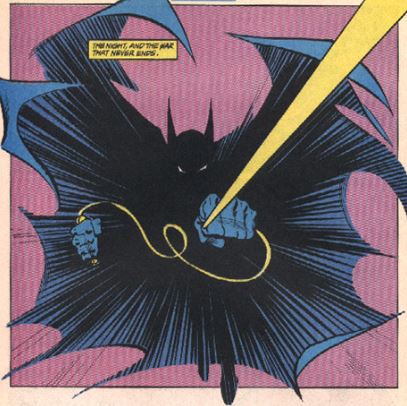
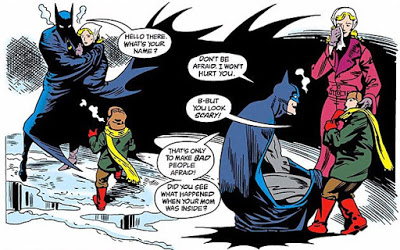
Breyfogle drew that Batman. Breyfogle's Batman was definitely human. His always visible muscles could be seen moving, bulging and straining under his costume, which at that point was just spandex, rather than the head-to-toe body armor he now wears. He would get hurt...a lot. His costume would rip. He would bleed. Memorably, one of his ears might get chopped off or bent in particularly savage fights. Usually from the neck down, he was an undeniably physical presence, a human being like all the others in the comics. But his head and cape, the "bat" parts of the Batman, were often inky black--this was when Batman was still wearing blue and gray, remember--as shadow would fall on him. In the distance, in the shadow, when he was trying to look imposing or scary or threatening, he would be half-transformed into an angry, jagged black shape with narrow, sharp, white triangles for eyes and, perhaps, equally white gritted teeth.
At other times, when hew as talking one-on-one with Commissioner James Gordon, or a police officer, or Alfred, or Robin or an innocent civilian, he would resume his normal shape, and it would be clear he was a man in a blue and gray bat costume.
I also like the length of Breyfogle's bat-ears--his was the baby bear length of ears, just right. My other favorite Batman artist, Kelley Jones, drew them gigantically long (if Breyfogle balanced the two aspects of Batman, Jones drew and perfected the all-bat version, the Batman-as-Batman-sees-himself), whereas many artists drew them quite short. Breyfogle, like Aparo and Neal Adams, drew them as long, but not too long.
When I think of Batman, the image in my head is of Breyfogle's Batman.
By the time I had gone off to college and buying comic books was becoming a weekly habit and ritual for me, Breyfogle had left Batman and pursued work for other publishers, none of which I read, although he would occasionally return for a Batman story here or there, he re-teamed with Grant to try and make Anarky into a solo superhero, and then he would show up in often unexpected places at DC, and a few pages of Breyfogle art would end up being a nice surprise I wasn't looking for, but was always happy to get.
By the aughts, I honestly felt kind of bad for Breyfogle, like he wasn't getting the attention and acclaim I felt he deserved. He might draw the Justice League for a few pages in Anarky or a one-shot or part of a multi-artist, event miniseries, and I would find myself taken aback by how good he was, and wondering why he wasn't on JLA, or one of DC's highest-profile books. Whenever there would be a sub-par issue of Batman--of which there were many in the aughts, and Grant Morrison's run on Batman included some shockingly poor artwork for the publisher's highest-profile books by one of the industry's highest-profile writers, I would wonder why the fuck Breyfogle wasn't drawing it.
I was genuinely surprised when he started working with Archie Comics on those comics set in possible futures where Archie married Betty or Veronica, because it seemed like such a weird place for Breyfogle's talents--no capes, no acrobatics, no flying kicks, no dynamic action scenes--but he rather remarkably managed to draw them in such a way that they kept the house style designs of the characters while still looking like his work.
When he had his stroke in 2015, and it was subsequently revealed that he would likely never draw again, I was surprised again--and now I felt more than kind of bad for Breyfogle. I honestly can't imagine how devastating it would be for an artist to lose his ability to create art, as I have to imagine drawing wasn't what someone like Breyfogle did for a living, but was something he did because he loved doing it. It was a vocation and what he was great at, and now he couldn't...? I tried to do what I could, but I am not nearly as rich as I would like to be, and I would like to be rich in large part because it means I can't help I want to help as much as I'd like (Honestly. My college loans are all paid off. I'm terrified of all forms of travel. I have extremely cheap taste in clothes, cars and the things rich people might normally spend money on. I have no significant other, no children, no pets. I want to buy a house and, after that, um, I don't really need much more money for anything other than giving it to people who can use money).
It's honestly been a little sad to be on the Internet at all this week, in part because of Breyfogle's passing. I was heartened, and a little surprised, to see how much love and affection for his work appeared in my Twitter feed and elsewhere on the Internet. My appreciation of his work was hardly unique, and I was hardly the only person in my general generation of comic book readers he had an incredible impact on. I lost count of how often I saw the same four images this week: Batman standing in an alley during a thuderstorm, his billowing black cape becoming an abstract black cloud on the cover of Detective #587; Batman standing dramatically with his back to the viewer as he faces Big Ben, a flock of bats flying out to meet him from the cover of Detective #590; Batman swaddling himself in his cape as he stands in a dove-filled graveyard, Breyfogle's own name on a nearby tombstone from Detective #610; Batman and the new Robin, Tim Drake, caught in a spotlight atop a roof (in perfect update of the cover from Batman #9) on Batman #465. They are all indelible images, and they are just a handful of those Breyfogle crafted.
I don't know what happens when someone dies. I know what the faith tradition I was raised in says happens, and I know what I hope happens (and what I fear might not happen). If there's a heaven, I hope Norm Breyfogle is there, and I hope he knows how much his work has meant to me, and the hundreds and hundreds of others who similarly got into comics or got into Batman in large part because of how God damn good Norm Breyfogle was at drawing Batman comics. And if there's not, and the human soul is not immortal, than I guess I can talk some solace in the fact that if he's not going to necessarily exist in some form forever, than at least his work will live on for...well, perhaps not forever, but for a long, long, long time to come.
Now, it occurred to me this week that many of the people expressing their sadness at Breyfogle's passing and their appreciation for his work are all from the same generation, and there's a good chance that there are many, many fans of Batman comics and DC's other super-comics who aren't at all familiar with Breyfogle's work, or perhaps have only seen the 20 pages or so of it that appear in the Batman: Knightfall omnibus, for example, or maybe the Holy Terror "chapter" in Batman: Elseworlds Vol. 1.
As I am not in a position to do anything else of value to mark Breyfogle's passing then, I figured I can at least do this, and so I've put together a reading guide of sorts for those who might find themselves wondering about this Norm Breyfogle character and what makes him so special. Below, in roughly chronological-ish order, are the books and comics the curious can seek out, in formats that should be the easiest to find at your local comic shop or your local library.
I am restricting it to his DC work, which is perhaps unfair to his versatility (and to the other publishers he worked with), but that is mainly because he is best-known for his Batman work, and the bulk of his work (and the bulk of it that has been collected) was for DC. Aside form the Archie comics mentioned, Breyfogle also drew Prime and Metaphysique for Mailibu, Mr. T for Now Comics, Bloodshot for Valiant/Acclaim, an American Flagg back-up for First Comics, a couple of short Marvel comics and work for several smaller publishers.
Legends of The Dark Knight: Norm Breyfogle Vol.1 (2015) This is probably the best place to start with Norm Breyfogle's Batman, as it is the beginning of his Batman, and it offers what amounts to somewhere between the first half and first third of his work on the character's two flagship books, Detective Comics and Batman. Breyfogle debuted on the title in 1987's Detective Comics #579, a Crime Doctor story by Mike Barr, which he both penciled and inked. A few months elapsed before he returned for #582, after which point he became the regular pencil artist for the series, sometimes inking his own work, more often being inked by long time collaborator Steve Mitchell. The bulk of the of the stories in this volume--and in Breyfogle's tenure on Batman--were written by 2000 AD alum Alan Grant, who wrote the first dozen issues of his run on 'Tec with co-writer John Wagner.
If I remember interviews I read years ago correctly, the two British comics alumni weren't too terribly immersed in DC continuity at the time, and as a result found it easier to create their own characters for Batman to fight and interact with than to get up to speed with what Ra's al Ghul and Man-Bat or whoever were up to the last time reader saw them. And so the Grant or Grant/Wagner-written comics collected herein--'Tec #582-594 and #601-607--were often short, done-in-one stories featuring Batman out in the city, not unlike a beat cop, encountering crimes that needed fought and people that needed saved. The villains were mostly new to Batman and new to readers, and several of them would become recurring characters (although, among the ones in this volume, it was mostly Grant himself who used them on a repeat basis).
These issues of 'Tec, all drawn between 1987 and 1989, featured brand-new bad guys The Ventriloquist and Scarface, The Ratcatcher,The Corrosive Man, Cornelius Stirk and Mr. Kadaver, who had a cool look to go with his name, but wouldn't make any return appearances. There are two longer, four-part stories, both of which are excellent, and among some of my favorite Batman comics of all time.
First, there's a four-part story guest-starring Jack Kirby's Etrigan, The Demon, in which Batman finds himself facing a superior, supernatural foe and tries to entreat Gotham City occultist Jason Blood to help him, but Blood is more afraid of his demon than the four-armed monster on the loose. In the climax, Etrigan is released and does take care of the monster, and then turns his evil attentions to Batman, in what is maybe one of my favorite fight scenes in comics (the virtues of which I talked about here, as well as posting some rather poor scans of some rather amazing art).
In addition to drawing the ultimate Batman, Breyfogle drew what I would consider the best Demon...if anyone other than a character's creator can truly be said to draw the best version of that character, of course (My second favorite Demon? John McCrea's). I'm not sure if this storyline was intentionally created to serve as a launchpad for Alan Grant's The Demon ongoing or not, but not long after Etrigan got his second and longest-lasting ongoing series.
The second four-part arc was "The Mud Pack," in which all four villains to have used the name "Clayface" over the years allied themselves to take down Batman once and for all...although by the end of the story, Grant was well on his way to simplifying the Clayfaces into a single villain and concept, one that better matches the one we have now, and the one from Batman: The Animated Series, which is the version most people who have ever heard of Clayface before are most familiar with.
In addition to all of those Detective issues, there's material from a pair of Batman annuals in this collection, featuring Robin Jason Todd (Breyfogle's very first Batman-related work) and The Penguin.
Legends of The Dark Knight: Norm Breyfogle Vol. 2 (2018) This long- and eagerly awaited (by me) second volume is due next month, and will collect Detective Comics #608-621 and Batman #455-459 from 1989-1991. These issues will include the introduction of Anarky, a rather sizable Penguin story (one of the covers of which, above, was shared online quite a bit this week; note the marker with Breyfogle's name on it), a Joker story and a pretty great one-issue story involving Catwoman and Catman. That last one I've written at length about before (that's the issue for which Breyfogle redesigned Catman, giving him the best of his costumes, even if it proved to be short-lived).
The Batman issues revolve around Tim Drake, and his rescue of Batman from the clutches of The Scarecrow, after which he dons his new Robin costume for the first time (These issues of Batman have already been collected in Robin: Reborn, discussed below).
The issue in which Commissioner James Gordon has his heart attack is included in this batch too; I recall that reading particularly preachy to me when I was a teenager, so I assume it will only seem more so now that I am an infinitely more jaded and cynical adult. On the other hand, Gordon seems to have taken up smoking again, so maybe it's still a timely reminder to not smoke and take care of yourself...hell, maybe Jim should read it himself.
This volume will include the end of Breyfogle's run on Detective, and get us pretty near the end of his time as a regular artist on the Bat-titles. There will certainly be enough for a Vol. 3, as there's a dozen issues left of Batman, his portion of Detective Comics #627, some nine issues of Shadow of The Bat, a couple of one-shots discussed below, the Retroactive special, some short stories...hell, there will probably be enough for a Vol. 4, if DC desires to do one.
Robin Vol. 1: Robin Reborn (2015) Breyfogle was not the first artist to draw the third Robin, Tim Drake, nor was he the artist who would become most associated with the Boy Wonder of the early 1990s, but he did draw many of the character's earliest appearances, and was the pencil artist who chronicled the period in which Tim hung around the Batcave training trying to earn The Dark Knight's trust, after the story arcs that introduced him and made a case for Batman always having a Robin ("Batman: Year Three", "A Lonely Place of Dying"). Breyfogle was also the artist who drew Tim's first appearance in the new Robin costume (on the splash page above).
This collection, the first of a new line collecting writer Chuck Dixon's run on the character, includes 1990's Detective Comics #618-621 and Batman #455-457 by Grant, Breyfogle and Mitchell. In the former, new villain The Obeah Man kidnaps Tim's parents in Haiti and Batman goes to rescue them; Tim's mother dies, but Tim's father survives, albeit in a coma. In the latter, Batman faces the resurfaced Scarecrow, and Tim has to decide if he should disobey Batman's orders to stay in the Batcave in order to save Batman's life, even if it means giving up his chance to ever be his partner.
(Is that the scariest image of a Robin ever drawn? I think it might be. I like how Breyfogle managed to make Robin look both menacing and mysterious--in part to not reveal the new costume, designed by Breyfogle's own influence Neal Adams--the figure looks, but also how frightened The Scarecrow seems to be of Robin appearing in the window. And I can't imagine it was easy to depict fear in a character whose face is completely hidden by a featureless mask like The Scarecrow wears here).
The rest of the collection is devoted to Chuck Dixon and Tom Lyle's original Robin miniseries. Though Grant and writer Marv Wolfman wrote the first Tim Drake and Robin III stories, it would be Dixon who would spend the most time on the new Robin character, and first Lyle and then Tom Grummett who would be the artists most associated with the start of the new Boy Wonder's career.
Detective Comics #627 (1991) The very first Batman story was "The Case of The Chemical Syndicate," which was published in 1939's Detective Comics #27. In 1991, when 'Tec reached issue #627, it's 600th issue featuring Batman, DC published this special 80-page issue. It hasn't been collected previously, at least not that I'm aware of, but I wouldn't be surprised if Breyfogle's contribution shows up in a future LDK: Norm Breyfogle collection. If you can find this in a back-issue bin or online for a reasonable price, it's worth a look.
Contained within are two reprints and two original stories, all of four of them using the same plot of "The Case of The Chemical Syndicate." The reprints are of the original 1939 Bob Kane and Bill Finger story (of course) and a 1969 cover version of that story by Mike Friedrich, Bob Brown and Joe Giella, commissioned by editor Julius Schwartz to celebrate Batman's thirtieth anniversary. The two new stories were by the modern Batman creative teams, telling their versions of the original story: One by Marv Wolfman, Jim Aparo and Mike DeCarlo, and the other by Alan Grant, Norm Breyfogle and Steve Mitchell. Sort of like Rashomon, only with a Golden Age Batman strip, only not really.
The issue features a painted cover by Breyfogle, featuring his cover version of #27's cover, rather unfortunately cluttered up by text and extraneous elements.
Batman: Birth of The Demon (1992/2012) Part of the "...Of The Demon" trilogy of Ra's al Ghul-related original graphic novels, Birth follows Mike Barr and Jerry Bingham's 1987 Son of The Demon and Barr and Tom Grindberg's 1990 Bride of The Demon. For Birth, Ra's al Ghul co-creator and famed writer-turned-Batman line editor Denny O'Neil teamed with Breyfogle for the definitive origin of his most famous contribution to Batman's rogue's gallery. Framed as a modern day story between the two arch-rivals, in which a deteriorating seems to kill the Dark Knight--shoving a fucking shovel into his chest--before they tumble into a Lazarus Pit together. Between the beginning and the end, however, we get Ra's' origin and learn how he discovered the pits and what he has been up to during his incredibly, unnaturally long life.
The graphic novel, which was originally published in 1992 and then republished in 2012, was of a slightly bigger, more album-like size than your average Big Two comic, and Breyfogle employed a rarely used style, in which he painted over his pencils (generally, this is only seen on a handful of the artist's covers). The result is kind of incredible, as the character designs and their movements are familiar from dozens and dozens of Batman comics, but their texture, their sheen, their mood is totally different...moodier, more dramatic, more "important" looking.
This book is also somewhat noteworthy for the fact that while it's still technically a Batman comic, the bulk of it is spent in centuries past, in an unknown Middle Eastern kingdom whose name was carefully removed from history by Ra's, and Breyfogle thus spends a lot of time drawing desert sands, horses and what looks like a combination of Hollywood Biblical epic trappings and oriental exotica of a past age's pop culture. In other words, like the art style, it is both incredibly familiar, but just as incredibly different, simultaneously.
It was originally published as a standalone hardcover, but in 2012 all three "...Of the Demon" books were collected under the umbrella title, and a new, Andy Kubert-drawn cover was slapped atop it. If your local library doesn't have the original, it should at least have the omnibus collecting all three books. (I previously reviewed Birth of The Demon here, if you're interested.)
Batman: Shadow of The Bat Vol. 1 (2016) This collection includes the first 12 issues of Shadow of The Bat, which was launched in 1992 as the new Grant/Breyfogle book, although Breyfogle would leave after the first five issues, which included the four-part "The Last Arkham." The story, which introduced Mr. Zsasz, Dr. Jeremiah Arkham and Amygdala, saw Batman committed to the newly rebuilt and refortified Arkham Asylum after he appears to have snapped and killed a police officer. Batman got himself committed on purpose, of course, to find out how an inmate Victor Zsasz seems to be escaping to commit murders in Gotham City on a regular basis, only to be found still locked in his cell the next morning. The story is notable not only as the first appearance of Zsasz, who would eventually become the most often-used of the Grant/Breyfogle created villains, but also for a rather rare instance of Breyfogle drawing Nightwing Dick Grayson.
That is followed by done-in-one "The Black Spider." Breyfogle would return for #13 (Collected in Batman: Shadow of The Bat Vol. 2) and #50. Grant would remain, and work with some pretty great artists. The rest of this volume includes the one-issue "Ugly American" with Dan Jurgens and Dick Giordano, the three-issue arc "The Misfits" by Tim Sale, the one-issue "The Thane of Gotham" by Mike Collins and Steve Mitchell (featuring one of my favorite of Brian Stelfreeze's covers for the series), and the two-part "Human Flea" by Vince Giarrano (Aside: I loved this character so much, and had DC Comics hired Teenage Caleb to write for them, he would have become a recurring member of Tim Drake's rogue's gallery before ultimately joining The Teen Titans, I think).
Batman: Anarky (1999) After an absence from DC and Gotham City, Breyfogle returned to illustrate a 1997 miniseries starring one of he and Grant's more-famous contributions to the mythos, brilliant teenage anarchist and vigilante Lonnie Manchin, AKA Anarky. Joe Rubinstein inked. Although the later collection gave Batman top-billing, Batman was more of a bit player, not getting too much more panel-time then guest-stars Etrigan, The Demon and Darkseid. In trying to turn a Batman adversary into a DC superhero, Grant and Breyfogle opened up the character's milieu quite a bit, having him artificially make himself more intelligent yet and even travelling to Apokolips to stare down DC's god of evil, whom he ended up amusing. At the end of the series, Anarky had a new costume, a dog side-kick with an anarchy-symbol collar and a talking computer named Max and he was primed for an monthly ongoing series, if the market demanded it.
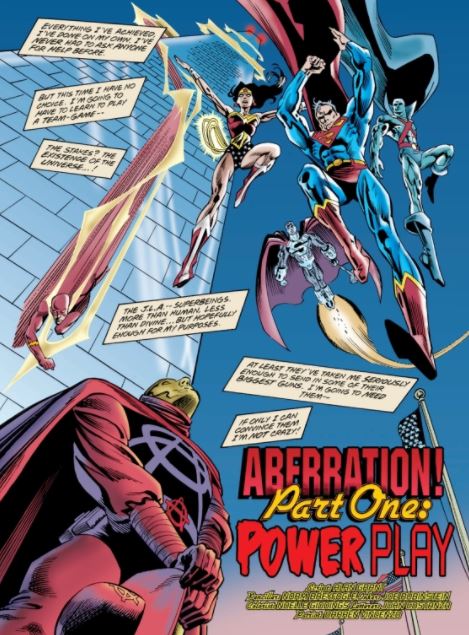
Anarky: The Complete Series (2018) The market was, of course, fickle. DC greenlit an ongoing that launched in 1999, but then they axed it almost immediately, so that it ran just eight issues. Its suddenness was apparent in the fact that in the final issues Grant, Breyfogle and Rubinstein were still introducing new characters and subplots that would never reach fruition. The mega-plots for the series included Anarky's discovery of a cosmic threat to Earth called "The Abberation" that he had detected but the JLA didn't take seriously and the search for his real father, who was teased to be one of a handful of Batman's greatest villains.
In the short run, Anarky would meet (and thus Breyfogle would get to draw) much of the Morrison/Porter/Dell JLA, Green Lantern Kyle Rayner (whose ring Lonnie would briefly gain control of, giving Breyfogle the chance to redesign Anarky's costume), Ra's al Ghul and all those potential fathers (The Joker, Two-Face, Killer Croc, The Ventriloquist).
The most surprising guest stars, however, were the ghost of General J.E.B. Stuart and the crew of The Haunted Tank, appearing as part of DC's Geoff Johns-written Day of Judgement crossover event series (as you can see from the cover, Breyfogle drew one hell of a bad-ass ghostly Confederate general).
Batman: The Abduction (1998) This 64-page prestige-format one-shot reunited Grant and Breyfogle, who is here inked by James A. Hodgkins. Typical of Grant's Batman stories, it takes a particular subject and riffs on it in various directions, and here the specific subject matter is aliens. Like, real--or "real"--aliens, not the sorts one normally associates with superhero comics. The pale, thing, big-headed, big-eyed "Grays" familiar from real-world abduction literature. Grant, of course, realizes the tension of trying to tell a serious story in which Batman is abducted by aliens and the fact that the character's co-workers include a coupla strong men from the alien planets of Krypton and Mars, and another one is a galactic space cop, but he mostly just acknowledges the tension and gets on with the business. Those of you who read my not-very-good mini-comic The Ghost In The Bathroom know I was particularly phobic of Gray aliens and the idea of alien abduction for a big chunk of my life, so, as I probably wrote in letter to the editor to DC Comics back in the day, this comic was literally the stuff my bad dreams were made of. There are lots of trippy visuals, and in one hallucinatory scene, Batman fights Bruce Lee. The book must have proved as financially successful as it was creatively, as it was followed in 2000 with another prestige-format one-shot by Grant and Breyfogle (here inking his own work), Batman: Dreamland, in which Batman pursues a killer into Area 51, and similar, paranoid millennial subjects are covered and themes pursued. The pair of these would make for a pretty good trade paperback collection, as neither seems to have been collected or republished before.
The Spectre (2002-2003) During the previously mentioned Day of Judgement series, The Spectre Force--the personification of God's wrath--was unmoored and vulnerable to falling into the wrong hands again, as its long-time host Jim Corrigan finally ended his long afterlife and ascended to heaven at the conclusion of John Ostrander and Tom Mandrake's excellent 1992-1998 series. DC had a popular-ish dead superhero in the form of former Green Lantern-gone-bad Hal Jordan; why not combine the two? That was the premise of the 27-issue 2001-2003 Spectre series written by J. M. DeMatteis. I found the premise particularly interesting, and the execution was quite ambitions...but somewhat dull. The series lasted a respectable-ish amount of time--more than three times longer than Anarky, for example--but it was ultimately cancelled and Jordan eventually brought back to life and made a Green Lantern again. What this has to do with Breyfogle is that he took over pencil chores on the book for the majority of its second half, drawing #15-#23 and #25-#27 (inked by Dennis Janke). The book certainly allowed Breyfogle to play in the DCU while straying far, far away from the rooftops and alleys of Gotham City, as he drew arcs set in outer space, on Apokolips and the various spiritual, metaphysical and cosmic planes that The Spectre operated on. In addition to various supernatural beings, Breyfogle's part of the series featured the ghost of Abin Sur, a version of Sinestro and various Justice Leaguers, especially Martian Manhunter and Green Arrow. DC has never collected any of this volume of The Spectre, which is perhaps unsurprising, so one would need to consult back issue bins if one wanted to read any of these.
DC Retroactive: Batman--The '90s #1 (2011) I think I've got that confounding title right. Just before DC rebooted their continuity in the fall of 2011 and launched "The New 52," they published a suite of one-shots under the umbrella title of "DC Retroactive," with each issue focusing on a particular character or team from a particular decade, and creators who worked on those characters at that time were engaged to produce a new story. That, or DC hired folks who could approximate the writing and art styles associated with those characters in that decade. For this one-shot, the Grant and Breyfogle team was called in. Once again they pit Batman against one of their most famous villainous creations, The Ventriloquist and Scarface (and Rhino). I wrote about it at the time for Robot 6. (A lot of what I say in this post I said previously in that piece.)
Batman: Elseworlds Vol. 1 (2016) Although Gotham By Gaslight is considered the first Elseworlds comic, 1991's Batman: Holy Terror was the first to bear the Elseworlds logo. If you can't find the original prestige-format comic in a back-issue bin, it is the first of the eight stories collected in this recent book. For Holy Terror, Breyfogle was teamed not with Grant, but with Alan Brennert. Set in a world where America is a commonwealth nation and is ruled by a theocratic government, young Bruce Wayne is set to join the clergy when he discovers the long-ago murder of his parents was part of a government conspiracy: They were, apparently, rebels who ran a secret clinic in which they helped those who suffered the religious-motivated brutality of The Star Chamber. Wayne takes a passion play demon costume once worn by his father as a disguise and begins to investigate their murder, ultimately uncovering what this nightmare version of the U.S. government did to characters that ended up being the superheroes of the "real" DC Universe.
Not only is the book unusual for being a Grant-less Breyfogle comic and for giving him a relatively rare chance to draw others of DC's more iconic characters (even if they don't much look like themselves here), but it's a lot more political than your average Batman comic, either by the standards of the early 1990s or today, where things like the Waynes assisting in abortions would probably generate a lot more fuss in those pre-social media days.
The collections also features stories drawn by Jerry Bingham, Howard Chaykin, Mark Chiarello, Bo Hampton, Kelley Jones, Jose Luis Garcia-Lopez, P. Craig Russell and Alan Weiss in which Batman is a cowboy, a space man, a Green Lantern, various monsters and a contemporary of Houdinis'.
The third volume of this series, Batman: Elseworlds Vol. 3, includes the Doug Moench-written 1995 comic Brotherhood of The Bat, in which Breyfogle is one of the many Batman artists to draw a chapter, along with just about every other Bat-office artist from the first half of the decade: Jim Aparo, Jim Balent, Bret Blevins, Vince Giarrano, Tom Grummett, Mike Manley and Graham Nolan.
Flashpoint (1999) No, not that Flashpoint.
In 1999, writer Pat McGreal and Breyfogle collaborated on this three-issue Elseworlds miniseries, which imagines a world in which The Flash saved President John F. Kennedy from the assassin's bullets...but the Scarlet Speedster ended up in a wheelchair as a result. I have not yet read this--those Stuart Immonen covers fooled me, I guess--but it appears to feature not only The Flash and some of his villains and supporting cast, but also much of the original Silver Age Justice League line-up. It has not been collected by itself, but it will be collected next year, in Elseworlds: Justice League Vol. 3, along with Conjurors (featuring one of the proto-Shdowpact/Justice League Dark teams), Evan Dorkin and all your favorite artists' Superman and Batman: World's Funnest (which is the best ever), the Kevin Maguire-drawn what-if-all-the-dudes-died story JLA: Created Equal (featuring Green Lantern Barbara Gordon!) and Green Lantern: 1001 Emerald Knights, which, with Flashpoint, is the only one of these that I've never read before.
Batman Beyond: 10,000 Clowns (2013) Breyfogle's last Batman-related assignment was this run from one of DC's several Batman Beyond comics, each of which conntinued the concept of the TV cartoon in one way or another. This one seems to be a pretty direct continuation of the cartoon's continuity, although it does feature old man--or older man--versions of Bruce Wayne, Dick Grayson and Tim Drake, in addition to Batman Terry McGinnis. I reviewed it at some length here.
And that's much of, but not all of, Breyfogle's work for DC Comics. He had a few fill-ins on Green Arrow and Hawkman, he drew the opening chapter of Green Lantern: Circle of Fire (from which the above Adam Strange/Firestorm page is taken), and he contributed to Aquaman Secret Files & Origins 2003, JLA: Incarnations, DC Comics Presents and The Silver Age, some of which has been collected, much of which hasn't (Given the writers attached to Silver Age, it's actually slightly insane that it hasn't been). I'm not sure if there's the demand for it, but after DC finishes its Legends of the Dark Knight: Norm Breyfogle collections, there's probably enough random, short Breyfogle stories like those above to produce a DC Universe By Norm Breyfogle collection, similar to the one highlighting the random contributions by Mike Mignola. Hell, I'd buy it, so there's one sale right there.
I did not know him. In fact, I hardly knew anything at all about it. I never met him. I never interviewed him over the phone or email. I never saw him speak at a comic book convention panel or in a college auditorium. I didn't follow him on Twitter, if he was even on Twitter, so I don't "know" him in the way that I now know dozens of other comic book creators by virtue of being exposed to their postings regularly. Come to think of it, I've only seen a handful of images of Breyfogle, and most of those were self-portraits rather than photographs.
So I feel a little strange about the sense of loss I felt upon hearing of his death, a sense that is still lingering like a particularly persistent fog around me. I suppose it comes from knowing that someone has died who I didn't know personally, who I barely knew much of, but who nevertheless had an enormous impact on my life.
Although Breyfogle drew comic books for major publishers for 30 years, he was by far best known for his work on Batman. That is where I first encountered his work, and it was Breyfogle's Batman that stoked my interest in the character and the medium, an interest that determined the direction of my life and made me what I am, and put me where I am now--for good or ill, I suppose.
I don't want to overstate how important Breyfogle's work was in getting me into comics. Had he never drawn Batman, then something else--Tim Burton's 1989 movie, Kelley Jones' covers, those weird Tom Taggart multimedia covers for 1992's Batman #477 and #478--would have eventually lured me into Gotham City. And, likewise, Jan Duursema's Advanced Dungeons & Dragons and Kevin Eastman and Peter Laird's Teenage Mutant Ninja Turtles would have likely gotten me into comics, it just might have taken a little longer, as I would have had one less draw.
But when I first walked into the comic book shop on Main Avenue in Ashtabula, Ohio during one of those occasional periods that my hometown actually had a functioning shop, I was immediately drawn to Breyfogle's covers for Batman #475 and Batman #476, another Ventrioliquist and Scarface story, from near the end of his run on the two main Batman titles. I recognized the main character, of course, from a childhood that included the live-action TV show, Super Friends cartoons and the Super Powers toy line, but he never looked as dynamic, as menacing, as cool or as fun as he did in Breyfogle's drawings of him. There was something special about the guy drawing those Batman comics, and it was apparent by comparing them to all the other Batman comics around them, those penciled by the likes of George Perez, Pat Broderick and Jim Aparo (all three of those are artists I would grow to appreciate and admire later, but 14-year-old Caleb found their Batmen too realistic, too stationary, too boring).
I started reading Batman comics backwards and forwards from that point on, getting new issues from the racks as they came out, and old ones from the back issue bins, and, when pulling from the bins, I started with those drawn by Breyfogle and his partner Alan Grant, who teenage Caleb would have told you was one of the greatest writers in the world.
The years in which the Grant and Breyfogle team, which usually included inker Steve Mitchell and occasionally co-writer John Wagner, were a perfect time to start reading Batman comics. The explosive, character re-defining stories of the late 1980s--"A Death In The Family", The Dark Knight Returns, "Batman: Year One", The Killing Joke--had come and gone, leaving a certain tone of import and melodrama in the line, but otherwise, the dust was settling, and DC seemed to have gotten much of the need to try and replicate those stories out of their system. The movie had debuted, but Hollywood adaptations of superhero comics were still a novelty, and its influence on the comics was negligible (I think designer Anton Furst's movie version of Gotham was incorporated into the comics as part of a story called "Destroyer," and, well, Robin III Tim Drake's first name didn't come out of thin air). The soap operatic narratives of the 1970s and early 1980s had fallen out of fashion, but the state of continuous crossover events hadn't yet infected Gotham in those pre-"Death of Superman" days (Breyfogle drew very few pages of "Knightfall," near the beginning, and returned for a three-issue stint on Legends of The Dark Knight for a story set in the "KnighQuest" cycle, but that was about it).
And so much of the Grant/Breyfogle run consisted of short stories of no more than four issues, but generally closer to one or two. Batman, mostly Robin-less, would go out into Gotham City and encounter a villain of some sort--as often as not, it would be a new and original villain, although, by the end of their time on the titles, they managed to get in almost all of the major members of the rogue's gallery. How different a time that was for DC Comics was also apparent in how many new and original villains appeared. Because comics weren't so widely viewed as a intelectual property factory producing concepts and characters for more lucrative films and television, Grant and Breyfogle weren't concerned about wasting their good ideas on DC's Batman comics when they could instead publish them at Image or elsewhere, so that if Hollywood wanted to ever make an Anarky movie, they would have to go through them.
When I first became a fan of Breyfogle's work, I doubt I could have explained what I liked about it so much, or why I preferred his Batman comics to those of his peers...although I am sure there are embarrassing letters to the editors in which I attempted to in the backs of many Batman comics of the mid-1990s.
Now I know that a large part of it is in the construction of his pages, and they way he drew action. It is apparent in his very first comics work. Look at this cover, wherein you can see he still hasn't mastered Batman's form and costume.
At that beginning point of his time with the Dark Knight, he has already mastered Batman as an action hero, as he virtually flies into the scene, breaking suddenly, dramatically and violently onto the cover.
Breyfogle drew some of the best action scenes in comics, then or since. As I complain endlessly week in and week out, too much of the "action" in American super-comics consists of characters posing in proximity to one another, leaving it to dialogue to explain what's happening. When Breyfogle's Batman fought someone or something, you could follow the series of moves, attacks and counters, from panel to panel. There was a logic to the fight, and there was a progression to it. It was a little story of physical movements that might last panels and might last pages.
I also liked how "cartoony" the art was, at least for Batman art of the time. Breyfogle struck a great balance between representation and expressionistic, and looking at his art, one could see how it could go in either direction and worked just as well, had Breyfogle so chosen to dial the art right or left.
Most of all, I appreciated how he drew Batman, which was exactly the way I thought about Batman, although since I was just then starting to think about Batman, I suppose it is more accurate to say that Breyfogle's art taught me how to think about Batman. I once saw Paul Pope speak at Ohio State University, and he described Batman oddly but accurately as a living logo for himself, apparent in his very first appearance on the cover of Detective Comics #27 (for decades the comics logo was a picture of Batman that looked like the icon on his chest, but with Batman's head where the silhouette of the bat symbol's head would be). Burton's Batman movie and editor Denny O'Neil's direction for the comics played up the idea that to the public at large, Batman was a maybe-real, maybe-not urban legend. They, like Frank Miller in his influential late-eighties work, returned to and reemphasized the "criminals are a superstitious and cowardly lot" bit of the character's origin, and so their Batman became something of a performance by Batman, a stage magician doing magic tricks to appear as a creature of the night and give himself an edge in his war on crime. Yes, Batman was the world's greatest detective, a peerless martial artist and in peak physical condition, but he was also a humbug, bluffing his way to victory over street crime.
Breyfogle drew that Batman. Breyfogle's Batman was definitely human. His always visible muscles could be seen moving, bulging and straining under his costume, which at that point was just spandex, rather than the head-to-toe body armor he now wears. He would get hurt...a lot. His costume would rip. He would bleed. Memorably, one of his ears might get chopped off or bent in particularly savage fights. Usually from the neck down, he was an undeniably physical presence, a human being like all the others in the comics. But his head and cape, the "bat" parts of the Batman, were often inky black--this was when Batman was still wearing blue and gray, remember--as shadow would fall on him. In the distance, in the shadow, when he was trying to look imposing or scary or threatening, he would be half-transformed into an angry, jagged black shape with narrow, sharp, white triangles for eyes and, perhaps, equally white gritted teeth.
At other times, when hew as talking one-on-one with Commissioner James Gordon, or a police officer, or Alfred, or Robin or an innocent civilian, he would resume his normal shape, and it would be clear he was a man in a blue and gray bat costume.
I also like the length of Breyfogle's bat-ears--his was the baby bear length of ears, just right. My other favorite Batman artist, Kelley Jones, drew them gigantically long (if Breyfogle balanced the two aspects of Batman, Jones drew and perfected the all-bat version, the Batman-as-Batman-sees-himself), whereas many artists drew them quite short. Breyfogle, like Aparo and Neal Adams, drew them as long, but not too long.
When I think of Batman, the image in my head is of Breyfogle's Batman.
By the time I had gone off to college and buying comic books was becoming a weekly habit and ritual for me, Breyfogle had left Batman and pursued work for other publishers, none of which I read, although he would occasionally return for a Batman story here or there, he re-teamed with Grant to try and make Anarky into a solo superhero, and then he would show up in often unexpected places at DC, and a few pages of Breyfogle art would end up being a nice surprise I wasn't looking for, but was always happy to get.
By the aughts, I honestly felt kind of bad for Breyfogle, like he wasn't getting the attention and acclaim I felt he deserved. He might draw the Justice League for a few pages in Anarky or a one-shot or part of a multi-artist, event miniseries, and I would find myself taken aback by how good he was, and wondering why he wasn't on JLA, or one of DC's highest-profile books. Whenever there would be a sub-par issue of Batman--of which there were many in the aughts, and Grant Morrison's run on Batman included some shockingly poor artwork for the publisher's highest-profile books by one of the industry's highest-profile writers, I would wonder why the fuck Breyfogle wasn't drawing it.
I was genuinely surprised when he started working with Archie Comics on those comics set in possible futures where Archie married Betty or Veronica, because it seemed like such a weird place for Breyfogle's talents--no capes, no acrobatics, no flying kicks, no dynamic action scenes--but he rather remarkably managed to draw them in such a way that they kept the house style designs of the characters while still looking like his work.
When he had his stroke in 2015, and it was subsequently revealed that he would likely never draw again, I was surprised again--and now I felt more than kind of bad for Breyfogle. I honestly can't imagine how devastating it would be for an artist to lose his ability to create art, as I have to imagine drawing wasn't what someone like Breyfogle did for a living, but was something he did because he loved doing it. It was a vocation and what he was great at, and now he couldn't...? I tried to do what I could, but I am not nearly as rich as I would like to be, and I would like to be rich in large part because it means I can't help I want to help as much as I'd like (Honestly. My college loans are all paid off. I'm terrified of all forms of travel. I have extremely cheap taste in clothes, cars and the things rich people might normally spend money on. I have no significant other, no children, no pets. I want to buy a house and, after that, um, I don't really need much more money for anything other than giving it to people who can use money).
It's honestly been a little sad to be on the Internet at all this week, in part because of Breyfogle's passing. I was heartened, and a little surprised, to see how much love and affection for his work appeared in my Twitter feed and elsewhere on the Internet. My appreciation of his work was hardly unique, and I was hardly the only person in my general generation of comic book readers he had an incredible impact on. I lost count of how often I saw the same four images this week: Batman standing in an alley during a thuderstorm, his billowing black cape becoming an abstract black cloud on the cover of Detective #587; Batman standing dramatically with his back to the viewer as he faces Big Ben, a flock of bats flying out to meet him from the cover of Detective #590; Batman swaddling himself in his cape as he stands in a dove-filled graveyard, Breyfogle's own name on a nearby tombstone from Detective #610; Batman and the new Robin, Tim Drake, caught in a spotlight atop a roof (in perfect update of the cover from Batman #9) on Batman #465. They are all indelible images, and they are just a handful of those Breyfogle crafted.
I don't know what happens when someone dies. I know what the faith tradition I was raised in says happens, and I know what I hope happens (and what I fear might not happen). If there's a heaven, I hope Norm Breyfogle is there, and I hope he knows how much his work has meant to me, and the hundreds and hundreds of others who similarly got into comics or got into Batman in large part because of how God damn good Norm Breyfogle was at drawing Batman comics. And if there's not, and the human soul is not immortal, than I guess I can talk some solace in the fact that if he's not going to necessarily exist in some form forever, than at least his work will live on for...well, perhaps not forever, but for a long, long, long time to come.
Now, it occurred to me this week that many of the people expressing their sadness at Breyfogle's passing and their appreciation for his work are all from the same generation, and there's a good chance that there are many, many fans of Batman comics and DC's other super-comics who aren't at all familiar with Breyfogle's work, or perhaps have only seen the 20 pages or so of it that appear in the Batman: Knightfall omnibus, for example, or maybe the Holy Terror "chapter" in Batman: Elseworlds Vol. 1.
As I am not in a position to do anything else of value to mark Breyfogle's passing then, I figured I can at least do this, and so I've put together a reading guide of sorts for those who might find themselves wondering about this Norm Breyfogle character and what makes him so special. Below, in roughly chronological-ish order, are the books and comics the curious can seek out, in formats that should be the easiest to find at your local comic shop or your local library.
I am restricting it to his DC work, which is perhaps unfair to his versatility (and to the other publishers he worked with), but that is mainly because he is best-known for his Batman work, and the bulk of his work (and the bulk of it that has been collected) was for DC. Aside form the Archie comics mentioned, Breyfogle also drew Prime and Metaphysique for Mailibu, Mr. T for Now Comics, Bloodshot for Valiant/Acclaim, an American Flagg back-up for First Comics, a couple of short Marvel comics and work for several smaller publishers.
Legends of The Dark Knight: Norm Breyfogle Vol.1 (2015) This is probably the best place to start with Norm Breyfogle's Batman, as it is the beginning of his Batman, and it offers what amounts to somewhere between the first half and first third of his work on the character's two flagship books, Detective Comics and Batman. Breyfogle debuted on the title in 1987's Detective Comics #579, a Crime Doctor story by Mike Barr, which he both penciled and inked. A few months elapsed before he returned for #582, after which point he became the regular pencil artist for the series, sometimes inking his own work, more often being inked by long time collaborator Steve Mitchell. The bulk of the of the stories in this volume--and in Breyfogle's tenure on Batman--were written by 2000 AD alum Alan Grant, who wrote the first dozen issues of his run on 'Tec with co-writer John Wagner.
If I remember interviews I read years ago correctly, the two British comics alumni weren't too terribly immersed in DC continuity at the time, and as a result found it easier to create their own characters for Batman to fight and interact with than to get up to speed with what Ra's al Ghul and Man-Bat or whoever were up to the last time reader saw them. And so the Grant or Grant/Wagner-written comics collected herein--'Tec #582-594 and #601-607--were often short, done-in-one stories featuring Batman out in the city, not unlike a beat cop, encountering crimes that needed fought and people that needed saved. The villains were mostly new to Batman and new to readers, and several of them would become recurring characters (although, among the ones in this volume, it was mostly Grant himself who used them on a repeat basis).
These issues of 'Tec, all drawn between 1987 and 1989, featured brand-new bad guys The Ventriloquist and Scarface, The Ratcatcher,The Corrosive Man, Cornelius Stirk and Mr. Kadaver, who had a cool look to go with his name, but wouldn't make any return appearances. There are two longer, four-part stories, both of which are excellent, and among some of my favorite Batman comics of all time.
First, there's a four-part story guest-starring Jack Kirby's Etrigan, The Demon, in which Batman finds himself facing a superior, supernatural foe and tries to entreat Gotham City occultist Jason Blood to help him, but Blood is more afraid of his demon than the four-armed monster on the loose. In the climax, Etrigan is released and does take care of the monster, and then turns his evil attentions to Batman, in what is maybe one of my favorite fight scenes in comics (the virtues of which I talked about here, as well as posting some rather poor scans of some rather amazing art).
In addition to drawing the ultimate Batman, Breyfogle drew what I would consider the best Demon...if anyone other than a character's creator can truly be said to draw the best version of that character, of course (My second favorite Demon? John McCrea's). I'm not sure if this storyline was intentionally created to serve as a launchpad for Alan Grant's The Demon ongoing or not, but not long after Etrigan got his second and longest-lasting ongoing series.
The second four-part arc was "The Mud Pack," in which all four villains to have used the name "Clayface" over the years allied themselves to take down Batman once and for all...although by the end of the story, Grant was well on his way to simplifying the Clayfaces into a single villain and concept, one that better matches the one we have now, and the one from Batman: The Animated Series, which is the version most people who have ever heard of Clayface before are most familiar with.
In addition to all of those Detective issues, there's material from a pair of Batman annuals in this collection, featuring Robin Jason Todd (Breyfogle's very first Batman-related work) and The Penguin.
Legends of The Dark Knight: Norm Breyfogle Vol. 2 (2018) This long- and eagerly awaited (by me) second volume is due next month, and will collect Detective Comics #608-621 and Batman #455-459 from 1989-1991. These issues will include the introduction of Anarky, a rather sizable Penguin story (one of the covers of which, above, was shared online quite a bit this week; note the marker with Breyfogle's name on it), a Joker story and a pretty great one-issue story involving Catwoman and Catman. That last one I've written at length about before (that's the issue for which Breyfogle redesigned Catman, giving him the best of his costumes, even if it proved to be short-lived).
The Batman issues revolve around Tim Drake, and his rescue of Batman from the clutches of The Scarecrow, after which he dons his new Robin costume for the first time (These issues of Batman have already been collected in Robin: Reborn, discussed below).
The issue in which Commissioner James Gordon has his heart attack is included in this batch too; I recall that reading particularly preachy to me when I was a teenager, so I assume it will only seem more so now that I am an infinitely more jaded and cynical adult. On the other hand, Gordon seems to have taken up smoking again, so maybe it's still a timely reminder to not smoke and take care of yourself...hell, maybe Jim should read it himself.
This volume will include the end of Breyfogle's run on Detective, and get us pretty near the end of his time as a regular artist on the Bat-titles. There will certainly be enough for a Vol. 3, as there's a dozen issues left of Batman, his portion of Detective Comics #627, some nine issues of Shadow of The Bat, a couple of one-shots discussed below, the Retroactive special, some short stories...hell, there will probably be enough for a Vol. 4, if DC desires to do one.
Robin Vol. 1: Robin Reborn (2015) Breyfogle was not the first artist to draw the third Robin, Tim Drake, nor was he the artist who would become most associated with the Boy Wonder of the early 1990s, but he did draw many of the character's earliest appearances, and was the pencil artist who chronicled the period in which Tim hung around the Batcave training trying to earn The Dark Knight's trust, after the story arcs that introduced him and made a case for Batman always having a Robin ("Batman: Year Three", "A Lonely Place of Dying"). Breyfogle was also the artist who drew Tim's first appearance in the new Robin costume (on the splash page above).
This collection, the first of a new line collecting writer Chuck Dixon's run on the character, includes 1990's Detective Comics #618-621 and Batman #455-457 by Grant, Breyfogle and Mitchell. In the former, new villain The Obeah Man kidnaps Tim's parents in Haiti and Batman goes to rescue them; Tim's mother dies, but Tim's father survives, albeit in a coma. In the latter, Batman faces the resurfaced Scarecrow, and Tim has to decide if he should disobey Batman's orders to stay in the Batcave in order to save Batman's life, even if it means giving up his chance to ever be his partner.
(Is that the scariest image of a Robin ever drawn? I think it might be. I like how Breyfogle managed to make Robin look both menacing and mysterious--in part to not reveal the new costume, designed by Breyfogle's own influence Neal Adams--the figure looks, but also how frightened The Scarecrow seems to be of Robin appearing in the window. And I can't imagine it was easy to depict fear in a character whose face is completely hidden by a featureless mask like The Scarecrow wears here).
The rest of the collection is devoted to Chuck Dixon and Tom Lyle's original Robin miniseries. Though Grant and writer Marv Wolfman wrote the first Tim Drake and Robin III stories, it would be Dixon who would spend the most time on the new Robin character, and first Lyle and then Tom Grummett who would be the artists most associated with the start of the new Boy Wonder's career.
Detective Comics #627 (1991) The very first Batman story was "The Case of The Chemical Syndicate," which was published in 1939's Detective Comics #27. In 1991, when 'Tec reached issue #627, it's 600th issue featuring Batman, DC published this special 80-page issue. It hasn't been collected previously, at least not that I'm aware of, but I wouldn't be surprised if Breyfogle's contribution shows up in a future LDK: Norm Breyfogle collection. If you can find this in a back-issue bin or online for a reasonable price, it's worth a look.
Contained within are two reprints and two original stories, all of four of them using the same plot of "The Case of The Chemical Syndicate." The reprints are of the original 1939 Bob Kane and Bill Finger story (of course) and a 1969 cover version of that story by Mike Friedrich, Bob Brown and Joe Giella, commissioned by editor Julius Schwartz to celebrate Batman's thirtieth anniversary. The two new stories were by the modern Batman creative teams, telling their versions of the original story: One by Marv Wolfman, Jim Aparo and Mike DeCarlo, and the other by Alan Grant, Norm Breyfogle and Steve Mitchell. Sort of like Rashomon, only with a Golden Age Batman strip, only not really.
The issue features a painted cover by Breyfogle, featuring his cover version of #27's cover, rather unfortunately cluttered up by text and extraneous elements.
Batman: Birth of The Demon (1992/2012) Part of the "...Of The Demon" trilogy of Ra's al Ghul-related original graphic novels, Birth follows Mike Barr and Jerry Bingham's 1987 Son of The Demon and Barr and Tom Grindberg's 1990 Bride of The Demon. For Birth, Ra's al Ghul co-creator and famed writer-turned-Batman line editor Denny O'Neil teamed with Breyfogle for the definitive origin of his most famous contribution to Batman's rogue's gallery. Framed as a modern day story between the two arch-rivals, in which a deteriorating seems to kill the Dark Knight--shoving a fucking shovel into his chest--before they tumble into a Lazarus Pit together. Between the beginning and the end, however, we get Ra's' origin and learn how he discovered the pits and what he has been up to during his incredibly, unnaturally long life.
The graphic novel, which was originally published in 1992 and then republished in 2012, was of a slightly bigger, more album-like size than your average Big Two comic, and Breyfogle employed a rarely used style, in which he painted over his pencils (generally, this is only seen on a handful of the artist's covers). The result is kind of incredible, as the character designs and their movements are familiar from dozens and dozens of Batman comics, but their texture, their sheen, their mood is totally different...moodier, more dramatic, more "important" looking.
This book is also somewhat noteworthy for the fact that while it's still technically a Batman comic, the bulk of it is spent in centuries past, in an unknown Middle Eastern kingdom whose name was carefully removed from history by Ra's, and Breyfogle thus spends a lot of time drawing desert sands, horses and what looks like a combination of Hollywood Biblical epic trappings and oriental exotica of a past age's pop culture. In other words, like the art style, it is both incredibly familiar, but just as incredibly different, simultaneously.
It was originally published as a standalone hardcover, but in 2012 all three "...Of the Demon" books were collected under the umbrella title, and a new, Andy Kubert-drawn cover was slapped atop it. If your local library doesn't have the original, it should at least have the omnibus collecting all three books. (I previously reviewed Birth of The Demon here, if you're interested.)
Batman: Shadow of The Bat Vol. 1 (2016) This collection includes the first 12 issues of Shadow of The Bat, which was launched in 1992 as the new Grant/Breyfogle book, although Breyfogle would leave after the first five issues, which included the four-part "The Last Arkham." The story, which introduced Mr. Zsasz, Dr. Jeremiah Arkham and Amygdala, saw Batman committed to the newly rebuilt and refortified Arkham Asylum after he appears to have snapped and killed a police officer. Batman got himself committed on purpose, of course, to find out how an inmate Victor Zsasz seems to be escaping to commit murders in Gotham City on a regular basis, only to be found still locked in his cell the next morning. The story is notable not only as the first appearance of Zsasz, who would eventually become the most often-used of the Grant/Breyfogle created villains, but also for a rather rare instance of Breyfogle drawing Nightwing Dick Grayson.
That is followed by done-in-one "The Black Spider." Breyfogle would return for #13 (Collected in Batman: Shadow of The Bat Vol. 2) and #50. Grant would remain, and work with some pretty great artists. The rest of this volume includes the one-issue "Ugly American" with Dan Jurgens and Dick Giordano, the three-issue arc "The Misfits" by Tim Sale, the one-issue "The Thane of Gotham" by Mike Collins and Steve Mitchell (featuring one of my favorite of Brian Stelfreeze's covers for the series), and the two-part "Human Flea" by Vince Giarrano (Aside: I loved this character so much, and had DC Comics hired Teenage Caleb to write for them, he would have become a recurring member of Tim Drake's rogue's gallery before ultimately joining The Teen Titans, I think).
Batman: Anarky (1999) After an absence from DC and Gotham City, Breyfogle returned to illustrate a 1997 miniseries starring one of he and Grant's more-famous contributions to the mythos, brilliant teenage anarchist and vigilante Lonnie Manchin, AKA Anarky. Joe Rubinstein inked. Although the later collection gave Batman top-billing, Batman was more of a bit player, not getting too much more panel-time then guest-stars Etrigan, The Demon and Darkseid. In trying to turn a Batman adversary into a DC superhero, Grant and Breyfogle opened up the character's milieu quite a bit, having him artificially make himself more intelligent yet and even travelling to Apokolips to stare down DC's god of evil, whom he ended up amusing. At the end of the series, Anarky had a new costume, a dog side-kick with an anarchy-symbol collar and a talking computer named Max and he was primed for an monthly ongoing series, if the market demanded it.
Anarky: The Complete Series (2018) The market was, of course, fickle. DC greenlit an ongoing that launched in 1999, but then they axed it almost immediately, so that it ran just eight issues. Its suddenness was apparent in the fact that in the final issues Grant, Breyfogle and Rubinstein were still introducing new characters and subplots that would never reach fruition. The mega-plots for the series included Anarky's discovery of a cosmic threat to Earth called "The Abberation" that he had detected but the JLA didn't take seriously and the search for his real father, who was teased to be one of a handful of Batman's greatest villains.
In the short run, Anarky would meet (and thus Breyfogle would get to draw) much of the Morrison/Porter/Dell JLA, Green Lantern Kyle Rayner (whose ring Lonnie would briefly gain control of, giving Breyfogle the chance to redesign Anarky's costume), Ra's al Ghul and all those potential fathers (The Joker, Two-Face, Killer Croc, The Ventriloquist).
The most surprising guest stars, however, were the ghost of General J.E.B. Stuart and the crew of The Haunted Tank, appearing as part of DC's Geoff Johns-written Day of Judgement crossover event series (as you can see from the cover, Breyfogle drew one hell of a bad-ass ghostly Confederate general).
Batman: The Abduction (1998) This 64-page prestige-format one-shot reunited Grant and Breyfogle, who is here inked by James A. Hodgkins. Typical of Grant's Batman stories, it takes a particular subject and riffs on it in various directions, and here the specific subject matter is aliens. Like, real--or "real"--aliens, not the sorts one normally associates with superhero comics. The pale, thing, big-headed, big-eyed "Grays" familiar from real-world abduction literature. Grant, of course, realizes the tension of trying to tell a serious story in which Batman is abducted by aliens and the fact that the character's co-workers include a coupla strong men from the alien planets of Krypton and Mars, and another one is a galactic space cop, but he mostly just acknowledges the tension and gets on with the business. Those of you who read my not-very-good mini-comic The Ghost In The Bathroom know I was particularly phobic of Gray aliens and the idea of alien abduction for a big chunk of my life, so, as I probably wrote in letter to the editor to DC Comics back in the day, this comic was literally the stuff my bad dreams were made of. There are lots of trippy visuals, and in one hallucinatory scene, Batman fights Bruce Lee. The book must have proved as financially successful as it was creatively, as it was followed in 2000 with another prestige-format one-shot by Grant and Breyfogle (here inking his own work), Batman: Dreamland, in which Batman pursues a killer into Area 51, and similar, paranoid millennial subjects are covered and themes pursued. The pair of these would make for a pretty good trade paperback collection, as neither seems to have been collected or republished before.
The Spectre (2002-2003) During the previously mentioned Day of Judgement series, The Spectre Force--the personification of God's wrath--was unmoored and vulnerable to falling into the wrong hands again, as its long-time host Jim Corrigan finally ended his long afterlife and ascended to heaven at the conclusion of John Ostrander and Tom Mandrake's excellent 1992-1998 series. DC had a popular-ish dead superhero in the form of former Green Lantern-gone-bad Hal Jordan; why not combine the two? That was the premise of the 27-issue 2001-2003 Spectre series written by J. M. DeMatteis. I found the premise particularly interesting, and the execution was quite ambitions...but somewhat dull. The series lasted a respectable-ish amount of time--more than three times longer than Anarky, for example--but it was ultimately cancelled and Jordan eventually brought back to life and made a Green Lantern again. What this has to do with Breyfogle is that he took over pencil chores on the book for the majority of its second half, drawing #15-#23 and #25-#27 (inked by Dennis Janke). The book certainly allowed Breyfogle to play in the DCU while straying far, far away from the rooftops and alleys of Gotham City, as he drew arcs set in outer space, on Apokolips and the various spiritual, metaphysical and cosmic planes that The Spectre operated on. In addition to various supernatural beings, Breyfogle's part of the series featured the ghost of Abin Sur, a version of Sinestro and various Justice Leaguers, especially Martian Manhunter and Green Arrow. DC has never collected any of this volume of The Spectre, which is perhaps unsurprising, so one would need to consult back issue bins if one wanted to read any of these.
DC Retroactive: Batman--The '90s #1 (2011) I think I've got that confounding title right. Just before DC rebooted their continuity in the fall of 2011 and launched "The New 52," they published a suite of one-shots under the umbrella title of "DC Retroactive," with each issue focusing on a particular character or team from a particular decade, and creators who worked on those characters at that time were engaged to produce a new story. That, or DC hired folks who could approximate the writing and art styles associated with those characters in that decade. For this one-shot, the Grant and Breyfogle team was called in. Once again they pit Batman against one of their most famous villainous creations, The Ventriloquist and Scarface (and Rhino). I wrote about it at the time for Robot 6. (A lot of what I say in this post I said previously in that piece.)
Batman: Elseworlds Vol. 1 (2016) Although Gotham By Gaslight is considered the first Elseworlds comic, 1991's Batman: Holy Terror was the first to bear the Elseworlds logo. If you can't find the original prestige-format comic in a back-issue bin, it is the first of the eight stories collected in this recent book. For Holy Terror, Breyfogle was teamed not with Grant, but with Alan Brennert. Set in a world where America is a commonwealth nation and is ruled by a theocratic government, young Bruce Wayne is set to join the clergy when he discovers the long-ago murder of his parents was part of a government conspiracy: They were, apparently, rebels who ran a secret clinic in which they helped those who suffered the religious-motivated brutality of The Star Chamber. Wayne takes a passion play demon costume once worn by his father as a disguise and begins to investigate their murder, ultimately uncovering what this nightmare version of the U.S. government did to characters that ended up being the superheroes of the "real" DC Universe.
Not only is the book unusual for being a Grant-less Breyfogle comic and for giving him a relatively rare chance to draw others of DC's more iconic characters (even if they don't much look like themselves here), but it's a lot more political than your average Batman comic, either by the standards of the early 1990s or today, where things like the Waynes assisting in abortions would probably generate a lot more fuss in those pre-social media days.
The collections also features stories drawn by Jerry Bingham, Howard Chaykin, Mark Chiarello, Bo Hampton, Kelley Jones, Jose Luis Garcia-Lopez, P. Craig Russell and Alan Weiss in which Batman is a cowboy, a space man, a Green Lantern, various monsters and a contemporary of Houdinis'.
The third volume of this series, Batman: Elseworlds Vol. 3, includes the Doug Moench-written 1995 comic Brotherhood of The Bat, in which Breyfogle is one of the many Batman artists to draw a chapter, along with just about every other Bat-office artist from the first half of the decade: Jim Aparo, Jim Balent, Bret Blevins, Vince Giarrano, Tom Grummett, Mike Manley and Graham Nolan.
Flashpoint (1999) No, not that Flashpoint.
In 1999, writer Pat McGreal and Breyfogle collaborated on this three-issue Elseworlds miniseries, which imagines a world in which The Flash saved President John F. Kennedy from the assassin's bullets...but the Scarlet Speedster ended up in a wheelchair as a result. I have not yet read this--those Stuart Immonen covers fooled me, I guess--but it appears to feature not only The Flash and some of his villains and supporting cast, but also much of the original Silver Age Justice League line-up. It has not been collected by itself, but it will be collected next year, in Elseworlds: Justice League Vol. 3, along with Conjurors (featuring one of the proto-Shdowpact/Justice League Dark teams), Evan Dorkin and all your favorite artists' Superman and Batman: World's Funnest (which is the best ever), the Kevin Maguire-drawn what-if-all-the-dudes-died story JLA: Created Equal (featuring Green Lantern Barbara Gordon!) and Green Lantern: 1001 Emerald Knights, which, with Flashpoint, is the only one of these that I've never read before.
Batman Beyond: 10,000 Clowns (2013) Breyfogle's last Batman-related assignment was this run from one of DC's several Batman Beyond comics, each of which conntinued the concept of the TV cartoon in one way or another. This one seems to be a pretty direct continuation of the cartoon's continuity, although it does feature old man--or older man--versions of Bruce Wayne, Dick Grayson and Tim Drake, in addition to Batman Terry McGinnis. I reviewed it at some length here.
And that's much of, but not all of, Breyfogle's work for DC Comics. He had a few fill-ins on Green Arrow and Hawkman, he drew the opening chapter of Green Lantern: Circle of Fire (from which the above Adam Strange/Firestorm page is taken), and he contributed to Aquaman Secret Files & Origins 2003, JLA: Incarnations, DC Comics Presents and The Silver Age, some of which has been collected, much of which hasn't (Given the writers attached to Silver Age, it's actually slightly insane that it hasn't been). I'm not sure if there's the demand for it, but after DC finishes its Legends of the Dark Knight: Norm Breyfogle collections, there's probably enough random, short Breyfogle stories like those above to produce a DC Universe By Norm Breyfogle collection, similar to the one highlighting the random contributions by Mike Mignola. Hell, I'd buy it, so there's one sale right there.
Subscribe to:
Posts (Atom)