This is the first round of solicitations to be released since the shuttering of Comics Alliance, and thus the first time in a while I've had to wonder a) where I could find and read DC or Marvel comics solicitations and b) where I should link to them, since I am no site that runs them is paying me money to write for them anymore. I'm going to go with CBR, I guess, as that's where I ended up reading them.
AQUAMAN #26
Written by DAN ABNETT
Art and cover by STJEPAN SEJIC
...
“UNDERWORLD” part two! Enraged by rumors of Arthur’s survival in the slums of Atlantis, the ruthless King Rath orders the use of ancient Atlantean techno-magic to track down the Aquaman at all costs! But the ex-king Arthur can’t hide for long when his fate collides with that of a mysterious young woman on the run from Rath’s own secret police. Her name: Dolphin.
On sale JULY 19 • 32 pg, FC • $3.99 US • EACH RATED T
It's interesting to see DC's Aquaman design seemingly slowly starting to evolve back into what it was during Peter David's early '90s, left hand-less run on the book, after it took so many years to restore him to his original design, seemingly to make the character look a bit more like Jason Momoa.
It's also interesting to see Dolphin finally appearing in Aquaman; she was added to the Aquaman cast during David's run, and sort of hung around awkwardly after David's (too) sudden departure from the book. But that was, what, three or four Aquaman #1s ago...?
Anyway, artist Stjepan Sejic's version looks a lot different than creator Jay Scott Pike's 1968 version:
Aw, poor Graham Nolan, being forced to draw the dumber, modern versions of the Bane* and Batman costumes...
I'm still looking forward to his return to Bat-comics, along with writer (and his old Detective Comics partner), Chuck Dixon in this upcoming Bane: Conquest series.
BATGIRL: STEPHANIE BROWN VOL. 1 TP
Written by BRYAN Q. MILLER • Art by LEE GARBETT, TREVOR SCOTT, PERE PEREZ and others
Cover by STANLEY “ARTGERM” LAU
Stephanie Brown is Batgirl—and now, she must learn to balance school and crime-fighting or face the wrath of Barbara Gordon! With guest appearances from Batman and Robin and villains like Man-Bat and Scarecrow, Batgirl steps up to the mantle! Plus, Batgirl must stop a nanovirus that will turn the citizens of Gotham City into mindless techno-zombies! Collects BATGIRL #1-12.
On sale AUGUST 16 • 296 pg, FC, $29.99 US
I missed this series when it was being published serially, as I was so embittered at the time about how badly DC handled their Batgirl Cassandra Cain character around the time of Infinite Crisis and "One Year Later" (they basically forgot she existed, and then gave her a heel turn in the pages of Robin that seemed to have been written and/or edited by folks who had never read any of her previous appearances before, and then various writers spent a handful of stories bunglingly attempting to fix those mistakes). I became newly curious about it while re-reading the recent collections of the early chunk of the first Batgirl monthly, however.
I'll definitely read this, but I'm still wavering over whether I should buy it or not. Anyone wanna weight in on this important decision that will be facing me this summer...?
That looks like a remarkably easy puzzle for the World's Greatest Detective to be wasting his time on. It's The Joker, Batman, and that piece goes right there!
Aw, look at how cute Riley Rossmo's Scarface is...!
BATMAN: SHADOW OF THE BAT VOL. 2 TP
Written by ALAN GRANT
Art by NORM BREYFOGLE, JOE STATON, STEVE MITCHELL, BRET BLEVINS, MIKE MANLEY, VINCE GIARRANO and others
Cover by BRIAN STELFREEZE
Follow Bruce Wayne through Gotham City’s underworld, a crazed carnival, the streets of London and even into the deep, dark recesses of the Batman’s mind in these 1990s stories! Collects BATMAN: SHADOW OF THE BAT #13-24 and BATMAN: SHADOW OF THE BAT ANNUAL #1. In stories that tie into the “Knightquest” epic, Jean-Paul Valley, formerly known as Azrael, takes over as Batman to battle Scarecrow and more!
On sale AUGUST 30 • 352 pg, FC, $29.99 US
That's a lot of great Batman artists right there! Let's see, this marks a particularly awkward period in Shadow of The Bat, as it was transitioning from being a showcase title for the Alan Grant/Norm Breyfogle creative team to being Just Another Batman Book (Albeit It One Written By Alan Grant), and, during these issues, the Batmen literally change from Bruce Wayne to Jean-Paul Valley; the the end of the third story arc he's wearing his clawed armor with the gauntlet-mounted machine guns that shoot little bat-symbol shaped darts.
The first issue collected within is Breyfogle's last on Shadow, "The Nobody," and then there's two issues of Staton before the new "regular" artist Bret Blevins takes over, although Vince Giarrano was a round a lot then, too. These issues feature both JPV on the streets of Gotham, and the temporarily wheelchair-bound Bruce Wayne and Alfred looking fro the kidnapped Shondra Kinsolving in England. They also feature the introduction of minor recurring Batman villain The Tally Man (basically a hitman who dresses super-fancy) and English superhero The Hood, who Grant Morrison would repurpose and use fairly extensively during his run on the Bat-books, specifically when his Batman and Robin gave way to Batman, Inc (The Hood was one of the English Batmen).
While the JPV comics mostly don't hold up so great today, Giarrano drew a particularly good rendition of the character, as his hart was so very pointy.
That annual, by the way, is the "Bloodlines" tie-in, introducing "New Blood" Joe Public, a patriotic-themed superhero who could "borrow" strength from those around him. I hated his design at the time, but it seems less stupid to me now that I am a more mellow adult. Very minor Gotham vigilante Pagan also appears in that story; I wonder how she would play to a modern, 21st century comics audience as, if I recall her two or three appearances correctly, she was a feminist who punched male criminals who preyed upon women in the face. That was her particular beat. Her brown costume featured a the circle and cross symbol for female over one eye.
BATMAN ’66/LEGION OF SUPER-HEROES #1
Written by LEE ALLRED
Art and cover by MICHAEL ALLRED
In pursuit of the time-traveling criminal known as Universo, the super-powered kids from the 30th century travel back to the 1960s to enlist the aid of the “greatest teen superhero ever”—Robin, the Boy Wonder! But Batman’s hard-boiled nemesis Egghead has stolen one of their unattended time bubbles and taken off to the Legion’s own time period. Looks like Batman has to head to the far-flung future with one group of heroes while Robin stays in the swinging sixties with another. Holy time-travel paradox!
One-shot • On sale JULY 19 • 32 pg, FC, $3.99 US • RATED E
This is quite literally the first time in my entire life I am actually excited about the release of a Legion of Super-Heroes comic book.
DARK DAYS: THE CASTING #1
Written by SCOTT SNYDER and JAMES TYNION IV
Art by JIM LEE, ANDY KUBERT, JOHN ROMITA JR. and others
Cover by JIM LEE and SCOTT WILLIAMS
...
The Joker’s surprise attack threatens to lay waste to all of Batman’s carefully laid plans. Will the Dark Knight be able to regain the trust of his closest allies, Green Lantern and Duke, and prevent the forces of darkness from consuming the DC Universe?! Will Hawkman’s warning stop our heroes from peering into the abyss?
The great comics event of summer 2017 is on its way, courtesy of superstar writers Scott Snyder and James Tynion IV with art by a master class of comics artists: Andy Kubert, Jim Lee and John Romita Jr.!
ONE-SHOT • On sale JULY 12 • 40 pg, FC, card-stock cover, $4.99 US • RATED T+
I feel a little anxious for Scott Snyder here, as I'm afraid he's stepping up, and stepping into, some real Geoff Johns-ian territory, and I'd hate to see him spend all his street cred on what could very well end up being a deeply stupid comic book, depending on whether or not this is the event that finally deals with all that Watchmen business or not (Is that what the various metallurgy sub-titles refer to? Is Batman forging a giant smiley face button or something?).
DEADMAN BY KELLEY JONES: THE COMPLETE COLLECTION TP
Written by MIKE BARON
Art by KELLEY JONES, VINCE GIARRANO, TONY DEZUNIGA and PABLO MARCOS
Cover by KELLEY JONES
Deadman has gone from supernatural hero to insane spirit of evil, and with a tide of demons threatening humanity, his true power can only be unlocked if he faces the secret within him that has driven him mad. Collects DEADMAN: LOVE AFTER DEATH #1-2 and DEADMAN: EXORCISM #1-2, plus stories from ACTION COMICS WEEKLY #618-621 and 623-626.
On sale AUGUST 30 • 272 pg, FC, $24.99 US
Ha, check it out: The only creator consistent to all of the comics collected herein is writer Mike Baron, and yet it is artist Kelley Jones whose name is in the title. Shouldn't this then be Deadman By Mike Baron, or at least Deadman By Mike Baron and Kelley Jones? (I would also accept Deadman By Mike Baron, Kelley Jones and Pals). These comics are all pretty great, particularly Love After Death (which I just re-read) and Exorcism. The Action Comics story is Jones-less for large swathes, and not thus not as spectacularly, weirdly drawn as the other bits, but it does feature both President Ronald Reagan, First Lady Nancy Reagan and I want to say Gorbachev, with Deadman and a demon hopping in and out of their bodies.
If the focus of this book was Jones' Deadman vs. Baron's, it would also include that story arc from Dough Moench and Jones' run on Batman where Deadman teams up with Batman to fight Incan mummies...those issues had cool glow-in-the-dark covers.
DEATHSTROKE #21
Written by CHRISTOPHER PRIEST
Art by DIOGENES NEVES
Cover by RYAN SOOK
...
“DEFIANCE” part one! A new day has dawned for Deathstroke. Having emerged from the Speed Force a changed man, Slade Wilson takes aim at living a better life—a life in service of justice. But when the world refuses to accept the new Deathstroke, Slade recruits a group of young heroes to join him including including former Teen Titans, Kid Flash and Power Girl, his children, Rose and Jericho, and the bombastic Terra! But has Slade truly shed his villainous past? And what other shadowy forces are working against him? Find out as Deathstroke’s bold new direction begins here!
On sale JULY 5 • 32 pg, FC, $3.99 US • RATED T+
Well this is...unexpected. That color scheme doesn't really work for Deathstroke, even if its definitely a better color scheme than orange and blue. I would have loved to see what all those jokers look like if they were forced to wear orange and blue versions of their costumes, instead of the more tasteful black and white. You know what also doesn't work for 'Stroke? A cape. Yeesh.
GOTHAM ACADEMY: SECOND SEMESTER #11
Written by BRENDEN FLETCHER, BECKY CLOONAN and KARL KERSCHL
Art by ADAM ARCHER, MSASSYK and SANDRA HOPE
Cover by KARL KERSCHL
“The Ballad of Olive Silverlock” part three! A terrible revelation sends Maps on a quest for answers at Wayne Manor! With Two-Face hot on their trail, Maps and Damian Wayne must work together to stop Olive’s rampage of destruction across Gotham City.
On sale JULY 12 • 32 pg, FC, $2.99 US • RATED T
Damian's few interactions with Maps have been a real highlight of Gotham Academy's relatively short life. I would personally be pretty okay if this book were replaced on the schedule with Damian and Maps or maybe Maps, Girl Wonder featuring Robin...
HARLEY’S LITTLE BLACK BOOK HC
Written by AMANDA CONNER and JIMMY PALMIOTTI
Art by JOHN TIMMS, AMANDA CONNER, MAURICET, NEAL ADAMS, DAVE JOHNSON, JOSEPH MICHAEL LINSNER, WILLIAM TUCCI and SIMON BISLEY
Cover by AMANDA CONNER
It’s the sensational team-up series in which Harley meets (and annoys) DC’s greatest heroes and villains! Harley meets up with Wonder Woman, Green Lantern, Lobo and more! But can she keep up with beings of this caliber? Collects HARLEY’S LITTLE BLACK BOOK #1-6.
On sale AUGUST 2 • 256 pg, FC, $29.99 US
Now I can't remember if I read the Zatanna issue or not, which leads me to assume that, if I did, it must not have been that good, as I have no memory of it all. The Wonder Woman issue was a little iffy, as was the Green Lantern one, but otherwise these are all pretty solid, and head, shoulders and torso above the regular Harley Quinn monthly. I'll definitely flip through this, if only to see how they address the apparent nudity of the Simon Bisley-drawn Lobo team-up issue, which they handled terribly in the single issue that was just published. Maybe by the time the trade hits they will have figured out a better way to deal with it, including maybe just leaving Lobo's dogs testicles visible, rather than hidden under a slapped-on clip-art red flag...?
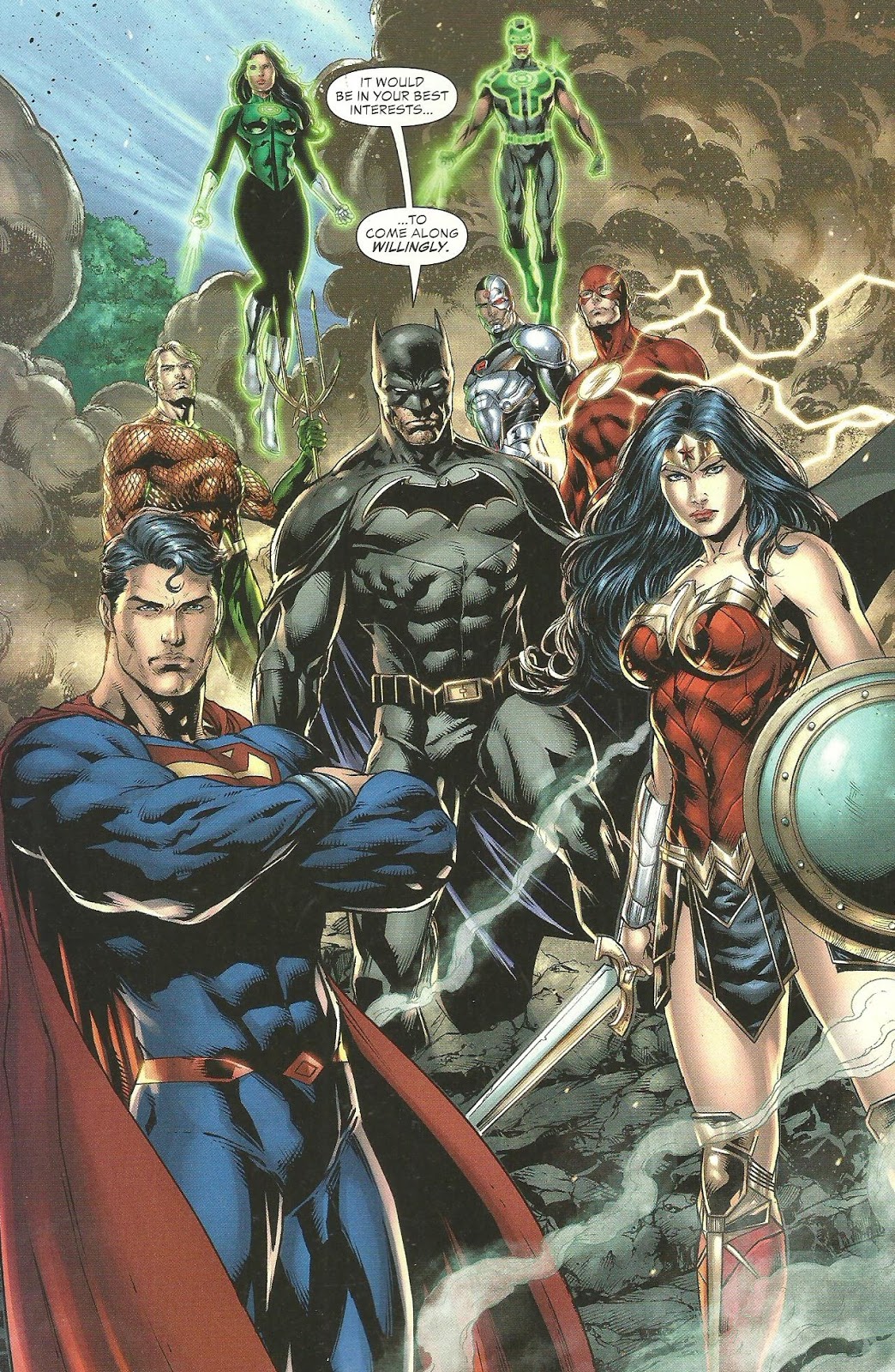
JUSTICE LEAGUE #24
Written by BRYAN HITCH
Art by FERNANDO PASARIN and OCLAIR ALBERT
Cover by BRYAN HITCH
...
“AFTERLIVES” part three! Our heroes’ mission into the afterlife goes horribly wrong when the Demons Three trap the Justice League in a hellish realm where they’re haunted and tortured by the ghosts of fallen heroes, dead villains and innocent civilians whose lives they failed to save.
On sale JULY 5 • 32 pg, $2.99 US • FC, RATED T
This synopsis is kind of interesting in that I don't know if or how many fallen heroes there actually are to use in the post-Flashpoint, seven-year-old, Golden Age-less DC Universe.
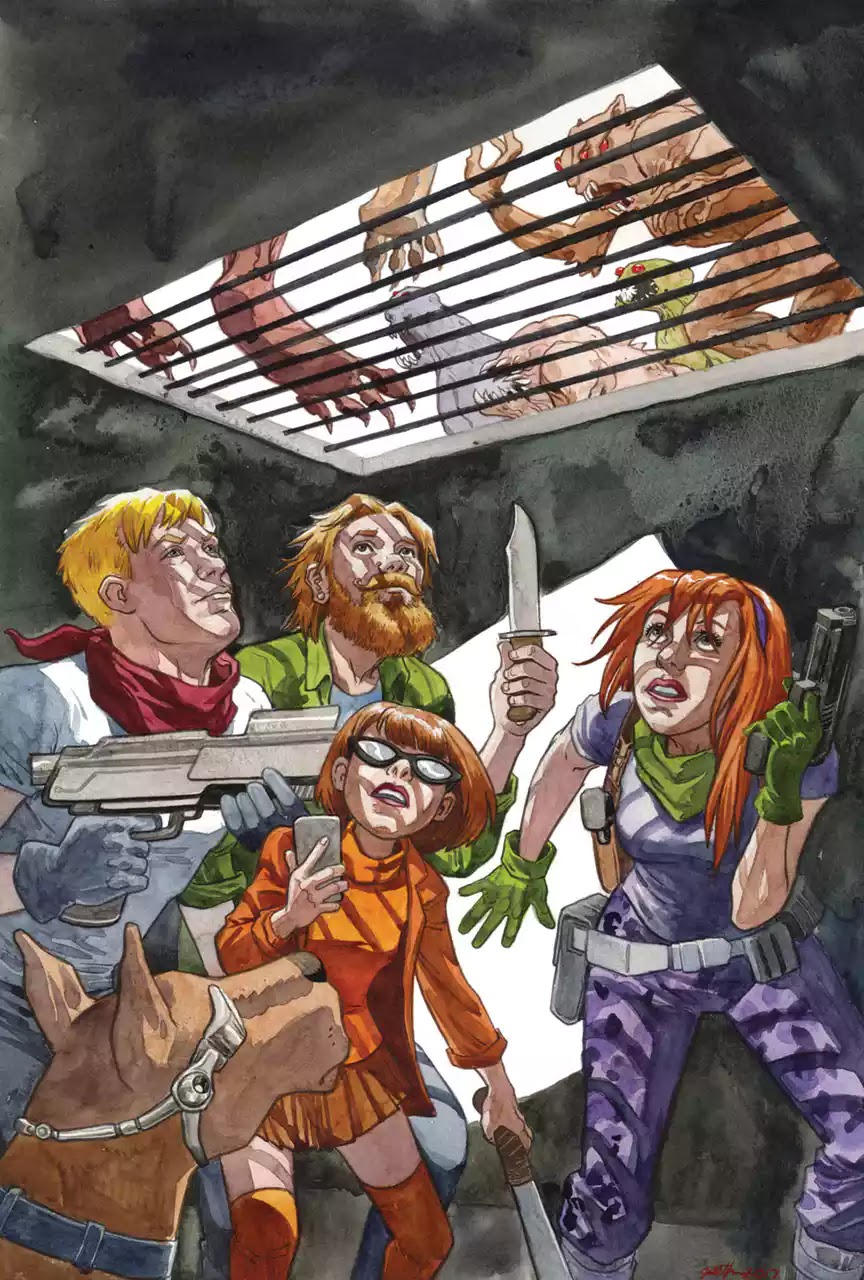
SCOOBY APOCALYPSE #15
Written by KEITH GIFFEN and J.M. DeMATTEIS
Art by DALE EAGLESHAM
Backup story art by JAN DUURSEMA
Cover by CARLOS D’ANDA
Variant cover by JILL THOMPSON
We finally catch up to the migrating monsters—and their destination is even more horrifying than anyone imagined! But before the gang can act, Scrappy-Doo and his pack of smart mutts show up with a heck of a grudge against Scooby. It’s two threats for the price of one! And, in the backup story, Scrappy strikes again—and someone pays the ultimate price!
On sale JULY 12 • 32 pg, FC, $3.99 US • RATED T
Jill Thompson, Jan Duursema and Dale Eaglesham? Man, this single issue will manage to waste the talent of a lot of skilled artists that DC could (and should) be better employing elsewhere in their line.
SCOOBY-DOO TEAM-UP #28
Written by SHOLLY FISCH
Art and cover by DARIO BRIZUELA
The gang uncovers a tale of their great-great-grandparents (and grand-dog!) in the old West. When monstrous rumors bring the Weirdness Wagon to town, will they find a fearsome beast, or just come face-to-scarred-face with the lawman Jonah Hex?
On sale JULY 26 • 32 pg, FC, $2.99 US • RATED E
Ha, using the gang's ancestors in a cowboy-era team-up with Jonah Hex sounds like a fun way to use that character and not involve time travel. Hopefully that's not actually their great-great-grandparents on the cover though, as they just look the exact same; I would wanna see a few subtle differences, like a big Wild Bill-style mustache on Fred's great-great-grandfather, old-timey spectacles on Velma's ancestor and so on.
WILDSTORM: A CELEBRATION OF 25 YEARS HC
Written by BRANDON CHOI, J. SCOTT CAMPBELL, WARREN ELLIS, CHRISTOS GAGE and others
Art by JIM LEE, SCOTT WILLIAMS, J. SCOTT CAMPBELL, BRYAN HITCH, PAUL NEARY, DUSTIN NGUYEN, BRETT BOOTH and others
Cover by JIM LEE and SCOTT WILLIAMS
In 1992 Jim Lee changed the course of comics history with the founding of WildStorm Productions, which would revolutionize the business and launch the careers of so many top creators. Now, the WS crew is back to celebrate 25 years of WildStorm with new short stories of the imprint’s greatest heroes by their classic creative teams, including WildC.A.T.s by Brandon Choi and Jim Lee; the Authority by Warren Ellis and Bryan Hitch; Gen13 by J. Scott Campbell; WildCats by Christos Gage and Dustin Nguyen; Backlash by Brett Booth, and more!
This new hardcover also includes a massive pinup gallery featuring new art by WS alumni including John Cassaday, Tim Sale, Adam Hughes, Carlos D’Anda, Adam Warren, Tony Harris, Lee Bermejo, Ryan Benjamin, Neil Googe, Fiona Staples, Cully Hamner and more, plus behind-the-scenes material that will blow your mind, and epic reprints of some of WildStorm’s greatest stories! This new hardcover is a must-have for old fans and new readers alike!
On sale AUGUST 23 • 240 pg, FC, $29.99 US
"Changed the course of comics history"...? That's laying it on a bit thick, isn't it? Wracking my brain to think of ways in which the WildStorm corner of Image Comics moved the needle at all, I'm having some trouble here. I guess it helped launch the career of prolific variant cover artist J. Scott Campbell? And maybe Bryan Hitch? Ellis' decision to step away from The Authority allowed the promising writer Mark Millar to get a blast of limelight that pretty much ruined his ability to write coherent comic books while boosting his career into a stratospheric trajectory.
Um...that's all I got.
I guess it's nice that DC Comics Co-Publisher Jim Lee is celebrating a lot of the worthy creators who have worked on WildStorm comics over the years here, but from where I'm currently sitting, it's very difficult (well, impossible) to disentangle some industry-wide impact that the founding of WildStorm had that was distinct from the rest of Image at the time of its founding, and it really seems like DC purchased WildStorm as a roundabout way to get Jim Lee to start drawing comics for them. Jim Lee pencils seem like the most valuable thing DC got from that particular deal; the WildStorm catalog of characters and "universe" has otherwise been something of an albatross around the neck of the publisher.
WONDER GIRL: ADVENTURES OF A TEEN TITAN TP
Written by ROBERT KANIGHER, BRUNO PREMIANI, JOHN BYRNE and others
Art by ROSS ANDRU, BOB HANEY, NEAL ADAMS, JOHN BYRNE and others
Cover by NICOLA SCOTT and DOUG HAZLEWOOD
The adventures of Wonder Girl are collected for the first time! These stories include appearances by Wonder Woman, the Teen Titans and more from the pages of WONDER WOMAN #105 (1959), THE BRAVE AND THE BOLD #60, TEEN TITANS #22, ADVENTURE COMICS #461, WONDER WOMAN #105 and 113, WONDER WOMAN: DONNA TROY #1 and WONDER GIRL #1.
On sale AUGUST 30 • 168 pg, FC, $14.99 US
This is a super-weird looking collection. The Cassandra Sandsmark version is on the cover, but this looks like it will have more Donna Troy than Cassie in it...and maybe even a little of original Wonder Girl Diana.
*Actually, I've been told that's Nolan's own redesign of Bane's costume. I prefer the original one from the '90s, but then, I am old.
Tuesday, April 18, 2017
Thursday, April 13, 2017
Comic Shop Comics: April 12th
Gotham Academy: Second Semester #8 (DC Comics) Oh hey, Gotham Academy is indeed being canceled. I'm a little disappointed, but not terribly surprised, given some of the erratic publishing decisions associated with the book. Given that it's about as far removed from Batman while still being technically part of the extended Batman franchise, it's not the sort of series that could really sustain very many decisions like, say, to take a few months off to tell that "Yearbook" anthology story arc, or to take another few months off to lay fallow, or to relaunch with a slightly different title.
Because its cancellation doesn't come as a surprise, that sure helps temper the disappointment. I've had, like, a year to mentally prepare myself for this moment, you know? This issue is more-or-less the conclusion to the current arc, although it ends with a cliffhanger, and the words "Next: The Ballad of Olive Silverlock Part One! Gear Up for Gotham Academy's Final Story Arc That Will Decide The Fate of Olive And Her Friends!" This issue ties pretty much everything together from the start of the series, and the writing team--still Brenden Fletcher scripting a story credited to himself, Becky Cloonan and Karl Kerschl--finally makes explicit all of that stuff that they've been hinting regarding Olive, her mom, their fire powers and their lineage.
Suicide Squad #15 (DC) Thus concludes the weirdly-formatted "Burning Down The House" story arc, with this final issue telling a single, issue-length story drawn by both art teams (John Romita Jr. and Richard Friend on one, Eddy Barrows and Eber Ferreira the other), rather than two shorter distinct-but-intertwined stories. To the surprise of no one, Amanda Waller is not really dead, Harley Quinn is not really dead (the latter cheats death by wearing a low-cut Kevlar bustier under her regular spandex bustier, and I guess that works if you expect to be shot between the boobs) and Deadshot didn't betray the team after all! Or, if he did, he only did a little bit.
The real surprise, for me at least, were how brutal this particular issue was, with Deadshot losing a large portion of his arm, and JRJR's panel showing it being severed revealing the meat and bone of his arm as if it were a hunk of Easter ham and Captain Boomerang killing one of the newly redesigned and reintroduced characters of the old Jihad team (now renamed "The Burning Earth") in a pretty final fashion, standing over his foe's decapitated boy, which lay in a literal pool of blood.
Super Powers #6 (DC) This was a lot of fun, and this concluding chapter seems to reveal Art Baltazar and Franco's true purpose with the project: Simply getting to write and draw all their favorite DC superheroes, as even at this late point in the miniseries they are still throwing characters in. This is the climactic battle against Darkseid in the streets of Gotham, and the way in which the assembled heroes finally defeat him is pretty complex, involving a (comic book) science plan and creative uses of multiple heroes' individual powers. It was a very classic Justice League ending to a story that was basically just a Baltazar-drawn Superman comic with a dozen or two different heroic and villainous guest-stars. It looks like it's for kids, and it is, but it's also plenty entertaining for adult readers of a certain type. Like, um, my type.
Wonder Woman #20 (DC) So, you've probably already heard that Greg Rucka is leaving the now twice-monthly Wonder Woman book, huh? I find myself more irritated than anything else by the news. I don't think he's that great a Wonder Woman writer. The stories are always better than average, but, on an issue-by-issue basis, they often amount to little more than a scene or three, and need to be read in trade to really be appreciated. Most issues are just rather blah and boring, although this one seems to be bringing "Godwatch," which I think is maybe only his third story arc, to its climax (It's hard to say, as each issue alternates between timelines; it may be the fourth...? A tag in this issue says it occurs seven years Wonder Woman arrived, which I guess makes sense as "the present" in the current, post-Flashpoint DCU, but it also shows the origin of her dogs, which were present earlier issues set in the present, soooo...I don't know? I'm a little lost, I guess).
What irritates me is that basically Rucka has used the opportunity presented by whatever continuity shenanigans are going on to re-reboot Wonder Woman's just rebooted (like, six years ago) origin story, and...that's about it, really. The entirety of his run has been working its way to revealing her true origins, which she herself has been deluded regarding.
And then someone else is going to take over as writer, but they will be saddled with Rucka's interpretation of Wonder Woman's supporting characters, which honestly isn't all that much different from George Perez's. The new writer will be stuck with an Etta Candy who is basically just a black, lesbian version of Steve Trevor, for example, and, like Trevor, she'll be a hard-nosed, bad-ass military person with no discernable personality. Sasha fucking Bordeaux will be involved. Rucka's Veronica Cale will be Wonder Woman's Lex Luthor again, and he's reintroduced reinterpreted versions of The Cheetah, Dr. Poison, Dr. Cyber and, as of this issue, Circe.
It's not that every new writer should get carte blanche to redesign the character's whole world, although that sure seems like the current remit, given the two post-Flashpoint volumes of Wonder Woman did pretty much exactly that, but if that's all Rucka was going to do before splitting, well, it might have been preferable if he adopted a more hyper-compressed storytelling style, or worked within the already established margins, as screwed up as they might be. I don't know, there's still five issues to go, so I guess we'll see.
As for this issue? It finally introduces Circe into Cale's cadre of reimagined Wonder Woman villains, and once again paints Cale as a more tragic figure, one pushed to bad things by bad gods, rather than an inherently wicked or selfish person.
Bilquis Evely is still drawing--artist Liam Sharp is apparently leaving with Rucka, and the first post-Rucka artist will be another talented one who worked on Bombshells alongside Evely--and she does her usual amazing job. The Circe redesign is nice, and the action scene in which she and Wonder Woman first encounter one another is great. Evely sure does a fine job on the bullets-and-bracelets trick.
Because its cancellation doesn't come as a surprise, that sure helps temper the disappointment. I've had, like, a year to mentally prepare myself for this moment, you know? This issue is more-or-less the conclusion to the current arc, although it ends with a cliffhanger, and the words "Next: The Ballad of Olive Silverlock Part One! Gear Up for Gotham Academy's Final Story Arc That Will Decide The Fate of Olive And Her Friends!" This issue ties pretty much everything together from the start of the series, and the writing team--still Brenden Fletcher scripting a story credited to himself, Becky Cloonan and Karl Kerschl--finally makes explicit all of that stuff that they've been hinting regarding Olive, her mom, their fire powers and their lineage.
Suicide Squad #15 (DC) Thus concludes the weirdly-formatted "Burning Down The House" story arc, with this final issue telling a single, issue-length story drawn by both art teams (John Romita Jr. and Richard Friend on one, Eddy Barrows and Eber Ferreira the other), rather than two shorter distinct-but-intertwined stories. To the surprise of no one, Amanda Waller is not really dead, Harley Quinn is not really dead (the latter cheats death by wearing a low-cut Kevlar bustier under her regular spandex bustier, and I guess that works if you expect to be shot between the boobs) and Deadshot didn't betray the team after all! Or, if he did, he only did a little bit.
The real surprise, for me at least, were how brutal this particular issue was, with Deadshot losing a large portion of his arm, and JRJR's panel showing it being severed revealing the meat and bone of his arm as if it were a hunk of Easter ham and Captain Boomerang killing one of the newly redesigned and reintroduced characters of the old Jihad team (now renamed "The Burning Earth") in a pretty final fashion, standing over his foe's decapitated boy, which lay in a literal pool of blood.
Super Powers #6 (DC) This was a lot of fun, and this concluding chapter seems to reveal Art Baltazar and Franco's true purpose with the project: Simply getting to write and draw all their favorite DC superheroes, as even at this late point in the miniseries they are still throwing characters in. This is the climactic battle against Darkseid in the streets of Gotham, and the way in which the assembled heroes finally defeat him is pretty complex, involving a (comic book) science plan and creative uses of multiple heroes' individual powers. It was a very classic Justice League ending to a story that was basically just a Baltazar-drawn Superman comic with a dozen or two different heroic and villainous guest-stars. It looks like it's for kids, and it is, but it's also plenty entertaining for adult readers of a certain type. Like, um, my type.
Wonder Woman #20 (DC) So, you've probably already heard that Greg Rucka is leaving the now twice-monthly Wonder Woman book, huh? I find myself more irritated than anything else by the news. I don't think he's that great a Wonder Woman writer. The stories are always better than average, but, on an issue-by-issue basis, they often amount to little more than a scene or three, and need to be read in trade to really be appreciated. Most issues are just rather blah and boring, although this one seems to be bringing "Godwatch," which I think is maybe only his third story arc, to its climax (It's hard to say, as each issue alternates between timelines; it may be the fourth...? A tag in this issue says it occurs seven years Wonder Woman arrived, which I guess makes sense as "the present" in the current, post-Flashpoint DCU, but it also shows the origin of her dogs, which were present earlier issues set in the present, soooo...I don't know? I'm a little lost, I guess).
What irritates me is that basically Rucka has used the opportunity presented by whatever continuity shenanigans are going on to re-reboot Wonder Woman's just rebooted (like, six years ago) origin story, and...that's about it, really. The entirety of his run has been working its way to revealing her true origins, which she herself has been deluded regarding.
And then someone else is going to take over as writer, but they will be saddled with Rucka's interpretation of Wonder Woman's supporting characters, which honestly isn't all that much different from George Perez's. The new writer will be stuck with an Etta Candy who is basically just a black, lesbian version of Steve Trevor, for example, and, like Trevor, she'll be a hard-nosed, bad-ass military person with no discernable personality. Sasha fucking Bordeaux will be involved. Rucka's Veronica Cale will be Wonder Woman's Lex Luthor again, and he's reintroduced reinterpreted versions of The Cheetah, Dr. Poison, Dr. Cyber and, as of this issue, Circe.
It's not that every new writer should get carte blanche to redesign the character's whole world, although that sure seems like the current remit, given the two post-Flashpoint volumes of Wonder Woman did pretty much exactly that, but if that's all Rucka was going to do before splitting, well, it might have been preferable if he adopted a more hyper-compressed storytelling style, or worked within the already established margins, as screwed up as they might be. I don't know, there's still five issues to go, so I guess we'll see.
As for this issue? It finally introduces Circe into Cale's cadre of reimagined Wonder Woman villains, and once again paints Cale as a more tragic figure, one pushed to bad things by bad gods, rather than an inherently wicked or selfish person.
Bilquis Evely is still drawing--artist Liam Sharp is apparently leaving with Rucka, and the first post-Rucka artist will be another talented one who worked on Bombshells alongside Evely--and she does her usual amazing job. The Circe redesign is nice, and the action scene in which she and Wonder Woman first encounter one another is great. Evely sure does a fine job on the bullets-and-bracelets trick.
Tuesday, April 11, 2017
This was my favorite part of The Unbeatable Squirrel Girl: Squirrel Meets World
It is a two-page sequence in which 14-year-old Doreen Green's best human friend Ana Sofia asks her if she actually knows the individual names of all of the scores of squirrels that have gathered around their tree house, and Doreen proves it by pointing them out one by one. This goes on for one giant paragraph that fills two pages before Ana Sofia finally cuts her off.
It reminded me of the list of Seven Hundred Hobo Names in John Hodgman's The Areas of My Expertise, although the section here doesn't really compete, in large part because writers Shannon Hale and Dean Hale don't even try to hit 700, although I think they could have if they really wanted to put the effort in (Also because as funny as squirrels might be, they are just not as funny as hobos).
I was a little wary of this book, which I listened to on audiobook (Recommended! I liked hearing a grown woman speaking aloud lines like "Chkkt!" and "Chktt-kit" and so on pretty much constantl) rather than read, as that is my preferred way to consume prose fiction. The reason I was wary was because what I like most about Unbeatable Squirrel Girl (the comic) is the way that Ryan North and Erica Henderson make it, as a comic, rather than anything in particular about the character, as likable as she may be (and as awesome as squirrels might be).
That said, I ended up really enjoying the book, which is geared towards a juvenile audience (I'll likely talk about it at greater length in the next installment of my occasional-ish "Everything Else" feature). It probably helped that it was a sort of secret origin Squirrel Girl story, set a good five years or so before Squirrel Girl's current comic book series, and that its continuity was murky, somewhere between that of the Marvel Cinematic Universe and the Marvel (comics) Universe.
But back to squirrel names for a moment. I had always assumed that it was Squirrel Girl who came up with the squirrel names and assigned them to her squirrel friends. After all, of the two she has adventured with the longest--Monkey Joe and Tippy-Toe--the former doesn't seem like the sort of name that a squirrel would come up with for itself. I mean, how would a squirrel even know what a monkey was in the first place? It's not like monkeys are commonplace in North American suburban neighborhoods. Rather, it seemed like the sort of silly name a silly teenage girl might give to a pet.
But in this book it is made quite clear that the squirrels come up with their own names (or, at least, their parents name them). That really rather blew my mind. A large portion of the book is told from Tippy-Toe's point of view--the POV character changes from chapter to chapter, and Tippy-Toe gets a lot of those chapters--so we see squirrel world from her vantage point, on the inside, and yeah, that was her name all along. Doreen didn't give it to her.
As I said, my favorite part of the audio-book was the above section, which is funnier when read aloud than it is sitting there on the page (the narrator's performance of Squirrel Girl's texts to Iron Man are similarly funnier when heard than they are when read), but now that I am looking at it in print, I find myself feeling somewhat disappointed by at least one of those squirrel's names (several of them are Marvel Comics in-jokes, by the way). One of the squirrels is named "Geraldine Ferraro." Spelled just like that, rather than a squirrel-ized "Geraldine Furraro." Seems like a lost opportunity, but still funny, I suppose.
Anyway, Squirrel Girl: Not just in comic books anymore!
There's a little art in the book, too. The cover image is by a Bruno Mangyoku, and you'll notice that Squirrel Girl looks somewhat off-model there. That is intentional, as the costume she ends up wearing in this adventure is a sort of accidental, ad hoc one, and it predates the Steve Ditko-designed one of her first comic book appearance, or any of the later updates to follow.
Mangyoku also draws Tippy-Toe on the back cover and on the inside of the book; I don't like how cartoony his Tippy is, as she resembles a television cartoon squirrel rather than a real squirrel, and I found myself wondering why they didn't just have Erica Henderson (or anyone from Marvel Comics, really) handle the handful of illustrations. There is a really nice image on the end-pages though, of Squirrel Girl in silhouette, leaping in front of a bright full moon above a city skyline. Tippy-Toe is by her side, identifiable by her bow, and a whole cloud of squirrels follow Squirrel Girl, almost like a second tail. I imagine this is from Mangyoku too (no other artist is credited anywhere). It's a really great, even beautiful image.
So hell, I don't know. The audiobook was really fun and funny to listen to, but the book allow you to check the spelling of those squirrel names and has those nice end-pages. I guess I'm torn here. Maybe borrow the audio-book from the library, and buy the book from the store? Or just borrow them both from the library like I did...?
It reminded me of the list of Seven Hundred Hobo Names in John Hodgman's The Areas of My Expertise, although the section here doesn't really compete, in large part because writers Shannon Hale and Dean Hale don't even try to hit 700, although I think they could have if they really wanted to put the effort in (Also because as funny as squirrels might be, they are just not as funny as hobos).
I was a little wary of this book, which I listened to on audiobook (Recommended! I liked hearing a grown woman speaking aloud lines like "Chkkt!" and "Chktt-kit" and so on pretty much constantl) rather than read, as that is my preferred way to consume prose fiction. The reason I was wary was because what I like most about Unbeatable Squirrel Girl (the comic) is the way that Ryan North and Erica Henderson make it, as a comic, rather than anything in particular about the character, as likable as she may be (and as awesome as squirrels might be).
That said, I ended up really enjoying the book, which is geared towards a juvenile audience (I'll likely talk about it at greater length in the next installment of my occasional-ish "Everything Else" feature). It probably helped that it was a sort of secret origin Squirrel Girl story, set a good five years or so before Squirrel Girl's current comic book series, and that its continuity was murky, somewhere between that of the Marvel Cinematic Universe and the Marvel (comics) Universe.
But back to squirrel names for a moment. I had always assumed that it was Squirrel Girl who came up with the squirrel names and assigned them to her squirrel friends. After all, of the two she has adventured with the longest--Monkey Joe and Tippy-Toe--the former doesn't seem like the sort of name that a squirrel would come up with for itself. I mean, how would a squirrel even know what a monkey was in the first place? It's not like monkeys are commonplace in North American suburban neighborhoods. Rather, it seemed like the sort of silly name a silly teenage girl might give to a pet.
But in this book it is made quite clear that the squirrels come up with their own names (or, at least, their parents name them). That really rather blew my mind. A large portion of the book is told from Tippy-Toe's point of view--the POV character changes from chapter to chapter, and Tippy-Toe gets a lot of those chapters--so we see squirrel world from her vantage point, on the inside, and yeah, that was her name all along. Doreen didn't give it to her.
As I said, my favorite part of the audio-book was the above section, which is funnier when read aloud than it is sitting there on the page (the narrator's performance of Squirrel Girl's texts to Iron Man are similarly funnier when heard than they are when read), but now that I am looking at it in print, I find myself feeling somewhat disappointed by at least one of those squirrel's names (several of them are Marvel Comics in-jokes, by the way). One of the squirrels is named "Geraldine Ferraro." Spelled just like that, rather than a squirrel-ized "Geraldine Furraro." Seems like a lost opportunity, but still funny, I suppose.
Anyway, Squirrel Girl: Not just in comic books anymore!
There's a little art in the book, too. The cover image is by a Bruno Mangyoku, and you'll notice that Squirrel Girl looks somewhat off-model there. That is intentional, as the costume she ends up wearing in this adventure is a sort of accidental, ad hoc one, and it predates the Steve Ditko-designed one of her first comic book appearance, or any of the later updates to follow.
Mangyoku also draws Tippy-Toe on the back cover and on the inside of the book; I don't like how cartoony his Tippy is, as she resembles a television cartoon squirrel rather than a real squirrel, and I found myself wondering why they didn't just have Erica Henderson (or anyone from Marvel Comics, really) handle the handful of illustrations. There is a really nice image on the end-pages though, of Squirrel Girl in silhouette, leaping in front of a bright full moon above a city skyline. Tippy-Toe is by her side, identifiable by her bow, and a whole cloud of squirrels follow Squirrel Girl, almost like a second tail. I imagine this is from Mangyoku too (no other artist is credited anywhere). It's a really great, even beautiful image.
![]() |
| Elle Collins took this picture, and it ran with her review of the book for Comics Alliance, which I still haven't read, because I don't like to read reviews of stuff I'm gonna write about until I write about them myself. But there's no reason you can't read her review now! |
Monday, April 10, 2017
On Wonder Woman and Justice League America Vol. 1
This 280-page collection of issues from Justice League America from 1993-1994 comprise the beginning of writer (and Slave Labor Graphics founder) Dan Vado's run on the main title of the then multi-book Justice League franchise, following the conclusion of Dan Jurgens' run as writer/penciler.
The entirety of Jurgens' run was collected in two volumes rebranded Superman and Justice League America, and apparently DC is doing the same with Vado's run, giving Wonder Woman top-billing in an apparent attempt to goose interest in a collection of these issues, which, if not the absolute nadir of the franchise, is certainly well into a valley between the peaks of the Giffen/DeMatteis run and the Grant Morrison.
The new title is more or less meaningless, just as that of the previous two collections was (as I mentioned before, Superman is barely in Superman and Justice League America Vol. 2, that's just a better title than The Second Half of Dan Jurgens' Justice League America). In fact, Wonder Woman took over leadership of this Justice League in Superman and.. Vol. 2, and she doesn't exactly play a bigger-than-average role in these comics.
Not only are we wading pretty deep into the era where DC was trying to keep the Giffen/DeMatteis conception of the League going past its expiration date at this point, but this book makes for an interesting read in 2017, given the fact that Vado is so clearly writing in the "old", pre-trade market, soap-operatic model of superhero comics. That is, rather than writing story arcs as part of a bigger, overarching storyline, Vado picks up the cast right where it was, making few if any real changes, and gives each of those characters a conflict of their own to wrestle with from issue to issue, major conflicts moving from the background to the foreground and necessary.
At this point, the League is still operating out of the new New York headquarters from their Jurgens run, with Max Lord essentially their boss and Oberon his assistant. Wonder Woman is the field leader of a team that consists of mainstays Blue Beetle, Guy Gardner (still wearing Sinestro's yellow ring), Booster Gold, Fire and Ice, plus Jurgens additions Maxima, Bloodwynd and their newest recruit, The Ray.
Of the long-timers, they are still all somewhere between reeling and sidelined by their fight with Doomsday, the one that killed the recently-resurrected Superman (the destruction of Coast City comes up in conversation at one point, and when Hal Jordan of Justice League Europe--Or was it International at this point?--shows up for a few panels, he's wearing his arm in a sling). Booster Gold's costume is still shredded, so he is wearing a big, goofy suit of armor that looks like a futuristic football uniform to me; Ted Kord has hung up his Beetle costume and devoted himself to lab work, leery of jumping back into the sorts of superhero fights that had landed him in a coma; Fire is still powerless; and Ice has left the team, but not the book, as she returns to her hidden ice kingdom.*
The foregrounded plots involve one in which Wonder Woman leading the team to secure an airport in a fictional war-torn country with an assist from original Flash Jay Garrick (who sadly doesn't stick around too long), only to face off against Dreamslayer and the "new" Extremists. Then she extends an offer of sanctuary to a pair of wanted space criminals who crash land on Earth, leading to a tense stand-off with Captain Atom and his '90s-looking back-up, The Peacemakers, who are working on behalf of President Bill Clinton. Finally, the team heads to the hidden kingdom Ice hails from, where her similarly-powered brother has initiated a hostile take over, and plans to march on northern Europe with the help of mystical weapons and the patronage of a shadowy threat which, if I remember correctly, will end up being the driving threat of the upcoming multi-book crossover event, "Judgement Day."
This collection has a nice new cover by Tom Grummet...unless DC found a nice Grummet drawing of this team in a drawer somewhere and repurposed it here. The bulk of the interiors are drawn by Kevin West, who arrives with the third issue of the collection, originally inked by Rick Burchett. West's style is quite strong, and pretty much perfect for the book at this point in its existence, as he draws figures as well as Jurgens--and, in fact, some of his lay-outs look so Jurgens-like it looks as if Jurgens himself was doing breakdowns--but he also has a strong facility for facial expressions, and several close-ups reminded me of the work of Kevin Maguire, the Giffen/DeMatteis team's original artistic collaborator.
The influence of the era can be seen slowly creeping into the book, visually as well as in the scripting, as when Blue Beetle finally puts his costume back on it looks a lot like Todd MacFarlane's Spider-Man, Booster armors up and Fire and Ice both get new, much more-revealing costumes.
The rest of the art in the book comes from pencil artist Mike Collins (two issues), Chris Hunter (one issue of Guy Gardner scripted by Chuck Dixon, which is a direct tie-in to JLA) and the art team of penciler Greg LaRocque and a trio of inkers, who draw Justice League America Annual #7, which is placed at the end of the collection (That's from the "Bloodlines" event, and introduces New Blood Terrorsmith, who has a neat look and a neat power, but never really went anywhere after this, save a Showcase appearance...there are three even less interesting and less appealing New Bloods who show up as well to help the League fight him).
The overall quality of the book is rocky, and despite its title, it's definitely for fans of the Justice League, not of Wonder Woman. That is, if you were picking this up specifically because of it's title, chances are you're going to be sorely disappointed. The art and story actually age pretty okay, although Gardner's lewd come-ons seem incredibly weird today, and it's hard to understand why Wonder Woman or Maxima aren't constantly throwing him through walls or breaking his bones. This Wonder Woman is a lot more patient and less violent than more modern takes, I guess.
*********************
As I noted when writing a little preview of this for Comics Alliance, back when there still was a Comics Alliance (sniff), this particular volume contains 1.) The Ray on the Justice League, 2.) The Justice League fighting a version of The Extremists and 3.) Terrorsmith, so one can't help but imagine a young Steve Orlando read and internalized these issues, given that he just launched a new comic book series called Justice League of America featuring The Ray on the the team, their first foes are a version of The Extremists and future solicitations reveal that Terrorsmith will be making, like, his third appearance ever.
*********************
Amazon has an entry for an October volume of Wonder Woman and Justice League of America that collects the series through issues #91. That's only six more issues, and considering that those six include part 1, part 4 and an "aftermath" of "Judgement Day," I have to assume parts 2 and 3 of "Judgement Day" will be in there as well. (Vado also wrote Justice League America Annual #8, but given that it's an "Elseworlds" annual I imagine arguments could be made for and against collecting it; the best argument for being maybe that Evan Dorkin draws a back-up in it called "The O Squad," in which all of the many, many JLA villains whose names end in "O" team-up).
Then there's one chapter of the the Zero Hour tie-in that ran across the various League titles by Christopher Priest (The story introducing Triumph, which...well, I don't know if that would get collected with Triumph or Priest's (excellent) run on Justice League Task Force or...what. Priest wrote JLA Annual #9, part of the weird-ish "Legends of The Dead Earth", Elseworlds-esque themed annuals).
Then the Gerard Jones-written run begins, the last before DC cancels the whole Justice League franchise, clearing the decks for Grant Morrison, Howard Porter and John Dell's JLA. That lasts 23 issues, and if DC ends up collecting them--and at this point, they've come so far, why not?--I'm curious if they will keep the the Wonder Woman... and title for volumes 3 and 4 and maybe 5 or...what, exactly.
I'm also curious if at any point they will collect the other early '90s League titles, Justice League International (perhaps re-christened in trade as Green Lantern and Justice League Europe?), Justice League Task Force (originally conceived with rotating line-ups and writers, a first volume seems an easy sell, as the pre-Zero Hour conception would/could include scripts from Peter David, Jeph Loeb and Mark Waid) and the unfortunately titled, originally-rather-poorly-drawn Extreme Justice.
*Did DC miss a huge opportunity by not pushing Ice, a superhero who is also an ice-powered princess, a few years ago, in the wake of 2013's Frozen movie? Like, if they were reinventing, rebooting and relaunching all their characters anyway, it occurred to me while reading this volume that in many ways Ice is basically just Elsa, only a superhero.
The entirety of Jurgens' run was collected in two volumes rebranded Superman and Justice League America, and apparently DC is doing the same with Vado's run, giving Wonder Woman top-billing in an apparent attempt to goose interest in a collection of these issues, which, if not the absolute nadir of the franchise, is certainly well into a valley between the peaks of the Giffen/DeMatteis run and the Grant Morrison.
The new title is more or less meaningless, just as that of the previous two collections was (as I mentioned before, Superman is barely in Superman and Justice League America Vol. 2, that's just a better title than The Second Half of Dan Jurgens' Justice League America). In fact, Wonder Woman took over leadership of this Justice League in Superman and.. Vol. 2, and she doesn't exactly play a bigger-than-average role in these comics.
Not only are we wading pretty deep into the era where DC was trying to keep the Giffen/DeMatteis conception of the League going past its expiration date at this point, but this book makes for an interesting read in 2017, given the fact that Vado is so clearly writing in the "old", pre-trade market, soap-operatic model of superhero comics. That is, rather than writing story arcs as part of a bigger, overarching storyline, Vado picks up the cast right where it was, making few if any real changes, and gives each of those characters a conflict of their own to wrestle with from issue to issue, major conflicts moving from the background to the foreground and necessary.
At this point, the League is still operating out of the new New York headquarters from their Jurgens run, with Max Lord essentially their boss and Oberon his assistant. Wonder Woman is the field leader of a team that consists of mainstays Blue Beetle, Guy Gardner (still wearing Sinestro's yellow ring), Booster Gold, Fire and Ice, plus Jurgens additions Maxima, Bloodwynd and their newest recruit, The Ray.
Of the long-timers, they are still all somewhere between reeling and sidelined by their fight with Doomsday, the one that killed the recently-resurrected Superman (the destruction of Coast City comes up in conversation at one point, and when Hal Jordan of Justice League Europe--Or was it International at this point?--shows up for a few panels, he's wearing his arm in a sling). Booster Gold's costume is still shredded, so he is wearing a big, goofy suit of armor that looks like a futuristic football uniform to me; Ted Kord has hung up his Beetle costume and devoted himself to lab work, leery of jumping back into the sorts of superhero fights that had landed him in a coma; Fire is still powerless; and Ice has left the team, but not the book, as she returns to her hidden ice kingdom.*
The foregrounded plots involve one in which Wonder Woman leading the team to secure an airport in a fictional war-torn country with an assist from original Flash Jay Garrick (who sadly doesn't stick around too long), only to face off against Dreamslayer and the "new" Extremists. Then she extends an offer of sanctuary to a pair of wanted space criminals who crash land on Earth, leading to a tense stand-off with Captain Atom and his '90s-looking back-up, The Peacemakers, who are working on behalf of President Bill Clinton. Finally, the team heads to the hidden kingdom Ice hails from, where her similarly-powered brother has initiated a hostile take over, and plans to march on northern Europe with the help of mystical weapons and the patronage of a shadowy threat which, if I remember correctly, will end up being the driving threat of the upcoming multi-book crossover event, "Judgement Day."
This collection has a nice new cover by Tom Grummet...unless DC found a nice Grummet drawing of this team in a drawer somewhere and repurposed it here. The bulk of the interiors are drawn by Kevin West, who arrives with the third issue of the collection, originally inked by Rick Burchett. West's style is quite strong, and pretty much perfect for the book at this point in its existence, as he draws figures as well as Jurgens--and, in fact, some of his lay-outs look so Jurgens-like it looks as if Jurgens himself was doing breakdowns--but he also has a strong facility for facial expressions, and several close-ups reminded me of the work of Kevin Maguire, the Giffen/DeMatteis team's original artistic collaborator.
The influence of the era can be seen slowly creeping into the book, visually as well as in the scripting, as when Blue Beetle finally puts his costume back on it looks a lot like Todd MacFarlane's Spider-Man, Booster armors up and Fire and Ice both get new, much more-revealing costumes.
The rest of the art in the book comes from pencil artist Mike Collins (two issues), Chris Hunter (one issue of Guy Gardner scripted by Chuck Dixon, which is a direct tie-in to JLA) and the art team of penciler Greg LaRocque and a trio of inkers, who draw Justice League America Annual #7, which is placed at the end of the collection (That's from the "Bloodlines" event, and introduces New Blood Terrorsmith, who has a neat look and a neat power, but never really went anywhere after this, save a Showcase appearance...there are three even less interesting and less appealing New Bloods who show up as well to help the League fight him).
The overall quality of the book is rocky, and despite its title, it's definitely for fans of the Justice League, not of Wonder Woman. That is, if you were picking this up specifically because of it's title, chances are you're going to be sorely disappointed. The art and story actually age pretty okay, although Gardner's lewd come-ons seem incredibly weird today, and it's hard to understand why Wonder Woman or Maxima aren't constantly throwing him through walls or breaking his bones. This Wonder Woman is a lot more patient and less violent than more modern takes, I guess.
*********************
As I noted when writing a little preview of this for Comics Alliance, back when there still was a Comics Alliance (sniff), this particular volume contains 1.) The Ray on the Justice League, 2.) The Justice League fighting a version of The Extremists and 3.) Terrorsmith, so one can't help but imagine a young Steve Orlando read and internalized these issues, given that he just launched a new comic book series called Justice League of America featuring The Ray on the the team, their first foes are a version of The Extremists and future solicitations reveal that Terrorsmith will be making, like, his third appearance ever.
*********************
Amazon has an entry for an October volume of Wonder Woman and Justice League of America that collects the series through issues #91. That's only six more issues, and considering that those six include part 1, part 4 and an "aftermath" of "Judgement Day," I have to assume parts 2 and 3 of "Judgement Day" will be in there as well. (Vado also wrote Justice League America Annual #8, but given that it's an "Elseworlds" annual I imagine arguments could be made for and against collecting it; the best argument for being maybe that Evan Dorkin draws a back-up in it called "The O Squad," in which all of the many, many JLA villains whose names end in "O" team-up).
Then there's one chapter of the the Zero Hour tie-in that ran across the various League titles by Christopher Priest (The story introducing Triumph, which...well, I don't know if that would get collected with Triumph or Priest's (excellent) run on Justice League Task Force or...what. Priest wrote JLA Annual #9, part of the weird-ish "Legends of The Dead Earth", Elseworlds-esque themed annuals).
Then the Gerard Jones-written run begins, the last before DC cancels the whole Justice League franchise, clearing the decks for Grant Morrison, Howard Porter and John Dell's JLA. That lasts 23 issues, and if DC ends up collecting them--and at this point, they've come so far, why not?--I'm curious if they will keep the the Wonder Woman... and title for volumes 3 and 4 and maybe 5 or...what, exactly.
![]() |
| Say, is this temporary, one-arc line-up the closest a League comes to The Big Seven between the end of the Detroit Era and JLA...? |
![]() |
| Extreeeeeme! I do like Amazing Man a lot, though, and was sorry to see that his death was treated as a real, permanent death. That guy should totally be on the Justice League right now. |
*Did DC miss a huge opportunity by not pushing Ice, a superhero who is also an ice-powered princess, a few years ago, in the wake of 2013's Frozen movie? Like, if they were reinventing, rebooting and relaunching all their characters anyway, it occurred to me while reading this volume that in many ways Ice is basically just Elsa, only a superhero.
Thursday, April 06, 2017
Comic Shop Comics: April 5th
Batman #20 (DC Comics) This is the climax of writer Tom King's current "I Am Bane" story arc, and his 20-ish issue run on the title overall, given how much the narrator focuses on recounting the events of the entire series to date, and tying the events of the first issue to those in this issue. I wish I could say that it was as exciting as that fact suggests it should be, however the entire issue consists of Batman and Bane trading bloody punches to the face while King's narration, from the POV of dead Martha Wayne, does all of the heavy-lifting.
I'm tempted to blame this arc's pencil artist David Finch, as I'm no real fan of his work, but I suppose King and the editors who assigned the story to Finch in the first place also deserve some of that blame. You know all those stories you've read or watched that harp on what a great fighter Batman is, how he's one of the world's top martial artists and blah blah blah? You wouldn't know it from this issue of Batman which, again, consists entirely of a 20-page fight scene with flashbacks. Batman just takes and gives punches, like a very weary boxer. It's hard to imagine a more dull fight scene in a comic book, and the sole point of interest in the visuals is probably the one panel where Finch decides to swipe a Frank Miller pose from The Dark Knight Returns.
Given that DKR is probably the most-read Batman comic book of all-time, I have to assume it was meant as a deliberate homage. But then, it's just the panel, not the page, so then I wonder if maybe it was just the result of simply looking for pictures of Batman putting his dukes up to swipe, or if it was a deliberate reference that just demonstrates that Finch doesn't really think about his comics art carefully enough to consider it beyond just-getting-through each panel, one at a time, with no thought of how they fit on a page or an issue. (Am I being too hard on Finch and Batman? I don't think so. Just compared to the other handful of comics I read this evening, it stands-out as piss-poor action. There isn't a page of Corey Lewis' Sun Bakery that isn't full of more action and vitality than any page in this comic book).
As for King's narration, it flirts with a fun idea, that part of the reason Batman has gone to such tremendous lengths over the course of the last few story arcs was that it would provide him with a perfect weapon to perhaps win his war on crime. This won't make much sense if you dwell on it too long--Gotham and Gotham Girl weren't exactly the first young super-people Batman had met--but one need not think of it too long anyway, as Batman himself deflates that idea with a pretty noble, heroic and simply-stated retort to his ghost mom.
This issue, like swathes of King's Batman, is thus more disappointing than it is all-around bad. He did a great deal of long-term planning, and proposed a lot of interesting ideas, but the execution is more often than not left wanting by poor art. I have to imagine King's Batman would have fared far better as a monthly, with a single, solid artist attached, rather than the baton being repeatedly passed to Finch or the occasional one-off artist who blows a key scene or two.
Next issue guest-stars the smiley face pin from the pages of 1986-87 classic Watchmen, so that should be...something.
DC Comics Bombshells #25 (DC) We're between story arcs and this is an anniversary issue, so it seems like as good a time as any to shift focus away from the Bombshells and to a team introduced in the the title's first annual: The World War II-era Bombshells-iverse's Suicide Squad. You'll recall that The Enchantress, Ravager, vampire Batgirl Barbara Gordon and Killer Croc now work as a strike force under the direction of Frankie (from the pages of Batgirl). In the 30-page feature story, in which regular writer Marguerite Bennett is joined by one-name artist Aneke, the Squad infiltrate a special German submarine captained by Edward Nygma in order to save his captive (and Batgirl's former lover), Luc Fuchs (Yeah, the Bombshells-iverse's Luke Fox). I really love the designs of this Suicide Sqaud, so it was great to see them all in action, as well as the neat, more unique presentations of the characters and their powers (This Enchantress, for example, looks an awful lot like the cute, kicky party-girl version of her first appearance, albeit more scantily-clad in accordance to the rules of this book. Her powers are used via her shadow, that, like Peter Pan's, seems to have a life of its own).
I feel compelled to call bullshit on some of Bennett's heavily affected dialogue, which uses modern-day slang in the 1940s (Or did the term "side quest" exist back then, decades before the invention of the first video game, and it just meant something slightly different? What about "PDA"...? And so on)
That story is complimented by a ten-page back-up (this fatter-than-usual issue will cost you $4.99), set in the 1930s and involving Frankie and two other supporting characters from the Cameron Stewart/Brenden Fletcher/Babs Tarr run raiding an Egyptian tomb and accidentally stumbling upon the fact that another Kryptonian has been on Earth for quite a while now: Faora). Here Frankie refers to "arms day," meaning the day in your workout routine focusing on your arms. Maybe Frankie just, like, invented 21st century slang...? That girl is so ahead of her time...!
Deathstroke #16 (DC) Credit where credit is due: Christoper Priest has turned Deadline into an honest-to-God interesting, compelling, even somewhat impressive villain. His "Twilight" story arc, with Larry Hama, Carlo Pagulayan, Jason Paz and others has turned out maybe be the very best Deadline story of all time!
If that's an accomplishment. I mean, it is an accomplishment, I'm just not sure how big an accomplishment. The blinded Deathstroke continues his charade as the super-hero Twilight, as part of a maybe overly-elaborate, Seinfeldian attempt to keep the fact that he's a brutal, amoral killer from the idealistic young girl/super-scientist/super-hero who helped save his life. That young lady, Power Girl II, is brutally killed in a two-page sequence that helps earns the series "T+" rating, and as that sends 'Stroke off to avenge her, it has all the markings of a classic fridging. But, um, spoiler alert: The young woman of color killed off to motivate the older white male hero turns out to be just fine, thanks to her amazing super-powers, and helps save the day without any further need of bloodshed.
It's a nice, if stressful, bait-and-switch Priest and company pulled off, and a lot of that credit is due to how final her death looked: Deadline shoots her with an alien gun that goes all the way through her, burning a hole in her and sending her skidding down an alley. Deathstroke, and any reader, would be forgiven for thinking there's no coming back form a shot like that.
Judge Dredd: Deviations #1 (IDW Productions) You guys know you should always pre-order your comics from your local comic shop, right? Why? Because if you don't, then you might end up missing out on a John McCrea-created (McCreated) comic about Judge Dredd being a werewolf, and have to wait on pins and needles for a few weeks for your shop to re-stock it.
Such was the fate I suffered.
This is apparently part of some What If...?/Elseworlds-like thing IDW did, where they had creators take a "classic" story of some kind and then "deviate" from it. Here, McCrea explains in his foreword that he was asked to do one that deviated from any Judge Dredd story he wanted, and he chose one from 2000 AD by John Wagner, Alan Grant and Steve Dillon where Dredd fought some werewolves, and temporarily became one...before being cured (IDW apparently also released a collection of that story under the title Judge Dredd: Cry of The Werewolf.
McCrea's deviation is that rather than being cured, Dredd stayed a wolf. And so here's a full-color, 24-page story of "Dreddwolf" by McCrea, an artist whose style is perfectly suited to the designs of Dredd and his milieu.
At $5, it's a bit over-priced, but IDW at least tries to compensate with a bunch of other non-comics stuff. The first page is a "What Really Happened..." recap of the story this one deviated from (I haven't seen any of the other Deviations specials, but I imagine the format is similar), a foreword from McCrea and an afterword (the latter in which the artist responds to the unfortunate event that occurred between his beginning work on this comic and its publication; Dillon's too-early death), six pages of process (which I found to be basically a waste of paper; it's the same page of the comic in six different stages of completion, from script to finished page) and then five pin-ups.
The pin-ups all feature either a werewolf, Dredd fighting a werewolf, or Dredd as a werewolf, and they come from a bunch of artist whose work you would be among those that you would most associate with Dredd (and/or would want to see associated with the character): Jock, Brendan McCarthy, Garry Leach, Eric Canete and Duncan Fegredo.
Jughead #14 (Archie Comics) This is, heartbreakingly, Ryan North's last issue on Jughead for the forseeable future, and it looks like his replacement is not going to be Chip Zdarsky, who North replaced on the title. This is pretty bad news, but if artist Derek Charm, who it is my firm belief is the very best of the Archie Comics since the relaunch of the line, then there will be some small consolation. I've liked these past 14 issues enough that I'll certainly pick up the next issue but guys I don't mind telling you, I'm worried.
Nightwing #18 (DC) There's a huge surprise at the end of this issue, as maybe the last villain I expected to see again--albeit a fairly natural one--arrives. Before that very last page? It's Nightwing and Robin vs. Professor Pyg's Dollotron Deathwing and Robin, with the heroes kinda sorta winning the day (or, at least, the majority of the issue), thanks in large part to all children's innate desire to be Robin.
I'm a little torn between whether writer Tim Seeley's reliance on Grant Morrison's Batman run here is commendable or perhaps a sign of creative exhaustion (there's an argument to be made for the latter, I suppose, given the degree to which the previous arc relied so heavily on Chuck Dixon's Nightwing comics), but as someone who enjoyed (most) of Morrison's run on those comics, I'm enjoying the hell out of it.
I suppose it's also possible that Seeley is doing some kinda big meta-tribute to Nightwing's history here too, as he's revisited two of the major stages of Dick Grayson's post-Robin, pre-Agent of Spyral career. We'll see.
Providence #12 (Avatar Press) I'll be honest: I thought this series ended last issue, and the months between the shipping of #11 and #12 only made me more confident in that. Well, it didn't. Rather, this is the final issue of writer Alan Moore's extremely elaborate exploration of the work of H.P. Lovecraft, which is something akin to fan fiction, meta-fiction, criticism, homage and extrapolation. It's essentially a unified theory of Lovecraft, and for this final (?) issue, many members of the cast have been reassembled to witness a dramatic shift in reality. Like the 11 previous issues, artist Jacen Burrows effectively renders the sorts of horrors that aren't meant to be portrayed visually (Shub-Niggurath appears in one panel, and is scary as hell).
I liked this a whole lot, but what is perhaps most striking at this point is the way in which Moore uses Lovecraft's writing as a stand-in for all forms of writing/storytelling/fiction, and the obvious but hardly-ever-made observation about just how crazy it is that Lovecraft's body of work is popular at all, given how weird and, frankly, off-putting his fiction was.
This hasn't been the best or easiest comic to read as it's been serially published, but it's going to make a hell of a collection some day...hopefully one with annotations (I've read and re-read Lovecraft, but it's been so many years since my last re-reading that I felt like there were a ton of allusions, in-jokes and biographical references that whizzed right by me and occasionally right over my head).
Sunbakery #2 (Image Comics) This issue of Corey Lewis' one-man anthology includes five different stories, mostly continued from the previous issue and, in one instance, ending in this issue (at least for now). The most noteworthy of the stories in this issue is Bloodshed, whose story lasts buts one-page...two if you count the cover that Lewis draws for it. That's "Bloodshed," which stars a character named Bloodshed, who seems like the exact sort of character one of the Image founders (or a fan of one of the Image founders) might have come up with in the '90s ("The Dream of The 90's Is Alive ...In BLOODSHED," reads the cover). Turns out Lewis did create the character way back then, although I suppose it's worth noting that for all the era-specific signifiers to the character (headband, shoulderpads, red X chest icon, etc) he still looks and reads like a bad-ass anti-hero who is heavily influenced by manga and/or anime, rather than just, I don't know, The Punisher and Deathstroke The Terminator or whoever).
If, for some strange reason, you could only read one comic book this week, you should make it Sun Bakery, as it is several awesome comics in one.
Superman #20 (DC) So after the head-bending, franchise-specific reboot of post-Flashpoint Superman continuity in "Superman Reborn," we return to Hamilton County and find things...weird, as writers Peter Tomasi and Patrick Gleason pretty much just pick up where they left off, but with some small changes, like Superman's family's surname being "Kent" again. I guess it's just going to take a bunch of new issues of Superman before a reader gets used to this.
This issue guest-stars Batman and Robin, who have once again returned to the farm. I really like both of the World's Finest having family's, or at least sons, now, and pencil artist Gleason gets to draw a lot of fun scenes, like everyone sitting around the kitchen table eating pie or Batman milking a cow (Don't get too excited about that latter point; it's not as amazing as the scene you're seeing in your head right now, he just goes to get a milk sample from a cow).
DC's shenanigans with the Super-family have been ridiculously convoluted over the last five years (imagine how much more simple, interesting and noteworthy it might have been if Superman and Lois just, like, had a kid), but at least Tomasi, Gleason and company's Superman is good enough that the continuity gymnastics can ding it, but not sink it.
I'm tempted to blame this arc's pencil artist David Finch, as I'm no real fan of his work, but I suppose King and the editors who assigned the story to Finch in the first place also deserve some of that blame. You know all those stories you've read or watched that harp on what a great fighter Batman is, how he's one of the world's top martial artists and blah blah blah? You wouldn't know it from this issue of Batman which, again, consists entirely of a 20-page fight scene with flashbacks. Batman just takes and gives punches, like a very weary boxer. It's hard to imagine a more dull fight scene in a comic book, and the sole point of interest in the visuals is probably the one panel where Finch decides to swipe a Frank Miller pose from The Dark Knight Returns.
Given that DKR is probably the most-read Batman comic book of all-time, I have to assume it was meant as a deliberate homage. But then, it's just the panel, not the page, so then I wonder if maybe it was just the result of simply looking for pictures of Batman putting his dukes up to swipe, or if it was a deliberate reference that just demonstrates that Finch doesn't really think about his comics art carefully enough to consider it beyond just-getting-through each panel, one at a time, with no thought of how they fit on a page or an issue. (Am I being too hard on Finch and Batman? I don't think so. Just compared to the other handful of comics I read this evening, it stands-out as piss-poor action. There isn't a page of Corey Lewis' Sun Bakery that isn't full of more action and vitality than any page in this comic book).
As for King's narration, it flirts with a fun idea, that part of the reason Batman has gone to such tremendous lengths over the course of the last few story arcs was that it would provide him with a perfect weapon to perhaps win his war on crime. This won't make much sense if you dwell on it too long--Gotham and Gotham Girl weren't exactly the first young super-people Batman had met--but one need not think of it too long anyway, as Batman himself deflates that idea with a pretty noble, heroic and simply-stated retort to his ghost mom.
This issue, like swathes of King's Batman, is thus more disappointing than it is all-around bad. He did a great deal of long-term planning, and proposed a lot of interesting ideas, but the execution is more often than not left wanting by poor art. I have to imagine King's Batman would have fared far better as a monthly, with a single, solid artist attached, rather than the baton being repeatedly passed to Finch or the occasional one-off artist who blows a key scene or two.
Next issue guest-stars the smiley face pin from the pages of 1986-87 classic Watchmen, so that should be...something.
DC Comics Bombshells #25 (DC) We're between story arcs and this is an anniversary issue, so it seems like as good a time as any to shift focus away from the Bombshells and to a team introduced in the the title's first annual: The World War II-era Bombshells-iverse's Suicide Squad. You'll recall that The Enchantress, Ravager, vampire Batgirl Barbara Gordon and Killer Croc now work as a strike force under the direction of Frankie (from the pages of Batgirl). In the 30-page feature story, in which regular writer Marguerite Bennett is joined by one-name artist Aneke, the Squad infiltrate a special German submarine captained by Edward Nygma in order to save his captive (and Batgirl's former lover), Luc Fuchs (Yeah, the Bombshells-iverse's Luke Fox). I really love the designs of this Suicide Sqaud, so it was great to see them all in action, as well as the neat, more unique presentations of the characters and their powers (This Enchantress, for example, looks an awful lot like the cute, kicky party-girl version of her first appearance, albeit more scantily-clad in accordance to the rules of this book. Her powers are used via her shadow, that, like Peter Pan's, seems to have a life of its own).
I feel compelled to call bullshit on some of Bennett's heavily affected dialogue, which uses modern-day slang in the 1940s (Or did the term "side quest" exist back then, decades before the invention of the first video game, and it just meant something slightly different? What about "PDA"...? And so on)
That story is complimented by a ten-page back-up (this fatter-than-usual issue will cost you $4.99), set in the 1930s and involving Frankie and two other supporting characters from the Cameron Stewart/Brenden Fletcher/Babs Tarr run raiding an Egyptian tomb and accidentally stumbling upon the fact that another Kryptonian has been on Earth for quite a while now: Faora). Here Frankie refers to "arms day," meaning the day in your workout routine focusing on your arms. Maybe Frankie just, like, invented 21st century slang...? That girl is so ahead of her time...!
Deathstroke #16 (DC) Credit where credit is due: Christoper Priest has turned Deadline into an honest-to-God interesting, compelling, even somewhat impressive villain. His "Twilight" story arc, with Larry Hama, Carlo Pagulayan, Jason Paz and others has turned out maybe be the very best Deadline story of all time!
If that's an accomplishment. I mean, it is an accomplishment, I'm just not sure how big an accomplishment. The blinded Deathstroke continues his charade as the super-hero Twilight, as part of a maybe overly-elaborate, Seinfeldian attempt to keep the fact that he's a brutal, amoral killer from the idealistic young girl/super-scientist/super-hero who helped save his life. That young lady, Power Girl II, is brutally killed in a two-page sequence that helps earns the series "T+" rating, and as that sends 'Stroke off to avenge her, it has all the markings of a classic fridging. But, um, spoiler alert: The young woman of color killed off to motivate the older white male hero turns out to be just fine, thanks to her amazing super-powers, and helps save the day without any further need of bloodshed.
It's a nice, if stressful, bait-and-switch Priest and company pulled off, and a lot of that credit is due to how final her death looked: Deadline shoots her with an alien gun that goes all the way through her, burning a hole in her and sending her skidding down an alley. Deathstroke, and any reader, would be forgiven for thinking there's no coming back form a shot like that.
Judge Dredd: Deviations #1 (IDW Productions) You guys know you should always pre-order your comics from your local comic shop, right? Why? Because if you don't, then you might end up missing out on a John McCrea-created (McCreated) comic about Judge Dredd being a werewolf, and have to wait on pins and needles for a few weeks for your shop to re-stock it.
Such was the fate I suffered.
This is apparently part of some What If...?/Elseworlds-like thing IDW did, where they had creators take a "classic" story of some kind and then "deviate" from it. Here, McCrea explains in his foreword that he was asked to do one that deviated from any Judge Dredd story he wanted, and he chose one from 2000 AD by John Wagner, Alan Grant and Steve Dillon where Dredd fought some werewolves, and temporarily became one...before being cured (IDW apparently also released a collection of that story under the title Judge Dredd: Cry of The Werewolf.
McCrea's deviation is that rather than being cured, Dredd stayed a wolf. And so here's a full-color, 24-page story of "Dreddwolf" by McCrea, an artist whose style is perfectly suited to the designs of Dredd and his milieu.
At $5, it's a bit over-priced, but IDW at least tries to compensate with a bunch of other non-comics stuff. The first page is a "What Really Happened..." recap of the story this one deviated from (I haven't seen any of the other Deviations specials, but I imagine the format is similar), a foreword from McCrea and an afterword (the latter in which the artist responds to the unfortunate event that occurred between his beginning work on this comic and its publication; Dillon's too-early death), six pages of process (which I found to be basically a waste of paper; it's the same page of the comic in six different stages of completion, from script to finished page) and then five pin-ups.
The pin-ups all feature either a werewolf, Dredd fighting a werewolf, or Dredd as a werewolf, and they come from a bunch of artist whose work you would be among those that you would most associate with Dredd (and/or would want to see associated with the character): Jock, Brendan McCarthy, Garry Leach, Eric Canete and Duncan Fegredo.
Jughead #14 (Archie Comics) This is, heartbreakingly, Ryan North's last issue on Jughead for the forseeable future, and it looks like his replacement is not going to be Chip Zdarsky, who North replaced on the title. This is pretty bad news, but if artist Derek Charm, who it is my firm belief is the very best of the Archie Comics since the relaunch of the line, then there will be some small consolation. I've liked these past 14 issues enough that I'll certainly pick up the next issue but guys I don't mind telling you, I'm worried.
Nightwing #18 (DC) There's a huge surprise at the end of this issue, as maybe the last villain I expected to see again--albeit a fairly natural one--arrives. Before that very last page? It's Nightwing and Robin vs. Professor Pyg's Dollotron Deathwing and Robin, with the heroes kinda sorta winning the day (or, at least, the majority of the issue), thanks in large part to all children's innate desire to be Robin.
I'm a little torn between whether writer Tim Seeley's reliance on Grant Morrison's Batman run here is commendable or perhaps a sign of creative exhaustion (there's an argument to be made for the latter, I suppose, given the degree to which the previous arc relied so heavily on Chuck Dixon's Nightwing comics), but as someone who enjoyed (most) of Morrison's run on those comics, I'm enjoying the hell out of it.
I suppose it's also possible that Seeley is doing some kinda big meta-tribute to Nightwing's history here too, as he's revisited two of the major stages of Dick Grayson's post-Robin, pre-Agent of Spyral career. We'll see.
Providence #12 (Avatar Press) I'll be honest: I thought this series ended last issue, and the months between the shipping of #11 and #12 only made me more confident in that. Well, it didn't. Rather, this is the final issue of writer Alan Moore's extremely elaborate exploration of the work of H.P. Lovecraft, which is something akin to fan fiction, meta-fiction, criticism, homage and extrapolation. It's essentially a unified theory of Lovecraft, and for this final (?) issue, many members of the cast have been reassembled to witness a dramatic shift in reality. Like the 11 previous issues, artist Jacen Burrows effectively renders the sorts of horrors that aren't meant to be portrayed visually (Shub-Niggurath appears in one panel, and is scary as hell).
I liked this a whole lot, but what is perhaps most striking at this point is the way in which Moore uses Lovecraft's writing as a stand-in for all forms of writing/storytelling/fiction, and the obvious but hardly-ever-made observation about just how crazy it is that Lovecraft's body of work is popular at all, given how weird and, frankly, off-putting his fiction was.
This hasn't been the best or easiest comic to read as it's been serially published, but it's going to make a hell of a collection some day...hopefully one with annotations (I've read and re-read Lovecraft, but it's been so many years since my last re-reading that I felt like there were a ton of allusions, in-jokes and biographical references that whizzed right by me and occasionally right over my head).
Sunbakery #2 (Image Comics) This issue of Corey Lewis' one-man anthology includes five different stories, mostly continued from the previous issue and, in one instance, ending in this issue (at least for now). The most noteworthy of the stories in this issue is Bloodshed, whose story lasts buts one-page...two if you count the cover that Lewis draws for it. That's "Bloodshed," which stars a character named Bloodshed, who seems like the exact sort of character one of the Image founders (or a fan of one of the Image founders) might have come up with in the '90s ("The Dream of The 90's Is Alive ...In BLOODSHED," reads the cover). Turns out Lewis did create the character way back then, although I suppose it's worth noting that for all the era-specific signifiers to the character (headband, shoulderpads, red X chest icon, etc) he still looks and reads like a bad-ass anti-hero who is heavily influenced by manga and/or anime, rather than just, I don't know, The Punisher and Deathstroke The Terminator or whoever).
If, for some strange reason, you could only read one comic book this week, you should make it Sun Bakery, as it is several awesome comics in one.
Superman #20 (DC) So after the head-bending, franchise-specific reboot of post-Flashpoint Superman continuity in "Superman Reborn," we return to Hamilton County and find things...weird, as writers Peter Tomasi and Patrick Gleason pretty much just pick up where they left off, but with some small changes, like Superman's family's surname being "Kent" again. I guess it's just going to take a bunch of new issues of Superman before a reader gets used to this.
This issue guest-stars Batman and Robin, who have once again returned to the farm. I really like both of the World's Finest having family's, or at least sons, now, and pencil artist Gleason gets to draw a lot of fun scenes, like everyone sitting around the kitchen table eating pie or Batman milking a cow (Don't get too excited about that latter point; it's not as amazing as the scene you're seeing in your head right now, he just goes to get a milk sample from a cow).
DC's shenanigans with the Super-family have been ridiculously convoluted over the last five years (imagine how much more simple, interesting and noteworthy it might have been if Superman and Lois just, like, had a kid), but at least Tomasi, Gleason and company's Superman is good enough that the continuity gymnastics can ding it, but not sink it.
Tuesday, April 04, 2017
Justice League Vs. Suicide Squad, (over exhuastively) reviewed
In what DC has described as the first major crossover of the "Rebirth" era (sorry, "Night of The Monster Men"!), the team that starred in Warner Bros' last big super-team movie is pitted against the team that will star in Warner Bros' next big super-team movie. They are totally going to fight, as you can tell from the "Vs." part of the title. DC Comics wanted to be very clear about the fact that they would be fighting, hence they went with "Vs." instead of their parent company's vague, more legalistic formulation of "V" (See Batman V. Superman: Dawn of Justice; actually, don't, if you can help it).
What might the two teams have to fight about? Plenty, since one is comprised entirely of supervillains, and the other entirely of superheroes. The Justice League's roster has been remarkably steady over the course of the five fictional years between when the first story arc of The New 52 Justice League was set and the second story arc, as well as over the course of the five real years (and a handful of change) that have passed since 2011's Justice League #1 ushered in a new, post-Flashpoint continuity.
Currently, the League consists of founding members Batman, Flash, Wonder Woman, Aquaman and Cyborg. They have been recently re-joined by former Power Ring, current Green Lantern Jessica Cruz, who, at Green Lantern Hal Jordan's behest, now has her Green Lantern Corps partner Simon Baz at her side on the roll call (Baz was briefly on a different, short-lived, government-run Justice League, the one that appeared in Justice League of America). Pushing their numbers up to eight is their newest recruit, Superman. Not the Superman that founded this League with his peers, that Superman, the New 52 Superman, is dead; this is the new Superman (not to be confused with the New Super-Man), who is actually the old Superman, the one who ended up in The New 52-iverse by way of Convergence (Look, it's complicated). I have no idea what happened toCaptain Marvel Shazam; the "Darkseid War" line-up dissipated, and while explanations of some of that roster's whereabouts were explained, he has just kind of gone missing, and the rest of the team doesn't seem to have bothered to go looking for him.
As for the Suicide Squad, they just recently--as in around the time their movie hit the big screens and DC relaunched their entire line with new #1 issues--settled on a new line-up reflective of the one in the movie: Harley Quinn, Deadshot, Captain Boomerang, Killer Croc, El Diablo and The Enchantress, lead by Colonel Rick Flag and Katana. Oh, and they added Killer Frost in the back-up to the last issue of Suicide Squad to see publication prior to the start of this crossover. But she won't be there long, judging by the covers of the upcoming Justice League of America book.
The Justice League has been appearing in the pages of Justice League, by writer Bryan Hitch and pencil artists Tony S. Daniel, Jesus Merino, Neil Edwards, Matthew Clark and Tom Derenick. I made it through the first seven issues, but it was a real slog. I wouldn't recommend it, but then, one hardly needs know the ins and outs of the Justice League's ongoing monthly to make sense of them and their presence here; if you read comics or watch TV or movies, you know everyone's deal on the Justice League.
The Suicide Squad has been appearing in the pages of Suicide Squad, by writer Rob Williams, pencil artist Jim Lee and plenty of guest-artists, who contribute the back-up, solo stories. It has been remarkably good since the "Rebirth" re-launch, definitely the best Suicide Squad since the Giffen-written second series, if not the original, John Ostrander-written one (Given the relatively poor quality of the two New 52 series that preceded this one though, I understand that's not saying much, but there you have it).
Given those creative teams, you might expect Hitch and Williams to be writing this, or at least Steve Orlando, who is writing the new JLoA book this is apparently leading in to. You would be wrong, though. Joshua Williams is handling the writing duties (the teams' parent books do offer tie-ins by their regular writers though), and each issue is drawn by a different artist, including a few who have previously contributed to Justice League, like Merino and Daniel.
Now I know what you're probably thinking, because it's what I thought when I first heard about this series: Those aren't very evenly matched teams at all. The Flash could KO the whole Squad in a second, and Superman could take them all out with the sonic waves from a clap (Really, only The Enchantress stands a chance against Superman). These two teams fighting for as few as six panels is probably going to include a few panels of padding; how can Williamson stretch it out for six issues?
Well, I suppose we will have to read it to find out! (Spoiler alert: He accomplishes it the old-fashioned way, by pitting the two conflicting sides against a third participant that will require their working together).
Justice League Vs. Suicide Squad #1 by writer Joshua Williamson, artist Jason Fabok and colorist Alex Sinclair
The first issue goes to artist Jason Fabok, who is no stranger to big, New 52iverse throwdowns, having drawn the "Darkseid War" arc in Geoff Johns' Justice League book. He's got 32 pages to draw here, but Williamson's script makes it easy on him, with four double-page splashes (one of which is turned over entirely to the credits) and three single-page splashes. Fabok's cover doesn't give us a whole lot to go on in terms of what the issue might contain other than drawing the casts of both books all just kinda posing, with the two biggest stars drawn biggest, front and center.
But wait, who is that squinting guy in the background? He's bigger than even Batman and Harley Quinn, even if he's not fully colored. Is that just Flag, or someone else? (I'm just playing; I know who it is).
We open in Death Valley, California, with a quote from John Steinbeck in the first panel (Ooh, literary!). A mysterious man in boots, always shown only in silhouette or mostly off-panel, descends a stair case and walks into a facility that looks remarkably like Belle Reve, Jedi mind-tricking his way past guards and a doctor in a lab coat that releases the prisoners for the man. Well, I say Jedi mind trick, but I guess it's more like outright mind control, as he asks two guards to kill one another and they do.
When a crowd of guards rush in, the off-panel freed prisoners slaughter them all, revealing only hints of their identities--a fist holding a flaming sword here, a blast of emerald energy there--and then they destroy the facility. The man leads the away. These are presumably the villains revealed in that eight-page, accordion pull-out ad that ran in like all of DC's comics the week before this series started. As most of those villains were redesigned in some way or another though, and not explicitly named, I don't know who they all are for sure. One looks as much like Dr. Impossible as he does Doctor Polaris, for example. Anyway, we only see them in extreme long-shot. Drama!
That leads us to the first of the double-page splashes, the one just featuring the title of the series stretched diagonally over a black field, with the creator's credits. For the penny-pinching among you (like, um, me), I should note that counting this spread, there are 32-pages in this $3.99 comics; the other issues all have 30 story pages. So DC didn't charge any extra, or subtract any panels, in order to make room for this giant logo and credits spread.
Turn the page and...it's another double-page splash! This one featuring most of the Suicide Squad--Captain Boomerang, Deadshot, Enchantress, Harley Quinn, Killer Croc, Killer Frost and El Diablo--fighting some goons in matching uniforms and machine guns on a beach. A box in the upper lefthand corner tells us we're in Badhnisia, which Google says is not a real place. It sounds bad, though!
Back at Belle Reve, Amanda Waller exposits to Flag, who is mad that she sent the Squad out without him: A generic bad guy named Apex, head of a generic bad guy cult called The Brotherhood ofEvil Mutants Brimstone has a generic maguffin machine, with which he plans to destroy the island of Badplaceia as a sacrifice to his generic bad guy god.
As the Squad kills their way through them, text appears next to each of them by way of identifying them (Example: "Enchantress. Witch. Scary." Another example: "Deadshot. Expert marksman. Has a death wish."*). Their dialogue goes a little further to define them for us--Killer Frost is new to the team, Captain Boomerang is a jerk, etc--and lets us know what their whole deal is. Covert missions that the United States government doesn't want it's fingerprints on, they're kept in line by microscopic bombs Amanda Waller placed in their heads and can detonate with the push of a button and so on.
Meanwhile, the Justice League is having a meeting!
They are all standing around a circular table on their satellite headquarters. Why are they all standing, rather than sitting? No chairs. Perhaps Fabok doesn't like drawing chairs, or people sitting. Or perhaps they are just showing off their endurance by standing. I don't know. I like when they have chairs with their icons on the back, though. That's like my favorite thing about the Justice League headquarters, and this particular HQ is missing it.
They too are introduced by a few lines of text, although it's hard to imagine that many readers don't know who Batman or The Flash are, and that they are "Dark Knight Detective" and "Fastest Man Alive," respectively. The subject of their meeting is, coincidentally enough, the Suicide Squad.
Batman is introducing the concept to the League, which seems kind of strange to me, as I know certain members of the League have crossed paths with iterations of the Squad before. As Batman explains it, the idea is not simply to use completely expendable operatives for suicide missions, but that by using colorful supervillains, Waller gets a built-in cover story: It will just look like a gang of villains up to no good. This doesn't sit well with the Leaguers, as they don't like the idea of people they might have captured being given, in Flash's words, hall passes, and/or being pressed into service for the government, rather than being rehabilitated, which is kind of the point of prison.
What they don't know is that the Squad members have bombs in their heads. What they do know is that while everyone was talking, Cyborg super-Googled "incarcerated convicts" and "sightings of two or more together," and he found...the previous action scene in Badislandville. Fight scene, here we come!
The Squad stops Apex just as he's in the process of destroying the island with an earthquake--via Deadshot sniper-ing him to death from the roof of a nearby building, and pointing out to Waller it would probably be easier just to send Deadshot to assassinate these people solo--but the aftershocks start toppling buildings and threatening the population.
Seeing no way out, Deadshot jumps to his death...but Superman catches him. And the Green Lanterns and Flash save all the buildings and people in another two panels. Then they all regroup behind Batman, where they can all pose for a splash page and the Dark Knight says threateningly, "Task Force X is over, Deadshot. It would be in your best interests... ...to come along willingly."
Hmm, I wonder where they are going to take them, willingly or unwillingly? I mean, if they turn them over to pretty much any legal system, won't the same thing just happen again? Waller did pluck them out of the prisons and/our homes for the criminally insane they were sentenced to for this whole thing in the first place.
There's some tense discussion, during which El Diablo says "Slow your roll, Batman" (a phrase I don't think I've ever heard, in all my years of Batman-reading), and Baz disses Captain Boomerang's boomerang motif. I'm not real clear on why the Squad is so resistant, given that the League offers to help them--they're not supposed to like being forced to serve on suicide missions or have their heads blown off, right?--but they aren't crazy about the idea, and none of them mention the bombs. Waller, meanwhile, orders them to fight the League, with this funny little line: "Do not let the Justice League take you alive. Or you're DEAD.."
They don't try to parse out whatever the hell that means, but instead FIIIIIIGGHHT!
As I mentioned previously, Justice League Vs. Suicide Squad isn't exactly a fair fight. At least, not this Justice League, which is all big guns, and this Suicide Squad, which is almost no big guns. (When the Squad fought the JLI incarnation of the League in 1988, they were much more evenly matched**). With no speedster of their own and no way to counteract a speedster, The Flash should be able to take the entire Squad down solo; instead he's merely shown running at Captain Boomerang, who he has given enough time to throw a boomerang at him (This Boomerang, like the one in the movie, just uses razor-sharp boomerangs, rather than a variety of trick ones).
Superman, who is as fast as The Flash but also has like eight other super-powers too, could similarly take them all down between panels, with only The Enchantress able to fight him, given his vulnerability to magic. In this spread, he's shown flying right at Enchantress, and throwing a punch, while she dodges and throws green lightning around.
Wonder Woman could probably also take most of these guys down in just about as fast, but she merely runs at Harley Quinn, sword drawn, as if she's going to chop her down (that fight should last all of one punch, really).
These two Green Lanterns have been consistently portrayed as new and unused to their powers--Jessica Cruz went an arc or so of Green Lanterns unable to make a construct--so I suppose it makes some sense that they don't just straight up will the Squad into green bubbles or whatever.
Still, the matches proposed here are kind of silly. Flash and Wonder Woman should finish Boomerang in Harley by the time we turn the page. Baz is fighting El Diablo, whose fire powers can't touch him through the ring's force field. Killer Frost is throwing icicles at Cruz, but they can't penetrate her force field. Aquaman is fighting Killer Croc, which might have been a good match pre-Flashpoint, but New 52 Aquaman is as strong and invulnerable as Golden Age Superman; one punch would take Croc out.
The only fights that could plausibly last long are the ones between Superman and Enchantress, and the one between Batman and Deadshot.
Cyborg, meanwhile, doesn't have anyone to fight, as in addition to vastly overpowering the Squad, the League also outnumbers them. He's shown running at Killer Frost with a hand outstretched.
I suppose this will all be over on the next page, as the other six Leaguers turn their attention to helping Superman and Batman with their opponents.
But no! We cut away to a castle in the Swiss Alps, where the guy who rescued the prisoners in the first scene is still speechifying to them. There's a page showing tight close-ups on the five rescued prisoners, revealing a clue as to who they might be, and then a turn of the page takes us to another double-page splash, revealing what the man wants of them: To kill Amanda Waller.
And who is "them"...? Emerald Empress, a Legion of Super-Heroes villain whose green motif makes her a little too visually similar to this version of The Enchantress; Doctor Polaris, a magnetically-powered Green Lantern villain whose New 52 redesign renders him unrecognizable here; Johnny Sorrow, a JSA villain whose "power" is that if you see his true face you go mad and/or die horribly; Rustam, a flaming scimitar-wielding villain of the original, well-written Suicide Squad of the 1980s; and, finally and most unexpectedly, Lobo, who here looks like he did during his 1990s heyday and whose continuity is crazy-confused in the New 52 (I think there were three Lobos prior to him in the current continuity, and at one point "Lobo" was a role instead of the name of a particular character? Remember, he was a supposedly sexy young man for a while, rather than a white-skinned super space biker with a cigar and hook).
Now this is a group of bad guys that could trouble the Justice League. Lobo has taken on Superman mano-a-Supermano plenty of times, and Polaris has fought the entire League before. What is more noteworthy about this particular team, however, is the sources they are drawn from. Emerald Empress is supposedly from a millennium in the future, in a continuity that gets rejiggered during every cosmic realigning, continuity rebooting event (we did see a Legion flight ring during the DC Universe: Rebirth special, remember). I think Polaris, Sorrow and Rustam are all making their post-Flashpoint debuts here, but, in any case, Sorrow's previous origins and stories established him as a character from the Golden Age of superheroes--an age that Flashpoint erased (But, again, DC Universe: Rebirth indicated that the Golden Age might have still happened, and just been mostly forgotten by the people of the New 52-iverse).
Is it possible that the presence of some of these characters is meant to not only suggest the previous, pre-Flashpoint DCU, but indicate that parts of that lost continuity, including its past and far-flung future settings, are coming back? I don't know. But there's one more surprise in store, as the issue's final page is a splash page revealing the identity of the mind-controlling mystery man: Maxwell Lord, bleeding from his nose as he does whenever he pushes his mind-control powers, dressed just as he was after his retcon-enabled heel turn a decade ago (!!!) in Countdown to Infinite Crisis, and, according to some people who aren't me, he may even be standing in front of a crack meant to suggest this particular castle in the Swiss Alps is the very same one in which he killed Blue Beetle Ted Kord in that same comic.
What could that mean...? I don't know!
Well, at least now he know how Williamson is going to fill all these pages. After the League crushes the Squad and removes their bombs (Hey, can Flash just vibrate his hand and snatch the bombs out of their brains safely, or does this current version of Barry Allen not have the power to pass through solid objects by vibrating his molecules?), they can all team up to fight Max Lord's team of mind-controlled supervillains and, I don't know, maybe then fight the Watchmen and reboot the DC Universe again. Exciting!
Justice League Vs. Suicide Squad #2 by writer Joshua Williamson, penciller Tony S. Daniel, inker Sandu Florea and colorist Alex Sinclair
This comic is done playing coy with its villains, with Daniel's cover art showing everyone more or less clearly (even if Max is maybe not immediately identifiable without anything else to go on), and the tag declaring the five villains "The Nightmare Army of Max Lord!"
Splash pages remain the order of the day, as we open with a full-page splash of Waller shouting eight words of dialogue, a splash immediately followed by a double-page splash, depicting Daniel's version of the Squad vs. League splash that Fabok drew at the climax of the previous issue. There are some changes in the arrangement, of course, but among the more significant is that Wonder Woman has lost her shield, sheathed her sword and now attempting to subdue Harley Quinn with her magical lasso, and that now Cyborg is fighting Killer Frost, while The Green Lanterns double-team El Diablo.
For some reason, The Flash, Superman and Aquaman have not yet taken down their opponents; in Flash's case, that fact is almost comical, as he's drawn running circles around a Captain Boomerang but not, like, punching him or handcuffing him or pants-ing him or anything.
Waller reiterates the plot to her Squad (Hey, how come Superman isn't overhearing their conversations with his super-hearing?), adding that Colonel Rick Flag is on his way to Bad Land, but in the meantime the Squad is supposed to fight The League to the death.
From there, Williamson starts getting into individual match-ups, like Killer Frost and Cyborg trying to blast one another, Killer Croc and Aquaman posing in one another's immediate vicinity and Batman and Deadshot trading blows and lines of dialogue. This last bit is pretty poorly choreographed, as when Batman throws a handful of Batrangs at Deadshot and one panel shows them flying past him, but the next shows Deadshot shooting them out of the air; I guess Deadshot dodged them all, turned around and shot the Batarangs down because he thought it would look cool, even though that meant turning his back on Batman?
At Deadshot's command, the Squad scatters in an attempt to make the League chase them. This...is kind of a dumb plan in that the League and Squad had pretty much already paired off, and it's not like they have any real chance of outrunning the League. With the exception of Batman, the whole League can either fly or do something quite close to it and possess something between enhanced speed (Aquaman, Cyborg) and flat-out super-speed. Again, Flash and/or Superman should have all these people unconscious and/or in cuffs by now.
Williamson perhaps wisely cuts to a different scene here, so we don't contemplate things like Captain Boomerang trying to run away from The Flash any further. We return to the Swiss Alps, where Lord is still trying to talk his "nightmare army" to nightmare march to his nightmare orders. Close observers of the ever-malleable DC continuity will want to pay special attention to this conversation.
Johnny Sorrow tells Lord he has been to multiple dimensions, "and this one has been manipulated." Emerald Empress agrees, saying her Eye of Ekron "feels like time is missing," and then mentions her need to find "The Legionnaire." They are referring pretty directly to DC Universe: Rebirth, which revealed that Doctor Manhattan and/or other characters from Alan Moore and Dave Gibbons' Watchmen had altered the DC Universe in the wake of Flashpoint in order to deliberately weaken it, in part by stealing time from it.
Less clear is what it means when Lord tells his nightmare soldiers that "The Justice League and I are old friends." He may be referring to his past continuity, or just to unrevealed elements of his "new" past. At any rate, he gets them all on board with his not-yet-revealed-master plan, even though it's clear it takes the use of his psychic powers to push some of them into agreeing to go along with them.
But this comic is called Justice League Vs. Suicide Squad, not Max Lord Holds A Meeting, so it is time to return to the fighting.
Superman vs. Enchantress! She manipulates Superman into lowering his guard, and then calls him a cretin and blasts him with a green coloring effect, at which point she realizes that "the mighty hero has a weakness...magic."
Cyborg vs. Killer Frost! You know that she doesn't just shoot ice like most ice-powered heroes and villains, but needs to drain heat energy from victims in order to use her power and/or stave off hunger and pain, making her a sort of heat vampire? Well, if not, the comic will make sure you do. Well, she drains some heat from Cyborg's human half, but apparently his machine parts keep him alive through the process.
The Green Lanterns vs. El Diablo! The pyrokinetic bad guy creates a giant fire construct of a three-headed, fire-breathing dragon (at this point, I realize that the movie/New 52 version of El Diablo is basically like Green Lantern Kyle Rayner's villain Inferno), but the Lanterns trap him in a green energy bubble, snuffing out the oxygen needed to fuel the flames. That fight takes all of three panels, making it perhaps the most realistic match-up.
The Flash vs. Captain Boomerang! While Williamson never gets around to explaining what The Flash is doing if he's not capturing Boomerang--What is he, a cat, playing with him?--he does finally have Boomer throw some boomerangs at some innocent beach-goers (not sure why they are still on the beach after all the earthquakes and gun shots and whatnot), making him chase something else for a few panels. Boomerang then immediately caves and starts telling Flash everything.
Aquaman vs. Killer Croc! Croc jumps into the ocean in an attempt to escape Aquaman (?), and there's a curious reference I didn't understand. Croc says he encountered Aquaman at Amnesty Bay before, but Aquaman doesn't have any memory of it, for some reason. ("Amnesty Bay? Have we met before?"). I have no memory of it either! Aquaman summons a giant great white shark to attack Croc (Just punch him, man! You're like 100 times stronger than him! Batman takes this guy out on the regular!) and, in a very unconvincingly drawn panle, Croc rips the shark in half...? He then circles around Aquaman in the cloud of shark blood and tries to bite the Aquatic Ace's elbow, which only breaks his teeth. Then Aquaman finally punches him out.
Batman vs. Deadshot! After throwing punches and insults for a while, Floyd eventually starts shotting Batman right in his armored bat-symbol, but Batman marches through the pain in order to punch Deadshot so hard he breaks his face mask off. Man, where were you in 2011, Bats? His old new costume needed torn apart much more urgently than this less-bad version!
Wonder Woman vs. Harley Quinn! She might be able to fly, she might have super-speed, but Wonder Woman is still unable to catch Harley before she gets on a motorcycle and speeds away. Harley seems to refer to the events of Harley's Little Black Book #1, which is weird only in that the Amanda Conner/Jimmy Palmiotti Harley seems like an entirely different character with an entirely different continuity than the one in Suicide Squad, and, after briefly distracting Wonder Woman, Harley attacks her by driving a motorcycle right into her. One of them walks away unscathed, the other unconscious. Can you guess which is which?
And that's pretty much it! The League has taken the Squad down with no real problems, and Waller's just about to blow their heads up when The Enchantress throws an unconscious Superman into the sand, having apparently exhausted her self taking him down. Waller then commands Killer Frost to absorb Superman's life-force, and she does so; this doesn't kill him either, even though he turns into a mummy for one-panel, but his solar-powered super-life-force powers her up to incredible rates, allowing her to freeze everyone on the beach. In a stunning upset, the Suicide Squad has won!
The Leaguers awake to find themselves each in an especially crafted tube-shaped cell designed to counteract their powers and abilities. Superman, for example, is under red lights, probably red sunlight generating lamps, the Lanterns have weird metal masks encasing their heads, and so on. Not sure what they did to Wonder Woman, as she's basically just tied up in her own rope, which isn't a thing I thought could happen to her. Anyway, they are totally captured and at the mercy of Amanda Waller, who crosses her arms on the last page, another Waller-focused splash, and declares "Welcome to the SUICIDE SQUAD."
So there you have it. Justice League Vs. Suicide Squad has ended with the Squad victorious, and it looks like--Oh, woah, woah, woah, wait. This is only the end of the second issue, huh? There are still four more issues of this to go? Huh.
Justice League Vs. Suicide Squad #3 by writer Joshua Williamson, pencil artist Jesus Merino, inker Andy Owens and colorists Alex Sinclair and Jeremiah Skipper
Jesus Merino and company's cover for this issue is at least somewhat reminiscent of that of 1960's The Brave and The Bold #30, and later homages to it, showing as it does the various Justice Leaguers all captured in tubes kept improbably enough side-by-side. On that long ago cover, they were in special chambers that were siphoning off their superpowers and then redirecting them into the colorfully dressed android, Amazo. Here they are merely captured in some very uncomfortable-looking tubes, while Amanda Waller looks in on them, projecting a shadow that reads "Prisoners Of Amanda Waller!"
After two pages of Flag and Katana visiting The Catacombs prison where Lord freed his bad guys, stepping over all the corpses and retrieving the "black box" they were sent there for, we jump to Belle Reve, where the Justice Leaguers are being kept quite uncomfortable. Batman is trussed up in a straight jacket and muzzle and bound to a big-ass dolly, like the kind Hannibal Lecter (and occasionally The Joker) are moved around on. He of course immediately breaks out, beats up six guys and runs to Waller's office to demand answers from her. Being the World's Greatest Detective, he knows that she can't really have been planning to induct them all into her Suicide Squad (He doesn't mention it, but one good clue? The guards didn't even bother removing his mask, cape or utility belt when securing him).
Meanwhile, the triumphant Suicide Squad goes to visit the caged Leaguers, essentially to tap the glass on their fishbowls and annoy them. While everyone is laughing at Captain Boomerang, Superman calls Killer Frost aside and has a long-ish, two-and-a-half-page chat with her, asking her why she wasn't behaving as ruthlessly as he had expected her to, and she tells him about a time before she became Killer Frost, back when she was just plain old Caitlin Snow (whose surname all but guaranteed she would get cold powers of some kind eventually), she saw him flying one day and he inspired her: "I thought... ...If a man could fly... I could stay in college."
He tries further inspiring her to be a hero instead of a villain (and it must work, because by the time I finally post this and you're reading it, she will all ready be appearing in Justice League of America). Deadshot cuts Superman off, though, with a cynical un-spirational speech.
Half a world away, on a tiny island in the South Pacific shaped suspiciously like a crescent moon, most of Max Lord's team is posing over a pile of dead shamans, while Max and Polaris try a combination of psychic persuasion and torture to get information off the high priest, who looks exactly like all the other shamans, save for a white beard (Which makes them a somewhat Smurf-like societu, I suppose). They talk cryptically about a "him" who can't be let free, who Max thinks he will be able to control with his powers and the priest disagrees. Max eventually gets what he wants, but it happens off-panel, so we readers don't know exactly what it is yet.
Waller then releases the Justice League, and she and Batman bring both teams to look at the security footage recovered by Katana and Flag. It shows Lord's team killing the guards in various horrible ways, and she informs the united super-people that all those terrible villains are on their way to Belle Reve to kill Waller, and she needs them to protect her. Everyone has a good laugh about this...
...even Batman seems bemused. Then Waller drops her next bombshell: Those five villains were "the first Suicide Squad!" (Sorry Rick Flag, Sr., Jess Bright, Karin Grace and Dr. Hugh Evans!)
You know what happens next, right? In traditional superhero team-up formula, the League and Squad have fought, so now it's time to team-up to fight a greater threat.
Justice League Vs. Suicide Squad #4 by writer Joshua Williamson, artist Fernando Pasarin and Matt Ryan and colorists Alex Sinclair and Jeremiah Skipper
A blast from the Eye of Ekron ("BOOM") and some purple magnet power ("KKRRTSSSHH") opens a big wide hole in Belle Reve prison for Max Lord and his team to dramatically march through, where a two-page spread shows both the League and the Squad waiting for them, a small army 18 super-people people strong. There's a little bit of talking, where Superman seems to know everyone better than everyone else, having memories of pre-Flashpoint Lobo and Maxwell Lord, and then the fighting starts.
Lord attacks Enchantress' mind taking her out of the fight, Emerald Empress uses her Eye to blast Baz through like five walls, and then Sorrow...bumps his fists together in front of his mask, summoning an army of creepy looking monsters. This turns out to be a good thing for the comic, as it gives everyone something to do. After all, while some of Max's people are pretty powerful, the League alone should be able to stop them fairly quickly, but from a pure fight choreography point of view, 18 versus five is probably a pretty difficult thing to build a series of comic book scenes around, so the monsters provide a convenient excuse for what so-and-so might be up to while Williamson and Pasarin focus on some smaller melees within the battle.
So we get Rustam and his flaming scimitar sword-fighting with Katana and her cursed katana; Superman and the Green Lanterns fighting the Emerald Empress until foreshadowing for future stories causes her to disappear (there's even an asterisk in a box addressing Superman, letting him know that he will have to deal with her later in the pages of Supergirl); Harley and Wondy vs. Johnny Sorrow (the ladies win, making him and his monsters ultimately disappear); and Cyborg, Aquaman, Killer Croc and El Diablo vs. Doctor Polaris (Cyborg uses science to send Polaris flying out of the comic book).
The two most dramatic encounters are those involving Lobo and Lord. Lobo chases down Waller, with Batman and Deadshot between them. Williamson's take on Lobo's powers is...kinda weird. I remember him having, like, Superman-level invulnerability, but these guys blow huge holes in him with Cable-sized guns and he just grows limbs and chunks of himself back with a super-fast healing factor...kinda like Wolverine, but faster. Batman finally stops him by injecting him with a Suicide Squad-brand brain bomb injected into him through his neck (again, should a syringe even be able to pierce Lobo's invulnerable flesh?) and then, um, doing this:
Pretty hardcore, Batman.
Did the World's Greatest Detective figure out that Lobo could grow his head back, or was he trying to kill an opponent here?
Meanwhile, Lord avoided all of the various fights and headed directly for some mysterious vault in the basement, with the only one trying to stop him being Killer Frost, whose mind he immediately takes over. And here's where things start to go pretty wrong, at least in terms of everything I knew--or thought I knew!--about this particular subject (which, to be fair, has been pretty damn fluid since around the time of Infinite Crisis, when DC adopted a more cavalier attitude about continuity and the "rules" of their universe in a more make-it-up-as-you-go-because-we-can-always-just-reboot-it attitude).
While Lord enters the vault and the rest of the super-people race to stop him, Waller explains that what Lord is really after is a powerful diamond called "the 'Eclipso Diamond'" or "the Heart of Darkness."
Longtime DC readers will know Eclipso as a Silver Age creation by Bob Haney and Lee Elias, who had a feature in House of Secrets. A sort of Jekyll and Hyde, hero-and-villain in one, Eclipso was a bad guy that solar scientist Bruce Gordon would transform into whenever there was an eclipse, a state of affairs brought about after he was stabbed with a black diamond by an evil jungle witch doctor.
In the 1990s, he got a series of dramatic retcons. The 1992 summer annual crossover event reimagined him as one of the most powerful villains in the DCU, able to possess others, and not just his original host Bruce Gordon. That was followed by a surprisingly good if short-lived ongoing series written by Robert Loren Fleming and Keith Giffen and, later, the John Ostrander/Tom Mandrake Spectre series revealed that Eclipso was actually The Spectre's predecessor as a cosmic force of vengeance (He did the Great Deluge, but had stopped exacting divine vengeance by the time of the plagues of Egypt).
I...don't know what's been going on with him in post-Flashpoint. I think he was revealed to have something to do with Gemworld? And the black diamond had appeared at some point in...Catwoman? Team 7? I don't know.
Anyway, what's Max want with the diamond prison of Eclipso?
Here, I'll let Waller explain:
And then we get another splash page, this one showing an eclipsed--i.e. possessed by Eclipso--Max Lord, clutching a big, glowing, purple chunk of crystal with his fingertips, surrounded by the entire Justice League (excepting Batman), all of whom are similarly Eclipsed. Now, when Eclipso was reinvented in the early '90s and took someone, the hues of their costumes would grow darker, their ears pointier, their eyes red and their faces "eclipsed."
Here they look fairly similar, save for the fact that their ears don't get pointy and their faces get cracked and wrinkly throughout the eclipsed portion.
Also, the way Eclipso "worked" during the "Darknesss Within" event series of 1992 and his monthly was that when someone came in contact with a black diamond shard of the Heart of Darkness and thought thoughts of vengeance or anger, it would allow Eclipso to take over their bodies and minds; he didn't "control" them so much as they became him. The only way to drive Eclipso out of an eclipsed hero was to expose them to sunlight (There was another, lesser effect, in which someone holding the diamond and thinking ill of someone else would summon some sort of Eclipso entity that would single-mindedly attempt to exact whatever form of vengeance the person inadvertently summoning Eclipso was thinking about; it mostly depended on the needs of the story which happened).
Here things are...different. Lord still seems to be himself, rather than having turned into Eclipso. He says: "And now with the Eclipso Diamond, the Justice League will help make the world safe... ...MY WAY." While he is shown touching the diamond, at no point did any of the Leaguers touch it, and here it's unclear if they are simply being mind-controlled by Lord, or if they are Lord. Or Eclipso.
I guess we'll find out next issue...?
Justice League Vs. Suicide Squad #5 by writer Joshua Williamson, pencil artist Robson Rocha, inkers Jay Leisten, Daniel Henriques, Dandu Florea and Oclair Albert and colorists Alex Sinclair and Jeremiah Skipper
This issue opens with a five-page sequence in which the eclipsed Justice League has taken over the world and placed Lord in the White House in just under 13 minutes. I continue to not really get how Eclipso "works" now. The various scenes show the League operating at night, but in the final page, a full-page splash, we see the eclipsed Lord with his feet up on the president's desk in the Oval Office, while Superman is carefully positioned behind a curtain. Sunlight is shown streaming in the windows, here and on the next page, but the light doesn't affect Lord. And while Superman is hiding from it, he flew Lord there in the daylight, and was thus presumably exposed to sunlight on the way to the White House.
Additionally, the pair talk. Lord is apparently still Lord, and the Leaguers are all mind-controlled, but their minds aren't overwritten by that of Lord or Eclipso. I guess Williamson has reimagined the diamond as some sort of mind-control booster...?
Meanwhile, Waller, Deadshot and Batman wake up buried beneath the rubble of Belle Reve, next to Lobo's still decapitated body. Superman digs his way in, at which point Batman sees his face. He pulls out his Kryptonite ring and gets ready to box the Man of Steel, but Supes just tosses him aside, apparently no longer weakened by Kryptonite (?), and he has a short conversation with Batman, demonstrating that he is totally still Superman, just under Lord's influence. Weird.
He grabs Waller and flies away.
At that point, Lobo wakes up, his head back, and Batman said blowing up Lobo's brain so he could regrow it from scratch was the only way to break Max Lord's control of his mind. Oh that Batman, he did know that Lobo could regrow his head all along! Batman knows everything!
After contending with Cyborg, whose robot half is fighting the eclipsed human half and is explaining to Batman, Lobo and the Squad what's what, Batman recluctantly recruits them all to the Justice League. Although given that there are more Squad members than Leaguers, maybe it's more like Batman has joined the Suicide Squad...? Well, whatever. It's gonna be a Justice League vs. Suicide Squad rematch, I guess, except now the League are the bad guys and the Squad are the good guys!
Back in D.C., Max is gloating to Amanda about how he has brought peace and security to the U.S. and how he will similarly save the rest of the world, but she just backhands him, grabs him by the scruff of the neck and rubs his face in the chaos outside the White House. He realizes belatedly that the diamond/Eclipso is somehow influencing him, and was clouding his mind.
Oddly, a bunch of civilians are eclipsed, and they are fighting and killing a bunch of non-eclipsed villains. Again, not sure how eclipsing works here, but wouldn't it be easier to just eclipse everyone? Like, if Max had just taken over the Squad at Belle Reve too, it would have been game over. Now he's gotta deal with Batman, Lobo and the Squad Boom Tube-ing into DC, where they start to fight the eclipsed League.
It doesn't last more than a few dramatic poses, however, as the sun itself suddenly becomes eclipsed, Max Lord vomits up a bunch of viscous black ink and then his body transforms into that of Eclipso himself, who floats above the fighting super-people and declares his intention to corrupt all of creation...!
The best part of the entire issue, however, is when Killer Frost looks up at the sun being weirdly eclipsed and asking what's happening, and Captain Boomerang responds with the most cartoonishly Australian response possible: "That's the sign the dingo just ate our baby, Luv."
Justice League Vs. Suicide Squad #6 by writer Joshua Williamson, artist Howard Porter and colorist Alex Sinclair
This is it! The thrilling conclusion! One-time JLA artist Howard Porter takes the artistic baton to bring us on home, and he is inking himself here. Porter's art can look pretty different from project to project, depending on who he's working with and, I would assume, deadline, but it looks better here than it has in a while, in my opinion, and its quite welcome after the rather lackluster two previous issues.
Eclipso's influence has spread world-wide, with the sort of eclipsed-on-eclipsed violence leading to rioting and looting in London, Australia and...somewhere in Asia...? I think that the writing on the neon signs in the third-panel is Korean, but I don't know; all the lights make me think Japan, but I guess it doesn't really matter, huh? The point is, Eclipso is taking over the world now.
And our heroes are all busy fighting, across a two-page spread in which Batman, Lobo and the Squad fight the Eclipsed Justice League; this fight is about as silly all the previous ones, with The Flash still running circles around Captain Boomerange without, like, hitting him or anything. Again, not sure why Eclipso doesn't just eclipse them all, but it's a pretty cool fight scene. I like how Wonder Woman throws a swing at Harley and misses, punching a big-ass hole in the turf in the White House lawn.
In the midst of the fray, Batman comes up with a plan. Remembering that Waller had used sunlight to neutralize the Eclipso diamond when it was in storage, he thinks aloud about where they can get some sunlight now that the sun has been eclipsed, and he looks to Superman, currently blasting Lobo with his heat vision.
"Superman's cells are supercharged from our yellow sun," Batman tells Frost, who, remember, is also a scientist. "Can you create a prism to trap his heat blast and convert it into sunlight?"
I...don't know about that, Batman. That science seems a little fishy to me. But I am no scientist, so I can't argue with you on this point. I'll just have to assume Superman's heat-vision is indeed yellow sunlight altered by his eye-parts, and that it can therefore just be prism-ed back into sunlight.
By this time, Eclipso has realized he can just, like, takeover everyone's minds, so he possesses the entire Squad...except Frost. She makes a big prism, Batman stands in front of it and smack-talks Superman, getting him to allude to an Alan Moore script from 1,000 years ago ("Burn."), because so much of DC Comics' storytelling model seems to be based around trolling Alan Moore for whatever reason. And this plan that's so crazy it just might work...actually works!
Superman shoots his heat beams at Batman, Batman jumps out of the way and the beams hit the prism and sunlight washes over all the eclipsed super-people and makes Eclipso say "ARGH!"
But it's not enough! The prism begins to melt, and despite Batman barking at Frost to keep it from melting, she's running out of the heat-energy fuel she needs to covert into ice power to keep the prism the right...prism-ness. Batman offers to let her absorb his life-force for energy. Then Superman floats over and tells her to "take the energy from all of us."
This shared sacrifice, cheesy as it is, ends up being enough and "FWOOM," "RRAAAGH!" the day is saved! The sun, the world and even Max Lord have all been de-eclipsed (declipsed?).
And that's that...but there's still 12 pages of comic left. So there's a lot of denouement and setting-up of Steve Orlando's Justice League of America series yet to go. So the issue transitions into "stay tuned for coming attractions" mode.
Everyone goes back to Belle Reve, for a series of chats. Superman gives a slowly recovering Frost another inspirational speech and congratulates her for helping save the day, Batman tells Waller he's taking Frost with her because she was so good at being a good guy during the course of this series ("Think of it as early parole for good behavior") and that maybe he and the League are cool with her running the Suicide Squad after all and then Batman has a heart-to-heart with Lobo.
Since Batman knocked him free of Lord's mind-control, Lobo offers Batman "one freebie" job while reminding Batman that the Main Man never, ever breaks his word. Batman calls the favor in immediately, saying he already has a job for him, to "work alongside a new kind of Justice League."
I guess that works, although "joining a Justice League" seems like a lot different than doing one job. Sounds a lot like a "wishing for more wishes" kind of exploitation, but as pages of JLoA reveal, it works on Lobo.
Meanwhile, Max Lord wakes up in some kind of crazy trap/contraption, where he immediately begins monologue-ing at Waller, about how he just realized that the events of this series were all orchestrated by Waller, as a way to convince Batman and the League to accept her and the Squad, and to get her hands on Lord.
He then ticks off a series of "loose ends", which are things that will be followed up on in other books. There's a panel of Emerald Enchantress mentioning her hunt for Saturn Girl, and maybe it would be easier to do it as a fivesome (as in The Fatal Five! The name of her supervillain team in the future! As the asterisk in a previous issue said, this will be followed up on in the page of Supergirl). There's a panel showing Johnny Sorrow's mask in some facility, where a lady in a lab coat tells a guy in a lab coat that the mask "whispering--about a lost society..." (like the Justice Society!). There are also panels focusing on Doctor Polaris (who has since shown up in the pages of Green Lanterns), Rustam (the focus of the current story arc in Suicide Squad) and another of a little boy finding the/a Eclipso diamond.
Then there are two more pages of Waller and Lord, in which Lord says he assumes Waller has kept him alive so that he can use her in Task Force X, and she struts away, saying, "Your talents would be wasted in Task Force X...."But you're perfect for... ...TASK FORCE XI."
Oh hey, the X in "Task Force X" isn't the letter X, but the Roman numeral for "ten," and thus "Task Force XI" is actually "Task Force Eleven."
Huh. Kinda like when Grant Morrison revealed that the "X" in the "Weapon X" program was the Roman numeral for "ten."
And that, finally, is that. We can now join Steve Orlando's Justice League of America, already in progress.
*Technically not true. As Deadshot himself has previously clarified, it's not so much that he has a death wish, it's that he doesn't care overmuch if he lives or dies. After all, if he really wished for death, well, it would be pretty easy for a guy who has machine guns on his wrists and a remote-controlled bomb in his brain to make his wish come true at pretty much any point.
**If you missed it, you can catch it in Suicide Squad Vol. 2: The Nightshade Odyssey. The League consisted of Batman, Martian Manhunter, Green Lantern Guy Gardner, Captain Atom, Black Canary, Rocket Red, Mister Miracle, Booster Gold and Blue Beetle. The Squad consisted of Rick Flag, Javelin, Vixen, Duchess, Nightshade, Bronze Tiger, Captain Boomerang and Deadshot. Again, the League would seem to vastly overpower the Squad, but some of their most powerful members spent the encounter talking to their friends on the Squad, and this was during the period where Gardner was suffering from a blow to the head that made him sickeningly sweet and thoughtful, rather than a violent and aggressive jackass.
What might the two teams have to fight about? Plenty, since one is comprised entirely of supervillains, and the other entirely of superheroes. The Justice League's roster has been remarkably steady over the course of the five fictional years between when the first story arc of The New 52 Justice League was set and the second story arc, as well as over the course of the five real years (and a handful of change) that have passed since 2011's Justice League #1 ushered in a new, post-Flashpoint continuity.
Currently, the League consists of founding members Batman, Flash, Wonder Woman, Aquaman and Cyborg. They have been recently re-joined by former Power Ring, current Green Lantern Jessica Cruz, who, at Green Lantern Hal Jordan's behest, now has her Green Lantern Corps partner Simon Baz at her side on the roll call (Baz was briefly on a different, short-lived, government-run Justice League, the one that appeared in Justice League of America). Pushing their numbers up to eight is their newest recruit, Superman. Not the Superman that founded this League with his peers, that Superman, the New 52 Superman, is dead; this is the new Superman (not to be confused with the New Super-Man), who is actually the old Superman, the one who ended up in The New 52-iverse by way of Convergence (Look, it's complicated). I have no idea what happened to
As for the Suicide Squad, they just recently--as in around the time their movie hit the big screens and DC relaunched their entire line with new #1 issues--settled on a new line-up reflective of the one in the movie: Harley Quinn, Deadshot, Captain Boomerang, Killer Croc, El Diablo and The Enchantress, lead by Colonel Rick Flag and Katana. Oh, and they added Killer Frost in the back-up to the last issue of Suicide Squad to see publication prior to the start of this crossover. But she won't be there long, judging by the covers of the upcoming Justice League of America book.
The Justice League has been appearing in the pages of Justice League, by writer Bryan Hitch and pencil artists Tony S. Daniel, Jesus Merino, Neil Edwards, Matthew Clark and Tom Derenick. I made it through the first seven issues, but it was a real slog. I wouldn't recommend it, but then, one hardly needs know the ins and outs of the Justice League's ongoing monthly to make sense of them and their presence here; if you read comics or watch TV or movies, you know everyone's deal on the Justice League.
The Suicide Squad has been appearing in the pages of Suicide Squad, by writer Rob Williams, pencil artist Jim Lee and plenty of guest-artists, who contribute the back-up, solo stories. It has been remarkably good since the "Rebirth" re-launch, definitely the best Suicide Squad since the Giffen-written second series, if not the original, John Ostrander-written one (Given the relatively poor quality of the two New 52 series that preceded this one though, I understand that's not saying much, but there you have it).
Given those creative teams, you might expect Hitch and Williams to be writing this, or at least Steve Orlando, who is writing the new JLoA book this is apparently leading in to. You would be wrong, though. Joshua Williams is handling the writing duties (the teams' parent books do offer tie-ins by their regular writers though), and each issue is drawn by a different artist, including a few who have previously contributed to Justice League, like Merino and Daniel.
Now I know what you're probably thinking, because it's what I thought when I first heard about this series: Those aren't very evenly matched teams at all. The Flash could KO the whole Squad in a second, and Superman could take them all out with the sonic waves from a clap (Really, only The Enchantress stands a chance against Superman). These two teams fighting for as few as six panels is probably going to include a few panels of padding; how can Williamson stretch it out for six issues?
Well, I suppose we will have to read it to find out! (Spoiler alert: He accomplishes it the old-fashioned way, by pitting the two conflicting sides against a third participant that will require their working together).
Justice League Vs. Suicide Squad #1 by writer Joshua Williamson, artist Jason Fabok and colorist Alex Sinclair
The first issue goes to artist Jason Fabok, who is no stranger to big, New 52iverse throwdowns, having drawn the "Darkseid War" arc in Geoff Johns' Justice League book. He's got 32 pages to draw here, but Williamson's script makes it easy on him, with four double-page splashes (one of which is turned over entirely to the credits) and three single-page splashes. Fabok's cover doesn't give us a whole lot to go on in terms of what the issue might contain other than drawing the casts of both books all just kinda posing, with the two biggest stars drawn biggest, front and center.
But wait, who is that squinting guy in the background? He's bigger than even Batman and Harley Quinn, even if he's not fully colored. Is that just Flag, or someone else? (I'm just playing; I know who it is).
We open in Death Valley, California, with a quote from John Steinbeck in the first panel (Ooh, literary!). A mysterious man in boots, always shown only in silhouette or mostly off-panel, descends a stair case and walks into a facility that looks remarkably like Belle Reve, Jedi mind-tricking his way past guards and a doctor in a lab coat that releases the prisoners for the man. Well, I say Jedi mind trick, but I guess it's more like outright mind control, as he asks two guards to kill one another and they do.
When a crowd of guards rush in, the off-panel freed prisoners slaughter them all, revealing only hints of their identities--a fist holding a flaming sword here, a blast of emerald energy there--and then they destroy the facility. The man leads the away. These are presumably the villains revealed in that eight-page, accordion pull-out ad that ran in like all of DC's comics the week before this series started. As most of those villains were redesigned in some way or another though, and not explicitly named, I don't know who they all are for sure. One looks as much like Dr. Impossible as he does Doctor Polaris, for example. Anyway, we only see them in extreme long-shot. Drama!
That leads us to the first of the double-page splashes, the one just featuring the title of the series stretched diagonally over a black field, with the creator's credits. For the penny-pinching among you (like, um, me), I should note that counting this spread, there are 32-pages in this $3.99 comics; the other issues all have 30 story pages. So DC didn't charge any extra, or subtract any panels, in order to make room for this giant logo and credits spread.
Turn the page and...it's another double-page splash! This one featuring most of the Suicide Squad--Captain Boomerang, Deadshot, Enchantress, Harley Quinn, Killer Croc, Killer Frost and El Diablo--fighting some goons in matching uniforms and machine guns on a beach. A box in the upper lefthand corner tells us we're in Badhnisia, which Google says is not a real place. It sounds bad, though!
Back at Belle Reve, Amanda Waller exposits to Flag, who is mad that she sent the Squad out without him: A generic bad guy named Apex, head of a generic bad guy cult called The Brotherhood of
As the Squad kills their way through them, text appears next to each of them by way of identifying them (Example: "Enchantress. Witch. Scary." Another example: "Deadshot. Expert marksman. Has a death wish."*). Their dialogue goes a little further to define them for us--Killer Frost is new to the team, Captain Boomerang is a jerk, etc--and lets us know what their whole deal is. Covert missions that the United States government doesn't want it's fingerprints on, they're kept in line by microscopic bombs Amanda Waller placed in their heads and can detonate with the push of a button and so on.
Meanwhile, the Justice League is having a meeting!
They are all standing around a circular table on their satellite headquarters. Why are they all standing, rather than sitting? No chairs. Perhaps Fabok doesn't like drawing chairs, or people sitting. Or perhaps they are just showing off their endurance by standing. I don't know. I like when they have chairs with their icons on the back, though. That's like my favorite thing about the Justice League headquarters, and this particular HQ is missing it.
They too are introduced by a few lines of text, although it's hard to imagine that many readers don't know who Batman or The Flash are, and that they are "Dark Knight Detective" and "Fastest Man Alive," respectively. The subject of their meeting is, coincidentally enough, the Suicide Squad.
Batman is introducing the concept to the League, which seems kind of strange to me, as I know certain members of the League have crossed paths with iterations of the Squad before. As Batman explains it, the idea is not simply to use completely expendable operatives for suicide missions, but that by using colorful supervillains, Waller gets a built-in cover story: It will just look like a gang of villains up to no good. This doesn't sit well with the Leaguers, as they don't like the idea of people they might have captured being given, in Flash's words, hall passes, and/or being pressed into service for the government, rather than being rehabilitated, which is kind of the point of prison.
What they don't know is that the Squad members have bombs in their heads. What they do know is that while everyone was talking, Cyborg super-Googled "incarcerated convicts" and "sightings of two or more together," and he found...the previous action scene in Badislandville. Fight scene, here we come!
The Squad stops Apex just as he's in the process of destroying the island with an earthquake--via Deadshot sniper-ing him to death from the roof of a nearby building, and pointing out to Waller it would probably be easier just to send Deadshot to assassinate these people solo--but the aftershocks start toppling buildings and threatening the population.
Seeing no way out, Deadshot jumps to his death...but Superman catches him. And the Green Lanterns and Flash save all the buildings and people in another two panels. Then they all regroup behind Batman, where they can all pose for a splash page and the Dark Knight says threateningly, "Task Force X is over, Deadshot. It would be in your best interests... ...to come along willingly."
Hmm, I wonder where they are going to take them, willingly or unwillingly? I mean, if they turn them over to pretty much any legal system, won't the same thing just happen again? Waller did pluck them out of the prisons and/our homes for the criminally insane they were sentenced to for this whole thing in the first place.
There's some tense discussion, during which El Diablo says "Slow your roll, Batman" (a phrase I don't think I've ever heard, in all my years of Batman-reading), and Baz disses Captain Boomerang's boomerang motif. I'm not real clear on why the Squad is so resistant, given that the League offers to help them--they're not supposed to like being forced to serve on suicide missions or have their heads blown off, right?--but they aren't crazy about the idea, and none of them mention the bombs. Waller, meanwhile, orders them to fight the League, with this funny little line: "Do not let the Justice League take you alive. Or you're DEAD.."
They don't try to parse out whatever the hell that means, but instead FIIIIIIGGHHT!
As I mentioned previously, Justice League Vs. Suicide Squad isn't exactly a fair fight. At least, not this Justice League, which is all big guns, and this Suicide Squad, which is almost no big guns. (When the Squad fought the JLI incarnation of the League in 1988, they were much more evenly matched**). With no speedster of their own and no way to counteract a speedster, The Flash should be able to take the entire Squad down solo; instead he's merely shown running at Captain Boomerang, who he has given enough time to throw a boomerang at him (This Boomerang, like the one in the movie, just uses razor-sharp boomerangs, rather than a variety of trick ones).
Superman, who is as fast as The Flash but also has like eight other super-powers too, could similarly take them all down between panels, with only The Enchantress able to fight him, given his vulnerability to magic. In this spread, he's shown flying right at Enchantress, and throwing a punch, while she dodges and throws green lightning around.
Wonder Woman could probably also take most of these guys down in just about as fast, but she merely runs at Harley Quinn, sword drawn, as if she's going to chop her down (that fight should last all of one punch, really).
These two Green Lanterns have been consistently portrayed as new and unused to their powers--Jessica Cruz went an arc or so of Green Lanterns unable to make a construct--so I suppose it makes some sense that they don't just straight up will the Squad into green bubbles or whatever.
Still, the matches proposed here are kind of silly. Flash and Wonder Woman should finish Boomerang in Harley by the time we turn the page. Baz is fighting El Diablo, whose fire powers can't touch him through the ring's force field. Killer Frost is throwing icicles at Cruz, but they can't penetrate her force field. Aquaman is fighting Killer Croc, which might have been a good match pre-Flashpoint, but New 52 Aquaman is as strong and invulnerable as Golden Age Superman; one punch would take Croc out.
The only fights that could plausibly last long are the ones between Superman and Enchantress, and the one between Batman and Deadshot.
Cyborg, meanwhile, doesn't have anyone to fight, as in addition to vastly overpowering the Squad, the League also outnumbers them. He's shown running at Killer Frost with a hand outstretched.
I suppose this will all be over on the next page, as the other six Leaguers turn their attention to helping Superman and Batman with their opponents.
But no! We cut away to a castle in the Swiss Alps, where the guy who rescued the prisoners in the first scene is still speechifying to them. There's a page showing tight close-ups on the five rescued prisoners, revealing a clue as to who they might be, and then a turn of the page takes us to another double-page splash, revealing what the man wants of them: To kill Amanda Waller.
And who is "them"...? Emerald Empress, a Legion of Super-Heroes villain whose green motif makes her a little too visually similar to this version of The Enchantress; Doctor Polaris, a magnetically-powered Green Lantern villain whose New 52 redesign renders him unrecognizable here; Johnny Sorrow, a JSA villain whose "power" is that if you see his true face you go mad and/or die horribly; Rustam, a flaming scimitar-wielding villain of the original, well-written Suicide Squad of the 1980s; and, finally and most unexpectedly, Lobo, who here looks like he did during his 1990s heyday and whose continuity is crazy-confused in the New 52 (I think there were three Lobos prior to him in the current continuity, and at one point "Lobo" was a role instead of the name of a particular character? Remember, he was a supposedly sexy young man for a while, rather than a white-skinned super space biker with a cigar and hook).
Now this is a group of bad guys that could trouble the Justice League. Lobo has taken on Superman mano-a-Supermano plenty of times, and Polaris has fought the entire League before. What is more noteworthy about this particular team, however, is the sources they are drawn from. Emerald Empress is supposedly from a millennium in the future, in a continuity that gets rejiggered during every cosmic realigning, continuity rebooting event (we did see a Legion flight ring during the DC Universe: Rebirth special, remember). I think Polaris, Sorrow and Rustam are all making their post-Flashpoint debuts here, but, in any case, Sorrow's previous origins and stories established him as a character from the Golden Age of superheroes--an age that Flashpoint erased (But, again, DC Universe: Rebirth indicated that the Golden Age might have still happened, and just been mostly forgotten by the people of the New 52-iverse).
Is it possible that the presence of some of these characters is meant to not only suggest the previous, pre-Flashpoint DCU, but indicate that parts of that lost continuity, including its past and far-flung future settings, are coming back? I don't know. But there's one more surprise in store, as the issue's final page is a splash page revealing the identity of the mind-controlling mystery man: Maxwell Lord, bleeding from his nose as he does whenever he pushes his mind-control powers, dressed just as he was after his retcon-enabled heel turn a decade ago (!!!) in Countdown to Infinite Crisis, and, according to some people who aren't me, he may even be standing in front of a crack meant to suggest this particular castle in the Swiss Alps is the very same one in which he killed Blue Beetle Ted Kord in that same comic.
What could that mean...? I don't know!
Well, at least now he know how Williamson is going to fill all these pages. After the League crushes the Squad and removes their bombs (Hey, can Flash just vibrate his hand and snatch the bombs out of their brains safely, or does this current version of Barry Allen not have the power to pass through solid objects by vibrating his molecules?), they can all team up to fight Max Lord's team of mind-controlled supervillains and, I don't know, maybe then fight the Watchmen and reboot the DC Universe again. Exciting!
Justice League Vs. Suicide Squad #2 by writer Joshua Williamson, penciller Tony S. Daniel, inker Sandu Florea and colorist Alex Sinclair
This comic is done playing coy with its villains, with Daniel's cover art showing everyone more or less clearly (even if Max is maybe not immediately identifiable without anything else to go on), and the tag declaring the five villains "The Nightmare Army of Max Lord!"
Splash pages remain the order of the day, as we open with a full-page splash of Waller shouting eight words of dialogue, a splash immediately followed by a double-page splash, depicting Daniel's version of the Squad vs. League splash that Fabok drew at the climax of the previous issue. There are some changes in the arrangement, of course, but among the more significant is that Wonder Woman has lost her shield, sheathed her sword and now attempting to subdue Harley Quinn with her magical lasso, and that now Cyborg is fighting Killer Frost, while The Green Lanterns double-team El Diablo.
For some reason, The Flash, Superman and Aquaman have not yet taken down their opponents; in Flash's case, that fact is almost comical, as he's drawn running circles around a Captain Boomerang but not, like, punching him or handcuffing him or pants-ing him or anything.
Waller reiterates the plot to her Squad (Hey, how come Superman isn't overhearing their conversations with his super-hearing?), adding that Colonel Rick Flag is on his way to Bad Land, but in the meantime the Squad is supposed to fight The League to the death.
From there, Williamson starts getting into individual match-ups, like Killer Frost and Cyborg trying to blast one another, Killer Croc and Aquaman posing in one another's immediate vicinity and Batman and Deadshot trading blows and lines of dialogue. This last bit is pretty poorly choreographed, as when Batman throws a handful of Batrangs at Deadshot and one panel shows them flying past him, but the next shows Deadshot shooting them out of the air; I guess Deadshot dodged them all, turned around and shot the Batarangs down because he thought it would look cool, even though that meant turning his back on Batman?
At Deadshot's command, the Squad scatters in an attempt to make the League chase them. This...is kind of a dumb plan in that the League and Squad had pretty much already paired off, and it's not like they have any real chance of outrunning the League. With the exception of Batman, the whole League can either fly or do something quite close to it and possess something between enhanced speed (Aquaman, Cyborg) and flat-out super-speed. Again, Flash and/or Superman should have all these people unconscious and/or in cuffs by now.
Williamson perhaps wisely cuts to a different scene here, so we don't contemplate things like Captain Boomerang trying to run away from The Flash any further. We return to the Swiss Alps, where Lord is still trying to talk his "nightmare army" to nightmare march to his nightmare orders. Close observers of the ever-malleable DC continuity will want to pay special attention to this conversation.
Johnny Sorrow tells Lord he has been to multiple dimensions, "and this one has been manipulated." Emerald Empress agrees, saying her Eye of Ekron "feels like time is missing," and then mentions her need to find "The Legionnaire." They are referring pretty directly to DC Universe: Rebirth, which revealed that Doctor Manhattan and/or other characters from Alan Moore and Dave Gibbons' Watchmen had altered the DC Universe in the wake of Flashpoint in order to deliberately weaken it, in part by stealing time from it.
Less clear is what it means when Lord tells his nightmare soldiers that "The Justice League and I are old friends." He may be referring to his past continuity, or just to unrevealed elements of his "new" past. At any rate, he gets them all on board with his not-yet-revealed-master plan, even though it's clear it takes the use of his psychic powers to push some of them into agreeing to go along with them.
But this comic is called Justice League Vs. Suicide Squad, not Max Lord Holds A Meeting, so it is time to return to the fighting.
Superman vs. Enchantress! She manipulates Superman into lowering his guard, and then calls him a cretin and blasts him with a green coloring effect, at which point she realizes that "the mighty hero has a weakness...magic."
Cyborg vs. Killer Frost! You know that she doesn't just shoot ice like most ice-powered heroes and villains, but needs to drain heat energy from victims in order to use her power and/or stave off hunger and pain, making her a sort of heat vampire? Well, if not, the comic will make sure you do. Well, she drains some heat from Cyborg's human half, but apparently his machine parts keep him alive through the process.
The Green Lanterns vs. El Diablo! The pyrokinetic bad guy creates a giant fire construct of a three-headed, fire-breathing dragon (at this point, I realize that the movie/New 52 version of El Diablo is basically like Green Lantern Kyle Rayner's villain Inferno), but the Lanterns trap him in a green energy bubble, snuffing out the oxygen needed to fuel the flames. That fight takes all of three panels, making it perhaps the most realistic match-up.
The Flash vs. Captain Boomerang! While Williamson never gets around to explaining what The Flash is doing if he's not capturing Boomerang--What is he, a cat, playing with him?--he does finally have Boomer throw some boomerangs at some innocent beach-goers (not sure why they are still on the beach after all the earthquakes and gun shots and whatnot), making him chase something else for a few panels. Boomerang then immediately caves and starts telling Flash everything.
Aquaman vs. Killer Croc! Croc jumps into the ocean in an attempt to escape Aquaman (?), and there's a curious reference I didn't understand. Croc says he encountered Aquaman at Amnesty Bay before, but Aquaman doesn't have any memory of it, for some reason. ("Amnesty Bay? Have we met before?"). I have no memory of it either! Aquaman summons a giant great white shark to attack Croc (Just punch him, man! You're like 100 times stronger than him! Batman takes this guy out on the regular!) and, in a very unconvincingly drawn panle, Croc rips the shark in half...? He then circles around Aquaman in the cloud of shark blood and tries to bite the Aquatic Ace's elbow, which only breaks his teeth. Then Aquaman finally punches him out.
Batman vs. Deadshot! After throwing punches and insults for a while, Floyd eventually starts shotting Batman right in his armored bat-symbol, but Batman marches through the pain in order to punch Deadshot so hard he breaks his face mask off. Man, where were you in 2011, Bats? His old new costume needed torn apart much more urgently than this less-bad version!
Wonder Woman vs. Harley Quinn! She might be able to fly, she might have super-speed, but Wonder Woman is still unable to catch Harley before she gets on a motorcycle and speeds away. Harley seems to refer to the events of Harley's Little Black Book #1, which is weird only in that the Amanda Conner/Jimmy Palmiotti Harley seems like an entirely different character with an entirely different continuity than the one in Suicide Squad, and, after briefly distracting Wonder Woman, Harley attacks her by driving a motorcycle right into her. One of them walks away unscathed, the other unconscious. Can you guess which is which?
And that's pretty much it! The League has taken the Squad down with no real problems, and Waller's just about to blow their heads up when The Enchantress throws an unconscious Superman into the sand, having apparently exhausted her self taking him down. Waller then commands Killer Frost to absorb Superman's life-force, and she does so; this doesn't kill him either, even though he turns into a mummy for one-panel, but his solar-powered super-life-force powers her up to incredible rates, allowing her to freeze everyone on the beach. In a stunning upset, the Suicide Squad has won!
The Leaguers awake to find themselves each in an especially crafted tube-shaped cell designed to counteract their powers and abilities. Superman, for example, is under red lights, probably red sunlight generating lamps, the Lanterns have weird metal masks encasing their heads, and so on. Not sure what they did to Wonder Woman, as she's basically just tied up in her own rope, which isn't a thing I thought could happen to her. Anyway, they are totally captured and at the mercy of Amanda Waller, who crosses her arms on the last page, another Waller-focused splash, and declares "Welcome to the SUICIDE SQUAD."
So there you have it. Justice League Vs. Suicide Squad has ended with the Squad victorious, and it looks like--Oh, woah, woah, woah, wait. This is only the end of the second issue, huh? There are still four more issues of this to go? Huh.
Justice League Vs. Suicide Squad #3 by writer Joshua Williamson, pencil artist Jesus Merino, inker Andy Owens and colorists Alex Sinclair and Jeremiah Skipper
Jesus Merino and company's cover for this issue is at least somewhat reminiscent of that of 1960's The Brave and The Bold #30, and later homages to it, showing as it does the various Justice Leaguers all captured in tubes kept improbably enough side-by-side. On that long ago cover, they were in special chambers that were siphoning off their superpowers and then redirecting them into the colorfully dressed android, Amazo. Here they are merely captured in some very uncomfortable-looking tubes, while Amanda Waller looks in on them, projecting a shadow that reads "Prisoners Of Amanda Waller!"
After two pages of Flag and Katana visiting The Catacombs prison where Lord freed his bad guys, stepping over all the corpses and retrieving the "black box" they were sent there for, we jump to Belle Reve, where the Justice Leaguers are being kept quite uncomfortable. Batman is trussed up in a straight jacket and muzzle and bound to a big-ass dolly, like the kind Hannibal Lecter (and occasionally The Joker) are moved around on. He of course immediately breaks out, beats up six guys and runs to Waller's office to demand answers from her. Being the World's Greatest Detective, he knows that she can't really have been planning to induct them all into her Suicide Squad (He doesn't mention it, but one good clue? The guards didn't even bother removing his mask, cape or utility belt when securing him).
Meanwhile, the triumphant Suicide Squad goes to visit the caged Leaguers, essentially to tap the glass on their fishbowls and annoy them. While everyone is laughing at Captain Boomerang, Superman calls Killer Frost aside and has a long-ish, two-and-a-half-page chat with her, asking her why she wasn't behaving as ruthlessly as he had expected her to, and she tells him about a time before she became Killer Frost, back when she was just plain old Caitlin Snow (whose surname all but guaranteed she would get cold powers of some kind eventually), she saw him flying one day and he inspired her: "I thought... ...If a man could fly... I could stay in college."
He tries further inspiring her to be a hero instead of a villain (and it must work, because by the time I finally post this and you're reading it, she will all ready be appearing in Justice League of America). Deadshot cuts Superman off, though, with a cynical un-spirational speech.
Half a world away, on a tiny island in the South Pacific shaped suspiciously like a crescent moon, most of Max Lord's team is posing over a pile of dead shamans, while Max and Polaris try a combination of psychic persuasion and torture to get information off the high priest, who looks exactly like all the other shamans, save for a white beard (Which makes them a somewhat Smurf-like societu, I suppose). They talk cryptically about a "him" who can't be let free, who Max thinks he will be able to control with his powers and the priest disagrees. Max eventually gets what he wants, but it happens off-panel, so we readers don't know exactly what it is yet.
Waller then releases the Justice League, and she and Batman bring both teams to look at the security footage recovered by Katana and Flag. It shows Lord's team killing the guards in various horrible ways, and she informs the united super-people that all those terrible villains are on their way to Belle Reve to kill Waller, and she needs them to protect her. Everyone has a good laugh about this...
...even Batman seems bemused. Then Waller drops her next bombshell: Those five villains were "the first Suicide Squad!" (Sorry Rick Flag, Sr., Jess Bright, Karin Grace and Dr. Hugh Evans!)
You know what happens next, right? In traditional superhero team-up formula, the League and Squad have fought, so now it's time to team-up to fight a greater threat.
Justice League Vs. Suicide Squad #4 by writer Joshua Williamson, artist Fernando Pasarin and Matt Ryan and colorists Alex Sinclair and Jeremiah Skipper
A blast from the Eye of Ekron ("BOOM") and some purple magnet power ("KKRRTSSSHH") opens a big wide hole in Belle Reve prison for Max Lord and his team to dramatically march through, where a two-page spread shows both the League and the Squad waiting for them, a small army 18 super-people people strong. There's a little bit of talking, where Superman seems to know everyone better than everyone else, having memories of pre-Flashpoint Lobo and Maxwell Lord, and then the fighting starts.
Lord attacks Enchantress' mind taking her out of the fight, Emerald Empress uses her Eye to blast Baz through like five walls, and then Sorrow...bumps his fists together in front of his mask, summoning an army of creepy looking monsters. This turns out to be a good thing for the comic, as it gives everyone something to do. After all, while some of Max's people are pretty powerful, the League alone should be able to stop them fairly quickly, but from a pure fight choreography point of view, 18 versus five is probably a pretty difficult thing to build a series of comic book scenes around, so the monsters provide a convenient excuse for what so-and-so might be up to while Williamson and Pasarin focus on some smaller melees within the battle.
So we get Rustam and his flaming scimitar sword-fighting with Katana and her cursed katana; Superman and the Green Lanterns fighting the Emerald Empress until foreshadowing for future stories causes her to disappear (there's even an asterisk in a box addressing Superman, letting him know that he will have to deal with her later in the pages of Supergirl); Harley and Wondy vs. Johnny Sorrow (the ladies win, making him and his monsters ultimately disappear); and Cyborg, Aquaman, Killer Croc and El Diablo vs. Doctor Polaris (Cyborg uses science to send Polaris flying out of the comic book).
The two most dramatic encounters are those involving Lobo and Lord. Lobo chases down Waller, with Batman and Deadshot between them. Williamson's take on Lobo's powers is...kinda weird. I remember him having, like, Superman-level invulnerability, but these guys blow huge holes in him with Cable-sized guns and he just grows limbs and chunks of himself back with a super-fast healing factor...kinda like Wolverine, but faster. Batman finally stops him by injecting him with a Suicide Squad-brand brain bomb injected into him through his neck (again, should a syringe even be able to pierce Lobo's invulnerable flesh?) and then, um, doing this:
Pretty hardcore, Batman.
Did the World's Greatest Detective figure out that Lobo could grow his head back, or was he trying to kill an opponent here?
Meanwhile, Lord avoided all of the various fights and headed directly for some mysterious vault in the basement, with the only one trying to stop him being Killer Frost, whose mind he immediately takes over. And here's where things start to go pretty wrong, at least in terms of everything I knew--or thought I knew!--about this particular subject (which, to be fair, has been pretty damn fluid since around the time of Infinite Crisis, when DC adopted a more cavalier attitude about continuity and the "rules" of their universe in a more make-it-up-as-you-go-because-we-can-always-just-reboot-it attitude).
While Lord enters the vault and the rest of the super-people race to stop him, Waller explains that what Lord is really after is a powerful diamond called "the 'Eclipso Diamond'" or "the Heart of Darkness."
Longtime DC readers will know Eclipso as a Silver Age creation by Bob Haney and Lee Elias, who had a feature in House of Secrets. A sort of Jekyll and Hyde, hero-and-villain in one, Eclipso was a bad guy that solar scientist Bruce Gordon would transform into whenever there was an eclipse, a state of affairs brought about after he was stabbed with a black diamond by an evil jungle witch doctor.
In the 1990s, he got a series of dramatic retcons. The 1992 summer annual crossover event reimagined him as one of the most powerful villains in the DCU, able to possess others, and not just his original host Bruce Gordon. That was followed by a surprisingly good if short-lived ongoing series written by Robert Loren Fleming and Keith Giffen and, later, the John Ostrander/Tom Mandrake Spectre series revealed that Eclipso was actually The Spectre's predecessor as a cosmic force of vengeance (He did the Great Deluge, but had stopped exacting divine vengeance by the time of the plagues of Egypt).
I...don't know what's been going on with him in post-Flashpoint. I think he was revealed to have something to do with Gemworld? And the black diamond had appeared at some point in...Catwoman? Team 7? I don't know.
Anyway, what's Max want with the diamond prison of Eclipso?
Here, I'll let Waller explain:
If Max can use his abilities to control the Heart of Darkness. He won't just be able to suggest people to obey him...And so, on the penultimate page, Lord says "Stop." And the various Leaguers all fall down, making exertion noises. The Squad are unaffected, because, Lord says, he doesn't want to control them when he has the League. That seems like poor planning, as if you can control everyone, why not do so? Wouldn't that be easier than just controlling the most powerful folks and having them beat up weaker folks for you?
...Max will be able to force everyone to become the worst versions of themselves.
And then we get another splash page, this one showing an eclipsed--i.e. possessed by Eclipso--Max Lord, clutching a big, glowing, purple chunk of crystal with his fingertips, surrounded by the entire Justice League (excepting Batman), all of whom are similarly Eclipsed. Now, when Eclipso was reinvented in the early '90s and took someone, the hues of their costumes would grow darker, their ears pointier, their eyes red and their faces "eclipsed."
Here they look fairly similar, save for the fact that their ears don't get pointy and their faces get cracked and wrinkly throughout the eclipsed portion.
Also, the way Eclipso "worked" during the "Darknesss Within" event series of 1992 and his monthly was that when someone came in contact with a black diamond shard of the Heart of Darkness and thought thoughts of vengeance or anger, it would allow Eclipso to take over their bodies and minds; he didn't "control" them so much as they became him. The only way to drive Eclipso out of an eclipsed hero was to expose them to sunlight (There was another, lesser effect, in which someone holding the diamond and thinking ill of someone else would summon some sort of Eclipso entity that would single-mindedly attempt to exact whatever form of vengeance the person inadvertently summoning Eclipso was thinking about; it mostly depended on the needs of the story which happened).
Here things are...different. Lord still seems to be himself, rather than having turned into Eclipso. He says: "And now with the Eclipso Diamond, the Justice League will help make the world safe... ...MY WAY." While he is shown touching the diamond, at no point did any of the Leaguers touch it, and here it's unclear if they are simply being mind-controlled by Lord, or if they are Lord. Or Eclipso.
I guess we'll find out next issue...?
Justice League Vs. Suicide Squad #5 by writer Joshua Williamson, pencil artist Robson Rocha, inkers Jay Leisten, Daniel Henriques, Dandu Florea and Oclair Albert and colorists Alex Sinclair and Jeremiah Skipper
This issue opens with a five-page sequence in which the eclipsed Justice League has taken over the world and placed Lord in the White House in just under 13 minutes. I continue to not really get how Eclipso "works" now. The various scenes show the League operating at night, but in the final page, a full-page splash, we see the eclipsed Lord with his feet up on the president's desk in the Oval Office, while Superman is carefully positioned behind a curtain. Sunlight is shown streaming in the windows, here and on the next page, but the light doesn't affect Lord. And while Superman is hiding from it, he flew Lord there in the daylight, and was thus presumably exposed to sunlight on the way to the White House.
Additionally, the pair talk. Lord is apparently still Lord, and the Leaguers are all mind-controlled, but their minds aren't overwritten by that of Lord or Eclipso. I guess Williamson has reimagined the diamond as some sort of mind-control booster...?
Meanwhile, Waller, Deadshot and Batman wake up buried beneath the rubble of Belle Reve, next to Lobo's still decapitated body. Superman digs his way in, at which point Batman sees his face. He pulls out his Kryptonite ring and gets ready to box the Man of Steel, but Supes just tosses him aside, apparently no longer weakened by Kryptonite (?), and he has a short conversation with Batman, demonstrating that he is totally still Superman, just under Lord's influence. Weird.
He grabs Waller and flies away.
At that point, Lobo wakes up, his head back, and Batman said blowing up Lobo's brain so he could regrow it from scratch was the only way to break Max Lord's control of his mind. Oh that Batman, he did know that Lobo could regrow his head all along! Batman knows everything!
After contending with Cyborg, whose robot half is fighting the eclipsed human half and is explaining to Batman, Lobo and the Squad what's what, Batman recluctantly recruits them all to the Justice League. Although given that there are more Squad members than Leaguers, maybe it's more like Batman has joined the Suicide Squad...? Well, whatever. It's gonna be a Justice League vs. Suicide Squad rematch, I guess, except now the League are the bad guys and the Squad are the good guys!
Back in D.C., Max is gloating to Amanda about how he has brought peace and security to the U.S. and how he will similarly save the rest of the world, but she just backhands him, grabs him by the scruff of the neck and rubs his face in the chaos outside the White House. He realizes belatedly that the diamond/Eclipso is somehow influencing him, and was clouding his mind.
Oddly, a bunch of civilians are eclipsed, and they are fighting and killing a bunch of non-eclipsed villains. Again, not sure how eclipsing works here, but wouldn't it be easier to just eclipse everyone? Like, if Max had just taken over the Squad at Belle Reve too, it would have been game over. Now he's gotta deal with Batman, Lobo and the Squad Boom Tube-ing into DC, where they start to fight the eclipsed League.
It doesn't last more than a few dramatic poses, however, as the sun itself suddenly becomes eclipsed, Max Lord vomits up a bunch of viscous black ink and then his body transforms into that of Eclipso himself, who floats above the fighting super-people and declares his intention to corrupt all of creation...!
The best part of the entire issue, however, is when Killer Frost looks up at the sun being weirdly eclipsed and asking what's happening, and Captain Boomerang responds with the most cartoonishly Australian response possible: "That's the sign the dingo just ate our baby, Luv."
Justice League Vs. Suicide Squad #6 by writer Joshua Williamson, artist Howard Porter and colorist Alex Sinclair
This is it! The thrilling conclusion! One-time JLA artist Howard Porter takes the artistic baton to bring us on home, and he is inking himself here. Porter's art can look pretty different from project to project, depending on who he's working with and, I would assume, deadline, but it looks better here than it has in a while, in my opinion, and its quite welcome after the rather lackluster two previous issues.
Eclipso's influence has spread world-wide, with the sort of eclipsed-on-eclipsed violence leading to rioting and looting in London, Australia and...somewhere in Asia...? I think that the writing on the neon signs in the third-panel is Korean, but I don't know; all the lights make me think Japan, but I guess it doesn't really matter, huh? The point is, Eclipso is taking over the world now.
And our heroes are all busy fighting, across a two-page spread in which Batman, Lobo and the Squad fight the Eclipsed Justice League; this fight is about as silly all the previous ones, with The Flash still running circles around Captain Boomerange without, like, hitting him or anything. Again, not sure why Eclipso doesn't just eclipse them all, but it's a pretty cool fight scene. I like how Wonder Woman throws a swing at Harley and misses, punching a big-ass hole in the turf in the White House lawn.
In the midst of the fray, Batman comes up with a plan. Remembering that Waller had used sunlight to neutralize the Eclipso diamond when it was in storage, he thinks aloud about where they can get some sunlight now that the sun has been eclipsed, and he looks to Superman, currently blasting Lobo with his heat vision.
"Superman's cells are supercharged from our yellow sun," Batman tells Frost, who, remember, is also a scientist. "Can you create a prism to trap his heat blast and convert it into sunlight?"
I...don't know about that, Batman. That science seems a little fishy to me. But I am no scientist, so I can't argue with you on this point. I'll just have to assume Superman's heat-vision is indeed yellow sunlight altered by his eye-parts, and that it can therefore just be prism-ed back into sunlight.
By this time, Eclipso has realized he can just, like, takeover everyone's minds, so he possesses the entire Squad...except Frost. She makes a big prism, Batman stands in front of it and smack-talks Superman, getting him to allude to an Alan Moore script from 1,000 years ago ("Burn."), because so much of DC Comics' storytelling model seems to be based around trolling Alan Moore for whatever reason. And this plan that's so crazy it just might work...actually works!
Superman shoots his heat beams at Batman, Batman jumps out of the way and the beams hit the prism and sunlight washes over all the eclipsed super-people and makes Eclipso say "ARGH!"
But it's not enough! The prism begins to melt, and despite Batman barking at Frost to keep it from melting, she's running out of the heat-energy fuel she needs to covert into ice power to keep the prism the right...prism-ness. Batman offers to let her absorb his life-force for energy. Then Superman floats over and tells her to "take the energy from all of us."
This shared sacrifice, cheesy as it is, ends up being enough and "FWOOM," "RRAAAGH!" the day is saved! The sun, the world and even Max Lord have all been de-eclipsed (declipsed?).
And that's that...but there's still 12 pages of comic left. So there's a lot of denouement and setting-up of Steve Orlando's Justice League of America series yet to go. So the issue transitions into "stay tuned for coming attractions" mode.
Everyone goes back to Belle Reve, for a series of chats. Superman gives a slowly recovering Frost another inspirational speech and congratulates her for helping save the day, Batman tells Waller he's taking Frost with her because she was so good at being a good guy during the course of this series ("Think of it as early parole for good behavior") and that maybe he and the League are cool with her running the Suicide Squad after all and then Batman has a heart-to-heart with Lobo.
Since Batman knocked him free of Lord's mind-control, Lobo offers Batman "one freebie" job while reminding Batman that the Main Man never, ever breaks his word. Batman calls the favor in immediately, saying he already has a job for him, to "work alongside a new kind of Justice League."
I guess that works, although "joining a Justice League" seems like a lot different than doing one job. Sounds a lot like a "wishing for more wishes" kind of exploitation, but as pages of JLoA reveal, it works on Lobo.
Meanwhile, Max Lord wakes up in some kind of crazy trap/contraption, where he immediately begins monologue-ing at Waller, about how he just realized that the events of this series were all orchestrated by Waller, as a way to convince Batman and the League to accept her and the Squad, and to get her hands on Lord.
He then ticks off a series of "loose ends", which are things that will be followed up on in other books. There's a panel of Emerald Enchantress mentioning her hunt for Saturn Girl, and maybe it would be easier to do it as a fivesome (as in The Fatal Five! The name of her supervillain team in the future! As the asterisk in a previous issue said, this will be followed up on in the page of Supergirl). There's a panel showing Johnny Sorrow's mask in some facility, where a lady in a lab coat tells a guy in a lab coat that the mask "whispering--about a lost society..." (like the Justice Society!). There are also panels focusing on Doctor Polaris (who has since shown up in the pages of Green Lanterns), Rustam (the focus of the current story arc in Suicide Squad) and another of a little boy finding the/a Eclipso diamond.
Then there are two more pages of Waller and Lord, in which Lord says he assumes Waller has kept him alive so that he can use her in Task Force X, and she struts away, saying, "Your talents would be wasted in Task Force X...."But you're perfect for... ...TASK FORCE XI."
Oh hey, the X in "Task Force X" isn't the letter X, but the Roman numeral for "ten," and thus "Task Force XI" is actually "Task Force Eleven."
Huh. Kinda like when Grant Morrison revealed that the "X" in the "Weapon X" program was the Roman numeral for "ten."
And that, finally, is that. We can now join Steve Orlando's Justice League of America, already in progress.
*Technically not true. As Deadshot himself has previously clarified, it's not so much that he has a death wish, it's that he doesn't care overmuch if he lives or dies. After all, if he really wished for death, well, it would be pretty easy for a guy who has machine guns on his wrists and a remote-controlled bomb in his brain to make his wish come true at pretty much any point.
**If you missed it, you can catch it in Suicide Squad Vol. 2: The Nightshade Odyssey. The League consisted of Batman, Martian Manhunter, Green Lantern Guy Gardner, Captain Atom, Black Canary, Rocket Red, Mister Miracle, Booster Gold and Blue Beetle. The Squad consisted of Rick Flag, Javelin, Vixen, Duchess, Nightshade, Bronze Tiger, Captain Boomerang and Deadshot. Again, the League would seem to vastly overpower the Squad, but some of their most powerful members spent the encounter talking to their friends on the Squad, and this was during the period where Gardner was suffering from a blow to the head that made him sickeningly sweet and thoughtful, rather than a violent and aggressive jackass.
Subscribe to:
Posts (Atom)