All-Star Batman #8 (DC Comics) This is the third installment of Scott Snyder's "Ends of The Earth" story arc, and it is the third in a row to feature a new artist (here Giuseppi Camuncoli, penciled by Mark Morales) and a mad scientist-style villain who once had some business or other with Bruce Wayne's company (here The Mad Hatter).
I confess being somewhat surprised, even shocked, by how good the issue was; in fact, it may be the best Mad Hatter comic I've ever read (The Paul Dini-scripted Batman: The Animated Series episode "Mad as a Hatter" is probably the best Mad Hatter story ever told, though). I can certainly think of Mad Hatter stories with more interesting designs and artwork (1994's Legends of The Dark Knight Halloween special Batman: Madness by Jeph Loeb and Tim Sale leaps immediately to mind), and there have certainly been a variety of wildly divergent takes on the character that are noteworthy (I'm thinking, for example, of Gail Simone's use of the character in her Villains United/Secret Six comics, in which she turned his hat obsession into an actual sexual fetish for hats), but I'm honestly coming up empty for a high-quality Mad Hatter comic book story here. (Any suggestions? I certainly wasn't a fan of that Gregg Hurwtiz/Ethan Van Sciver story arc in Batman: The Dark Knight, and most of the good Mad Hatter comics I can think of are ones that appeared in non-canonical comics adapted from various cartoon shows.)
After a few pages of connective tissue linking this particular issue to the storyline it is a part of (although, like the first two chapters, it reads relatively complete on its own, making it a good candidate for any sort of future "best of" collection of Mad Hatter comics), Batman confronts The Hatter in a specially-built headquarters, and recalls their very first meeting.
The diminutive villain, here dressed in a rather fancy, even classy-looking white suit, attempts to convince Batman/Bruce Wayne--he knows his secret identity, somehow--that upon their very first meeting, he had planted one of his mind-controlling microchips on Wayne, and that Batman's entire career has simply been an elaborate fantasy created by a combination of Wayne's own imagination and The Hatter's technology.
To Snyder's credit, while this proposal obviously isn't true, he has The Hatter present a fairly compelling case to Batman, and a good chunk of the issue is devoted to Batman questioning whether it is true or not. Snyder indulges in the villain's Lewis Carroll obsession, but in a rather unusual way: Sure, there are various allusions to elements of the two Alice novels, but Snyder goes a bit deeper than most Batman writers ever bother, connecting his plot to to thematic (or interpreted) aspects of the Alice books. That is, the questioning of reality, and whether one is dreaming or not.
While the quality, and some of Snyder's storytelling choices, might be surprising, the actual outcome won't surprise anyone: It turns out Batman wasn't just a dream of Bruce Wayne's, and the superhero manages to fight his way out of the elaborate mind trap the villain set for him and comes out on top of this particular conflict, through sheer force of will and a judicious application of violence (I guess one thing this story shares with "Mad," that aforementioned Hurwitz-scripted Mad Hatter arc from The Dark Knight, is that Batman comes off as a bit of a bully by so brutally fighting against such a diminutive foe--and here he even threatens The Hatter with drowning).
The particulars of the story give Camuncoli a whole bunch of cool stuff to draw. Not just Batman and the Mad Hatter (in various forms), but also Batman's allies Batwoman, Nightwing, Red Hood and Duke Thomas, plus villains The Joker, Bane, Catwoman, Harley Quinn and The Riddler.
Snyder again eschews dialogue balloons in favor of narration boxes, filled with Batman's first-person narration of the events, with The Hatter's dialogue appearing in a different font as quoted by Batman. Here it works better than it has previously, in large part because Batman finds himself struggling against a character who has taken his name from a work of prose fiction, a character trying to convince Batman that his 75+ years of comic book adventures never happened.
The Duke-starring back-up, still being drawn by Francesco Francavilla (who really ought to be hard at work on drawing Riverdale residents in the midst of a zombie apocalypse, if you as me), finds Duke ready to quit being Batman's partner, and visiting the community center where he and Bruce Wayne worked together during Wayne's bearded, amnesiac period. There he meets fellow former We Are Robin Robin Izzy, who discusses Duke's still non-existent code name: "Dre figured something like Lark? Dax, he thought you'd go for something with "Bat" in it, like Bat-Claw, Bat-16, Bat-Guano....Rama?"
They are all terrible.
Archie #18 (Archie Comics) Artist Pete Woods joins Mark Waid for this issue, in which the 19-page story (plus a pin-up; kind of a rip-off for a $3.99 book) deals mostly with the evolving romantic relationships of Archie, Veronica, Betty and...Dilton?!
Back from her forced exile, Veronica and Archie discover they can't quite pick up exactly where they left off. Meanwhile, Betty and Dilton hang out and aren't exactly hitting it off, until they discover their shared love of car mechanics (Cars being basically just science machines, as Dilton notes at one point). Meanwhile, the Blossoms try to enlist Jughead to do detective work for them, and Jughead enlists the Blossoms to buy him burgers.
Waid and Woods get off some good jokes here and there, but not nearly enough. Bring back the back-ups, dammit! (Or maybe hire Ryan North to write bonus jokes on the bottom of each page?) These things are expensive!
Batgirl Vol. 3: Point Blank (DC) This collects the final 12 issues of the Kelley Puckett/Scott Peterson/Damion Scott run on Batgirl, and thus concludes one of the strongest runs on book bearing the title "Batgirl." In retrospect, it's a damn shame that the run only lasted about 36 issues or three years (the book, and the character, would endure longer, of course), but I'm sure that at the time all involved found it a perfectly acceptable time to pass the metaphorical baton. The two-year Lady Shiva on-again, off-again arc and Batgirl's struggle against a death wish born of crushing guilt was resolved by the end of the last collection, and while the drama around her, as she is continually torn between two father figures and the lives they represent--assassin David Cain and superhero Batman--wasn't resolved, it was explored repeatedly in different ways, and was integrated into the character as a continuing aspect.
At this point, the character was pretty much established, so why not leave? The answer, again in retrospect, is because what would follow (for the title and for the character) would never be quite this good again, but hell, they didn't know that in 2003, did they?
The longest arc of this book is actually by guest writer Chuck Dixon, who sends then-Green Arrow Connor Hawke and his kinda/sorta sidekick Eddie Fyers to Gotham City, trailing an ancient Roman cult that has begun assassinating people...with arrows. Spotting Hawke on a rooftop with a bow, Batgirl attacks, and we get to see a Scott draw a martial arts battle between two of the DCU's best martial artists (While one could assume Batgirl would be the ultimate victor, Hawke is on defense, so it's actually pretty one-sided). The assassins' targets include Jack Drake, which then gets Robin and Spoiler involved, and they serve as bridge characters between the two somewhat out-of-it weirdo heroes, who were raised in various forms of isolation from society at large. This arc not only highlighted what was so damn likable about these characters--none of whom survived Flashpoint unmangled-beyond-all-recognition--but also gave Scott a great opportunity to demonstrate his dynamic action storytelling. It helps that we see his pencils and/or lay-outs drawn not by regular inker Robert Campanella, but by such a distinct stylist as Klaus Janson (in the first issue of this arc) and then Wade Von Grawbadger).
There are two more issues that tie in to the then-ongoing "Bruce Wayne: Fugitive?" storyline, as Cassandra uses her mastery of the fighting arts to try and determine whether or not Bruce Wayne actually killed Vesper Fairchild (first with just her budding gal pal Spoiler, later with Alfred, Nightwing and Oracle). There's exploration of her friendship with Stephanie Brown, which occurs throughout the course of a single issue, in which Cassandra Cain goes from refusing to train Steph because she is so beneath her level to looking forward to their sparring as pretty much her only contact with a human being outside of crime-fighting. There's also a few scenes starring the pair that suggested what I would have liked to see in a post-Infinite Crisis Batgirl comic: Cassandra and Stephanie sharing the mantle, while Oracle Barbara Gordon serves as their mentor (and the pair train each other; with Cass teaching Steph how to fight, and Steph teaching Cass how to read and act like a normal teenage girl).
The final story is a four-pager from Batgirl Secret Files & Origins #1 by Scott Peterson, pencil artist Giuseppe Camuncoli (whose issue of All-Star Batman saw release today; weird) and inker Cameron Stewart. It's obviously very short, but does a perfect job of illustrating the differences between the two Batgirls. Cassandra finds herself facing Batgirl Barbara Gordon in Oracle's "holo room," and can't understand why Babs was so terrible at fighting (it takes Cassandra less than two seconds to defeat her). Hologram Barbara eventually gets the upper-hand, though, demonstrating that what she might have lacked in invincible kung fu, she made up for in smarts and sneakiness.
If I did the math right, I think there are still three 12-issue collections worth of issues of this volume of DC's Batgirl ongoing, featuring runs by writer Dylan Horrocks (okay, but not as good as this one) and Andersen Gabrych (not very good). I'm not sure if DC will pursue collecting those or not, but I'd buy 'em if they did. Looking back, what is most memorable about the second half of this series are the covers, including a run of rather gorgeous covers by James Jean, and later one by Tim Sale, who is one of the very few artists who can draw that particular character and costume really well*.
Oh hey, fun fact! Not only was this the first Batgirl ongoing that DC ever published, it remains the longest-lived one, at 73-issues. The 2011, New 52 series starring a rebooted Barbara Gordon lasted 53 issues, before DC relaunched it with a new #1 as part of their "Rebirth" initiative. If they hadn't, Babs woulda caught Cass in another year or so. As is, it's gonna take a good six years or so...if they don't cancel it before then or, more likely, relaunch it.
Batman #19 (DC) The most classic Bane vs. Batman battle remains their first one of any real import, the 1993 storyline "Knightfall." In it, Bane attempts to exhaust Batman by staging a mass break-out of Arkham Asylum's inmates, essentially forcing Batman to run a gauntlet of many of his criminally insane foes before facing Bane in hand-to-hand combat.
Here, writer Tom King has Batman pulling the same stunt on Bane, as Batman holes up deep within Arkham, forcing Bane to fight his way through its inmates. The opponents vary though, with only The Scarecrow, Two-Face, The Riddler, The Mad Hatter, Mr. Zsasz, Firefly and Amygdala appearing in both the "Knightfall" gauntlet and this issue. King also has Bane going up against The Black Spider (in new All-Star Batman design), Calendar Man, Copperhead, Dr. Phosphorous, The Flamingo, Hush, Man-Bat, Maxie Zeus (Is this his post-Flashpoint introduction?), Mister Freeze and Solomon Grundy. Bane disposes of each within either a panel or a page, the most space being devoted to the first foe he faces, Two-Face. Most of the fights take place more-or-less off-panel, or between pages, as Bane delivers a pithy, '80s movie-style fight quip. "I don't have nightmares," he yells at The Scarecrow, for example, "I give nightmares!"
One could quibble with some of these villains appearing at all (Like, I'm not sure how Copperhead or Solomon Grundy got in there, and Man-Bat seems particularly out of place), and one could certainly wonder how one earth Bane actually defeats some of them (It should take more than venom and gumption to put him in Grundy's weight class, for example, and Dr. Phosphorous shouldn't be punch-able with a more-or-less bare fist).
What makes less sense is Batman's decision to a) release all of the inmates, even if only from their cells instead of the building and b) to arm them with their various weapons. Alfred mentions that doing so is kind of crazy, and King doesn't really cover why none of them immediately attack Batman, for example, or why Bane doesn't simply kill any of them (Since Bane has no compunction against killing his foes, and most of these guys are themselves serial killers, it seems like a near-certainty that someone would get killed during all the fights, and Batman's not exactly a fan of anyone killing anyone). I'm also not sure why Batman and Alfred just can't use the Psycho-Pirate on Bane or, again, why Batman doesn't just call Batman and Wonder Woman in to kick Bane's ass for him (There is a line of dialogue answering that last bit, but it didn't make much sense to me; as I noted a few issues ago, Batman literally flies up to Superman's Fortress of Solitude and asks him to do him a favor, and asking him to spend like five minutes flying down to Gotham and beating Bane up would have been a smaller ask, really).
My biggest concern with the story, which is actually kind of fun in its way, is the art. This is, remember, David Finch drawing, and so it's not very good looking. Finch gets the opportunity to draw a pretty huge swathe of Batman villains, and the results are predictably uninteresting, mostly just a whole bunch of panels of people posing and flexing in proximity to one another. The cover is a pretty good example of Finch's artwork within.
What's going on? Well, there's Bane, from the knees up, flexing. And he's surrounded by a bunch of heads of random sizes and placement, featuring some of the villains he faces, all of them in their costumes (Inside, they are just wearing white prison/asylum uniforms). The guy with the sideburns? That's Maxie Zeus. He's not wearing his costume, inside or out.
DC cruelly hired Tim Sale to draw the variant cover for this issue:
I'm kinda glad they did, because it means we get to see Sale's Scarecrow again, and, as I've said many times before, Sale's Scarecrow is my favorite Scarecrow. I find it amusing that Sale just draws his own versions of these characters, rather than bothering to stay on-model with the various New 52/Rebirth designs of the characters; with the exception of Bane, who wasn't in it, all the other villains on the cover look like the versions Sale drew in Long Halloween (Firefly doesn't look like he does in the pages of this comic, but like he did the last time Sale drew him, in that Showcase story in which the Arkham inmates played softball against the Blackgate inmates).
What makes it cruel, however, is that it reminds a reader that someone other than Finch could have been drawing the interiors of this book. Maybe someone like Sale. Man, this book would looks so different, so much better if it had Sale's artwork within...!
Anyway, this is a fun if kinda dumb script, drawn in such a way that the dumb is accentuated over the fun.
DC Comics Bombshells #23 (DC) This issue concludes the Bombshells' adventures in Vixen's kingdom of Zambesi, as writer Marguerite Bennettt ties Hawkgirl and Vixen's origins together just as tightly than she binds them romantically (maybe more so, as she has Vixen's amulet being forged forged from Thanagarian Nth Metal generations upon generations ago). The writing on this series remains far, far better than it needs to be, and certainly better than would be expected of it, as Bennett goes to the trouble of including characterization and themes to a plot that is basically a semi-silly romp. Thanagraian robot animals and a giant mech piloted by a Nazi dominatrix battle a bunch of scantily-clad versions of DC superheroines, and the climax involves Vixen invoking the powers of a gigantic sphinx, which is visible to everyone, in a way that doesn't seem like it would work with what we know about her powers. But whatever, there's also a dog wearing an army helmet that Vixen stole from Hitler after she raced a snakewoman in the Berlin Olympics so, you know, I probably shouldn't get overly hung-up on such things.
Richard Ortiz and Laura Braga draw this issue.
Nightwing #17 (DC) I confess complete befuddlement as to what the hell is going on with DC's more-mutable-than-ever continuity these days, as the fact that something is going on seems to be the new status quo, rather than a single cosmic crisis that violently (but efficiently) rejiggers everything within the space of six-to-twelve issues or so.
Nightwing's girlfriend, who may possibly be pregnant with his unborn child, has been captured by Deathwing, who by all indications seems like he may be the Dick Grayson from an alternate timeline or dimension or Earth or whatever. There's a weird scene where Dick sees a drop of his own blood, and temporarily glimpses the various Earths of the DC Multiverse, including different versions of himself looking at him (Robin Damian Wayne gets a similar vision shortly afterwards).
The mystery of Deathwing doesn't get resolved, but the villain behind her abduction and the one responsible for Deathwing's visage (and that of a Damian-sized Robin wearing Dick's pre-Flashpoint original costume who joins the fray) is revealed in the final scene. In keeping with writer Tim Seeley's use of this arc as a sort of Batman and Robin reunion, it is a new villain introduced during Grant Morrison's run on the Bat-books.
Javier Fernandez draws. He's not my favorite artist of the current Nightwing book, but he does a damn fine job, particularly in distinguishing the two 'Wings from one another and the two Robins from one another; not simply in the way they look, but in the way they are designed and moved. Also, he does a particularly creepy version of the villain, who is one of Batman's creepier villains.
Superman #19 (DC) If you've been reading Superman comics for very long, you've probably already solved at least one aspect of the Two Supermans mystery that has been going on since about the time Convergence ended, and heated up around the time of DC Universe: Rebirth and the accompanying relaunches, even if you don't have all the mechanics figured out yet. The cover for next week's Action Comics, which was released during DC's solicitations three months ago, makes it pretty explicit and, in retrospect, it explains why this Superman (who is the pre-Flashpoint one, who was spared being rebooted during Flashpoint because he was trapped by Brainiac in events that lead to Convergence, only to somehow prevent events from Crisis On Infinite Earths and land in The New 52-iverse, wears blue boots instead of red ones, and why his narration boxes are blue.
This is, of course, another extended homage to 1963 "Imaginary Story" "The Amazing Story of Superman-Red and Superman-Blue," with New 52 Superman playing the part of Superman-Red and the Convergence-ed post-Crisis Superman we've been reading about since Rebirth playing the part of Superman-Blue. The twist? Well, a twist? There were apparently a Lois Lane-Red and Lois Lane-Blue too...? I guess...?
This is only the penultimate issue of "Superman Reborn," so, like I said, the mechanics remain unrevealed. Co-writers Peter J. Tomasi and Patrick Gleason pick up Jon's story where it left off in the previous issue of the series, the first part of the four-part story, with Jon and the pictures from pre-Flashpoint continuity floating in a void. Mr. Mxyzptlk, who pencil artist Gleason and inker Mick Gray make look just as creepy in his classic design as Action pencil artist Doug Mahnke managed, challenges Superman and Lois to a game. If they win, they get Jon back; if they lose, Mxy keeps Jon as a playmate.
As the issue nears its climax, Jon encounters two red spheres of sentient lightning that communicate with him and feel like his parents, but different to him. Alighting on his fists, the orbs take him to Mxy and his parents and there's an explosion and Superman appears in his dumb, high-collared New 52 costume (though Gleason and Gray have seemingly done away with the armor plating element). Jon isn't really sure it's them, and Mxy simply shouts "Deja-New-52!"
So I guess the dead New 52 Superman and the dead New 52 Lois Lane have fused with their Convergence-ed, "Rebirth" era counterparts? What, exactly does that mean? What exactly happened to divider their essences in such a manner in the first place? And what does it have to do with the mysterious Mr. Oz, who appears on this cover but doesn't appear within the book at all, a being so powerful he had captured and trapped a 5th dimensional being?
Answers will presumably appear in Action Comics #976. I'm not sure about where this is going, but so far "Reborn" has had fantastic artwork, and I dig the weekly scheduling, which allows this story arc to build-up the sort of momentum that monthly comics, or even bi-monthly ones, can't quite achieve.
*Ironically, Vince Giarrano, who I mentioned in passing in the previous post, draws the first issue in this collection. He does such a good job of aping Scott's style on the title character and Spoiler, that the only place it is really apparent that it is Giarrano drawing is in the face of the antagonist, and probably then only if you've read other Giaarrano comics.
Saturday, March 18, 2017
Monday, March 13, 2017
Review: Doctor Strange and the Secret Defenders
Don't be fooled by the cover, like I was!
Sure, the cover may feature a very nice, if slightly off-model, portrait-style image of Doctor Strange by Tim Sale, and yes, that is certainly the sort of thing that earns a second look. But be careful; that the date on Sale's signature indicates that he produced the image in 2015. So it was only just recently created, and by an artist who has nothing at all to do with the interior comics, which were originally produced between 1993 and 1994.
Aside from the fact that Doctor Strange is indeed in the book, this cover in no way reflects the contents. How secret are these Secret Defenders? So secret that Marvel couldn't even show them to you on the cover!
Those contents are the first 11 issues of Secret Defenders, collected under the title Doctor Strange and The... because Marvel is betting that Doctor Strange will move more books than Secret Defenders (note that the second half of the series is collected as Deadpool and The Secret Defenders*). That, or Marvel felt pressed to get as many Doctor Strange-branded books on shelves as possible as the movie premier loomed, and there weren't really a whole lot of choices for great material.
Writer Roy Thomas has a pretty strong central concept for this particular iteration of Marvel's famed "non-team," a sort of misfit, B-side answer to their Avengers franchise. Pushing the non-team further away from the team concept, this book would feature a Defenders line-up without a set, steady line-up.
Instead, original Defender Doctor Strange would begin each arc consulting his tarot deck, upon which various Marvel superheroes--generally a mixture of the popular and the odd-ball--would appear. Strange would then gather up those fairly random characters and throw them at some threat or another.
The results read a lot like Thomas was doing the same thing he had Strange doing, working from a set of cards featuring Marvel heroes, and plucking a handful at random, but I suppose it had the advantage of getting Wolverine or Spider-Man into a few issues of a Defenders comic.
Despite how solid the concept seems, the execution is, as always, everything, and, well, this is certainly a Marvel comic book circa 1993.
Thomas is paired with pencil artist Andre Coates for the first eight issues of the title collected herein, and Coates does his job just fine. There's nothing terribly noteworthy or memorable about his work, which does the job well enough. I admit I found a lot of the panels downright hilarious, but in retrospect, that had more to do with the strange costuming choices than any real deficiency on his part.
The book does get quite a bit more lively towards the end, when pencil artist Tom Grindberg comes on. His work here is...well, it's something. He draws all of his figures as big, bold behemoths that not only fill the pages, but crowd them. There's a real Mignola-like look and feel to his figure work, and his over-exaggerated musculature--his Silver Surfer and Thunderstrike have tiny heads, smaller than their any single muscle on their bodies--is so expressive that I couldn't tell if he was drawing sarcastically or not. (Vince Giarrano and Kelley Jones, two artist whose work I really like, also sometimes draw in such an exaggerated manner I sometimes wonder if they are being sarcastic or not).
There are five different stories in this collection, meaning there are five different Secret Defenders line-ups. Coates draws the first three, Grindberg the last two.
In the first, Strange gathers Wolverine, Darkhawk, Spider-Woman (Julia Carpenter version) and a Nomad I was blissfully unaware of before this story (long-haired, gun-toting Jack Monroe, who wore big, dumb wraparound sunglasses and a trench coat, his only nod to a costume being a big, dumb N-shaped belt-buckle; he had a baby on his back for most of the story, and I just sort of assumed he was a Marvel Universe answer to Lone Wolf and Cub...?). They are called on to break-up a weird-ass invasion/scheme by extradimensional beings who have disguised themselves and the stupidest looking supervillains with the worst codenames (See: Dreadlox) and were turning old hobos into teenagers, for reasons.
The even more random team of The Punisher, Namorita and Sleepwalker are convened by Strange to tackle Roadkill, a sort of zombie Hulk who drives semis that he turns into vehicles of pure-fire (He kinda Ghost Rider-izes 'em, but he does the whole truck and trailer, not just the wheels) and travels the American highways with his talking sidekick, a dead cat named Splatt. He is really a Cryptkeeper-like horror host from a TV anthology show brougth to life, and unaware of that fact. My favorite part of this story, aside from my fascination with the Sleepwalker character, is that Strange's astral projection finds The Punisher standing over the bodies of two muggers he just executed in the street, and he doesn't say anything. I'm endlessly amused by the Marvel universe's convenient ignoring of the fact that The Punisher is a deranged serial killer. Like, Spider-Man or Daredevil might argue about it or come to blows with him when they happen to see him murdering someone, but it's generally treated more like a bad habit than serious crime for which she should be put in a cell next to Taskmaster or The Hobgoblin or whoever. Strange just acts like he didn't even notice.
That's followed by the most tedious arc, a three-parter that feels like a thirty-parter in which Strange, Spider-Man, Scarlet Witch and Captain America battle Xandu, newly empowered by the Wand of Watoomb. It is perhaps noteworthy for how hands-on Strange is in this one compared to some of the others, and it reads like a Doctor Strange story with guest-stars. It is based on a bunch of older comics I hadn't read; it makes sense and everything, it's just kind of repetitive, as Thomas drags out the story longer than the false drama can sustain (Will Xandu merge Earth with The Death Dimension, kill all the heroes and become Emperor of the new realm? No, no he will not).
Cue Grindberg, who shows up to pencil a two-parter in which The Silver Surfer visits his fellow former Defender to ask him to recruit him some allies to go after Nebula (this one is also based on a bunch of other, older comics; there's a whole page full of recap panels with asterisks pointing a reader towards the issues it references). Surfer insists they be allies that Nebula has never met, so Strange provides him with iron Man understudy War Machine and Thor understudy Thunderstrike.
The final issue is written by Ron Marz, and its labeled as the third chapter of the "Starblast" crossover. I've no idea how it fits in, or what the heck that is exactly, but for the purposes of this issue-long story, it simply provides a super-fast, super-strong robot that a very, very long-haired Nova wants to fight, but he can't catch it. Strange gives him Northstar, who can catch it, but neither of them are strong enough to defeat the robot, so then Doc sends in The Incredible Hulk to punch it to pieces in a great, two-page spread.
And that is that. The issue has a coda of sorts, in which Thanos appears and will take over the book for a few issues, but those issues apparently aren't terribly marketable in 2017, so the next collection of the title is Deadpool and The Secret Defenders. The kids love Deadpool.
I still kinda like the premise of this title, and it seems to be a more-or-less evergreen one, although Marvel already has two Doctor Strange titles at the moment, so I imagine it will be a few years before they even attempted an arrival. Plus, for some reason, the market is forever rejecting Defenders books, no matter how awesome they are (I really dug that one by Matt Fraction, for example).
*Deadpool and The Secret Defenders collects issues #15-25, so the only issues of the series that remain uncollected are #12-#14, which feature a Thanos-led team that includes The Super Skrull, The Rhino, Nitro and Titanium Man. While attaching "Doctor Strange" and "Deadpool" to the title for the sake of selling the collections does indeed make some sense, it also somewhat unfortunately obscures the fact that they are collecting issues from the same series. I'll have to read Deadpool and The...before I can say whether the two volumes are distinct enough to stand on their own, or if they need to be read in sequence.
Sure, the cover may feature a very nice, if slightly off-model, portrait-style image of Doctor Strange by Tim Sale, and yes, that is certainly the sort of thing that earns a second look. But be careful; that the date on Sale's signature indicates that he produced the image in 2015. So it was only just recently created, and by an artist who has nothing at all to do with the interior comics, which were originally produced between 1993 and 1994.
Aside from the fact that Doctor Strange is indeed in the book, this cover in no way reflects the contents. How secret are these Secret Defenders? So secret that Marvel couldn't even show them to you on the cover!
Those contents are the first 11 issues of Secret Defenders, collected under the title Doctor Strange and The... because Marvel is betting that Doctor Strange will move more books than Secret Defenders (note that the second half of the series is collected as Deadpool and The Secret Defenders*). That, or Marvel felt pressed to get as many Doctor Strange-branded books on shelves as possible as the movie premier loomed, and there weren't really a whole lot of choices for great material.
Writer Roy Thomas has a pretty strong central concept for this particular iteration of Marvel's famed "non-team," a sort of misfit, B-side answer to their Avengers franchise. Pushing the non-team further away from the team concept, this book would feature a Defenders line-up without a set, steady line-up.
Instead, original Defender Doctor Strange would begin each arc consulting his tarot deck, upon which various Marvel superheroes--generally a mixture of the popular and the odd-ball--would appear. Strange would then gather up those fairly random characters and throw them at some threat or another.
The results read a lot like Thomas was doing the same thing he had Strange doing, working from a set of cards featuring Marvel heroes, and plucking a handful at random, but I suppose it had the advantage of getting Wolverine or Spider-Man into a few issues of a Defenders comic.
Despite how solid the concept seems, the execution is, as always, everything, and, well, this is certainly a Marvel comic book circa 1993.
The book does get quite a bit more lively towards the end, when pencil artist Tom Grindberg comes on. His work here is...well, it's something. He draws all of his figures as big, bold behemoths that not only fill the pages, but crowd them. There's a real Mignola-like look and feel to his figure work, and his over-exaggerated musculature--his Silver Surfer and Thunderstrike have tiny heads, smaller than their any single muscle on their bodies--is so expressive that I couldn't tell if he was drawing sarcastically or not. (Vince Giarrano and Kelley Jones, two artist whose work I really like, also sometimes draw in such an exaggerated manner I sometimes wonder if they are being sarcastic or not).
There are five different stories in this collection, meaning there are five different Secret Defenders line-ups. Coates draws the first three, Grindberg the last two.
In the first, Strange gathers Wolverine, Darkhawk, Spider-Woman (Julia Carpenter version) and a Nomad I was blissfully unaware of before this story (long-haired, gun-toting Jack Monroe, who wore big, dumb wraparound sunglasses and a trench coat, his only nod to a costume being a big, dumb N-shaped belt-buckle; he had a baby on his back for most of the story, and I just sort of assumed he was a Marvel Universe answer to Lone Wolf and Cub...?). They are called on to break-up a weird-ass invasion/scheme by extradimensional beings who have disguised themselves and the stupidest looking supervillains with the worst codenames (See: Dreadlox) and were turning old hobos into teenagers, for reasons.
The even more random team of The Punisher, Namorita and Sleepwalker are convened by Strange to tackle Roadkill, a sort of zombie Hulk who drives semis that he turns into vehicles of pure-fire (He kinda Ghost Rider-izes 'em, but he does the whole truck and trailer, not just the wheels) and travels the American highways with his talking sidekick, a dead cat named Splatt. He is really a Cryptkeeper-like horror host from a TV anthology show brougth to life, and unaware of that fact. My favorite part of this story, aside from my fascination with the Sleepwalker character, is that Strange's astral projection finds The Punisher standing over the bodies of two muggers he just executed in the street, and he doesn't say anything. I'm endlessly amused by the Marvel universe's convenient ignoring of the fact that The Punisher is a deranged serial killer. Like, Spider-Man or Daredevil might argue about it or come to blows with him when they happen to see him murdering someone, but it's generally treated more like a bad habit than serious crime for which she should be put in a cell next to Taskmaster or The Hobgoblin or whoever. Strange just acts like he didn't even notice.
That's followed by the most tedious arc, a three-parter that feels like a thirty-parter in which Strange, Spider-Man, Scarlet Witch and Captain America battle Xandu, newly empowered by the Wand of Watoomb. It is perhaps noteworthy for how hands-on Strange is in this one compared to some of the others, and it reads like a Doctor Strange story with guest-stars. It is based on a bunch of older comics I hadn't read; it makes sense and everything, it's just kind of repetitive, as Thomas drags out the story longer than the false drama can sustain (Will Xandu merge Earth with The Death Dimension, kill all the heroes and become Emperor of the new realm? No, no he will not).
Cue Grindberg, who shows up to pencil a two-parter in which The Silver Surfer visits his fellow former Defender to ask him to recruit him some allies to go after Nebula (this one is also based on a bunch of other, older comics; there's a whole page full of recap panels with asterisks pointing a reader towards the issues it references). Surfer insists they be allies that Nebula has never met, so Strange provides him with iron Man understudy War Machine and Thor understudy Thunderstrike.
The final issue is written by Ron Marz, and its labeled as the third chapter of the "Starblast" crossover. I've no idea how it fits in, or what the heck that is exactly, but for the purposes of this issue-long story, it simply provides a super-fast, super-strong robot that a very, very long-haired Nova wants to fight, but he can't catch it. Strange gives him Northstar, who can catch it, but neither of them are strong enough to defeat the robot, so then Doc sends in The Incredible Hulk to punch it to pieces in a great, two-page spread.
And that is that. The issue has a coda of sorts, in which Thanos appears and will take over the book for a few issues, but those issues apparently aren't terribly marketable in 2017, so the next collection of the title is Deadpool and The Secret Defenders. The kids love Deadpool.
I still kinda like the premise of this title, and it seems to be a more-or-less evergreen one, although Marvel already has two Doctor Strange titles at the moment, so I imagine it will be a few years before they even attempted an arrival. Plus, for some reason, the market is forever rejecting Defenders books, no matter how awesome they are (I really dug that one by Matt Fraction, for example).
*Deadpool and The Secret Defenders collects issues #15-25, so the only issues of the series that remain uncollected are #12-#14, which feature a Thanos-led team that includes The Super Skrull, The Rhino, Nitro and Titanium Man. While attaching "Doctor Strange" and "Deadpool" to the title for the sake of selling the collections does indeed make some sense, it also somewhat unfortunately obscures the fact that they are collecting issues from the same series. I'll have to read Deadpool and The...before I can say whether the two volumes are distinct enough to stand on their own, or if they need to be read in sequence.
Sunday, March 12, 2017
Review: Ghost Rider/Wolverine/Punisher: Hearts of Darkness
Hey, I remember this one! It was an extra-long prestige format comic published in 1991. My grandfather and my siblings were shopping downtown, back when my hometown's downtown still had stores in it, including a comics shop, and my little brother, then considering maybe getting into comics, asked my grandfather to buy it for him. My grandfather, for whom comic books used to cost a dime, was taken aback by the $4.95 price tag (which was actually steep even for 1991), but ultimately relented.
I wonder what he would make of this new trade paperback edition, which costs $15.99; hell, having read the 1991 one-shot, I couldn't imagine how Marvel could get away with that price tag. Turns out they did so by including a sequel I didn't know existed until I started reading this new edition, the 1994 Dark Design (plus a five-page Marvel Age interview with Hearts pencil artist John Romita Jr).
The premise of Hearts of Darkness was that the three characters whose names came before the sub-title--Ghost Rider, Wolverine and Punisher--represented a new* breed of hero with levels of darkness in their hearts that pushed them so close to evil that the demon prince Blackheart thought he could tempt the three of them to assist him in assassinating his father, Mephisto who was, of course, one of Marvel's various Satan analogues.
It was probably just a happy coincidence that, in the early 1990s, these were also three of Marvel's most popular characters. Writer Howard Mackie certainly knew what he was doing in terms of proposing a comic book.
It's an extremely simple, straightforward story. Blackheart invites Danny Ketch, Frank Castle and Logan to the town of Christ's Crown--apparently named because of a hill surrounded with thick thickets of thorn bushes nearby--via letters promising them information they might want, signing the missives B.H.
All three show up on the same day at the same boarding house, run by a woman whose little girl Lucy is extremely trusting and takes to each of the dark, scowling men immediately. Her mother portentously notes her daughter strange trusting nature, and how it's almost like there isn't a bad bone in her body.
That night, Blackheart reveals himself to the three anti-heroes simultaneously, and, when they all tell him to get bent--they may occasionally kill their foes, or, in Frank's case, constantly kill their foes, but that doesn't mean they are going to sign up to work withthe a devil (There's a lot of hair-splitting and semi-silly speechifying about how they all walk the razor's edge without falling over the cliff, and other such metaphor mixing).
To try to convince them, Blackheart snatches up Lucy, the only pure soul in Christ's Crown, and takes over the minds of the rest of the city, all of whom have enough sin in them that they can control them. He also steals Danny's bike.
Together, the three popular badasses are able to claw, shoot and hot-chain their way through hordes of little frog-like demons, journey to hell, turn Blackheart into gory chewing gum and save Lucy.
The chief pleasure of the book, then as now, was John Romita Jr.'s artwork, inked by a perfectly compatible Klaus Janson. I really loved his Blackheart design. He looks a bit like a giant, humanoid porcupine, with a head, shoulders and back covered in a mane of bristling spines. He has a tail, bit red eyes and no mouth; additionally, Romita and Janson give him what look like thorns all over his skin. It's a sharp, uncomfortable, jittery, anxious design. It's a hell of a devil, really (I wish that's what the version in the first Ghost Rider movie looked like; it might have gone a ways towards improving that film).
The version of Mephisto who appears here was pretty unfamiliar to me, looking like a gigantic, bloated humanoid with large breasts (and long, string-like nipples), and a vaguely avian head that looks like a primitive ceremonial mask of a bird. There's something of a primitive fertility goddess statue about him. He never gets up off his haunches, but is shown big enough to grab the mooshed-up Blackheart in his hand and throw him into his mouth.
JRJR draws the three title characters exceptionally well, of course. I particularly liked seeing how small and stocky his Wolverine looked; perhaps it was the influence of the films, or simply the slackening of Big Two style guides over the decades, but Wolverine tends to be as tall whoever is drawing him these days wants him to be, so it was kinda refreshing to see a little Wolverine standing next to a giant Frank Castle.
Dark Design is...not very good. Mackie writes it, but Ron Garney pencils and Al Milgrom inks. I like both artists, and Garney in particular has evolved in style into something I quite like now, but back in 1994 he was very much working in a 1990s Jime Lee-like style. Unlike Hearts, this sequel doesn't age well at all, and seems to be, visually at least, inextricably linked to the time in which it was published.
Blackheart has returned to Christ's Crown, and is now sort of insane. He has somehow transformed and twisted the town into a goth sci-fi big city, and enslaved portions of the population, who are called The Corrupt. They wear dumb spandex costumes, have visible black veins, and wield weird laser guns.
Lucy, now a tween or teen, is protected by a small and dwindling band of rebels. I'm not sure why Blackheart didn't just take over their minds too, but it may have something to do with her burgeoning psychic powers, with which she summons Ghost Rider, Wolvie and Punisher back to town. After killing their way through The Corrupt, they take on Blackheart again, this time interrupting his wedding to Lucy (Ew).
He gets what he needs from her, though: Her innocent blood on the tip of his knife, with which he seemingly kills his father.
As I said, Garney's style here is pretty much just default early '90s superhero art. His Blackheart lacks all the pointy parts of JRJR's, looks smaller and wears a coat; he reminded me of an extremely off-model Nightcrawler throughout. He draws the weird bird version of Mephisto, but with a few alterations, like some sort of make-up or mask on his face, and huger, blacker nipples.
Wolverine has traded his brown and yellow costume in for his blue and gold one at this point, but Ghost Rider and Punisher have barely changed (the latter traded in his white boots for black ones, but that's the most drastic wardrobe change he made during the years between these comics). The coloring, by Paul Mounts, is much more garish and nauseous in the second story, but that likely has a lot to do with the changing technology of comic book coloring of the day. There were many more new options suddenly available, and colorists went for them.
I'm not sure what the originals cost these days, should you find them in back-issue bins, but I'd be shocked if they had increased in value so much that you couldn't find them there for cheaper than the cost of this collection. On the other hand, new collections are easier to buy. If you really want to. Like I said, this is a nice showcase of JRJR's art from a previous stage in his career, and serves as a nice time capsule of a certain time in Marvel comics history, but it's not exactly literature.
*Created between 1972 and 1974, these characters weren't exactly brand-new in 1991, although they were definitely among the second generation of Marvel characters. This Ghost Rider was introduced just around the time this comic was originally published though.
I wonder what he would make of this new trade paperback edition, which costs $15.99; hell, having read the 1991 one-shot, I couldn't imagine how Marvel could get away with that price tag. Turns out they did so by including a sequel I didn't know existed until I started reading this new edition, the 1994 Dark Design (plus a five-page Marvel Age interview with Hearts pencil artist John Romita Jr).
The premise of Hearts of Darkness was that the three characters whose names came before the sub-title--Ghost Rider, Wolverine and Punisher--represented a new* breed of hero with levels of darkness in their hearts that pushed them so close to evil that the demon prince Blackheart thought he could tempt the three of them to assist him in assassinating his father, Mephisto who was, of course, one of Marvel's various Satan analogues.
It was probably just a happy coincidence that, in the early 1990s, these were also three of Marvel's most popular characters. Writer Howard Mackie certainly knew what he was doing in terms of proposing a comic book.
It's an extremely simple, straightforward story. Blackheart invites Danny Ketch, Frank Castle and Logan to the town of Christ's Crown--apparently named because of a hill surrounded with thick thickets of thorn bushes nearby--via letters promising them information they might want, signing the missives B.H.
All three show up on the same day at the same boarding house, run by a woman whose little girl Lucy is extremely trusting and takes to each of the dark, scowling men immediately. Her mother portentously notes her daughter strange trusting nature, and how it's almost like there isn't a bad bone in her body.
That night, Blackheart reveals himself to the three anti-heroes simultaneously, and, when they all tell him to get bent--they may occasionally kill their foes, or, in Frank's case, constantly kill their foes, but that doesn't mean they are going to sign up to work with
To try to convince them, Blackheart snatches up Lucy, the only pure soul in Christ's Crown, and takes over the minds of the rest of the city, all of whom have enough sin in them that they can control them. He also steals Danny's bike.
Together, the three popular badasses are able to claw, shoot and hot-chain their way through hordes of little frog-like demons, journey to hell, turn Blackheart into gory chewing gum and save Lucy.
The chief pleasure of the book, then as now, was John Romita Jr.'s artwork, inked by a perfectly compatible Klaus Janson. I really loved his Blackheart design. He looks a bit like a giant, humanoid porcupine, with a head, shoulders and back covered in a mane of bristling spines. He has a tail, bit red eyes and no mouth; additionally, Romita and Janson give him what look like thorns all over his skin. It's a sharp, uncomfortable, jittery, anxious design. It's a hell of a devil, really (I wish that's what the version in the first Ghost Rider movie looked like; it might have gone a ways towards improving that film).
The version of Mephisto who appears here was pretty unfamiliar to me, looking like a gigantic, bloated humanoid with large breasts (and long, string-like nipples), and a vaguely avian head that looks like a primitive ceremonial mask of a bird. There's something of a primitive fertility goddess statue about him. He never gets up off his haunches, but is shown big enough to grab the mooshed-up Blackheart in his hand and throw him into his mouth.
JRJR draws the three title characters exceptionally well, of course. I particularly liked seeing how small and stocky his Wolverine looked; perhaps it was the influence of the films, or simply the slackening of Big Two style guides over the decades, but Wolverine tends to be as tall whoever is drawing him these days wants him to be, so it was kinda refreshing to see a little Wolverine standing next to a giant Frank Castle.
Dark Design is...not very good. Mackie writes it, but Ron Garney pencils and Al Milgrom inks. I like both artists, and Garney in particular has evolved in style into something I quite like now, but back in 1994 he was very much working in a 1990s Jime Lee-like style. Unlike Hearts, this sequel doesn't age well at all, and seems to be, visually at least, inextricably linked to the time in which it was published.
Blackheart has returned to Christ's Crown, and is now sort of insane. He has somehow transformed and twisted the town into a goth sci-fi big city, and enslaved portions of the population, who are called The Corrupt. They wear dumb spandex costumes, have visible black veins, and wield weird laser guns.
Lucy, now a tween or teen, is protected by a small and dwindling band of rebels. I'm not sure why Blackheart didn't just take over their minds too, but it may have something to do with her burgeoning psychic powers, with which she summons Ghost Rider, Wolvie and Punisher back to town. After killing their way through The Corrupt, they take on Blackheart again, this time interrupting his wedding to Lucy (Ew).
He gets what he needs from her, though: Her innocent blood on the tip of his knife, with which he seemingly kills his father.
As I said, Garney's style here is pretty much just default early '90s superhero art. His Blackheart lacks all the pointy parts of JRJR's, looks smaller and wears a coat; he reminded me of an extremely off-model Nightcrawler throughout. He draws the weird bird version of Mephisto, but with a few alterations, like some sort of make-up or mask on his face, and huger, blacker nipples.
Wolverine has traded his brown and yellow costume in for his blue and gold one at this point, but Ghost Rider and Punisher have barely changed (the latter traded in his white boots for black ones, but that's the most drastic wardrobe change he made during the years between these comics). The coloring, by Paul Mounts, is much more garish and nauseous in the second story, but that likely has a lot to do with the changing technology of comic book coloring of the day. There were many more new options suddenly available, and colorists went for them.
I'm not sure what the originals cost these days, should you find them in back-issue bins, but I'd be shocked if they had increased in value so much that you couldn't find them there for cheaper than the cost of this collection. On the other hand, new collections are easier to buy. If you really want to. Like I said, this is a nice showcase of JRJR's art from a previous stage in his career, and serves as a nice time capsule of a certain time in Marvel comics history, but it's not exactly literature.
*Created between 1972 and 1974, these characters weren't exactly brand-new in 1991, although they were definitely among the second generation of Marvel characters. This Ghost Rider was introduced just around the time this comic was originally published though.
Labels:
ghost rider,
howard mackie,
jrjr,
klaus janson,
punisher,
ron garney,
wolverine
Thursday, March 09, 2017
Comic Shop Comics: March 8th
Action Comics #975 (DC Comics) First, let me say that I personally don't care about spoilers, and if you do, then you might just want to scroll down to the next comic book cover and start reading there. I'll try not to reveal the name of the character who has been posing as The Other Clark Kent for the last few months of Superman comics, but chances are I'll reveal the character anyway (I think DC's promotional material for the "Superman Reborn" storyline, of which this is the second chapter, did a pretty decent job of revealing anyway, presenting said character as one of four suspects).
This $3.99, 38-page comic is billed as a "Supersized Anniversary Issue," and contains two stories, although they bleed into one another in such a way that they're not too terribly distinct from one another. The first of these is a 20-pager by the regular Action Comics writer Dan Jugens and one of the two regular Superman pencil artists, Doug Mahnke (Jaime Mendoza inks). As we saw in last week's part one, something strange happened at the Kents' farm, and Lois and Clark's son Jon dissolved before their eyes, seemingly somehow abducted by The Other Clark Kent.
Here, the two pissed-off parents storm Other Clark's apartment, where they are confronted by the strangely powerful Clark, who demands to know why they have forgotten about him and why Superman never saved him (tying this into the DC Universe: Rebirth/Something To Do With The Characters From Watchmen plot, the previous chapter showed Mr. Oz finding an empty, gigantic cell covered in child-like, Superman-obsessed graffiti. Other Clark, like Doomsday and Tim Drake, have been captives of Mr. Oz for a while now).
This being a superhero comic, a fight breaks out, with Other Clark running through a checklist of Superman villains, demanding that Superman guess who he really is or, in other words, to say his name. These are all basically splash pages with two small inset panels in each, which is a bit of a waste of your comic book real estate but, on the other hand, they do give Mahnke the opportunity to draw pin-up style fights between Superman and members of his rogue's gallery: Lex Luthor, Bizarro, Brainiac, Mongul, Parasite, Cyborg Superman, Doomsday and, of course, the real culprit, who you will likely have guessed by now if you haven't been reading.
He is pretty clearly in his pre-Flashpoint form, despite at least one major appearance in the New 52 Superman books, one in which he essentially drove the action of that book, which, in retrospect, makes me kind of wish he wasn't used since Flashpoint at all, as it would make the reboots and changes make a little more sense. This is perhaps one of the few, pre-existing, totally-part-of-the-mythos characters who coul have easily done or undone any reboots at a whim.
Jurgens writes him as particularly menacing, a result of his disappointment in Superman for failing to save him, or even notice he was missing, and he's blaming Jon, who he plans to make everyone in the world forget (In fact, the last panel is Lois looking at Superman and saying "...Jon who?").
I have a couple of concerns about this character's usage. First, as I've said, we've already seen him in the New 52, and he was therefore subject to the reality-warping apparently instigated by Pandora...and/or Dr. Manhattan, retroactively, I guess. As a completely meta-character, a few dimensions higher than these characters (and one higher than us ourselves here in the real world/Earth-Prime), it's hard to imagine who or what Pandora and/or Doctor Manhattan would be that their time-stream/multiversal merging could even affect him.
Second, who could Mr. Oz be that he's powerful enough to trap and imprison him, and in such a manner? (That manner will be explored in the second story, if not the actual identity. I suppose he could be someone as powerful as The Other Clark, because they are of the same species, or be from a higher plane of existence still but there's no real clues here. His name is a half clue, perhaps, but the second two letters contradict the first two).
Third and finally, this character's making something of a heel turn. While always technically an adversary of Superman's, you'd be hard-pressed to call him a villain. He's really only turned evil in an "Imaginary Story" by Alan Moore, so what the writers here are doing seems to be at least semi-inspired by yet another work of Alan Moore, a well DC writers and editors simply don't seem capable of staying away from for longer than a month or so at a time. Moore call-backs and allusions show up in the books constantly, and how weird would it be if this mega-plot hinged on not only his characters from Watchmen but also his characterization of a Superman character in another work of his? (Grant Morrison did something semi-similar during his JLA run, too, I should note, but that was years after Moore did it, and Morrison used similar characters, rather than the same character. At any rate, it seems that Jurgens and Paul Dini have been thinking of those Moore and Morrison stories, even if only in the back of their heads, while writing.
The back-up story, "The Man in the Purple Hat," (okay, I've spoiled it by now, haven't I?) is by Paul Dini and artist Ian Churchill. The first is a surprise only in that it's always a surprise to see Dini doing comics work to me, but he has some association with the character. Churchill I wouldn't imagine a good choice for this story, but this was honestly the best work I've ever seen from him, as he fairly flawlessly imitates art from Silver and Golden Age Superman comics, and manages levels of character acting I didn't think he was capable of.
In this 18-page story, Jon and The Man in the Purple Hat share stories, with the latter's story being how exactly Mr. Oz captured him, how he eventually escaped and how he managed to restore Superman's secret identity by becoming a perfectly human Clark Kent...and doing such a good job of it that he himself hadn't realized he had done it.
So this was all very well executed, surprisingly well-executed, but as to how long this character will stay more villainous than mischievous (something that doesn't really work for a non-Imaginary story, given his power levels), and how this fits in with all this Mr. Oz/Watchmen business.
I can't wait to read the next chapter, but I'd be lying if I said I wasn't a bit worried about it.
Deathstroke #14 (DC) My greatest criticism regarding this particular issue of the series I'm surprised to find still on my pull-list given my complete disinterest in the character (which goes a long way towards demonstrating the power of a great writer) is for whoever it was that decided on the text filling too much of the cover:
To my surprise, this issue prominently features Power Girl II, the one who appeared in the pages of Teen Titans for a while and who I therefore completely ignored. She doesn't have powers that in any way resemble Power Girl I's, who was actually just Supergirl from the first of the two worlds designated Earth-2 in the New 52 so um...you can kinda see why I ignored her, right? This stuff is downright byzantine sometimes). Instead, she seems to have the powers of The Doom Patrol's Elastigirl). She's also a super-scientist with a German shepherd (pictured on the front).
Joe Bennett continues to pencil, here inked by Jeromy Cox, and writer Priest has Slade performing a hit for the guy who kinda sorta decided to let him maybe stay out of prison. Power Girl, being a superhero, just sees a taxi cab accident and people with guns, so she intervenes and saves a badly poisoned Slade. Meanwhile, stuff continues to happen with Rose and Jericho...in the case of the latter, bad stuff.
Detective Comics #952 (DC) Having played up the mystery of Cassandra Cain's parentage, and Shiva's particular interest in and kinship with her, for years in the pre-Flashpoint DCU (DC is in the midst of reprinting those particular comics right now! You should totally read Batgirl Vol. 1: Silent Knight and Batgirl Vol. 2: To The Death right now! They are a much better investment than, say, trade paperback collections of Detective Comics!), writer James Tynion perhaps wisely decides to not bother this time around...although he continues to echo the earlier continuity in a way that begs comparison with the Scott Peterson/Kelley Puckett-written Batgirl, and comes up wanting.
In this issue, it's immediately apparent that Shiva is Cassandra's mom. We're told as much in the first two pages, and she tells Cass and Batman before the issue is over. She also attempts to fight her, and is disappointed that Cass isn't trying to kill her, and more disappointed still when Cass says "Won't... Kill..."
Tynion's portrayal of Shiva is...weird, though. Now she's a complete sadist. She doesn't seem too terribly interested in finding the world's greatest fighters and then fighting them to the death as mush as she is in setting up a rival faction to Ra's a Ghul's League of Assassins, and with them...destroying cities? For some reason? (Maybe they will reveal that later). She's also a complete sadist, more interested in inflicting pain than simply killing as quickly and efficiently as possible. I...don't really get it.
There's a lot I don't really get in this book though, to be honest. Shiva is attempting to destroy Gotham City for an unstated reason, and that includes framing Batman for murder, making people believe the Joker is attacking and trying to assassinate Batman's 'TEC team with swords. They all stand in a circle and fight, two of them being horribly wounded. I have no idea why Clayface didn't just take them all on himself, given that he's essentially unkillable by swords (he eventually does so; Clayface should really even be able to take on Shiva too, since he's just sentient mud that can control itself on a near-molecular level).
Again, I like all these characters, and Tynion's not a bad writer, I just have no idea what he's doing, or why. The art here is all over the place, with I think two artists credited and three colorists, each with particular page designations? I liked whoever did the first three pages the best (Fernando Blanco and Alex Sinclair, I think). The Shiva/Cassandra fight, and the Shiva/Batman fight that follows, were both pretty terrible...but then, I say that after having just read a Shiva/Cassandra fight expertly choreographed and rendered by Damion Scott last week, so...
As for the cover, your guess is as good as mine. Suffice it to say that Batman does not fight a bunch of brown hands within.
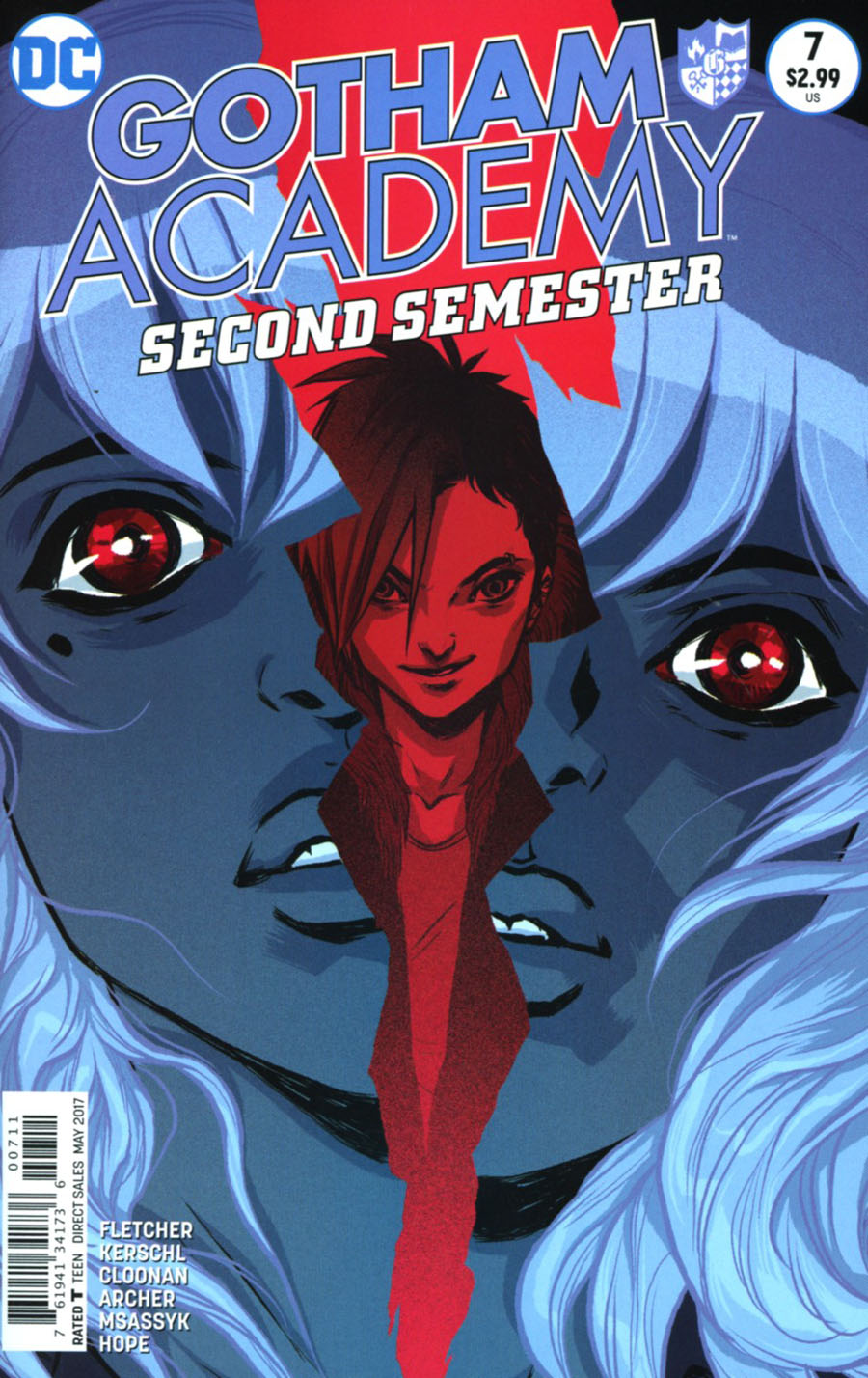
Gotham Academy: Second Semester #7 (DC) This issue, like each of the previous ones, has a story credit devoted to Brenden Fletcher, Becky Cloonan and Karl Kerschl, while Brenden Fletcher is credited with the script. I find this somewhat distressing, as it means that it took not one, not two, but three people to decide to make Tyler Durden a teenage girl at a Gotham City private school. That's the sort of decision that one usually expects from Brian Michael Bendis, where he seemingly finishes watching a movie or TV show and decides to write a Marvel comics event series based on that premise. But even if, say, Fletcher re-watched Fight Club and thought, "Hey, what if Tyler Durden went to Gotham Academy?" that means there are two people there who can talk him down and say, "Nah, that's too obvious."
Now, this issue features that revelation, and it's still possible there's a supernatural variation to distinguish it from Fight Club, but, ugh, I rolled my eyes so hard in this issue I had to spend a few minutes on my hands and knees, feeling around my apartment floor to find them and put them back in my head.
I suppose I should also note that this is starting to feel very climactic, and it seems like there's a very good chance that there won't be a third semester of the title.
Josie and the Pussycats #5 (Archie Comics) I...have a really hard time writing about this book, because it is so dense, so complex and so good. Can I just say that this is the very best comic book I read last night? By a factor of, I don't know, 10 or 20? This is the end of the first story arc, as Melody happily shrugs on the climactic last page, in which the Pussycats are being arrested for plagiarism ("I...don't think you can be arrested for that," Valerie says). It also features the first appearance of Alexander Cabot, who, like Alan M., is extremely different in this series than he was ever previously portrayed.
Seriously, if you read only one new comic book this week, I hope it is this one. It is so good.
Justice League of America #2 (DC) Do you know what's weird about this series? Well, one of the weird things about this series? Batman is on this Justice League. But he's also on that other Justice League, the one with all of the most powerful and influential superheroes in the world. He frequently, if unconvincingly, articulates what makes the Leagues different, but when this League is confronted by a potentially extinction-level threat--the Marvel analogues from Angor arriving and announcing their attention to conquer Earth--he doesn't bother to call his pals in the other League, but decides he'll just fight them with Black Canary, Lobo and a bunch of newbies. (I mean, I know why he doesn't, but it might be nice if there was a throwaway line of Batman saying under his breath "Dammit, Superman is off-planet with the Lanterns" or, Cyborg checking in and saying he saw the fight on the news, and asking if Batman's team needed any help.)
The goals, the premise of this League that writer Steve Orlando keeps laying out--that they are a team of the people, that they will inspire regular folks to act in heroic ways, that they will be more earthbound--isn't exactly in keeping with the first threat he presents them with, fending off an extra-dimensional invasion by off-brand versions of Doctor Doom, Magneto, the dread Dormammu and so on.
This is the first Ivan Reis-less issue (even though it says #2, it's technically the third issue, as there were two number ones, but comics), and artist Felipe Watanabe and inker Scott Hanna are here instead. The difference is quite noticeable.
As for the plot, fake Doctor Doom and The Extremists have started by taking over fake Latveria and consolidating their control there, so Batman and his team have to decide to take on a whole country in the next chapter.
Justice League/Power Rangers #3 (DC) As giant, octopus-looking creatures attack major cities on several continents, the Justice League and Power Rangers go to work, the former calling in a rather random group of reservists (Green Arrow, Black Canary, Mera, Beast Boy, Starfire,Captain Marvel Shazam, Nightwing, Supergirl, Batgirl, Kid Flash, Green Lantern Jessica Cruz and...pre-Flashpoint Hawkgirl...? Well, whatever; I mean, John Stewart's this League's Lantern, so writer Tom Taylor and artist Stephen Byrne are basically just telling the story they want, rather than worrying if it fits in with a particular continuity).
Taylor includes some pretty great lines in this, particularly once Brainiac captures the Zords and heads to Earth-PR with them, likely to use them to collect the city in a bottle and give the rest of that Earth to Lord Zedd. That's when it's up to the League and Billy to try to invent a dimensional portal that will take them back to their home world.
The two panels that stick with me the most, though, are the first two on page eight. The first is labeled "Buenos Aires, Argentina" and shows Nightwing, Green Lantern John Stewart, Green Arrow, Black Canary attacking an octopus. The next one is labeled "Seattle, USA" and shows Cyborg, Starfire and Capt--Er, Shazam fighting an octopus there. Don't GA and Canary live in Seattle now? Did they teleport away from their city, which was being attacked by a giant octopus, in order to go fight a giant octopus in a different city, while other heroes had to teleport to their city to fight the giant octopus attacking it?
See, this is why the Justice League needs Barbara Gordon, Oracle...
Reggie And Me #3 (Archie) This is my least favorite of the Archie books, but I have to admit it is the most densely plotted, and writer Tom DeFalco does seem to be going out of his way to present a rather realistic, and surprisingly morally complex, portrayal of high school life. I guess it's my least favorite because it's the least funny, but I suppose it is also the book that has the most in common with the line's flagship book, Archie.
In this issue, she overall shape of Reggie's plan to eliminate his two main rivals, Archie and Moose, by pitting them against one another, continues to take form, and it becomes somewhat complicated when we follow Reggie to Moose's house after school, and together we learn there's a lot more to the big guy than is immediately apparent. And just as we learn that maybe Reggie's not all bad, his dog Vader (the and Me of the title) begins to suspect that maybe his Reggie isn't all good.
Also, we learn that Midge ships Reggie and Betty ("Beggie"...?). I could see that. If nothing else, it would annoy Archie!
Suicide Squad #13 (DC) In the first chunk, drawn by John Romita JR and Richard Friend, Deadshot admits that yes, it was he who shot Amanda Waller to death (although I don't think she's as dead as they all seem to think) and he then kinda sorta takes on the rest of the Squad before escaping (Djinn shuts off the brain bombs). In the second chunk, drawn by Eddy Barrows and Eber Ferreira, the rest of the Squad escapes, a traitor is revealed and another character seemingly gets killed...but probably not.
I still find the format confusing, as the two stories seem to follow one after the other, but they are labeled like different storylines. They make sense read like this, although where the labels and The Ends fall don't, and I'm not sure how they will be placed in a trade. These two, for example, seem like they have to be read back-to-back...? I don't know. Maybe the book needs to just change artists more frequently, so that, say, JRJR would have drawn all 20 of these pages, or maybe the back-ups need to focus on something other than the main storyline, like little sidequests featuring the characters that are otherwise unrelated to the main storyline? I don't know.
I really like JRJR's art, though, and don't really like Barrows, and it's weird to see the inconsistencies between the two in these two stories (Does Boomerang have sideburns or not? Does Harley's mallet have spikes or not? And so on).
Wonder Woman #18 (DC) I like Bilquis Evely's art.
This $3.99, 38-page comic is billed as a "Supersized Anniversary Issue," and contains two stories, although they bleed into one another in such a way that they're not too terribly distinct from one another. The first of these is a 20-pager by the regular Action Comics writer Dan Jugens and one of the two regular Superman pencil artists, Doug Mahnke (Jaime Mendoza inks). As we saw in last week's part one, something strange happened at the Kents' farm, and Lois and Clark's son Jon dissolved before their eyes, seemingly somehow abducted by The Other Clark Kent.
Here, the two pissed-off parents storm Other Clark's apartment, where they are confronted by the strangely powerful Clark, who demands to know why they have forgotten about him and why Superman never saved him (tying this into the DC Universe: Rebirth/Something To Do With The Characters From Watchmen plot, the previous chapter showed Mr. Oz finding an empty, gigantic cell covered in child-like, Superman-obsessed graffiti. Other Clark, like Doomsday and Tim Drake, have been captives of Mr. Oz for a while now).
This being a superhero comic, a fight breaks out, with Other Clark running through a checklist of Superman villains, demanding that Superman guess who he really is or, in other words, to say his name. These are all basically splash pages with two small inset panels in each, which is a bit of a waste of your comic book real estate but, on the other hand, they do give Mahnke the opportunity to draw pin-up style fights between Superman and members of his rogue's gallery: Lex Luthor, Bizarro, Brainiac, Mongul, Parasite, Cyborg Superman, Doomsday and, of course, the real culprit, who you will likely have guessed by now if you haven't been reading.
He is pretty clearly in his pre-Flashpoint form, despite at least one major appearance in the New 52 Superman books, one in which he essentially drove the action of that book, which, in retrospect, makes me kind of wish he wasn't used since Flashpoint at all, as it would make the reboots and changes make a little more sense. This is perhaps one of the few, pre-existing, totally-part-of-the-mythos characters who coul have easily done or undone any reboots at a whim.
Jurgens writes him as particularly menacing, a result of his disappointment in Superman for failing to save him, or even notice he was missing, and he's blaming Jon, who he plans to make everyone in the world forget (In fact, the last panel is Lois looking at Superman and saying "...Jon who?").
I have a couple of concerns about this character's usage. First, as I've said, we've already seen him in the New 52, and he was therefore subject to the reality-warping apparently instigated by Pandora...and/or Dr. Manhattan, retroactively, I guess. As a completely meta-character, a few dimensions higher than these characters (and one higher than us ourselves here in the real world/Earth-Prime), it's hard to imagine who or what Pandora and/or Doctor Manhattan would be that their time-stream/multiversal merging could even affect him.
Second, who could Mr. Oz be that he's powerful enough to trap and imprison him, and in such a manner? (That manner will be explored in the second story, if not the actual identity. I suppose he could be someone as powerful as The Other Clark, because they are of the same species, or be from a higher plane of existence still but there's no real clues here. His name is a half clue, perhaps, but the second two letters contradict the first two).
Third and finally, this character's making something of a heel turn. While always technically an adversary of Superman's, you'd be hard-pressed to call him a villain. He's really only turned evil in an "Imaginary Story" by Alan Moore, so what the writers here are doing seems to be at least semi-inspired by yet another work of Alan Moore, a well DC writers and editors simply don't seem capable of staying away from for longer than a month or so at a time. Moore call-backs and allusions show up in the books constantly, and how weird would it be if this mega-plot hinged on not only his characters from Watchmen but also his characterization of a Superman character in another work of his? (Grant Morrison did something semi-similar during his JLA run, too, I should note, but that was years after Moore did it, and Morrison used similar characters, rather than the same character. At any rate, it seems that Jurgens and Paul Dini have been thinking of those Moore and Morrison stories, even if only in the back of their heads, while writing.
The back-up story, "The Man in the Purple Hat," (okay, I've spoiled it by now, haven't I?) is by Paul Dini and artist Ian Churchill. The first is a surprise only in that it's always a surprise to see Dini doing comics work to me, but he has some association with the character. Churchill I wouldn't imagine a good choice for this story, but this was honestly the best work I've ever seen from him, as he fairly flawlessly imitates art from Silver and Golden Age Superman comics, and manages levels of character acting I didn't think he was capable of.
In this 18-page story, Jon and The Man in the Purple Hat share stories, with the latter's story being how exactly Mr. Oz captured him, how he eventually escaped and how he managed to restore Superman's secret identity by becoming a perfectly human Clark Kent...and doing such a good job of it that he himself hadn't realized he had done it.
So this was all very well executed, surprisingly well-executed, but as to how long this character will stay more villainous than mischievous (something that doesn't really work for a non-Imaginary story, given his power levels), and how this fits in with all this Mr. Oz/Watchmen business.
I can't wait to read the next chapter, but I'd be lying if I said I wasn't a bit worried about it.
Deathstroke #14 (DC) My greatest criticism regarding this particular issue of the series I'm surprised to find still on my pull-list given my complete disinterest in the character (which goes a long way towards demonstrating the power of a great writer) is for whoever it was that decided on the text filling too much of the cover:
Blinded.See, the fact that Deathstroke is blinded is actually revealed on the very last page, as a sort of shocking cliffhanger. But it's not so shocking if you knew it was coming just by looking at the cover (Yes, I am criticizing DC for spoiling the ending of their own comic just one review after saying I don't care about spoilers. What can I say? I'm capricious).
Beaten.
Broken.
To my surprise, this issue prominently features Power Girl II, the one who appeared in the pages of Teen Titans for a while and who I therefore completely ignored. She doesn't have powers that in any way resemble Power Girl I's, who was actually just Supergirl from the first of the two worlds designated Earth-2 in the New 52 so um...you can kinda see why I ignored her, right? This stuff is downright byzantine sometimes). Instead, she seems to have the powers of The Doom Patrol's Elastigirl). She's also a super-scientist with a German shepherd (pictured on the front).
Joe Bennett continues to pencil, here inked by Jeromy Cox, and writer Priest has Slade performing a hit for the guy who kinda sorta decided to let him maybe stay out of prison. Power Girl, being a superhero, just sees a taxi cab accident and people with guns, so she intervenes and saves a badly poisoned Slade. Meanwhile, stuff continues to happen with Rose and Jericho...in the case of the latter, bad stuff.
Detective Comics #952 (DC) Having played up the mystery of Cassandra Cain's parentage, and Shiva's particular interest in and kinship with her, for years in the pre-Flashpoint DCU (DC is in the midst of reprinting those particular comics right now! You should totally read Batgirl Vol. 1: Silent Knight and Batgirl Vol. 2: To The Death right now! They are a much better investment than, say, trade paperback collections of Detective Comics!), writer James Tynion perhaps wisely decides to not bother this time around...although he continues to echo the earlier continuity in a way that begs comparison with the Scott Peterson/Kelley Puckett-written Batgirl, and comes up wanting.
In this issue, it's immediately apparent that Shiva is Cassandra's mom. We're told as much in the first two pages, and she tells Cass and Batman before the issue is over. She also attempts to fight her, and is disappointed that Cass isn't trying to kill her, and more disappointed still when Cass says "Won't... Kill..."
Tynion's portrayal of Shiva is...weird, though. Now she's a complete sadist. She doesn't seem too terribly interested in finding the world's greatest fighters and then fighting them to the death as mush as she is in setting up a rival faction to Ra's a Ghul's League of Assassins, and with them...destroying cities? For some reason? (Maybe they will reveal that later). She's also a complete sadist, more interested in inflicting pain than simply killing as quickly and efficiently as possible. I...don't really get it.
There's a lot I don't really get in this book though, to be honest. Shiva is attempting to destroy Gotham City for an unstated reason, and that includes framing Batman for murder, making people believe the Joker is attacking and trying to assassinate Batman's 'TEC team with swords. They all stand in a circle and fight, two of them being horribly wounded. I have no idea why Clayface didn't just take them all on himself, given that he's essentially unkillable by swords (he eventually does so; Clayface should really even be able to take on Shiva too, since he's just sentient mud that can control itself on a near-molecular level).
Again, I like all these characters, and Tynion's not a bad writer, I just have no idea what he's doing, or why. The art here is all over the place, with I think two artists credited and three colorists, each with particular page designations? I liked whoever did the first three pages the best (Fernando Blanco and Alex Sinclair, I think). The Shiva/Cassandra fight, and the Shiva/Batman fight that follows, were both pretty terrible...but then, I say that after having just read a Shiva/Cassandra fight expertly choreographed and rendered by Damion Scott last week, so...
As for the cover, your guess is as good as mine. Suffice it to say that Batman does not fight a bunch of brown hands within.
Gotham Academy: Second Semester #7 (DC) This issue, like each of the previous ones, has a story credit devoted to Brenden Fletcher, Becky Cloonan and Karl Kerschl, while Brenden Fletcher is credited with the script. I find this somewhat distressing, as it means that it took not one, not two, but three people to decide to make Tyler Durden a teenage girl at a Gotham City private school. That's the sort of decision that one usually expects from Brian Michael Bendis, where he seemingly finishes watching a movie or TV show and decides to write a Marvel comics event series based on that premise. But even if, say, Fletcher re-watched Fight Club and thought, "Hey, what if Tyler Durden went to Gotham Academy?" that means there are two people there who can talk him down and say, "Nah, that's too obvious."
Now, this issue features that revelation, and it's still possible there's a supernatural variation to distinguish it from Fight Club, but, ugh, I rolled my eyes so hard in this issue I had to spend a few minutes on my hands and knees, feeling around my apartment floor to find them and put them back in my head.
I suppose I should also note that this is starting to feel very climactic, and it seems like there's a very good chance that there won't be a third semester of the title.
Josie and the Pussycats #5 (Archie Comics) I...have a really hard time writing about this book, because it is so dense, so complex and so good. Can I just say that this is the very best comic book I read last night? By a factor of, I don't know, 10 or 20? This is the end of the first story arc, as Melody happily shrugs on the climactic last page, in which the Pussycats are being arrested for plagiarism ("I...don't think you can be arrested for that," Valerie says). It also features the first appearance of Alexander Cabot, who, like Alan M., is extremely different in this series than he was ever previously portrayed.
Seriously, if you read only one new comic book this week, I hope it is this one. It is so good.
Justice League of America #2 (DC) Do you know what's weird about this series? Well, one of the weird things about this series? Batman is on this Justice League. But he's also on that other Justice League, the one with all of the most powerful and influential superheroes in the world. He frequently, if unconvincingly, articulates what makes the Leagues different, but when this League is confronted by a potentially extinction-level threat--the Marvel analogues from Angor arriving and announcing their attention to conquer Earth--he doesn't bother to call his pals in the other League, but decides he'll just fight them with Black Canary, Lobo and a bunch of newbies. (I mean, I know why he doesn't, but it might be nice if there was a throwaway line of Batman saying under his breath "Dammit, Superman is off-planet with the Lanterns" or, Cyborg checking in and saying he saw the fight on the news, and asking if Batman's team needed any help.)
The goals, the premise of this League that writer Steve Orlando keeps laying out--that they are a team of the people, that they will inspire regular folks to act in heroic ways, that they will be more earthbound--isn't exactly in keeping with the first threat he presents them with, fending off an extra-dimensional invasion by off-brand versions of Doctor Doom, Magneto, the dread Dormammu and so on.
This is the first Ivan Reis-less issue (even though it says #2, it's technically the third issue, as there were two number ones, but comics), and artist Felipe Watanabe and inker Scott Hanna are here instead. The difference is quite noticeable.
As for the plot, fake Doctor Doom and The Extremists have started by taking over fake Latveria and consolidating their control there, so Batman and his team have to decide to take on a whole country in the next chapter.
Justice League/Power Rangers #3 (DC) As giant, octopus-looking creatures attack major cities on several continents, the Justice League and Power Rangers go to work, the former calling in a rather random group of reservists (Green Arrow, Black Canary, Mera, Beast Boy, Starfire,
Taylor includes some pretty great lines in this, particularly once Brainiac captures the Zords and heads to Earth-PR with them, likely to use them to collect the city in a bottle and give the rest of that Earth to Lord Zedd. That's when it's up to the League and Billy to try to invent a dimensional portal that will take them back to their home world.
The two panels that stick with me the most, though, are the first two on page eight. The first is labeled "Buenos Aires, Argentina" and shows Nightwing, Green Lantern John Stewart, Green Arrow, Black Canary attacking an octopus. The next one is labeled "Seattle, USA" and shows Cyborg, Starfire and Capt--Er, Shazam fighting an octopus there. Don't GA and Canary live in Seattle now? Did they teleport away from their city, which was being attacked by a giant octopus, in order to go fight a giant octopus in a different city, while other heroes had to teleport to their city to fight the giant octopus attacking it?
See, this is why the Justice League needs Barbara Gordon, Oracle...
Reggie And Me #3 (Archie) This is my least favorite of the Archie books, but I have to admit it is the most densely plotted, and writer Tom DeFalco does seem to be going out of his way to present a rather realistic, and surprisingly morally complex, portrayal of high school life. I guess it's my least favorite because it's the least funny, but I suppose it is also the book that has the most in common with the line's flagship book, Archie.
In this issue, she overall shape of Reggie's plan to eliminate his two main rivals, Archie and Moose, by pitting them against one another, continues to take form, and it becomes somewhat complicated when we follow Reggie to Moose's house after school, and together we learn there's a lot more to the big guy than is immediately apparent. And just as we learn that maybe Reggie's not all bad, his dog Vader (the and Me of the title) begins to suspect that maybe his Reggie isn't all good.
Also, we learn that Midge ships Reggie and Betty ("Beggie"...?). I could see that. If nothing else, it would annoy Archie!
Suicide Squad #13 (DC) In the first chunk, drawn by John Romita JR and Richard Friend, Deadshot admits that yes, it was he who shot Amanda Waller to death (although I don't think she's as dead as they all seem to think) and he then kinda sorta takes on the rest of the Squad before escaping (Djinn shuts off the brain bombs). In the second chunk, drawn by Eddy Barrows and Eber Ferreira, the rest of the Squad escapes, a traitor is revealed and another character seemingly gets killed...but probably not.
I still find the format confusing, as the two stories seem to follow one after the other, but they are labeled like different storylines. They make sense read like this, although where the labels and The Ends fall don't, and I'm not sure how they will be placed in a trade. These two, for example, seem like they have to be read back-to-back...? I don't know. Maybe the book needs to just change artists more frequently, so that, say, JRJR would have drawn all 20 of these pages, or maybe the back-ups need to focus on something other than the main storyline, like little sidequests featuring the characters that are otherwise unrelated to the main storyline? I don't know.
I really like JRJR's art, though, and don't really like Barrows, and it's weird to see the inconsistencies between the two in these two stories (Does Boomerang have sideburns or not? Does Harley's mallet have spikes or not? And so on).
Wonder Woman #18 (DC) I like Bilquis Evely's art.
Sunday, March 05, 2017
Comic Shop Comics: March 1st
Batgirl Vol. 2: To The Death (DC Comics) I so enjoyed the first collection of the Kelley Puckett/Scott Peterson/Damion Scott/Robert Campanella Batgirl that I snapped up the next one almost immediately upon finishing it. I read many of these comics in the past, some as they were originally published, and some from back-issue bins, but they've only gotten better with age, and, obviously, this is the way to read them: In big chunks, in the order they were created and published. The first volume contained the first 12 issues and the annual (the latter of which is worth checking out if only to see some very, very weird pre-Marvel Mike Deodato artwork).
This volume includes the next 12 issues, plus some of the relevant character profiles from Secret Origins & Files (Batgirl Cassandra Cain, Oracle, Cain, Shiva and Batgirl Barbara Gordon).
I really like the Cassandra Cain character. Raised to be an unstoppable assassin but wracked by the guilt she felt for taking her first and only life (Late in this volume, Shiva intuits exactly why killing a man affected Cassandra as profoundly as it did), her crime-fighting motivation is so different than those of her other peers. Additionally, like almost all of Batman's various allies over the years, Cassandra was a bit of a Batman fan, and I really like the fact that he's her role model to the point where she doesn't necessarily want to be a Robin or a Batgirl, or to have a relationship with Bruce Wayne (who she doesn't even know is Batman), she just wants to be Batman, 24/7.
At this point in the series, Puckett has set up an interesting dynamic in which Oracle and Batman are kind of like Cassandra's surrogate parents, albeit divorced ones who squabble and have different desires for their 17-year-old protegee. Barbara, with whom Cassandra was living, wants her to take on some semblance of a real, civilian life, for Cassandra Cain to have an identity beyond Batgirl at some point (as she herself did, even retiring at one point). Meanwhile, Batman likes her just the way she is, and when things come to a head--when Cass' identity is compromised and Batman makes her move out of the Clocktower and into her own Batcave, he tells Barbara that this will make her a more effective weapon in their arsenal (Whether intentional or not, this foreshadows the events of storylines "Bruce Wayne: Murderer?" and "Bruce Wayne: Fugitive," in which Batman attempts to discard his secret identity altogether, much to the annoyance of his allies).
Additionally, Babs and Bats disagree on whether or not Cassandra actually ever took a life (she did), and whether or not they should intervene in her deal to duel Shiva to the death. The climax of that storyline is the last issue of this collection.
There are a couple of issues in here that deal specifically with her relationships with the other teenagers in Batman's orbit, a neat one in which she has an extremely awkward team-up with Robin Tim Drake, and then two issues in a row in which she reluctantly teams up with Spoiler. There are also a couple of issues devoted to crossovers, like an issue in which she, Spoiler and Oracle take on a Joker-ized Shadow Thief (a Last Laugh tie-in), and one of the first chapters of "Bruce Wayne: Murderer."
I really like Puckett's overall strategy for the series, which is quite episodic. While there are threads that run from issue to issue, particularly regarding Cassandra's relationships with her two pairs of parental figures--good guys Oracle and Batman, bad guys Shiva and Cain--and her feelings about death and killing, there are a lot of discrete, done-in-one issues that read like complete stories unto themselves. This volume of Batgirl, at least at this point in its existence, was very much a book that was all jumping-on point. (My favorite story in here, aside from the team-ups with Robin and Spoiler, was probably the "Nobody Dies Tonight" one, in which she makes a near super-human effort to prevent anyone in the entire city from having their life taken in anyway, up to and including trying to save a man on death row from dying in the gas chamber.)
While Puckett wrote the hell out of this book, with assists from Peterson and Chuck Dixon, who handles some fill-ins, it's the art that attracted me to it in the first place, and remains my favorite aspect. Batgirl's design is pretty much perfect. Scott gives her a big, round, Spider-Man-like head, bit feet and hands, and long, lithe limbs--physically, she looks like a martial arts machine. Her costume is all black, and looks an awful lot like Batman's from many angles; size aside, she's the only one of Batman's many allies that might pass for him in a distant sighting or the middle of a battle.
I'm not crazy about the stitching on the mask, but I like everything else about it, from the solid black over her eyes and mouth, to the long-pointy ears and scallops on the gloves, to the over-sized pouches on her utility belt, which further suggests a little kid playing dress-up, wearing something of their parents' that they haven't quite grown into yet (Oddly, as big as her pouches are, Cassandra rarely uses any tools at all; so far, I think all she's ever used in the series is little dart-like batarangs and a grappling gun).
Scott does an excellent job of drawing her in action, whether it's fighting large groups of ill-suited, untrained opponents--which he usually renders simply by having her posed in the air, doing two or three moves at once, while a crowd of people fall all around her--or worthy ones like Shiva or the few metahumans she accidentally encounters, wherein we see her actually trading blows.
I was pretty disappointed when I went to look for the third volume at both my local comic shop and my local Barnes and Noble and found neither of them had it in stock. I remain disappointed by how Cassandra has been used in The New 52, although I'm hopeful that Tynion will gradually have her adopt her old costume and previous codename of Black Bat (or The Bat, or even just Batgirl; it's not like the people her and Barbara are punching in the face need to know which Batgirl is punching them in the face, right?).
In the mean time, these comics are so damn good...although it does make me feel a little weird that the Batman comics I've enjoyed the most this year, outside of the first arc of All-Star Batman, have been the collections of Robin and Batgirl from forever ago.
Batman #18 (DC) I've grew rather weary of this particular style of comic book cover years ago, in which one character stands triumphantly above a pile of fallen foes, but I am apparently the only one, as DC keeps commissioning such covers, and artists keep delivering them. Just last week, Detective Comics featured the same basic concept, only it was Shiva standing over a group of fallen Batman allies. That one was also a bit better drawn. Artist David Finch, who draws this issue inside and out, doesn't seem to have put much planning into his image, and thus kind of ran out of room for Bane's legs. He just imagines Bane standing knee-deep in some rubble. The defeated Bats are scattered about, and not arranged in a particularly compelling fashion; I mean, did you even notice Duke on the cover? That's his ear and temple and shoulder at the very bottom.
Inside, regular writer Tom King and on-again, off-again artist Finch (here inked by Danny Miki), cuts back and forth between the latest round of Bane vs. Batman and a re-telling of the two characters' origins, at least in terms of how parallel they are. The modern day action mainly consists of Batman taking a savage beating from Bane in order to distract him. The origins focus on moments where their formative years mirrored one another, including the loss of their mother, an older man taking them in, their training and so on.
I'm not really a fan of Finch's artwork, as I may have noted a few dozen times before on the blog, and his telling of Bane's childhood in a Santa Priscan prison is neither as distinct or dramatic as artist Graham Nolan's original telling of that same story was (in 1993's Batman: Vengeance of Bane one-shot). His Bane looks much, much older and, much to my annoyance, is shown without Osoito (I know it should be "Osito," but they spelled it "Osoito" in Vengeance). As I said on Twitter the other night, I've taken a lot about the reboots in stride, but I draw the line at excising Osoito from Bane's origin story!
King also seems to indicate that Batman and Bane are both pretty much bonkers in a pretty similar way, having spent most of their childhoods talking out loud to their dead mothers. That's kind of weird.
Aside from not being as good as Nolan, and even given his flashbacks much of a personality, Finch does okay with the art herein. He's in better form than he was in the past (I believe his last big Bane story appeared in his short-lived, godawful Batman: The Dark Knight series), and I assume not having to worry about writing as well as drawing and keeping a monthly schedule has allowed him to do a bit better. It's not very good, but it could be worse.
DC Comics Bombshells #23 (DC) I of course love Marguerite Sauvage's cover for this issue, and loved it even more after reading the issue. The first third or so features Wonder Woman and Supergirl on an island together, and I like to imagine that's all Sauvage had to go on, so she went in this particular issue with the art, which is certainly in keeping with the tone of Bombshells which, remember, is based on a line of statuettes reimagining heroines and villains as 1940s good girl pin-up models (Inside the book? Wondy is trying to help Supergirl process her grief over having lost her sister Stargirl during the Battle of London; they spend the entire sequence wrapped up in white robes, talking about death and mourning at night, while shell-shocked Steve Trevor hangs around).
If you look closely, in the lower right corner you'll notice the slogan "Keep Calm and Carry On," with Wonder Woman's tiara atop, where the crown would have been. It's kind of cute, but seems out of place here instead of, say, on one of the covers from like ten issues ago or so when the Bombshells were in London. Also, aren't the "Keep Calm And..." jokes pretty played out at this point? It seems like a meme that has exhausted itself.
Back to the interiors, they are sadly Sauvage-less, but still fairly good looking. Matias Begara, Laura Braga and Mirka Andolfo each draw portions of Marguerite Bennett's script. As I mentioned, the first portion deals with Wonder Woman, Supergirl and Steve talking about death. Bennett's script gets pretty poetic at points, but it also gets pretty windy. Wonder Woman takes about six pages of monologue-ing before she gets to something of real value, something a reader might really remember and perhaps even take comfort in some day. It's interesting stuff, but not so interesting that it's not also tedious.
The next section finds Wonder Woman taking a meeting with Luthor in an invisible jet--his invisible jet, it turns out. I really like the way Bennett writes Wondy's dialogue here, which might sound weird after I just complained about how much she had Wonder Woman gassing on earlier, but here she's exchanging dialogue with a smart, cunning person of dubious morality, rather than talking at someone. While the Wonder Woman book is currently on pretty solid footing, I can't help but wonder what Bennett's Wonder Woman might be like.
The final section finds Diana joining the other Bombshells in Vixen's kingdom of Zambesi, where the last few issues have been set. Hawkgirl does something risky, which ends up teaching her the parts of her own origin story she had forgotten: It turns out this Hawkgirl is Thanagarian, an the Hawkpeople are planning to invade Earth at some point in the near future.
Nightwing #16 (DC) There are two important things to take away from the page above, which is written by regular writer Tim Seeley and drawn by artist Javier Fernandez. First, Nightwing totally had a boner (see panel two), but it went away before he swung into action. Good thing too, because the fifth panel would look very different if Fernandez had to draw that (it can't be easy to hid in a suit like that!). Second, Nightwing and his new girlfriend Shawn Tsang like to engage in some light, French vanilla BDSM in the bedroom.
These are things I don't normally think about when thinking about Nightwing. Also, this issue reveals that he and Starfire totally did it when they were teenagers. TMI? Or just the right about of I...? You decide!
So as you'll recall, last issue ended with Shawn, who may or may not be pregnant with Dick Grayson's child, being abducted by a person unknown (but most likely some new version of Deathwing). This issue doesn't reveal her fate. What it does do is riff on the ideas of sons and heirs, both in rather direct references to the Robin Hood legend that Dick tells the reader, and in the inclusion of Robin Damian Wayne. Rather randomly goaded into action by his new Teen Titan teammates, all of whom are pretty confident that Dick is the true heir to Batman's legacy and not Damian, the pint-sized terror heads to Bludhaven to settle who has the right to wear the cowl at some point in the future once and for all.
Dick, who just discovered Shawn is missing, doesn't have time for Damian's shit, of course, but they end up re-teaming to find Shawn. The Dick Grayson/Damian Wayne dynamic is a pretty great one, and one that was more than compelling enough to power Grant Morrison and company's Batman and Robin and, of course, resulted in Damian still being around after what was once meant to be a pretty quick and pretty final death for Robin IV*.
I'm still a little worried about Shawn, which I guess is a good argument for the fact the Seeley has written her and this book in general so well, but I'm feeling pretty confident that she's going to make it out of this story arc alive and, in the mean time, I'm enjoying the Dick/Damian reunion.
I know we're just starting this arc, but so far it seems that each arc of the current Nightwing title is better than the one that preceded it, which is pretty much exactly what you want in a serially published comic book.
Super Powers #5 (DC) So I apparently missed an issue of this--Damn you, Local Comics Shop!--as the plot had advanced pretty far since the last time I read it, and all of a sudden the Legion of Doom is involved, and Golden fucking Pharaoh is making a cameo. To Art Baltazar and Franco's credit, it still wasn't that hard to fill in the blanks of the issue I missed. The Superman's new half-brother, who now looks just like Superman with green skin and blonde hair and a little Brainiac forehead bling, is battling various Justice Leaguers outside the crystalline Fortress of Solitude, when The (An?) Unknown Superman appears to defuse the situation. Meanwhile, Darkseid and army of Parademons (the cuter, little red ones from the Super Powers line, rather than the bigger, blockier green, yellow and gray ones) arrive in Gotham City, and are greeted there by its resident supervillain, The Joker.
I really like Baltazar's take on The Joker, and this whole series has been sort of weird in that the writing has been perfectly all-ages friendly--this is a more "serious" story than the gag-driven Tiny Titans or Superman Family Adventures stories--but the art makes it seem like it should be sillier or funnier. I have a particularly hard time taking his Darkseid seriously, having previously read Tiny Titans, where the Baltazar-drawn Darkseid served as the lunch lady at the Titans' school (there's not a whole overlap between characters, otherwise; the adult heroes and villains who appear in this series generally only appeared from the waist down in the pages of Tiny Titans, with a few exceptions).
Superman # (DC) Peter Tomasi and Patrick Gleason, the latter both co-writing and penciling present the first issue of the multi-title crossover storyline, "Superman Reborn." Curious title, given that Superman was just Rebirth-ed, wasn't he? Anyway, this storyline appears to be the one that will finally settle just what the hell is going on with the Superman franchise after the events of DC Comics: Rebirth, as well as the current DCU mega-plot involving Mr. Oz and maybe the characters from Watchmen or whatever.
In that regard, after a portentous opening, we see that one of Mr. Oz's prisoners has escaped, and we get a look inside the now empty cell, which seems to have been filled with graffiti by a giant child (the spelling is too good to be a Bizarro, and it's difficult to imagine anyone imprisoning a fifth dimensional imp like Mr. Mxyzptlk, so at this point, I've got no good theories on the escapee).
The rest of the issue is divided into demonstrating just how idyllic Clark, Lois and Jon's life is...just to have it start getting screwed around with by history/continuity warping/eating forces, which Clark and Lois seem to equate to the mysterious extra Clark Kent that's been lurking around the Superman books of late. At the climax, Jon is eaten by these forces.
This would likely have been a much more dramatic moment, if DC had just launched a new ongoing series co-starring Jon (Super Sons), which means he's totally not going to be deleted from the universe. If it weren't for the Super Sons launch, however, that might be a more open question, given that Jon's role as Clark and Lois' son is such a big, character and franchising type of change that his being somehow violently removed from continuity would actually seem a lot more likely than when other superheroes experience such threats. Like, I know Batman's never gonna die, no matter what death traps he finds himself in, or what the odds he faces are. But Jon, who, the argument could be made, shouldn't be there in the first place? Well, who would be too terribly surprised if he went the way of the last kid that this Clark and Lois were raising as a son, you know?
Anyway, not a whole lot happening here, really, but it's an all-around well-made issue, and this promising story arc is off to a compelling start. I'm certainly interested in where it's going, enough so that I plan on picking up all the chapters (I dropped Action after the first arc, but have stuck with Superman).
*Actually, I guess he was technically Robin V prior to the post-Flashpoint reboot, but afterwards he became Robin IV.
This volume includes the next 12 issues, plus some of the relevant character profiles from Secret Origins & Files (Batgirl Cassandra Cain, Oracle, Cain, Shiva and Batgirl Barbara Gordon).
I really like the Cassandra Cain character. Raised to be an unstoppable assassin but wracked by the guilt she felt for taking her first and only life (Late in this volume, Shiva intuits exactly why killing a man affected Cassandra as profoundly as it did), her crime-fighting motivation is so different than those of her other peers. Additionally, like almost all of Batman's various allies over the years, Cassandra was a bit of a Batman fan, and I really like the fact that he's her role model to the point where she doesn't necessarily want to be a Robin or a Batgirl, or to have a relationship with Bruce Wayne (who she doesn't even know is Batman), she just wants to be Batman, 24/7.
At this point in the series, Puckett has set up an interesting dynamic in which Oracle and Batman are kind of like Cassandra's surrogate parents, albeit divorced ones who squabble and have different desires for their 17-year-old protegee. Barbara, with whom Cassandra was living, wants her to take on some semblance of a real, civilian life, for Cassandra Cain to have an identity beyond Batgirl at some point (as she herself did, even retiring at one point). Meanwhile, Batman likes her just the way she is, and when things come to a head--when Cass' identity is compromised and Batman makes her move out of the Clocktower and into her own Batcave, he tells Barbara that this will make her a more effective weapon in their arsenal (Whether intentional or not, this foreshadows the events of storylines "Bruce Wayne: Murderer?" and "Bruce Wayne: Fugitive," in which Batman attempts to discard his secret identity altogether, much to the annoyance of his allies).
Additionally, Babs and Bats disagree on whether or not Cassandra actually ever took a life (she did), and whether or not they should intervene in her deal to duel Shiva to the death. The climax of that storyline is the last issue of this collection.
There are a couple of issues in here that deal specifically with her relationships with the other teenagers in Batman's orbit, a neat one in which she has an extremely awkward team-up with Robin Tim Drake, and then two issues in a row in which she reluctantly teams up with Spoiler. There are also a couple of issues devoted to crossovers, like an issue in which she, Spoiler and Oracle take on a Joker-ized Shadow Thief (a Last Laugh tie-in), and one of the first chapters of "Bruce Wayne: Murderer."
I really like Puckett's overall strategy for the series, which is quite episodic. While there are threads that run from issue to issue, particularly regarding Cassandra's relationships with her two pairs of parental figures--good guys Oracle and Batman, bad guys Shiva and Cain--and her feelings about death and killing, there are a lot of discrete, done-in-one issues that read like complete stories unto themselves. This volume of Batgirl, at least at this point in its existence, was very much a book that was all jumping-on point. (My favorite story in here, aside from the team-ups with Robin and Spoiler, was probably the "Nobody Dies Tonight" one, in which she makes a near super-human effort to prevent anyone in the entire city from having their life taken in anyway, up to and including trying to save a man on death row from dying in the gas chamber.)
While Puckett wrote the hell out of this book, with assists from Peterson and Chuck Dixon, who handles some fill-ins, it's the art that attracted me to it in the first place, and remains my favorite aspect. Batgirl's design is pretty much perfect. Scott gives her a big, round, Spider-Man-like head, bit feet and hands, and long, lithe limbs--physically, she looks like a martial arts machine. Her costume is all black, and looks an awful lot like Batman's from many angles; size aside, she's the only one of Batman's many allies that might pass for him in a distant sighting or the middle of a battle.
I'm not crazy about the stitching on the mask, but I like everything else about it, from the solid black over her eyes and mouth, to the long-pointy ears and scallops on the gloves, to the over-sized pouches on her utility belt, which further suggests a little kid playing dress-up, wearing something of their parents' that they haven't quite grown into yet (Oddly, as big as her pouches are, Cassandra rarely uses any tools at all; so far, I think all she's ever used in the series is little dart-like batarangs and a grappling gun).
Scott does an excellent job of drawing her in action, whether it's fighting large groups of ill-suited, untrained opponents--which he usually renders simply by having her posed in the air, doing two or three moves at once, while a crowd of people fall all around her--or worthy ones like Shiva or the few metahumans she accidentally encounters, wherein we see her actually trading blows.
I was pretty disappointed when I went to look for the third volume at both my local comic shop and my local Barnes and Noble and found neither of them had it in stock. I remain disappointed by how Cassandra has been used in The New 52, although I'm hopeful that Tynion will gradually have her adopt her old costume and previous codename of Black Bat (or The Bat, or even just Batgirl; it's not like the people her and Barbara are punching in the face need to know which Batgirl is punching them in the face, right?).
In the mean time, these comics are so damn good...although it does make me feel a little weird that the Batman comics I've enjoyed the most this year, outside of the first arc of All-Star Batman, have been the collections of Robin and Batgirl from forever ago.
Batman #18 (DC) I've grew rather weary of this particular style of comic book cover years ago, in which one character stands triumphantly above a pile of fallen foes, but I am apparently the only one, as DC keeps commissioning such covers, and artists keep delivering them. Just last week, Detective Comics featured the same basic concept, only it was Shiva standing over a group of fallen Batman allies. That one was also a bit better drawn. Artist David Finch, who draws this issue inside and out, doesn't seem to have put much planning into his image, and thus kind of ran out of room for Bane's legs. He just imagines Bane standing knee-deep in some rubble. The defeated Bats are scattered about, and not arranged in a particularly compelling fashion; I mean, did you even notice Duke on the cover? That's his ear and temple and shoulder at the very bottom.
Inside, regular writer Tom King and on-again, off-again artist Finch (here inked by Danny Miki), cuts back and forth between the latest round of Bane vs. Batman and a re-telling of the two characters' origins, at least in terms of how parallel they are. The modern day action mainly consists of Batman taking a savage beating from Bane in order to distract him. The origins focus on moments where their formative years mirrored one another, including the loss of their mother, an older man taking them in, their training and so on.
I'm not really a fan of Finch's artwork, as I may have noted a few dozen times before on the blog, and his telling of Bane's childhood in a Santa Priscan prison is neither as distinct or dramatic as artist Graham Nolan's original telling of that same story was (in 1993's Batman: Vengeance of Bane one-shot). His Bane looks much, much older and, much to my annoyance, is shown without Osoito (I know it should be "Osito," but they spelled it "Osoito" in Vengeance). As I said on Twitter the other night, I've taken a lot about the reboots in stride, but I draw the line at excising Osoito from Bane's origin story!
King also seems to indicate that Batman and Bane are both pretty much bonkers in a pretty similar way, having spent most of their childhoods talking out loud to their dead mothers. That's kind of weird.
Aside from not being as good as Nolan, and even given his flashbacks much of a personality, Finch does okay with the art herein. He's in better form than he was in the past (I believe his last big Bane story appeared in his short-lived, godawful Batman: The Dark Knight series), and I assume not having to worry about writing as well as drawing and keeping a monthly schedule has allowed him to do a bit better. It's not very good, but it could be worse.
DC Comics Bombshells #23 (DC) I of course love Marguerite Sauvage's cover for this issue, and loved it even more after reading the issue. The first third or so features Wonder Woman and Supergirl on an island together, and I like to imagine that's all Sauvage had to go on, so she went in this particular issue with the art, which is certainly in keeping with the tone of Bombshells which, remember, is based on a line of statuettes reimagining heroines and villains as 1940s good girl pin-up models (Inside the book? Wondy is trying to help Supergirl process her grief over having lost her sister Stargirl during the Battle of London; they spend the entire sequence wrapped up in white robes, talking about death and mourning at night, while shell-shocked Steve Trevor hangs around).
If you look closely, in the lower right corner you'll notice the slogan "Keep Calm and Carry On," with Wonder Woman's tiara atop, where the crown would have been. It's kind of cute, but seems out of place here instead of, say, on one of the covers from like ten issues ago or so when the Bombshells were in London. Also, aren't the "Keep Calm And..." jokes pretty played out at this point? It seems like a meme that has exhausted itself.
Back to the interiors, they are sadly Sauvage-less, but still fairly good looking. Matias Begara, Laura Braga and Mirka Andolfo each draw portions of Marguerite Bennett's script. As I mentioned, the first portion deals with Wonder Woman, Supergirl and Steve talking about death. Bennett's script gets pretty poetic at points, but it also gets pretty windy. Wonder Woman takes about six pages of monologue-ing before she gets to something of real value, something a reader might really remember and perhaps even take comfort in some day. It's interesting stuff, but not so interesting that it's not also tedious.
The next section finds Wonder Woman taking a meeting with Luthor in an invisible jet--his invisible jet, it turns out. I really like the way Bennett writes Wondy's dialogue here, which might sound weird after I just complained about how much she had Wonder Woman gassing on earlier, but here she's exchanging dialogue with a smart, cunning person of dubious morality, rather than talking at someone. While the Wonder Woman book is currently on pretty solid footing, I can't help but wonder what Bennett's Wonder Woman might be like.
The final section finds Diana joining the other Bombshells in Vixen's kingdom of Zambesi, where the last few issues have been set. Hawkgirl does something risky, which ends up teaching her the parts of her own origin story she had forgotten: It turns out this Hawkgirl is Thanagarian, an the Hawkpeople are planning to invade Earth at some point in the near future.
Nightwing #16 (DC) There are two important things to take away from the page above, which is written by regular writer Tim Seeley and drawn by artist Javier Fernandez. First, Nightwing totally had a boner (see panel two), but it went away before he swung into action. Good thing too, because the fifth panel would look very different if Fernandez had to draw that (it can't be easy to hid in a suit like that!). Second, Nightwing and his new girlfriend Shawn Tsang like to engage in some light, French vanilla BDSM in the bedroom.
These are things I don't normally think about when thinking about Nightwing. Also, this issue reveals that he and Starfire totally did it when they were teenagers. TMI? Or just the right about of I...? You decide!
So as you'll recall, last issue ended with Shawn, who may or may not be pregnant with Dick Grayson's child, being abducted by a person unknown (but most likely some new version of Deathwing). This issue doesn't reveal her fate. What it does do is riff on the ideas of sons and heirs, both in rather direct references to the Robin Hood legend that Dick tells the reader, and in the inclusion of Robin Damian Wayne. Rather randomly goaded into action by his new Teen Titan teammates, all of whom are pretty confident that Dick is the true heir to Batman's legacy and not Damian, the pint-sized terror heads to Bludhaven to settle who has the right to wear the cowl at some point in the future once and for all.
Dick, who just discovered Shawn is missing, doesn't have time for Damian's shit, of course, but they end up re-teaming to find Shawn. The Dick Grayson/Damian Wayne dynamic is a pretty great one, and one that was more than compelling enough to power Grant Morrison and company's Batman and Robin and, of course, resulted in Damian still being around after what was once meant to be a pretty quick and pretty final death for Robin IV*.
I'm still a little worried about Shawn, which I guess is a good argument for the fact the Seeley has written her and this book in general so well, but I'm feeling pretty confident that she's going to make it out of this story arc alive and, in the mean time, I'm enjoying the Dick/Damian reunion.
I know we're just starting this arc, but so far it seems that each arc of the current Nightwing title is better than the one that preceded it, which is pretty much exactly what you want in a serially published comic book.
Super Powers #5 (DC) So I apparently missed an issue of this--Damn you, Local Comics Shop!--as the plot had advanced pretty far since the last time I read it, and all of a sudden the Legion of Doom is involved, and Golden fucking Pharaoh is making a cameo. To Art Baltazar and Franco's credit, it still wasn't that hard to fill in the blanks of the issue I missed. The Superman's new half-brother, who now looks just like Superman with green skin and blonde hair and a little Brainiac forehead bling, is battling various Justice Leaguers outside the crystalline Fortress of Solitude, when The (An?) Unknown Superman appears to defuse the situation. Meanwhile, Darkseid and army of Parademons (the cuter, little red ones from the Super Powers line, rather than the bigger, blockier green, yellow and gray ones) arrive in Gotham City, and are greeted there by its resident supervillain, The Joker.
I really like Baltazar's take on The Joker, and this whole series has been sort of weird in that the writing has been perfectly all-ages friendly--this is a more "serious" story than the gag-driven Tiny Titans or Superman Family Adventures stories--but the art makes it seem like it should be sillier or funnier. I have a particularly hard time taking his Darkseid seriously, having previously read Tiny Titans, where the Baltazar-drawn Darkseid served as the lunch lady at the Titans' school (there's not a whole overlap between characters, otherwise; the adult heroes and villains who appear in this series generally only appeared from the waist down in the pages of Tiny Titans, with a few exceptions).
Superman # (DC) Peter Tomasi and Patrick Gleason, the latter both co-writing and penciling present the first issue of the multi-title crossover storyline, "Superman Reborn." Curious title, given that Superman was just Rebirth-ed, wasn't he? Anyway, this storyline appears to be the one that will finally settle just what the hell is going on with the Superman franchise after the events of DC Comics: Rebirth, as well as the current DCU mega-plot involving Mr. Oz and maybe the characters from Watchmen or whatever.
In that regard, after a portentous opening, we see that one of Mr. Oz's prisoners has escaped, and we get a look inside the now empty cell, which seems to have been filled with graffiti by a giant child (the spelling is too good to be a Bizarro, and it's difficult to imagine anyone imprisoning a fifth dimensional imp like Mr. Mxyzptlk, so at this point, I've got no good theories on the escapee).
The rest of the issue is divided into demonstrating just how idyllic Clark, Lois and Jon's life is...just to have it start getting screwed around with by history/continuity warping/eating forces, which Clark and Lois seem to equate to the mysterious extra Clark Kent that's been lurking around the Superman books of late. At the climax, Jon is eaten by these forces.
This would likely have been a much more dramatic moment, if DC had just launched a new ongoing series co-starring Jon (Super Sons), which means he's totally not going to be deleted from the universe. If it weren't for the Super Sons launch, however, that might be a more open question, given that Jon's role as Clark and Lois' son is such a big, character and franchising type of change that his being somehow violently removed from continuity would actually seem a lot more likely than when other superheroes experience such threats. Like, I know Batman's never gonna die, no matter what death traps he finds himself in, or what the odds he faces are. But Jon, who, the argument could be made, shouldn't be there in the first place? Well, who would be too terribly surprised if he went the way of the last kid that this Clark and Lois were raising as a son, you know?
Anyway, not a whole lot happening here, really, but it's an all-around well-made issue, and this promising story arc is off to a compelling start. I'm certainly interested in where it's going, enough so that I plan on picking up all the chapters (I dropped Action after the first arc, but have stuck with Superman).
*Actually, I guess he was technically Robin V prior to the post-Flashpoint reboot, but afterwards he became Robin IV.
Thursday, March 02, 2017
I'm torn between laughing and sighing, honestly.
In this week's Cyborg #10, writer John Semper Jr. and artists Will Conrad and Szymon Kudranski introduce a pretty neat new villain with a neat power/gimmick, The Rat Lord. They also introduce a new Detroit-based superhero who calls herself The Black Narcissus. She has a variety of high-tech weaponry, including a hoverboard, which is, of course, just another word for "flying skateboard."
This new character is black.
I should note that this was the first issue of Cyborg I've bothered to read since the Rebirth special, and is one of the better of the handful of issues of his solo comics I've read since DC launched and then re-launched a Cyborg ongoing monthly in the last few years.
That said, seeing a back superhero with a high-tech skateboard can't help but bring to mind the late, great Dawyne McDuffie's infamous Marvel proposal for Teenage Negro Ninja Thrashers.
Maybe Semper and company should have considered giving this new hero a jet-pack or rocket-boots instead...?
This new character is black.
I should note that this was the first issue of Cyborg I've bothered to read since the Rebirth special, and is one of the better of the handful of issues of his solo comics I've read since DC launched and then re-launched a Cyborg ongoing monthly in the last few years.
That said, seeing a back superhero with a high-tech skateboard can't help but bring to mind the late, great Dawyne McDuffie's infamous Marvel proposal for Teenage Negro Ninja Thrashers.
Maybe Semper and company should have considered giving this new hero a jet-pack or rocket-boots instead...?
Labels:
cyborg,
dwayne mcduffie,
phoning it in,
szymon kudranski
Monday, February 27, 2017
Comic Shop Comics: February 22nd
Batman '66 Meets Wonder Woman '77 #2 (DC Comics) Most of this issue is set during World War II, the setting of the first season of Wonder Woman '77, when the Bruce Wayne of Batman '66 was just a little boy. It works, though, because Wonder Woman is an immortal, as is her opponent in this issue, Ra's al Ghul (and also Nazis). The ending is set in the present of Batman '66, the year 1966, when Bruce Wayne finishes telling Dick Grayson his tale, pulls his cowl on and tells his chum that they are headed to Paradise Island, to find Wonder Woman before Ra's does.
The fun writers Marc Andreyko and Jeff Parker are having playing with the timelines, finding places where they would potentially intersect and how, exactly, is apparent, and slightly contagious.
Additionally, pencil artist David Hahn and inker Karl Kesel continue to do an amazing job of simplifying the characters down to the point where they look like the characters that Adam West, Linda Carter and Burt Ward were playing, rather than looking like West, Carter and Ward the actors (Artist Mike Allred, who provides the covers, doesn't really pull that trick off, but given that it's just a cover it's not a big deal; I do find his wax dummy Linda Carter kind of unsettling, though, and I say that as a huge fan of Allred's work who has been wanting him to do Batman '66 interiors since DC first started publishing this sereis)
There's one weird scene that struck me as weird in an unintentional way, rather than weird in a purposeful way, as when Wonder Woman talks to some bats, and she doesn't do it telepathically, but by actually speaking bat language out loud, with the words, "Sweekeek Eek!". There's a moment where Wonder Woman rescues little boy Bruce from a Nazi in the caverns beneath Wayne Manor, and the Nazi backs away from her, expositing...until he plunges backwards over the cliff, falling to his death. And Wondy just watches him fall. I know this is war, and war is hell, but man, I'm not used to this sort of Wonder Woman. Did she and Steve kill Nazis on the show...? (I was born in '77, and have only rewatched a few episodes since, so, um, I'm not exactly up on the inner workings of that particular superhero TV show).
Two Wonder Woman comics were released today. This was the all-around better of the two, in addition to being the more fun one to read.
Belfry (Image Comics) This was an impulse buy, based on the fact that I like Gabriel Hardman's artwork and the suggestive title and cover image showing a bat lady (which reminded me instantly of a sighting of a bat-winged woman in Vietnam that John Keel reported in The Mothman Prophecies).
It's a one-shot, horror comic written, drawn and everything-else-ed by Hardman, an artist whose work you may be familiar from his work for Image, Dark Horse, DC or Marvel (he first came to my attention for his work with Jeff Parker on Marvel's Agents of Atlas comics; I honestly can't tell what is keeping that movie adaptation from happening).
It's extremely straightforward in terms of plot, with the most complex bit being the sort of loop-de-loop stinger of an ending, which is almost expected in short horror comics. The 22-page comic opens in the middle of a terrible plane crash, in a series of off-kilter black panels filled with nothing by hand-drawn sound-effects.
From there, our co-pilot protagonist and the other survivors find themselves in a jungle, and almost immediately set upon by bat-winged humanoids that turn out to be some kind of vampires, albeit ones that don't try to pass for human and live in the wild, like particularly highly-evolved animals (they appear to be able to use tools, so their culture is of a level that would designate them as higher than animal, but not much higher, at least not from what little clues we're given here).
Then we see another thing they have in common with vampires, aside from the blood-sucking and their similarities to bats.
Like I said, the plot is pretty straightforward, but Hardman's art--the best of his I've ever seen, honestly--and the atmosphere it conjures makes it a compelling, moody, slightly scary affair. Horror fans, and those interested in different takes on the vampire story, should find this particularly enjoyable.
While I liked the title, after reading the book and seven pages of back matter, in which Hardman shares sketches and explains his thought process and even recommends some of his own favorite horror narratives, I think he would have been better off going with Bat People, which better describes the content (there are no belfries in the book, which is set entirely in a jungle, and even thinking of belfry as a metaphor for the human mind doesn't work all that well given the story) and has the added benefit of suggesting one of the films he suggests, the 1942Cat People. (Seconded! Cat People is fantastic; the 1982 remake not so much, although it does feature 1,000% more Natassja Kinski nudity than the original.)
Deathstroke #13 (DC) Wow, if you thought Slade Wilson was a shitty father before, just wait until you make it to the surprise last page of this issue.
Detective Comics #951 (DC) Between reading this issue and writing these words, I read a good chunk of Batgirl Vol. 1: Silent Knight, which collects the entire first year of the first Batgirl title, the one starring Cassandra Cain. While the Kelley Puckett, Scott Peterson, Damion Scott and Robert Campanella comic series has always colored the way I've seen the re-booted Cassandra (in the same way my reading of comics featuring New 52 Tim Drake and Stephanie Brown are colored by their Chuck Dixon-written adventures from the '90s), they are now so fresh in my head that I find writer James Tynion and artist Christian Duce's take on the character and Lady Shiva all the more disappointing.
While Tynion has devoted 'Tec (and, before it, Batman and Robin Eternal) to reestablishing supporting members of the Batman comics of the '90s and '00s in the new rebooted continuity, I find myself torn over whether that is a good thing or a bad thing to devote one's time to. I love these characters (Tim and Cass especially), and enjoyed and continue to enjoy the comics that originally featured them (the millennial Batgirl still holds up perfectly well in 2017), but maybe not so much that it's worth having messy, mangled-up versions of them appearing in mediocre comics.
And, unfortunately, that's what this is.
This version of Shiva is designed and drawn more like the one from later in her pre-Flasphoint career (which could be worse; do you remember what she wore in her New 52 debut?), and is the apparent leader of some weird-ass assassin group The League of Shadows, a secret society that Batman, The World's Greatest Detective, didn't believe really existed. Until they struck! (As I'm pretty sure I've noted before, coupled with his disbelief in The Court of Owls, that makes Batman 0-2 when it comes to detecting secret societies.) This is the threat that Batwoman's dad's splinter group of the U.S. military was formed specifically to fight.
Here we learn they are coming to Gotham and, after first framing Batman for the murder of the mayor, they stage what appears to be an attack by The Joker (Hey, remember how there are three Jokers? When do you think Batman will get on that? It seems like something that would be pretty high on his list of priorities). But when Batman and his current Detective Comics crew--Batwoman,Batgirl Orphan, Batwoman, Batwing, Azrael and Clayface--show up to subdue the crowd of apparent Joker venom victims, the rioters all whip out swords, spears and various ninja weapons from, um, somewhere. Batman is really being bad at detecting lately!
Duce's art is of the New 52 DC house style; it tells the story well enough, but is completely uninteresting and lacks anything in the way of style, and Alex Sinclair's coloring only buries the relative strengths of Duce's linework under the pall of moody darkness and lighting effects too common in current Bat-comics.
Eddy Barrows' cover art is nothing to get excited about, either, featuring as it does the figure of Shiva sandwiched between a pile of text and a pile of posed unconscious superheroes. I do like the little shuriken embedded harmlessly in Clayface's head, though. Clayface would be the on member of this team that would have a serious advantage over Shiva, as I'm not sure how you fight sentient, shape-changing clay with your bare hands; she's almost certainly gonna have to cheat and break out some kind of high-tech weaponry, right?
Jughead #13 (Archie Comics) Guys, this comic is so good that I am convinced it is actually too good, because it means I'm just going to be all depressed when current writer Ryan North leaves after this story arc, as I heard he will be doing. This arc, by the way, is the one in which Reggie Mantle wins a bet and is named "King For A Month" over all of his friends, and, lucky for them, he has decided to use his new powers to compel them to form a band with him, called--what else?--The Reggies. If you missed all that in the previous issue, don't worry--Dilton recaps everything for you (with an assist from Chuck).
There are an awful lot of jokes, and many of them are very, very funny. There's the names of other Josie and The Pussycats-adjacent bands, there's Jughead's song "The Things I Like To Eat, Including Burgers, Fried Chicken, Bone Marrow, Vegetables If There's Enough Butter On Them, And Sugar, Sugar Is Pretty Good Too" (I can't read music, so correct me if I'm wrong, but it appears as if North actually wrote this as an actual song, with, like, notes and everything; it doesn't seem to be to the tune of The Archies' "Sugar, Sugar"), the best possible way to present the absolute tedium of the studio recording process, more (and more specialized) hunks and a fantastic three-panel sequence in which Reggie and Veronica react to the news that they've gone viral, but not for anything that is good.
Artist Derek Charm continues to provide the best art I can remember reading in an Archie comic since Dan DeCarlo, and I can't tell you how much I love his constantly-squinting, Captain Marvel-eyed Reggie (And by Captain Marvel, I of course mean the male one in the red suit, currently owned by DC Comics, not the lady one in the red and blue suit, currently owned by Marvel Entertainment). (Oh hey, I half-watched part of this week's episode of Riverdale while visiting my sister's family, and while my 13-year-old niece heartily endorses it*, I was way too freaked out by everything I saw to form an opinion...But! The reason I mention this is that I see Reggie is apparently of Asian descent on the show, so I wonder if this particular character design would look offensive, if you picked up this comic with the expectation that Reggie is Asian-American, rather than a generic 1940s-created white comic book character?).
Anyway, North and Charm's Jughead is the best thing ever. If you haven't been reading it, go pick up Jughead Vol. 2 right now; it's a trade paperback collecting the two-issue Chip Zdarsky/Charm story where Jughead and Archie go camping and stumble upon the Mantle family reunion and the entire three-issue North/Charm Sabrina story, and, completely randomly, the first issue of the new Josie and The Pussycats, which is also fantastic.
Justice League of America #1 (DC) After four character-specific one-shots and a "Rebirth"-branded one-shot, the Steve Orlando-written Justice League comic finally kicks off for real, still featuring the pencil art of Ivan Reis (with a trio of inkers).
I still can't make heads-or-tails of the repeatedly stated premise of this series, that what will differentiate this Justice League from the other Justice League Batman is in is that it will be a Justice League of the people.
"People need to see heroes are human," Batman tells the supermodel with the magical amulet allowing her to access the ability of any animal, "Like them. That they can be heroes."
From there we check in with the various other team members: The former rockstar with a sonic scream and the kid kid who can turn his body into light, the alien super-biker and the blue-skinned, ice-powered heat vampire and the guy who can shrink to sub-atomic size. When a signal goes out from the Troubalert (one of the many call-backs to previous DC narratives Orlando fills his comics writing with), they all convene to pose in a double-page spread and face off against...The Extremists? Oh man...
So The Extremists are a group of thinly-veiled Marvel Comics villain analogues created by Keith Giffen, J.M. DeMatteis and Bart Sears during the Giffen/DeMatteis era of the Justice League comics. They are exactly the sort of characters that would naturally attract Orlando, who puts The Ray in the city of Vanity (from the pages of Aztek) and pits Lobo against the fire trolls that Aquaman fought in the earliest issues of Erik Larsen's terrible run on Aquaman**). Thing is, the characters aren't terribly exciting by themselves, and whatever Orlando ends up doing with them, so far he seems to be presenting them with the same old goal they've had in past stories. Having failed to save their own Fake Marvel Universe, they've come to the DC Universe to conquer it, in order to save it from itself (This is also what Geoff Johns had his version of the Crime Syndicate up to in Forever Evil, now that I think of it).

So Orlando may have something new and interesting to do with these characters, but, if so, there's no indication of it apparent in this issue, the cliffhanger ending of which is Batman offering himself up to them as someone they can kill and make an example of. I'm going to go out on a limb here and guess that Batman is not actually going to die, not even temporarily, next issue.
Under normal circumstances, I would probably drop this book at this point. And by "normal circumstances" I mean a DC Comics line where the Justice League franchise's A book is really good. But as I actively loathe the Bryan Hitch-written Justice League book, this book has the advantage of being better-written and better-drawn, so I'm not going anywhere.
That doesn't mean I won't still wish it was better, though...!
Scooby-Doo Team-Up #23 (DC) In this issue, Scooby and the gang meet Quick Draw McGraw (and El Kabong) and Baba Looey...as well as slightly more obscure Hanna-Barbera Western funny animals Ricochet Rabbit and Droop-a-Long. As with a handful of other characters Scooby-Doo has teamed up with in the pages of Scooby-Doo Team-Up, this is a pretty awkward fit, both in terms of visual style and the degree of realism in each side of the team-up's home narratives.
I mean, yes, Scooby-Doo is an animal, and he does talk--sort of--but he's not a talking, funny animal character. He doesn't walk around on his hind-legs, speak clear English to everyone around him and hold down a job. At least, not usually, and not in the source of the Scooby-Doo characters that show up in Scooby-Doo Team-Up. Quick Draw, on the other hand, is a horse who is also a sheriff. (I do like seeing him threaten Fred and the others with a six-gun though; that's something you don't see every day.) So when Scooby and the gang do encounter characters like this, it feels...off, like Scooby and Shaggy's appearances in Laff-A-Lypmics (Say, if they did one of those weird Hanna-Barbereboot comics based on Laff-A-Lympics, what do you think that would be like? Gladitorial combat? The Hunger Games-ificication of Hanna-Barbera's cartoon all-stars?).
That doesn't mean such team-ups aren't worth doing and aren't worth reading, of course, it just means they feel really, really weird, even wrong to me. There weren't too many good gags in this issue, I thought, but it was a vast improvement over last issue-s strange, background-less adventure in a vacuum, and I did enjoy seeing Snuffles show up and join Scooby in the rapturous enjoyment of a Scooby Snack (I didn't realize it at the time, but in A Pup Named Scooby-Doo, Scooby's reaction to eating a Scooby Snack was at least in part borrowed from Snuffles, albeit more violent, as Scooby tended to turn into a rocketship and explode between his self-hugging and his floating back down to earth).
Suicide Squad #12 (DC) "Who Kiled Amanda Waller?" the text on the cover asks, and I'm willing to go on record right now and say "No one." No one killed Amanda Waller, because she's not really dead--she did, however, fake her own death for some reason, because Amanda Waller is a control freak who would fake her own death in a way that casts suspicion on her rivals and/or the criminally insane murderers she employs. But for now, she seems to die in this issue, shortly after having ceded control of the Squad to that Harcourt lady.
This issue is again split into two different stories, that are really the same story, drawn by different artists. John Romita Jr. and Richard Friend draws the first 12 pages (labeled "Burning Down The House Part 2: Those Left Behind"), while Eddy Barrows and Eber Ferreira draw the next ten pages (labeled, um, "Those Left Behind," for some reason).
In the JRJR section, the recently re-introduced Rustam takes on the Squad after rescuing his allies,The Jihad The Burning World. One of the most interesting/entertaining/weird parts of re-reading the original Suicide Squad comics from the 1980s and early 1990s, which DC has belatedly been collecting and publishing in trade paperback format, is seeing just how 1980s it all was, and trying to wrap one's head around how these comics might have appeared had they been published, say, this year, instead of a couple of decades ago. Certainly terrorism and Middle East geo-politics in American pop culture look very, very different pre- and post-9/11, and I pretty vividly recall reading the introduction of Rustam's super-team The Jihad and wondering how on Earth that would translate into today's comics, if anyone bothered attempting it.
Well, Suicide Squad writer Robbie Williams and one of his many artistic partners attempt it here! The Jihad is now The Burning World, and their line-up includes redesigned versions of Ravan, Manticore, Djinn and Jaculi. For the most part, they all look better, or at least less dated and less cultural insensitive than their 1980s designs. I was probably most struck by the Manticore design, as this version has a robot humanoid body and a lion's head, which makes him a bit of a reverse Manticore.
Basically, the Squad and World fight, the World wins and leaves, and JRJR gets another shot to draw the hell out of a bunch of characters, including a neat sequence in which the digital Djinn fights Hack as she tries to transport the team as digital information into Blackgate Prison, where Rustam's teammates were being kept for some reason (Is there no Slab in The New 52-iverse?).
In the back-up, Harcourt interrogates the various members of the Squad to see if they were the ones who might have shot Waller, and Hack and Harley both suspect Deadshot.
Sun Bakery #1 (Image) Despite being a fan of Corey S. Lewis' work, I neglected to pre-order a copy of his self-published one-man anthology series, Sun Bakery. I guess I wasn't the only one who missed out on it the first time around, as it's being republished by Image Comics. Having not read or seen the self-published version, I don't know what might have be different about this one, but I'm assuming the Image Comics 25th Anniversary logo on the front and the barcode with Imagecomics.com above it are new.
Otherwise, this looks like a top-to-bottom, cover-to-cover Corey S. Lewis joint. As he explains in an afterword of sorts, the idea was to bring "a Shonen Jump type flavor to Western comics." I don't know if he succeeded to find the exact flavor he was looking for--this didn't feel the same as the issues of Shonen Jump I read, anyway--but I sure like the idea of a Lewis-conceived attempt at a Shonen Jump for North American comics shops.
There are three stories of some length in here--13, 17 and nine pages, respectively--plus a back-up, bonus comic of three pages, which seems present mostly because there was some space left to fill. The inside front cover, the inside back cover and every other available space has words and doodles and little comics content by Lewis on them. It's an almost intimate reading experience, not unlike reading a homemade comic book drawn by a friend just for you.
As for those stories, they are all the first chapters. The first is "Arem," and stars Arem Lightstorm, a "space documentarian" who wears a big, familiar-looking battle-suit with a hand-cannon that shoots...pictures. She's basically part space-explorer, part photographer, seeking to fill her Instagram account with awesome pictures. In his afterword, Lewis refers to it as "a tribute/parody comic of a video game that is probably pretty obvious!" I didn't make the connection (it's Metroid) until I read that, but, yeah, imagine a Metroid where the goal is to take the best pictures to get a lot of likes on social media.
The pace is very casual, as we basically wake up with Arem and follow her as she starts her day. There's some action and a cliffhanger, but one of the great things about Lewis' art is that everything seems action-packed, even if it's just a person walking out of the shower and grabbing a slice of pizza. (You know what's weird, though? Arem showers, eats and then works out. I would have worked out, showered and then eaten. I mean, I guess the eating could take place either before or after the shower, but both showering and eating seem like definite after work out activities, not pre workout activities.
"Dream Skills" seems a little more ambitious. In this setting, guns are replaced by swords, and not by law or anything, but because all of a sudden human beings developed some kind of "aura circle" of energy that repels bullets. Now, guns are useless, but, it turns out, swords can penetrate the aura circle, and a dueling culture has arisen. Puff is our point-of-view character, and she's being introduced to this new sword-wielding world by Xasha, the lady on the cover. The story ends with a fantastic diagram of Xasha's swords man hidden blade features. When the narration refers to a sword as the ultimate life accessory, it wasn't kidding; the hidden compartments of her sword hilt and the features embedded in the blade make it something of a purse or utility belt and something of a cell phone in addition to being a cool-looking weapon.
The final story, Bat Rider, is about a mysterious skateboarder named Bat, his sentient, talking skateboard, and the ghost of his ex-girlfriend, who skates alongside him. The relationship between Bat and his board reminded me a little of that between D and his hand in Vampire Hunter D, but maybe that's just me. It's awesome.
While none of these are full-color stories, the first two are all pinks and purples and whites, while "Bat Rider" is a stark black and white that really pops compared to everything around it. The panels are the shape of a cell phone screen. Apparently that's because it started as a smart phone digital comic, but the upright, rectangular panels with rounded corners also suggest the shape of a skateboard, and thus look perfectly apporpirate.
There's a very brief little crime and sex story called "Dead Naked," too.
It's an all-around great comic. You should totally read it.
Teen Titans #5 (DC) This issue finishes up the first arc, and it's where I'll be jumping off. Not because I'm disappointed with the book, but just because it's about to get a dramatic price increase, and I can trade-wait it. It's a pretty good comic though, and as I think I mentioned last time, this is the most consecutive issues of a Teen Titans comic I've read since Geoff Johns was writing it. And that was a really, really long time ago now.
The arc ends almost exactly as one would expect it to end, with maybe one element being a bit of a surprise, but it works well enough, and establishes a new status quo for Damian and a reason for this iteration of Titans to exist. I like the new tower too, which honors the original while still looking fresh and new.
I'm not sure why Damian has Wolverine claws throughout the whole thing, though. That seems pretty random.
The last panel includes a next issue box reading "The Sixth Titan," which, according to future covers, will be a new Aqualad who looks like the one on the Young Justice cartoon. It occurred to me while reading this that Nobody should probably be the seventh Titan. I know she doesn't belong on a Titans team the way the rest of these people do, but given her relationship with Damian, and how she evolved to become his first real friend, it seems like he would want to include her here (Of course, the same could be said of the new Superboy...unless his parents won't let him join?).
Wonder Woman #17 (DC) Gross, huh? That's Barbara resuming the curse of The Cheetah in order to save her friends from Veronica Cale. I don't like looking at it.
As with writer Greg Rucka's previous run on Wonder Woman, this is rather slowly, gradually paced, and can even be a little boring read one chapter a month, and likely reads better in trade. That, or maybe this was a rather slow chapter, as the title character has sit this and the previous few chapters of this story out, only appearing in goofy vision sequences set at a sanitarium, while the supporting cast has come to the fore.
*I particularly enjoyed hearing my niece express exasperation that Archie can't make up his mind in terms of which girl to date after watching, like, three episodes of this show. He's had 75 years and ten million pages of comic books to make up his mind in terms of which girl to date, and he still hasn't; will he choose faster on the TV show?
**A run that did give us Lagoon Boy, so it wasn't all bad.
The fun writers Marc Andreyko and Jeff Parker are having playing with the timelines, finding places where they would potentially intersect and how, exactly, is apparent, and slightly contagious.
Additionally, pencil artist David Hahn and inker Karl Kesel continue to do an amazing job of simplifying the characters down to the point where they look like the characters that Adam West, Linda Carter and Burt Ward were playing, rather than looking like West, Carter and Ward the actors (Artist Mike Allred, who provides the covers, doesn't really pull that trick off, but given that it's just a cover it's not a big deal; I do find his wax dummy Linda Carter kind of unsettling, though, and I say that as a huge fan of Allred's work who has been wanting him to do Batman '66 interiors since DC first started publishing this sereis)
There's one weird scene that struck me as weird in an unintentional way, rather than weird in a purposeful way, as when Wonder Woman talks to some bats, and she doesn't do it telepathically, but by actually speaking bat language out loud, with the words, "Sweekeek Eek!". There's a moment where Wonder Woman rescues little boy Bruce from a Nazi in the caverns beneath Wayne Manor, and the Nazi backs away from her, expositing...until he plunges backwards over the cliff, falling to his death. And Wondy just watches him fall. I know this is war, and war is hell, but man, I'm not used to this sort of Wonder Woman. Did she and Steve kill Nazis on the show...? (I was born in '77, and have only rewatched a few episodes since, so, um, I'm not exactly up on the inner workings of that particular superhero TV show).
Two Wonder Woman comics were released today. This was the all-around better of the two, in addition to being the more fun one to read.
Belfry (Image Comics) This was an impulse buy, based on the fact that I like Gabriel Hardman's artwork and the suggestive title and cover image showing a bat lady (which reminded me instantly of a sighting of a bat-winged woman in Vietnam that John Keel reported in The Mothman Prophecies).
It's a one-shot, horror comic written, drawn and everything-else-ed by Hardman, an artist whose work you may be familiar from his work for Image, Dark Horse, DC or Marvel (he first came to my attention for his work with Jeff Parker on Marvel's Agents of Atlas comics; I honestly can't tell what is keeping that movie adaptation from happening).
It's extremely straightforward in terms of plot, with the most complex bit being the sort of loop-de-loop stinger of an ending, which is almost expected in short horror comics. The 22-page comic opens in the middle of a terrible plane crash, in a series of off-kilter black panels filled with nothing by hand-drawn sound-effects.
From there, our co-pilot protagonist and the other survivors find themselves in a jungle, and almost immediately set upon by bat-winged humanoids that turn out to be some kind of vampires, albeit ones that don't try to pass for human and live in the wild, like particularly highly-evolved animals (they appear to be able to use tools, so their culture is of a level that would designate them as higher than animal, but not much higher, at least not from what little clues we're given here).
Then we see another thing they have in common with vampires, aside from the blood-sucking and their similarities to bats.
Like I said, the plot is pretty straightforward, but Hardman's art--the best of his I've ever seen, honestly--and the atmosphere it conjures makes it a compelling, moody, slightly scary affair. Horror fans, and those interested in different takes on the vampire story, should find this particularly enjoyable.
While I liked the title, after reading the book and seven pages of back matter, in which Hardman shares sketches and explains his thought process and even recommends some of his own favorite horror narratives, I think he would have been better off going with Bat People, which better describes the content (there are no belfries in the book, which is set entirely in a jungle, and even thinking of belfry as a metaphor for the human mind doesn't work all that well given the story) and has the added benefit of suggesting one of the films he suggests, the 1942Cat People. (Seconded! Cat People is fantastic; the 1982 remake not so much, although it does feature 1,000% more Natassja Kinski nudity than the original.)
Deathstroke #13 (DC) Wow, if you thought Slade Wilson was a shitty father before, just wait until you make it to the surprise last page of this issue.
Detective Comics #951 (DC) Between reading this issue and writing these words, I read a good chunk of Batgirl Vol. 1: Silent Knight, which collects the entire first year of the first Batgirl title, the one starring Cassandra Cain. While the Kelley Puckett, Scott Peterson, Damion Scott and Robert Campanella comic series has always colored the way I've seen the re-booted Cassandra (in the same way my reading of comics featuring New 52 Tim Drake and Stephanie Brown are colored by their Chuck Dixon-written adventures from the '90s), they are now so fresh in my head that I find writer James Tynion and artist Christian Duce's take on the character and Lady Shiva all the more disappointing.
While Tynion has devoted 'Tec (and, before it, Batman and Robin Eternal) to reestablishing supporting members of the Batman comics of the '90s and '00s in the new rebooted continuity, I find myself torn over whether that is a good thing or a bad thing to devote one's time to. I love these characters (Tim and Cass especially), and enjoyed and continue to enjoy the comics that originally featured them (the millennial Batgirl still holds up perfectly well in 2017), but maybe not so much that it's worth having messy, mangled-up versions of them appearing in mediocre comics.
And, unfortunately, that's what this is.
This version of Shiva is designed and drawn more like the one from later in her pre-Flasphoint career (which could be worse; do you remember what she wore in her New 52 debut?), and is the apparent leader of some weird-ass assassin group The League of Shadows, a secret society that Batman, The World's Greatest Detective, didn't believe really existed. Until they struck! (As I'm pretty sure I've noted before, coupled with his disbelief in The Court of Owls, that makes Batman 0-2 when it comes to detecting secret societies.) This is the threat that Batwoman's dad's splinter group of the U.S. military was formed specifically to fight.
Here we learn they are coming to Gotham and, after first framing Batman for the murder of the mayor, they stage what appears to be an attack by The Joker (Hey, remember how there are three Jokers? When do you think Batman will get on that? It seems like something that would be pretty high on his list of priorities). But when Batman and his current Detective Comics crew--Batwoman,
Duce's art is of the New 52 DC house style; it tells the story well enough, but is completely uninteresting and lacks anything in the way of style, and Alex Sinclair's coloring only buries the relative strengths of Duce's linework under the pall of moody darkness and lighting effects too common in current Bat-comics.
Eddy Barrows' cover art is nothing to get excited about, either, featuring as it does the figure of Shiva sandwiched between a pile of text and a pile of posed unconscious superheroes. I do like the little shuriken embedded harmlessly in Clayface's head, though. Clayface would be the on member of this team that would have a serious advantage over Shiva, as I'm not sure how you fight sentient, shape-changing clay with your bare hands; she's almost certainly gonna have to cheat and break out some kind of high-tech weaponry, right?
Jughead #13 (Archie Comics) Guys, this comic is so good that I am convinced it is actually too good, because it means I'm just going to be all depressed when current writer Ryan North leaves after this story arc, as I heard he will be doing. This arc, by the way, is the one in which Reggie Mantle wins a bet and is named "King For A Month" over all of his friends, and, lucky for them, he has decided to use his new powers to compel them to form a band with him, called--what else?--The Reggies. If you missed all that in the previous issue, don't worry--Dilton recaps everything for you (with an assist from Chuck).
There are an awful lot of jokes, and many of them are very, very funny. There's the names of other Josie and The Pussycats-adjacent bands, there's Jughead's song "The Things I Like To Eat, Including Burgers, Fried Chicken, Bone Marrow, Vegetables If There's Enough Butter On Them, And Sugar, Sugar Is Pretty Good Too" (I can't read music, so correct me if I'm wrong, but it appears as if North actually wrote this as an actual song, with, like, notes and everything; it doesn't seem to be to the tune of The Archies' "Sugar, Sugar"), the best possible way to present the absolute tedium of the studio recording process, more (and more specialized) hunks and a fantastic three-panel sequence in which Reggie and Veronica react to the news that they've gone viral, but not for anything that is good.
Artist Derek Charm continues to provide the best art I can remember reading in an Archie comic since Dan DeCarlo, and I can't tell you how much I love his constantly-squinting, Captain Marvel-eyed Reggie (And by Captain Marvel, I of course mean the male one in the red suit, currently owned by DC Comics, not the lady one in the red and blue suit, currently owned by Marvel Entertainment). (Oh hey, I half-watched part of this week's episode of Riverdale while visiting my sister's family, and while my 13-year-old niece heartily endorses it*, I was way too freaked out by everything I saw to form an opinion...But! The reason I mention this is that I see Reggie is apparently of Asian descent on the show, so I wonder if this particular character design would look offensive, if you picked up this comic with the expectation that Reggie is Asian-American, rather than a generic 1940s-created white comic book character?).
Anyway, North and Charm's Jughead is the best thing ever. If you haven't been reading it, go pick up Jughead Vol. 2 right now; it's a trade paperback collecting the two-issue Chip Zdarsky/Charm story where Jughead and Archie go camping and stumble upon the Mantle family reunion and the entire three-issue North/Charm Sabrina story, and, completely randomly, the first issue of the new Josie and The Pussycats, which is also fantastic.
Justice League of America #1 (DC) After four character-specific one-shots and a "Rebirth"-branded one-shot, the Steve Orlando-written Justice League comic finally kicks off for real, still featuring the pencil art of Ivan Reis (with a trio of inkers).
I still can't make heads-or-tails of the repeatedly stated premise of this series, that what will differentiate this Justice League from the other Justice League Batman is in is that it will be a Justice League of the people.
"People need to see heroes are human," Batman tells the supermodel with the magical amulet allowing her to access the ability of any animal, "Like them. That they can be heroes."
From there we check in with the various other team members: The former rockstar with a sonic scream and the kid kid who can turn his body into light, the alien super-biker and the blue-skinned, ice-powered heat vampire and the guy who can shrink to sub-atomic size. When a signal goes out from the Troubalert (one of the many call-backs to previous DC narratives Orlando fills his comics writing with), they all convene to pose in a double-page spread and face off against...The Extremists? Oh man...
So The Extremists are a group of thinly-veiled Marvel Comics villain analogues created by Keith Giffen, J.M. DeMatteis and Bart Sears during the Giffen/DeMatteis era of the Justice League comics. They are exactly the sort of characters that would naturally attract Orlando, who puts The Ray in the city of Vanity (from the pages of Aztek) and pits Lobo against the fire trolls that Aquaman fought in the earliest issues of Erik Larsen's terrible run on Aquaman**). Thing is, the characters aren't terribly exciting by themselves, and whatever Orlando ends up doing with them, so far he seems to be presenting them with the same old goal they've had in past stories. Having failed to save their own Fake Marvel Universe, they've come to the DC Universe to conquer it, in order to save it from itself (This is also what Geoff Johns had his version of the Crime Syndicate up to in Forever Evil, now that I think of it).
So Orlando may have something new and interesting to do with these characters, but, if so, there's no indication of it apparent in this issue, the cliffhanger ending of which is Batman offering himself up to them as someone they can kill and make an example of. I'm going to go out on a limb here and guess that Batman is not actually going to die, not even temporarily, next issue.
Under normal circumstances, I would probably drop this book at this point. And by "normal circumstances" I mean a DC Comics line where the Justice League franchise's A book is really good. But as I actively loathe the Bryan Hitch-written Justice League book, this book has the advantage of being better-written and better-drawn, so I'm not going anywhere.
That doesn't mean I won't still wish it was better, though...!
Scooby-Doo Team-Up #23 (DC) In this issue, Scooby and the gang meet Quick Draw McGraw (and El Kabong) and Baba Looey...as well as slightly more obscure Hanna-Barbera Western funny animals Ricochet Rabbit and Droop-a-Long. As with a handful of other characters Scooby-Doo has teamed up with in the pages of Scooby-Doo Team-Up, this is a pretty awkward fit, both in terms of visual style and the degree of realism in each side of the team-up's home narratives.
I mean, yes, Scooby-Doo is an animal, and he does talk--sort of--but he's not a talking, funny animal character. He doesn't walk around on his hind-legs, speak clear English to everyone around him and hold down a job. At least, not usually, and not in the source of the Scooby-Doo characters that show up in Scooby-Doo Team-Up. Quick Draw, on the other hand, is a horse who is also a sheriff. (I do like seeing him threaten Fred and the others with a six-gun though; that's something you don't see every day.) So when Scooby and the gang do encounter characters like this, it feels...off, like Scooby and Shaggy's appearances in Laff-A-Lypmics (Say, if they did one of those weird Hanna-Barbereboot comics based on Laff-A-Lympics, what do you think that would be like? Gladitorial combat? The Hunger Games-ificication of Hanna-Barbera's cartoon all-stars?).
That doesn't mean such team-ups aren't worth doing and aren't worth reading, of course, it just means they feel really, really weird, even wrong to me. There weren't too many good gags in this issue, I thought, but it was a vast improvement over last issue-s strange, background-less adventure in a vacuum, and I did enjoy seeing Snuffles show up and join Scooby in the rapturous enjoyment of a Scooby Snack (I didn't realize it at the time, but in A Pup Named Scooby-Doo, Scooby's reaction to eating a Scooby Snack was at least in part borrowed from Snuffles, albeit more violent, as Scooby tended to turn into a rocketship and explode between his self-hugging and his floating back down to earth).
Suicide Squad #12 (DC) "Who Kiled Amanda Waller?" the text on the cover asks, and I'm willing to go on record right now and say "No one." No one killed Amanda Waller, because she's not really dead--she did, however, fake her own death for some reason, because Amanda Waller is a control freak who would fake her own death in a way that casts suspicion on her rivals and/or the criminally insane murderers she employs. But for now, she seems to die in this issue, shortly after having ceded control of the Squad to that Harcourt lady.
This issue is again split into two different stories, that are really the same story, drawn by different artists. John Romita Jr. and Richard Friend draws the first 12 pages (labeled "Burning Down The House Part 2: Those Left Behind"), while Eddy Barrows and Eber Ferreira draw the next ten pages (labeled, um, "Those Left Behind," for some reason).
In the JRJR section, the recently re-introduced Rustam takes on the Squad after rescuing his allies,
Well, Suicide Squad writer Robbie Williams and one of his many artistic partners attempt it here! The Jihad is now The Burning World, and their line-up includes redesigned versions of Ravan, Manticore, Djinn and Jaculi. For the most part, they all look better, or at least less dated and less cultural insensitive than their 1980s designs. I was probably most struck by the Manticore design, as this version has a robot humanoid body and a lion's head, which makes him a bit of a reverse Manticore.
Basically, the Squad and World fight, the World wins and leaves, and JRJR gets another shot to draw the hell out of a bunch of characters, including a neat sequence in which the digital Djinn fights Hack as she tries to transport the team as digital information into Blackgate Prison, where Rustam's teammates were being kept for some reason (Is there no Slab in The New 52-iverse?).
In the back-up, Harcourt interrogates the various members of the Squad to see if they were the ones who might have shot Waller, and Hack and Harley both suspect Deadshot.
Sun Bakery #1 (Image) Despite being a fan of Corey S. Lewis' work, I neglected to pre-order a copy of his self-published one-man anthology series, Sun Bakery. I guess I wasn't the only one who missed out on it the first time around, as it's being republished by Image Comics. Having not read or seen the self-published version, I don't know what might have be different about this one, but I'm assuming the Image Comics 25th Anniversary logo on the front and the barcode with Imagecomics.com above it are new.
Otherwise, this looks like a top-to-bottom, cover-to-cover Corey S. Lewis joint. As he explains in an afterword of sorts, the idea was to bring "a Shonen Jump type flavor to Western comics." I don't know if he succeeded to find the exact flavor he was looking for--this didn't feel the same as the issues of Shonen Jump I read, anyway--but I sure like the idea of a Lewis-conceived attempt at a Shonen Jump for North American comics shops.
There are three stories of some length in here--13, 17 and nine pages, respectively--plus a back-up, bonus comic of three pages, which seems present mostly because there was some space left to fill. The inside front cover, the inside back cover and every other available space has words and doodles and little comics content by Lewis on them. It's an almost intimate reading experience, not unlike reading a homemade comic book drawn by a friend just for you.
As for those stories, they are all the first chapters. The first is "Arem," and stars Arem Lightstorm, a "space documentarian" who wears a big, familiar-looking battle-suit with a hand-cannon that shoots...pictures. She's basically part space-explorer, part photographer, seeking to fill her Instagram account with awesome pictures. In his afterword, Lewis refers to it as "a tribute/parody comic of a video game that is probably pretty obvious!" I didn't make the connection (it's Metroid) until I read that, but, yeah, imagine a Metroid where the goal is to take the best pictures to get a lot of likes on social media.
The pace is very casual, as we basically wake up with Arem and follow her as she starts her day. There's some action and a cliffhanger, but one of the great things about Lewis' art is that everything seems action-packed, even if it's just a person walking out of the shower and grabbing a slice of pizza. (You know what's weird, though? Arem showers, eats and then works out. I would have worked out, showered and then eaten. I mean, I guess the eating could take place either before or after the shower, but both showering and eating seem like definite after work out activities, not pre workout activities.
"Dream Skills" seems a little more ambitious. In this setting, guns are replaced by swords, and not by law or anything, but because all of a sudden human beings developed some kind of "aura circle" of energy that repels bullets. Now, guns are useless, but, it turns out, swords can penetrate the aura circle, and a dueling culture has arisen. Puff is our point-of-view character, and she's being introduced to this new sword-wielding world by Xasha, the lady on the cover. The story ends with a fantastic diagram of Xasha's swords man hidden blade features. When the narration refers to a sword as the ultimate life accessory, it wasn't kidding; the hidden compartments of her sword hilt and the features embedded in the blade make it something of a purse or utility belt and something of a cell phone in addition to being a cool-looking weapon.
The final story, Bat Rider, is about a mysterious skateboarder named Bat, his sentient, talking skateboard, and the ghost of his ex-girlfriend, who skates alongside him. The relationship between Bat and his board reminded me a little of that between D and his hand in Vampire Hunter D, but maybe that's just me. It's awesome.
While none of these are full-color stories, the first two are all pinks and purples and whites, while "Bat Rider" is a stark black and white that really pops compared to everything around it. The panels are the shape of a cell phone screen. Apparently that's because it started as a smart phone digital comic, but the upright, rectangular panels with rounded corners also suggest the shape of a skateboard, and thus look perfectly apporpirate.
There's a very brief little crime and sex story called "Dead Naked," too.
It's an all-around great comic. You should totally read it.
Teen Titans #5 (DC) This issue finishes up the first arc, and it's where I'll be jumping off. Not because I'm disappointed with the book, but just because it's about to get a dramatic price increase, and I can trade-wait it. It's a pretty good comic though, and as I think I mentioned last time, this is the most consecutive issues of a Teen Titans comic I've read since Geoff Johns was writing it. And that was a really, really long time ago now.
The arc ends almost exactly as one would expect it to end, with maybe one element being a bit of a surprise, but it works well enough, and establishes a new status quo for Damian and a reason for this iteration of Titans to exist. I like the new tower too, which honors the original while still looking fresh and new.
I'm not sure why Damian has Wolverine claws throughout the whole thing, though. That seems pretty random.
The last panel includes a next issue box reading "The Sixth Titan," which, according to future covers, will be a new Aqualad who looks like the one on the Young Justice cartoon. It occurred to me while reading this that Nobody should probably be the seventh Titan. I know she doesn't belong on a Titans team the way the rest of these people do, but given her relationship with Damian, and how she evolved to become his first real friend, it seems like he would want to include her here (Of course, the same could be said of the new Superboy...unless his parents won't let him join?).
Wonder Woman #17 (DC) Gross, huh? That's Barbara resuming the curse of The Cheetah in order to save her friends from Veronica Cale. I don't like looking at it.
As with writer Greg Rucka's previous run on Wonder Woman, this is rather slowly, gradually paced, and can even be a little boring read one chapter a month, and likely reads better in trade. That, or maybe this was a rather slow chapter, as the title character has sit this and the previous few chapters of this story out, only appearing in goofy vision sequences set at a sanitarium, while the supporting cast has come to the fore.
*I particularly enjoyed hearing my niece express exasperation that Archie can't make up his mind in terms of which girl to date after watching, like, three episodes of this show. He's had 75 years and ten million pages of comic books to make up his mind in terms of which girl to date, and he still hasn't; will he choose faster on the TV show?
**A run that did give us Lagoon Boy, so it wasn't all bad.
Subscribe to:
Posts (Atom)