Wednesday, June 15, 2016

Comic Shop Comics: June 15th

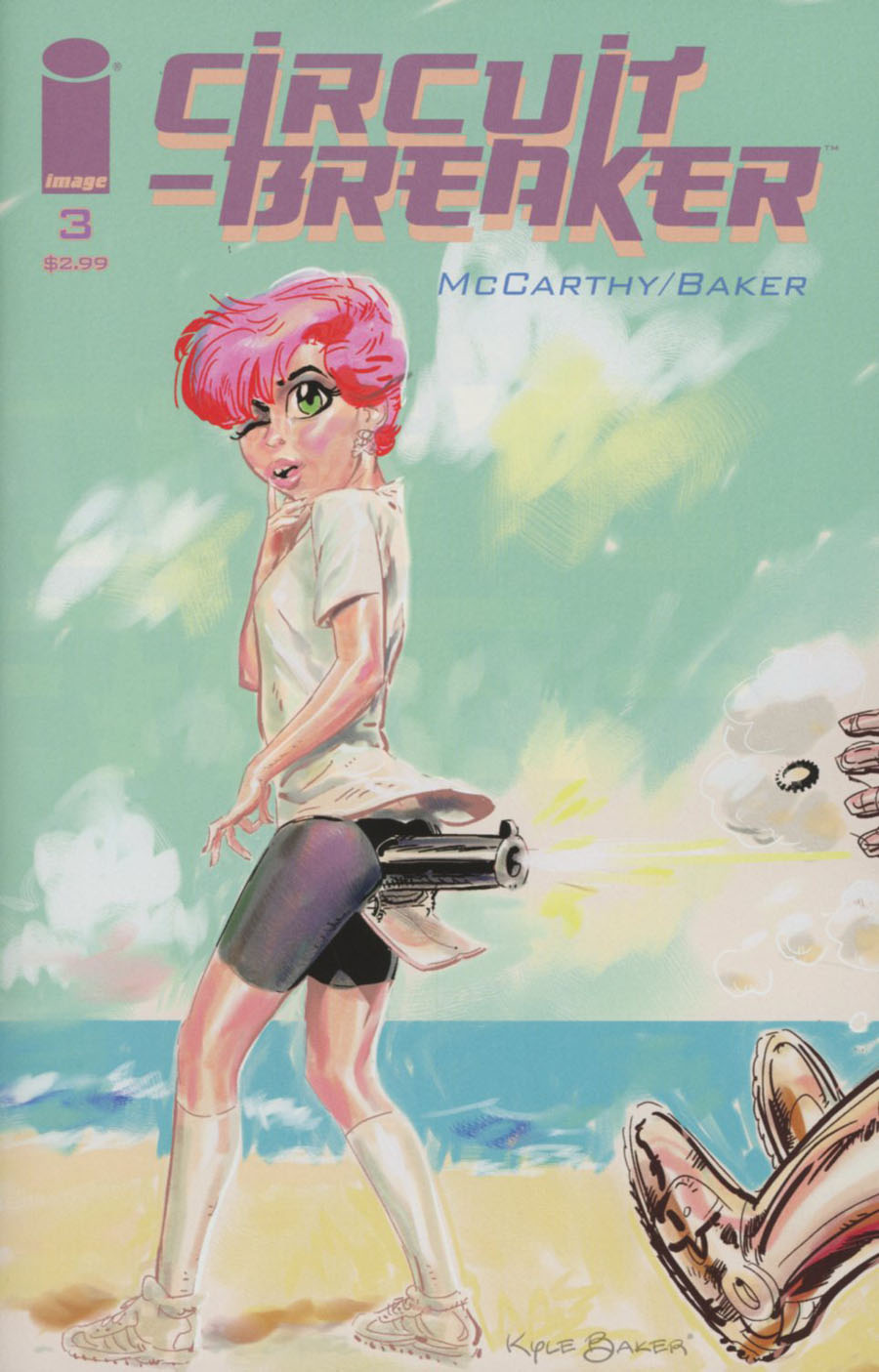
Circuit-Breaker #3 (Image Comics) The latest issue of Kevin McCarthy and Kyle Baker's ultra-dense dissertation on Japanese pop culture in the form of a pastiche adventure comic has so much going on that my brain can barely catalog all the references.

The first eight pages–just eight pages!–features a flashback to the war between the U.S. and Japan 50 years ago, and that war was fought primarily between the American superheroes (whose catchphrases their leader Commodore 64 steals without remorse) and the robot heroes of Japan, the climax a battle between the Gigantor analogue (I think) and the Americans' Godzilla-like kaiju, which a character calls out as such: "This is psychological warfare! They think they can walk all over us with their goofy 'Godzill?'").

After those eight pages, the storyline resumes, the pace of the craziness doesn't let-up at all.

The action climax involves a transforming truck robot that is only something of an allusion to the Transformers and the revelation of our heroine's real nature to her enemies in the robot terrorist cell.

Two random thoughts: 1) I need to set this issue aside for the next time my Japanese friend visits, so she can translate the sound effects and names that appear in some panels and 2) When Marvel next tries to relaunch the Fantastic Four, they should give Kyle Baker a crack at them–he does a great Thing, from what little we see of Aunt Petunia's favorite nephew in this issue.

Dark Night: A True Batman Story (DC Comics) I actually haven't read a page of this yet. In fact, I haven't even torn the cellophane off. So I'm just listing it here because I bought it at the shop today. This is Paul Dini's graphic novel-format memoir about surviving and recovering from a brutal physical attack in the 1990s, when he was working on Batman: The Animated Series. It's drawn by Eduardo Risso, one of the greatest Batman artists around these days who hasn't really gotten to draw Batman as much as one might hope he would. I'm both really excited to read this, and a little anxious, given the subject matter.

Jughead #7 (Archie Comics) I feel weird saying this, as I thought Erica Henderson's artwork on the first six-issues of the Chip Zdarsky-written Jughead was perfect, but I think I might prefer the work of Derek Charm. Granted, Henderson's version of Jughead's nose was better, as she managed to retain it's unrealistic cartooniness while fusing it to her own personal, not-at-all-indebted-to-the-old-Archie Comics-house style style, but Charm's character designs are a nice fusion of "new" art with the flat, gag comic look of Archie Comics.

Not that one needs to rate Charm and Henderson against one another or anything. I just point this out because I was a little worried about the change in artists, and it turned out that I liked this new guy who isn't Erica Henderson a whole lot.

Chip Zdarsky's plot for this new arc isn't as crazy as that of the previous arc (at least, not yet), but it includes lots of jokes, some of which are wonderfully surreal (like the Mantle family reunion). What I found most surprising, however, is the way in which there's some actual character conflict and drama in this issue, as Jughead loses his temper with Archie, who perpetually values girls over him.

It's a weird thing to realize, but guys, Archie Comics are really, really great right now, and I look forward to reading them in a 100% non-ironic way. In fact, this was the first comic I read this week (I don't know about you, but I generally stack up all my new comics in the order of which I am most excited to read them, with any trades going at the bottom. This week it was Jughead, Circuit-Breaker, Swamp Thing, Lumberjanes and SpongeBob).

Lumberjanes #27 (Boom Studios) Well, what do we have here? It's another Lumberjanes story arc that seems to be going on way too long for what relatively little story there is. It hasn't dragged yet or anything, but just knowing that this is the third issue in what will be a four-to-six-issue arc has given me something of a sinking feeling.

Jen, Roanoke Cabin, Scouting Lad Barney and, um, that other 'jane from a different cabin and their magical, super-powered kittens are all reunited with Rosie and The Grand Lodge ladies...and they are now all stuck in the next of the giant, horned monster bird that turns out to be a Roc (rather than a Thunderbird, as I assumed; I guess that makes sense, since despite the North American setting the majority of the monsters the 'janes face are from classical myth).

Their our two opinions on how best to deal with the giant monster bird, one of which is to kill it, and the other of which is to escape without killing it. Barney finds the key through the power of bird-watching, and the new girl comes up with a plan, the realization of which makes for an actually rather dramatic cliffhanger, as she figures it out but doesn't spill, leaving a reader (or at least this reader) to puzzle over it in their (or my) head, but not getting any satisfaction. Next issue, I guess.

Patsy Walker, AKA Hellcat Vol. 1: Hooked on a Feline (Marvel Entertainment) I haven't read all of this first trade paperback collection of Kate Leth and Brittney Williams' new Hellcat comic yet–that's what I'm going to do as soon as I hit the "publish" button after finishing this post–but I've read the first two issues as they were serially published, and they were excellent. While I've read many more issues of the other two series, based on what I know so far, I would hold this up next to Chip Zdarsky and Joe Quinones' Howard The Duck and Ryan North and Erica Henderson's Unbeatable Squirrel Girl as one of Marvel's very best comic books, a perfect example of how genuinely fun and funny the Marvel Universe and its characters can be when they are allowed to be.

SpongeBob Comics Annual-Size Swimtacular #4 (United Plankton Pictures) For the fourth SpongeBob summer annual, the comic is once again devoted to superheroes, which means a whole lot of pages featuring Aquaman parody Mermaid Man. This particular installment includes some work from some honest-go-goodness, what-are-these-guys-doing-here? superhero comics creators, including Jerry Ordway (who drew the cover), Jon Bogdanove (who drew the table of contents) and Neal Adams, who pencils and inks a Derek Drymon written and laid out story that parodies the Adams illustrated, "relevant" Green Arrow/Green Lantern stories of the late 1960s. In this version, Green Arrow stand-in The Green Harpoon convinces Mermaid Man and Barnacle Boy to quit saving the city from supervillains and instead devote themselves to "the boring problems of the common citizen!"

Seeing Adams' version of Mermaid Man, who has the too-big muscles, neck and chin of a superhero parody, sharing the panel with what look like pretty straight versions of typical Adams characters run through a SpongeBob filter, is pretty great fun.

The other stand-outs in this over-sized, 48-page comic are the Drymon-written, Robb Bihun-drawn "SongeBob BabysitterPants," drawn in a rather realistically rendered, ink-heavy style, and Scott Roberts "Speed O 'Lightning," an entire, 10-page story written to the tune of the Underdog theme song. You should probably read that one out loud for the full effect.

Swamp Thing #6 (DC) The final issue of Len Wein and Kelley Jones' Swamp Thing miniseries ends with a bit of a whimper, as T.S. Eliot predicted (and Wein points out himself in his narration). That's mostly because this is the last issue though, and there's really only one way the conflict can end. Matt Cable has cured Alec Holland from the curse of being Swamp Thing, and he's done so by becoming Swamp Thing in Holland's stead...and then promptly using his newfound, god-like powers to threaten to conquer the world. SHIELD ARGUS has nukes pointed at Houma, Louisiana, where the conflict is set, and it can therefore end in one of three ways. First, Cable can take over the world. Second, ARGUS can wipe Holland, Cable and a portion of Louisiana off the map. Or, third, Holland can take the Swamp Thing powers back from Cable and everything can go back to where it was at the start of the series.

Guess which of those three options Wein goes with?

Of some surprise, if only because it is such a contrast to what we've seen before, a few classic Swamp Thing characters make appearances, and there are guest-stars galore. Not only do Steve Trevor Agent of ARGUS, The Phantom Stranger, The Spectre and Zatanna all reappear, but so too does Etrigan, The Demon.

It's great fun to see Jones' versions of all of these characters. I particularly liked his Zatanna, which is just so...different than the way everyone else draws her, and some of the expressions his Spectre makes. I wasn't very enamored of his Demon (I didn't care for his Etrigan when it appeared in his run on Batman either), but it's still interesting to see Jones' bizarre style applied to different characters just to see how he interprets them. Like, I'd be excited if Santa Claus showed up in a Kelley Jones comic, just to see how Jones would draw that jolly old elf (Hey, that's not a bad idea! Mr. Wein! Can your next miniseries with Kelley Jones involve Santa Claus? Maybe he can team up with Batman to fight Calendar Man and The Krampus or something...)

I suppose one could read something into the last panels in which Swamp Thing is overly emphatic about the fact that he knows exactly who he is, that he is Alec Holland and definitely not a sentient plant with Holland's memories, as some kind of meta-response to what Alan Moore did with Wein's character during the classic run which is the main reason anyone knows/cares about Swamp Thing at all (especially given DC's apparent decision to base their latest relaunch on calling out Watchmen as some kind of wound on the DC Universe), but I've become somewhat inured to DC comics writing criticism or conversation with Moore's work for the publisher a generation ago...to the point where I can sometimes spot it, but rarely care enough to think about it.

As with the previous issues, I cam for the Kelley Jones art, and everything else about the comic was just some sort of Kelley Jones delivery system.


Okay, that's it for tonight. I'll probably write at greater length about Dark Knight and Patsy Walker later, and do come back this weekend for reviews of this week's DC "Rebirth" books, of which there were many.

Monday, June 13, 2016

I recently reread Secret War for the first time.

Brian Michael Bendis and Gabriele Dell'Otto's five-issue, 2004-2005 Secret War miniseries was, in retrospect, probably a pretty important, or at least important-ish, comic for Marvel.

The series featured some of Bendis' first writing of many of Marvel's top-tier characters after having spent some years writing Ultimate Spider-Man, Daredevil and Alias, including non-Ultimate Spider-Man, Wolverine and Captain America, all of whom would form the nucleus of his new Avengers team (along with Luke Cage, who also co-stars in this series). Immediately preceding the 2005 launch of New Avengers and House of M, the book could be seen as a sort of warm-up for Bendis' assumption of Marvel's Avengers franchise, which he would rather quickly transform into the publisher's top franchise, making it more important (and better-selling) than the X-Men, and his role as Marvel's chief writer-of-line-wide crossover events (In addition to House of M, he also wrote Secret Invasion, Siege, Age of Ultron and contributed to Avengers Vs. X-Men. His Civil War II just launched).

Secret War introduced the character Daisy Johnson/Quake, who would remain a minor character, but a minor one who has reappeared in various places in the years since, including TV series Agents of SHIELD (in an odd, roundabout way, from what I understand), and it half-introduced more prominent new character Maria Hill, who appears in the last issue as the new commander of SHIELD succeeding an AWOL Nick Fury...but she is never actually named.

What I remember most about the series, however, is how angry it made me while reading it.

The sources of my anger were three-fold. First and foremost, it was as written-for-the-trade ("decompressed," we used to call it) as all of Bendis' scripts generally were, and it suffered incredible delays between issues, particularly between the penultimate issue and the final issue: It took 22 months for Marvel to publish those five issues.
Secondly, and worst of all, when the final issue did see release, much of it consisted of two characters in conversation–Daisy Johnson and unnamed Maria Hill–and Dell'Otto kept recycling the same handful of images of Daisy, fan-cast as Angelina Jolie with her Hackers haircut (see below), over and over again in one of the most transparent acts of making as little new art as possible I've seen before or after. I counted 28 individual panels featuring Daisy seated at a table being interviewed by Hill in that issue, but only four-to-six different paintings of her, occasionally framed differently to try and disguise the fact they were just being re-used over and over (He also recycled imagery from the earlier issues, with new Bendis narration atop them, meant to serve as flashbacks to events that were only about a few issues past).
Thirdly, it was over-priced at $3.50, and the 22-ish page stories were followed by a bunch of lame filler in the form of transcripts of interviews between characters presented as SHIELD files...outtakes of Bendis' script, for the most part. (Ah, those were the days, when $3.50 seemed like far too much to pay for a Marvel comic book!)

By the time the final issue did come out, I could barely remember what happened in the others. Nick Fury recruited a rag-tag band of superheroes, many of the comic book-selling variety, to help him invade and do something illegal in Latveria, and then we wiped their minds so they forgot about this "secret" war.

Some co-workers–both of whom were regularly watching Agents of SHIELD at the time–were reading the series for the first time some months ago because of the Daisy Johnson connection, and they were discussing it. I realized then that I had never actually read the story in one sitting, just 20 pages at a time over the course of almost two years–you know, the way Marvel published it–and the book had hit the ten-year anniversary of its completion last year. So it seemed like a good time to revisit it, and see how it aged.

The storyline is itself incredibly disjointed, jumping around in time, stopping where things get interesting, re-starting via flashback at the climax of the secret/forgotten war, and then skipping over the next bit. Basically, the story mechanics of getting from A to B to C to D are jumbled up; we get those points in the story, albeit out of order, but explanations of how we get from one to the other are missing. To be generous, I think this is simply a matter of Bendis placing a lot of faith in the reader–too much faith, probably, given the interminable months-long wait between chapters–and his attempt to create a reading experience evocative of what the heroes themselves went through. They don't actually remember what happened, only bits and pieces, and they are eventually just told what happened. They themselves are missing large parts of the story, and therefore so is the reader.

On the other hand, it could just be poorly structured and written. When one looks at Bendis' entire body of Marvel work, the latter actually seems more likely. He's great at writing scenes, but no so hot at writing stories.

And this story? There's a pretty clever idea in it. At some point, SHIELD starts running the numbers and realizes that the economics of low-level super-villainy in the Marvel Universe just doesn't make any goddam sense. Millions of dollars are spent on high-tech gadgetry like goblin gliders and super-exoskeletons and special chemical weapons, but the villains wearing those costumes and wielding those weapons are primarily using them to pull-off bank heists that generally net them no more than tens of thousands of dollars at a time (This discrepancy has been pointed out repeatedly before; I want to say primarily regarding The Flash villains, most of whom use fantastical weaponry for bank robberries and jewel heists. Were Captain Cold to simply sell his freeze ray technology to an arms manufacturer, he could legally make millions or billions, and not have to constantly worry that someone is going to punch him out at super-speed).

Following the money, SHIELD finds that these low-level, tech-powered "theme villains" (as they call them) are being funded by a foreign government, Latveria, making that fictional Marvel Universe country a state-funded sponsor of terrorism...just three years after 9/11.

Fury takes this info to the president (George W. Bush, whose face is in shadow), and Fury is told by the president and his team that they'll handle it without SHIELD, thanks. Fearing they won't, Fury goes through a fun but long putting-together-a-team process (Cage, Wolverine, Spider-Man, Captain America, Daredevil, Black Widow and a mysterious 18-year-old girl that looks like Angelina Jolie from Hackers). Together, they travel to Latveria, kick a bunch of villains' asses, execute the Prime Minister (not Doom, who is oddly absent) and destroy her castle in an earthquake to "send a message."

Then Fury somehow erases everyone's minds. But one year later the villains come gunning for them all with a terrorist plot to destroy all of New York City in an act of massive blowback. Timely intervention from the Fantastic Four–maybe the bad guys should have attacked D.C.? Or any U.S. city that is not home to 99% of all superheroes?–stops the explosion from leveling the city, but Fury is forced into exposition, and everyone gets mad at him. Wolverine flies into a berserker rage and tries to kill Fury, but Fury turns out to be a Life Model Decoy, so it's all cool.

The storyline is something of a precursor to Mark Millar's dunder-headed politics in Civil War, as Bendis' Fury tries to articulate a post-9/11 view of superheroics that raises more questions than answers. Fury regards heroes as soldiers, which is what they would soon become thanks to the super-draft that the heroes all fight over in Civil War, but they're not willing ones...exactly.

Fury could probably have pulled it off without tricking and brainwashing the likes of Captain America, Spider-Man and Daredevil. Black Widow seems cool with it, Daisy (who kills the Prime Minister and destroys the castle all by herself anyway) isn't brainwashed, Wolverine says he would have done it if just asked, and there have gotta be enough Wolverine-like characters among the anti-heroes and mercenaries of the Marvel Universe to do it. Of course, that wouldn't sell as many comics. Fury's justification for using the heroes is...murky at best. He explains that the Latverian PM was using American criminals, trying to "punish us by funding our criminals--use our criminal system against us...so I had to use our heroes against her."

He wanted the action to be "loud" and "total." The language these people–terrorists? Latverians?–understand was superheroes killing people and destroying castles, and he wanted to send a message that wouldn't just stop the Latverian plot, but stop some other state from executing something like it at some later date.

But given the "secret" nature of the secret war, it's not like the example is widely seen. In fact, Fury covered it up in the media, so no one is actually aware it occurred, not even the brain-washed heroes who participated, just maybe a few survivors of the attack in Latveria. Who exactly is it supposed to scare/send a message to? Doctor Doom? Has Doctor Doom ever been scared that if he doesn't straighten up and fly right the Avengers might come after him? (Further confusing the matter is that the heroes all wear special "stealth suits" during the attack, so, for example, Spider-Man and Captain America don't even look all that much like Spider-Man and Captain America. Of course, I wasn't even aware they were wearing stealth suits until the back of the book, however, when they show Dell'Otto's designs for their mostly-black suits; the parts of the story in which these suits appear are all colored black and white...which, in Dell'Otto's painting, means gray and gray. I wonder if there was a change made to this aspect of the story during publication, when an editor noticed it didn't make any goddam sense, and perhaps the black-and-white coloring was a way of covering up the contradiction of wanting to send a message using sueprheroes, but then disguising the superheroes).

Things get extremely murky after Fury's visit to Bush and his cabinet, when he is furious to find that they now know about a terrorist plot to attack the American homeland and are going to do nothing. I'm honestly not sure what this scene is supposed to refer to.

I imagine Fury was referring to 9/1l, but then, that doesn't quite make sense, because Al Qaeda was a non-state actor, and it's not like we ever followed rules of diplomacy with them before their attack on September 11, because they were a non-state actor.

And it's weird to hear Fury making that speech about the Bush administration, since they did just attack and overthrow a government during the invasion of Iraq, a year before this series launched, without any real evidence that Iraq was a state sponsor of terror. Essentially, Bendis has cooked up a fantasy version of what the Bush administration wished they had after the 9/11 attack–proof that the leader of a hostile nation we weren't terribly fond of was funding a coordinated terror attack on the U.S.–but in the Marvel Universe the Bush administration decided to not attack that country.

I know it's "just" superhero comics, but why drag in all of this real-world geo-politics if you're not going to deal with them realistically or logically, or just play the "it's just comics" card...?

Fury's nonsensical plan doesn't actually work, anyway, as it just causes the Latverian prime minister–who survived having an earthquake in her heart and a castle knocked on top of her–to gather all her tech-enhanced villains for a big chain reaction bomb meant to destroy New York City. Her plan kinda sorta almost works, or at least seems to maybe work at the climax of the fourth issue, but it's difficult to tell just what on Earth is going on. Invisible Woman Sue Storm is in the middle of trying to use her invisible force field powers to break the chain and/or contain the blast, and Dell'Otto just draws it like this, so, um, who knows what's happening.
Is that an explosion? An explosion caught in a forcefield?

Whatever happened, New York City was not destroyed, and who knows how many of the villains even died. (Best guess? The bomb went off, but the damage it caused was reduced severely by the Fantastic Four's various unintelligible actions.)

Dell'Otto's character designs are awfully sharp, and I really liked his Luke Cage, who has a full head of hair, rather than shaving it bald or wearing that dumb beanie David Finch always drew on him in New Avengers. I also really liked Dell'Otto's Wolverine, whose sideburns extend into devilish goatee.

His storytelling leaves a lot to be desired, and that may have something to do with the pressures of the deadline, which obviously completely broke him by issue five. The action scenes are all dark and contain many similar-looking villains, so it can be difficult to tell the players apart, and his Fury is as gymnastic and agile as his Spider-Man or Daredevil.

And then there's this weird scene, where I think The Thing tries to break the ground, and then just holds the pose for a few panels...? Rather than beating repeatedly on the ground...?
Seriously, I've got no idea what's supposed to be going on there. In context, Thing is trying to destroy the pier to stop the chain reaction bomb some how but I just read it again, and I can't figure the imagery out. It looks like he's just holding the pose and waiting for the pier to crumble beneath him for some reason.

I kinda liked the new Goblin design,
and Spider-Man's patter with the Goblin (in general, Bendis is a pretty good Spidey-patter writer).

I did not like seeing SHIELD Agents getting physical with the captured villain Shrike. The torture of enemy combatants is a black, black stain on America, and while they don't torture him to the extent that real-world enemy combatants have been tortured, they do kinda beat the shit out of a helpless man they've already denied due process, and it's just a little too evocative to the collective sins of Global War On Terror-era America, and not exactly something I'm comfortable seeing in my superhero comic books.

Especially since one of those guys is post-Godzilla, pre-Agents of Atlas Jonnhy Woo, one of my favorite SHIELD Agents!

I re-read this not in the form of the single issues, which are buried somewhere in my comics midden, but in the form of a trade collection, and damn, was I surprised to find that the story ended about two-thirds of the way through the book, which contains an incredible amount of filler, in the form of SHIELD files on many Marvel characters who don't appear in the book (almost 60 pages worth of them, taken from some a one-shot entitled Secret War: From The Files of Nick Fury, and then another 30 pages of process stuff).

It certainly reads better in trade, and it's certainly interesting to read a decade later, after we've seen where Brian Michael Bendis went with these characters (and his career) during that decade at Marvel, but it's still not any better than mediocre. One of Bendis' many interesting, ambitious failures (albeit with plenty of fun moments, my favorite of which is probably Ben Grimm's battle cry, above), featuring some of the most obviously phoned in art I've ever seen in.

Friday, June 10, 2016

Afterbirth: DC's "Rebirth" initiative, week two

Aquaman: Rebirth #1 by Dan Abnett, Scot Eaton, Oscar Jimenez, Mark Morales and Gabe Eltaeb

The new Aquaman writer is going to be...the same guy who took over the previous volume for its last four issues? Writer Dan Abnett is teamed with artists Scot Eaton and Mark Morales, who pencil and ink the 15 pages between five pages worth of framing sequences by Oscar Jimenez.

While I haven't read any of the New 52 Aquaman since somewhere during writer Jeff Parker's run, the status quo introduced here doesn't seem to be all that different from what it was during Geoff Johns' initial run: Aquaman is torn between two worlds, many Atlanteans don't like him, most surface-dwellers think he's a joke, it's stressed that he doesn't "talk to" fish but psychically compels them, and so on.

Abnett's script, like Johns' early issues, seem weirdly defensive about the very subject of Aquaman, stressing how incredibly powerful and bad-ass he is, and that he's greatly feared...while also pointing out that he's laughed at and not considered a real superhero like his Justice League peers.

The comic still has a chip on its shoulder, then. There don't seem to be any major changes in the supporting cast, and the villain who narrates this issue and who Aquaman will apparently be fighting in future issues of the new Aquaman series will be his archenemy, Black Manta.

Somewhat tiresomely, Manta lays out his plan to the readers–he intends to fridge Mera, because "without her love, I believe he would collapse...so I will being with her. That will be a mortal wound."

Yeesh.

If this issue is indicative of the upcoming Aquaman series, then I wouldn't be at all surprised if this book gets canceled and relaunched at least one more time before teaser trailers for an Aquaman film begin appearing online.


Flash: Rebirth #1 by Joshua Williamson, Carmine Di Giandomenico and Ivan Plascencia

Given the role that The Flashes played in DC Universe: Rebirth #1 (and in the history of DC's multiverse and crises in general), it is perhaps little surprise that this particular Rebirth one-shot ties so directly to the cosmic continuity shenanigans.

After a pretty quick re-telling of The Flash Barry Allen's origin (as established by Geoff Johns in a series entitled, um, Flash: Rebirth) brought about by a murder case eerily similar to that of Barry's mom, we get to see the Wally West/Barry Allen scene from the Rebirth one-shot again, this time somewhat abbreviated, and from Barry's point-of-view.

While Wally runs off to check in on his fellow Titans, casually mentioning that he'll have the Speed Force make him a new costume when Barry tells him that he can't be "Kid" Flash anymore, but should just be a Flash, Barry runs to the Batcave to talk Watchmen with Batman.

The mega-plot involving the true nature of The New 52-iverse isn't advanced all that much, really; we just learn how exactly The Comedian's bloody smiley-face pin came to be embedded in the wall of the Batcave, and that Barry and Batman are going to work on this mystery together...and keep it from everyone else until they can make some headway.

I rather liked Di Giandomenico's art, colored by Ivan Plascencia, as it seemed to combine elements of the original New 52 Flash art team of Francis Manapul and Brian Buccellato with a more solid, bolder superhero comic style.

One of the questions that hung in the air after the final pages of Johns' Rebirth one-shot was just where the Alan Moore-ruined-The DC Universe plot was going to be continued. Well, here it is...although it doesn't get continued very far. Does that mean The Flash will be the book to watch going forward? Maybe. Like I said, Flashes are always fairly central to such stories (Wally, by the way, will be appearing in Titans, another good bet for future comics relevant to this nebulous plotline).

The downside of this issue's focus on the events of DC Universe: Rebirth, however, is that it doesn't give much of an indication of what will be occurring in the new volume of The Flash.


Wonder Woman: Rebirth #1 by Greg Rucka, Matthew Clark, Sean Parsons, Liam Sharp, Laura Martin and Jeremy Colwell

Former Wonder Woman writer Greg Rucka, who delivered a well-respected 2003-2006 run that closed out the George Perez-launched, post-Crisis series, has returned to the character a full ten years later. I know many Wonder Woman fans are pretty ecstatic about Rucka's return, and that it has more to do with affection for Rucka's writing and his take on the character than simply relief that Meredith and David Finch are finally leaving the character and the title, but I wonder if turning to the guy who wrote Wonder Woman 13 to 10 years ago isn't maybe too much of a "Rebirth."

It's a feeling that this one-shot special did nothing to alleviate, as the entire 20-page script can basically be reduced to Rucka shouting "What the hell's been going on around here?"

The first line of the comic includes the words "the story keeps changing," and that is the plot of this comic: Wonder Woman beginning to come to grips with the fact that her origin changed in the previous Wonder Woman title (thanks to writer Brian Azzarello), presumably because of the cosmic intervention of The Flash, Reverse Flash, Pandora and/or Doctor Manhattan and his Watchmen bros.

For the first fourteen pages of the comic–pencilled by Matthew Clark, inked by Sean Parsons and colored by Laura Martin–Wonder Woman narrates her confusion, see-sawing between two, contradictory versions of her origins. The Perez-established one from the 1987-2006 Wonder Woman series, and the Azazarello-established one from the 2011-2016 Wonder Woman series are repeatedly juxtaposed, as Wonder Woman narrates that she was formed out of clay by her mother and brought to life by the gods, or that she was conceived by her mother and Zeus.

She gets in a fight to save a woman from some bad men, returns home and subjects herself to the lasso of truth, essentially interrogating herself to find out which version of her own history is real, and questioning the events of the New 52 series, like her becoming the God of War after inheriting the helmet of the late War/Ares. The sequence ends with her punching a mirror and sending its fragments flying like shrapnel, with each shard of mirror containing an image from a past Wonder Woman story, including scenes from Rucka's run and both The New 52 and pre-Flashpoint versions of Wonder Woman and Superman.

I am assuming this is an intentional reference to Superboy-Prime punching and ultimately breaking the wall of DC comics continuity in the pages of Infinite Crisis (the event that ended Rucka's run on Wonder Woman, and lead to an ill-starred reboot the comic never really recovered from, narratively*). If not, that's a hell of a coincidence.

She then discards her New 52 Wonder Woman costume, and changes into a new, "Rebirth" version, which looks like a more colorful (i.e. not brown) version of the one she wore in Batman V. Superman: Dawn of Justice. At this point Liam Sharp, who will be drawing every other issues of the upcoming, Rucka-written Wonder Woman series, takes over for the last six pages, in which she visits Olympus in order to find out where she "stepped wrong," and there she fights some Hesphaestus-created "automatones" (read "robots).

Not unlike the Geoff Johns-written DC Universe: Rebirth #1 one-shot that kicked off this initiative, then, Rucka's Wonder Woman story is a sort of meta-criticism of DC Comics, here specific to the character with her name on the cover. This is the story of how The New 52 got Wonder Woman wrong, and how she/Rucka will fix it. I'd really like to hear what people new to the character might think of this particular issue, and its value as a jumping-on point, because as I was reading I was wondering just how impenetrable it might be as it flashes back to an almost 30-year-old comic repeatedly.

The last panel includes a "Next" box, reading:
Follow Wonder Woman in two alternating stories--as she untangles the mysteries of her present...and her past!

In Two Weeks: Wonder Woman #1! "The Lies" Begins!

And On Sale July 13: Wonder Woman #2! The Start of "Year One!"
While a definitive origin of Wonder Woman coming out the events of Flashpoint and Rebirth might seem necessary-ish, I don't envy the task before Rucka. His origin will be playing at shortly after Grant Morrison's excellent reimagining of it in the pages of his Earth One graphic novel (which would work just fine as her DCU origin...were it not for a few details that don't match up, like Steve Trevor's appearance) and just as Renae De Liz is approaching the climax of her retelling of Wonder Woman's first year in the pages of The Legend of Wonder Woman, which is made unofficial by it's 1940s setting (Marguerite Bennett has also been telling a particularly strong Wonder Woman "Year One" story set in the 1940s in the pages of DC Comics Bombshells, even though it's only one thread of several in that ensemble book).

At the very least, then, Rucka has to re-present an origin story for Wonder Woman and explain away the previous one. Ideally, he has to come up with one that will stick, so that the story doesn't keep changing. And he has to come up with something that is better than what Morrison, De Liz and Bennett have done. So, you know, no pressure.

Rucka at least has the advantage of working with two excellent artists–Sharp and Nicola Scott–and the good will of readers who have either suffered through or been unable to read Wonder Woman for a while, as it's been horribly written and horribly drawn.

Action Comics #957 by Dan Jurgens, Patrick Zircher and Tomeu Morey

One of the first things that made me question DC's collective sanity during their "New 52" relaunch/reboot was that they had decided to cancel Detective Comics and Action Comics, which had been around since 1937 and 1938 respectively, only to begin new volumes with new #1 issues.

The argument that Dan DiDio had made at the time was that after some discussion they decided they had to relaunch these two foundational books as well to signal just how serious they were about this being a brand-new start for the entire universe. Less than five years later, of course, we see they weren't that serious after all, and so they're resuming the old number.

Kind of. Action ships issues #957 and Detective ships issue #934 this month, even though the previous volumes were cancelled with #904 and #881; they've decided to retroactively make issues #1-52 of each of those books part of the old numbering systems, for maximum confusification. Hopefully, no reader will ever attempt to find Action Comics #905-956 or 'Tec # -933, since they don't exist.

Mainstream superhero comic books are so fucking dumb..

This first issue of the now bi-weekly Action picks up on the events of Superman: Rebirth #1, itself a continuation of the plotline from the Super-books involving the death of The New 52 Superman. As expected, he is immediately replace by the "spare" Superman, the older version from a divergent timeline of the pre-Flashpoint DC Universe who sent a year in a bottled city on Talos and 5-8 years in hiding in the post-Flashpoint DCU.

What draws him out of hiding is seeing Lex Luthor wearing a new set of blue and red armor, complete with a red cape and S-shield–something he was more or less forced into if he wanted to keep his position of power on Apokolips in the pages of Justice League–declaring himself the new Superman, intent on carrying on the legacy of the dead one.

Old Man Superman quickly shaves, throws on a Superman suit he's apparently just had lying around (it's not the pre-New 52 one, but a much less dumb costume than the one his New 52 counterpart wore), and flies off to confront Luthor. And then Doomsday attacks.

The Superman story is still extremely complicated, and seems to necessitate an at least passing familiarity with a whole raft of other comics. It's not an ideal jumping-on point, but then, it's not completely alienating either. If you are young and adventurous and really want to read a Superman comic, this will be something you will gradually get into, I think. I'd recommend Superman over Action though, as while Zircher's artwork here is fine, it's certainly not as strong as that of Doug Mahnke and Patrick Gleason in the pages of Superman.

This issue doesn't answer the questions that have been bugging me since the fact that Old Man Superman would be replacing New 52perman as the one true Superman became apparent, namely what they were going to do with the secret identity problems and how they were going to solve the two Lois Lanes problem. Jurgens seems to be approaching answering the first here, although at this point it's more mysterious than anything else: Clark Kent just shows up in the office of The Daily Planet and then rushes off to cover the Lex Luthor vs. Superman conflict. Since even Superman can't be in too places at once, well, something mysterious is going on here.


Detective Comics #934 by James Tynion IV, Eddy Barrows, Eber Ferreira and Adriano Lucas

Writer James Tynion has previously been heavily involved with two weekly series spotlighting the many Batman supporting characters who don't have their own titles to star in, the 52-issue Batman Eternal and the 26-issue Batman and Robin Eternal. With the first issue as the new writer of Detective Comics, it seems like he's going to be able to continue that focus.

The issue opens with Azrael (introduced in Batman and Robin Eternal getting the stuffing knocked out of him by someone who he believes to be Batman. From there, Batman goes to visit Batwoman (who once starred in Detective for a while, between her introduction in the pages of 52 and the launch of her own book) and lays out the premise of the book. There are a lot of new-ish teen vigilantes in Gotham, and he had hoped to take them in for intensive one-on-one training ("I've already taken in one, Duke Thomas," he says, referring to Batman: Rebirth #1).

His time-table has been screwed up by some new foe that is monitoring Gotham's crimefighters with sophisticated drones bearing bat-wings and an unseen figure that looked enough like Batman to fool Valley (Hopefully it's not Lincoln March, given that was a plot point in Batman Eternal). So Batman and Batwoman are setting up teen vigilante bootcampe for Red Robin Tim Drake (who, um, shouldn't need it at all), Spoiler Stephanie Brown and Orphan Cassandra Cain. And, completely randomly, grown-up bad guy Clayface. (Bluebird Harper Row seems conspicuous in her absence, even though Tynion did at least temporarily write her out of Batman comics for the foreseeable future at the end of Batman and Robin Eternal. She wanted to go to college and thus take a break from crime-fighting, although given how much she's worked together with the other characters, and that she lives with Spoiler at the moment, that seems like being part of Team Batman would be a particularly difficult thing to give up. I hope she returns at some point.)

At least an element of this series is exactly one I've wanted since Batman Eternal at least; Tim, Stephanie and pals hanging out. Adding Batwoman to the mix wasn't something I would have imagined, but I guess it makes sense given that the character doesn't have anywhere else to go at the moment, and putting the former military woman in a drill sergeant-like role makes sense. Clayface's participation seems way out of left-field to me. If they had to go with a reformed villain, Killer Croc seems the more obvious choice, given the two characters' recent history (Man-Bat would have been a good choice too, actually).

Red Robin finally–finally!–gets a new, less-terrible costume. And while this one's still not good, it's several million times better than the New 52 Red Robin costume, which was the worst costume of all. Cassandra's costume is pretty awful too, essentially looking like an armored, cape-less, ear-less version of her Batgirl costume. Hopefully she gets her ears and cape back eventually, and resumes her Black Bat ID.

The greatest barrier between me and Tynion's story, however, is the presence of pencil artist Eddy Barrows, whose work I have never been a fan of (And some of that work, on pre-Flashpoint Teen Titans comics, has been just plain awful). That said, I was pleasantly surprised by his work in this issue. It was the best I've seen from Barrows, and I didn't mind reading it here one bit. He may not have been my choice to draw this book, but I don't think he'll keep me from reading it either. I'll certainly pick up the second issue of this series...Er, I mean, the 935th.

Thursday, June 09, 2016

Comic Shop Comics: June 8th

Black Canary #12 (DC Comics) So, what if the Brenden Fletcher-written Black Canary solo title wasn't cancelled, but went on for, like, a few more decades, and DC allowed the character to age in real time? That's the centerpiece for this final issue of the series, with original artist Annie Wu returning to join Sandy Jarrell to close out this unique chapter in the character's life.

Dinah's possible future life flashes before her eyes after she was impaled with a katana, and each scene that follows jumps a few more years into the future, as she continues her music career while an apocalypse of sorts tied to the villain of this story arc changes the world outside her career for the worse.

Can she pull it together in time to defeat the demon, with the help of her friends? Spoiler alert: Yes.

This book has been somewhat rocky, and I've always liked the premise better than the execution, but Fletcher certainly deserves credit for doing something so radically different with the character, and tying her sci-fi, superhero adventures and new day job and secret identity to sound so thoroughly, an aspect of the character that isn't generally explored (and, in fact, she has gone without for long, long stretches of her existence; Dinah's "canary cry" may be her super-power, but it is apparently not an intrinsic part of her character).

Fletcher and company also do a pretty good job of wrapping up this short chapter of Dinah's life, too, prepping her for her "Rebirth" appearances in the pages of Green Arrow (which, as I noted last week, could really be called Green Arrow/Black Canary, at least based on the Rebirth special) and Batgirl and The Birds of Prey.

Legends of Tomorrow #4 (DC) In the latest issue of DC's four comics-for-the price of two Legends of Tomorrow, the second half of the book is again the strongest. The Firestorm and Metamorpho features just keep doing what they've been doing, and if there is any real development in either it is simply that the art looks a little less sharp than it did in the previous issues. The stand-out is, once again, the Keith Giffen-written, Bilquis Evely-drawn "Sugar and Spike," in which the P.I. team investigate a museum of superhero oddities run by an obscure Green Lantern villain to see if he is displaying an equally obscure Green Lantern alien sidekick that may or may not still be alive, at the behest of Green Lantern Hal Jordan. As with the previous installments, this is the sort of comic that doesn't really work in the context of The New 52, built on forgotten Silver Age continuity as it is; the museum setting, for example, is filled with costumes and props of oddities of DC continuity that The New 52 was built upon throwing out, like Kite-Man and the original, Golden Age Red Tornado (odd Sugar and Spike didn't even seem to notice that costume hanging there, given their connection to the woman who wore it).

As for the fourth and final feature, Len Wein and Yildiray Cinar and Trevor Scott's Metal Men strip, it similarly incorporates the greater DC Universe, although in its current form, rather than in its past. Having just defeated Red Tornado, our title characters get rescued from the military by "Clifford Steele, Attorney at Law," hide-out with Cyborg on the Justice League satellite, unmask their Aonymous-like foe The Whisperer as another old DC supervillain (still sans his crazy costume, sadly) and, finally, meet the army's all-new Metal Men, which are lead by Copper, the post-Infinite Crisis addition of a second female into the Metal Men's line-up.

I really like one of these features, I kinda like another, and can tolerate the other two just fine, so at 80-pages for $7.99, I think this format is pretty great. It doesn't look like DC has any plans to continue it indefinitely with different features, and I'm not sure about the economics of this model–like, if DC would lose money commissioning new material to fill it, or if there are enough creators willing to work cheaply enough on characters-who-couldn't-sell-a-monthly to keep this going–but I wouldn't mind reading a book like this indefinitely. In fact, it could be a good way to not only introduce old characters into the new DC Universe (Metamorpho, Sugar & Spike) or give the spotlight to supporting characters (The Metal Men), but to keep cancelled titles with some following going (Firestorm).

For example, if Omega Men or Doctor Fate or Midnighter can't carry a monthly, but sell well in trade (a big "if" on the latter point, I know), then maybe Legends of Tomorrow offers a good way to generate revenue to pay creators while they stock up enough pages to fill trades? I have no idea.

If they do do more books with more features, I have plenty of suggestions for characters, but it might be a good idea to use some of those who are actually on the TV show called Legends of Tomorrow (The Atom, The Hawks, Rip Hunter, Jonah Hex, etc). Just a thought. I don't spend as much time in comic shops as a lot of people DC could ask, but I did overhear a conversation the week the first issue came out in which a customer excitedly picked it up and asked if it had anything to do with the new show and the retailer had to admit that no, it in fact did not, eventually adding that they did share Firestorm in common.

Lumberjanes/Gotham Academy #1 (Boom Studios) In discussing this book on Comics Alliance, Elle Collins called it "a natural crossover that anyone who's a fan of both properties has probably imagined, and a comic I don’t think any of us ever thought would ever actually be published until it was announced." I think that pretty accurately sums-up the out-of-left field nature of the book. Despite both comics being about groups of kids having supernatural adventures, their common ground isn't as obvious as that of easier-to-conceive of inter-company crossovers, like, I don't know, Black Canary/Jem and The Holograms: Battle of The Bands or The Rocketeer Meets the DC Comics Bombshells or Godzilla vs. The Mighty Morphin Power Rangers or whatever.

Having now read it, it reminded me a bit of DC's other recent out-of-left-field crossover, Batman/Teenage Mutant Ninja Turtles. It similarly is the work of a creative team that isn't known for work on either franchise, or some combination of creators from both books, and it is similarly pretty clearly the work of one publisher borrowing the other's characters: With Batman/TMNT, it was a DC Comic co-starring IDW's version of the TMNT characters, while here the Gotham Academy kids are appearing in a Boom Lumberjanes miniseries.

As with Freddie Williams II's artwork on Batman/TMNT, I was disappointed with pencil artist Rosemary Valero-O'Connell and inker Maddi Gonzalez's in that because they aren't regular artists on either book, the result is a crossover between Lumberjanes and Gotham Academy in which none of the characters look like themselves, and everyone looks slightly off. That is, I should note, a matter of expectations, however, and I assume that over the course of the next five issues I'll find the artwork fitting the characters better. At this point though, it just seems like a very sharp departure, particularly from that of Gotham Academy which, until the recent "Yearbook" story arc, had a pretty clearly defined look with little to no variation.

The story, written by Chynna Clugston Flores (who I wish was drawing it as well, simply because I love her art so much), is at this point a pretty simple, straightforward and effective get-the-groups together one. Lumberjanes camp director Rosie and Gotham Academy's Professor MacPherson both go missing, and the girls of Roanoke Cabin and Gotham Academy's Detective Club go looking for them in the weird woods surrounding the Lumberjanes camp. They find each other, and some animal skull-headed, robe-wearing humanoid monsters that shoot energy beams.
See this variant? That's by Clugston Flores. Imagine a whole comic that looked like that!
Clugston Flores does a pretty good job of capturing what is likeable about each book, and making each of the many characters seem like themselves. I liked it well enough that I was more than halfway through before I realized that Lumberjanes is set during the summer, and that the girls attend a summer camp, while Gotham Academy is set during during the school year, since the kids attend a school and thus the two groups should really never even be able to meet like this.

Maybe that's a clue that Calendar Man is behind it all...?

SpongeBob Comics #57 (United Plankton Pictures) The theme for this issue is accompanied by a visual one. All of the comics are told in black and white and yellow, and almost all of them riff on classic black and white films, particularly, as the cover alludes to, film noir. The best, or at least my favorite, however, is Jay Lender and Marc Hempel's "The Clarinet of Dr. Calamari," which is a pretty direct parody of...well, you can guess what, with some visual references to classic silent, expressionistic films thrown in.

As always, any single comic book that features contributors as wide-ranging as Hilary Barta, Chuck Dixon, James Kochalka and Maris Wicks is one that's well worth your time and $4.

Wonder Woman: Rebirth #1 (DC) I plan on writing about this in greater depth later in another installment of a column devoted specifically to the fruits of DC's "Rebirth" initiative, so I'll just be brief here. The art team is different than the one originally solicitied. That team was Paulo Siqueira and Liam Sharp, the latter of whom was to be one of the two artists on the ongoing Wonder Woman; instead Matthe Clark pencils and Sean Parsons inks the first 14 pages of this book, Liam Sharp draws the last six and Siqueira's credit is reduced to a "Special thanks to." I'm not sure what that indicates, if there were last minute changes to the script that necessitated most of it being re-drawn, or if something got fouled up with Siqueira's schedule. The art looks fine, though, particularly Sharp's, and visually Wonder Woman will not only be a vast improvement over what it's been under the Finchs, but a pretty good-looking book in general.

As for Rucka's story, I laughed when I read the first line. I laughed repeatedly throughout. And I shook my head while laughing during a large panel referencing one of the silliest aspects of Infinite Crisis. I'm pretty sure "comedy" wasn't what Rucka was going for, though. Like Geoff Johns' DC Comics: Rebirth #1 special, the subject matter here seems to be something along the lines of "Wow, we sure fucked up with The New 52, huh? What were we thinking?" That subject matter from Rucka, who sat the entirety of the New 52 out, is at once a little more genuine (Johns was chief architect of the New 52, with his name all over it, after all), and also a little petty, given it reads like a direct attack on someone else's Wonder Woman run (and that someone is Brian Azzarello, not Meredith and/or David Finch). This is just the first chapter exploring the fact that Wonder Woman's story keeps changing, and it's quite possible Rucka will develop it in such a way that he incorporates the previous status quo in a way that changes without criticizing it, but, for now, it reads like a pretty straightforward meta-discussion of Wonder Woman continuity.

Sunday, June 05, 2016

These are some Marvel Comics collections that I've read recently:

Daredevil: Back In Black Vol.1–Chinatown

So here's a problem with trade-waiting. I had every intention of buying this trade paperback collection of the first five issues of the new Daredevil comic, because I liked the writer, I liked the artist, I liked the character and the new direction seemed particularly promising. But then I saw it just sitting there in the library, waiting for me to take it home and read it for free, and suddenly paying $16 for it didn't seem like all that great of an idea.

I would not envy either writer Charles Soule or artist Ron Garney the task of doing a new Daredevil comic on the heels of the Mark Waid's work on the character, which spanned 57 issues, five years and a relaunch. Not only did Waid manage to find new–or at least long-abandoned–territory to cover with the character and offer such a lengthy, thorough examination of him, but Waid's artistic collaborators like Chris Samnee, Paolo Rivera and Marcos Martin regularly delivered one of mainstream comics' best-drawn books. Not only would Soule and Garney find themselves competing with Frank Miller-era Daredevil the way just about everyone since has been forced to do in the imaginations of Daredevil readers (in fact, a large part of what made Waid and company's run so instantly appealing is the way in which it read as a reaction to the Miller take), but they would be doing so immediately following one of the best-received mainstream superhero comics of the decade (so far).

Soule and Garney do just fine, however, and I guess I envy them for their talent, then, and their ability to tell high-quality comic book stories. It certainly helps that some pains are taken to distance their new book from Waid's two volumes of Daredevil. The title character has relocated back to New York City, he has a new day job as an assistant district attorney for the city, the genie of his secret identity is firmly back in the bottle, he's got a brand-new (awesome) costume and he's working with an apprentice, a new character named Blindspot.

In other words, almost everything about the comic is new, even the most familiar elements–the Hell's Kitchen setting, The Hand–are new in contrast to immediately preceded them, or the twist Soule brings to them.

Both Murdock and Daredevil are pursuing a new crime lord, a Fu Manchu-style villain who is also a Chinatown cult-leader. His name is Tenfingers and he has, um, ten fingers on each hand. It's an incredibly effective visual, as rendered by Garney. Daredevil isn't fighting alone, but alongside an apprentice of sorts named Blindspot, an illegal Chinese immigrant who has invented his own invisibility suit with which to protect his neighborhood...although the fact that he's not a U.S. citizen frustrates his ability to, like, patent and sell his miraculous invention. Or even get a good job.

This collection reads like an actual graphic novel, with a beginning, middle and end, a completely complete story of Daredevil and Blindspot's battle against Tenfingers...and their mutual foes, which I already spoiled (The Hand, if you missed it).

Garney's art is all big, muscular figures rendered in precise, sometimes sketchy lines, although it's impossible to talk about the visuals of this book without mentioning the coloring, by Matt Milla. It's not quite black and white, but close to it, in the manner of the millennial, Greg Rucka-written run on post-"No Man's Land" Detective Comics. Most of the pages have a single color applied to them like a wash, with each portion of the page appearing either black, white or some gradation of that color–red, blue, green, etc. The one exception is the bright, bold red of the highlights of Daredevil's new costume: The eyes, the belt, the boots, the fists.

It's a really rather beautiful comic, immediately striking when compared to almost anything its sharing space with, and appropriate given the fact that color is something completely foreign to our protagonist (along with several other aspects of a visual universe, like, in one dramatic scene, the digital numbers on the countdown clock attached to a bomb).

I really like the new Daredevil costume quite a bit, as I know I've said before; I really prefer it to what Marvel Studios and Netflix outfitted the hero with in the last few episodes of the first season, and the entirety of the second. Not only does the black look make more tactical sense (like, if I were a teenager and still thought as seriously about the interior logic of such comics, I would think a red costume would be super-dumb compared to the option of a black one), but it looks so much closer to the costume Daredevil wore on the show before he officially took the name "Daredevil."

In the comic, it's a nice, striking, emphatic change from the red of the Waid-written years, although there are enough details to the costume to allow room for Ol' Hornhead's signature color. Those details include wrapped up fists and laced-up boots, that give him the look of a guy who made his own suit, while simultaneously echoing the fact that he was the son of a boxer.

I'm not terribly crazy about the exact shape of the "DD" on his chest, but I'm not a fan of the "DD" in general (Rule of thumb for superhero costumes: Cool heroes have one letter on their costume, lame ones have two or more).

Blindspot's costume is somewhat generic, but that very simplicity is it's strongest aspect...especially given the fact that it was created in-story to be functional rather than thematic. The cover doesn't provide a very good look at it, but it's basically a full black bodysuit with a hole for Blindspot's hair at the top, some white stripe hightlights up and down it's sides, and a very distinct mask that shows a stylized, frozen face from the top lip to the hairline. The character's name might be a little on the nose–"We're all the same," he says of his fellow illegal immigrants, "Smack in the middle of society's blind spot. Invisible–but what the hell, this is a superhero comic, after all.

The first give issues of the new Daredevil are followed by a short, eight-page story that originally appeared in a ridiculously-titled anthology All-New, All-Different Point One #1 and introduces the character of Blindspot to readers and to Daredevil. It's rather awkwardly stuck on to the end of the book, as we had just finished a 100-page story featuring the character and already met him and knew most of this information, but it wouldn't make sense at the front of the book either, since Daredevil #1, now the first chapter of this collection, also thoroughly introduces the character and his relationship to Daredevil.

The best strategy would have probably been not to collect it at all. It's interesting to see how various books handle these shorts, though. The first trade collections of All-New, All-Different Avengers and the new New Avengers also have awkward preview type stories from a similar anthology (Avengers #0) to attach to their stories, but both put them in the front of the book, and they work a bit better. The former is a short story featuring The Vision and setting up his status quo before the start of the team he will be joining, while the latter is a series of pre-cognitive visions about the events of the first few issues of that series, delivered via a villain's extracting them from a psychic.

Anyway: Daredevil is still great, but in a completely different way than it was great before.


Extraordinary X-Men Vol. 1: X-Haven

The unfortunate thing about Jeff Lemire's mainstream superhero comics writing is that he came to it only after he achieved a degree of acclaim as an excellent graphic novelist. So when he turns out merely mediocre work, there's an element of frustration associated with it; you know there are better things he could be doing with his time.

Not that I can fault the man, of course. I imagine turning out scripts for various Marvel or DC franchises pays much better than creator-owned work, and I know it's a hell of a lot easier than writing and drawing original graphic novels. It doesn't appear as if Lemire's first story for the X-Men franchise caused any undue stress, as there wasn't even a whole lot that seemed to have gone into this first story arc for the new title: It's simply a reorganization of familiar, too-often repeated X-Men plot points, with only a few specific details changed.

It's basically a new coat of paint Lemire and the art team of Humberto Ramos and Victor Olazaba are applying, but it's not like they're even changing the color from, say, white to eggshell or ivory; it's just off-white.

How much of that is Lemire's fault versus Marvel's is something only Lemire or editors Daniel Ketchum or Mark Paniccia could answer; certainly a lot of the foundational elements of this series were probably decided by someone other than Lemire, including the status quo of mutantkind in the current Marvel Universe and which characters could be used...and which were mandated.

Some months after the events of Secret Wars, after Cyclops has apparently done something terrible that has made the whole world hate and fear mutants as hard as they ever had before (something that is never explained, but it must be pretty bad, since he had previously conquered the world in Avengers Vs. X-Men), mutantkind gets some more bad news. Actualizing Marvel Entertainment's film rights-driven attempts to make Inhumans the new mutants (even though the Inhumans are, as I'm sure someone has already pointed out, just like fetch), the two groups are in a life-or-death existential struggle: The Terrigen mists that empower Inhumans are apparently poisoning mutants, sterilizing them and preventing the creation of new mutants...and even causing some to lose their powers or get sick.

This is problematic for the obvious reason that Marvel's mutants have always been born to non-mutant human beings, and I don't want to think about what exactly the differences are between mutants and Inhumans in the Marvel Universe, genetically speaking–culturally, it's difficult to believe that human beings would be racists (or speciest?) against mutants, but be totally cool with Inhumans. Marvel has always had this problem, as the difference between, say, Spider-Man and The Fantastic Four and Wolverine and the X-Men is simply the source of their extraordinary powers and appearances, but hell, giving the Marvel Universe another race/species mutated/evolved/misted from homo sapiens is just underlining and emphasizing that tension.

As a reader, the bigger problem is simply that we've seen this before, and recently too. Mutants are hated and feared, they are once more a tiny, dwindling population facing extinction (as they were after the events of House of M and the "No more mutants" spell) and so they retreat to a secure and fortified hideaway (as they did during their House of M to "Schism," "Utopia" phase).

As I said, only the specifics have changed. They are still operating a school/refugee camp, but now it is located in Limbo (like, the part of Hell in Marvel's universe that mutant sorceress Magik is linked to), which keeps them safe from humans and Inhumans, but is a pretty dumb place to set up shop, as any time Magik loses focus–as she does in these issues–they will besieged by an infinite horde of demons.

Storm, given a new, terrible costume with a nonsensical pair of belts and a shiny top with a weird texture, is the headmistress and leader. Her superhero team is assembled throughout this first story arc. There's Iceman, also given a new, terrible costume–a red and black, turtleneck adult onesie, and, obviously, Magik. Their recruitment drive includes gathering Colossus (who has grown a beard and started farming, Kingdom Come Superman-style), Nightcrawler (in a state of prolonged shock and only speaking in Bible passages), the still time-lost Marvel Girl Jean Grey (who is trying to live a normal life and go to college, until she encounters anti-mutant hatred from a guy she kissed) and the Old Man Logan version of Wolverine (imported during the events of Secret Wars, and, for all intents and purposes, just plain old Wolverine with different hair, which is kind of a dumb cheat regarding the death of the "real" version).

Back at the school/camp, Forge is a sort of behind-the-scenes member of the team, taking Beast's place as the tech guy and interacting with the outside world mainly via a reprogrammed Sentinel.

They all come together in time for a climactic battle against The Maurauders and Mister Sinister, one of, like, the five or six villains The X-Men seem to be constantly fighting. This time his half-assed plan is kinda sorta related to the new status quo, as he claims to be trying to invent a new, disease-resistant version of mutantkind, but it's basically just Mister Sinister Mister Sinister-ing as always.

If these first five issues were all about putting together a team, then it's possible Lemire will move on to focusing on something fresh, new or at least interesting in future issues, but this first arc was in incredible disappointment, and one that seems like a waste of everyone's time; Lemire's, Ramos and Olazaba's, and, of course, the reader's.

Worse still, I think this is meant to the be the "A" book in the post-Secret Wars X-Men franchise, with All-New X-Men (the time-lost, original X-Men plus a few teenage hangers-on) and Uncanny X-Men (Magneto leading a team that is basically just a renamed X-Force) are the apparent B books.

It's readable, so it's far from the worst X-Men comics ever made or anything, but that's not an exactly high bar for quality superhero comics in the year 2016, is it?


Guardians of The Galaxy: New Guard Vol. 1–Emperor Quill

So it says on the spine and in the fine print, anyway; the cover simply identifies the book as Guardians of The Galaxy, with no mention of this "New Guard" business. That extra clause is presumably there to separate this volume one from all the other books called Guardians of The Galaxy Vol. 1 out there; this is the second one by Brian Michael Bendis (or third, if you count the oversized hardcovers). As I've noted before, Guardians of The Galaxy is a particularly difficult book to try and follow in trade, given the number of relaunches and the number of collections that don't have any volume numbers attached at all.

This particular volume one collects the first five issues of the current incarnation of the series, which, like the previous incarnation, is written by Bendis. It begins in medias res, as did the entire Marvel line, some months after the events of Secret Wars, the event series which lead to the cancellation of all of Marvel's comics and the temporary replacement of the line with fill-in miniseries for some months before everything relaunched with new number one issues.

The major change to Guardians is the addition of The Fantastic Four's Benjamin Grimm/The Thing–who, like fellow FF member Johnny Storm, is team-less and in need of a new running crew following the ending of Secret Wars. Less major is the fact that Kitty Pryde has started wearing Peter Quill's mask and jacket and going by the apellation "Star-Lord," while the former Star-Lord has assumed his late father J'son's role as elected emperor of Spartax, and...well, that's a bout it really. Gamora is missing from the cover and the first issue, but returns shortly, and Bendis picks up right where he left off, following story threads from "The Black Vortex" storyline (I could here note that it therefore doesn't really make any sense to have completely relaunched the title with a new #1 issue, but, well, why bother?)

Now re-teamed with artist Valerio Schiti for the length of this collection (at least), Bendis is in fairly fine form here. For the most part he eschews his propensity for over-explaining and filling the pages with dialogue balloons, and his script is fast-paced, fun and funny. It's also pretty forgettable, and even as a regular Wednesday visitor of a comic shop, I have a hard time imagining anyone dishing out $20 to read a story like this in $4, 20-page installments over the course of five months or so.

So: The Guardians steal something from The Chitauri, and since it may be a dangerous space-weapon of some kind, they take it to Spartax, currently ruled by their friend Peter. Then Gamora falls out of the sky, fighting Hala, a Kree warrior who survived the destruction of her home world during "Black Vortex" and blames the Guardians for that destruction. They all fight her.

Then a big, scary space barbarian shows up on Drax The Destroyer's trail, calling himself a "Destroyer of Destroyers." They fight him too.

And that takes five issues. Fighting, jokes, catchprhases. It's all written well, and Schiti's art, colored by Richard Isanove, is simultaneously smooth and sharp. It's easy to read and flows nicely, making it well-suited to Bendis' breezy script. His Rocket looks more like an mid-century Hanna-Barbera animal character than usual, and his Groot gets a little redesign, but other than that there's not much separating his Guardians from any other artist's version of them.

But if you ever hear anyone speaking dismissively of "fight comics" and find yourself wondering what they mean by that, Guardians of The Galaxy: The New Guard is exactly what they're talking about. Five issues, two fights and no plotting aside from what is necessary to generate and execute those fights, let alone anything like, say, a point-of-view or a message or a theme or anything.

In fact, there's so little going on in this book that at least one character has literally nothing to do. Poor Flash Thompson/Venom, the latest Guardian to earn his own spin-off series, has all of 17 lines. These include "Drax! Drop it!!!" and "Oops" and "On it" and "Totally" and "Hurry. He ain't easy to hold on to."


Hawkeye Vs. Deadpool

Want to play one of these things is not like the other? Okay, let's. Did you figure it out yet? That's right, it's this comic! While all of the other collections discussed in this post are recent releases collecting the first issues of various post-Secret Wars relaunches, this is a 2015 collection of a five-issue miniseries that launched in late 2014. Reflective of my general apathy towards the Deadpool comics, I apparently took a year or so to get around to actually taking the time to read the damn thing.

It was surprisingly good. The work of rather frequent Deadpool writer Gerry Duggan and artists Matteo Lolli and Jacopo Camagni, it finds a rather reasonable excuse to team two characters that have just about nothing to do with one another–this pre-dates Deadpool's place on the Avengers Unity Squad (in, like the second or third reboot of Uncanny Avengers, and I think that was his first stint as an Avenger of any kind, but I may be wrong). Well, other than the fact that this is the Marvel Universe, so 99% of all the superheroes live in the same city.

It opens on Halloween night, where Deadpool is taking his wife and kids (?) trick or treating, and they stop by Hawkeye's building. They get a message from a hacker who has a flash drive filled with a roster of SHIELD agents that a criminal organization would quite literally kill to get their hands on, and soon find themselves embroiled in chases and fights to get the maguffin–er, drive before the bad guys can put it to nefarious uses.

These bad guys are Black Cat, her two henchmenpeople (one of whom is Tyhpoid Mary, whose face is rarely colored correctly) and a mad scientist brainwashing very large victims and dressing them as superheroes. The other Hawkeye, Kate Bishop (or Lady Hawkguy, as I prefer) joins the title characters.

There's a lot going on in here, but all of it is very light-hearted, and it's mostly excuses for fights, jokes and two (or three) title characters to bicker with one another. The book's relative age is apparent in several pointed parodies of the more inventive work that writer Matt Fraction and artist David Aja put into the Hawkeye monthly at the time, before it went off the rails schedule-wise.

There's a neat sequence involving sign language, as Hawkeye being deaf is played up here in a way it usually isn't, and there's a fun scene where the creators slip into a Fraction/Aja style sequence that is part diagram, part silent comics, in which Deadpool stands outside of the panel borders, railing against what he's looking at:
What the hell is going on?! This is taking forever!

Are we waiting for the dog to solve the crime? I don't understand what's happening!!
This isn't just Hawkeye vs. Deadpool in terms of the characters fighting–once while Clint is in his right mind, later when he's not–but also a conflict between the two modes of storytelling that their respective books employed at the time.

...WAIT. I just now got why Kate was wearing a stethoscope and olive green jacket on Halloween night. She was dressed as Hawkeye from M.A.S.H.. Huh. That is a terrible costume for a 20-something to wear in 2016.


New Avengers: A.I.M.–Everything Is New Vol.1

Writer Al Ewing has assembled a particularly hodge-podge Avengers line-up including Roberto De Costa (formerly Sunspot) and P.O.D. from Jonathan Hickman's Avengers run, Young Avengers Hulkling and Wiccan, leftovers from Ewing's own short-lived Mighty Avengers and Captain America and The Mighty Avengers run Power Man II and White Tiger, long-time Avenger Hawkeye and, apparently chosen at random, Songbird and Squirrel Girl.

Ewing is following up on at least one element of Hickman's pre-Secret Wars Avengers saga, that in which mutant superhero Sunspot had infiltrated, purchased and completely taken over bad guy mad science organization A.I.M. (Advanced Idea Mechanicas) and begun to transform it into a force for good, Avengers Idea Mechanics. They operate from an artificial island, and their remit is global rescue operations...of a particularly weird, almost Doom Patrol-like variety, based on the contents of this trade (which collects the first six issues and a few pages from the anthology Avengers #0.

As for the whys of the team Da Costa has assembled, they seem to be here solely because either Ewing likes them a lot (as must be the case for his hanging on to the new Power Man and White Tiger through so many relaunches) or they drive the plot, as is the case with the two Young Avengers.

As for that plot, the team is in the middle of bizarre attack on Paris in which a large gorilla/scorpion hybrid with a floating gem for a head is turning civilians into zombies of a sort by replacing their heads with floating gems. This monster works for W.H.I.S.P.E.R., a new agency with a new acronym lead by Ultimate Reed Richards, who apparently landed in the post-Secret Wars Marvel Universe just like his Ultimate Universe bro Miles Morales did. While this is going on, they are being visited/audited by SHIELD's robot Dum Dum Dugan and Hawkeye, who SHIELD is forcing Da Costa to take on as New Avenger so that he can spy on them for SHIELD (Which everyone is super-up front about; "SHIELD Agent Clint Barton reporting for duty," Clint says upon exiting the helicopter, "I'm the super-secret traitor on your team. Sorry.")

That's the first two issues. The next four involve the two Young Avengers, as Hulkling is captured by a campaign party of Kree/Skrull hybrids who want to make him "The King of Space," and the rescue attempt involves the team fighting Cthulhu-in-everything-but-name (At least Ewing lets a character refer to the obvious, letting us know he knows how derivative the villain is, when Songbird catches sight of the creature and says "Oh, good. There's a giant space Cthulhu in the space castle.") Space Cthulhu doesn't go down easy, infecting Wiccan and, in the final section of the book, forcing the Avengers of the year 20XX to come back in time to try and stop the infected Wiccan before he becomes too powerful to stop (Spoiler alert: Luke Cage and Jessica Jones' baby grows up to be the Captain America of the year 20XX. That's cool.)

Ewing's scripting is pretty fun, and he does his damnedest to try and marry Hickman's sense of the outrageous to a cool, just-another-day sense of casualness among all the characters. The result is something akin to a poor man's Jason Aaron in terms of tone. It's self-consciously zany, with all of the characters constantly referring to the zaniness.

It may be too self-conscious though, which sucks some of the fun out of it, and, like too many of Brian Michael Bendis' team books, everyone seems to have the same personality and the same speech patterns. Squirrel Girl and Songbird don't talk exactly alike–the former talks like Ewing's impression (or is it parody?) of Ryan North's writing–but they are on the same spectrum, and not even all that far apart on the spectrum.

Perhaps Ewing will get to it eventually, but I found myself curious and then frustrated by the peculiar make-up of this team. In a way, it was rather refreshing to simply skip the recruiting-the-team sequences of a superhero book, but given just how weird and random this line-up is, it seems like some form of explanation would have been helpful. While most of these characters have been in or around various Avengers squads in the past, they certainly don't seem like anyone that would have been on Da Costa's radar, and it's unclear why some of them would even be the least bit interested in working with a private, mad science branch of the Avengers...here based on an artificial island off the coast of California, which is very, very far away from where all these New Yorkers live, you know? (If the team was merely the remnants of the Hickman Avengers who aren't busy elsewhere, or the characters fighting alongside Sunspot during the last arc of his Avengers/New Avengers, then this let's-just-get-to-the-action-and-jokes approach would make more sense.)

The majority of the artwork is provided by Gerardo Sandoval, and it's a very striking style, looking to be about 65% manga-inspired and 45% 1990s super-comics inspired. There's something very Street Fighter or Capcom about that cover above, and I don't think it's a coincidence.

I like the art in general, or at least I did until I started reading. Any single panel or page looks pretty cool, but it doesn't flow very well, and actually reading the six issues worth of it can be a bit of a challenge. By the third issue I found myself wishing for more traditional grids and more static, less muscular and poised-to-explode figures.

He does a neat thing with Reed Richards/The Maker's weird helmet, making the lens in the middle of it look like a large, sinister, emotive eye, but it's also disconcerting to see his Reed grinning like a demon and being so, well, buff, not a word traditionally associated with the guy named "Reed."

He does a pretty good job with Tippy-Toe, who Ewing always labels as if she were an equal member of the team, always posing her as close to Squirrel Girl in terms of positioning and body language as possible (When Squirrel Girl has her head turned into a gem, the same fate befalls Tipp-Toe; when the team goes into space, Tippy-Toe gets a little space helmet). That said, his squirrels look more like Pomeranian/Ewok hybrids, and his Squirrel Girl is pretty awful. Not only does she have gigantic teeth that fill her whole mouth, but she's wasp-waisted and thin-limbed in a way that seems in direct contrast to the fuller-figured Squirrel Girl from Squirrel Girl, which may be one of Marvel's best comics at the moment.

When other artists finally arrive in issue six, they are artists whose work looks absolutely nothing like Sandoval's. At least they are employed strategically. Phil Noto draws a four-page section in which Wiccan confront Cthulhu inside his own mind, while Mark Bagley and Scott Hanna draw a two-page epilogue set in the year 20XX, where we get to see Hulkling and Wiccan's happily ever after.

This last issue in the collection has a couple of pretty great moments, particularly regarding the defeat of the bad guy, who ends up being pretty damn small once Wiccan sees the cosmic monster for what it really is (The kiss scene could have used a panel where Teddy/Hulkling reacts to the taste of Billy/Wiccan's mouth, given that a space squid just wriggled out of it, but maybe that's just the way I would have written the scene).

There are a lot of pretty fun bits in this comic (See "Champagne Robot"), but my favorite was probably Power Man confronting Wiccan about the codename "Wiccan" in the cafeteria:
Well...are you a Wiccan? Do you practice Wicca?

...

I'm not talking about self-help guides or magic systems. I mean, on the most basic level--is this your faith?

'Cause I don't know if you get to wear someone else's belief system like a cape, you know?
Right on, Power Man! I hate Wiccan's hero name too! Is it worse than Asgardian? Sort of! Asgardian is only worse in that it leads to a pretty obvious joke, which you would think everyone involved would have thought better of before assigning it to a gay character. Billy does give himself a new name during the course of this book–Demiurge–but that's while he is possessed by the tentacle monster, so I'm not sure if it will stick or not.

Originally, he was given the name Asgardian because each of the Young Avengers was supposed to correspond to an Avenger character, and readers were meant to think he was perhaps somehow related to Thor. As it eventually turned out, he was kinda sorta the son of Scarlet Witch though. I suppose "Wiccan" was meant to reflect that fact, but as Power Man says, it's kind of weird to be a superhero named Wiccan, just as it would be to go by the code name Jewish or Catholic.

Given that he's the son of a character who goes by the name Scarlet Witch, maybe Warlock would be best...? Or something along those lines...?

I guess we'll see if "Demiurge" is a temporary or permanent(-ish) replacement (Note: I also don't like that name).

Finally, I'd just like to note that New Avengers had some of the best variant covers. Michael Cho produced a particularly strong one, there's a great Chris Burnham variant, and Ed Piskor of Hip-Hop Family Tree fame did the "hip-hop variant cover," and I don't know if there's a better candidate for hip-hop variants than Piskor; Piskor should have done all of those. And, in a perfect world, drawn the interiors of this series while he was at it.


******************

This is probably as good as place as any to mention that I reviewed All-New, All-Different Avengers Vol. 1: The Magnificent Seven for Good Comics For Kids the other day. If you want to read yet one more review of a new collection of a new Marvel series by me, then you can do so here.