Monday, June 15, 2015

The further adventures of Cathedral

A few years ago, I singled out Cathedral as my favorite character from Alex Ross and Mark Waid's 1996 Kingdom Come series, mentioning that as far as I knew he appeared only in a single, two-panel scene in the first issue (fighting The Whiz, only to be tossed aside by Wonder Woman) and on the cover of the first issue (along with 32 other characters). The key to that cover in one of the trades is where I learned the character's name, as he goes without one in the comic itself, and found a simple five-word description of the character: "Holy terror of the underworld."

I was recently re-reading–well, skimmingKingdom Come in the form of a well-loved/falling apart library copy of Absolute Kingdom Come. I paid more attention to the copious supplementary material than the story itself, which I've read and re-read so many times before, although I did scan all of the pages for little details, particularly all of the pages with crowd scenes, as the pages in the Absolute version are so large that it's much easier to see background characters.

I learned a little more about Cathedral in this volume. First, there's the above sketch; he appeared with Catwoman II and Manotaur in the section of the sketch gallery marked "The New Breed." Here we get more than five words on Cathedral. Writes Ross, "Instead of dark-clad, cloaked figures roaming around on building rooftops and edifices, I threw together someone who would blend in better."

Sheesh. Look at the detail on the sketch. No wonder Cathedral was relegated to just two panels, which only showed parts of him anyway. He looks like a real pain in the ass to draw; can you imagine him starring in a monthly comic? It's hard to imagine anyone drawing that guy on 20 pages a month...I would assume he would spend a lot of time out of costume or in silhouette.

Anyway, it turns out he does appear in more than two panels, although only in the background. You really have to hunt and/or read the "Keys to the Kingdom" character annotations to follow Cathedral's storyline through Kingdome Come. Apparently he didn't learn his lesson after his encounter with Wonder Woman and The Justice League, and so he ends up in The Gulag with all of the other "bad" super-people (his leg appears in one panel of a Gulag scene).

During the climactic battle scene, which makes a bit less sense every time I read it (Batman decided the best way to de-escalate the fight between The Justice League and the escapees was to attack them all with his own superhero army?), Cathedral is among the active rioters.
He's shown rushing Red Robin in one panel and, a few pages later, is shown being knocked down by Justice Leaguer and original Red Tornado Ma Hunkel, who I did not even realize was in this comic, but who is fantastic; she now wears a full suit of high-tech armor, and has some sort of torso-spinning tornado punch action with which she floors Cathedral.
Catherdal's body is not among those named in the splash page showing the aftermath of the nuclear bomb explosion (which claimed the life of Red Hood, aka Lian Harper, who apparently dies an early death in this continuity too). But he's not shown being tossed into Dr. Fate's cloak/portal or under Green Lantern's forcefield, nor is he shown among the surviving prisoners who Wonder Woman takes with her to Paradise Island for rehabilitation, Golden Age Wonder Woman-style.

So his final fate is undetermined, but fingers crossed he appears in an Alex Ross-written-and-drawn comic book called Alex Ross' The Cathedral at some point.

Sunday, June 14, 2015

Meanwhile...

A few days ago, Comics Alliance launched a new feature called "The Question," which essentially consists of posing a question to various contributors to answer. For the first installment, the question in question was Which comics should DC Comics launch after Convergence?, and five Comics Allies (myself included) offered three suggestions apiece.

What was quite interesting was that four of those five all suggested some variation on a Lois Lane book (my own was The Planet or The Daily Planet, a Gotham Central set in the newsroom of Metropolis' paper of record), and the fifth may have as well, as he noted his choice for an Amanda Waller-starring comic was made in part because we were so Lois Lane-heavy. I think the results speak for themselves: The people (well, we people anyway) really want to read Lois Lane comics.

Hopefully there's enough pro-Lois sentiment in the piece and the comments section that the good folks at DC Comics will start stroking their chins and considering Lois Lane comics. And hopefully what they come up with will be absolutely nothing like the last Lois Lane book they published, which was not a good comic book at all:
I read it and remember not liking it, but on the specifics? I think Lucy Lane and Superman appear in it? And there were too many artists? And it involved illegal experiments of some kind, involving aliens and/or gene-splicing to make people look alien-like? I don't know. The cover clearly shows an alien from Alien and Lois Lane though, implying it was a stealth remake of Alien with Lois Lane in the Sigourney Weaver role and the Daily Planet building in the role of the space ship, but that was not at all what it was about. (Speaking of Lois Lane comics, Kate Beaton Lois Lane comics are the best Lois Lane comics).

I wrote some other stuff for some other places this week, too. For example, I reviewed Andi Watson's charming original graphic novel Princess Decomposia and Count Spatula for Good Comics For Kids (although in retrospect I fear I didn't use the word "delightful" nearly enough times), and I reviewed Rick Geary's excellent Louise Brooks: Detective for Robot 6.

Friday, June 12, 2015

Comic Shop Comics: June 10

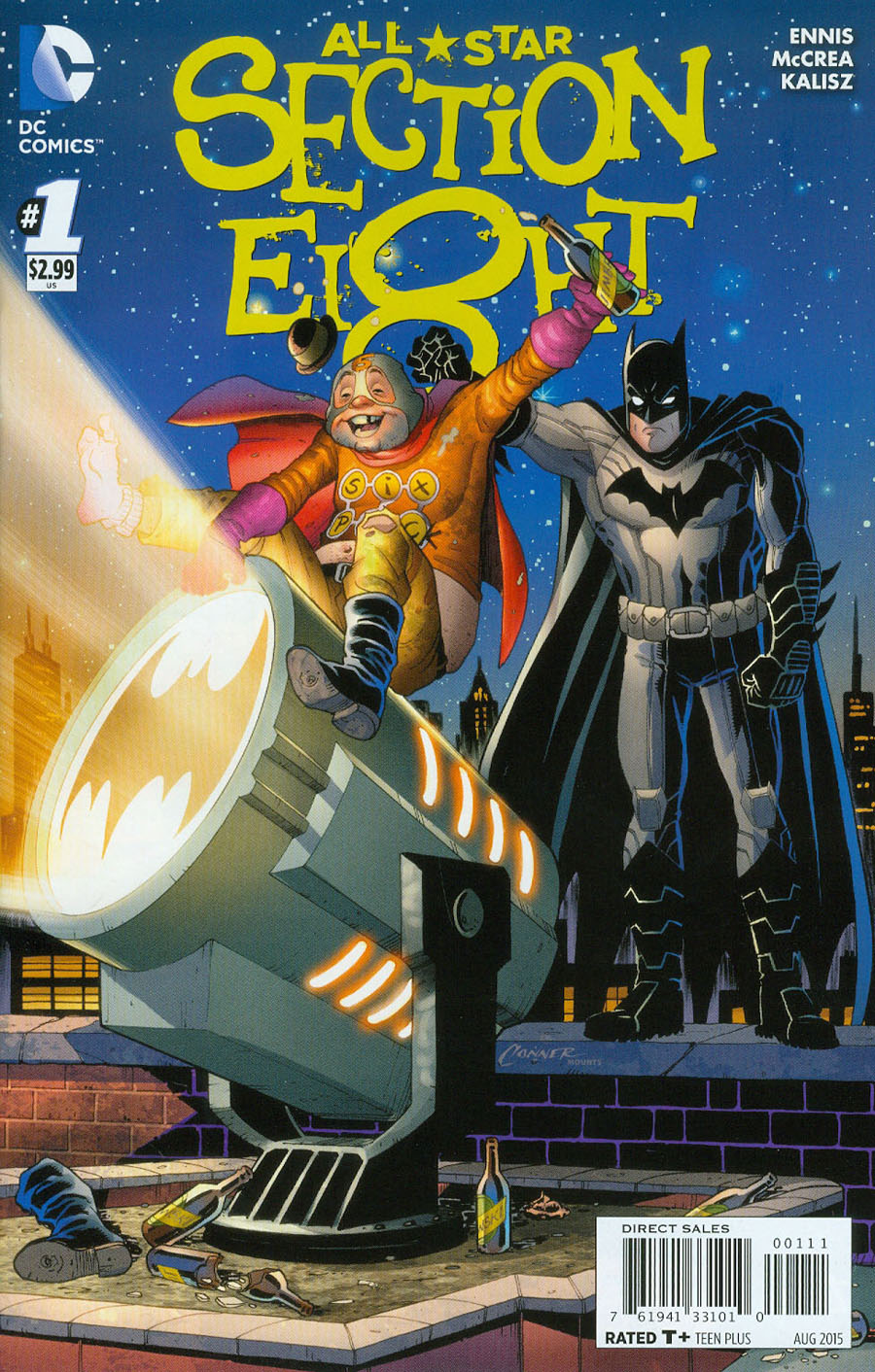
All Star Section Eight #1 (DC Comics) Garth Ennis and John McCrea's Section Eight series seems to have picked up an adjective in "All Star," which should really have a hyphen in it, shouldn't it? The prologue that was featured in Convergence: Harley Quinn #2 just called it Section Eight, so now I'm curious about the addition of the "All Star," which is featured not only on the cover, but also in the solicitations on dccomics.com and in the fine print of this issue. Is that meant to differentiate it from Hitman continuity, I wonder...? In the same way that All-Star Batman and Robin, The Boy Wonder and All-Star Superman were understood to be par to be part of a discreet All-Star line, rather than part of the main-line DCU continuity? (Or wait, if that was the intention, than this logo would need to be all tilty in order to match that of Chip Kidd's design for the previous two All Star books, wouldn't it...? Hmmm...)

If that was the thinking, it hardly mattered. There are relatively few characters from Hitman that survived the book's last issue, and they are the only ones to appear here: Sixpack, Bueno Excellente, Baytor and Hacken, who I was honestly quit surprised to see (The one-time comedy relief character among Tommy Monaghan's gang of drinking buddies/hired killers, Hacken is now straight man...as he'd almost have to be in a cast that consists of Sixpack, Baytor and Dogwelder II).

Because this is told through the eyes of Sixpack, a character who is basically the most unreliable narrator in comics history, no real great pains needed to have been taken to differentiate this story, which is maybe kinda sorta set in a different continuity-verse than Hitman was; it appears to be an entire issue set within the alcohol-addled mind of Sixpack, who was always going on about his adventures that were more often than not just drunken delusions. Now instead of hearing Sixpack say these things, as Tommy and the others did, we're on the inside, with Sixpack, experiencing them.

After a four-page sequence introducing Section Eight, shown coming to the rescue of the badly-wounded Superman, Batman and Wonder Woman (all wearing what appear to be the costumes they would have been wearing near the end of Hitman...not so sure about Wondy's bracelets though), fighting on against a horde of robots that have already killed the hell out of Dr. Fate, Plastic Man, Blue Beetle Jaime Reyes, Captain Marvel, The Flash and Green Lantern Kyle Rayner (I love the way McCrea draws the gigantic, claw wounds and big bite-marks taken out of the characters, alive and dead), and then a four-page sequence where Sixpack inadvertently becomes his "old" self again, the story begins in earnest.

Sixpack has to put the team back together, but given the fact that there are only two members of Section Eight left alive, he's going to need to do some major recruiting. He does, but still finds himself one hero short: And then he looks out the window of Noonan's Sleazy Bar and happens to see Batman at an ATM machine.

He fails to get the Dark Knight to sign up, but he does witness a very unusual interaction between the vigilante and Gotham City law enforcement, and McCrea draws the a series of tributes to Neal Adams, Kelley Jones and Jim Aparo, that are surprisingly perfect.

I was (obviously) pretty excited about this book from the start, but man, when I hit the panel where John McCrea was drawing an homage to Kelley Jones in a panel with Norm Breyfogle like excitement lines around the top in a book that is a spin-off of Hitman...? That is a lot of my favorite things about comics in a single panel.

I'll likely have a bit more about this elsewhere later but, for the time being, I should at least note that this was not at all disappointing, and I was a little skeptical regarding whether or not it would live up to my expectations, what with people always saying you can't go home again. Ennis and McCrea seemed to have managed it just fine...or, if they're not home-home, they're in the same neighborhood, maybe a few doors down.

This is easily the strongest of the three out-and-out comedy series DC launched post-Convergence–that is, Bat-Mite, Bizarro and Section Eight–although I do find myself wondering how this might read to someone who has never read Hitman. I assume many of the jokes will still land just fine; the Batman bits are all funny, whatever one might think of Sixpack, who is a character-type that used to be pretty prevalent in American pop culture, but has all but disappeared over the course of the last few decades, as the "town drunk" character type was retired given better understanding of alcoholism as a disease.

I do not care for the Amanda Conner cover one bit, though. She's a great artist, and she tries to make the cover ugly–note the pile of poop on the cover–but man, her Sixpack is just too smooth, too cute.


Gotham Academy #7 (DC) Some books are going to end up being rather hurt by the two months vacation DC's line took for Convergence, and this one may be hurt the worst. And that's in spite of the strong push DC has been giving the book, grouping it together with Batgirl and Grayson as fresh, new takes on Gotham City super-detective comics.

The creative team had just wrapped up their first story arc, and had a somewhat grafted-on feeling back-up teasing what seemed to be the next arc–in which Academy alum Bruce Wayne signs Damian up to attend school there–and then nothing for two months.

The book returns with a fill-in artists (Mingue Helen Chen), a somewhat messy (in terms of both art and story construction) done-in-one story starring a guest-star and a supporting character and seems to end it's "new direction" by page 20; the "new direction" teased seems to come to an end when Damian is expelled on the last page, and a last-panel banner reading "Next Month: Olive Returns!"

Most of the ongoing books that are still going on post-Convergence have involved rather radical new status quos: Think James Gordon replacing the presumed dead Batman in a robo-Batman bionic rabbit suit, or Superman having lost his powers and his secret identity, or Hal Jordan having stopped getting haircuts and gone on the run from the Green Lantern Corps. This new direction, Damian joining the cast, lasted just one issue? In effect, then, Gotham Academy seems to have taken a third month off, not publishing new issues in April or May, and then a fill-in issue for June.

Maps is our star, and she finds a magical quill pen that seems to be able to control the thoughts and actions of others, including getting her and Damian's hands stuck together for the course of the issue. There's a porrly laid-out scene on pages two and three that I had to read and re-read and re-read to try and make sense of it, and eventually just steamed ahead, with the dialogue explaining it later. The problem? All of the characters in the scene look alike: Damian, Eric and even Maps. Theye all share teh same basic short, black hair look and dark blazers over dark shirts costuming.

Damian's inadvertent quoting of Batman '89 in one scene, and Maps' general enthusiasm for this totally hardcore new student who happens to have both a grappling gun and a batarang on his person are pretty charming, but it doesn't change the fact that this was overall a very weak issue of a series that really needed to come back form vacation as strong or stronger than ever.


Injection #2 (Image Comics) I thought the first issue was an awfully strong start, and this being a relatively light month, I figured I'd read #2 as well. I don't think I'll be buying #3 off the rack, though. There's some great art from Declan Shalvey, as is to be expected, and there's a nice, brutal fight scene set in a kitchen, but writer Warren Ellis seems to have backed off of the big, cliffhanger reveal at the end of the last issue, and so the story doesn't progress in an obvious way, but goes for a bit of a walk in a different direction. That's fine and all, but it's fine and all for a graphic novel, not a serially-published comic book. I suppose I'll trade-wait this one after all, then.


Saga #29 (Image) Last month's issue ended with a surprise death of a supporting character, so surely the cast of this issue should be safe, right? Wrong! There is a very sudden, very shocking, very final-looking death in this issue, and another less final looking death. Plus some of those terrorists on the cover get killed to. Basically, there's a whole lot of dying all over this issue, and that last page almost broke my heart.

The two-page splash on pages six and seven is something I've never seen anywhere, never even imagined I would see anywhere, so, um, kudos to Brian K. Vaughan and Fiona Staples for being so...creative? Let's go with creative?

Also, I find it hilarious that the person who draw that is also drawing Archie comics now.

Also also, while it was certainly an extremely unexpected scene, it certainly makes the object of our heroes' quest easier. If the subject of that splash wasn't doing what it was doing, if it couldn't do that, then yeesh, imagine the difficulty they would have in trying to get what they needed...


SpongeBob Comics #45 (United Plankton Pictures) Once again, SpongeBob has one of the best covers of the week.


Uncle Scrooge #3/#407 (IDW) Hmmm...I didn't care much for this issue, making it an all-around rather disappointing Wednesday evening for me (Thank God for Section Eight!). The bulk of this issue is a 32-page story by Romano Scarpa and Rodolfo Ciminio in which Scrooge laments the lack of thriftiness in modern society (although it appears to be the pre-war years here; hell, there's a kid playing with a stick and a hoop in the first panel!). He finds a back that, in an effort to promote thriftiness, has given away $100 to three individuals, with the promise of giving them another $100 if they can manage to save or increase that $100 in 24-hours.

As it turns out, all three individuals are known to Scrooge: His nephew Donald, his sometimes rival Jubal Pomp and a Beagle Boy. It's a pretty complicated set-up for a series of criss-crossing gags, but I didn't find many of them particularly funny. Then again, my favorite Scrooge stories of any length tend to be the ones involving exotic travel and adventures, so perhaps it's not the comic, it's me.

There's also a two-page gag strip by Tony Strobl involving a parrot, which was perhaps a particularly unfortunate subject matter for an Duck story, as the latest volume in Fantagraphics' absolutely essential Carl Barks Library was Donald Duck: The Pixilated Parrot, and so I had just read a pretty great comic by one of the greatest comics creators of all time featuring Scrooge, DOnald, the nephews and a parrot.

Tuesday, June 09, 2015

I like this John McCrea cover.


That's John McCrea's cover to Section Eight #1, a six-issue miniseries that constitutes he and Garth Ennis' return to the DC Universe and stars a couple of relatively minor characters from their 1996-2001 Hitman series. Below that is the cover of Hitman #1, which the former is clearly meant to echo.

I really like McCrea's art, and it's fun seeing the deliberate reference to a previous cover. Note the differences in the Batmans, in terms of their costuming, as well as the similarities, in terms of Batman's expression and the way McCrea draws his cape, as a sort of explosion of ink.

Ennis and McCrea first introduced the characcter Tommy Monaghan, the hitman of the title, in a 1993  annual attached to their run on The Demon (Psst! Ennis and McCrea's Demon run would make a fine collection, People At DC Who Decide What Gets Collected). They used Batman to help ease the character into the audience's eyes, which made sense not only in terms of Batman helps sell things, but because Tommy was a Gothamite (The Demon was set in Gotham City, after all).

Between the end of The Demon and the launch of Hitman, Tommy appeared in a short story in The Batman Chronicles #4, sort of tied to the then-ongoing Batman crossover storyline, "Contagion." Batman then played a fairly prominent role in the first Hitman story arc, punching Tommy so hard in the stomach at one point that he throws Thai food up on Batman's boots. Despite both Batman and The Joker swearing vengeance upon Tommy Monaghan by the end of that story arc, neither reappeared for a rematch throughout the rest of the Hitman run, which made for maybe the only loose story thread Ennis didn't tie-up.

As for Batman's presence on the cover of Section Eight this week, Section Eight's leader Sixpack is trying to revive his team, no easy feat since most of them are dead. He gets up to seven, but still needs an eighth, and Batman is his first potential new recruit.
If you're looking for this book tomorrow–and you should be!–do note that the McCrea cover above is a "variant;" for reasons that perplex me, the "regular" cover is by Amanda Conner, a fine artist whose only fault in this instance is that she's not John McCrea.

A few thoughts on The Brave and The Bold #1-6 (1991)


I found all six issues of this 1991 miniseries in the $1 bins at a comic book store in Erie, Pennsylvania that I had never heard of and, as far as I know, was not around when I attended college in the city in the back half of the 1990s. I remember seeing house ads for the series in the other comics I was reading back then–probably Advanced Dungeons & Dragons, Sandman and/or some Batman comics–and being curious about the title and the characters. I had obviously heard of Green Arrow and even The Question, but was completely unfamiliar with Native American hero The Butcher, who I assumed was a popular if obscure character on par with The Question, but whom I had never seen reappear anywhere else in the years of comics-reading which followed (Looking him up online now, something I didn't have the option of doing in 1991, I see he was apparently created by writer Mike Baron and artist Shea Anton Pensa for a five-part miniseries simply called The Butcher guest-starring Green Arrow; his surname is actually "Butcher," too, so it's not really all that creative of a codename, nor is it indicative of his violence or anything).

I'm pretty sure I have at least one issue of it that I must have similarly found in a discount bin somewhere, as at least parts of the second issue were familiar to me. I hope I don't actually have all six of these in a longbox somewhere, and I simply forgot reading them.

The series was co-written by Mike Grell and Mike Baron, and mostly penciled and inked by Shea Anton Pensa, with Pablo Marcos helping ink the last few issues. Grell also seems to have drawn the bulk of the covers, as you can see above.

Some thoughts:

–It was somewhat surprising how down-to-earth the plotting was. While former Justice Leaguer Green Arrow gets top-billing on the cover, and fellow former Justice Leaguer Black Canary appears early on (out-of-costume, and as Dinah Lance), there's little in the way of the fantastic here. Oliver Queen is basically just a rogue vigilante who uses a bow and arrow, and when he attacks bad guys, no one really seems to recognize him. He's just some guy with a bow and arrow who dresses in green; no one's ever like, "Look out! It's Green Arrow!"

The costume he wears at this point is barely even that. A hood is as close as he comes to concealing his identity, with no mask and no trick arrows. (Well, there's one grappling hook arrow, but that's it.)

The closest thing to the fantastic, beyond Ollie's amazing aim perhaps, is The Question's mask, which gives him the bizarre, featureless face. When he first appears, he's wearing it and his trenchcoat and hat, but after that, he goes the majority of the series out of mask and costume, as just plain two-fisted, uzi-shooting journalist Vic Sage.

This could very easily have been a standard 1980s action movie, had Baron and Grell simply changed the names of the stars. That's neither necessarily a bad thing nor a good thing, but it is a striking thing. It's very rare to read a DC or Marvel comic book so thoroughly disengaged from the superhero universe settings of the publishers. For comparison's sake, consider Matt Fraction, David Aja and company's Hawkeye, premised on being a comic about what the Avenger did when he wasn't being an Avenger–it was full of cameos and references to various Marvel superheros, on a fairly constant basis.

The superhero comic-as-80's action movie vibe of this comic was unusual enough at this point to be downright refreshing.

–I thought the use of "The Brave and The Bold" for this book was...interesting. I imagine it had something to do with preserving the trademark or copyright on the title, as it's fairly randomly applied here. The logo takes the old one from The Brave and The Bold and attaches the word presents, and then throws up the name of the three main protagonists who have their own logos, so that the book looks like it's entitled The Brave and The Bold Presents Green Arrow, The Butcher and The Question, but the fine print simply refers to the book as The Brave and The Bold.

I don't know if it's simply a matter of my mind seeking patterns for comfort, or having been trained by reading enough issues of the Brave and The Bold collected in Showcase Presents collections, but I expect a book with that title to have two co-stars teaming up, not three, so it seemed a little weird to me to have all three in here.

According to the letters page, some consideration was given to adding Black Canary's name to the covers as well, but they decided against it, as she only appears sporadically, and never as Black Canary.

–I forgot how much I liked the "old" Black Canary, the one who had short black hair as Dinah Lance, and put on a blonde wig to fight crime. Maybe it's not a very realistic disguise, given how fake wigs tend to look in real life, but it's extremely effective in comic books. Black Canary is unrecognizable in her street clothes and without her wig.

–Check out this cool place Ollie takes Dinah to dinner at:
Chez Cool? I'm sure it doesn't get any cooler than that

–Speaking of cool, at one point in the first issue, John Butcher realizes that Green Arrow has stumbled into a case he himself was working on, and he goes to visit Dinah and Ollie at Sherwood Florist.

Ollie greets him thusly:

–It was weird to read the adventures of this particular take on Green Arrow after having spent so much time with the Justice League version that preceded and followed the urban hunter iteration. It was mostly weird to see how quick to kill GA is here.

In the first issue, he's Green Arrowing around in the woods when he stumbles upon a terrorist camp of radical Native American separatists. When a guard spots him and points a gun at him, GA shoots an arrow into the barrel of the gun (thrusting the gun back into the guard's jaw) and then KOs him with a kick.

Later, he's putting arrows into the legs and bellies of people shooting at him.

By the end of the story, he's smooshing bad guys under logs...
...and killing them left and right...
Man, Batman and Superman would not approve of that kind of behavior. (So I guess it's a good thing this series is so divorced from the DCU in general.)

Green Arrow's allies have no compunctions about killing either, with The Butcher's weapon of choice being a knife, with which he slits his opponents' throats and, at the climax, Vic Sage is firing automatic weapons into a crowd of bad guys and finishes off their leaders with a bazooka.

–For a guy who sometimes doesn't appear to even have a mouth, Vic Sage sure has a mouth on him:
Swastika money target lightning bolt! That's, like, the F-word of grawlixes, isn't it?

–Anyway, this was a pretty fun read, made more so for just how unusual it reads in 2015. I liked the big, dumb action movie plotting, I liked Shea Anton Pensa's weird, expressive art, with its gnarled, knotted human figures exploding into awkward actions, and the way he draws hair, from Ollie's seemingly permed mustache to the big, flowing action mullet on Vic Sage and bigger-still mullet on Sage's friend Tot.

Goofy fake-swearing aside, it was a surprisingly adult comic, too–if this were an action movie, it probably would have been rated R. There's a good deal of killing and blood, but it's very grounded and connected to the real world, with the wounds being inflicted coming from blunt trauma, gunshots, explosions and knives and arrows; there's none of the ultra-violence and strangely inappropriate gore you find in a lot of DC Comics of the past decade or so, in which spandex-clad, cape-wearing children's cartoon characters get impaled, disemboweled or lose limbs. I don't want to go so far as to say the story was "sophisticated," but there's a level of sophistication to it; Baron and Grell's plotting is sort of cartoonish, but it's cartoonish in the way of cartoonish adult entertainment; the characters have actual motivations that exist in the real world (money, sex, power, respect...that sort of thing, not, like, ruling the galaxy or reshaping DC Universe continuity or whatever).

The politics of it were a pleasingly complex mish-mash, too. Our heroes are manly men of righteous violence; politically incorrect vigilantes unafraid to use lethal force and break laws and rules in pursuit of justice. Their opponents include an Irish terrorist, radical Native American separatists of varying levels of commitment to violence and a forest clear-cutting, eco-evil robber baron. Caught up in the conflict are various people of indigenous cultures with varying view points on the future of their culture, and which paths to take moving forward.

It often reads like a Libertarian version of the old Denny O'Neil-penned social relevant Green Arrow/Green Lantern adventures, but it's so 1980s in its tropes and trappings that it's hard to apply the right labels to aspects of it, as words like "liberal," "conservative" and "libertarian" don't really mean the same things today as they did in 1991. I appreciated that while it has political elements to it, it's not a screed, and as broadly-drawn as some of the characters are, the writers don't set up any straw men.

There's a perhaps uncomfortable "might makes right" message in here, but "might" is defined by martial arts ability, archery skills and willingness to execute awesome motorcycle jumps as opposed to fire power, political power or money. So the ultimate moral Grell and Baron were trying to impart, I think, is to take karate, kids.

That, and that explosions are cool.
And explosions are, of course, apolitical.

Sunday, June 07, 2015

Review: Justice League #41 ("The Darkseid War" Part 1)

DC Comics has published two preludes to the "The Darkseid War" already, the second time in their Free Comic Book Day preview, and the first time...I forget where. I'm pretty sure it was an issue of Justice League, but two months vacation from DC continuity for the events of Convergence have rather addled the part of my brain that keeps track of this stuff. In fact, I only remember where I read the second tease on account of Joe McCullouch making fun of DC putting part two of a prelude in a book geared towards people who don't really read comics. It's been in the works for much, much longer, however, and, in fact, perhaps as long ago as the last week of August 2011, when writer Geoff Johns introduced the new Justice League (and The New 52) in an origin story set "five years ago" and featuring Earth's first contact with Jack Kirby's god of evil, Darkseid.

It seems unusual that the "Darkseid War" story arc is playing out in the pages of Justice League, however, even if it is Johns' home title, and features the biggest heroes of the current DC Universe. Darkseid's opponent in his war is going to be a rebooted and redesigned version of Marv Wolfman and George Perez's Anti-Monitor, and he was introduced at the end of Forever Evil, the first of DC's event series of The New 52, which was big enough a deal to get its own limited series, take over the Justice League books, spawn a few tie-in miniseries and hijack the whole line for a month of those weird semi-animated 3D covers. That series was itself prefaced by "Trinity War," a storyline big enough to run through all three then-extant Justice League books (and a few sundry tie-ins).

If those events were all building towards this, well, it seems rather small doesn't it? Yes, this first official chapter is 41(-ish) pages, but I mean small in terms not of story-length, but signals the publisher is sending. Compared to "Trinity War" and Forever Evil, stories building towards this, to the extent that they could be read as the first two acts of a three-act story cycle, this story arc lacks any of the highlighting, sign-posting and fan-goading that the Big Two usually engage in when telling their readers what books are "important" to read (Hell, Convergence and Futures End got much more in the way of highlighting).

That's not a bad thing, of course; it's just an unusual thing.

Well, since this book is supposedly going to be such a big deal, I suppose I will play along and treat it as such. If you've got a copy of Justice League #40, grab it and read it with me, won't you?

THE COVER

This cover, by new Justice League artist Jason Fabok,looks so much like a movie poster that I found myself trying to think of which specific movie poster it borrows its design, lay-out and character posing from. I guess that's a good indication that this comic book is going to be "cinematic"...?

Front and center, we have Batman, Green Lantern and Wonder Woman. As is immediately evident, this story is apparently set well before current goings-on in the DC Universe, as Batman is neither dead nor "dead," Green Lantern has a ring, uniform and short hair, and so on. Wonder Woman appears to have a new costume, but I haven't been keeping up with The Finchs on her title, so maybe that's up-to-date.

The background elements, moving clockwise, consist of 1) A lady in a reddish hood with glowing eyes (Is it Pandora? Is Geoff Johns finally going to explain the ending of 2011's Flashpoint in this story arc? Spoiler: No, that's Darkseid's daughter, introduced in the preludes as a sort of anti-Wonder Woman; while Wondy is the daughter of Zeus and an Amazon, this new lady is the daughter of Darkseid and an Amazon), 2) Justice Leaguers Superman, The Flash, Cyborg, Lex Luthor, Power Ring, Aquaman and Captain Marvel Shazam flying in front of Apokolips, 3) Darkseid, wearing a slightly varied version of his dumb new New 52 armor designed by Jim Lee, and 4) The Anti-Monitor.

PAGE 1

Five horizontal panels of equal size stacked atop of one another, slowly zooming out from an empty wine glass as it is filled with wine, followed by a pair of close-ups. See? Cinematic!

The wine pouring into the glass reminded me of Grant Morrison, Howard Porter and John Dell's hyper-compressed JLA arc introducing Zauriel while pitting the League against Neron, The Demon's Three and a renegade angel; still my favorite Justice League story ever.

PAGES 2-3
We see who was pouring the wine. It is Kanto The Assassin, and he and Lashina of The Female Furies are just hanging out in some normal folks' apartment, waiting to kill the lady who lives there when she got home. The lady's name is Myrina Black, and they are apparently going around killing ladies with that name.

Fabok has redesigned both of these two, too. Everybody from Kirby's Fourth World mythology gets redesigned, and it's a tough gig, really, as Kirby's designs are so unfuckwithable, but, on the other hand, are on the silly side, and seem much more so when plopped down in the world of The New 52, where no one wears spandex, only armor, where even The Flash and Captain Marvel look grim and gritty.
I understand the temptation to redesign these characters (Notably, Lashina's is much more subtle than Kanto's), but, at the same time, the silliness is part of their charm. Personally, I think seeing the original Kanto here would probably make him look all the more alien and terrifying, given the sharp contrast between that guy and all of the New 52-iverse's other heroes and villains.

I, naturally, hated this new Kanto design immediately, but the more I looked at it, the more it grew on me. Fabok keeps its essential colors and shape, so that even though Kanto doesn't have a hat on, his horned helmet looks a bit like that hat from afar. And he's still got facial hair, which is important.

So it's not ideal, but in a world where such perfect superhero costumes as Carmine Infantino's Flash costume and Joe Shuster and company's Superman costume are deemed in need of drastic tweaks, well, this is fine.

And it could be worse, as we'll see in a few pages!

Of note here is the fact that Kanto kills the woman by flicking a knife at her. A few panels later, he says, "Come, Mother Box," and the knife, now stained with what looks like red paint, returns to his hand with a PING and speaks to him in a mechanical-looking font, its dialogue bubble emanating Kirby dots (Okay, that's a nice touch).
Mother Boxes need not be boxes, but now come in other, more functional shapes. I'm not sure why they still call 'em boxes, though; "Mother Knife" sounds a lot more badass, doesn't it? Especially as the sentient killing instrument of the god of evil's court assassin?

PAGES 4-7

All of a sudden, we get a narrator, the first of several. This is one of my big pet peeves about modern superhero comics; writers still write them as they always have, they just put the stuff that used to be in thought bubbles in narration boxes. But thinking, or talking to yourself, is different than narration. This would be a fucking mess in prose, as it moves from omniscient third-person to first-person narration, then another first-person narrator, and so on. Gah.

You can't quite tell from his color-coded, sigil-bearing, personalized narration boxes–which feature yellow print on a field of charcoal gray, with red outlines and, on the corner of teh first box on each page, an unintelligible symbol that upon closer inspection seems to be a fraction of his new costume–but this is Mister Miracle.
His Mother Box takes the form of a key, apparently, and he re-tells us his origin while breaking into a well-fortified facility on Apokolips, in order to steal a...Mother Box, from a stack of other Mother Boxes...? I think...?

Johns' origin of this Mister Miracle seems in line with his standard origin, with only minor tweaks, but I was struck by what a hard time I had reconciling this guy with the one I saw in the pages of Earth 2 and Futures End...It's the reverse of the way shared-universe superhero comics are supposed to read, but I find myself more confused about characters the more times I see them in different books.

Fabok has heavily redesigned Mister Miracle (here's Abhay Khosla's right-to-the-point take), even redesigning the re-design from his previous New 52 appearances. If you squint and look from a distance, it seems to be the same basic design, although from the neck down he appears to be wearing armor made out scrapped bodies of Marvel's The Vision. And a utility belt? That's not very sporting of an escape artist, is it? Houdini kept the key under his tongue, not on a key chain worn around his belt.

For a god, this guy's got a lot of padding, including a huge codpiece. Do the New Gods kick each other in the crotch a lot?

Brad Anderson is the colorist. I'm not sure if he's to blame for how dark Mister Miracle's new duds are or not. I mean, yes, he colored the page, so he's responsible for that, but perhaps Fabok or someone else instructed him to make sure that there was as much black and gray on Miracle as there was red or yellow, and that the green of his cape looked like a drab olive rather than anything bright.

At the end of his origin story, Miracle either takes a box-shaped Mother Box or puts a Mother Box against a tower of Mother Boxes, and says, "This can't be possible" aloud, while narrating, "I'm going to need the Justice League."

PAGES 8-9

Cue Narrator #2! It's Wonder Woman, talking about what she and most of the original Leaguers had in common, the fact that, as children, they were all searching for something. It's a pretty elegant bit, really. Good job, Geoff Johns!

PAGES 10-11

Wonder Woman keeps narrating, and these pages are arranged as a two-page spread, the panels moving horizontally across both pages. The League is investigating a murder scene–giving me an uneasy feeling, as I flashback to Identity Crisis–the scene of the murder on the first three pages.

One big panel runs across the top half of the spread. We see The Flash Barry Allen in three places, investigating stuff at super-speed. Batman is crouched over the body of the Black woman, wearing goggles. Cyborg is doing something with special effects, while Captain Marvel Shazam stands behind him, looking uncomfortable. In the foreground, we see Steve (Trevor) in a suit of black and gray body armor, which also includes a big codpiece, standing with his arms crossed over his chest, next to Wonder Woman, standing with her hands on her hips.
Here we get a pretty good look at Wonder Woman's new new costume. They're staying with the black and red color scheme, apparently, and here it looks duller and drabber than elsewhere, with no white or silver highlights. There's a weird hybrid eagle/star on her chest, strange new bracelets that don't really look anything at all like bracelets (and include armored knuckles)and she's wearing some sort of old-school battle skirt. She's also got a shield, a must for invulnerable warriors, and she's ditched the "WW" choker, which is for the best.

While Batman and Flash talk crime-scene investigation, Green Lantern Hal Jordan and Power Ring Jessica Someone-or-other use their rings in another room to search for clues.

PAGE 12

Four-panels here; in the first one, part of Batman's dialogue carried over from the last panel of the previous page gets a narration box, even though it's not narration.

Cyborg's chest symbol has flip-flopped sides, so now it looks like a C; on the previous spread, it was backwards, I think. Shazam explains why he's uncomfortable: "I've never seen a dead body before."

One of the appeals of Captain Shazam is, of course, that he brings a sense of child-like wonder and innocence to the world of superheroes. Innocence that can be soiled!

Honestly, there's no reason for Shazam to be there. He's not using the wisdom of Solomon to crack the case ("I say we cut the body in half, and give one half to each...wait, that won't work here, will it?"), and he doesn't have any CSI experience or fancy gadgets or magic clue-detecting jewelry. Wonder Woman has the standing-around-looking-tough-next-to-the-government-agent-standing-around covered. Couldn't they have him pull monitor duty or something?

PAGE 13-14

Superman, Lex Luthor and Captain Cold walk down a high-tech hall, discussing Luthor's attempts to cure and get answers out of a person named Neutron, apparently dying of cancer. This must be following up on something from previous story arc "The Amazo Virus," which I did not read.

Superman tells Luthor that she only get his information from asking, not torture, or the threatening of torture. Neither of them seems to recall their first meeting, in which Luthor tortured Superman to extract information from him at the behest of the U.S. government, particularly well.

Captain Cold appears at the bottom of page 11; another example of sub-par staging on Fabok's part.

PAGE 15

Mister Miracle continues narrating his origins, while looking at files with the Mother Box, which is apparently his Mother Box. I guess the Mother boxes can change shape now, giving them one thing over the modern smart phones that Jack Kirby predicted decades ago in their invention.

PAGE 15-16

Another horizontal lay-out spread over two pages, apparently to accommodate perhaps the goofiest ad in comics history. Or at least since Marvel had their artists draw Old Spice products into panels.

Along the top, Darkseid enters the room. "Those colors," he says to Miracle, "Why do you wear those colors?"

He is apparently referring to the red, yellow, drab olive and charcoal of Mister Miracle's new costume.

Along the bottom, Nick Lachey argues passionately for each of the two Twix bars in a package of peanut butter Twix, denigrating the other in each panel. Is there anyone who eats peanut butter Twix who only eats one of the Twix, and not the other? Is that the joke? Is it funny? I don't get it. If DC made a bunch of money off of these ads, they sure didn't pass the savings on to readers: This goddam comic still cost $4.99, about half a manga collection or a quarter of a Big Five trade collection or original graphic novel.

With the money you could save just trade-waiting DC comics, you would have plenty left over to buy packages of Twix, eat one, and throw the other away.

PAGES 17-19

Darkseid and Mister Miracle fight. Miracle throws a frisbee from the Tron arcade game at Darkseid. Darkseid eye-beams his legs out from under him and then attempts to stand on him.

Darkseid's foot is gigantic, but if Darkseid is so many times larger than Miracle, it's not apparent until the end of their fight a few pages after Darkseid is introduced into the narrative.
Again, the staging is extremely poor. The basic relationship of the size of two characters, especially when they are in conflict with one another and especially when one there is such a dramatic difference between them is really something a comic book narrative should establish immediately.

Anyway, Miracle Boom tubes out from under Darkseid's gitantic foot, probably into Justice League #42.

PAGE 20-24

In the Black family kitchen, Cyborg explains that there are 44 surviving Myrina Blacks in the U.S., and that another has just been killed. The League's CSI scene is interrupted when a woman climbs out of The Flash's mouth (Neat visual, that).

She has red eyes, and undercut and a funny-shaped space axe; she's wearing a poncho with an Omega symbol on it and no pants, and speaking in the same colored-bubbles as Darkseid.

It's Darkseid's Daughter!

Dee Dee engages the League in combat, cutting Batman in the shoulder, the small of the back and maybe the throat. Don't worry if he "die"; he's already "dead" in his own book, and the preludes for this storyline have already revealed that he will become a New New God, apparently replacing Metron.

PAGE 25

Mister Miracle arrives in a parking garage, not Justice League #42, where he and his Mother Box find a dead boy, one of the Myrina Blacks. Her murderers, Lashina and Kanto, are still there, and they fight in front of the late Ms. Black's size-changing car (look at panel 2 vs. panel 5).

Mother Box mentions Miracle's wounds, and the burn marks on his thigh-armor are clearly visible. I'm not sure who should feel more embarrassed here. Me, for suggesting that Mister Miracle doesn't need to be so heavily armored right before he suffers a terrible wound to his legs, or Mister Miracle, for wearing all that armor and it still not being enough to protect his legs. Good thing Darkseid didn't aim for his crotch, as that massive codpiece wouldn't have helped.

PAGE 26-30

Back to the other fight, Dee Dee unwraps Cyborg like a Christmas present, stabs Shazam from behind, withdrawing her axe blade thing all drippy with silhouetted gore and knocks Wonder Woman around while the Amazing Amazon calls Superman for back-up.

At on point, Dee Dee eye-lasers Wonder Woman's bracelets off, saying, "You're stronger without them, aren't you?"

In Brian Azzarello's run on Wonder Woman, Diana's bracelets weren't there as a reminder to never be enslave to man or anything, but were instead a sort of power dampener, keeping her from accessing the powers she had from being the demi-goddess daughter of Zeus. Here, Diana doesn't transform as she did in Wonder Woman when taking off her bracelets, but, as I said, I have no idea what's what with Wonder Woman at the moment, and given the fact that her bracelets have changed, the way they work in the New 52 may have changed as well.

PAGE 31-32

The narrative sure is jumping around a lot, which makes for an exciting read, but makes it hard to write about in this format. But I'm not giving up!

Back at wherever Luthor and Superman are, the two prepare to join Wonder Woman and the others. Captain Cold has disappeared again, but Lena Luthor, Lex' sister, is sitting in front of a couple of computers, doing her Oracle impression. (Oh shit, now that I look closer, I see that she's actually in a wheelchair too. By "her Oracle impression," I just meant she was sitting in front of generic computer screens, knowing things convenient for a lady sitting in front of computers talking to the super-people to know. "Oracle-ing" seems to be increasingly popular in superhero fiction–The CW's Ollie Queen has his own Oracle, CW's Flash has a whole team of Oracles, et cetera, and I guess Luthor has one in his Luthor Cave or wherever they are).

Anyway, Luthor suits up in his new kryptonite-powered armor and, when Superman sasses him–Superman, your girlfriend is getting murdered; maybe now's not the time to tell off Luthor and say you guys don't need his help?–Luthor blasts him with a kryptonite-powered repulsor beam.

I'm assuming it's a purple beam because that's Luthor's favorite color, but the kryptonite power source is green kryptonite; I don't think there's purple krytponite, is there?

Then Lena shoots her brotehr three times, twice in the back and once in the arm! With a gun that looks like a conventional firearm, and smokes and makes "BLAM BLAM BLAM" noises like a conventional fire arm, but fires what look like laser beams, and, whatever the projectiles are, they're enough to completely penetrate Luthor's super-armor, two of the shots going in one side, through his body and out the other side of the armor.

Is Luthor totally dead forever now? Probably.

PAGES 33-35

Back to the League vs. Dee Dee fight. She takes down Green Lantern and Power Ring, and summons an army of shadows, not unlike that The Anti-Monitor raised in Crisis On Infinite Earths. In thsi sequence it's made clear that Batman, Shazam and Cyborg are not dead, all of them at have at least gotten to their knees.

There's a cutaway to Ultraman's cell, where he's on the floor, saying in a small voice to himself, "He's coming. The monster is coming for us."

You'll probably recall that the reason Ultraman and the Crime Syndicate came to Earth-0/The New 52-iverse in "Trinity War" and Forever Evil was that The Anti-Monitor had destroyed their world, Earth-3.

PAGES 36-37

Speak of the devil. Or anti-god. Or whatever. The Anti-Monitor appears on a two-page spread, surrounded by a halo of light and Kirby dots, with black shadow lightning swirling around where his feet would be.

A purple narration box with an "S" in it features the dialogue–like, there's quotation marks and everything, so this is more of a voiceover as in a film or TV show than narration as in prose–"The destroyer is here!"

No one associated with the color purple and an S have appeared in the book yet, so there's no indication who's talking.

PAGE 38

A very busy page, as we jump back and forth to the Luthor Cave a few times, Johns and Fabok picking up the tempo before the denoument of the last few pages.

There's Superman cradling a bleeding Luthor and asking Lena, "Why?" while the purple S continues to talk in the corner.

There's Superwoman, finishing the purple S's sentence. So it's Superwoman, also in a cell since the end of Forever Evil, who was talking. She's huddled on a bench in her cell, and say's "Oh, sweet child," a reminder that Superwoman is pregnant, but we're not sure who the father is. Ultraman, Owlman and the late Lex Luthor of Earth-3 were all suggested during the course of Forever Evil, but maybe it's actually The Anti-Monitor's or Darkseid's. Presumably it will be revealed during the course of this story (and maybe they'll resolve the end of Flashpoint, too? The Anti-Monitor coming could conceivably be a threat of large enough magnitude for Pandora to decide she somehow needed to merge pre-Flashpoint DCU with the WildStorm Universe and the "Vertigo Universe"...although Johns would then have to make sure there were some WildStorm heroes in here, and Veritgo immigrants other than Swamp Thing and Constantine, who had arrived in the DCU prior to Flashpoint).

There's Lena Luthor, holding a Mother Box aloft and instructing it to send Luthor and Superman "to their end...For Darkseid."

There's Kanto and Lashina attacking Miracle (note Kanto's helmet here; in profile, the top horns visually approximate the shape of the feather in his cap), and Miracle asking his Mother Box to "steal their coordinates! Jump and cover! NOW!

PAGES 39-40
Scott lands in front of a gigantic griffin, with the creative name of "Griff." The typical Johns final-page splash features a woman with a funny coat, super-tight pants and a Wonder Woman-like bustier who looks exactly like Wonder Woman and Darkseid's Daughter save for the fact that she has bangs and an Omega symbol tattooed under her eye.

"MY NAME IS MYRINA BLACK" she says in huge font at Mister Miracle, and asks him to join her in her war against Darkseid. This is Darkseid's Daughter's mom, shown giving birth to her in DC's FCBD offering. I remember the tattoo!

"RAAARK," says Griff.

I've been a little hard on Fabok here, but only because he deserves it. But to be fair, that is one hell of a drawing of a griffin on the last panel...or at least the parts we can see of it (I guess this scene is kind of poorly staged, at least in terms of introducing the griffin, as we only see its head and a bit of a wing; I'm just assuming it has a lion's body. On the other hand, it's Black who is the focus of the reveal, not the griffin, even though the griffin looks cooler, and has cooler dialogue. I want to read a Fabok comic about that griffin, more than the Justice League, really).

I think this points to a major problem with DC Comics right now, something that worries me about the future of the medium in it's mainstream (i.e. direct market) iteration. It's clear that Fabok can draw a static image of something really, really well. That's true of a lot of artists working for DC right now that I kind of hate to read comics by–Tony S. Daniel, Brett Booth, maybe David Finch when he's not on deadline. They're great pin-up or cover artists, but as finished as their individual images are, they're not very good storytellers.

Despite that, they're the artists getting the best gigs at DC right now. The publisher didn't hire John McCrea or Nicola Scott or Evan Shaner or Tim Truman or Phil Winslade or Tom Grummet or Dan Jurgens or Ron Wagner or Denys Cowan or Tom Mandrake or Rags Morales or Cory Hamner (just to grab some names of artists who recently did exceptional work for the publisher during Convergence, and leaving out creative teams like Cameron Stewart and Babs Tarr or John Romita Jr. and so on who are presumably quite happy with their regular, ongoing assignments), they hired Fabok.

Now that is likely because Fabok is more popular, that he's an artist who will sell more books when put on Geoff John's Justice Leage than Ron Wagner or Cory Hamner might, and ultimately that's what's most important.

And it worries me that DC and its more ardent fans are creating this sort of negative feedback loop, where the publisher promotes the work of talented artists who haven't yet got a great grasp on comics storytelling fundamentals because they're popular, and those artists have their popularity rise because of the promotion that the publisher invests in them, and so on, until there's a certain segment of a certain generation of a comics audience that can no longer tell good comics from bad.

But, again, it does make sense, form a business point-of-view, I suppose.

I guess the best we can hope for is that a) Fabok and other artists on top-tier DC Comics projects really bust their asses to improve and continue to learn and refine their abilities rather than resting on their laurels and b) that readers who like what they've see in books like this also read a hell of a lot more comics, from different artists and publishers and genres.

That, or DC could just do whatever I tell them all the time, but, oddly enough, they never ask for my opinion. I just give it. After the fact.

What was I talking about...?

Oh, Justice League #41. On the last page we get the title of the comic, "Darkseid War Chapter One: God Vs. Man," and the credits. Fabok pencilled and inked his work...or else Anderson colored directly over Fabok's pencils. I don't know. Maybe Fabok should work with an inker, to free up his time to better construct lay-outs? Or hire an assistant to help with those lay-outs?

It also tells us that there is a David Finch-penciled Joker 75th Anniversary variant cover (which is terrible, by the way), and has the now-standard credits regarding Jerry Siegel and Joe Shuster's creation of Superman and the special arrangement bit, and, it's nice to see, a credit to Jack Kirby for creating the New Gods.

I'm certainly interested to see what happens next. But not as interested as I am in The Adventures of Griff.

Friday, June 05, 2015

Review: All-New X-Men Vol. 6: The Ultimate Adventure

The sub-title of this volume is a joke, of course, as the story arc that ran through issues #31-36 of All-New X-Men was neither "ultimate" in that it was the final one, nor was it ultimate in that it was the "best achievable or imaginable of its kind." Rather, it took place in the Ultimate Universe, home to Marvel's once robust, now-waning line of Ultimate comics.

Get it?

No, it's not that funny, but what else could writer Brian Michael Bendis have called it instead? It is, essentially, just a way to usher the stars of this particular book–four of the five time-lost teenage X-Men founders, plus X-23–out of the way while Bendis focuses on a fairly major turning point in his X-Men narrative in Uncanny X-Men, the issues dealing with the reading of Charles Xavier's will, and the omega-plus level mutant Matthew Malloy. As we've seen, the end result of those events were pretty dramatic on the status quo of these two X-books, and having these particular mutants around for the proceedings would have made them a lot messier, as their importance to X-Men history has a tendency to warp things around them. That may be one of the reasons Bendis keeps sending them off into outer space for adventures with the Guardians of the Galaxy (this story arc was immediately followed by their second such team-up, following The Trial of Jean Grey).

Instead of shooting them off to space, here he shunts them into a parallel universe. (While these collections read more-or-less well-structured in this format, when one takes a few steps back and considers the mega-story, it is kind of weird that Bendis brought the "First Class" X-Men to the present, and then has spent so much time finding busy work for them, as if marking time between Age of Ultron and Secret Wars, isn't it?)

For brevity's sake, I'll try not to get too off topic, but suffice it to say that the Ultimate Universe is not what it once was.

Originally a 2-4 title imprint with writers Bendis and Mark Millar boiling a few concepts down to their essences and updating them for the 21st century–Spider-Man, The X-Men, The Avengers, The Fantastic Four–while eschewing all of the things that kept potential new readers from trying out superhero universe comics–high issue numbers, decades worth of continuity, crossovers, stunts and resurrections, reboots and headline grabbing changes of status quo. Within a few years, the line became everything it was supposed to not be, to the point that it was even a more unwieldy and unfriendly place for new readers than the core Marvel Universe (I've tried returning to it several times after dropping the books–somewhere around the time they jumped form $2.99 to $3.99 in price and Ultimate Spider-Man re-numbered for no reason–and have found it nearly impossible to find my footing. The Ultimates/Avengers franchise in particular, as its consisted of "seasons" and miniseries by at least a half-dozen different writers, and many of the big events that have shaped and changed the team happen in miniseries unconnected to The Ultimates/Ultimate Avengers in terms of titling).

While Bendis' still on-going Ultimate Spider-Man run hasn't been too bad, having "only" renumbered and been re-titled three or four times (that I know of), killing off Peter Parker and replacing him with Miles Morlaes at one point, the X-Men franchise has been a real mess. It went through three writers before I dropped it–Millar, Bendis and Brian K. Vaughan, with a Chuck Austen fill-in–and, as with The Ultimates, carried on in various mini-series and event stories that made them difficult to keep up with once one stopped paying attention to the line for very long.

As All-New X-Men is an X-Men comic, the cast's visit to the Ultimate universe is naturally going to be most concerned with the Ultimate X-Men. This is unfortunate, to the point that it may explain why Bendis gives the most panel-time to Miles Morales of any character from the Ultimate universe; that, or his tendency to cross his titles over with one another, perhaps to try and cross-pollinate the sales of each. While Ultimate Spider-Man and Doom are in here too (I always liked the goat legs, if not the blanket draped over him), this is in large part a sort of All-New X-Men/Ultimate X-Men crossover and, I'll be honest, I have no idea what the deal with the latter is.

I'm not entirely convinced Bendis does either, after reading this. I recognized Storm, Jean Grey, Iceman and Rogue, who are all easily identifiable by their powers and/or hairstyles, but there was also a brunette with no costume who never used her powers (who turned out to be Kitty Pryde, with a new, more stylish haircut than the last time I read a comic with Ultimate Kitty Pryde in it), a blonde kid with Wolverine claws who turned out to be Ultimate Wolverine's son, Jimmy (?), a lady with Human Torch powers who is never named, and a blonde guy with terrible hair who is also never named, but disappears midway through the story anyway.

As for the story, it opens with a three-page sequence set in the Ultimate Universe, which reveals that Ultimate Tony Stark is still around, and that they've got an Amadeus Cho, too. They're talking about a portal to another universe, and then the portal shuts itself off. It probably had something to do with that time Miles Morales visited the Marvel Universe, or 616 Galactus tried to eat the Ultimate Earth.

Meanwhile, back in the regular Marvel Universe, the "All-New" team watches as all teachers leave to go be in Uncanny for a couple of months, and then Teen Beast starts tinkering with Cerebro, because that is convenient to the plot. Then he detects a new mutant, and he, Jean, Iceman, Angel and X-23 go to recruit her, deciding to leave the rest of the students there, because that's convenient to the plot. The new mutant's power? She can open portals to alternate universes. That's extremely convenient to the plot.

Naturally, they all get thrown into the Ultimate universe, and are separated.

Iceman finds himself fighting Ultimate Mole Man and friends under Ultimate Atlanta. Jean Grey winds up in New York, and meets Miles. Beast ends up in Latveria, and is kidnapped by Ultimate Doctor Doom, aka Victor Van Damme (Hey, I totally forgot that was his name!). X-23 ends up in the middle of a football game...somewhere, then steals a motorcycle, climbs on the back of a truck and travels to Canada in, like, a few hours (Apparently unsure she's in a different universe, she tries going back to their base, which exists there, but is obviously pretty different). Angel ends up in The Ultimate Savage Land, where he meets the new Ultimate Wolverine (The pair of them get to the Ultimate Canadian tundra about the same time that X-23 does, despite traveling there from the south pole).

And the mutant who got them all there in the first place? She's essentially out of the story until the last issue, when she's needed to send them home.

So the plot is basically inconsequential, involving the various All-New X-Men visiting various characters in the Ultimate Universe, comparing notes, and then teaming up with Ultimate Spider-Man and the Ultimate X-Men for a big showdown with Doctor Van Damme, and then going home, because the story is over.

It's extremely thin on plot, and essentially pointless–Wolverine Jr. mentions that on his world, human beings created mutants in a lab, a big difference between the two universes, but it doesn't come to anything. There's perhaps some interesting character bits for Jean Grey here. If she were an actress on a TV show playing two parts, this might be a fun string of episodes for that actress, but here it's just one more example of Jean Grey meeting one more example of an alternate version of herself. At one point, she herself bemoans the repetitive, pointless nature of their adventures, complaining that not only is she in the wrong time, she's also in the wrong place.

Were this 2002 and anyone at all cared at all about the Ultimate universe, a meeting between the Marvel Universe X-Men and The Ultimate X-Men might have been something of an occasion, particularly since this was one of those things that then-Editor-in-Chief Joe Quesada said would never, ever happen, and was therefore having Marvel cross the streams like this would have been akin to an inter-company crossover fans thought they'd never see; maybe not JLA/Avengers, which they were waiting on for years, but maybe, I don't know, Batman/Daredevil.

But now? This is something like the fourth or fifth (at least) crossover (or semi-crossover, as in the case of some of the Marvel Zombies business, and that one thing with the Squadron Supreme), at least the second by this very writer (and prominently featuring Miles Morlaes) and the characters involved are an alternate version of the Marvel Universe X-Men and what is essentially the dregs of the Ultimate X-Men; Jean and Iceman are the only ones with Ultimate analogues around and, as I mentioned, several of these Ultiamte X-Men are so negligible that they don't even have names.

Pointless or not, Bendis does still write conversations well (even if everyone sounds like various degrees of wise-cracking Spider-Man...which works well for the Icemans, but not so much with, say, X-23). My favorite bit was probably Beast's line of questioning of the new mutant, Carmen, upon their first meeting her. Mahmud Asrar's artwork is excellent, and seems to get better as the book progresses, so that the scenes at the end seem much cleaner and smoother than those at the beginning (although the colorists do change at least once during the course of the events.

The covers are all very, very misleading, implying that Ultimate Spider-Man is visiting the All-New X-Men, and obscuring which universe is host to which visitor (Also, Teen Cyclops is on the cover of the trade for some reason, despite not appearing within the story at all; I suppose he's still in space with his dad).

Thursday, June 04, 2015

Comic Shop Comics: June 3

Age of Reptiles: Age of Egyptians #1 (Dark Horse Comics) I've only read Ricardo Delgado's dinosaur comics in trade format before, but it was such a light week and this looked so good I couldn't resist...although I might have had I realized it was $3.99 instead of $3.50.

As you might expect if you too have read any of Delgado's previous Age of Reptiles comics, it's great: Completely amazing in its detail and storytelling, there are no words, no sounds of any kind, but its action and drama are written so eloquently with pictures that one won't miss words a bit. Fuck you, words!

A Spinosaurus wanders to a river–or is it the sea? I see sharks in there, and I forget how long ago there were river sharks–and then swims along it, getting in fights, getting out to sleep, eating things. It's a lot more exciting than I make it sound there, trust me.

There are two quite remarkable things that Delgado does in this issue. One is that he shows just how full of life nature could be so long ago; his panels are literally teeming with drawings of living things, once Spinosaurus hits the water and starts swimming. The other is that he puts sauropods in the role of aggressor and therapod dinosaur in the role of victim. We see a small herd of some sort of gigantic sauropod brutally kill a predator, and then have a pretty tense face-off with our protagonist, with one of them taking a swing at him. Spinosaurus is an apex predator, but he's so dwarfed by the massive size of the sauropods and outnumbered by them that he seems small and insignificant before them; it's a neat trick recasting him as an underdog when challenged by these vegetarian giants.

I do wish the page devoted to a preview of the next issue's cover and a paragraph of text from editor Philip Simon could have given us some notes on which species of dinosaurs and other animals appear in this issue. I'm not bad on the subject of dinosaurs by any means, but I couldn't, like, identify what kind of sauropods those were or anything just by looking at Delgado's drawings, you know?


Airboy #1 (Image Comics) Wow. This was...different. Did you read It's a Bird...? Writer Steven T. Seagle's memoir about how stressed out he was about being asked to write Superman comics, which becomes a sort of meditation on the character intertwined with the writer's biography?

Well, this is sort of like that...by way of Ennis and McCrea's Dicks. We open with James Robinson naked and pooping on a toilet, being cajoled by Image Comics Publisher Eric Stephenson into writing a new Airboy revival for Image, as the Golden Age character has fallen into public domain. Robinson, who feels typecast as the Golden Age revival guy, doesn't want the assignment, but reluctantly takes it when Stephenson offers to match his DC page rate.

I'm a big fan of actors playing fictionalized versions of themselves, and while it only rather infrequently happens in comics, I like it here too. I know almost nothing about James Robinson–I knew he was married to former DC editor Jann Jones for example, but I didn't know they had divorced–other than what he's written and that it tended to be pretty good (when it wasn't completely horrible), so it's difficult for me to tell how much of this is autobiographical and how much is exaggerated for comedic effect. Did Cully Hamner or Tony Harris tell Stephenson that Robinson was an egomaniac? I don't know; but I know those names, and it's funny to imagine they did.

I'm assuming that the drug-fueled night on the town, culminating with Robinson and Airboy artist Greg Hinkle having sex with a lady at the same time, didn't happen (Robinson assures Hinkle that his wife will never find out...a scene that made it into the comic, after all), just as I assume that Hinkle doesn't have the porn star penis he grants himself (the script must refer to it as pretty big, as Robinson's comics avatar calls it an anaconda at one point, but on the next page, it seems to be have grown a few inches in length and circumference).

So here we have the story of a middle-aged professional comic book writer, dissatisfied with his career and the public's perception of him, while aware that he's already peaked and that his recent DC Comics writing has been pretty terrible (Oddly, he doesn't mention his recent Marvel writing; nobody really read or liked your Fantastic Four or All-New Invaders either, James!*), taking an assignment he doesn't want out of desperation, dragging a younger, up-and-coming artist with him into a night of complete debauchery, and, on the cliffhanging last page, they're faced with Airboy in full-color glory, in sharp contrast to the two-tone coloring of the previous 19 pages, announcing "Gentlemen...this behavior will not stand!"

Is he a drug-induced hallucination, or has Airboy himself become real in order to manage his own revival? I don't know. But I'm looking forward to the next issue of this James Robinson-written comic book, which certainly isn't anything I ever said about his Earth 2 or Justice League of America or Cry For Justice...Holy shit, remember that? Cry For Justice? That was a real comic, right? I've tried to block my memories of it as much as possible, as I did with Identity Crisis, but, if I recall correctly, that was DC and James Robinson's response to Ultimates 3, right?

The letters page has no letters to publish yet, so instead there are testimonials from Robinson's friends/comics professionals Gerry Duggan, Matt Fraction, Jeff Lemire, Darwyn Cooke and Brian K. Vaughan.

Fraction's is terrible:
That's like four syllables better than Boris Karloff's Frankenstein might have managed in a review: "Airboy good!"

Also, there's no way of knowing if he's talking about the character, the original Golden Age comics, the Eclipse revival, or this comic.


Archie #666 (Archie Comics) I had a devil of a time choosing which of the six interlocking variant covers to purchase of this, the very last issue of Archie...before it's relaunched next month. Oh! It's the 666th issue! Now I see why I had a devil of a time choosing!

Honestly, I probably spent longer trying to pick a particular cover than I did reading it. Divided into chapters, all written by Tom DeFalco and drawn by Dan Parent, Fernando Ruiz, Rich Koslowski,Tim Kennedy and Pat Kennedy, the fairly simply story is that of Archie Andrews' 666th detention. He has to repair all of the damage accidentally done to a hallway in a single Saturday, or face expulsion. Meanwhile, all of the characters reminisce about Archie and how much they like him (It's actually an awful lot like the end of Life With Archie, although not as morbid). You can probably guess how things turn out; Pat Kennedy and Rich Koslowski get to draw a pretty good panel of pretty much everyone, although it's kind of too bad it's not a full-page splash.


Bat-Mite #1 and Bizarro #1 (DC Comics) I'll have full reviews of these two elsewhere later today (UPDATE: It's later; here), and am just listing them here for the sake of completeness and to fulfill the self-imposed rule of this particular EDILW feature (That is, listing and writing a little about each of the books I bought at the comic shop during a particular week; I don't know how valuable "I spent money on this comic" is as an indication of my perception of a comic's potential quality is, but there you have it). Neither was quite as good as I would have liked, but neither was bad at all, either. I think it's well worth noting of the primary creators involved in these books–writers Dan Jurgens and Heath Corson, artists Corin Howell and Gusvato Duarte–three are newcomers to DC Comics. Corson is an animation screenwriter who adapted some so-so Geoff Johns comics into not-very-good direct-to-DVD cartoon movies. Howell is an artist who has self-published in addition to working for Viz and Oni, was previously featured in the "Hire This Woman" column from former DC editor Janelle Asselin and is an honest-to-goodness lady (remember how many female artists were involved in the New 52 launch? That's right, zero; I think there was one female writer, and, like, a cover artist or two?). Duarte is a Brazilian cartoonist and comics artist, whose only previous work published in the states was via Dark Horse, I think (Duarte fans correct me if I'm wront).

In other words, not only are these books unusual for DC Comics in that they are comic comic books (i.e. they are comedies), or that they feature such radically different artistic styles, they are noteworthy for the fact that they are bringing new talent to DC Comics. That was one of my major criticisms of (and points of confusion regarding) The New 52 reboot and relaunch; DC seemed to be saying that they realized their books weren't as good as they could be, that they weren't appealing to as wide an audience as they should be, and that their plan to address that was to have the exact same people who were making those comics continue to make them, just reshuffling who was doing what, dressing the characters as if they were starring in superhero movies rather than superhero comics, resetting the numbering to #1 and giving the shared universe a new, secret history/continuity, completely unknown to anyone.

So this new, post-Convergence line revamp seems to be the sort of thing DC should have done in September of 2011, rather than June of 2015, but hey, better late than never!

Despite noting the artwork of Corin Howell and Gustavo Duarte, the image above is not drawn by either. Instead, it's from Bill Sienkiewicz, who drew it as a dream sequence in Biarro #1. I post it because as much as I've always admired and respected Sienkiewicz's art, I would have never guessed he was so goddam good at drawing unicorns. But look at that; those are some fine unicorns.


*Well, I liked them okay, as the reviews of the collections I wrote on EDILW should bear out.