Friday, April 24, 2015
Meanwhile...


Wednesday, April 22, 2015
Comic Shop Comics: April 22

The interior art is handled by Michael Avon Oeming, a welcome presence whose highly cartoony art makes for a quite nice result when blended with the general aesthetic of the TV show's costumes and design work. The script is by an even older comics hand, Mike W. Barr, who has turned in one of the more complex, densely dialogued issues of the series to date. While The Penguin is hardly Batman's greatest foe, he's definitely one of his more eloquent enemies, and it's a pleasure to imagine the alliterative lines and literary allusions Barr writes being spoken in the voices of Adam West and Burgess Meredith.

The Earth-2 refugees and their new ally Deimos (the archenemy of the title character from Warlord, if you've never met and/or heard of him) continue to journey to the underground city that seems to be beyond Telos' ability to attack (smart money would say Skartaris, setting of Warlord), stopping to fight Telos' borrowed Brainiac robots along the way.
Telos visits the city of Kandor to cajole the Kryptonians into fighting, as they don't seem to be attacking another city as he demanded. This whole scene is a little on the weird side. Kandor doesn't look too terrible Kandorian, no one has superpowers (what color sun is shining down on Telos? The lighting sure suggests yellow), and Nightwing and Flamebird (both of whom are male) are there, so I assume this is a Pre-Crisis Kandor.
Oddly, writer Jeff King doesn't really introduce the city or its two superheroes; Flamebird's name is mentioned, Nightwing's isn't. And then Telos just kills the whole city anyway, so who cares, I guess.
Meanwhile, Earth-2 Batman II decides to cover his pals as they make their way underground, and Earth-2 Dick Grayson remains with him. It appears that while they failed to recruit any of the dozen or so superheroes just chilling in Pre-Flashpoint Gotham City, including that city's Batman, they were followed by a big chunk of Batman's rogues gallery. I wasn't sure if all of those characters should be there in the forms they were (Like The Joker and Dr. Hurt, for example), but the tie-ins are so full of little continuity and timing glitches, it's not really worth dwelling on how Stephen Segovia and Jason Paz draw The Joker's face or whatever.
Earth-2 Batman II appears to kill himself while taking out all of them save The Joker (I think; there's a body, but his head doesn't come off or anything, and DC usually goes pretty over-the-top when it comes to depicting a death...plus, he should be pumped full of Miralco, and thus still pretty invulnerable), The Joker shoots Earth-2 Dick Grayson who is totally gonna be the new Earth-2 Batman III in June's Earth 2: Society and, in the underground city of Skartarsis (Hey, I was right!), Shakira is using construction equipment to throw Monarch and Per Degaton into a pile of time-travelers. None of whom I recognize. I think one might be Max Mercury, and another a mis-colored Waverider, but I'm just guessing now.
I have no idea who the Bat-villain dressed like a cartoon king is, nor do I know who the all-white guy is. Help?

Save for this one, of course, which pairs Bernie Wrightson-inspired artist Kelley Jones (who drew some of my favorite Swamp Thing pages after Alan Moore and Rick Veitch's runs) with Swamp Thing co-creator Len Wein. You couldn't really ask for a better team for this book. Not without somehow convincing Wrightson to draw Swamp Thing again, of course, and even then I wouldn't be that excited, as Jones is one of my favorite comics artists of all time.
So Wein takes the time period quite literally here, as his issue opens immediately before Crisis on Infinite Earths, with Abby remarking on the red skies, and Swamp Thing traveling to Gotham City to ask Batman what's up with them (Rather than traveling through The Green, he puts on a trench coat and wide-brimmed hat and takes the train, as Abby wanted to go with).
They're not there long before a dome goes up, and they're stuck, with Swamp Thing cut off from The Green and lacking his powers—sort of. I'm not sure how a Swamp Thing with no "powers" even works, as he is here the plant version that though; it was Alec Holland until he/it learned otherwise. What, exactly, animates Swamp Thing if he has no connection to The Green and no powers? Additionally, he seems to be able to use his powers to a certain degree, their effects just aren't very long (He grows a rose from his finger tip in one panel, for example, but it dies in the next panel).
And he never gets around to contacting Batman, although Batgirl Barbara Gordon appears briefly, chasing Poison Ivy. As for their opponents from a rival city, they're a bunch of vampires from the Vampire World's Gotham City—a setting co-created by Jones in the trilogy of Batman vs. vampires projects with Doug Moench.
Wein does an extremely efficient job on this book, re-telling Swamp Thing's entire origin in a three-page sequence, getting him into Gotham City, and then moving he and Abby through the year under the dome in a rather interesting fashion (Swamp Thing is basically stuck in the park, and Abby comes to visit him when she can and tell him about life outside the park). Jones predictably brings the crazy to Swamp Thing, in melodramatic poses and expressions, and incredible scenes of his body forming, de-forming and re-forming.

"Why not buy both?" the wily shopkeep asked. Ha! He was lucky I was spending $3.99 on a comic book at all! If I were as thrifty as Scrooge, I wouldn't have bought either, but merely read it in the store and put it back on the shelf.
At 43 pages worth of comics, it is a better value than the bulk of IDW's $3.99 comics. That may be because they're reprints—of Italian Disney comics—rather than originally produced comics, but I hope they can keep that price point and page count. If so, I may add this book to my pull-list, rather than just sampling it out of curiosity.
Tuesday, April 21, 2015
Comic Shop Comics: April 15

That corner of a large two-page spread was but one of several unexpected references to the original 1987 Predator film contained in the first, 23-page issue of this four-part series. It's a little pricey, and based on the relative high-quality of the variant covers, one might be better off awaiting the trade (as it's likely to contain all the variants0, but I liked it and thought writer Alex de Campi and company all did a very good job of having Predator invade Archie Comics, rather than doing a more straightforward crossover. As mentioned last week, I wrote about it at some length for Robot 6, so if you'd like more assessment than "It was pretty good" and "I rather liked it," click here.

This issue opens with Dick Grayson from Earth-2—not the original Earth-2 that will show up in th tie-ins in a few more weeks, but the New 52 Earth-2 from the pages of Earth 2 and Earth 2: World's End—narrating and reliving the events of the climax of World's End. He gets his son onto a refugee ship leaving their doomed world, only to see it destroyed immediately. Stricken with grief over having just sent his little boy off to die, he then tries to help the other heroes fight Darkseid, and then a bunch of them end up on Telos, as seen last issue.
The solicitation for this issue included this sentence: "And the cyborgs of Futures End engage in a battle to the death against the reimagined heroes of the Just Imagine Universe, while the city of Superman Red and Blue takes on the opposing forces from GENERATIONS!" While that's technically true, it kind of oversells it. The "Just Imagine Stan Lee..." universe is referred to in an odd way by Telos: "[T]his world, born of a great creator whose time was short-lived but who moved on to serve his purpose on another planet!" Is "short-lived" really any way to refer to Stan Lee? Certainly his time at DC was short-lived, but that was the whole premise of that particular project; and what exactly was his "higher purpose on another planet!"...? Made me wonder what Lee's next writing project was immediately after re-creating iconic DC superheroes in his own, startlingly different forms with the help of some great, high-profile artists...
Anyway, the "Just Imagine Stan Lee" heroes appear in all of three panels; during which thy are apparently all slaughterd by the murder-bots of Futures End's future. They're never introduced or identified—so I hope you remember that series of 2001-2002 one-shots they are from—and they get all of three lines of dialogue total.
As for Superman Red and Blue—the original, Silver Age versions, not the later, millennial versions—taking on the opposing forces from Generations, they all get two panels and no dialogue.
The most significant amount of time not spent reviewing the events of World's End or re-fighting Telos involve Earth-2's Batman II and Grayson visiting pre-Flashpoint Gotham City (currently home to Batman, Robin, Nightwing, Oracle, Batgirl, Black Bat, Red Robin, Red Hood, two Atoms, Superman, Supergirl, Zatanna, Mera, Vixen, Jade, Zatanna, The Flash Wally West, Catwoman, Poison Ivy, Harley Quinn, The Huntress, The Question, Batwoman, Arsenal, Donna Toy and Starfire) to recruit some help. All they get, however, are a Batmobile and a kevlar suit for Grayson.
I suppose the big emotional moment in this issue is meant to come when Batman Thomas Wayne meets Batman Bruce Wayne, and Earth-2 Dick Grayson meets pre-Flashpoint Alfred but, as Tom Bondurant pointed out, some of it felt off in terms of who recognizes who, and I found it particularly weird that Oracle and Alfred were using everyone's real first names in front of Grayson, who neither of them recognized as anything other than a mysterious invader of the Batcave.
The last page, in which they meet a minor character from an intriguing setting, promises that perhaps the third issue will be better, but if one didn't like Earth 2 or Earth 2: World's End, the fact that this book is little more than another Earth 2 by another name—so far, anyway—isn't exactly endearing.
Jeff King continues to write, so I suppose we can blame him for most of the disappointing plot elements and strange choices for what to focus on; Carlo Pagulayan and Jason Paz continue to draw, and they do a pretty great job of it. While this may feel an awful lot like Earth 2 continued, it looks better than any Earth 2 comics have in a while.

For the purposes of this story, written by Tony Bedard and drawn/sampled by Cliff Richards, Aquaman swam to Metropolis immediately after losing his hand (apparently leaving Dolphin and Aqualad behind somewhere) for some reason, and then immediately got caught up in the dome when Brainiac stole the city.
Bedard does a heck of a lot of telling rather than showing in this, using the old, tired info dump-via-newscaster technique, but it allows him to get through a lot of stuff pretty quickly, while also giving a reader of this book a good idea of some of the other heroes stuck in this Metropolis—Steel, Green Arrow, Green Lantern Kyle Rayner, Superboy, Martian Manhunter, Blue Beetle, Fire, Superboy and an extremely mis-colored Ice. I liked the part of the story where half-crazy, just-lost-his-limb Aquaman, completely cut-off from the ocean, storms into an aquarium and claims it as his own. That might have had the makings of a good story in and of itself, but, as is, it's just a flashback as
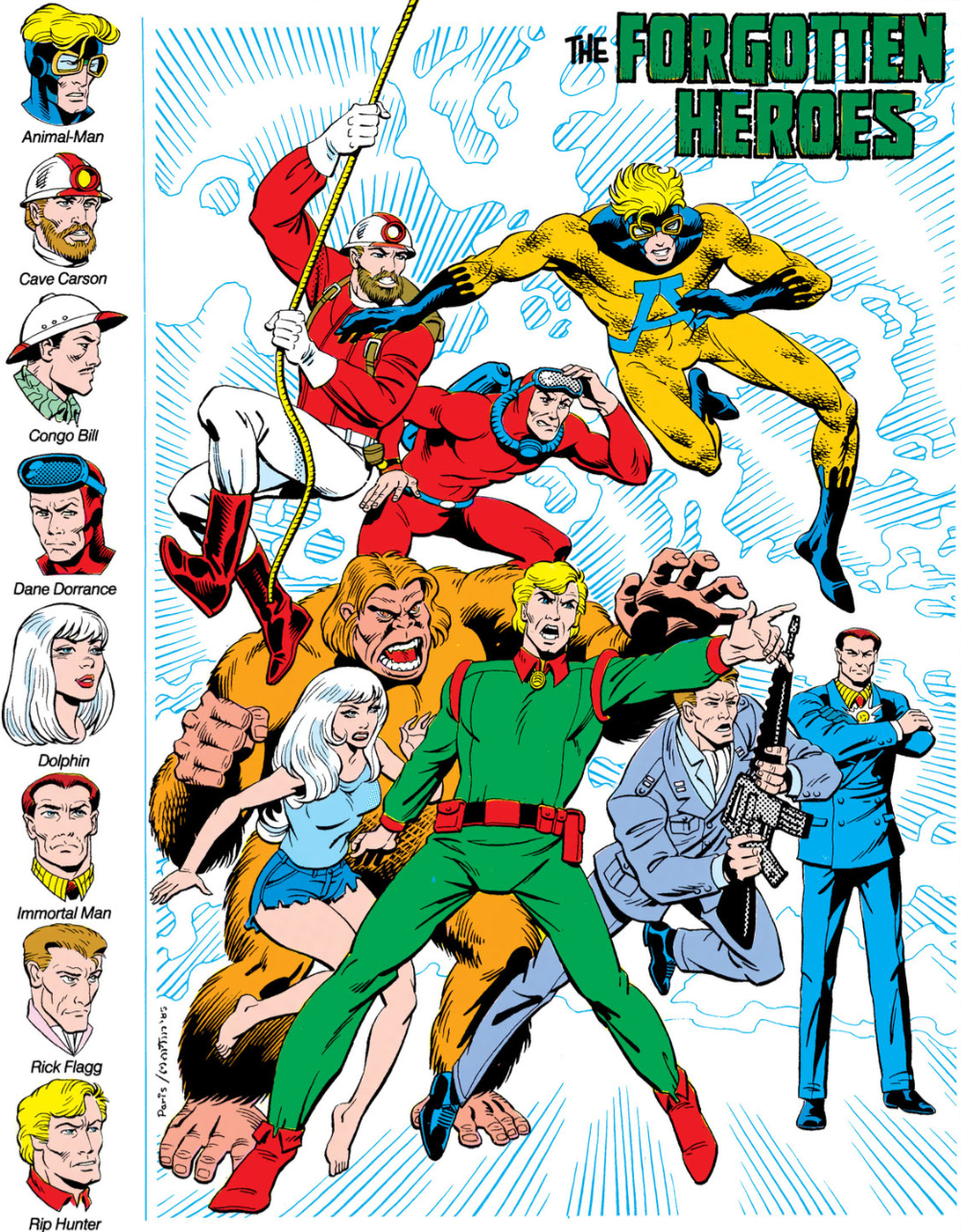
Bedard rushes through Aquaman's story to get to the fight against Deathblow, of all people. Here Aquaman is talked out of the aquarium by Dane Dorrance of the Sea Devils, and he follows Dorrance back to STAR Labs, where they hook Aquaman up with the same cybernetic harpoon he got in his own title and salt water showers.
The continuity is a little messed up, as Bedard intimates that Aquaman is pining for Mera, who the dome separated him from—in actuality, they had been apart for a while at the time Aquaman would have gotten domed, and she wouldn't reappear in Aquaman until #12...I don't think they actually got back together until Peter David stopped writing the Aquaman book.
Worse, there was some continuity wonkiness between the various tie-in books published this week. In Man of Steel, John Henry Irons narrates that "any hero or villain with biologically based super-powers lost those abilitis." Here Aquaman keeps his "biologically based" ability to breathe underwater, but loses his telepathy...which was either a genetic mutation (biological t hen, right?) or a magical-based power inherited from his sorcerer father. A lot of Aquaman's powers and origins were in flux at this moment in his history, really; Bedard seems to be working with the retconned version of the character, which de-retconned David's retcons to return him to his Silver Age origins. It's really quite distracting, having to second-guess so much of what you're reading (At least one other tie-in I read this week was worse still, as you'll see below).
An awful lot of time is spent introducing Aquaman's WildStorm universe opponent, although the five pages featuring Deathblow simply show him killing everyone in a Department of Extranormal Operations field office in order to look at their files on Aquaman.
I've really enjoyed artist Richards' work in the past, but this book is really nothing to write home about, as he uses a hyper-realistic approach, one in which almost every background or surface is a photo or photo effect. It's a really sickly, hard-to-look-at book. I kind of love cover artists Becky Cloonan's off-model '90s Aquaman though, and wonder what the book might have looked like had she got to draw all 22 of its interior pages instead of just the cover.

DC superhero comic book, where credibility is hardly very often a concern.
In the first issue of the Green Arrow mini-series, both California-based Connor Hawke and Seattle-based Oliver Queen (I think he would still have been in Seatlle pre-Zero Hour) find themselves trapped in Metropolis. Writer Christy Marx—who does a fine job here, even if Chuck Dixon seems a better choice for a '90s-era Green Arrow nostalgia project—at least attempts to explain their presence in Metropolis. Connor was there to check out a huge building someone gifted to his ashram, while Oliver was there "looking for someone."
The majority of the issue is character-focused, showing what the two characters were up to individually over the past year, and then staging a rather intense meeting between the two, as Connor knows Oliver is his father, but Oliver doesn't realize Connor is the son he left behind as an infant.
Thankfully, the Telos speech doesn't start until page 19, and they don't meet their opponents until the very last panel on page 22: Kingdom Come's Dinah Queen and her daughter by Oliver Queen, Olivia Queen, Black Canary II.
Penciled by Rags Morales and inked by Claude St. Aubin, this was by far the best-looking of this week's tie-in minis, and maybe one of the better overall so far. Morales is excellent at drawing people, both their figures and their faces, and thus was pretty perfect for this more dramatic than usual Convergence book, as there was an awful lot of content that had little to do with the goofy premise of the event.
In other words, the emphasis here was definitely more on the Green Arrow than on the Convergence. I wonder how or if Marx can keep that up in the second half of the series. The fact that the opponents are so closely related, and that Olivia stands in sharp contrast to Connor as a child that Oliver Queen—well, a Oliver Queen—stayed with, raised and trained at least shows potential. In far too many of these tie-ins, the opponents seem chosen completely at random.

The cover, by Walter Simonson, is pretty great though, and captures the look and spirit of Bogdanove's art from the era quite well.
Steel was visiting Metropolis with his niece Natasha and nephew Jemahl when the dome went up, and now Steel is filling in for Superman—the fact that his powers come from his suit rather than his body mean he's in the same fighting shape as always, while most of the heroes stuck in Metropolis are de-powered. Meanwhile he an his family work with Professor Hamilton to solve the dome problem.
It becomes a moot point when Telos drops the dome and Gen 13 is teleported in to fight. As with Aquaman and Deathblow, this particular match-up seems to have been chosen completely at random. The Gen 13 kids seem awfully ready to murder Steel instantly, too; it's been weird how ready to fight so many of the "heroes" participating in these fights have been (The most logical match-ups have been the ones that include villains or evil versions of heroes, like those from the Flashpoint timeline or The Extremists, as there's no leap in logic required to imagine them being willing participants in fights to the death).
This particular fight gets more complicated when The Parasite, whose powers got turned on when the dome fell, and Natasha and Jemahl, each wearing their own home-made suits of armor, join the fray, and Steel gets pretty much killed, ending the issue on his deathbed.
Despite the weirdness that's pretty much inherent in the premise of Convergence, this issue actually accomplished at least one major aspect of the event—it adeptly revisited a particular character and setting.

Superboy's powers in this comic include X-Ray vision and arctic breath, two of Superman's powers that Superboy has never had (in fact, in Superboy #0, the first issue of the series after the events of Zero Hour, he got a special pair of glasses that gave him Superman-like vision powers, including X-Ray vision and heat vision). He's referred to as "Kon-El," the Kryptonian name that Superman would eventually give him...but not until about five years (our time) later. And Superman is not even in this domed city, so it's not like he could have given Superboy the name at some earlier point during this differentiated timeline. Also, Dubbilex and Dr. Serling Roquette (the latter of whom Superboy would have yet to have met, although it's possible he met her earlier here) try to fix Superboy's powers by bombarding him by solar energy; that's how Superman's powers work, not Superboy's. It wasn't until a 2003 retcon that Geoff Johns made Superboy an actual genetic clone of Superman; at this point he was an attempt to replicate Superman, and his powers were derived from his tactile telekinesis.
At one point, Superboy falls prey to kryptonite gas; Superboy would have been vulnerable to kryptonite at this point, but he wouldn't have known it. It wasn't until Robin first decked him with Batman's kryptonite ring that Superboy learned he was vulnerable to it.
But other than those five or seven continuity errors in a 22-page comic book specifically designed to fondly recall a particular comic from a particular time period, then, you know, this wasn't that bad. That all might sound like nitpicking to many of you, but I think it well worth pointing out that in the particular case of Convergence, revisiting very particular versions of the characters is th entire premise of the series. Readers can, as always, try to no-prize the comic out of the mistakes its creators may have made, but if there was ever a project where DC shouldn't want their readers to have to do so, this would be it.
Writer Fabian Nicieza seems to be the one to blame, but he can share that blame with his editor and a pair of assistant editors. In the more broadstrokes, Nicieza does okay with the comic. Dubbilex and Serling are trying to restore Superboy's powers to him in a Metropolis lab, as Superboy lost them during the dome-ing. More than ever he feels the pressure to be able to stand in for Superman, who is not in this Metropolis, but he's never been less prepared to do so.
And then Telos drops the dome, restores everyone's powers and gives his speech. Superboy soon finds a trio of opponents. He dispatches the first two ridiculously easily—Red Robin Dick Grayson and The Flash Wally West from Kingdom Come—and then meets the third on the cliff-hanging splash: Kingdom Come's Superman.
Karl Moline provides the pencil art and Jose Marzan Jr. provides the inks. Their art is just fine, but neither seems particularly right for a story starring the early '90s version of Superboy (the artist most associated with the character from that point, Tom Grummett, drew last week's Convergence: Speed Force), nor for a story involving Alex Ross' Kingdom Come characters.
No complaints about Babs Tarr's excellent cover, though, which borrows a pose from Grummett while capturing the spirit of the artist and the subject matter. It would have been great fun to see the woman currently defining the 21st century Batgirl tackle an iconic teenage DC hero from a previous decade.
Lumberjanes #13 (Boom Studios) You know who they are, now find out how they came to be! This is a kinda sorta origin story for Roanoke Cabin, set on first day of camp, as we meet the various 'janes each getting dropped off by their families...and thus we meet their families as well (Well, with the exception of two of them, as one arrives in a cab and the other is already there). Slightly more interesting is the story of how Ripley got her hair 'do, and more interesting than all of that is the story of how molly got her hat. Original Lumberjanes artist Brooke Allen returns after a too-many issue absence to draw this one.

The first story is written by Lauren Beukes and features great art by Mike Maihack (whose work I last saw in Scholastic graphic novel Cleopatra In Space). Entitled "The Problem With Cats," it's a little on the trite side. It begins with a cool Wonder Woman adventure, in which she must try to save Batman and Superman from her villains Cheetah, Circe and Medusa, but we soon find out that adventure is taking place in the imagination of a little girl. She has a fight with her sister, imagines another adventure, and they make up and play Wonder Woman together. It's cute, Maihick's designs and art are great (and it's cool how he varies his art when depicting the imaginary scenes versus the "real" scenes in the story) and it's an all-around quite decent all-ages story. It's just that this is one more story about Wonder Woman in the sense of Wonder Woman as a symbol or idea, rather than a story about Wonder Woman in the sense of a fictional character who has adventures.
There are shockingly few really excellent stories of the latter kind, so it can be a frustrating to see such obviously talented folks take the slightly easier tack. At least for me as a fan; as a critic, I can't say there's anything wrong with the story per se, aside from maybe being a little on the over-obvious side.
The second story is by prose writer Cecil Castellucci (probably best known to comics readers for writing The Plain Janes from DC's short-lived Minx imprint for YA OGNs) and artists Chris Sprouse and Karl Story. Entitled "Girls' Day Out," it's a story in which Lois Lane interviews Wonder Woman which...well, it's been done before, at greater length and with more depth, by Phil Jimenez during his too-short run on the Wonder Woman title (the gag with the lasso of truth has been done before as well, maybe two times too often). Which isn't to say it doesn't have its moments—I loved the part where Lois Lane attacked the robot threat, saying she's getting the story which isn't really how journalism works outside of the Silver Age Daily Planet.
So it's not the best issue of the series, but it's far from the worse one either. It's got two good stories, even if it doesn't have any great ones. I'm pretty sure—without double-checking—that it has the best cover so far. It features Wonder Woman capturing her enemies from the first story, and is the work of Ben Caldwell, the cartoonist responsible for the winning Wonder Woman strip in Wednesday Comics.
Sunday, April 19, 2015
Who's Who in the DC Convergence #2
 |
| Brian Stelfreeze |
Created by Paul Norris and Mort Weisinger
Alter Egos: Orin, Arthur Curry
Occupation: King of Atlantis
Marital Status: Estranged from his wife, Mera
Known Relatives: Atlanta (mother, deceased), Atlan (father, immortal wizard), Orm/Ocean Master (half-brother), Arthur Junior (son, deceased), Koryak (son)
Group Affiliation: JLA
First appearance: MORE FUN COMICS #73 (1941)
HISTORY
Prince Orin was born to the Queen Atlanta and sired by the ancient Atlantean sorcerer Atlan. Because he was born with yellow hair, however, Atlantis' superstitious priestly class thought he bore the mark of the curse of Kordax, a green-skinned, yellow-haired ancient Atlantean with the power to control sea life.
Orin was left to perish at Mercy Reef, where low-tide would expose him to the air and kill him. He was rescued and adopted by a pod of dolphins, lead by his adoptive mother Porm, who raised the little Atlantean as if he were a young dolphin.
He was later adopted by a lonely lighthouse keeper named Arthur Curry, who gave the mysterious young boy from the sea his own name, and raised him until his death. After Arthur Curry Sr.'s disappearance, Orin/Arthur wandered the world by land and sea for years, eventually discovering his Atlantean birthright.
Estranged from his people, who, after the death of his mother were being ruled by a cruel dictator, Arthur spent a great deal of time among the surface world, where he befriended an emerging second-generation of superheroes that included Martian Manhunter, The Flash Barry Allen, Green Lantern Hal Jordan and Black Canary Dinah Lance. Together with Batman and Superman, the seven heroes formed The Justice League of America, named after their forebears in the Justice Society of America.
Arthur would eventually be made king of Atlantis, take on sidekicks Aqualad and Aquagirl and marry Mera, with whom he had a child, Arthur Jr. Their marriage ended badly, however, when their child was killed by Aquaman's arch-enemy Black Manta, and Mera went insane, blaming Aquaman for the boy's death.
A particularly moody superhero who was constantly being pulled in different directions, Aquaman would often withdraw from one or all of the worlds to which he belonged. During one such epic brooding session in the Aquacave, he grew his hair long and grew a beard. He was eventually drawn out by Aqualad, and in one of his greatest defeats since the death of his son, Aquaman was disfigured by the sea-going villain Charybdis.
Charybdis temporarily stole Aquaman's telepathic powers to communicate and control aquatic life, and forced is left arm into a pool of piranhas, who quickly skeletonize it from half of the forearm down. After recovering, the hero replaced his hand with first a harpoon, and then a golden-colored cybernetically-controlled hook with a retractable cord he could launch from its base and turn into a drill. To his dismay, he was becoming ever more like Kordax, who had his left hand chopped off as punishment, and who also had it replaced with a weapon.
During this time, Aquaman's incredibly contentious relationship with the Justice League—which included repelling a Wonder Woman-lead team that tried to enter his city of Poseidonis without prermission—gradually began to repair itself. When the entire world—oceans included—were under threat from an invasion by powerful alien beings calling themselves The Hyperclan, Aquaman somewhat reluctantly joined Wonder Woman, Martian Manhunter, Batman, Superman and Barry Allen and Hal Jordan's successors in forming a new, more powerful league to protect the Earth.
Under water, Aquaman continued to adventure with Aqualad, who had taken the new name of Tempest, and Dolphin, a white-haired young woman who was also a victim of Charybdis, and who helped save Aquaman and Aqualad from the villain.
POWERS & ABILITIES
Like all Atlanteans, who have evolved to be able to not only withstand but thrive at the deepest depths of the oceans, where the water pressure is powerful enough to crush human beings, Aquaman has a pronounced level of super-strength, super-speed, super-endurance and a level of invulnerability on land, when the pressure is removed.
Aquaman's most notable power, however, is his telepathy, with which he can use to communicate with and occasionally even command others to do his bidding. It works especially well on sea-life, but he can also communicate and attack other forms of life with relatively low-level psychic attacks. Doing so comes with a cost, however, as dominating others psychically has, on at least one occasion, transformed him his skin into fish-like scales, pushing him ever closer in appearance to Kordax.
Aquaman's preferred weapon is his right fist and the multi-function hook on his left hand. He occasionally carries tridents into battle, the most powerful of which is the Trident of Poseidon, the, like, actual Greek god Poseidon.
For further reading: ATLANTIS CHRONICLES #1-7 (1990), AQUAMAN: TIME AND TIDE (1996), AQUAMAN #1-47 (1994-1998), JLA #1-#58 (1997-2001)
 |
| Stelfreeze |
Created by Denny O’Neil and Joe Quesada (yes, that Joe Quesada), based on the character “created” “by” Bob Kane
Alter Egos: Jean-Paul Valley, Azrael
Group Affiliations: The Order of St. Dumas
Catch-phrase: “Yes, like the cat from The Smurfs. I have never heard that before. You are definitely the first person to ever mention that to me.”
First appearance: As Jean-Paul Valley, BATMAN: SWORD OF AZRAEL #1 (1992); as Batman, BATMAN #489 (1993)
HISTORY
Jean-Paul Valley was a Gotham City college student before he learned, upon his father’s death, that he was actually engineered and secretly trained since birth by The Order of St. Dumas’ advanced brain-washing and programming system, called, um, The System. He inherited his father’s title and role in the organization, but didn't want it.
Batman Bruce Wayne took him in, giving him a job as a security guard at Wayne Tech, while he and Robin Tim Drake trained Valley to fight Gotham City crime.
After Batman’s back was broken during a brutal fight with master criminal Bane, Wayne passed the mantle of the Batman and the keys to the Batcave to Valley, while Wayne and Alfred left the country to search for his kidnapped love interest Dr. Shondra Kinsolving (who, fortuitously, also possessed metahuman spinal damage-healing powers).
Valley proved psychologically unsuited to the task of being Batman, however, gradually altering the Batman costume until it was an unrecognizable suit of armor with clawed gauntlets that machine-gunned out little bat-shaped shuriken. He cut off all contact and cooperation with Robin, Commissioner Gordon and the Gotham Police Department, and gradually grew more and more extreme and violent, refusing to save a villain falling to his death (as Batman himself wold have done), which lead to the death of that villain’s hostage.
After Bruce Wayne was healed by Kinsolving's power, he trained under Lady Shiva to recover his edge and, with the help of allies Robin, Nightwing and even Catwoman, Wayne forcibly reclaimed his mantle from Valley. The former, fallen Batman eventually retook his Azrael identity, and after a period of estrangement from the Bat-family, he eventually rejoined them (and starred in his own monthly series).
He apparently died at the conclusion of his series Azrael: Agent of the Bat, a fact confirmed by his appearance as a Black Lantern in Blackest Night.
POWERS & ABILITIES
Valley’s bizarre upbringing gave him peak human physical condition, and made him an expert gymnast, athlete and hand-to-hand combatant. As Azrael, he originally fought with retractable flaming blades in his costume’s gauntlets.
As Batman, his armor was packed with offensive gadgetry (see above).
For further reading: BATMAN: SWORD OF AZRAEL, BATMAN: KNIGHTFALL VOLS. 1-3
 |
| Rodolfo Damaggio |
Created by Kelley Puckett and Jim Aparo
Alter Ego: Green Arrow
Marital Status: Single…ladies. And gentlemen.
Known Relatives: Oliver Queen (father), Sandra "Moonday" Hawke (mother)
Group Affiliations: JLA (but only for, like, seven issues)
Best Bros: Eddie Fyers, Green Lantern Kyle Rayner, Robin Tim Drake
Dietary restrictions: Vegetarian
First Appearance: GREEN ARROW #0 (1994)
HISTORY
Connor Hawke befriended Green Arrow Oliver Queen during the latter’s stay at a California ashram. Queen had retreated there in order to seek some sort of inner peace after thinking he had killed his former best friend Green Lantern Hal Jordan, who, at the time, had gone off the deep end and was calling himself "Parallax" and was in the process of destroying all of time and space in order to rebuild it himself (It would later be revealed/retconned that Jordan was actually possessed by an ancient fear entity called Parallax; see Parallax for more).
While Hawke and Queen were traveling together with former federal agent Eddie Fyers, the pair learned that Oliver was actually Connor’s father, conceived many years earlier during a tryst with Sandra "Moonday" Hawke. Shortly afterwards, Queen gave his life while saving Metropolis from an eco-terrorist group, and Connor took up the mantle of Green Arrow until Oliver’s eventual/inevitable resurrection, after which point they both went by the name Green Arrow, fighting crime together and separately until the events of Flashpoint lead to the restructuring of the DC Universe and its timeline, apparently wiping Connor out of existence (Although a Connor Hawke would later surface on Earth-2).
POWERS & ABILITIES
Connor Hawke is a superb archer, although not nearly as talented with a bow and arrow as his father was. He nevertheless continued to carry the weapon into battle after taking up the mantle of Green Arrow in order to honor his late father.
Hawke is a better hand-to-hand combatant than he is an archer, however, and is, in fact, one of the best martial artists in the DC Universe, and has only rarely been defeated (in one notable instance, by Lady Shiva, widely believed to be the world’s greatest martial artist and assassin).
Hawke is also one of the handsomest young men in the DC Universe, which, when combined with his relative innocence and naivete, has made him pretty much irresistible to women, which he doesn't really know what to do with.
For further reading: Connor’s tenure as GA lasted from GREEN ARROW #91-#137 (1994-1998), pretty much none of which is available in trade. GREEN LANTERN: EMERALD ALLIES (2000) collects Connor's first meeting with Green Lantern Kyle Rayner. The so-so miniseries CONNOR HAWKE: DRAGON’S BLOOD (2008) did get collected, but is hardly the best Hawke story around. One of the best Connor Hawke stories was that in JLA #8-9 (1997), collected in a couple different JLA trades over the years. ADVENTURES IN THE DC UNIVERSE #16 (1997) is well-worth seeking out.
 |
| Jim Lee |
Created by Jim Lee and Brandon Choi
Alter Ego: Michael Cray
Occupation: U.S. and International special forces operative
Known Relatives: Admiral Phillip James Cray (father), Elizabeth Cray (mother), Alexander Cray (brother), Rachel Goldman/Sublime (daughter)
Group Affiliations: U.S. Navy, SEALs, International Operations, Team 7, StormWatch
Signature look: Eye-make up, bandanna
First appearance: DARKER IMAGE #1 (1992)
HISTORY
Driven to join the armed forces to avenge the death of his parents at the hands of terrorists, Michael Cray was eventually recruited into the International Operations, formerly part of the Central Intelligence Agency, where he was assigned to their elite Team 7. Like the rest of his team, he was maneuvered into being exposed to the "Gen Factor," which would have made them "Gen Active," which is WildStorm jargon for "super-powered." Many of them died, some survived with powers, while others—like Cray—did neither.
He continued to work with IO for sometime, before going solo and attempting to atone for all of his misdeeds. He had many adventures, a few inter-company crossovers and eventually gained low-level superpowers, including a healing factor and the ability to subconsciously manifest force-fields for self-defense, a delayed result of his exposure to the Gen Factor.
Then he died and there were some reboots, but obviously the Deathblow in Convergence was plucked from a time before his death.
POWERS & ABILITIES
With or without his superpowers, Deathblow is super-good at killing people.
For further reading: DEATHBLOW (2015), DEATHBLOW VOL. 1 (2008), BATMAN/DEATHBLOW: AFTER THE FIRE (2014)
 |
| Nicola Scott |
Created by James Robinson and Nicola Scott, based on the character created by Harry Lampert and Gardner Fox
Alter Ego: Jason "Jay" Garrick
Occupation: Unemployed college graduate
Marital Status: Totally dumped by his girlfriend Joan Williams
Known Relatives: Mother
Group Affiliation: World Army
First appearance: EARTH 2 #1 (2012)
HISTORY
Five years of the his world's "Wonders" Superman, Batman, Wonder Woman, Robin and Supergirl either died or disappeared while repelling an invasion from Apokolips, recent college Jay Garrick had a strange encounter that would transform him into the first of a new wave of Wonders.
The dying god Mercury, who, told Garrick that he and many other gods had been fighting Apokolips unseen and that he had been captured by an even darker force with designs on their world, offered Garrick a dire warning about the future. He then gifted Garrick with the last of his power, giving Garrick super-speed.
He had to put his new power to the test almost immediately, as he and Hawkgirl, a former agent of the World Army who had gone rogue, joined the new hero Green Lantern in saving Washington DC from Solomon Grundy, the powerful avatar of The Grey.
The Flash, like his new allies, was briefly hunted by the World Army, and he had a particularly close call at his mother's house. After coming to the aid of Khalid Ben-Hassin, who would become Dr. Fate, against Wotan, it seemed as if The Flash had gained enough new allies to form some sort of team of heroes who could fight for justice together...but that was all rather quickly derailed when Apokolips attacked Earth yet again. Flash, like his super-powered allies, was quickly swept up in a losing-battle to save their world.
Millions of people escaped Earth on space-faring refugee ships, including Garrick's mom, while he, Green Lantern, Superman II, Batman II, former avatar Yolanda Montez and young civilian war correspondent Dick Grayson were transported to the mysterious sentient planet Telos.
POWERS & ABILITIES
The Flash can run fast. Really, really fast.
For further reading: EARTH 2 VOLS. 1-5, EARTH 2: WORLD'S END
 |
| Scott |
Created by James Robinson and Nicola Scott, based on the character created Martin Nodell
Alter Ego: Alan Scott
Occupation: Founder and CEO of media empire GBC productions, Avatar of The Green
Marital Status: Kind of a sore subject
Group Affiliation: World Army
First appearance: EARTH 2 #1 (2012)
HISTORY
A powerful media mogul and one of his world's richest men, Scott seemingly had everything going for him, or as much as anyone from his world—which suffered horrifically during an invasion from Apokolips that claimed the lives of his world's few heroes ago—could.
While taking a much-needed vacation with his long-time boyfriend Sam Zhao in China, Scott was about to propose when the train they were on had a terrible accident, killing Sam and the other passengers. Scott was miraculously saved by the intercession of a mysterious green flame that chose Scott to be its champion. It healed him, gave him a new costume and asked him to choose a token through which he cold channel his new powers. He chose the ring he had planned on placing on Sam's finger.
Scott discovered that the flame speaking to him was the voice of The Green, a mysterious force that connected all organic life on his Earth. Scott could now create force-fields and force-blasts of green energy, could fly and do almost anything...his only limitation being his own will-power, and his nearness to the Earth itself (when he almost leaves the planet's atmosphere at one point, his powers extinguish).
Scott's first duty as Earth's Green Lantern was to defeat the Solomon Grundy, the avatar of the The Gray.
Scott did so with help from The Flash and Hawkgirl, although when they proposed an alliance, he rebuffed them, angry and embittered by the loss of Sam. Hawkgirl attempts to convince him otherwise, even helping Scott investigate what exactly caused the train wreck that claimed Sam's life.
When Apokolips launched a new assault on Earth, Scott, as the world's most powerful hero, lead the resistance, taking on Superman clone Brutaal and joining forces with The World Army and its own handful of heroes.
Together with a motley crew of heroes, Scott sought to defend Earth from yet another Apokolyptian invasion, rallying Earth's other avatars and even facing Darkseid himself in one-on-one combat. But the champions of Earth were overmatched and eventually overwhelemed. Millions of refugees attempted to flee the dying world before it was completely consumed by Apokolips. Scott, Flash, Superman II, Batman II, former avatar Yolanda Montez and young civilian war correspondent Dick Grayson were transported to the mysterious sentient planet Telos.
POWERS & ABILITIES
Through the powers imbued in him by The Green, Scott is able to manipulate magical green energy in a way that gives him super-human strength and invulnerability, as well as to fly, create force-fields and other energy constructs, and to project offensive blasts of green energy.
He also has some power of plant-life, which he can cause to grow supernaturally fast, and can communicate with The Green and the other aspects of the Earth, like The Grey.
For further reading: EARTH 2 VOLS. 1-5, EARTH 2: WORLD'S END
 |
| Adam Warren |
Created by Jim Lee, J. Scott Campbell and Brandon Choi
Base of Operations: La Jolla, California, WildStorm Universe
Line-up: Caitlin Fairchild, Sarah Rainmaker, Roxanne "Roxy" Spaulding/Freefall, Percival Edmund Chang/Grunge, Bobby Lane/Burnout and John Lynch
First appearance: WILDCATS TRILOGY #1 (1993)
The blandly-named International Operations, a one-time branch of the Central Intelligence Agency that eventually became its own, distinct entity, initiated an internship program for young people—which was in actuality an excuse to perform tests on the "Gen-Active" (i.e. super-powered) children of the members of IO's strikeforce, Team 7.
One of the programs enrollees, Caitlin Fairchild, escaped with several others, but later returned to free the others—and ended up getting caught themselves. Eventually freed with the help of John Lynch, one of the members of Team 7, the teens hooked up with Sarah Rainmaker and, under the leadership of Lynch, they formed the superhero team Gen 13.
Fairchild is the smartest member of the team, and their natural leader. She gained super-strength, super-speed and a degree of invulnerability when her powers were activated--along with a tall, buxom new figure. Despite her smarts, here clothes were regularly damaged are accidentally removed, and she would sometimes be unaware of such changes in circumstances.
Roxanne "Roxy" Spaulding, aka Freefall, is Fairchild's younger half-sister, and has the power to manipulate gravity, allowing herself to float or fly by lessening it, or increasing it in or around others to knock them down or pin them.
Edmund Percival Chang took the name "Grunge," which will certainly never make the character the least bit dated, and had the power to mimic the molecular make-up of any material he touches, not unlike DC's Amazing Man or Marvel's Absorbing Man.
Bobby Lane, aka Burnout, is basically just Johnny Storm from The Fantastic Four, while Sarah Rainmaker is basically just Storm from the X-Men.
Together with Lynch and/or their robot maid Anna, the team had many adventures, most of them extremely derivative of those of the X-Men on whom they were so clearly based. Despite their humbling beginnings, cartoonist Adam Warren turned out some of the very best superhero comics of the late '90s and early '00s using these characters.
For further reading: If you're looking in the back-issue bins, you're better off with GEN 13 BOOTLEG (1996-1998) than any of the earlier, non-Adam Warren GEN 13 stuff. After GEN 13 BOOTlEg: GRUNGE: THE MOVIE (1997) and GEN 13: MAGICAL DRAMA QUEEN ROXY (1998), Warren had the reigns for the GEN 13 ongoing from #60-77 (2001-2002). The team crossed over with Superman, The Fantastic Four, Generation X, The Maxx and Monkey Man and O'Brien...all worth a look for novelty's sake at least.
 |
| Ron Wagner |
Hal Jordan created by John Broome and Gil Kane; Parallax created by Ron Marz and Daryl Cunninham
Alter Ego: Hal Jordan
Hobby: Playing God
Group Affiliation: The Green Lantern Corps...at least up until he killed them all
First appearance: GREEN LANTERN #50 (1994)
HISTORY
At the dawn of the modern age of superheroes, Hal Jordan became the first Earthling to ever be inducted into the Green Lantern Corps, the universe-wide peace-keeping force created by the Guardians of The Universe who were gifted with green power rings capable of creating and manipulating green energy and matter.
Jordan was a successful Green Lantern for years, becoming one of the best in the organization's history—despite a rebellious streak that often caused him to butt heads with the Guardians—and was one of the world's premiere heroes, co-founding the Justice League and serving with the team for may years.
When Mongul and the Cyborg-Superman destroyed his hometown of Coast City, California, Jordan went a little insane, fighting and killing most of Corps, all but one of the Guardians and his archenemy, the fallen Green Lantern Sinestro, who had long fought against Jordan and the Green Lanterns with a Qwardian-created yellow power ring.
With each Lantern Jordan defeated, he took their rings and absorbed their power, eventually draining the power from the organization's central power battery on Oa, the source of the entire Corps' power. Shortly after this, Jordan was confronted by former GLs Guy Gardner and Arisa, Sentinel (Original Green Lantern Alan Scott), Wonder Woman, Martian Manhunter, Captain Atom and Darkstar Colos, but Jordan defeated them quickly and thoroughly.
While his actions seemed to be a complete 180, they eventually made a sort of sense. Working with the temporally-powered villain Extant (formerly Monarch, and formerly Hank "Hawk" Hall before that), at least until he was able to absorb his underling's power over the time-stream, Jordan—now calling himself "Parallax"—sought to de-create the universe, eating away the time stream at both the beginning and end of time until it no longer existed. He would then use his practically omnipotent powers to re-create the universe, this time making it so that Coast City was never destroyed and its many inhabitants never annihilated.
A large contingent of superheroes, including Superman, The Ray, a time-lost Batgirl Barbara Gordon, Guy Gardner, Jordan's successor Green Lantern Kyle Rayner, battled Parallax outside of time and space, ultimately defeating him when Green Arrow Oliver Queen—Jordan's best friend—fired an arrow into his chest. Superman and the others then re-started the universe themselves by creating a new "Big Bang" via the young hero Damage. The DC Universe and it's de-created timeline were thus re-created, but without Jordan to guide it. This new timeline was fairly identical to the old one, with only a few significant changes that were unknown to those within the DC Universe (We sure noticed on Earth-33, however).
Parallax would appear only a few more times after the events of Zero Hour, generally causing trouble with his incredible powers even when trying to do good (as when he attempted to resurrect the dead Oliver Queen and only succeeding in creating an exact but soulless clone of his body), and he would ultimately give his life to destroy an extra-dimensional "suneater" entity that was snuffing out the sun.
Writer Geoff Johns would later retcon the hell out of the character in Green Lantern: Rebirth; it was a pretty elegant solution to a perceived problem that made the plot of Jordan's arc much more complicated, while making the drama and ethical issues of that arc more simplistic. None of that much matters as far as is Convergence is concerned, however, as it features a pre-Final Night version of Parallax.
POWERS & ABILITIES
Parallax could do pretty much anything. By the time he had defeated the GLC and Guardians, Jordan had essentially become a living power battery, capable of absorbing and manipulating energies of any kind, including the fundamental powers of existence, like time itself. Jordan was physically powerful enough to knock Superman on his ass with his bare hands, and to destroy and remake the universe. Even when his powers were fairly depleted, he retained powers similar but greater than those of a Guardian.
For further reading: GREEN LANTERN: EMERALD TWILIGHT, GUY GARDNER: WARRIOR #18-21 (1994), ZERO HOUR, GREEN LANTERN #0 (1994), FINAL NIGHT (1998), PARALLAX: EMERALD NIGHT (1996)...and DAY OF JUDGEMENT and GREEN LANTERN: REBIRTH if you want to know what happened to Jordan after he stopped calling himself "Parallax."
 |
| Jon Bogdanove |
Created by Louise Simonson and Jon Bogdanove
Alter Ego: Dr. John Henry Irons
Occupation: Construction worker/crimefighter
Known relatives: Butter (grandfather), Bess (grandmother), Clay/Crash (brother), Blondell (sister-in-law), Jemahl, Paco and Tyke (nephews), Natasha and Darlene (nieces)
No relation to: Henry Heywood
Base of Operations: Metropolis
First Appearance: ADVENTURES OF SUPERMAN #500 (1993)
HISTORY
Dr. John Henry Irons, named for the African-American folk hero who challenged a machine in a steel-driving contest that he won at the cost of his own life, was a brilliant inventor and engineer working for AmerTek Industries. Irons was chiefly responsible for the creation of a hand-held energy cannon, which, upon falling into the wrong hands, had the potential to become the automatic handgun of laser guns. Disgusted, Irons faked his own death and started a new life as a construction worker in Metropolis.
One day he saved a fellow worker from falling from a high-rise girder, only to fall himself. He was saved by Superman, who, when asked by Irons what he could ever do to repay Superman, was told simply to "live a life worth saving."
Irons had ample opportunity to do so when Superman "died" in his battle to stop Doomsday (a battle which buried Irons in an avalanche of rubble). Irons used his engineering skills to create a high-tech suit of armor, complete with a big Superman-style S-shield and a red cape, and stepped up to try and replace the dead Superman. The Man of Steel, as Irons appropriately called himself, was only one of four to attempet filling the late Superman's red boots--a teenage clone, a brutal vigilante wearing a visor and a cyborg all converged in Metropolis claiming to be the real Superman--but he was the only one to attempt it without the benefit of superpowers.
Steel's first major battles in Metropolis were pretty personal, as he soon discovered that new versions of his energy cannons were being used by local street gangs, who called the deadly new weapons "Toastmasters." The source of the weapons turned out to be the criminal The White Rabbit, the new identity of Irons' former AmerTek partner Dr. Angora Lapin.
When the nefarious nature of the Cyborg Superman was finally revealed, Steel joined "The Kid" (the name teen Superman clone preferred to "Superboy") and the alive-but-weakened Kal-El in storming Engine City, which the Cyborg and his extrateresstrial ally Mongul had built on the ruins of Coast City. Eventually joined by Green Lantern Hal Jordan, Supergirl and The Eradicator (the true identity of the fourth substitute Superman), they succeeded in defeating The Cyborg and Mongul, and saving Metropolis from a devastating missile attack.
Steel, as he shortened his name to after Superman returned, later moved to Washington D.C. to be closer to his family, and adopted the city under his protection. He would move a few more times, repeatedly refine his armor and its design, and develop a close relationship with his niece Natasha. His greatest adventures, including being recruited into the re-formed JLA after the new, more powerful team's battles against The Hyperc Can, rogue angel Asmodel and The Injustice Gang, would follow in the years after Zero Hour.
POWERS & ABILITIES
Steel (usually) doesn't have any superpowers, but tampering from otuside forces has occasionally given him tempoary powers of various kinds. Despite being a regular human being—if bigger, stronger and in better shape than most—his incredible armor gives him the strength and abilities of a metahuman. In addition to offering him a high-degree of vulnerability, super-strenth and flight capabilities, his original armor included a high-powered, wrist-mounted rivet gun that fired hot, metal rivets with incredible accuracy, and a long-handled sledgehammer. Later suits contained various features, including a "smart hammer" with a shorter handle that he could control, and had the unique ability to hit harder the farther it was thrown.
Steel is a genius-level intellect, adept in the fields of engineering, munitions, medicine and physics, and is one of the world's foremost super-scientists.
For future reading: RETURN OF SUPERMAN (1993) or SUPERMAN: DEATH AND RETURN OF SUPERMAN OMNIBUS (2013); while none of it is currently available in trade paperback form, John Henry Irons starred in his the 52-issue monthly STEEL (1994-1998), which isn't too hard to find in back-issue bins. He was a common presence in the Superman books from his creation onward as well.
 |
| Tom Grummett |
Created by John Byrne, based on the character created by Otto Binder, Curt Swan and Al Plastino, based on the character Superman created by Jerry Siegel and Joe Shuster
Alter Ego: Matrix, Mae Kent, Exhibit A In How Sometimes Attempting To Simplify Superhero Comics Only Makes Them More Comiplicated
Known relatives: Martha Kent (adoptive mother), Jonathan Kent (adoptive father), Superman/Clark Kent/Kal-El (adopted brother)
Bases of Operations: Smallville, Kansas and Metropolis
First appearance: SUPERMAN #16 (1988)
HISTORY
Deep breath. Okay, in an alternate reality referred to as a "pocket universe," as there weren't any alternate realities at the time, three Kryptonian superheroes escaped their Phantom Zone imprisonment to wreak havoc. That reality's Lex Luthor had created an artificial life form called "the protoplasmic matrix," which resembled the late Lana Lang and had all of her memories, but which had the physiology and all of the superpowers of the one, true Superman from the DCU (the pocket reality's Kal-El having died while still Superboy, and thus never growing up to become Superman.
After failing to stop the criminals on her own in her Supergirl form, Matrix came to the DCU to recruit Superman's aid. He helped her, but by the time they defeated the criminals, the pocket universe was lifeless and destroyed.
Superman then took this Supergirl to his own reality and left her with his parents, who named her Mae and tried to instill in her the same good old-fashioned, Midwestern, down-on-the-farm values that made their adopted son such a great hero.
When her powers malfunctioned a bit, she fled for the seclusion of space, eventually returning to Earth...and falling in love with Lex Luthor II (actually the one and only Lex Luthor, whose mind was in a younger clone of himself and who was now posing as his own son). This naturally made things awkward with her adoptive brother.
Supergirl tried and failed to help Superman stop Doomsday and, after his death, tried to fill in as best she could as Metropolis' protector (a role in which she found a lot of competition, as it seemed to be raining Supermen). She aided Steel, Superboy and the not-dead-after all Superman in defeating The Cyborg-Superman and Mongul, and had a pretty dramatic falling-out with Luthor when she discovered he had been secretly cloning her.
Things would get much, much weirder when she began to question if she had a soul and met the young Linda Danvers, but that business would all occur after the events of Zero Hour, which excuses us from having to talk about them at all, thank goodness.
POWERS & ABILITIES
The Matrix had the ability to change shape and could be imprinted with the thoughts, memories and abilities of others. Her basic super-power, however, was a powerful telekinesis, which could be used to mimic most of Superman's powers, in addition to allowing her to "cloak" herself visually and aurally, create defensive force fields and attack others with offensive psionic force blasts.
For further reading: SUPERMAN: THE MAN OF STEEL VOL. 8 (2014), SUPERMAN: THEY SAVED LUTHOR'S BRAIN (2000), THE DEATH OF SUPERMAN (2013), WORLD WITHOUT A SUPERMAN (1993), THE RETURN OF SUPERMAN (1993), SUPERGIRL #1-4 (1994)
Friday, April 17, 2015
You will believe might be persuaded to suspend your disbelief regarding whether or not a Predator can fly.

Thursday, April 16, 2015
Reggie Mantle is a gosh-darn sexual Tyrannosaur.

Wednesday, April 15, 2015
This should totally be the next DC superhero film:


Bonus? The line-up is set and the casting is already done, so all they'd need to do is get a script and a director. Which means this movie that I just imagined is just about as close to completion as the Wonder Woman film is, right?
Tuesday, April 14, 2015
Review: All-New X-Men Vol. 5: One Down

As of right this second, there are five volumes of All-New X-Men and four volumes of Uncanny X-Men (the fifth will come out on Wednesday). They are all numbered, which certainly helps, at least in terms of which volume in each of those titles to read in which order. But the two series are inter-connected, so you wouldn't want to read, like, all five volumes of All-New and then start in on Uncanny. Also, Battle of The Atom, a massive, 250-page collection of a storyline running through several different X-books including All-New and Uncanny, happens between volumes of both series. So that's pretty important to read. And Guardians of The Galaxy/All-New X-Men: The Trial of Jean Grey is kinda important to the proceedings of All-New (but not Uncanny), so you'd want to read that too. I think the reading order would be something like All-New Vols. 1-3, Battle of The Atom, All-New Vol. 4, Trial of Jean Grey and then All-New Vol. 5. That's at least half of Bendis' run on X-Men, but just the half that follows the All-New team, the five original X-Men brought forward from their past into our present/their future. Oh, yeah, there's time-travel involved too!
These movies, they're kind of hard to walk in on the middle of, aren't they? Even if you're watching them on DVD. Because some have numbers on the spine, and some don't. I guess the trades, like this one, all start with a recap page, but the two paragraphs of text at the beginning of this one are pretty vague and meaningless. I'd prefer a, "Hey dummy, make sure you read these trades in this order" kind of thing.
Anyway—All-New X-Men Vol. 5: One Down.
This was kind of a frustrating read, because it was a Brian Michael Bendis-written comic and an X-Men comic, so of course it was frustrating, but what I found most frustrating was that I couldn't figure out what the sub-title referred to. Was it that one of the original X-Men left? Because he did that in comics previous to the ones collected herein. I thought it might refer to a runaway student of the New Xavier School—the one Grown-Up Cyclops runs, not the establishment school that Wolverine was running until he "died"; that's called The Jean Grey School now—but she actually comes back shortly after she tries to leave. I thought it might also refer to one of the time-traveling villains, who gets caught by the end of this trade, but then he gets away by writing a letter to himself in the future. So that's probably not it either.
Speaking of frustrating, this six-issue collection kicks off with All-New X-Men #25, which is treated as a noteworthy anniversary issue, despite the fact that Marvel's randomly accelerated publishing schedules means it doesn't take 25 months to reach 25 issues anymore, and their willingness to reset the issue clock back to #1 at the drop of Tom Brevoort's hat—sometimes the creative team doesn't even have to change—that numbering's not really relevant anymore.
 |
Unequivocally awesome? Rafael Grampa's variant
|
But on the other hand: The plot.
It boils down to this: The Beast is having trouble sleeping, and a bald man is in the corner of his bedroom, mumbling a bunch of random nonsense about alternate realities for 32 pages, with the 18 guest art teams mostly contributing pin-ups with random subject matter. There are a few examples of sequences that occur within the pin-ups, like a segment in which Adams draws a bestial Beast hunting and eating dinosaurs in The Savage Land, and, more weirdly still, there are entire short, jokey, 1-2 page comic strips that occur within the story—during which time the mysterious bald figure conveniently stops narrating. It's a really fucking weird comic; I liked seeing so many great artists play with the characters, even if the majority of them are restricted to what often amounts to no more than a cover featuring a single character, but at the same time it's irritatingly pointless. In fact, it may or may not be a dream of Beast's, and it doesn't matter either way if it is or isn't.
Well, a bald man talking endlessly at a frustrated, captive audience about completely irrelevant non-events to kill time does serve a pretty good metaphor for an awful lot of Bendis' writing for Marvel. His X-Men run in particular, as Secret Wars looks like it will be resolving the plotlines of All-New in a rather expected and transparent fashion (although I hope I'm wrong, as "and then we rebooted the timeline" would be the most disappointing ending imaginable to this story of the time-lost X-Men).
After the story of Beast's dreams of pin-ups—which Marvel charged $4.99 for, despite the fact that 15 of those pages were simple splashes, and three of 'em double-page splashes!—the book resumes telling a story of some kind.
The narrative apparently picks up after the events of The Trial of Jean Grey, with Jean troubled by her newfound power and power levels and Teen Cyclops missing from the team, having elected to stay in space with his space-pirate dad.
X-23, who has barely been in the book at all—a subject of repeated jokes, actually—elects to leave, but as she's going she meets someone else coming—The Brotherhood from Battle of The Atom, i.e. the evil future X-Men lead by Charles Xavier Jr. who came back in time to force the present X-Men to send the past X-Men back to the past before they fuck up the future.
It's essentially a big rematch fight then, but this time there are relatively fewer X-Men around to oppose The Brotherhood, and Bendis takes time to jump around in the villains' own personal timelines, to show their origins and what banded many of them together. It ends with a pair of significant revelations, and a clever twist on the idea of time travelling villains from the future...although it's an aspect of time travel stories I've never liked (I remembered being really upset by it while watching Bill and Ted's Excellent Adventure as a 12-year-old).
The final issue is a chill-out one of the sort that often occurs between big story arcs in super-team books, in which Angel and X-23 go dancing at a club together and then hook up. It, and thus the collection, ends with a pretty big cliffhanger, as a handful of the Jean Grey School's X-Men arrive at the supposedly secret location of the New Xavier School, but it's a cliffhanger that will pick up in Uncanny rather than All-New; next on All-New's agenda is a trip to the Ultimate Universe.
*One of my favorite artists, and one whose work appears in comics way too infrequently. I have no no idea who his two-page splash depicted though. Magick and...one or two or three other X-ladies...?
Saturday, April 11, 2015
Who's Who in the DC Convergence #1
 |
| Ladronn |
Created by Grant Morrison, Gail Simone and John Byrne, based on the character created by Julius Schwartz, Gardner Fox and Gil Kane, which was very loosely based on the character created by Ben Flinton and Bill O’Conner
Alter Ego: Ryan Choi
Known relatives: A disapproving father
Occupation: Professor at Ivy University
Base of Operations: Ivy Town, somewhere in New England
First Appearance: DCU: BRAVE NEW WORLD (2006)
HISTORY
Hong Kong-born scientist Ryan Choi was a longtime admirer of Ray Palmer, with whom he exchanged letters for years. When Palmer disappeared after the events of Identity Crisis (if you haven’t read it, don’t; it’s terrible), Choi moved to America with his father and took Palmer’s place on Ivy University’s teaching staff…and, upon finding a size and density-changing belt, he also took Palmer’s place as The Atom.
Palmer’s years of weird adventures in and around Ivy Town had warped the fabric of reality, making the place a sort of hotspot for various weird and paranormal menaces, which Choi bravely fought using his keen mind and Palmer-gifted abilities to shrink.
He battled a cancer god, microscopic aliens, a shrinking serial killer and Wonder Woman villain Giganta before being pulled into the unfortunate events of Countdown (Don’t read that either; it’s even worse than Identity Crisis).
When Palmer finally returned, he and Choi straightened out the nature of their relationship—which wasn’t as Choi and readers thought it was—but they both continued to use the name The Atom.
And then Choi got killed by Deathstroke and a team of lame-ass villains, and his tiny little body was stuck in a matchbox.
POWERS & WEAPONS
Choi wore a “bio-belt” that gave him powers identical to those of his predecessor, Ray Palmer. He could shrink to unimaginably small sizes, while retaining his density, so, like Palmer, he could shrink to the size of a flea, but still punch with the force of a grown man.
Also like Palmer, Choi is a brilliant scientist specializing in physics and the emerging field of super-science.
Unlike Palmer, he often fought with a weapon of sorts, which he called a “Bangstick.” Originally conceived by his friends in the Lighter Than Air Society as a means for sub-atomic propulsion, this special staff could also produce a concussive effect. As for why it was called a Bangstick instead of a "Boom Stick," well, the latter was already taken.
Choi also knew martial arts, because he was Asian, so of course he had to know martial arts.
For further reading: Choi starred in The All-New Atom, which lasted 25 issues, and was collected in four trade collections. He was an interesting character, and the series had an interesting premise, but it was overall pretty terrible from start to finish.
 |
| Phil Noto |
Stephanie Brown/Spoiler created by Chuck Dixon and Tom Lyle; Batgirl created by Gardner Fox and Carmine Infantino, inspired by Bill Finger and Sheldon Moldoff's Bat-Girl.
Alter Ego: Stephanie Brown
Occupation: Gotham University student
Known relatives: Arthur Brown/Cluemaster (father), Crystal Brown (mother) and a daughter she gave up for adoption
Group Affiliation: Batman, Incorporated
Base of Operatons: Gotham City
Favorite color: Purple
Favorite food: Waffles, apparently
First Appearance: As Stephanie Brown, DETECTIVE COMICS #647 (1992); as Batgirl, BATGIRL #1 (2009)
HISTORY
The daughter of Z-List Gotham criminal Arthur "Cluemaster" Brown, Stephanie grew up resenting her father for spending most of her childhood in jail, and for being an all-around bad guy. As a teenager, she created a fuchsia costume and began her career as the vigilante crimefighter The Spoiler; this was back when a "spoiler" was someone who spoiled things, and did not yet refer to giving away the ending of a movie, television show or other piece of popular entertainment on the Internet. What she wanted to spoil was simply her father's criminal plans.
This brought her into Batman and Robin's orbit, and, before long, she took a romantic interest in then-Robin Tim Drake. The pair had an intense on-again, off-again relationship; sometimes romantic, sometimes as crime-fighting partners, sometimes as just friends.
Despite her closeness to Tim, Stephanie was never very readily accepted by Batman and the rest of Gotham's vigilante community, most of whom repeatedly attempted to get her stop trying to be a superhero. She did seem to finally gain Batman's acceptance when he made her the fourth Robin, replacing Tim Drake when Drake temporarily quit. This was, in actuality, just one in a long line of dick moves by Batman, as he took Stephanie on as Robin mainly to convince Tim to return to the role.
After Batman fired her as his sidekick, she resumed her Spoiler identity and sought to prove herself by...well, this part never really made sense to me. "War Games," that is. It was a big, stupid Batman crossover story in which Spoiler somehow accidentally set-off a gang war in Gotham City, but the war and her role in it didn't really make any goddam sense. She was tortured to death via power tools by the villain The Black Mask, because The Joker was apparently busy.
No one in the whole world liked this, so it was later retconned to reveal that Stephanie and Dr. Leslie Thompkins had faked the former's death, in an attempt to make Batman feel bad about violence. That seems like kind of a dick move, too.
Anyway, she next became Batgirl, when her friend Cassandra Cain decided to stop being Batgirl, since she could no longer make sense of her own continuity, as every story involving Cassandra Cain since the concusion of her title made even less sense than "War Games" did. Stephanie started out by rocking Cassandra's costume, but eventually Barbara "Oracle" Gordon, the original Batgirl, decided to quit giving Stephanie static, and became her partner and mentor, even designing her a brand-new Batgirl costume, which included lots of purple and a utility garter belt.
Stephanie seemed to flourish as Batgirl, earning Oracle's respect and, upon his return from his "death," even Batman's official sanctioning, as he made her a part of his Batman, Incorporated initiative.
And then Flashpoint happened.
POWERS & ABILITIES:
Stephanie Brown has no super-powers, and hasn't had the years of extensive training that many of those in Batman's circle of allies have had, making her the least formidable of the three Batgirls to date. She has trained with Robin Tim Drake, Batgirl Cassandra Cain, Batman himself and The Birds of Prey, particularly Huntress, with whom she shares an affinity for purple.
For further reading: DETECTIVE COMICS #647-649, BATGIRL VOL 1: BATGIRL RISING, BATGIRL VOL 2: THE FLOOD, BATGIRL VOL. 3: THE LESSON
 |
| Andy Kubert |
NEW 52 EARTH-2 BATMAN II
Created by James Robinson, Carlos Urbano and Julius Gopez, based on the character “created” “by” “Bob Kane”Alter Ego: Dr. Thomas Wayne
Occupation: He's Batman.
Marital Status: Widower (His wife is deeaaaaaad!!!)
Group Affiliation: The World Army
First Appearance: EARTH 2 ANNUAL #1 (2013)
HISTORY
While still a medical student, Thomas Wayne fell in with the Falcone crime family, and spent some time partying and doing lots of drugs with Frankie Falcone. It was Frankie who introduced Wayne to a young woman named Martha.
After Thomas and Martha married and had a son together, Wayne tried to sever all ties with Falcone, who eventually decided to have the Waynes killed. Thomas survived the attack that claimed his wife’s life, but decided to pretend to be dead in order to better pursue a life of vengeance against Falcone. He was able to accomplish this in part through using the miraculous super-steroid drug Miralco, which he stole from colleague Rex Tyler.
Disowned by his adult son Bruce “Batman” Wayne, who was less-than-happy when he found out about his father’s poor life choices, Thomas eventually took up the mantle of Batman after his son gave his life staving off the initial Apokolyptian invasion of Earth-2.
When Apokolips renewed its attacks on Earth-2, Thomas joined forces with a second generation of Earth-2 super-people, including Green Lantern, The Flash, Hawkgirl, Red Tornado and others.
POWERS & ABILITIES
Thomas Wayne possesses the superior crime-fighting, justice-loving genes of the Wayne Family, and he is an expert hand-to-hand combatant, expert athlete and knows lots of doctor stuff.
The Miraclo super-drug gives him super-human strength, speed and stamina, as well as an enhanced level of invulnerability. But these powers only last for 60 minutes, and then the human body requires 24 hours between usages. Additionally, if Miralco is anything like Earth-Prime steroids, it also causes acne and dramatic mood swings, shrinks your genitals and makes your head look pretty weird…so just say no to drugs, kids! Remember: Miralco is wacko.
For further reading: EARTH 2 VOL. 3: BATTLECRY and EARTH 2 VOL. 4: THE DARK AGE, plus current issues of EARTH 2 and EARTH 2: WORLD’S END
 |
| Chris Burnham |
Cassandra Cain created by Kelley Puckett and Damion Scott; Black Bat created by Grant Morrison and Chris Burnham
Alter Ego: Cassandra Cain
Occupation: Professional crime-fighter in the employ of Bamtman, Incorporated
Known relatives:David Cain (father), Lady Shiva (mother)
Base of Operations: Hong Kong
Favorite Saying: "..."
First Appearance: As Cassandra Cain, BATMAN #567 (1999); as Black Bat, BATMAN, INC #6 (2011)
HISTORY
Cassandra Cain was conceived of—even before her actual conception—by her father David Cain as the greatest assassin the world had ever known. He sought out Sandra Wu-San—the woman who would become Lady Shiva, widely believed to be the greatest martial artist in the world—to reproduce with him.
He raised the resulting child exclusively in the language of violence, teaching her how to dodge bullets by shooting guns at her, and that sort of thing. As a result, young Cassandra never learned to speak or read, but she did learn to read body language to the extent that she could "predict" what someone would do before they did it, an ability that would eventually make her one of the world's greatest martial artists.
By the time she was eight, her father was ready to start using her as a weapon. After he put her hair in pigtails and gave her a frilly dress, she certainly looked harmless—right up until she ripped the throat out of her designated victim with her bare hand.
The shock of actually taking a man's life—compounded by her reading his pain and horror via her unique skills—horrified young Cassandra, and she ran away from her father at that point, and managed to stay off his radar for years.
She eventually ended up in Gotham City, during the lowest point in the city's history, after the United States Government officially excised the city from its territory and declared it a no man's land. Cassandra became one of Oracle's many civilian agents during this lawless time, and she eventually so impressed both Oracle and Batman that the pair decided to make her the new Batgirl, giving her a modified costume first worn by The Huntress when attempting to fill-in for an MIA Batman.
While not the greatest detective, and not terribly socialized, Cassandra became an excellent crime-fighter, particularly when paired with minders like Batman, Oracle, Robin, Nightwing or even Spoiler, who could help her navigate the social mores that were still alien to her.
During this time she eventually learned to speak and read, and among her accomplishments were fighting Lady Shiva to the death—twice (The first time, Shiva "kills" her quickly, but, realizing Cassandra has a death wish, she resurrects her immediately, so that Cassandra was only "technically" dead; the second time, Cassandra wins, but refuses to kill Shiva).
Around the time that Superboy-Prime started punching DC continuity, after the cancellation of Batgirl, Cassandra's story gets so garbled as to be non-sensical and at one point DC even had to launch a Batgirl miniseries to make sense of all the nonsense stories involving the character over a period of a few years (If I recall correctly, she was injected with mind-conrol drugs by Deathstroke?).
It's best to pretend that nothing after the cancellation of her own series even happened (and the last arc or so of that series wasn't very good, either).
She would later appear as Black Bat, wearing a modified version of her old Batgirl costume, as Batman's Hong Kong agent in his Batman, Incorporated initiative.
POWERS & ABILITIES
Whether or not Cassandra's abilities to intuit the movements of others constitutes a meta-human superpower or not is probably up for debate. It's an ability she shares with her mother Lady Shiva, however, and, as with Lady Shiva, it has made her one of—if not the—best hand-to-hand fighters in the world. As stated above, it allowed her to defeat Lady Shiva herself, and Batgirl has fought Batman to a draw on at least one occassion—she was all messed up on drugs at the time, though, and he was trying not to hurt her, so it wasn't exactly a "fair" fight, since she wasn't in her right mind and he wasn't trying to fight her. My money would be on Cass though.
Aside from being able to beat up pretty much anyone, Batgirl probably has Bat-arangs and other Bat-stuff, as hers is the biggest utility belt with the biggest pouches in the whole history of utility belts.
For further reading: As Black Bat, Cassandra Cain only had a few brief appearances in BATMAN INCORPORATED, which has been collected into three trades: BATMAN INCORPORATED VOL. 1, BATMAN INCORPORATED VOL.1 (not a typo!) and BATMAN INCORPORATED VOL.2; all are worth reading, even if the Black Bat content is extremely low.
As Batgirl, Cassandra Cain was the first Batgirl to support her own title, and at 73 issues she still holds the record for the longest extant Batgirl title (the current Batgirl series, the first to star Barbara Gordon, ironically enough, is only at issue #40, but barring a relaunch should eventually catch and surpass Cassandra's series). Most, of Cassandra Cain's BATGIRL has been collected in trade; the first 37 issues or so, by the book's original creative team, are the best, although the rest of the run has its moments, particularly writer Dylan Horrocks' run, which had all those gorgeous James Jean covers...and is oddly uncollected. BATGIRL: SILENT RUNNING, BATGIRL: A KNIGHT ALONE, BATGIRL: DEATH WISH and BATGIRL: FISTS OF FURY collect the good stuff, by the original creative team of Scott Peterson and/or Kelley Puckett, Damion Scott and Robert Campanella. I remember liking 2001's SUPERBOY #85, by Joe Kelly, Pascual Ferry and Keith Champagne pretty well; and 2006's SOLO #10, the Damion Scott issue, has two pretty good Cassandra Cain stories in it—a Spoiler/Batgirl team-up, and a possible future story where Batman Tim Drake has married Batgirl Cassandra Cain.
 |
| Ryan Sook |
Created by Otto Binder and Al Plastino
Alter Egos: Milton Fine, Vril Dox
Marital Status: Married to his work.
Hobby: Shrinking cities, putting them in bottles
Favorite colors: Purple and green
First Appearance: ACTION COMICS #242 (1958)
HISTORY
God, where to start? Brainiac is probably the most fluid character in Superman's corner of the DC Universe, going through constant reboots, retcons, rejiggers and updates—occasionally for in-story reasons, often in response to a cosmic reset button pushed by the publishers here on Earth-33.
The original Brainiac was a bald, green-skinned alien and/or android with a tight-fitting pink shirt and boots, no pants, and diodes atop his head. He went about trying to shrink various cities on Earth to put in bottles, as he had previously done to the Kryptonian city of Kandor. Because Brainiac had collected Kandor before the planet was destroyed, it was the only city to survive. So Superman wasn't exactly the last son of Krypton, just the last full-sized son of Krypton. Superman kept Kandor safe in his Fortress of Solitude, promising to figure out how to restore it to full-size at some point. ("Yeah right," Reed Richards laughed, "Right after I cure Ben Grimm!")
Brainiac got a bit of a make-over in the 1980s thanks to writer Marv Wolfman and artist Ed Hannigan, who gave him new robot body resembling a metal skeleton with a giant brain, as well as a huge, tentacled ship that looked like his head.
Crisis On Infinite Earths didn't affect his design, but did affect his origin, as he was then a criminal scientist named Vril Dox from the planet Colu, who was sentenced to death but whose intelligence melded with that of Earth man Milton fine, a psychic sideshow mentalist.
As for our current version, the one who existed after the events of Flashpoint rejiggered the DC Multiverse yet again, he was still a criminal scientist named Vril Dox, living on the planet Yod-Colu. Aware of an imminent, planet-devouring danger from the Fifth Dimension called "The Multitude," Dox shrunk a city on his home planet to keep it and his family safe, and then sent out drones throughout the universe, to similarly preserves cities from different planets. He takes Metropolis from Earth about five or six years ago, but it is saved by a jeans and t shirt rocking young Superman, who takes his first flight in order to reach Brainiac's ship, and discovers his godawful New 52 costume on that ship.
After that defeat, Brainiac next returns to Earth after having infected Superman with the "Doomsday" virus, but is defeated once again, this time being thrown out of the universe and discovering the Multiverse in the process. Meanwhile, in the year 2019, Brainiac kills the majority of StormWatch in The Bleed, and begins another attack on Earth, this time as a kaiju-sized giant with a scary, many-eyed face. He is once again thwarted by Superman.
POWERS & ABILITIES
Brainiac is, as his name implies, very smart. Like, really, really smart. With those smarts, he's created a truly fearsome arsenal of weaponry and a technology that can be difficult to comprehend. But then, he did build a ship many times larger than Earth, multitudes of robot bodies and the ability to shrink and store entire cities.
He also has vaguely defined mental powers, which allow him to do mind-stuff, occasionally possessing human brains as easily as he can hijack computers and technology of various kinds. He is at his strongest, and has the greatest number of abilities, when inside his ship.
For further reading: Running just slightly behind Lex Luthor in the race to be Superman's archenemy, there are scores of Brainiac stories, and he often appears in at least a supporting role in some of the better Superman stories (Like "Whatever Happened To The Man of Tomorrow?", for example).
DC Comics did put together a nice sampler of stories in the form of the 2008 trade paperback SUPERMAN VS. BRAINIAC, collecting stories from throughout the characters' history of conflicts.
For the purposes of Convergence, however, DC likely wants you to be most familiar with 1) Grant Morrison's run on Action Comics, which introduced the New 52 Braniac, which means SUPERMAN—ACTION COMICS: VOLS. 1-3 (which is really quite good, despite the inconsistent art by an ever-shifting array of artists), 2) SUPERMAN: DOOMED and 3) THE NEW 52: FUTURES END, only the first chunk of which is available in trade so far.
Geoff Johns and Gary Frank's SSUPERMAN: BRAINIAC, part of Johns' pre-New 52 run on the character, was pretty good. Dan Jurgens and Jerry Ordway's SUPERMAN: PANIC IN THE SKY! is pretty good if you can find that; it was a Superman story arc with a Crisis-sized cast, and was popular enough to be collected in trade paperback back in 1993, when trade collections of superhero comics were still pretty rare. Finally, Jim Krueger and Alex Ross' JUSTICE is great fun; that's essentially their attempt at producing a grown-up version of Challenge of The Super-Friends, and while it's of course out-of-continuity (think All-Star Justice League), it uses the original version of Brainiac as the lead villain.
 |
| Bruce Timm |
Created by Paul Dini and Bruce Timm
Alter Ego: Dr. Harleen Frances Quinzel
Occupation: Career criminal/disbarred psychologist
Marital status: Still waiting Mister J makes an honest woman out of her
Known relatives: Mr. Quinzel (father), Sharon Quinzel (mother), Barry Quinzel (brother)
Group Afilliations: The Secret Six, "The Gotham City Sirens"
Base of operations: Gotham City
Not to be confused with: Harlequin
First appearance: "Joker's Favor" episode of Batman: The Animated Series (1992)
HISTORY
Harley's Brooklyn parents were probably asking for trouble when they named their daughter Harleen Quinzel. Whip-smart, Quinzel decided on a career in psychology at a young age, perhaps because she sought to understand what was wrong with her own family. In college, her boyfriend committed suicide, starting her obsession with the Gotham City master-criminal and mass-murderer The Joker.
She had the opportunity to become exceptionally close to The Joker while serving as an intern at Arkham Asylum, during which point the Clown Prince of Crime seduced her and they began their mad love affair. When Quinn was finally discovered to be complicit in his escapes, she herself was thrown in a padded cell in Arkham.
She made her escape during the earthquake that devastated the city, and adopted her own colorful criminal code-name: Harley Quinn. She teamed with one-time fellow Arkham inmate Poison Ivy, who gave her a chemical concoction that greatly enhanced her strength, speed and agility, making Harley a genuine physical threat to Batman—and more than a match for The Joker in a fair fight.
The two set on a crime spree, intending to take down both Batman and the Joker, but Harley was unable to bring herself to kill The Joker, and ended up back in his thrall, working with him throughout much of the time in which Gotham City was declared a federal "no man's land."
She would work with The Joker on and off for a while, but eventually attempted to get out from under his shadow by striking out as a villain in her own right. She reconciled with Poison Ivy, and together the pair relocated from Gotham City to Metropolis for a while.
After a variety of adventures and misadventures on both sides of the law—Harley Quinn may be a criminally insane supervillain obsessed with the worst killer in human history, but she actually kinda sorta has a heart of gold—she found herself re-teaming with Poison Ivy and Catwoman, an alliance that lasted a bit longer than most involving two or more super-villains might. In the trio's case, it was men who came between them: Batman and The Joker, in particular.
POWERS & ABILITIES
A low-level meta-human, Quinn received enhanced strength, speed, endurance and agility thanks to a chemical compound created by Poison Ivy. It also made her immune to many poisons and toxins, which allowed her to associate freely with Ivy with little fear of being accidentally poisoned to death.
Harley is a superb gymnast, and has honed her fighting ability by taking on pretty much every hero and villain in Gotham City at one point or another. Her favorite weapon is a comically large mallet.
For further reading: BATMAN: HARLEY QUINN (2000), HARLEY QUINN: PRELUDES AND KNOCK KNOCK JOKES, HARLEY QUINN: NIGHT AND DAY, HARLEY QUINN: WELCOME TO METROPOLIS, GOTHAM CITY SIRENS VOLS. 1-4 (Please note that the now-difficult to find BATMAN: HARLEY QUINN special is being collected along with other pre-New 52 Harley material in a collection also due out in July, also entitled BATMAN: HARLEY QUINN).
 |
| Scott McDaniel |
Dick Grayson created by Bob Kane, Bill Finger and Jerry Robinson; Nightwing identity created by Marv Wolfman and George Perez, although the superhero identity "Nightwing" first appeared in a 1963 Superman story, and the costume has been repeatedly updated from Perez's original designs.
Alter Ego:Dick Grayson
Formerly: Robin, Batman
Martial Status: The DC Universe's most eligible bachelor, once almost married Starfire
Known Relatives: Adopted father Bruce Wayne
Group Affiliations: The Teen Titans, The New Teen Titans, The New Titans, The Titans, Justice League Task Force, The JLA, The Outsiders and Batman, Incorporated
BFF: Wally West
First Appearance: As Robin, DETECTIVE COMICS #38 (1940); as Nightwing, TALES OF THE TEEN TITANS #44 (1984)
HISTORY
Dick Grayson grew up in the Haley Circus, where he and his parents performed as the acrobatic team The Flying Grayson. Gangsters trying to shake down Haley for protection money sabotaged one of the trapezes on one tragic night, and young Dick Grayson lost both of his parents during a performance, as the pair plunged to their deaths before his eyes.
Luckily for Dick, Bruce Wayne was in attendance and, seeing himself in the young, tragically orphaned boy, Bruce makes Dick his ward and begins training him to be his sidekick, Robin. After a long, productive career as Batman and Robin, The Dynamic Duo, Grayson went off to college at Hudson University, and teamed with Batman less-and-less.
After a falling-out with Batman, Grayson devoted more and more time to his work with the Teen Titans, a group he had been leading since he first teamed up with Kid Flash and Aqualad years before. To further sever his ties with Batman, and step out of his mentor's shadow, he took the new identity of Nightwing. During his time with The Titans, Grayson developed a very close relationship with the alien princess Koriand'r, codenamed Starfire, almost marrying her at one point.
He was eventually drawn back into Batman's orbit when the Dark Knight started to lose it in the years after Batgirl Barbara Gordon's severe injuries and the second Robin Jason Todd's death at the hands of The Joker. A brilliant young boy named Tim Drake had deduced Dick Grayson and Bruce Wayne's true identities, and noticed that, without a Robin, Batman had become increasingly unhinged. Drake tried and failed to convince Grayson to resume his role as Robin, but he did manage to convince Grayson and Wayne to reunite...and to convince Grayson and Alfred Pennyworth that Batman did indeed need a Robin. The pari decided that rather than Grayson putting on the old Robin costume, it should be Drake.
After Nightwing helped Batman and the new Robin defeat Jean-Paul Valley, who had temporarily taken on the role of Batman and had gone a bit around the bend, Grayson briefly assumed the mantle of Batman, while Bruce Wayne disappeared for a while on mysterious business. Nightwing then moved to Gotham's never-before-mentioned sister city Bludhaven, protecting it as Batman protected Gotham. During that time, he worked on and off with the various incarnations of the Titans and with Batman, Robin, Oracle, Huntress and their allies. It was during this time that Grayson and Barbara Gordon began a serious romantic relationship.
When Batman—and the rest of the JLA—were seemingly killed, Nightwing lead a new incarnation of the Justice League.
And, not long after, when Batman was again seemingly killed again, Nightwing again resumed the mantle of Batman, now working with Bruce's biological son Damian as Robin, rather than Tim Drake, and again joining and leading a new incarnation of the Justice League. When Batman returned from the dead this time, he and Grayson both went by the name Batman.
Then Flashpoint happened, and scrambled Nightwing's continuity pretty badly, to the point where much of what's above didn't happen, and that which did happen has now happened in very different ways, most of which haven't been revealed.
POWERS & ABILITIES
Raised in a circus by circus acrobats before he even started training in the fine art of climbing buildings, running around rooftops and swinging around the city on grappling hooks and bat-ropes, Nightwing is an extremely gifted acrobat and gymnast, as at home in great heights as it's possible for anyone who can't fly to be.
Having been trained since childhood by Batman, Nightwing is also an excellent detective, martial artist, and can do pretty much anything Batman can do, about as well as Batman can. The one area in which he far exceeds his mentor, however, is in his leadership abilities and people-skills. An affable, likeable and all-around charismatic guy, Grayson has spent his whole life among superheroes (particularly Superman and his fellow sidekicks), and has been leading various superhero teams since puberty. Even if Batman is a brilliant tactician in his own right, his off-putting personality and territorialism regarding his city make him a hard person to work with. Other superheroes may follow Batman because they have to, whereas they follow Nightwing because they want to.
Nightwing is also proficient at throwing Bat-shaped things at people, although his weapon of choice has long been a pair of Eskrima sticks.
He is widely regarded as the sexiest superhero in the DC Universe, and in possession of the best butt.
For further reading: As one of the oldest and most popular characters in DC Comics history, there are obviously a lot of comics featuring Dick Grayson available in trade. For a decent post-Crisis, pre-New 52 history, try BATMAN: YEAR THREE and/or ROBIN: YEAR ONE, NIGHTWING: YEAR ONE, BATMAN: A LONELY PLACE OF DYING, BATMAN: PRODIGAL, any of the Chuck Dixon/Scott McDaniel run on the 1996-2009 Nightwing ongoing series (BLUDHAVEN is he first volume) and BATMAN & ROBIN Vols. 1-3. He also appears in many of the Titans trades from this period, as well as all of the big Batman event stories and line-wide crossover stories; Nightwing is actually a hard DC superhero not to run into when reading DC Comics.
 |
| Noto |
Barbara Gordon was created by Gardner Fox and Carmine Infantino, her Oracle identity was created by Kim Yale and John Ostrander
Alter Ego: Barbara Gordon
Marital status: Single
Known relatives: Father James Gordon, psycho-killer brother James Gordon Jr.
Group Affiliations: American Library Association, Suicide Squad, Birds of Prey, JLA, Batman, Incorporated
Base of Operations: Gotham City
BFF: Black Canary Dinah Lance
First Appearance: As Batgirl, DETECTIVE COMICS #359 (1967); as Oracle, SUICIDE SQUAD #23 (1989)
HISTORY:
Super-smart twenty-something Barbara Gordon, the daughter of Gotham City Police Commissioner James Gordon from his first marriage, moved to Gotham to live with him and take a position as the head librarian of the Gotham City Public Library. One night she was on her way to a costume party dressed in a sexy, Carmine Infantino-designed Rule 63 Batman costume, and happened upon costumed criminal Killer Moth.
Despite having no prior experience fighting crime, she was able to take the villain down, either on account of the fact that she was just that awesome, or because he was Killer Moth (I believe he used to just go by "Moth," but added "Killer" to sound slightly more menacing).
Despite the instant-disapproval of the He-Man, Women-Hating Dynamic Duo, Batgirl embarked on a fairly successful career as a Gotham City crime-fighter, occasionally working with Batman and Robin, but never taken completely into their confidence. She eventually retired of her own accord, and pursued a career in politics.
Her life was forever changed when she was visiting her father and answered the door, only to find The Joker on the other side. He shot her instantly through the spine, and then went about stripping and photographing her, as part of his plan to drive her father and Batman as mad as he was.
Barbara never recovered the use of her legs, and was henceforth confined to wheelchair, but she soon reinvented herself as a computer expert, hacker and information broker, working for a time with the Suicide Squad under the codename Oracle. She achieved much greater success as Oracle than she ever had as Batgirl, working closely with Batman and his various allies, often supplying them with information and coordinating their actions.
She later developed first a working relationship and then an extremely close friendship with Black Canary, and together the two formed an informal partnership, with Oracle providing the brains and Canary the brawn. They would occasionally recruit other heroes to help them on missions and, later, added permanent members to their team, including The Huntress and Lady Blackhawk.
In addition to her work with the Bat-Squad and her Birds of Prey team, Oracle also joined the JLA, playing a key role and fending off the anti-sun Maggeddon, and gradually became the information broker for much of the DC Universe's superhero establishment. During this time, she had an intense and passionate—though on-again, off-again—romanric relationship with former Robin and current Nightwing Dick Grayson, and she helped Batman train Cassandra Cain to be the new Batgirl.
Oracle naturally joined Batman in his Batman, Incorporated endeavor, fighting cybercrime both as Oracle and as an online Batgirl avatar.
POWERS & ABILITIES
Barbara Gordon possesses a photographic memory, and is an unparalleled computer hacker.
For further reading: BATGIRL: YEAR ONE, BATMAN: THE KILLING JOKE, much of BIRDS OF PREY, BATMAN, INC #8.
Now, if you're looking for BIRDS OF PREY in trade, ORACLE/BLACK CANARY: BIRDS OF PREY was a 1996 one-shot, essentially kicking off a series of specials and miniseries, and introducing the premise of Oracle and Black Canary as a team. An ongoing series was launched in 1999 and ran through 2009, and was followed by a short-lived, 15-issue second volume, before the New 52 reboot launched a third, Oracle-less volume. When looking for trade collections, once again "Chuck Dixon" is a good signifier of quality; he was followed by Terry Moore, Gilbert Hernandez and Gail Simone, the last of whom would eventually become the most closely-associated with the premise, her 65-issues across two volumes eventually eclipsing Dixon's own 52-issue run, which included the original one-shots and minis as well as the first few years of the ongoing. Dixon's and Simone's were the longest and most heavily-collected runs; regarding the latter, it's probably worth noting that her series gets less good the longer it runs, so those from the second volume are pretty poor compared to her run on the original title.
 |
| Rafael Albuquerque |
Renee Montoya created by Sean Catherine Derke, Laren Bright and Mitch Brian; The Question created by Steve Ditko
Alter Ego: Renee Montoya
Occupation: Freelance crime-fighter
Marital status: Single, but looking...ladies.
Known relatives: Disapproving parents, ally brother
Base of Operations: Gotham City and The Outer Banks of North Carolina
Distinguishing characteristics: No face
First appearance: The Question, BLUE BEETLE #1 (1967); Renee Montoya BATMAN #475 (1992)
HISTORY
Renee Montoya's crime-fighting career began with the Gotham City Police Department, where she made homicide detective, eventually assigned to the GCPD's Major Crimes Unit. She was originally partnered with Harvey Bullock and, later, Crispus Allen.
She came into frequent contact with Batman and Gotham's other colorful crime-fighters and criminals, beginning a particularly strange relationship with master criminal (and one-time Gotham City District Attorney) Two-Face, aka Harvey Dent.
Montoya was one of the police officers to stay behind in Gotham City after it was declared a "no man's land" by the federal government, and she served as a go-between of sorts between Two-Face and the James Gordon camps during the crisis, repeatedly appealing to Two-Face's Dent persona. Dent falls in love with her, which doesn't work out all that well for him. Not simply because he is a criminally insane murderer and arch-criminal, nor because he's hideously—yet symmetrically!—disfigured, nor even because his morality teeters between good and evil and is decided decision by decision by the literal flip of a coin. Well, those things are all factors, sure, but Montoya is also a lesbian, which Two-Face will later out her as in revenge.
Montoya ultimately leaves the force in disgust after her partner is murdered, and tries to lose herself in alcohol and naked ladies until she's approached by the mysterious vigilante The Question, who recruits her as a sort of sidekick during his year-long investigation of Intergang and The Crime Bible. Before long, Montoya finds herself training under The Question, and upon his death from lung cancer, she takes up his mantle. And by "mantle" I mean freaky face-less mask and a fedora. I didn't like this at the time, and I still don't like it, as it seemed to take two interesting characters and reduce their number to one. That's just bad math.
As The Question, Montoya had some boring adventures in various back-up sand event tie-in comics, mostly involving The Crime Bible and her ex-girlfriend Batwoman, and then Flashpoint seemingly erased Montoya from existence, introducing a weird new version of The Question.
POWERS & WEAPONS
Montoya lacks anything in the way of super-powers, but she does have the various skills and abilities of most successful career big city homicide detectives and street-level vigilantes. Detective skills, martial arts skills—she briefly trained under Richard Dragon, one of the world's best martial artists—and the ability to shoot guns pretty well. That sort of thing.
For further reading: THE QUESTION VOLS. 1-6 (starring the original Question), GOTHAM CENTRAL VOLS. 1-5 (starring Montoya; particularly VOL 2: HALF A LIFE), 52, THE QUESTION: THE PIPELINE
 |
| Andy Kubert |
Created by Tom Taylor, Nicola Scott and Robson Rocha, based on the character created by Jerry Siegel and Joe Shuster
Alter Ego: Val-Zod
Marital Status: Single
Group Affiliation: The World Army
Often Mistaken For: Earth-23 Superman President Calvin Ellis
First Appearance: EARTH 2 #19 (2014)
HISTORY
One of the few survivors of the destruction of his universe's Krypton (two universes over from the DC Universe proper, in the current Multiverse), Val-Zod was discovered not by some kindly old Midwesterners, but by Earth-2's Terry Sloan, one of the world's smartest men...and a real bastard. He offered to protect Val, and stuck the young Kryptonian refugee in a deep, dark basement below the World Army's Arkham base, where Val was deprived of sunlight (and thus couldn't charge up his Kyrptonian cells, and gain the sorts of amazing super-powers possessed by his fellow Kryptonian survivors Kal-El (who would become Superman) and Kara Zor-El (who would become Supergirl, and then Power Girl).
His traumatic past and life in a cell made Val-Zod an unlikely candidate to take up the mantle of Superman after Kal-El gave his life (along with Batman and Wonder Woman) saving his Earth from the invading forces of Apokolips, as in addition to being a pacifist, Val was also afraid of wide open spaces.
After some understanding prodding from the Red Tornado Lois Lane and Jimmy Olsen, and some tough love from Batman II Thomas Wayne, Val eventually stood up to help defend the world from Brutaal, an evil clone of Superman that had lead a second Apokolytpian invasion of Earth-2.
POWERS & ABILITIES
Superman II possesses the same Kryptonian physiology as his late predecessor, and thus the regular laundry list of powers: Super-strength, super-speed, super-breath, invulnerability, flight, X-Ray and heat vision, ridiculously enhanced senses, and so on.
For further reading: EARTH 2 Vol. 4: THE DARK AGE, EARTH 2: WORLDS'S END
Subscribe to:
Posts (Atom)