Sunday, February 15, 2015

Meanwhile, at Robot 6...

This week at Robot 6 I wrote about TwoMorrows' Swampmen: Muck-Monsters and Their Makers, a book of features, interviews and tons of art edited by Jon B. Cooke and George Khoury (the above image is a title page, featuring a painting by Douglas Kaluba).

They "only" cover the swamp monster genre from a Golden Age prose short story to the end of the 1980s climax of Swamp Thing, not discussing the phenomenon's relationship with film (not even the based-on-the-comics swamp monster movies, like the Swamp Thing films and TV shows, except in passing during interviews), or of DC and Marvel's efforts to keep their respective 'Things ongoing concerns, despite no one ever quite being able to replicate what Alan Moore did for DC or Steve Gerber did for Marvel. It occurs to me there's probably a book about swamp monsters to be written—like, a book-book—and that this represents a hell of a head-start on it, with plenty of research and interviews done already, should Cooke or any of his collaborators want to sit down to set down the whole history of the swamp monster genre of horror.

In my review, I sort of mused on why it is that the weird little sub-genre became so popular and, given Moore's run on Swamp Thing, so important to comics history, and the best I could come up with was coincidence, although Swamp Thing co-creator Len Wein offered his own rather convincing theory, which I shared at the end of my piece.

Flipping through the book again, starting with the Frank Cho-drawn cover (see below), I noticed another pattern that could at least explain why so many of these comics were popular upon release, and perhaps helped sustain the genre.

1970


Neal Adams, 1971


Hector Varella, 1971


Tom Sutton and Jack Abel, 1971


Frank Brunner, 1973


Neal Adams, 1973


Bob Larkin, 1974


Nestor Redondo, 1974


Nestor Redondo, 1975


Phil Belbin, 1976


Jesse Santos, 1976


Tom Yeates, 1982

Hmmm...I think I detect a pattern.

Speaking of which, here are two original pieces that appear in the book, Frank Cho's cover, here unencumbered by the title and text...
...and a pin-up by Pablos Marcos of Skywald's 1970s revival of The Heap, a much more grotesque and scary version of the original Golden Age comics muck-monster...
Sex sells...swamp monsters.

Thursday, February 12, 2015

Comic Shop Comics: February 11

Batman Eternal #45 (DC Comics) Javi Fernandez provides the art and Gotham By Midnight writer Ray Fawkes provides the script for this issue, which is concerned mostly with the supernatural sub-plot: Batman brings down Professor Milo and The Bygone Man, who were assaulting him with ghosts last issue; Jim Corrigan checks in on Batwing to see how he's doing with his whole punching-ghosts-to-death-with-Nth Metal knuckles project and then Batman meets up with both of them. There's a scene with Spoiler and Bluebird, and then another with Batman and Julia in the Batcave in which Batman thinks he may have uncovered the true mastermind of the whole plot.

The suspect? Maybe the most obvious one, probably the one most readers thought of upon hearing the title of this book when it was first announced, and who they thought of when they read the first page of the first issue.

That said, this particular suspect hasn't appeared in the book at all yet, and thus if it does turn out to be him—and I'm assuming it won't, but he's just one of the last red herrings that plotters Scott Snyder and James Tynion IV have to introduce before convincing us it was Julia Pennyworth all along—than this will have been a very, very poorly constructed mystery.

Regarding that mystery, there are a few clues mentioned here to consider: Spoiler's insistence that it's Bruce Wayne behind everything (Bruce Wayne's brother or "brother"...?), Corrigan's revelation that a dream bird instructed Milo on how to write his evil book of ghost summoning (The Penguin? The Court of Owls?) and the fact that Bruce Wayne's company and fortune was divided up by shell companies all bearing the names of Arabic-language demons (Ra's? Talia?).

I liked Fernandez's art quite a bit. The first scene, with the ghosts, is a little on the messy side, but there's some nice stuff throughout the rest of the issue. I particularly enjoyed a bit where Corrigan and Milo talk in the extreme background, while Batman and Batwing catch-up in the foreground:


The New 52: Futures End #41 (DC) You know, I wish I could travel through time. If I could, I would have jump back 41 weeks or so and worn the past Caleb to not even bother reading Futures End until about, oh, until the series reaches the mid-to-late thirties, as nothing much of interest or importance seems to happen in the first 30-some issues, but now everything's starting to come together.

In outer space, Justice League 2020 and StormWatch 2020 battle Brainiac's skull ship, while on Earth, the two Supermen battle a giant Brainiac. Meanwhile, Batman Bruce Wayne, Tim Drake and Plastique continue to infiltrate Terrifitech.

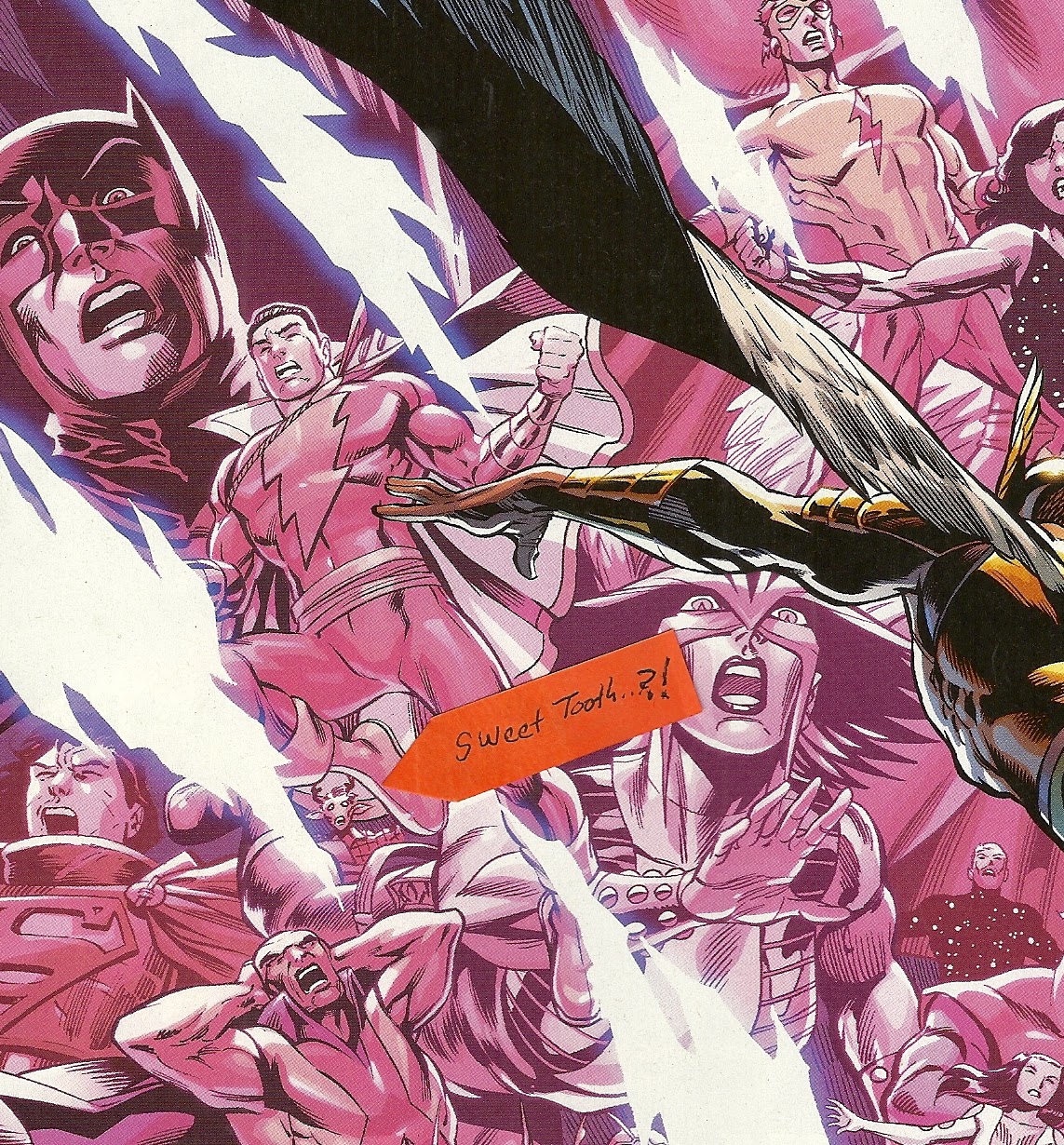
The most intriguing pages of this issue, drawn by Jesus Merino, Andy MacDonald and Dan Green, are probably the splash spread on pages five and six, wherein Hawkman flies into the glowing pink mouth of the Brainiac ship and runs headlong into the pink-tinted Multiverse, as the spread is full of casualties of continuity and characters from different realities: Batman '66, Red Son Superman, Doc Fate, Superboy Prime, headband Supergirl, Pariah and Harbinger, and, most notably, what appears to be a not-very-good-drawing of the protagonist of Jeff Lemire's Vertigo series Sweet Tooth.
There are some eye-rolling moments and some glitches in the proceedings, to be sure. I'm not sure why people keep almost referring to Tim Drake as "Robin" if he never was Robin but always Red Robin, I can't imagine this scene made anyone all that happy—
—as, like the re-introduction of Donna Troy to the New 52, it just reminds one that DC can't quit picking at its constantly rebooting continuity like a scab that will never heal and, well, the whole thing struck me as rather hackneyed and poorly-made. But I think much of that has to do with the fact that I read Tom Scioli's Transformers Vs. G.I. Joe immediately before reading this, and after seeing Scioli's Quintessons—giant, god-like robot heads with metal tentacles—the Brainiac ship seemed, well, mundane.

Like, I had just read a pretty insane narrative with a scene almost identical to the scene in this book, and that one blew my mind. This one I find wanting. My fault, I know, but come on, forty guys making Futures End, step up your game; Scioli and co-writer John Barber are crushing you on their Hasbro-licensed toy comic.


SpongeBob Comics #41 (United Plankton Pictures) This issue features a 24-page story by Derek Drymon and Jacob Chabot in which Squidward and SpongeBob become an unlikely stars in the world of live performance. Squidward's clarinet/modern dance performance is interrupted by the naturally-occurring slapstick of SpongeBob, and, try as he might, he can't break away from being the straightman in a Vaudevillian comedy act to be taken seriously as an artist. There's probably something to be said in here about the metafictional nature of Squidward and the plight of those with more ambition and dreams than talent, but it's really too depressing to think about too deeply, so I decided to just concentrate on the jokes.

As much real-estate as "Star of the Show" takes up, there's still room in here for a few shorts, including contributions of various length from Noah Van Sciver, Maris Wicks, James Kochalka, Nate Neal and another, shorter Drymon comic. Did you know dolphins only vocalize through their blowholes, and not their mouths? I did not know that; I thought their clicks came from their weird toothy jaws. You learn something new every day. In a SpongeBob comic. Well, every day that you read a SpongeBob comic, I guess.


Transformers Vs. G.I. Joe #5 (IDW) This is an extremely difficult comic book to review, and not just because I ran out of synonyms for the word "awesome" by the second issue. Each one ends with a commentary section, in which writer/artist Tom Scioli and co-writer John Barber discuss the comic book you just got done reading, and their discussions are more often than not full of superlatives and more colorful expressions of what's so great about the book that reviewing it on top of their own kinda sorta review of it generally seems superfluous.

For example, here are some phrases and sentences taken from their five-page story commentary:

•"Jotobots"

•"In early drafts, Cover Girl and Bumblebee get married. That's probably not going to happen."

•"I've been a comics professional for 10 years, I've made comics way longer, I've read comics even longer and I haven't seen this one before."

•"It's a comics Advent calendar, with moments instead of chocolate in each box."

•"I think this is the only comic where a character has a removable head that is a separate character, who also has a removable head that is a separate character."

•"One Joe alone can hold off Cobra forever...three can take 'em down."

This issue is a particularly action-packed one, although I suppose that's a little redundant, because every issue of this series is packed with action. Essentially one gigantic fight scene, full of the various toys teaming up in different combinations to engage in the war between the Decepticon/Cobra alliance (Decepticobra) and the Joe/Autobot allians (The Jotobots).

So Optimus Prime, Snake-Eyes and Duke join forces to fight off the Quintessons to get to Cybertron; Decepticon mobile bases Trypticon and Fortress Maximus and an army of Cobra foot soldiers storm mobile Autobot base Metroplex; Tunnel Rat leads a daring mission within Fortress Maximus to rescue the mind-controlled Joe pets dubbed U.S. 7 (and have to fight their way through the Oktober Guard to do so); Hot Rod and Grimlock come to blows over leadership of the Autobots; Grimlock fights Megatron to the death; and Optimus Prime fights some alien invader-destroying satellites in a strange configuration I've never seen, in which he wears his trailer on his back like a pair of wings ("his avenging angel mode," according to Scioli).

There are just three brief looks at the action on Earth; one is a page with three scenes involving Storm Shadow trying to kill General Hawk in the bathroom and a weird hint about the significance of the latter's stone axe; another involves Destro and The Baroness plotting to kill the comatose Cobra Commander only to make a startling discover; and the final one involves someone breaking Tomax, Xamot and "the poet laureate of terror" Major Bludd out of jail. Given Scioli's penchant for taking everything to the extreme, it's not surprising that he has the Crimson Twins not only finishing one another's sentences, but finishing one another's words, so that they alternate saying syllables.

Scioli has a pretty amazing technique he continue to use throughout, in which he embeds tiny little panels into what might otherwise be splash pages, so he gets his cake and gets to eat it, too; almost every page is a splash page and a six (or more) panel page. The result is a comic that is full of big, huge moments of the sort that would only fit on splash pages or two-page spreads, but which is full of story, event and moments; it's a 20-page comic that reads like a poster book and like a graphic novella at the same goddam time.

The best example of this is probably the spread on pages two and three, which shows the Joe-terraformed Cybertron approaching Earth orbit, while the giant robot bases all converge for battle, and there are a full fourteen tiny panels full of information and/or awesome shit embedded within them. (Awesome shit like Gung-Ho getting an Autobot tattoo on his left arm, for example). The spread is too big to fit on my scanner (but you can see it and a few other pages here), so here's the "Advent calendar" page instead:
I love this comic so much.

Wednesday, February 11, 2015

Four things

1.) Remember the other night when I shared that Teenage Mutant Ninja Turtle drawing Cleveland artist John G. did for a flier about a weird Melt sandwich? Well, here's another, older one he did, this one featuring Donatello instead of Leonardo.

Yes sir, I sure do like those John G. ninja turtles. The only way they could be better is if they were black and white. And on the cover of a comic book, instead of a poster about a sandwich.


2.) Speaking of things I wrote about, last night I discussed Downtown Bookworks' DC-themed Super Heroes: My First Dictionary at some length, and expressed my desire to know the context of the image used to define the word "kiss." Jacob T. Levy responded by linking to the above image. I'm assuming Dick is saying that Batgirl should give up crime-fighting and stick to her day job, whatever it is (because he doesn't know what it is at this point), but man, it sure sounds like he's coming on to her there, doesn't it? Or am I just reading too much into the Washington Monument on the skyline...?


3.) On the subject of things I did not right about, but other people did, how about Superman #38, huh? I thought it sort of clever that the big events of that particular issue that DC went out of their way to publicize—Superman's new power, and his slightly different costume which looks like it may have been mis-colored in this issue, if that is it—were not really the big change to the status quo, which comes at the very end of the book. That plot point struck me as a much bigger deal than Superman's new, not-that-interesting-or-exciting-of-a-power. I think because DC made a big deal out of the other stuff though, the event at the end was an even bigger surprise, and caught me much more off guard than it otherwise would have. So, that was some all-around effective marketing, I think.

Mike Sterling, whose blog post on this subject that last link directs you to, is right though. I'm pretty sure that the thing Superman does at the end of Superman #38 is something he's never before done in his 75-ish-year history (mainly because he's a dick), but because this Superman is still only a little over three-years-old, and so much has changed about him and his world so haphazardly in that time, I still don't have a sense of who he is and what his mileu is like, so it's not as powerful a moment as it would have been had there not been a continuity reboot a couple of years ago.

For example, I actually don't have any idea who knows Superman's secret identity and who doesn't at this particular point. Batman, Alfred, Wonder Woman and Ulysses, sure, after that? I don't know. So adding one more doesn't knock me down the way it might have five years ago.


4.) And, finally, on that thing everyone's been talking about today? I don't really care all that much, and I won't be terribly excited about the next Spider-Man movie unless it means Kirsten Dunst will be Mary Jane again, or Elizabeth Banks will be Betty Brant again or J.K. Simmons will be J. Jonah Jameson again (Actually, I think that there's my ideal Spider-Man movie; Spider-Man: Threat or Menace? starring Simmons as JJJ and Elizabeth Banks as Betty Brant and...that's it. Just two-and-a-half hours of Simmons yelling about stuff on a Daily Bugle set, with Banks giving him someone to talk to).

Those last two Spider-Man movies were not that great, but they had some pretty good performances in them, and if that franchise is ending with just the two films, then I'll at least miss Emma Stone, and Andrew Garfield's sweet chemistry with her and with Sally Field's Aunt May.

I'm not that interested in a Spider-Man 3.0 at this point, especially if it means re-telling his goddam origin again, or re-introducing another set of goddam Goblins. At this point, they've cycled through most of the best Spider-Man villains, and while there are some who would be great for film—Mysterio and The Chameleon—they're not exactly the sorts of characters one would expect to star in the first outting of a new superhero franchise, and so I'm not really sure where they could, would or should go next in terms of antagonists, re-doing previous villains or starting to use some of the lamer ones. Oh man, what if they make a movie with Morbius, The Living Vampire? Or Carnage? But maybe it won't matter. Iron Man hasn't had any villains, and his movies have tended to be pretty alright.

I think it is somewhat unfortunate that Marvel Studios will be getting into the Spider-Man movie business if only because the fact that Marvel Studios hasn't had access to Marvel Comics traditional foundational and/or most popular franchises—Spider-Man, The X-Men, The Fantastic Four—has kind of forced the Studios to be more creative, to develop C-listers like Iron Man and Thor and even Q-Listers like The Guardians of the Galaxy. I'd rather see Ant-Man and Dr. Strange than Ultimate Spider-Man (Or will it be Spectacular Spider-Man, do you think...?). I think we've seen this in their comics, too; the more the publisher is forced by circumstance to develop other franchises and characters—think of how the Q-rating of The Avengers has shifted between, say, 1994 and 2014—the better their line has become, the more chances they've taken and the more unlikely creative successes they've had.

Also, I can't imagine why Marvel would want to stick Spider-Man in any of their movies. The first Avengers movie only had, what, six superheroes in it, and most of them had very little to do. I think Hawkeye had like ten minutes of screen time? He shot an arrow once or twice, maybe? They're adding another three Avengers for the next movie. Are we gonna have Spider-Man joining the Avengers for the third film? Are they ever gonna get, like, say, one black guy on the team? That's not too much to ask, is it? One non-white Avenger?

The worst part of it is, however, that it will apparently delay several of the more interesting sounding film projects Marvel Studios already had in the pipeline, which means it will also apparently delay any of the more interesting-still Marvel Studios films that I want them to make but that they haven't announced yet, the ones that so far exist only in my dreams, like The Champions, The Defenders, The Invaders, Devil Dinosaur of The Savage Land, Man-Thing and Howard The Duck, Fin Fang Foom and The Legion of Monsters, Namor: The Submariner and J. Jonah Jameson Yelling For Like Three Hours.

...

You know, I say I don't care all that much now, and then I rattle off a bunch of negatives, but if it turns out that Marvel Studios' Spider-Man movie turns out to be a film adaptation of Spider-Man: Turn Off the Dark, I'm going to be really excited.

...

Same goes for Spider-Man: The Clone Saga, co-starring Tobey Maguire, Andrew Garfield and Some New Guy.

Monday, February 09, 2015

More on Super Heroes: My First Dictionary

Last month I reviewed publisher Downtown Bookworks' Super Heroes: My First Dictionary for School Library Journal's Good Comics For Kids blog. I was genuinely interested in, even fascinated with, the book, for more than just professional reasons. As I mentioned in the short piece I wrote, in addition to all of the great art and fun, out-of-context imagery (writer Michael Robin seemed to gravitate towards all sorts of traditional comics blog fodder), I think a book like this speaks volumes about what an interested third party (here, Downtown Bookworks rather than DC Comics and DC Comics' core readership) think about DC's superheroes. You know, who the most noteworthy ones are, what their most familiar appearances and traits are, what the youngest of fans might be potentially interested in about them, and so on.

Here are some things I noted in that regard while reading through the book in preparation for the review...

1.) No New 52 costumes This shouldn't really come as a surprise, I suppose, but there were a total of zero images taken from the "New 52" era of DC Comics, which began in September of 2011, and looks like it will be ending—at least as a branding exercise—in June of this year. There are no panels taken from any comics produced in that time, and while characters often appear in various versions of costumes they've worn over the years, they all tend to wear what they were wearing in the 1970s and 1980s (There are examples of Golden Age Batman, for example, but they are overwhelmed by images of "New Look" Batman).

Whatever the goals of the New 52 costume redesigns, and whatever virtues they might have had, as far as marketing DC's characters outside of comics shops goes, the original costumes are still considered the "real" ones.


2.) Captain Marvel is now Shazam! The one nod to post-Flashpoint, New 52 changes I noticed was that the dictionary dropped superhero Captain Marvel's name and replaced it with Shazam!, exclamation point included, which was, of course, the name of the wizard who gave Billy Batson the magical ability to transform into Captain Marvel, and the magic word Billy would have to shout in order to effect that transformation.

Captain Marvel and characters from his world appear rather frequently in the book—surprisingly, so, really. Looking at the contents of this book, he would appear to be one of DC's top-tier characters, right up there with The Flash and Green Lantern.

Captain Marvel appears 15 times, usually as Captain Marvel but occasionally as Billy Batson, although in some cases they aren't named in their appearances at all. Black Adam appears in two entries alongside first Billy and than Captain Marvel; Uncle Dudley appears alongside Billy in one entry; Mr. Mind appears in two entries by himself ("Bored: There's nothing to do on Mr. Mind's home planet, so he feels bored" and "Smart: Mr. Mind is smart because he reads a lot"), and Mary Marvel appears four times.

Now, as I said, Captain Marvel isn't called "Captain Marvel," but rather "Shazam!"...complete with an exclamation point at the end of his name, even when his name is at the beginning or middle of a sentence. I don't like that at all. I've never been supportive of changing the superhero Captain Marvel's name to "Shazam" for lots of reasons, including the fact that it only further confuses the premise, it divorces the character from his long history and it cedes the name of "Captain Marvel" to rival Marvel Entertainment, even though they were Stan Lees-come-lately to the Captain Marvel game (the Fawcett/DC Captain Marvel debuted in 1939, while the Marvel Captain Marvel debuted in 1967).

But it seems especially wrong in a first dictonary for kids, meant to introduce them to definitions and word usage. I mean, there's a strange grammar element in every mention of the name "Shazam!" if they insist on keeping the exclamation point in there. If they have to call Captain Marvel Shazam (and please note all of the art here used pre-dates Cap's new name of Shazam by decades), they could at least lose the exclamation point.

Now, one quetion that arose immediately when DC officially renamed their Captain Marvel "Shazam" was what they were going to call the rest of the Marvel Family, which would almost certainly include Mary Marvel and Captain Marvel Jr. at the very least (Uncle Marvel and the Lieutenant Marvels and Hoppy The Marvel Bunny weren't so prevalent). Would they henceforth be called Mary Shazam and Shazam Jr., or...what, exactly?

When DC did introduce some of these characters—the expected Mary Marvel and Captain Marvel Jr.—in a new version of the Marvel Family in the Justice League back-ups collected in the trade Shazam! Vol. 1, they just went by their first names, although Freddy Freeman, the former Captain Marvel Jr., did refer to himself as "King Shazam."

Well, here's a possible answer as to what they might eventually end up being called. Mary is simply called "Mary," which is a pretty terrible superhero name, and the Marvel Family is referred to as "the Shazam! Family."


3.) Harley Quinn is in here for some reason Another relatively rare nod to the modern DC line of comic books is the inclusion of Harley Quinn. It's not as if female supervillains were needed for greater female inclusion within the book—Catwoman, Cheetah and Poison Ivy are all in here repeatedly—and Harley's presence within almost certainly reflects the character's greater prominence. She was created in 1992,  far later than every other character included in this book, making her a real outlier among the dozens of heroes and villains within. (Teen Titans Raven and Cyborg, who debuted in 1980, are probably the next most recent creations to officially appear in the book... although Green Lantern Kyle Rayner, who first appeared in 1994, does make uncredited cameo appearance in a counting section at the end of the book).

Harley Quinn is  drawn in her original costume, and in an old-school style that makes it look like she was pulled from a comic from the mid-1980s. She appears in two entries—those for "hat" and "tiptoe"—but both are the same image; the full-body "tiptoe" image is simply cropped to show just her head in the "hat" entry.


4.) They go surprisingly deep into DC's bench While Superman, Batman, Wonder Woman, Robin, Batgirl, The Flash, Aquaman, Shazam!, Green Lantern and Lois Lane are the most prominent characters in the book, you'll also find Animal Man (never in costume, though), Aqualad, The Atom, Beast Boy, Black Canary, Commissioner Gordon, Cyborg, Doctor Fate, the oddly-omnipresent Elongated Man, Firestorm, Green Arrow, Hawkman and Hawkgirl, Jimmy Olsen, Kid Flash Wally West (out-of-costume, in his original costume and in his later yellow and red costume) Martian Manhunter, Mera, Metamporpho (in just one panel, where he appears a slide with a head), Krypto, Plastic Man, Raven, Red Tornado, Speedy, Starfire (cropped so you only see her from the clavicles up), Streaky, Wonder Girl Donna Troy (in her red suit), Zatanna, and, in one panel, Star Sapphire and The Creeper. Golden Age Flash Jay Garrick and Golden Age Green Lantern Alan Scott both appear, but are simply called Green Lantern and The Flash, when there names are mentioned. Severely side-burned Teen Titan Jericho and Doom Patrol-er Robotman also appear, but go unnamed. A couple of Legionnaires appear in one panel as well, but they're not named.

As for villains, there's Lex Luthor, The Joker, The Penguin, The Riddler, Brainiac, Bizarro, Gorilla Grodd, Black Manta, Captain Cold, Sinestro and Darkseid, and the aforementioned Black Adam, Catwoman, Cheetah, Harley Quinn, Mr. Mind and Poison Ivy. They all appear repeatedly, and by name, but you'll also find far less prominent characters, like Copperhead, First-Appearance Chess Aficionado Despero, The Fiddler, Mirror Master, a Parademon, Trickster and  Two-Face. There are also appearances from Mister Freeze, Mr.Mxyzptlk, The Royal Flush Gang's King, The Mad Thinker and Shade...but they all go completely unnamed.

That's probably for the best where Mxy's concerned; his is definitely not a good name to try and teach to three-year-olds...I think you have to have a pretty decent command of phonics before you get into trying to pronounce Fifth Dimensional names (I was writing this blog about three years before I finally memorized how to spell "Myxyzptlk," and I still have to sound it out).


5.) They trust kids to roll with changes in characters' appearances As I said above, characters appear in different costumes throughout. For some of the more prominent characters, like Superman, Batman and Wonder Woman, these changes are all pretty minor; Golden Age Superman and John Byrne Superman look basically the same, and you might need to see them standing side-by-side to not the differences in the S-shield or the cut of his shorts. Similarly, the main difference between Golden Age Batman and "New Look" Batman is a matter of a yellow oval on his chest. Even Wonder Woman's, Golden, Silver and Bronze Age costume changes tend to be pretty minor, mostly involving the cut of her shorts and her footwear.

But other characters have pretty drastic costume changes. Elongated Man, for example, appears in his original, purple, masked costume, as well as his later red and black costume. I've already mentioned Kid Flash, who appears in his original costume, which was an exact duplicate of Flash's costume, and his later yellow and red costume. Green Arrow usually appears in his bearded look, but there are a few panels of the clean-shaven version of the character.  Supergirl's v-neck blouse with the poofy sleeves appears almost as often as the more traditional look, and Lois Lane looks pretty different in almost every appearance, with various lengths of black or auburn hair, and in radically different outfits, and holding radically different kinds of reporting equipment, given that the images of her are pulled from some 40  years worth of comics.

6.) A pretty decent attempt is made at naming the artists who contributed On the page opposite of the table of contents, there's a chunk of page-space devoted to thanking "the following illustrators whose artwork appears throughout the book," which lists 48 artists alphabetically, from Jack Abel to Tom Ziuko. It's not a comprehensive list, however.

For example, Norm Breyfogle isn't thanked, nor is Mike Mignola...

...and I'm 100% sure that first image is Breyfogle's, while I'm 98% sure that second one is Mignola's.


7.) This is by far my favorite panel in the whole book:
Mostly because of how completely out-of-context it is. Are tehre costumes in many colors in Batman's closet? Then how come he's always wearing the grey and blue one? Does he just where the pink, green and orange ones when he's lounging around the Batcave, or what?


8.) No wait, this one is:
It really makes me want to find the comic book it was clipped from, so I can read the panel in context. Like, I know why Batman has all those crazy-colored costumes in his closet, but I don't know the circumstances that lead to Robin giving Batgirl "a friendly kiss" while the bored, somewhat surly-looking Batgirl reluctantly allows him to do so.


9.) Finally, can I ask a question?
Who is that peeking out of the O...? And who is that in the tight-fitting uniform behind the Q...?

Sunday, February 08, 2015

John G. draws a Teenage Mutant Ninja Turtle

Lake Erie Monster artist John G. also draws posters for local restaurant chain Melt, which gives him plenty of opportunities to draw some downright weird-ass illustrations, based on the names and contents of their various sandwiches (Many of which sound like things Shaggy, Scooby-Doo, Dagwood Bumstead and ninja turtle Michaelangelo would come up with after an intense sandwich conference).

One such sandwich is, of course, "The Teenage Mutant Ninja Turtle Melt, " a grilled cheese sandwich prominently featuring pizza rolls and using the word "ooze" as if it were a good thing. I believe a previous illustration John G. did for this particular sandwich featured his riff on the poster for the Teenage Mutant Ninja Turtles II: The Secret of the Ooze, although I'd have to check the wall of the closest Melt restaurant to be certain.  This one features a "straight" illustration of Leonardo, having apparently just taken a katana to the sandwich.

I like the image an awful lot. The artist's use of heavy ink and the splattery effects have always reminded me of Kevin Eastman's work, so it's nice to see what his version of one of Eastman's creations looks like. Pretty good, I'd say; pretty good (Far, far better than the sandwich it's promoting sounds, anyway).

Saturday, February 07, 2015

Review: Marvel Zombies Destroy!

My initial reaction to this book was to make a joke about the fact that they have now made so many Marvel Zombies comics that they decided to quit numbering them, but looking at that Wikipedia page I mentioned in my recent review of Marvel Zombies 5, I see this is hardly the first Marvel Zombies-branded book to be published sans a number (That would be their third outing, Dead Days, and Destroy! was also preceded by the non-numbered Return, Evil Evolution and Supreme).

This five-issue, 2012 miniseries seems to follow Marvel Zombies 5 rather closely in that it features Howard The Duck fighting zombies in an alternate dimension, but it is not the work of Marvel Zombies 3-5 scribe Fred Van Lente; rather this miniseries rather unusually has two different writers, with a Frank Marraffino (Marvel Zombies Supreme) writing the first two issues, and veteran writer Peter David taking over for the final three issues. The unusual change seems to suggest a problem of some kind, or at least a story behind it, but perhaps it was a schedule thing as much as anything else; there's a little editorial in the back by editor Jake Thomas that mentions the difficulties the team went through in getting it out, and how the project was a dream come true for him, and how heavily involved he was.

The art team is more stable, but it still required a fill-in artist, which is, again, pretty unusual in a miniseries, and the fill-in falls on issue #3, which is right where the writers change. A Mirco Pierfederici draws all of the issues save for #3, which is penciled by Al Barrionuevo and inked by Rick Magyar. It's worth noting that the change isn't terribly disruptive; I wouldn't have noticed a change in either writer or artist while reading if I hadn't read the credits page first.

I think that says less about the styles and skills of the creators than the fact that they were working on a franchise with such specific sensibilities. Does it have zombies in it? Are there a lot of jokes, a dark sense of humor and a great deal of horror? Okay, fine, it's Marvel Zombies then. Like a few other offerings to date, this one doesn't really feature the "real" Marvel Zombies, the ones from that alternate dimension first introduced by Mark Millar which was basically just the Marvel Universe if all the superheroes had turned into zombies, but it does feature plenty of zombified Marvel superheroes (from another alternate dimension full of zombies), and cast is split between Golden Age characters and the most obscure Marvels this side of Woodgod. Howard the Duck gets top bill (Ha! Bill!), and Dum Dum Dugan is the next biggest star, if that tells you anything about the cast.

Howard, Agent of ARMOR, recruits Dum Dum, Agent of SHIELD, to be a part of his crack strike force nicknamed "Ducky's Dozen." It appears that ARMOR, the acronym for government agency Alternate Reality Monitoring and Operationl Response, has discovered a reality where the Nazis won World War II (like DC's pre-Crisis Earth-X, then), and they accomplished this by becoming zombies. Worse yet, the Nazi zombies are preparing to invade the Marvel Universe, unless Howard's team can journey there first and wreck their mode of conveyance. Dugan has been recruited specifically for his Nazi-fighting expertise, but he suspects there's some other reason Howard wants him along and isn't telling him...and he's right!

As for The Dozen, they're a huge group of totally awesome-weirdos, only a few of whom I had ever even heard of, or could tell you much of anything about: Battlestar, Blazing Skull, Breeze Barton, Red Raven, Dragoon, Dynaman, Eternal Brain, Flexo, Gur and Taxi Taylor. How many of these guys are super-old, super-obscure characters, and how many were invented specifically to be killed off in this series? There's only one way to find out, and it's a good 15 minutes of Wikipedia-ing fun!
Spoiler alert: 3/4th of them don't make it back home, but somehow I doubt some of these deaths will stick, given the tongue-in-cheek nature of the entire series.

The dozen heroes journey into Nazi zombie-controlled territory and attempt to fight their way up a Mount Rushmore-style Nazi base with the heads of Hate-Monger, Zola, Red Skull and Baron Von Stucker, and they immediately find unexpected heavy resistance in the form of the zombified, Nazi-fied Invaders. And then they get some unexpected assistance from some lady superheroes going by the name "The Sufragists," and lead by Miss America, who has picked up this world's fallen Captain America's shield and legacy.

As the story progresses, new unlikely allies and unlikely enemies join the fray, with Loki siding with Earth-616's good guys and a zombified Thor and the rest of a zombified Asgard siding with the Nazis whose ancestors used to worship them.

There's a nicely strange aura about the entire book, owing in large part to its big, odd-ball cast, almost all of whom are completely disposable on account of their being either created specifically for this book, so rarely seen it's hard to imagine they would be missed (I had no idea Red Raven was even still alive to be killed!) or alternate reality characters, in which case anything goes, as we've got our own perfectly good Thor or Zola or whoever back in the "real" Marvel Universe.

Some gags work a lot better than others. I thought the riffs on Namor's catch-phrase didn't really work, as they were coming from Namor—well, a Namor—himself, but I did sort of love the armband worn by Dum Dum's alternate dimension, Nazi zombie doppelganger:
Yes, that's a handlebar mustache where the swastika should be and, yes, they did think to rename him Dead Dead Dugan, which is the title of this particular issue's story.

Marvel Zombies Destroy! certainly has its moments and, I think, more moments than many of the other Marvel Zombies efforts. It appears that there's still some life in this franchise after all.

*********************

One of my favorite parts was Thomas' editorial, as in it he shares some of the concept art he came up with for covers, which looked a lot different and a lot better once Michael Del Mundo got a hold of it:


*********************

So have we all agreed to just ignore what Original Sins revealed about the true nature of Dum Dum Dugan, because it's stupid? Will Secret Wars/Battleworld un-retcon that away? Because I couldn't get it out of my mind while reading this, and it really made me wish I'd read Destroy before Original Sin or Original Sins.

Thursday, February 05, 2015

Meanwhile...

Today at Good Comics For Kids, I have a review of Fantagraphics' latest Peanuts gift book, A Valentine For Charlie Brown.

And, at Robot 6 I have reviews of Michael DeForge's First Year Healthy, Akira Toriyama's Jaco The Galactic Patrolman and Takuma Morishige's My Neighbor Seki.

Comic Shop Comics: January 28-February 4

Batman Eternal #43 (DC Comics) Huh. I never realized how much New 52 Spoiler's costume resembles New 52 Huntress' costume until I glanced at this pretty okay cover by Ivan Reis and thought, for a split-second, that Huntress was on the cover. Spoiler's basically just missing the big white cross design over the torso, right? And, obviously, the two costumes differ from the neck up.

I think the big news about this particular issue, however, is who provided the interior art: David Lafuente, an excellent artist who has been provided excellent art for Marvel...exclusively, as far as I know. He's worked with Brian Michael Bendis a few times on All-New X-Men and a bunch of Ultimate Spider-stuff, and the last place I saw his work was in All-New Doop. I was pretty shocked to see him turn up here, as I was fairly certain he would have signed some sort of exclusive agreement with Marvel by this point. Well, that and I'm surprised Marvel editors would let them out of his sight. Well, that and, Batman or no, issue #43 of a 52-issue weekly Batman series seems like an awfully random place for the artist to show up for what I'm pretty sure is his first DC work.

He's a very welcome presence, and his work helps put this particular issue of Batman Eternal into the handful of issues so far with really, truly, excellent interior art. The story, this time scripted by James Tynion IV, involves Batman, Red Robin and Harper "Bluebird" Row rescuing Spoiler from Catwoman. It looks great, even with two different inkers (Victor Olazaba and Scot Hanna), and it's a pretty good issue of the series as well, showing some real forward momentum, and focusing on some of the more interesting players in the sprawling cast.
I'm still not crazy about Harper's costume, which will hopefully get revamped before too long, but I've managed to stomach that godawful Red Robin costume for however many issues of this series he's appeared in so far, so certainly Harper could look worse. I still don't like her using a gun to fight with though; even if it's a non-lethal stun gun, it just doesn't seem like the sort of thing Batman would be cool with. Maybe he'll teach her karate like she asks just so she'll stop using a big-ass, Cable-looking gun to shoot her foes with (And if electrical engineering's her thing, maybe she can settle for electro-knuckled gloves or something...?).

Spoiler offers a bombshell revelation about who the big, behind-the-scenes villain is in the last panel. Unfortunately, it's one of the few people we know can't possibly be the real villain, although it does seem to point toward a character I've suspected, even if I don't think it's "fair" to use that character, as he hasn't been introduced into the series. I don't read a lot of mystery novels—I've maybe read a dozen in my whole life—but are you allowed to introduce the mystery villain in the last, oh, the last 40 pages of a 250-page novel...?

Not that Tynion, co-plotter Scott Snyder and the other writers have actually revealed the villain here. They just have Spoiler name who she thinks the villain is, which points towards a particular character.

Oh, and this is in Batman #43:
I'm not sure who came up with the cat's dialogue bubble resembling a cat emoticon—LaFuente, letterer John J. Hill, or one of the many writers, but they deserve some props for it. That is awesome.


Batman Eternal #44 (DC) Ray Fawkes assumes scripting duties for this issue, and the grinding sound you may hear is the book changing gears. Spoiler's bombshell is only followed up on in a two-page sequence, in which artist "ACO" draws Harper so differently from LaFuente one might not recognize her were there not a caption telling us the scene was set in her apartment. There's also a one-page check-in with Luke Fox, aka Batwing (Oh yeah, he's in this book; remember him?). The rest of the book deals with the fall-out of the haunted Arkham sub-plot, and Batman's hunt for obscure villain Professor Milo, a pharmacist at Arkham who all the inmates point to as being key to the occult shenanigans that went on there (As with all of the other master villains to appear int he series so far, he received an invitation to do what he did...along with a spellbook of some sort).

There's a somewhat awkward accounting for the character having appeared in both Batman Eternal and Gotham Academy, which has used relatively obscure Batman characters as faculty members, simultaneously, with Julia Pennyworth telling Batman, "Get this: Not only was he on the Arkham staff, he was teaching chemistry over at Gotham Academy. Can you imagine, they let him near children...with that haircut?"*

ACO's art is a pretty jarring shift from that of LaFuente, probably made still more so by the fact that I read these two issues back-to-back, rather than waiting seven days between. I wonder how this will ultimately read in trade? I have to imagine it will be a weird experience, with the art shifting so drastically so often.

Anyway, this artist has a very realistic style, so that Batman looks like movie Batman more than comic book Batman, and there are a lot of effects in the imagery to make it all look very realistic and not terribly comic book-y. It even borders on illegible during a few points, where there are maybe some kinda sorta ghosts or something and, in the action climax, when Milo unleashes a cloud of some sort of gas.


Batman '66 #19 (DC) Poor Boy Wonder.


Gotham Academy #4 (DC) This book has a rather frustrating habit of jumping a few beats ahead of the cliffhanger ending of the previous issue, which can make each new issue start in a rather disorienting fashion. Gotham Academy #3, for example, ending with a monstrous hand reaching out from a hole in the ground of an abandoned building on campus, apparently trying to grab our young protagonists. This issue opens at least a day later, with Olive Silverlock and Pomeline Fritch in gym class out of doors, staring at the sealed up North Hall, where they encountered the monster hand last issue.

Perhaps this reads better in trade than serially. At any rate, our heroine Olive and her sidekick Maps continue their investigations of the mysteries of Gotham Academy, while Olive keeps her own secrets from everyone, including the readers (while letting clues gradually dribble out). In this issue, they interrogate an "intense" young man who seems to know something about everything, bust someone Scooby-Dooing a ghost, discover a secret passage, eavesdrop on Bruce Wayne's one-panel appearance and, in the last few pages, Olive meets an unexpected recurring Batman villain, and the encounter is much more casual than one might expect.

We also meet another member of the Academy's faculty, drama teacher Mr. Trent. I think this might be a stealth cameo by Simon Trent, the actor who played TV superhero The Gray Ghost on Batman: The Animated Series in the episode called "The Gray Ghost" (Adam West voiced the character, who that show's Bruce Wayne used to admire as a child). Beyond the surname and the profession, there's but one other clue: Trent mentions in one line of dialogue that "I do have some experience playing a ghost you know! Heh heh."


New 52: Futures End #39 (DC) Despite Ryan Sook's striking cover, in which Amethyst takes up a sword and torch to fend off a horde of monsters—the most notable of which is a huge gorilla with mechanical wings and bolts in its neck—the interior art by Stephen Thompson is significantly more mundane, and only five of the book's 20-pages deal with the Amethyst/Frankenstein plot (At Frankenstein's request, Amethyst beheads Frankenstein Sr. and then kills all the mechanical/animal hybrid monsters in three quick, lame panels.

The rest of the book is devoted to check-ins with various sub-plots: Firestorm and Dr. Polaris on the Justice League satellite, the boring-ass, barely comprehensible plot involving the Grifter, Fifty-Sue and their friends and enemies, and Constantine and Superman I in Smallville.

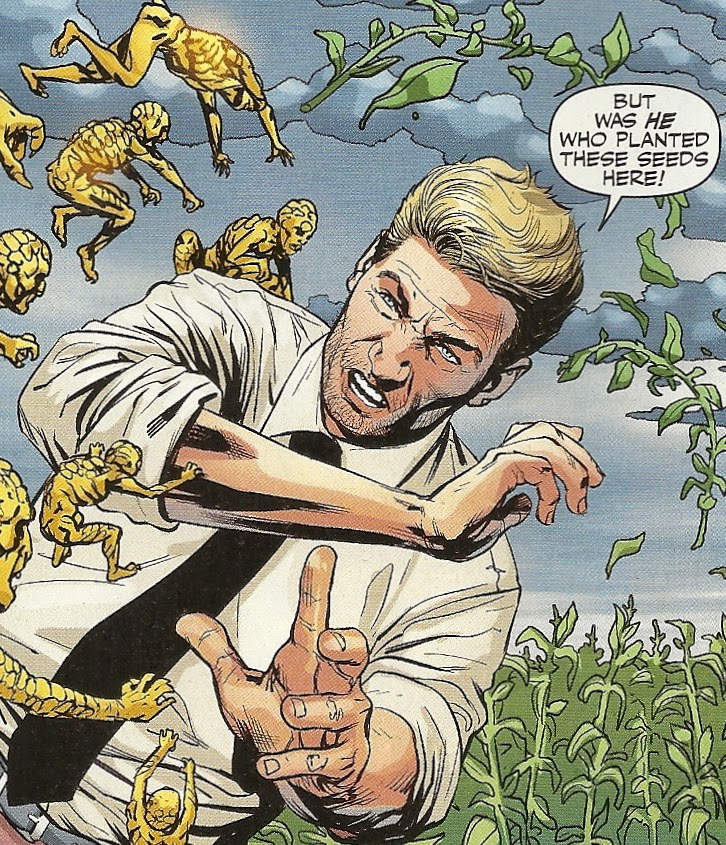
I kinda liked the idea of these little corn-based monsters that come rushing out of the Smallville cornfields to attack them, but I'm not so clear on why they didn't turn into popcorn when Superman blasted them with his head vision and set the fields ablaze.
That's just science, isn't it...?


New 52: Futures End #40 (DC) Hmm, I wonder if this wouldn't have been the best place to start with the series? It's certainly where stuff really seems to be happening, after a lot of issues in which very little of any interest did. Superman flies off to get his New 52 Year One outfit with which to fight Brainiac (who appears in Manhattan in the giant form you see on the cover), Constanine summons a big fiery pig monster to eat the little corn men who all seemed to have been burned to death in the previous issue. The Atom, Hawkman and what looks like the full roster of the 2020 Justice League gather to take on Brainiac, Batman 2020, Plastique and Tim Drake storm Terrifitech and find a bunch of dead SHIELD Agents there (wrong superhero universe, artist Patrick Zircher!), and Brainiac seems to be intent on sealing off Manhattan, perhaps for collection purposes. So lots of heroes, lots of stuff happening.

I thought it weird that Wildfire and Superman II would both be on the same League at the same time, considering how similar their costumes are...particularly since the new Superman has already been outted and doesn't need to wear the Wildfire-like hemet/mask anymore.

Even weirder? There's a panel where Hawkman responds to an observation The Atom makes with the lines, "Really, Dr. Genius? We can see that--but what is it!?" That didn't strike me as a particularly Hawkman thing to say, but what do I know? I'm only one guy, and four guys wrote this comic book.


Saga #25 (Image Comics) Man, this book...! I like how the rather large cast, composed almost entirely of very interesting characters with an incredibly interesting character designs, has broken up into several different groups, and I liked the way Hazel spoils the plot in her narration by telling us how much time will pass between certain events and even the outcome of certain conflicts, but in a matter-of-fact way that only heightens the tension, as the "spoilers" are vague enough to make the reader curious about what will happen between where we are now and the outcomes she's talking about.

I also like Marko's beard.

I also also like the way Fiona Staples draws breasts.


Star Wars #2 (Marvel Entertainment) Okay, I didn't actually buy this one ($4? Fuck that), but I did read my friends copy, as she bought one. John Cassaday's art is pretty good, but there were a few bits that bugged me. Vader's knockdown of Luke when they cross light sabers doesn't really work (based on the way they crossed swords, he would have knocked him in the opposite direction), and the scene with C-3PO trying to scare away scavengers with a blaster pistol seemed like a real missed opportunity, as we never even get to see C-3PO holding the blaster (He appears in silhouette only, and then there's a close up of the blaster clattering down the runway of the Millennium Falcon).

Other than that, the art was pretty solid—as weird as the attempts to pair the characters so closely with the actors playing them occasionally seem (Like, there was at least one panel where I felt like I knew exactly where Cassaday paused his DVD to use as reference when drawing). The script was pretty great. I liked the way Vader was about to behead Luke in the same way that Anakin Skywalker beheaded Count Poopy in Episode III, and Han's insistence that there's no such thing as The Force and, of course, the fact that there was an Imperial Walker in it. I fucking love Imperial Walkers.


*Has Professor Milo ever met Guy Gardner? If not, why not?