Monday, May 19, 2014

DC's August previews reviewed

August seems like a pretty big month for DC Comics. Grant Morrison's Multiversity, now called The Multiversity finally kicks off and a slew of comics get culled, perhaps indicating a new wave of launches in the near future (With All-Star Western, Batwing, Birds of Prey, Trinity of Sin: Pandora, Trinity of Sin: Phantom Stranger and Superboy all being canceled, DC's 44 "New 52" titles will shrink to just 38 in September, unless they follow those up with a bunch of new launches).

I see too that DC is pulling a Marvel and double-shipping their unexpected hit comic Harley Quinn, and having an artist other than regular artist Chad Hardin draw one of those issues so they can double-ship, Marvel style.

But probably the biggest news of the month is that I saw words I never thought I'd see before in these solicitations: "DC UNIVERSE selfie variant cover."

No examples are shown, but if they turn out to be anything at all like the results of a Google Image search for the term "selfie" plus DC superheroes, I think we can all agree that DC UNIVERSE selfie variant covers are going to be the best thing ever (Here's hoping they collect them all in a standalone comic book; as I hope they're doing with all those Mike Allred variants).
Note that the fourth image that came up was an actual woman in an actual refrigerator.

Anyway, for DC's complete solicitations, you can go other places. Like here, for example. But for me offering opinions on them, there's nowhere to go but here, which is where you already are.

ADVENTURES OF SUPERMAN #16
Written by JOE KEATINGE
Art by MING DOYLE, BRENT SCHOONOVER, DAVID WILLIAMS, AL GORDON, TULA LOTAY and JASON SHAWN ALEXANDER
Cover by JON BOGDANOVE
On sale AUGUST 27 • 40 pg, FC, $3.99 US • RATED T • DIGITAL FIRST
As citizens of Earth flee to the stars, Kamandi tells the story of Superman’s earliest defeat – one that haunted him for years. Don’t miss this epic adventure spanning the entirety of Superman’s lifetime, from an all-star roster of talent!

Damn, Bogdanove sure did a hell of a job drawing in the styles of a bunch of very different artists on that cover.


ALL-STAR WESTERN #34
Written by JUSTIN GRAY and JIMMY PALMIOTTI
Art and cover by DARWYN COOKE
On sale AUGUST 27 • 32 pg, FC, $3.99 US • RATED T+ • FINAL ISSUE
Time has finally caught up with Hex as he battles to the death against his worst enemy: Jonah Hex!


Whatever Jimmy Palmiotti and Justin Gray have been blackmailing Dan DiDio with all these years has apparently come out, as their Jonah Hex book, first called Jonah Hex and then New 52-booted as All-Star Western is finally being canceled, years after its sales would have dictated it be canceled.

I like the way Darwyn Cooke draws horse legs.


AQUAMAN AND THE OTHERS #5
Written by DAN JURGENS
Art by LAN MEDINA and ALLEN MARTINEZ
Cover by JOE PRADO
On sale AUGUST 6 • 32 pg, FC, $2.99 US • RATED T
As Aquaman lies impaled with his own trident, the ancient evil of Legend finally claims possession of the Others’ Atlantean artifacts – except for one. And for that one, Legend must take it from the resurrected Vostok X!


Ancient evil? Okay, first of all, I didn't think Legend was that bad. And ancient? It's from 1985; that's hardly ancient.

I like Pat Gleason.


Cute cover for this month's issue of Batman/Superman.

....

Although I guess the cat standing on another cat to push Catwoman's pelvis into Superman's is a little weird.

And those stars and moon will probably be a little ruined when they put the logo on the image.


BATWING #34
Written by JUSTIN GRAY and JIMMY PALMIOTTI
Art by EDUARDO PANSICA
Cover by DAN PANOSIAN
On sale AUGUST 6 • 32 pg, FC, $2.99 US • RATED T • FINAL ISSUE
It’s the final issue of BATWING – but what is the final fate of Luke Fox?

This book's cancellation seems way overdue, based on the way it sells in relation to the rest of DC's comics. I imagine the character will live on in Batman Eternal and, if a Batman weekly sells (and tells) as well as I think it will, then I imagine weekly Batman comics may be here to stay for a while, giving plenty of space for characters like Batwing to appear in a better-selling book.


BIRDS OF PREY #34
Written by CHRISTY MARX
Art by ROBSON ROCHA and OCLAIR ALBERT
Cover by JORGE MOLINA
On sale AUGUST 13 • 32 pg, FC, $2.99 US • RATED T • FINAL ISSUE
By Batgirl betrayed! But why is she siding with the Suicide Squad? Find out in this tale from the Birds’ past!


Birds of Prey...cancelled? On the one hand, that seems perfectly predictable to me, given how incredibly far its drifted from its original conception (I think by the time you've removed Oracle from the equation, BOP has basically just become one more superhero team, especially when you divorce it from its own history and the character relationships that made the drifting from core concept seem more like evolution than change for change's sake).

On the other hand, it's kind of hard to believe that DC would cancel this particular kinda sorta Batman Family book, while still publishing Red Hood and The Outlaws. Perhaps this is only being canceled in the way Teen Titans and Suicide Squad were...that is, to be relaunched with a new creative team and new #1 issue next month.

 Oh, hey, look—King Shark is back to having a Great White shark-shaped shark head, rather than the Hammerhead shark-shaped shark head he was rebooted into having. That's...completely random.


CONSTANTINE #17
Written by RAY FAWKES
Art by EDGAR SALAZAR and JAY LEISTEN
Cover by JUAN FERREYRA
On sale AUGUST 13 • 32 pg, FC, $2.99 US • RATED T+
John Constantine is no stranger to death, but he’s never seen it on this scale – a spell gone terribly wrong has sent him back through time to World War I! Unfortunately, he’s not the only mage in the trenches…and where death has this much power, black magic couldn’t be more dangerous!


Part of me wants to accuse DC of ripping off the cover of Danica Novgorodoff's The Undertaking of Lily Chen
—but then the rest of me realizes that the motif isn't really that unique, and some comic artist before Novgorodoff likely did something similar before her too.

GRAYSON #2
Written by TIM SEELEY
Art and cover by MIKEL JANIN
DC UNIVERSE SELFIE variant cover
...
On sale AU
GUST 6 • 32 pg, FC, $2.99 US • RATED T
...
Grayson digs deeper into the mysterious organization known as SPYRAL and learns more about his new partner – Helena Bertinelli!
 
Oh hey, it's the New 52 debut of...the name of the former secret identity of the post-Crisis, pre-Flashpoint Huntress. Surely that is of interest to...someone...?


JUSTICE LEAGUE #34
Written by GEOFF JOHNS
Art by DOUG MAHNKE and KEITH CHAMPAGNE
Cover by ETHAN VAN SCIVER
DC UNIVERSE SELFIE variant cover
...
On sale AUGUST 20 • 32 pg, FC, $3.99 US • RATED T
...
Paranoid survivalist. Wanted fugitive. Damned soul. Meet the newest member of the Justice League: Jessica Cruz, a.k.a. Power Ring! With the most dangerous weapon in the universe in her possession, Jessica has been transformed into a dark prophet – one who will force the other members of the League to confront their greatest fears in preparation for a horrific new threat. Meanwhile, Batman and Lex Luthor continue their mission to cure the world of super-villains – but will the extremes they’re willing to go to threaten even their closest allies? Lex hopes so.


Well, her costume is all kinds of stupid, from the camo to the light-construct survival gear, to the doubling of the logos, to the eye-patch (which, for reasons that escape me, resembles a shamrock more than the vague butterfly shape of Power Ring's regular logo), to the head band to the over-accesorization. That said, it's neat that Earth finally got a female Green Lantern (sorta), and that there will be at least one semi-lasting effect from Forever Evil (aside from Grayson, of course, but I don't expect that to last too long).


THE MULTIVERSITY #1
Written by GRANT MORRISON
Art and cover by IVAN REIS and JOE PRADO
...
1:100 Variant cover by GRANT MORRISON
...
On sale AUGUST 20 • 48 pg, FC, $4.99 US • RATED T
...
The biggest adventure in DC’s history is here!

Join visionary writer Grant Morrison, today’s most talented artists, and a cast of unforgettable characters from 52 alternative Earths of the known DC Multiverse! Prepare to meet the Vampire League of Earth-43, the Justice Riders of Earth-18, Superdemon, Doc Fate, the super-sons of Superman and Batman, the rampaging Retaliators of Earth-8, the Atomic Knights of Justice, Dino-Cop, Sister Miracle, Lady Quark, the legion of Sivanas, the Nazi New Reichsmen of Earth-10 and the latest, greatest Super Hero of Earth-Prime: YOU!

Comprising six complete adventures – each set in a different parallel universe – plus a two-part framing story and a comprehensive guidebook to the many worlds of the Multiverse, THE MULTIVERSITY is more than just a multipart comic-book series. It’s a cosmos spanning, soul-shaking experience that puts YOU on the frontline in the Battle for All Creation against the demonic destroyers known as the Gentry!

In issue #1, pencilled by superstar artist Ivan Reis (AQUAMAN, JUSTICE LEAGUE), President Superman of Earth-23 uncovers a threat to all Reality so apocalyptic it will take a team of incredible heroes from across the Multiverse to face it – including Captain Carrot, like you’ve never seen him before!

But even with a multitude of alternate worlds to choose from, where every variation is possible, can anyone hope to prevail against the onslaught of ultimate evil and undying hatred – in the unstoppable form of a one-time cosmic defender with unimaginable powers?! Join us, if you dare, for the beginning of THE MULTIVERSITY!


This really sounds even better than I would have/could have hoped. There's more to get excited about in that first paragraph in the solicit than almost the rest of the New 52 line combined; Morrison's like his own New 52.

There will be some six variant covers (although I didn't see a mention of a "selfie" variant), but I left in the one that sounded the most interesting—one by Morrison himself. As I've noted before, Morrison is really a pretty good artist (for a writer, anyway), so I'm eager to see what that will look like, whether it's just a sketch repurposed as a collectible gimmick cover, or if it's a legit piece of artwork from Morrison, tackling it the way an artist might tackle a cover assignment.

I'm in no hurry for this summer to pass, but between this comic book solicitation and that trailer for that one Marvel superhero movie, August seems like it's going to be the most exciting nerd month of the year...
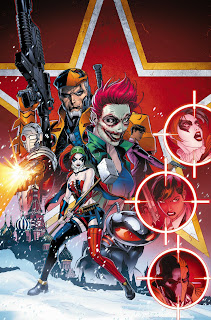
I suppose it would be silly to ask why Harley Quinn has a balaclava to keep her head and face warm in the cold of the Russian winter, while having so much skin exposed, huh? Especially since she's not even wearing the balaclava?

I do find myself wondering how Joker's Daughter is in New Suicide Squad (and thus presumably captured by law enforcement) while simultaneously causing trouble in Batman Eternal (and thus presumably not yet captured by law enforcement), although I suppose her story arc in Eternal could finish up much more quickly than expected.

SECRET ORIGINS #5
Written by MARV WOLFMAN, SCOTT LOBDELL and JEFF PARKER
Art by ANDRE COELHO, PAULO SIQUEIRA and ALVARO MARTINEZ and RAUL FERNANDEZ
Cover by LEE BERMEJO
On sale AUGUST 27 • 48 pg, FC, $4.99 US • RATED T
The latest explosive origins from DC Comics – The New 52 include Cyborg by Marv Wolfman and AndrĂ© Coelho; Red Hood by Scott Lobdell and Paulo Siqueira; and Mera by Jeff Parker and the art team of Alvaro Martinez and Raul Fernandez.


Well, Cyborg's origin is wildly unnecessary, as we just read it in the first half-dozen issues of Justice League, which were among the best-selling and most-read comics of the New 52 relaunch (they already based a direct-to-DVD animated adaptation of that story arc, didn't they?), but I'm actually interested in the Red Hood origin. I hate, hate, hate the character, and super-hate the fact that he survived The New 52 reboot (he seemed like one of the "mistakes" of the old DCU that a reboot might actually be needed to help purge from the universe), but I'm curious as to how his story makes sense in the new continuity, as his resurrection was initially tied to the events of the Crisis On Infinite Earths (retroactively, of course) and Infinite Crisis).

I would have thought that, if you were going to reboot your entire continuity anyway, and you wanted to have a character who died alive, the easiest thing to do would be to rewrite history so he never died, but, apparently, Jason Todd still died and still came back to life... (I just read Batman and... #20, I think it was, the issue where Batman takes Jason Todd back to the scene of his death to try and jog his memory about his having come back to life, and it was really, really weird and confusing, because I had no idea what the hell they were talking about (I guess "Death In The Family" happened, just not the way it happened in "Death In The Family," which is one of those worst-of-both-worlds situations DC has created for itself).

SENSATION COMICS FEATURING WONDER WOMAN #1
Written by GAIL SIMONE and AMANDA DEIBERT
Art by ETHAN VAN SCIVER and CAT STAGGS
Cover by ETHAN VAN SCIVER
1:25 Variant cover by PHIL JIMENEZ
On sale AUGUST 20 • 40 pg, FC, $3.99 US • RATED T
DIGITAL FIRST
Retailers: This issue will ship with two covers. Please see the order form for details.
Diana Prince: Amazon warrior, ambassador to Man’s world, or champion of women in need? All of the above! This digital-first anthology series will bring some of comics’ greatest talents to Themyscira, and give them leave to explore Diana, her world – and ours!
Gail Simone and Ethan Van Sciver kick things off when Oracle calls for help after the entire Bat-Family gets sidelined. But when Wonder Woman steps into the breach, Gotham City’s criminals get the surprise of their lives! Then, Amanda Deibert and Cat Staggs take Diana to school, where she meets her biggest fan!


I've already mouthed off about this a bit on Twitter, but my first two thoughts were 1.) I can't believe DC is finally publishing a Legends of the Dark Knight-style anthology book starring Wonder Woman, and 2.) I can't believe they weren't already publishing the book.

This seems to be the Wonder Woman equivalent of the Digital First, $4, 40-page, continuity-lite anthology books Legends of the Dark Knight and Adventures of Superman, which is fine by me; I read and enjoyed both of those books, even though the quality could vary pretty drastically from story to story and issue to issue. DC did cancel them both, but they were around long enough to generate a few trades' worth of material, give some great creators the chance to play with DC's biggest creators and to produces some evergreen stories.

This seems to follow the same pattern, as it sure sounds like an "old" DCU storyline, and, in fact, sounds like Van Sciver may be illustrating a script Simone has had lying around for a while (or a story that's been bouncing around in her head for a while), as she previously wrote both Wonder Woman and Oracle's book Birds of Prey.

I hate to complain at all about a gift I've been asking for for years now, but I do note this is rated "T for teen." I hope that it will be a more new-reader, all-ages friendly version of the character, at least in some issues, and that they'll take it easy on the Wolverine/Punisher version of Wonder Woman that is the default one in the DCU now. You know, less talk of of killing, now testicle-grabbing or limb-severing. If only because it seems to me that DC should m make sure that anyone that owns a comic shop should always have a Wonder Woman comic they can hand to a little girl who asks for one...preferably without having to ask her to wait while they go through their longboxes in search of an issue of Adventures in the DC Universe from the late 1990s.

Oh, and I suppose it's worth noting that this makes three Wonder Woman monthlies, if you count Superman/Wonder Woman (and I just did).


TEEN TITANS #2
Written by WILL PFEIFER
Art and cover by KENNETH ROCAFORT
DC UNIVERSE SELFIE variant cover
1:25 Variant cover by CAMERON STEWART
On sale AUGUST 20 • 32 pg, FC, $2.99 US • RATED T
...
Now the new hotness on social media, the Titans try to control their own images as a new threat continues to grow around the team. Meanwhile, S.T.A.R. Labs takes an interest in DC’s teen heroes.

"New hotness"....? "Social media"...? Wow, this comic is about teens!

I like that Cameron Stewart person, and would like to see him drawing more for DC than just one out of every 25 covers of Teen Titans...


I found the few issues of Trinity of Sin: Phantom Stranger that I read to be pretty dull, but I really like the work of cover artist Guillem March. Those are some nice, scary versions of Phantom Stranger he drew on this particular cover.

In other news, Trinity of Sin: Phantom Stranger is totally canceled with this, it's 22nd issue. That's actually a pretty damn respectable run for a Phantom Stranger comic in 2014, particularly given the...peculiarities of this version of the character, the more-standard-than-not creative team chaos on the book, and the fact that DC still hasn't gotten around to explaining what the fuck is up with this whole Flashpoint/Pandora/merged universes/Trinity of Sin business yet.

Speaking of Pandora, her book ships its final issue in August as well, with #14.

Sunday, May 18, 2014

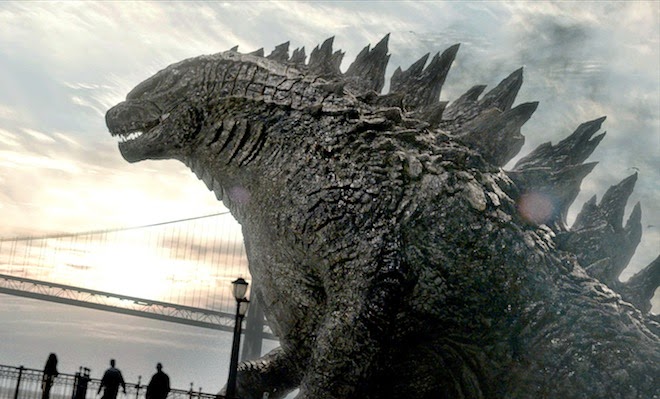
Strike two: Hollywood takes another swing at making an American Godzilla

There have now been 30 Godzilla movies spanning 60 years, and throughout all that time, the creature's appearance has been fluid, with changes ranging from tweaks to overhauls occurring on an almost movie-by-movie basis. Some of that was practical, of course: The Godzilla suits used to portray the character in his 28 Toho-produced films would go through a lot of wear and tear between the fireworks popping off them, the rubbing against other monster suits during battles and plunging in and out of a huge water tank. Some of the changes were made for aesthetic or storytelling purposes, depending on how a particular filmmaker might want to portray Godzilla. And so the fangs and Godzilla's tiny little ears would come and go. The number of toes or the size and shape of his spines might change. His eyes would get bigger or smaller.

The two most radical changes were made in the two American-made Godzilla films. The infamous 1998 Roland Emmerich-directed one reimagined the so-called King of The Monsters into something much more realistic-looking, a sort of gigantic theropod dinosaur that resembled a huge version of a creature that might have conceivably once walked the Earth, a design reflecting the changing understanding of what dinosaurs might have looked like between 1954 and 1998.

The world so thoroughly rejected that Godzilla that Toho eventually re-named it "Zilla" (Because the filmmakers had taken the "god" out of "Godzilla," you see) for its few later appearances in Godzilla media (2004 film Godzilla: Final Wars, a pair of video games, IDW comic book series Godzilla: Rulers of the Earth). The Godzilla that appears in the new Gareth Edwards-directed film is much closer to the range of Godzillas that have appeared in the later Toho films—a large rubber suit could conceivably be made in its shape and a human actor placed inside it, whereas the sleek, dinosaurian Emmerich monster would have been almost impossible for most actors to effectively play—but it's still a big perplexing deviation for what Godzilla "should" look like.

While the decision to redesign the monster so fully, for filmmakers to make their Godzilla their Godzilla, is understandable, and coming to grips with the new Godzilla's looks is, at least among fans, a ritual not unlike adjusting to a new actor coming in to play James Bond*. So here's the Daniel Craig of Godzillas, a design the studio's PR have worked quite diligently to hide from the world until the movie opened (Perhaps out of embarrassment, but more likely to build anticipation; it is worth noting that they did the same with Godzilla '98's campaign).

Oddly, surprisingly, maybe even shockingly, radically redesigning the title monster was only one of the several mistakes from the last American Godzilla that Edwards and company repeated in their film. In addition to trying to build a more realistic humongous city-stomping, radiation-breathing monster, the film also spends too much concern on biology, focusing on the origins of Godzilla (in the previous film, Godzilla was a marine iguana mutated by radiation from nuclear weapons tests; here it's theorized that he is a prehistoric beast from a time when the Earth was "ten times more radioactive then it is today" that feeds off of radiation) and, peculiarly, the reproductive habits of kaiju (in the previous film, it was Godzilla laying "his" eggs and hatching a brood of raptor-like baby Godzillas; here its his two monstrous opponents laying and hatching their eggs in San Francisco).

To his credit, while Edwards seems to have made some of the same mistakes as Emmerich, the filmmaker he seems to be emulating the most here is Steven Spielberg, perhaps nowhere more noticeably in his Jaws-like (or, more topically, his Alien-like) delay in showing the audience the monster. Edwards teases the hell out of the audience, offering just a blurry glimpse here or a particularly Jaws-like shot of a Godzilla's "fin"—resembling a stony island of stalacmites—cutting through the ocean there.

The problem, however, is that Edwards seems to have learned only the first half of the Spielberg/Ridley Scott Jaws/Alien monster-hiding technique, but not the second. He relentlessly teases Godzilla, reveals him, and then goes back to hiding him immediately (As Laura Hudson put it in her review, "at a certain point in every seduction, the clothes have to come off"). For a Godzilla movie, there is remarkably little Godzilla in this film, often to very frustrating effect.

So, for example, when we first see Godzilla in full, he sort of sneaks up on the first of his foes, and the camera pans up from his feet, over his massive, obese-looking bulk, all the way up to his face, and Godzilla, standing in an appropriately sumo wrestler-like pose, roars in challenge at his foe (Similarly to the visuals, Godzilla's famous roar is always obscured as well; I don't think there was a single instance in which the swelling score didn't rise to interrupt the cry).

Finally, the monsters are gonna fight!

And they do, but Edwards shows that fight on the the news. On a television screen. In the background of a scene of the hero's wife Elizabeth Olsen telling their kid to turn off the TV and go to bed. The other potentially big, exciting set-piece involves one of Godzilla's monster foes rampaging through the Las Vegas strip, wrapping one of its several limbs around the Eiffel Tower reproduction there and twisting it to pieces; that is shown in black and white on a tiny monitor in the back of one of the many military situation rooms that about a quarter of the movie seems to be set in.  Sure, why show a giant monster run amok on the Vegas strip, where there's all that awesomely bizarre architecture to trash, when you could show some bland scientist and army guys reacting to it instead?

Even during the climactic battle between Godzilla and his two foes, Edwards seems leery about ever giving the audience too clear a view of his Godzilla. All of his appearances take place at night, in the dark (the bad guy monsters have black-out causing EMP powers, which is handy  for that), and/or during rainstorms, and/or amid clouds of dust and smoke.
A typical view of Godzilla
In the 1990s, the decade of Spielberg's Jurassic Park and that last American Godzilla, when CGI was still new and costly, they used to set scenes like this under such conditions to help obscure the weakness in the special effects (For a great contrast, see the first appearance of the monster in Joon-ho Bong's 2006 Korean monster flick The Host; it first appears running through a crowded area in broad daylight, a scene made startling for its placement of the alien in such a mundane, everyday, unusual environment for a monster).  Here I'm not sure what the excuse for keeping Godzilla out of a Godzilla movie is.

Far more screentime is devoted to the human characters, all of whom are generic character types cut from an Emmerich-like disaster/apocalypse film. Giving the best performance by far is Bryan Cranston, who plays a nuclear engineer who loses his wife Juliette Binoche in a bizarre, unexplainable accident at a Japanese nuclear plant in 1999, and then spends the next 15 years turning into the movie scientist who seems crazy but is actually right (complete with an apartment in which the walls are completely covered in news clippings and research).
The actual protagonist of the film is handsome but bland Aaron Taylor-Johnson, the grown-up son of Cranston's character, a generic army guy who loves his family and his country and will do anything to save them.  He journeys from San Francisco to Japan, and, after monsters emerge, he tries desperately to get back to San Francisco, where, coincidence would have it, the three monsters are all going to meet-up for the climax.

Along the way, he meets Ken Watanabe's Dr. Ichiro Serizawa and David Straithairn's Admiral Someone-or-other. Ichiro Serizawa, by the way, is the name of the scientist character in the original, 1954 Gojira that developed the "oxygen destroyer" that ultimately killed the monster. Here, Watanabe's Serizawa is a more passive observer, part of top-secret, international organization "Project Monarch" that once tried to kill Godzilla with atom bombs in 1954, kept one of the other monsters in a heavily-monitored and protected quarantine zone in Japan (a neat, eerie set-up, wherein nature has overtaken the urban environment) and generally covered up the existence of giant monsters for 60 years (The history of Project Monarch sounds a hell of a lot more interesting than the film that was made that mentions it).

Those non-Godzilla monsters, by the way, are huge, vaguely-insectoid creatures Watanabe and company call a M.U.T.O. (Massive Unidentified Terrestrial Organism; not sure why it takes more than 15 years to come up with a name by which to identify this U.T.O., or why Godzilla got a name they didn't). There are two of them, male and female. The male has wings, and was being kept captive in Japan. The female was thought dead and discarded in the Yucca Mountain facility in Nevada, until it revives when it learns the male is alive (the Yucca Mountain scene has a beautiful, but really quite amazingly stupid reveal to it, by the way). The larger, Cloverfield-looking female, complete with swaying sack full of eggs, trots off to meet the male MUTO in San Francisco, and Godzilla is on his way as well, to "restore order," as Watanabe's character believes (No reason for his inherent belief in Godzillas noble ability to slay bad monsters is given; I think we're just supposed to take it as an article of faith that all Japanese people inherently respect and revere Godzilla).

The monsters and Taylor-Johnson and a bunch of army guys all convene in a dark, stormy, smoke-filled city for an apocalyptic battle that suggests  the similar passages in Transformers: Dark of The Moon, Battlefield: Los Angeles, War of the Worlds (Tom Cruise version) and, to a much lesser extent, the climaxes of Man of Steel and even The Avengers (And how's that for a summation of a film? "It's like Transformers, but without the Transformers.")

The MUTOs are pretty cool looking, and Godzilla looks...weird and off, but then, we see relatively little of him, and we almost never see his entire body for longer than a frame (the awkward, hunched way he moves and lurches though, it seems like he must be more at home in the water, where we really see him book it—or, at least, we see his spines moving fast. There are no shots of a swimming Godzilla, because, again, why blow the budget of showing cool shots of your title character doing cool shit when you can instead give the viewer another scene of a major American city in ruins, as virtually every third movie this summer will prominently feature?).

There are certainly scenes of eerie beauty and bizarre, fascinating imagery in the film but then, they're basically the scenes you've already seen. As Sean T. Collins tweeted, the sad, moving and beautiful stuff in the trailer is in the movie, but that's it.

Or, as Stephanie Zacharek writes in her excellent Village Voice review:
There are two other great moments in Godzilla: One, when the scientist played by Watanabe—a wonderful actor who's as underused as everyone else is—captivates a roomful of unimaginative military brass with a heartfelt story about the Japanese origins or our nuclear-radiated troublemaker, cappint it off with the unbeatable kicker "We call him Gojira!" In the other, Godzilla uses his super-powered radioactive heat-ray breath to fry a something-or-other whose identity the spoiler police forbid us to reval. You could make a Vine of this moment and charge people $13.50, plus $7.50 for 3D glasses, just to watch it over and over again for two hours.
The film is actually a pretty stitched-together affair, some of its components just as random and ill-fitting as any amateur Vine video. The most interesting and intense scene by far, for me at least, was the opening credits sequence, which tried to visually distill the history of Godzilla and Project Monarch into a brief montage, while using a neat animated "redacting" effect to reveal the names of the people who star in or made the film (Like Watchmen, then, the very best part is the opening credits, after which it's all downhill). There's a mysterious scene of Watanabe on the trail of giant monsters, including finding a titanic fossil. There's the Cranston/Binoche scene, by far the most emotionally effective scene in the film (Damn, that Cranston can cry!). There's the aforemetnioned passage in which Cranston and Taylor-Johnson seek to penetrate the quarantine area.

And then there's the rest of the movie, in which we descend into typical summer blockbuster destruction filmmaking.
Much has been made of the original Gojira as a reaction to the horror of nuclear weapons, created by the one country to have actually suffered from that trauma, and indeed the first handful of Godzilla films and other Toho monster films rather explicitly trade in atomic age anxiety and hopeful prayers for the peace that comes from different peoples and nations working together (In the original Gojira, the monster created by atomic weapons can only be destroyed by an even more deadly weapon, one so dangerous that its creator takes his life during its deployment, so that no one will be able to make another one; in 1964's Mothra vs. Godzilla/Godzilla vs. The Thing, the human heroes beg Mothra's nation to forgive them for the harm they've caused with nuclear weapons and other sins of empire, and come to their aid to rescue them from destruction at Godzilla's hands).

This Godzilla film rather disappointingly eschews a point of view. Edwards isn't really interested in the pure poetry of giant monsters, trying to strip them of metaphor to make them real and believable. Godzilla and the MUTOs are prehistoric monsters, reawakened, full-stop. There are feints in the direction of the Fukushima disaster, the 2004 tsunami, global warming and the like, and a reminder that dropping the A-bomb on Hiroshima was a shitty thing to do, and that nuclear weapons going off in or around cities is still bad, but Godzilla is himself pretty definitively de-coupled from nuclear weaponry, Edwards and the screenwriters making explicit the fact that Godzilla existed as he does now millions of years before man, let alone nuclear power, and that the A-bomb he was hit with in the fifties didn't hurt—or, notably, strengthen—him.

There might be something in there damning toward nuclear power and/or mining in general—the  MUTOs are awakened by a mining operation, and are only able to return to life because a nuclear power plant is creating enough radioactivity for them to feed off of again—and/or something simplistic along the lines of government secrets are bad, but it's all pretty garbled, and because each event falls so snugly into blockbuster filmmaking building blocks, that looking to any suggestion as some sort of message seems like overreaching.

If there's a cautionary tale in here at all, it's the same one that was told in Godzilla '98—don't make shitty American Godzilla movies, dammit.

*********************

It's really too bad that this was as bad as it was, and not just because I blew $9 on a rather unpleasant film-going experience, instead of watching a terrible movie for free on DVD in the comfort of my own home while doing something else, which is how I generally enjoy bad movies, movies about giant monsters and bad movies about giant monsters.

It's too bad because I really wanted this to be good and successful, so they would make more of 'em, because I want to see cool CGI, giant monster fights on a big movie screen. I want to see a new Godzilla vs. King Kong remade/rebooted, damn it (I thought often about Peter Jackson's King Kong remake while watching this; while there are plenty of detractors with plenty of criticism of that film, it is a beautiful example of a filmmaker taking everything he loved about a classic film and extrapolating and expanding on it, giving audiences ten times more of what was cool in the original—you liked when King Kong fought that T Rex? Well, here he is, fighting three of 'em!—and exploring the subtext by dramatizing it as text).

I'd like to see Godzilla fight with and against other Toho monsters in the future.

So I basically thought of this film the same way I did Man of Steel, Amazing Spider-Man,  the Hulk and Fantastic Four movies, all three Transformers movies, the G.I. Joes and Godzilla '98—Well, that was disappointing. I hope they make another one soon.


*Fun fact I learned just ten seconds ago: There have "only" been 25 Bond films, meaning Godzilla's starred in more films than the Bond character. Something tells me that Bond is likely to overtake Godzilla in the next decade or so, based on how this film turned out. 

Friday, May 16, 2014

Meanwhile, at Comics Alliance...

Holy crap, Stephen Bissette's Godzilla!
There's a new Godzilla movie opening this weekend at a theater near you, and that seemed like a good enough reason to read every Godzilla comic ever (and watch every Godzilla movie ever, although I'm still only like midway through the Showa series), so I put together this brief history of Godzilla in American comics piece that ran at Comics Alliance today.

I've discussed some of those comics in formal reviews here on EDILW in the past, and I will likely discuss the rest here at some point in the future. I'll also discuss the new film, which I just returned from seeing about an hour or so ago, although I'm not sure if it will be in the next installment of Everything Else" or in a standalone pose; techinically, Godzilla's not a comic book character, so I'm not sure if I should give his new film a post of its own or not. Either way, I still have to write up my thoughts on Amazing Spider-Man 2 before I get to Godzilla.

In short though, it is not a very good movie (awesome trailer, though!), and while it's much better than the 1998 American Godzilla film, it repeats many of the same mistakes, including a new, more "realistic" design that, while closer to the original Godzilla than Godzilla '98's "Zilla," still doesn't look right.

And, in fact, Godzilla '14 doesn't look anywhere near as cool as the version of it that Arthur Adams drew on the cover of Godzilla: Awakening, the official movie tie-in graphic novel published by Legendary Comics:
I tweeted my initial reactions to the film on twitter, because I tweet, because I am a young, hip, with it, social media savvy type cat. My initial thoughts on the design?
Now that I've given it more time to settle into my brain, though, I guess it makes a certain amount of sense. This is Godzilla's 30th film, and he's been making movies for 60 years now. Maybe he's just in his Marlon Brando-in-The Island of Dr. Moreau phase of his career...?

I didn't like many of the Villains Month comics, but I liked the gifs of the covers. Same with these.

DC revealed the creative teams and some of the covers for the Futures End one-shots they plan to suspend the entire New 52 line in September to make room for. Given that Futures End is a possible alternate future that will never actually come to pass, these are basically inessential reading, along the lines of the #1,000,000 issues that tied in to the DC One Million series, or those weird-ass "Legends of the Dead Earth" annuals from 1996. It therefore seems like a really bad business plan...except, of course, for the fact that it gives them an excuse for a mess of new #1s and gimmick covers, along the lines of those somewhat animated, 3D-like covers from last September's Villains Month decimal-pointed issues.

Relatively few of those comics were any good, and I wasn't really wowed by the covers at all, but I do like the online gifs created to show off the covers. Here's one for this September's batch.

Neat, huh?

Now, I'm not sure what the exact story with that issue of TEC is, but I think it has something to do with the fact that The Riddler, like the Wicked Witch of the Oz, will disintegrate if he comes into contact with water, and so Batman is trying desperately to shield The Riddler from the rain with his large, umbrella-like cape, but, despite his best efforts, a raindrop hits The Riddler and he disappears. I think.

Thursday, May 15, 2014

Meanwhile, at Robot 6...

I reviewed Alice in Comicland, the latest Craig Yoe book, at Robot 6 today. It's just what it sounds (and what it looks) like: A collection of Alice's Adventures in Wonderland/Through The Looking Glass-related comics of various kinds, mostly from the same time period, with a emphasis on Alice riffs from comics masters over other concerns. It's a great-looking book, and the prose pieces at the beginning are well worth reading for the insights they offer on the relationship of Lewis Carroll's Alice books and comics.

I felt like I learned quite a bit from these introductions. Like, for example, I learned that original Alice illustrator John Tenniel had a serious mustache:

While many of the artists were quite familiar, there were a few I had no prior exposure to (that I can remember). One of these was artist Chad Grothkoph, who drew the book's only full adaptation, of Through The Looking-Glass. Here's the cover to the cominc in which his adaptation originally appeared:

Additionally, there were references to, and covers from, many Alice comics that didn't make it into the collection. I was sorta bummed that the one in the upper right corner of this book didn't make it in, just because I was curious about it:
I do so like seeing different artists drawing the same character over and over in vastly different styles. Just on that one page, you can see three completely different Alices, each looking rather far removed from the two that exist most prominently in my head, Tenniel's black-and-white Alice and the one from the Disney cartoon.

If you've been reading comics very long, you will no doubt rather quickly think of dozens of Alice comics not included or mentioned. One of these, for example, is Caleb's Adventures In Wonderlean by Russell Waterman and James Jarvis (the cover of which you can find at the top of this post). I bought it during PictureBox's going out of business type sale a few months back, specifically because of my affection for Carroll's Alices, and the fact that it replaced the little girl named "Alice" with a dude named "Caleb."

It's an odd book. It's only 12 pages long, but it has very nice paper stock and is expertly stapled. You guys, I had no idea how hard it was to staple a comic book together until I made my last mini-comic. Stapling is soooo hard! Each page has a nine-panel grid of comics on it, and I really like the rough, gritty, heavy line with which Jarvis draws everything. The story is pretty simple. This yellow-skinned, blue-haired guy name dCaleb is handing out in the park one day, and he sees a squirrel run by, saying it's "late...very late." So he follows it down a rabbit squirrel hole, and has a brief series of encounters that are like abbreviated, not-quite-right versions of various Alice episodes.

For example, he meets a hare smoking a hookah atop a mushroom, rather than a caterpillar; sees a pair of lemurs ("cat-things," he calls them) perched in a tree, and they completely disappear, leaving only their grins; he attends a tea party witha talking dog in a yellow top hat, a blue bear in a bonnet and a sleeping toad.

I know nothing of the background of the comic, although based on the Caleb's slang, I'm assuming it was produced in England, or somewhere similar that is foreign bust still English speaking. Nice lines, nice colors, nice name for a protagonist, but sorta random, sorta pointless story.

Anyway, go check out my review at Robot 6 if you like, and check out Alice In Comicland as well (from your local library, if you haven't got $30 to spend on a coffee table art book type of comics collection book).

Wednesday, May 14, 2014

Comic shop comics: May 14

Batman Eternal #6 (DC Comics) Pretty great cover by Andy Kubert this week. It's too bad there's so much clutter on it. The book's logo covers up the evil, anthropomorphized Asylum's "head," there's the tagline, 75th anniversary logo and barcode on the bottom, and then that stack of credits. Too bad.

The credits for this issue shift again, with Scott Snyder and James Tynion IV keeping their "story" credit, Ray Fawkes handling "script" and John Layman and Tim Seeley here being credited as "contributing writers" rather than just "consulting" writers. The fourth artist to draw the book appears this issue, too—Trevor McCarthy. I'm not a fan of his realistic style, but it works well enough. The art on this series has yet to really be a draw for me, as only issue #4's Dustin Nguyen and Derek Fridolfs work in a style I personally appreciate all that much.

The focus of this issue shifts a little too, as we check-in with another member of the Bat-family—Batwing II Luke Fox—who is being assigned another story thread from those introduced in the first issue.

After Batman rescues Batwing from The New 52 Gentleman Ghost, perhaps the single worst redesign of the reboot, he races home, only to be informed that his old friend Jim Corrigan is waiting for him in his library. This was my first exposure to the new, New 52 Spectre/Corrigan, whose presence in this universe at all sort of confuses me (he seems to "belong" on Earth 2, with the rest of the Golden Age heroes). He seems to have been rather radically reinvented, having gone from a tough, hard-bitten police detective (or ex-policeman) to an "occult expert" and magician in a big, green, high-collared coat over a green suit jacket and green pants, with a gold cravat (I think that's meant to be a cravat or scarf of some kind). He's also lost his white streak of hair, and it's unclear if he's a ghost or resurrected dead man, or simply a living man with The Spectre in him. (he's different enough that I actually wondered if Snyder and Tynion had originally planned on using Jason Blood, Gotham City's resident occultist with a powerful supernatural force bonded to him, but were unable to use him for some reason).

Corrigan says he plans on investigating the occult goings-on at Arkham while Batman's busy with the A-plot of the weekly series, and Batman promises to send him one of his agents, oddly choosing Batwing, who proved just a few pages earlier to be no good with the occult.

What's going on in Arkham exactly isn't clear. We're introduced to a new player who is not Deacon Blackfire, and this new player seems to be in charge, but the art in this entire sequence is sort of muddled and hard to read (the character is shown reclining on a throne of cardboard boxes and severed arms with fresh, red blood on them). (There's also a panel in which it seems like Maxie Zeus has had at least one arm cut off, which is kind of weird if true; has Zeus even had a story in The New 52-iverse yet...?).


The New 52: Futures End #2 (DC) After two issues of death and destruction, this third issue of the series (which started with #0, if you're questioning my counting abilities) is a relatively quite one. In fact, no one dies at all!.

 It does revolve entirely around a funeral, however.

This is probably also the best issue of the series so far. The nightmare future and central premise already laid out in the first issue, and the cast introduced in the second, this issue focuses on New 52/FYL Firestorm as he attends the funeral of Green Arrow, who he failed to save last issue. In the process, we're introduced to Mr. Terrific, who seems like he'll be awfully easy for Batman Beyond to bring himself to murder, given what an a-hole he is (I think I've mentioned this before, but I know next to nothing about New 52 Mr. T, beyond knowing how much I don't know—I'm not sure which Earth is his home Earth and which one he's currently situated on). And we get a look at the superhero community five years from now. Aquaman will have a different costume, Black Canary will wear Count Vertigo's cape for some reason, Superman, Batman and all of the Robins will be MIA (unless that's Superman wearing the weird Cobra Viper helmet and S-Shield...?), Arsenal will have a cool costume and look like a superhero for the first time in years, and there will be at least one guy I don't recognize (the guy wearing the American flag like a cape).

There are a lot of references to "the war" and things that have occurred in the last five years, which reminded me of DC's "One Year Later" jump ahead in time, where the entire universe shared a "missing year" which was meant to gradually be filled in during the course of weekly series 52 (though it was mostly ignored). There's also a mention of the fact that at some point Apokolips "chased the survivors of another Earth to our own" above an image of Gree Arrow holding a sign reading "Two Worlds One Humanity." I wonder if that will actually come to pass, and Earth 2's superheroes will come to the New 52's Earth Whatever This Is (Earth-New 52, I calls it)...? That could prove interesting, but it would also sort of defeat the purpose of having an Earth-2, as it would mean the DCU would once again have multiple Flashes, a guy named Green Lantern with different powers and backstory than the other Green Lanterns and so on.

Anyway, this issue has a lot of clues and teases and some actual character work, demonstrated through dialogue. It's actually a better first issue to a series than either #0 or #1 were.

Oh, and there's one more new character introduced. Or re-introduced, I guess: The New 52/FYL King Faraday, who doesn't look like King Faraday at all. He's just a dark-haired FBI agent with too-fancy a vest.

Pretty great cover this time around, too. I really like that Green Arrow death arrow, and the longer I look at it the more I see to appreciate in it.


SpongeBob Comics #32 (United Plankton Pictures) This issue features the first part of this book's first multi-issue story, but, if you're a fan of the current gag strip format, don't worry; only the cover story continues into the next issue, while there are still a half-dozen other standalone SpongeBob comic strips of various lengths, from a page of James Kochalka to a ten-pager by Vince Deporter.

That five-part serial? It features a Mermaid Man comic within a SpongeBob comic, as SpongeBob (written and drawn by Derek Drymon) is reading a classic Mermaid Man comic (drawn by the great Jerry Ordway) only to find that the climax of the story is missing. He decides to visit the aged Mermaid Man and Barnacle Boy at Shady Shoals retirement home to find out how the hero's battle with Viro Reganto ended, only to find that the aged Viro Reganto is also living there...right across the hall, in fact.

It's always a pleasure to see Ordway drawing superheroes, and there's something particularly pleasurable to see him doing so in this context; here, after all, is a story about an older superhero recalling his glory days, drawn by an older superhero comics artist in a style a classic style that recalls the art of his former publisher's glory days.

Tuesday, May 13, 2014

A comic book you can buy: The Ghost in the Bathroom

I made a mini-comic, and I think it's safe to say that it is by far my best mini-comic yet, since the first two weren't really very good. In addition to being the least bad of the three, this is the most autobiographical, kinda sorta dealing with childhood fears and what becomes of them. The Ghost in the Bathroom is an 8.5 x 5.5-inch, black-and-white comic with 24 story pages. If you'd like to purchase a copy, send three $1 bills (that's $3, total) or a check or money order for $3 to Caleb Mozzocco, 7950 Mentor Avenue B102, Mentor, Ohio, 44060, along with your address, and I'll send you a copy. (Additionally, I still have too many copies of my previous books Mothman Comics and My Pet Halfling, if for some reason you might want to have either of those as well. Those also cost $3).

Here are the first three pages of Ghost...


Monday, May 12, 2014

Comic shop comics: May 7 (and some FCBD leftovers)

Batman Eternal #5 (DC Comics) Guy, guys, guys! Teen Titans is canceled! Now's your chance! Hurry, redesign Tim Drake's Red Robin costume before they relaunch Teen Titans! I'm no fan of the Red Robin identity (especially now that there's no Robin that Drake needs to distance himself from by adding an adjective), but it would be a lot easier to live with if, at the very least, he'd ditch the utility harness/bandoliers and the utility arm-bands. He's already got a utility belt on; how many gadgets does that guy need?!

In this issue, Scott Snyder (story) and James Tynion IV (story and script) check-in with many of the supporting characters. Red Robin investigates a different angle of the Professor Pyg attack from issue #1 (and finds nanotechnology, which kinda sorta supports Andy Kubert's wildly inaccurate cover; cool Insecticon-like robot flea, though!). Vicki Vale and Joey Day, who is written and drawn as her black Jimmy Olsen, try to investigate the Penguin/Roman crime war, and end up being rescued by Harper Row...who then needs rescued by Red Robin (Will they make a cute couple? I think they'll make a cute couple. As long as he gets a non-hideous costume at some point in the future).

As for Batman, his only appearance is during a tense conversation with Red Robin, during which they are both jerks to one another. It's pretty unfortunate that Forever Evil #7 has yet to ship, and the "final fate" of Dick Grayson hasn't been revealed yet, as when Batman tells Red Robin they should be working together, Red Robin shuts him down by replying "That worked pretty well for Nightwing, didn't it? Our so-called family sure knows how to stick together." Later he says, "Nothing's the same anymore. Not since Joker. Not since Damian...and now Dick, too..."

We know from solicitations that Dick Grayson won't be killed during the delayed (And re-written? Or just too-slowly drawn?) finale to Forever Evil and that he will later become some sort of gun-toting super-spy, but we don't know if he'll fake his own death, or if Batman and Red Robin will know he's still alive, or if he just quits the Batman family of his own volition or...what.

There's probably enough problems between Red Robin and Batman after the somewhat forced tension of "Death of The Family" to justify the scene, but it's a pretty good example of how poor management of one important title in a shared universe like this can adversely effect another.

The art by Andy Clarke is pretty nice, and I actually really like the focus on the big, often under-utilized supporting cast of the Batman comics line, old and new characters alike. A weekly series like this, overseen by the lead Batman writer, might prove to be a sustainable model...eternally (although, if this series is able to stay at least this good, sell as well as I assume it will and not burn out Snyder and Tynion, and DC therefore decides to do another year-long weekly Batman series, I would expect there to be a break of some months between series).

...

Now that I think about it, this might be the most I've seen of Tim Drake in a Batman comic book since the reboot. I used to really, really like Tim Drake, as I followed him from "A Lonely Place of Dying" to becoming Robin and then becoming the best Robin and keeping the role until the introduction of Damian Wayne, at which point Drake started to reced more and more from the Batman line and appear more often in his own book and/or the Titans comics. I don't really feel any connection to this new, recreated version of the character in the dopey costume, however, mainly because I don't have the experience of having gotten to know him as I did the with Tim Drake 1.0.


The New 52: Futures End #1 (DC) I suppose it's a good thing they gave the real first issue of this series, the zero issue, away for free on Free Comic Book Day, as it's really rather integral to understanding a big chunk of this issue, which reads more like a #2 than a #1.

The same four writers are credited as writers in this issue, and one of them, Keith Giffen, still has that "art consultant" credit. This time though there's only one artist, Patrick Zircher, who draws every scene, regardless of which character from which canceled New 52 series happens to be starring in it.

I have some questions and concerns about the book, despite not being repulsed or turned-off by it enough to not pick up the next issue (and considering how few DC comics I can say that about at the moment, I suspect this may actually be one of their better $3 books in their New 52 line...?).

Okay so first we open with Batman Beyond who meant to travel all the way back to the present, I think, but mistakenly landed "Five Years From Now...", after the thing he came to stop, Skynet going online and Ultron turning most of the DC heroes and villains into Deathloks, had already begun. His semi-sentient operating system A.L.F.R.E.D. explains to young Master Terry McGinnis that this is because the time travel device he was wearing was calculated for Master Bruce Wayne's mass, not Terry's. So what he seems to be saying is that the heavier something is, the farther backwards in time their machine sends it. This seems somewhat illogical, as the more of something there is, the more energy it should take to push it farther along, whether through time or space. But whatever: The heavier something is, the farther back in time it goes. But wait, Batman Beyond actually traveled through time with a stowaway, one of Brother Eye's cyborg monsters, which means BB's mass was actually much greater than Bruce's would have been if he had lived long enough to make the trip himself, therefore Batman Beyond should have overshot the target date and ended up somewhere further in the past then he meant to, right?

So I got to page two before becoming confused and annoyed...annoyed because there are four writers here, so editors or no editors, there were 1-3 writers who should have raised objections when whoever messed that bit up messed that bit up.

In the next scene, some unseen machine-like intelligence does that thing where information about what it's looking at and reccomendations for action appear in its field of vision, that thing that Terminator did in...let's see...1984! The vision of the near-future concocted in 2014 by four writers shouldn't look so much like the vision of the future concocted for an Arnold Schwarzenegger movie from 30 years ago, should it? (From what we've been shown so far, the DC Universe of 2019 looks a lot like 2014, only someone's actually wearing Google glasses).

The unrevealed machine thing then appears to totally kill the hell out of all of StormWatch, even destroying The Carrier. The StormWatch line-up of 2019 includes Hawkman, Mermaid and Authority mainstays The Engineer, Jack Hawksmoor, Apollo and Midnighter but aw, who cares, they're dead now, right? (Apollo almost definitely is, as we see the flesh disintegrating from his skeleton as he screams; the others are simply aboard an exploding Carrier, and thus might have Door-ed themselves out off-panel). This was where I started to get concerned. Is the entire series set in the future rather than the present? If so, that means that a) none of this really "matters," and thus won't be likely to appeal to many readers, whether its any good or not (and it is competently constructed, visually if not verbally), b) they can keep on killing superheroes by the handful in every single issue without it ever actually having any impact on the DC Universe and/or DC's publishing line. So the threat that this could be little more than another exercise in superhero death porn feels quite real.

In the next scene Grifter, another WildStorm import who starred in a New 52 title that was rather quickly canceled, murders a family, but it's okay—they were probably aliens pretending to be humans.

And, finally, Jason Rusch is trying to turn into Firestorm in order to answer a distress call from Green Arrow, but by the time he tracks down Ron Raymond—who was having sex with the brown-haired "hot blond" in the storage room of clothing botique Hot Spott that he has on speed dial for just that reason—and transforms, Green Arrow has totally been killed too!

So in the first issue, they killed off seven superheroes (on-panel, many more, like Superman, Wonder Woman and Black Canary were killed off at some point prior to the start of the series). In this second issue, they killed off seven more. Hence my concern.

On the plus side, the dead Green Arrow and dead Hawkman of 2019 have better costumes then the live ones of 2014, and I think Firestorm 2019 may have a better costume than any Firestorm has had in quite some time. I also like that his face is "flame" colored, so the superhero form doesn't have a particular race; it was a little weird when they black kid and the white kid combined to form yet another white superhero.


Scooby-Doo Team-Up #4 (DC) The first issue of the new bi-monthly Scooby-Doo team-up series to not feature Batman and Robin, there's a somewhat unsettling, discordant clash of style between Scooby and the gang's look and that of this issue's guest-stars: The Teen Titans, in their more recent, chibi Teen Titans Go! appearance rather than their less exaggerated Teen Titans designs. Artist Dario Brizuela draws both sets of characters on-model and quite well, but the gulf in designs is just so drastic he is unable to massage them to meet somewhere in the middle, as he had done with Batman and some the previous Bat-villains, where he was able to build a convincing world in which somewhat tweaked versions of the Batman: The Animated Series villains seemed to fit in the Hanna-Barbera world of Scooby-Doo (and Batman, for his part, looked like a compromise between the Hanna-Barbera Batman and the TAS version.

The huge-headed homunculi of the Teen Titans seem to belong in the same panels as Scooby and company even less than Bat-Mite, who at least had the excuse of being from a different dimension.

To writer Sholly Fisch's credit, he at least addresses and makes a joke of this:
The plot is this. Titans Tower is apparently haunted, so Robin calls in Scooby Doo and the gang. They solve the mystery almost immediately. In less than nine pages, actually. But then, the Tower is visited by a real demon, Raven's uncle, brother of Trigon The Terrible, Myron The Mildly Irritating!

Can nine teenagers and one talking dog with a speech impediment dispel the annoying demon in the remaining ten pages or so? Yes. The gag-to-page reation is particularly high and, while they don't fit right, Brizuela draws both sets of characters exceptionally well.

Additionally, it reminded me that Starfire can actually be a really fun character, when played as the naive anime-inspired alien princess of Teen Titans and Teen Titans Go rather than the super-powerful sex maniac falling out of her tiny costumes portrayal that DC decided to go with in the New 52 rather than something closer to these cartoon shows many more people watch then will ever read an issue of Red Hood and The Outlaws...

She-Hulk #4 (Marvel) This makes four consecutive issues in which She-Hulk must fight killer robots. That's not a complaint, just an observation. This is also the first issue that is not quite a standalone one, although it could be picked up and enjoyed pretty easily without having read She-Hulk #3, as the events of that issue are organically and efficiently recapped within (and I mean within the story; there is a recap page, but I'm not sure I've ever actually read a Marvel Comics recap page all the way through since they started publishing them, what, 15 years ago now?). Basically, Dr. Doom's son applied for asylum, She-Hulk argued his case, and in the end it didn't matter, because Dr. Doom broke into the courtroom and whisked his son off to Latveria.

In this issue, Shulkie travels to San Francisco to consult with the other superhero/lawyer about what she should do, and ultimately decides to visit Latveria to tell Dr. Doom off (and destroy Doombots).

Once again Charles Soule's script is fleet, fast and funny, and Javier Pulido's art is a pure joy to look at, to read and to just plains oak up. I'm not 100% sure yet, but I think this is my favorite of all the Marvel comics I'm currently buying serially. (Which is only three; Superior Foes is generally a funnier, richer reading experience, but they just jacked the price up, which sours my enjoyment a bit, and they've been doing weird stuff with fill-ins; Hawkeye, meanwhile, seems to have gotten lost in narrative weeds, with two unrelated story arcs running alternately, except when random, third story threads appear).


SpongeBob Freestyle Funnies 2014 (United Plankton Pictures) Another Free Comic Book Day release I'm coming to late, this one does a hell of a job of advertising what SpongeBob Comics has to offer. It is nothing more than an issue of the regular series, but free. The 30 pages include contributions from James Kochalka, Sam Henderson, Andy Rementer, Corey Barba and Maris Wicks (doing a two-page installment of "Flotsam and Jetsam," her educational strip about aquatic life). The two biggest stories are Gregg Schiegel's "8-Armed & Dangerous," a classic Mermaid Man and Barnacle Boy story in which the heroes battle Octopus Doctor, and meet Mermaid Girl, and writer Graham Annable and artist Jacob Chabot's "Relocate," in which Squidward calls his realtor in an attempt to finally escape his annoying neighbors SpongeBob and Patrick.

I hope some folks took the opportunity of getting this for free to see what SpongeBob has to offer; it's a really great gag comic by some of the greatest working cartoonists, and easy to enjoy regardless of one's previous affiliation with or affection for the cartoon show it's based on (Myself, I've seen a handful of episodes with my nieces, but was never really a fan. Maybe it had something to do with them telling me I reminded them of Squidward...?).


The Transformers Vs. G.I. Joe Free Comic Book Day #0 (IDW) I visited my shop on Saturday of this week, as I was in the area, having skipped visiting on Wednesday (as I was not in the area, and there weren't enough comics on my shopping list to justify the drive there in my mind). The clerk asked if I was able to come in for Free Comic Book Day, and noted that they had plenty of leftovers, pointing me towards two longboxes full of FCBD offerings. I was extremely excited to find this, particularly after reading the kind words The Comics Journal's Joe McCulloch had for it.

I should probably note that G.I. Joe and Transformers, the 1980s cartoons and toys and, to a much lesser extent, comics and storybooks and films and whatnot, were a major part of the imaginary life of my later childhood, even more so than Star Wars or Scooby-Doo or Indiana Jones or He-Man. I am pre-disposed to eat up G.I. Joe or Transformers comics with a spoon (and both franchises together?! Wow!).

That said, I pretty quickly lost interest in the comics, before Devil's Due and Dreamwave or whoever stopped publishing them. I recall them being pretty good, but not good enough to keep buying and reading when there was so much other good stuff on the racks every week. When IDW took over the licenses, I was pretty much lost. I both love and hate the speed with which IDW exploits their licenses; the hate part comes from the fact that sometimes they pump out so many series in so many different continuities that I get lost and tend to throw my hands up in the air and give up, not knowing what to read when. (Admittedly, part of this is my own problem, as I read them in trade, and so everything is already a few months old by the time I'm ready to pick it up).

I'm pretty sure this is IDW's first stab at a G.I.Joe/Transformers series, and my goodness did they ever choose a unique path to take with it. They've enlisted Tom Scioli, he of American Barbarian (and Godland and Myth of 8-Opus before that), to tell the story, in collaboration with John Barber, whose "afterword" goes to some lengths to assure readers that this is really all Scioli; he did relatively little, he says, and their creative process seems like just that. Creative.

Writes Barber:
Tom built a fantastic outline for an introductory tale, I turned that outline into a script and sent it over to Tom, then he turned it into a completely different script (incorporating what worked from my version, of course!) and devised the strikingly compelling layouts you've just read.
That was for the FCBD issue; for the series itself, Barber says "Tom whipped up a quick billion-page outline for the most epic of all epics."

So, what did they come up with here?

This is mostly a G.I. Joe comic, with two-pages of Starscream pursuing Bumblebee through space and towards Earth at the beginning, and a one-page epilogue in which Starscream presents Megatron with the head (!) of Bumblebee. Starscream and Bumblebee appear briefly in the middle of the story as well (Bumblebee chooses to hide from his pursuer in a Cobra fortress). The bulk of it involves a G.I. Joe raid on that Cobra fortress, back during the days when Duke was a rookie, Snake Eyes had his handsome face and voice (he and Duke were both vying for Scarlett's attention then) and Major Bludd had both of his eyeballs.
Scioli fills the pages with striking lay-outs, including splash pages so full of minute details and action they read like 12-panel grids. The Joes are all instantly identified by little file cards listing their names and a brief description ("SCARLETT, Two Words: Crossbow Grenades," "ROADBLOCK, World's Deadliest Chef," "ROCK 'N' ROLL, Jimmie Paige on a Machine Gun"), as are their Cobra foes ("MAJOR BLUDD, Terrorist Poet"). Additional characterization for many of the main characters are provided during the action, of course.

Obviously, Scioli and Barber are doing their own thing with the characters here, as we actually see the moment Snake-Eyes loses his face and voice (a fairly shocking scene, and an excellent use of a splash page) during the course of a G.I. Joe mission. These are quite obviously early days for the Joes—most of the characters and vehicles are from the first line or wave of toys, just as most of them appeared in the first cartoon miniseries (I'm not bothering to look it up, but I think the only exceptions here are Bazooka, Roadblock and Hawk; The Baroness seems to be wearing her second costume rather than her first, too).

The Transformers characters get less panel-time, and the Decepticons speak and act (and are narrated about) in a grand, semi-mythological manner that recalls the work of Jack Kirby; the epilogue page, for example, looks like it could very easily be an homage to a scene in Darkseid's throne room, if you only swapped a few characters in for the ones pictured here.

Scioli's art is quite reminiscent of the old Marvel comics, although he has a rougher, more primitive-looking, more energetic, more emotional line (and his lay-outs are all a great deal smarter). The whole thing looks like a fan comic created by a very talented fan in the late 1980s. I honestly can't remember the last time I so excited while reading a comic book-comic.

In a way, I sort of wish I didn't pick this up, as now I don't think I'll be able to resist reading the series as IDW releases it serially, which mean I may have to break my No $3.99 Comics rule...