Monday, February 17, 2014

New 52 vs. DC Super-Pets: Batgirl

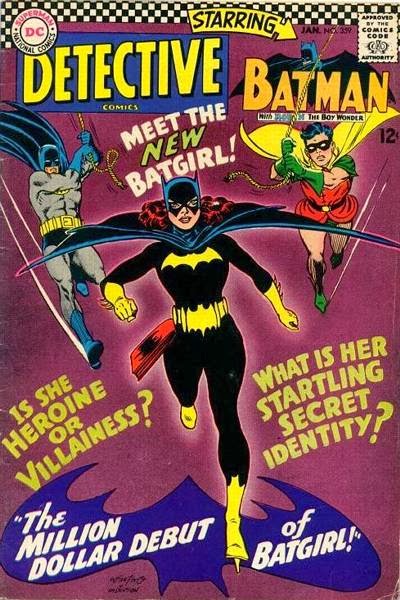
Carmine Infantino's cover for 1967's Detective Comics #359
While Sheldon Moldoff and Bill Finger introduced a Bat-Girl, with a hyphen, in 1961, the character Batgirl (without a hyphen) was created by Gardner Fox and Carmine Infantino at the direction of editor Julius Schwartz in 1967.

When she first appeared, she was waring the costume above, and it changed little over the 20 years between her debut and her 1988 retirement.
Mike Mignola and Karl Kesel's cover for 1988's Batgirl Special #1. I bought this comic from a back-issue bin specifically for the cover, and all I remember about it was that its insides were not as good as the cover. 

A few more Batgirls eventually followed in the comics. In 1999's Batman: Shadow of the Bat #83, part of the "No Man's Land" storyline, a mysterious new Batgirl in a new, all-black costume that hides her entire face appears. She's eventually revealed to be The Huntress, having adopted a bat-costume in an attempt to fill the void left by Batman, who was MIA from Gotham at the start of the story.
Damion Scott
She's soon forced to relinquish the name and costume, which both go to Cassandra Cain, who would be Batgirl for the next 11 years, wearing that costume throughout her tenure, with little to no alteration.
Phil Noto
In 2009, Stephanie Brown, formerly The Spoiler (and formerly the fourth Robin, albeit only for about the length of a single storyline), became Batgirl, and she had her own Batgirl costume, a black, yellow, and purple get-up with a utility belt and matching utility garter. The less said of this costume, the better. She proved to have the shortest tenure of any Batgirl, save for The Huntress, as the September 2011 New 52 reboot of the DC Universe excised Cassandra Cain and Stephanie Brown from continuity, now making it so that the de-aged Barbara Gordon never retired from being Batgirl.

Here's what her new, New 52 costume looks like.
Adam Hughes
From afar, it looks like it's basically her original costume, but the closer one looks, the more new and changed details one finds. Like most of the New 52 costumes, it isn't a simple body-stocking or spandex suit, but looks like something a Hollywood costuming department might put together for a superhero movie. It's a suit of armor more than a costume, complete with plates and seams and segments. There are more breathable, flexible areas where she needs to bend. And check out the palms of her gauntlets—I don't know why, but the grips on those give me the willies.

The inside of her cape is also purple now, and, on that first cover at least, she seems to have her cape affixed with some sort of bat-brooch...that, or she's just wearing a bat-pin on her cape.

It seems that the design has ben finessed a little big already, as the underside of her cape eventually became yellow, rather than purple.
Ed Benes
Either way, I don't like it much, and would prefer something closer to her original costume, or the one that appeared in the 2004-2008 animated series The Batman.

Here's how artist Art Baltazar dresses Batgirl, in the pages of the DC Super-Pets Character Encyclopedia:
Batgirl was a recurring character in Baltazar's Tiny Titans comic, and the version of her that appears in this encyclopedia is basically a grown-up version of the Tiny Titan, wearing a pretty similar costume. She's got a fairly traditional Batgirl color scheme of blue (and blue-black), yellow and purple, which looks like a blending of her coloring from the live-action TV show and the comic books of the 1960s (where her bodysuit was most often colored gray).

Baltazar's main innovation here is that he changes her tunic into a dress—that, or she's wearing a skirt and a tunic. Baltazar's artwork is so simple and flat that it doesn't really suggest textures, so it's difficult to say exactly what material she might be wearing or how thick it might be, and therefore I can't tell if she's wearing tights or leggings under the skirt (good), or wearing pants under her skirt (bad...and weird).

As un-Batgirly as the skirt or dress might be, I actually kind of like it in the way it evokes the original Bat-Girl costume, and the way it differentiates this look from the original Batgirl costume (The costume from The Batman that I like is actually a dress over tights).

I don't think this is the best possible Batgirl costume, and I don't think the design is quite the home run that Baltazar's Animal Man costume is, but I don't like it any less than I like The New 52 design and, with some tweaks, I think Baltazar's basic design could make for a far superior costume than The New 52 costume.

***********************
Baltazar is apparently quite enamored of the skirt/dress design when it comes to superheroines and supervillainesses. In addition to Batgirl, Wonder Woman, Aquagirl, Green Lantern Katma Tui, Black Canary, Zatanna, Hawkwoman, Raven, Harley Quinn, Catwoman, Poison Ivy, Star Sapphire and Circe all wear dresses or skirts in the DC Super-Pets Character Encyclopedia...as does Batwoman, a relatively short-lived character who has only been around long enough to have one costume design so far (Unless you count the Golden Age Batwoman, which I'm not counting).

Sunday, February 16, 2014

Review: Uncanny Avengers Vol. 2: The Apocalypse Twins

Despite being the second collection of the Rick Remender-written title starring a half-Avengers, half-X-Men "Unity" faction of Avengers, and despite starring the same characters with no additions or subtractions, and despite its reference to the events in the previous volume and the continuing tensions between the characters from that volume, in several respects this read like an entirely different book.

Much of that is visual, given that the "regular" artist for the series, John Cassaday, only lasted four issues, and the artist who drew the remaining, non-Cassaday chapter of Vol. 1 (Olivier Coipel) isn't around either. Art duties have been assumed, at least for six of the seven issues collected here, by Daniel Acuna.

And much more of that seeming like a different book is due to the fact that this volume—much more so than the previous one, which was devoted to premise establishing, character introduction and dealing with the aftermath of a single previous Marvel comic, Avengers Vs. X-Men—is permeated by the at times confusing and slightly unpleasant feeling that can occasionally characterize Big Two super-comics: The sense that one has walked in during the middle of a movie, or, more accurately, started watching a soap opera already a decade or so in progress.

The sub-title characters are descendants of the apparently deceased X-Men villain Apocalypse, and there is apparently a whole culture built up around Apocalyse, including an extended family with feuds over the rights of ascendency, a cult, a connection to the Celestials...probably all stuff devoted Marvel readers are already pretty familiar with. Additionally, characters discuss minor plot points in an off-handed fashion, like Rogue and Sunfire's history with each other and with Apocalypse, while fairly major plot points are culled from many other Marvel stories, some of which I've read (this deals with the fallout from the first story arc of the Remender-written Uncanny X-Force, for example, the death of The Sentry from Siege, and so on) and some of which I haven't (Wasp and Captain America both being lost in time and space for a while, whatever Wonder Man's been up to, like, is whole life, something from another Remender-written Uncanny X-Force story arc in which Wolverine maybe killed Archangel or something, and something from somewhere about Wolverine killing Daken by drowning him in a mud puddle, I guess...?). And there are multiple versions of Kang involved, and thus time-travel and...Oh man. I could follow the plot okay, but I felt pretty left out of the specifics, the texture and the emotional beats of the story, and generally had no idea what was going on regarding the various motivations for the characters' actions, or the finer points of their conflicts and histories.

As near as I can figure out, at some point, Kang kidnapped the titular twins and trained them in time travel or something, leading them to a critical point in history in which seven time lines diverge. They rebel against Kang, and are setting about some incredibly complicated plan involving a mutant rapture that will take all of the mutants from earth to a new planet, Planet X, forever enforcing a sort of segregation between mutants and humans (Or temporarily, I guess; since humans should continue to mutate, right? Again I find myself at the point where I'm not entirely clear as to what distinguishes a mutant from a human being; if the formers are evolutionary jumps of the latter, or if they are a distinct sub-species or a distinct species).

The Avengers Unity Division wants to stop this mad plan, but, to do so, they must first stop fighting themselves, and Remender has them breaking into pretty clear Avengers vs. X-Men factions, with Havoc siding with Cap and The Avengers (in an attempt to keep them team meant to realize Xavier's dream together) and Thor siding with the X-Men, who seem eager to kill the hell out of the Apocalypse Twins, which is something he can get behind, being a warrior and all.

I was lost enough on the core points regarding what the fuck a mutant actually is that the conflict didn't really make a whole lot of sense to me, as in the argument between Rogue and Scarlet Witch regarding Alex's dumb speech in the first volume, nor did the circumstances of the schism really register with me (Cap seems pissed at Wolverine for leading the squad that killed the child version of Apocalypse in X-Force, but I'm pretty sure Fantomex pulled the trigger, and, anyway, isn't that kid alive and well in Wolverine and The X-Men, or is that yet another of Apocalypse kids?).

Also somewhat confounding was the fact that the team seemed to be facing an extinction level event, and yet the rest of the Avengers—those in Avengers and Avengers Assemble, for example—don't answer the all-hands-on-deck distress signal. It's just these half-dozen goofballs, because they happen to be the ones in this title (On the very last pages, though, Remender just check in with the various Avengers and X-Men squads, as they all listen to the Twins' call for a mass mutant exodus from the planet).

All in all though, it's a bigger, richer narrative than the one seen in the first volume, albeit one I found overly-complicated. Part of that's on me, sure, as I'm not well-versed enough in Marvel minutae to "get" much of this, but then, I think it points to a certain degree of failure on the part of the creators and the publisher as well, given that this is a book that is, by the point collected here, less than a year old, and part of a line-wide effort to attract new readers to the Marvel Universe.

Regarding attracting new readers, I thought it was pretty weird that this book collects Uncanny Avengers #8AU, a designation meant to indicate that it ties into Age of Ultron. That issue is drawn by Adam Kubert, and barely mentions Ultron, but instead chronicles Kang's time with the Twins. It's presented out-of-order here too, not appearing on either side of Uncanny Avengers #8, but between issues #6 and #7.

I was quite surprised how much I ended up liking the art, as Acuna is an artist I had started to actively avoid after the few, pretty poor examples of his artwork I've seen in the past. The Acuna who shows up here, however, is head and shoulders above the one I had seen working on DC books in the past, though, the artwork having a much more drawn look to it, and the character acting leaps and bound above what it once was.

I particularly liked his rendering of Alex "Havoc" Summers, which features a leaner, more elongated figure with a slightly angular face; it's a build not unlike that of his brother Scott Summers, and one that distinguishes him from the other big muscular short-haired blond guy on the team, Steve "Captain America" Rogers.

One aspect of his work here I didn't care for? Wolverine's bushy sideburns are still visible when he's wearing his cowl, which makes me think either his sideburns are too big or his mask is too small.
There are some pretty cool designs in this book, although I'm not entirely sure who came up with what—in addition to Acuna and Kubert, Cassaday is still around enough to provide the cover art, and it's possible he did design work on the series before the reality of a monthly (or, knowing Marvel, more-than-monthly) series caught up with him. The Twins are pretty cool-looking, resembling god-like, mythological figures more than Apocalypse himself ever did, and the Four Hourseman that show up during Kubert's section, during medieval times, when Thor carried an axe rather than a hammer, are pretty awesome.

Check them out:
They only last about two pages, but I was pretty sad to see them go, based on how weird and cool-looking they are.

Four new Horsemen appear near the climax, a Horseman unity division including black and blue versions of recently deceased mutants (Banshee and Daken) and recently deceased humans (The Grim Reaper and The Sentry). They also called themselves The Four Horsemen of Death, rather than Apocalypse. They're obviously not as cool-looking as the medieval four above, and they lack horses, robot or otherwise, which makes them pretty poor horsemen in my book. If you're going to be a horseman of any kind, I think it absolutely necessary that you at least have a horse.

And now I leave you with an image of The Sentry peeling apart his face to shoot energy beams at Thor:

Saturday, February 15, 2014

@#$%ing @#$ @#$% @#$%^& @#$%ing @#$%ing @#$%s!

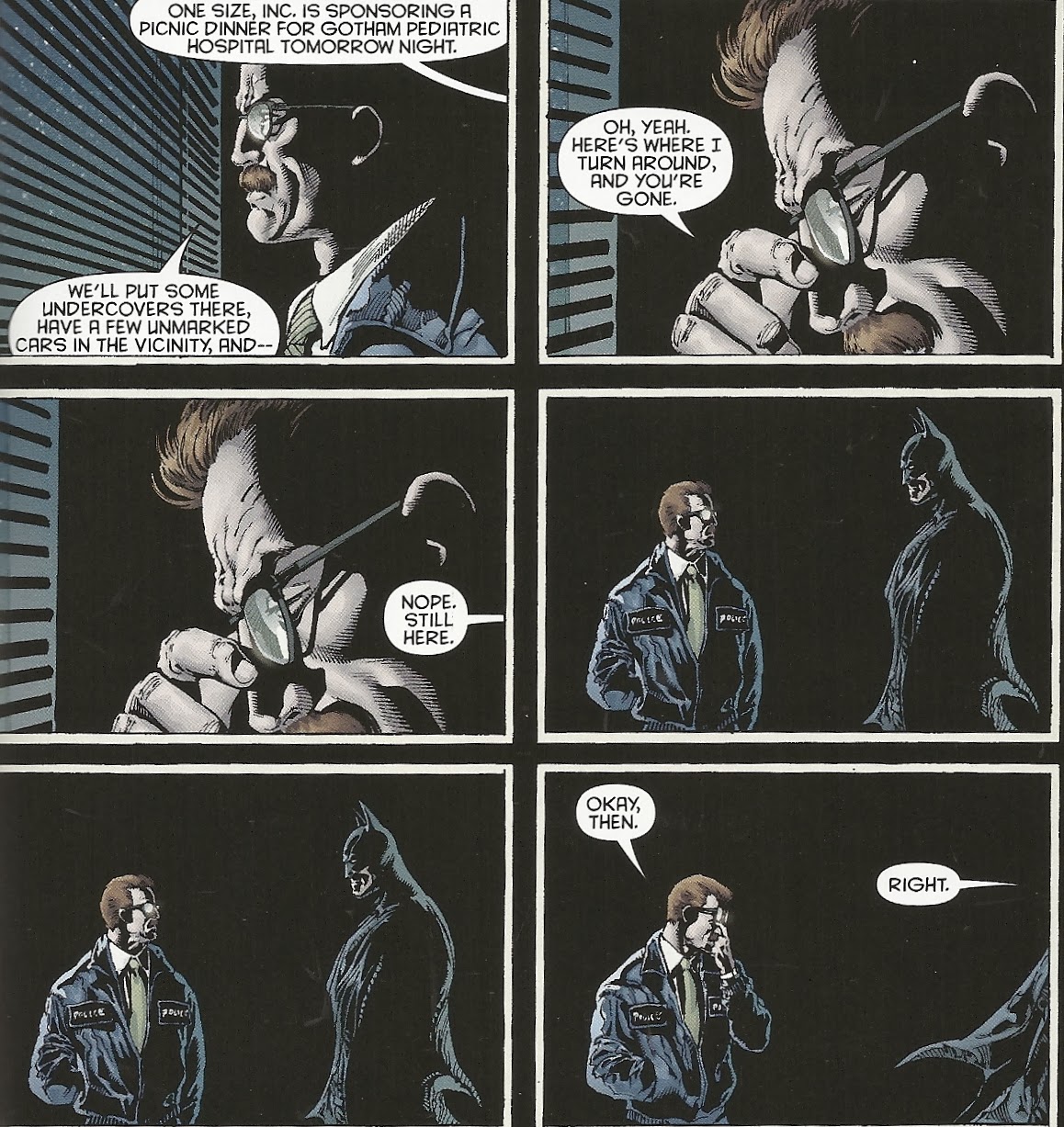
So hey, what did you guys do this afternoon? I spent, oh, a few hours writing an incredibly long post about Batman: The Dark Knight Vol. 3: Mad by Gregg Hurwitz, Ethan Van Sciver and Szymon Kudranski. It was in a list format, discussing the several positives (like the scene above) and many, many negatives of the storyline, its conception and execution. I had actually started it Friday night, by re-reading the collection and taking some notes, and then spent this afternoon filling in the list with paragraphs of commentary, including a few digressive mini-essays about some of the issues raised by the story.

I saved repeatedly, but I guess there was some broken HTML in there somewhere, and I told myself I'd find it before posting—I didn't think that was enough to block saving, but apparently so. Anyway, I then spent a little more time scanning images, and broke for dinner. When I tried opening NPR in another window for company while I cooked, the computer completely froze and I had to forcibly close my browser. "Are you sure you want to do this?" the computer asked, "You will lose any unsaved changes." But since I had been saving my changes, I figured I'd be okay.

A few hours later, dinner cooked and eaten, part of a Godzilla movie watched while I digested and my over-heated laptop having spent some time cooling off, I returned to the computer in order to insert the images and post the piece when, to my horror, I discovered the last three-fourths of it were lost. Then I spent another 45 minutes of my day trying to figure out a way to recover it, but I was completely stumped and could find no answers on the Internet or through the "help" areas. It wasn't in my history and blogger, so far as I can tell, doesn't save drafts the way some other blogging whatchacallthems do (I've idiotically, accidentally erased pieces I wrote for Robot 6 and Good Comics For Kids in the past, for example, but been able to find previous drafts, minimizing the re-writing needed).

Now, I could have re-written the post. I still had my notes, after all, part of it was saved, and, having just written it, I remembered the gist of what I was trying to say. In fact, if I rewrote it now, it would more likely than not be a better post, as I would have actually written a second draft of it, which is something I never do (As you can probably tell from the less-than-sterling quality of the writing). But I've already wasted, let's see, the majority of one entire Saturday on talking about a mediocre comic book for a few thousand words, and don't really want to spend/waste any more of my life on it.

So this is basically just a post explaining why there's not a bigger, better post here in its place.

Sorry! But trust me, I'm much more irritated about it than anyone else could possibly be.

Thursday, February 13, 2014

Meanwhile, at Robot 6...

Today at Robot 6 I have a review of Fabien Vehlmann and Kerascoët's Beautiful Darkness, a really rather amazing book that is very difficult to discuss without spoiling some of its greatest pleasures. You can go read my review if you like, but, honestly, you'd be better off just going ahead and reading Beautiful Darkness instead.

Wednesday, February 12, 2014

Review: All-New X-Men Vol. 3: Out of Their Depth

The third volume of Brian Michael Bendis and Stuart Immonen's All-New X-Men, the series dealing with the original, teenage X-Men visiting the present Marvel Universe and refusing to go back until they fix it, opens with the resolution of a particularly manipulative cliffhanger. When Cyclops and his team appear on the lawn of Wolverine's X-Men school and headquarters to pick up anyone who wants to defect to Cyclops school, Emma Frost's protegees The Stepford Cuckoos accepted, as did one of the original five, left unrevealed until the first issue of this volume—It's Angel (although Uncanny X-Men Vol. 2 made that clear anyway).

The first four of the five issues contained in this volume  deal with the events of Angel's defection and its aftermath. This includes some fighting, like a diamond form Emma slugging Wolverine, and some emotional heart-to-hearts about mind-control, as when Kitty tries to comfort a despondent Jean Grey.

These four issues are all penciled by Stuart Immonen and inked by Wade Von Growbadger (who I think may just be the best of the current X-Men art teams, but I don't know; Olivier Coipel and Nick Bradshaw are pretty amazing too).

That story arc also signals the resolution of the Mystique, Sabertooth and Mastermind plot, which has been to rob and rob and rob until they've amassed a small mountain of money in a warehouse, with which Mystique offers to buy Madripoor off of Madame Hydra. Wolverine, Kitty and the new kids are on their trail, culminating in a big-ass fight scene with other players involved, like The Silver Samurai. The good guys naturally win, and at least some of the bad guys are caught...although Mystique escapes SHIELD custody almost immediately. While I'm all for big-ass fight scenes, especially ones drawn by Immonen and including quipping combatants like teen Iceman and teen Beast, the most interesting part of the story arc occurs a little earlier, when the X-Men hear Alex "Havoc" Summers' dumb-ass press conference from Uncanny Avengers Vol. 1, and Kitty replies at length, in a scene that basically amounts to Bendis telling Rick Remender to shut up.

It takes a full page, and follows some commentary from various X-Men, but Bendis, through Kitty, explicitly re-couples the traditional X-Men/mutant metaphor as one that refers, however broadly, to (insert any other persecuted minority of any kind here), having Kitty tell a story from her childhood in which a boy she had a crush on found out he was Jewish. "So, no offense to your brother Scott," she says in summary, "But he sure as hell ain't talking for me."

And, of course, more interesting than that big-ass fight scene is the part during which the "All-New" X-Men meet the Avengers Unity Division from Remender's Uncanny Avengers for the first time. This naturally leads to some fighting—like when Jean picks up the "No more mutants" memory from Scarlet Witch's mind—but, more interestingly, some weird bonding between Alex and Teenage Scott, where the Alex Summers from the present gets to try and reconnect with a past, more pure and uncorrupted version of his estranged brother.

This Avengers team shows up a little later too, in the aftermath of the climactic fight, and I found some of the interactions to be pretty amusing. Bendis does some pretty clever dialogue throughout this volume.

The highlight of this volume, however, is the fifth and final issue in the collection, which reads an awful lot like one of Jeff Parker's issues of X-Men: First Class: It's lighthearted, fun and funny, and features very striking artwork, of a much more cartoony style than any of the other X-artists of the moment, even Bachalo.

It's by David LaFuente, and is one of those quieter, day-in-the-life stories that super-team comics occasionally have between major plot-lines. In this instance, Rachel Grey and the time-travelling, teenage version of the alternate future version of her mom repeatedly, awkwardly bump into one another, Iceman convinces Cyclops to steal Wolverine's Jeep and go into town where they try to make new friends and meet girls at a street fair, and Jean accidentally discovers from adult Beast that teen Beast had a huge crush on her, and, in a scene that is more than a little weird, the two teenagers make out, while holographic versions of variously mutated adult Beasts hang in the air around them, sort of watching.
This issue was a lot of fun, and, as always, it was a lot of fun seeing Bendis do humor—this read a bit like some of his better Ultimate Spider-Man writing—and allowing an artist whose style is pretty far afield of the Marvel house style (which exists on a much, much broader spectrum of art styles than the DC house style at the moment).

As for what happens next, it's Battle of The Atom, which I reviewed in brief here.

Tuesday, February 11, 2014

Review: Uncanny X-Men Vol. 2: Broken

When Frazier Irving showed up as the fill-in artist late in the first volume of the new Uncanny X-Men, the Brian Michael Bendis-written series following Cyclops and his small, rebel school of X-Men and serving as co-flagship with All-New X-Men, it seemed like a choice dictated by the material. These X-Men and their new recruits were taking a sudden detour to the infernal limbo dimension that Magick is somehow bonded to and uses to teleport through. Irving draws cool evil, demonic shit, and is pretty good with flames and painterly textures, and is a pretty good choice for drawing Magik in her goofy "Darkchilde" mode fighting Dormammu for control of a corner of hell.

It turns out Irving's presence isn't going to be quite so short-lived. In addition to finishing up the Limbo plot, which fills issues #6-7, the first two collected here, he returns for issues #10-11, for issues dealing with the ongoing storylines of the book: Someone apparently within SHIELD launching a Sentinel program against Cyclops' mutants, someone on Cyclops' team apparently betraying him...someone other than Magneto, who is openly betraying him, but making the argument to Cyclops that he's pretend-betraying him. Basically the sort of espionage/thriller stuff that has characterized the Marvel of the 21st century for so long now.

If one-time Wolverine and The X-Men artist Chris Bachalo had a style that didn't gel all that well with fellow artist Nick Bradshaw, his style gels even worse with that of Frazier, as neither artist produces work that looks much like anything the other produces and, in fact, are so individualized in their styles at this point that it's difficult to think of artists who they would fit in well enough with the split duties on a title like this (I did notice for the first time, and I'm not sure why this never occurred to me before, how much Irving's work resembles that of Richard Corben; imagine that, a Frazier Irving/Richard Corben Uncanny X-Men!).

As with the other X-Men titles I've been reading, this is a case of two good artists taking turns on a single ongoing, both of whom are very good and both of whom keep the book looking great, but neither of 'em making for a very consistent-looking book.

How important this is, in the long run, likely varies from reader to reader. As a fan of these comics, I do like that it means the trades come out at a faster clip, although if I were a retailer and/or publisher, I think I'd worry about the books coming out too quickly, and creating unnecessary competition (If you're spending $8 rather than $4 on Uncanny X-Men each month, for example, maybe that second $4 is coming from money you'd otherwise spend on, I don't know, Detective Comics...or maybe it's coming from money you'd otherwise spend on X-Men or Amazing X-Men or Wolverine and the X-Men or one of the X-Force comics or Indestructible Hulk and so on).

One obvious ill is I think it diminishes the role of the artist to a great extent, as it makes Brian Michael Bendis the only regular, month-in, month-out contributor to the series, and literally makes Bachalo and Irving interchangeable. This run of Uncanny then, isn't going to end up being known as the Bendis/Bachalo/Irving one (provided those two both stick around, and one isn't replaced by a third artist eventually), but as the Bendis run.

So where did we leave off?  Magik, like the other adult member's of Cyclops' team, has had her powers somehow scrambled or what's the world...oh, broken, as in the sub-title, by her extended exposure to the Phoenix Force in Avengers Vs. X-Men. And I guess Dr. Strange villain Dormammu is making a play for control of her Limbo, which is why he is able to teleport them all to Limbo, she turns into Darkchilde and a bunch of Mindless Ones attack the team.

This story is on the I'm-having-trouble-believing-this-shit side, and not just because someone somewhere once thought it was cool to name a character "Darkchilde" and no one has since changed it. I was pretty sure the Midless Ones were supposed to be tough customers—that's Dormammu's Mindless Ones, not these guys—so I'm not entirely sure how or why they don't slaughter Cyclops' X-Men in one splash-page flat. Most of the recruits are extremely raw, with no combat training, and powers that are effectively useless in most fights—Angel can fly, Triage can heal people, codename-less Benjamin Deeds can shape change his head to resemble that of whoever he's talking to. Bendis has the Stepford Cuckoos reach into everyone's brains and turn them into berserker warriors to keep them alive in the fight, but no matter how brave you are, shape-changing your face or having large bird wings doesn't really qualify you to beat up rock monsters, you know?

Meanwhile, SHEILD recruits Dazzler to be their official mutant liaison, and she immediately starts wearing a tight-fitting Stormtrooper costume for some reason.
After the trip to Limbo, Fabio "Goldballs" Media (Bendis is the worst at creating new Marvel characters) quits and returns home, Dazzler immediately arrests him and takes him to a SHIELD brig, and the X-Men rescue him.

In the final issues, Cyclops makes a spur-of-the-moment decision to appear at a pro-mutant, pro-Cyclops rally, and a new kind of Sentinel attacks, the volume ending with a look at the man (or woman or creature or robot), and...I don't know who it is.
Should I?

In general I prefer the Bachalo sections' art to that of the Iriving sections, although one thing I really like that Irving did was repeatedly line the Cuckoos up just so.
And while this volume has more issues in it than what seems to be the new standard—five—it still has some supplementary material, some of which consists of Bachalo's designs for the new Dazzler, Agent of SHEILD costume.

These, naturally, include one where she is wearing thigh-hight boots and/or leggings with tiny, little shorts...
...just like the Bachalo redesigns of Magik, Emma Frost and Husk.

Bachalo really likes that look, apparently.

Monday, February 10, 2014

Review: Wolverine and The X-Men Vol. 3

I wonder how much sense the third collection of Jason Aaron, Chris Bachalo, Nick Bradshaw and company's Wolverine and The X-Men series might make if you didn't also read Avengers Vs. X-Men. Or if it makes any sense at all. I rather enjoyed Avengers Vs. X-Men, which I read in one big gulp thanks to some Bible-sized hardcover collection that included the entire series and the spin-off, nothing-but-fights companion series with the ludicrous title of AvX: Versus, and I imagine if one likes Wolverine and The X-Men, one would also like Avengers Vs. X-Men, but the five issue collected herein really depend on a good working knowledge of the series it ties into.

These issues don't comprise a single story arc reflecting the events of Avengers Vs. X-Men, but each issue reflects a particular story beat from the series, so, in essence, these are five somewhat stand alone tie-ins to particular issues or story elements of the event series. And unlike a lot of event series, a lot happened in the pages of Avengers Vs. X-Men, so the status quo the cast of this book is reacting to in various ways changes greatly from issue to issue.

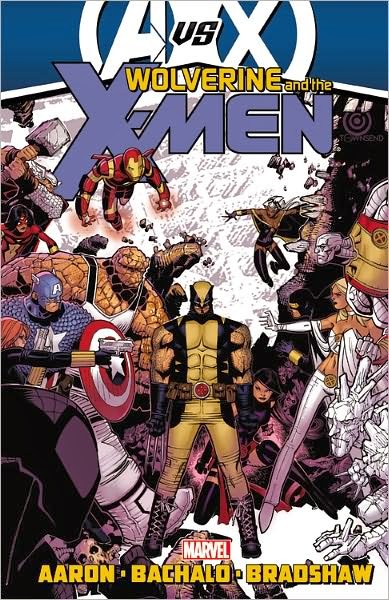
Wolverine is, of course, one of the more conflicted characters in the event's conflict, visually represented by Chris Bachalo's cover, as he's really the only character involved who is both an Avenger and an X-Man simultaneously (Beast also sides with the Avengers), and is the one character among all the heroes who had a pretty huge problem with Cyclops before the conflict even started. He's therefore a fairly big player in that series, and this book checks in with him and a few other characters throughout the tumultuous events of Avengers Vs. X-Men, at one point more-or-less derailing the entire premise of Wolverine and The X-Men (The Jean Grey School's entire staff of X-Men resign en masse to join with Cyclops' team, leaving only Kitty Pryde behind). The volume ends with Cyclops and the rest of "The Phoenix Five" still possessed by the Phoenix Force, so how Aaron rights the monthly series will be interesting to discover in the next volume.

So in the fist issue, Captain America visits the school to tell Beast and Wolverine about the Phoenix Force's imminent arrival on Earth, and to recruit them each for a different mission (Beast goes into space to try and stop the Phoenix, Wolvie joins Cap and the other Avengers to beat-up the X-Men and get likely host Hope away from them).

In the second, Cyclops, Emma Frost and Magick arrive at the school in the aftermath of the Utopia fight to try and recruit Wolverine to the mutant cause; Wolverine refuses, but just about everyone else joins Cyclops.

In the third, X-Men and Avengers are fighting all over the world, while Wolverine is trying to get Hope to the moon to...it's complicated. The pair of them fight an alien death squad, though.

In the fourth, Cyclops, Emma and the others are already empowered by the Phoenix Force, which must have happened between issues of this series, and  Rachel Grey is hunting for Hope (Apparently Rachel, who, as far as I can tell, is character sharing some of the lamer attributes of both Jean Grey and Cable, was some sort of mutant hunter of mutants in the future? Called a "hound"...?),  and there's a big X-Men vs. Avengers fight, in which Wolverine and... regular Kid Gladiator sides with the X-Men to beat up a bunch of Avengers.

And, finally, in the fifth issue, Kid Gladiator's dad, Gladiator, leads Warbird and a bunch of Shi'ar soldiers attack Cyclops and company's base in an all-out assault that goes very, very badly for them. This issue, narrated by Warbird (another Wolverine and... regular) and splitting its attention between the Gladiator vs. Phoenix fight and Warbird's origin story, reveals the bephoenixed X-Men at maybe their most villainous. Cyclops, Colossus and Magick all do some fucked-up shit to their fellow heroes and the world as a whole in the course of Avengers Vs. X-Men, up to and including Cyclops betraying Emma and killing Xavier, but nothing seemed quite so evil to me as the scene in this issue where Colossus and Namor not only defeat Gladiator, but then proceed to savagely hold him down and beat him bloody while Cyclops watches, eventually ordering them to stop when it looks like the near dead—or hell, maybe dead—Gladiator has had enough (The last issue ends with Warbird carrying an unconscious Gladiator into the Jean Grey School; Kitty says to ready the medical bay and Doop has a first aid kit, so I assume he didn't die).

As with previous volumes, Bachalo and Bradshaw split up penciling duties (each of them is inked by four different inkers), with Bachalo drawing three issues and Bradshaw two. As I've said before, both are great artists, and either would be great on the title, but their styles don't mesh well at all, and it's not merely a matter of the different ways they draw.

Bachalo's character designs are so individualized that his Iceman or Wolverine don't really look like the same Iceman and Wolverine that Bradshaw draws, and Bachalo's panels have nor borders, using the generous white space of the page to form gutters around his panels, while Bradshaw's have the traditional black-lined borders.

Their clash doesn't really matter here, as each issue reads like a stand-alone tie-in to a different issue of Avengers Vs. X-Men, but while Wolverine and The X-Men is a consistently good-looking book, it's not a consistent looking book.

Sunday, February 09, 2014

Review: Uncanny Avengers Vol. 1: The Red Shadow

Unity is a laudable concept, but it's maybe not the sexiest word to have in the title of a Marvel fight comic, which is why the Rick Remender-written Avengers comic that spun out of the events of Avengers Vs. X-Men borrowed the traditional X-Men adjective "Uncanny" and added that the popular proper noun "Avengers" for Uncanny Avengers. Rather than being called something like, you know, The Avengers Unity Division, which is technically the name of the particular faction of heroes starring in this book (See the Olivier Coipel-drawn panel above).

The premise is pretty solid. Following the world-wide war between The Avengers and the X-Men of that particular event series, Captain America thought long and hard about what his enemy Cyclops said about he and the other non-mutant heroes steering clear of mutant issues for years (which probably had more to do with Marvel editorial and the fact that Captain America had his own titles and the X-Men had theirs than with Captain America's own personal beliefs in mutant civil rights).

To help do his part to fulfill the dreams of the late Charles Xavier (who, you remember, was killed by the Phoenix force-empowered Cyclops at the climax of Avengers Vs. X-Men), Cap decides to form a superhero team that is half Avengers and half X-Men, with human and mutant heroes fighting side-by-side for the good of all.

And Remender chooses a pretty perfect villain for the first story arc, given that premise. The Red Skull (Or a Red Skull; if I read this correctly, this is a resurrected clone of the original Red Skull...?), who has decided to use mutants in America as the Nazis once used Jews, gypsies and other scapegoats in Germany, a sort of shared minority punching bag to unite the populace against and make them more easily ruled by a fascist strong man like, say, The Red Skull.

While the premise is strong and flows perfectly and naturally out of Avengers Vs. X-Men there is, of course, a problem with it: The Avengers have always included mutants in their ranks, at least since their first major line-up shake-up in the, uh, 1960s. That's when Captain America reformed the team as 50% mutant, with The Scarlet Witch and Quicksilver joining him (and becoming among the longest serving Avengers in the team's history). Original X-Men Beast had a pretty good run as an Avenger, and Wolverine's been on the team for almost a decade now. Namor served a stint, and Storm was an Avenger for at least five minutes.

While Remender does a fine job writing the mutants in his roster, they seem more like the characters he was assigned, ones that no one else was using too prominently on their X-Men or Avengers teams, and, for the most part, they're therefore not really the X-Men or the mutants who seem like they are most ready to graduate into the sort of superhero one typically might associate with Marvel's A-List superhero team, or ones particularly well suited to a PR effort or sincere mission to live Xavier's ideals.

Of the four in the first story arc, which comprises four-fifths of this collection then, we get long-time Avengers The Scarlet Witch (who has never really had much to do with the X-Men formally) and Wolverine (who is on most Avengers and X-Men teams already anyway).

The more interesting choices are Rogue, who has some pretty serious issues with Scarlet Witch, given that whole "No more mutants" thing that decimated the mutant population and, in a roundabout way, set the stage for Avengers Vs. X-Men and the death of Xavier, and Havoc, the horribly-costumed brother of Cyclops, who is a fairly minor character in the Marvel Universe as a whole, and thus an interesting inclusion on an Avengers team, especially as its leader, which is what Captain America has made him (Although immediately has trouble taking orders from someone else, since he's always the leader of all his teams).

The non-mutants on the team, at least in that first arc, are, of course, Cap and, um, Thor, who is either a god or an alien, depending on whether you're an ancient norseman or not, and therefore doesn't really fit with the mission statement so well.

With the fifth issue, more characters are added: Japanese mutant Sunfire, a nice addition in how random and previously un-affiliated he is with the Avengers, and human heroes Wonder Man and The Wasp.

Backseat driving the line-up aside, Remender does a nice job of selling the premise and justifying the inclusion of most of the members, giving them interpersonal conflicts and alliances right out of the gate (Thor being maybe the only exception; he's merely written as the cartoon character he usually is).

The plot of the first arc includes a pretty shocking splash page ending to the first issue, and an extremely silly point that has a nice gross-out component and goes a bit further in making the Red Skull someone the X-Men might want to fight (Actually, I'm not sure why all the X-Men teams didn't go after the Skull...beyond, you know, different titles and Marvel editorial).
DC's not the only publisher who can play the gross-out grand guignol game.
He and his new super-hero team, which is filled with characters with Peter Milligan/Grant Morrison sounding names like The Goat-Faced Girl, Dangerous Djinn and so on, rob Xavier's grave, remove his brain and, somehow, fuse it with Red Skull's brain to give him Xavier's mental powers (it's sorta glossed over how exactly that works, given that the Red Skull's skull is the same size as everyone else's skull; that is, big enough for about one brain).

This first story arc is drawn by John Cassaday, a talented artist with a few collections of pretty high-quality X-Men comics on his bibliography, but probably not someone you want on a monthly comic book, as evidenced by the fact he draws only the first four issues of this collection. The fifth issue is drawn by Olivier Coipel and Mark Morales, and is an all-around stronger piece of work, although I suppose I should take into account my preference for Coipel's more fluid, energetic style over Cassaday's, but it's a well-drawn book, from start to finish.
I love the way Cassaday draws the Skull's smile.
The previously-mentioned grating occurring between Avengers history and the expressed goals of this Avengers team aside, and some over-narration aside, Remender does a pretty fine job on the book...save for that one, now-infamous scene in #5, in which Alex "Havoc" Summers makes his "M-word" speech.
Shut up, Alex.
Those who care about the issue have all already had their say long ago, when #5 was originally released as a single issue, so I don't want to get too deep into it here, but it doesn't really work in context any better than is sounded out of context.

Remender has Havoc state during a press-conference that he doesn't like being identified as a mutant, and thinks that the world "mutant" itself is, in fact, a divisive term, meant to separate mutants from the rest of humanity, and he would prefer to be thought of as human rather than mutant. Putting aside whether or not that's a thing the leader of a The Avengers Unity Division showcasing human and mutant hero working shoulder-to-shoulder would or should say, and putting aside (Hey, I've done a lot of putting aside with this book!) how that works if you extrapolate the mutant metaphor the way it's generally extrapolated (replace the word "mutant" with "black" or "Jewish" or "gay" or "Mormon" or "teenager" whatever, and there's no way that speech doesn't sound pretty weird, and potentially offensive to a lot of folks), Havoc and/or Remender sort of fuck up two important points in that little speech.

First, Alex refers to mutant as "the M-word," which in the traditional reading of the X-Men metaphor would make it equivalent to "the N-Word," and "black" and "N-word" sure as hell aren't the same thing, nor is "Jewish"/"K-word" or "gay"/"F-word" or "Mormon"...I actually don't know any offensive terms for Mormons. If you know any, please, don't tell them to me. If there is an "M-word" in the Marvel Universe, it's "mutie," as in "you stinkin' mutie," not "mutant.

Second, mutants literally are a separate species than human beings in the Marvel Universe...aren't they? I am not the most well-read Marvel reader (I've "only" been reading Marvel comics for about 15 years now), and X-Men continuity is an especially confounding area of comic book knowledge for me. Also, I'm not a biologist, and know even less real-world science than I know comic book science. But that said, it was my understanding that the mutants in the Marvel universe had their own scientific classification—Homo sapiens superior—which would make them a distinct organism separated by species from Homo sapiens (i.e. human beings), no? Don't Marvel's mutants share a genus with human beings (Homo), but have their own species (superior, or sapiens superior).

Like, look at Neanderthals. They share a genus with humanity, but are generally considered a different species, Homo neanderthalenis...although Wikipedia says that's not exactly settled science, and that some believe them to be not a distinct and separate species than Homo sapiens, but a sub-species, classified as Homo sapiens neanderthalenis. At any rate, whether Marvel's mutants are their own species or a sub-species of humanity, what Alex says sounds pretty contrary to what Marvel history I know. (And man, when you factor in the Celestials in mutant evolution and all that ancient aliens shit, it's reeeaaaaallllly hard to make equivalences between the real world and the Marvel universe).

Anyway, that speech was a super-dumb part of an otherwise pretty good comic book.

Now look at this crazy looking Neal Adams variant cover:
Wow. I don't know exactly what it feels like to have a cloned Nazi monster with chunks of Charles Xavier's brain grafted on to his own trying to mentally dominated you with psychic powers, but that Adams image at least gives me a few clues to go on.

Meanwhile, at ComicsAlliance... (Some thoughts on Forever Evil so far)

Norm Breyfogle. Mark Buckingham. Greg Capullo. Cliff Chiang. Gary Frank. Patrick Gleason. Ig Guara. Chad Hardin. Dan Jurgens. Aaron Kuder. Jae Lee. Jim Lee. Doug Mahnke. Francis Manapul Inaki Miranda. Moritat. Sean Murphy. Peter Nguyen. Paul Pelletier. Nicola Scott. Thony Silas. Ethan Van Sciver.

These are some of the names that tend to pop into my head during the first reading of each issue of Forever Evil (I tend to read them about a half-dozen times or so, in preparation for these pieces at ComicsAlliance). Those are the names of some of the better artists doing work regularly for DC Comics these days, artists whose styles are at least within the conceivable spectrum for a mainstream, DCU/New 52 book.

Certainly some of them have trouble keeping up with their current commitments, some are no doubt loyal to the monthlies they're working on and some are working on books that may actually be higher-profile and, in the long-run, more profitable for them than an event series like Forever Evil might be. But one thing they all have in common is that they are far better artists than David Finch by most of the metrics in which superhero comic art can be measured, and I wonder about them because it's hard to look at the finished, printed art for the series and understand why the people who decide who-does-what for DC Comics wanted Finch on this particular project.

I was never the biggest fan of Finch' style, but he seems to have certainly declined quite a bit since Marvel pushed him as one of their "Young Guns" creators, back in 2004-2005 or so, when he helped Brian Michael Bendis remake The Avengers into Marvel's number one franchise. He seems to have trouble hitting deadlines, his work seems rushed when he does hit them, he's not very good with figure work, he's not very good at facial expressions, he's not very good at settings or filling up pages with cool stuff to look at (this was, by the way, pretty evident before this particular series was even solicited; Justice League of America, or at least the three issues he drew for the title launched as a Geoff Johns/David Finch book, were pretty poor).

A big superhero crossover series isn't the best place for an artist of Finch's particular skills, as the dozens of characters mean a lot of drawing, much of it very precise (For example, among the many characters in this narrative are ones who are supposed to look exactly like other characters in the book, including, for example, Superman, an evil Superman duplicate from an alternate dimension, and a failed cloning experiment of Superman; in this fifth issue, Sinestro regards Hal Jordan's Earth-3 doppleganger and remarks, "You're a strange creature, are you not? You look like Hal Jordan..." and you just have to take his word for it).

Johns also writes for the splash page, something he has always done—and, in fact, his writing for big "moments" within his stories are, I think, a component in his success—but if an artist isn't quite up to the challenge, those splashes only accentuate the artist's weakness.

For example, this splash page in which Power Ring decides to fight back against Sinestro, rather than fleeing. Not only is it not that big a moment—I, for example, might have OMG SPOILERS!!!! chosen to instead highlight the part where Sinestro creates a yellow light construct of a buzzsaw to cut off Power Ring's right arm, or the part where Sienstro completely incinerates Power Ring with a blast of yellow energy—but it only served to highlight, underline and advertise a pretty basic fuck-up Finch made in its drawing. (Also, it looks like Power Ring is totally grabbing Sinestro's dick in that picture.)

Or take pages two and three, a splash in which Deathstroke leads a a team of villains against Luthor, Batman and their allies; many of the "new" characters arriving on the scene are obscurbed by one another (Of Giganta, we only see her arm and face and, in fact, never see much more of her, except in an extreme long shot).

What's New 52 Copperhead look like? I know he has a snake head and what look like long, boneless, snake-y arms, but does he have legs, or a big snake tail, or legs and a tail? Does he wear clothes? I don't know; we never see him on-panel in way that let's us see him; he's never visually introduced, despite two pages (almost 1/10th) of the book devoted to a panel in which he and his allies arrive. This is the best look we get at the character—
—the other panels are just images of his arms or head reaching in from off-panel.

That same splash includes this awkward section:
After a few split-seconds of confusion, I figured out that the gun there is held in Captain Cold's right hand (half of which is obscured by Blockbuster's huge forearm), but at a glance it looks like it could just as easily be something mounted on Black Manta's shoulder, or being held by Bizarro or something on Blockbuster's forearm. You wouldn't take a photograph like that, because of how the flattening of the image would confuse where an object behind a figure fits, so why would you draw a picture like that, given that you are in 100% complete control of every element of it in a way that's difficult for a photographer to achieve?

And then, of course, there's the final two page spread, posted at the top of this post (Yes, there are two two-page spreads in a 21-page comic). It's supposed to be a very big moment, and it was one of the two in this issue that really piqued my curiosity. According to the verbal component of the comic, it signals the arrival of the "creature" that destroyed Earth-3, something from somewhere in the Multiverse that evil Superman Ultraman was worried about, and was so worried about that he wanted to conquer this Earth and prepare it for the creature's coming.

This should be another moment for Finch to really show how, but in actuality, he only does about a half a page of drawing; just some cliffs, pine trees, and tiny little figures representing the Crime Syndicate. The colorists fill in the sky and the water and the red stuff.

It apparently looks like something from some TV shows and movies that comics readers would recognize, but I never saw any Star Trek or Doctor Who, as unusual as that might make me among comic book readers.

As a fan who would really like to give myself over to this story, I feel like I should care immensely about that last page, and pore over it for clues to what I imagine is meant to be a pretty shocking reveal, but Finch and the rest of the art team aren't really giving us anything to work with in that image.

Is that something stationary, glowing in the sky? Is it something streaking through the sky, leaving a light trail? Is it a bolt of lightning, appearing for only a moment, and the thing they all recognize is something off-page...?

No idea.

I've been trying to guess what it could be for most of the week now. As I noted in the CA piece, Deathstorm says "Look. Up in the sky." when he sees it, alluding to Superman...or, since this is something that destroyed Earth-3, something Superman-like...an evil Superman of some kind. But then, that's Ultraman, the evil Superman of Earth-3. Is there a more evil Superman from a more evil alternate Earth? Is that Ultraman-Red, flying through the sky like a comment?

I wondered if maybe it was meant to be something Shazam-related, as lightning is the source and signifier of their power, and while it's usually golden or electric blue color, this being an alternate universe version, maybe their Shazam is red (I don't think there's ever been an Earth-3 version of Captain Marvel/Shazam in the comics*, as the character hailed from Earth-S pre-Crisis, and thus an evil, Earth-3 version might make for something new). But while it might make some sense to have something Shazam-y in the climax, with Black Adam a player in the story, Captain Marvel/Shazam a player in "Trinity War" (and currently exiled from Earth like all of the Justice Leaguers who aren't Batman, Catwoman or Cyborg) and the original wizard Shazam having some part to play in the vague story revolving around Pandora and the Trinity of Sin you would think DC might actually get around to telling one day, perhaps in the New 52's first event series, it should be noted that Ultraman made short work of Black Adam, and thus probably wouldn't be overly worried about another version of the character.

I also wondered if maybe it might be the Thunderbolt, as in the magical creature that used to pal around with Johnny Thunder in the Golden Age and then on Earth-2, a near-omnipotent creature that Grant Morrison posited was actually an entity from Mr. Mxyzptl's Fifth Dimension, a characterization that Johns and other writers kept through the end of the "old" DCU...and I don't think we've seen Johnny or a T-Bolt of any kind since the reboot (I'm a story arc or two behind in Earth 2, the title in which they'd be most likely to show up, though).

I know several folks have guessed it is Darkseid or an Apokalytpian threat, but given how relatively easy it is to defeat Darkseid—Cyborg did it by believing in himself five years ago, when there were only six superheroes fighting Darkseid and his army of Parademons—I can't imagine him having wiped out a world of more ruthless versions of the DCU's heroes, nor posing a threat to Earth-New 52 at this point, when it's chockfull of super-people.

I'm a little worried that whatever it is, it's not going to be something that gets dealt with by the end of the series. We're a good 100 pages into the story so far, and relatively little has actually happened in the 48-hours that this issue says has passed since Forever Evil #1.** The Crime Syndicate called a big meeting and said they were in charge of the world now, they captured Dick Grayson, Ultraman flew around looking for Kryptonite to snort and Superwoman told everyone she was pregnant with their baby. Meanwhile, Luthor and some disaffected villains teamed-up, and Batman and Catwoman dropped Cyborg's torso off at his dad's place and then went to a Wayne Enterprises basement to get something. That was the first five issues. Is their time to introduce a new threat and defeat it in just two more issues, as the rate they're going?

It seems more likely that the book might end as "Trinity War" ended, not with a conclusion so much as a lead-in to a different story, the main difference here being that Forever Evil was announced and solicited by the time "Trinity War" was playing out, whereas we've already seen solicitations for the month of comics following the conclusion of Forever Evil, and there's now Pandora War or Crisis On Earth-52 or New Crisis On Infinite Earths announced.

In that case, if it is just setting up the next storyline, then I suppose it could be the New 52 introduction to Harbinger, or The Monitor, or Anti-Monitor (although I feel like Johns might have written all the the Anti-Monitor stories he felt he needed to at this point, given that character's appearances in his his Lantern sagas). And this could be the first act in a New 52 equivalent of Crisis On Infinite Earths, perhaps finally getting around to explaining just what the hell happened at the end of Flashpoint, why—and how—Pandora mixed the WildStorm Universe with the DC Universe to create a new continuitiverse, what the threat she thought this new universe was needed in order to combat and the battle with that conflict.

Perhaps it's what I've been assuming will occur sooner or later—some sort of cosmic "crisis" in which time and space are in flux, resulting in a partial re-setting of DC's continuity, marrying the "good" parts of the New 52 (The Batman stuff, the Green Lantern stuff, maybe some of the Superman and Wonder Woman stuff) with the "good" parts of the old DCU (like timeline long-enough to allow for generations of heroes, reinstating the two generations of Titans and, more likely than not, the Golden Age characters).

But anything I could think of as being the threat behind the red streak of light in the sky has the same argument against it: There hasn't been anything in the story so far to suggest it might be any of those things, and as loose as Geoff Johns and DC Comics might play with some story-telling conventions, I would hope the ending wouldn't be completely out of left-field, as in a character that hasn't been mentioned or teased or foreshadowed in anyway suddenly becoming a surprise antagonist (I suppose the argument could be made that that is basically happened at the end of "Trinity War," but Johns did at least sprinkle some clues throughout the story, including in the title of the story, albeit it awkwardly).

As a critic, I don't think Forever Evil has been very good so far, mainly due to the terrible nature of the artwork (the story side is better if one is reading Johns' Justice League along with the main series). As a consumer, I find it sort of annoying to the point of galling, given the steep cover price and the lack of perceived value, given all the space wasted on bland, nothing-going-on splash pages...and that some important story beats are happening in another title (For example, Owlman's seemingly flipping Nightwing to his side in Forever Evil rang false, given that it went down in the space of like two panels, whereas a larger portion of an issue of Justice League presented a more compelling argument, and explained Owlman's motivation for even wanting to team with Nightwing). As a fan, I finally perked up a bit with this issue, as it at least proposed two mysteries to which I'm interested enough in the answers that I'm genuinely curious about what happens next.
The first, and biggest, is, of course, the identity of the "creature" that destroyed Earth-3 and has now come to Earth-New 52. And the second is where Power Ring's power ring will end up, since this ring, like the Green Lantern and Sinestro Corps rings, is apparently programmed to seek out a replacement host upon the death of its bearer.

*The direct-to-DVD cartoon movie Justice League: Crisis on Two Worlds did include evil opposites of The Marvel Family on the reversed-morality world that Owlman, Superwoman and their gang hailed from.

**It's only been two days?! Have you seen what happened to Gotham City, either in Forever Evil: Arkham War or the Scarecrow issue from Villains Month? Apparently, Gotham City is always just about ten hours away from being Planet of the Apes.

Thursday, February 06, 2014

Meanwhile...


Sorry posting has been a bit lighter than usual this week, but I have a good excuse: I've been doing just as much writing-about-comics, I've just been doing it elsewhere. For example, I have reviews of the two latest Toon Books at Good Comics For Kids this week, newcomer Thereza Row's lovely Hearts and Lilli Carre's better-still The Night Parade.

At ComicsAlliance, I have an interview with cartoonist Michael DeForge about his excellent Ant Colony.

At Robot 6, I have a column featuring short-ish reviews of Batman: The Dark Knight Vol. 3: Mad, Empowered Vol. 8, Justice League Dark Vol. 3: The Death of Magic and X-Men: Battle of The Atom (In brief: Problematic, and I'll probably revisit here later in a format here at EDILW; good; bad; surprisingly, even shockingly good).

Wednesday, February 05, 2014

Brokeback...for men!

Ah, the classic brokeback pose, a staple of superhero comics. One often sees models and actresses posed looking over their shoulders and twisting at their waists, so one can see their asses and at least one of their breasts in profile, but in superhero comic books, where everything is exaggerated, and the laws of anatomy, like those of physics, can be abandoned with ease, women can be posed so that the viewer sees the entirety of their asses and both of their breasts, a pose most human beings would be unable to strike unless they had their spines removed or horribly altered (hence the name).

Here, in this splash page from Forever Evil #5 (one of the five splash pages in this 21-page comic), pencil artist David Finch draws a much more rare example of a male character striking a brokeback pose. Note Power Ring's buttocks, of which the viewer can see in their entirety, and his chest, which, likewise, is facing the viewer, and is visible in its entirety.

Is this merely another example of Finch drawing the human figure extremely poorly, or is the artist consciously making a statement, trying, in his own small way, to strike a blow for equality in the way male and female characters are portrayed in superhero comics?

Monday, February 03, 2014

Review: The Hidden

Richard Sala's graphic novel The Hidden bears perhaps the best title imaginable, although it is one that obscures the subject matter, and the immortal, public domain characters at its center, two of the most prevalent and influential characters from one of the greatest piece of horror fiction and one of the earliest science-fiction novels, predating that term by years and years and years.

Those characters are hidden from the reader in the title of the book (despite their appearance on the cover, rendered in such a Salaean manner as to be unrecognizable from their more popular, Golden Age Hollywood-inspired designs), and are, in fact, hidden from the reader throughout much of the story as it unfolds: One in plain sight, the other behind the scenes, only revealing himself as the story reaches its climax.

It's hard to talk about the comic without revealing that which is hidden, and I'm reluctant to do so, as the surprise is one of the book's many charms. I'd suggest if you have any interest in Richard Sala's work (and it's hard for me to imagine a comics reader who wouldn't), or in radical new takes—visual as well as narrative—on old horror story standards, you stop reading this blog post and make to your nearest library, comic shop, book store, Fangagraphics.com or online book seller and do what you can to get your hands on this 2011 book.
Without spoiling anything, here's what I can tell you. It's a 134-page, full-color graphic novel, written, drawn and lettered by Sala, all in his very distinctive style (There's no mistaking a panel of a Sala comic for a panel of anyone else's comic). It's generally square in format, with many pages featuring only one big drawing, and the others a few panels per page.

It opens with a young college professor awakening from a nightmare to see his small town being torn apart by giant men-shaped creatures, tall enough to peer into second story windows and to grip the young, voluptuous women Sala excels at drawing in one hand, each with stiched-up, mask-like faces. He knew this would happen, and flees.

He awakens in a cave after a rather vivid nightmare...
...and he now has a long gray beard, as if he slept a sleep similar to Rip Van Winkle. A young couple finds him and tells him that their car stopped and they've been walking, seeking to survive in a new world with no electricity and no communication. It's your basic end-of-the-world narrative, but unlike most of those in comics, film and TV these days, this one isn't zombie oriented.

Their group picks up more survivors, a pair of caterers that witnessed what seems like the cabal of powerful people behind this end-of-the-world scenario, although their leader mentions a behind-the-scenes partner.

Finally, the amnesiac, now-bearded professor leads them to a compound of an old associate, and goes to confront the hidden monster behind the mysterious goings-ons.

And that's as much as I can tell you without spoiling anything.

Sala unravels the reveal gently, with first the name of the professor (Victor), the colleague's rambling, long-winded recounting of their discoveries of how to extend life and reanimate the dead, through the application of electricity to the brain and the combination of body parts from different cadavers.

And, finally, Victor meets his "son," a gigantic—at least 15-feet tall—rotten-faced but well-dressed ghoul with a bizarre way of talking. "So—he it is—finally come to be in the presence of myself, since so many years," the monster greats his maker, "Hiding in always time—this was unsuitable, he it is."
So yeah, this is a Frankenstein story. The professor is the same one who created the monster we generally refer to as Frankenstein (and someone somewhere will always point out is technically called Frankenstein's monster). The giant, doll-like men and, presumably, the other strange monsters lurking around his hideaway that Colleen takes a hatchet to, are the creations of the monster; while it has no soul, no real humanity, it's driven to create others like himself, just as his creator created him.

These are his "new men," and unborn life is the only kind they'll tolerate. They sick to wipe out the old men (and, especially, it seems, the old women) and start over, the media moguls and powerful politicians the caterers saw gloating over the end of the world being mere pawns.

It's not the most intricately plotted of Sala's comics, but it is probably his grandest and most epic in terms of scale, and it's full of suspense, mystery, horror, violence and a perhaps surprising amount of action—at the climax, Victor and Colleen fight off a horde of new men with a hatchet and grenades.
It's also maybe the most-Hollywood ready of Sala's works. While there's generally an old-school Universal monster movie feel to much of his work, with the occasional dab of Hammer Studios aesthetic, this book seems the mostly easily made into a modern movie—maybe not of the big, dumb, would-be blockbuster movie sort (like, say, I,Frankenstein), but a smaller, more clever and stylistic film.

Sunday, February 02, 2014

Comic shop comics: January 29

Adventures of Superman #9 (DC Comics): Writer Christos Gage and artist Eduardo Francisco (That's not his cover art though; that's Dan Panosian) present an issue-length Bizarro story, which signals its "Flowers for Algernon" inspiration in its title, "Flowers for Bizarro." 

After a typical encounter between Superman and Bizarro, the Man of Steel defeats his foe and brings him to Dr. Hamilton at STAR Labs, and after briefly studying his brain, Hamilton comes up with a "cure" for Bizarro that restructures the way his brain works, essentially making him normal. That is, rather than a backwards Superman, Bizarro becomes another Superman (The bit in which Hamilton explains how Bizarro's brain works is pretty inspired; like Grant Morrison and Geoff Johns have so often done, Gage takes an inherited bit of old school comic bookery and works backwards until he comes up with a plausible sounding rationale for it to be so).

If you read "Flowers for Algernon" in junior high (or Peter Milligan and Duncan Fegredo's "Flowers for Rhino" in  Spider-Man's Tangled Web #5-6), then you know that things start out pretty good, but can't last. Bizarro's still got his looks and his reputation as a menace and villain to deal with, and super-hearing and a normal functioning brain means he can hear every snide remark and feel every negative emotion such remarks elicit.

While a, um, forward thinking Bizarro doesn't fit in on Earth any better than a backwards one did, Superman and Hamilton devise a pretty good solution, one you've problem seen multiple times before in various media, but with a fresh twist.

Francisco's art is pretty great, and his very distinct, human-looking Superman, Bizarro and Hamilton are a refreshing change from the more cookie-cutter character  designs that tend to populate superhero comics (The Toyman also appears in a minor role, with Francisco giving him the creepy Animated Series design, while also using the Geoff Johns—I think it was—characterization in which all the various Toyman appearances over the years are robot "toy" selves created by the real Toyman).

If DC ever releases a Greatest Bizarro Stories Ever Told, this seems like a good candidate for inclusion.

Aquaman #27 (DC): I'm still not loving the title as much as I had hoped I would when writer Jeff Parker took over, I think in large part because it's missing the sense of humor I associate with much of Parker's best work, but I'm not exactly disliking it either. For now I guess I'm just reading, and hoping it gets really good soon, as I'm not sure how many issues of a not bad comic I want to read in serial format at this point in my comics-buying life.

As for the plot, it involves Aquaman singlehandedly taking on and ultimately taking down "The Karaqan," a big crustacean-y, tantacle-y, man-shaped kaiju that's gone on a rampage, temporarily linking minds with it and uncovering bits of ancient Atlantean history that will likely come to play in later issues. Meanwhile, a reporter is investigating Aquaman's surface world hometown, and a group of mysterious scientists are being mysterious. The artwork comes courtesy of two pencillers (Paul Pelletier and Netho Diaz) and two inkers (Sean Parsons and Ruy Jose), and looks a little unfocused and messy because of it. Both art teams seem fine, but it's obvious that there are many hands involved, and the resultant art isn't terribly sharp.

Classic Popeye #18 (IDW): One of two comics among this handful that is more than a few weeks late, due to some missed connections between my local comic shop and Diamond, I think the next issue of this series is actually due on this coming Wednesday.

Anyway, here's 32-pages of classic, Bud Sagendorf gag strips from 1951. This issue's stories seemed weaker than normal, perhaps because there are so many of them and each is relatively short. My favorites of the batch were probably the one where Popeye cat-sits a lion and turns it into a loyal, purring pussycat by virtue of his toughness and the one in which Wimpy encounters a remote-controlled robot duck.

Saga  #18 (Image Comics): In this issue: Everybody dies! Well, it sure seems like it. Last issue both D. Oswald Heist and Prince Robot IV got shot, The Will was bleeding from a fatal neck wound, and Marko's mom got distance-lanced. In this issue, Lying Cat receives traumatic injury to the eye, Alana and baby Hazel get thrown off the top of a lighthouse, and Gwendolyn gets shot in the back of the head.

So who lives and who dies? This issue answers that, and jumps forward in time some months, as is signaled by the last-page reveal. If this were a TV show, this issue would read like a season finale.

Also, we learn a little bit more about the nature of Lying Cats and what past trauma motivates our Lying Cat. I'm pretty worried about her left eye, though. As cool as she'd look with an eye patch, I hope her eye heals better than Fiona Staples drawing of its injuring suggests it will. I want Lying Cat to be in top physical condition for the inevitable fight with that big, red Saint Bernard...

Scooby-Doo Team Up #2 (DC): Translated from the barking! This is the other comic I've been waiting a few weeks on now, and hoo boy was it ever worth the wait. Scooby and the gang are the guests of honor at Batman and Robin's meeting of The Mystery Analysts of Gotham City, which includes in its cameo-riffic crowd scenes Dr. Thirteen, Mysto the Magician, Slam Bradley, Jason Bard, Kaye Daye and Roy Rymond, The TV Detective...and, in photograph form only, Detective Chimp and Sam Simeon (The "Ape" from Angel and The Ape). Writer Sholly Fisch is fairly coy with the identities of some of the Analysts, referring to the simply as "Jason" or "Mister Bradley."

While there are a lot of characters in this comic, the team-up occurs between Scooby-Doo, wearing Robin's mask and cape to help him overcome his cowardice, and Ace, The Bat-Hound, who Fisch writes like Batman as a dog. This "Dynamic Scooby-Duo" are the only mystery-solvers left unaffected by The Scarecrow's fear gas, leaving the Scarecrow—who artist Dario Brizuela draws to resemble The Scarecrow's very first design Batman: The Animated Series, the red-shirted, pupil-less masked version—and his Straw Men free to rob at will.

It is just as awesome as it sounds.