Saturday, August 17, 2013

Here are links to a few things I wrote and a whole bunch of things that I did not.

After two weeks off (save for tie-ins), the Justice League crossover/event story "Trinity War" returned this week, as did my reading of it for ComicsAlliance. For week four of our "Trinity War Correspondence" series, you can click here. (And if you're thinking "I liked the ComicsAlliance writes about superhero crossover stories as they occur better when Andrew Wheeler was doing it with Avengers Vs. X-Men," well, great news! Andrew Wheeler is taking on Infinity in "Comics Alliance x Infinity", which kicks off this week).


Also this week, I reviewed Kitaro, Drawn and Quarterly's (hopefully first of many) collection(s) of Shigeru Mizuki's Ge Ge Ge no Kitaro for Robot 6. I think I liked NonNonBa better, but "The Great Yokai War" and, especially, "The Creature From The Deep" stories included are excellent. The latter is a sort of Godzilla riff that anticipates future events in kaiju films, and features the protagonist transforming into a giant half-yeti, half-whale monster. Like Godzilla, he has a breath weapon, but it's weird: He breathes a beam of light that causes hair to grow out of inanimate objects, rendering the delicate mechanics in stuff like the tanks used against him useless.

Anyway, three cheers for Shigeru Mizuki! Three cheers for Shigeru Mizuki! Three--

Also also this week, lots of other people who aren't me wrote lots of things about comics on the Internet! Let's link to and discuss some of 'em, as many of them pertain to things I've mouthed off about recently-ish.


First up, Mark Millar, who has a movie based on one of his comic books in theaters this weekend. The Comics Journal's inimitable Joe McCulloch noted that one of the lines from a scene in Kick Ass 2: The Comic Book that garnered some of the negative attention during the latest round of People In The Not-Comics Media Writing About Mark Millar ("...it's time to see what evil dick tastes like") was actually lifted from an issue of Garth Ennis' Preacher (See Tim O'Neil for the details), though the set-up to the reference to the taste of "evil dick" is slightly different. That takes some real balls, to rip-off a line from Ennis, and from the series he's probably best known for...although maybe not; I read Preacher and didn't remember that line, nor did I recall it when I saw Millar's panel reprinted on line a few times this week.

More shocking still though, is that Millar also apparently lifted a line almost wholesale from Alan Moore, the world's best-known comics writer. And again, it wasn't from an obscure work: It was from Moore's "Whatever Happened To The Man of Tomorrow?," one of the most famous stories starring the most famous superhero.

And then Jog went on to write about artsy manga comics featuring sex and violence.

Meanwhile, Tucker Stone, Abhay Khosla and Nate Bulmer returned to the "pages" of tcj.com with a new "Comics of The Weak" column, in which Stone reviews the first issue of Kick Ass 3 #1, its well-timed released tied to the opening of the new film. Let's see, how did Stone put it? Oh yes: "Your legions are ready to apologize for you, dingus. But it’s up to you to get on fucking base." So you'll want to read that.

In Abhay's portion of the column, he discusses Kevin Maguire's removal from Justice League 3000, which was going to be the Keith Giffen/J.M. DeMatteis/Kevin Maguire reunion comic, until someone decided differently at some point between announcing, scheduling and selling the series and actually shipping the first issue. He caught Giffen saying something extremely uncharitable "in a exclusive statement to Newsarama"—not an exclusive statement to Newsarma, but "a" exclusive statement to Newsarama. I'm sure Giffen meant that the decision to hire Howard Porter was "a no-brainer" and was trying to focus on the positive (who was coming on) rather than the negative (who was being kicked off), but man does that sound cold. Does DC Comics have Keith Giffen's soul in a jar now or something?


Hey, so what about women in comics, huh? That's something people are always talking about, right? Heidi MacDonald, a woman, in comics, noted earlier in the week that Boom Studios hired a female artist for a new book, a crime series from an Adventure Time writer, and the headline seemed to tweak the people who complain about their not being more women in comics for failing to appreciate and/or notice ("Comics publisher hires female artist; industry stands up and cheers...not").

I'm pretty sure, like 100% positive, that when people on the Internet bemoan the lack of female creators in comics, they're really bemoaning the lack of female creators in superhero comics published by DC and Marvel. Because everyone else seems to do a pretty good job of hiring female writers and artists (I don't follow Boom super-closely, but I sure seem to recall seeing a lot of female bylines there, like Grace Randolph on Superbia and on their Adventure Time books and their Muppet comics and so forth).

MacDonald posted that story on Monday of this week; since then, she's also posted news that Laura Braga was going to be drawing Witchblade (they still make Witchblade comics...?), the latest development in the development of Marisa Acocella Marchetto's Cancer Victim film adaptation, posted a quartet of Fiona Staples' upcoming Saga covers, noted the incredibly talented Molly Crabapple (who probably beats even 1990s era Neil Gaiman and Paul Pope for the title of Most Attractive-looking Maker of Comics*, and who is that rare cartoonist that has a name that sounds like that of a cartoon character), has signed with HarperCollins (a "real" publisher, rather than a comic book publisher) for her memoirs and that Carla Speed McNeil will totally be drawing some Red Sonja that EDILW favorite Devin Grayson will be writing

Oh, and that DC's new Harley Quinn series will be co-written by Amanda Conner, who is also providing cover art, so the Big Two try now and then, they're just not as good at it as, you know, every other publisher.

So I don't know; I always feel a little weird when I hear (well, read; I never actually hear) anyone talking about the lack of female creators in comics, because I see the work of female creators everywhere I look in comics. In the last 24 hours, for example, I've read three graphic novels: A collection of a not-very-good Batman comic made by a bunch of dudes (although I think one of the three colorists might be a lady), a book of very funny pug cartoons by a female cartoonist, and an review copy of an awesome upcoming anthology series, in which seven of the seventeen artists are female.

So I never know for sure if by "comics" they actually mean "comics," of if they're actually just talking about "superhero comics," and hearing the entire field of comics creation—comic books, original graphic novels, manga, webcomics, newspaper comic strips!—reduced to a single genre that dominates a single channel for the delivery of comics content (that is, North American direct market comic shops, always irritates me, no matter what the discussion is about.

Which isn't to say, of course, there's anything wrong with anyone wanting more women in superhero comics; I just wish people would say say what they mean.

I've seen this linked to a couple times this week, so I'm going to link to it too: Here's Faith Erin Hicks, another woman who is in comics and done plenty of high-profile work that I wish I could throw into my computer screen and have it pop out of the computer screen of people who say there aren't any women making high-profile, mainstream comics, on the subject of the "lack" of women in comics.


OH MY GOD. It wasn't until I read that Hicks comic again that I noticed she made a point of citing Full Metal Alchemist, which I thought was created by a male for some reason, and then I just looked up Full Metal Alchemist creator Hiromu Arakawa and discovered that she's a she, and not a he.

I have always thought Arakawa was male for some reason, probably because I don't know any Japanese women named "Hiromu" (When I was a teenager, I assumed Cam Kennedy and Kelley Jones were female artist, because those are girl names), and because I have this weird habit of assuming comics artists look like their drawings (And tend to have my mind blown when I see them in real life and realize that, say, Dave Sim is not, in fact, a cartoony aardvark, or that James Kochalka was not a cute little elf and so on. So far I've somehow never seen a picture of Faith Erin Hicks, so she is still a Faith Erin Hicks drawing of Faith Erin Hicks in my mind's eye).

Anyway, just sharing my mind-blowing revelation with you all. I love Full Metal Alchemist, and it was one of the last comics I can recall being literally (yes, literally) addicted to. After enjoying the anime in bits and pieces on Cartoon Network back when I had a TV and cable, a few summer's ago, I decided to try the manga out from the library, and as soon as I finished the first few volumes, I was compelled to go back and grab another handful. And on and on until I got right up until where they left off, and then went through a kind of withdrawal, and had to buy the new volumes as they were released rather than awaiting their arrival at the library. So I own, like, the last five or six volumes of the series, but not the first 30 or so.

Weird. I was just thinking of Full Metal Alchemist the other day too, when I saw The Seven Deadly Sins in DC's Pandora #2, and thought about how much cooler Arakawa's story of a person in a big red coat fighting the Seven Deadly Sins was...


On the subject of DC's 3D coverpocalypse, none-too-happy-about-it retailer Brian Hibbs shared an image he found using the old Lucy and Charlie Brown with the football image as a metaphor, but I think Abhay went him one better in the already-linked-to "Comics of the Weak": "Watching DC Comics is like watching Charlie Brown try to kick the football right now, except if there was no one holding a football anywhere in sight, and you were basically just watching a stupid little kid fling himself onto his own head over and over."

Jeez, how many times can I link to Abhay saying mean but funny things about DC Comics in a single piece?


From the DEPARTMENT OF THAT JOKE ISN'T FUNNY ANYMORE: Hey, let's talk about Peanuts for a second. There's this thing going around right now, both of the comics sites I contribute to did link-posts on it (Evidence here and here) and TCJ's Tim Hodler flirted briefly with the idea of ranting about it while casting about for something to rant about.

As a person who reads and writes about comics who named his blog after a Morrissey song** and quotes lyrics from Moz's songs right below that blog title, I feel like this is something I should maybe find naturally appealing, but I don't find This Charming Charlie the least bit funny.

Maybe I'm too close to the subject matter, what with The Smiths being the soundtrack to my life and all (Not when I was a teenager; I mean my adult life—I was a well-adjusted teenager and far less melancholic than I am now. I listened to grunge music and Smashing Pumpkins and Weezer and dancey industrial music back then).

But, for the joke to work, shouldn't all of the lyrics be coming from Charlie Brown, the most Morrissey-like member of the Peanuts cast? They don't sound right int he dialogue balloons of Sally, Schroeder, Lucy, Linus and (especially) Snoopy. It just seems random.

Now, Morrissey lyrics put in the thought bubbles and dialogue balloons of emo super-androids The Vision and The Red Tornado? That would be funny.


It seems significant to me that the long-in-the-works Grant Morrison-written Wonder Woman comic is apparently going to be retitled from Wonder Woman: Earth One to Wonder Woman: The Trial of Diana Prince.

It means someone at DC—or perhaps Morrison himself—want to establish some form of distance between the book and the other books in DC's somewhat confusingly titled "Earth One" line (J. Michael Straczynski and Shane Davis' Superman: Earth One Vols. 1-2, Geoff Johns and Gary Frank's Batman: Earth One). Now, whether it's because that someone thinks the Morrison book reflects poorly on the "Earth One" line, or if association with the "Earth One" light does no favors to Morrison's story, I don't know.

Thinking about an "Earth One" Wonder Woman—i.e. a bookstore-ready, YA reader-friendly series of original graphic novels—it occurs to me that Brian Azzarello, Cliff Chiang, Tony Akins and company's completely-divorced-from-the-DCU, Wonder Woman ala Percy Jackson fits the bill pretty much perfectly. In fact, I have a hard time imagining a better Wonder Woman: Earth One than what's in the New 52 Wonder Woman, at least one that's visually consistent with those "Earth One" books.

Or maybe DC is abandoning the "Earth One" line...? It seems like we're due for a second book from Johns and Frank, a book the first volume all but promised. Of course, on the other hand, those guys have been pretty busy on the Shazam back-up in Justice League and, in the case of Johns, writing like four books a month.


I read the first issues of two new series from DC's Vertigo imprint recently: Jeff Lemire's Trillium and Simon Oliver and Robbi Rodriguez's Collider.

I liked the Lemire book quite a bit; frankly, much more than I expected to. I don't know if this will be the case with future issues (I get the impression not, but I suppose it will depend on where Lemire sends his protagonists), but this first issue was a flip-book, introducing two characters from different times and places as they go through journeys and, at the climax, meet one another. So the starting point is the ending, and the comics leads to it. It's a neat idea, and a good you-really-have-to-read-the-comic boook-not-the-trade gimmick, because how do you collect a flip book like that...? (I guess I know the answer, but it will be much lamer). The first half, or the first half I read, features a space lady in a more or less generic sci-fi set-up that felt a bit like some sci-fi movies I've seen (Sunshine came most immediately to mind) and like a dulled-down Keif Llama plot. The second half features a battle-addled World War I vet on the verge of losing it leading an expedition into the jungle in search of a lost ruin. The two somehow end up in the same panel. I really like Lemire's art, here colored by himself and Jose Villarrubia, and wish to God he drew all of his own stuff; I don't think his Animal Man would be such a slog if he were drawing it, and man oh man what I wouldn't have given to see his Frankenstein before that was canceled!).

I found Collider even more generic in its science fiction tropes; here in a near future the laws of physics occasionally break down and a special federal agency called the Federal Bureau of Physics has to come in and fix the problems. The art was excellent, and Rico Renzi's colors gorgeous. I loved looking at the pictures, even if the words and the story they told didn't exactly excite me (Unlike, say, Saucer Country, I didn't find a hook to hang my interest on). The cover's especially great though, isn't it? One of the most striking I've seen on the new comics racks of late.

I guess the title will be changing soon due to legal reasons, which is really too bad. Not only is the new title completely generic (The Federal Bureau of Physics, naturally), not only is having to change the title of a book that was always gonna have a hard time surviving the direct market between the first and second issues not going to make keeping above cancellation levels any easier, but they designed the hell out of that Collider logo:

Oddly enough, both of these books feature upside-down head-shots of their protagonists.
That's weird, right?

Looking around the rest of the imprint's recent offerings, they've still got a few old series hanging on (Fables, Unwritten, Fables spin-offs), that new series by Veritgo alumni Scott Snyder and Sean Murphy that's gotten some pretty rave reviews and a handful of books that woulda been on the WildStorm imprint, if DC hadn't dissolved it (A new Tom Strong miniseries, Astro City and a Django Unchained. Of those, I've read Astro City #2 and #3, and they were both excellent, and Django Unchained #6, which, despite nice drawings by Denys Cowan, is a terrible adaptation of the portion of the film it covered, making the same mistake of every film adaptation I've ever read—excising waaaaayyyyy too much of the film in order to fit a too-big visual story into a too-small comics format. I'm not sure about the math in terms of frames of film to comics panels, but adaptation comics almost never read like storyboards, but more like sped-up versions of the films, rushing past the things that make the films interesting in the first place. Seems like a waste of Cowan's talents, really, but I'm glad he's working and I hope he gets a ton of money from it. Now, if DC could only talk Tarantino into writing a comics-only sequel for Cowan to draw...).

I do hope DC continues to pour resources and attention into the Vertigo line, despite the contemptuous-sounding remarks co-publisher Dan DiDio made about the imprint to The New York Times in March, as it it to their benefit as it is to anyone else's to keep Vertigo around not only in the hopes of generating more evergreen trade paperback series like Sandman, Preacher, Alan Moore's Swamp Thing stuff and so on, but because Vertigo has long been, and remains to this day, the place where they cultivate new talent.

Just imagine where the New 52 would be without Jeff Lemire, for example, who got his start working with DC on Vertigo title Sweet Tooth, or, especially, Scott Snyder, who got his with American Vampire, and now consistently generates some of DC's biggest sales in his Batman and Superman Unchained (and, the valuable thing about Snyder's Batman work is, at least so far, DC has been able to pluck plot-points from it and tie them into the whole Bat-line, and see significant bumps in sales all around).

Now it's possible that Lemire and Snyder coulda gone straight to DC super-comics without ever working for Vertigo, but they wouldn't have brought the fanbases they did with them, and it might not have worked out as well—other new-to-DC writers who DC hired to New 52 books who didn't work at Vertigo first and came straight off of, say, Image series, haven't always worked out as well, but some of them have yet to quit either, so that's good.

Anyway, if DC is Warner Bros' IP farm, then Vertigo is DC's talent farm, and the more they cultivate it, the better.


President Obama, trying to lure the troops into a false sense of security, probably.
Have you wondered what Orson Scott Card, writer of popular science fiction prose, Ultimate Iron Man comics, crazy old man editorals and at least one thankfully still-unpublished Superman short feature, has been up to lately? Just, you know, being crazy, paranoid, ignorant and more than a bit racist in public again. Here is Slate's David Weigel on Card's latest.

While I don't really agree with Weigel (wrong's wrong, no matter how many people are standing with you), I thought this quote interesting:
The controversy over Orson Scott Card's opposition to gay marriage appears to have simmered down. Maybe it'll kick up again as the Ender's Game premiere closes in, but it shouldn't—Card's religious objection to gay marriage is shared by a substantial minority of Americans, and holding it against him is a little pat.
(It makes more sense in context).

I read Card's whole piece (you can too, here, if you can make it all the way through; once he gets to the "Obama is basically already Hitler, what if he gets more Hilter-er?" part it gets a little hard to take him seriously, and once he gets to the part where somewhere in the next three years Obama will train and organize urban youth gangs into a National Police force capable of taking on the FBI, CIA, Secret Service and U.S. Military, well, dude's got a lot more faith in Obama than I. That sounds pretty much impossible, and given Obama couldn't close Guantanamo or pass a health care plan better than the decades old Republican plan that became The Affordable Care Act, I don't seem him pulling off that particular miracle).

It was the longest time I've ever spent with Card's writing, and it was marvelous in how poor it was. Not in his opinions, which all sound somewhere between those of someone who only gets news via e-mail forwards and a crazy person, but just in the basic construction of his arguments.

Take these two consecutive paragraphs, one of which says no one in the national media has ever challenged Obama on anything, followed immediately by examples of national media organizations that have done just that, one of which is a whole fucking 24-hour cable news channel and another is one of the handful of newspapers people still read:
In his years as president, the national media have never challenged Obama on anything. His lies and mistakes are unreported or quickly forgotten or explicitly denied; his critics are demonized.

It's hard to imagine how American press coverage would be different if Obama were a Hitler- or Stalin-style dictator, except of course that everyone at Fox News, the Wall Street Journal, and the Rhinoceros Times would be in jail. Or dead.
The piece ends with an "Aw, I'm just kidding....or am I?" line that...ugh.

So hey, there's more than one reason not to go see that Ender's Game movie whenever it comes out or, better yet, go to the movies that weekend and see something else: Not only is Card homophobic and convinced that gays getting married will destroy this country, he's also afraid of the black guy in the White House appointing his black wife successor and then militarizing all the black guys into an army to beat up him and people who work for the conservative national media and throw them in jail.


Also at Slate? I think Douglas Wolk does a pretty incredible job explaining the DC and Marvel rivalry by using two of their characters as metaphors. They're great choices; neither are really the flagship characters the way Superman and Spider-Man are, but both have a few things in common and, thanks to recent film adaptations, they may be the two best-known characters in a lot of people's minds:
DC, like Batman, is fantastically regimented, a little bit irrational, and hesitant to reach out beyond its home turf; like Bruce Wayne, its relationships with its extended family are fraught with resentment of its imperious ways. Marvel, like Iron Man, adapts to circumstances, makes endless duplicates of its biggest successes, and always seems to be a bit ahead of the curve; like Tony Stark, it can be slovenly about the details when they count.
That right there is an example of what I tend to think of as the best kind of writing: The kind I wish I would have thought to write, and wrote as simply and elegantly.

...


Oh hey, now I remember why I stopped doing these links posts! It's because I think they will be quick and easy and take like five minutes, and then a few hours go by and I realized I wasted an evening I shoulda been doing something more productive.


*Sexism!

**Hey, did you know The Pretenders covered "Every Day Is Like Sunday"...? I can't remember if I listened to that a super-long time ago and just forgot that I ever had, or if this was the first I heard it, but I guess it doesn't matter, as it's awesome.

Thursday, August 15, 2013

Sometimes I'm torn.


Here's a good example.

So, on the one hand, there are the above panels from Charles Soule and Alessandro Vitti's Red Lanterns #22, in which is former Green Lantern Guy Gardner, who has recently become a Red Lantern and adopted a terrible new costume as per New 52 regulations, meets Red Lantern Zilius Zox.

Zox is a being from a planet where the predominant lifeform are guys with giant, spherical heads with arms and legs attached.

Guy worked with a similar being in the Green Lantern Corps for pretty much his entire superheroic career (The Internet tells me his name was Galius Zed, but I always just called him The Guy Who's Just a Giant Head with Arms and Legs), but here appears to have never seen one of these guys. And he then refers to him as a "testicle with teeth."

Gross. And crass. And juvenile.

But then, on the other hand, the very same issue of the very same comic has this panel in it:
And if that's not a perfect one-panel encapsulation of everything gloriously, hilariously insane about superhero comics than man, I don't know what is.

Did you know that Batman is so insecure about not having any superpowers...

...that he apparently labels his 45-pound weights as 500-pound weights, in order to trick children into thinking he's got the super-strength necessary to lift 2,000 pounds over his head?

That's the impression I get from this image, from the Ethen Beavers-drawn, Bill Wrecks-written DC Super Friends: Batman Little Golden Book. I recently picked up both it and its companion book Superman by the same team, and they are gorgeous-looking. The story's are no great shakes—I'd recommend Ralph Consentino's picture books about these two heroes over these Little Golden Books—but the artwork is pretty superb, and Beavers makes me like the big-foot Super Friends designs more than just about any other artist I've seen tackle them (excepting only J. Bone, I think).

Wednesday, August 14, 2013

Comic shop comics: July 31-August 7

Adventures of Superman #3 (DC Comics) This issue departs from the anthology format in order to present a single 30-page story written by Matt Kindt and drawn by Stephen Segovia, two very talented men with very different styles whose work nevertheless meshes rather nicely here (As much as I'd love to see Kindt draw his own DC Comics stories, somehow I don't see his style being all that welcome in their line, but who knows; they did let Jeff Lemire draw a Batman story for Legends of the Dark Knight, and an Ultra The Multi-Alien story for one of those big anthologies they occasionally do, usually through Vertigo.

It's basically a day-in-the-life story, split into two parts, one following and narrated by Superman, the other by Lois Lane. The former has a big, busy day that begins with flying around in outerspace with a Green Lantern, fighting a space monster, settling a planet-wide war on an alien planet and escaping from an inescapable prison of Darkseid's on Apokalips.

Lois Lane's only involves a single location, but then, she can't move as fast as Superman. She's interviewing Lex Luthor, who is trying to recruit her for his presidential campaign (I guess this might fit into the pre-New 52 continuity, then; Superman and Darkseid both have their classic designs, at any rate) and has made a deadly threat to try and enforce her to comply.

Both strands are well-written—I particularly like the amount of thought Kindt put into what being Superman and having those powers must be like, and how they would influence one's behavior—and both are well-drawn, but the formatting was a little annoying while reading. The Superman portions dominated each page, the top 5/6ths of each page dedicated to Superman, and reading left-to-right and up-to-down in the basic Z patterns of comics-reading (well, all reading, actually), while the Lois portions occupy a thin horizontal strip along the bottom of each page, reading like one, long, continuous strip.

Reading the book like a normal comic means that both narratives are constantly interrupting one another, so the flow of the story is broken about twice a page, right up until the end. I would have enjoyed both better if I read them individually; reading the Superman portion first, and then going back and rereading the Lois portion all at once. But I wasn't sure if the events in each story were meant to inform one another or not, so I slogged through as it was presented.

They don't. Not really. At least, not until the very end.

It's a pretty great little character piece, and I'd recommend it, but the format is unusual in such a way that it is both interesting and kind of annoying at once.

Daredevil #29 (Marvel Entertainment) Technically the second part of a two-part arc, this issue actually reads perfectly well as a standalone, done-in-one. That's the great trick of serial comics, really, creating each one so that it works all on its own but also works as part of a bigger ongoing narrative, and nine times out of ten, writer Mark Waid manages to nail it.

Here he's still working with Daredevil's colorist Javier Rodriguez, who assumes pencil chores as well as coloring duties (Alvaro Lopez inks) and, what do you know, Rodriguez is a hell of an artist, and editor Stephen Wacker really oughta have him alternating with regular arist Chris Samnee whenever Samnee needs a break because, holy God, look at this stuff.

Here's one of my favorite panels, preceded by a panel for context:
I love the little "explosion" on the wall and the way the frame is knocked crooked, implying that DD just ran silently down the hall and jumped off the wall in order to give himself the proper altitude to kick a crooked cop in the head (the actual blow is delivered off-panel; with an about-to-kick-a-dude-in-the-head panel that strong, you don't even need to see the kick itself).

The plot is that the Sons of the Serpent, apparently a pre-existing Marvel group that is maybe a mixture of the Ku Klux Klan and Hydra (my knowledge of Marvel continuity is exceptionally weak, as many of you have likely noticed), have so thoroughly infiltrated a locked-down courthouse that Matt Murdock/Daredevil has no idea which people in it are secretly Serpent agents, and he has to fight to protect a few of their intended victims without really having any good idea which civilians are actually bad guys. Also, there's a bomb.

It's a neat, surprisingly thrilling set-up (particularly given the low-stakes of superhero comics; it's not like anyone worries about whether Matt Murdock will get shot to death or not while reading) and executed with pretty much flawless comics art throughout.

Here's another page worth staring at a bit:
Damn man, look at those stairs! Look at the way the three vertical panels show Daredevil plunging from a great height, with a small figure in the upper right left, then the figure appearing twice as he jumps and begins to fall in the second, and then is plummeting at the bottom of the page in the third panel, now increased in size to reflect the action and drama of diving through a hail of bullets as opposed to leaning against or climbing atop a railing.

Wow. That's just plain old fashioned great comics-making, right there.

I don't know who deserves the high-fives for the BLAM-ing gunshots, Rodriguez or letterer Joe Carmagna or both, but those are a pretty excellent visual incorporation of a sound effect into a panel of art.

What excites me most about Daredevil is that this isn't the conclusion or launch of a big story, it's not an anniversary issue or anything, it's just another, more or less random issue of the comic. And it's this good. Daredevil is just plain always this good (Almost. There were a few weak issues, but not many out of 23-plus).

FF #10 (Marvel) I'm not entirely sure what Mike Allred and Marvel were thinking with this cover, which isn't merely a pretty dull one, but not at all reflective of what happens inside the issue itself except in perhaps some metaphorical way. And there is some awesome stuff inside this issue, the sorts of awesome stuff you would think they would want to put on the cover of a comic book.

There's Doctor Doom lounging around on his throne drinking wine from a goblet and not giving a crap whether or not you can totally see up his mini-skirt or not (because he's evil). There's old John Storm freaking out and slapping a stack of flapjacks. There's an impromptu field trip lead by some of the bad kids in school to play a high-stakes game of 20 questions with imprisoned Inhuman Maximus The Mad (I don't know him at all, but based on the way he talks, the way he's drawn and the way he's imprisoned, I have to assume he's pretty evil and pretty dangerous).

And, most thrilling of all, the Four and a few of the Future Foundation kids take FF writer Matt Fraction, artist Mike Allred and editor Tom Brevoort on a Pym particle-powered trip that goes horribly wrong.
Marvel has, of course, had their creators appear in their comics before (In the Marvel Universe, Marvel Comics publishes comic books featuring the Marvel heroes, but they there they are based on the real-life adventures of the heroes, rather than being fiction), and I've even seen the "embedded" gag used before (Brian Michael Bendis used Warren Ellis in that capacity rather memorably in an old issue of Powers), but it's been an awful long time since I've seen a Marvel creator put himself and his peers in a comic (Maybe that issue of Ultimate Spider-Man where Wolverine and Spidey switched bodies, and Bendis was drawn by Bagley introducing the story?), and I can't recall ever seeing it done quite so elegantly (But again; Marvel continuity? Not my strong suit).

This issue also answers a question many comics fans have no doubt wondered for a very long time now: Why does Tom Brevoort always where that hat?
Because that way he always has something handy to hit Matt Fraction with, obviously.

As fun as all that was though, I think my favorite part was the sequence that occurs on pages six and seven, where more and more members of the Future Foundation join Ahura on the roof. That's the part that made me laugh out loud, anyway.

Hawkeye Annual #1 (Marvel) Hey, it's an annual! And it's an annual functioning just as I think annuals should all function: It provides an extra, bigger-than-usual dose of the very same thing that makes the parent title enjoyable, by as much of the creative team of the parent title that it's generally feasible to get to do an extra, extra-long issue (That is, the writer).

So Matt Fraction reunites with artist Javier Pulido, the first fill-in artist on the book, who drew a two issue arc in which Hawkeye Kate Bishop rescued Hawkeye Clint Barton from the clutches of Madame Masque, and provoked the villaness' ire. This story, "West Coast Avenger," features a rematch between the two, as Masque removes her mask to pursue the quite vulnerable Kate as she arrives in L.A. to attempt to start a new life away from the other Hawkeye (Not sure exactly how or where this fits in with Young Avengers, where Kate is currently dimension-hopping, but she does mention her "team" in the narration, and hey, I can roll with it, as nothing here directly contradicts anything that happened there).

Just about everything I said about Daredevil can be repeated to refer to Pulido's work here. This is a perfect comic book, it's story told perfectly. The pages are panel-packed, so the story feels much longer than it's 30 pages, and Pulido and Fraction use a variety of panel structures and page lay-outs to keep the narrative not only constantly moving, but constantly and often dramatically changing. This is an exciting comic book to read, more for the way it's put together and the way it reads than the events that occur within it (Again, refer to the Daredevil review above; at no point did I think Masque would succeed in killing Kate).

Pulido does a neat thing with silhouettes throughout, usually for dramatic effect but, as I reached the end of the book, and saw Kate appearing in silhouette at the most unlikely of times (in close-up in a well-lit diner, for example, while everything around here is visible, including the people she's talking to...and even the Kate Bishop in another panel), I began to wonder if maybe it wasn't simply a time-saving measure, a way to provide nice-looking images (thanks in large part to the coloring work of Matt Hollingsworth) without having to go to the trouble of drawing characters' faces and clothing over and over.

It works. Or at least worked well enough that I was somewhere around page 25 before I even considered that maybe it was a way of cutting corners disguised as an effective technique. But given that it is effective, I don't suppose it matters much.

This was all-around great stuff—so much so that if Fraction and Pulido wanted to launch a West Coast Hawkeye or Lady Hawkguy spin-off series, I'd add it to my pull-list lickety split.

Popeye Vol. 3 (IDW Publishing) This is the third and apparently final collection of IDW's Roger Langridge-helmed Popeye revival comics, collecting the final four issues of the series. Altogether, they published 12 issues of the series, and perhaps that's enough—Better to go out on a high note, quitting while the book is still enjoyable, than dragging it on until the quality dips below the rather high standard the early issues set.

Langridge scripts all four of the stories contained herein (Seven altogether, including a pair of Sappo stories), and draws the last two: A Popeye/Barney Google crossover that you probably thought you'd never see (because you probably had to google "Barney Google", a character from the funny pages of your great-grandparents' days who hasn't left the same sort of cultural footprint than the adapted-into-animation Popeye did) and a surprisingly touching, even elegiac story in which Popeye writes a letter to Swee'pea's real mom.

The rest of the artwork is provided by Ken Wheeaton, Bruce Ozella and Vince Musacchia, and the remaining Popeye stories feature a pair in which Bluto is the evil (but strangely attractive, according to Olive) antagonist and another in which Popeye's pal Toar must defeat him in a boxing match in order to gain U.S. citizenship (This story, "Your Tired, Your Poor, Your Muscled Masses" includes my favorite gag in the book, a neat variation on the old angel and devil on the shoulders routine that I've never, ever seen before).

As in previous volumes, IDW went all out in securing strong and unlikely artists to provide them with variant covers, which are all included in the back with the regular covers, in a gallery that serves as a nice digestif for the eyes. In this collection, we have Popeye by Al Jaffee, series co-editor and co-book designer Craig Yoe, Mitch O'Connell and Dave Sim, whose contribution also serves as the cover for the entire collection.

Teenage Mutant Ninja Turtles Vols 3-5 (IDW) As mentioned previously, I used the opportunity of my local comic shop's 20% off anniversary sale on all trades to get caught up on IDW's Teenage Mutant Ninja Turtles trades. I think. IDW publishes so many comics tied-into the franchises they get the licenses to that it can be pretty bewildering to try and follow them all. As far as I can tell, they've got four, maybe five different collection programs going (The original Eastman and Laird TMNT, the original TMNT comics from that run by creators other than Eastman and Laird, the original Tales of the TMNT collection, the Archie Comics series and their own, original ongoing series...is that right?)

As I also mentioned, I wasn't entirely sure what to read and in what order, so I just went by the numbers on the spines, skipping a collection of the "Micro-Series" and a trade entitled The Secret History of The Foot Clan (Reading these, though, I kept seeing footnotes referring to events in various "micro-series" one-shots, so I guess those occur more or less congruently with the events of this book...?)

By this point in the series (20 issues in), it's become quite clear that co-plotters Kevin Eastman and Tom Waltz's goal is to blend elements from both the original volume of the comic book series with elements from the original cartoon series, meeting somewhere in the middle in terms of characters and concepts, but with a tone more in keeping with that of the original comics.

And so there are characters who were original to the comics (Fugitoid, Karai) and characters original to the cartoon (Krang, the Rock Soldiers, the goddam Neutrinos, Slash) interacting with the main cast of heroes and villains, almost all of whom have more in common with their comics versions than their cartoon versions (And I'm merely talking about the original, Mirage-published volume of the comic book and the original 1987 cartoon series; I'm spotty on the comics that followed after Image took over, and even spottier on the various cartoons that followed the first few seasons of the original...I think I bailed around the time Michelangelo started using a grappling hook or a net instead of nunchucks).

I realize this is probably the exact sort of comic book I would have liked to read—or at least what I would have wanted if you asked me—when I first looked for some Turtles comics in the early '90s, and my options were the too kid-friendly Archie series and the weird-ass black-and-white Mirage comics, which, at that point, were temporarily completely surrendered to artists as various as Michael Zulli, Mark Martin, Rich Hedden, Tom McWeeney and (my favorite at the time) Rick McCollum and Bill Anderson (Now, ironically, I prefer both the goofy Archie versions and the awesome original version, maybe especially during the strange, anthology era where Eastman and Laird sort of disappeared, and the Turtles' adventures became so unmoored and free-wheeling).

So yeah, I liked these, and, at this point, I've gotten over the fairly dramatic and unexpected changes to the characters' origins...even the more eyebrow-raising ones, like making Casey Jones a teenage victim of child abuse or the suspension-of-disbelief problems I had with the rapid-aging and kung fu skills-acquired-through-past lives-transmission or whatever.

I really rather admired Waltz and Eastman's ability to tell one big, long, ongoing story while still managing to include the ups and downs and starts and stops and climaxes of something approaching story arcs; this series feels much more like a serial than any other modern comic book I read or have read in a long time. Rather than being written for the trade, or even just organized into story arcs, it feels like a continuing, soap opera-like narrative.

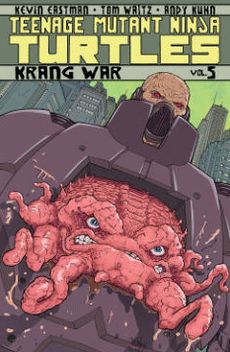
One of those little climaxes comes in the third volume, in which Splinter and the Turtles meet and fight The Shredder to a draw. The conflict of the fourth volume revolves mainly around a fifth, evil mutant turtle named Slash, and that of the sixth volume, sub-titled "Krang War," involves the Turtles teleporting to The Neutrinos' world in Dimension-X and teaming-up with them and a re-designed (I don't like the new design, honestly) Fugitoid to save their planet
from Krang.

That fourth volume has some pretty strong character work, and it was interesting to see so much time and attention paid to discussion of the need or utility of comic book heroes having to kill their villains. Splinter instructs his students that while he abhors killing, they have to prepare themselves to take The Shredder's life, which doesn't necessarily sit well with all of them. Generally mainstream comics hand-wave this away in one of two directions, with the heroes having a vow against killing they pretty much never violate or the heroes taking lives on such a regular basis that it becomes a sort of white noise to the story.

Each book also, somewhat surprisingly, has a different artist. The third is drawn by Dan Duncan, who has been drawing the series since it's beginning. His art has been something of an acquired taste, and was so different from the style of so many of the other artists to draw the characters over the years that I was initially put off by it, but quickly grew to like it; he was particularly good at drawing action scenes, as the characters always seemed highly-animated, so that their limbs and weapons would always seem to be in the process of being violently flung when they fought; out of the corner of your eye, the art would almost seem to move. I never grew to like his Splinter, though, who always seemed to be too big, too goofy and too donkey-like to me.

For the fourth volume, he's replaced rather unexpectedly by Andy Khun, whose art is nice, but a sudden and drastic change in style from that of Duncan; suddenly the turtles all seem bigger, thicker and more swollen; their faces take on more distinct expressions, and they seem more like the Teenage Mutant Ninja Turtles I would have expected to see in issue #1 of a new TMNT series, not issues #13-#16. His artwork seems particularly static when compared to that of Duncan, though.

I preferred hid Splinter, and was a little disappointed with his Slash, which is a big, brutish, snapping turtle-style turtle, closer to Tokka from The Secret of the Ooze in a black mask than the Slash of the original cartoon.
In a variant cover, Ross Campbell seemed to compromise between the big monster version of the interiors and the cartoon version. Check out this image:
Man, I wish Campbell was drawing a Turtles comic monthly...

Anyway, note the little palm tree tucked into his belt. That's Slash's binky, a plastic palm tree in the aquarium he grew up in as a normal, pre-mutated turtle in the cartoon. I completely forgot about that until I saw it here (Actually, I completely forgot about the existence of Slash at all, until he was mentioned in the comic).

For the fifth volume, Kuhn is replaced by artist Ben Bates, who is probably the best of the three. Like Kuhn, his turtles look a little more classic in terms of their size, scale and basic anatomy (although more so than Kuhn), and like Duncan, they are highly-animated, with fairly brilliantly-executed images of characters in motion (although, again, more so). He is therefore perfectly suited for this volume, which climaxes with a pretty huge battle sequence involving lots of laser guns and hand-to-hand combat.

Each volume contains all of the various and variant covers for the books (the other reason I prefer the trades of this series to the singles, beyond the too-rich-for-my-blood $3.99 price tag; there are so many cool variants I can't imagine not wanting to get, say, the Kevin Eastman or Ross Campbell versions).
I particularly like the Eastman images, as his version of the Turtles naturally remains the more or less definitive one in my mind. Of all the Splinters in these three books, his is certainly my favorite, and it amuses me that whenever he includes Casey Jones on a cover, it's the same adult Casey Jones from the old Mirage comics, not the teenage one from the IDW books.
Just look at all the ink in those images. I love the tactile, gritty appearance of Eastman's artwork.

Monday, August 12, 2013

Hey, look at me! I'm a pundit!

It has happened so very many times over the course of the last two years that it shouldn't come as a surprise anymore.

Yet ironically, the fact that it has happened so many times at this point is the very reason it is surprising: Surely DC Comics would have figured out whatever was broken or wrong within the editorial or management structure of the company by this point and fixed the problem by now, right?

I'm talking, of course, about sudden, drastic, counterintuitive (if not just plain crazy seeming) changes in creative teams on their New 52 line of books, including more than one instance in which the creative team of a book was rather radically altered sometime between the time the book was announced, promoted and solicited (i.e. was being sold) and the time the first issue saw release.

In this case, it's Kevin Maguire being kicked off of the upcoming Justice League 3000, which was to have launched in October, but has now been pushed back to December. (If this is the first you've heard of it, here's ComicsAlliance's coverage and here's Comic Book Resources').

While this isn't the first time an announced creator has been pulled from a New 52 book on the eve of the book's debut (it may be the first time it was an artist rather than a writer though; there's been so much of this of late I've honestly lost track), this move is particularly surprising for two reasons.

First, Maguire's inclusion on the book, along with the writing team of Keith Giffen and J.M. DeMatteis, was the (or at least a) major selling point of this fourth Justice League title. That is the very creative team that, of course, spun the troubled and tired Justice League franchise of the 1980s into one of the decade's bigger, most-admired, most-influential and most fondly remembered super-team comics; their run is still one of the most distinctive in the League's decades-long history, and one of the most immediately identifiable eras on the book (Giffen and DeMatteis lasted five years; Maguire didn't make it that long, but he's the artist most-associated with the run, and they've all reunited for several miniseries and projects paying nostalgic homage to their time on the book).

So having the Giffen/DeMatteis/Maguire reunion on a Justice League title, only minus Maguire? That would be a little like Marvel announcing a Chris Claremont/John Byrne X-Men book, and then, a few months later, announcing that it would actually be Fabian Nicieza writing.

Second, it's not as if Maguire is an unknown quantity. As I said, his run on a Justice League book occurred 25 years ago, and has been working steadily for publishers big and small on interiors and covers ever since, including several projects for DC during the time in which at least one of the current folks sort of in charge (Dan DiDio, currently a co-publisher) has been sort of in charge, including a 2008 Batman Confidential story arc, the Metal Men strip in the backs of the last volume of Doom Patrol, an issue of Superman/Batman, the DC Retroactive: JLA—The '90s special one-shot, the "Tanga" feature in some short-lived anthologies and even a New 52 book, Words' Finest.

It's frankly hard to imagine an artist who is even more of a known quantity at DC Comics, which makes his removal from the title for any reason having anything at all to do with his style or the quality of his work kind of insane sounding. Who at DC—hell, who among superhero comics readers—doesn't know what Maguire's art looks like?

What's particularly depressing about the move in the broadest terms—that is, beyond how frustrating it must be to Maguire himself, and frustrating to fans disappointed that he won't get another crack at a Justice League next month after all—is that one of the specific reasons he cited for his removal was that DC wanted a more "'dark and gritty'" direction and, well, just look at the grimaces on that cover.

This was a book being sold primarily by its credits and a single cover image. On that image, we have a Flash with a bandit-style mask, like an Old West train robber, a Wonder Woman who has not a magic lasso but some kind of magic mourning star, and a Green Lantern who is darker and scarier than the Batman, wearing what looks like a tattered, green burial shroud. That looks pretty dark and gritty to me; how much darker and grittier can you get, really? (And, as Maguire said, why hire that team for something dark and gritty? There's a reason their era of the Justice League is referred to by the sound of laughter: "Bwa-ha-ha").

Replacing Maguire is, of course, Howard Porter, an artist who helped define the Justice League the decade after Maguire did, drawing the Grant Morrison-written JLA (And yes, it is kind of ironic that to create a comic book about a Justice League 1,000 years in the future, those futurists at DC Comics hired a team who worked on the Justice League in the 1980s, and replaced one of them with a guy who drew the league 15 years ago instead of 25).

I like Porter, and, frankly, I'm sort of excited to see a mix-and-matched JLA creative team on a JLA book, just as I'd be excited by a Morrison-written, Maguire-drawn book. I can't see this book being a big success at this point though, "Justice League" in the logo or not (Obviously, it's the "Written by Geoff Johns" that makes two of the three current Justice League books hits more so than the fact that they are League books).

Giffen's become a sort of utility player at DC, doing whatever's needed, often turning up in The New 52 as a last minute fill-in writer or artist, and he's coming off of a just-cancelled Threshold, which looks to be one of the least successful of the New 52 books, based on public numbers and how quickly it was canceled. DeMatteis' current project is Phantom Stranger, recently retitled Trinity of Sin: Phantom Stranger.

And Porter? Well, recent-ish credits have included Magog, DC Universe Online Legends, a few issues of The New 52 Green Arrow, pieces and parts of the He-Man and The Masters of the Universe miniseries and covers for...Giffen's cancelled Threshold.

More damning than the recent accomplishments of either of those three individuals, however, is the very fact that DC bothered to announce a team attached to the title, then change that team (without, apparently, adequately informing Maguire of the whys and wherefores immediately, so that he made it to social media with a degree of bafflement that does the company no favors). That is, DC Comics is obviously still trying to figure out what exactly Justice League 3000 is going to be, and they've given us a peek behind the curtain: They didn't really have a solid idea of what they wanted when they decided to do the title, they didn't like what the creators came up with, and so they decided to start over, one month before they had originally planned to ship it, but now they've given themselves three months to do it right.

Personally, I was kinda looking forward to getting to see Maguire, Giffen and DeMatteis reuinite on a Justice League book that gave them access to all of the big guns on the team (or at least versions of those big guns), given that the League they got to work with consisted of Batman and whoever else they were allowed to use, few of whom (Just Martian Manhunter, really) had much history or even vague association with the Justice League. It felt a little like they've earned the right to do a serious (or even just serious-ish) take on the Justice League, and to get to use Superman, Wonder Woman, Flash and Green Lantern in addition to Batman...and whoever the hell else they wanted.
These not being the "real" versions of the characters, I wasn't looking forward to it the way I might have if, say, Maguire were joining Geoff Johns for an arc of Justice League. For Maguire-drawn versions of DC's big gun Justice Leaguers, I guess we're gonna have to continue to settle for the covers of Justice League: A Midsummer's Nightmare and Fanboy #3).

*********************

And that's not even the big, bad news coming from DC Comics this week! Maguire being rather publicly fired/removed from a new book of his before the first issue even shipped was just another example of a pattern of strangeness at DC Comics, they actually did something much more noteworthy and, on the whole, negative.

I used to work with a lady at my day job who, in one of her previous jobs, used to manage a coffee shop. One time she told me that someday she and I should open a pair of businesses, a door-by-door coffee shop and comic book store. She had the real estate all picked out, in a block of vacant storefronts next door to a tattoo parlor. Just think, a tattoo parlor, a coffee shop and a comic book store: That would make for a cool, eclectic little strip of locally-owned businesses, right? All we needed was a lot of money...

I pooh-poohed the idea, even though it was nothing more than a fantasy, as the city I currently live in (Mentor, Ohio) seems to be pretty well-covered by comic book stores: There are already two within or very near the city limits, and a third, superior shop the next city over.

But if I ever won the lottery, I have fantasized about opening a comic book store in my hometown, which has supported, over the years I lived in or around it, about five different comic stores, all of which came and went. But if I had millions to spend, certainly I could plop one down on the ghost town that was my hometown's main street, and afford to lose money on it for the rest of my life.

But then you hear about stuff like this DC 3-D cover debacle, and what starts as the sort of fantasy you day dream about when you buy a lottery ticket ends up sounding like the sort of nightmare you might wake up screaming from.

You've heard about this, surely? If not, here's Comic Book Resources. Here's retailer Brian Hibbs at The Savage Critic (Telling post title? "The staggeringly epic incompetence of DC Entertainment"; do note that as of right this second, there are exactly 52 comments). Here's ICv2.Here's The Beat. Here's Tom Spurgeon.

I give you all of those links because I don't entirely understand either the retail side of comics (like, in a factual way) or the collector/speculator/gives-a-shit-about-variants corner of comics, but if you click on all of those, you should get the basic facts explained from a few different directions by a few different individuals with various levels of investment in the health of the direct market.

Put as simply as possible, it sounds like DC sold more of those goofy (but oh so gif-able!) 3-D covers then they actually produced, either through, as Hibbs' post title put it, incompetence, or maybe through some sort of shady collectibles-market goosing stunt. The result being that there are more orders for the comics with those covers than there is comics with those covers, direct market retailers are going to have to re-jump (or un-jump, and/or then re-jump) through all of the hoops they have to jump through on a monthly basis in this crazy business and a whole bunch of people aren't going to get what they wanted...and, in many cases, those who aren't going to get what they wanted, won't even know how much or how little of what they ordered is going to get to them.

DC is publishing "normal," $2.99 versions of these comics, missing only the goofy cover.

I wish I knew that was going to be an option originally, but for a completely different reason. As you all know (because I harp on it constantly), $3.99 is more than I'm willing to pay for 20-22 pages worth of comics (I draw the line at $3.50) in serial format, and anything that costs that much I'll just wait for the trade.

So I sort of already wrote 52 books of DC's publishing slate in September off, not even considering purchasing any of the books. Now I find out that they're actually going to be available for a buck less than they were solicited, but now it seems awfully late to pre-order, say, a 2D version of a book focusing on a character I like (Scarecrow, Bizarro) or with creators I like. And I'm kind of afraid to even mention any of those books to my poor local comic shop keeper; I don't want to see him break down in tears or start screaming at the sky.

*********************

The New Republic did a long, mostly positive, "Hey, look at this pretty awesome guy!" story about Mark Millar, perhaps the most successful terrible writer in the field of comics (Here's a link to Spurgeon's post about it; start there and see if you want to give The New Republic your eyeballs' attention/your computers' clicks). Millar does have a rather interesting story in terms of the the arc of his career, in his meteoric rise from someone struggling to get co-writing gigs through friendship with a writer at DC Comics and, after scoring a few solo credits, earned a sort of mega-success at Marvel (in large part due to the way his writing and his vision aligned with the zeitgeist of the early '00s, in some small part by being in the right place at the right time—that is, at Marvel when the Ultimate line was being created) and, in short order, growing more popular than Marvel.

That is, Marvel needs (or would like) Millar more than Millar needs Marvel at this point.

Of course, whether that story is a tragedy or not likely depends on what one identifies as success in comics—Millar's writing has gotten worse in leaps and bounds as his popularity has risen, but I imagine there are a lot of creators and/or would-be creators for whom having Hollywood movies adapted from your comics and, more importantly, getting big, fat checks for development deals (whether your Superior or Nemesis movies ever actually get made or not), is the acme of achievement (Millar sure seems to think so, which is good for him; after all, he is the person whom he has to please the most, and it's not like what I personally think of someone or their work should be important to, um, anyone but me, reallY).

After reading a few more hagiographic profiles of Millar in the past, I was glad that writer Abraham Riesman at least reached out to critics of Millar about some of the more noxious aspects of his work, including the inclusion of rape. There, Riesman got a quote from former ComicsAlliance editor Laura Hudson (whose link to the article is how I originally knew it existed, because who reads The New Republic...?)

I gave up on Kick-Ass about half-way through (the comic book; I made it through the whole movie, which rather considerably turned down the racism, violence and strange-ass identity politics of the comic it was adapted from and/or inspired by), and certainly never made it to Kick-Ass 2 so the, um, gang rape and bit about "evil dick" was all news to me. (But geez, gross; I guess all those gory Geoff Johns books don't seem so bad compared to that).

Unfortunately, it doesn't sound like Millar got the opportunity to respond directly to Hudson's rather direct criticism of his assertion that rape is just one more bad thing a bad guy can do to prove how bad he is ("It's using a trauma you don't understand in a way whose implications you can't understand, and then talking about it as though you're doing the same thing as having someone's head explode," she says."You're not. Those two things are not equivalent, and if you don't understand, you shouldn't be writing rape scenes.")

And Colin Smith, "a comics scholar who is writing a book about Millar's work," says that "Millar does indeed have a history of producing work which represents less powerful groups in an insensitive, and often deeply insensitive, manner."

But that's about it, which is sort of disappointing in that the Riesman acknowledges the problems a lot of people who aren't Hollywood producers seem to have with Millar's work—especially his creator-owned, "Millarworld" work—without giving it a whole lot of room for discussion.

For example, saying—or having someone else say, actually—that Millar "represents less powerful groups in an insensitive...manner" isn't quite the same as saying that Millar treats black/white race relations in such a bizarre manner in Wanted that it's hard to tell if the writer himself is racist, or if only most of the characters in the story are racist, especially when taking into account how the first Kick-Ass miniseries apparently ended.

Or that in one miniseries he uses the word "retarded" so many times that a reader might understandably wonder if Millar thinks it's not a word that's in bad taste to use, or if he's simply a poor enough writer that he gives multiple characters the same un-PC verbal ticks.

I'm personally sort of surprised that Millar isn't also called out for his appropriation of characters and concepts from mainstream comics and films, from the opening in Kick-Ass biting off Condorman (of all things) to Superior essentially being his pitch for a Superman movie to his selling of Nemesis as a Commissioner Gordon-versus-an Evil Batman movie (Something the New Republic article uses in its lede; although by then "Tony Stark" was added into the pitch to dilute the obviousness of the appropriation).

I'm not sure what to make of this part of the profile:
It’s come not just from moral crusaders but also diehard comics fans who say that, instead of deconstructing superhero comics, he’s actually reinforced some of the genre’s worst impulses. Indeed, the criticisms often come from the liberal end of the political spectrum: His work has been called classist, racist, and sexist.
Have any moral crusaders ever said anything bad about anything in any Millarworld comics? The only objections to a Millar script I've ever heard from outside the world of comics has been about Midnighter and Apollo kissing; in fact, nudity and, for lack of a better term, "gay stuff" seem to be the only thing "moral crusaders" outside of comics ever object to (See the recent news of Fun Home).

I'm not sure what that "liberal end of the political spectrum" means, exactly, either. Like, can't conservatives call someone classist, racist and sexist too? If you use those words, does that automatically make you liberal?

Okay, two more and I'm out.

The headline? "'You're Done Banging Superheroes, Baby': How the sickest mind in comic books became their biggest star."

The sub-head sounds fine, but I don't know how on earth you can define Mark Millar as comics' biggest star, as his Millarworld comics only sell well for creator-owned comics (Fun fact: At a circulation of 50,000, according to Wikipedia, The New Republic sells more copies of each issue serially than many issues of Kick-Ass have).

Millar's one of the more successful writers in comics, but only when he's writing corporate superheroes; his miniseries are decent mid-list performers at best, performing phenomenally only once qualifiers are added. And one has to consider the fact that a lot of the people who show up for Secret Service or Jupiter's Legacy do so because of Dave Gibbons or Frank Quitely, not Millar.

I guess you could make the sub-head more accurate by softening it to say "one of their biggest stars." (As for the sickest mind? I know one New Republic writer who is missing out on a lot of great comics, and oughta google "Johnny Ryan" ASAP).

The main measure by which one can consider him "comics' biggest star" is his success rate at having his creator-owned mini-series, the "Millarworld" stuff, optioned for possible film adaptation. And framing success in one medium by the interest in adaptation by another medium is a pretty damn backward way of saying someone is a "star" in the former medium.

Finally, this:
The latest film adaptation of one of his comics, Kick-Ass 2, hits screens on August 16. The Avengers and the Iron Man trilogy were profoundly shaped by his work. And last year, he became Fox’s chief creative consultant for all of its Marvel superhero flicks, including the entire X-Men and Fantastic Four franchises. By decade’s end, he’ll have had more of his creations translated into movie form than any comics writer other than Stan Lee.
Well that's obviously bullshit.

Millar has had two movies released based on his work, so far: 2008's Wanted (an adaptation in little more than name only; a character name, a few lines of dialogue, the title and maybe one scene are all that remained of Millar and artist J.G. Jones' comic) and 2010's Kick-Ass, with Kick-Ass 2 pushing it up to three movies when it sees release in a few days.

That's one feature film fewer than those based on the Teenage Mutant Ninja Turtles comics of Kevin Eastman and Peter Laird (although "by decades end" there may be more), the same number as have been based on writer Marv Wolfman's Blade character and one more than has been based on the work of writer/artist Mike Mignola (again, so far) or a single Warren Ellis-written miniseries (Red).

Meanwhile, writer Alan Moore has had four films adapted directly from his work: 2001's From Hell, 2003's League of Extraordinary Gentelmen, 2005's V For Vendetta and 2009's Watchmen (Despite taking the opposite tack as that of Millar when it comes to film adaptation; Moore rails against the movies and has asked that his name be removed, while Millar writes comics miniseries as movie pitches and openly courts Hollywood's attention).

Riesman seems to be counting the three Iron Man movies and The Avengers as Millar adaptations, due to some similarities between them and The Ultimates, which is a little silly. Millar's main contribution to those films was in the casting of Samuel L. Jackson, which had at least as much to do with Bryan Hitch's ability to draw celbrity likenesses than it had to do with Millar.

I'm not sure how one considers those movies based on Millar's "creations" more so than they're based on the creations of the guys who created those characters; for all four of those movies, Millar was little more than one of the more popular recent "caretaker" creators to have worked on the franchises for Marvel Comics.

"Creations" is a little broad too, because, by that measure, writer Bob Kane and writer Jerry Siegel have had more movies based on their creations than Millar has too, and that's not likely to change "by decade's end."


*********************

(Wait, surely the villain rapist guy means to say "It's time to find out what evil dick tastes like" rather than "It's time to see what evil dick tastes like," since one doesn't see taste, right?)

*********************

Hey, remember this comic?
Every mainstream media outlet that wants to do a profile of Mark Millar should ask him about Mark Millar's The Unfunnies. All I remember about it was the part where the lady bird is going to have sex with the landlord because she can't afford to pay the rent this month, he says he'll accept, but only if she allows him to have sex with her kids as well (?!?!??!!!!) and then she murders him. And feeling like maybe this is a comic book that I shouldn't have bought with money and kept in my home.

So yeah, mainstream media? Next time you interview Millar about all his movie development deals, make sure you ask what the fuck was up with Mark Millar's The Unfunnies.