Saturday, February 18, 2012

Reminder: Judy Drood is awesome


That's one and one-third pages of Richard Sala's Mad Night, which everyone who hasn't already read it should go read immediately, while those of us who have already read it should probably go read it again. Reading or re-reading Sala's Mad Night seems an infinitely better use of all of our free time than reading anything on the Internet right now.

Friday, February 17, 2012

Meanwhile, at Robot 6...

I have a review of Lily Renée, Escape Artist up at Robot 6 this week. It's the graphic novel biography of the lady who drew these awesome Golden Age covers...
...as well as interiors on various strips for Fiction House and St. John in the late 1940s.

It's a great story, and, unfortunately, a pretty terrible comic.

I sure wouldn't mind reading a collection of Renée's Golden Age comics though...and/or a collection of St. John's Abbott and Costello comic, which she collaborated on with her husband at the time.

Wednesday, February 15, 2012

Comic shop comics: February 15

Daredevil #9 (Marvel Entertainment) You're not sick of people on the Internet raving about how great Daredevil is yet, are you? Oh. Well, um, there's another review underneath this one. So in this issue, Mark Waid picks up where last month's cliffhanger ended, with Daredevil investigating the theft of his father's coffin, along with the coffins of everyone else buried in that particular cemetery. while moving forward with a story thread from the past few arcs.

It's deft plotting, and, as with several other issues, Waid finds an interesting setting and situation to throw someone with such spectacularly strange senses into, as Daredevil follows the grave-robbing Moleoids to their master. And what does The Mole Man want with a bunch of coffins full of a bunch of corpses? That's not yet laid out, and it's a pretty intriguing mystery.

As top-form as Waid's scripting is, the art is, as usual, spectacula. Paolo Rivera pencils, Joe rivera inks and Javier Rodriguez colors, and this issue is just full of blacks, as that color seems to be nibbling at the edges of almost every image in this issue, as Daredevil's journey gets darker and darker.

Here's a detail of a two-page spread, in which we see Daredevil creeping into the underworld, on the trail of the Moleoids hauling coffins, as they head into an immense cavern lit by magma/lava:It's a bad scan (it wouldn't all fit on my scanner), but look at the detail in it, and look at those colors. Wow.

Here's one neat two-panel sequence, in which Waid, the Reiveras and Rodriguez reveal that, for whatever reason, the Mole Man's monsters are invisible to Dardevil's radar vision. So in addition to the scary little Moleoids Rivera draws, our hero is surrounded by unseen monsters throughout the story.

I'm running out of ways to say "Daredevil is a great superhero comic," but it is. In fact, it's at the top of the heap of comics the major publisher's are producing these days.

Oh, but it's not all peaches and cream. There are 20 story pages in here, plus a recap page and a letters page. And there are 12 pages of ads and, get this, every single one of them is a house ad for another Marvel comic, the only ones that aren't full-page house ads are the two that are two-page house ads. What a strange waste of space; no wonder Marvel charges $4 a book so often; they apparently don't get any ad revenue anymore.

Reading Daredevil today was the first time I've read a Marvel book and thought that there were too many ads in it—two consecutive pages of story without an ad are rare this issue—since the early issues of the David Aja-drawn Iron Fist, which is why I ended up dropping the title, figuring it would read better in trade, without all those ads getting in the way of the flow of Aja's superior art. (Although I never actually got around to reading those trades). I'd consider dropping Daredevil for the same reason—this stuff is gonna look great without an ad for AvX every other page—were it not one of the few comics I'm still reading as it's serially published.


Wonder Woman #6 (DC Comics) While Daredevil's cover alludes to a trip to the classical, mythical underworld, the actual, classical, mythical underworld plays a role in this month's issue of Wonder Woman. Diana and her allies Hermes and Jason Statham pull of their sneaky plan to get Hera out of their faces, a plan that involves simultaneously confronting both Poseidon and Hades (whom are given wonderfully idiosyncratic redesigns and the appellations Sea and Hell to further distance them from the Olympians' appearances in previous volumes of Wonder Woman.

What exactly happens and how was a little muddy, and that it works in-story isn't something clear to someone not actually in the story, since how the hell would we know that the thing they use affects the other thing that way, but I got it the second and third time through.

Tony Akins is still in Chiang, and his art's still pretty great, but it's a bit of a bummer that the series' artist missed such a substantial chunk of its opening arc.

I was pretty vocal in registering my disappointment that DC's rebooted-for-the-21st century Wonder Woman was still going to be the ruthless efficient, brutally violent, post-Kingdom Come Wonder Woman, rather than the, um, "real" Wonder Woman*, so I suppose I should point out that as the book's progressed, she's only gotten more over the top.

In the first issue, she lopped off a fleeing centaur's arm with a sword (when her magic lasso was right there!) and, in this issue, she again faces that same centaur and she......well I guess she reduces it to a red smear on the pavement, staining her arms to the elbows in its gore.

Yeesh.

I am glad writer Brian Azzarello and artist Akins decided to stage that scene so that her splattering her opponent happens out of sight, but, still: Yeesh.


*Shut up, I know

Just Imagine Dave Sim Creating Zatanna....

Well, not exactly, but the cover of the latest issue of Sim's Glamourpuss, on sale today, certainly suggests what that might look like...

Tuesday, February 14, 2012

Two children's books about children's book author Wanda Gág

As an artist and writer, Wanda Gág is known for her fairy tales, those she invented herself, and those her old world ancestors used to tell, the ones collected by the Grimm brothers, and translated into English and illustrated by Gág.

But as has often been pointed out, Gág herself resembles a plucky fairy tale heroine. The first of seven children, a magical number, she was born at the end of the 19th century to Bohemian immigrants with a connection to a rural enclave of barely-changed immigrants—her Grandma lived in a place called Goosetown, and the Gág children referred to the people there as “Grandma folks.”

Her father died when she was 15, still a maid, and she began to live a life of hard work that makes it look like Cinderella had it easy—in addition to caring for her often sick mother and helping keep house for six younger siblings, she also went to school and stayed up late nights, drawing things she could sell and drawing things simply because she loved drawing things, and would spend all day doing so if she could.

By virtue of her years of hard work, perseverance and talent, she earned a scholarship, then another and moved to New York City. A successful gallery show later, a publisher asked if she ever thought about publishing a kids book—she had and, as a teenager, had little stories and poems published in children’s magazines—and published 1928’s Millions of Cats, a massively successful book. She bought a ramshackle New Jersey farmhouse, dubbed it “Tumble Timbers,” and lived her own version of living happily ever after—writing and drawing whatever she wanted. It’s no surprise then that a modern children’s book author would want to tell that fairy tale in a book of their own, and that’s precisely what Deborah Kogan Ray did with her 2008 book, Wanda Gág: The Girl Who Lived to Draw (Viking).

Ray’s book takes a rather Hollywood biopic approach, beginning at a moment of personal triumph, and then flashing back to the beginning of the story.

The first image is of Gág’s Tumble Timers, the mailbox with her name in the foreground, and the a figure in a hat standing on the porch. The text tells us that it’s 1928 and “an artist named Wanda Gág” has just created her first book for children.

“That rainy spring, as she polished the words and prepared to draw the illustrations in her studio,” the narration tells us, “she would often think of her own childhood.”

A turn of the page starts the story proper. Each two-page spread features an image of Ray’s, which fills at least one of those pages, but in many cases stretches over the gutter and onto the second page.

The text portion of the spread begins with an italicized quote from Gág, taken from her Growing Pains, a publication of her girlhood diary, in italics. Below that Ray tells the appropriate part of the story.Ray focuses quite a bit on Gág’s childhood, her family’s encouragement of their children to be creative, their journey’s to Goosetown and, especially, Wanda’s special connection to her father, an artist who made his living by painting decorations on buildings and churches six days a week, and spent Sunday’s painting what he wanted for himself.

His last words to Wanda on his deathbed were, translated to English as Ray recounts them, “What Papa couldn’t do, Wanda will have to finish,” a too-perfect to be fictional hook that provides a story arc to Wanda Gág’s biography—first by working hard at keeping the home together and taking care of her mother and siblings, and then by achieving fame as an artist, Gág finished her father’s two callings for him. Ray traces Wanda’s life back up until the starting point, and ends with how successful her book turned out—“In 1929, Millions of Cats was awarded a John Newberry Honor…Many now consider it to be the first modern picture book”—and sort of happily ever after that calls back to her father’s last words:
Wanda went on to create many other picture books and make many more prints and drawings that she exhibited.

The girl who lived to draw carried out her father’s wish.

“What Papa couldn’t do, Wanda will have to finish”
The book features three one-page epilogues: After Millions of Cats, recounting highlights from Gág’s professional and publishing career; Wanda’s Diary, about the diary she kept and which much of her biographical information came; and Author’s Note, telling a little bit about the creation of this book.

It’s a rather wonderful little biography of the artist, one perfectly suited to what I would like to think is her ideal audience, little girls who also like to draw, and would also like to one day become artists—in that respect, I think Gág in an ideal hero and role model. I sincerely wish I had learned her story at six or seven instead of in my mid-thirties.

Because Gág was, as Ray says in her author’s note, “a saver,” Gág provided her own biography, although she did so in a strange way. When asked to write an autobiography, Ray tells us Gág demurred, as “a book of recollections about her girlhood would not have the freshness and sense of wonder that she sought in all her work.” So they published her diary instead, which has the freshness of immediacy.

Ray is quite an accomplished artist, as the small samples I’ve chosen to highlight here will hopefully convey, although hers is not a style I’ve ever particularly been enamored with. The artwork is alive with lines, and thus a very organic, very living set of drawn pictures, but there’s a slight, impressionistic blur to the work, and an unnatural warmth. Her art is realistic in design, but obviously artificial as drawn art simultaneously—It’s fine work, but it’s not the sort I naturally gravitate towards.

I’m of two minds over how appropriate it is as well. Both Wanda and her father longed to create the images they wanted in their lives, and it therefore seems appropriate that Ray illustrates their story in her own style, whatever that style may be.

But if form is to reflect content, then I wonder if a book about Gág drawn in a style similar to Gág’s, with its big, bold, black and white figures and rolling settings winding their way from one page to the next might not have been more appropriate.

Ray tells Gág’s fairy tale life like a fairy tales, but not as one of Gág’s own fairy tales.

I’m not sure if that would have been preferable—I think it would have been clever, but perhaps too clever?—and it would have run the risk of seeming like a pastiche more than an original work.

It’s something I’d like to see done at some point, though.

The Girlhood Diary of Wanda Gág, 1908-1909: Portrait of a Young Artist (Capstone Press; 2000) also uses Gág’s diaries as source material for her story, but this work is meant as a more straightforward educational tool, and while the story is still there, it’s obviously not as engagingly told.

This slim, 32-page volume is part of a Diaries, Letters and Memoirs series, meant to educate young readers on different time periods. Other books include A Civil War Drummer Boy, A Colonial Quaker Girl, A Pioneer Farm Girl and so on. Other recognizable names in the series include Louisa May Alcott, Charles Lindbergh and Theodore Roosevelt.

There is a two page summary of Gág’s childhood, and then excerpts from the diary entries themselves, which account for the bulk of the book. I’ve read the entries in their entirety in Growing Pains, and these are mostly shortened versions, using ellipses to edit them down into shorter, more child-friendly chunks. They aren’t bowdlerized or anything, though; Gág’s industriousness, ambition and dreaminess shines through, and I think it’s probably enough of a taste of Growing Pains that a young reader might want to follow up with that book when their older.

An afterword tells readers the rest of Gág’s story, up to her death and legacy, and there’s a timeline, page of places to find out more, and a “words to know” glossary (“deplorable,” “glee club”, “tuberculosis,” etc).

The book is also full of little activities to do—“Draw a Profile Face,” “Making Spaetzle”—and a few sidebars expounding on things referenced in the diary—“German and Bohemian Traditions,” “Ladies’ Turner Society.”

The images in this book—which is fairly heavily illustrated—consist mainly of photographs and images of Gág’s art, particularly that from the time period in which she was keeping the diary.

As more of a teacher’s aid than a book-book, I’m not sure how to recommend this one to interested parties. I suppose I’d recommend it to grade school teachers who want to teach their kids about Wanda Gág.

*****************

The Girlhood Diary's timeline included several photos. Here's one of Gág’s father, Anton. Note the way that this image was later echoed by a photograph of Gág from 1916 or 1917...

PSA: Don't miss Valentine's Day at ComicsAlliance

It's still Valentine's Day for another two hours or so, and if you haven't visited ComicsAlliance yet today (Say, why haven't you visited ComicsAlliance yet today), then I'd like to call your attention to a couple of neat, holiday-specific features there today.

First, there's Chris Sims' "New 52"-themed valentines (One of which is pictured above), and then there's a set of homemade superhero valentines from EDILW favorite Carolyn Main. She did an Aquaman one too......but you can click on over to CA to read the joke on the bottom half of it. And for more of Main's comics, cartooning and illustration, do yourself a favor and spend some time on her website.

Monday, February 13, 2012

DC's May previews reviewed

I’ve said before that when Marvel steals ideas from DC, they steal their good ones, but when DC steals from Marvel, they steal their bad ideas.

Here’s a good illustration. DC’s solicitations are now in that annoying, “We couldn’t be bothered to think of an entire complete paragraph about each of our books, because we don’t really care and maybe they’re not even done yet anyway”, bullet-point format.

That's the most evident "news" in this round of solicitations to me. I also note no new DC Comics Presents collections, which kind of bums me out—I love those things, and I sincerely hop we haven't seen the last of them.

The big news (to people who aren't me) in DC’s line this month (which is May, remember) is the launch of the “second wave” of “New 52” titles, and the rebooted publisher's first big franchise-specific cross-over series, “Night of Owls,” in which Scott Snyder’s Batman plot spills into most of the other Bat-books.

I haven’t been reading, so maybe it will end up being dynamite, but some of the specific solicitations don’t fill me with hope. Most of them say something like “NIGHT OF THE OWLS continues here!” and “[insert title character’s name] fights some Owls!”

In fact, the solicits for Batman: The Dark Knight (guest-written by Judd “Not David Finch” Winick) and Batwing are almost identical:

Red Robin is back in Gotham City just in time to face off against TALON and THE COURT OF OWLS!

BATWING arrives in Gotham City just in time to fight the chaos the Court of Owls has unleashed! Outgunned and on unfamiliar turf, can Batwing survive?

As always, you can read the complete solicitations at ComicsAlliance and/or Comic Book Resources.


ACTION COMICS #9
Written by GRANT MORRISON
Backup story written by SHOLLY FISCH
Art and cover by GENE HA
Backup story art by CULLY HAMNER
...
On sale MAY 2 • 40 pg, FC, $3.99 US • RATED T
...
• Featuring characters from parallel Earths, including PRESIDENT SUPERMAN!
• Introducing new villain SUPERDOOM!
• Guest artist GENE HA joins GRANT MORRISON for this tale of not one, not two, but THREE Earths!
• And in the backup story, President Superman must stop a nuclear attack – but he can’t leave the White House!


This sounds pretty cool, although I’m surprised to see Gene Ha on art here. Where’s Rags Morales?!

Ha’s cover image looks pretty week too, especially when compared to its initial Alex Ross inspiration, or the image of this “President Superman” that Doug Mahnke and company drew in Morrison’s Final Crisis: Also, those high-collared, armor-plated Superman costumes don’t really fit under button-up, collared dress shirts, do they? Did Jim Lee take into account that Superman can’t really do his iconic pulling-the-shirt-open-to-reveal-the-S-Shield pose anymore?

Well, he can, but it’s a little harder to believe, like Green Arrow or Captain America wearing their quiver and shield under their shirts when in their civilian identities…


So that, apparently, is “the team AQUAMAN belonged to before the Justice League,” his equivalent of The Justice Experience, I guess.

I don’t recognize any of them, although the lady in the black animal skin bikini on the far left is probably Shakira from Warlord. I suppose it’s possible the dude in the background is some kind of weirdly redesigned Adam Strange, but I’d guess they were mostly new characters.

Also, they each have a gold, glowing thingamabob of some sort, so I’m guess they are all at least semi-powered by lost Atlantean artifacts.


Batgirl vs. Owlgirl! Or is that Spider- or possibly Crabgirl? Her limbs sure look arthropoddy to me…

So I haven’t been reading Batgirl, because sticking Ultimate Barbara Gordon in the middle of the DCU for no reason is so weird and gross I can’t really get past it enough to read a comic that features poor art and a story that’s going to be, at best, not-that-bad.

But! I’m curious: Did they ever establish New 52 Barbara Gordon’s age? Because she looks really young here, like, in her early teens, whereas Nightwing (who used to be younger than her) looks like he’s the same age he’s always been. Also, her boobs are different sizes, depending on who’s drawing what cover. I mean, I guess that’s always been the case with most DC females, but in the past, Barbara Gordon’s breast size has varied from really big to huge, depending on who was drawing the cover, whereas now it seems to vary between prepubescent and post-pubescent.

I am discussing the age of the new Batgirl based on the size of her breasts on various comic book covers: I feel really great about my life right now. (Sigh…)


Here’s the cover to Batman #9, by the way. I think that’s Batman’s bat-burqa, under which he’s wearing his Ray-Bans…?


BATMAN, INCORPORATED #1
Written by GRANT MORRISON
Art and cover by CHRIS BURNHAM
...
On sale MAY 23 • 32 pg, FC, $2.99 US • RATED T
...
• BATMAN, INCORPORATED makes its NEW 52 debut with an all-new first issue!
• The series hits the ground running as BATMAN and ROBIN face off against the assassin GOATBOY!
• LEVIATHAN’S sinister mission revealed!


That’s a fine cover by Burnham…he’s one of DC’s best artists right now, and he’s especially adept at covers. This is among the only ones that really leaped out at me from this round of solicits, and the one that looks like it will be more distinct on the new comics racks.

I imagine Batman Inc returning in the same month as the “Night of Owls” crossover will be welcome new to Bat-fans who maybe aren’t that into it; of all the Bat-books, only Batman Inc, Batwoman and Tony Daniel’s stupid-looking TEC are doing their own "Night of The Owl"-less things.


In this month’s issue of Detective Comics, Batman hate-humps a huge pile of red hamburger meet in the middle of a grave yard!


EARTH TWO #1
Written by JAMES ROBINSON
Art by NICOLA SCOTT and TREVOR SCOTT
Cover by GREG CAPULLO
...
On sale MAY 2 • 40 pg, FC, $3.99 US • RATED T
...
• First issue of an ongoing series from writer JAMES ROBINSON and artist NICOLA SCOTT!
• Who are the heroes of EARTH 2 – and what befell them?
• Starring ALAN SCOTT, JAY GARRICK and many others!
• You may think you know Earth 2…but this is DC Comics – The New 52, where anything can happen!
• Don’t miss the extra-sized debut issue!


I already discussed the variant cover for this book a bit in yesterday’s post, but I wanted to put this here to note the actual spelling of the title, Earth Two, and the actually spelling of the designation of the name of the alternate Earth, “Earth 2.”

Got it.


Hey look Green Arrow’s got not a bow, not a crossbow, but guns that shoot arrows! That’s…different.


MYSTERY IN SPACE #1
Written by PAUL POPE, KYLE BAKER, ANDY DIGGLE , ROBERT RODI, NNEDI OKORAFOR, MICHAEL ALLRED, ANN NOCENTI, MING DOYLE and STEVE ORLANDO
Art by PAUL POPE, MICHAEL ALLRED, KYLE BAKER, MING DOYLE, DAVIDE GIANFELICE, SEBASTIAN FUMARA and others
Cover by RYAN SOOK
...
One-shot • On sale MAY 2 • 80 pg, FC, $7.99 US • MATURE READERS
This one-shot anthology is loaded with unsettling short stories that will hijack your imagination and take you to strange, mysterious places. Journey to the edge of the abyss with Michael Allred! Arrive in the middle of an intergalactic space heist with Paul Pope! Plus: Broken hearts will be cryogenically frozen, a zero-gravity menage á trois will be compromised by aliens, and solar systems will spiral out of control when top comics talents and exciting newcomers collide!


This looks like a companion book to last June's Strange Adventures book. I thought that was pretty good. I count three of my favorite artists contributing to this, so I'm pretty excited about it.


THE RAVAGERS #1
Written by HOWARD MACKIE
Art and cover by IAN CHURCHILL
...
On sale MAY 30 • 32 pg, FC, $2.99 US • RATED T
...
• First issue of a new series spinning directly out of “THE CULLING!”
• FAIRCHILD, brother and sister THUNDER and LIGHTNING, the monstrous RIDGE, BEAST BOY and TERRA are being pursued by ROSE WILSON and WARBLADE, who want them dead at any cost!
• No one’s survival is certain each month in THE RAVAGERS!


So, who are all these goofballs in the horrible Ultimate Tron costumes in this book? Well, there’s the girl from Gen 13 front and center, a new monster guy named Ridge (I’m assume he’s the bastard son of former Pennsylvania governor Tom Ridge, created in a dangerous experiment during Ridge’s brief stint as the director of the Department of Homeland Security).

There’s a new new Thunder and Lightning, not Black Lightning’s post-Superboy punch, continuity error daughters from Judd Winick’s Outsiders and Geoff Johns and Alex Ross’ Justice Society of America (respectively), and not the original Teen Titans characters, but all new ones. Thunder’s thunder powers apparently involve having Havoc from the X-Men’s powers…? (Actually, looking at his costume, I would guess he bangs those little wrist baubles together and that shoots sonic waves out of his chest hole, which Churchill as illustrated as a big laser beam). I don’t know what’s up with Lightning’s weird, vestigal extra breasts on her shoulders, or her terrible haircut, but she’s the lady with the lightning powers (I’m actually just sort of relieved she’s not the New 52iverse’s Sparx, whom I always kinda liked). It’s worth noting that these all new versions have nothing to do with the previous comic book versions, or the Teen Titans cartoon versions, which have presumably been in front of a lot of kids’ faces over the course of the last few years.

The girl in the middle is Terra, who would be the third or fourth Terra, depending on whether Geoff Johns’ retcon of the alternate dimension Terra from Team Titans being the original Terra or not holds. If so, she’s the third. And also the second brunette Terra. Why is she so radically redesigned, so as to not at all resemble any previous Terras? I don’t know. A bigger question would be why does Beast Boy look like he looks.

Yeah, that russet-colored werewolf guy is apparently supposed to be Beast Boy, the 47-year-old character who debuted in Doom Patrol (and was, at the time, totally awesome) before moving on to find relative fame as a member of the Marv Wolfman/George Perez era Titans teams.

I think he may have been purple for a little while, but he’s been green for most of his fictional life, including the time he spent as one of the chief stars of a popular Cartoon Network series, and all of its spin-off merch.

So naturally, DC decided to relaunch him so that he’s completely unrecognizable.

I hope these guys get new costumes pretty quickly, because these designs look like, to use a technical art term, throw-up.


STORMWATCH #9
Written by PETER MILLIGAN
Art and cover by MIGUEL SEPULVEDA
...
On sale MAY 2 • 32 pg, FC, $2.99 US • RATED T+
...
• New writer PETER MILLIGAN comes aboard!
• APOLLO and MIDNIGHT battle RED LANTERN SKALLOX!
• V-MAN’S connection to STORMWATCH is revealed – and it’s a doozy!


I am forced to admit: Red Lantern Skallox looks pretty metal. And he’s pretty hardcore too; in fact, he’s so hardcore he ripped the –er right off the end of Midnighter’s codename!


Did Rob Liefeld really need to sign his cover to Savage Hawkman? Is it not apparent who drew it?


SUPERBOY #9
Written by SCOTT LOBDELL
Art by R.B. SILVA and ROB LEAN
Cover by IAN CHURCHILL
On sale MAY 9 • 32 pg, FC, $2.99 US • RATED T
• “THE CULLING” continues here from this month’s TEEN TITANS ANNUAL #1 and leading into LEGION LOST #9!
• SUPERBOY vs. ROSE WILSON – round two!
• The shocking debut of the all-new WARBLADE!


There was an old Warblade…?


SUPERMAN #9
Written by KEITH GIFFEN and DAN JURGENS
Art by DAN JURGENS and JESUS MERINO
Cover by IVAN REIS and OCLAIR ALBERT
1:25 B&W Variant cover by IVAN REIS
On sale MAY23 • 32 pg, FC, $2.99 US • RATED T
Retailers: This issue will ship with two covers. The variant cover will feature the standard edition cover in a wraparound format.
• SUPERMAN faces new supervillainess MASOCHIST!
• How can Superman fight an opponent he can't touch?
• LOIS LANE faces a turning point in her career as a journalist.


...??!!

Oh, so that’s what was on Hades’ head in the last issue of Wonder Woman

Like a lot of the Olympian redesigns we’ve seen so far, that looks pretty neat.

Sunday, February 12, 2012

(links)

On Thursday, DC Comics released the findings of their "New 52" market research study with the same fanfare they release variant covers and new miniseries, and while they were careful to note that "the survey results are not a reflection of all comic book readers or the broader audience for graphic novels," but of readers who bought the single issues of the comics either in print or in digital formats (In other words, direct market readers who buy comics at their local comic shop and/or tried out DC's digital initiative.)

The results, which DC Women Kicking Ass parses a bit here, reveal a readership that is—surprise!—mostly male, mostly adult and mostly already buying comics. Only 5% of the readers were new ones, and DCWKA further noted that number of women buying those comics is actually down a percentage point from 20 years ago, and shakes its head that only 2% of the readers were apparently ages 13-18.

Sooooooo, that's an all-around failure then, right? Few new readers, few kids reading and less women, the only real increase in readership coming from the same group of people who were already reading...and not getting any younger (and, in most cases, any richer, I imagine). And that comes after that unprecedented marketing pitch, that Only Good Once strategy of relaunching and renumbering everything (You can only renumber Action and TEC for the first time ever once, after all) and all DC got out of it was...that?

Yikes.

It should probably be noted that these results aren't really all that much of a surprise, just a confirmation of what seemed evident all aong. A look at the creative teams enlisted to reinvent the DC Universe and all of its heroes for the 21st century, which consisted of a combination of the very same folks who were producing the comics no one wanted prior to the relaunch with such "new blood" as a few guys who worked on Spawn and some Marvel and Image talents from the early to mid-90s, made it clear that DC wasn't going for new readers, so much as lapsed readers who outgrew superhero comics and/or some of the readers who only read Marvel.

I can't imagine the mood in DC HQ is actually as grim an I think it should be, but it seems to me that DC ran around the building breaking all the emergency cases that say "Do Not Break Unless...", employed all their weapons of last resort and through all their Hail Marys and all that accomplished was, what? Edging out Marvel in direct market share for a couple of months?

*************************

Okay, with that big, sad news out of the way, let's return to chronological order for these links...

*************************

So hey, did you guys watch that Super Bowl thing last week? I sure as hell didn't; it's one of the few things with the word "super" in it I couldn't be the least bit interested in.

The following day a fake Facebook friend posted a link to this new Madonna video, which I was shocked to see included MIA (along with some scary happy looking lady named Nicki whom I had never heard of before, probably to my oldness).

I haven't seen a video like that in a long-ass time...do they still make music videos? Do they appear on television these days, or all just go straight to Youtube? MTV stopped playing them around the time I was in high school, and Judd Winick was still just a guy on one of their reality shows.MIA looks really...uncomfortable dressed like a cheerleader, mouthing cheers and shaking pom-poms. But perhaps I'm just projecting—that seemed like a pretty unusual milieu for her, compared to settings, costumes and personas I generally see her inhabiting in her videos.

It amused me that the football team in the video has the same colors as Ohio State University's football team, which was the bane of my existence every other fall Saturday during the decade or so I lived near OSU's campus in Columbus. (I think; perhaps Madonna's team is red and silver, not scarlet and gray...my eye for team colors isn't that sharply defined).

Also, those back-up dancer/cheerleaders were hella creepy in those manga masks......shudder!

I then watched the actual half-time show on Youtube a few days later, as I heard MIA was "controversial" during it (I guess she just flicked off a camera or something? Lame)

I really rather liked how it opened, with Madonna being pulled out onto the field by a bunch of enslaved extras from 300, all riding on a giant throne castle cart like Xerxes. And then she and a court of folks danced around in horns and crowns, swinging swords and suchlike. It seemed perfectly fitting for the climax of Super Bowl Sunday, which has somehow become one of America's biggest holiday's during my lifetime, rivaling Easter and Thanksgiving for Second Place Christmas, but being completely secular, with no one at all celebrating any religious aspect of the "holiday" (except for folks who regularly go to church on Sunday, since Super Bowl Sunday always falls on a Sunday, but that's more of a coincidence than anything else). Basically, she played a pagan queen during a big pagan Amaerican fauxliday, and though the act was self-aware, and really just a commercial for an album of something, that's what Super Bowl Sunday is—a self-aware bachanalia for the entertainment and advertising industries.

So Madonna in February of 2012? Rad.

I do hope she goes on a big stadium tour now, and keeps it up for years...if every show of hers could be as big a production as that one was, it would help a lot of Americans get back to work in the burgeoning dancing, costume-making and set-building industries....

*********************

Say, that didn't have very much to do with comics, did it?

********************

"Lemony Snicket teams up with cartoonist Seth" is pretty much an ideal headline, isn't it?

This headline wasn't as exciting, but the article underneath it mentioned a project that sounds awfully exciting. I'd want to know who more of the cartoonists involved are before I danced around my apartment over it, however, but the few mentioned were certainly great enough to make me inhale sharply and sit up straight in my chair.

*********************

Golden Age Comic Book Stories has posted a couple of great Golden Age Captain Marvel strips. Check 'em out if you've got a few minutes to spare today. I think they make for a pretty good illustration of why I like the original Captain Marvel so much, especially the first one, which features Dr. Sivana. Billy follows him to his lab—a door in an alley marked "Nefarious Research Inc. — Keep Out!", where Sivana is hard at work on an awesome wish-fulfillment invention. He uses it to capture Billy Batson and then, with his archenemy at his mercy, he puts on his top hat and goes to a nearby bar to have a drink. The second strip features a panel of Captain Marvel fighting a bunch of monkeys, one of the few members of the animal kingdom he can't readily whip.

*********************

I've talked a lot of shit on Brett Booth here—mainly because he draws terrible comic books—but a while back I looked around his blog and was somewhat surprised to see how genuinely great he is at drawing dinosaurs.

DC Comics found a way to capitalize on that fact, and in the interest of pointing out Booth's strengths as well as his weaknesses, I would like to direct your attention to this fairly awesome cover to the upcoming relaunch of G.I. Combat, which will feature a "War That Time Forgot" strip among its regular features.

"The War That Time Forgot," you're probably well aware, is the DC feature in which World War II soldiers fight dinosaurs on a mysterious Pacific island. It was awesome.

**********************
Here's the cover for Art Baltazar and Franco's upcoming Superman Family Adventures, which I'm hoping will end up reading like a cross between their Tiny Titans and the Showcase Presents: Superman Family collections that are full of Silver Age strips from Superman's Girlfriend Lois Lane and Superman's Pal Jimmy Olsen.

Superman and Lois look like they do in Tiny Titans (the former only appears from the neck down there, however), and Krypto looks like Batlazar's Krypto from the DC Super Pets! line of illustrated young readers books that Capstone publishes. Supergirl and Superboy are both notably older and more grown-up looking than in Tiny Titans, looking like actual teenagers here, and Superboy has a new long-sleeve version of his t-shirt costume.

Looks pretty good so far.

***************************

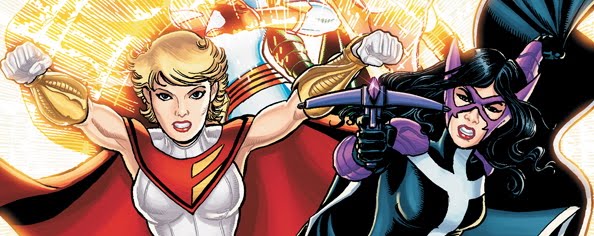
Speaking of DC covers, here's one for the first issue of Worlds' Finest, the book that will star the "New 52" version of Earth-2' Power Girl and Huntress, trapped in the main New 52iverse, written by hot, young up-and-coming talent Paul Levitz and drawn by the impressive art team of George Perez and Kevn Maguire. (Ugh...Worlds' probably isn't a typos, is it...?)

Of special note is the background, which seems to indicate that on their home world, Power Girl was Supergirl and Huntress was Robin. That's pretty different than the original pre-Crisis Earth-2, and the new post-Crisis Earth-2 we saw during the last volume of Justice Society of America. This is an all-new, all-different Earth-2, apparently.

Also of note? Power Girl's got a new costume. I don't like how fussy the armbands are, and the P-Shield looks kind of goofy as drawn there (I'd prefer a simple red triangle, honestly), but compared to many of the "New 52" costume redesigns, Power Girl got off pretty easy).

In his piece offering a quick history of Power Girl costumes for ComicsAlliance, Chris Sims notes how similar PG's new costume looks to Rob Liefeld's Superman knock-off Supreme's costume, something Todd Allen at The Beat also noticed.

I would put it down mostly to coincidence, since Power Girl was wearing a red cape over a white costume a few decades before Liefeld first put Supreme to paper, and she's a Superman-derivative character owned by the same company that owns Superman, while Liefeld's...homage was done for his own publisher that, at the time, was definitely not DC.

But then, whoever designed the new PG duds went so far as to borrow those ugly-ass gold gauntlet-like bracelet things from Supreme, which seems like a rather obvious "tell" of the inspiration. I mean, if you're going to steal from Liefeld, don't steal the bad parts, just steal and slightly alter the stuff he stole and slightly altered from you.

*********************

Wait, one more DC cover related tidbit: They also released a variant cover for James Robinson and Nicola Scott's upcoming Earth-2 book, and the previously mentioned Allen wonders why it looks like Flashpoint (I'm guessing he drew the conclusion based on the alternate costumes and the savage, sword-wielding Wonder Woman).

When I first saw it, I immediately thought of Trinity, which featured Superman, Wonder Woman and Batman on every cover, often wearing altered costumes.

As to the why of it, which Allen wonders a bit about as well, I thought the original announcement of the "second wave" of New 52 titles made rather clear that the Earth-2 heroes wouldn't simply be sitting put on their own alternate earth, but engaging the multiverse in general.

Wait, how did DC put it...?

Yeah, here it is:

EARTH 2 – Writer: James Robinson. Artist: Nicola Scott. The greatest heroes on a parallel Earth, the Justice Society combats threats that will set them on a collision course with other worlds.

************************

This was pretty funny.

I mean, I only read two Marvel comics regularly, and one of them is Daredevil, which just crossed-over with Amazing Spider-Man, in the traditional part of the story's in this book, the other part's in that book crossover fashion. And it's about to do that again with The Punisher and ASM. So that's two crossovers in just a few months in just one of their books.

I was thinking about it, and I wonder if Buckley really was lying, as Brothers says, or if he just doesn't really read Marvel Comics, not even as many as I do (remember, that's two) or not even very much about Marvel Comics, and thus he honestly isn't aware of the fact that Marvel actually publishes a lot of crossovers, like, pretty much all the time.

And then I was wondering what would be worse, from a Marvel audience member's perspective, knowing that the publisher was telling a big, dumb, obvious lie to them, or that he doesn't even read the comics he sells 'em...?

*******************

I already linked to my contribution to Robot 6 this week. At ComicsAlliance I wrote a little bit about that Alan Moore-interviewed-by-generous-through-the-computer-screen video (interesting that his explanation of why Morrison talks shit about him so much is the exact same as Morrison's explanation for the same in his book; there's a lot of great stuff in that interview though, you should watch the whole thing, and then give some money to the Pekar statue), Spidey's newest new costume, James Sturm's Avengers boycott, another comics creator dispute that is going to be fought in the courts (in this particular one, it's creator vs. creator instead of creator vs. publisher. That's...progress?), an update on DC's apparently weekly reshuffling of New 52 creative teams and my weekly week-in-review piece.

*********************

That Sturm article links back to a couple of pieces Tom Spurgeon has written on Marvel's shabby treatment of Kirby's heirs over the past few years—as he's eloquently pointed out, legal issues aside, it would cost Disney/Marvel very, very little to voluntarily give Kirby's heirs a bunch of money simply because it's the right thing to do—and, in discussing Sturm's current position, Spurgeon also reprinted a section from a 2004 interview where he pressed Sturm about the issue of getting a paycheck for working on Kirby characters. I apologize in advance if this is too big of an excerpt:

TOM SPURGEON: Is there any queasiness working with characters that were part of a dispute? Maybe Stan's recent lawsuit is a contractual dispute rather than a work-for-hire dispute, but it's driven by rhetoric that claims these characters have been exploited unfairly and he's been exploited unfairly. Is it the fact that these specific characters don't hold any extra queasiness for you at all?

JAMES STURM: Like in what sense?

SPURGEON: You have $10,000 in the bank, but Marvel doesn't send Jack Kirby's children trade paperbacks of their father's work when it's re-released.

STURM: Boy. But if you extend that argument to your day-to-day existence, on how you shop and how you spend money and how you interface with the world, you couldn't touch anything. You know what I mean? It's like, we live in a tainted fucking universe. Every pair of shoes you buy was probably stitched together by someone being paid ten cents an hour under ungodly conditions. And that's not to excuse myself, but are you getting at that maybe I shouldn't do this out of concern for...?

SPURGEON: It's one thing to get work-for-hire from an artist who is ceding control of his characters to you, but you're signing a work-for-hire agreement with a corporation that may have, or may not have, unfairly taken these characters from the artist to begin with.

STURM: What the fuck have I done, Tom? What the fuck have I done? Holy shit. Black mark on my soul.

I don't know. Obviously everyone's ethical standards vary, but I just don't feel I've made an egregious ethical breach. I think the question is valid and I'm glad you raised it. But for me, a few things play into it. First, Kirby himself returned to work for Marvel. Second, Marvel has changed owners several times since Kirby's stints there. Finally, I have never heard of any boycott by Kirby's heirs -- or anyone else for that matter -- calling for writers or artists to refrain from using characters he created.

Kirby created something 40 years ago that has so influenced and shaped comics history and I look to honor it. I hope that comes across in the book. Kirby's imprint is all over Unstable Molecules, his art adorns each cover (and several interior pages). My position at Marvel is no different than Kirby's was: work-for-hire.

I'm sure every character that was created some writer feels propriety for. I shouldn't do that Stingray graphic novel because somebody who developed him feels cheated? Remember that stupid character called Stingray from Marvel?

To trivialize a very important issue, I wanted to call attention to that penultimate sentence: I whouldn't do that Stringray graphic novel because somebody who developed him feels cheated?

Was James "The Guy Who Did Market Place" Sturm just picking the name of a random nobody Marvel character like Stingray to use as a humorous example, or does James Sturm really have a Stingray graphic novel in him that he would have liked Marvel to have published?!

I just ask because I'd really, really, really like to read a graphic novel about Stingray by James Sturm.

*********************

In that Robot 6 piece, I mentioned that I had never seen the cartoon show Adventure Time, which the comic book Adventure Time is based on, but that I borrowed a DVD from the library based on the strength of the comic adaptation.

They only had one DVD, and it was not labeled as season-specific, so I'm not sure how thorough Cartoon Network's collection of Adventure Time is (Mystery Incorporated debuted later than Adventure Time, and it has at least three DVD collections, all clearly labeled, so far).

There were 12 episodes on it, and it was pretty awesome, from the neat opening song to the even neater one that plays over the credits. Apparently its a cartoon about a 12-year-old boy who lives in a tree house with his best friend, a dog who has Plastic Man's powers and the voice of Bender from Futureama, and they go on adventures that mainly involve quests through an all-ages, cartoon Dungeons & Dragons fantasy setting (Finn, the boy, even fights a gelatinous cube! Although he calls it a jelly cube...) and beating stuff up and wrecking things. Highly recommended...although I imagine most of you who have cable have already seen it anyway. If you haven't, and/or don't have cable, look for the DVD at your library!

The comic's pretty good too, although if you're not wealthy, I'd maybe advise waiting for the trade, as it's a $4 book, and the main story doesn't conclude in the first issue (Also, I imagine the trade will include all the variants, and they seem to be getting some pretty great artists to contribute variant covers, like Jeffrey Brown for #1.)

***********************

Here's a fun, if weird, fact. James Fallows' cover story for The Atlantic about President Barack Obama, entitled "Obama, Explained," is 12,000 words long. Static Shock artist and co-writer Scott McDaniel's post about what went wrong with the quickly-canceled title is over 15,000 words long.

(I'd recommend you start with David Uzumeri's breakdown of McDaniel's post, as it's much, much shorter).

I'm not sure what to make of this. Rozum said Static Shock sucked, and he wanted to just write a good story with a compelling cast of interesting characters, but kept finding himself getting pushed aside by his editor and co-writer, an artist doing his first real comics writing. McDaniel said Rozum didn't seem interested enough in the bottom line, and was opposed to he and his editor's attempt to drum up immediate interest in the book by employing shocking content, like the character being dismembered (And that this decision was based on a CBR poll...?).

McDaniel and his editor seemed to have "won" the fight, but the book got canceled right away anyway, and I can't think of anyone anywhere having admitted to liking it. I didn't even like the sound of the book, or what little I had glimpsed of it from far away.

So what's the lesson here...?

I don't know. But since they tried the dismemberment approach and it didn't work out, maybe next time creators find themselves in this position, they'll try the cast development approach.

*********************

Finally, to end on a That's fucked up note, have you heard about Marvel's counter-suit against the Ghost Rider creator, the result of which is destitute artist being forced to pay the huge, massively profitable entertainment corporation that is about to make a bunch of money off a movie based on this dude's creation $17,000 bucks?

And this in the same week Sturm decided to wave his arms about Marvel's history of dick moves regarding Jack Kirby's legacy and heirs.

Creators and fans responded by rallying around Gary Friedrich; Steve Niles has set up a paypal account if you'd like to help Friedrich out.

In a perfect world...well, in a perfect world this wouldn't be happening at all. In a slightly more perfect world, Nicolas Cage would drive up to Frierich's house on a motorcycle, rev the engine until the artist came out to see what was going on, and then hand him a check for $17,000. I have no idea what Cage is making for that movie, but $17,000 is a pittance in movie money, even if it's a hell of a lot of money for struggling artists (It's more than I make in a year, that's for damn sure).

Saturday, February 11, 2012

Review: Moon Knight By Brian Michael Bendis & Alex Maleev Vol. 1 (No seriously, that's what they called it)

Last year Brian Michael Bendis began writing the newest volume of a Moon Knight series for Marvel, teaming with artist Alex Maleev, with whom he had enjoyed a long and popular run on the title of another of Marvel’s gritty, street-level urban crime-fighter characters.

The particular tack Bendis took was a somewhat familiar one he had honed over the years of his writing New Avengers; in order to help ensure the popularity of a character he liked, he made him an Avenger. Now the Moon Knight character has had some affiliation with the team before and, in fact, was currently on an Avengers team at the time the book launched—the black ops version of the team in Secret Avengers, one of the few Avengers books Bendis doesn’t write—but here Bendis gives his star an Avengers-developed and approved mission, and he puts the three most popular Avengers in every issue.

The twist, which is telegraphed on the cover, and which I’m about to spoil since this is a six-month-old storyline, is that all of this Avengers business is simply in Moon Knight’s head. The character began life as a Werewolf By Night villain who then transitioned to a clumsy Batman knock-off, but his defining trait over the last decade or so has been that he’s a literal crazy person, someone suffering from a variety of fairly severe mental illnesses. Yes, quite edgy.

Exactly how mentally ill Moon Knight is becomes part of the story, and something his non-hallucinatory allies like an ex-SHIELD agent-turned-Hollywood prop man and New Avengers cast-off Echo try to figure out while helping him. Is he, perhaps, mentally ill like a fox?

Bendis at least suggests this may be the case, when the character talks about some new techniques he’s been trying out, and it does provide some background tension…as well as at least one really weird set-piece, in which Moon Knight wears a Spider-Man costume over his Moon Knight costume and breaks into a brothel to fight hookers in his version of the Spider-Man persona (he also wears fake Wolverine claws, which he unsheathes when he goes into a fake Wolverine berserker rage during the same fight).

It’s a welcome bit of unpredictability in an otherwise somnambulistic Bendis plot. If you’ve read any half-dozen of his Marvel story arcs, you’ll recognize all of the familiar, grating tics: Everyone talks the same, as if they’re reading a spec script for a 10 p.m. hour-long cable drama, everyone has the same sense of humor, the plot is told primarily through explanatory dialogue, favorite Marvel characters and concepts get dropped in or just name-dropped, etc.

Moon Knight has moved from New York to L.A. because, as has been pointed out in a score of other Marvel comics, all the superheroes live in New York City. Moon Knight’s in town to try and stop a mysterious villain from setting himself up as the Kingpin of L.A. (It’s teased throughout that it’s someone familiar and powerful; when the final reveal is made, I must confess I have no idea who the character actually is, although he is on Wikipedia).

While there, he’s also producing a crappy television show based on the soldier-of-fortune adventures of his secret identity, Marc Spector. The star of a Bendis comic, written like a pitch for a TV series actually producing his own TV series within the comic seemed kind of clever, and in this case Bendis is definitely in on the joke, as he has a character in the show-within-the-comic melodramatically repeat one of Bendis’ most oft-mocked lines.

Maleev is particularly well-suited to drawing Bendis scripts. In a more perfect world, perhaps Maleev would be the only artist allowed to draw Bendis scripts (Well, aside from Bendis himself, although he seems to have given up professional cartooning since enlisting with Marvel).

He draws in a photorealistic style, but he does seem to be drawing in it, rather than dropping in photos. A lot of the characters look heavily photo-referenced, but expertly and organically so: I couldn’t, like, identify movie stills within the DNA of the panels, or recognize actors or models in the character designs.

The only real flourish of expressionstic, more superhero-like art is in Moon Knight’s occasionally moon-shaped, almost-luminescent white cloak, which is over long, and a nice, sharp, dramatic break with the more realistic settings and character designs.Maleev also handles typical Bendis scenes of Person Monologueing for 1-3 pages quite well…certainly quite a bit better than many of the other artists who have drawn Bendis scripts at Marvel over the last decade. I was curious about this book prior to finding this volume, which collects the first seven issues of the monthly series, and serves as a satisfying enough chunk, resolving one mystery (the identity of the villain planning on becoming the Kingpin of L.A.) and ramping up the other (seriously, how crazy is Moon Knight?) by the end of the seventh issue.

I had noticed from Paul O’Brien’s regular analysis of Marvel’s month-to-month figure at The Beat that Moon Knight was pretty far down the chart, and moving far, far fewer copies than most Bendis-written Marvel Universe books do (in December, for example, it was #78 on the chart, and moved 24,626 units, while Avengers and New Avengers were #17/57,000-ish and #25/53,000-ish respectively).

From the contents of the first seven issues, I can’t tell why the market is less interested in this Bendis books than it is in some of his others, but it’s worth noting that even his more popular books are falling down the charts, with the X-Men retaking their traditional spot of Marvel’s top franchise from the Avengers, and DC’s “New 52” experiment dominating the top ten.

Looking at the covers for the individual issues, however, I see that Marvel was charging $4 a pop for this book, which might explain it’s relatively poor placement on the charts. I imagine even fans willing to shell out 33% more for Avengers or Spider-Man than they might if DC were publishing those books becoming more reluctant to do so when it’s a Moon Knight book.

******************

Oh, but I hate, hate, hate, hate the way Maleev draws liquids:
******************

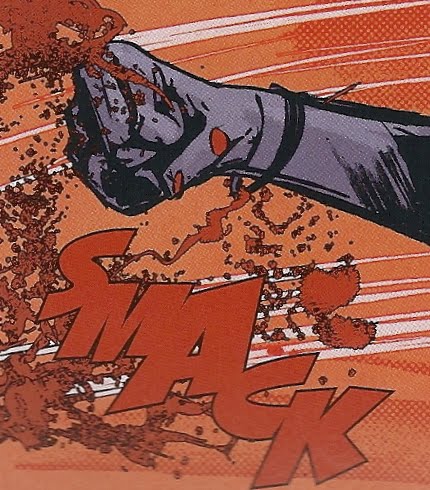
I thought this scene was really weird. It involves Marc "Moon Knight" Spector (that's him on the left) and super-martial arts expert Echo (on the right). He tries to kiss her, and does, I guess because she let him (her being a super-martial artists with wicked reflexes and what not). And then, instead of, like pushing him or slapping him, she decks him so hard that blood explodes out of his face.

And then she does it a few more times:Pretty weird, right? But maybe that's what Bendis and Maleev were going for: These two people are both totally insane.

*********************

Finally, may favorite part of the whole book was the last chapter, in which the mystery villain is finally revealed (stop reading if you don't wanna know who it is, yo). Like I said, I didn't recognize him or his name, but he looks totally awesome: Oh ish, look! It's...it's...it's...a guy cosplaying Bela Lugosi's Dracula...?

Not pictured: He totally wears a monocle, too.

Do you recognize this dude? He's apparently a Thor villain named Count Nefaria.