Sunday, September 18, 2011

A few quick links

DC Women Kicking Ass creates a timeline of the new Batwoman title's long, long, long road to actually coming out. If I were putting the timeline together myself, I would have started on the day The New York Times announced Batwoman's creation in May of 2006 instead of when a certain rumor site started spreading rumors about it, but maybe that's just me being old-fashioned regarding the validity of unsourced industry gossip...particularly from such a credulous source. Anyway, good on DCWKA for putting it together.

Up top of the post is Alex Ross' design for Batwoman's costume, which was basically cobbled together from pre-existing Bat-costumes (Batgirl Barbara Gordon's basic design, the original Batwoman's head-piece, Batman Beyond's color scheme), resulting in something that looks both new and classic at the same time.

It's soooooo much better than the new Batgirl costume, and I remain perplexed by DC's decision to have Lee redesign their universe's various wardrobe's instead of Ross.

Sorry to keep complaining about the New DC's costuming; I'll get over it someday. Maybe in a year or three.


This story was of interest f me mainly for a number involved: Famous pretend-crazy Glenn Beck's new subscriber-only TV show thingee has 230,000 subscribers. I guess Keith Olbermann was making fun of it for being a low number, even though it's more than the people who watch his dumb show, but whatever, just look at that number, and then compare it to sales for Justice League #1 (so far) and pretty much every comic book of the last few years.

It's a pretty stark reminder just how niche a field comic book publishing really is. The very best-selling serial comic books form the biggest publishers, with the full weight of an unprecedented PR campaign behind them, are lucky to match the number of sad, poor, crazy people willing to plunk down money to spend time with a sad, rich, crazy person make them feel worse about themselves and the world they live in.


So apparently DC's short, fat, middle-aged characterAmanda Waller is now no longer at least two of those things in the company's re-booted universe. One could excuse the move by noting that the movie and television versions of Amanda Waller (played by Angela Bassett in Green Lantern and Pam Grier in Smallville) were taller, slimmer and sexier than the comic book version, but that doesn't really answer the question, just shifts responsibility for the change—why did the film and television producers so radically change the character?

Waller was formerly known as The Wall, a play on her name that also reflected her personality and her visual appearance, but now I wonder what they will call her. Perhaps The Post...?

(The above image is a detail from Karl Kesel's cover for 1989's Suicide Squad #34, in which Amanda Waller, left, battles Granny Goodness, right...say, I wonder how hot they'll make Granny Goodness look in the new DCU...? )

I do like that drawing of the new slimmer, buxom, hollow-cheeked (Or perhaps she just has a very defined facial structure; depends on how un-generous wants to be in characterizing the new look) Waller. A lot of what I had first heard about the book, including writer Adam Glass's thin, mostly dire resume and the random changes like King Shark becoming a half-hammerhead shark , turned me off on trying out the new book. But I liked the original concept and the original series, and if the art's decent, maybe it's worth a shot...?

Then I read the first paragraph of Don MacPherson's review of the first issue, and yikes. This is probably the ideal place for the publishers ugliest, darkest material, especially if it's going to carry on Secret Six's nasty-villains-battling-even-nastier-villains conceit, but it's not something I feel like wallowing in. Suicide Squad fan and Comics Alliance contributor Chris Sims was even harder on the issue than MacPherson was, and then the rest of the CA staff gave it a critical beatdown. With a 0.5 out of 10, I do believe it was the lowest rated of all of DC's "New 52" so far.


Johnny Ryan on Chester Brown's Paying For It in Vice. Sort of. NSFW, obviously, but you knew that when I said "Johnny Ryan," didn't you?


I love this dude's costume. And those bats in the first panel. And the panel above. Pretty great comic all around, actually.


When I first saw the headline "Some new Wonder Woman concept art by Cliff Chiang" at The Beat and glanced the image that Heidi MacDonald ran under it, I thought (for a split second) that maybe DC had toyed with redesigning Wonder Woman into a centaur as part of their reboot.


Comics Alliance recruited artist Carolyn Main to review a trio of "New 52" books, and she's a very funny, very astute critic. I liked her characterization of Animal Man as "Tarzan of the hipsters," and her synopsis of Hawk and Dove's basic story: " Bird People are kind of air marshals sometimes, and have many emotional problems concerning their brothers and or lady birds." (The above image is detail from a NSFW one-panel gag on Main's website, which is chockfull of awesome art...much of it NSFW).

Saturday, September 17, 2011

EVERYTHING ELSE:

I occasionally consume media other than comics, books about comics, children's picture books that closely resemble comics and movies based on comics. Here are thoughts on some of the works from various media I've encountered in the last month or two, all of which were borrowed from my local library (and are, perhaps, available through or at your own local library).


AUDIOBOOKS

Assassination Vacation by Sarah Vowell: I’m assuming I like the way Vowell writes, but I can’t be sure, since, like David Sedaris, she’s an author I’ve only heard read her books to me, and never actually read one myself.

I like what I hear though!

In this 2006 book Vowell travels to places of significance (sometime quite tangential significance) to the three 19th century presidential assassinations—Lincoln, Garfield and McKinley—in the process telling the stories of aspects of their presidencies, the lives of their killers, and the lives of the nation revolving around these crisis points in history. And, of course, what it all means today.

Her obsessive interest in the time period is presented as an endearing, oddball trait when she shares personal anecdotes, but it’s infectious.

It was a particularly surreal experience hearer her many disses of how boring Garfield and his presidency was while I was driving home from work, which is in Mentor, Ohio, birthplace of Garfield (his home, preserved as a monument/museum to him, and a large park named after his wife are actually both right down the street from where I work, and I drive by them almost daily).

I was actually pretty bummed the entire time I was listening to this, as it was the last of the Vowell books available in audiobook editions that I had to listen to, so it’s going to be a long, long time before I can look forward to another week’s worth of commutes or long road trip with Vowell again…


The Looming Tower: Al Qaeda and The Road to 9/11 by Lawrence Wright: Like any grown-up who has paid much attention at all to the news over the last few decades, I knew many of the characters in Wright’s definitive history of the most talked-about terrorist group of the 21st century, and a handful of the most notable events in their history.

But this still felt like a new story to me, because of all the connective tissue Wright finds and highlights. It was a strange, slightly scary, completely revelatory experience to learn so much about something I thought I already had a pretty good handle on, and realize how little of the whole story American mass media tends to pay attention to.

This is a riveting work, and I was sorely disappointed that it ended when it did (it was a 2007 release), as I wanted to hear the rest of the story through the prism of Wright’s research and intense delivery style.


The Lost City of Z: A Tale of Deadly Obsession in the Amazon by David Grann: The author alternates between tales of his own search for the subject matter, which involves interviews, trips to libraries and museums and a trip to the Amazon jungle, and the search of that subject matter, Colonel Percy Harrison Fawcett, the perfect example of a Victorian explorer who eventually disappeared into the Amazon jungle while searching for a lost civilization he believed existed there, never to be found.

Grann sucks the romance right out of exploring, describing the incredible, unbearable hell of trekking through the Amazon jungle with long passages describing various men being literally eaten alive by insects, to the extent that any exploration at all during that time period seems insane, even suicidal.

Fawcett is an amazing character though, and one who runs across many other amazing characters, and this was a blast of a story, full of suspense, and coming as close to solving an 85-year-old mystery as possible, I suppose. More thrilling still is Grann’s interview with an aracheological expert of the area, who ultimately proves Fawcett’s theories of a massive advanced civilization living in one of the most inhospitable places on earth true—sort of.


Misquoting Jesus: The Story Who Changed the Bible and Why by Bart D. Ehrman: I first heard of this during an interview with Jon Stewart on The Daily Show and tried reading the book when it was new back in 2006, but found it a rather dull slog.

Having someone read it to me seemed like it might be an easier way through it though, so I gave the audiobook a try.

It still seems a little too dull for my tastes, but listening to the audio version I was a more-or-less captive audience. Ehrman’s goal is to write the first book about Biblical textual criticism for a popular audience, and he does accomplish that, however, as educational as the book is, as effective as it is on communicating information about this important but little-understood area of scholarship, it wasn’t a whole lot of fun to read (or have read to you), which is something I sort of expect from great books for lay people. (Needs more jokes, basically).

Ehrman has a particularly well-suited biography for a book like this, though: His interest in the Bible began in his teenage years when he became a born-again Christian who literally believed that the Bible contained the inerrant word of God…and then he started to study the Bible and found out it was actually a living, evolving document that had changed thousands and thousands of times, in ways big and small, since its thousands of stories were first set to paper and, in the case of the New Testament (the major focus of the book, as the title alludes to), they weren’t even set to paper until a couple centuries after Jesus’ death.

This apparently lead to something of a crisis of faith for Ehrman earlier in his life, but I don’t think it all that hard to wrap my head around a truly omnipotent being creating thousands of human beings capable of writing these stories, and somehow being behind the inspiration of many of them—even if removed to the point of being the first domino out of 5,679 dominos—and the ultimate document still containing exactly what that being wanted it to, changes, mistakes and all, for whatever inscrutable, unknowable reason that being wanted them in there.

Anyway, if you read one book on New Testament textual studies…


Unfamiliar Fishes by Sarah Vowell: Read by Vowell, Keanu Reeves, Edward Norton, Catherine Keener, Paul Rudd, John Hodgman, Bill Hader, Fred Armisen, Maya Rudolph and John Slattery, and featuring mustic by Grant-Lee Phillips (and Michael Giacchino), this production has the talent and star power of a respectable feature film behind it, seemingly moreso than an audiobook production of a tome on Hawaiian history.

I could listen to a whole book read by Norton. Or Keener. Or Reeves. (The pleasure of hearing Reeves read actually really surprised me).

This was a fantastic story full of a dozen or so fantastic stories contributing to the overall narrative, and was a real revelation for me. Of the three Vowell books I’ve read (er, listened to)—including the above-mentioned Assassination Vacation and 2009’s Wordy Shipmates—this was the book about the subject I knew the least about, and thus expected to be least interested in.

The opposite turned out to be true.


The War Lovers: Roosevelt, Lodge, Hearst and the Rush to Empire, 1898 by Evan Thomas: In addition to the title war-mongerers, Thomas focuses on two other men from the period, philosopher William James (brother of Henry) and the powerful speaker of the House Thomas Brackett Reed, both of whom opposed the various wars the other three were constantly seeking to stoke (eventually getting the Spanish-American War).

By force of personality and accomplishment, Roosevelt becomes the de facto star of the five and thus the book, and he’s a fascinating character, particularly as portrayed here in his pre-presidency years (His presidency is discussed, but Thomas’ focus is on Roosevelt and company’s lifelong love of war, and its climax in the war with the Spanish).

Someone really, really, really, really needs to make a modern movie about Roosevelt and the Rough Riders—Roosevelt is a fascinating character who seems at turns like a clown, an asshole, a madman and a hero, and the mixed-up make-up of his regiment (half rich dandies, half cowboys, few real soldiers) is pretty amazing.

Hearst and his participation in the war also seems like great film fodder, but you can’t beat the story of Roosevelt…as told here, rather than through his hagiographers.


DVDS

After.Life (2009): Two quick confessions. First, I had never heard of this film when it was in release in theaters a couple of years ago, and had no idea it existed until I saw it on the shelf at the media section at my local library.

Second, despite some curiosity about it (I like looking at and listening to Christian Ricci, and always enjoy seeing Liam Neeson in roles that I consider Un-Liam Neesonny), I didn’t actually borrow it and bring it home to watch until I overheard two boys talking about it, saying something along the lines of, “Dude have you ever see this? Christina Ricci’s like totally naked through the whole movie…!”

The one boy slightly overstated his case, but, um, yeah, Christina Ricci sure is not wearing a whole lot of clothes through much of the film, and when she is wearing clothes, it’s often just a red slip.

She plays a troubled young woman who suffers a terrible car accident and awakens (or does she?) on the table of undertaker Liam Neeson, who is either gifted with the supernatural ability to speak to the recently dead, or is he a sadistic monster trying to convince a still-living woman she’s actually dead so he can bury her alive?

Writer/director Agnieszka Wojtowicz-Vosloo’s film is a relatively small one, the majority of it set in a single room, with only a few scenes set in a few different locales, but it’s quite effective.

Despite a few clichéd elements—a creepy kid, dream/reality confusion—Agnieszka Wojtowicz-Vosloo’s brings up a very universal, primal fear about death and what happens afterward, with enough suggestion to allow a viewer to dwell on it.

I enjoyed the performances of both of the principal actors, and it’s genuinely scary if a viewer is willing to give him or herself over to it. In fact, it was so good that, after having seen it, I was even more surprised by the fact that I had never heard of it.

And, poking around a bit online, I discovered that it must not have been just me. It apparently wasn’t all that popular a movie: According to IMDb, it made less than $60,000 on its opening weekend, and grossed about 3.6 million, almost a million less than it cost to make.

I blame the dumb title, with its random placement of a period in the middle of it.


Dinoshark (2011): Despite the fact that Roger Corman helped produce this movie about a prehistoric monster feeding off of often swimsuit-clad people visiting a Mexican resort beach, and despite the fact that there are not one, but two scenes that set in the locker room of a women’s water polo team, there is not a single bare breast in this entire movie.

There is a scene where the hero jumps off a flying jet ski to throw a hand grenade into the face of a leaping prehistoric shark monster, however, but still, no nudity.


Law & Order: UK: Season One (2010): I can’t tell you how delighted I was to find this on the TV series shelf when looking for a Criminal Intent collection. I had no idea this even existed.

I just converted to Law & Order a few years ago, during a, um, rough time when I found myself alone a lot, and Law & Order was one of the only things on my four channels. It’s formulaic nature and focus on plot above character or interesting visuals makes it an ideal TV show for my current purposes—something to have on in the background while I’m drawing or scanning pictures from comics to blog about later.

This was a pretty exciting Law & Order experience, as it is comfortably similar to the original show (I think the episodes were even adapted from the American show’s episodes, based on the opening credit sequences), but simply setting it in the UK rendered everything exotic about it.

While a lifetime of pop culture and news consumption has given me a working knowledge of the US. legal system, the UK’s is completely mysterious—the police have different procedures and different titles, they say something different when they arrest people and, best of all, in court they wear robes and wigs and the lawyers or barristers or whatever all share a locker room where they take off and put on their costumes. Neat!

This cast was also probably the best-looking L&O cast I’ve encountered. Smoking hot Freema Agyeman plays Alesha, the attractive assistant district attorney-type role that the various U.S. shows usually have an attractive young lady play, and Jamie Bamber plays the younger member of the two cops couple, and he’s a very, very, very handsome man—more handsome than Jeremy Sisto or Skeet Ulrich, in my inexpert opinion (Agyeman was apparently in a couple of those Doctor Who shows so many of my fellow American nerds seem to like so much, but which I have somehow managed to completely avoid).

The guys in the Lenny Briscoe and Jack McCoy-like roles are pretty swell too, particularly Bradley Walsh, in the former; everything just seems more dramatic in a British accent, I guess.

Also, it has a great theme song—at least along the spectrum of Law & Order theme songs, none of which I really care for.


MST3K Vs. Gamera (2011): The back of this Shout Factory-produced, five episode collection declares it the “first-ever themed collection” of Mystery Science Theater, and it consists of the Mystery Science Theater crew’s first attack on Gamera and his four sequels (-Vs. Barugon, -Vs. Gaos, -Vs. Guiron and -Vs. Zigra).

Gamera, as you’re probably aware if you didn’t skip over this entry upon seeing the acronym MST3K, is an off-brand Godzilla type of kaiju, a gargantuan, bipedal turtle with tusks, the uncanny ability to breathe fire, and the even more uncanny ability to draw his limbs and head inside his shell, and then fire jet propulsion flames out of those holes, allowing him to fly like a flying saucer. And he is the friend to all children.

The film series was a perfect fit for a slightly insane, no-budget TV series dedicated to making fun of totally insane, no-budget films, and these episodes are among some of the more fruitful of that period of the show.

Seeing all five back-to-back like this allows one to really enjoy the nuances of the Gamera films, and to better differentiate them—like the Saturday afternoon Godzilla movies of my youth, all of the Gamera episodes of MST3K had previously just blended together into one big episode in my head—although that also probably makes this set more of one for fans than for the casual, What’s this crazy puppet show all about then? viewer.

Each DVD opens with a crudely computer animated Gamera storming out of the theater doors before they close on his way to the Satellite of Love set, where computer animated Crow and Tom Servo perform weird little skits comprised of remixing their riffs and dialogue from the episode into something that makes (some) sense.

The bonus features include behind-the-scenes pieces entitled “So Happy Together: A Look Back at MST3K & Gamera” (featuring talking head interviews with Joel Hodgson, Frank Conniff, Trace Beaulieu, Josh Weinstein and Jim Mallon), “Gamera Vs. The Chiodo Brothers” (featuring a casual, rambly interview with old-school special effects masestro’s The Chiodo Brothers, whom I had never heard of) and “Gamera Obscura: A History” by August Ragone.

The last of these was my favorite of the bonus features, and it is basically just Ragone talking about the history of the Gamera franchise and its place in Japan for a really long time in front of a static camera. It’s poor filmmaking, but interesting film history (even if it would have been better read than watched). It set me scouring the catalogs Ohio’s libraries for newer Gamera movies, which Ragone talks up as being particularly high quality.

The DVD set includes five posters by artist Steve Vance, in which the ‘bots share a new movie poser with Gamera and/or his foe for each of the films.

An unfortunate side effect of seeing so many MST3K Gamera episodes in a row, however, was that their various versions of the Gamera theme song were stuck in my head for weeks...right up until I saw a DVD of the Master Ninja episode, and had their beat box/scat version of the "Master Ninja Theme Song" stuck in my head...


90210: The Third Season (2011): In preparation for this week’s debut of season four, I spent a big chunk of last week watching all 22-episodes of the third season of this, my second favorite TV show ever (Behind Beverly Hills, 90210).

That is a lot melodrama and teen angst to watch in a short amount of time, but the cliffhanger endings made it very, very difficult to stop watching after an episode or two.

Comparing this season to the last, I found myself wanting to yell at the characters more often than usual (and, in fact, doing so now and then—I live alone; might as well take advantage of it), as I would say a full 80% of these kids’ problems they brought on themselves by lying.

Sure, outside forces often come into play causing conflict, but in almost every case they compound the conflict by either not telling the truth about it or lying about it.

That’s the takeaway here kids—always be honest, with yourself, with your friends and with your family. That, and be very, very, very careful when you have sex, which you should do only safely, and preferably not until your out of high school.


Paul (2011): I just rewatched E.T. for the first time since childhood (you’ll see why in a few months, when I get done drawing my next comics project), which reminded me of this movie’s existence and made me want to see how a post-modern magical alien movie from the writer of Shaun of the Dead and Hot Fuzz and the director of Superbad and Adventureland might turn out.

It was a surprisingly sweet movie, but ultimately a more sweet movie than a funny one. The special effects that brought the title character to life were accomplished, but the Paul character and his party hardy attitude was a bit much at times (he seemed like the mascot for a product of some kind, like a chatty alien version of Spuds MacKenzie) and a lot of the talent involved seemed to have been wasted or, at the very least, ill-served. It’s definitely the weakest of the films co-starring Simon Pegg and Nick Frost.


Shades of Gray (2010): I’m glad I don’t feel all that strongly about UFOs, because if I did I would probably have very weird, very conflicted feelings about Gray Barker, who did a lot to popularize UFOs, their public discussion and various aspects of their study, but he also seems to have been an inveterate hoaxer, a bad apple that I’m sure many of the more serious students of the phenomena though spoiled the bunch.

This 2009 documentary offers a pretty interesting and relatively thorough introduction to Barker, a controversial, polarizing figure that they present as part Fox Mulder and part Mark Twain.

I felt it revealed an awful lot about the man, and made me want to find out more about him (Sadly, I can’t find any of his books in any Ohio libraries, and I’ve been looking for his Silver Bridge for well over a year now.)

I hope someone writes a thorough biography of Barker sometime soon, preferably before his friends and family pass away and are no longer interviewable.

What stuck with me most after watching this was just how much Barker contributed to American pop culture, including the so-called paranoid theory of UFOs that informed the X-Files TV show and two feature films, the “Men In Black” that also got two feature films, the Mothman and the so-called Philadelphia Experiment (each of which also earned at least one film apiece). Most of those contributions, some of which he simply had a part in popularizing or playing up, have gone unacknowledged and uncredited. I guess that was inevitable, given that Barker traded in true, or "true" stories, instead of turning his considerable imagination to the production of fiction.


Warbirds (2009): Were I more disciplined, hard-working student, my childhood fascination with dinosaurs might have lead me into a career in the field of paleontology. Instead, I realized early on that science is hard, and so I abandoned science for the arts, and channeled my love of dinosaurs into foolishly watching movies like this made-for-TV (according to IMDb) movie that is no damn good at all.

There’s a triple-meaning to the title, which refers to the WW II-era lady pilots themselves, the airplanes they fly and the giant winged dinosaurs they spend the majority of the movie trying not to get eaten by.

The premise isn’t bad. The lady pilots, who apparently test-fly airplanes before the male pilots take them into battle against the Axis, are tasked with a top secret mission delivering an imperious American officer, his men and mysterious cargo to a secret location. They’re downed by a mysterious attacker, and land on an uncharted island under Japanese possession. It’s swarming with the flying reptiles, who have picked off most of the Japanese soldiers.

It’s cheaply made, cast, acted and executed, and it’s the sort of movie I don’t understand at all. They don’t play up the sexual under-undertones in a way to make it exploitive. It’s not the least bit funny. It’s not the least bit scary. It’s just bad. Because the filmmakers play it perfectly straight, it would need Jurassic Park-level special effects and filmmaking to even be tolerable; but with that option taken away, they don’t bother finding an angle, but just plow ahead making a terrible, terrible movie.


Your Highness (2011): I meant to make a rare trip to the movie theater to see this on the strength of the thrailer alone. The combination of sword-and-sorcery, Dungeons & Dragons-style fantasy with an excessive amount of swearing and dick jokes is, after all, something I’ve been keenly interested in for well over ten years now, plus, Zooey Deschanel and Natalie Portman in the same movie? Swooooon.

But either it didn’t stay in theaters long enough or I was way too busy during the weeks it was to make it, so I had to wait for a DVD.

It turned out to be an extremely weak endeavor, although there’s something quite charming about so much money being spent on costumes and special effects simply to tell the sorts of junior high school lunch table gay panic jokes one might expect to find in cheaper movies featuring SNL alum. (Whether or not one ultimately finds a minotaur trying to hump one of the questers in the middle of a labyrinth and then having his erect penis cut off and worn as a trophy is funny or not, I think it’s kind of funny that some special effects folks had to spend hours putting together the minotaur. Then there’s a clockwork bird, which exists only to take light jabs at Clash of the Titans…not the 2010 remake, which did away with the clockwork owl, but the 1981 version).

There’s also plenty of charm among the principal cast, most of whom don’t get nearly enough to do (Deschanel seems particularly wasted), and they certainly help sell the inherent humor in a clash between modern slang delivered in highly affected English accents.

It ultimately scans like the trailer padded out to feature film length, but it has its moments, and God knows there are worse, less ambitious films to waste one’s time on…


CDS

The Green Album: I like the idea of this previously mentioned album—“alternative” bands covering Muppet-related songs—more in theory than in practice.

I think much of that had to do with my relative unfamiliarity with many of the bands, and my unfamiliarity with many of the songs themselves. Outside of the theme song, “Mahna Mahna” (by The Fray) “It’s Not Easy Being Green” (by Andrew Bird) and a few from Muppet movies I’ve happened to watch in the last few years, I didn’t really recognize many of them, or think them really worthwhile songs, no matter who was covering them.

The OK Go theme song, probably the strongest entry, is quite different than the one in the video, as it’s Muppet-voice free. This allows for a pretty long vocal-free stretch between the “To introduce our guest star…” portion, as the part where Kermit says “Ladies and Gentleman, OK Go!” and the Waldorf and Stadler comment is simply musical, allowing you to sing along your own lyrics to introduce your own guest star, even if it’s someone with a long name, like, say, “Jaaaaaay! Caaaaaleb! Mozzoccoooooo!” (Hey, does anyone out there know what makes that sound heard between 2:13 and 2:22, in the video version? I like that sound).

Brandon Saller's version of "Nightlife" from The Great Muppet Caper, with its extended drum solo, and The Alkaline Trio's version of "Movin' Right Along" from THe Muppet Movie are pretty solid upbeat songs, too.


La Roux: A chance hearing of “Bulletproof” on some Top 40-ish pop radio station my young, female relatives listen to got me interested in this act, and I spent a while last summer looking them up on YouTube and watching their videos (This one's my favorite).

The singer, whom the Internet tells me is named Elly Jackson, sports a look that looks a bit like the young Tori Amos amalmagated with the young Morrissey.

I really liked the album. A lot of the songs sound like, if you subtracted the vocal tracks, they could be songs form a video game, particularly from the early part of the album. I couldn’t help imagining a little red pompadoured sprite jumping around on platforms and avoiding enemies in a Super Mario-like sidescroller while listening to them (the second song, “Tigerlily,” is set in a haunted house level)


PICTURE BOOKS


Dracula and Frankenstein Are Friends by Katherine Tegen and Doug Cushman : Sarah Vowell mentioned this book in her Assassination Vacation, as a present she gave her young nephew Owen, to demonstrate his interest in the macabre or, as he himself termed it, “spooky stuff.”

In addition to that kinda sorta recommendation, I like the simple, declarative nature of the title, so I sought it out.

The book begins with a two-page spread depicting the two neighboring monsters’ houses—Dracula’s house-sized castle, Frankenstein’s a ramshackle house with an electrical device on the roof—and every lot on the street is dedicated to a different kind of monster.

Here’s the right half of the spread, and the first two sentences of the story:“Dracula and Frankenstein are friends,” it begins, “They live in two side-by-side houses, in a town where all of the houses are spooky.”

It’s followed by two more two-page spreads, each dedicated to a cutaway view of each of the two famous monster’s houses, before plunging into an overview of their relationship and then introducing the conflict: At a café one day, Frankenstein mentions his desire to throw a Halloween party, and Dracula retorts that he was going to have a Halloween party as well.

It’s not a brilliant book by any means, and I wasn’t overly impressed with artist Doug Cushman’s artwork, although the idea of all these movie monsters living in a town together, and the little cameos and details Cushman fills the pages with.

I particularly liked the fact that Dracula changed from his traditional black tuxedo and serrated, high-collared black cape into a bright red suit and cape for his party.

Niece #1, who also enjoys spooky stuff (but not stuff that’s too spooky), liked the book. She particularly liked the Invisible Man, whom she figured was a ghost (I believe it was her first exposure to the Invisible Man), and the pages showing their houses, commenting that she wouldn’t like to sleep in Dracula’s bed (a coffin), but it seemed preferable to Frankenstein’s bed (a large wooden slab of a table that can be rotated so that it can move from horizontal to vertical).

She did ask why Dracula’s welcome mat said “Velcome” instead of "Welcome." That was one of the things I thought was funniest in the book, but I guess my eight-year-old niece hasn't seen as many old Dracula movies as her 34-year-old uncle...

Friday, September 16, 2011

Another Mothman.

The above image is the cover of Mothman (Kidaven Press; 2010) by Q.L. Pearce, part of the a "Mysterious Encounters" series for young readers (the slim hardcover is 48 pages long, consisting of four chapters, with big words like "conspiracy" and "prophecies" and "okapi" in bold, with a glossary at the end defining them. The interior images are limited to a low-angle photo of the statue of Mothman in Gunn Park in Point Pleasant, and a goofy-looking rubber model from the Mothman museum.

The cover image is the only original illustration of the subject, given a ginger bread man-like trunk and legs, big black insect-like wings that are as dark and solid as the creatures body, and shining red eyes that seem to either be reflecting the light of the headlights or being lit from within. The figure blends in to the shadows surrounding it so well, you have to kind of tilt the cover a bit here and there to see the details, although the scanner makes the image a lot more clear than it appears in person.

I can't decide.

On the one hand, Masters of the Universe-branded Hot Wheels are about as silly as inventing a car for The Hulk to drive, since there are no automobiles on the planet Eternia (Everyone gets around on giant cats of prey or crazy vehicles shaped like animals with weird names with hip-hop spelling like Attak Trak or Stridor).

But that van pictured in the background of this ad, featuring what looks like an old panel van with Battle Armor He-Man astride Battle Cat painted on the side is totally awesome in the way that all old panel vans with fantasy scenes painted on the side are.

I just can't decide if the fantasy scene depicting He-Man makes it more or less awesome than it would be if it were just a generic barbarian character with a battle axe riding a giant cat...

Thursday, September 15, 2011

Meanwhile, at Robot 6...

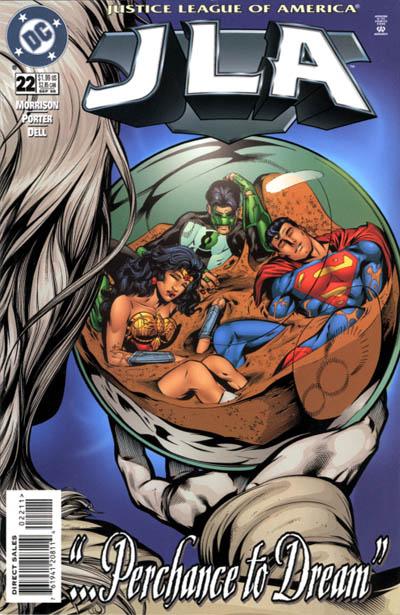
You know, sometimes I think maybe Howard Porter's late-nineties JLA art hasn't aged all that well. Anyway, today at Robot 6, I take a look at 1960's Brave and the Bold #28, 1987's Justice League #1 and 1997's JLA #1 in light of Geoff Johns and Jim Lee's nearly Justice League-free Justice League #1.

Wednesday, September 14, 2011

Comic shop comics: September 14

All-New Batman: The Brave and The Bold #11 (DC Comics) In this issue, Batman and Jonah Hex team up in a time-traveling adventure to stop Warner Bros. from producing 2010's Jonah Hex feature film.

Okay, actually Batman travels much farther back in time than that (with help from Doctor Nichols, natch), way back to cowboy times. The villain he and Hex face isn't a particularly inspired choice, as the two previously took him on in an episode of a Batman cartoon (but not an episode of the cartoon series this comic is based on).

The choice of first scene, pre-team-up guest stars is a bit more refreshing: Cave Carson and Geo-Force.

The best part of the story, however, was seeing another example of Batman's mastery of disguise:


Daredevil #3 (Marvel Entertainment) This is still a perfectly traditional superhero comic, executed perfectly. What I really dig about Mark Waid's writing on this title is his confidence in the fact that his collaborator is a great artist, and the way he thus seems to be thinking up wild things for Paolo Rivera to draw. Waid's challenging Rivera, and Rivera's meeting the challenge, which, in turn should encourage Waid to come up with greater, more difficult challenges in the future. That's the way writer/artist creative teams like this should work. Props to Inker Joe Rivera and colorist Javier Rodriguez for making this such a slick, beautiful book—the coloring is really where most superhero comics seem to get (visually) fucked up these days, but Daredevil is lovely.


Green Lantern #1 (DC) There' sso little change in this particular title, one wonders if DC needed even bother with renumbering it—same creative team, same lead, same story, picking up right where the last issue left off. Even the tweaked and surely extremely temporary changes to the status quo—Hal Jordan is ring-less, and Sinestro is the new Green Lantern of Space Sector 2814—were thoroughly lead into by the last issue of the previous volume.

Not much happens in this issue, which is mostly devoted to (re-)introducing some of the principal characters, but it does a fine job of leaping over that relatively low bar.


DC Retroactive: JLA—The '90s #1 (DC) I was a little surprised that DC chose the Keith Giffen, J.M. DeMatteis and Kevin Maguire creative team and the "Bwa-Ha-Ha" iteration of the League for the '90s special. The writing team's run began in 1987 and ended in 1992, with Maguire a somewhat sporadic presence, so that team—behind the book and starring in the book—was just about as much of an late-80s book as it was an early-90s book. More representative creative teams might have consisted of Grant Morrison and Howard Porter, whose JLA ran from 1997 to 2000 and included such '90s signifiers as mullted Superman, Kyle Rayner as Green Lantern and shirtless, un-groomed, hook-handed Aquaman, or perhaps writer/artist Dan Jurgens (Justice League America, 1992-1993) or Gerard Jones and Chuck Wojtkiewicz (1994-1996). I don't know whatever became of Jones or Wojtkiewicz, but Morrison, Porter and Jurgens at least are all still working for DC.

Ah well, as much as I might have liked to see Morrison returning to his post-Rock of Ages roster, when Plastic Man, Steel, Zauriel and the others joined the Big Seven, I suppose the Giffen/DeMatteis/Maguire team better fits the nostalgia-stoking mission statement of the Retroactive books, and their run seems to be more or less erased by the post-Flashpoint reboot (if I've understood what I've heard about JLI #1), so this is an era well worth revisiting one last time (for now).

In addition to the main cast of the American League, the trio bring in Justice League Europe's Power Girl, her cat, and their Injustice League of Multi-Man, Major Disaster, Clock King, Clue Master, Big Sir and Bruce. The major conflict involves a bit of Apokalyptian technology falling into the wrong hands and the fighting of a giant monster, but as with the majority of Giffen and DeMatteis' Justice League comics—especially their occasional revisits to the characters after they completed their five-year run on the franchise—it's more about the banter, the jokes and the characters than anything else.

It still sort of boggles my mind how seemingly easy it is for Giffen and DeMatteis to slip right back into writing these characters as if 20 years or so hadn't past, and Maguire's artwork just gets better and better (as a comparison with the Maguire-penciled, Terry Austin-inked back-up reprint demonstrates).

According to the fine print, that back-up is supposedly Justice League of America #6, but I think it's actually Justice League America #60, the final issue of the Giffen/DeMatteis era, before they handed creative duties over to Jurgens (and the book went off to wander in the wilderness for five years, until Morrison and company came on to restore it to its original, pre-Crisis concept of DC's biggest heroes united to beat-up threats too big for any of them to handle on their own).

As the final issue of their run, and part 15 of a 15-part climatic storyline, it might seem like an unusual choice to pull out as representative of their run, but it does devote almost every single one of its pages to checking in on one of the many characters that populated the Giffen/DeMatteis Leagues, and thus introduces a pretty sprawling cast while highlighting particular character traits and running gags.

While the writing and the art don't seem dated at all, the same can't be said of the fashion. Check out Max Lord's sweater, which dates this story precisely as having been published during the eight season of The Cosby Show:

Advice for comics creators

Not from me, but from Tsugumi Ohba and Takeshi Obata, the creators of Death Note and now Bakuman, a series about two high school kids who decide to become manga creators.

While Bakuman so far lacks the addictive suspense of the pair's previous collaboration, it's still a pretty intriguing book because, as we all know, comics are the most interesting thing in the whole world. So what better subject for a comic than comics themselves?

In the first volume, as our protagonists are preparing to move from the theoretical phase into the actually-making-comics phase, artist Moritaka Mashiro suggests his writer partner Akito Takagi start his manga research with The Qualifications of a Man, as it lays out five qualifications for being a great comics creator (and, obviously, a man). Remember to read left-to-right, gaijin!: Those all sure sound sensible to me. Those first three especially seem like they would lead to better comics, if internalized by the best creators.
Mashiro, the dark-haired artist in these panels, is the nephew of a struggling manga-ka who has died, and whose studio the boys have inherited. Mashiro's uncle referred to himself as a "gambler," because he wasn't a natural-born genius, and thus he had to work super-hard at his craft constantly, and was essentially gambling that he would manage to hit it big.

He had his own rules for what it takes for an artist like himself to become successful Ready? Finally, a Ohba and Obata offer a word of caution. Early on in the first volume, when Takagi is trying to recruit the reluctant Mashiro to team up with him, Mashrio explains the difference between a manga artist and a gambler, and how little money there actually is in the field: "You're a manga artist if you create one mega hit or several ones successful enough to live off of," he says. "Otherwise, you're just a gambler. Even the author of Death Note wrote somewhere that he'd probably starve to death in five years if he didn't keep working."

Monday, September 12, 2011

A few more Mothmans.

1.) There are two images of Mothman in author Judith Herbst’s Monsters (Lerner Publications; 2005), a slim, heavily-illustrated, 50-page volume devoted to introducing young readers to a handful of paranormal entities.

Here’s the first: The credits say that the image, which is obviously a reconstruction based on one of the famous witness drawings of the creature, is by Raymond Buckland and from the Fortean Picture Library.

It’s quite similar to William Rebsamen’s depiction for the cover of Loren Coleman’s 2002 Mothman and Other Curious Encounters.

The following page features an original illustration by Bill Hauser:He draws an especially insect-like Mothman, in the act of pursuing the Scarberrys and Mallettes during their encounter with him in November 1966.

It’s not as accurate an image as the above one, but its an evocative one. The wings are gigantic; the right one stretches over onto the previous page.


2.) Mothman also appears in The Little Giant Book of “True” Ghost Stories (Sterling; 1998), a fat, little 350-page, five-by-four-inch collection of short ghost stories.

In part two of the book, by writer Margaret Rau, there’s a chapter entitled “The Spectres” that contains five stories.

The first of these is “Mothman,” in which Rau offers a four-page summation of the Mothman story, beginning with the November 16, 1966 Wamsley and Bennet encounter with the creature (the story with the dropped child, and the monster on the porch, peering into the windows) and then offering a handful of shorter stories of a few more.

The book is illustrated by artist Jim Sharpe, who draws a black and white image for each of the 84 stories within. Here’s his Mothman: It’s definitely a unique take. Sharpe keeps it well within the bounds of most descriptions—big, all eyes and wings, no apparent facial features, a sort of vaguely human but essentially shape-less shape—and yet it doesn’t really look much like many other Mothmen.

The size is pretty vague too—Is he flying, or standing ?—and the outstretched “arms” could be limbs or they could be some sort of garment, like a big, flowing scarf. I like Sharpe’s linework in general, and after I got sort of tired of the ghost stories within, I still flipped through the book page by page to take in the art.

Here the sketchiness of Sharpe’s linework and the variation of width ads another layer of equivocation to the Mothman’s nature. Are its wings bare? Feathered? Covered in fur? Organic, or inorganic? Sharpe’s lines can be read as any of those options.

Sunday, September 11, 2011

Sunday is now Links-day.

Okay, show of hands: Who liked Gail Simone, Ardian Syaf and company’s Batgirl #1?

All the reviews of it that I’ve seen so far have been negative, with the kindest words being those I’ve seen in comments threads, and usually amounting to “I trust Gail” and “this is just the first issue,” which is a fine attitude to have, but it seems a little closer to rooting for a sports team than assessing a particular comic book (That is, the positivity I’ve seen seems to be from folks who are fans of the character and fans of the writer, not people who particularly appreciated that particular comic book).

Here are some examples of some of those negative reviews: Chris Sims of Comics Alliance, Esther Inglis-Arkell of 4thletter.net and Paul O’Brien of House to Astonish. (Oh wait, found a positive one: Don MacPherson rated it as a 7 on a scale of 10, which is a low C in school, but that’s still more positive than negative).

In certain ways, and in certain circles, Barbara Gordon and how DC handled her was one of the most controversial elements of their Is it or isn’t it? reboot/relaunch, for the obvious reasons that as Oracle Barbara Gordon was one of DC’s principal superheroines (in addition to being one of the most high-profile heroes in a wheelchair), whereas as Batgirl she was just one of a half-dozen ladies in Batman costumes.

Writer Gail Simone had a real challenge with the title, because she had to turn out something that had to be better than all of the Oracle stories–which includes bits of Suicide Squad, bits of Grant Morrison’s JLA and a solid decade of Batman and Birds of Prey comics, many of which Simone herself had written—in order to justify the reversion of the character.

I didn’t read it.

Unlike Sims, I wasn’t even really open to the idea that reverting Oracle to Batgirl could be done, having read enough of Simone’s writing over the years to feel perfectly confident that, although she is consistently amusing and an incredibly competent comics-scripter, she’s never once written anything that really knocked me across a room.

I’ve seen enough of Syaf’s work to know that I don’t like it more than I like having three extra dollars, and come on, cover artist Adam Hughes drew her cross-eyed, and she’s wearing a Batgirl costume so repulsive it almost makes one miss Batgirl III’s Ultimates-style purple suit with utility garter.

I was a little surprised to see that, after Sims’ review, the whole CA staff took on Batgirl #1 (along with all of Wednesday’s DC #1s), and they hated it.

Each staffer assigned each book a rating out of 10, and Batgirl was tied with Tony Daniel’s Detective Comics for last place with a 3; that’s worse than the Dan DiDio-written OMAC, the Judd Winick-written Batwing (5.5) and the Rob Liefeld-drawn Hawk and Dove (3.8)!

If Batgirl was a litmus test comic for how the “New 52” and DC’s it’s-mostly-a-reboot-but-we’re-going-to-keep-altered-versions-of-like-10-storylines-in-continuity approach is going to work out, then the fact that Batgirl #1 turned out just as bad as it looked like it was going to is a very, very, very bad sign.

I chose the above image because it’s the one that looks like Batgirl is holding a sex toy, and I am 12. It’s also a nice illustration of how awful her costume looks though; what’s with the weird, crustacean-like gauntlets? One of the things I’ve found most perplexing about DC’s relaunch efforts is the fact they that they are trying to find the iterations of characters that will be most recognizable to mass audiences (Choosing for their Batgirl the one who was in the live-action TV show, the cartoons and that one feature film everyone says they hated, instead of one of the more recent comic book Batgirls), and yet they give them these brand-new, totally repellent costumes.

If the idea was to use the Batgirl from the TV show, why not give her a costume that looks at least vaguely like the one form the TV show too…?


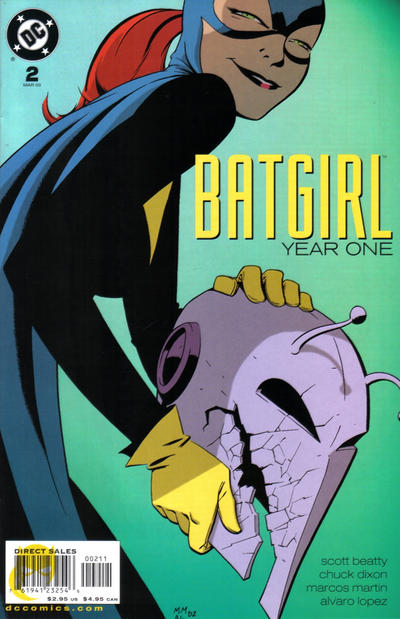
Batgirl: Year One was a really good comic featuring Barbara Gordon as Batgirl, one that was able to tell a story featuring that character from that point in her career without having to throw out either a baby or a single drop of bathwater.

I kinda liked the foul-mouthed, doing-it-to-piss-off-her-dad Babs/Batgirl from All-Star Batman and Robin, The Boy Wonder too.

I wonder why DC didn’t dust off Geoff Johns’ script or proposal for Batgirl: Earth One, and maybe have him write this series, since “The New 52” is so popularly received as a Geoff Johns thing. I’m sure DC turned to Simone because they knew she would be the least objectionable person to reboot Barbara Gordon among Barbara Gordon fans, but I don’t know—maybe Simone working from Johns’ plot…?


I’ve never known exactly what state Batman’s Gotham City was meant to be located in, but I’ve always assumed that it was in a state, somewhere here in the United States of America. Now that I see that image of a sign from the upcoming Batman: Arkham City videogame, I wonder if Gotham isn’t somewhere in the UK, or possibly Canada…? (Via Comics Alliance)


Not really comics at all, aside from the fact that I saw it at a site mainly devoted to covering comics, but I really enjoyed this stop-motion animated version of the Jonny Quest opening sequence. That show really had one of the all-time great American cartoon theme songs (I first encountered it through Reverend Horton Heat’s cover version of it, on the 1995’s alternative-bands-cover-cartoon-theme-songs album Saturday Morning's Greatest Hits. You can hear it here, as of this posting).

I was always struck by the fact that as cool as the song was, as awesome as all the stuff they show in the opening sequence—Mummies! Pterodactyls! Spider eyeball robots!—the cartoon that followed it was always inevitably much more boring, the result of being a twenty-minute version of a cool four seconds worth of footage from the opening sequence.


Earlier this week I reviewed a handful of August graphic novel releases at Robot 6, including Chris Eliopoulos’ Okie Dokie Donuts. In addition to drawing good doughnuts, robots and people, Eliopoulos draws a mean Ant-Man, here and here, and a pretty good Benjamin "The Thing" Grimm. You can see more of his art on his site, and you can read the whole Ben Grimm story here.


Here’s Tom Spurgeon on the virtues of DC keeping their prices down.

Spurgeon’s point regarding the importance of lower-priced comics, because it decreases the likelihood of individuals suddenly feeling they aren’t getting the value they expect from their comics anymore and walking away from the shops-altogether—is important.

Spurgeon was commenting on DC Executive Vice President John Rood stating that the drop in price didn’t spur a rise in copies sold. I always assumed lowering the price point meant less people dropping that book, not getting more people to buy it.

For example, while I'm pretty obsessed with price points, I don't do book-to-book comparisons, like "Well, I'd really like to read Brian Michael Bendis and Mike Deodato's new issue of New Avengers, but it costs $3.99, whereas this James Robinson and Brett Booth issue of Justice League of America is only $2.99; I guess I'll get the latter instead"). I simply don't buy $4 books, but do buy books that are less than $4.

DC is in a weird position in that they very, very rarely published Marvel or IDW sized 22/$3.99 books, instead they've tried different things, like 32/$3.99 books with back-ups and $2.99/20 page books.

Marvel essentially did this really stupid, evil thing, and DC decided not to follow suit...it' hard to reward the absence of bad behavior, you know? They're like the good son in the parable of the prodigal son(Only unlike the bad son, Marvel is still out there carousing, and haven’t come home yet).


Okay, it's official: I hate Matt Seneca. In the same way I hate guys like Jog, Abhay, Spurgeon and Tucker Stone (all of whom I love). Like, hate/love in a, Damn him, I wish I could write like that once in a while kind of way. Anyway, check out Seneca's reaction to DC's new "New 52" version of the Justice League.

Saturday, September 10, 2011

Comic shop comics (Scroll down for long, mildly irate Flashpoint tangents)

DC Retroactive: Green Lantern—The ‘80s #1 (DC) Despite the neat Joe Staton cover showing three different Earthling GLs, this is a John Stewart story. It seemed like a pretty significant John Stewart story too, so I was little surprised to see it here, given the mandate of these Retro books, although I don’t know if the events herein were a retcon or an expansion of an old story point that occurred in the GL book in the 1980s or what (I was three years old in 1980, and 13 years old in 1989, and my comics reading during that decade was limited to a handful of G.I. Joe and Transformers comics purchased from drug store spinner racks by relatives and given to me to read when I was home sick from school and laid up and bored on the couch all day).

I liked Len Wein’s story, in which John, with hair and a straight, Hal-style Silver Age costume (mask and all), tells his girlfriend at the time, one Tawny Young (who, despite her name, is neither a stripper nor a pornstar, but a television news anchor) his secret identity.

I like how she reacts, quite atypically for a journalist/superhero girlfriend (journalism is a surprisingly popular field for the girlfriends of superheroes to go into, isn’t it?), and how he reacts when the media learn his identity and confront him (I paraphrase, but he’s basically just like, “Aw fuck it, yeah, I’m Green Lantern. No big.”)

It’s not a terribly beefy story, but aside from those bits of Wein’s scripts, I think it’s probably noteworthy for being a sustained story of Stewart as a typical, even generic superhero having a typical, even generic superhero narrative occur around him. Stewart is generally a supporting character and teammember, either as one of the Justice Leaguers or one of the Green Lantern Corps, and other than Kurt Busiek and company’s portions of Trinity featuring John Stewart, I’m hard-pressed to think of another example of John as solo star like this (I’m sure there are other, perhaps from the ‘80s, but I haven’t read any).

The artwork, by Staton, is pretty incredible, and incredibly atypical for a modern superhero story. I fucking loved it. The back-up is by Wein, features Hal Jordan, and is drawn by Dave Gibbons. It has nice art, and is very, very boring. It took me three tries to get through the middle passage, which is full of Hal arguing with the Guardians.

I loved the panel wehre he flies off screaming Carol’s name though:


DC Retroactive: Green Lantern—The ‘90’s #1 (DC) The Retro specials from this decade are among the most quixotic, as the creators are mostly all still around and working fairly regularly (with very few exceptions), and the status quos of the stars were recent enough that a comic store with a decent $1 bin probably has plenty of comics by these creators on this title in it.

So, for example, for $5 you could by this, which features a brand-new story by Ron Marz and Darryl Banks set during Kyle Rayner’s pre-Winick career and a reprint of 1996’s GL #78 by Marz and Banks, or you could probably just by GL #78 and four other Marz/Banks GL joints from back in the day.

There’s not much to there new story, “Hothead,”and it’s probably not even worth tracking down unless you miss Marz writing Kyle’s voice and Banks drawing his body, and you’ve already read all their other comics doing just that.

So in this story, Kyle fights his Sinestro-like enemy Effigy. And, um, that’s it.

The back-up is an all-around stronger piece, seemingly specifically chosen because it offers a nice introduction to who Kyle is, how he differs from the previous Green Lanterns, and has a nice, melodramatic scene featuring a romantic turning point in his relationship with Donna Troy, foreshadowed and built-up throughout the first half of the story (Call me a sap, but I liked the bit with the ring-construct necklace, that will exist as long as he focuses his will on it and thus as long as he believes in their relationship).Also, equal servings of cheesecake and beefcake.


Flashpoint #5 (DC) To call the fifth and final issue of Flashpoint anticlimactic is an understatement. Actually, to say Flashpoint #5 is anticlimactic is an understatement is itself an understatement.

As soon as the premise was announced—a Flash story involving a radically altered DCU—both what happened and how it will be fixed was made pretty clear (the Bad Flash whose power is to change time probably changed time, the Good Flash will probably fix it in the end), and only got clearer once June rolled around and DC announced their “New 52” linewide reboot and relaunch plans. The relaunch would entail plenty of continuity screwing around with, and it would be accomplished through Flashpoint (i.e. through Flashes messing around with the timestream), which is essentially the exact same thing that happens every time DC reboots parts of their continuity—the universe and/or timeline are severely imperiled, are either radically damaged or destroyed, the heroes repair or even recreate the universe and/or timeline, with some minor changes resulting in another layer of confusion in Hawkman’s origin, or the number of super-pets Superman had, or whether or not Wonder Woman was at the first Justice League meeting.

This time around that reboot was even more anticlimactic than it would have been simply because once DC started talking about the crazy things they had planned, it was hard to even care about what the two Flashes will say to each other while de-creating and recreating the DCU, or how many alternate versions of characters will be dismembered before th conclusion.

Geoff Johns finishes off his miniseries with a “twist” regarding how the DC Universe became the Flashpoint-iverse, but not much of one. In fact, by simply pointing out that their is a twist, you can probably already guess which of the two Flashes actually is to blame, and how they fix it (Running, obviously).

The reversal isn’t all that clever, even if it is slightly less obvious than the most obvious explanation, and Johns doesn’t really bother to explain what happened anyway. There’s mention of those close to Flash Barry Allen being affected the most by his actions, but that doesn’t really explain why Bruce Wayne gets shot instead of his father and mother, and why the former turns into Batman and the latter The Joker, for example, or how Aquaman and Wonder Woman could turn into genocidal maniacs.

The gag is that time travel is so unpredictable that the tiniest change can radically alter the whole world moving forward, the whole butterfly’s wings things, but Johns picks a rather random event to be changed (in terms of its impact on the universe, not on the Flash), and doesn’t explain how knocking over that domino would send the whole world to hell in a handbasket years later.

One could extrapolate that it would lead to a word without a (second) Flash, but, um, so what? There were good and noble heroes before The Flash Barry Allen, there were good and noble heroes at the same time as him, and if you took Barry Allen out of the DCU, it’s not quite the same as if you took George Bailey out of Bedford Falls.

That’s just me casting about for an explanation Johns doesn’t bother with, though; he and his story aren’t really that concerned with the changes so much as suggesting a mess of changes for a mess of editors to spin miniseries out of, and now that the event is over, most of those miniseries seemed extremely pointless.

Barry Allen doesn’t even try to track down and talk sense to Wonder Woman and Aquaman for example, two characters who are supposedly providing the big conflict that shapes the setting of this story, but whom hardly even appear in the series (Their conflict remains unresolved, too).

Flashpoint is big and dumb like a lot of Johns’ comics, but it’s not big enough, and it’s either too dumb or, maybe, not dumb enough. I don’t know; Johns has a rather uncanny ability to strike a balance between really dumb and amusingly insane plot points, this razor thin line where I can’t tell if what he’s doing is Silver Age fun or just braindead dumb that I read into the deadpan delivery and see what I want, but this time his callibration’s off.

That, or I’m not as receptive as I’ve been in the past.

It’s probably a little of both.

I know the fact that this was the lead-in to the reboot had me ratcheting up my expectations quite a bit, as it was the biggest reboot DC’s done since Crisis On Infinite Earths, and thus should have been their best destroy-and-rebuild-the-DCU story since COIE, but, I don’t know, Zero Hour was better than this, as was Final Crisis and, hell, I’m not even sure if this was as good as Johns’ own Infinite Crisis…I guess it was more consistent visually and more tightly focused. (The art, by the way, is okay, but it’s weaker than the earlier issues, as deadline pressure must have started to take its effect. Still, props for having a single artist draw a whole story, DC! When was the last time that happened for a big, heavily-promoted story like this?).

Can we talk about the “New 52” tie-in a bit? It’s just two pages, a two-page spread that seemed written and drawn after the rest of the book and stuck in the climax, leading to a denoument in which Barry Allen visits Batman Bruce Wayne in the “new” continuity, although all that’s changed is that their costumes look worse (And there’s no in-story acknowledgement that anything has changed, either).

Here’s the spread:It reminded me of the two-page spread in the last issue of Infinite Crisis where the Trinity talk about taking a year off and saying the world will be in good hands, and there’s a big, hastily-drawn image of the other characters of the DCU, most of them with new, awful costumes suggesting their new, ill-considered new status quos (none of which lasted until Final Crisis, let alone to now).

Barry says,and a hooded figure with lipstick, glowing eyes and tiger-stripe skin says,Let’s take a moment to consider what a bunch of bullshit that is.

The suggestion is that the three are: 1) The DC Universe, the shared setting of DC’s main superhero line of comics, the WildStorm Universe, 2) The WildStorm Universe, the main shared setting of the WildStorm superheroes, a universe that occasionally crosses over with the DCU and has been rebooted with alarming frequency over the past few years up until DC canceled the imprint a while back, and 3) The Vertigo “Universe”, a theoretical setting in which the former DCU characters and concepts that became part of the company’s 1991-launched mature readers line share.Come on now.

There is no Veritgo Universe.

The Vertigo line, at least the ones starring DC characters, was set the DCU. Foundational books Swamp Thing, The Sandman, Doom Patrol, Shade the Changing Man and Animal Man all launched as normal DC books with big, fat DC bullets on them, and became Vertigo books once they were underway, when the Vertigo imprint began in 1993.

All of those stories featured the most mainstream DC characters as guest stars at one point or another. Swamp Thing guest-starred the Justice League, Batman, Superman, The Demon Etrigan, just about every magical character in the DCU and crossed over with Crisis On Infinite Earths; things that happened in Swamp Thing were canon in the DCU (like Zatana’s dad Zatara’s death).

The very first trade collection of The Sandman conatained stories featured the JLI, Fourth World characters and Dr. Destiny. The Element Woman, members of Infinity Inc, the Golden Age Wesley Dodds version of Sandman and the 1970s Jack Kirby version of The Sandman would play roles big and small in the rest of the series, and then there were all the cameos of the likes of Superman and the Lords of Order and Chaos and so on.

Animal Man’s lead was in Justice League Europe, and the JLI appeared in Doom Patrol (Geoff Johns wrote later stories incoroporating Doom Patrol’s Vertigo continuity back into the DCU).

And it wasn’t exactly a one-way street, either:Those are just covers. Swamp Thing and John Constantine attended Hal Jordan’s funeral, and the former even made a brief appearance in 1993’s New Titans Annual #9 (The “Bloodlines” one!). The Daniel version of Dream appeared in 1999’s JSA #1 and later near the end of that title’s run. Black Orchid joined a Justice League in 2001’s Justice Leagues: Justice League of Amazons #1.

The only wall of separation that exists, as far as I can tell, is that sometime around 2003-2005 or so, Vertigo quite letting DC use the characters in their DCU books, creating a “wall” that you would sometimes hear Dan DiDio mention at conventions when people would ask if Swamp Thing was going to fight Superman any time soon.

The notion of a “Vertigo Universe” seems to exist only in the minds of a few DC editorial types, inspired by some sort of intra-company bureaucratic conflict over various intellectual properties.

It’s an inside joke for a dozen DC editors, I guess.

Separating the WildStorm Universe out seems sort of silly too, since it’s simply one more superhero universe that DC bought up over it’s decades. The DCU, as it’s existed since COIE was, of course, comprised of a bunch of different extra-company superhero lines, including Fawcett (Captain Marvel and company), Charlton (Blue Beetle, The Question, Captain Atom, etc), Quality (Plastic Man, Uncle Sam, The Freedom Fighters, etc), and, most recently, Milestone (Static, a bunch of characters DC doesn’t actually want). And I guess there are universes that have come and gone from the DCU, like the Red Circle characters and licensed characters like Doc Savage and the THUNDER Agents and whoever.

I don’t know. I understand that they want to make Jim Lee happy, but making his single superhero universe that never really caught on equal to DC’s conglomeration of pretty much every superhero publisher from the Golden Age to the Bronze Age who wasn’t Timely/Atlas/Marvel seems…silly.

So too is the mystery head’s statement that the three imprints were always “meant” to be part of a single fictional universe, but they were split up in order to “weaken your world for their impending arrival” (There’s your next crossover, by the way).

It’s an odd way to phrase it because, on a metafitional level, we all already know it’s not true. They weren’t created to be one and separated. They were separate, and now are being made one. I don’t know who the “they” are, obviously, but I’m not sure I understand why Johns couldn’t have had her state the universes were weaker alone, and so now they are being joined to make them stronger to prepare for “their” arrival.

That, at least, would ring true, and could have meant the same thing if phrased differently.

Oh well, that's the end of the DCU. At least for another 2-5 years, when they go back to the old continuity, using the backdoors built into the conclusion of this series.