Tuesday, January 25, 2011

Reminder:

Every Tuesday between 4 and 5 pm I post 'Twas the Night Before Wednesday..., a look at the best/worst/most interesting/capable-of-me-linking-a-bad-joke-to releases of the week in comics, along with a homemade cartoon. This week's column features a cartoon that's twice as many panels as usual! Double the value!

(By the way, I realize there's been relatively little content for the last few days, so I suppose I should note that this isn't it for the day; I should have a post or two more tonight, at least one of which will be more substantial than this one or the last few.)

Monday, January 24, 2011

Commentary on today's big comics news story:

I thought they ceased publication of Wizard magazine years ago.

Sunday, January 23, 2011

Somehow I neglected to mention this cover for Neal Adams' Batman: The Odyssey comic,

despite the fact that it features a guy riding a dinosaur shooting a gun at Batman, who is riding a giant monster bat, when I was discussing DC's previews for their April books last night.

I still haven't read an issue of that series, but, based solely on the cover images, it looks like the craziest Batman story ever. I'm actually kind of hesitant to read it at this point, as I'm afraid it might not live up to the heights of insanity I believe it to reach.

Saturday, January 22, 2011

DC's April previews reviewed (after some talk of the new rating system)

The biggest news related to DC’s publishing plans for April of this year is a seemingly minor one: Instead of a near-microscopic, completely meaningless seal of approval from the Comics Code Authority appearing on a handful of their books, they will now be rating their book’s, Marvel-style.

You can read DC’s full explanation of what the ratings are and what they mean in this post on dccomics.com. There are four of them, and they range from “E for Everyone” to “M for Mature.”

This is way overdue, and I’m glad to see DC finally taking this step, even though I suspect that, like Marvel’s ratings system and the Motion Picture Association of America letter-system they’re both ultimately a reflection of, application will be arbitrary to the point of being nonsensical at certain times.

Nevertheless, prior to this, DC had exactly two ways of labeling the content of their books. “For Mature Readers,” which was applied to everything published by their Vertigo imprint (regardless of content), and nothing at all, which was put on everything else. The end result was that everything that wasn’t a Vertigo book appeared to be an all-ages book, no matter how much graphic violence was in the book and, if you’ve read many DC comics over the last decade—or even just read this blog the last few years—then you know how incredibly violent and gory the mainstream DCU has gotten.

I don’t know if this will change that at all, but it should at least keep DC or a shop-owner from getting into trouble for selling something to a kid they probably shouldn’t have.

Between E and M are T (Teen) and T+ (Teen Plus). The former is defined as “Appropriate for readers age 12 and older. May contain mild violence, language and/or suggestive themes.” The latter is defined as “Appropriate for readers age 16 and older. May contain moderate violence, mild profanity, graphic imagery and/or suggestive themes.”

Based on those definitions, I would imagine the majority of the DCU output would therefore have to be labeled M, “Appropriate for readers age 18 and older,” as that’s the rating that allows for “intense violence.”

Let’s look at a few images from DC Comics over the course of the last few years, ones that struck me as a bit over-the-top for all-ages books featuring what originally began as children’s characters:How would you rate the level of violence in those images: Mild, moderate or intense?

Well, DC’s solicitations give us a clue as to how they rate some of the books that hosted some of those images: Mild.

As I said, I would expect the “T+” and “M” ratings to be the ones that were used the most on DCU books, but that’s not the case.

All of the books written or co-written by Geoff Johns (Green Lantern, The Flash, Brightest Day), probably the DC writer who is most notorious for including over-the-top violence in his work, are rated T (Remember, that’s mild violence).

The books written by James Robinson (Justice League of America, Superman/Batman Annual #5), who wrote the ultra-violent, corpse-strewn Cry For Justice, will also be rated T, as will the Outsiders, the book written by DC co-publisher Dan DiDio, the man most fans (rightly or wrongly) blame for the heightened bloodlust in DC’s line over the last few years.

The only “T+” books I saw were Green Arrow, Jonah Hex, Secret Six, Titans and Zatanna.

I haven’t read all of those books, but for the most part that sounds about right. GA has returned its title character to a status quo closer to that he had during Mike Grell’s run in the ‘80s, when Green Arrow was a darker, ediger book with limited contact with the lighter, brighter DCU. Secret Six is a book in which the good guys are depraved villains. Titans is currently a villain book too, and opened with a snuffy arc in which a woman killed a man by having sex with him while converting her genitals into fire.

I was slightly surprised to see Zatanna there, although she did have Vertigo one-shot, so I suppose she’s a good candidate for an almost-mature book (sales would likely benefit from bumping the book from “T+” (“suggestive themes”) to “M” (“nudity, sexual themes”).

Jonah Hex would also probably be more comfortable as an “M” book (he too belonged under the Vertigo “Mature Readers” umbrella for a while), as it would allow for Deadwood-style dialogue, more graphic violence and for some of the many prostitutes featured to sometimes be topless (Neither Hex nor Zatanna could really be hurt very badly by moving up to the “M” level; they both sell around Vertigo levels now anyway).

The only “E” books I saw were the ones on the unofficial “Johnny DC” imprint (that is, no DCU books), and the only non-Vertigo mature books were a pair of video game adaptations that would have appeared on the WildStorm imprint, if it were still around.

I think how—and perhaps even if—the new rating system effects the content of DC comics is something we won’t really be able to get a handle on for a few months, even years.

DC has repeatedly demonstrated that many of their decisions are made rather suddenly, and I’m sure the bulk of the first few months worth of books under the new rating system will have been created long before the system was instituted. So if April’s issue of Green Lantern is rated “T for Teen,” I highly doubt that it was written and drawn for a different audience than March’s issue was.

In the long run, I can only see good coming from the system, as DC has thus far been in the strange position of pushing content to skew as “adult” as possible, but keeping the idea that there wares are safe for kids something that could at least be argued, which is why you never see nudity, but violence gets more hardcore, and you get specific not-swearing, like “F#$% you, you @#$%ing @$$hole” or whatever.

Now, if Ed Benes really wants to draw page after page of female heroes and villains pointing their barely-clad butts and boobs at the “camera’s” eye, DC can have him team with Gail Simone to create a Birds of Prey Vs. Gotham City Sirens Swimsuit Special and slap an “M” on it (Hell, they could even start drawing nipples on the women below their painted-on tops!)

If Eddie Berganza really wants to publish stories about teenage heroes being violently killed and dismembered, tortured for days and eaten alive by monster-dogs, no need to stick all that super-decadence in Teen Titans, just slap an “M” on a Blood Titans Giant-Size Snuff-Tacular 80-page giant.

I know I would love to read Grant Morrison and Guillem March’s Batman: The Red Casebook, an M-rated miniseries devoted to Batman’s erotic war journal chronicling his many sexual conquests.

As pleased as I am with this development, I’m even more pleased by a development that followed it almost immediately: Archie Comics bid the code farewell as well, which brings about the end of the Comics Code Authority. Huzzah!

And after that long-ass preamble, I suppose it’s high time I get around to actually doing what the title of this post promises: Reviewing DC’s April previews.


ACTION COMICS #900
Written by PAUL CORNELL, RICHARD DONNER,
DAVID GOYER, DAMON LINDELOF and more
Art by PETE WOODS, JESUS MERINO and more
Cover by DAVID FINCH

Superman returns to ACTION COMICS just in time for the title’s historic 900th issue, which clocks in at 100 pages! Everything Paul Cornell and Pete Woods have been building to over the last year culminates here in the ultimate Superman vs. Lex Luthor battle! But that’s not all - this story will lay the grounds for an insanely epic story coming out this summer in the pages of ACTION!
Plus, an incredible roster of guest talent help us celebrate this landmark issue, including the screenwriter of The Dark Knight, David Goyer; famed Superman: The Movie director Richard Donner; the co-creator of Lost, Damon Lindelof; and the creative team behind the hit DC UNIVERSE ONLINE game!

On sale APRIL 27 • 96 pg, FC, $5.99 US, RATED T


Is it worth noting that DC is selling this book by noting all of the people from outside of comics who had a hand in it’s creation? At least Goyer, Donner and Lindelof are Hollywood folks with some comics-writing experience, having worked on JSA, a few Action Comics arcs and Ultimate Wolverine Vs. Hulk, respectively).

The Finch cover, above, is pretty lame for the 900th issue of a comic book. Even the Ross one looks clever and dynamic by comparison, and those are two adjectives rarely applied to Ross’ work.

I like his take on the Superman-lifting-a-car-over-his-head-while-a-dude-grabs-his-head-to-steady-himself-from-freaking-out image:


Perhaps it's just the blood of my ancestors (well, 1/4 of my ancestors) pumping through my veins, but I really like this Batman and The Joker colored like the flag of Italy cover for Batman Europa. Batman in anything other than black or blue tends to look really striking.


BATMAN INCORPORATED #6
Written by GRANT MORRISON
Art and cover by CHRIS BURNHAM

Man-of-Bats is a self-styled hero and community leader who protects his Sioux reservation from crime and disease. His son, Raven Red, can’t seem to keep his father’s often-embarrassing enthusiasm in check – and he dreams of escaping his father’s shadow to become a big time hero. But what happens when this homemade Dynamic Duo become the targets of a sophisticated, well-connected killer from the shadows? Can the intervention of Batman save them before it’s too late?

On sale APRIL 20 • 32 pg, FC, $2.99 US, RATED T


I sure hope the intervention of Batman can save them before it’s too late, because Man-of-Bats and Raven are the best.

By the way, Chief Man-of-Bats riding a buffalo? Even better than Batman riding a horse.


DC COMICS PRESENTS: BATMAN – ARKHAM #1
Written by DENNIS O’NEIL, ALAN GRANT and PAUL GRIST
Art by CURT SWAN, JOHN DELL, RICK TAYLOR, FRANK TERAN, CARL CRITCHLOW, KOI TURNBULL and DAN DAVIS
Cover by GEORGE PEREZ
Don’t miss this collection of classic, creepy tales of Arkham Asylum, wrenched from the pages of BATMAN CHRONICLES #6, BATMAN: ARKHAM ASYLUM – TALES OF MADNESS #1, BATMAN VILLAINS SECRET FILES #1 and JUSTICE LEAGUES: JUSTICE LEAGUE OF ARKHAM #1!
On sale APRIL 13 • 96 pg, FC, $7.99 US


What a curious little collection this is. The binding factor is that these are all stories featuring the criminally insane Bat-villains that get housed at Arkham post-defeat, but the stories are otherwise a little all over the place.

There’s a ten-page O’Neil/Swan collaboration about the history of Gotham City, a 38-page Alan Grant/Dave Taylor/Bill Sienkiewicz story about what the Arkham inmates got up to during the Gotham City Earthquake of 1998 (part of the “Cataclysm” storyline leading to “No Man’s Land”), another 22-pages of Grant-scripted stuff from a 1998 Secret Files special with an awesome Brian Bolland cover, and Paul Grist, Coy Turnbull and Davis’ deeply weird Justice Leagues: Justice League of Arkham.

That weird-ass one-shot belongs to the JLA Justice Leagues event story, in which alien menace “The Advance Man” makes the members of the JLA forget they were ever part of the JLA, but deep within their subconscious minds, the Leaguers all remember those letters, just not what they stand for. Over the course of several one-shots, each with a nice George Perez cover, various Leaguers for their own Leagues, so we Aquaman’s underwater Justice League of Atlantis, Wonder Woman’s all-woman Justice League of Amazons and so on.

Batman’s League consisted of himself, Nightwing, Catwoman, and some of his deadliest, most insane enemies. I’m not sure how it stands up on its own, divorced from the other chapters of the story; the whole Justice Leagues event would probably make a fine DC Comics Presents volume on its own. There are about a million cameos in it—including Starman Mikaal Tomas joining a Justice League years before James Robinson added him to the real team, which may have some added relevance now—and currently quite popular Ethan Van Sciver drew the opening one-shot in the six-part series.

While this particular DC Presents volume has plenty of random Alan Grant stories set in the titular asylum, it does not collect my favorite—his two-part story form Showcase ’94, in which he and artist Tim Sale have the Arkham inmates form a baseball team that must play the team from Blackgate Prison (the repository of Gotham’s un-insane miscreants).
That story—think Morrison and McKean's Arkham Asylum x A League of Their Own— is fantastic, and how about the covers of the Showcase issues containing it, huh? Mike Mignola and Kyle Baker did those.

(Ooh, you know what would make a dynamite collection? DC’s various mid-nineties Showcase anthologies, Showcases ’93, ’94, ’95 and ’96. They could collect them all into one of their big black and white phonebook-sized collections and call it Showcase Presents: Showcase).


FREEDOM FIGHTERS #8
Written by JIMMY PALMIOTTI & JUSTIN GRAY
Art by TRAVIS MOORE & TREVOR SCOTT
Cover by DAVE JOHNSON
The startling conclusion to “American Nightmare” as The Jester’s hidden motivations are brought to light – along with the insidious purpose of the Confederate weapon of mass destruction. Will the Freedom Fighters succeed in protecting the nation, or are our days of freedom at an end?
On sale APRIL 6 • 32 pg, FC, $2.99 US, RATED T


The Jester is one of those characters that I’ve always liked the idea of, but never actually read a story featuring. I hope Palmiotti, Gray and Moore do a good enough story to match the version of the character that exists only in my mind so far, but I assume they won’t (Actual stories rarely meet the expectations of one’s that only exist as unrealized potential, right?)

Another nice Dave Johnson cover, anyway.

Speaking of DC’s FF, have any of you been reading this series? Is it any good? Is it, say, 500 times better than the two FF minis that Palmiotti and Gray wrote?


GREEN LANTERN #65
Written by GEOFF JOHNS
Art by DOUG MAHNKE and KEITH CHAMPAGNE
Cover by IVAN REIS and OCLAIR ALBERT

The “War of the Green Lanterns” takes a shocking turn! With the entire Green Lantern Corps against them, the four Earthborn GLs make a choice that will rank among the most memorable in GL history. But not all of them agree on what has to be done and what lines are to be crossed. Plus, the countdown to the live-action film continues with another exclusive look at the upcoming GREEN LANTERN movie!
On sale APRIL 13 • 32 pg, FC, $2.99 US, RATED T


The cover features a top-secret, blacked-out character appearing to join the Sinestro Corps (the Yellow Lanterns). I have to assume that it’s going to be one of the four Earth Lanterns—Hal Jordan, Kyle Rayner, John Stewart and Guy Gardner, for those of you who don’t follow this stuff too closely—since those are pretty much the only people who it would be a shock to see joining the Sinestro Corps. If it was just one more random scary alien, who cares, right?

Of those four, Guy Gardner would make the most sense—he is the scariest—but he’s starring in a book sub-titled Emerald Warriors, so he pretty much as to continue wearing green, right? The roundness of the head suggests John Stewart, but sometimes they make those blacked-out images slightly differently shaped than the final image, so as to confuse guessers.

By the way, I like that one Yellow Lantern who looks like a shaven, headless wooly mammoth in a wetsuit.


JUSTICE SOCIETY OF AMERICA #50
Written by MARC GUGGENHEIM
Art by HOWARD CHAYKIN and more
Cover by FELIPE MASSAFERA
1:10 Variant cover by DARWYN COOKE
We’re celebrating the fiftieth issue with an extra-sized spectacular and a roster of artists you won’t want to miss! The team must explore a bizarre and fantastic underworld found beneath Monument Point . . . with the help of the one and only Challengers of the Unknown! And why was Senator Eagin out to get the JSA during the long-ago witch hunts against the mystery men?

On sale APRIL 20 • 56 pg, FC, $4.99 US, RATED T


In fact, the spectacular roster of artists is so spectacular, we can’t even tell you who they are yet!


THE MIGHTY CRUSADERS TP
Written by J. MICHAEL STRACZYNSKI, MATTHEW STURGES, BRANDON JERWA, JOHN ROZUM and ERIC TRAUTMANN
Art by TOM DERENICK, ROGER ROBINSON and others
Cover by STANLEY “ARTGERM” LAU
J. Michael Straczynski and a host of top comics writers present The Shield, The Web, The Hangman and others are reinvented for a new era in this exciting new collection featuring RED CIRCLE: THE HANGMAN #1, RED CIRCLE: INFERNO #1, RED CIRCLE: THE WEB #1, RED CIRCLE: THE SHIELD #1 and THE MIGHTY CRUSADERS SPECIAL!
On sale MAY 18 • 160 pg, FC, $19.99 US


So, they’re using the title The Mighty Crusaders for a collection of the various one-shots that lead up to DC’s (shortlived, it turned out) revival of the old Red Circle characters? What will they use for the title of the collection of the miniseries, The Mighty Crusaders then…?


POWER GIRL #23
Written by JUDD WINICK
Art and cover by SAMI BASRI
You might think Power Girl and Superman would be more than up to the task of taking down a few dozen dinosaurs – but we forgot to mention they were magic dinosaurs. The kind that spontaneously grow wings. And shoot lasers from their eyes. Under ordinary circumstances, they’d turn to Zatanna for help – but it looks like she’s the one who summoned the dinos in the first place! What’s going on here?
On sale APRIL 20 • 32 pg, FC, $2.99 US, RATED T


I love the fact that the solicitation mentions "magic dinosaurs," but the cover just shows Power Girl and Zatanna posing in a magic dinosaur-free environment.


RED ROBIN #22
Written by FABIAN NICIEZA
Art by FREDDIE WILLIAMS II
Cover by GUILLEM MARCH

GOTHAM CITY SIRENS #22
Written by PETER CALLOWAY
Art by ANDRES GUINALDO
Cover by GUILLEM MARCH

BATMAN #709
Written by DAVID HINE
Art and Cover by GUILLEM MARCH


I like the premise of this story, a Batman riff on the Biblical Sodom and Gomorrah story—angels visiting a corrupt city and seeking a single good person living there in order to spare it from destruction, I like the covers, and I love at least one of those artists, but it's kind of troubling that a three-issue crossover story will have three completely different writers and three different artists. Surely someone else should be credited as writer here, right? Or did Nicieza just write whatever he wanted for part one, and Calloway did whatever he wanted with part two and Hine did whatever he wanted with part three?


SUPERMAN #710
Written by J. MICHAEL STRACZYNSKI & CHRIS ROBERSON
Art by EDDY BARROWS and J.P. MAYER
Cover by JOHN CASSADAY
...
In the latest chapter of “Grounded,” the recently returned Bruce Wayne stops by Salt Lake City to pay a little visit to Superma — excuse us, Clark Kent! Learn how a legendary friendship was born as Bruce and Clark revisit the previously untold tale of one of their earliest meetings in which the teenaged duo faced the menace of the immortal Vandal Savage!
...
On sale APRIL 13 • 32 pg, FC $2.99 US, RATED T


In general I think there's something lame about writers trying to establish never-before-revealed connections between heroes long before they were heroes—I remember one short Loeb/Sale story where Alfred Pennyworth is chauffeuring little boy Bruce Wayne through a Smallville back road, and the car breaks down or stops for some reason next to a field where little boy Clark Kent is playing baseball with his pals, for example—but this one sounds zany enough to be fun.

The little I've read of "Grounded" so far was enough to make me quite reluctant to read anymore, but I curious to see what this Roberson fellow can do with JMS' in-progress story about Superman being an asshole in random, real-world cities.


T.H.U.N.D.E.R. AGENTS #6
Written by NICK SPENCER
Art by CAFU & BIT
Cover by JOHN CASSADAY
The first arc of the series everyone’s talking about comes to a dramatic conclusion as the T.H.U.N.D.E.R. Agents attempt to deal with the fallout from last issue’s startling events! Featuring a thrilling, no-holds-barred battle royal between T.H.U.N.D.E.R. and Spider! It’s an issue so fantastic, you’ll want to burn your copy, erase your own memory and buy it all over again!
On sale APRIL 13 • 32 pg, FC $2.99 US, RATED T


Okay, some exaggeration is to be expected in these little paragraphs which are intended to hype up and sell issues of comics. But to refer to DC’s THUNER Agents as the series “everyone’s talking about”…? That seems a little much.

Is anyone talking about this series? It’s possible someone somewhere is, but I certainly haven’t run across anyone anywhere doing so.


SUPERMAN/BATMAN ANNUAL #5
Written by JAMES ROBINSON
Art and cover by MIGUEL SEPULVEDA
Picking up where March’s JUSTICE LEAGUE OF AMERICA #55 left off, “Reign of Doomsday” amps up the danger as Supergirl and Batman are trapped aboard the Justice League satellite with Cyborg Superman and Doomsday — and both villians want to tear them limb from limb! A “who’s who” of the DCU shows up to aid in the battle, but there’s something different about Doomsday — something even the Justice League of America might not be prepared for! The story continues in this month’s SUPERBOY #6!
On sale APRIL 6 • 56 pg, FC, $4.99 US, RATED T


This seems like a rather weird place for a chapter of the "Reign of Doomsday" storyline to show up, doesn't it? As an annual, it will be a different size and a different price point than the other chapters, which have or will appear in single issues of various monthlies, plus that Steel one-shot.


Awesome. I hope the boys wear pink costumes inside as well.


I'm pretty sure the lead character in The Anchor fought that very same deer-centaur dude...or something close.

Wednesday, January 19, 2011

Justice League: Cry For Justice


What a strange comic this is.

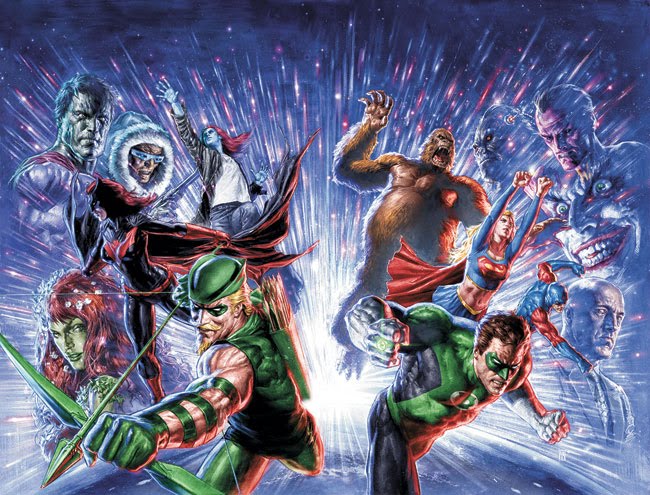
Since I first heard this comic book series announced in the coverage of 2008’s Wizard World LA (At the time it was to be an ongoing series entitled The Justice League featuring Green Lantern Hal Jordan, Green Arrow Oliver Queen, Supergirl, Batwoman, Starman Mikaal Tomas, Congorilla, Ray Palmer—not The Atom, but Ray Palmer—and Freddy Freeman, who would hopefully be back in his blue suit by then), to when I picked up the first $3.99, 22-page issue and recoiled at its price (and premise!) and figured I’d maybe buy the trade, to all of the passionate negative (and sometimes quite funny) reviews I read, to my mind being blown by the fact that it involved killing off of Lian Harper to a few weeks ago, when I borrowed a copy of the hardcover collection from the library.

That’s not a complete sentence. Someone should diagram it. I don’t remember how to diagram sentences. If I did, I would diagram it. Then I’d know how to make it a proper complete sentence.

As I look back on my years of experience interacting with this work in some form or another, it all seems like such a swirl. Now that I sit down to write a review, I’m not even sure where to begin.

Here are some random memories. Moments from the time spent reading this work.

Thought/memory 1
The book contained an introduction, which is something I always like to see in collections of serial comics—they can prove to be a nice little something extra to help incentivize a trade purchase, and are often useful in establishing a context for a particular collection (often needed when it comes to these sorts of super-comics) or to make a case for why this particular group of comics is important enough to be represented as a book.

This particular introduction is by writer James Robinson, and he confesses that it was so long in process, a process including “three years of stops and starts and changes/shifts to events with the DC Universe,” that he’s not even sure to begin, so he decided to simply list a collection of 13 thought/memories, which you’ll notice I am patterning this bit of criticism after, since I wasn’t sure where to begin either.

Robinson does seem a bit defensive here and there in the introduction, noting that he “got the word from DC” regarding what they wanted to do to Roy Harper, and that he was “slightly leery.” He mentions arguing successfully that “an equally dark fate should not befall Mia/Speedy," and then there’s his conclusion, which I’ll quote at greater length:

I can honestly say that JUSTICE LEAGUE: CRY FOR JUSTICE was one of the weirdest, darkest tales I’ve ever written. I think it may be the darkest JLA story ever written, although others may beg to differ. AM I proud of that? Not proud, no. I merely state what I feel to be true. I certainly know this tale isn’t to everyone’s taste. I know some people are even angered by it. But it’s a work I stand behind. I hope, reading it as one combined (and therefore quicker) read, you’ll see what I was going for…the slower build, gaining momentum…the growing cast…the growing event.

He may be right about this being the darkest JLA story—it’s main competition is the un-mentioned Identity Crisis, which I think would probably win a dark-off with Cry. I’m sure it does read better like this then it did spread over far too many months, as interminable delays between issues dragged the tale out into drips and drabs, and, eventually, most of DC’s titles moved beyond the events of the conclusion before it actually concluded. It’s parent title, Justice League of America, for example, had almost a dozen issues released that were set after the conclusion of Cry, but before that conclusion actually saw print.

I only read the book as one combined, and therefore quicker read, and while it was a less frustrating read, I’m sure, it was also easier to question the logic of the plot. There isn’t actually very much logic to it. It’s also strange that characters that play an important role in the first scene of the book, like Superman and Wonder Woman, aren’t present for the conclusion—that’s because months and months of real time passed as these issues were being written and drawn, and the cast Robinson started with wasn’t one he had access to by the time it took to make the book. I’m trying to think of an analogy in another medium…the best I can do is that it would be a little like making a made-for-TV miniseries event, but having to use different characters and/or actors in the final episodes, because production took so long that the actors who starred in the first episodes moved on to other projects. (Stranger still, Wonder Woman has a few cameos on the ground at the climax, but she's not present at JLA HQ, where her magic lasso might have saved the day; more on all that conflict later).


Thought/memory 2
The text pieces that ran at the end of each issue of the miniseries are absent from this collection. Robinson mentions them in his introduction. These were basically DC’s excuse—along with a different cover stock—for charging $3.99 for 22-pages worth of story throughout the series, something that was commonplace at Marvel at the time but was then almost unheard of at DC. The pieces basically consisted of illustrated prose by Robinson, introducing the various oddball characters that made up parts of his cast or made cameos, and explaining their histories and what it was about them that Robisnon liked.

I’ve read multiple commentators say the pieces were the best part of the series.

While none of those are included in the trade, Faces of Evil: Prometheus #1 by writer Sterling Gates and artist Frederico Dallocchio is. This was a random one-shot that DC published mainly as an apology or explanation for previous bad comics they’ve published. They make comics like that sometimes. In this case, it was a complicated retread of Prometheus’ origin and appearances in Grant Morrison’s JLA comics, and a rationale for why A.J. Lieberman did such a terrible job with Prometheus’ characterization during the writer’s brief, best-forgotten run on Batman: Gotham Knights, tied-in to Final Crisis.

Why is the issue included, other than the fact that it also features Prometheus? I can only imagine the thought was to include a comic so banal, tiresome and meaningless, so unimaginatively scripted and poorly illustrated that, for all its many faults, Cry For Justice wouldn’t seem quite so bad in comparison.


Thought/memory 3
Much of the criticism leveled at Cry has centered on its events, and thus directed at Robinson and “DC” or “DC’s editors,” the people who were suggesting he do this or that to this or that character.

Certainly, it’s deserved. But the artwork on this series is rather poor as well, and that didn't seem to generate as much attention.

Mauro Cascioli is responsible for much of it, although because he lacks the bare-minimum requirement for an artist working on a monthly comic book—the ability to produce 22 pages of artwork every 30 days—he only actually draws four full issues, and parts of two more. Scott Clark comes in to draw parts of two issues, and one full issue.

If you look at any single panel worth of imagery by Cascioli, it’s evident he can produce great work. As contrarian as I can be, as picky and demanding as I am when I discuss superhero art, I’m not going to suggest Cascioli is a bad artist or anything.

He’s just a bad comic book artist. Let’s look at a few panels in sequence:Don’t read them, just look at them. Look at how that giant table shrinks between panels four and five, how characters shift places between appearances.

The artwork lacks continuity, which I mean here not in the usual superhero comic book sense, but in the filmic sense.

The artwork can be pretty, with characters often looking a bit like they jumped off of Drew Struzan movie posters, but distracting mistakes abound. The Atom II and The Atom III will share a scene, and in two of the three panels the costumes will be mis-drawn. Supergirl’s S-shield will slide up and down her shirt, depending on the panel. Little things like that.

But then, those little things are what this series is built out of—it's a trivia game for advanced players, testing their knowledge against Robinson’s knowledge of obscure DC characters from throughout the company’s history (many of which get trotted out for the sole purpose of being killed off because…well, I don’t know why. Maybe Robinson was given a body count quota that needed to be met?)

Clark’s art suffers for a different reason. First, he’s not Cascioli, making this book Occasion #246 where a big, “important” Big Two event comic is ruined by putting a hot or popular artist on parts of it, only to have to call in others to finish the job for them.

It may be a corporate produced product created by a committee, but it doesn’t have to look like one—I wish DC at least had the courtesy to try and pretend along with us that the comic is an ambitious piece of art driven by passion and individual vision.

The main problem with Clark’s art may simply be that he didn’t have enough time to go nuts. He draws parts of the book’s climax, in which entire cities are beginning to disappear and/or be ground to pieces by the never-quite-explained forces of Prometheus’ city-eating bomb-things, and every superhero in the DC Universe is in a race against the clock to save millions of people and it all looks…small.

The script is like that of a wide-screen Hollywood action movie; the art plays it like a radio drama. (Where was George Perez when this was going on?)


Thought/memory 4
The aforementioned body count is pretty high, but it’s also pretty silly, as you’ll see by some of the particular characters killed. I counted a thirteen “name” characters, beyond the hundreds of nameless casualties in the bomb-thing generated tragedy at the end.

There’s Tony, Starman Mikaal Tomas’ boyfriend. And then there’s Freedom Beast, the more politically correct successor to B’wana Beast. And a Mike Dante, who was apparently a professional colleague of The Atom Ray Palmer. And Jay Garrick’s Golden Age sidekicks, “The Three Dimwits” Winky, Blinky and Noddy (They’re not named, so unless you’ve happened upon any Golden Age Flash stories, you might not even realize Robinson dusted them off to kill them off). And then there’s Tasmanian Devil, the Australian hero who was a member of the Global Guardians and, briefly, the Justice League (two other Global Guardians died are killed, but I couldn’t recognize them; I’ll post a scan below if anyone can name them). And there’s Clayface II (although DC’s half-dozen Clayfaces have all become more-or-less interchangeable). And there are three minor villains of more recent vintage, Penny Dreadful and Arak the WindWalker from the ‘80s Infinity Inc. and Endless Winter, from a JSA Confidential story arc.
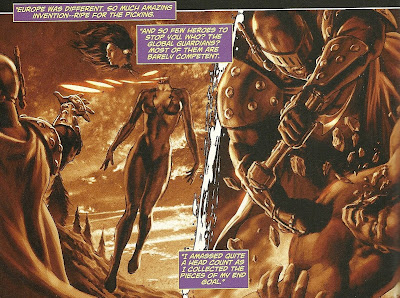
The two biggest deaths are, of course, the villain of the piece, Prometheus, a sort of anti-Batman created by Grant Morrison in 1998, who is here shot through the head by Green Arrow Oliver Queen, to avenge the death of Lian Harper, Roy Harper’s young daughter.

It’s the latter death that probably got the most attention and generated the most outrage, and with good reason. What’s most bizarre about her death in the comic itself is how shoehorned in it all is.

Roy Harper, the former Speedy and former Arsenal who was now going by Red Arrow and had retired from the Justice League but was still sorta hanging around the team in this series for some reason, doesn’t even really have any lines until about halfway through the fifth issue of this seven-issue series (I suppose one overall problem with this series is that, during the time it ran, there wasn’t really a Justice League, given the creative team chaos of that book and a line-up that radically changed from story to story—this is and was a B-title lacking an A-title).

Those lines, of course, pertain to his having a daughter, and are used to demonstrate that he loves her. When he notices the time, he leaves the other Justice Leaguers staring at monitor banks, and, when someone asks where he’s going, he explains, “I’m just going to my room to call Lian and wish her sweet dream slike I do every night.”

“Give my grandkid my love,” Green Arrow says.

By the time this issue is over, Roy will be brutally maimed, his right arm torn or somehow cut off. By the end of the next issue, Lian will be dead, found crushed to death in some rubble when Prometheus’ bomb-thing destroys a bunch of Star City.

And that’s why Green Arrow decides to kill Prometheus. For his (not really) grandkid that is clumsily mentioned in order to kill off.

Lian herself never actually appears in the book; all we see of her is her shoes while Green Arrow cradles her body. (Let’s hear it for DC at least having that much restraint to at least not show us the corpse of a toddler in this book…although this all sounds like something that should happen in a book featuring Green Arrow and Roy Harper, like perhaps Green Arrow or Teen Titans.)

If we count the Prometheus one-shot at the end of the book, the body count goes up a little higher. Several New Blood characters have apparently been operating as “The Blood Pack” (the name of a made-for-reality TV superhero team that existed for the length of a four-issue miniseries in 1995) off-panel. Prometheus fights and brutally defeats them. Gunfire merely has his hands chopped off, but Anima—previously seen seemingly dying in Titans East—is killed, being cut completely in half when she leaps at a teleporting Prometheus.

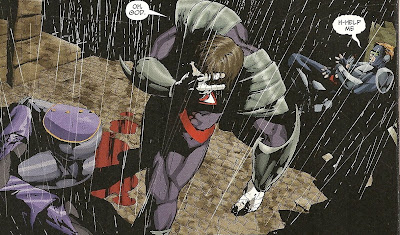
The bottom half of a young woman lying in a pool of blood in a rain-soaked alley has gotta be a symbol for something, right?How about a woman’s torso floating through space…? Do note Anima’s completely un-Anima-like costume.

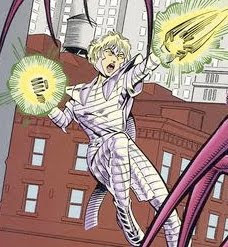
Here’s what Anima usually wore back when she first appeared and had her own comic book.
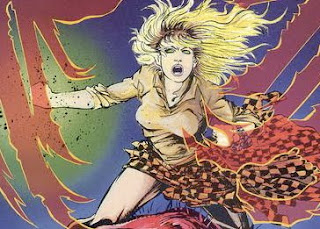
You know, as a one-time Anima fan, I think I’m just going to go ahead and pretend that DC never published that particular comic book (I’m sure I’m not the only one). And even if you forced me to admit that they did, and that Anima was therefore killed off (probably for real this time, given that she was cut in half), I’m jusg going to assume that the young blonde lady being called Anima here is a completely different Anima.

That would explain why she’s dressed completely differently. And doesn’t seem to have the same powers. And isn’t accompanied by her big red spirit giant ally monster guy, Animus.

(That is, by the way, what DC did with Prometheus. Someone got the character so incredibly wrong in a few appearances that they published this one-shot to thoroughly explain that that Prometheus wasn’t the real Prometheus, just another guy pretending to be Prometheus—the real Prometheus sets the pretender on fire at the end of Prometheus #1, because that’s gritty and adult….just like cutting young ladies in half and chopping off superheroes’ hands).


Thought/memory 5
For all of the death and its random application (Remember this character? He’s dead! Did you know Jay Garrick used to hang out with these comedic sidekicks? No? Well he did, and they’re dead!), the most troubling aspect about the book is probably the torture scenes.

The villains torture innocent people to death, of course; in the first issue, we’re told Ray Palmer’s colleague was tortured and killed by Killer Moth (Isn’t there another moth for that sort of thing? A Torturer Moth…?).

But so do the heroes. The first torture scene occurs in the first issue, in which Ray Palmer—who, as Chris Sims pointed out during Blackest Night, was chosen to receive an indigo power ring because he was one of the most compassionate human beings on the planet—tells Killer Moth, “Welcome to pain” and uses his size-manipulation powers to grow inside the Moth’s skull.(That is, as Sims also noted, the exact same way Ray Palmer’s crazy wife accidentally killed Sue Dibny in Identity Crisis).

The Atom later does this to who he thinks is Prometheus, but who is actually the shape-shifting Clayface II, who is actually just sentient clay (It works too; even if Clayface was able to completely imitate Prometheus down to a microscopic level, his skull and brain would be so flexible that having a little man growing in them wouldn’t have to hurt him).

During that torture session, The Atom justifies what he’s doing: “All I’ve done is give this psycho the mother of all headaches,” rating physical pain as far below that of emotional pain of mourning over lost loved ones, “The pain we feel can’t be fixed with an aspirin.”

The Atom would do this on five more villains, including Deadline.

Starman also tortures Houngan for information.

While those are the only two heroes who are actively torturing villains, Green Latnern Hal Jordan, The Atom Ryan Choi, Supergirl (!!!) and Green Arrow will all watch and fail to intervene during different sessions.

It’s not until Ray Palmer is torturing Deadline—near the end of Cry #4—that Green Arrow finally says that, “This is getting beyond out of control” and that “heroes don’t torture. This has to stop.”

Ray and Hal try to argue with Green Arrow.

“I figured this might not jibe with our liberal views,” Ray says, “but good men have died, and I’m not killing anybody.”

“Torture is wrong,” Green Arrow answers. “Torture is what they do, not us.”

This is actually an extremely compelling issue, and one that perhaps should be discussed more often in different types of heroic action fiction, particularly since we’ve so recently discovered that Americans have been instructed to use and have used torture (and/or “enhanced interrogation”) in order to fight our wars in this new century.

Hearing about what’s been done by Americans in our name was probably the most appalled I’ve ever actually been. Nevertheless, the good guys roughing up the bad guys to get information is a staple of so much action fiction—even after the so-called “torture memos” came out and we’ve had to listen to government lawyers argue in public about who much pain has to be inflicted in order to cross the line between legal “enhanced interrogation” and “torture” and hear elements of the Abu Ghraib scandal and of the cover-up of it.

It might be nice to have a mature, serious discussion about the rights and wrongs of inflicting violence against the violent, of doing evil to fight evil in a superhero narrative.

It would probably be better to do so in one with fewer talking gorillas, though.

And just as it seemed so wrong to have Superman in Identity Crisis, a story about a rape, having Supergirl complicit in torture doesn’t seem quite right.

Also, it would have been nice if the entire story wasn’t so incredibly ridiculous, and the debate framed so lamely. Not liking torture is a “liberal” viewpoint, Ray Palmer says. Torturing is therefore…a conservative virtue? Normal? What is it The Atom mean by that? (And does that mean The Atom is Republican? Did he vote for John McCain and Sarah Palin in 2008?)

The discussion ends there though, as Green Arrow takes Hal Jordan and Ray Palmer down before they can attack him for wanting to stop them from attacking the bound and helpless villain they were torturing, and then Supergirl breaks up the fight and they all fly off to do something else.

In other words, the discussion never really happens.

I had a really hard time reading about, let alone liking, many of the heroes of Identity Crisis after reading that book—Zatanna, Green Arrow, Black Canary, Hawkman, Flash Barry Allen and Green Lantern Hal Jordan all seem compromised as heroes and characters by their actions in that story; to a certain extent, they were broken as heroes (I had suspected writer Brad Meltzer had chosen those particular characters for the sub-plot involving lobotomizing villains and tampering with Batman’s mind because they were at that point mostly semi-retired or unused characters. Of course, DC then focused attention on all of them to the point that the two who were deceased at the time of the story are alive and even Zatanna has her own title).

Reading these scenes does the same for me. Hal Jordan and Ray Palmer come across as monsters; Green Arrow and Supergirl are either simply monstrous, but not as monstrous as the other two, or cowards.

No one come off as particularly heroic in these scenes, even if Green Arrow eventually convinces everyone that torture is bad. If you’re a member of an organization called “The Justice League,” if you hang out with Superman on a regular basis, TORTURE = BAD is probably something you should already know. (And by the way, where is Superman and his super-senses at this point? This seems like the sort of thing that would have him flying in to lecture—if not beat-up—his unruly allies).


Thought/memory 6
The more times I flip through the book, the more I begin to think that Robinson may be right about it being the darkest Justice League story. It’s certainly gory; there are a bunch of torn-to-pieces gorillas lying in pools of blood in the first issue, and when Donna Troy takes down Prometheus, she does it by pounding his face in, thick splashes of blood flying from her knuckles in panel after panel.

It’s main competition, as I noted, is Identity Crisis, with which it shares an awful lot in common, not least of all an uncomfortable and poorly handled subject that has come to define the book—as rape is to Identity Crisis, torture is to Cry for Justice.

Also like IC, Cry lacks a great deal of logic in its operation, and reads a bit like the more daring bits were written first, and a plot attached to it later, as the writer constructed a series around those dark events.

IC is certainly much more ridiculous, and much less “fair” with the reader, but the logic of Prometheus’ actions in Cry don’t make much sense.

His plan involves hiring just about every minor, cannon fodder-level villain in the DC Universe (that is, everyone who’s not shown on the cover of the first issue) to steal a bunch of DC artifacts for him—The Flash’s Cosmic Treadmill, The Atom’s Time Pool, etc.—and to then to coerce a super-intelligent gorilla from Gorilla City and I.Q. Quimby into building him a series of complicated teleportation devices.

These are powerful enough to teleport an entire city, anywhere in time or space or other dimensions, after first protecting them with impenetrable forcefields.

“Instead of destroying cities…something a monkey could do if you strapped a big enough bomb on its back,” Prometheus explains once captured, the idea here would be to simply whisk the heroes’ home towns away. “With limitless possibilities of where they’d been sent, you’d never find them. With the dead, you mourn and move on. With this you’d be tortured forever.”

To activate his weapons, he needed to be aboard the Justice League’s satellite, so he’s been posing as Freddy Freeman through much of the series in order to get on the satellite and activate the weapons (What method he uses that enables him to disguise himself as, and replicate all the considerable superpowers of Freeman/Captain Marvel Jr./Shazam is never explained). Once his task was done, he was going to fight his way to freedom.

Things don’t go according to that plan. First, the devices don’t really work—they simply destroy cities. Second, he’s captured.

At that point, he plans to tell them how to shut down the devices in exchange for them letting him go, creating a dilemma for the heroes.

Why does Prometheus want to escape more than he wants to destroy all those cities, to get freedom instead of revenge, as he says? (It’s not apparent from Cry, but the one-shot included demonstrates that the JLA were pretty harsh with Prometheus the last time they caught him).

They keep their word and let him go, which is the heroic thing to do, but then, the series has shown these heroes being much less than heroic, and the epilogue shows Green Arrow killing Prometheus…breaking a promise to a man caught in the act of genocide seems a lesser sin than shooting an arrow into his head when he’s not looking.

There are other, smaller, head-scratching moments. For example, how on earth is Prometheus caught off-guard by Green Arrow and actually killed by an arrow being shot at him, when he’s taken on multiple versions of the Justice League and always at least tied them? For all his preparations, his detailed plans to defeat each and every superhero and protect himself from their powers, his armor isn’t arrow-proof?

But it was the artificiality of Prometheus’ plan and the false-urgency it created at the end that seemed to deflate the story more than anything else to me.


Thought/memory 7
For what could easily be classified as a “fight” comic, Robinson, Cascioli and company make strange choices regarding what action to show, and what to have occur off-panel.

The major fight scene is between Prometheus and the various League members and hangers-on on the satellite, in which he whips through them using a series of specially-designed bullets to and gadgets, ala his first appearance in Morrison’s JLA (Oddly, he neglects to kill anyone, even when they’re as easy to kill as not kill—as in the case of Gehenna and Jason once they’re de-Firestormed, and he experiences the same can-defeat-any-hero-but-wasn’t-planning-on-having-to-fight-a-villain scenario that he did in that first story (Here he’s faced with The Shade instead of Catwoman).

Prior to that, almost all of the action scenes revolve around Congorilla and Starman—fighting each other, fighting dudes in robot armor, fighting Penny Dreadful and Arak—while Green Lantern and Green Arrow stay out of the action.

Here, for example, we see them lead to an HQ full of villains, and they leap into the fray: From there, the scene shifts to check in on some other characters, and we return to GL and GA, this is the scene:The entire battle happened off-panel. How did they defeat the Composite Superman? What happens when fearless Hal Jordan encounters Master of Fear, The Scarecrow? Eh, who knows.

That may have been part of the slow build Robinson mentioned in the introduction, as we get only tastes of actual action until the climax, but an awful lot of the key events—the things that people will remember this story for—occur in allusion.

We don’t often see the many characters who get killed get killed—the image of Winky, Blinky and Noddy above, for example, is there only appearance. We don’t get to see Prometheus-as-Freddy fight Red Arrow, or Supergirl fight him. And, as mentioned previously, the big climax involving the disasters in all of the fictional cities across the DCU focuses mainly on a solitary hero striking a pose here or there, as if the cities falling apart is happing just beyond the borders of the panel.

That’s fine, I suppose. There are certainly a lot of comic books about Green Arrow and Green Lantern fighting villains out there, it just seemed strange to me.

It could also be because of the way the book evolved. The book was originally going to be about Hal and Ollie leading a proactive group of heroes going out and hunting down villains before they can raise their heads, but it got changed into a limited series. Near the end, the two Green characters talk about many of the villains they've fought and captured during the time span covered by this series, and there are a few panels showing longshots of them in action against villains not seen otherwise in the book. The restructuring may have meant Robinson had to race through a lot of stuff to make sure he had room to include what he regarded as the important stuff.


Thought/memory 8
My favorite part of the book is when Black Canary calls Green Arrow “shiftless.”

My second favorite part is when Congorilla shows up at Animal Man’s House, and they show a panel of The Forgotten Heroes, which attempts to reveal a bad-ass version of Cave Carson, with his shirt sleeves rolled up to reveal ripped biceps and a pickaxe poised menacingly over his head.

I also liked the splash page where we see Green Arrow holding Lian’s body, and, standing behind him, is Black Canary, who looks like she just did a face-palm, slap-yourself-on-the-head-because-you-can’t-believe-how-stupid-this-shit-is sort of move.


Thought/memory 9
In addition to Cry and Faces of Evil: Prometheus #1, this collection also included a couple of those two-page origins stories from the backs of 52 and Countdown. The choices of which to include all seem to deal with characters originally announced as the line-up for this team, but which didn’t really matter given the way the book eventually came out (Roy Harper, for example, seems to get a slightly larger role than Batwoman, and yet Batwoman has an origin in the back).

If you’re curious, these are The Atom Ray Palmer (by Len Wien, Mark Bagley and John Dell), Batwoman (by Wein, Don Kramer and Michael Babinski), Congorilla (Wein, Adrian Syaf and Dell), Green Arrow Oliver Queen (Mark Waid, Scott McDaniel and Andy Owens), Green Lantern Hal Jordan (Waid, Ivan Reis and Oclair Albert) “Shazam!” Freddy Freeman (Wein, Syaf and Vincente Cifuentes) and Starman Mikaal Tomas (Wein and Sergio Carrera).


Thought/memory 10
As much as I disliked this comic, I'd still kinda like to read the one that Robinson and DC announced way back during that 2008 Wizard World LA panel—it sure sounded like an awesome comic book. Robinson's run on JLoA with Mark Bagley has been pretty decent stuff, although it has been fairly troubled, as is evidenced by the first few issues in which Robinson built up a big, new League based on the events of Cry, and then for whatever behind-the-scenes reasons, had to slash that roster down to a fraction of the line-up that was around for only two or three issue.

Tuesday, January 18, 2011

Marvel's April previews reviewed

If you read through Marvel's solicitations for comics they plan to ship in April (which you can do by clicking here), you'll see repeated references to "Thor Goes Hollywood Variant by TBA" in many of the individual solicitations.

What exactly would a "Thor Goes Hollywood" cover image look like? Photo covers featuring characters from the movies? No. If the single example posted among the solicitations available on Newsarama.com is any indication, the covers will feature Thor fighting the title characters of other movies, like Greg Horn has him doing in this image:(It would have been even cooler if he were swimming, like in the movie poster) While I can't imagine chasing any of these variants, as a wacky theme, Thor/film mash-ups has some potential, along the lines of those "Wolverine Art Appreciation" covers.

I guess it depends on how specific they get with their references, how imaginatively they choose movies (or will it just be movie posters...?) to throw Thor in to and how well executed the art is.

I'm certainly looking forward to seeing what the rest of them end up looking like.

As for the rest of Marvel's April plans, well, let's take a look...


AMAZING SPIDER-MAN #658
Written by DAN SLOTT
Pencils by JAVIER PULIDO
Cover by Stefano Caselli
Thor Goes Hollywood Variant by TBA
CLASSIFIED!
40 PGS./Rated A ...$3.99

AMAZING SPIDER-MAN #659
Written by DAN SLOTT
Pencils and Cover by Stefano Caselli
CLASSIFIED!
40 PGS./Rated A ...$3.99


Wow, those both sound really great—I’ll be sure to add them to my pull-list.

ANNIHILATORS #2 (OF 4)
Written by DAN ABNETT & ANDY LANNING
Penciled by TAN ENG HUAT & TIMOTHY GREEN II
Cover by ALEX GARNER
Variant Cover by GUY DAVIS
They’re back: The Spaceknights and the Dire Wraiths! As the Wraith’s deadly Black Sun ascends and their foul magicks return, the home world of the SpaceKnights looks as if it will be the first planet to fall to their might! Only the awesome Annihilators, the newest and most powerful Marvel team of all, stand between the Wraiths and total galactic conquest! Meanwhile, Rocket Raccoon races to Planet X to rescue his old buddy Groot. But what is the secret from Rocket’s past that is coming back to haunt him? All this, plus a variant cover by B.P.R.D.’s Guy Davis!
48 PGS./Rated T+ ...$4.99


High on the list of things I never thought I’d see is Guy Davis drawing Rocket Raccoon and Groot on the cover of a comic book.

I hope the back-up either gets collected into its own trade or one-shot, or, at the very least, gets included in an Annihilators trade collection.


Hey look, there’s a dinosaur on the cover! Is that just that Reptil fellow, or do the gang fight a dinosaur in this issue? Dinosaurs always pique my interest.


CAPTAIN AMERICA: THE FIGHTING AVENGER #1
Written by BRIAN CLEVINGER
Pencils by GURIHIRU
Covers by GURIHIRU &
BARRY KITSON
Captain America’s Day One!
He’s got the strength. He’s got the training. But has he got what it takes? A ragtag Special Forces unit takes Captain America on his first mission of World War II. Their orders? Don’t get him killed! But when the low-profile assignment draws the attention of Baron Strucker, the future Red Skull and half the Nazi army, it’ll be a crash course in super heroics for Marvel’s first Avenger!
48 PGS. /One-Shot/Rated A ...$3.99


This looks like it should be pretty neat—I love what Gurihiru art I’ve seen and read in the past—but it also looks like its part of an upcoming Cap flood. In addition to the Captain America monthly, the in-progress Captain America: Hail Hydra, Captain America & The Korvac Saga and Captain America: Man Out of Time miniseries, and all of the various Avenger books starring either former Captain America Steve Rogers, current Captain America Bucky Barnes or both of ‘em, this month also sees the release of the above one-shot and Steve Rogers: Super-Soldier Annual #1.


FEAR ITSELF #1 (of 7)
Written by MATT FRACTION
Pencils & Cover by STUART IMMONEN
Variant Covers by STEVE McNIVEN & STUART IMMONEN
Fantastic Four Anniversary Variant by PAOLO RIVERA
Blank Variant Cover Also Available
DO YOU FEAR...TOMORROW?
In this time of global anxiety, of economic turmoil and mass hysteria, Sin, the new Red Skull, has made an awesome discovery...a shameful secret that will rock the foundations of the Marvel Universe! A revelation that will divide father and son, turn friend against friend, and herald the rise of Fear personified. HE IS RETURNING...and the world has nothing to fear but FEAR ITSELF. Matt Fraction and Stuart Immonen bring fans the biggest Marvel the biggest Marvel event since CIVIL WAR!
56 PGS./Rated T+ ...$3.99


I suppose it’s the extremely vague wording in the solicitation, along with the undisclosed premise, and the fact that almost everything mentioned sounds like something I’ve already read in a big Marvel comic book from the last half decade or so, but I can’t really get excited about this thing.

Yeah, I’m glad it’s not another Bendis-written story, and I like Immonen a whole lot, but I don’t know…I can’t feel any heat here. Maybe I’ll get more excited the more I learn about it.

Check out that price though…is that a misprint? They’re really giving away almost three times as much story than they usually do for $3.99? That makes a purchase seem a lot more appealing…and paying $4 for one of their 22-pagers a lot more unnecessary feeling.

Now what’s this about being bigger than Civil War? In terms of story-scale, or are we talking the number of tie-ins? Because as a fictional event, wasn’t Siege bigger than Civil War…if it was the culmination of the three-act storyline, the culmination of the “Avengers Dissasembled”/House of M/Civil War/Secret Invasion/“Dark Reign” mega-story?


I like this cover.


INVINCIBLE IRON MAN #503
Written by MATT FRACTION
Art & Cover by SALVADOR LARROCA
Thor Goes Hollywood Variant by TBA
FEAR ITSELF tie-in!
Fear has spread across the land and has made its way to Broxton, Oklahoma. As the Broxton residents prepare for a major disaster, Iron Man and Stark Resilient head into action. On the eve of this cataclysmic event, the Armored Avenger will face many dangers, but the greatest danger of all will be facing Fear Itself in this tie-in to the biggest Marvel event ever!
32 PGS./Rated A ...$3.99


What the…now Fear Itself isn’t just as big as Civil War, it’s “the biggest Marvel event ever!”


THE MIGHTY THOR #1
Written by MATT FRACTION
Pencils & Cover by OLIVIER COIPEL
Variant Cover by TRAVIS CHAREST
Variant Cover by WALT SIMONSON
Blank Variant Cover also available
Thor Movie Variant also available
It’s a shining, golden, new age for the Thunder God and Matt Fraction and Olivier Coipel are back to lead the charge! Thor and Sif dive deep into the heart of the fractured World Tree to reclaim an artifact from beyond time and space, an artifact that attracts the attention of the Silver Surfer. And when a herald such as he arrives on Earth, the arrival of his master is certain to follow. Prepare for the return of the World Eater...prepare for the return of Galactus! Fans can’t miss an all new behind the scenes look at the highly anticipated major motion picture with a sneak peek at some of the art!
32 PGS./Rated T+ ...$3.99


This sounds a lot like what they did with Iron Man around the time of his movie—launch a new flagship book for the character with a new #1 with the intent of giving potential new readers curious due to the movie and it’s accompanying push of the Thor character and concept a book to be pointed at. The Mighty Thor #1 sure sound a lot more appealing than Thor #621 (Especially when you consider the fact that the current main Thor title consists of issues #1-29 and #600-#621…with no issue numbers between 30 and 599, because modern direct market comic books are insane and impenetrable to all but the most devout).

Of course, this week Invincible Iron Man, the book this one seems to be patterned off of, just made its own insane jump to #500 after thus far bearing consecutive issue numbers, so maybe in a few years The Mighty Thor will be just as difficult to jump in to as Thor is today…


Man, I love John Romita Jr. art…! This is from New Avengers, one of the two Bendis-written comics I was curious about in this month’s solicitations and plan to read in trade eventually (Ultimate Comics Spider-Man, to answer your question).

The only thing better than a dinosaur on the cover of a comic book? Devil Dinosaur on the cover of a comic book.


SPECTACULAR SPIDER-MAN #1000
Written by JOHN OSTRANDER
Penciled by MICHAEL RYAN
Cover by PAOLO RIVERA
Spider-Man and the Punisher take on the Russian mob! Vast amounts of drugs from overseas are flooding the streets, and the Punisher is ready to kill to stop the flow. But Spider-Man has a different approach...and when a Midtown High student gets caught up between the two crimefighters, it could mean life or death!
56 PGS./Rated A ...$4.99


Okay, I give up…why is this #1000…?

Nice cover art, anyway.


Hopefully Batroc, because the rest of those guys are pretty boring.

The new Venom sure is flexible!

I guess it’s kind of funny that he has a machinegun that he’s firing while striking that classic-ish McFarlane pose.