Thursday, June 24, 2010

Alex Sheikman on Mouse Guard: Legends of the Guard

Alex Sheikman (Robotika) is another of the three artists who contributed a short story to Mouse Guard: Legends of the Guard #1. I asked Sheikman some questions about his story and the creation thereof for this piece on Newsarama, but didn't have room to include every interesting thing Sheikman had to say. So I'm putting it here. As with the previous pieces in this little mini-series of posts, my questions are in italics and the artist's answers are in regular font.


************************


How did you come to work on this project, and why was it one you wanted to devote your time too? I imagine you must have been a fan of Mouse Guard previously?

Yes, I am definitely a Mouse Guard fan. In fact I was a fan ever since I saw the first black and white issue printed by Comixpress. When I heard that David was going to do an anthology type of series, I decided I wanted to try my hand at this great world that David created.

So I e-mailed David to see if there was a possibility of contributing to the project. It turned out that it was so early in the process, nothing has been set yet, but David told me that he already had me down on a list of possible contributors. I started working on putting the story together right away and was glad I got the extra time because of an early start.


How did working with David Petersen work? Did you have carte blanche to do whatever you liked? Was there a lot of discussion regarding your story?

David was great to work with. He already proved that he got “chops” when it comes to writing and drawing and he can now add editing to his comic book accomplishments. Both he and Paul Morrissey (who came in a bit later to make sure the story moved through production at a good pace) put up with all of my neurosis…

I had a pretty good idea of the story that I wanted to do for Legends and to make sure that I did not overstep any guidelines I did rough layouts (with some minimal scripting) right away and sent them to David so we could discuss the story itself and correct any inconsistencies it might have with the purpose of this miniseries.

It turned out that the only adjustments that I ended-up making, were more of a result of our discussion about storytelling and about how to make the story flow better.


What was it like drawing a story set in a world as thoroughly defined by another artist’s style and aesthetic? Did you find yourself trying to draw David Petersen-like at all?

What was it like drawing a Mouse Guard story? It was fun!

Being a fan of David’s art, I very much appreciate his style, both in his rendering technique and also his storytelling, but I did not want to mimic it. That would not be fair to the fans and it would defeat the purpose of Legends miniseries. So I spent sometime thinking about what made Mouse Guard unique and then I tried to interpret those qualities through my sensibilities.

For example, I feel that textures play a big role in creating a certain atmosphere in Mouse Guard. So I focused on how I can render lush backgrounds and gnarly trees.

Also the square format of the printed book is very unique because of how it changes the composition of the page. So I looked through Mouse Guard to see how David was using that format to enhance his storytelling and I used that as a springboard to develop the pace and rhythm for the story that I did.


Was it challenging working with animal characters as opposed to humans? It seems like a more difficult task to convey emotion in the face of a mouse instead of a human, particularly since the Mouse Guard mice tend to look more like real mice than overly anthropomorphic, funny animal types.?

That was a challenge, but it was a fun challenge that any artist would enjoy tackling. Every assignment brings something different and it offers an opportunity to learn something new.

A big challenge for me was the scale of things. I am so used to drawing everything in proportion to human characters, that it took me a little bit of an effort to adjust the scale of everything (rocks, trees, grass…) so that he mice did not look like they were six feet tall.


How different is the world of Mouse Guard from that of Robotika? I know Robotika has its own history and culture too, but I was thinking that pretty much anything could happen or show up in an issue of it, and I don’t think I’d be the least surprised, where as if a ferret with a robot leg or a mouse speaking Japanese showed up in Mouse Guard it would probably freak me out a little.

The two storylines/worlds are very different from each other, partially because they were created with different purposes in mind. However, I must say that idea about the Japanese-speaking samurai mouse is a good one…maybe in Legends II


Do you anticipate Legends of the Guard introducing your work to a different audience than the one that might read Robotika or some of the other stuff you’ve done?

It’s possible…my main focus here is to do something that might be slightly different than what David does in the regular series and hope that the Mouse Guard fans enjoy it.

Wednesday, June 23, 2010

Four new-ish DC comics that aren't on my pull-list that I bought and read anyway

Birds of Prey #2: You’ve gotta admire DC Comics’ chutzpah. This is only the second issue of a brand-new ongoing series, the artist of which is Ed Benes (Whose artwork, I’ll remind you, I am not terribly fond of, by which I mean I hate it). Benes has his fans, of course, and this new volume of Birds of Prey was being sold as the work of writer Gail Simone and her old Birds of Prey collaborator Benes getting back together again.

So naturally, in this second issue of an ongoing monthly series, Benes disappears about halfway through, with Adriano Melo finishing the pencil chores. Second issue! And there’s already a fill-in artist helping out! (Looking ahead at the solicits for the next few issues, Melo will be back for the fourth issue, and the fifth will be drawn by an Alvin Lee).

Like I said, I don’t think much of Benes’ work, on account of the fact that everyone looks the same, the art is really hard to read (what do you think is going on in that second panel exactly, for example?)and most of the panels are constructed along the principle of keeping as many of the women’s wedgies as possible in the viewer’s line of sight at all times.
However, if there’s a way to make Benes work less enjoyable, it’s to quite randomly, transparently have him leave a book unfinished, just so the reader can be reminded that whatever his weaknesses (or strengths, I guess?), the guy can’t keep a monthly schedule.

So naturally, DC keeps putting him on monthly comics. There is literally no one in the world who could have drawn 22 pages of super-people running around fighting over the course of a 30-day period. This is the best one of the American comic book industry’s two biggest publishers can do.

As for Simone’s story, it’s hardly her best work. There’s a plot in here somewhere about someone somehow attacking the Birds’ team for some reason, but it’s hardly been teased at so far, let alone made clear.

Faced with a mysterious, pants-less opponent, Black Canary foregoes using her superpower and Huntress forgoes using her many long-range weapons, because this bad-ass martial artist chick is too fast to be shot at with a crossbow. Instead, they must hit her with their feet and fists.

Then Hawk and Dove show up and fight the lady. Then Oracle happens to overhear a news report about Black Canary having killed someone in Iceland, and apparently the Gotham City Police Department is going to arrest her for this international crime, committed in Iceland.

So the Birds fight the Gotham City Police Department, until they decide to stop. And then Oracle gets a video phone call from a supporting character from Simone's first run on the book, and he's all like, “Hey lady, my boy Savant has been killed, so I’m going to commit suicide in front of you now, okay?”Brightest Day!

And then Oracle puts her hair up because now she’s pissed. The end.

I’d like to say the problem here is a script that could have used another draft and, most especially, a poor choice in artist for any monthly comic, but I don’t know—the Melo half of the book isn’t really any better than the Benes half.

Granted, Melo may not have had much time to draw this, if Benes fell behind, but, um, I don’t know, does it seem weird at all that this is considered professional work in 2010?

On the positive side, at least Simone and Melo (I think it’s Melo, anyway, maybe it’s just Benes losing steam) have The Penguin take time to leer at one of the heroines, so that it’s not just the artist and the reader who are expected to be ogling the stars of the book: Even still, Birds of Prey #2 seems like an elaborately constructed insult that a lot of talented people spent a lot of time and energy working.


Detective Comics #866: It’s probably unfair to compare this issue to Batman #700, which I complained about for way too many words as recently as Sunday, but the Bat-office is practically begging readers to do so.

Both issues featured 30-page stories set in multiple time-frames, including one in which Dick Grayson was Robin and one in which he was Batman, and both are told in multiple art styles.

The difference between the two is that TEC doesn’t have a bullshit rejected cover section and the accompanying $4.99 price tag. That, and the multiple styles here are the work of a single art team, pencil artists Dustin Nguyen and Derek Fridolfs. Coming out just a few weeks after Batman #700, it almost looks like the Bat-office wants to let us know that they totally have a guy on their payroll who could have drawn all of Batman #700 in various art styles if they wanted to use him, but decided instead to just throw together something pretty fucked up looking instead.

The story is written by Denny O’Neil, and in a post-Bendis American comics industry, his old-school, awfully purple narration now looks refreshingly unique: “He has been here before, years ago, before decay and rot claimed the area,” “His fingers seek purchase,” all that stuff.

Batman Dick Grayson visits a crumbling mansion, looking for a loose end to tie-up a case from his very first night on patrol with Batman Bruce Wayne, and flashbacks to that night. There are some odd reaches at retconning—Robin busted The Joker on his first night on patrol? Batman and Robin encountered the Order of St. Dumas that early in their careers?—but it’s very well-structred.

Nguyen and Fridolfs’ artwork, as colored by David Baron, is the major selling point here, though. The present day sequences are drawn to look much like the art form this team we’ve already seen on TEC and Batman: Streets of Gotham, but the past sequences are drawn in a looser, more abstracted style, in which The Joker takes on the design of Batman: The Animated Series, Robin looks like Bob Kane or Dick Sprang depictions of him and the blue-cowled, yellow-ovaled Batman looks like a compromise between Sprang and Nguyen.

Additionally, the flashback art fades in and out of “comic book-iness,” with the pages gradually growing suggestions of old-school dot coloring and printing errors and signs of wear and tear on them. It’s a pretty neat trick, and one of several that Baron and even letterer Todd Klein pull off, which includes a punctuating panel in which a Joker laugh of HAs appears in the shape of a disembodied, Cheshire cat grin over an all-black panel.

It’s not as ambitious, imaginative or idea-packed as Grant Morrison’s Batman #700 story, but it’s a well executed script, with extremely well executed artwork that works with and enhances the story.

The result? This comic book wasn’t a frustration, but a pleasure.

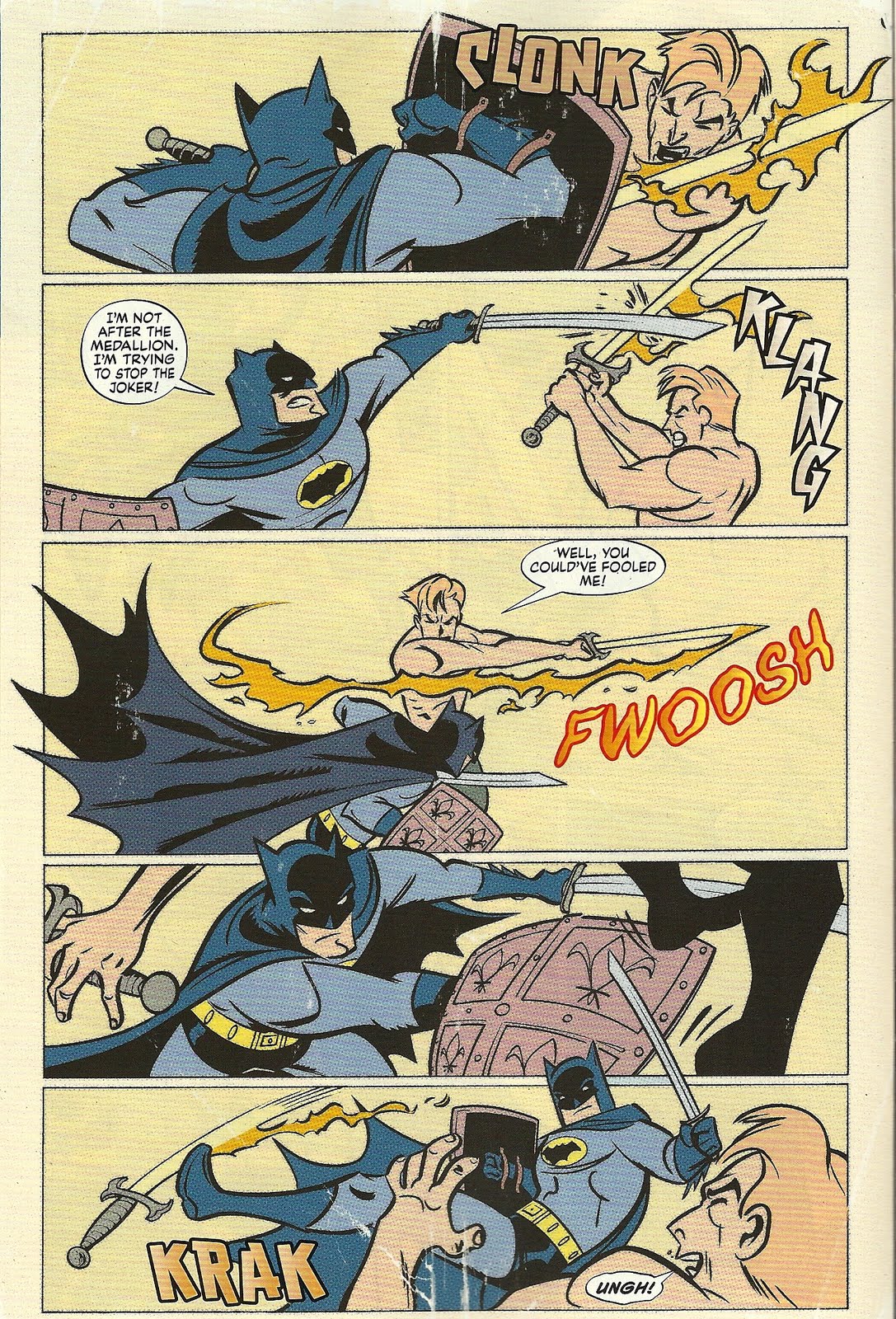
Oh, and there's a scene where this happens:Man, Denny O'Neil is just so into the idea of Batman getting into sword fights! And if one or more of the dudes in the sword fight are shirtless, all the better!


Justice League: Generation Lost #3-#4: Like Birds of Prey, this bi-weekly JLI reunion book has some pretty awful, slapdash artwork in it, but at least it has something of an excuse—the bi-weekly publishing schedule means that it is somewhat hurried and slapdash.

That doesn’t make it any easier to look at, but it does make one feel a bit bad for complaining. Keith Giffen handled the breakdowns for both issues, while #3 is drawn by Fernando Dagino and a pair of inkers and #4 is by pencil artist Joe Bennet and Jack Jadson.

It’s pretty ugly stuff, but then, that’s to be expected from a series like this, right? (Oh God, I expect pretty ugly stuff now! DC, what are you doing to me?!)

The plot, by Giffen and Judd Winick, the latter of whom scripts both issues, finds the new-ish Blue Beetle and a brand new Rocket Red joining up with the others, therefore pretty much putting the JLI back together, give-or-take a Green Lantern or green Martian. Booster Gold notices it as well, and thinks it’s Maxwell Lord’s doing. Lord, meanwhile, is…turning people into dead Black Lanterns (not undead ones, but dead-dead ones) or something I don’t understand (Should I recognize that particular Black Lantern who appeared in #4?)

It’s a decent read, and if the art seems fairly sub-par fairly often, well, DC seems to keep lowering the bar on acceptable superhero art, and read on the same afternoon as the above issue of Birds of Prey, sub-par looks almost like par.

Ted Naifeh on Mouse Guard: Legends of the Guard

As previously discussed, Ted Naifeh (Courtney Crumrin, Polly and The Pirates, Good Neighbors) is one of the three artists who contributed a short story to Mouse Guard: Legends of the Guard #1. I asked Naifeh some questions about his story and the creation thereof for this piece on Newsarama, but didn't have room to include every interesting thing Naifeh had to say about Mouse Guard, drawing and drawing Mouse Guard. So I'm putting it here. As with the previous piece in this little mini-series of posts, my questions are in italics and the artist's answers are in regular font.


*************************


How did you come to work on this project, and why was it one you wanted to devote your time too? I imagine you must have been a fan of Mouse Guard previously?

Mouse Guard was one of those books I couldn’t ignore. There aren’t a lot of them. But it has a presence. Something about the format, the craft, the cute little mice treated with such grave seriousness. It’s beautifully complete. I ran into David last year at Dragon Con and we got to talking about his world, and he brought up the Legends book. I was immediately interested. I even came up with the basic idea right there in the midst of conversation. He loved it. In January, I called Archaia regarding another project, and the Mouse Guard editor asked me if I had time for this. It turned out I had a window while I was waiting for approval on the thumbs for Good Neighbors Vol 3. The timing was perfect.


How did working with David Petersen work? Did you have carte blanche to do whatever you liked? Was there a lot of discussion regarding your story?

There was less than I’d expected. I understood David’s world pretty well, and we’d already decided on the idea. But I hadn’t known the format, that it was tales told in a tavern. So I had to re-conceive the conclusion of the story. It had been a bit more tragic. But if everyone dies, no one can tell the tale.


I smiled when I noticed you did a story with bats, given the spooky settings and characters you’ve worked with before. What attracted you to the bats of Mouse Guard as subject matter?

I really liked them in the main series. They struck me as the goblins of the Mouse Guard world, except cooler because the can fly. But more importantly, they’re not wicked creatures. Any more than the mice are. There’s just this attitude of mutual distrust. I like the idea that mutual distrust can turn a foreigner into a monster. I’m a big fan of the Hobbit, but I feel like there was something a little to convenient about the sudden appearance of the goblin army. It seems to me that what everyone wants in a war is a goblin enemy, but what you really get is dwarves, elves and men seeing each other as goblins. Is that too geeky? Sorry.


What was it like drawing a story set in a world as thoroughly defined by another artist’s style and aesthetic? Did you find yourself trying to draw David Petersen-like at all, or modulating your style to “fit in,” even if only unconsciously?

Oddly, I had no trouble slipping in to his world, both in writing and in art. Obviously, I don’t stylize mice the way he does. I prefer to look at real mice and stylize in my own specific way. My bats were based on real vampire bats, but they ended up looking like gargoyles on gothic cathedrals. But it’s clearly a story from his world, because his world is so unique it could hardly be anything else. As for the story, I feel very much in step with the way he writes, so it was easy to write something in way that fits into it. I have a much harder time writing established superhero comics, because I don’t get the style as well. But David’s work just clicks for me.


Was it challenging working with animal characters as opposed to humans (and fairies and monsters)? It seems like a more difficult task to convey emotion in the face of a mouse instead of a human, and the bats especially have pretty spectacular visages.

Not at all. Facial expressions are hard wired into our brains. You can get a strong range of emotion out of punctuation. Look at Wallace and Gromit. Gromit doesn’t even have a mouth, but he has this huge gamut of emotions. The only thing he can’t do is smile. Which is fine, because he rarely has cause to smile anyway. It’s the same with the mice in Mouse Guard. They don’t smile much, but it’s a pretty somber book anyway, so you don’t miss it. I find that artists like myself start losing emotional range when we get caught up trying to be too realistic, or too fancy in our stylization. Artists forget than the first purpose of a comic character is to convey emotion. Everything else, like realism, or other kinds of virtuosity, is an optional extra. If you sacrifice expression for the sake of other concerns you’re putting the cart before the horse. We’re all guilty of it from time to time, but it’s not good comics.

Tuesday, June 22, 2010

More of David Petersen on Mouse Guard: Legends of the Guard

Once again, here's a link to the feature on Mouse Guard: Legends of The Guard series I did for Newsarama yesterday, and here are some of the "deleted scenes," featuring David Petersen. If you're interested, do read the piece on Newsarama first, as the more relevant questions and explanation of the project can be found there.

These are bits that I found super-interesting, but didn't have room to include in the piece. Better to post them here on my personal blog than to let them go to waste though, right? Questions are in italics, Petersen's answers are in regular font below.


************************


How were the particular artists who contributed chosen? I’m curious what criteria you might have looked for in a contributor, if it was simply a matter of them being artists you liked or if you were looking for artists you knew would have very different takes on the characters.

I picked everyone who is in this collection. I was focused on individuals who are both writer and artist in one (though we do have a few collaborative efforts as well). Good solid fun stories that were well told was the goal, so people who I think do that well were put on a list. The top of the list were people who filled the criteria above, but also were friends of Mouse Guard (had talked to me at conventions about how much they enjoy the book, done pinups in the past, or have publicly helped push my book on to their fans.) I think that I also chose artists who have a very unique style. Something that when you see their work it's immediately recognizable as theirs.


You opened up Mouse Guard to other artists almost immediately, with pin-ups in the back of the very first issues. I take it you’ve always liked the idea of other artists drawing your mice guard?

I like the idea of seeing other takes on my characters and world. The pin-up section started as a way to fill an extra page when I was just starting out and learning how to pace an issue. The idea of one less page to fill was nice. But it resulted in having some awesome folks do some amazing pieces.


What was the collaboration like? Did the artists come to you with their stories finished, or were you heavily involved throughout the process? Obviously Mouse Guard takes place in a world with a very detailed and specific culture and history, but I noticed one of the rules of the tale telling contest was “no complete truths.”

For the guests, I try and offer them a great deal of flexibility. They can use the two hardcovers and the RPG as a guide if they like, but these being the “tall tales” of Mouse Guard, we wanted them to go beyond that. Roughly the three main rules are: No adult language, no gratuitous violence, and no adult themes. I also had them avoid certain characters of mine or major events and wars, but by doing so I hoped I was opening up what they could play with. They could make characters, make their own wars and events, rewrite history! I want these stories to feel uniquely like the creator(s) and not like a David Petersen story so-and-so just happened to draw. I just approve the work as long as it makes sense to me as a good story (it reads well, the thumbnails tell the story, etc.)


Did you get any or many weird questions from any of the contributors about details that might be second nature to you at this point, like, I don't know, how many toes mice have or if ferrets make a particular noise when fighting hedgehogs or anything?

Sure, I was asked about towns, what animals wear clothing (or don't wear clothing), culture differences between mice of different areas, etc. The number of digits on hands and feet has come up too. For some reason, I do three fingers and three toes...but real mice have more than that. Some artists wanted to do something more in-line with nature, others wanted to keep continuity with what I do. I tired to answer their questions as best as I could, but I tried to make sure they were still doing what they wanted to do...what felt right to them.


Is it at all difficult to see other artists, even such incredible ones as these, working on your creations? I was wondering if it was a bit like a parent letting one of their friends babysit for the first time at all?

Not at all. It's a thrill! I really enjoy these people's work and I'm grateful they are willing to do the project. This being an out-of-real-continuity book, it's easier to be so cavalier, I'm sure. If I were handing over the reigns for someone to tell one of my major stories with Lieam, Saxon, and Kenzie, I'm sure I would have the feeling of saying goodbye to my kids.

Meanwhile, on Newsarama.com...

I have a Q-and-A style interview with Tim Hensley about his Wally Gropius on Newsarama's main page today, which you can read here. I never wrote a formal review of it because I was working on an interview with the creator, and I don't really like to do both regarding a single work (Repeating what my friend thought of it after three seconds of flipping through it in this strip last month being the closest I've come to a "review" so far). But, casually, if you're wondering, "Hey Caleb, is this book any good? Should I read it?" Then I would answer, "Yes, yes that book is very good, and you should totally read it."

I guess Green Arrow really does have an arrow for every occassion.


********************

I started drawing this earlier tonight to use as the little cartoon/illustration I use at the top of the 'Twas the Night Before Wednesday... posts I do every Tuesday afternoon on Blog@, but it ended up being five panels too long, so I'm just going to leave it right here. Remember, Justice League: Rise of Arsenal #4 is in stores this Wednesday, June 23!

Monday, June 21, 2010

Give my paymasters your precious, precious clicks!

Hello Every Day Is Like Wednesday readers. I just wanted to give you guys a quick heads-up that I have a feature story on Mouse Guard spin-off series Mouse Guard: Legends of the Guard up at Newsarama.com, which you can read by clicking here. In it, we hear from Mouse Guard creator David Petersen, who is drawing the framing sequences and covers for each issues, as well as editing the stories and sort of curating the contributors, and from the three artists who created the short stories in the first issue: Jeremy Bastian (Cursed Pirate Girl), Alex Sheikman (Robotika) and Tedd Naifeh (Courtney Crumrin, Polly and The Pirates, etc).

So go read it.

Or, if you have no interest in Mouse Guard or any of those artists (which I think would make you an honest-to-goodness crazy person), then click on the link and just click around at random so I look popular, okay?

Okay, enough of that. Let's change the subject. What do you want to talk about today? Really? Well, tough. I want to talk about the Internet, and a few of the reasons I love it so. And then I want to talk some more about Mouse Guard.

One of the many things I love about the Internet and blogging, something I learned to love by coming to it after years writing for the dying print media, is the space the Internet provides and the extreme lack of pressure that comes with infinite space.

When writing an interview for a feature story in a newspaper, for example, I would by necessity ask ten or 20 questions, even if I knew I was only writing a few hundred words on the subject, because the more you ask, the more material you have to choose from, increasing the likelihood of a great quote. That would generally lead to punchier stories, among accomplishing other things (Building rapport, other reporter bullshit). The downside of asking ten questions to get two quotes to use is that you'd often have to let a lot of good stuff go to waste, particularly if the person you were interviewing had a ton of interesting things to say.

On the Internet though, page space is unlimited, so if you get 20 interesting answers to 20 interesting questions, then you need not worry about running out of room, only of losing the interest of your readers (or, if you're writing it for someone else, exceeding the word count).

But on a blog like this, in which no money is involved and I'm not trying to court or please any particular audience (i.e. If you find a 4,000 word post about Roy Harper's costume boring and don't want to read it, who cares? You didn't spend any money, and I won't lose any if you don't read it), I don't even have to worry about that.

This is a long, boring, roundabout way of saying that the artists above all had a lot of interesting things to say about comics and art, especially pertaining to the drawing of mice with swords. I didn't have room to stick 'em all in the Newsarama interview, but rather than let them go to waste, I'm going to post the bits I didn't get to use in the article here over the course of the next few days.

The question portion will likely be a little repetitious—I asked Naifeh, Sheikman and Bastian almost the exact same questions, for example—but you can always skim the posts. Or not read them at all. I don't mind. I don't make any money off Every Day Is Like Wednesday whether you read a particular post or not. I don't do this for the money, I do it for...Oh man, why do I do this? Mental illness? OCD? Crippling loneliness? A love of superheroes and comic books that has no healthy outlet other than talking to mostly strangers about them for hours every week?! Aaaa! I've just talked myself into an existential crisis!

At any rate, I'll be posting some Q's and A's with some very talented artists over the course of the next few days. So, uh, look for that, I guess.

Sunday, June 20, 2010

Comic shop comics: June 9th

Batman #700 (DC Comics) I feel a little weird even attempting a review of this comic book at this point, even the sort of “type up what I thought right after reading it” pseudo-reviewing I do in this space, given that so long has passed since its release that I think the main points of contention I had with it were covered elsewhere already.

Like in Comics Alliance’s roundtable on it. David Uzumeri summed up my feelings on the price tag (“[F]rankly highway robbery. As a $3.99 31-page oversized issue, there'd be a lot to recommend here. As a $4.99 ‘supersized special,’ it's a disaster”), and Chris Sims offered a cover-all complaint that points out exactly why this book should have been just about perfect: “THEY'VE HAD 700 MONTHS.”

And at his Factual Opinion, Tucker Stone gave the pin-up section—eight pages art, at least some of which is recycled, and four pages of computer drawings of the Batcave—to help justify the $2 price hike the kicking it deserves:

And then it's a bunch of fucking pin-ups, which—Daredevil 500 got pin-ups right. Not that hard to get them right! You go and get some artists that people haven't seen before and a few they don't see enough, and boom, let 'em surprise you. No, this, instead, picks out the exact same guys that you can see all the time.

But maybe you haven’t read those particular posts, and refuse to click on the links to them which I’ve just gone to the trouble of providing for you? Fine.

Batman #700 is Grant Morrison’s run on the Batman comics summed up in a way-too-expensive, thrown-together package, which means it includes all of the positive things he’s done while writing Batman and Batman and Robin over the last couple of years, but also most of the negatives of those series.

The main event is a 30-page story scripted by Morrison and illustrated by six different artists (including the inkers). It opens in the past, which looks like it’s set somewhere around the time that the Silver Age was giving way to the Bronze Age. Silver Age plot device Professor Nichols, who used to send Batman and Robin back in time, is brought back into continuity, and given a fresh sheen of comic book realism (His time machine is a sort of hypnotic, mental time travel).

The Joker has assembled a who’s who of Bat-villains—The Riddler, Catwoman, The Mad Hatter, Scarecrow—to forcibly use Batman Bruce Wayne, Robin Dick Grayson and Nichols’ “maybe machine” for their own nefarious purposes. The following chapter is set in the present, in which Batman Dick Grayson and Robin Damian attempt to solve Nichols’ mysterious murder, and the final chapter is set in the far-flung future, in which Batman Damian (seen in Batman #666) attempts to save Gotham City. Elements of the first chapter—Nichols, The Joker’s joke book—come into play in the next two.

Like most of Morrison’s bat-writing, it’s pretty great stuff, impressive in its ability to make the most difficult aspects of Batman’s long and varied fictional history “work” together, a ton of fun to read and a nice demonstration of the unique pleasures possible when a writer devotes him or herself to a nice long run on a title.

And like far too much of Morrison’s time on the Batman franchise, it’s a complete fucking mess.

The Bat-office had Tony Daniel draw the “Yesterday” section, apparently using the logic that Daniel is the artist most associated with Morrison’s Bruce Wayne-as-Batman comics, despite the fact that this is a Bruce Wayne Batman whose Robin wore green panties and pixie boots, who fought a Catwoman who wore a purple cape and green dress and who would often travel through time in the course of his adventures.

Why not hire a classic Batman artist for the gig, or someone who can do a more classic style? Who knows.

Regardless, Daniel, again inking himself, does a fine job here. I’m still not crazy about his style, and his storytelling leaves a lot to be desired—note the introduction of Nichols on page two, and how he relates in space to the Joker—but for whatever reasons, the work here is much, much better than it was the last time he and Morrison collaborated on a Batman comic.

For the “Today” section, DC turned to Frank Quitely, which makes sense—he’s the artist who drew the first three issues of Batman and Robin featuring the new and current Batman and Robin, as well as the covers for the rest of the series. Of all the artists to draw the book so far, he’s certainly the most popular.

Unfortunately, he could apparently only handle five of the eight pages needed before deadline, so Scott Kolins draws the last thirteen panels of the story. Kolins is a fine artist, of course, but the style he uses here is so different than Quitely’s (I think they even switch colorists, as two are credited for this section, and Kolins’ has a weird, airbrushed look to it) that the turn of the page is jarring.

It also breaks the whole different-artist-for-each-setting plan of the book, contributing to the impression of half-assedness radiating from the pages. They would have been better off having Kolins do the whole thing, or instead of Quitely looking to another of the current Batman artists: Dustin Nguyen, Guillem March, even Mark Bagley or Daniel.

Big-ups to Kolins for this scene though: Between reading his production material for Batman: Year 100 and hearing him speak about the project, I’ve heard a lot of Paul Pope’s thoughts on Batman, and one that really stuck out was what he had to say about superheroes and eating. Batman must burn a ton of calories every night, and yet almost never gets shown eating, he argued—and when Batman does eat, like most superheroes, he seems to keep his gloves on.

So it was neat to see Batman drinking a cup of coffee with his glove off, while Robin similarly enjoyed a slice of pizza.

The nine-page “tomorrow” section is drawn by Andy Kubert, and I’ve got no complaints about it. Kubert was a great choice—he drew the only previous appearance of Damian-as-Batman—and he manages to draw all the pages himself and make them look pretty damn nice.

Finally, there’s an “And Tomorrow…” section showing that, as Morrison has had characters repeat repeatedly, “Batman and Robin can never die!” This whole section is penciled by David Finch, a spectacularly terrible choice for the gig, and consists of six pages set in four different futures, before returning back to the present for two pages.

This too breaks the different-artist-for-each-setting pattern, and demonstrates Finch’s lack of versatility. (Can he draw in a Bruce Timm/animated style? No, no he cannot.)

There are four futures, two of which are “old” futures—that of Batman Beyond and the 853rd Century from Morrison’s DC One Million series/event.

Why not have someone who has drawn Batman Beyond before, either a big name associated with the show like Bruce Timm or Darwyn Cooke or an artist who worked on the Batman Beyond comic book DC used to publish (or one of the artists working on the upcoming Batman Beyond miniseries)? It’s only a page; I think even Timm or Cooke could have fit three panels into their schedules.

And for the Batman One Million section, why not ask Val Semeiks or Howard Porter or Mark Buckingham or Jim Balent or Staz Johnson or one of the other artists who have drawn him before? (Again, it’s only one page; three panels). I wouldn’t have even recognized this future Batman as Batman One Million, were it not for the presence of his robot sidekick Robin, The Toy Wonder in one of the panels.

So that’s way too many words about the main story: Well-written, but featuring oddly rushed, overly patchwork art which leaves one thinking more about the decisions of the editors in the Bat-office than it does about how cool Batman and Robin are.

Finally, there’s the “Batman Art Gallery,” which adds injury to insult. They tacked an extra dollar on to the price of this book, apparently for the 12 pages of art in it. These include pin-ups by Shane Davis and Sandra Hope, Juan Doe, Guillem March, Bill Sienkiewicz, Philip Tan, two by Dustin Nguyen (both of which are quite clearly created as covers for Batman: Streets of Gotham…one of them even have the title “Batman: Streets of Gotham” worked directly into the artwork) and one by former cover artist Tim Sale.

In other words, it looks like someone decided the week before the book went to print that they could charge an extra buck for it if they filled up some more pages, and editor Mike Marts spent a frantic half hour in his office finding unused cover art to use.

They could have had a bunch of folks that one doesn’t usually see drawing Batman drawing Batman pin-ups here, or they could have had a bunch of artists who have drawn Batman in years past contribute new work to accentuate the anniversary nature of the book. Or they could have just saved readers a buck and not bothered.

It’s frustrating, because it’s exactly reading experiences like this that can push a regular serial comics reader sitting on the fence between reading new issues as they come out and switching to trades (or hell, quitting) into giving up monthly installments—it is quite clearly not worth it, and it’s clear some folks aren’t even trying to make it appear worth it.

This concludes today’s episode of Caleb Mozzocco, Verbose Armchair Batman Editor.

Oh wait, two more things!

I noticed an “Approved By The Comics Code Authority” stamp on the cover of this issue, a relic from the past whose continued presence on certain comic books continues to confuse me.

This mainstream super-comic certainly wasn’t the goriest or most violent one I read this week (the next one down was), but it did contain this panel: I’m not kvetching or anything here, mutant rats eating a dude’s eyeball in a Batman comic isn’t as nearly as decadent as a space alien ripping the skins off a family in a comic ironically entitled Brightest Day, I just think it’s weird seeing what the CCA stamps these days.

Oh, and in the page-wasting “Secrets of The Batcave” section, Stephanie Brown got another damn glass case……even though she’s not even dead anymore! The Internet wins! Bill Willingham loses!


Brightest Day #3 (DC) I really don’t get why DC was so pumped about this David Finch character signing an exclusive deal with them. Perhaps he is really popular, and the bean counters knew that a comic book with a David Finch cover was likely to sell 2,000 more issues than one without a David Finch cover or something, but I don’t think his stuff is very good at all.

I spent more time contemplating David Finch’s work this week than usual, as I happened to read two comics featuring his cover art, as well as seeing some interior art (see above).

The closer I look at the cover of Brightest Day #3, the worse it looks. It’s your average everybody pose-and-hid-their-feet sort of image, but it’s not a very good one. Why is Martian Manhunter so tiny, and what’s he standing on? (Did he makes his legs intangible, for the sake of being easier to draw?) Where are Hawkman’s legs, exactly? Why is Hawkgirl’s fetish harness so ill-fitting? Are she and Mera okay? Have they been drinking gingold? Why is head as big as her pelvis and hips?

I guess you’re just not supposed to look too closely at these things, but it strikes me as super-weird that a piece of art this fussed-over, where the colorist made sure to add light flares all over all the metal in the image, but never said to the editor, “Hey, shouldn’t Hawkman’s torso be connected to a bottom half? And is J’onn supposed to be a few inches shorter than Aquaman and Mera, or is he in the background and, if the latter, then shouldn’t we be able to see his goddam feet?”

Just for comparison’s sake, here’s the covers of the third issues of DC’s preceding weeklies, of which this bi-weekly project is something of a descendant of:


None of them are the greatest covers in the world either, but each is at least working some sort of concept, and even Trinity’s one-third of an image at least features better figure work on a posing lady.

As for the insides, this is much like the last two issues, in that the featured characters continue to pursue their own storylines, none of which have connected just yet. The biggest development is the white power ring having a conversation with Deadman while forcing him to fight the Anti-Moniotor; otherwise, Aquaman and Firestorm continue to deal with their post-Blackest Night issues, J’onn J’onnz continues to track an alien monster and the Hawks beat the bejeezus out of people while looking for the bones of their ancestors.

Of special note this issue is how terrible the art in the Firestorm section is. It looks like photos of a real hospital were imported into someone’s computer, and not terribly great drawings of Ronnie Raymond, Jason Rusch, Jason’s dad and Professor Stein were cut-and-pasted on top of them, interacting with the rest of the panel about as organically as that suggests.

On the plus side, I thought this panel of an undead orca answering Aquaman’s VUU VUU VUU VUU VUU telepathic summons was really funny:
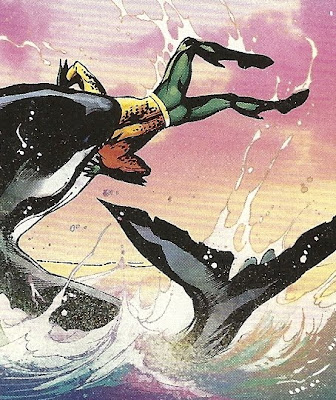
And this panel of Hawkman fighting some mercenary dude’s answered the question I’ve always had about why he and Hawkgirl use maces, since it seems like there’s a pretty good chance that hitting a dude with a mace will either kill him or leave him brain-damaged:Obviously, Hawkman doesn’t really care how permanently he damages bad guys.

On the whole, I’m still digging this series, and looking forward to seeing how the various threads will eventually intersect, as well as the mystery of the white power battery.


Heralds #1-#2 (Marvel Comics) Here’s Marvel’s latest flirtation with a 52-like schedule. This is a special limited series being published on a weekly schedule, although it’s only a five-issue series.

I think there’s a ton of potential in weekly comics, and look forward to a day when DC and Marvel publish their big stories like Siege and Blackest Night on such a schedule. No, it wouldn’t make economic sense, but can you imagine how exciting it would have been to read a chapter of Blackest Night a week over the course of two months?

This is a series being told on the fringes of the Marvel universe instead of at its heart, so I can’t imagine the publishing schedule will be seen as a great draw to a lot of Marvel fans. The series seems like one that a lot of them would file under their own personal “wait for the trade” lists, and since it will wrap up in about a month, they won’t even have to wait very long for the trade.

It’s by written by Kathryn Immonen (Patsy Walker, Hellcat) and drawn by Tonci Zonjic (Marvel (ugh) Divas) and is about an unlikely all-heroine super-team being temporarily thrown together for little logical reason to battle a mysterious alien menace.

The line-up is fairly random: Emma Frost, Hellcat, She-Hulk, Monica Rambeau/Photon, Valkyrie and, for the first issue at least, Agent Brand of SWORD. To Immonen’s credit, she finds an interesting, buy-able rationale for the team existing. Emma’s boyfriend Scott “Cyclops” Summers was made to promise that he wouldn’t organize any sort of surprise birthday party because she didn’t want to celebrate it with anyone she knew, so he apparently chose some super-ladies at random to take Emma on a girl’s night out.

Because this is the Marvel Universe and more than two super-characters can not be in the same place at the same time without the world coming under threat, something hinky at SWORD unleashes all sorts of chaos.

I was rather surprised at how trivia-oriented the plot was, as I felt several elements were familiar to me from other Marvel Comics (or cartoons based on ‘em), although it was nothing very solid—that is, I there were several points where I felt like I was seeing something that I should recognize, even though I didn’t.

That aside, Immonen writes some really great dialogue, and I enjoyed the conversations between Scott and Emma, the pitter-patter fight chatter and girl talk of the heroines and even the way she injected humor into the science-people-talk-about-science sections of the plot (“Look. Imagine an onion.” “No.”).

Zonjic’s art was really great, but, for some weird reason, issue two adds a second artist and second colorist (James Harren and June Chung), which seems awfully early in a series for an art change…especially since it’s just a five-issue miniseries and there was absolutely no reason to start shipping the damn thing until Zonjic (or whoever got the assignment) had finished drawing it.

Ah well, flawed but fun sure beats flawed and not much fun.

Saturday, June 19, 2010

Instead of blogging, I was babysitting.

My eldest niece, Niece #1, and I have at least one interest in common–we both really like to draw. That makes babysitting her both very easy and rather fun for me, since as long as we have paper and a writing implement or two, we have a cheap, safe, easy-to-clean-up-after activity with which to pass the time.

I spent much of the day today with her and her little sister, Niece #2, which cut into my complain-about-Batman-comics time. So in lieu of complaining about the outrageous price of Batman #700 or the art in the Firestorm sections of Brightest Day #3 (I'll get to that tomorrow though), I thought I'd just scan and post some of the drawings we did today.

We played a game of her invention where she would tell me what we were going to draw, and then we would each draw it, without looking at one another's work until we were both done.

First, we posed for and drew portraits of each other. Here's me, by her: I moved my right arm from my hip to drink a root beer at one point, hence the scribbled out arm, and the "AW" on the object in my hand.

Here's her, by me: (I know, I know...in my own defense, I didn't use a pencil, just ballpoint pen straight to paper. Most of the drawings I post on EDILW are done in pencil so I can erase out all my screw ups before I ink, scan and post 'em. So as amateur-ish as they all may look, they're actually pretty fussed-over).

Okay, next up were drawings of ourselves with horses: (She's gotten much better at horses since just last April, when she drew them like this).

(Horse, giant deformed pony, same thing).

And finally, there was a pretty complicated assignment.

I was instructed to divide my piece of paper into five sections, and then draw five little pictures of Bella doing things.

Bella is my nieces' year-and-a-half-year-old Shih Tzu...and she's named for Isabella, the queen of Spain that Niece #1 learned about the week before Columbus Day in first grade, not the heroine of a certain popular prose series of Mormon vampire abstinence porn. (Not that there's anything wrong with naming one's Shih Tzu after characters from Such books, or movies based on them—in fact, I have a Yorkie named "Jacob's Abs"*)

Here's what I came up with: Going clockwise, that's Bella cooking, Bella piloting a helicopter, Bella hang-gliding, Bella racing tiny little cars with my chocolate lab roommate Yogi, and Bella running away from an angry crocodile.

And more or less clockwise again, we have Bella piloting an airplane I'm told is labeled "Flying Dog" while my father's Shih Tzu Yankee hangs on to the back, Bella dancing with Yankee and another Shih Tzu of my niece's acquaintance, Bella on top of a lighthouse waving at Yankee in a boat, Bella and Yankee playing tee ball, and Bella and Yankee going camping.


*No I don't

Friday, June 18, 2010

In which I babble about three comics-based movies I haven't even seen yet

I've been a terrible comics fan this summer. Despite being mildly interested to rather excited about each of them, I have yet to see Kick-Ass, The Losers or Iron Man 2...and now we can add Jonah Hex to the list of Comics Movies You'd Think Someone Big Into Comics Would Maybe See On Opening Weekend.

I don't have any reason for having not seen any of those movies yet, I guess I just don't get the movies as much as I used to now that no one pays me to watch movies and then write a few hundred words about whether I thought they were any good or not. I hope to at least see Iron Man 2 on the big screen, and hopefully Jonah Hex, which I am honestly quite curious about.

There have been tell-tale signs that things weren't going so hot with Jonah Hex throughout the production, and I got a sinking feeling when I saw that first trailer, in which they revealed that Jonah Hex apparently had a super-power of some sort other than simply being Jonah Hex.

The reviews I've seen so far haven't been pretty. In fact, they've been so not pretty that Jonah's profile might actually be prettier than the reviews.

Keith Phipps' review for The Onion's AV Club, summed up the movie rather pithily: "Jonah Hex is what happens when someone promises to deliver a releasable movie by a certain date, and then doesn’t." Phipps notes the stitched-together, at-conflict-with-itself nature of the movie ("[E]very once in a while, a film limps into theaters so stitched together, it’s a wonder it doesn’t rip apart in the projector.") The AV Club, by the way, gives the movie the letter grade of "F." Marmaduke earned a D.

I'm still curious. In fact, maybe now I'm a little more curious than I was before I started seeing reviews. (Phipps' review also says the movie's only 81 minutes long. How the hell do you make an 81-minute feature film in 2010? The average comic book superhero movie is like five hours now, isn't it?)

Part of the reason for that curiosity is simply I don't understand how exactly one can screw up making a Jonah Hex movie. He's not all that complicated a character. He's a Clint Eastwood-style cowboy hero, a bounty hunter with a heart of gold (or at least a heart much less black than one might expect him to have) and a hell of a visual hook. Jonah Hex is pretty much tailor-made for a 21st century Western, since he wears the ugliness of the era right there on his face. He's a poke-in-the-eye-obvious metaphor for an exciting, adventure-filled but ultimately quite ugly period of American history. He could have quite literally been the face of the modern, post-deconstructionist western.

And I'm not talking about the character's potential or anything. That's just who and what he is, in terms of visual design. His back-story and the details of his life are awfully unimportant—and, in fact, factor in to very few of the Hex stories I've read over the years—so he's not like Batman or Spider-Man where a filmmaker needs to make a lot of decisions about how much of a specific story to tell, which of the hundreds of characters to include and how to deal with the audience's preexisting understanding of the character from all the other media examples they've seen of him. (By the way, how many cartoon appearances does Hex have? I know he was in Batman: The Animated Series and Batman: The Brave and The Bold. Wasn't there a time-traveling episode of one of the Justice League cartoons, too? Is that it? Anyway, the point is, he's not like Superman or Batman or Spider-Man or even The Hulk).

A studio could take just about any Western script they have in their script slush pile, change the protagonist to a horribly-scarred bounty hunter, and hey, what do you know, it's suddenly a Jonah Hex movie.

I realize my words have very little weight here, given that I'm going off of a couple of reviews rather than the movie itself, but it sounds to me like Jonah Hex may have gone wrong by trying to turn a character who was little more than a generic cowboy with an interesting look into superhero character, complete with super-powers and a plot involving saving the day. Hex comics were and are almost all straight Westerns, not superhero comics, so bending his home genre toward another simply because of a faulty perception that the medium of comics automatically equals superhero seems like a pretty huge, fundamental problem that it would probably be pretty difficult to recover from.

Or hell, I don't know, maybe the folks who made the movie were just incompetent. I guess I'll go see it at some point and find out for myself.


*******************


Maybe Keith Phipps just hates ugly cowboys, though? Let's check another of my favorite sources for film criticism, The Village Voice. Oh shit, "Bracingly inept, Chef Boyardee spaghetti western Jonah Hex is the rare 80-minute movie that you can’t even call 'taut.'" Heh. "Chef Boyardee spaghetti western."

Okay, they can't all be like this. Let's just head to Rottentomatoes.com. Yeesh, as of this writing it's got a 14% positive rating. "There isn't a single reason to see this movie...Director Jimmy Hayward fails to establish a viable reason for this movie to exist..." ah, wait, here are a couple of positive reviews.

Kevin Carr says "Jonah Hex is not a good movie. Not by a long shot...But that didn't stop me from having a hell of a lot of fun watching it." And Amy Biancolli says: "I think Jonah Hex could have exceeded 80 minutes to make room for some real visual invention. And three-dimensional characters. And a plot. A plot would have been nice."

Those are the positive reviews? Because those are not very positive things to say about a film.


*******************


The bad news, of course, is that if opening weekend box office reflects the buzz and reviews the film is getting then that means a Jonah Hex 2 isn't terribly likely, and even a "reboot" would be a long shot (It didn't take long for Punisher and Hulk reboots, of course, but I think both of those characters/franchises were perceived as a lot more exploitable than Jonah Hex).

So I guess that means we're unlikely to see Hex vs. the undead or Hex vs. Lovecraftian monsters movies in the near future, and a movie about a Hex wandering around a post-apocalyptic future is definitely out of the question, as is a feature-length, live-action adaptation of the recent episode of Batman: The Brave and The Bold where Mongul hires Jonah Hex to capture Batman to use as a gladiator on War World.


********************


I'm curious what, if any, impact the (presumed) failure of the film might have on DC Comics' publishing plans for the character. It's no secret that the book sells pretty abominably in the direct market. According to the monthly Beat analysis, the Jonah Hex monthly comic moved a little over 11,000 units, and that's about the neighborhood it's been hanging around in for most of the past year, with occasional fluctuations in response to particular artists (#50 was charted at just over 15K for example).

That's generally around cancellation levels for DC, but Hex has continued to hang on. There are several possible reasons for this, of course, including the fact that those numbers are pretty rock solid (it may only sell around 11K a month, but it always sells around 11K a month, instead of dropping drastically each month) and that the collected trade editions may do just fine in bookstores, regardless of how many serialized issues direct market retailers buy to sell their customers.

I suppose it's also possible that writers Jimmy Palmiotti and Justin Gray have compromising photos of Dan DiDio (that would explain why DC's launching a Freedom Fighters ongoing monthly from the pair all of a sudden!).

Or perhaps DC's kept publishing the monthly so long in order to have plenty of Hex material to sell civilians when the movie came out. If that is the case, and the movie has now come and gone (and if it does end up being a flop and thus not birthing a healthy film franchise), then perhaps DC will pull the plug on the monthly?

That's a lot of if's, I know.

Personally, I don't read Jonah Hex, save for a random issue here and there when I like the artist involved, or in the form of a trade paperback I randomly find at a library, but I do kind of hope it sticks around. Regardless of the state of my personal pull-list, I like knowing that DC is publishing the sort of book that anyone can pick up at almost any time and get a complete, done-in-one story, and I love the idea that they're publishing a book in which a Jordi Bernet-drawn issue will be immediately followed by a Darwyn Cook-drawn issue, and that in any given month you might see J.H. Williams III, Val Semeiks, Paul Gulacy or Phil Noto under its cover (And the covers themselves have all been from a who's who of great comics talents). Whatever else it may be, Jonah Hex is a pretty great showcase of comics artists.


*******************


As lax as I've been about getting to the movie theater this summer to see the latest crop of based-on-a-comic movies, one film I can guarantee I'll be at on opening day (barring some unforeseen tragedy) is Scott Pilgrim Vs. The World.

I was kind of worried when star Michael Cera was first announced, as I have a hard time matching him to Bryan Lee O'Malley's comics character, and the first trailer left me kind of nervous. But the second trailer, and now the new "international trailer," have dispelled all my worries and I find myself super-excited about the prospect of a live-action Scott Pilgrim movie.

Seriously, this looks so good:
If you're reading this blog at all, chances are you've already seen that trailer somewhere, as I think just about everyone who writes about comics on the Internet has either posted it or posted a link to it (You're welcome for the free marketing, people who made Scott Pilgrim Vs. The World!)

Director Edgar Wright posted it on his blog the other day, and I can't tell you how happy I was that he also listed the songs featured in the trailer, solving a problem that's been plaguing me since the second trailer was released: What is that goddam song that starts at around the 1:50 mark with Kim Pine pretending to shoot her self in the head and plays throughout the rest of the trailer?

I can't tell you how many times I've watched that second trailer, because even if I was counting, I would have lost count pretty quickly, as it was a very high number. At least part of that was due to the fact that the song played throughout the back half of the trailer got stuck in my head, which meant I had the trailer stuck in my head, and ended up compulsively re-watching it over and over, in a half-conscious attempt to get the song out of my head by getting over it.

Since I didn't know what the song was, I had no choice but to watch the trailer a billion times or so. (So great job whoever put that trailer together! You pretty much hypnotized me at one point!)

Well now I know that the song is "Invaders Must Die" by The Prodigy, from the 2009 album of the same name. Like the song that plays over the opening of the second trailer, "Great DJ" by the Ting Tings
But whatever, I finally knew the name of the song, and could listen to it over and over to break its hold on me! I was somewhat shocked to learn I actually kind of liked a Prodigy song, given how much they used to irritate me in the mid-to-late-'90s. I think I like "Invaders Must Die" slightly more with explosions, cymbals and the clanging of metal weapons mixed in over top of it though.

Oh, and the song that plays just before the "If we're going to date, you may have to defeat my Seven Evil Exes" bit is from "It's Getting Boring By The Sea" by Blood Red Shoes, which is a pretty damn awesome song. (Actually, I've liked all of the Blood Red Shoes songs that I've heard so far).

So hooray for the Scott Pilgrim Vs. The World trailers, I love everything about them, and particularly like the way they seemingly improve on some gags from the original comic (like Scott's terrible drawing of Ramona's hair when he asks Comeau if he knows a girl with hair "like this," and the fact that Comeau immediately recognizes her; in the comic Scott just dangles his fingers to evoke Ramona's hair). I'm still kind of nervous about this, as I think some of the idiosyncratic humor of the comic's characters' dialogue delivery gets lost when it's polished up and spoken by professional actors, but so far it looks so great.


********************


I was surprised to learn that Sony's adaptation of the Smurfs comics—or, more likely their adaptation of the cartoon adaptation of the comics—is going to be a horror movie.

At least, I assume it's going to be a horror movie. That would explain why all I feel when I see this

is confused terror.


Wednesday, June 16, 2010

Three from Boom: The Grasshopper and The Ant, Hawks of Outremer #1 and Uncle Scrooge #392

The Grasshopper and The Ant: Harvey Kurtzman’s comics version of the classic insect fable was originally produced in 1960 for Esquire magazine, and almost 50 years later it’s still a remarkably relevant work. Perhaps that should come as nor surprise; 50 years is awfully recent compared to the original fable’s suspected vintage (Heck, the Bible’s Book of Proverbs includes a version of it).

Of course, it might also come down to the fact that this is a Kurtzman comic we’re talking about, and the late, great cartoonist’s work boasts a vitality and originality that makes it always seem fresh and new. (When I first encountered his work, it was his covers to the earliest issues of Mad that were reprinted in various price catalogs and histories of comics, and I remember being quite shocked to learn that those drawings were done before my parents were born, but looked just as fresh as last Saturday’s Saturday morning cartoons).

Kurtzman’s The Grasshopper and The Ant is a 37-page story, with each page consisting of a single large drawing, the edges of the page making each page its own de facto panel, with the lovely hand-lettering in dialogue balloons sometimes breaking the single image into several moments, by virtue of the time it takes to read all the words. (We probably shouldn’t get into this now, but Kurtzman does some pretty amazing stuff in these pages when it comes to manipulating time through the interaction of the words and pictures…it’s particularly amazing given the perfect uniformity of the pages and panels; given the format, each page should “last” as long as every other one, but that’s not the case. Shit, this is a comic not just to read, but to study).

You probably know the basic story. There’s a grasshopper and an ant. The former wants to sing and dance and play all year around, while the latter works gathering food; when winter comes along, the grasshopper has nothing to eat and either starves or is saved by the ant so he can survive to learn his lesson.

Kurtzman’s version has a sucker-punch twist befitting the work of a cartoonist—particularly a cartoonist who is also one of the founders of Mad—but it’s the execution and the details that make this an exciting read.

The 1950s origins of the comic are somewhat apparent in some of the details, with the grasshopper making long-winded speeches and playing the bongos while his fellow insect beatniks (bugniks?) read poetry or play jazz, or the insect equivalent: “This is th enew ‘cool-chirping,’ Ant…semi improvisational, distinguished by an immediacy of communication; an expressiveness characteristic of the free use of the voice and forming a complex, flowing rhythm.”

All the ant wants to know, however, is “Can you gather grain to it.”

Kurtzman gets a lot of mileage out of simple bug jokes, like Grasshopper talking to what he thinks is Cicada (but is really just Cicada’s discarded exoskleton), and/or the application of insect details to normal human situations and conversations, like Ant remarking on how a hot, Kurtzman-curvy butterfly was the “freckle-faced caterpillar I sued to know—with pigtails and braces” or individualistic Grasshopper scoffing when someone hints there’s a “big Locust Plague staring up…Big outfit! Security…”

“Me?” he says, “Join a plague? CONFORM?”

Underlying the panel-to-panel gags is the sense that bug-life, even more so than the human life they’re playing at, is extremely short and likely to end suddenly and violently, adding to the tension of a story we all know ends with one of the characters either dying or almost dying.

As I said though, Kurtzman’s version is his own version. As big a fool as his grasshopper may be, he’s still a cool fool, and if never doing any work at all is bad for your health, constantly doing work at the expense of all else isn’t presented in a necessarily healthy light either. This Grasshopper and Ant are two unappealing extremes, so it’s neat to see that they both have something to learn from the other before the final pages, and that Kurtzman has a darkly funny ending in mind all along.

If the moral of the original was something along the lines of “To work today is to eat tomorrow” or “If you don’t work in the spring, summer and autumn, you’re totally going to starve to death in the winter,” Kurtzman’s seems to be something along the lines of, “No matter how hard a worker you are, and no matter how with it and cool you are, if you’re a chump, you’re going to come to a bad end.”

And is there any more important moral to learn and internalize than, “Don’t be a chump?” I think not.


Hawks of Outremer #1: Robert E. Howard’s characters have given birth to thousands of pages of comic books over the years, and yet Marvel, Dark Horse, and other publishers still haven’t managed to exploit them all. Enter Boom Studios, which is adapting Howard’s 1931 short story “Hawks of Outremer” into a four-issue miniseries.

The star of the story is Cormac Fitzgeoffery, a typically badass, no-nonsense Howard hero, this one an Irish chieftan who was fighting against Saladin and the “Moslem” during the Crusades. When the story opens, he’s presumed dead, and after recounting his tale to one of the few men he counts as friends, he learns that a man he owed allegiance to has been killed. So he sets out to kill those he holds responsible, both by direct action and self-interested inaction.

The first issue of the series, adapted from Howard’s story by Michael Alan Nelson, is pretty much a perfect serial comic book, in terms of structure. It’s a fairly complete story all on its own, with an introduction to the character and setting followed by a conflict with a beginning, middle and satisfying end, but there’s an overarching conflict to propel a reader into the next issue. In other words, it works as a single 22-page story, and as the first chapter of a longer story.

Nelson does a great job of turning a prose piece into a comics one—this looks and works like a comic book, rather than something adapted from prose, and Nelson relies on the images of the art and the dialogue to tell the story, not resorting to captions or narration.

The art is provided by Damian Couceiro, and it’s pretty strong. His Cormac has the pissed-off, scary look of Conan and Solomon Kane, and is fairly hulking compared to the other characters. Couceiro is given an awful lot of the heavy lifting to do, but bears the weight well, and colorist Juan Manuel Tumbrus makes it look as if pen-and-ink drawings are done over water-colored backgrounds.

It’s somewhat slight—it’s a Robert E. Howard 12th century revenge story, after all, and Howard’s not the most complex writer in the world—but it’s very well done.


Uncle Scrooge #392: This is a Duck Tales-centric issue, which is kind of amusing—a Disney duck comic heavily inspired by an old Disney duck cartoon that was adapted from old Disney duck comics.

The issue is broken up into two complete stories by two different creative teams, and they’re both quite solid. This is a comic book anyone of just about any age could pick up and enjoy.

The first is “Everlasting Coal,” written by Paul Halas and Tom Anderson and drawn by Zavier Vives Mateh. This one reminded me the most of the classic Carl Barks-style Uncle Scrooge stories, with the ducks going off to a far off land to exploit a resource, and having an adventure in the process. The resource here is coal that burns indefinitely without ever being consumed, which can only be found in a mountain range ruled over by a bandit named after a type of delicious rice.

The second is “The Littlest Gizmoduck,” which is written by Disney Adventures Staff (that’s a funny name), drawn by artist Robert Santillo and finds Huey, Dewey, Louie and Webby (which doesn’t rhyme at all) constructing their own homemade Gizmoduck costume, and then using it against the Beagle Boys.

I’ve always been more partial to the traveling adventures, so I enjoyed the first story more, despite the more dynamic art Santillo provides the second one. As someone who grew up with Duck Tales (the cartoon) and then discovered Carl Barks’ duck tales (the comics) as an adult, I particularly enjoyed seeing Donald Duck and Donald Duck stand-in Launchpad McQuack together with Uncle Scrooge and the nephews in the first story and, yeah, I admit it—seeing Gizmoduck again did push a nostalgia button I didn’t know I had.