Tuesday, April 20, 2010

More artwork from Niece #1, six-year-old artistic super-genius

To give my new scanner a workout, I messed around with some of the art I've been collecting lately, by my eldest niece, whose drawings of whales I shared with you guys a few months back.

Here's a seal.


Here's a dog (Who, by the way, is actually a specific dog—Yogi, my current roommate).


Here's a horse. No, really, it's a horse. Which, for some reason, has a disturbingly human-looking face. It's also a girl horse, Niece #1 pointed out to me, as you can tell by the bows.

Forgive the poor quality of the scan; this one was done on the back of a Bob Evans place mat.


This is a bear.


This is a bear with Uncle Caleb's head.


This one may need some explanation.

That's Uncle Caleb, on his birthday. The thing on his head is a Verizon gift bag, turned upside down to both cover his baldness and act as a party hat. The object in his left hand/line is his new cellphone, which came in the bag. The object in his right hand/line is the drawing itself. That's right, there's a drawing of the drawing inside the drawing! So avant garde.

Speaking of avant garde, I assume that "Caleb" is spelled "Clube" not because my niece is still a poor speller but because she refuses to let the staid rules of conventional spelling restrict the way in which she can express herself.


Speaking of unconventional spelling, "Finile" is supposedly pronounced "Finally," so that reads "Finally Friends."

As for the subject matter, it is a bunch of sea mammals with purses, about to go shopping with one another. From left to right, that's a seal, an orca, a dolphin and a narwhal.

I know the site has been pretty light on imagery the past few months, as I moved away from the public library scanners I was using. Well, no more! I've got my very first scanner of my own, so expect more drawing of dubious skill like the one above, as well as more specific, art-centric criticism (now with examples!) in the future. Hooray!

Monday, April 19, 2010

DC's July previews reviewed


ACTION COMICS #891
40 pg, FC $3.99 US
Written by PAUL CORNELL
Art by PETE WOODS
Cover by DAVID FINCH & Joe Weems
When Lex Luthor finally regained control of LexCorp, he thought he had everything he wanted. But in BLACKEST NIGHT, he briefly became an Orange Lantern and got a taste of true power. Now he’ll do anything – anything – to get that power back. Buckle in for a greatest hits tour of the DCU’s most wanted as Lex Luthor begins an epic quest for power, all brought to you by new ongoing writer Paul Cornell (Dr. Who, Captain Britain and MI-13) and artist Pete Woods (WORLD OF NEW KRYPTON), with covers by David Finch (BRIGHTEST DAY, Ultimatum)!


Is it even worth having Lantern powers, if you have to wear a glowing orange suit in order to have them…?

Also, I’m pretty sure I don’t care for this David Finch character’s work much. This isn’t much of a cover, which is a damn shame since Pete Woods is the artist on the inside. This cover wouldn’t even catch my eye on a shelf…well, it would, but only because of the amount of orange on it, not because of the skill with which it’s designed and rendered.


BATMAN #701
32 pg, $2.99 US
Written by GRANT MORRISON
Art and cover by TONY DANIEL
Grant Morrison and Tony Daniel re-team to tell the exciting 2-part, untold tale of Bruce Wayne and his adventures between BATMAN R.I.P. and FINAL CRISIS! What happened to Batman – and Dr. Hurt, for that matter – after the devastating events at the climax of R.I.P.? And what secrets within this story point toward THE RETURN OF BRUCE WAYNE?


Noooooooo!!!!!! What about that nice Guillem March fellow who can draw really well?


BATMAN AND ROBIN #14
32 pg, $2.99 US
Written by GRANT MORRISON
Art by FRAZER IRVING
Cover by FRANK QUITELY
In “Batman Must Die!” part 2 of 3, one of our heroes lies near death! Dick Grayson and Damian Wayne enter the ultimate, blood-soaked battle against two foes who almost destroyed the original Batman. Are the new Dynamic Duo up to this final confrontation with absolute evil? If they can’t truly bond as a team, they’re dead!
Retailers please note: This issue will ship with two covers. Please see the Previews Order Form for more information.


It looks like this title is still going on in conjunction with the Grant Morrison-written Batman: Return of Bruce Wayen, and, for at least two issues anyway, Morrison's also going to be writing Batman? Cool. That's good strategy for DC too, given how well Morrison-written Batman sells—no matter how awful the artist involved. In fact, Morrison's Batman and Robin has been DC's best-selling not-tied-into-Blackest Night book, so the more Morrison-written Batman they can publish a month, the better. For now, anyway.


You know what would make this cover even better? If the horse was wearing a Batman cowl.


Okay, that’s a fun cover. Not sure why Huntress is wearing so much honest-to-God lingerie, but it looks better than her normal costume. If you're going to wear a plastic bikini, why not class it up with garters and fishnets?

That cover, by the way, is by Cliff Chiang, doing his damnedest to make monocles sexy.


BRIGHTEST DAY: THE ATOM SPECIAL #1
32 pg, $2.99 US
Written by JEFF LEMIRE
Art by MAHMUD ASRAR & WALDEN WONG
Cover by Gary Frank
Discover all-new allies, enemies and adventure as The Atom leaps from the pages of BRIGHTEST DAY into this one-shot special! Rising stars Jeff Lemire (SWEET TOOTH) and Mahmud Asrar (Avengers: The Initiative) update the Atom’s origin and kick off the tiny titan’s next major story, which continues this month in ADVENTURE COMICS #516 (see page 87). If you thought you knew Ray Palmer, then think again! The smallest hero in the DCU is about to become one of its biggest, and the excitement starts right here!


Hey, whatever happened to the other Atom? Ryan Choi? Did James Robinson snuff him in Cry for Justice? The first issue of that miniseries was the last time I saw Choi in a comic book.


GREEN ARROW #2
32 pg, $2.99 US
Written by J.T. KRUL
Art by DIOGENES NEVES & Vicente Cifuentes
Cover by MAURO CASCIOLI
A BRIGHTEST DAY occurs in Star City after the White Ring gives birth to a massive forest downtown at ground zero of Prometheus’ CRY FOR JUSTICE attack. Inside, Green Arrow has taken up residence, determined to end the rampant corruption surrounding the forest. First, he’ll have to face off against the forces of his former company Queen Industries – including their new owner who has a secret connection to the Emerald Archer’s past. Just as the twelve resurrected individuals from BLACKEST NIGHT have a part to play in BRIGHTEST DAY, so does the forest. Green Lantern Hal Jordan guest-stars and don’t miss an ending you’ll never see coming!


I think the idea of Green Arrow being an outlaw hero in a comic book city that has it's own Sherwood Forest is actually a pretty cool idea. I'm not sure they had to devastate Star City and smash Lian Harper to death in order to give GA such a setting, and the star-shaped layout of the city (as seen in last week's Brightest Day #0 is a little contrived, but whatever.

Are any of you guys reading GA post-Cry? How are these Krul and Neves characters doing so far?


HAUNTED TANK TP

128 pg, $14.99 US
MATURE READERS
Written by FRANK MARRAFFINO
Art and cover by HENRY FLINT
The Haunted Tank is back in action in this collection of the 5-issue miniseries. African-American tank commander Jamal Stuart has his 21st century war ride in full battle rattle and is ready for anything – anything except the spirit of Confederate Civil War General J.E.B. Stuart!


Did any of you guys read this? Do I want to read it? I like the artist and I like the old Haunted Tank comics, but have no prior experience with the writer and am leery of the premise in a Vertigo book.


HELLBLAZER #269
32 pg, $2.99 US
MATURE READERS
Written by by PETER MILLIGAN
Art by GIUSEPPE CAMUNCOLI & STEFANO LANDINI
Cover by SIMON BISLEY
John Constantine is going insane, and he’s crazy enough to summon the only person he thinks might offer help: Shade the Changing Man. But Shade is not the gentle soul he once was – he’s desperate and dangerous. In fact, Shade’s harboring a nasty grudge and has more problems than Constantine – if that’s even possible.


????!!!!!!!


I want to make a joke about feathered hair, but I’m having trouble forming one.

That’s the cover to The Mighty Crusaders #1, by the way, DC’s latest attempt to convince the market to support a Red Circle book…by sheer will power alone.


POWER GIRL #14
32 pg, $2.99 US
Written by JUDD WINICK
Art and cover by SAMI BASRI
Due to the events in JUSTICE LEAGUE: GENERATION LOST, Power Girl finds herself mysteriously unaware of the period in her life when Max Lord was pulling her strings as part of Justice League International. Meanwhile, the distractions of being a heroine cause her business to falter as her friends and co-workers disappear. Are they simply walking away – or is something worse happening to them?


They’re being written by Judd Winick—what could be worse than that?!


Yeah, get that costume, Damian! Rip it up! Destroy it! Mess it up so bad that no one will ever be able to wear it again!


RIP HUNTER: TIME MASTER #1
32 pg, $2.99 US
Written by DAN JURGENS
Art and cover by DAN JURGENS & NORM RAPMUND
“The Search for Batman” starts here! Vanishing Point – where time ends – is tearing itself apart, and one of the keys to keeping reality from being torn asunder is finding exactly where Bruce Wayne is in the time stream! Rip Hunter puts together a high-powered band of Time Masters to travel throughout history in search of the World’s Greatest Detective, but can even the combined might and skill of Superman, Green Lantern and Booster Gold help the Time Master pinpoint where Batman went at the end of FINAL CRISIS?


Er, what’s Hal Jordan doing there? Does he know anything much about time travel or history? No. Is he one of Batman’s close friends or allies? No.

As odd a team of people to look for Batman as that may be, I’m still totally going to buy this series.


THE SPIRIT #4
On sale JULY 21
40 pg, $3.99 US
Written by DAVID HINE
Co-feature written by MARV WOLFMAN
Art by MORITAT
Co-feature art by PHIL WINSLADE
Cover by LADRĂ–NN
New series writer David Hine comes aboard for the first chapter of “Frostbite!” The ultimate high has arrived on the corners of Central City, and the ghouls who deal it aren’t interested in cutting the all-controlling Octopus in on the action! It doesn’t take long for hot blood to hit the icy city streets!
And in the co-feature, THE SPIRIT: BLACK & WHITE, Marv Wolfman and Phil Winslade show us what happens in Central City when the lights go out – every last one of them! It’s a citywide blackout in black and white!


“New series writer?” Already?! The first issue hasn’t even shipped yet (it comes out on Wednesday), and they’re already announcing a new writer? Jeez. If I were inclined to pick #1 up on Wednesday because of Mark Schultz’s byline, I’d be a lot less more likely to when I see he’s only sticking around for three issues before someone else takes over.


X-FILES/30 DAYS OF NIGHT #1
32 pg, $3.99 US
MATURE READERS
Written by STEVE NILES & ADAM JONES
Art by TOM MANDRAKE
Cover C by SAM KIETH
Two of the most popular horror properties of the last two decades collide in this harrowing 6-issue adventure of epic proportions! Co-writers Steve Niles (writer and co-creator of 30 Days of Night) and rockstar-turned-writer Adam Jones (the band Tool) team with the amazing, moody artistry of industry legend Tom Mandrake (THE SPECTRE, BATMAN) to unleash the ultimate comic culture crossover! When evidence of a possible cannibal killer in Wainright, Alaska, draws the attention of the FBI, Agents Mulder and Scully draw the less-than-glamorous assignment. But all is not as it seems once the agents are on the ground. Not only has the long seasonal darkness begun to fall, but there’s something unnatural about a few of the locals. And what does a chilling, mysterious black ship have to do with the murders? Find out here! Co-published with IDW.


Well this is…unexpected. I wonder if I’m the only person who is most interested in this project because it will feature Tom Mandrake art? (And a Sam Kieth variant cover…?)


For DC's complete July solicitations, sans my invaluable insights, click here.

Sunday, April 18, 2010

There was another comics convention this week? I guess that's why they refer to this as "convention season," huh?

I can't tell you guys how happy I am that one of my "jobs" in life is one in which getting an email with the subject line "IA! IA! CTHULHU FHTAGN!" That's a teaser ad for a new Boom Studios ongoing, The Calling: Cthulhu Chronicles by Michael Alan Nelson and Johanna Stokes, by the way. It was one of the many, many, many announcements made at the new Chicago Comic & Entertainment Expo (acronym-ed into C2E2), which the big direct market publishers certainly seem to be embracing, at least judging by that metric.

Speaking of announcements...


—I would hate it if New Comic Book Day shifted from Wednesday to Tuesday, as these articles report is something Diamond's considering, and not just because it would mean having to change the name of my blog (And after almost fear years of building my brand, too!) and my regular Tuesday night column at Blog@.

It makes little business sense to me for the industry to move the day of their new releases to Tuesday, the day that new books, new CDs, and new DVDs come out, since there’s an increased chance that a consumers disposable entertainment money could go to one of those things instead of comics (And oh hey, what about new video games? Those come out on Tuesdays too?).

It’s also nice that New Comic Book Day always falls in the middle of the week, although I suppose that’s more a matter of my liking Wednesday being New Comic Book Day because it’s always been New Comic Book Day in my comics-buying-life, and those of us in the Wednesday Crowd are notoriously adverse to change.

Oh yeah, that’s another thing we’d have to change…the Wednesday Crowd would end up being the Tuesday Crowd…


—I have no way of knowing if Mark Millar’s temporary online umbrage regarding the X-Men office doing an X-Men-vs.-Vampires story featuring Blade was some dumb bit of self-promotion or genuine. If the former, I’m furthering his cause, if the latter, then the answer to his “What do I do?” question seems fairly obvious: Don’t start talking about your story plans in public five years before those comics are going to see print.

And it certainly wouldn’t hurt to come up with some more original story ideas than “The X-Men fight vampires, Marvel Comics’ premiere vampire slayer is involved.”
Robot 6 have little write-ups of Millar's chatter on the subject here and here.


—Dark Horse has hired Marc Andreyko to write a comic book spin-off of Let Me In, the English-language remake of the quite excellent Swedish vampire movie Let The Right One In. Which was based on a novel. That will make this comic book a spin-off of a remake of an adaptation of a book. Awesome…?


—The license-devouring publisher IDW announced they would be publishing comic books based on the game Dungeons & Dragons. DC/TSR’s Advanced Dungeons & Dragons was the comic book that introduced me to the wonderful world of comic books.

I’ve revisited it since, and after a life-time of D&D-related licensed material (ranging from that awesome Saturday morning cartoon to that awful movie with Thora Birch and Jeremy Irons, and a lot of paperback novels in between), I’ve come to the conclusion that the quality of the final product has a lot more to do with who’s creating it rather than something inherent in the license itself.

While I haven’t read many comics based on D&D since, I’ll definitely be interested in giving the IDW books a look when they come out. (And it looks like I can now add “Write Dungeons & Dragons comics scripts for IDW” right between “Write Batman: Club of Heroes for DC” and “Write Ultimate Freddie Prinze Jr.” on my list of dream jobs).


—Steve Rogers definitely won’t be taking back the Captain America cowl and shield after Siege, at least not immediately. It looks like he’ll be the new Nick Fury—has that been announced anywhere yet? Or is that just conventional wisdom?—and will have a new costume that looks part-SHIELD uniform, part patriotic hero uniform. Ed Brubaker will be writing a four-issue Steve Rogers: Super-Soldier series, which will be drawn by Dale Eaglesham, who sure didn’t stick with Fantastic Four very long (What’s the average length of a “run” on a monthly these days? Six months? Twelve?).

I do not care for the way he draws Rogers’ five o’ clock shadow.


Writer Roger Langridge and artist Chris Samnee to create a new all-ages Thor comic entitled Thor: The Mighty Avenger, Caleb Mozzocco to add a comic to his pull-list.


—I realize that Neil Gaiman, Alisa Kwitney and Karen Berger didn’t invent the term “children’s crusade” when Vertigo did its one and only summer annual crossover ala the DCU at the time, and thus have no official or legal ownership over the title, but isn’t it at least a little gauche for Marvel to call Allan Heinberg and Jim Cheung’s next Young Avengers limited series The Children’s Crusade?

And on the subject of Vertigo’s Children’s Crusade, I don’t see a collection of it listed on Vertigo’s graphic novels page, nor on Amazon.com. How on Earth is it that DC/Vertigo is sitting on Neil Gaiman material that they’re not putting into trade format and shoving out into bookstores and libraries?

A trade paperback with the name Neil Gaiman on the cover is one of the few sure things in the publishing industry. If DC’s not going to put a Children’s Crusade trade together to make money, at the very least they should publish one to spite Marvel.

(If you haven’t read it yet, you may want to check any $1 boxes you come across. It was from the early ‘90s, back when shops ordered huge, and chapters of it appear pretty frequently in such discount bins. It’s not Gaiman’s best work, but it serves as a pretty great introduction to the Vertigo “Universe”/publishing line at the time, starring the characters from Sandman, Doom Patrol, Animal Man, Swamp Thing, Black Orchid and what would become the ongoing Books of Magic, and written by Gaiman, Kwitney and the regular writers for most of those books).


—The spoiled partial line-up of the Secret Avengers team, seen in this leaked (by leak-ees unknown) image here, didn’t do much for me, but the full line-up announced over the weekend sounds a lot more exciting: Steve Rogers, Sharon Carter, Black Widow, Nova, Valkyrie, Moon Knight, The Beast, War Machine and the Irredeemable Ant-Man.

Yes, just adding Captain America’s girlfriend and the funny Ant-Man are enough to excite me.

It’s just too bad there are 15 different Avengers titles at the moment and apparently none of ‘em have Namor in ‘em…

Quick, Kick-Ass-related question


Forgive me if this is a ridiculous question, but I only made it about two issues into Mark Millar and John Romita Jr.'s gay-panicky, casually racist, delay-plagued eight-issue miniseries Kick-Ass, so I never made it to the part where pre-teen death-dealer Hit-Girl's secret origin is revealed.

I have read a lot of reviews of the new movie though, which sounds like it scrubbed the more questionable content of the comics while still managing to make the same existential error (premising a story on a realistic take on a popular fantasy genre, and then devolving into an extremely fantastic story with next to no grounding in anything approaching the real world).

Most of those are most focused on the character Hit-Girl, in particular her swearing and her ability to inflict Uma Thurman-in-Kill Bill casualties. Many of these reviews mention who she is and how she came to be, and, well, it sounds almost exactly like the origin of the 2000-2008, Cassandra Cain version of DC Comics' Batgirl.

According to the nation's film critics, Hit-Girl was trained in martial arts by her father since birth, subjected to crazy amounts of child abuse like being shot in order to learn to take a bullet, all for the purpose of turning her into a perfect killer.

Cassandra Cain was trained in the martial arts by her father since birth, subjected to crazy amounts of child abuse like having the shit beat out of her, getting stabbed and shot in order to learn how to take all sorts of damage, all for the purpose of turning her into a perfect killer.

The main difference between the two origins is that the one from the Batman comics seems a lot more realistic since a) Cassandra Cain paid a huge developmental price for all of that abuse, never learning to speak or understand English until long after she escaped from her father, and b) her father was one of the world's greatest professional assassins and spent years perfecting a training-kids-to-be-assassins program, where as Hit-Girl's father is apparently just an ex-cop.

Am I being unfair and oversimplifying their similarities, and they're actually much more dissimilar than they seem? I suppose I'll borrow a Kick-Ass trade from the library eventually, and then I'll see for myself...

Saturday, April 17, 2010

Comic shop comics (April 7th-14th)

Batman and Robin #11 (DC Comics) The last page reveal of the classic DC villain that Talia has brought in to “steer” her son Damian in deadly combat against Batman Dick Grayson via remote control was a real shock. Not because the character hasn’t been seen in so long, but because he’s become so ubiquitous and over-used in almost every DCU book (Hell, he even regularly appears in Tiny Titans!) that I was honestly flabbergasted to see Grant Morrison use him at all.

Given how few and far between the Bat-villains that Morrison didn’t personally make up have appeared during this run, it’s honestly awfully weird to see that guy here.

This is the middle issue of the current three-issue arc, and as such, it’s fairly uneventful. Dick Grayson continues to explore the mysterious caves beneath the Batcave while puzzling out the secret history of The Waynes and bat-men, while Damian and Sexton beat up some dudes in the grave yard.

The Andy Clarke/Scott Hanna art team remains quite competent, if never quite jaw-dropping. They’re head and shoulders above Philip Tan and Tony Daniel, but not quite up there with Frank Quitely or Cameron Stewart.


Brightest Day #0 (DC) Well this is a very unusual strategy to pursue for a zero issue that kicks off both a 26-issue biweekly series and story arcs in seven different ongoing titles: Trying to talk readers out of reading any of those comics.

Here’s the very first page, which includes a recreation of one of the saddest things most children experience, a sad thing that often constitutes a child’s first experience with death:
Aw, a baby bird falling out of its nest! And because this is a DC comic book, and because it’s a Geoff Johns-written DC comic book, the baby bird just can’t fall to its death, it must also be a bloody death.
That there is a lot of baby bird blood.

Sure, the newly resurrected Boston Brand uses the white lantern ring he’s still wearing to bring the bird back to life, so there’s not reason to, like, mourn the fictional baby bird or anything, but jeez, who wants to to read page two of a comic book like that?

The next 46-pages aren’t a whole lot better.

Writers Johns and Peter J. Tomasi spend a few pages with Boston Brand narrating in a grave yard before he embarks on his new role, which instead of floating around invisible to the world at the behest of a mysterious but benevolent god-like being now involves him, um, floating around invisible to the world at the behest of a different mysterious but benevolent god-like being. (So far, anyway).

From there, the pair check in with each of the 12 resurectees from Blackest Night #8, essentially just setting up plot lines that will be followed in Brightest Day and the other six books given full-page house ads at the end of this issue (This is a pretty great value though; 47, ad-free story pages, followed by hosue ads after the story ends).

Some of these look more intriguing and entertaining to me than others, and I suppose a lot of that will depend on one’s affection for the characters. The fact that Martian Manhunter J’onn J’onnz is planning to bring life back to Mars, for example, sounds interesting to me, perhaps partially because I like the character so much and partially because I haven’t read that story before, but the ‘90s Hawk and Dove having the same conversation they always have for three pages? Hawkman and Hawkwoman talking about how much they love each other? Osiris, who is essentially Black Adam Jr., promising to do the same thing Black Adam’s done in a couple of storylines already?

I’m having a hard time working up any enthusiasm, and I found myself much more curious about how Captain Boomerang got put in prison for crimes he committed in a past life (Surely a good lawyer could have got him off?) or what kind of paperwork the Justice League anted Ronnie Raymond to fill out to prove he was still alive.

It doesn’t help that the book is entirely set-up, which in most cases involves a lot of sitting around (Or standing or flying around) talking, and however great Johns’ plotting abilities may be, he writes simply awful dialogue.

The art by pencil artist Fernando Pasarin and other inkers is serviceable but unremarkable, and it sure shames that of ballyhooed cover artist David Finch. Why was DC so excited about singing an exculsive contract with the cover artist? He can’t even give Maxwell Lord two arms or roughly similar sizes.

Despite the fact that I don’t think this was a very good comic, it’s a better one than the comprable event/branding kick-offs of Countdown to Infinite Crisis #1 or Brave New World #1, and it’s made pretty clear that at least half fo the plot lines introduced here will continue in books other than the Brightest Day series, with the ads and a stiched together splash page showing different characters by different artists indicating what characters will appear where.

This may not be a very good comic, but it’s not so horrible one that it’s convinced me not to read Brightest Day #1. I could swear Johns and Tomasi were trying to do just that, though.


King City #7 (Image Comics) This, on the other hand, is a very good comic. Writer/artist Brandon Graham finally has new material from his planned King City epic published, after Image spent the last six issue re-releasing material from the Tokyopop-published King City Vol. 1 trade digest as extra-tall, extra-wide, more Golden Age-dimensioned serial comic books.

We get a flashback to Joe the Cat Master’s training we see his cat Earthling as a kitten (Kawaii!) and we watch the pair on their latest weird job, which includes several strange uses for a weaponized cat and lot of fun word image puns.

I love this comic.

Friday, April 16, 2010

Review: Marvel Zombies 4

Trying to break the Wednesday habit in favor of reading super-comics in trade format can be pretty difficult, particularly if you’ve been reading new comics every Wednesday for along time.

Marvel Zombies 4 was a particularly difficult series to resist, as it was written by one of my favorite writers, Fred Van Lente (Action Philosophers, Incredible Hercules), drawn by the very talented Kev Walker who ably demonstrated his skills in Marvel Zombies 3, and was about a team of monster heroes comprised entirely of characters found on my shelf of Marvel Essential collections.

Thankfully, Marvel made the task of not buying Marvel Zombies 4 #1 when it was first released as a comic book easy, by charging $3.99 for the 22-page comic book (33% more than your average 22-page comic book from Marvel or DC*), and then using this as the cover:
Who on earth would pay $4 for anything wrapped in that? I really want to know, so that I can look down on them from afar.

(That familiar-looking professional wrestler whose chest is caving in, by the way, is supposed to be The Son of Satan, and the lady in the underpants who looks like every lady Greg Land has cut-and-pasted onto a cover is suppose d to be one-time Man-Thing supporting character Jennifer Kale).

The cover of the trade paperback collection isn’t all that great, it’s one of Arthur Suydam’s increasingly tired zombie covers, which here doesn’t really work because formless muck-monsters and skeletons are kind of hard to zombify, but it’s not as depressingly awful as that Greg Land piece (What is, really?).

Unfortunately, the Greg Land covers are included in the trade collection as well, but at least it’s not the first thing you see. In fact, you can probably even Xacto-knife them out of the trade if you’re so inclined.

But enough of judging the book by its covers, let’s talk about the book itself. It’s entitled Marvel Zombies 4, but is more like Marvel Zombies 3 II, since it has the same creative team as Marvel Zombies 3, and follows directly up on that plot line.

If you’ve read the previous series, you know Zombie Deadpool lead a Marvel Zombiverse invasion of “our” Marvel Universe, with the HQ of super-secret organization Alternate Reality Monitoring and Operational Response in Florida. It was successfully stopped, but part of Zombie Deadpool—specifically, his head—managed to escape, meaning the threat of a zombipocalypse spreading throughout the Marvel Universe still existed.

As this series opens, ARMOR doctor and Marvel Zombie victim Morbius, The Living Vampire has joined with Kale, Jack Russell (Of Werewolf By Night) and Damion Hellstorm, The Son of Satan to track down and destroy the head (and any zombies it may have created).

Van Lente’s plot was surprisingly complex, as it involved not only those two “sides” of the conflict, but also voodoo-style zombie maker The Black Talon and the Marvel universes kingpin of villains, The Hood (Seen most often in New Avengers and “Dark Reign” branded titles) and Dormammu, plus some Roxxon Corporation-hired supervillains serving as Blackwater-like security contractors. There are therefore a lot of players here, and while it never exactly gets convoluted, it’s hardly as straightforward as Marvel Zombies 3 was, and a lot less new reader friendly (Ididn’t have much problem personally, but it definitely lacks the instantaneous “Marvel heroes as zombies, got it” hooky premise that the original series had, and I probably would have been lost if I didn’t have a decent working knowledge of the Marvel Universe…I still felt I would have liked it more if I had greater knowledge too. Like, should I have been more excited to see The Night Shift? Maybe, if I knew who they were).

Of course, that same complexity, and the near-chaos of cameos it created is also a large part of the appeal of the book, seeing various Marvel characters bounce off of one another. It’s violent, it’s gory, it’s full of Marvel’s monsters, someone says “And whatsoever knows fear-- --BURNS AT THE TOUCH OF THE MAN-THING!” so sure, it’s a lot of fun. Even Deadpool wasn’t all that annoying, and Van Lente and Walker have a fun “action” scene of the zombified head of Deadpool eating a man Pac-Man-style.

Walker’s art is still pretty great. The action moves and flows clearly from panel to panel, the designs meld the radically different characters into the same narrative quite successfully and there’s a slightly sketchy aspect of his work that makes it look vaguely John Romita Jr-ish, only darker and less-distinct. A pretty perfect look for a book about Marvel zombies and monsters, really. (I’m not crazy about his Man-Thng though…he looks too little in many panels, as well as too much man and not enough thing.)

It ends pretty much where it began, with Morbius saying that his monster team worked well together and should maybe stick around, and Deadpool’s head escaping, but then this is the fourth Marvel Zombies series (not counting Marvel Zombies Return, which immediately follows it, and the Army of Darkness crossover business), so it shouldn’t come as any surprise that the story doesn’t end without preparing to start again.

After the conclusion of the title story, there’s a trio of black-and-white reprints of stories from 1973’s Tales of The Zombie, featuring Simon Garth, Marvel’s Zombie-with-a-capital-Z (who is featured in the main story, primarily as Deadpool’s head’s source of transportation). These are by Steve Gerber, Sal Buscema, Stan Lee, Bill Everett and Tom Palmer and Roy Thomas, and they’re full of gorgeous art.

The first story, for which Buscema provided layouts and Palmer finishes, was noteworthy in that it was full of female nudity—well, with strands of long hair or shadow obscuring nipples—and it is just beautiful, beautiful artwork. Those guys could really draw, so when they wanted to draw a sexy woman being sexy, the result was a recognizably human beautiful woman. And, um, obviously “recognizably human” should be the bare minimum of what a professional artist should be able to accomplish, not something worth singling out for special praise, but it was so obvious how good Buscema and Palmer were at drawing since their chessecake-filled story came so soon after this hideous image by Greg Land.


*I was dismayed to read this quick note from John Jackson Miller noting that in March, for the first time ever, there were more $3.99 books than $2.99 books in Diamond’s top 300 (Although it’s worth noting that Miller didn’t stipulate how many of those $3.99 books were only 22-pages vs. how many were 30-pages or more…as a consumer, it’s important to take into account whether or not a publisher is giving you more content for a higher price or not). I was somewhat cheered up by Tom Spurgeon’s “slightly horrified” reaction to the fact, and this comparison in discussing the price hike: “The justifications for it feel like a teenager deciding to drive an increasing number of her errands at 90 mph and admitting this is crazy but pointing out they've managed to do this so far without totaling the car.”

*******************

By the way, I read this trade just a few days after reading Terror Titans, and thinking about that very violent Sean McKeever-written comic book with the word “titans” in the title naturally got me thinking about those other very violent Sean McKeever-written comic book with the word “titans” titles.

This book is just as violent and gory as any of those book, although a lot less shockingly so, because one expects to see violence and gore in a comic book about monsters destroying the cannibalistic undead more than one expects to see Wonder Dog stalk and maul Marvin and Wendy from Super Friends.

But this has a baby being eaten on page three, a head getting smashed like a water balloon on page five, exploding fish monsters that bathe Morbius in gore, Deadpool’s aforementioned Pac-Man impression, a giant amoeboid thing impaling characters, a red blood rain that melts human flesh and bone on contact. Plus, some squicky sex talk (“Let’s…find somewhere you can slip into something more comfortable. Like me.")

And you know, it’s perfectly fine here. The book says “Parental Advisory” in small font on the back of the book near the UPC symbol, so there’s none of that Trojan horse bullshit and, again, this is a horror comic book about monsters destroying each other made for grown-ups and marketed to grown-ups, instead of an all-ages superhero comic. (And sorry if it sounds like I’m picking on Teen Titans here; it’s just the most egregious example, and the one freshest in my memory from having just read it).

I guess it’s just one of those things I don’t understand about superhero comics. Why put all that violent, gory, mature audiences content in all-ages super-books when there are already so many alternatives for violent, gory, mature audiences content, in many cases in books published by the same two publishers who do all the superhero stuff and, at least in this particular case, even set in their superhero world?

If DC thinks their readers want ultraviolent, gore-filled horror comics set in the DCU, why don’t they just publish such comics and market ‘em, instead of trying to turn Teen Titans or Justice League or whatever into those sorts of comics?

Okay, I promise I’m going to shut up about that run of Teen Titans forever now.

Not comics: Some rambling thoughts on The Narnia Cookbook: Foods from C.S. Lewis' The Chronicles of Narnia

The other day I took my niece to one of my local libraries, a very nice little library which is—surprisingly enough—completely devoid of a graphic novel section (The graphic novels they do have—Watchmen, some Gaiman stuff, Fruits Basket and Full Metal Alchemist—are intershelved with the juvenile fiction prose, organized by author).

While we were in the juvenile non-fiction, looking for books about the breed of puppy her family has, this book grabbed my eye:

I doubt I’ve ever mentioned it on this site, on account of it not being a comic or anything, but I was really into The Chronicles of Narnia as a kid.

I was first introduced to them in fourth grade, when the “advanced” kids in my class, and elite half dozen or so, were given The Lion, The Witch and The Wardrobe to read. I wasn’t one of those half dozen, and actually having it demonstrated to me that I was, in fact, not all that smart, was probably one of the most important formative moments in my life—that day at school I sort of vowed to become smart, reading the damn thing in my free time in the library, and applying myself in school in general from that point on (Well, in most areas—I continued to never be very good at math, and never made it to the advanced math classes in high school).

I went to a Catholic grade school, so I suppose introducing Lewis’ mildly allegorical fantasy series to us probably made some teacher or administrator think they were awfully smart, giving us our medicine with a spoonful of sugar, but I honestly didn’t notice how Christian it actually was until much later.

Well, I realized that the Aslan and Emperor Beyond the Sea relationship was analogous to the father/son relationship between Jesus and God, and that “He’s not a tame lion” perfectly echoed the saying “God moves in mysterious ways,” but the whole Aslan-sacrificing-himself-on-the-Stone Table-to-save-others-and-then-rising-from-the-dead thing? I was probably rereading it for the third or fourth time in high school when that light bulb went off. So perhaps it’s no wonder I wasn’t considered among the advanced readers.

This book bore a “World of Narnia TM” seal above the title, with an irritated-looking lion radiating golden rays set on a gold oval hovering over the title, so I rightly assumed it was a product of a much more recent era than the seven Narnia books I read over and over (The boxed set I eventually bought was from Collier’s, who first published their version in 1970…The Narnia Cookbook is from 1998, and acquired by this library in 2000).

Obviously, I had to bring this home (I found a lot of other fun children’s books there, but I’m going to hold off writing about any art-centric books until I get my scanner situation straightened out).

C.S. Lewis’ stepson, Douglas Gresham, writes and introduction to the book, as well as introductions to each broad section (Breakfast, Lunch, Tea, Dinner, etc.), although he’s only given a “commentary by” credit. A Mary Kate Morgan has a bio on the back flap, but no credit elsewhere, so I’m not sure who wrote what exactly. (While Morgan has no byline, she is given a thank you on the title page for “her research and culinary expertise in the preparation of these recipes).

Each page or so opens with a paragraph or so about the food in question, which matter-of-factly discusses the countries of Narnia alongside those of our world when talking about imports and exports, likes and dislikes.

That’s followed by a quote from one of the books that mentions food in some way, followed by standard cook book formatted lists of ingredients and instructions, and Pauline Baynes’ delicate illustrations from the books, generally blown up to larger size than they’re usually seen in and colored.

It occurred to me while reading that it might have been fun if it were written from the viewpoint of one Narnian to another; for example if the work was premised as being an actual cookbook from Narnia that found its way into our world.

No such luck though. Gresham writes as himself addressing young readers who have experienced Narnaia in the books already, the most affectation that goes into it being that he takes it for granted that Narnia is real, saying things like “If you’ve ever been to Narnia, then you know,” or noting that the recipes are focused on those fit for Sons of Adam and Daughters of Eve, as the citizens of Narnia have such widely divergent diets, or that it’s considered in bad taste to serve eggs when there are Talking Birds of any kind around.

It’s not a bad idea for a book, as I remember food playing a big role in the books, each meal being recounted in great detail, and often intriguing me, since as an American kid in the 1980s I had never heard of a lot of the foods talked about in these books written by a guy in the UK in the 1950s.

I probably would have loved this when I was a kid, and even as a teenager or college student I would have been delighted to try making many of these recipes.

I became vegan near the end of college though, and am still vegetarian-bordering-on-vegan, and there’s not a damn thing I could make in here, really, beyond the entries on, like, a plate of figs or an assortment of fruit. I could probably do some of the baked goods with some substitutions, but it’s actually kind of remarkable to think how much meat and other animal products are consumed in Narnia, given that it’s a country in which talking animals make up a significant part of the citizenry.

Surely it would be, at the very least, gauche to eat animal flesh in Narnia, and, at the worst, something akin to cannibalism. I know there are divisions between normal animals and Talking Animals, and that The Sons of Adam wouldn’t eat venison from a talking Narnian Deer, but wouldn’t eating even the flesh of a non-talking deer that happens to leave in Narnia be pretty weird? What would your friends who are deer think?

None of these questions occurred to me while reading as a child of course, but approaching a cook book as an adult vegetarian with a mind to try out some of the recipes sure focused the issue for me: Narnia is a weird place.

One recipe that is quite noticeably absent is that of apples wrapped in bear meat, as eaten by Peter, Susan, Edmund, Lucy and their pissy dwarf friend in Prince Caspian.

That was such a particular meal, and the chapters during which is was arrived at written in such a way, that I’ve always remembered that detail and, in fact, that particular meal was probably the most memorable aspect of Prince Caspian for me. (That’s probably my least favorite book, and not a whole lot goes on in it, really).

Our heroes are lost in the forests of Narnia, and have been living off apples for a while, when they are attacked by a bear. The dwarf takes it down with an arrow, and then they butcher it and take some of the meat with them.

Here’s the dinner scene that so stuck with me:

The Dwarf had splendid ideas about cookery. Each apple (they still had a few of these) was wrapped up in bear’s meat—as if it was to be apple dumpling with meat instead of pastry, only much thicker—and spiked on a sharp stick and then roasted. And the juice of the apple worked all through the meat, like apple sauce with roast pork. Bear that has lived too much on other animals is not very nice, but bear that has had plenty of honey and fruit is excellent, and this turned out to be that sort of bear. It was a truly glorious meal.

That’s not in the book, not even with some sort of more reasonable meat substitution, like beef or pork or venison instead of bear. (Can people even eat bear? When I was kid it was one of the many animals I wanted to taste, because of this scene, but now the thought of bear meat seems particularly abhorrent.)

I think this meal finds its way into the cook book as “Lucy’s Roast Apples” in the desserts section, but instead of bear meat, the apples are complemented by brown sugar, raisins, cinnamon, whipped cream or ice cream and, “if you want to be really posh,” a little applejack or brandy.

If you’ve no aversions to dairy products though, I suppose this book would be pretty valuable. I know a younger version of Caleb would have liked to spend a night cooking up some of the suggested saddlebag, traveling foods like meat pastys, scotch eggs, apples, cheese and oatcakes and taken them for a long hike in the woods.

As is, I may just try making Mr. Tumnus’ cake with some substitutions, in part because Gehane writes “One of the leser known uses for a piece of nice cake like this is to fry a slice (about a half inch thick) in a little butter and have it for breakfast on a cold winter’s morning. It is a Dwarf’s delight.”

I don’t know about delighting dwarves, but fried cake sounds pretty good to me.

Wednesday, April 14, 2010

There's only one reasonable explanation.

If you've read any of my past posts in which I excitedly blogged my way through certain episodes of the Batman: The Brave and the Bold cartoon, then you know I'm a pretty big fan of the series.

In addition to being a really fun, really funny, really well voice-acted cartoon seemingly aimed at both little kids and the most obsessive adult DC Comics fans, the show consistently marries the particular design skills of many of the great artists to work for DC over the decades (particularly Dick Sprang and Jack Kirby) into a seamless, consistent whole while retaining the individual artists' personal aesthetics. It also seeks out the weirdest and most obscure DC-owned characters available as guest stars, demonstrating how contrary to popular fan opinion even the wackiest characters have modern resonance and potential kid-friendly commercial appeal. It presents a Batman we haven't really seen in any non-comics media since the seventies or so, a life-loving, wise-cracking Bob Haney-style Batman who is nevertheless the ultimate bad-ass, know-it-all detective and obsessed crime fighter we've come to know and love since the mid-eighties or so.

There was a point during the first episode I saw—in which Batman teamed up with Plastic Man to fight Gentleman Ghost, and then crash-landed on Dinosaur Island where Batman got turned into a gorilla, that I wondered if maybe they weren't just making the show just for me. How else to explain the disproportionately large roles given to Plastic Man and Aquaman, two of my favorite superheroes, who aren't exactly at the top of many fans' Favorite Superheroes lists?

That suspicion eventually passed, when I realized how many other folks out there love the show just as much—if not more—than I do.

I haven't been watching it too regularly, as I lack cable and I'm not much of a TV person—90210 and Dancing With The Stars excepted—and I just recently caught up with the second season.

Now I know they weren't making this show for me. Instead, I apparently found a magic lamp at some point during the past few years, and accidentally rubbed it, unbeknowest to me releasing a wish-granting genie. Since I released it unawares and thus didn't actually make a wish, the genie must have read my mind, and then went off to Hollywood, got a job in animation and helped developed Batman: The Brave and The Bold's second season in an effort to duplicate my un-asked for, unconscious desires.

How else to explain a run of episodes that included
Plastic Man's pal Woozy Winks,


Captain Marvel fighting a Dr. Sivana that looks like he leapt right out of a C.C. Beck comic (oh, and the Sivana kids and Black Adam, too),


Aquaman packing Mera and a sullen Arthur Jr. (wearing his dad's 1986 miniseries costume!) going on an RV vacation of the surface world,


The Teen Titans as little kids,


Batman flying the killer skies with Enemy Ace,


The Batman of Zur-En-Arrh (!!!),


Batman wearing Plastic Man as a giant boot...in order to kick a Bigfoot in the face...in the middle of a fight scene against an entire gang of Bigfoots,


Batman wearing the Metal Men as a Batman costume...


...allowing him to use their fantastic metallic powers to do battle with their foes,


and Doc Magnus undercover as a space pimp (wearing his Metal Man Gold as false gold teeth)

And that's before we even get into in what is perhaps the greatest episode of anything on TV ever, "Death Race to Oblivion," in which someone—probably that genie I was talking about—had the great idea to splice DC super-comics with Wacky Races and Death Race 2000, resulting in an episode in which Mongul eschews the whole forced gladiatorial combat thing for an every person-for-themself road race between various superheroes and supervillans in their various super-vehicles.

So you've got Batman and Joker in the Batmobile and Jokermobile (respectively), Green Arrow in his Arrow Car, Gentleman Ghost in a souped-up hearse, Steppenwolf in a monstrous polluting tank thing, The Huntress on a purple motorcycle, Black Manta in a big War of the Worlds-looking manta crab walker thing, Green Lantern Guy Gardner in a ring-generated muscle car,


Woozy Winks driving Plastic Man in the form of a race car,


and Catwoman in her Catmobile, with cat-scratching action!

Who wins? Who loses? And how do the heroes defeat Mongul? Well, it involves Batman transforming the Batmobile into a giant robot battle suit and, oh my God,Batman in a Batmobile that is also a Transformer!

Thank you mind-reading, wish-granting genie in the animation industry! Keep up the good work!

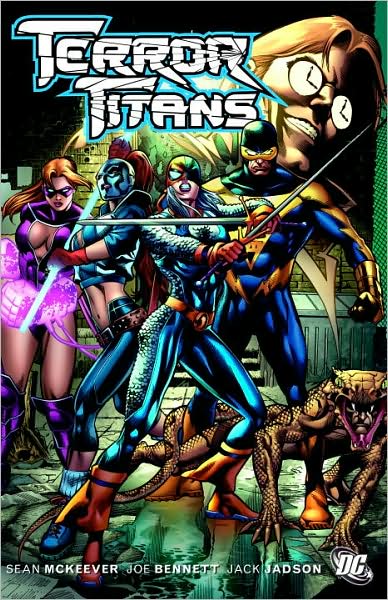
Some thoughts on Terror Titans

Having recently read a couple of collections of Sean McKeever’s run on Teen Titans, I figured I might as well read the trade collection of his spin-off miniseries Terror Titans as well, and thus finish off all of the trades produced during McKeever’s Titans.

The book follows Rose “Ravager” Wilson, who had just quit the Teen Titans team, infiltrating the ranks of new Clock King’s team of teenage legacy villains, the so-called Terror Titans.

Clock King uses them to help him capture and sell teenage super-people to The Dark Side Club, a place where bad guys organize and bet on gladiatorial death matches between superheroes.

It’s not a very good work, but I didn’t find myself necessarily incensed about its poor quality in such a way that I felt motivated to give it a formal review either.

So instead, here are some random thoughts on it.


—Aside from a few weak points, including an unclear beginning (borne of this book being a spin-off, no doubt) and a somewhat nonsensical climax (more on that later), the series is plotted very well. Almost every issue opens with an eight-panel, silent sequence featuring the life story of one of the Terror Titans, which does a fair job of showing up that they’re all life-long psychopaths in a quick, efficient manner, and writer Sean McKeever manages to demonstrate The Clock King manipulating each of the four title characters somewhat subtly. By the book’s climax, it’s made clear that the various conflicts between the main characters have all been engineered by the Clock King for a purpose.

Additionally, McKeever does a good job of sketching out the characters of the Terror Titans, although the series’ hero and its villain remain ciphers.


—The violent content that was so off-putting in a book featuring Robin, Wonder Girl and Marvin and Wendy works much better here in a more standalone title than it did in Teen Titans. Like Secret Six, this is a book consisting mostly of bad guys and worse guys (and a bunch of mind-controlled victims, I guess), so depravity of any kind is a lot more at home here.

I personally don’t like DC’s often juvenile, trying-to-have-it-both-ways approach to mature content, in which they neither commit to actual mature readers content, but don’t produce all-ages material either. Terror Titans, like the Teen Titans series about the time this spun out of it (and plenty of other DC Comics of the last few years), reads a bit like an R-rated movie in which the studio kept making one tiny edit after another until they had snipped away enough content that the MPAA granted them a coveted PG-13 rating.


—While his motivations are never made clear and his plans don’t make a whole lot of sense, McKeever’s Clock King is certainly built up as a formidable, scary villain. The fact that McKeever manages to do so without any of the usual cheap tricks—like, say, having Clock King defeat The Joker or Prometheus off-panel to prove what a bad-ass he is—but instead by spending time revealing his brutal nature slowly, action by action, line by line, the old-fashioned way, makes him doubly so.


—I’m of two minds about the art, which is penciled by Joe Bennett and inked by Jack Jadson. I don’t think it looks very good, personally, but I’m unsure of whether or not it’s good.

Like Eddy Barrows, who was occasionally drawing Teen Titans during the time this spun out of it, they draw muscled human bodies in tortured, agonized poses pretty well, so a great deal of the book is appropriately ugly and painful looking. I could feel stress emanating from the pages, and that’s a good thing, given the content.

It’s not unreadable, and, sadly, “not unreadable” actually qualifies as a positive when talking about current Big Two super-comic art, although it could certainly be more clear. Particularly during the fight scenes, of which there are many, it is difficult to tell who is doing what to whom, and who actually wins and loses the fights (Of course, these end with boxes declaring the winner, which helps in cases where the poses and rendering simply show two identical super girls in similar, painful-looking, eyes-squinting, mouth-open poses).

They draw awful clothes though. There’s a scene where Ravager and the Terror Titans are all wearing street clothes, and…and there was a blazer over a t-shirt tucked into jeans…and- and an off-the-shoulder peasant blouse belly shirt…and a micro tank top and tiny shorts with white piping and…

Well, let’s just say if there were a DC superhero named Fashion Police Woman who caught the villains in the lair, she would have been more than justified in using lethal force on the team.


—That said, I do like the character design of The Clock King. And… No actually, that’s the only nice character design in this book.


—I can’t think of a better illustration of how out of control DC’s legacy-itis has gotten than this book. The very first scene of the book features our villainous protagonists Disruptor II, Copperhead II, Persuader III* and Dreadbolt (son of Bolt) attacking a group of teen heroes consisting of Aquagirl II, Terra III**, Star-Spangled Kid III, Zatara II, Offspring (son of Plastic Man) and Molecule, the only non-legacy character of the bunch.


—I had to eventually throw my hands up and give up on trying to figure out how this fit in with Final Crisis. The Dark Side Club is, at the series’ opening, run by characters with names familiar from Jack Kirby’s Fourth World mythology—Desaad, Steppenwolf, Bernadeth and so on. They are all in mundane human forms though, similar to the way Grant Morrison imagined them in Seven Soldiers: Mister Miracle and the early parts of Final Crisis.

I couldn’t tell if this series was set before or after Final Crisis though, as the characters refer to “Boss Dark Side” and Granny Goodness having died, and the prophecy concerning the dark gods arriving on Earth having failed to come to pass.

Oh, and Clock King kills two of the New Gods, too.


—There’s a strange bit of dialogue during a meeting between Clock King and the evil New Gods about the direction of the Club which I’m not sure I understood, but it seems like McKeever either used the wrong word or someone in editorial should have spiked that word.

“I realize you feel your Caesar act is in some way, engaging, Vundabarr,” Clock King says to Vundabarr, “But you and your co-chair have to accept that you aren’t packing in the sodomites like you used to.”

The next few sentences, if that helps provide context: “The crowds you’ve managed to keep, they don’t spend. They don’t bet. They don’t get terribly excited anymore.”

So, um, what was that about sodomites, and what on earth does that have to do with anything here?


—A couple of super-nerdy nitpicks: How does Dreadbolt punch out Offspring in the opening scene, if the latter is made out of living plastic? And how is Miss Martian able to retain her shape-changed disguise when Fever defeats her by bathing her in fire?


—That said, hoo boy is this a pretty gory comic. In addition to all the blood-spitting face punches and broken necks and bones, there’s a panel of two people having their heads bisected by Clock King’s little Phantasm balls (one vertically, one horizontally), there’s a sequence of the character Hardrock (What if the Thing were a teenager, with a dumb name?) tearing Young Frankenstein (Get it? Like the movie) into three pieces, a character having her flesh melted off while being blown apart with her entrails flailing about, and, in the scene that surprised me the most, a character with explosive fingertips having all ten of her fingers chopped off…by our hero Rose Wilson…the only character fighting in the tournament who’s not being mind-controlled into fighting.

It is, or course, not marked mature readers, because no one says “the F-word” and all of the nipples remain covered by spandex or clingy cotton.


—There are an awful lot of characters killed for such a short span of issues. Not counting civilians, New Gods in human forms and characters created specifically for this series (Pristine and TNTeena, I think). These include Molecule, a “missing year” Teen Titan only seen in 52 (and Tiny Titans!), who gets chopped in half; Bolt, a late-eighties Blue Devil villain, who gets teleported into a stone chimney; and Fever, a new hero created for John Arcudi and Tan Eng Huat’s short-lived 2001 Doom Patrol series , who gets shot with a shotgun after our heroine Rose Wilson knocks her unconscious in a tournament bout.


—Clock King’s big plan doesn’t really make a whole lot of sense. As the series draws to a close, we learn that the scheming villain hasn’t just been brainwashing the captured teen heroes to fight one another in the arena, but he’s been programming to serve as his own personal army in some undefined, goal-less terror campaign (Other than mentioning unleashing chaos a few times, he doesn’t seem to have any concrete political or personal goals for his plot).

He calls them “The Martyr Militia,” and he sets them loose in LA to tear up the street, attacking empty vehicles and buildings for a few pages…? There’s nothing to it other than random, victimless violence, and since there doesn’t even seem to be any casualties, it doesn’t even seem like terrorism.

In our world, it would probably be kind of scary, but in the DCU, unleashing a dozen Y-List teenage heroes to tear up a city block seems kind of small potatoes, doesn’t it? Something Superman or The Flash or Green Lantern could take care of between the panels of their own, regularly scheduled adventures?


—Who on Earth thought the ideal way to introduce Milestone’s Static into the DCU was to have him show up in the second half of a violent Teen Titans spin-off in which Ravager is the biggest name character?


*Well, I’m going to go ahead and call her Perusader III, because she’s the third character with that name and schtick in DC’s comics, but chronologically along the DCU timeline, she’s Perusader II. The original Persuader is a Legion villain, so he exists a thousand years in the future, making the second and third Perusaders more “pre-gacy” than “legacy” characters. Ah, comics!


**Or Terra II, depending on whether or not the Team Titans Terra was Terra II or Terra I who temporarily thought she was Terra I…I lost track of that plot point