"Happily, I did not learn of the Superman versus Captain Marvel law suit until years later. It would have done me no good to discover two of my idols, staunch believers in direct action, bent over, hands cupped to lips, whispering in the ears of their lawyers. No one should have to grow up that fast.
"The Superman people said that Captain Marvel was a direct steal. The Captain Marvel people said what do you mean; sheer coincidence; isn’t there room for the small businessman; we don’t know what you're talking about. It went on that way for years, but the outcome was clear form the start. Captain Marvel fought hard but he was a paper tiger. One wondered whether he was beginning to drink. He was losing his lean, Fred MacMurray look, fleshing out fast in the face, in the gut, in the hips, moving onward and outward to Jack Oakie."
—Jules Feiffer, The Great Comic Book Heroes
Saturday, June 21, 2008


Friday, June 20, 2008
Jules Feiffer's Superheroes Week: An unusual metaphor applied to The Spirit
"The Spirit could even suffer defeat in the end: be outfoxed by a woman foe—stand there, his tongue making a dent in his cheek—charming in his boyish, Dennis O’Keeffe way—a comment on the ultimate ineffectuality of even super-heroes. But, of course, once a hero turns that vulnerable he loses interest to both author and readers. The Spirit, through the years, became a figurehead, the chairman of the board, presiding over eight pages of other people’s stories. An inessential do-gooder, doing a walk-on on page eight, to tie up loose strings. A masked Mary Worth."
—Jules Feiffer, The Great Comic Book Heroes
—Jules Feiffer, The Great Comic Book Heroes
Thursday, June 19, 2008
Namor vs. New York
As I mentioned at the top of the week, one of the things that most excited me about finding an old copy of Jules Feiffer's Great Comic Book Heroes was that it contained stories featuring Golden Age heroes whose original exploits I've never had the opportunity to read much of.
Heroes like Namor, the Sub-Mariner.
I really like Namor, in part because he's just such a horrible superhero. His look is improbable—a mostly naked man with pointy ears and cute little wings on his ankle—and he's powerful, violent, arrogant and prone to shouting really funny things out loud, like "Imperius Rex!"
But at his core, he's basically an incredible asshole.
And that's probably why I like reading comics about him. I mean, yes, obviously, he's a fun and funny character, one with a great degree of camp about him and the potential to fight just about any other Marvel he shares a panel with, but unlike a lot of fictional characters, he's the sort one would loathe being around in real life. Which makes reading about him in pretend-life kind of attractive; you get to hang out this total asshole jerk guy without ever being on the receiving end of his pomposity. Or his punches.
In the modern Marvel Universe, Namor's anti-social as all hell, always trying to steal Reed Richards' wife or punching people out for touching him, but he's downright mild-mannered compared to how he used to be in the Golden Age. Which means as awesome as Namor is now, he used to be even awesomer (Awesome enough to be referred to as "awesomer" instead of "more awesome").
Feiffer's book includes a ten-page Namor story by Bill Everett which seems to be entitled "Prince Namor, the Sub-Mariner," but might as well be called "Namor Just Totally Wrecks New York Until We Run Out of Pages."
Perhaps because Namor didn't get as much attention as Superman, Batman, Sheena and The Spirit during the essay portion of the book, or perhaps because the story doesn't exactly make Namor look at all like a superhero, there's an asterisk after the character's name, and a few sentences from Feiffer explaining the character.
"If Wonder Woman hated men, The Sub Mariner went her one better," Feiffer wrote. "He hated everybody...Luckily the war came along, and he switched from beating up Americans to Nazis. Untl then, he was well on his way to becoming the Black Muslim of the comic books."
I actually spent a few days thinking of exactly what Feiffer meant by that —remember, this is a 1965 book Feiffer's writing!—and I'm guessing it's a joke comparing Namor's Atlantean quest to conquer the surface world (or at least ocassionally beat it up) to the Nation of Islam's desire to form a country for black folks within the continental United States. I don't think their goals line-up very well though. In the first panel of this story, for example, a green-skinned fishman wearing a robe and crown is sitting on a throne underwater, and Namor tells him, "I shall return to New York City and destroy the entire continent, using the metropolis as my central base!" I'm not real up on the Nation, but I'm pretty confident that destroying North America is not one of their goals.
Anyway, enough politics—let's watch as Namor visits New York!
The fish king guy likes what he heard from Prince Namor, and offers him entire naval fleet. Namor thanks him but decides to pass; "This is a selfish grudge, and there's no reason yet to make an international situation of it." So he's just going to conquer New York by himself.
He surfaces in front of the Statue of Liberty, and starts talking to himself about what it symboizes: "Huh! They'll not know what liberty means when I'm through with them. I'll conquer this nation and enslave all it's people. I'll be emperor of America, and make these people pay for what they have done to me!"
I don't know what they've done to him, but it must be pretty bad, since she breaks the jaw of the first poor bastard he sees.

This establishes a pattern for the next eight pages; Namor just runs around going all King Kong on the city, and insulting the intelligence of the weaklings who try to stop him. He flies up to the statue, and "throws out terrified tourists, mercilessly," deciding that it will be his castle. (And that's "throws out" as in "picks up over his head and throws out the window into the sea," not merely "asks to leave" or whatever.)
When the "stupid policemen" of the harbor patrol head out after him, he rips the rudder off their boat, and then pushes their ship directly into the path of a giant ocean liner, which smashes it to bits.
When he makes it to land, New York's finest try gas, nets and fisticuffs:

In the mayor's office, hizzoner and an aide discuss asking the governor to call out the national guard, which leads to one of the most terrifying panels I've ever seen:
Gah! Can you imagine turning around and seeing that outside your window? Particularly a couple stories up? He looks like Peter Pan mixed with Satan there.
The mayor calls Namor a crook and a bum, and the scion of Atlantis responds thusly:
Then it's off to destroy a commuter train, probably full of commuters:
In the first panel, note the jaded New Yorker who walks right by Namor and doesn't even seem to notice that the guy who just passed him looks like a big elf with ankle-wings in a bathing suit: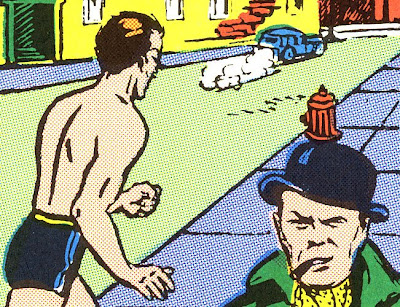 What a town!
Let's see, Statue of Liberty, the harbor patrol, the mayor, a train...what next? Ah, the Empire State Building!

He flies up, rips the top off it, and throws it. At a baby.
He's on his way back to his castle, the Statue of Liberty, when he spots pretty blonde Betty Dean, and is powerless to ignore her. Blondes are Namor's kryptonite. She asks him to stop tearing shit up, and let New York live in peace, warning him that The Human Torch (whose name Feiffer mentions in his essay is kind of ridiculous, since the Torch is a robot, not a human) is now a part of the police force. Namor laughs at the thought of the Torch's "little flame," and then dives in the water, because that's the end of the story.
The end.
Heroes like Namor, the Sub-Mariner.
I really like Namor, in part because he's just such a horrible superhero. His look is improbable—a mostly naked man with pointy ears and cute little wings on his ankle—and he's powerful, violent, arrogant and prone to shouting really funny things out loud, like "Imperius Rex!"
But at his core, he's basically an incredible asshole.
And that's probably why I like reading comics about him. I mean, yes, obviously, he's a fun and funny character, one with a great degree of camp about him and the potential to fight just about any other Marvel he shares a panel with, but unlike a lot of fictional characters, he's the sort one would loathe being around in real life. Which makes reading about him in pretend-life kind of attractive; you get to hang out this total asshole jerk guy without ever being on the receiving end of his pomposity. Or his punches.
In the modern Marvel Universe, Namor's anti-social as all hell, always trying to steal Reed Richards' wife or punching people out for touching him, but he's downright mild-mannered compared to how he used to be in the Golden Age. Which means as awesome as Namor is now, he used to be even awesomer (Awesome enough to be referred to as "awesomer" instead of "more awesome").
Feiffer's book includes a ten-page Namor story by Bill Everett which seems to be entitled "Prince Namor, the Sub-Mariner," but might as well be called "Namor Just Totally Wrecks New York Until We Run Out of Pages."
Perhaps because Namor didn't get as much attention as Superman, Batman, Sheena and The Spirit during the essay portion of the book, or perhaps because the story doesn't exactly make Namor look at all like a superhero, there's an asterisk after the character's name, and a few sentences from Feiffer explaining the character.
"If Wonder Woman hated men, The Sub Mariner went her one better," Feiffer wrote. "He hated everybody...Luckily the war came along, and he switched from beating up Americans to Nazis. Untl then, he was well on his way to becoming the Black Muslim of the comic books."
I actually spent a few days thinking of exactly what Feiffer meant by that —remember, this is a 1965 book Feiffer's writing!—and I'm guessing it's a joke comparing Namor's Atlantean quest to conquer the surface world (or at least ocassionally beat it up) to the Nation of Islam's desire to form a country for black folks within the continental United States. I don't think their goals line-up very well though. In the first panel of this story, for example, a green-skinned fishman wearing a robe and crown is sitting on a throne underwater, and Namor tells him, "I shall return to New York City and destroy the entire continent, using the metropolis as my central base!" I'm not real up on the Nation, but I'm pretty confident that destroying North America is not one of their goals.
Anyway, enough politics—let's watch as Namor visits New York!
The fish king guy likes what he heard from Prince Namor, and offers him entire naval fleet. Namor thanks him but decides to pass; "This is a selfish grudge, and there's no reason yet to make an international situation of it." So he's just going to conquer New York by himself.
He surfaces in front of the Statue of Liberty, and starts talking to himself about what it symboizes: "Huh! They'll not know what liberty means when I'm through with them. I'll conquer this nation and enslave all it's people. I'll be emperor of America, and make these people pay for what they have done to me!"
I don't know what they've done to him, but it must be pretty bad, since she breaks the jaw of the first poor bastard he sees.

This establishes a pattern for the next eight pages; Namor just runs around going all King Kong on the city, and insulting the intelligence of the weaklings who try to stop him. He flies up to the statue, and "throws out terrified tourists, mercilessly," deciding that it will be his castle. (And that's "throws out" as in "picks up over his head and throws out the window into the sea," not merely "asks to leave" or whatever.)
When the "stupid policemen" of the harbor patrol head out after him, he rips the rudder off their boat, and then pushes their ship directly into the path of a giant ocean liner, which smashes it to bits.
When he makes it to land, New York's finest try gas, nets and fisticuffs:


In the mayor's office, hizzoner and an aide discuss asking the governor to call out the national guard, which leads to one of the most terrifying panels I've ever seen:

Gah! Can you imagine turning around and seeing that outside your window? Particularly a couple stories up? He looks like Peter Pan mixed with Satan there.
The mayor calls Namor a crook and a bum, and the scion of Atlantis responds thusly:

Then it's off to destroy a commuter train, probably full of commuters:

In the first panel, note the jaded New Yorker who walks right by Namor and doesn't even seem to notice that the guy who just passed him looks like a big elf with ankle-wings in a bathing suit:
 What a town!
Let's see, Statue of Liberty, the harbor patrol, the mayor, a train...what next? Ah, the Empire State Building!

He flies up, rips the top off it, and throws it. At a baby.
He's on his way back to his castle, the Statue of Liberty, when he spots pretty blonde Betty Dean, and is powerless to ignore her. Blondes are Namor's kryptonite. She asks him to stop tearing shit up, and let New York live in peace, warning him that The Human Torch (whose name Feiffer mentions in his essay is kind of ridiculous, since the Torch is a robot, not a human) is now a part of the police force. Namor laughs at the thought of the Torch's "little flame," and then dives in the water, because that's the end of the story.
The end.
Jules Feiffer's Superheroes Week: On boy companions, and the gayness of the Dynamic Duo
Here's what Jules Feiffer had to say about sidekicks in The Great Comic Book Heroes:
"I couldn’t stand boy companions. If the theory behind Robin the Boy Wonder, Roy the Superboy, The Sandman's Sandy, The Shield's Rusty, The Human Torch's Toro, The Green Arrow's Speedy was to give young readers a character with whom to identify if failed dismally in my case. The super grownups were the ones I identified with. They were versions of me in the future. There was still time to prepare. But Robin the Boy Wonder was my own age. One need only look at him to see he could fight better, swing from a rope better, play ball better, eat better, and live better—for while I lived in the east Bronx, Robin lived in a mansion, and while I was trying, somehow, to please my mother—and getting it all wrong—Robin was rescuing Batman and getting the gold medals…
"He was obviously an 'A' student, the center of every circle, the one picked for greatness in the crowd—God, how I hated him. You can imagine how pleased I was when, years later, I heard he was a fag… "
Feiffer was kidding, of course. He goes on to bring up Frederic Wertham's Seduction of the Innocent, quoting an oft-quoted passage about how Batman and Robin's lifestyle was "like a wish dream of two homosexuals living together."
Feiffer doesn't agree, despite the fact that the young Feiffer had no real love for Robin. Wrote Feiffer: “Batman and Robin were no more or less queer than were their youngish readers, many of whom palled around together, didn’t trust girls, played games that had lots of bodily contact, and from similar surface evidence were more or less queer."
"I couldn’t stand boy companions. If the theory behind Robin the Boy Wonder, Roy the Superboy, The Sandman's Sandy, The Shield's Rusty, The Human Torch's Toro, The Green Arrow's Speedy was to give young readers a character with whom to identify if failed dismally in my case. The super grownups were the ones I identified with. They were versions of me in the future. There was still time to prepare. But Robin the Boy Wonder was my own age. One need only look at him to see he could fight better, swing from a rope better, play ball better, eat better, and live better—for while I lived in the east Bronx, Robin lived in a mansion, and while I was trying, somehow, to please my mother—and getting it all wrong—Robin was rescuing Batman and getting the gold medals…
"He was obviously an 'A' student, the center of every circle, the one picked for greatness in the crowd—God, how I hated him. You can imagine how pleased I was when, years later, I heard he was a fag… "
Feiffer was kidding, of course. He goes on to bring up Frederic Wertham's Seduction of the Innocent, quoting an oft-quoted passage about how Batman and Robin's lifestyle was "like a wish dream of two homosexuals living together."
Feiffer doesn't agree, despite the fact that the young Feiffer had no real love for Robin. Wrote Feiffer: “Batman and Robin were no more or less queer than were their youngish readers, many of whom palled around together, didn’t trust girls, played games that had lots of bodily contact, and from similar surface evidence were more or less queer."
Wednesday, June 18, 2008
Weekly Haul: June 18th
 Batman and The Outsiders #8 (DC Comics) Now that Chuck Dixon has announced he’ll be leaving the book, the incredibly mediocre adventures of Batman’s hand-picked team of random characters has taken on something of a lame duck vibe. Which is too bad, because it was kinda lame to begin with.
But if you’ve been reading these last eight issues, which have been one long story about an evil corporation’s nefarious attempt to manufacture real-life Pokemon to populate the moon with, you might have assumed it was all going somewhere. Well, now we know it’s not.
Dixon and the extremely solid art team of Julian Lopez and Bit are on the schedule for just two more issues, and then Frank Tieri and J. Calafiore step in for the last two parts of a three-part “Batman R.I.P.” tie-in.
You might remember that particular creative team from Gotham Underground, the series that tied-in to Salvation Run, which was a tie-in to Countdown, which was a prequel to Final Crisis, although the writer of Final Crisis recently disavowed it as such. So, the new creative team isn’t one that seems particularly exciting, you know?
I’m also kind of confused as to how all of the Bat-books (Detective, Nightwing and Robin, in addition to BATO) are supposed to tie-in to “Batman R.I.P.,” since there’s no discernable logline for that particular story. It’s apparently about Batman having a really crazy night and kind of going a little nuts as his world seems to fall apart around him; what will all these satellite books tie in to, exactly? In the olden days of the ‘90s, the Bat-crossovers were at least easy to follow. “Knightquest” was about Batman retaking the mantle from Jean-Paul Valley, “Prodigal” was about Nightwing filling in as Batman, “Contagion” was about a plague striking Gotham, et cetera.
Anyway, BATO #10?
Well, there’s some more pointless running around in China, a remote-controlled OMAC piloted by a guy in the Batcave, some nice, dry British smartassery from Alfred, and I’m not really sure anything has really happened in the course of eight issues now. Lopez and Bit draw well—Batgirl’s butt, Batgirl’s utility belt, Green Arrow’s collar, the soles of Nightwing’s boots, the JLA door/teleporter tunnel thing that doesn’t look anything like it does in other books—they all look awesome under their pens.
So for very well illustrated shallow stories of superheroes running around, stories that are quite clearly never ever going to amount to anything, you could do worse than this book, I guess.
At least for two more issues.
 The Brave and The Bold #14 (DC) Two of Batman’s more frequent team-up partners in the old-school Brave and the Bold, Deadman and Green Arrow, team-up with each other in this issues, while Batman stays completely off-panel. This is the first half of what appears to be a two-parter, involving an evil scheme launched in Deadman’s hometown of Nanda Parbat targeting GA’s hometown of Star City.
 Mark Waid’s script is decent, managing a lot of exposition without completely ceding the story to laying out that information. I was also struck by the degree of palpable danger in the story, in which intangible ghosts that can kill with a touch target GA. Obviously, he’s not actually going to get killed or anything, but the somewhat unique level of danger made certain scenes more dramatic than usual, especially when coupled with the almost casual way in which Deadman prioritizes saving GA’s life over those of innocent bystanders, plenty of whom die in this issue.
The art is by Scot Kolins, the first artist to tackle the title who is neither George Perez nor Jerry Ordway. I like Kolins’style okay, and he’s a solid storyteller, but after 13 issues by real masters, it can’t help but seem like a bit of a step down in terms of quality.
Part two will feature Nightwing and Hawkman, a pair that are as unlikely a match up as Deadman and GA are, but, should the two team-ups team-up, the story will likely seem a lot less unique, as Deadman and Nighwing have so much common ground (former circus aerialists with an affinity for high collars and team-ups with Batman) and GA and Hawkman are practically the World’s Finest team.
And hey, call me nostalgic, but would it have killed DC to get Neal Adams to do a cover for this issue?
Chiggers (Aladdin Mix) Hope Larson's latest is a black and white original graphic novel about a girl named Abby at summer camp. Larson's art is as strong as ever, and her story this time out is much more grounded than the dreamier, more poetic Gray Horses and Salamander Dream. Check out Monday's Best Shots column at Newsarama for a full review.
 Incredible Hercules #118 (Marvel Comics) Okay, so on page one we have cut-out sports cards for “Yon starting lineup for thy God Squad!”, on page nine we have Nightmare talking in Dream of the Endless font, on page 21 we have Amadeus Cho responding to one of Japanese god of evil Mikaboshi’s taunting haikus with a limerick involving Nantucket, and on the last page we have the now cyborg pup watching two members of the Squad knocking boots/sandals.
 So yes, this is still a great comic book. Earlier this week someone who should know better asked “Should Comics Only Be Reviewed After The Story Is Completed?”, a question that involved her making unfair comparisons between the medium of feature films (which are produced and sold to the audience/consumers as complete, distinct wholes) and serial super-comics (which are produced and sold to the audience/consumers as complete, distinct pieces, and then later re-sold to the same and/or different audience/consumers in collected format). Then someone who should quit paying attention to that other someone (I say selfishly because when she links to her that means I ende up having to pay attention to her again, and end up reading foolish questions like this) took up the (silly) question, and offered the obvious answer—No; critics should review what’s sold to them.
Anyway, it reminded me that generally only bad comics would prompt someone to even ask that question (but even then, there’s something to review in a bad comic with very little individual story, depending on the inclination of the critic and the venue; in the cases of the two ladies linked above, there’s no reason not to review single issues, as they write for personal blogs with no space limitations, other than their own personal desire not to cover single issues that may be part of a story arc).
Good comics can tell a complete story in every one of their single issues, single-issue stories that also contribute to a larger story that the entire series is being devoted to telling (see All-Star Superman, for a great example of a series of done-in-ones which also tell a 12-part story).
Incredible Hercules is one such a comic. Every single issue has been a done-in-one story, with a beginning, middle and end (even if the ending is sometimes a cliffhanger, setting up the next issue’s beginning), yet each has been a chapter of a story arc, and each of those story arcs has been a chapter in a larger story about Hercules’ and Amadeus’ place in the world, their relationship with each other, and the relationship between classical mythology, classic Marvel mythology, and the modern Marvel mythology of the series you’re reading.
It’s not serial super-comics’ fault that Final Crisis and “Batman R.I.P.” aren’t written as single-issue stories within greater stories. It’s not even the creators’ faults (Grant Morrison’s work on All-Star Superman shows it’s not like he hasn’t figured out how to write comics like that). And it’s not even necessarily a bad thing; different comics are written differently.
Anyway, despite the sidetrack, my point is simply this: Incredible Hercules is extremely well constructed, and if you’re the sort of writer and/or blogger who has a hard time thinking about comics as single-issue story units within a larger story, well, here’s one you shouldn’t have any trouble with.
Plus, it’s the only comic on the stands in which Mark Paniccia’s last name is likely to be used as the sound effect of a stone wall being smashed through by a demigod’s bare fists.
Marvel Adventures Avengers #25 (Marvel) And this is the other enormously satisfying Marvel comic I read this week. Jeff Parker and Ig Guara, the same creators who brought us MAA #24’s clash against the all-new, all-different Hatemonger, return to tell a tale of this all-star Avengers team going up against The Wrecking Crew and Arnim “Holy shit, his face is on a TV screen in his chest!” Zola, who hits the team with some kinda Freaky Friday device.
The result? Wolverine-in-Ant-Man’s-body having a tiny little berserker rage, Hulk-in-Storm’s-body trying to pick up a tree, and a great climactic stand-off in which Storm-in-the-guy-with-the-crowbar’s-body bashes her/his own face.
I love you Marvel Adventures Avengers!
RASL #2 (Cartoon Books) Cigarette smoking! Liquor drinking! Sexing with a woman who might be a prostitute! A strip club! A woman grabbing a dude’s crotch! All written and drawn by all-ages adventure comics darling Jeff Smith! It’s taking me some getting used to, more adult material by Smith, but this is extremely beautifully drawn (and lettered). In this second issue, the science between or lead character’s parallel-dimension hopping starts to come into greater focus, but Smith is still unwinding his story.
 Teen Titans: Year One #5 (DC) This one’s a little late—looks like three weeks late, to be exact—which is perfectly understandable, given its original colorist did just pass away.
 Personally, I hope the next issue is super-late, because the next issue is also the last issue, and I’ll be sorry to see Amy Wolfram, Karl Kerschl and Serge LaPointe’s winning reimagining of the Titans’ formative years end. As they’ve been doing for four issues now, they take elements from the team’s early years, ones you can read all about in the excellent Showcase Presents, and modernizing and reimagining them in the context of a young adult novel-like teen dramedy.
And, as I may have pointed out four times before, it is absolutely gorgeous.
In this issue, we see what a crappy parent Green Arrow is, Speedy asks to borrow the Arrowcar, Wonder Girl goes on a date, Kid Flash and Aqualad mill around, Batman visits the cave and Ding Dong Daddy attacks.
Part of me wishes we could see this creative team tackle the regular DCU Teen Titans monthly—no sleight against the current creative team on it—but then, I imagine if Wolfram and Kerschl were stripped of the freedom doing a continuity-lite book like this gives them, the final product would likely suffer.
So I hope we get to see TT:YO #6-12 some day, or at least some more work from this creative team with the Titans. Hell, maybe they could do the next “Who the Hell is Donna Troy This Decade?” origin story. We’re do for one, after the Infinite Crisis/52 reboot.
 (Presumably the young Jules Feiffer wouldn’t have had any problems imagining Carlos Pacheco’s bigger, bustier Wonder Woman was as strong as they said she was, as he did with H.G. Peter’s daintier version of the character)
 Trinity #3 (DC) Tom Spurgeon called it “comfort food, ” applauding the fact that it established “a pleasant, old-school jog with its first issue and the book’s seeming recognition that “there are dramatic stories out there that don't involve re-branding, murder and 1970s super-villains taken very, very seriously.”
Face-kick aficionado Chris Sims noted that rather than a bad comic, “it’s completely adequate in every way… It’s nothing that I haven’t seen before, and I’ve got the impression that if you’ve ever read any halfway decent comic book with these characters, it’s nothing you haven’t seen before either.”
Fairly feint praise, obviously, but pretty accurate nonetheless. Sims even gets right to the heart of what I’m digging about the series. I have read plenty of halfway decent comic books with these characters, but certainly not as often as I like.
The Superman books are in pretty good shape and have been since “Up, Up & Away.” The Bat-books and Wonder Woman are both somewhere between halfway decent and all-the-way decent (depending on the particular title or issue).
But man, I hardly ever see Superman and Batman in the same book at the same time that was halfway decent (despite the fact that they share an ongoing monthly), or the World’s Finest plus Wonder Woman (despite the fact that they’re all in JLoA together), or the whole Justice League line-up, who guest-star in this particular issue.
And I think that’s the real virtue of this series, at least at this (early) point: It’s decent, something that unfortunately can’t be said for as many DCU books as it should be. I know I like to nitpick here, but I’m really not all that hard to please when it comes to DC super-comics—all I really want is a book that’s not terrible, that looks like it was produced by professionals, makes some amount of sense in the fictional DCU (an attraction to which is the main reason I bother reading DCU books at all) and doesn’t depress me.
The lead story here is the whole JLA line-up versus the purple-skinned Hulk-like alien Konvikt, meaning Mark Bagley gets to pencil a large chunk of the DC hero roster, and it’s competent but unspectacular super-fighting (Not quite sure why Flash doesn’t just run real fast and push K. off the Earth).
This week’s back-up, laid out by Mike Norton and finished by Jerry Ordway, features new-ish hero Tarot and a buff guy named Jose who staples fliers for anti-gang programs on telephone poles whom I’m pretty sure is actually super-guy Gangbuster.
My least favorite part is the caption in which Tarot mentions listening to Paramore. I liked the songs I’ve heard on the radio enough to check their album out from the library, and it’s not all that good. I have a feeling a having a character listen to them on her iPod is going to date the story in a pretty negative way; kinda like when I’m flipping through my old Superman comics and find that panel with Jimmy Olsen wearing a Spin Doctors shirt.
Jules Feiffer's Superheroes Week: On disliking Wonder Woman
"My problem with Wonder Woman was that I could never get myself to believe she was that good. For if she was as strong as they said, why wasn’t she tougher looking? Why wasn’t she bigger? Why was she so flat-chested? And why did I always feel that, whatever her vaunted Amazon power, she wouldn’t have lasted a round with Sheena, Queen of the Jungle?
"No, Wonder Woman seemed like too much of a put-up job, a fixed comic strip—a product of group thinking rather than the individual inspiration that created Superman. It was obvious from the start that a bunch of men got together in a smoke-filled room and brain-stormed themselves a Super Lady....I see now that my objection is just the opposite of Wertham's: Wonder Woman wasn't dykey enough."
—Jules Feiffer, The Great Comic Book Heroes
"No, Wonder Woman seemed like too much of a put-up job, a fixed comic strip—a product of group thinking rather than the individual inspiration that created Superman. It was obvious from the start that a bunch of men got together in a smoke-filled room and brain-stormed themselves a Super Lady....I see now that my objection is just the opposite of Wertham's: Wonder Woman wasn't dykey enough."
—Jules Feiffer, The Great Comic Book Heroes
Tuesday, June 17, 2008
Jules Feiffer's Superheroes Week: An unusual metaphor applied to Superman and Captain Marvel
“The most savage reprisals in comic books were, just as in the revolutions, saved not for one’s enemies but for one’s own kind. If, for a moment, Superman may be described as the Lenin of super-heroes, Captain Marvel must be his Trotsky. Ideologically of the same bent, who could have predicted that within months the two would be at each other’s throats—or that, in time, Captain Marvel would present the only serious threat to the power of the man without whom he could not have existed?”
—Jules Feiffer, The Great Comic Book Heroes
—Jules Feiffer, The Great Comic Book Heroes
Marvel's September previews reviewed
 THE AGE OF THE SENTRY #1 (of 6)
 Written by JEFF PARKER & PAUL TOBIN
Penciled by NICK DRAGOTTA & RAMON ROSANAS
Cover by DAVE BULLOCK & MICHAEL CHO
Kicking off an all-new miniseries bringing you two "classic" silver-age tales of the Sentry at the birth of the Marvel Age! When the Golden Guardian is critically injured, Scout, Lindy Lee and Watchdog have to travel back in time to learn exactly how Rob Reynolds became THE SENTRY. They must learn the secrets to save our hero – so he can save the world! PLUS: When the Tinkerer and the Mad Thinker team up to create a device capable of stealing the Sentry's powers, they only have one obstacle on their path to world domination. The parasitic beam takes HOURS to work! What evil scheme will keep the Sentry in place long enough to destroy him? Don't miss the breathtaking tale of monsters and mayhem!
I hate the Sentry. I love Jeff Parker, Paul Tobin and Nick Dragotta. So I guess Marvel found a way to make me buy a Sentry comic.
 Fact: Even Dumb-ass '90s shit like symbiote fights looks awesome when John Romita Jr. draws it.
 BIG HERO 6 #1 (of 6)
Written by CHRIS CLAREMONT
Pencils, Cover & Variant Cover by DAVID NAKAYAMA
The astonishing return of Big Hero Six! Who, you ask? Why none other than Japan's top heroes, defending the land of the rising sun in the name of the Emperor! Come join Hiro (the smartest boy in Japan), Baymax (his trusty robot companion), Honey Lemon (with her all-containing handbag), Gogo Tomago (somersaulting into an unstoppable energy ball)... plus, who are the Six's two new members? When unknown super-villains strike Tokyo, BH6 is on the scene, and the stage is set for new adventure and a new series!
Is this something brand new, or based on some old Claremont X-person concept from 27 years ago that I've just never heard of? Looks and sounds intriguing, but I'm not so sure about voluntarily subjecting myself to Claremont...
CAPTAIN BRITAIN AND MI13 #5 Written by PAUL CORNELL. Penciled by LEONARD KIRK. Cover by BRYAN HITCH. Monkey Variant by David Yardin. Blade is back. And what is Lady Jacqueline Falsworth to him, except another dead vampire? Plus: Excalibur in the suburbs, the tears of a Skrull and tea with Union Jack. Pick up the hottest book to come out of SECRET INVASION, by Paul Cornell (Dr. Who, WISDOM) and Leonard Kirk (HULK: WARBOUND, Batman).
They had me at “tea with Union Jack.” Guess I better hurry up and get caught up on the first few issues…
Oh, and “monkey variant?” Really? Good luck with that, Marvel.
FANTASTIC FOUR: TRUE STORY #3 (of 4) Written by PAUL CORNELL. Penciled by HORACIO DOMINGUEZ. Cover by NIKO HENRICHON. Okay, you remember that the FF had ventured into fiction to save the world? In this issue, we find out who the big villain is (one of the original Marvel villains, that the FF have never met!) Frankenstein vs. Dracula! Johnny collapses in the arms of Mr. Toad! And the deaths of nearly all the FF. Yes, in a miniseries. The guys on the main book are just going to have to deal. Join us as True Story becomes a true nightmare.
You’ve no idea how long I’ve waited to read the words “collapses in the arms of Mr. Toad” in the solicitations for upcoming Marvel comics…
 INCREDIBLE HERCULES #121
Written by GREG PAK & FRED VAN LENTE
Penciled by CLAYTON HENRY
Cover by ARTHUR SUDYAM
Monkey Variant by Roger Cruz
"LOVE AND WAR," Part 1
The Greek Goliath is looking for some R&R after the events of "Sacred Invasion," and hopes to find it in the arms of ex-Renegade NAMORA. But there's no rest for warriors when the AMAZONS declare war on Atlantis! And these ain't your mama's Amazons-- is that why Amadeus Cho sides with them instead of Herc? Plus: ARES returns!
Why? I'm going to guess because he just hit puberty....? Anyway, Hercules, Namora, Amazons, Atlantis, Ares...this sounds like a story about Amazons attacking I can get in to.
 MARVEL ADVENTURES THE AVENGERS #28
Written by JEFF PARKER & PAUL TOBIN
Penciled by IG GUARA
Cover by SEAN MURPHY
It's always tough when your parents don't like the girl you're dating, but it's even rougher if you happen to be Thor, son of Odin! Worse, Odin sets Thor up on a date with a Frost Giant's daughter! When Thor ditches her to sneak away on a date with Storm, it's up to rest of the Avengers to cover for him.
This is a pretty nice image of the MA team, but if this is a story about Thor dating, I'd really like to see a nice Thor-on-a-date image on the cover, maybe something romance comic inspired...?
 MARVEL ADVENTURES SPIDER-MAN #43
Written by MARC SUMERAK
Penciled by CARLOS FERREIRA
Cover by PATRICK SCHERBERGER
When Peter Parker's biology class goes on a field trip to a popular aquatic theme park, Pete can't wait for a day full of water, whales and walruses. But our hero never expected to find himself face-to-fin with an Atlantean villain determined to release the park's animal inhabitants back to the freedom of the ocean! Looks like Spidey is in DEEP trouble.
One of my favorite scenes in Kurt Busiek and Erik Larsen's The Defenders, which was the single greatest comic book Marvel has ever published (suck it, Kirby and Lee Fantastic Four!) is when the Hulk fights this dude Orka-with-a-K underwater in the Battle for Atlantis. He gets stronger the more whales that are around, so he keeps calling in more whales, and Hulk still—ahem—wails on him, and so then he calls in more whales, and this cycle continues until the book is over.
So Spidey vs. Orka in a done-in-one set at a Sea World-like popular aquatic theme park? Yeah, that sounds like it might be fun.
MARVEL APES #1 & 2 (of 4) Written by KARL KESEL. Pencils by RAMON BACHS. Cover by JOHN WATSON. Variant Cover For Marvel Apes #1 by RAMON BACHS. Variant Cover For Marvel Apes #2 by PHIL JIMENEZ. Flingin' feces, True Believer-- the entire Marvel Universe has gone APE! Just when he thinks life can't get any worse or weirder, Marty Blank – a.k.a. that lovable loser, the Gibbon -- finds himself and the brilliant-and-beautiful Dr. Fiona Fitzhugh transported to a world where monkeys rule and humans don't exist!. SEE the spectacular simian city of Monkhattan! MEET the hominoid heroes and villains – SPIDER-MONKEY! DOC OOK! IRON MANDRILL! SIMIAN TORCH! THE APE-VENGERS! And more! THRILL to the return of Speedball! CONTAINS No-Ads, as we are thrilled to present you backup tales exploring the Apeiverse! LEARN the dark secret of the primate planet! WORRY that the fate of the entire universe is in the hands of the Gibbon! Not a hoax, not a dream, not an imaginary story - just the most not-to-be-missed mini-series of the season! If you only buy one (well, two) comics this month about super-powered, intelligent apes-in-capes, it must be MARVEL APES! 40 PGS.(each)/ Rated T+ ...$3.99 (each)
Well, I really enjoyed reading that solicitation a lot.
I suppose this series debuting in September is to what we owe the probably-not-going-to-be-as-sought-after-as-the-zombie-variant monkey variant incentives.
SECRET INVASION #6 (of 8)
Written by BRIAN MICHAEL BENDIS
Penciled by LEINIL FRANCIS YU
Cover by GABRIELE DELL'OTTO
Variant Cover by LEINIL FRANCIS YU
Sketch Variant Cover by LEINIL FRANCIS YU
EMBRACE CHANGE! With these words, the Skrulls have made their intentions clear but not everyone thinks they sound all that bad. Which heroes and icons are hell-bent on defending the Earth from the invasion, and who thinks a new era has dawned for mankind? The final double-page spread of this issue will send chills down your spine, and that is a promise!!
The blockbuster event of the year heads towards its shattering conclusion by Bendis and Yu.
32 PGS./Cardstock Cover/Rated T+ ...$3.99
It's a promise, but is it a money back guarantee?
And look...32 pages (ten of which will be ads) for $3.99! Marvel totally jacked up the price of this book after the first issue! Why isn't everyone freaking out about this?
ULTIMATE ORIGINS #4 (of 5)
Written by BRIAN MICHAEL BENDIS
Penciled by BUTCH GUICE
50/50 Cover by GABRIELE DELL'OTTO & DEAN WHITE
50/50 Variant Cover by ALEX MALEEV
Continuing the shocking exploration of the dark side of the Ultimate Unverse! For the first time we learn: How did Nick Fury become Nick Fury? How did the Hulk become the Hulk? And, finally, how did a baby Peter Parker connect to it all? Plus: the Ultimate Watcher has appeared and he is here to witness the Ultimatum!
How did Nick Fury become Nick Fury? I always just assumed Mr. and Mrs. Fury decided to name him Nick. But then, I suppose everything I thought I knew is wrong!!
WOLVERINE: FIRST CLASS #7 Written by FRED VAN LENTE. Pencils & Cover by MICHAEL GOLDEN. The SOVIET SUPER SOLDIERS have kidnapped Kitty's flame Colossus, and she and Wolverine must brave the dangers of Russia's irradiated Forbidden Zone to save him!
This is probably Marvel’s best title that is neither called Incredible Hercules nor written by Jeff Parker. And check out the artist on this issue: Michael Fucking Golden, as I believe they like to call him around the all-ages Marvel Adventures offices.
Oh, and speaking of Wolverine…
WOLVERINE: ORIGINS #28 Written by DANIEL WAY. Pencils & Cover by MIKE DEODATO. “DARK DECEPTION: PROLOGUE”FEATURING ART BY NEW REGULAR PENCILER, MIKE DEODATO, JR.! Wolverine’s days in the Weapon X program, his first encounter with The Incredible Hulk, his induction into the X-Men…it’s all here in the prologue to DARK DECEPTION, next month’s WOLVERINE: ORIGINS and X-MEN: LEGACY crossover!
WOLVERINE: ROAR Written by DUANE SWEIRZYNSKI. Pencils & Cover by MIKE DEODATO. A self-contained, double-sized one-shot written by Duane Swierzynski (Cable) and illustrated by Mike Deodato (Wolverine: Origins)! All Logan wanted was a place to stop for a cool drink and listen to absolutely nothing for a while. Well, at least he got his second wish. Because in Roamer, New Mexico (population 342, and falling fast) there’s a savage creature with revenge in its heart, and a roar that can blow out the eardrums of any living being within a mile…except for Logan, of course, whose regenerative abilities bring his hearing back after a minute. But “a minute” is not soon enough -- not when you have zero sense of balance and there’s a bloodthirsty creature that you can’t hear coming. A creature that won’t stop until Roamer is wiped off the face of the earth. A creature who wants the last thing you hear to be the sound of your own screams…
WOLVERINE: SAUDADE Written by JEAN-DAVID MORVAN. Pencils by PHILLIPE BOUCHET. Cover by PHILLIPE BOUCHET. Presented for the first time in North America: an amazing tale by two of Europe's top creators, starring one of the world's most popular super heroes! While on holiday in Brazil, the X-Man known as Wolverine has his motorcycle stolen by a group of young boys -- one of whom has a secret. When a brutal gang kidnaps the boy, Logan sets off on a quest to find him " leading to a deadly encounter with a corrupt faith healer who may not be what he appears! WOLVERINE: SAUDADE is a vicious saga of bloody revenge as only Wolverine can deliver!
I don’t know if anyone’s ever pointed this out before or not, but Marvel sure seems to publish a lot of Wolverine comics. This isn’t counting the 15 X-Men and Avengers titles he’ll be appearing in this month, nor his colon (:) free monthly, which is apparently late or in a skip month or something because Steve McNiven is slow.
 X-MEN: FIRST CLASS #16 Written by JEFF PARKER. Pencils & Cover by PATRICK SCHERBERGER. Here's what it's all been building to! The youngest, most rad members of the X-Men and the Fantastic Four ditch their lame teams and form THE MOST AWESOME DUO IN THE HISTORY OF SUPER-HEROING! Get ready world for ICEMAN and HUMAN TORCH! And Spider-Man shows up too! Chill out and feel the burn! (solicit text contributed by Robert Drake)
If Brian Michael Bendis showed up on my door step with four arrows in his back, looking pale and bleeding profusely, and, when I tried to call an ambulance and he coughed, “No, there’s no time—quick, take this…” and bequeathed unto me the magical medallion he wears on a gold chain around his neck, the one that gives him the power to do whatever the hell he wants with The Avengers franchise and always somehow always sell a lot of issues of each no matter what, I would totally have The Human Torch, Spider-Man and Ice Man on the team, and they’d form their own little clique. (Also on Caleb’s Avengers? Captain America, Iron Man, Hulk, She-Hulk—that’s right, two Hulks!—Namor, Quicksilver, Beast, Storm, Luke Cage, The Falcon, Atlas, Hercules, Ant-Man III, The Wasp, Black Panther, maybe Daimon Hellstrom The Son of Satan, possibly Thor and definitely Wolverine.)
So anyway, this looks like an ideal comic; like Spidey and his Amazing Friends, but without any girls around to spoil the fun.
Monday, June 16, 2008
Jules Feiffer's Superheroes Week: On Captain Marvel
“Villains ranged from mad scientist Dr. Sivana (the best in the business), who uncannily resembled Donald Duck, to Mr. Mind, a worm who talked and wore glasses, to Tawky Tawny, a tiger who talked and wore a business suit. A Disney land of happy violence. The Captain himself came out dumber than the average super-hero—or perhaps less was expected of him. A friendly fullback of a fellow with apple cheeks and dimples, he could be imagined being a buddy rather than a hero, an overgrown boy who chased villains as if they were squirrels.”
—Jules Feiffer, The Great Comic Book Heroes
—Jules Feiffer, The Great Comic Book Heroes
DC's September previews reviewed
 AMBUSH BUG YEAR NONE #3
Written by Keith Giffen & Robert Loren Fleming
Art by Keith Giffen & Al Milgrom
Cover by Amanda Conner
Darkseid makes a list and checks it twice! Plus, a shotgun wedding, alternate universes, more OMACs than you can shake a stick at and the very important return of Super-Turtle all wait for you in this all-new, all-ridiculous third issue.
There seems to be a lot of talk about replacing Dan DiDio today. (Well, more than usual, anyway). Can we vote on it? ‘Cause if so, I say Jann Jones.
 BLUE BEETLE #31
Written by Matthew Sturges
Art by Andre Coehlo
Cover by Rafael Albuquerque
After getting roped into Border Patrol duty, Blue Beetle learns you can’t fight City Hall! He can still fight Intergang, though – but they’re not going to make it easy for him! Guest-starring Doctor Mid-Nite!
You know, all they had to write for the solicitation to this comic would have been, “Look at Blue Beetle’s hat!” and I would have bought it.
I mean, look! Look at his hat! This comic is going to be awesome!
 BOOSTER GOLD #12
Written by Chuck Dixon
Art and cover by Dan Jurgens & Norm Rapmund
Guest writer Chuck Dixon goes back to the future and brings our heroes into the past for “Vicious Cycle” Part 2. When Booster’s attempts to right a wrong from Batman’s early days goes horribly wrong, he must look to the newest member of his Time Masters team to set things straight.
Speculation time! See that part where it says “the newest member of this Time Masters team?” See who’s butt and who’s dad is on the cover there? Remember how Geoff Johns and Jeff Katz are leaving the book, and the next writer hasn’t been announced yet? Remember the Jurgens is taking over rumor? Could pre-Killing Joke Barbara “Batgirl” Gordon be joining the cast of Booster Gold permanent like?
It fits. A displaced-in-time Batgirl played a major role in Jurgens’ Zero Hour.
 DC UNIVERSE: DECISIONS #1-2 Written by Judd Winick & Bill Willingham. Pencil art by Rick Leonardi. Covers by Stephane Roux. Election season is upon us, and the stakes have never been higher! An unknown villain is attempting to assassinate the presidential candidates, and only the heroes of the DCU stand in the way. As Green Lantern, Green Arrow, Superman, Batman and more try to learn the killer’s identity, they are faced with the difficult task of reconciling their own personal ideals with the mission at hand. Brought to you by writers Judd Winick (GREEN ARROW/BLACK CANARY, TITANS) and Bill Willingham (FABLES, DAY OF VENGEANCE) and featuring sensational art by Rick Leonardi (ROBIN, SUPERGIRL)! Issue #1 on sale September 10; issue #2 on sale September 24 • 1 and 2 of 4
This is one of those books that, in theory, sounds like my ideal comic book, since it mixes the two things I spend the most time online reading about these days—superheroes and presidential politics.
I’d be really skeptical even if it weren’t being written by the tag team of Judd Winick and Bill Willingham. The results of injecting real world issues into the fantasy setting of the DC Universe are almost always bad and, worse, damaging, trivializing the real world events and tarnishing the appealing fantasy nature of the characters.
As long as I’ve been reading DC Comics, it seems like the trend has been to move further and further away from the DCU-is-the-real-world-but-with-500-superheroes take and more towards one that is a complete fantasy world.
Story by story, this tends to work fine, but, in aggregate, it gets pretty messy.
For example, how many Iraq and Iran analogues are there in the DCU at this point?
Is there an Iraq War in the DCU? (I believe Lois Lane was covering the “Quarac War” during Greg Rucka’s Superman run).
Was there a 9/11? I’ve heard 9/11 referred to in DC Comics, but there was no explanation of why Superman didn’t stop the planes (and rightly so; I’m not complaining!).
Was George W. Bush ever president of the DC U.S.A.? Because Luthor won the 2000 election, and then I lost track of what was happening in the Oval Office (Pete Ross took over for a bit, right? But then there was that guy in Amazons Attack and Uncle Sam and the Freedom Fighters).
Now, I would imagine that this poorly-named series will feature imaginary candidates belonging to imaginary political parties, which seems to drain all of the appeal of the 2008 Presidential Election + DC Superheroes formula.
Certainly DC doesn’t want to have Hal Jordan endorsing John McCain and Olliver Queen endorsing Obama, but that is exactly what would make this comic fun to read. In my experience, people aren’t interested in politics in the abstract during presidential campaigns—“I don’t care who’s running, I just like watching the debates for the policy discussions!”—but because of the specific people running.
So take that out, take the parties out as well (as I suspect they will, but I’m just guessing) and what is there of interest really?
I’m still morbidly curious about this project, and will likely track the trade down from the library next year or whenever, if only to see how they handle the characters who aren't Green Arrow and Hawkman.
At any rate, Dave Campbell already wrote the consummate politics of the superheroes story, and you can read it for free here.
 JACK KIRBY’S THE DEMON OMNIBUS HC
Written by Jack Kirby
Art and cover by Jack Kirby & Mike Royer
One of Jack “King” Kirby’s most memorable creations returns in this title collecting the entire, original 16-issue series from the early 1970s! Part man, part elemental fury, Etrigan the Demon was bound to Jason Blood by Merlin to defend Camelot, only to become a demonologist in the modern-day DC Universe.
Advance-solicited; on sale November 19 • 384 pg, FC, $49.99
Between the Fourth World Omnibus series, the OMAC collection and this, DC seems to want me to blow my whole $600 stimulate-the-economy check on Kirby reprints instead on something sensible, like rent, bills and food.
I’m glad to see them working their way through all their Kirby material though. That means it’s only a matter of time before they get to this.
 FAMILY DYNAMIC #2
Written by J. Torres
Art by Tim Levins & Dan Davis
Cover by Sean Galloway
The Family Dynamic meets the dynamic duo known as Blackbird and Little Wing! But are they friends or foes? Or could they even be... family? One thing is for certain, there's no time for such questions with Tragedy Ann, the drama queen of crime, and her loony lackey Tom Foolery threatening to blow up Storm City!
This looks good.

FINAL CRISIS #4
Written by Grant Morrison
Art by J.G. Jones and Carlos Pacheco
Covers by J.G. Jones
It's one month after the Anti-Life Equation was released worldwide. Millions now toil as slaves of Darkseid, while the Justifier shock troops of Apokolips lay waste to the planet Earth and hunt down its protectors. The remaining free humans and superheroes are stationed around the world, besieged within the walls of ten very familiar 'Watchtowers', as they fight a desperate, losing battle against the triumphant forces of evil.
While Green Arrow and Black Canary attempt to deliver the secret of humanity's last hope across America's blasted wastelands, the Outsiders brave the horrors of the Bludhaven bunker in search of Batman. The ultimate battle is coming...but which heroes will become villain – and vice versa? And what part do the Secret Society have to play in the dawning of this new Age of Evil? Darkness is falling and death rules the day. Is this truly the end of the Age of Super Heroes? Don't miss FINAL CRISIS #4: “How to Murder the Earth!” Retailers please note: This issue will ship with two covers by J.G. Jones that will ship in approximately 50/50 ratio. Please see the Previews Order Form for more information.
Hey look, art by J.G. Jones and Carlos Pacheco! Guess they weren’t as far ahead as they thought.
That’s really too bad. I like Pacheco a lot and all, but I really have a hard time believing DC can’t produce a seven or eight issue event series without needing multiple artists. Millennium managed the same art team for eight issues, and that thing shipped weekly.
How could this possibly even happen? DC had time to plan and create an entire year-long weekly series, which has already ended, building up to Final Crisis, so they knew they were going to be doing a big tentpole crossover starting in May of '08 back when they were brainstorming a sequel to 52.
Also, Howard Porter’s design for Darkseid in that other story Grant Morrison wrote about Darkseid conquering earth looked a lot cooler than the one on this cover.
 THE FLASH #244
Written by Alan Burnett
Art by Paco Diaz & Drew Geraci
Cover by Brian Stelfreeze
The epic “This Was Your Life, Wally West” kicks off in high gear as Flash faces a scary blast from the past in a new story written by Alan Burnett (Batman: The Animated Series, SUPERMAN/BATMAN). Plus, Keystone City is abuzz over the new threat in town, who just might be the finish line for the Flash!
There sure are a lot of bees on this cover. What you think of that Batman?

JOKER HC Written by Brian Azzarello. Art by Lee Bermejo & Mick Gray. Cover by Lee Bermejo. In the all-new, hardcover original graphic novel JOKER, writer Brian Azzarello (100 BULLETS) and artist Lee Bermejo (HELLBLAZER covers) – the creative team behind the acclaimed miniseries LEX LUTHOR: MAN OF STEEL – show an even darker and more disturbing side to the most dangerous man in Gotham: The Joker. After yet another stint in Arkham Asylum, The Joker finds “his city” divided among mobsters and costumed villains. Not content to settle for a piece of the pie, The Joker vows to take back the whole damn enchilada by any means necessary. Look for appearances by a slew of Gotham’s most wanted, including gritty takes on Two-Face, Riddler, Killer Croc, Penguin, Harley Quinn and even Batman! Not since THE KILLING JOKE have you seen such a powerful tale of The Joker – you won’t want to miss this one! Advance-solicited; on sale October 22 • 128 pg, FC, $19.99 US
October? Three months after the big movie featuring the Joker comes out? Jeez, wait another month or two and you can try and coordinate with the DVD release.
Did any of you guys read Azzarello and Bermejo’s Luthor series? Is it worth tracking down?

JUSTICE LEAGUE INTERNATIONAL VOL. 3 HC
Written by Keith Giffen & J.M. DeMatteis
Cover by Kevin Maguire
Art by Kevin Maguire, Steve Leialoha, and others
Batman, Green Lantern, Booster Gold and the other quirky heroes of JUSTICE LEAGUE INTERNATIONAL are back! First, the team battles a colony of spaceships known only as the Cluster, then track Mister Miracle back to Apokolips in this new volume collecting issues #14-22 of their acclaimed 1980s series.
Yes, they keep on coming! I love the cover too; almost everyone’s face is perfect: The cuddling Barda and Scott, the completely cut off Oberon, the sneaky Blue Beetle, the a-hold Guy Gardner, the posing-like-superheroes-are-supposed-to-pose Batman and J’onn…
In addition to the League on Apokolips, the introduction of Manga Khan and his smart aleck robots and Lobo vs. Guy Gardner, one contains the Bruce Wayne, super-spy story , so you’re probably going to want to want this one.
 JUSTICE LEAGUE OF AMERICA #25 Written by Dwayne McDuffie. Art by Ed Benes. Cover by Ed Benes. Vixen and Animal Man journey into the sacred Tantu Totem to solve the mystery of their altered powers. But Anansi, the African spider god responsible for these changes, has only begun reshaping the powers and histories of the Justice League, as eight-year-old Bruce Wayne shoots the burglar who killed his parents, Wonder Woman retires from the JLA after the tragic death of her husband, Superman, and The Green Lantern Corps quarantines Earth after one of their number destroys an American city. With the team’s history changing before Vixen’s eyes, is the JLA we now know gone forever?
That paragraph sounds awesome, and then I just glance back up at that cover—the twenty-fifth in a row featuring the Justice League either posing, milling around or laying on a pile of rubble—and see the “Art by Ed Benes,” and all my enthusiasm just dissipates.
Wonder Woman and Superman, married? Bruce Wayne shooting his parents’ killer? And the most exciting image Benes could think of was to just depict the League hiding one another’s feet? This looks like he just handed in a page of his sketchbook to give the colorists.
ROBIN #178
Written by Fabian Nicieza
Art and cover by Freddie E. Williams II
The repercussions from “Batman R.I.P.” have shaken Robin to the core. With all his relationships fracturing and his place as both sidekick and son, boyfriend and best friend thrown into turmoil, how will Tim Drake determine the best course of action for his future? "Search for a Hero" begins an epic tale that could very well turn the Boy Wonder into a man!
So, reading between the lines, it seems Dixon leaving Robin (and Batman and the Outsiders) must have something to do with the “Batman R.I.P.”…or at least the post-“Batman R.I.P.” direction of the Bat-franchise.
So, um, did someone neglect to tell the guy writing two Bat-books what’s up with Batman? Are the various Bat-books not edited in the same office any more or…what?
I’d probably read a Fabian Nicieza Robin; I think he’s every bit as decent a writer as Dixon, but I’m getting a really bad feeling about this storyline and the new direction of the Bat-books….

SHOWCASE PRESENTS: WONDER WOMAN VOL. 2 TP
Written by Robert Kanigher
Art and cover by Ross Andru & Mike Esposito
Collecting WONDER WOMAN #118-137, in which Wonder Woman and Wonder Girl face the Human Iceberg, the Island Eater, the Robotic Wonder Woman and more!
This will include at least six Wonder Tot stories. So, in other words, it’s what you might call a “must-buy.”

“And they appear to be having seizures!”
 I have a feeling I'm really going to like James Robinson's Superman run.
 What are you so happy about Robin? A C is pretty bad. And you’ve got to show that shit to Batman. You know what he was doing when he was your age? While you were busy doing poorly in math class, he was traveling the world honing his mind and body under the tutelage of a dozen masters of strange arts to reach the peak of human perfection in his quest to avenge his parents and wage a successful war on crime.
 THE BATMAN STRIKES #49
Written by Matt Manning
Art by Christopher Jones & Terry Beatty
Cover by Andie Tong
What happens when Batman and Robin chase villains around Gotham all night? Dick Grayson falls asleep in class! Between his angry teacher and the monstrous Killer Moth Robin’s in for one long day.
Oh, well I guess that explains why the Robins are C-students…
Still not sick of me?
Really? Wow, then you must be a glutton for punishment. Anyway, I have reviews of graphic novels that I haven't covered here up at both of the comics sites run by guys named Matt Brady.
At Warren Peace Sings The Blues, I took a turn filling in for the vacationing Matthew J. Brady and reviewed Mike Dawson's Freddie & Me: A Coming-Of-Age (Bohemian) Rhapsody.
And for this week's Best Shots @ Newsarama column, I've got reviews of Roswell, Texas and Out Of Picture Vol. 2 among the metric ton of reviews from the Best Shots crew.
At Warren Peace Sings The Blues, I took a turn filling in for the vacationing Matthew J. Brady and reviewed Mike Dawson's Freddie & Me: A Coming-Of-Age (Bohemian) Rhapsody.
And for this week's Best Shots @ Newsarama column, I've got reviews of Roswell, Texas and Out Of Picture Vol. 2 among the metric ton of reviews from the Best Shots crew.
Sunday, June 15, 2008
Jules Feiffer's Superheroes Week: On the Superman love triangle
“Love is really the pursuit of a desired object, not pursuit by it. Once you’ve caught the object there is no longer any reason to love it, to have it hanging around. There must be other desireable objects out there, somewhere…What Kent wanted was just that which Superman didn’t want to be bothered with. Kent wanted Lois, Superman didn’t—thus marking the difference between a sissy and a man. A sissy wanted girls who scorned him; a man scorned girls who wanted him. Our cultural opposite of the man who didn’t make out with women has never been the man who did—but rather the man who could if he wanted to, but still didn’t. The ideal of masculine strength, whether Gary Cooper’s, Lil Abner’s, or Superman’s, was for one to be so virile and handsome, to be in such a position of strength, that he need never go near girls. Except to help them. And then get the hell out.”
—Jules Feiffer, The Great Comic Book Heroes
—Jules Feiffer, The Great Comic Book Heroes
This week is Jules Feiffer's Superheroes Week
 The other day I was perusing some of the old books being discarded from one of my local libraries. Just as libraries are always getting new books in, they’re also getting rid of old ones, to make room on the shelves: The ones that never go out, or contain out-dated information, or are available in newer prints, or are completely falling apart with age or over-use. Usually then end up in book sales sponsored by friends of the library-type volunteer groups, a sort of win-win for everybody. The library gets some money out of books they needed to get rid of anyway, and customers get old books at a super-cheap price.
 At one such sale, I found a large, red, extremely battered book. It was about nine inches wide and 12 inches high, and had some sort of stain or discoloration on the blank red cover. It was the spine that caught my eye though, as there was a silhouette of a caped strong man on it. Flipping through, I saw a lot of prose strewn across the opening pages, and then about 130 pages full of full-color reprints of Golden Age superhero stories. Superman! Batman! Wonder Woman! Plastic Man! Captain America! The Human Torch! Golden Age Green Lantern and Flash! The Spirit! And still more!
It was like a sampler platter of the best of the Golden Age superheroes; the DC stories looked like ones I’d read in library-borrowed DC Archive hardcovers (all of which I’d like to own, and none of which I can afford—expand your Chorincles trade program, guys!), but I’ve never really read precious few Captain America, Namor and Human Torch stories.
And it only cost $1, on account of how beat-to-hell it was.
It wasn’t until I got home—there were other comics-related books to sift through—that I realized exactly what this big red book was.
This was The Great Comic Book Heroes (Bonanza Books; 1965) by Jules Feiffer, a classic and oft-quoted essay by Feiffer that describes his own relationship with comics (he was one of the few that was there at the beginning, and is still working in some aspect of cartooning) and his childhood attraction to the various heroes.
It was one of the earlier works of comics literary criticism, and everyone who saw the second Kill Bill has heard at least part of it (David Carradine’s speech to Uma Thurman about the true nature of Superman is in here).
 Fantagraphics has since brought the book back, with a fantastic cover image, but the Fanta edition just contains Feiffer’s prose, whereas this old volume featured stories starring many of the characters he discussed (The only one missing a story is Sheena The Jungle Queen, and poor Captain Marvel was only allowed one-page, due to his legal status at the time).
 As I was reading Feiffer’s fantastic essay, every few pages I would hit a paragraph featuring a wonderfully insightful observation, one that was framed in a colorful, witty way; one that I was somewhat surprised to find was still relevant.
It’s not simply that Captain America and Batman are still starring in comic books today, or that the comics blogosphere likes to joke about how gay Robin is or what exactly was up with Wonder Woman and the ropes.
I think it’s a mixture of the ascendancy of the superhero in American culture as a whole at the moment, and the increased interest in comics (fueled in large part by the mainstream publishing industry’s embrace of the graphic novel format) leading to ever increasing discussions of these subjects. Who are these heroes, where did they come from, what do they mean, how were they created—these topics are more talked about now than at any time in my life.
Feiffer talks a lot about Dr. Wertham, for example, a man who's work against and worries about comics have recently been discussed at great frequency online, in print and, hell, even on The Colbert Report, thanks to David Hajdu’s recent and well-publicized book The Ten-Cent Plague.
I kept noticing points of Feiffer’s and thinking, “Hm, that would make a good blog post.” By the time I’d thought that a half-dozen times, I figured I might as well go ahead and do a theme week of posts.
Now, Feiffer’s career is one of those that can make you feel deeply ashamed of yourself just by reading his online bio. Comics artist, cartoonist, playwright, screenwriter, children’s book author and illustrator—Feiffer seems to have done it all and, to make one feel even more inferior, he seems to have done it all incredibly well.
Given all that, this isn’t going to be Jules Feiffer Week because I’d need a lot more than a week to discuss Feiffer, even if I were to just focus on his comics/cartoon/sequential art work.
So instead, this week is simply going to be Jules Feiffer’s Superheroes Week. Every day for the next seven days, I’ll post a quote from his essay about some of the superheroes and subjects we’re still talking about today, plus some image-heavy looks at some early adventures of the Golden Age’s greatest bare-chested heroes (which were included in the 1965 version). This will be in addition, rather than a replacement of, our regular features, like Wednesday night’s Weekly Haul, and the monthly looks at DC and Marvel’s preview reviews.
In the mean time, I’d highly encourage everyone to check out fellow “Best Shots” shooter and frequent EDILW poster Michael C. Lorah’s excellent and wide-ranging interview with Feiffer for Newsarama. You can read it here.
Saturday, June 14, 2008
Random thoughts on The Incredible Hulk, including lots of spoilers and nerdier observations
that I didn't want to include in my actual review (which you can read here). Don't proceed reading the rest of this post if you haven't seen the movie yet! It's not the greatest film ever made, but it is a pretty good one, and I'd hate to ruin it for anyone.

—For all the references to the TV show, there were a couple of elements and scenes that came right out of the comics.
Bruce Banner’s online conversations with a “Mr. Blue” recalled the Bruce Jones run on the monthly book.
There’s a nice scene between the Hulk and Liv Tyler’s Betty Ross that references a scene in Jeph Loeb and Tim Sale’s Hulk: Gray (there’s a straight panel-to-frame adaptation in this scene).
And there may even have been a riff on James Kochalka’s darling Hulk vs. the rain story (At least, there’s a scene of the Hulk yelling at a rain storm; it made me think of the Kochalka story).
—There seemed to have been a lot cut from the film, even since the time the trailers were being released. There are several scenes and exchanges of dialogue in some of the trailers that aren’t actually in the film.
—The film was fine, but I think it could actually have been a bit longer. The cave scene between the Hulk and Betty was just a little too fleet, and could have used some more attention to cement her recognition of the Banner inside the Hulk.
Later, when she attempts to calm the Hulk when he’s in a lab going through a process to cure him, the moment similarly seems to happen too fast. There’s no hesitation or consideration; she just jumps on top of him before one can even process what she’s doing or why.
I think Betty’s effect on the Hulk was supposed to have been the reason why his anger is focused enough that he becomes a heroic monster at the end instead of just a monster-monster, but too little attention was spent developing that. The transformation from monster to hero thus seemed a little sudden and forced.
—The Banner-can’t-have-sex-or-he’ll-Hulk-out conflict was a nice touch. Anger is always considered the trigger for the Hulk, but I kind of liked the idea that any kind of excitement could trigger it.
This adds Banner/Hulk into the long line of superheroes that either can’t or won’t have a girlfriend and/or sex.
And it adds a new layer of tragedy to Banner’s plight. I can’t imagine anything worse than making out with Liv Tyler in bed and then having to suddenly stop. That’s mental anguish—having Liv Tyler want to fool around with you, and being unable to do so for longer than, like, five seconds, for fear of turning into a rampaging monster.
—I love Liv Tyler’s bangs in this.
—I was super-psyched to hear the Hulk talking in this one. It’s been a while since I’ve rewatched the Ang Lee version, but I don’t recall that Hulk saying anything other than “RRRRAAAAUUUUGGGH!!!!” Except for during a, like, dream sequence or something.
He even said “Hulk smash!” at one point, which was awesome. I kind of wish he could have talked about himself a little more, though.
Early on, there’s that part where he tells the soldier guys chasing him around the soda pop factory to leave him alone. I think he says, "Leave me alone," but certainly "Leave Hulk alone" would have been better.
And when he defeats The Abomination and stands with his foot on his fallen foes chest and roars, wouldn’t that scene have been vastly improved by having Hulk bellow, “Hulk is the strongest one there is!”
I wouldn’t have minded a “Bah” or a “puny humans” here or there either.
—I suppose Hulk didn’t much call himself Hulk because it wasn’t his name for himself; he gets his name from a TV reporter, who quotes a douchebag college kid describing a monster as some sort of “hulk.”
That bit was pretty unnecessary. Since they glossed over the whole origin story, assuming we all knew enough about the story to not need more than a reminder of the basics—scientist, accident, monster—they could have just as easily assumed we knew the monster called itself Hulk.
—Likewise, The Abomination’s name comes about in a really roundabout way. Right before he gets Abominated, Tim Blake Nelson’s character is all like, “I don’t know what this could do, it could turn you into some kind of…abomination!” Heh. Subtle.
I guess the press materials must have referred to the fact that Tim Roth’s Emil Blonsky turns into a Hulk-like monster called The Abomination, because I’ve seen plenty of critics refer to the monster by that name, even though it’s never used in the film itself (beyond TBN’s set-up).
Or perhaps there are just a lot more movie critics who read Marvel comics than I was previously aware of.
—I didn’t even recognize the name Samuel Sterns until Nelson gets some Hulk blood on his head, and it starts to get all bubbly. As I mentioned the other day, I’m rooting for a huge opening weekend for this just to see The Leader in the sequel.
—I also didn’t recognize Dr. Samson as Dr. Samson until afterwards, when I checked the credits.
Man, I am a terrible comic book nerd.
—Was there ever an in-comic explanation for where the Hulk’s extra mass comes from, and where it goes when he reverts to Banner? It occurred to me while watching one of his transformations that all of his bulk has to be coming from somewhere, right? I guess I never thought of it while reading the comics because the transformation usually happens between panels. Just curious; I’m not terribly well versed in Hulk comics.
—The name of the doctor on the WWII-era super-soldier serum doesn’t match the names of the doctor listed on Captain America’s Wikipedia page, although it does seem to be an anagram of one of them. What gives, Marvel Studios?
—I thought the super-soldier stuff worked pretty well, functioning as a wink-wink, nod-nod thing to comics readers, but without feeling forced on to the story at all.
—Was this Stan Lee’s most substantial role in a Marvel movie? It seemed like a particularly long one for him. Both he and Lou Ferigno have substantially beef-ed up roles compared to their awkward walk-by cameo in Ang Lee’s Hulk.
—I am both glad and disappointed that they did not show Stan Lee’s reaction to the sip of Hulk blood. A Hulk-ed out Stan Lee—just imagine!
—Speaking of Stan Lee, he had a cameo in this movie, playing an old man who drinks a tainted bottle of imported soda pop. He was also in Iron Man, playing Hugh Heffner (or some other old guy in a smoking jacket surrounded by young women). Unlike the previous Marvel character movies, both Incredible Hulk and Iron Man are understood to occur in the same, shared universe, as little details like the presence of SHIELD and Tony Starks few lines of dialogue clearly indicate.
It seems clear that in the future, Marvel Studios will continue to tease this connection in their future movies (Iron Man II, Thor, Captain America) and then when The Avengers comes out, all those characters will team-up for the biggest superhero movie of all time.
But if Stan Lee cameos in each of those, playing a different character, then you know what that means? It means that in the movie Marvel Universe there are, like, at least a half-dozen guys who look just like Stan Lee!
—I might be the only person in the world, but I’d prefer to see a Defenders movie over an Avengers one.

—For all the references to the TV show, there were a couple of elements and scenes that came right out of the comics.
Bruce Banner’s online conversations with a “Mr. Blue” recalled the Bruce Jones run on the monthly book.
There’s a nice scene between the Hulk and Liv Tyler’s Betty Ross that references a scene in Jeph Loeb and Tim Sale’s Hulk: Gray (there’s a straight panel-to-frame adaptation in this scene).
And there may even have been a riff on James Kochalka’s darling Hulk vs. the rain story (At least, there’s a scene of the Hulk yelling at a rain storm; it made me think of the Kochalka story).
—There seemed to have been a lot cut from the film, even since the time the trailers were being released. There are several scenes and exchanges of dialogue in some of the trailers that aren’t actually in the film.
—The film was fine, but I think it could actually have been a bit longer. The cave scene between the Hulk and Betty was just a little too fleet, and could have used some more attention to cement her recognition of the Banner inside the Hulk.
Later, when she attempts to calm the Hulk when he’s in a lab going through a process to cure him, the moment similarly seems to happen too fast. There’s no hesitation or consideration; she just jumps on top of him before one can even process what she’s doing or why.
I think Betty’s effect on the Hulk was supposed to have been the reason why his anger is focused enough that he becomes a heroic monster at the end instead of just a monster-monster, but too little attention was spent developing that. The transformation from monster to hero thus seemed a little sudden and forced.
—The Banner-can’t-have-sex-or-he’ll-Hulk-out conflict was a nice touch. Anger is always considered the trigger for the Hulk, but I kind of liked the idea that any kind of excitement could trigger it.
This adds Banner/Hulk into the long line of superheroes that either can’t or won’t have a girlfriend and/or sex.
And it adds a new layer of tragedy to Banner’s plight. I can’t imagine anything worse than making out with Liv Tyler in bed and then having to suddenly stop. That’s mental anguish—having Liv Tyler want to fool around with you, and being unable to do so for longer than, like, five seconds, for fear of turning into a rampaging monster.
—I love Liv Tyler’s bangs in this.
—I was super-psyched to hear the Hulk talking in this one. It’s been a while since I’ve rewatched the Ang Lee version, but I don’t recall that Hulk saying anything other than “RRRRAAAAUUUUGGGH!!!!” Except for during a, like, dream sequence or something.
He even said “Hulk smash!” at one point, which was awesome. I kind of wish he could have talked about himself a little more, though.
Early on, there’s that part where he tells the soldier guys chasing him around the soda pop factory to leave him alone. I think he says, "Leave me alone," but certainly "Leave Hulk alone" would have been better.
And when he defeats The Abomination and stands with his foot on his fallen foes chest and roars, wouldn’t that scene have been vastly improved by having Hulk bellow, “Hulk is the strongest one there is!”
I wouldn’t have minded a “Bah” or a “puny humans” here or there either.
—I suppose Hulk didn’t much call himself Hulk because it wasn’t his name for himself; he gets his name from a TV reporter, who quotes a douchebag college kid describing a monster as some sort of “hulk.”
That bit was pretty unnecessary. Since they glossed over the whole origin story, assuming we all knew enough about the story to not need more than a reminder of the basics—scientist, accident, monster—they could have just as easily assumed we knew the monster called itself Hulk.
—Likewise, The Abomination’s name comes about in a really roundabout way. Right before he gets Abominated, Tim Blake Nelson’s character is all like, “I don’t know what this could do, it could turn you into some kind of…abomination!” Heh. Subtle.
I guess the press materials must have referred to the fact that Tim Roth’s Emil Blonsky turns into a Hulk-like monster called The Abomination, because I’ve seen plenty of critics refer to the monster by that name, even though it’s never used in the film itself (beyond TBN’s set-up).
Or perhaps there are just a lot more movie critics who read Marvel comics than I was previously aware of.
—I didn’t even recognize the name Samuel Sterns until Nelson gets some Hulk blood on his head, and it starts to get all bubbly. As I mentioned the other day, I’m rooting for a huge opening weekend for this just to see The Leader in the sequel.
—I also didn’t recognize Dr. Samson as Dr. Samson until afterwards, when I checked the credits.
Man, I am a terrible comic book nerd.
—Was there ever an in-comic explanation for where the Hulk’s extra mass comes from, and where it goes when he reverts to Banner? It occurred to me while watching one of his transformations that all of his bulk has to be coming from somewhere, right? I guess I never thought of it while reading the comics because the transformation usually happens between panels. Just curious; I’m not terribly well versed in Hulk comics.
—The name of the doctor on the WWII-era super-soldier serum doesn’t match the names of the doctor listed on Captain America’s Wikipedia page, although it does seem to be an anagram of one of them. What gives, Marvel Studios?
—I thought the super-soldier stuff worked pretty well, functioning as a wink-wink, nod-nod thing to comics readers, but without feeling forced on to the story at all.
—Was this Stan Lee’s most substantial role in a Marvel movie? It seemed like a particularly long one for him. Both he and Lou Ferigno have substantially beef-ed up roles compared to their awkward walk-by cameo in Ang Lee’s Hulk.
—I am both glad and disappointed that they did not show Stan Lee’s reaction to the sip of Hulk blood. A Hulk-ed out Stan Lee—just imagine!
—Speaking of Stan Lee, he had a cameo in this movie, playing an old man who drinks a tainted bottle of imported soda pop. He was also in Iron Man, playing Hugh Heffner (or some other old guy in a smoking jacket surrounded by young women). Unlike the previous Marvel character movies, both Incredible Hulk and Iron Man are understood to occur in the same, shared universe, as little details like the presence of SHIELD and Tony Starks few lines of dialogue clearly indicate.
It seems clear that in the future, Marvel Studios will continue to tease this connection in their future movies (Iron Man II, Thor, Captain America) and then when The Avengers comes out, all those characters will team-up for the biggest superhero movie of all time.
But if Stan Lee cameos in each of those, playing a different character, then you know what that means? It means that in the movie Marvel Universe there are, like, at least a half-dozen guys who look just like Stan Lee!
—I might be the only person in the world, but I’d prefer to see a Defenders movie over an Avengers one.
Mark Millar: Still just comic book-famous, or famous-famous?
Today The Incredible Hulk opens in theaters, and in just two short weeks the next of this summer’s many based-on-a-comic-book movies will see release: Wanted, Night Watch director Timur Bekmambetov’s adaptation of Mark Millar and J.G. Jones’ 2003 Top Cow miniseries of the same name.
See this?

That’s a pass for a preview screening of the film. In most media markets of a certain side, they do preview screenings of movies, to ensure reviews and coverage the weekend of release, as well as word-of-mouth. For studio movies, this usually entails an evening screening in a big theater house, with critics mixed in with a large crowd.
The studios hire local or regional advertising and/or PR firms to organize these, and they in turn usually partner with a local media institution like (newspaper, radio station, TV station) to distribute these passes. Sometimes those media will then partner with a local business to help them distribute passes. For example, when I worked for a local altweekly, our advertising people would get a stack of passes that they would give to a business to give away, usually trying to find a business whose clientele would be likely to appreciate the film (For example, if the movie were based on a video game, they might approach a video game store; for one based on a comic book, they might approach a comic book store, and so on).
The passes usually look like the one in the picture there. On one side, is a version of the movie poster, and on the reverses is all of the pertinent info about the screening—when and where it is, how many it’s good for, some fine print regarding not recording it on your cell phone camera and posting it on the Internet, et cetera.
Sometimes, they contain a little bit of info about the film. That’s the case with Wanted.
 (Above: This is what the pass looks like in Looking Glass Land).
There’s a little paragraph about the movie, and I found the phrasing of this paragraph about Wanted to be kind of interesting, from an inside-comics-fandom-looking-out perspective, anyway.
It’s just two sentences long:
Based upon Mark Millar’s explosive graphic novel series and helmed by stunning visualist director Timur Bekmambetov—creator of the most successful Russian film franchise in history—Wanted tells the tale of one apathetic nobody’s transformation as he is introduced to a new life and new powers that he never knew existed. In 2008, the world will be introduced to a hero for a new generation: Wesley Gibson.
We’ve all noticed the increasing mainstream acceptance of comics and comics culture over the last decade or so, something that seemed so gradual for so long, and suddenly, BOOM! the rest of the world suddenly started caring about this art form we’re all so passionate about.
Now terminology has always been a problem in discussing comics/comix/graphic novels/sequential art, and we seem to have settled on “graphic novel” through usage, but it’s kinda problematic, particularly if one cares to sit down and start to draw lines separating around what a graphic novel is and what it isn’t. (Is Neil Gaiman’s Sandman a graphic novel, or a series of graphic novels, or a comic book series? Technically, it’s a comic book series, right? But when the comics are collected into a trade, then it becomes a graphic novel and, hell, collect the graphic novels into a giant omnibus, and suddenly it’s only two graphic novels).
Anyway, Wanted is referred to as a “graphic novel series,” which it isn’t. It’s a comic book series. It was published in six single floppy, stapled, spine-less issues. You could call it a graphic novel, if “comic book” or “comic book series” bears negative connotations—I’m fascinated at the acceptance comics have when referred to as “graphic novels” as opposed to “comic books”—since it has since been collected into a trade paperback format, with a spine and binding and a single cover and all. But to call it a series of graphic novels, you’d have to argue that each and every single issue of it was a graphic novel, and I don’t think one can argue that.
The other thing I found interesting, the thing that actually made me thin there was a post in this at all, was that it mentioned writer Mark Millar, but not artist J.G. Jones.
Now, the credits for the film—the one’s that appear on the poster, anyway—says “Based on the series of comic books by Mark Millar and J.G. Jones,” but Jones’ name isn’t on the paragraph on the other side of the pass above.
That indicates that whoever composed that paragraph thought Millar’s name was more important than Jones’. This surprised me, because I was under the impression that neither of the creators were names that anyone outside of comics would have ever even heard of, let alone be a selling point. Millar might be one of the biggest—and best selling, I’m sure he’d eagerly point out—names in the North American comics industry, but if you don’t read comics (or read about them) would you have ever even heard of him?
I’m not singling Millar out; Grant Morrison, Geoff Johns and Brian Michael Bendis are among the best-selling and most popular writers alongside Millar, but does anyone who’s never seen the inside of a comic book shop know who the hell they are? Hell, even Neil Gaiman’s mainstream name recognition is at this point far stronger for his non-comics work than his comics work; folks who don’t read comics still know the fantasy author who wrote Coraline and Stardust.
Frank Miller, Alan Moore, Stan Lee, maybe Will Eisner, probably Jack Kirby and Harvey Pekar and now Marjane Satrapi, those are names folks outside comics would easily recognize as comics creators. But Millar? This is the first movie based on his work. He hasn’t written for other media the way, say, Neil Gaiman has. I know some of Millar’s work has gotten mainstream media attention—particularly Civil War—but it’s always been in the context of look what Marvel’s doing with their Marvel heroes, not look what This One Writer is doing.
Were those sorts of articles enough to jack his Q-rating up high enough that name-checking him in a one-paragraph description of Wanted makes a lot of sense?
Perhaps.
If so, though, I find it pretty surprising.
See this?

That’s a pass for a preview screening of the film. In most media markets of a certain side, they do preview screenings of movies, to ensure reviews and coverage the weekend of release, as well as word-of-mouth. For studio movies, this usually entails an evening screening in a big theater house, with critics mixed in with a large crowd.
The studios hire local or regional advertising and/or PR firms to organize these, and they in turn usually partner with a local media institution like (newspaper, radio station, TV station) to distribute these passes. Sometimes those media will then partner with a local business to help them distribute passes. For example, when I worked for a local altweekly, our advertising people would get a stack of passes that they would give to a business to give away, usually trying to find a business whose clientele would be likely to appreciate the film (For example, if the movie were based on a video game, they might approach a video game store; for one based on a comic book, they might approach a comic book store, and so on).
The passes usually look like the one in the picture there. On one side, is a version of the movie poster, and on the reverses is all of the pertinent info about the screening—when and where it is, how many it’s good for, some fine print regarding not recording it on your cell phone camera and posting it on the Internet, et cetera.
Sometimes, they contain a little bit of info about the film. That’s the case with Wanted.
 (Above: This is what the pass looks like in Looking Glass Land).
There’s a little paragraph about the movie, and I found the phrasing of this paragraph about Wanted to be kind of interesting, from an inside-comics-fandom-looking-out perspective, anyway.
It’s just two sentences long:
Based upon Mark Millar’s explosive graphic novel series and helmed by stunning visualist director Timur Bekmambetov—creator of the most successful Russian film franchise in history—Wanted tells the tale of one apathetic nobody’s transformation as he is introduced to a new life and new powers that he never knew existed. In 2008, the world will be introduced to a hero for a new generation: Wesley Gibson.
We’ve all noticed the increasing mainstream acceptance of comics and comics culture over the last decade or so, something that seemed so gradual for so long, and suddenly, BOOM! the rest of the world suddenly started caring about this art form we’re all so passionate about.
Now terminology has always been a problem in discussing comics/comix/graphic novels/sequential art, and we seem to have settled on “graphic novel” through usage, but it’s kinda problematic, particularly if one cares to sit down and start to draw lines separating around what a graphic novel is and what it isn’t. (Is Neil Gaiman’s Sandman a graphic novel, or a series of graphic novels, or a comic book series? Technically, it’s a comic book series, right? But when the comics are collected into a trade, then it becomes a graphic novel and, hell, collect the graphic novels into a giant omnibus, and suddenly it’s only two graphic novels).
Anyway, Wanted is referred to as a “graphic novel series,” which it isn’t. It’s a comic book series. It was published in six single floppy, stapled, spine-less issues. You could call it a graphic novel, if “comic book” or “comic book series” bears negative connotations—I’m fascinated at the acceptance comics have when referred to as “graphic novels” as opposed to “comic books”—since it has since been collected into a trade paperback format, with a spine and binding and a single cover and all. But to call it a series of graphic novels, you’d have to argue that each and every single issue of it was a graphic novel, and I don’t think one can argue that.
The other thing I found interesting, the thing that actually made me thin there was a post in this at all, was that it mentioned writer Mark Millar, but not artist J.G. Jones.
Now, the credits for the film—the one’s that appear on the poster, anyway—says “Based on the series of comic books by Mark Millar and J.G. Jones,” but Jones’ name isn’t on the paragraph on the other side of the pass above.
That indicates that whoever composed that paragraph thought Millar’s name was more important than Jones’. This surprised me, because I was under the impression that neither of the creators were names that anyone outside of comics would have ever even heard of, let alone be a selling point. Millar might be one of the biggest—and best selling, I’m sure he’d eagerly point out—names in the North American comics industry, but if you don’t read comics (or read about them) would you have ever even heard of him?
I’m not singling Millar out; Grant Morrison, Geoff Johns and Brian Michael Bendis are among the best-selling and most popular writers alongside Millar, but does anyone who’s never seen the inside of a comic book shop know who the hell they are? Hell, even Neil Gaiman’s mainstream name recognition is at this point far stronger for his non-comics work than his comics work; folks who don’t read comics still know the fantasy author who wrote Coraline and Stardust.
Frank Miller, Alan Moore, Stan Lee, maybe Will Eisner, probably Jack Kirby and Harvey Pekar and now Marjane Satrapi, those are names folks outside comics would easily recognize as comics creators. But Millar? This is the first movie based on his work. He hasn’t written for other media the way, say, Neil Gaiman has. I know some of Millar’s work has gotten mainstream media attention—particularly Civil War—but it’s always been in the context of look what Marvel’s doing with their Marvel heroes, not look what This One Writer is doing.
Were those sorts of articles enough to jack his Q-rating up high enough that name-checking him in a one-paragraph description of Wanted makes a lot of sense?
Perhaps.
If so, though, I find it pretty surprising.
Subscribe to:
Posts (Atom)