Saturday, December 09, 2006

Delayed Reaction: Death's Head II


Death’s Head II #2-#4 (Marvel Comics UK); by Dan Abnett, Liam Sharp and Andy Lanning

Why’d I wait?: These three issues came out in 1993, back when I was still in high school and only reading a handful of monthlies. At the time, I wouldn’t have dared touch an X-Men comic, which I would have associated with the X-Men cartoon on Fox, perhaps the funniest half hour on television of all time.

Why Now?: A friend of mine was moving and knowing that I read comics, stuffed these in my mail box instead of the recycling bin. Why did she have these? Back in the ‘90s, she said she went on two dates with a comic book writer who wrote Death’s Head for Marvel UK. In the process of trying to explain what he did for a living to her, he gave her these three issues. She couldn’t remember his name though, so it’s unclear if it was the writer of these particular issues, or another writer entirely. Obviously, the dates didn’t leave much of an impression on her.

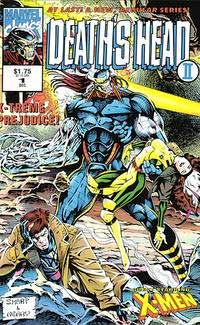
Well?: Having missed the first issue (the cover of which is above, since I couldn’t find any others to use with this piece), I was a little lost as to who exactly Death’s Head was, and why he was named like a sequel to a movie rather than going by Death’s Head Jr. or Death’s Head the Second.

I was even more lost by the weird plot involving giant inter-dimensional monsters called The Raptors (who did not at all resemble birds of prey, but more like the Hulk crossed with aliens from Dragon Ball Z), an evil creature named Wrathchilde that had a head shaped like Death’s Head and a wardrobe like Spawn’s hand-me-downs, and a scantily clad, poorly rendered woman who goes by the name Tuck.

They’re all after the Sapphire Lotus, some magical Maguffin that D.H. doesn’t want them to get because, well, I don’t really know—something about a different dimension where everyone dresses even worse than the X-men, like the Negative Zone inhabited by a race of Terrible Character Designs.

My years laughing at the X-Men cartoon helped me understand this story much better, as the team make-up, their characterizations and their character designs are of the same era as the ‘toon.

In #2, a chapter of “The Lotus FX” arc entitled “X-cuses! X-cuses!”, Wolverine, Cyclops, Gambit, Rogue, Beast, Jubilee and Psylocke are in the middle of fighting the goofy-looking cyborg monster that is Death’s Head, before they ultimately team-up in their quest for the Lotus (I guess the venerable Marvel tradition of fighting and then teaming-up held true at Marvel UK as well).

It’s hard to get past the eye-assaulting art and the aesthetic crimes of the character designs to read the story itself, but perhaps that’s for the best—it’s not a very good story, and there were times I wondered if having read #1 would have actually helped me understand it any better or not. Abnett has definitely improved as a writer in the decade that followed.

Death’s Head himself seems like a mildly interesting character, some sort of decomposing body with a cool name wearing a cut-away (battle-damaged?) scary mask, and with some sort of morphing arm powers. Unfortunately, he sort of looks like half of he characters in the Image Universe when it was first launched.

Sharp’s artwork is about as ‘90s as you can get, with plenty of background-less splash pages. Four panels seems to be the largest amount of panels on any one page. Sharp’s grasp of anatomy is questionable at best, and Psylocke seems to give Sharp the most trouble. In most panels, she seems to be a sort of mannequin totem pole, with a head stacked atop a pair of breasts stacked precariously upon a giant set of hips, with legs like towers at the bottom.

As issue #3 drew to a close, with Tuck hanging by her Vampirella-esque bathing suit by a tree, I was struck by the rampant sexism and misogyny that drips off every panel, but #4 made me realize that it’s not just the ladies whose bodies are over-idealized into unrecognizability and given to being posed suggestively and in states of undress.

This concluding chapter, entitled “X-Terminations,” has Death’s Head and the X-Men facing off against Wrathchilde and his Raptors in a battle in which the only casualties are the X-Men’s costumes. Wolverine loses his shirt completely. Cyclops has half his torn off, revealing his nipple. Rogue has her jacket ripped off and her uniform shredded, so that by the end of the book, her breasts are spilling out of the rips (If Sharp were drawing her anatomy correctly, her nipple would be visible as well), and another tear on her hip reveals as much flesh as they can get away with in these pre-Max Comics imprint days.

Poor Psylocke, who’s costume was already a one-piece bathing suit with one of the most dramatic thongs in all of a comicbookdom, has her uniform shredded as well. In a fierce battle, Sharp gives us a long shot panel of this shredding, with the back of Psylocke’s costume being torn off, and the thong ripping. In the last panel, which is simply the now near-nude X-Men posing, Psylocke is in the back, her costume now just a bib covering the top half of her breasts and a matching loincloth.

I think Death’s Head II himself best summed up my feelings about these three issues early on in the adventure, when he said “Arrghhhhhhhhhh…That hurt.” It sure did, Death’s Head II. But your pain is only fictional; mine is all too real.

Would I Go Back in Time to Buy Them Off the Shelves?: If I could go back in time to when this was actually on the shelf, I’d run into comic shops and scream like a prophet of doom about the upcoming crash of the market, and that all speculators are just totally wasting their time.

That, or maybe I’d bring a copy of Grant Morrison’s New X-Men Omnibus with me just to blow the minds of the X-Men fans of 199s.

Special note: The penultimate page of #2 contains a panel of Tuck, hyped up on lotus “FX” punching Death’s Head in the face and sending him flying. The sound effect used to simulate the sound of her punching his metal face is “WHANNGG!” It’s placed over the sprawling Death’s Head’s crotch. Coincidence, or dirty joke?

Other weird-ass sound effects include “GRRIIIINCHHH!”, which is the sound of an energy beam striking Death’s Head’s head; “WHAOCHUNK!”, which is the sound of Wolverine cutting a Raptor’s throat out; and the very versatile “KZ-AACK!” which is the sound made by virtually any expenditure of energy, be it teleportation, laser beam or explosion.

Friday, December 08, 2006

December 7th's Meanwhile in Las Vegas...

This week's column takes a closer look at Batman/The Spirit and Dead Sonja, She-Zombie with a Sword. If you read last week's "Weekly Haul," you've already read me blabbering about these two books, but go ahead and click over to LVW anyway; it will make my column seem more popular.

Thursday, December 07, 2006

Actually Essential Storylines: Robin


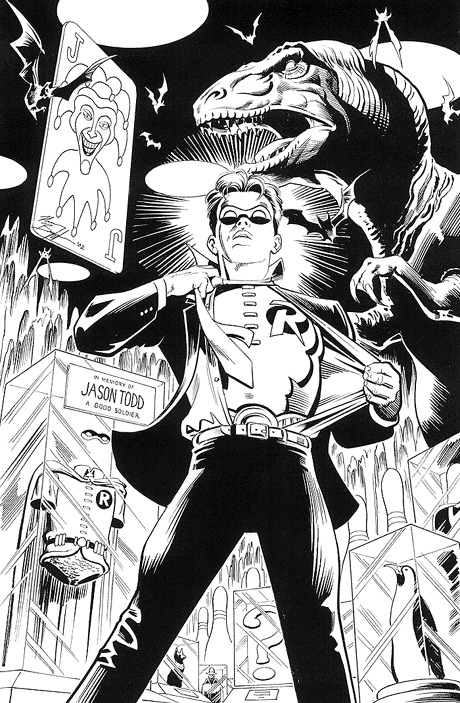
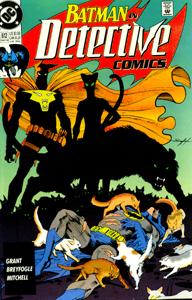
This week’s issue of 52 featured the origin of Robin Tim Drake, written by Mark Waid and illustrared by Freddie E. Williams III, the current artist of the Robin series. As far as Robin artists go, he’s probably not the definitive one, but he's otherwise a perfect choice. Sure, he hasn't drawn as many panels of Robin's adventures as Mike Weiringo, Tom Lyle or Norm Breyfogle (who drew the above image), but he may yet. Williams does do a nice Robin, one that manages to look like a teenager, something so many artist drawing him fail to capture.

The origin is fleetly told and leaves a lot out, as they almost all have so far, which is understandable—Waid's only got six panels to work with, not counting the title panel—and the narration jumps from the original Robin miniseries to Tim’s “One Year Later” adoption by Wayne.

But let’s turn our attention to the “Essential Storylines” bit of the origin, shall we?

Here’s what DC suggests…

BATMAN: YEAR THREE: I didn’t expect to see this storyline on this particular list. While it’s certainly an essential Robin storyline, it’s about the original Robin, Dick Grayson, and Tim Drake has next to nothing to do with it. Written by Marv Wolfman, the story featured Grayson returning to Gotham to face an increasingly obsessed and dark Dark Knight, while his origin is retold, rounding out the “Year” trilogy of Batman’s early years. The art is courtesy of Pat Broderick and John Beatty, with George Perez handling the covers. It was never collected, but ran from Batman #436-#439. I wonder if they actually meant to suggest Batman: A Lonely Place of Dying, which was collected into a trade (though it’s since gone out of print) and which dealt with the origin of Tim Drake.

ROBIN: A HERO REBORN: If you only read one Robin storyline, this is it. This trade collects two story arcs. The first is by Alan Grant, with art by Norm Breyfogle and Steve Mitchell, and it’s entitled—get this—“Identity Crisis.” It’s pulled from Batman #455-#457, and tells the tale of young Tim Drake, Robin-in-waiting, who is temporarily staying with Bruce Wayne and trying to earn the right to become Robin. When Batman and Vicki Vale fall into the clutches of the Scarecrow, Tim has to half-break his vow not to become Robin until Batman says he’s ready, going into action against the villain as Tim Drake rather than Robin (This is the story Waid and Williams reference in panel four, although they get pretty much all the details wrong).
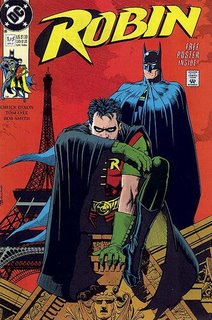


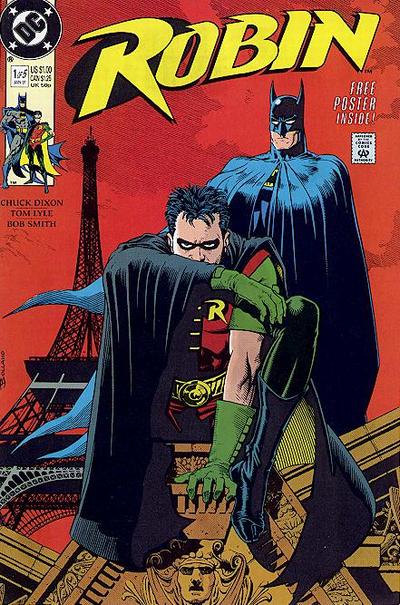
Its followed by the five-part 1991 Robin miniseries, by Chuck Dixon, Tom Lyle and Bob Smith, a team that would become the Robin creators over the next few years (and Dixon would become the definitive Tim Drake writer, writing more stories of him than anyone else). To sharpen his skills, Tim travels to Paris to train under a Tibetan martial artist, but quickly gets sidetracked and involved in international espionage. He meets Lynx and blind martial arts master King Snake, as well as Lady Shiva, who helps train him. In addition to picking up his signature weapon, the collapsible staff, Robin picks up a sling, but it never quite catches on in future stories the way the staff does. Snake and Lynx will be back for several more battles, but, oddly, neither of them really catch on as Robin rogues. Lynx is even killed off—twice.

ROBIN: TRAGEDY AND TRIUMPH: This long out-of-print graphic novel actually contains two storylines, one by the Grant and Breyfogle team about Tim Drake’s parents falling prey to the Obeah Man (which is set before the “Identity Crisis” story in A Hero Reborn, and another by Dixon and Lyle that made up Robin II, which featured this Robin’s first fight against the man who killed the last Robin, the Joker. We’ll get to them below.

IDENTITY CRISIS: Tim’s father was killed by Captain Boomerang as part of an elaborate plan by Jean Loring to cover up the fact that she’d kinda sorta accidentally killed Sue Dibny (How she knew who Tim Drake was in order to target his father for assassination is one of several unexplained and unexplainable aspects of the series).

And here’s what they missed…

ENTER TIM DRAKE: Tim Drake made his first appearances in the Marv Wolfman-written story “A Lonely Place of Dying,” which ran in Batman #440-#442 and The New Titans #60 and #61. In it, Batman reaches his lowest point up until then, driven to the edge of sanity by the simmering anger and guilt over what happened to Barbara Gordon and Jason Todd. One young boy thinks the answer to his problem is simple—Dick Grayson needs to return to Gotham and become Robin again, because Batman always seemed happiest and effective when Robin was at his side. The young boy is Tim Drake, who had figured out the dynamic duo’s secret identity, and hunts Grayson down to sell him on his big idea. George Perez provided the cover art, and the interiors are by Perez, Jim Aparo and Tom Grummet. Though it marks the first introduction of Tim Drake, DC has allowed the trade to go out of print for some reason. (This is the storyline the first three panels of Waid and Williams’ six-panel origin refer to).

Batman and Alfred had something of a problem on their hands with young Tim Drake knowing the secret. No one was sold on the idea of him becoming the next Robin at this point, but the thought crossed all of their minds—Nightwing and even Alfred seemed much more open to the idea then Batman. Fortunately, Tim’s parents were out of town, as they usually were, and he started spending his time in the Batcave, using his nascent detective skills and computer know-how to help Batman out.

He would take his next big step toward Robin-hood in “Rite of Passage,” a four-part story arc running through Detective #618-621, by the Grant, Breyfogle, Mitchell team. While Tim helps Batman catch a cyber-thief by the handle “Moneyspider” (actually a recently introduced Batman rogue who was essentially the anti-Robin), his parents’ jet crash lands in Haiti, where they are captured by The Obeah Man, a nefarious voodoo-working corporate kidnapper. Batman swoops to the rescue, but arrives too late, and the Drakes are poisoned: Tim’s mother dies instantly, and his father is plunged into a coma (this is the story that made up the first half of the above-mentioned Tragedy and Triumph trade).

“Maybe it’s something we all have to though…before we put on the suit!” Tim thinks aloud to Alfred, but DC did something a lot different (and more dramatic) with this Robin, as Jack Drake eventually revived, making Tim the first Robin who had to actively lie to a parent about his nightlife and why he came home from hanging out with Bruce Wayne with bruises so often. Oddly, no writers to follow Grant ever put the Obeah Man to use, though you’d think he’d be a perfect villain for Robin, since he’s essentially his Joe Chill.

ENTER ROBIN: Following the “Identity Crisis” arc and his miniseries, Robin would make his official Gotham debut in Batman #465 by Grant, Breyfogle and Mitchell. The logo was temporarily altered to read Batman with Robin for this issue, and the story, entitled “Debut,” was a pretty busy done-in-one in which Robin takes to the streets solo, helps out Batman and Bruce Wayne and meets Commissioner Gordon, who has just proposed to Sgt. Sarah Essen.

In Batman #467-#469, the Dixon and Lyle team brought King Snake and Lynx to Gotham for a rematch with Robin, but the bad guys hardly stood a chance—This time, Robin has Batman in tow. Dixon and Lyle also handled the dynamic duo on Detective #644-#646 in a story called “Electric City,” and then in #647-#649, they introduced Robin to Cluemaster, who would essentially become his archnemesis, and vigilante her The Spoiler, who would become his girlfriend (and, later, his replacement).

The original Robin miniseries did well enough to generate two sequels by the same creative team. In Robin II: The Joker’s Wild, Batman leaves town just as Joker returns, and Robin must break his word to Batman to never engage the Joker in order to save Gotham. That was followed by Robin III: Cry of the Huntress, which returned the Huntress to Gotham in a big way. In a sign that these were books of the ‘90s, the first sequel miniseries had multiple variant covers for every single issue, each with a holographic sticker weaved into the artwork somewhere, while the second sequel miniseries had some sort of stupid slide cover that would morph the characters on the cover into one another, a gimmick which I never really understood. It also came pre-polybagged. (Man, I haven’t heard the word “polybagged” in a long time).

UNMASKED AND REPLACED: Having proven himself as Robin writer extraordinaire, Dixon oversaw the launching of the ongoing Robin miniseries, which saved us from any more crazy covers. He would pit Tim against villains like Cluemaster, Maxie Zeus and the General; team him up with Spoiler, Huntress and Green Arrow II; and introduce supporting characters and Robin’s car, the Redbird (Which was extremely lame, I thought). Robin and Spoiler would date off and on, and she would eventually have a kid (not Tim’s), and be welcomed into the Bat-family fold, training with Batman and learning Tim’s secret identity. While the monthly has had its moments, few if any of the stories have been great ones, and none really qualify as “essential” reading. Most of the big events in Tim’s fictional life occurred in the other Bat-books, or, more recently, outside of them completely.
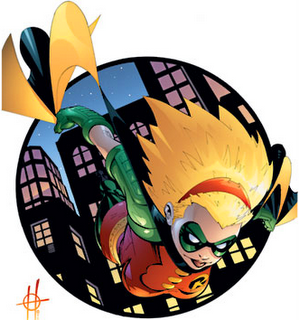
After Dixon left, pretty much every new writer meant a new school and new supporting cast for Robin (although Dixon himself changed this up quite a bit too). Perhaps the most promising was Fables writer Bill Willingham, who oversaw the outing of Tim’s double-life to his father. Needless to say, it didn’t sit well with Jack Drake, who ends up pointing a gun at Bruce Wayne and ultimately forbidding Robin to keep being Robin. It’s been collected into the trade Robin: Unmasked!. Willingham also created a new villain for Robin, but whatever the writer had planned for Tim was ultimately sidetracked by the abysmal “War Games” event/story. While Tim was forced into retirement, former Spoiler Stephanie Brown temporarily took up the mantle as “The Girl Wonder,” and some of her stories are collected in trade Batman: War Drums.

ROBIN IN CRISIS: Robin would play a part in pretty much every big Bat-event and DCU crisis story from the moment he put his suit on. In Gotham, he helped Batman and Jean-Paul “Azrael” Valley fight off Bane and the Arkham escapees in “Knightfall,” and, when the crippled Batman went off to search for the kidnapped Shondra Kinsolving, he left Robin and Azrael in charge of Gotham during “Knightquest.” That didn’t go so great, and in “Knightsend,” Robin joined Nightwing, Catwoman and a freshly healed and re-trained Batman in reclaiming the cape and cowl from a bat-shit insane Azrael.

During the plague outbreak of “Contagion,” Robin was infected and very nearly died. After the “Cataclysm,” when Gotham was plunged into “No Man’s Land,” Batman forbid Robin from operating in Gotham, which was just as well, as the Drakes moved to Keystone City for a time. He snuck in once with the help of Superboy, Impulse and Lagoon Boy, and was later summoned by Batman to help him retake the city along with their other allies Nightwing, Azrael, Oracle and the New Batgirl.

During “War Games,” Tim was in retirement while a citywide gang war broke out for absolutely no reason, but he still fought off the gangsters who invaded his high school in plain clothes and helped out at Dr. Leslie Thompkins’ clinic for a while. Ultimately he suited back up, but couldn’t save his ex-girlfriend Stephanie from being tortured to death by the Black Mask (But wait, this dumb-ass story says it wasn’t Mask who killed her after all, it was Dr. Thompkins…man, if there’s one story I’d like to see Infinite Crisis wipe out of continuity, it’s this one).

On the national stage, Robin crossed staffs with Anarky in Robin Annual #1, part of the “Eclipso: The Darkness Within” summer event. The following year, when aliens known as Parasites invaded our dimension to feast on spinal fluid (and accidentally create new meta-humans known as “New Bloods”), Robin teamed up with Gotham thief-turned-New Blood Razorsharp (who, despite a few promising appearances since, was burned to ashes by Superboy-Prime in Infinite Crisis) in Robin Annual #2. Later, he joined other superheroes in a frontal assault on the Parasites’ lair in Bloodstorm #1.

During “Zero Hour,” Tim briefly met a young version of Dick Grayson as part of the chaotic chronal effect stemming from Parallax and Extant’s attack on the timestream in Robin #10. He played a fairly central role in the battle against the Joker and his Joker-ized hordes in Joker’s Last Laugh, and was even presumed dead for a while. In Identity Crisis, his dad was killed, part of an extremely crappy year for our hero. Identity Crisis followed right on the heels of “War Games,” so his ex-girlfriend and father were both murdered within a few weeks of each other, and to get him out of town post-“War Games,” Batman sent him to defend the city of Bludhaven, which was ultimately obliterated by the Brotherhood of Evil in Infinite Crisis. That’s not the only thing Tim lost in IC, of course; his best best friend Superboy was killed fighting Superboy-Prime.

TEAM PLAYER: After meeting Superboy in Superboy/Robin: WF3: World’s Finest Three and Impulse in Robin + Impulse #1, Robin would join the pair for the poorly named team endeavor Young Justice. After a few poorly-written appearances and a bad start, their monthly series would eventually hit its stride under writer Peter David and artists Todd Nauck and Larry Stucker. Originally they teamed with Wonder Girl, Arrowette and Secret, and operated out of the Justice League’s old Happy Harbor base, with Red Tornado serving as their chaperone, but their base would move around a bit and they’d add several new members over the years, including Empress, The Ray, Lil’ Lobo, Slobo and Snapper Carr. Only two books of the series have ever been traded, Young Justice: A League of Their Own (which collects the worst issues of the series) and Young Justice: Sins of Youth (which collected their incredibly fun crossover with the rest of the DCU). Robin was the team’s defacto leader, up until Wonder Girl was elected leader as the series drew to a close.

The team dissolvde during lame-ass Geoff Johns/Judd Winick collaboration The Titans/Young Justice: Graduation Day, during which a renegade Superman robot went on the fritz and killed Lilith and Donna Troy.

Robin, Superboy, Impulse and Wonder Girl would reform under the guidance of B-Listers Cyborg, Starfire, Beast Boy and the just-reincarnated again Raven to form the latest version of the Titans in Teen Titans. The series has so far been collected into no less than six trades, all written by Geoff Johns and drawn by a variety of artists. The book was rather formless and directionless, and a lot of the character development extremely forced (Robin and Superboy became best friends over night, Superboy and Wonder Girl became boyfriend and girlfriend in even less time, Impulse became “dark” and mature as Kid Flash), but Johns turned the series around post-Infinite Crisis, and Robin is now the team’s leader with a new line-up.

ONE YEAR LATER: The most interesting aspect of this week’s “Essential Storylines” was the notably absent four-part “One Year Later” arc from Robin, which was collected with another story in Robin: Wanted. Written by the current Robin scribe Adam Beechen, with pencils by Karl Kerschel and Williams, this is the story that introduced Robin’s new costume (Click here to see how old some prominent elements of the “new” design actually are), turned Robin’s fellow sidekick Cassandra Cain into a stereotypical Dragon Lady villain (contradicting every single Cassandra Cain story ever written in the process), announced Bruce Wayne’s intention to adopt Tim Drake and chronicled Robin’s first meeting with Captain Boomerang Jr. I agree with DC; don’t bother reading this story. The first issue had a lot of promise, but it’s hard to care much about a story written and edited by folks who have apparently never read a single Batman story from the past ten years (In addition to making Cassandra Cain into a villain, Beechen also manages to make Oracle, Batman, Nightwing and Robin all look like idiots, and re-kill the already dead Lynx). You’re much better off checking out Batman: Face the Face, the “One Year Later” story from the pages of Batman and Detective, which similarly breaks the news of Bruce’s decision to adopt Tim. In the pages of Batman Tim met Bruce Wayne's alleged son with Talia al Ghul, and the two "brothers" didn't get along well at all. In this week's Detective #826, Robin gets a rematch with the Joker. And in Teen Titans, Tim's apparently been taking Superboy's death pretty hard, and has been devoting himself to clone him back to life.
Weekly Haul: December 6th


52 #31 (DC Comics) For the second week in a row, the book seems to be particularly Morrison heavy, so much so that I read half the dialogue in a Scottish accent. Deep in space, we get a look at this crazy plague Lobo was talking about, as he and his allies (now including Ekron) prepare to cut it off at the source. Back on Earth, Everyman uses his shape-changing powers in a rather sketchy but perfectly understandable way, Ralph Dibny hits a flask (of Gingold, I hope…?) and chats with Wonder Girl, and, in the most maddening bit of the this week’s book, he solves the mystery of Supernova’s identity. Off-panel, of course. Here’s how he breaks it down: “The who made perfect sense. The powers threw me, but when I saw them from the proper angle, I sussed out the one device that could tie them all together. Superman being out of the picture was the key. One of two keys, if you want to be cute about it.” I lingered on that page for quite a while, reading that bubble over and over, but I just couldn’t figure it out. My best guess remains Booster Gold because of the familiarity with Ralph, but I don’t get the “key,” why Supes would have to be gone, or the device, so Booster’s just a wild guess. And why is “angle” emphasized like that? Confidential to 52 editorial: Nice save on the “Cult of Connor” business, even if it was really awkward and not really true (that phrase appeared in a headline in a clipping Ralph was waving around previously). Don’t forget to change that headline and cut out Cassie’s bubble about the C.O.C. in the trade.

Agents of Atlas #5 (Marvel Comics) It’s another exposition-heavy issue, as we learn the true origins of Venus (Hint: Should Jeff Parker get to write an Agents of Atlas/Mighty Avengers crossover, she and Ares won’t have all that much to talk about after all), and the team ferrets out the traitor in their midst…sort of. Only one more issue to go, and you all damn well better buy it, because I’m hoping for an ongoing of this creative team handling this weird-ass superteam.

The All-New Atom #6 (DC) There’s a whole lot to like about this series, including it’s wonderful setting, gorgeous covers and the number of pilgrims cameo-ing the backgrounds, and this first story arc had a neat idea behind it (a war between science and magic) and some interesting villains (the flea people with the weird grammar), but as the first story arc comes to an end, it’s clear the book’s start has been—what’s a nice way to put it?—rocky. We’re only on issue #6, and we’ve already had two different artists with two very different styles, and this penciller, Eddy Barrows, does a merely serviceable job. The two-page splash spread on six and seven is written as if it should be a total money shot, but instead it’s simply a suburban grid with five or six giants in it, with random supervillains choosing seemingly random sides (not sure what’s going on in that monkey panel). The book has all the elements of a great one, and writer Gail Simone has severely cut back on her misuse of asterisks (only one instance this issue), but it’s birth has been a messy and painfully awkward one, as if it was launched a few months too early, and without sufficient development. Here’s hoping things get better from here on in.

Batman Confidential #1 (DC) For this they cancelled Legends of the Dark Knight? Just like the over-ten-years-old LDK, this book is set during Batman’s early years, and is dedicated to rotating creative teams telling previously untold tales of Batman’s long crime-fighting career. The problems start immediately, with the title that sounds like a Harlequin romance novel about the Caped Crusader, and the cover by artist Whilce Portacio who apparently couldn’t find any photo reference of Bats when he sat down to draw it, and settled for Muppets instead. Writer Andy Diggle has done a fine job rehabbing DC characters in the past—see his Swamp Thing and Adam Strange: Planet Heist—but doesn’t do anything too sensational here. The story is that of Lex Luthor and Bruce Wayne’s first meeting, but it opens with a paint-by-numbers Batman vs. Thug scene and makes a minor but oh-so-easy-to-avoid continuity flub (At this point, the only human being on Earth who should no about the existence of Gorilla City is Barry Allen; and if Luthor did know it, he certainly wouldn’t use it as a random example like he does publicly here). A bigger problem is Potacio, who is visibly, painfully struggling with fundamentals here. Note Batman’s never-symmetrical, never-the-same-length ears, Luthor and bodyguards’ repulsive choice in suits and a couple of panels that just plain make no sense (page 8, panel 1; page 20, panel 1). I think I’ll sit the remainder of this arc out.

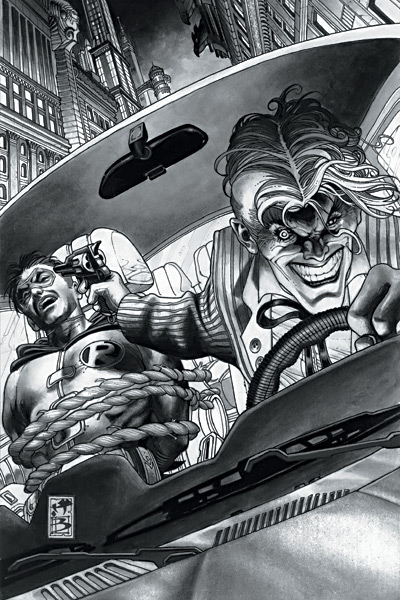
Detective Comics #826 (DC) Okay, I give up. I can’t think of a better Joker story I’ve read, except for maybe Mad Love, which was also written by Paul Dini. In his best done-in-one of his run, Dini stages a dramatic Joker and Robin confrontation, with Mr. J. rescuing the Boy Wonder from a gun fight, then gassing him, tying him up in the passenger’s seat of a car (and using a glass Christmas bulb for a gag—nice touch) and then driving around town running people over while chatting him up. In addition to the strong setting and nice ironic climax, Dini really gets into the Joker’s head here, letting us see the method to his madness, and, via narration, gives us a nice peek into Tim Drake’s detective skills. The art is by Don Kramer and Wayne Faucher, and though it’s not as strong as the writing is (during a flashback to the Bat Family’s trip around the world, it’s hard to distinguish Dick Grayson from Bruce Wayne), they do a wonderful Joker, one who seems one-part DCU Joker and one-part Batman: The Animated Series Joker. Just make sure you stop reading after the third panel on page 21; the last page and a half are a sub-par denoument to an otherwise excellent story.

Dr. Strange: The Oath #3(Marvel) This is issue three of a five-part miniseries, so it’s more than halfway over at this point. And it’s just as awesome as the last two issues. Like Agents of Atlas, this is a book just begging to be a monthly.

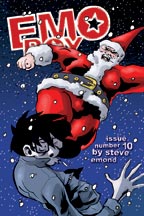
Emo Boy #7 (Slave Labor Graphics) “Well, I know who’s naughty, and I know who’s nice…why shouldn’t I know who’s emo?” With those words, Santa Claus meets Emo Boy in a diner on Christmas Eve. Our melodramatic hero has been hunger-striking to protest the horrible commercial ritual that is the modern American Christmas, and suffering all sorts of (hilarious) hunger-induced hallucinations as a result. He gets introduced to a whole new kind of suffering when the Christmas spirit is literally beat into him. An all around great issue of an all around great series, and just in time to give to the most emo person on your Christmas list (Though the cleverly-named trade might also make a good stocking-stuffer).


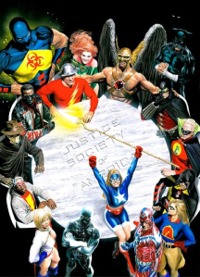
Justice Society of America #1 (DC) Wow, now this is a relaunch—I hope Brad Meltzer and Brian Michael Bendis are taking notes. Writer Geoff Johns returns to the JSA, bringing along cover artist Alex Ross, who gives us not only a kick-ass team portrait for the cover, but alo a brand new logo and his Kingdom Come Starman design. In 40 pages, Johns teases the events of 52, gives the JSA a new, separate and distinct raison d’ etre from the JLA’s, introduces and kills off one legacy character, reassembles the Society with some intriguing new characters and gives them a brand new base. It took New Avengers about 15 issues to accomplish that much, and Justice League of America has spun its wheels for four dithering over the roll call. I have a quibble or two, particularly regarding DC’s goddam Multiverse (the status of which no one who reads, creates or edits DC comics seem to be clear on at this point), but this is about as close to a perfect issue as a superteam’s #1 issue can be. Don’t believe me? Okay, well in addition to New Avengers and JLoA, please also take into consideration the recent Teen Titans, The Authority, WildC.A.T.S. and Gen 13 re-launches.

The Irredeemable Ant-Man #3 (Marvel) Finally, a Marvel superhero who tries to pull the same crap most of us readers would if we had such amazing powers. This is probably tied with Dr. Strange for being my favorite Marvel book at the moment.

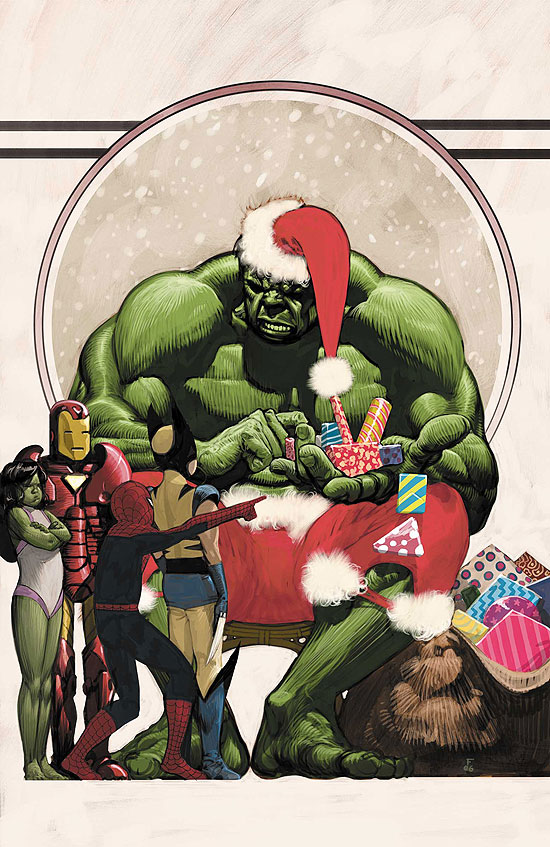
Marvel Holiday Special (Marvel) Well, this book is definitely not worth the $3.99 price of admission, particularly considering how little of it is actually comics-comics, but it was definitely a lot of fun. The less said about Frazer Irving’s cover the better, because it just blows my mind (Why is the Hulk and adult, while the other Marvel heroes are kids? I don’t get it). There are only three short stories contained within. One is “A.I.M. Lang Syne” by Andrew Farago, Shaenon K. Garrity and Ron Lim, about A.I.M.’s holiday office party (the jumps at the end of each scene, like “Continued on 13th Page Following” are almost as funny as the jokes themselves). Then there’s “How Fin Fang Foom Saved Christmas,” by the Fin Fang Four creative team of Scott Gray and Roger Landridge, which teams Foom and Dr. Strange’s manservant Wong against a Hydra cell and a giant robot Santa (Confidential to Wong: There’s only one “L” in that kind of lama; if you actually meant llamas, then there are more of them in NYC than in Tibet). Finally, Mike Carey and Mike Perkins present a Thing vs. Annihilus story in rhyme that really has nothing to do with the holidays. The rest of the book is rounded out by weird little extras, like cut-out ornaments, a full-page, four-paragraph letter from Ralph Macchio, reprints of past holiday special covers (those Adams ones sure put this year’s to shame!) and the ridiculously extensive Marvel Handbook-style entry on Santa Claus.

Midnighter #2 (DC/WildStorm) Ever wonder why Hitler only had one ball? Wonder no longer, as Garth Ennis provides the reason in the second issue of his appropriately silly new series, in which the Midnighter is sent back in time to kill the future Fuhrer before he gets a chance to set up any death camps or invade Poland. Last issue, Midnighter kicked a tank shell that was fired at him just as easily as if he were punting a football. This issue, he chews through barbwire. I like how Ennis is writing the character as a mixture of Batman and the Punisher, with all the powers of Popeye.

Stan Lee Meets Silver Surfer #1 (Marvel) Wow, even Stan Lee, who wrote so much of the Surfer’s insufferable pseudo-philosphical ramblings, finds him annoying. In the Lee-written, Mike Wieringo-drawn lead story, Galactus summons Lee to try putting up with the Surfer for a few minutes, but Lee’s only human. Best part? Lee narrating out loud to himself as he’s teleported aboard Galactus’ ship, to which the big G. responds, “Spare me your comic book dialogue!” The second story is by Paul Jenkins and features art by Mark Buckingham, and it’s a pretty fawning ass-kissing of Stan, with Jenkins even patting himself on the back for creating Superman knock-off The Sentry. I especially enjoyed Lee telling the young Jenkins to try thinking of a charater of his own “in the mighty marvel style,” and out pops a character in the distinguished DC style. Back-ups include a two-pager by Jacob Chabot pitting the Marvel Universe’s lamest villains against Lee, and a reprint of an old-school Spidey vs. Surfter story by Lee and John Buscema.

Superman Confidential #2 (DC) The story of Superman’s first confrontation with kryptonite continues. The big green rock is still narrating, but now it seems like there’s something inside doing the thinking. Meanwhile, the young Superman again puts his invincibility to the test while fighting a volcano, learning that he can fill his lungs with lava and puke it up as if it were nothing worse than sea water. Also of interest is the possible reason why Superman lied to Lois about his real identity all those years. A well-written, beautifully drawn book, which I enjoyed all the more now that I’ve seen how badly wrong a Confidential book can go.

Saturday, December 02, 2006

November 30th's Meanwhile, in Las Vegas...


This week's Las Vegas Weekly column looks at Bardín the Superrealist (which I can't reccomend highly enough), baking manga Yakitate!! Japan and graphic memoir Mendel's Daughter.

And while you're at LVW, you may want to check out Geoff Carter's intriguingly headlined story "Blog Is Dead," which explains how and why myspace is bad for the blogosphere.

Wednesday, November 29, 2006

Weekly Haul: November 29th


52 #30 (DC Comics) The company line is that all four writers involved with this weekly title write every single page as a team; that is, they all plot, they all script dialogue, and they all take a pass on every single page. Having not been involved in any of the meetings, I don’t know if this is true or not, but, this issue in particular, it doesn’t seem to be. Or, at the very least, certain writers’ fingerprints are much more evident on certain scenes than usual. The history of the Batman, for example, sounds an awful lot like what Grant Morrison told Newsarama.com in an interview was his vision of Batman’s personal history, and some of the lines read like they poured right out of Morrison’s finger tips (Not only the “Defeat me and the ten-eyed surgeons of the empty quarter will come to slice out your demons,” but even the offhand comment about the Joker being “this crazy, brilliant clown running around”). Likewise, the Question/Montoya segments read like those written by Greg Rucka, in part because he wrote a very similar story about the Huntress and the Question before, and in part because he’s the only writer who regularly uses the detective novel narration.

At any rate, this is a particularly rich issue of 52, from that masterpiece of a cover (muddied up by text as it is), proceeding through scenes featuring all members of the current Bat Family, and a weird new take on half-forgotten rogue The Ten-Eyed Man. In a mostly wordless sequence, artist Keith Giffen and Joe Bennett give us a “greatest hits” version of the personal tragedies endured by Batman, including the crippling of Barbara Gordon, his own temporary crippling at the hands of Bane, a scene that could come from Contagion, No Man’s Land or War Games, the revelation that his dead sidekick Jason Todd came back to life due to an inter-dimensional version of Superman punching along the walls of the “Heaven” dimension he was trapped in and thus altering the time stream, the death of Jack Drake and, finally, holding a gun to Alex Luthor’s head at the end of Infinite Crisis (One of these things is not like the other; can you guess which one?). Notice no mention of Cassandra “Batgirl” Cain anywhere in this issue, or Leslie Thompkins going over to the dark side for, um, whatever reason she suddenly became evil.

Aquaman: Sword of Atlantis #46 (DC) To keep this supposedly monthly series semi-monthly, a guest creative team is called in, sort of. Regular series artist Butch Guice draws the two-page prelude, while Phil Winslade draws most of the story (so well, in fact, that I wouldn’t mind he and Guice switching regular art duties, particularly if Winslade is the faster artist of the two). Regular writer Kurt Busiek gets top writing credit, but Karl Kesel as listed as “co-plotter.” The story is a sort of flashback that King Shark tells himself while training the new Aquaman, about his first encounter with the previous Aquaman. Or, as the title page puts it, this is “a tale of the classic Aquaman…in the days when he was king!” In it, Orin, Mera and Vulko visit a trading outpost, where King Shark has been biting people’s heads off—literally. Seeing how this story fits in with the newer high fantasy, “Swordfish and Sorcery” approach to the book Busiek has been taking since he took over, it does raise the question of why we even needed a new Aquaman. The classic one takes to the setting just as well as the new one.

Batman #659 (DC) After just four issues, the hot, new creative team of Grant Morrison and Andy Kubert apparently needed to take a break and, rather than letting this monthly miss shipping dates, DC drafted the creative team of John Ostrander and Tom Mandrake (responsible for the superlative series, The Spectre). I feel pretty bad for the pair. Individually, they’re great talents, and together they’ve produced one of the best DC series of all time, but following the industry’s hottest writer and hottest penciller is a thankless task. The first chapter of this story sets it up as a fairly unremarkable one. There’s a new bizarrely-themed rogue in Gotham named “Grotesk” who, in addition to not being able to spell very well, is cutting parts of his victims’ faces off and then burning them alive. Mandrake’s art is fantastic, some of the best of his career, and Ostrander’s story is serviceable, but a little cliché-ridden, and too pre-Morrison Batman. The most exciting thing about this title at the moment is the radical things Morrison is doing with the characters, but this could be just another issue of Paul Dini’s Detective Comics, or form any point in the last 20 years worth of Batman stories, really.

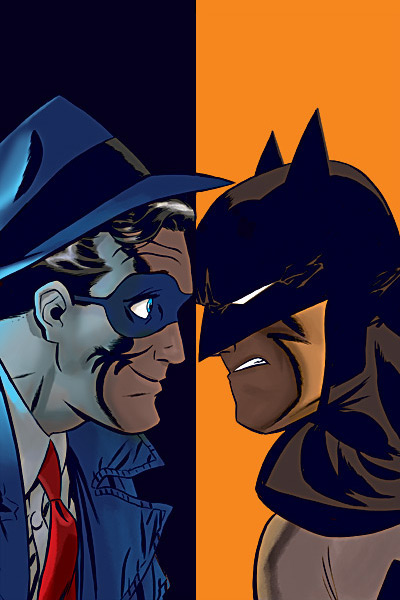
Batman/The Spirit #1 (DC) Good Thing About DC Having the Rights to the Spirit #1: It keeps Will Eisner’s work and character in the public’s consciousness. Good Thing About DC Having the Rights to the Spirit #2: This fun crossover. Writer Jeph Loeb has been letting me down quite a bit lately, but he’s in top form here, and this book fits nicely in with his best DC work (That is, everything with Tim Sale). Darwyn Cooke’s art is similarly spot-on; there’s nothing quite like a book so well illustrated that you have to pause every couple of pages just to admire the panel. The story is compact, but does everything you could hope such a crossover would do. Loeb, Cooke and inker J. Bone synthesize the best bits of Batman comics, the Bruce Timm-produced cartoon and even the old live action TV show for a sort of perfect Batman, and Eisner’s characters fit surprisingly well into this world (Cooke and Loeb do an especially fantastic job setting up the title sequence). The story? The two title heroes’ pipe-smoking police contacts, Dolan and Gordon, reminisce about the time their masked allies met one another. The two policemen attend a Policeman’s Benevolent Association ball in Hawaii. Spirit rogue The Octopus unites the Rogue’s Galleries of both Batman and the Spirit in an elaborate plot to bump off Dolan, Gordon and the rest of the country’s best coppers all at once, a plot that Batman, the Spirit and Robin must try to put the kibosh on. I was leery of an Eisner-less Spirit comic but, after reading this, I’m looking forward to Cooke and Bone’s Spirit #1.

Black Panther #22 (Marvel Comics) Any Marvel reader not currently reading Black Panther is missing out. I have some reservations about the title myself, particularly about its highly glitchy continuity and the ever-changing artists, but the “World Tour” story that wraps up here in a “Civil War” tie-in has been one great jumping on point after another. In this issue, Panther and Ororo visit Captain Britain to see if he’s down with joining their Coalition of Kicking Iron Man’s Ass or not, and then head to Washington D.C. to sit down with the president but, as has been the case with every meeting save the one with Namor, end up throwing down instead. Who with? Briefly with Jim Rhodes, a.k.a. War Machine, a.k.a. “The Black Iron Man” (Cool. I’ve been wondering whose side he was on). And then with Tony Stark, a.k.a. Iron Man, a.k.a. “The White Iron Man.” With both Namor and the Panther (and, thus, the respective countries) lining up against Stark, I honestly don’t even see how the final battle of “Civil War” is going to be anything but a rout. I guess we’ll find out in a few more months…


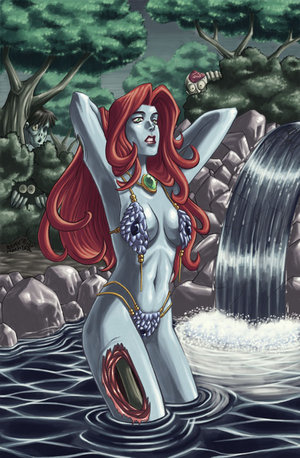
Dead Sonja, She-Zombie with a Sword #1 (Blatant Comics) Well, it had to happen sooner or later, didn’t it? I’m sure Dynamite Comics, who currently own the rights on Red Sonja comics and sell plenty of zombie-related comics due to their rights on Army of Darkness comics are kicking themselves for not thinking of this first. Hell, I know I am, and I don’t even own a comic book company. Writer Rob Potchak Jr. and Blatant certainly get props for coming up with a genius idea and title, but there’s nothing inside the book as remotely clever or well executed as the title, logo and covers (they even have several variant covers, ala Dynamite’s Red Sonja books). The black and white art, by Owen Gieni, Ap. Furtado and Remy “Eisu” Mokhtar (that’s Eisu’s cover pictured) is all decent, and done in a fun, loose style, but few of the jokes are very funny. Of course, seeing as the sixth page of this 48-page comic includes a rape-related joke, it’s hard to find anything that follows even remotely chuckle worthy, as that’s a pretty reprehensible thing to include in any story, let alone one as unserious as this.

Green Lantern #15 (DC) Attention, Justice League fans! This issue of Green Lantern features the first appearance of the new Justice League line-up that’s currently being teased on covers of the JLoA monthly. You know, Black Lightning, Arsenal, Hawkgirl, Vixen, Red Tornado—those guys. Now, they look pretty cool all lined up and posing like that in the snow, but you know where a better place to introduce the team might have been? Their own title, which has yet to formalize the line-up (Four issues in, writer Brad Meltzer is still gathering the team together). They’re in the book for the same reason just about everyone seems to be in it these days—to take down rogue superhero Hal Jordan. Also vying for the honors are a mind-controlled Global Guardians, the faceless hunters of Saturn and the Rocket Red Brigade. Johns throws all kinds of good craziness at readers this issue, including another teasing look at the growing Sinestro Corps (I like how their home base resembles a Santa’s workshop of evil here). My only real complaint with this particular issue is Jordan’s comments about Tasmanian Devil being gay and, during their time on League factions, harboring a crush on Jordan. Our hero blasts him with his ring and quips, “I told you before, Taz. You’re not my type.” Can’t a gay were-Tasmanian devil attack a straight superhero without the straight superhero assuming he’s making a pass at him? It’s in character with Johns’ new, Guy Gardner-ified, post-Rebirth Jordan, but it’s still pretty ugly.

The Immortal Iron Fist #1 (Marvel) I know precious little about Danny “Iron Fist” Rand, other than the fact that his name makes me snicker almost as much as his goofy-ass costume, but the three first names on this creative team are enough reason to check out just about any comic book: Brubaker, Fraction and Aja. The issue itself gives plenty more reasons to check out #2, including Aja’s gorgeously sketchy and dark art (and neat little way of highlighting kung fu action) and Brubaker and Fraction’s terse narration and widening the point of view to make this a story about a dynasty of Iron Fists, not just Danny. Now, about that school picture of Luke Cage…

Stan Lee Meets Doctor Doom #1 (Marvel) The Lee-written lead-ins on this series of one-shots have been mostly hit-or-miss, but this one’s a definite hit. At home working on a model of a ship (I love how Lee presents himself as this old guy who putters around on different hobbies like baking, biking and miniature ship-building all day) one day, he’s summoned to Latveria by Victor Von Doom, who’d like to have a little chat with him: “ I am displeased by the manner in which I am portrayed in American comic books.” He earns his freedom by pointing out that he’s just a guy who cameos in superhero movies. The art on this piece, by Salvador Larroca, is just drop dead gorgeous—Latveria and its doombots have never looked so awesome. Back-ups include a Jeph Loeb and Ed McGuinness story about Lee once again goading his creations into playing their roles and a classic Fantastic Four story by Lee and Jack Kirby. That’s a lot of good comics reading for just $3.99.

Superman/Batman #30 (DC) Penciller Ethan Van Sciver is a force to be reckoned with. He’s just an incredibly gifted artist, one who’s capable of drawing just about every DC character very well, and rendering some of them so well it’s downright transcendental. Like Green Lantern Kilowog, who looks like some sort of humanoid rhinoceros, with a touch of extinct giant mammal to him. Or Plastic Man, whom Van Sciver gives a strong sense of realism and three-dimensionality, which makes his cartoon-ish shape changing seem all the more impressive. When this Plas is at rest, he seems as real as Batman, Alfred or Superman, but when he stretches a limb, all the detail and line-work fades away, and you can see him stretching his molecules (Page 18, panel 2—tell me that isn’t one of the best Plastic Man panels you’ve ever seen; I dare ya!). Van Sciver’s skills are, unfortunately, a huge liability to a monthly comic book like Superman/Batman should be, as he draws too slowly to keep a monthly schedule. So, what’s he doing as the regular artist on this series? I have no idea. If you’ll allow me to engage in a bit of armchair editing here, if it were up to me, I’d get Van Sciver on an All-Star book or working on an arc to be fit into one of the Confidentials or Classifieds, where he can take his time drawing and the finished product can be fit in whenever there’s an open slot, rather than having him hold up what should be a top seller month in and month out for DC.

Now, back to the issue at hand, this issue of Superman/Batman, we’re in part three of the Bunch of Crazy Shit Happens For No Reason storyline. Superman fights Kilowog, but whatever seems to be controlling Big K’s mind is starting to get into Supes’ too. Meanwhile, Lex Luthor calls Batman in to steal something from the Fortress of Solitude that could be the key to unraveling this mess, and sets him up with Plastic Man (in his first “One Year Later” appearance, Plas fans). For some reason, Batman acts like he barely knows Plas and as if they weren’t on the Justice League together for, what, 95 issues or so? Plas also mentions that he has a son now, which puts the Joe Kelley stories about Plas as a deadbeat dad back into continuity, after Kyle Baker went to the trouble of knocking them out of continuity. You know, I don’t mind Plas being a reformed thief, but I really don’t like the idea of him being a reformed deadbeat. Oh well, I guess we’re just lucky he survived Infinite Crisis and hasn’t been super-punched out of continuity.

Teen Titans #41 (DC) I could have sworn “Titans Around the World” concluded last issue, but I guess not, as the Titans are still fighting Bombshell this issue. Jericho is back from the dead and with a better haircut and costume, and he narrates the issue, as the team takes on Bombshell and her freelance military specialists, who all wear Nazi-style helmets for some reason (To let us know they’re the bad guys, maybe…?). Bombshell gets her butt kicked, naturally, and also gets her top shredded to the point that it’s barely functional. The only other noteworthy story beats involve a surprise guest appearance by Sarge Steel and Agent Diana from the pages of Wonder Woman (no idea where this fits into her story, though), a light bulb going off over Robin’s head about how to resurrect Superbly and Miss Martian and Jericho officially joining the team. The art is by guest painkillers Pico Diaz and Ryan Benjamin plus five inkers, which might explain why it’s so horribly inconsistent. This is a very, very ugly book, and character designs change rapidly from page to page.

Confidential to Deathstroke: There’s no “N” in the word “kid.” Jeez, I thought your special implants gave you the ability to utilize 90-percent of your brain, and yet you can’t spell simple three letter words? How on earth do you ever hope to defeat the Teen Titans?

(Not actually an installment of) Actually Essential Storylines: The Metal Men


This week’s issue of 52 featured the origin of The Metal Men, written (as each origin is) by Mark Waid and drawn by artist Duncan Rouleau. Given what a major role Dr. Will Magnus has played thus far in the series, it’s high time they got around to explaining just who the hell he and his robotic creations actually are.

Unfortunately, I’m not well versed enough in Metal Man history to present the regular “Actually Essential Storylines” feature on the team. Turning my longboxes upside down and shaking yielded few results and, aside from a few random guest-appearances here and there, the closest thing in my personal library to a Metal Men story is their guest appearance in a few chapters of Showcase Presents: Metamorpho Vo. 1.

Apparently, their past isn’t terribly important anyway, as the only things DC lists under “Essential Storylines” is Metal Men Archives Vol. 1 and 52, the series you’re already holding an issue of in your hand.

Looking at the origin itself, it’s clear that Magnus is the star of the Metal Men in the post-Infinite Crisis DCU, as the Metal Men’s names and powers aren’t even all mentioned in the story. As always, it may also be worth noting what Waid leaves out—no mention of the mid-90’s revamp, in which the robots’ personalities were based on those of real people, nor of Magnus’ time as “Veridium” or as part of “Enginehead” in the short-lived series by the same name.

Waid does manage to give the team their very own, distinct mission statement here, which makes this origin a bit of a manifesto for the team—“The Metal Men specialize in defending earth from the unique menace of cutting-edge science gone wrong.”

Rouleau, for his part, does such a fine job in designing the characters and visually imbuing each of them with visible personalities (and making that “responsometer” look so cool) that putting him on a full-length Metal Men story seems like a foregone conclusion.

I’ll be back next week with a full installment of “Actually Essential Storylines.” In the meantime, feel free to peruse the archives:

Catman

Black Canary

Nightwing

Booster Gold

Wildcat

Green Lantern Hal Jordan

Steel

Elongated Man

Tuesday, November 28, 2006

Delayed Reaction: Spider-Man: The Other—Evolve or Die


Spider-Man: The Other—Evolve or Die (Marvel Comics), by Various

Why’d I Wait?: Rage, mostly.

This crossover story spanned all of the Spider-Man titles, and had several different creative teams, two of which I wasn’t terribly interested in (I do like JMS’s work on The Amazing Spider-Man—although I missed the Gwen/Goblin issues, so that might be why I still like it—but dropped it after John Romita Jr. left the series; Reginald Hudlin’s previous arc on Marvel Knights Spider-Man, meanwhile, was an interesting premise horribly executed). But what really repelled me was that one of the titles it would crossover into was a brand-new one, Friendly Neighborhood Spider-Man, which was to be written by Peter David and penciled by Mike Wieringo. I was very excited when that title was originally announced and eagerly awaited adding it to my monthly reading, but launching a new title with a number one issue that then continued into other titles just left a bad taste in my mouth, and I ended up passing on both the event and the FNS monthly.

Why Now?: Because now it’s available in a hefty trade paperback collection which can be borrowed from the library and read for free.

Well?: This overall story shares a lot of problems with the three Batman trades containing the epic “War Games” story, starting with a ridiculously long title, and then extending to different writers with different storytelling styles, art styles that don’t blend together at all and thus actively clash and mediocre editing that leads to character designs shifting between chapters. These problems seem endemic to these sorts of crossovers in general (and are emphasized when reading the stories in trade, rather than single issue installments), and neither Marvel nor DC seems interested in solving them, though it’s actually not that hard to do. In fact, I can think of two ways.

One is to get one single artist to draw the whole thing. The only real challenge is that you’d have to have the story mapped out far enough in advance that said artist would have the necessary lead time to get it all drawn. The second strategy is to make the story so damn good that no reader would ever dare wait read the trade, but would instead pick up each installment as they came out.

I remember this storyline proving pretty controversial among Spider-fans, in part because it played with and built on JMS’s mystical/magical origins for Spider-Man’s powers (Personally, I didn’t mind them at all, as JMS left them equivocal, and we were basically taking Elijah and Morlun’s word for how definitive that origin was over the more simple, traditional explanation that it was just radioactive spider venom). To be sure, things get very, very weird at the climax (I don’t even understand why the arm spikes appeared at all), but the story is filed with lots of little segments that work well on their own.

JMS has always excelled at handling Spider-Man’s relationship with his family, and I always enjoy seeing his Peter Parker play off his wife and aunt, particularly know that he’s “out and proud” with them, and they’ve all moved into Avengers Tower.

Peter David also provides from nice little scenes, like the horribly named new villain Tracer, and a guest-star packed chapter in which Spidey visits with the Marvel Universe’s most brilliant minds to seek a cure for his condition. Hell, even Hudlin, who writes the weakest points of the story, has his moments, like the Parkers’ use of a time machine, as Peter tries to make his last days with his family ones to remember.

Did I say last days? Yes, I did. As for the overarching story, during a battle in which he gets shot by the world’s slowest bullets, Spidey finds out he’s dying, just as Morlun comes back to eat his spider-powers. After seeking a cure and getting his affairs in order, Peter prepares to die, and Morlun makes sure it’s a very violent death. On his deathbed, Peter gets all spider-y, eats Morlun’s head, and then dies. Only to be reborn, better than ever!

There are some problems in the book that will make your head spin—in one issue, Mary Jane’s arm is broken, in the next, it’s completely fine—but the greatest problem with the story is the context in which it takes place. JMS, Hudlin and David have killed off Peter Parker and resurrected him with a new lease on life, new powers and a new understanding of his place in the universe. There are seeds for stories here that warrant more exploration, but they—and The Other in general—are made completely irrelevant by what followed.

As “Civil War” loomed, the focus switched to Spidey’s relationship with new father figure Tony “Iron Man” Stark, and then he was unmasked, the biggest Spider-Man development in 40 years, and switched sides in the war between Shellhead and Cap. If the Spider-office was going somewhere with The Other, as the certainly seemed to be, the “Civil War” event/story forced it to take a drastic detour.

Bonus nitpicking!: The cover of this trade collection features Spider-Man web-slinging at the reader, with a background formed of tiles of all the variant covers for the various second-printings of the original comics that make up the contents of the trade. The last few pages features all of these variants, including Spidey in his black suit, the Scarlet Spider and various other Spider-Man looks and identities through the years. In the background of each, there’s a pumpkin bomb and a Doc Ock tentacle. However, neither Doc Ock nor any pumpkin bomb-chucking villains appear in the story. Also, please note, that many of the variants have Spidey shooting webs from his wrists, as when he’s wearing his original costume, however, in some of those costumes, like the black costume, the webline should be coming from elsewhere.

Would I Travel Back in Time to Buy These Issues Off the Rack?: No. The story certainly has its moments, and there are plenty of funny bits and good old-fashioned super-hero soap opera drama, but it’s hardly a must-own story, even for the most hardcore Spider-Man fans.

Delayed Reaction: Spider-Man/Doctor Octopus: Year One


Spider-Man/Doctor Octopus: Year One (Marvel Comics), by Zeb Wells and Kaare Andrews

Why’d I Wait?: I remember picking the first issue of this miniseries up off the rack the week it was released, flipping through it, and standing there looking at it in my hand for long seconds, trying to decide whether or not to put it back on the shelf or add it to my weekly haul. I liked at least 95% of Wells’ previous output, some of it quite a bit. I loved Andrews’ art, and bought several issues of Incredible Hulk just for the cover art he provided for it (There’s a dream trade for you, a collection of Andrews’ various Marvel covers). But what I saw in the flip-through (all Otto Octavius, no Spider-Man) didn’t exactly win me over, and I figured I’d check it out in a few months in trade.

Why Now?: Those few months—and a few more—have passed, and it’s in trade. I actually forgot about my interest in the series altogether until I was at the library recently and saw it sitting there.

Well?: Well, it’s an exceptionally poorly named series. I understand giving Spidey top-billing, as he’s the hero and all, but he actually has very little to do with the story, only popping in during the closing chapters.

What I didn’t understand was the subtitle, “Year One.”

I guess I’ve always just assumed that phrase was something DC owned, if not in a legal sense, at least in a cultural sense, not unlike “Crisis” or “Imaginary Story” (Similarly, I’d be stunned to see a DC story with the words “What If?” in the title). Frank Miller’s Batman: Year One kicked off the formulation, being followed by a Year Two and Year Three, and just about every DC hero has had a Year One miniseries or story, it was even the theme for a round of lat -90s annuals, wherein every single DCU monthly had a “Year One” annual.

And the story doesn’t even adhere to that formulation anyway. This isn’t the first year in the relationship between the two title characters, it’s the first, I don’t know, 30 years of Octavius’ life, starting with him as a little boy and working gradually up to his first few battles with Spidey.

All that said, it’s a pretty great story. Wells follows Sam Raimi’s lead and plays Octavius as a sort of tragic figure, a brilliant scientist beset by unfortunate circumstances that eventually turn him into a sympathetic monster. Wells goes further though, in amping up the tragedy—abusive father, very weird relationship with his mother—and in drawing a parallels to Spider-Man.

Peter Parker and Otto Octavius aren’t just two guys who have alter egos named after eight-legged animals; they were both bespectacled little nerds with a yen for science who suffered the slings and arrows of their peers in school.

Wells further ties Octavius into the Marvel Universe as a whole, with his origin relying greatly on radiation, that Cold War weapon that also helped birth the Hulk and X-Men, and he searches for and finds some very nice symbolism in art history with the Da Vincini’s Vitruvian Man. Sure, it’s a character study in extremely broad, often theatrically grand strokes, but the melodrama all works as a sort of science fiction opera plot. If you read one Doctor Octopus story in your life, this is probably the one to read.

Andrews does not disappoint either. He can be somewhat chameleonic in his style, and here his work regularly calls to mind that of Sam Kieth and Tim Sale (particularly the bits dealing with Otto’s childhood, and a few panels of the grown Spidey in action).

He brings some of Well’s weirder scenes to quirky life, like the lover’s embrace/sexual harassment as seen through an X-Ray machine, and he even makes the sight of a fat guy in a tight suit with robot tentacles look pretty cool—not an easy task, to be sure.

Andrews draws some of the best Doc Ock tentacles I’ve ever seen, and the scenes of the villain in his cage, his tentacles unconsciously coiling and uncoiling like those of a real octopus in an aquarium, are simply beautiful.

Would I Travel Back In Time To Buy It Off The Rack?: Knowing what I now know, I might have gone ahead and taken that first issue home with me, but I’m glad I didn’t. At $2.99 a pop, this five-issue miniseries would run you about $15 if you bought it in single-issue installments. But the advertisement-free, easier to store and read trade collection only costs $13.99.

Saturday, November 25, 2006

Civil War #5: The Remix

Ah, the things you can do with a scanner and Photoshop these days. After you've read last week's Civil War #5, click here for a re-dubbed version.

Oddly enough, in addition to being hilarious, the story is kept virtually intact (the Daredevil scene is the only real deviation from the original story), and, in some ways, makes a lot more sense than Mark Millar's script (Like, the reason Spidey puts Iron Man through a wall, or Punisher's reaction to Ultra Girl).

November 23rd's Meanwhile, in Las Vegas...


This week's LVW column features reviews of Meathaus Vol. 8: Headgames, Josh Neufeld's The Vagabonds #2 and the long overdue conclusion to Ranma 1/2. The picture above, by the way, comes from Columbus, Ohio artist Phonzie Davis, who's one of the 40 or so artists who contribute to the Meathaus anthology. That's his version of The Creeper. It's not actually in the book, of course, but I posted it anyway cause I like it. Dig Jack Ryder's crazy straw hat...

Wednesday, November 22, 2006

Weekly Haul: November 22nd


7 Brothers #2 (Virgin Comics) The latest Virgin launch is a collaboration made in heaven, between filmmaker John Woo and comics writer (and huge John Woo fan) Garth Ennis, with strong art by Jeevan Kang. It’s weakness is the same as all of Virgin’s launches so far, however: It crawls out of the gate, and is front-loaded with exposition. The exposition in this case is a lot more thrilling than that of, say, Devi or Snakewoman and doesn’t have all the question marks that haunt those titles, and it also stands on it’s own as a story. Still, it would be nice of one of Virgin’s lushly illustrated new launches could start with enough of a bang (and a complete story) to let readers know if the books for them or not. Of the four VC books I’ve tried so far, this is the only one I haven’t dropped yet.

52 #29 (DC Comics) It’s the elder statesmen of the JSA vs. the new Infinity Inc., and each seems to have a new recruit—the same old Obsidian and a brand-new Jade. Meanwhile, on the island of mad scientists, it’s Thanksgiving dinner, with chainsaw-carved ptero-turkey and Egg Fu on the menu. There’s one panel that seems a little over the top (page 15, panel 5), but otherwise, it’ s just about a perfect issue of DC’s best title. And have you seen next week’s cover yet? Wow.

Action Comics #845 (DC) Another strong issue of another strong run on another strong Superman title. Geoff Johns and Richard Donner do a straighter Bizarro then I’d like (Shouldn’t Luthor have said, “Don’t fetch me the Super-Boy"), but Adam Kubert draws a battle between the Man of Steel and the Man of Twisted Metal. The discussion between Lois and Clark regarding kids was frank and refreshing, even if Lois changes her mind, and the name they assign “The Super-Boy” is a nice tribute. Doesn’t look like Superman becoming a family man is a permanent change to the status quo, however, judging from the cliffhanger ending. Wonder if we’ll get a “Boy from Krypton”/Damien al Ghul crossover any time soon…

The Amazing Spider-Man #536 (Marvel Comics) Just last week I was bitching about how weird it was that Iron Man just shrugged and let Spidey get away in Civil War #5, and didn’t have the foresight to install a shut-down of some sort in his “Iron Spidey” suit. Well, Millar might not have shown it in the main series, but J. Michael Straczynki does show it here, as well as Iron Man following Spidey out the window and their battle continuing for five more pages. JMS does such a fine job with Spidey that it’s hard to believe he’s the same guy in Civil War; as anxious and stressed as Parker might be, he still cracks wise with Shellhead (Interestingly, if you didn’t read Civil War #5, the Iron Man vs. Spider-Man scene actually makes a lot more sense and reads much smoother than if you’ve been reading both ASM and CW). On page six, something really weird happens, as an asterisk-ed “Some time later…” caption tells us the remainder of this issue is set after Civil War #6, which won’t be out for a month now. Ugh…

Civil War: Frontline #5 (Marvel) Four more short stories adding depth, texture and a few confusing subplots onto the line-wide “Civil War” epic. (The main series’ “A Marvel Comics Event in Seven Parts” sounds a little sillier with each tie-in issue that comes out; shouldn’t it read something like, “A Marvel Comics Event in Seventy-four Parts?”) In “Embedded,” Ben and Sally both work their contacts, the former getting more info on a government conspiracy tied to the new Thunderbolts, the latter getting welcomed to the Anti-Reg fold. In “The Accused,” Reed Richards and Maria Hill talk over Robbie Baldwin’s prone body, about the mysterious changes going on within it. In “Sleeper Cell,” CEO and serial killer Norman Osborne easily infiltrates an international press conference, and there’s more conspiracy theory fodder. Finally, writer Paul Jenkins and Marvel enlist another great artist (Klarion the Witch Boy and Judge Death artist Frazier Irving) for another horribly offensive and nonsensical tale comparing the events of a real war to Marvel’s superhero crossover.

Conan #34 (Dark Horse Comics) New series writer Tim Truman and old series artist Cary Nord finish off their first storyline, as Conan and Jiara fight off hill-men who have no bones and are full of strawberry jelly (I’m guessing, based on how easily Conan cuts them in half). I was a little worried how Conan would fare without Kurt Busiek, but it looks like there’s nothing to worry about: It’s still pulp fantasy at it’s finest.

Connor Hawke: Dragon’s Blood #1 (DC) Connor Hawke, the son of Green Arrow Oliver Queen, was meant to replace his father when the original GA died, and he carried the legacy (and the starring slot in the Green Arrow monthly) for over 30 issues, until it was cancelled to make room for Kevin Smith’s relaunch. I’ve always liked Connor for the unique superhero he is—for starters, he’s a vegetarian and a virgin (unless you count that ghost one time)—and I was pretty excited that DC was giving him another shot at a starring role in his own miniseries. The creative team is a perfect choice. Chuck Dixon, who wrote Connor’s adventures on GA (as well as most of his guest-appearances in the ‘90s), is at the helm, paired with artist Derec Donovan, who’s style so closely resembles those who drew Connor back in the day. The story is a typical Dixon yarn, a big, action movie-style adventure, which seems greatly inspired by Enter the Dragon and slightly inspired by Norse mythology. Connor and sidekick/father figure Eddie Fyers head to China, recruited with the rest of the world’s best archers to compete in an archery competition. Dixon hasn’t mentioned why Oliver Queen, Roy Harper, Merlyn or either of the current Spyders weren’t invited (at least not yet), but Lady Shado and several interesting new characters seem to get invites. My only complaint is the lame title for the series. Connor, like his dad, goes by the name “Green Arrow,” but this isn’t called Green Arrow: Dragon’s Blood, which would have been an accurate and fair title (and probably sold more issues), or even just Dragon’s Blood (every comic book doesn’t need to be named after it’s star character, after all). Other than that, this was a plain fun action title.

The Enigma Cipher #1 (Boom! Studios) A college professor finds an old Nazi code (hence the title) in an old book he purchases, and passes it on to some students as homework, thinking cracking the obsolete code would be a nice group exercise. The government has other plans, however, since said text turns out to still be vitally important—important enough to kill innocent U.S. civilians over. Pretty, bright co-ed Casey is soon the last survivor with a copy of the code, on the run from government killers with no one in her corner save a cope. The story, by Andrew Cosby and Michael Alan Nelson, is straight up Hollywood action/thriller, which is either a good thing or a bad thing, depending on how you feel about Hollywood action/thrillers. The art, by Greg Scott, is evocative and effective, though there’s the odd panel here or there that looks awfully photo-reference-y (I swear Casey morphed into Liv Tyler a few times). It’s from the same creative team that brought us X Isle, which is similar to in several respects, feeling like a movie script that got turned into a comic book miniseries. And, like X Isle, there’s a mystery propelling it, one that’s strong enough to keep you interested. The first issue hardly blew me away, but at the same time, I’m dying to know what the code says.

JSA: Classified #19 (DC) Wow, stories by Chuck Dixon and Scott Beatty? On the same week? Beatty is another former Bat-writer we haven’t heard much of lately, and another very reliable talent (I enjoyed his Gotham Knights run despite my desire to leave the title with Devin Grayson, and his two fill-ins on Green Arrow were better than most of Judd Winick’s regular run), and one who often works with Dixon (The excellent Batgirl, Robin and Nightwing Year Ones). With this story arc, he tackles Dr. Mid-Nite, who seems like a natural fit, seeing how the doc has always been something of a Batman Lite. Someone is stealing meta-human body parts, and being both a superhero and a doctor, Pieter Cross is called in to crack the case. The plot is a riff on the kidney thieves urban legend, which is elegantly recreated on the first few pages by the art team of Rags Morales and Michael Bair, but bears an unfortunate resemblance to the John Sublime/Nu-Man plot from Grant Morrison’s New X-Men, which took place in a broader science fiction setting and context where it seemed much more natural than the DCU (we could get into a discussion about if any of these powers are actually biological in nature or not, but let’s skip it). It’s always nice to get more Morales pencils (I always thought he was the perfect penciller for JSA), and it’s cool Beatty doles out cameos to so many DC bit players, some of whom might even live and super-hero again if and when they get their organs back. Icemaiden, however, is pretty much a goner. Best single issue of either Classified series I’ve read in a long, long time now. Confidential to Roulette: You may want to update your computer system’s security files; Cross is actually Dr. Mid-Nite III, not II.

Planetary Brigade: Origins #1 (Boom!) In this spin-off of Keith Giffen and J.M. DeMatteis’ Hero Squared, the writers explain how the Justice League-like super-team Captain Valor came to be. The characters themselves are rather weak—Grim Knight, Earth Goddess, Fighting Man, etc.—and the character designs rather lackluster, but that’s as much a symptom of too many creators doing too many JLA/Avengers riffs, parodies and analogues over the decades as it is of any weakness on Giffen, DeMatteis or their artist collaborators’ parts (This issue is drawn by Julia Bax). If you’ve read any of the writers’ Bwa-Ha-Ha books, you’ll know right off the bat whether this is one for you or not, as it’s the exact same style of humor and execution. As a fan of many of their past Bwa-Ha-Ha books, I say this more in observation than in complaint. The various heroes all convene around an experimental weapons test, which gives rise to foe Mister Master and mutant prairie doges, and destiny seems to be pushing them towards remaining together as a team. Or at least, that’s what Fighting Man passively-aggressively observes while ranting that he wants no part of this “sorry little super-team” they all seem hell-bent on forming, even though no one other than him has suggested any such thing.


Punisher: War Journal #1 (Marvel) Frank Castle’s been pretty much M.I.A. from the mainstream Marvel Universe since Garth Ennis and John McCrea’s “Confederacy of Dunces” closed out the Marvel Knights title, but writer Matt Fraction and artist Ariel Olivetti bring him back in a big way here. The result is…interesting. The Punisher, a superhero distillation of the late-70s, early-80s bad cop/revenge fantasy movies, has always been an inherently silly character. Ennis took that very silliness and made it very scary, by simply putting Castle in more realistic situations. Fraction puts him in the same world as Stilt-Man and Jack O’ Lantern, and also gives him a rather loony sense of humor, which we get to hear a lot of, thanks to the first-person narration (Punny refers to Stilt-Man as an “asshat”, and makes an allusion to Gilligan’s Island that’s so out-of-left-field that Fraction builds a gag around it). Olivetti’s art is great, but his version of the Punisher has arms that look like they’re full of helium, which only increases the comedy of the book, as Castle looks more like The Tick than a nutty Vietnam vet-turned-mobster-serial killer. All in all, it was a lot of fun (the Iron Man robot scene pretty much justified the price of admission alone), and I look forward to #2. The issue also offers us another look at the Spider-Man/Punisher scene from Civil War #5, and there are quite a few little differences, from what Frank’s packing to the contents of Jack’s pumpkin helmet to whether Jester dies or not (here he gets grazed by three shots and takes one in the sternum) to how badly hurt Spidey is (He’s in good enough shape to stand on his own and trade quips with Frank). Line of the week: "Nobody gets me. Maybe it's the big skull on my chest, I don't know."

Runaways #22 (Marvel) Regular artist Adrian Alphona returns, and the title seems to be back on track after the Mike Norton-drawn fill-in story and the Young Avengers crossover. The team goes up against the Silver Bullet Gang (or, as Molly calls ‘em, “Cowboy wereweoofs”), and engage in some melodramatic character building, but the main thrust of the story concerns Chase’s dilemma of how far to go to bring Gert back from the dead. I think I know where this is going, despite the last page cliffhanger, which implies that Chase is going over to the dark side.

Sam Noir: Samurai Detective #3 (Image Comics) Manny Trembley and Eric A. Anderson’s Asian pop culture/Western detective story mash up comes to it’s conclusion much too soon, but we can always hope for a sequel. Sam enters his enemies lobby to kill guys in black suits, makes it to the rooftop for a showdown in a snowy garden, and then on to the big boss himself—er, herself. The creative team references The Matrix and Kill Bill, or, just as likely, the same sources those films referenced, and Sam gets off some more quotable narration, like, “There are a lot of misconceptions about what it’s like when two trained samurai duel…but really, it’s a lot more like two ships passing in the night. Only faster. And then one of those ships die.”

Ultimate Spider-Man #102 (Marvel) The very uncomfortable secret of Ultimate Jessica Drew, Spider-Woman revealed! It’s another exposition heavy issue of the eight-part “Cone Saga” story arc—the second, if you’re counting at home—but the revelations are so big and weird that I certainly don’t mind a bit. This story has just been one out-of-left-field left hook to the reader’s head after another, and I’m punch drunk and loving it. Regarding the Parker clones, I like how the one with the messed-up, half-formed face is given a messed-up, half-formed imitation Spider-Man costume by the high-tech lab guys who made him. I assumed he made it himself, but they show him escaping the lab he was birthed in here—all the others have cool super-suits, while he has what look like Spider-Man pajamas sewn by a junior high Home Ec student.

Wonder Woman #3 (DC) The cover date says “Oct. ‘06” and last week’s DC Nation column is in the back instead of this week’s, so I guess this issue is only about a month late, but it sure seems longer. Perhaps that’s simply because the rest of the DC Universe is moving ahead, while the adventures of this alleged third pillar of said universe has only managed three issues since the last volume of her title ended in the midst of Infinite Crisis. At this point, Wonder Woman has had more appearances in JLoA than in her monthly. I’m not sure where the delays are coming from—The Dodsons’ art is top notch, and they’ve done some impressive design work, but it’s not so detailed as to justify consecutive blown deadlines. And the story, while enjoyable enough, is hardly anything other than Superhero 101. Thus far, it’s simply been a series of super-people fighting, so it’s not as if Allan Heinberg has been laboring over the scripts (and if he has, then DC oughta hire a new writer STAT—if all they wanted was a mediocre story, then they shouldn’t have any problem finding a writer who can deliver mediocre on deadline). In this issue, Hercules fights Wondy’s rogues, Diana and Nemesis recap Hercules’ origin for us, then Wonder Woman fights Circe. And that’s all. Terry Dodson’s design work continues to impress—this is easily the best Circe design ever—but the title remains more irritating than exciting.

X-Factor #13 (Marvel) Writer Peter David rips-off himself with this homage to one of the best-loved single issues of his last series featuring many of these characters, in which the current members of X-Factor Investigations all visit Doc Samson individually for some therapy. In a way, it’s a bit of a cheat, taking the easy way to get us inside the characters’ heads; on the other hand, it does it’s job very effectively, and this makes for a great jumping on point for one of Marvel’s better-written titles. I was a bit lost on some of the X-continuity, particularly M’s story, and was a little unsure as to why Quicksilver is evil and powerless now (I skipped Son of M, where the answers presumably lie), and what he’s even doing in this issue, but overall it’s a great done-in-one.

Sunday, November 19, 2006

Actually Essential Storylines: Catman


This week’s 52 back-up story feature the origin of Thomas Blake, a.k.a. Catman. The fact that the cat-themed Batman foe who wasn’t Catwoman got this special spotlight so relatively early in the game (he’s merely the 17th DC character to be featured thusly) is a testament to just how well writer Gail Simone and artists Dale Eaglesham and Brad Walker were able to rehabilitate him in the last year or so.

Let’s ignore the Silver Age Catman, whose motivation involved wooing the old yellow and red-wearing, utility purse-carrying Batwoman, since he (and she) are no longer in continuity anyway, and focus instead on the post-Crisis Catman.

Blake was a Bruce Wayne like wealthy playboy whose boredom led him to big game hunting and gambling. Having mastered the former (and lost his forturne in the latter) he turned to Batman for inspiration and decided to wear a cape and cowl with pointy ears, his tracking and hunting experience coming in handy in his life of crime.

According to this new Mark Waid-written, Eaglesham-drawn, post-Infinite Crisis origin he’s a big game “trapper” (hunting big game is illegal now, yo) who became a Gotham super-villain out of boredom, wearing a “magic African cloth that gave him nine lives.” That’s panel one. Panel two is devoted to his Green Arrow appearances, panel three and four to what happened between then and Villains United, panel five and six to recapping VU and Secret Six.

Now, we’re told, Catman “hunts and punishes those who he believes abuse their power…whether hero or villain.” That sounds cool; hopefully it will actually be the case the next time we see him.

Under “Essential Storylines,” which is probably a bit of a misnomer since there’s no such thing as an “essential” Catman “storyline,” although there are some good reads involving the man who walks like a cat, here’s what DC recommends…


Detective Comics #311: Yes, by all means, this 43–year-old, out-of-continuity story is absolutely essential. If this were a Secret Files & Origins entry on Catman, this book would be listed under “First Appearance,” which it is. Essential storyline? Not so much. I’d still love to have it collected in a graphic novel though. This is the book whose cover features Cat-Man, still using the hyphen back then, astride a giant robot cat. He also carries a “kit-bag,” drives a Cat-Car (the engine even purrs…literally!) and calls his hideout his Catacomb. Before you hit the back issue bins and eBay for this golden oldie, you may want to visit the good people at Scans_Daily.

Green Arrow: The Archer’s Quest: This six-issue Green Arrow story by Brad Meltzer, Phil Hester and Ande Parks is undoubtedly a great Green Arrow story—hell, it’s one of the best—but it’s not really a Catman story. He does appear in two issues of it, but Meltzer’s depiction has little to do with any previous versions of the character. Not only is he a fat slob who wears his old costume around the house under a bathrobe (a costume he lost in a previous appearance, by the way) and have two little dogs, but his hair is the wrong color and he’s apparently in the witness protection program, for ratting out the Brotherhood of Evil off-panel somewhere. Simone did a great job of incorporating this out-of-character appearance into Catman’s subsequent appearances in her Villains United miniseries and the Infinite Crisis: Villains United special, making it all make sense and explaining away what might otherwise have simply seemed like lazy superhero universe writing on Meltzer’s part (For example, he obviously dyed his hair as part of his witness protection program-given new life). It’s available in trade.

Villains United: Simone does the seemingly impossible in this “Countdown to Infinite Crisis” miniseries, making Catman into one of the DCU’s baddest bad-asses. If you missed it, a cabal of villains lead by Lex Luthor (actually, Alexander Luthor in holographic disguise) is organizing every villain on earth into a massive trade union of sorts, killing most of those who won’t play along. These include six villains like Catman, who are organized by the mysterious Mockingbird into the Secret Six, operating out of the House of Secrets. Catman is one of the lucky members to survive the Luthor vs. Mockingbird war, and these survivors decide to band together for, um, some reason. They’re next seen in Villains United: Infinite Crisis Special #1, also by Simone and Eaglesham, mostly avoiding the big superhero vs. supervillain “Battle of Metropolis” seen in Infinite Crisis #7. VU is currently available in trade paperback, and the one-shot special is collected in Infinite Crisis Companion and it’s easily the best of the four stories within.

And here’s what they missed…

Detective Comics #612: As far as my longboxes can tell, Catman’s first post-Crisis appearance was in this 1990 story by Alan Grant, Norm Breyfogle and Steven Mitchell. Simply titled “Cats,” it was a jam-packed, elegantly written, beautifully designed and illustrated one-issue story of one bad night in Batman’s life. Grant’s tale involves Catwoman, Catman, a runaway man-eating tiger, a couple of guys collecting stray cats to sell to a lab and even an old-fashioned cat burglar, all of which gives Grant an opportunity to lay out an encyclopedia’s worth of trivia about cats and the superstitions surrounding them. When one of Blake’s exotic pets escapes and makes a meal out of some poor sap in a park, the sensationalistic media blames Catwoman, who seeks to clear her name. The three masked rooftop dwellers all search for the tiger simultaneously, and it climaxes with Batman fighting the beast hand-to-paw, and Catwoman pitching Catman off a roof. The story was never collected into trade, like so much of the superlative Grant/Breyfogle run on the Bat-books, but once again Scans_Daily comes through. Note the awesome-ness of the Breyfogle designed costume, with the Wildcat-esque floppy ears and the cat-symbol on the chest. I think this one puts the newer costume to shame, but hey, that’s just me.


(And while I’m linking to Scans_Daily like mad, check out Catman being defeated by a Hostess cupcake. Now, I’m no supervillain, but I’m fairly certain it’s just not good strategy to immediately stuff into your mouth any food offered to you by a foe in the middle of a fight. What if Robin had injected that cupcake with rat poison?)

Batman: Shadow of the Bat #7-#9: This three-part 1993 story by Alan Grant featured art by a then still up-and-coming, pre-Long HalloweenTim Sale, and interlocking painted covers by Brian Stelfreeze. Entitled “The Misfits,” it followed losers Killer Moth, Calendar Man and Catman as they form an alliance to gain the respect they were always unable to earn on their own. Into the fold they welcome new character Chancer, whom I don’t think we’ve seen since. Their plot is a three-way kidnapping and ransom scheme, in which they nab Mayor Krol, Commissioner Gordon and Bruce Wayne. Since Batman can't come to the rescue, it’s up to Robin and Nimrod the Hunter (I know how it sounds, but it’s actually a biblical name, I swear) to save the day. Catman swears to Gordon’s wife that no harm will come to the captives once he collects the money, and is pissed at Moth for trying to renege on the deal and murder them anyway. This story isn’t in trade yet either, which seems odd considering the rising star of the artist. Maybe DC will give us a Sale omnibus someday collecting his many shorter stories.

The Secret of the Universe: Man, if you weren’t for Alan Grant, would we ever see a Catman story? This 1995 three-part crossover between Grant’s then-regular title Shadow of the Bat (#43 and #44) and Catwoman #26 might as well have been entitled “Rats, Bats and Cats,” as that pretty much sums up the plot. Catman and Batman battle atop the Cat and the Fiddle (seen in Catman’s first appearance!), while the religious leaders of the island cat cult that Thomas Blake robbed to get his magical cloth hire Catwoman to steal it back for them. Meanwhile, the Ratcatcher—an insane former exterminator who got a severe case of Stockholm syndrome and switched sides in the war between rodents and humans—has a crazy scheme to poison every human being in Gotham and give birth to a super-evolved races of rats he calls “Rattus Sapiens” (See? Crazy.) Catwoman beats Catman up again, and she makes off with his cape. He and his pet panthers give chase, and they all run smack dab into the Ratcatcher’s army of rats. The rodents prove no match for the big cats and cat-people, and Rattus Sapiens are apparently smart enough to realize the ‘catcher is a nutcase, and leave him to his fate. Catman gets hauled off to jail, while Catwoman makes off with his cape and his pets, saying she’ll give him the magic cloth back in a year or so (Blake is next seen rotting away in Gotham's Blackgate Prison during the earthquake that rocked the city in "Cataclysm" and plunged it into "No Man's Land;" Blake appears sans costume in 1998's unfortunately titled Batman: Blackgate, Isle of Men #1).

The story is probably most notable for it’s unique art, which really irritated me back in the day (I’m sure there’s a pissy letter from me about it in the back of a later issue of Shadow of the Bat). Barry Kitson provided the art for the SOTB issues, but the editors chose to highlight Kitson’s unique art process by skipping the inks and coloring the “high contrast” second step of his unique penciling process (Apparently, at the time Kitson would pencil an issue, then go back and re-pencil it to focus on the use of light and shadow during a second pass). It’s kind of cool-looking, making for a highly impressionistic story that would have fared better on a different story (his hordes of rats just look like little brown balls in the last chapter), or at least a story that didn’t feature a middle chapter penciled by Jim Balent, in the regular pencilled, inked and colored method. You could seriously get whiplash reading this story. The SOTB chapters also feature interlocking painted covers by Stelfreeze.There’s just something about Catman that inspires Stelfreeze to want to do interlocking covers, apparently.

Green Lantern 80-Page Giant #1: Catman’s most unlikely modern appearance was in this 1998 GL special. The book was structured as a sort of Green Lantern version of Cantebury Tales, with retired Lanterns Alan Scott, John Stewart and Guy Gardner gathering at Warrior’s to tell tales of their ring-slinging exploits. Though Hal Jordan, Kyle Rayner and G’Nort weren’t present, they each star in a story within the book, as told by one of the others. In “Whatever Happened to G’Nort?” written by Ty Templeton and drawn by Steve Ellis , we learn that the caninanoid Lantern is down and out in New York City. When he spies cat burglar Catman with a dufflebag full of loot trying to jimmy open a window on a fire escape, he assumes he just got locked out of his house, but some instinct deep within him stirs him to chase Catman. “My God! There’s a yeti after me!” Blake exclaims and runs, while G’Nort calls after “Hold on! Stop! I’m not trying to catch you! I’m only trying to chase you!” G’Nort eventually trees Catman, who is then taken down by firemen. Not exactly an essential Catman story, but a fun one.

Secret Six: There’s still one issue of this six-part miniseries left to go, which may explain why it wasn’t on the list of “Essential Storylines” yet. Simone is once again at the helm, but with a new art team consisting of penciller Brad Walker and inker Jimmy Palmiotti (they take some getting used to; I loved Walker's pencils as inked by Troy Nixey during the Bat-books’ “War Games” story, and obviously Palmiotti does awesome work with a lot of the pencillers he’s inked, but I don’t think the pair meshed all that well). There’s also a new Six, as Catman, Deadshot, Scandal and Ragdoll welcome Superboy villain Knockout and Batman villain the Mad Hatter to the fold. The series is a lot of fun, and Simone writes a hell of an awesome Hatter, but it’s also a little confused. It’s unclear if this story is “One Year Later” or not. If so, then it follows right on the heels of VU; if not, one wonders why these guys are all still living together, as they lack the clear mission statement Waid gives them in the 52 back-up. They mostly just play defense, as they fend off attacks from Cheshire, Vandal Savage and Dr. Psycho. If you missed it, don’t worry; a trade collection has already been solicited.