Monday, October 09, 2006

Actually Essential Storylines: Green Lantern Hal Jordan


The latest issue of 52 featured the origin of “Green Lantern” in the back-up feature, which in this case refers to Green Lantern II, the Silver Age bearer of the name, Hal Jordan.

As with each of the weekly back-up origin stories, it was written by Mark Waid, and the art was from a well-chosen art team—here, Ivan Reis and Oclair Albert, the latest of the three art teams to tackle the Green Lantern monthly series.

And, as with each of the weekly back-up origins, the story ended with “Essential Storylines,” suggesting where new readers can learn more about the hero in question.

As in our previous installments of Actually Essential Storylines, we’ll take a closer look and see if we can’t add to those storylines.

Here's what DC recommended:

Green Lantern Archives: And no wonder. At $50 a pop, I’m sure the company would be only too delighted if you’d invest in some of the archive collections, as would your local comic shop proprieter. For old school Green Lantern Hal Jordan reading, however, a far better investment would be Showcase Presents: Green Lantern Vol. 1, for which you’ll get about 500 pages of classic stories and change back from a twenty dollar bill. You’d have to be a Hal Jordan or GL fetishist to really invest in any of these though. Wonderful Gil Kane art aside, you’re going to be subjected to a lot of misogyny and casual racism at the expense of Hal’s sidekick “Pieface.”

Green Lantern: Emerald Dawn: The six-issue, post-Crisis miniseries is currently collected in trade, and tells the origin of Hal Jordan in more modern, long-form comic storytelling, undoubtedly a wise investment, but tread carefully with it’s sequel, as it was among the storylines singled out in Infinite Crisis Secret Files and Origins #1 for Superboy-Prime punch rejiggering.

Green Lantern: Rebirth: If you read only one story on this list, this is the one to read. Not only is it’s art among the most stunning—this is the miniseries that put Ethan Van Sciver on the map—but it also covers pretty much Hal Jordan’s history in quick, easy to digest form. Geoff Johns had to do quite a bit of contortionism to make this all work out, resurrected Jordan from the dead, restoring his Green Lantern status and absolving him of his crimes as Parallax, and while I don’t necessarily agree with the need to make Jordan a hero again (he was more fascinating as a villain, and Kyle Rayner and the other three Lanters were more than adequate successors), Johns gets major props for making all this crazy business work. Just don’t talk to me about the Batman punch-out scene, unless you want to read 1,000-word essay on it’s impossibility.

Green Lantern Corps: Recharge: This is a pretty decent read introducing a new status quo to the GLC (which is quickly changed during Infinite Crisis, when we lose Rayner), but I’m a little surprised to see it here.

Here’s what they missed…

The fall of Hal Jordan: Venerable Silver Age superhero Hal Jordan going nuts, turning into a killer and attempting to destroy and remake the entire universe is one of the most controversial storylines in DC history. Indeed, there were so many fans that just couldn’t buy it that it was eventually reversed, and some of those fans have played a role in that reversal (take Geoff Johns, for instance). We won’t get into the whole debate here, but for those curious in it, Jordan lost his entire home city in “Reign of the Superman” from the Superman titles (a storyline collected here) and started to go a little nuts with guilt. He went so nuts that he rebelled against the Guardians in “Emerald Twilight”, in which he fought pretty much the entire GLC and Sinestro—to the death. He then went on to fight Guy Gardner and the Justice League in the “Emerald Fallout” storyline in Guy Gardner: Warrior and, later, the entire universe in Zero Hour. He went on to fight his replacement as Green Lantern, Kyle Rayner, in a few issues of Green Lantern, but was little used as a villain until he gave his life saving Earth from the Suneater in The Final Night. This wasn’t the end of Jordan’s starring role in seemingly every DC crossover event, however. In the Johns-penned Day of Judgement (what, was the phrase “Judgement Day” to clear and catchy or something?, his shade is freed from purgatory and bonds with the Spectre force, with Hal Jordan becoming the new Spectre. If there were any good stories to tell with Jordan as the Spectre, DC never really got around to telling them, as the company seemed confused in terms of whether anyone knew Hal was really the Spectre and whether he’d be a murderous spirit of vengeance or a more superheroic spirit of redemption.

Kyle Rayner: Rayner’s origin story is somewhat dated in the details—we first meet him dancing in a club to Nine Inch Nails—but his creator Ron Marz gave us a hero we could really relate to, and after eventually finding his footing, gave us a title that was focused as much on the Green Lantern legacy and the character of Kyle Rayner as it was on superheroics in general (together with Flash and Starman in the late ‘90s, Marz’s Green Lantern really brought legacies to the fore of the DCU). Highlights from Marz’s run on the title have been collected in Green Lantern: Baptism of Fire, which collects Rayner’s road trip seeking advice on the hero game from such diverse characters as Batman, Captain Marvel and Wonder Woman; Emerald Knights, which teamed Rayner with a time-lost Jordan; and a couple of team-ups with Connor Hawke, Green Arrow II.

Other great Kyle Rayner stories occur throughout Grant Morrison and Mark Waid’s runs on JLA, and in Green Lantern: Circle of Fire, which created six new GLs and teamed them with Rayner and a random assortment of DC characters (Firestorm, the Atom, Adam Strange and Power Girl)—it was written by some guy named Brian K. Vaughan (Wonder what ever happened to him?)

Justice League of America: Hal Jordan’s role as a founder of the Justice League lead to some of the best Jordan stories, like Mark Waid and Barry Kitson’s superior maxiseries JLA: Year One (which, unfortunately may not even be considered in continuity post-Infinite Crisis), and it’s semi-sequel The Brave and the Bold, which focused on Jordan’s friendship with Barry Allen, the Flash. Jordan’s early days with the League were also show in the first few issues of the criminally uncollected JLA: Incarnations maxiseries, and the also uncollected Waid-masterminded series Silver Age, in which the Silver Age JLA and their many allies of the period face off against the Secret Society of Supervillains and a new villain with bizarre powers.

While Jordan was with the League through the end of the “Sattellite Years,” he had relatively little to do with the Justice League post-Crisis. Guy Gardner became the League’s Green Lantern throughout the long and influential run by Keith Giffen and J.M. DeMatteis, though Hal Jordan would step in to lead first Justice League Europe and then Justice League International after Giffen and DeMatteis concluded their run with the epic “Breakdowns.” That was his last stint with the League, though ever since he’s returned from the dead, he’s been hanging around the Watchtower and sticking his nose in League adventures. Brad Meltzer seems to be poised to make Jordan's place on the League official in the relaunched Justice League of America.

The Classics: Of all the Hal Jordan stories, the ones that are best-known, even by people who have never even read a Hal Jordan story, are his team-ups with Green Arrow, in which a young turk of a writer by the name of Dennis O’Neil tried inserting some Marvel-style, real world relevance into the DCU. Read today, as the two volumes of trade paperback collections DC currently has in print makes easy to do, the stories are wildly dated and incredibly awkward, but they go down easy thanks to some sensational art by the likes of Neal Adams, Bernie Wrightson, Dick Giordano and others. It’s not a Hal Jordan story, but one of the more clever and revered Green Lantern stories is by Alan Moore, and it’s collected in The DC Universe Stories of Alan Moore, and entitled “Mogo Doesn’t Socialize.” Finally, prestige format special Superman/Green Lantern: Legend of the Green Flame unearthed a long dormant script featuring Superman and Jordan by Neil Gaiman, of all people. It was illustrated by an all-star line-up of artists, and told a story that was deemed out-of-continuity because one of the plot points it turned on—Jordan and Superman knowing each other’s secret identities—was wiped out of continuity by Crisis on Infinite Earths. Of course, with everyone seemingly having always known everyone else’s secret IDs during the tumultuous period of light retcons that occurred between Identity Crisis and Infinite Crisis, there doesn’t seem to be any reason why this wouldn’t be in continuity anymore.


Other universes: Mark Waid and Alex Ross played coy about who the Green Lantern in Kingdom Come was exactly (it could have been Alan Scott or Jordan), but Ross’ love for Hal is unequivocal in the Rossiverse, as Hal is the Lantern in JLA: Liberty and Justice, and the current maxiseries Justice. In the DKU, Jordan was said to be off-planet during The Dark Knight Returns, but he returns in a big way during The Dark Knight Strikes Back. Jordan played a fairly major role in Alan Davis’ silly but well-drawn Justice League of America: The Nail, which posits a world in which the Kents never find baby Kal-El and DC history rockets forward without a Superman. The just as nutty Elseworlds special Batman: In Darkest Knight is well worth seeking out, if just to see how Batman and Hal Jordan’s worlds are spliced together within. And speaking of splicing Hal Jordan’s world with that of another hero, in the midst of the historic DC/Marvel crossover that gave birth to the mixed universe known as “Amalgam Comics,” Jordan and Tony “Iron Man” Stark were fused into…wait for it…Iron Lantern! For even greater cognitive dissonance, try tracking down the DC/Dark Horse Comics crossover, Green Lantern/Aliens, in which the space cop Jordan and some fellow Green Lanterns come across the acid-spitting killer monsters from the Alien movies. By far the best alternate universe Hal Jordan story, however, if not the best Hal Jordan story in any continuity, is Darwyn Cooke’s sensational period piece The New Frontier. Hal Jordan has seemed less and less relevant the further he’s come from his Cold War setting and roots, so it shouldn’t come as a surprise then that Cooke made him work like never before simply by returning him to the 1950’s.


Other media: Hal Jordan was the Green Lantern that my generation grew up with, thanks to his placement on the League during the various incarnations of the Superfriends cartoons. Kyle Rayner was the Lantern introduced on Superman: The Animated Adventures, however (though Rayner’s origin was basically just a reappropriated version of Jordan’s), and John Stewart would become the League’s Lantern on Justice League and Justice League Unlimited (Jordan would get cameos, however). He also had a cameo in an episode of the Duck Dodgers, in which he has his laundry mixed up with that of the titular character, leading to 20 minutes of Daffy Duck as a Green Lantern fighting Sinestro alongside Kilowog and the others.

Delayed Reaction: As The Crow Flies


Batman: As The Crow Flies (DC Comics), by Judd Winick, Dustin Nguyen and Richard Friend

Why’d I Wait?: It’s a Judd Winick DC Comic.

Why now?: Because the Columbus Public Library has absolutely everything in trade these days. After reading the first volume of Under The Hood, I wanted to check out Winick’s first Batman story to see if he wrote better stories when he wasn’t resurrecting long (and unequivocally) dead supporting characters.

Well?: When I originally read the solicits for Batman #626, the first chapter of “As the Crow Flies,” I thought pairing Batman villains the Penguin and the Scarecrow was a pretty inspired idea (and felt a twinge of pity for poor Judd Winick and Dustin Nguyen, the oncoming creative team that had the unenviable task of following the Jeph Loeb/Jim Lee “Hush” and Brian Azzarello/Eduardo Risso “Broken City” teams on the Batman monthly).

The Penguin was not only named after a bird, but loves birds, and many of his earlier crimes revolved around stealing birds or committing bird-themed crimes. The Scarecrow took his name from something that’s whole reason for being was simply to scare birds. And yet despite the obvious crossover that presented itself between the two characters, I don’t think any writers had ever exploited it (at least, not since I took up temporary residence in Gotham City).

Though Winick did use them both in the same story, he doesn’t really play with that dynamic at all, and putting the volume down, I was a bit confused as to why the story was entitled what it was. It doesn’t really have anything to do with the story, which doesn’t even contain crows, literally or figuratively.

As for the Penguin and Scarecrow pairing, Winick simply has the former hire the latter, and their dynamic is exactly that of the weird one he built up between the Black Mask and Mr. Freeze in “Under the Hood.” Instead of two Batman archvillains working together or fighting one another, Penguin hires the Scarecrow as a hired gun in what has to be the most expensive and convoluted protection racket in the history of organized crime—To make threats of violence against hoods in his organization even scarier than actual violence, the Penguin hires the Scarecrow to provide him with fear dust which, like his fear gas, will scare the beejuzus out of whoever gets a whiff of it.

Both characters seem awfully out of character, and either one could be replaced with just about any other character in Batman’s rogues gallery to tell the exact same story. The Scarecrow takes an awful lot of crap from the Penguin for no discernable reason, and the Penguin’s bully act seems out of place directed at the Scarecrow, a character that has long ago eclipsed the Penguin in threat and relevance in Gotham City.

If the instilling-fear-through-fear-dust plot seems overly silly, I am withholding one bit of info because it’s something of a spoiler, but it involves a gigantic scarecrow monster that breathes fear gas and tears people to pieces which, you may rightly guess, is actually Jonathan Crane, The Scarecrow, turning into some kind of weird were-scarecrow.

It doesn’t make much sense on a story level—turning a brilliant if mad scientist into a rampaging monster is a bit of a waste of a brilliant if mad scientist, isn’t it? Why not inject a hired hand with the monster serum?—and makes absolutely no sense on a creative level.

The essence of Jonathan Crane’s character is that he’s a psychiatrist and scientist who becomes a criminal to further his studies in fear; his modus operandi is evoking terror through psychology and chemistry. Why turn him into just another monster? It reminds me of the update DC’s Bat Office did to Killer Moth during the “Underworld Unleashed” crossover. The Killer Moth was a lame villain whose very lameness made him fairly unique, but they turned him into a slavering moth monster named Charaxes, essentially making him indistinguishable from slavering crocodile monster Killer Croc or slavering bat monster Man-Bat among Batman’s rogues.

If the story was another sub-par effort on Winick’s part, belonging near the bottom of the Batman barrel of stories currently available in trade, at least Nguyen and Friends’ art is superior. As dumb as a were-scarecrow may sound on paper, they sure make it look cool on paper, particularly when it shows up to interrupt a meeting the Penguin is holding (Matt Wagner echoes the scene and design on one of his covers, which is used as the cover of the trade). They also do a nice Crane, who here has long hair, and an exceptional Robin, who actually looks like a young teenager here, instead of a short man, which is how far too many artists draw the Boy Wonder.

I used to think every comic book writer had at least one good Batman story in them, but after reading two of Judd Winick’s so far, I’m beginning to think that may not be the case. Perhaps every comic book writer exceptJudd Winick has at least one good Batman story in them, or else Winick simply hasn’t written his yet.

Would I Travel Back in Time and Buy the Individual Issues Off the shelves?: God no. In fact, I wish I wouldn’t have even bothered getting it for free from the library and reading it.

Thursday, October 05, 2006

Last week's best in Las Vegas Weekly


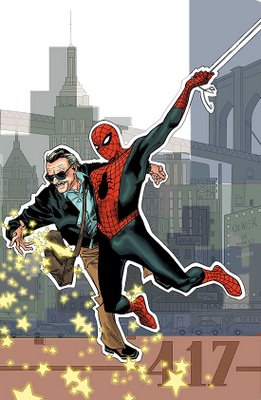
This week's easily syndicate-able comics review column (Kids, ask your local altweekly editor about getting it in your area!) in Las Vegas Weekly takes a look at Stan Lee Meets the Amazing Spider-Man #1 and Bart Simpson's Treehouse of Horror #12. You can click here too check it out.

If you find yourself wishing I would have devoted a few hundred more words to the Treehouse of Horror, don't worry, there's another, longer, geekier review of it here. Kindly ignore the mispelling of the book's title there, though.

And yes, I do realize that the above picture is of Stan Lee meeting Kirsten Dunst, not Spider-Man, but I'd already used the cover of the comic book and didn't want to re-run it. Besides, wouldn't you rather look at Kirsten Dunst than Spidey? I know Stan Lee would, based on how much happier he seems in this photo than he did on the cover of SLMtASM.

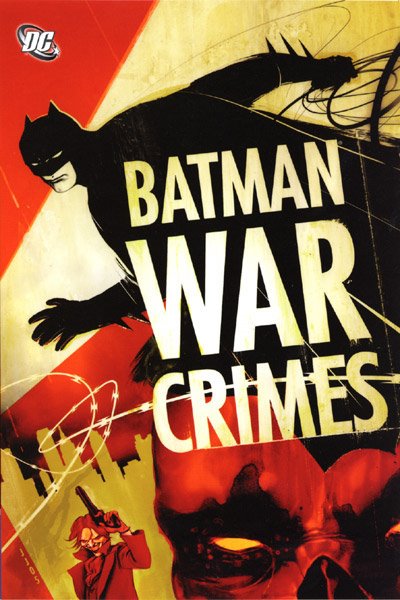
Delayed Reaction: Batman: War Crimes


Batman: War Crimes (DC Comics), by Various

Why’d I Wait?: Same reason I waited on most of the last three volumes' worth of “War” stories—I’d seen just enough to know this probably wasn’t something I’d want to spend money on.

Why Now?: Well, I’ve read three volumes worth of “War Games” via borrowed-from-the-library trades already, what’s another 132 pages?

Well?: My initial impulse was correct—I did not like the stories contained within this collection. But beyond the quality of the stories and the bizarre plot points (particularly in the final one), let’s look at this as it was published in this edition, as a collection of several different stories into one single volume which, presumably, is meant to be seen as a single, unified work.

It’s hard to imagine a crazier fucking trade collection.

Conatined within are stories from six different comics, two different Batman ongoing series and two different Batman specials. None of them continue into one another, exactly, and the result is an anthology loosely organized around the principle of what post-“War Games” Gotham City is like. Read straight through, it has the same jarring clashes of art styles that the trilogy of “War Games” volumes had, but it lacks the sense of propulsion that moved those books forward; War Crimes moves in fits and starts.

I’m not exactly sure why it was published as a trade collection at all, really. The main purpose of most of these stories is simply to set up the new Gotham's status quo, but, post-Infinite Crisis and “OYL,” that status quo has changed again. Nothing in this book is the least bit relevant to the future of Batman comics (and, as we’ll see in a moment, little of it is consistent with past Batman stories, either). In that sense, it’s a book so dated that it’s one of the least essential ones to include in anybody’s Bat-library.

Let’s take the stories one at a time, shall we?

First up, Bruce Jones and penciller Eddy Barrows give us “Strangers in Paradise,” in which Black Mask is interrupted during some torture by a lieutenant in his crime organization, and he then walks us through the current state of the Gotham underworld, summarizing the events of “War Games” and the first half of “Under the Hood.”

Next up, Will Pfeifer and Ron Randall do something similar from Commissioner Akins’ perspective; this story at least has something salient to say—I like Akins’ use of the word “criminal mastermind” to describe Batman, and there’s a creepy, three-panel Joker story embedded within this short story.

That’s followed by another short story by Andersen Garych and penciller Tom Derenick (recently seen kicking all kinds of ass drawing Steve Engleheart’s JLA: Classified and JSA: Classified snoozefests), this one featuring Cassandra “Batgirl” Cain and Tim “Robin” Drake training together in Bludhaven. It’s a great little character piece featuring the two, accentuating their differences, and clearly showing who is far superior than the other in which area of expertise needed by Gotham crimefighters. (What I really dig about this Batgirl and this Robin is that each of them make up half a Batman; B.G.’s driven and an unstoppable hand-to-hand combatant, but has a long way to go when it comes to being a detective; Tim’s an incredible detective, but lacks the will to ever actually be a Batman). The story is particularly weird to read after the developments of recent issues of Robin, however; this is just one more story that completely contradicts the whole Cassandra Cain Is Suddenly Evil For No Reason plotline.

Finally, after three lead-ins, this brings us to the actual “War Crimes” story, a four-parter that may go down in history as the most insane Batman story ever (even including the Silver Age one where he rode a giant Batarang).

After Stephanie Brown’s death and time spent as both the Spoiler and Robin is revealed on television—which would make figuring out Batman’s secret identity pretty easy, although that never really comes up—Batman learns that there was something funny about Stephanie’s death at the end of “War Games.” It seems treatment may have been withheld, and her medical records from that night are suspiciously missing, and difficult for him to track down.

As he investigates that solo, he also has to contend with the Joker, who is seeking revenge on Black Mask for taking his job by killing a Robin (Nevermind the fact that “Under the Hood” makes it so that the Joker never actually killed a Robin before), the Black Mask (who is dressing up as Batman in an effort to discredit Bats), and a new player with a badly burned face whose identity is spoiled by one of the covers.

Everybody fights, the Joker again seems lame (don’t ask how he got away from Red Hood, who was holding him captive last time we saw him; I have no idea), Batman takes his shirt off in the middle of a fight and Black Mask is captured and escapes moments later.

Then comes the conclusion, wherein we learn who “killed” Spoiler. Or, at least, who withheld medical treatment from her, which lead to her death (I guess Black Mask technically killed her, since he brutally tortured her within an inch of her life before she even got to the clinic where she died).

Ready for the weirdest fucking character 180-degree turn of all time, even weirder than Batgirl going batshit insane in the pages of Robin? Dr. Leslie Thompkins, elderly medical doctor, avowed pacifist and one of Bruce Wayne’s closest friends and confidants (even though she disagreed with his being Batman), decides to break her Hippocratic Oath and let Stephanie Brown die. This happens at the end of a story where she saves the lives of murderers and criminals, and stands up to the police and gangbangers when they come into her clinic, saying that she can’t let any harm come to her patients, even if she has to break the law or risk her own life.

She lets Spoiler die. Why? She was thinking that maybe if Batman lost an ally in his war on crime, he’d hang up the cape and cowl once and for all (Even though it was the death of loved ones which lead him to become Batman, even though the crippling of Barbara Gordon or the death of Jason Todd—still in effect, as far as she knew—didn’t deter Batman one bit).

Rereading Leslie and Batman’s final conversation at the end of the book, I still can’t see how any of it makes any sense. She claims she wanted “to end it all—all the secret warriors in hoods and capes. The endless violence. I could no longer be a party to such madness. Best to sacrifice one to caution others from putting on those stupid masks.”

Uh, yeah, that’s one way. Or she could have saved Stephanie Brown’s life, then publicly outted her, Batgirl, Robin, Nightwing, Catwoman and Batman, with enough evidence that she’d have to be believed, thus ending, or at least making very difficult, their lives as “secret warriors.”

More ludicrous still, this pacifist who has spent much of her life bitching at Batman for punching out crooks and spraying them with sleeping gas, pulls out a revolver and says, “I’m too cowardly to take the last step. That’s what you’re here for, Bruce.” Or in other word, “Look, I know you don’t kill, and have never killed anyone, and yes, I know I’ve spent my entire life telling you to be less violent, but, would you mind shooting me?”

He says no, of course, and then gives her a speech about how killing to stop the cycle of violence is “a sick idea from an evil mind.” And evil mind like Police Commissioner James Gordon’s? Or any of the GCPD who have killed in the line of duty? Or soldiers fighting in wars? Or Wonder Woman, who offed Max Lord and never had Batman trying to bring her in? Or former fellow Justice Leaguers like Aquaman, Green Arrow, Hawkman, Guy Gardener or Major Disaster? Or Superman, who killed the Phantom Zone criminals before vowing to never kill again? Or like Batman himself, who tried to kill the Joker at the end of “A Death in the Family?"

I particularly like when he tells her that she’s dead to him, “What’s left is just another soulless killer—one more name to be added to my criminal database.” Like this is the start of her criminal career or something, and she might appear in a mask and cape in next month's issue of Batman calling herself the Treatment With-Holder or something.

Would I Travel Back in Time to Buy the Original Issues Off the Shelf?: No. But man, if I could time travel, what I wouldn’t do to disrupt the Bat Office editorial meetings regarding this whole stupid crossover…

Delayed Reaction: Batman War Games Act Three


Batman: War Games Act Three (DC Comics), by Various

Why’d I Wait?: The same reason I skipped most of Acts One and Two. The few issues I’d read off the shelf—of those contained in this trade paperback collection, just the Robin and Batgirl issues, plus the final issue of the arc—weren't very good.

Why Now?: In for a penny, in for a pound.

Well?: The (few) strengths and (many) weaknesses of the previous two collections of this epic-length storyline are repeated for a third time here, most particularly the inconsistent art styles and character designs (Oracle seemingly visits the hairstylist between each chapter, while Killer Croc mutates wildly and the Scarecrow changes clothes with about the same frequency).

The entire story is premised on a pretty unbelievable event, that Batman could somehow predict the dumb-ass coincidence of every gang leader in Gotham being dumb enough to answer an anonymous invitation to a meeting and then all accidentally kill one another, but the suspension of disbelief grows throughout this entire volume.

If you weren’t an avid reader of Batman comics and the many spin-offs they’ve given birth to, there are certainly some incredibly random things going on in this book, perhaps the most random being the Scarecrow suddenly transforming into a giant monster for no reason near the climax (it’s explained in Batman: As The Crow Flies…sorta, but not here). If you are an avid reader, you’ll be mildly annoyed by some of the minor inconsistencies (Wait, how is Robin suddenly good enough to take down Mr. Fun solo? How come no one recognizes former Senator Barbara Gordon on TV? Is Black Mask a master of disguise all of a sudden?), and likely pretty damn outraged by the conclusion, which, after a second reading still doesn’t make a lick of sense.

Batman, high on everybody’s top ten list of best fighters in the DC stable, goes hand to hand with Black Mask, a deformed gangster with no martial arts training to speak of, in front of Oracle in her clock tower. For some reason, Batman can’t drop Mask, and instead of lifting any of her very formidable fingers to drop Mask for Batman (or help him out), she simply bitches at Batman—“Stop this! You have to stop! You’re killing each other!”

Batman wastes his breath telling her it’s all right if he gets beaten to death, just as long as he simultaneously beats Black Mask to death.

Finally, O. does the only sensible thing—she sets off a bomb, turning the entire building into a crumbling death trap, thus forcing Batman to let Black Mask get away and save her life, or else continue to beat up Black Mask and see all three of them die horribly.

Yeah, I don’t get anything about this scene. At all. Maybe if Black Mask were, I don’t know, Shiva. Or Bane. Or Prometheus. Or maybe King Snake. But Black Mask? How come Barbara didn’t just beat him silly herself? How on earth is he holding his own against Batman?

This strange chapter of this interminably long story would have been easy to ignore, if DC didn’t make it a major plot point for every Bat-book that’s followed since. This event is what triggered a break in the Oracle/Batman relationship, so that the two longtime allies are no longer even speaking to each other.

Oracle leaves her hometown of Gotham and her place on Batman’s team to devote herself to her own team (the one starring in Birds of Prey), and Batman relies solely on Nightwing for a while, and then, later, solely on Robin.

So Batman, who has always shown a willingness to use any and all available tools and resources in his war against crime, willingly dumps one of his greatest resources, and Oracle, who’s whole life was wrapped up in Gotham City, whose father still lives there, and who was engaged to former Robin and current Nightwing Dick Grayson, simply splits.

It seems like nonsense, but it’s not half as senseless as the weird turns other supporting members of the Bat-family will make within the years that follow this story.

Would I Travel Back in Time to Buy it Off the Shelf?: Hell no.

Wednesday, October 04, 2006

Broaching a difficult subject online


If you want to teach and/or preach about a complex topic, there’s no more striking way to do so than in the easy-to-read medium of comics. Just pick up one of the legendary “Chick Tracts” for evidence, if you can stop laughing long enough to take the message seriously.

Is Libertarianism an easier sell thanthe Tracts' version of fire-and-brimstone Christianity, or are novelist L. Neil Smith and artist Scott Bieser simply more talented than Jack Chick? Their collaboration, The Probability Broach: The Graphic Novel, a comic adaptation of Smith’s 1979 novel of the same name, is a Libertarian manifesto couched in a thrilling, suspenseful sci-fi noir mystery, with equal parts politics and action.

Win Bear is a police detective in the drab “future” Denver of 1987, where an energy crisis means most people ride bikes and a federal Homeland Security (wow, how's that for prescient?) police force serves and protects. While investigating the murder of a physicist with connections to the Libertarian—I mean, Propertarian--Party, Bear gets blasted sideways in time to an alternate world where “Propertarianism” flourished.

The result? Their world is a paradise, where the government just barely exists, science is centuries ahead of where it is in our dimension, everyone wears at least one weapon and hovercrafts drive on roads paved with grass. Bear allies himself with that universe’s version of himself to unravel a “Hamiltonian” conspiracy from our world trying to take over Libertarian-land. The story’s treatment of both history and science are fascinating, and it’s probably the most compelling argument for Libertarianism I’ve ever read. I guess it's true what they saw about spoonfulls of sugar and medicine.

It's a hard-to-find small press book, but Bieser is making it much, much easier to read, by posting it online at his site. The current plan is to put the first 47 pages up, and then the remaining 140 or so in serialized, five-page bites. By all means, click to bigheadpress.com and check out the first few pages to see if it's something you can get into or not, but I'd reccomend foregoing reading online and investing in the graphic novel. It's a fascinating read, no matter what your personal p

Weekly Haul: October 4th


52 #22 (DC Comics) Well, editor Stephen Wacker’s sudden departure didn’t do anything to derail the relentless weekly schedule of DC’s most exciting book. At least, not so far. This issue picks up on one of the more exciting plotlines, one that’s been neglected over the last few weeks: Will Magnus’ difficulties with the U.S. Government over weaponizing the Metal Men and the capture and/or collection of mad scientists by person or persons unknown. We also see more of the Luthor vs. Steel story, which the Supernova storyline dovetails into, and, for the most out-of-left-field moment of the week (other than that bus ad for the Silverblade Returns movie), the introduction of young Jon Standing Bear, who seems destined to be the new—wait for it—Super-Chief! The art, courtesy of Eddy Barrows and Rob Stull, is, as usual, passable but a little rushed (check out the hands of the asshole on the bus, for example). The back-up is of Green Lantern Hal Jordan, penciled by too-slow-for-a-monthly artist Ivan Reis. With such a convoluted history—Jordan is merely the second of the five earth men to use that superhero name—it was far more interesting to see what Waid would choose to include and what he’d choose to ignore than what he actually wrote. It’s basically just a retelling of his original Silver Age origin, ignoring Alan Scott, Kyle Rayner and Parallax completely. Quick note on the cover: “Magnus: Robot Hunted?!” Groan. If and when DC collects artist J.G. Jones’ gorgeous covers of this, they had damn well better leave all that cluttered font off, particularly the godawful jokes and puns like this one.

Agents of Atlas #3 (Marvel Comics) We reach the mid-point in writer Jeff Parker and penciller Leonard Kirk’s resurrection of Marvel’s pre-Marvel heroes, and it’s another explanation-heavy issue. Herein we learn how Venus came to Africa and what she was doing there, as well as the complete history of Marvel Boy (or should that be Marvel Boys?). You really can’t ask for a cooler collection of old-school superhero types, and since Jimmy Woo seems to be still putting the team back together at this point, it looks like a majority of the series will deal with Who The Agents Are and How They Came To Be, meaning there had damn well better be a sequel. The cover by Tomm Coker, contrasting the original Marvel Boy with his current look, is probably the best of the week.

The All-New Atom #4 (DC) Cover artist Ariel Olivetti puts together a hell of a cool cover here, with a woman about to be squihsed by Giganta’s foot, about to squish the Atom with her own foot, but the logo pretty much covers up the giant foot, ruining a pretty great cover. Writer Gail Simone, and the title, are freed from controversial penciller John Byrne as of this issue, with Eddy Barrows stepping in to take over penciling duty. It’s quite an improvement, in part because anyone who’s not John Byrne is free of the baggage that John Byrne brings with him to any project, and also because Barrows’ character designs are more solid and his storytelling a little clearer—Hero Ryan Choi, for example, always looks both Chinese and grown up now. Simone’s toned down the insane usage of asterixes a bit, with one of the three footnotes she uses in her narration not even being connected to an asterisk, but they’re still here, now pretty much the sole black mark on an otherwise really fun read.

The Boys #3 (DC/WildStorm) Ah, now this is the series I was expecting when I heard the premise and creative team of this new book, about a black ops team assigned to keep superheroes in line, brought to us by the writer of Preacher and the artist of Transmetropolitan. The team known as “the Boys” starts to bond a little, and we get to see their individual personalities a bit better, while Garth Ennis takes us aboard the sattelite headquarters of a JLA-esque team known as The Seven, where we learn just what it takes to join their fabled ranks. Artist Darick Robertson makes a wrong moment feel even wronger with his contributions to the scene, like the shape of Superman-esque hero Homelander’s tan-line. Eww. After this ish, it shouldn’t be too hard to root for the Boys when they inevitably start stomping super-skulls. Note the codename of the poor new recruitwho gets subjected to the superhero equivalent of the casting couch here—Starlight. That’s the same codename that Natasha Irons is going by over in 52, which demonstrates just how hard it is getting to do superhero parodies these days. Just about every conceivable codename has been taken.

Detective Comics #824 (DC) Paul Dini sticks to his done-in-one formula here, but draws on some past events from his short run so far, like the Riddler going straight. E. Nigma meets up with Oswald “The Penguin” Cobblepot at the Iceberg Lounge, where the two former rogues compare notes about the reformed life. Batman investigates, first in his work clothes, then later as Bruce Wayne, on a date with Paris Hilton—er, “ Jackie Vaseux.” Guest-stars include Lois Lane and Dini favorite Zatanna, and Dini even adds an interesting new villain, in the form of Mr. ZZZ, a somnabulist thug. Returning penciller Don Kramer does a decent job, but probably wasn’t the best choice for this particular story, as sexy women are not his strong point, and this issue is chock full of ‘em.

Doctor Strange: The Oath #1 (Marvel) I’ve always thought the Sorcerer Supreme worked far better as comedy relief (Busiek and Larsen’s The Defenders, Thor: Vikings, X-Statix Presents: Deadgirl) or deus ex machina (every time Brian Michael Bendis has used him) than as a serious lead, but Brian K. Vaughan has more than earned the benefit of the doubt at this point in his career. He starts out on a rather light note in the waiting room of Night Nurse’s place of business, and rather elegantly works in Strange’s origin (told in simple sillouhettes by artist Marcos Martin) and a gripping new conflict for him, involving the fate of his manservant Wong and, perhaps, all of humanity. It’s actually an interesting blend of the medical and magical, but to say anything about it here would ruin the punch of that last page.

The Irredeemable Ant-Man #1 (Marvel) Wow, between this and DC’s All-New Atom, little superheroes are coming back in a big way. I’m not sure who gets credit for designing the new Ant-Man’s suit—I’m assuming it’s penciller Phil Hester—but it’s a winner, the best duds any of the heroes to have gone by that name has ever worn (I never got the original Ant-Man costume design…it wasn’t very ant-y). It looks a tad like the new “Iron Spidey” costume, but with a more tasteful color scheme and diddlybobs/antennae, the key to looking like an ant. After the first issue of Robert Kirkman’s story, it’s not entirely clear who Ant-Man is at this point, or if he’s two different people, but we see him foil a mugging only to ask the victim on a date, then flashback to a SHIELD hellicarrier, where we meet some low-level SHIELD agents who find themselves in possession of Hank Pym’s latest Ant-Man suit design. Kirkman packs a ton of character work (And panels! And dialogue!) into this very full first issue, and the art, by Hester and long-time partner Ande Parks, is fantastic (not sure if Eric’s sideburns would be considered regulation, but what do I know? SHEILD lets Dugan wear that funny little derby hat all the time, so maybe they're less stringent with personal appearance than other military outfits).

Justice League Unlimited #26 (DC) Hey DC, want to know the secret of getting me to make a complete impulse buy of a title I don’t normally read? Put Aquaman in it. It’s that simple. I don’t know if that works for everyone, or just me, though, so maybe that info’s not really all that valuable. Anyway, Aquaman on the cover and a quick flip through were all it took to get me to pick this issue up. Dr. Fate narrates, as the Justice League call him in to help with a magical crisis. Turns out it’s originating in Atlantis, so Superman, Fate and Booster Gold join up with Aquaman to save the day from Black Manta and Felix Faust. Fans of the late, great Booster Gold and the Peter David-era Aquaman, this is the book for you—this month, at least.

Marvel Team-Up #25 (Marvel) Okay, good news and bad news about this, the final issue of Robert Kirkman’s Marvel Team-Up. Bad news first: Freedom Ring does not, I repeat, not, get resurrected through his magic ring, or any even less likely method. Therefore, Kirkman went to the trouble to create a cool new additon to the Marvel Universe, and spent a lot of monthly real estate doing nothing more than allowing us to get to know him, just to ice him a few issues later. It was a real narrative sucker-punch, for which Kirkman is to be commended, however the fact that Freedom Ring was a cool hero who just so happened to be gay (and that’s the way he was written, rather than gay-ness being his mutant power or something) and that he was Marvel E.I.C. Joe Quesada’s poorly chosen example of a gay headlining character in the Marvel Universe when seeking to fend off criticism of an anti-gay policy makes Freedom Ring's death seem particularly ugly for the company. "See, we publish gay heroes, like Freedom Ring, who is starring in Marvel Team-Up," the line went, only Freedom Ring gets exterminated in the very next issue and, the issue after that, the series is cancelled. Ouch. As for the good news, this is a pretty excellent issue, wrapping up storylines from the previous 24. Sure, it’s more than a little rushed and messy, but considering how much is packed in, that’s too be expected. Kirkman takes us to the possible future that the “League of Losers” resides in to bookend the book (look, there’s a Speedball completely blameless for Stamford and what followed!), then flashes back to Dr. Strange gathering the original team he sent up against Titannus to, um, fight him again. Andy Kuhn provides the art, and hopefully he’ll provide more Marvel art in the future, as his take on a lot of the heroes herein is pretty fun (I particularly liked Shulkie wearing an extra tunic of Dr. Strange’s). Only one glitch in the art department—Did Jessica Jones temporarily go blonde at some point in the recent past, or has Luke Cage knocked up another woman we don’t know about? The best part of the book is probably the cover, a riff on Scott Kolins’ cover for #1, upon which Phil Hester and Ande Parks denote a lot of the major changes in the Marvel Universe over the last 25 months, from costumes to Civil War. I particularly like the tiny little Ant-Man running out of the crowd scene—based on this image, I think the new Ant-Man is going to make a welcome addition to the Marvel Universe, at least as far as crowd shots of superheroes go.

Nightwing #125 (DC) Confession: I’ve never read Nightwing regularly. I read a couple issues when it crossed over with Birds of Prey during “The Hunt for Oracle” and during various Bat-crossovers, but the series never really grabbed me (Scott McDaniels' highly kinetic art aside). I tried the first two issues of Devin Grayson’s run and then split—surprisingly, I just didn’t care for her take, even thought I’ve loved a lot of the Nightwing stories she’d told in Bat-books and in The Titans. I didn’t even bother with the Bruce Jones relaunch—all it takes to scare me away from a book is the words “Jason Todd.” Well, with another new creative team starting this issue, it seemed like a good jumping on point, and, honestly, I don’t see any reason to jump off yet. Marv Wolfman’s story is surprisingly sharp and a tad more hip than I expected considering how long Wolfman’s been writing DC comics, and Dan Jurgens' art is always welcome. I really liked his Nightwing during his run on Teen Titans, when the original team met the new kids using their name, and he’s only gotten better at drawing Dick since then. As for the plot, it’s mostly boilerplate at this point, as ‘wing tracks down a mysterious character who’s either a villain or a misunderstood guy in a super-suit, and a ghostly Monitor shadow begins haunting him, saying something about how Nightwing was meant to die in the crisis but survived—an oversight that need correction. It’s a neat little meta-fictional twist, and it will be interesting to see how it plays out.

Premillennial Maakies (Fantagraphics Books) When I recently got my own place, one of the unfortunate sideeffects was the division of the household's massive, shared book collection, which cut our Maakies collections in half. I glad then to see that Fanta was re-releasing the first collection of Tony Millionaire's genius Maakies strips (one of the collections I'd lost to my roommate in the move), and that the new collection was so handsomely designed by Mr. Chip Kidd. Like a lot of Fanta's books, this one is so nice that it seems to a shame to stick on a shelf instead of leaving it out on a coffee table for visitors to see and enjoy (perhaps one day I'll get a house that's all cofee table, to leave my Maakies, Peanuts , Dennis the Menace and other Fanta books on), but at least this new version of the book is horizontal, and will look just right when set next to my other collections, like The House at Maakies Corner. Ah finally, my collection of the comic strip that ruined the comics pages The Columbus Dispatch and The Cleveland Plain Dealer for me forever is complete again...

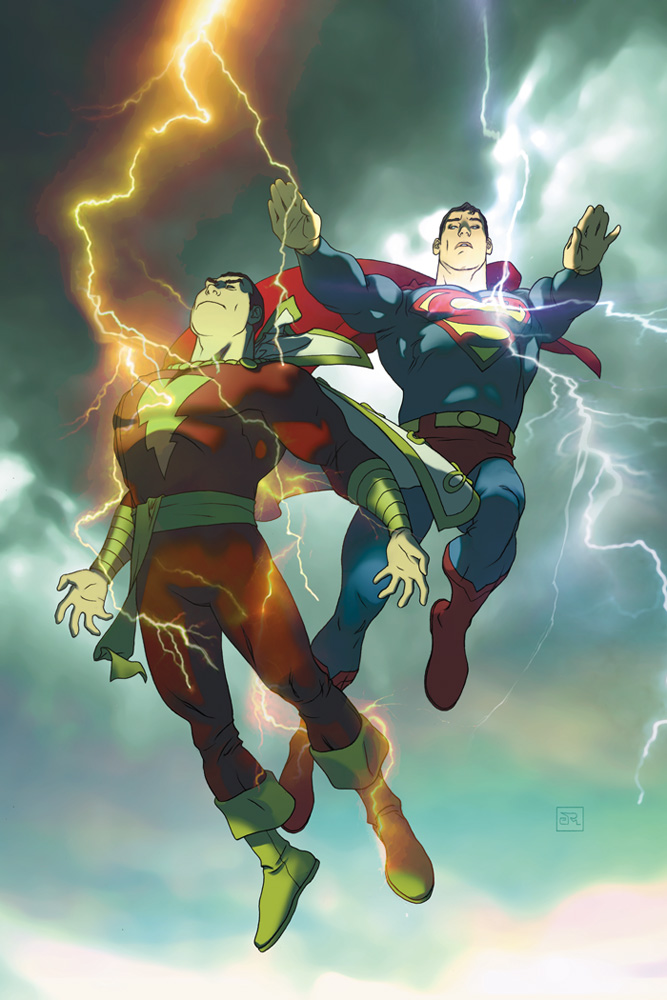
Delayed Reaction: Superman/Shazam!


Superman/Shazam!: First Thunder (DC Comics), by Judd Winick and Joshua Middleton

Why’d I Wait?: You know the deal by now. Judd Winick + DCU comic = Wait for the trade to make it to the library.

Why Now?: Word from some of my fellow Best Shots shooters was that this is a book well worth reading, and even those who normally hate Winick’s writing (Hey, that’s me!) will be pleasantly surprised. Plus, Joshua Middleton’s art is absolutely gorgeous, and I’ve always liked Captain Marvel as a character, even if I’ve never read more than a handful's worth of stories featuring him in them that weren’t crap.

Well?: The words "pleasantly surprised" pretty much sum up my feelings about this book. After it’s “prelude,” the three-part “Lightning Strikes Twice” story that ran through the Superman titles (and was collected in the Day of Vengeance trade), and the weak issues of Outsiders featuring Captain Marvel Jr., I was pretty sure I’d hate this series.

But surprise, surprise, mostly freed from the bounds of continuity (this story is a “Year One” one), Winick does seem to get many of the characters fairly well, and arranges the toys in a way that allows Middleton to make the most of them.

In Fawcett City, evil scientist and industrialist Dr. Sivana is trying to destroy a solar research station using giant robots and other mad science inventions, but new hero Captain Marvel keeps getting in the way. Also on Captain Marvel’s agenda is breaking up a ring of relic thieves targeting museums, a team-up with Superman, a battle against Eclipso and Sabbac and a fight with a Sivana goon squad that hits him while he’s in his secret identity.

Winick’s Sivana is perhaps the weakest part of an otherwise strong book. The more of Winick’s writing one reads, the more apparent certain ticks become, and perhaps the most grating is the way he writes every single villain—Luthor, the Joker, Gorilla Grodd, Black Mask, the Penguin, Sivana, Brick—the exact same. His Sivana is is pretty much just like Lex Luthor with bigger ears (Middleton does a nice job physically distinguishing the two bald baddies in a face-to-face meeting in one scene), and once more Winick gives his Big Bad a toadie/lieutenant to carry on rat-a-tat conversations with.

The rest of the characters Winick handles with more grace and individuality, and he does a wonderful job in the first two pages establishing Captain Marvel as an icon worthy of standing shoulder to shoulder with the rest of the DC’s big guns (now if someone would just put him on the Justice League…), and his first appearance, catching a falling plane, is simply delightful.

The end is just as strong as the beginning, with a fantastic four-page sequence in which Superman reveals his secret identity to Billy Batson (That was fast! Lois Lane had to wait years for that, and Jimmy Olsen still doesn’t know).

As impressed as I was with Winick’s writing here, it’s Middleton who makes this book well worth a read, regardless of your feelings for Cap or Supes (Like Alex Ross, Middleton’s skilled enough an artist to make you like Captain Marvel, by the sheer force of his own talent being applied to him). There isn’t a character design in the entire book that isn’t a homerun. Middleton evokes a perfect amount of boyishness in Cap’s expressions, his Billy is a treasure, and he draws perhaps the best Wizard Shazam of anyone, excepting only C.C. Beck and maybe Ross.

If there’s ever going to be a Captain Marvel monthly again—and there damn well better be!—Middleton’s the man for it. I’m really digging Howard Porter’s art on the Winick-written Trials of Shazam (even if I hate the direction—this graphic novel is yet another example that the character isn’t broken and thus doesn’t need fixed), but Middleton simply can’t be beat.

Would I Travel Back in Time to Buy the Original Issues Off the Shelf?: As pleased as I was with the series, I don’t think so. If I recall correctly, there was at least one major delay in the release of this series (I guess art as gorgeously lit as Middleton’s was takes a little more time than the editors realized), which might have killed the momentum. If I read it chapter by chapter, I might very well have lost interest when I saw Sivana playing Stock Winick Villain. I wouldn’t mind owning this in trade though, when I have $12.99 to blow on a graphic novel I’ve already read.

Tuesday, October 03, 2006

Same old premise, fresh new take


This Wednesday, The Savage Brothers #2 will be in comics shops. If Savage Brothers #1 is any indication, it should be a hell of a read. Though it is technically a zombie apocalypse comic, of the sort which I've long since grown tired of, writers Johanna Stokes and Adrew Cosby have a unique, lived-in take on the end of the world. To read an interview with the pair I conducted for Bamkapow.com, click here.

Saturday, September 30, 2006

He is Vaughan, hear him roar


This week's Las Vegas Weekly column features reviews of Pride of Baghdad, Otherworld and Blade #1. You can read it here. If you still haven't heard enough praise for Pride, I have a longer write up of it here.

Weekly Haul: September 27th


52 # 21 (DC Comics) The most interesting, exciting and downright alarming story about DC’s best ongoing series this week doesn’t occur within it’s covers at all. (Newsarama.com has the story on that here, here and here). As for the issue itself, however, it’s got gueststars galore. Lex Luthor appropriates the old Infinity Inc. trademark (shades of Milligan’s X-Force and John Arcudi’s Doom Patrol), and his sickly-designed green and purple superteam take on new names and costumes, led by Natasha Irons’ Starlight. The new Infinity Inc. gives an excuse for the absolute least likely character in DC’s entire character catalogue to become a legacy character, as we get Nuklon II (Hell, the original Nulkon didn’t even like the name or that hideously dated look, and changed them both). The new team comes face to face with first the new Blockbuster (What’s this, Blockbuster III? Come one DC, not every character needs to be a legacy character!), who is busily rampaging in Las Vegas (shades of Hulk), and then the new Teen Titans. This line-up is lead by Beast Boy and Raven, and includes an import from the Cartoon Network’s Teen Titans-iverse, Hotspot (nee Joto), plus two rather lame Apokalyptians, Power Boy and Little Barda, and someone apparently integrated to the DCU from the Kingdom Come-iverse, Zatarra II (who we’ll learn more of in this week’s Teen Titans). Plus, Ralph Dibny finds a new, hardcore use for his Gingold extract, Red Tornado get a new look and we skip the secret origins for a week.

Action Comics #843 (DC) Kurt Buskiek and Fabian Nicieza’s three-part story arc may have started in as simply a place holder fill-in story, something to plug into the title while the oncoming Richard Donner and Geoff Johns super-team were still getting ready, but it turned out to be an incredibly fun Superman story. Supes’ ragtag band of superheroes—Nightwing, Firestorm II, The Veteran, Skyrocket, Livewire, Bluejay and Aquaman II—regain their powers, free their fellow meta-humans, defeat the Auctioneer and save the world. Woo hoo! I loved this weird assemblage of heroes, and some of the cameos (look, Plastic Man still exists on “New Earth!” Sweet!), but the best part by far is the cover, with it’s headline of, “Superman to aliens: We’ll smack you up!” Somehow, I just can’t imagine Superman saying “We’ll smack you up!” On a side note, another article teased on the cover reads “Entire Ohio Town Forms Human ‘S’ That Can Be SEEN FROM SPACE!” As an Ohioan, I’m curious as to which town. Anyone know where I can get a copy of this Action tabloid, or is it only available in Metropolis?

The Amazing Spider-Man #535 (Marvel Comics) You win Marvel—I’m your bitch. Suffering crossover fatigue from following Infinite Crisis for so long, I swore I’d read nothing but the two main Civil War titles, and the Marvel books I was already reading that just so happened to crossover into Civil War. But I was weak. The 90-page, four-issue reprint of Amazing Spider-Man’s “Civil War” tie-ins last week, plus the drama of Civil War #4 was too much to resist, and I just had to see Spidey turn on Tony “Iron Man” Stark. Maybe it was the cover of this issue alone that made me cave and buy it—I’ve waited so long for someone to punch Iron Man in the face, that I just couldn’t resist. In this issue, written by JMS (whom I occasionally wish was writing Civil War, as he’s been able to frame the pro-registration argument in terms that seem compelling, at least in a vague sense—the implementation, on the other hand, remain indefensible). In this issue, Peter Parker’s doubts about what side he’s on intensify, and he asks Stark to take him to the Negative Zone to investigate the prison complex captured non-registrants are forced into. He also has a conversation with Reed Richards, who explains why he’s acting like such an evil douchebag—it basically comes down to Richards agreeing that Joe McCarthy’s anti-communist witch hunts should have been complied with, and those called before HUAC should simply have rolled over for the commission, a position that Reed Richards and Ann Coulter are the last two human beings on Earth to hold. The punching in the face doesn’t really occur between these covers—the issue ends with Iron Man tackling Spidey, and flying through his own walls and endangering the lives MJ and May to do so. I was pretty surprised by this issue, in part because I thought it was the knowledge that Tony had recruited the Green Goblin to help him enforce the Superhuman Registration Act that would cause Spidey to flip, but also at how hardcore evil Tony is becoming. The N-Zone institution is like Guantanamo Bay, only worse. Guantanamo gives feds plenty of wiggle room in treating detainees because it’s not on American soil, but this place isn’t even in the same universe as America, and these aren’t foreign nationals and/or American citizens suspected of affiliation with terrorist groups, but citizens whose only crime is not signing the equivalent of a federal draft. Their sentence? Lifetime imprisonment until they sign. Yikes. The Superhuman Registration Act makes the Patriot Act sound like the Bill of Rights.

The American Way #8 (DC/WildStorm) Now this is a superhero civil war, complete with North vs. South tensions and racial issues at the core of the conflict. If you missed it in singles, don’t you dare miss it in trade.

Bart Simpson’s Treehouse of Horror #12 (Bongo Comics) I’m not the most faithful reader of Bongo’s Simpsons comics; hell, at this point I’m not even a faithful watcher of The Simpsons TV show, which seems to have peaked a decade ago. But just as it never pays to miss a Halloween episode of the show, it never pays to miss a Halloween issue of the comics, partly because the freedom of the format allows comic book creators (like TV writers) to go wilder than usual, and partly because Bongo brings in some big names to create the Treehouses, and it’s always interesting watching these talents with such peculiar art styles of their own working in Matt Groening style; more often than not, the art and humor becomes a unique hybrid. In this issue, Kyle Baker, Terry Moore and Eric Powell take a crack at the first family of animated prime time television, and the results are well worth a read. While I’m a big fan of emu-based humor and an emu plays a big role in Powell’s story, I think I enjoyed Baker’s tale of fairy vengeance even more.

Batman #657 (DC) Wow, who knew the giant trophy Tyrannosaurus robot in the Batcave was still operational? Grant Morrison continues to weave an exciting story, as Batman brings his alleged son from a drugged night of passion with Talia al Ghul back to the cave, where he grates on Alfred’s nerves and on Robin’s bones. Artist Andy Kubert’s Batman seems heavily influenced by Jim Lee’s designs, and some panels called to mind the work of Norm Breyfogle , still my favorite Batman artist. I particularly enjoyed Batman and Robin’s conversation about young, spoiled Damien al Ghul, and how it sounded like a couple bickering: “So tell me it’s not possible. Is it possible?…What about us?…This doesn’t change anything.” Kubert’s shining moment is page 20: Holy God, that’s a beautiful page. Confidential to Cassandra “Batgirl” Cain fans driven mad by DC’s “New Earth” continuity: So, if Damien al Ghul was raised and trained by the League of Assassins, but the League was decimated in “Destruction’s Daughter” and rebuilt by Cassie during the missing year, did she raise and train Damien, or is he yet another example of a League-trained child, of the sort Cassie claimed to believe she was the only one of in Robin?

Black Panther #20 (Marvel) The post-nuptial “World Tour” story arc continues, and like, the first installment last month, this second chapter is a solid B effort from writer Reginald Hudlin, whose main goal for each issue seems to be to get T’Challa into a different cat-themed costume (Hudlin’s either pushing for a Black Panther action figure line, or trying to beat the Silver Age Batman for the amount of different costume’s in his hero’s closet) and bringing him to blows with a some royal super-person or another. T’Challa and Ororo take the Panther Rocket to the Blue Area of the moon to chat with Inhuman king and queen Black Bolt and Medusa, but end up fighting much of the royal family before the misunderstanding is all ironed out. The fight seems overly forced (as last month’s one with Doom was) and the Bruce Lee quote seemed odd coming from the mouth of an African royal/superhero/scientist who presumably has little time for pop culture study, but all in all, Hudlin seems pretty savvy when it comes to pumping out fun done-in-ones.

Blue Beetle #7 (DC) Wow, it really works. It’s common knowledge that Marvel will stick Wolverine or Spider-Man on any cover they possibly can to boost sales, just as DC will use Batman, but I was skeptical that it actually translated into more books moved. Well, now I’ve seen the light, having experienced it first hand. I’d tried the first issue of DC’s new Blue Beetle, and while the writing was fine and the art was great, I never picked up #2 or any future issues. I guess I questioned the need of a legacy-for-legacy’s sake charcter like Blue Beetle III, especially since I was still so sorry to see Blue Beetle II killed off, and was unimpressed with the basic story of a young hero having a legacy thrust upon him, as I’ve read that story in several dozen other comic books. Well, this week while scanning the shelves of my local comic shop, and image of Batman’s pointy ears caught my eye, and I picked up Blue Beetle #7. The tag “How I Survived My Infinite Crisis” (the usually wit-free tag lines on the cover of DC comics are another thing I’m incredibly skeptical of) and a flip through landed it atop my stack of books. The new Beetle Jaime and his family (okay, that is a new twist) plus the new Peacemaker (What, Peacemaker VIII? Aaaa! Too many legacies!) gather around the divots made from issue #1’s fight with Guy Gardner, and Jaime recounts his role in Infinite Crisis, form his perspective, allowing for guest stars like Batman, the Green Lanterns, Green Arrow and Black Canary, plus some cameos from the likes of Black Lightning and Mr. Terrific. It was a fun one-issue story, and I love Cully Hamner’s art, particularly his design of and rendering of BB’s costume, so the opportunity to see him drawing so many different DC characters was welcome. As with the #1, however, I don’t see any strong reason to pick up the next issue. At least I finally know why no one could find the Brother I sattelitte until the scarab and Jaime teamed up.

Civil War: Frontline #6 (Marvel) One issue, four stories, four different levels of quality. In “Embedded,” we see the Battle of Geffen-Meyer Chemical Plant from a different perspective, that of embedded journalist Ben Urich (Sally Floyd, meanwhile, is under arrest). Tony Stark seems even more blasé in a post-Goliath casualty interview than he did in Civil War #4, but Urich wants to talk about the new “Thunderbolts” more than Goliath, to Stark’s consternation. In an inadvertently hilarious sight gag, first responders try covering Goliath’s gigantic corpse with a blanket, but end up needing dozens of them, and even then they’re just barely covering his face and shoulder. In “The Accused,” Speedball tells off a particularly goofy Reed Richards, and the last panel may be the single most surreally ridiculous one I’ve ever seen. “Sleeper Cell” opens with a pretty cool image, and I didn’t bother with the insulting fourth story, wherein real life military tragedies are offensively compared to Marvel’s “Civil War” crossover. This issue’s seemed to be Stark and SHEILD to Hitler and the Nazis, and you know what they say about comparing an opponent to Hitler or the Nazis—if that’s all you’ve got for rhetoric, it’s time to give up the argument. I’ll keep my fingers crossed that Paul Jenkins and Marvel will therefore give up on these back-ups in the next few issues of Frontline, but somehow I doubt it.

Civil War: Young Avengers & Runaways #3 (Marvel) The unexpectedly large role the Young Avengers are playing in the main Civil War book—with Patriot, Stature and Wiccan front and center for the last few issues—have rendered this particular issue a little confusing. I assume this whole series takes place before the last issue of Civil War, which means we have to expect that Wiccan, who gets captured by SHIELD here, will escape, only to be captured by SHIELD for a third time. Regardless of the continuity traffic copping, this was an okay read, with Morrison’s Marvel Boy handing out beatdowns to Marvel’s two premier super-teen teams. Zeb Wells’ story is devolving into simply so-so, but Stefano Caselli’s art is reason enough to finish the series. I particularly like his Old Lace, his sexy take on Nico and the edge of bad assed-ness he brings to Chase Stein and Victor Mancha. And the scene with Vision’s hand? Hardcore.

DDP Quarterly! (Devil’s Due Publishing) Among the rules of thumb I have about comics purchasing is this: Any new comic that costs a quarter or less is well worth the purchase. Even if it totally sucks, you’re probably getting your moneys worth in paper alone. So when I saw the 25-cent price tag on this new publication from DDP, the publishers of so many decent licensed comics that they could be on the verge of becoming the industry’s next Dark Horse Comics, I put it atop my stack without even flipping through it. So it made it all the way home with all of the real comic books before I flipped through it and saw that it was nothing but preview images and interviews, with not even a single sequential art story within. It was shaped like a comic book, sure, but it wasn’t a comic book. It was simply DDP hype disguised as a comic book, and, to add insult to injury, they asked us to pay to look at their advertising. Man, I’d write an angry letter to complain and ask for my money back, but the cost of a stamp greatly exceeds the cost of this publication.

Eternals #4 (Marvel) I find myself somewhat embarrassed to say I’m not loving Neil Gaiman’s next go-round with a Jack Kirby creation, but considering how The Sandman turned out , The Expositionals, er, Eternals seems like sort of a waste of everyone’s talent and time. I’m particularly annoyed by the covers, which are so different and (frankly) so much weaker than John Romita Jr.’s artwork inside. Sadly, not only is Gaiman’s new Marvel book no Sandman, it’s not even a 1602.

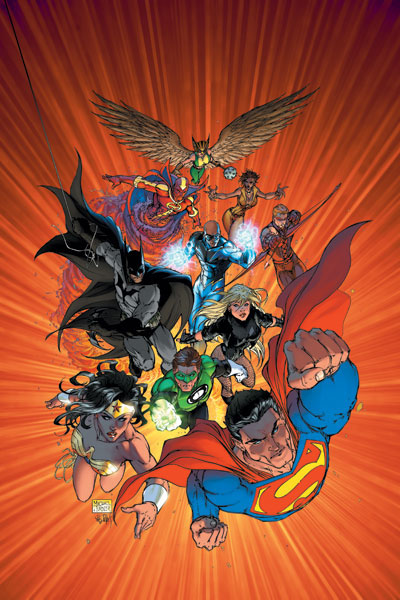
Justice League of America #2 (DC) Three issues in, counting #0, and Brad Meltzer is still slowly putting the League together, at a write-for-the-trade/wait-for-the-trade pace. Of the ten heroes shown on the cover, one of them hasn’t had so much as a cameo appearance yet. Batman, Superman and Wonder Woman (Diana, not Donna; I don’t get it either) continue to look at glamour shots to determine who’s in or out; admittedly, a cool idea, although it probably need not take more than one issue. Black Lightning continues to infiltrate the villains, who Meltzer takes similar liberties with the characterization of to what he did with Catman in Green Arrow and Captain Boomerang and Dr. Light in Identity Crisis. Vixen fights some villains. Black Canary, Hal Jordan and Arsenal fly around. And Red Tornado has sex with his wife, and is sore afterwards (Ew!). He also puts on a costume that makes him look just like he did when he was an android; not sure how that works, exactly. If I had to offer a theory on the mystery villain pulling the strings and bossing a human-looking Dr. Ivo around, I’d guess it’s Amazo, but I hope I’m wrong, as I want more from Meltzer than the League vs. Amazo, round 2,456.

JSA: Classified #17 (DC) Tony Bedard makes a connection between the original Hourman’s Miralco drug and the Venom drug that fuels Bane. Seeking to save Santa Prisca from drug dealers, Bane does battle with the Priscan mob, loses, and is forced to assassinate Hourman I, opting instead to team up with Hourman II. The story’s nothing special, really, but the art, by Scott McDaniels, is the usual treat.

Ramayan 3392 AD #1 (Virgin Comics) I’ve grown somewhat bored with Virgin Comics already, in part because all of the titles I’m reading seem so similar (and are all so slowly paced). I couldn’t resist giving this new series a try though, based on that glorious Alex Ross painted cover alone. The science fiction-like re-telling of the Indian mythological epic reminded me, somewhat unfavorably, of Devi and a handful of European comics of similar themes and tone, but by the time I reached the end, I was excited to see what happens next. In that respect, Ramayan is like the rest of the company’s line—even the worst comics they put out are good enough to keep you reading.

Red Sonja: Monster Isle (Dynamite Entertainment) This oversized one shot is a nice jumping on/trying out point for barbarian comics fans who want to see what the number two name in the genre is up to these days. Writer Roy Thomas (yes, that Roy Thomas) deposits the She-Devil with a Sword on the titular isle, which is run by a Marlon Brando look-a-like pulling a sorcerous version of Dr. Moreau’s trick. It’s not a bad read on a pot-boiling, genre level, and though artist Pablo Marcos’ work is only so-so (Sonja’s anatomy is fluid and ever-changing), he gets lots of cool monsters to draw.

Secret Six #4 (DC) The titular team’s glaring lack of raison d’etre isn’t going away, and I find myself wondering why they’re still all hanging out together and what they’ve been doing over the course of the last year, but despite this lack of foundational strength, Gail Simone’s team book remains a pretty fun read. I guess it comes down to really liking most of the characters, and Simone’s way with them (particularly her Dr. Psycho and Mad Hatter). This issue is mostly devoted to a throwdown against the new OYL Doom Patrol, which makes for some fun moments (particularly the bit with Ragdoll and Elastic Woman, and Knockout’s goodbye to Robot Man). The relish with which Psycho took to his punishment was a nice twist too. Brad Walker’s art is improving each issue as he gets a better handle on his subjects, but I think Troy Nixey’s inks look much sharper on his pencil art than Jimmy Palmiotti’s do, based on how much more snap Walker’s work had in the rather dreadful “War Games” crossover than it has here.

She-Hulk #12 (Marvel) Wow, I thought new artist Rick Burchett had hit his stride last issue, but this one is head and shoulders above #11. Little can be said about the surprising guest-star here without spoiling some of the book’s coolest surprises, so let’s just say that Shulkie is whisked away to Saturn to fulfill her cosmic duties as an objective observer of the trial for Starfox, a difficult task considering their history, recent an ancient. The plot also allows Dan Slott to get his book out of the “Civil War” mega-story for a while, and that’s a very welcome development, considering Shulkie is apparently on the (clearly) wrong side of the debate at this point.

Snake Woman #3 (Virgin) One more baby ssstep forward, as Jesssica learnsss a little more about her passst, and the Bad Guy shows up to confront her.

Stan Lee Meets the Amazing Spider-Man #1 (Marvel) I hate to be a cynical young comic book reader, and I do understand the man’s hard to overestimate impact on the comic industry and medium (he did create the Marvel Universe with a handful of artists and re-create the American superhero, influencing every single superhero comic to follow), but over the past few years the name Stan Lee has become more of a logo or brand name to me than the name of an honest-to-God comic book writer. Well, a read of his contribution to this quirky work disabused me of that notion. He may have long since entered into the elder statesmen era of hiscomics career, but Stan has still got it. The wacky concept of this book was all it took to convince me to pick it up, and I’m glad I did. The first story, penned by Stan Lee (who’s credit sequence shows no matter how many times you may have seen an homage to or parody of Lee credits, no one does ‘em like he does—“pluperfectly,” ha!), is about Spidey swinging by to ask for some advice from his creator and father figure. Lee sets it up as the perfect excuse for a speech on the importance of heroes, and then switches it up with a punchline too good to spoil. Olivier Coipel’s Romita-esque pencils don’t hurt none, either. The next story, by Joss Whedon and Michael Gaydos, is about an interdimensional comic book convention, which has fun with the concept of parallel versions of the same person comparing notes, and shies away from Lee until the end, where Whedon makes the predictable “There’s only one Stan Lee” comment, but saves room for a porn joke. Perfect. And if that still wasn’t enough comics for you, the back up is an apparently re-colored (as it looks much better than anything from that era) Spidey story by Lee and John Romita, whose work here shows all us young whippersnappers where John Romita Jr. inherited his name and talent (if not his style). Somewhat surprisingly, this was probably the most satisfying read in a huge week of releases.

Teen Titans #39 (DC) Tony S. Daniel returns to art chores for the second chapter of “Titans Around the World,” a round-the-world search for a missing member that makes for a pleasant story arc. We meet three more Titans from the missing year this issue (one of whom was also in this week’s 52--now that’s synergy!). The first is Zatara, the never-before-mentioned cousin of Zatanna who has her fathers name and gained powers similar to his namesake and cousin “during that whole mess with the Spectre” (I’m guessing it had something to do with the Rock of Eternity explosion?). His appearance is a bit of a letdown given the fact that DC readers were led to believe he came to our dimension during Infinite Crises’s multiverse re-jiggering (Offspring, Batman’s son and a new Starman, all of whom appeared in the Kingdom Come-iverse previously, have also been sighted in the modern DCU). It’s also a little underwhelming. While his appearance, like that of Miss Martian (a teenage J’onn J’onnz) and Bombshell (a teenage Captain Atom) may make for an interesting few pages of a story arc like this, none are very inspired creations, and none really add anything interesting to the fabric of the DCU. As for M.M., how a green martian other than J’onn J’onnz is on earth is explained, though why she’s adopted a Sailor Moon (Sailor Mars?), Japanese school girl look, despite the fact that she lives in Australia, isn’t. Confidential to Plastic Man fans disappointed by the thought of their hero as a deadbeat dad: There’s another hint that the new Offspring character isn’t from the Kingdom Come-iverse either, but is actually the out of wedlock, long-ignored son of Plastic Man that Joe Kelly introduced during his JLA run and Kyle Baker erased from continuity in his Plastic Man.

The Ultimates 2 #12 (Marvel) It’s finally here! The long, long, long, long awaited conclusion to Mark Millar and Bryan Hitch’s Ultimates 2, the latest book in the world, arrives this week with an oversized chapter appropriately entitled “The Avengers.” But what’s this? We actually have one more chapter to go, as Millar and Hitch just had way too much story for 12 issues. Oh well, I guess we’ll just have to wait another four to six months for that (In the meantime, we can look forward to enjoying Ultimate Wolverine vs. Hulk #3…sigh). While it’s hard to utter the words “worth the wait” during waits this long, this book has never once disappointed, and in this issue we see the Ultimates not only kicking ass, but killing ass, like the soldiers they are. Watching the Hulk pound the Liberators into the ground is to be expected (I loved his dialogue, by the way, even if he seems a tad calmer than he did in the first volume), but I was a little surprised at how harshly Quicksilver and the Wasp—not to mention a completely smashed Tony Stark--dealt with their opponents, and particularly the lack of mercy Captain America showed his fallen opponent. This title couldn’t get much more over the top without a Max label, which makes it the perfect fusion of PG 13-rated summer blockbuster and Marvel comics, as it was intended to be. If I were Jeph Loeb, slated to follow this series up with Ultimates 3 and Ultimates 4, I’d probably be crying myself to sleep every night.

Ultimate Spider-Man #100 (Marvel) The good thing about a creative team sticking with a single title this long is that it allows them to build up vast amounts of momentum when they want to hit you with the sort of revelation they do in this issue (this is a story that was literally 100 issues and years in the making). The bad thing about a creative team sticking with a single title this long is that it makes it awfully hard for people like me to think of new ways to say how amazingly awesome it is. I mean, how many times can you say Ultimate Spider-Man is the very best ongoing superhero comic book on the market before it starts to lose meaning? Ah well, I ‘ll say it one more time, and then excuse myself to go scour Mark Bagley’s sketchbook section for clues into possible future storylines.

Uncle Sam and the Freedom Fighters #3 (DC) DC’s FF heads out west to recruit the new Black Condor (if Geoff Johns would have merely wounded rather than killed Black Condor II, it would have saved them the trip), who, like the last one, is a Native American granted mystical powers to save his people from the white man back in the 19th Century. The bit about teaming up with the spirit of the country was interesting, and artist Daniel Acuna has certainly busted out a super-cool character design for Black Condor III, but I’m having some trouble seeing what’s so incredibly different about BC III that it dictated the creation of another generation in the legacy of such a minor character. The rest of the issue is devoted to the FF fighting superheroes from their former employers, all sporting the lamest names you could imagine for a group of evil, government-sponsored superheroes—Chief Justice, Spin Doctor, Propaganda and Embargo. Together, they are First Strike (snicker!). Acuna does something different with his art here, and I think I like it better (the characters lose some of the plasticity they had in previous issues), but I’m not sure if the third issues in an eight-part miniseries is the best place to experiment with new styles. Now, what the hell was Jonah Hex doing in the third panel, I wonder?

*I take it back, I suppose you could imagine worse names for a group of evil, government-sponsored superheroes, like Killer Flag, The Reclublican, The Demolition-crat and the Spirit of Seventeen Seventy-Kix. Those names are lamer. Well, a little lamer.

Wonderland #2 (Slave Labor Graphics) Like Haunted Mansion, this unlikely collaboration between Disney and indie publisher SLG is surprisingly high-quality, and I enjoyed the second issue every bit as much as the first, for much the same reason. Writer Tommy Kovac is able to ground his story in the works of Lewis Carroll and the Disney film without ever striking a single discordant note, and it’s a treat to see artist Sonny Liew’s stylistic take on Disney’s stylistic take on the original John Tenniel designs. At last count, there were somewhere around fourteen thousand comic books set in or around the worlds that Carrol created, but this far, Wonderland seems to be the best.

Zombie #1 (Marvel) Okay, I have something of a rule when it comes to zombie comics. There are so damn many of them that, at this point, they need to have either a seriously interesting hook or some seriously awesome artwork to justify their existence (let alone a purchase). I let this book off the hook, however, as it’s the first new, non-Punisher book on Marvel’s Max imprint in a long, long time, and I’ve yet to read a bad Max comic (Think Bendis’ Alias, or Ennis’ Punisher books, Fury or Thor: Vikings). Well, Kyle Hotz’s art is pretty cool, but not cool enough for another tour of Night of the Living Dead Homage Land. The book starts with a bank robbery, complete with hostages, gone horribly wrong, when the robbers drive into a zombie apocalypse. The first issue cliffhanging ending, in which our surviving protagonists get ready to hole up in a fortified building for an impeding zombie siege, was simply a scene I’ve seen way to many times. Zombie #2, I just don’t think I’ll be reading you.

JLofA Switcheroo


Back in July, I posted a short piece guessing the members of Brad Meltzer's new Justice League of America based on the partially blacked out cover of Justice League of America #2, and saying that everyone who read it owed me $1 if I was 100-percent correct. Well, JLoA #2 was finally released this week (it's the first one posted above) and, as you can see, the League is out of the bag. You can also see that DC cheated, coloring the bow differently to throw us off the trail, and positioning Black Lighting and Black Canary differently; even Hawkgirl's original outline seemed blockier, suggesting Hawkman.

Now, I'm not going to get worked up over the changes or DC's attempts to deceive readers, mostly because it was a fun guessing game and I was pretty close anyway. Of my original guesses, it looks like I had eight out of ten. Sure, I guessed Green Arrow Connor Hawke instead of Arsenal, but I'll give myself that one, since DC cheated by mis-coloring the bow. Hawkgirl's original shape did seem to suggest Hawkman, due to its size and the shape of the helmet, but I'll give that one to DC, and therefore you don't owe me a $1 after all.

But what's most interesting about DC's switcheroo is that they apparently neglected to tell cover artist Michael Turner who was actually the team as well. Check out Arsenal in that picture. He's wearing a version of his "Red Arrow" costume, the one he sported during his appearances in Dan Jurgens' Teen Titans, the first issue of his own miniseries and in Kingdom Come. This is the costume he was wearing on both versions of the cover for JLoA #1 that he appeared on too, except in the previous JLoA covers his beltbuckle had a big "R" on it, either for "Red Arrow," or "Roy" or, possibly, "R-senal." But on this cover, Turner gives him a "G"-shaped belt buckle, like the kind Green Arrow wears.

It looks like in the process of fooling readers, DC made a pretty glaring error on the cover of one of their more popular comic books. It just goes to show that it never pays to lie.

Thursday, September 21, 2006

A Eulogy for Bill "Goliath" Foster


(Text of speech delivered by the 616 version of J. Caleb Mozzocco on Thursday, September 21, 2006, at a New Jersey cemetery)

Friends, we are gathered here today to say good bye to Barrett Foster, known to those of us who knew him best as Bill, and, to the world as, Goliath, the really big superhero who wasn’t Yellowjacket, Giant Man, Atlas or that other Goliath…who’s really Hawkeye…and also dead now. I think.

I didn’t know Foster as well as some of you. In fact, I didn’t know him at all. I even had to wiki him and re-read my copy of Civil War Files while preparing these remarks this morning. But Tony Stark asked me to say something here because, well, he felt someone should, and everyone else who knew Foster better than me either feels partly responsible for his death, or is a wanted criminal who’s afraid they’ll get killed themselves if they show up here today. So I guess it’s down to me.

Foster may have become most famous as a superhero, but he was also a scientist, and, by all accounts, a rather brilliant one. When Dr. Henry “Hank” Pym, a.k.a. Ant-Man, a.ka. Giant-Man, a.k.a. Yellowjacket became stuck at his giant size, it was Foster who helped with his research, becoming close enough to Pym and experienced enough with the usage of Pym Particles that Foster developed his own superhuman identity, taking the name of “Black Goliath.”

Why he chose that particular name, I’ll never know and, sadly, will now never be able to ask him. This was back in the day when there were fewer black heroes than there are today, of course, but even then few seemed to need to identify themselves by announcing their race in their codename. After all, it’s not like Luke Cage was calling himself Black Power Man, or his highness King T’Challa was going by Black Black Panther, and certainly the white heroes never felt the need to call themselves White Thor or White Giant-Man.

And what was with “Goliath?” I mean, he was a bad guy in the Bible, wasn’t he? A bad guy who got taken out by a slingshot.

Now it hardly matters, of course. As time went on, Foster would take on other names, including “Giant-Man” and just plain old “Goliath,” which is what he was going by when the Superhuman Registration Act was passed. It was in resisting to register with SHIELD and become a federal employee that Goliath became branded a criminal, and banded together with fellow outlaws Captain America and the Falcon to form a team that the papers have been calling “The Secret Avengers.”

They were responding to a distress call when they came across the government’s registered super-heroes, lead by Tony “Iron Man” Stark. Foster and the others were told there was a petrochemical plant on fire, with three or four hundred innocents trapped inside. So Foster did what heroes do: He rushed there to see what he could do to help.

There was a chemical plant on fire, but it was empty—Stark put the call out to lure the Cap, Foster and their allies into one place so they could talk it out. Stark showed up with a veritable army of super-people behind him, not to mention hundred of SHIELD soldiers and a soulless clone of his fallen friend Thor. He brought them all along not because he was looking for a fight, but rather to show the rebels how strong support for the Registration Act actually was among their peers.

It was raining, just like it is this morning, when things turned ugly, and the Thor clone started shooting lightning and swinging his mechanical Mjolnir—did I pronounce that right? Reed? Is it “muh-jol-nur” or “yolnir,” or “mo-yol-nur?” His mechanical hammer.

Foster, showing the bravery we’ve come to expect from a man who saved the lives of every one of us standing here—and billions of others—when he risked his own against the Nth Man—Reed? Is it “Enth” Man? Did I say that one right?—stood up to Thorzarro, attacking him head on, and paying the price for resisting arrest at the hands of a soulless clone created in a government laboratory.

Goliath’s death seems all the more tragic because things were really starting to look up for him. He’d had more cover appearances in these last few months than he has since his own short-lived title, and he has been appearing regularly shoulder to shoulder with the greatest hero in our universe, Captain Ameri—well, second greatest hero, behind Iron Man, of course. And Mr. Fantastic. And Yellowjacket. And, of course, the lovely Wasp.

There’s also been some talk, gossip really, about an all-black superteam recently. And Goliath’s death means we may not ever get to see a Black Avengers team, featuring Josiah X, Black Panther, Storm, War Machine, Goliath, Falcon, Cage and Blade.

But instead of focusing on the negatives, we should try to focus on the positives, as hard as it might be to do so, under the circumstances. I know that’s what Bill would have wanted. Well, I assume that’s what he would have wanted--his entry on Marvel.com doesn’t really say what he would have wanted us to focus on in the event of his death.

If nothing else, Goliath’s death should serve as a reminder to us all of what happens when you refuse to follow the letter of the law, even laws passed within a week’s time of a horrible, traumatic tragedy, by lawmakers who certainly didn’t have time to read the whole thing, let alone debate it. And this is what will happen: You will be arrested and sent to a prison in an alternate dimension, or you will be killed by lightning while resisting arrest.

Goliath has taught us a very important: No man, no matter how big he can grow, is bigger than the law.

I know it’s going to be hard living without Goliath. He was always there for us, whether we needed him to get our kitten out of a tree, fiddle with the TV attenae, put the star on top of the Christmas tree, reach something on the top shelf of the grocery store, or saving us from Stilt-Man or Atom-Smasher.

But keep in mind, just because he’s dead and gone now, doesn’t mean he’ll be dead and gone forever. Death isn’t always final, and dead doesn’t always mean dead—unless you’re related to Peter Parker of course. Heh heh, just kidding, Pete.

I’m sure we’ll see Bill again someday. Maybe it will just be as a ghost or zombie, or resurrected to join the Legion of the Unliving. Or maybe we’ll see him while journeying through the past, or heaven or some weird astral dimension. Maybe Kang The Conqueror or Immortus will bring him back, pulling him out of the time stream before the lightning hit him. Maybe an alternate Bill Foster from a different dimension will come here to our universe, and make a home for himself here.

At the very least, I’m sure Tony and Reed will be able to grow another Bill Foster, just as they grew another Thor. It’s not like we don’t have enough genetic material, I mean, just look at the size of that thing!

Yes, Tony and Reed can grow us another Bill Foster, one that’s just as good as the original—no, better than the original! One that will obey the Superhuman Registration Act, one that won’t resist arrest and one that would never swing a truck at a federal agent. So dry your eyes, friends and family of Bill Foster, now that we’ve perfected the fine art of cloning superheroes for government usage, the sky’s the limit.

I can’t speak for Tony and Reed, of course, but I’m sure they’d be happy to make you another Bill. After all, it’s the least they could do, given the fact that it was their clone that—I’m sorry Tony, what did you say? “Audio-blocks?” What do you mean by—wait, does anyone else hear that? Like a buz--Aaaaa! Aaaa! Make it stop! I surrender! I surrender! Oh God, the pain!

(End transcript)

Weekly Haul: September 20th


52 #20 (DC Comics) The secret origin of the Emerald Eye of Ekron is revealed, and it’s as satisfactorily inspired and obvious. Most of the action is superheroic, as the space set battle some sort of space locusts, but we also check in with Steel, who’s been keeping busy as a volunteer fireman, and Supernova, who floats into the Batcave and has a looksee around, until his eyes fall on the Infinity Gauntlet (or at least Jeph Loeb’s version of it). The back-up is the origin of Adam Strange by Kevin Nowlan. The Kuberts (who drew the Man of Two Worlds storyline suggested at the end of the story) or Pascal Ferry (who drew Planet Heist) would have been better choices; sure, the latter’s exclusive to Marvel now, but surely the Kuberts could have found the time to draw nine stinking panels.

Astonishing X-Men #17 (Marvel Comics) It’s cool that Joss Whedon is playing with some Grant Morrison additions to the X-iverse, particularly considering Marvel’s company-wide efforts to undo all of Morrison’s innovations, but I sort of wish he would have left Cassandra Nova out of it—I’m completely lost as to what the Hellfire Club’s motivation is, if the characters that make it up are real or not, and what that thing they want Kitty to retrieve for them is exactly (Having no idea what’s going on is a common problem when reading X-Men comics). Otherwise, Whedon continues to do a nice job with the characters, particularly Kitty, and there’s a cool twist when a mole on the X-Men team is revealed. The last page has what should be a bigger twist, but it’s similarity to the way Morrison ended a previous invasion of the mansion by Cassandra Nova takes away a lot of the punch. The scene in which Wolverine regains his personality, thanks to the timely intervention of his own personal version of spinach, ranks among the coolest Wolverine moments of them all. A special note to those without Japanese friends to ask to help translate: She says something along the lines of “Why can’t you be asleep like everyone else.”

Blade #1 (Marvel) He was the first Marvel character to make it to the big screen—not counting Howard the Duck, whose film I’m still trying to forget—and yet for some reason Marvel’s had trouble making a comic starring their vampire-slaying Daywalker work in the years since Wesley Snipes brought him to life. Er, death. Un-death? Regardless, the latest try seems poised to succeed. Writer Marc Guggenheim pits Blade against a vampire Spider-Man who was turned by none other than Dracula himself, but that’s just a warm-up (and a convenient excuse to put Spidey on the cover to boost sales). The real action is divided between Blade’s discovery of a vampire conspiracy that has infiltrated SHIELD and a re-telling of his origin. It’s a deftly handled first issue, one that packs in quite a bit of story and gives us a good glimpse of what’s on the horizon. The art, by Howard Chaykin, is pretty great stuff, much stronger than his first issue of Hawkgirl. Good to see the man getting so much mainstream work these days.

Civil War #4 (Marvel Comics) With this issue, we pass the halfway point of the monumental Marvel series, and, appropriately, things escalate like crazy, with Thor’s return revealed and explained, a very big death occurring, Marvel’s first family splintering, new characters joining the fight, some leaving the fight, and some switching sides. Mark Millar is certainly telling a gigantic, pulse-pounding, can’t-wait-until-the-next-issue series, but as soon as I put the issue down, I couldn’t stop wondering about where Marvel Comics could go from here. At the very least, it will be hard to ever look past Tony Stark and Reed Richards’ actions here—hell, even Hank Pym, the Wasp and the other Pro-Reg heroes seem like total shitheels for going along with them. It’s been a couple years now, and I still haven’t been able to think of the “Power Pact” in a heroic light, ever since what they did to Dr. Light and Batman was revealed in Identity Crisis. And what they did is nothing compared to what Stark, Richards and their allies do to one former friend here.

Birds of Prey #98 (DC) This issue we get yet another Bat-female. As a Cassandra Cain fan, I’m still smarting from DC’s nonsensical character assassination of Batgirl II, and am not quite ready to deal with Batgirl III just yet, although writer Gail Simone sure does present her appearance as a puzzler, seeing as how she has some sort of superspeed or teleportation powers, plus seems to know the secret IDs of the main three Birds. Simone almost makes what would have been a sweet reference to All-Star Batman and Robin, the Boy, I Wonder When the Next Issue of This Book Will Come Out? when Batgirl III introduces herself, if Simone didn’t censor it for religious content. The line is actually, “I’m the goddamn Batman,” not, “I’m the damn Batman.” And because I just can’t let what DC’s done to Cassandra Cain go, it’s worth noting that Oracle decides to look into the whereabouts of Batgirl III here, but has yet to search for Batgirl II. What the hell is that all about?

Conan #32 (Dark Horse Comics) Kurt Busiek returns from the DC Universe to continue the origin story of Conan, the occasionally running “Born on the Battlefield,” lushly illustrated by Greg Ruth. In this installment, Conan has hit puberty and already started bedding frails like the B.C. version of James Bond. He also proves that if he didn’t grow up to become a thief, barbarian and king, he would have made a hell of a professional bull rider.

Conan and the Songs of the Dead #3 (Dark Horse) Dear Joe R. Lansdale: Please write every Conan comic books from now on.

Marvel Adventures Avengers #5 (Marvel) Note to self: Be sure to read the credits more carefully before snapping up books. I would have passed on this ish if I had noticed in time that it was Tony Bedard rather than Jeff Parker who was scripting it, since it’s Parker’s writing that’s kept me interested in the title. Still, Bedard does a decent enough job. I can’t say I enjoyed the book, but it certainly wasn’t poorly done. And given the developments of Civil War this week, this title just got all the more important—It may be the only place you can expect to see Captain America and Iron Man getting along from now on.

Runaways #20 (Marvel) Given that writer Brian K. Vaughan and artist Adrian Alphona (who sits this ish out, with Mike Norton and Craig Yeung filling in) have announced their departure from the book, and that Joss Whedon will be coming on next, the book suddenly has an unfortunate, lame-duck vibe about it. The Runaways continue to do battle with the giant monster wrecking L.A., while Chase and Old Lace seek out the Gibborim to do a deal that will bring Gert back from the dead.

Superman #656 (DC) Alien spaceship crashes down in Russian wilderness, Soviets recover it and perform tests on the alien found within, alien escapes bent on revenge, hero fights alien. It’s hard to imagine a more played out plot for a superhero comic, but somehow writer Kurt Busiek and his top-notch art team make it seem like this is the first time anyone’s ever written that story. Plus, I’m loving what they’ve done with Arion, and can’t wait to see where that plotline’s going.

Testament #10 (DC/Vertigo) The sad thing is, “Get tagged and you’re it” probably would sell RFID tags to today’s youth. I’d be a hell of a lot more comfortable with Douglas Rushkoff’s near-future sci-fi/political thriller if the future it presented didn’t feel so damn much like our present.

Union Jack #1 (Marvel) Britain’s working class hero, an Old World answer to Captain America, is enlisted by his government to lead a team of international hero on a desperate hunt to find and stop eight super-powered terrorists before they destroy large chunks of London, and the people living on them. Writer Christos N. Gage’s premise is solid, although the bickering between Jewish mutant Sabra and Saudi Arabian hero Arabian Knight is predictable and tiresome, and this story seems to be in poor taste, considering the actual terror attacks on London. Union Jack’s an interesting character though, with a cool look, and penciller Mike Perkins turns out some sweet action-packed art to go along with Gage’s story.

X-Factor #11 (Marvel) Writer Peter David has just added a fascinating new twist on to mutant evolution, tying it into European folklore in a novel and interesting way. The characters and their interaction has always been this titles strongest selling point, but now the plot is finally starting to catch up. Quicksilver seems terribly out of place, however, especially given the way he just pops in for a few panels before prancing off.