Friday, September 08, 2006

Delayed Reaction: The Abandoned


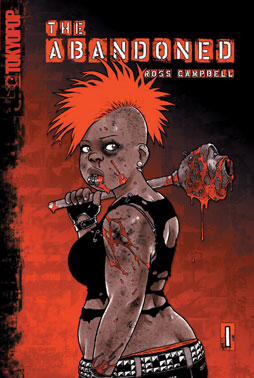
The Abandoned (Tokyopop), by Ross Campbell

Why’d I Wait?: All I knew of the book from seeing it on the shelf was what I saw on the cover. The image was that of a full-figured black woman with a red mohawk, holding a bloody plunger and splattered with blood. The author credit revealed that the book was created by someone who wasn’t Japanese, meaning it wasn’t really manga, despite the fact that it was published in Tokyopop’s typical manga format. Finally, the back cover included a picture of zombies. As a comic book reader, fan and critic, and as a film critic, I am soooo goddam sick of zombies.

Why Now?:Well, had I flipped through the book in the comic shop the first time I saw it, I probably wouldn’t have waited at all. All it took to sell me on it off the library’s shelf was a quick flip through, which revealed creator Ross Campbell’s awesome, sexy punk character designs, squirmy gore and violence scenes and a gray, white and red palette that was hard to resist.

Well?: The post-millennial resurrection of zombies on the big screen is nothing compared to the revival the undead cannibals have seen in comics—hardly a week ever goes without at least one book featuring the slowly walking undead seeing release. At times, it seems like zombies are getting to be the new superheroes, they’ve become so ubiquitous. So if creators are even going to bother with zombie stories these days, they need to have an incredible hook just to be interesting, let alone to stand out from the rest of the crowded field (Walking Dead’s endless nature, The Savage Brothers’ lived-in vibe and The Last Christmas’ use of Santa and his elves as zombie fighters are some pretty good examples of decent hooks).

Campbell’s fantastic art and the hand-crafted feel of the book (his is the only credit, and the letters feel like the intimate, hand-scribed ones of a little indy comic, despite the professional glossiness of the art) are probably enough to push this zombie apocalypse to the top of the heap, but that’s hardly the only selling point to this 200-page epic.

Campbell also has a point to his zombie apocalypse, in the form of a Big Idea like those in the first few George Romero Living Dead movies, and his cast is an incredibly colorful one, filled with the types of characters one sees too rarely in any kind of comics or pop stories, and certainly not in any from this particular genre.

After Hurricane Riley strikes the southwestern United States, turning out the lights in our heroes’ hometown of Savannah, something strange happens. Just about everyone except our heroes suddenly drops dead. But they don’t stay that way long. Moments later, they rise and start seeking out human flesh, which they bite right off whoever is in their way in gory, red chomps (Campbell eschews ultraviolence and over-theatricality in his gore. When someone bleeds from a bite or wound, or, worse yet, has pieces of their flesh removed by the handful, the red stuff looks like it would in real life, I imagine, rather than coming out in gushers and sprays. When someone is eaten here, they seem like terrified meat, rather than a cinematic punchline).

Just why is it that everyone except our heroes have been turned into zombies? The unhappy birthdays some of them suffer spell it out—everyone over the age of 23 dies and comes back. Which brings us to Campbell’s Big Idea: In The Abandoned, we see a modern society which literally eats it’s young; where you die as soon as you enter adulthood, and then sustain yourself off devouring youth. As a metaphor, it isn’t subtle, but there’s little subtlety in The Abandoned, nor should there be, really. As a plot point, it cranks the suspense and drama up from 11 to 1100. Even in the unlikely chance our teenage heroes can somehow survive the constant zombie attacks, it is quite literally only a matter of time before they themselves become zombies.

As for those heroes, the main one is the punk chick from the cover, Rylie. A seventeen-year-old who works at I Scream, a zombie-themed ice cream parlor owned and operated by white sisters Nikki and Cam and who volunteers at an old folks home. She’s ecstatic that her “true-love-to-be” Naomi is moving to town, and arrives the day before the night where everything goes to hell.

Those four, plus fat, mean girl Mae, big, black Ben and his little white ex-boyfriend John comprise the cast. The only ones who’s sexual identity is revealed at all are gay, itself something of a rarity, but they’re also all punk rock Southern teens with accents, something else you rarely see, and though they’re all fairly pop culture savvy (Rylie used to wish for a zombie invasion, and I Scream has flavors like Nut of the Living Dead), they’re not smart-ass know-it-alls like the kids from the Scream movies.

The women are also refreshingly realistic in their proportions and variety. Naomi and Cam are skinny and boyish; Nikki buxom and hippy; Rylie full-figured; Mae zaftig to the point of obesity. Yet Campbell makes them all seem sexy, even the huge, bull dog-faced Mae, in some scenes. Part of it is their sense of style and the tiny clothes Campbell dresses them in, but it’s also the realism and care with which he renders them. When we first meet Rylie, she’s simply wearing her panties and drooling in her bed; when she moves to get up, Campbell draws all of her curves, concentrating and eroticizing the bulge of her belly as she bends just as much as her breasts or butt.

The Abandonded thus ignores the MPAA’s weird double standard where extreme violence is more acceptable than sexuality, homosexuality and nudity. And while the book is definitely sexy in a Suicide Girls kind of way and does contain some romance, it’s a definitely of the zombie apocalypse genre, rather than the romance genre. There are passages of gory panels that are truly horrifying, in part because we got to know the characters getting eaten so well before Campbell killed them off, and in part because he has such a wildly cruel imagination when it comes to hurting them (a bit involving Rylie and a shard of broken glass that I found myself inadvertently shielding my eyes while reading leaps back to mind).

Despite the invasion of zombie invasion books in comic shops today, The Abandoned is the only serious competition The Walking Dead has to its thus far undisputed title as King of All Zombie Comics. Tokyopop’s website says two more volumes are forthcoming, and I eagerly await both, though I’m a little surprised to hear it—the story told in the first volume is so complete, I assumed it was the entire story.

Would I Travel Back In Time to Buy it Off the Shelf?: Hell yeah. But luckily, I don’t have to, as it’s still on sale.

Saturday, September 02, 2006

Getting Lost


This week's column in LVW focuses exclusively on the most major work the medium's produced this summer, Alan Moore and Melinda Gebbie's Lost Girls. Click here to read the review.

Weekly Haul: August 30th


52 #17 (DC Comics)Okay, so based on the cover image, Lobo has taken the cape of Superman, the cowl of Batman, the sword and lasso of Wonder Woman and the coat of Captain Jack Sparrow. 52’s Gang of Four, assisted by Keith Giffen, Chris Batista and two inkers, do an admirable job trying to make the dated, one-joke Lobo seem more relevant, but he just doesn’t really stretch that far (Refreshingly, however, they use the once-overexposed character judiciously, all of his dialogue occurs in the vacuum of space, sparing us any catchphrases). Animal Man raises a great point upon first catching a glimpse of Lobo--how does one smoke a cigar in a vacuum? Lobo’s origin story, this week’s back-up feature, is penciled by his creator Keith Giffen, and is perfectly drawn. Mark Waid, who writes it, captures the spirit of the character’s early appearances in the narration quite well.

Action Comics #842 (DC) You know how annoying people who talk on their cell phones in public are? Well, imagine a giant guy talking on a giant cell phone—that’s the villain of the piece, a sort of alien auctioneer who starts stealing and selling earth stuff, refocusing his attention this issue on the DC Earth’s most valuable resource—superheroes. Superman, Nightwing, Firestorm II, Aquaman II, Livewire, The Veteran, Skyrocket (Woohoo!) and Bluejay (Yay!) are the ragtag team that’s left to save the day. I gotta say, I love me some Bluejay, and it’s great to see Skyrocket too, plus the overall willingness to shine the Superman spotlight so liberally around the dark corners of the DCU. Best line? Probably Livewires’ nickname for the tight-butted Nightwing: “Tightwing.”

All-Star Superman #5 (DC) Another homerun in Morrison and Quitely ongoing synthesis of all previous Superman incarnations into one, ultimate story. Quitely has done amazing things with Clark Kent thus far, and outdoes himself here. This is one Superman story where the “disguise” of Clark Kent isn’t so easy to see through. Physically transforming himself through his posture and facial expressions, Kent seems like a big, doughy lummox, rather than Superman with glasses. The real spotlight here is on Lex Luthor though, and Morrison manages to boil his hatred of Superman down to its most elegantly simple explanation: “How would you feel if someone deliberately stood in your way, over and over?” I’m having a hard time coming up with a favorite moment from this issue. The best I can do is narrow it down to either the appearance of Beppo the Supermonkey (um, sorta), the thing that fell out of Luthor’s pocket and how he uses it, or the joke about Melville.

Black Panther #19 (Marvel Comics) I’d expect more fireworks when the super-powered ruler of Latveria and the super-powered rulers of Wakandia get together for a tête-à-tête. Instead, writer Reginald Hudlin sets Cictor von Doom up as a straw man bad guy who’s not above (one not above making racist remarks to Storm, Panther and Africans in general) and B.P. as defensive about his continent’s cultural and technological achievements. Then there’s a fight with a bunch of Doombots (though the word “Doombot,” one of the most fun words in the Marvel Universe, is sadly used aloud in this issue). The promise inherent in the royal couples world tour is enough to keep me interested and reading for at least a few more issues though. Actually, the next stop is the moon, to visit the Inhumans, so I guess the words “world tour” aren’t exactly accurate, are they?

The Boys #2 (WildStorm/DC) No, I’m still not impressed. I mean, it’s fine and all, it’s just that I’ve seen it all before elsewhere in other Garth Ennis stories. (Like the scene where the Female attacks a house full of bad guys? It’s pretty much the exact same scene that introduced the Russian in “Welcome Back, Frank,” just not as outrageously funny). Maybe this promising series from two incredibly talented creators will finally get somewhere new and interesting next issue, when the team finally goes after some “supes.”

Civil War: Young Avengers & Runaways #2 (Marvel) More fighting, the inevitable make up, and one hell of an unexpected guest appearance. I love Caselli’s visual takes on the characters and the Runaways’ disses of the YA—good to see I’m not the only one who finds their names, costumes, powers and reason for being a little, um—what’s the word I’m looking for?—lame.

JLA: Classified #26 (DC) Howard Chaykin’s story here is awfully similar to Gail Simone’s story arc from just a few issues ago, dealing with how the JLA acts on the stage of world politics, which lines they can’t or won’t cross and which they will and why. In addition to Simone and Chaykin, plenty of other DC writers have tackled the same issues, including Giffen and DeMatteis, Joe Kelly, Brian Azzarello and, most potently, John Arcudi in his superior one shot JLA: Superpower. It would probably behoove DC to finally tell a definitive story about the JLA’s place in the world ometime soon, for consistency’s sake if nothing else. This time, two completely fictional South American countries are at war with one another, and they’re using methahumans as WMDs, which piques the USA’s and the JLA’s interest. The League meets with the President (no, not Bush) in the White House (Wait, Batman, taking a meeting with the President? In the White House?), and they go to the U.N. for permission to fact find. Permission denied, the League decides to go ahead and go in anyway—in plain clothes. The League itself is the Big Seven, apparently right after or near the end of Kelly’s run on JLA (Kyle’s the Lantern, Wally’s still Flash, J’onn’s still Martian and not a Skrull and Aquaman is in his shirtless, necklace-wearing phase). The art, by Kilian Plunket and Tom Nguyen, is nice (even if their cover is anonymously lackluster) and Nguyen is a particularly good choice to ink, as he inked this version of the League when they were starring in JLA.

Justice #7 (DC) This Alex Ross-helmed maxiseries is a strong refutation of DC’s recent impulse to have to remake everything that’s not Superman and Batman. Martian Manhunter and Captain Marvel have both received radical redesigns in an attempt to make the characters work better, but as Ross and company prove here, they’re hardly broken (It’s somewhat ironic that the first issue of Trials of Shazam! drops the same day that Ross proves yet again that Captain Marvel is just as great as the rest of DC’s big guns just the way he is). In this issue, it’s guest-stars galore, including the huge JLA line-up and Captain Marvel, plus the Metal Men, the Doom Patrol, Plas, Metamorpho, Black Adam, some plainclothes sidekicks and Aqualad. Ross’ art, painted over Doug Braithwaite’s pencils, infuses the proceedings with a layer of wonder. For example, check out the two-page spread of the Fortress of Solitude. It’s a setting we’ve visited thousands of times in comics, but really, when was the last time it made you gasp like this? Here it’s like seeing it for the first time. I have no idea who’s slated to helm JLofA after Brad Meltzer’s short run ends, but if they’re looking for a shake-up rather than a continuation, here’s hoping Alex Ross and Geoff Johns are put in charge. Best line: “I hate asking…but my wallet got burned up when you threw me into the sun.”

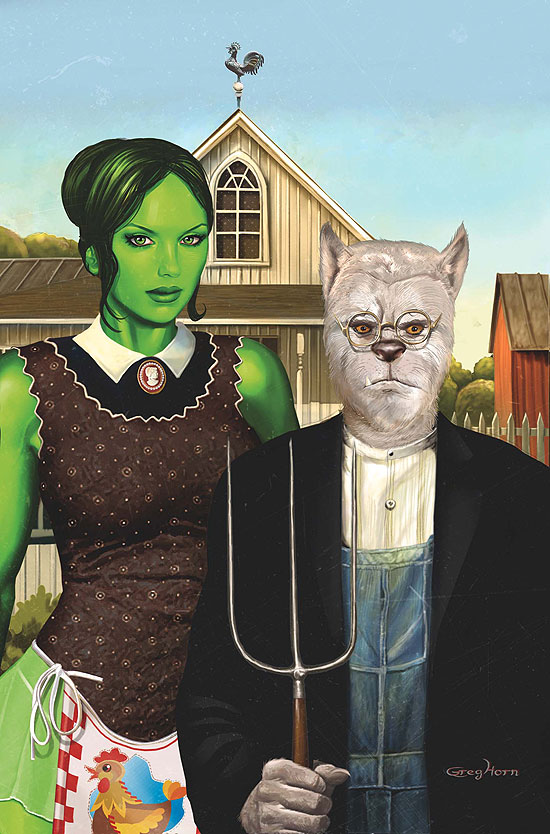
She-Hulk #11 (Marvel) Best. She-Hulk. Cover. Ever. The (super)power couple of She-Hulk and John Jameson are Honeymooners, but he’s spending his howling at the moon in his Man-Wolf form. Their relationship is about to take a turn for the even weirder, it seems, as Starfox’s role in the proceedings is explained and then nullified.

Solo #12 (DC) Uhhh…Hm. I got nothing.

Superman/Batman #29 (DC) Mark Verheiden is—unfortunately—keeping Jeph Loeb’s Throw Everything At The Reader approach to this title. In the second issue of his arc, his first with the series regular artist Ethan Van Sciver, a bunch of random characters attack the title heroes, though in some cases they may be a shape-shifter posing as other characters, as in last issue. There’s The Creature Who Could Not Die, the Caveman from Krypton, Golden Age Lois Lane, and the Green Lantern rings on the fingers of Kilowog and Hal Jordan, apparently controlling the ring-slingers (the slinger has become the slingee!). Ethan Van Sciver is an incredible artist, perhaps the best draftsmen and designer this particular title, which is known for its hot artists, has had, but in this issue we discover his limitations—not even he can make the new Skrullish Manhunter design look remotely cool. And speaking of the Manhunter, since when did J’onn J’onnz become such a dick? Sure, Batman jumps out of the shadows and shoots him in the face with a flamethrower, but J’onn could be a little more professional about it. “Even if I had my suspicions, do you honestly think I would trust them to a human like you?” he tells his long-time friend before blowing him off (Remember the last time you blew off a long-time Justice Legue colleague who lacks superpowers and dresses up in an animal costume, J’onn? That’s right, he got shot in the head and the universe was almost destroyed). I do hope that’s not the last we’ve seen of J’onn this story arc; while I loathe his new look, I’d hate to think he actually responded to news of some sort of shape-shifting alien invasion of earth with a “Yeah, whatever human. I’m out of here.” Confidential to Van Sciver: Lois got a haircut.

Teen Titans #38 (DC) When the subject of new teammates comes up, Rose Wilson finally says what I’ve been thinking since the OYL relaunch: “Does that mean more adults on the Teen Titans like Cyborg? Because the team kinda loses it’s point, doesn’t it?” Geoff Johns ratchets up the OYL mysteries, as the team heads to Russia to meet Red Star (given a new, cool status quo and a look resembling his Cartoon Network style) and search for the missing Raven. They learn that Raven is searching for something that was stolen from titans Tower by one of the 20 young heroes who were Titans during the missing year. There’s a great two-page spread teasing the list of suspects, including two from the Kingdom Come-iverse (Zatara and Offspring), three from the cartoon (Hotspot and Mas y Menos) and one named after a Mel Brooks movie (Young Frankenstein). It should be fun getting to the bottom of this mystery and meeting some of these new characters, although the first issue of this new arc was accompanied by some particularly weak art. The pencils by Carlos Ferreira seemed static and awfully amateurish for such a strong-selling DC book, and some of the pictures were downright confusing (Um, did Risk actually eat a quarter in that one scene, or what?)

Transformers: Evolutions #3 (IDW) Wait, concluded next issue? That’s it? That’s all we get? Four issues of the Steam Age Transformers? Man, it hardly seems worth it. Why waste all that time on Transformers redesign to tell such a short and exceedingly weak story.

Trials of Shazam! #1 (DC) I broke my vow never to buy another Winick DCU book because of my love of Porter’s art (particularly this gorgeous new painterly storybook/comic book fusion style) and the Big Red Cheese outweighed my disdain for Winick’s lazy, lazy writing (the ignorance of continuity, the indistinct characterization, the lack of any research at all). In general, Winick doesn’t seem interested in the occult at all, and when writing about demons, trolls and magic (which he does surprisingly often), he resorts to gobbledygook that sounds like overheard and misunderstood Dungeons & Dragons lingo. He does so here too, but this time around there’s an explanation given for it. The last page shocker, teased at by the end of Infinite Crisis #7 seems to indicate that DC has found a way they can keep telling Captain Marvel stories even though they can’t use his actual name in a title—just change him into Shazam. Like the recent Martian Manhunter redesign and relaunch, this book seems to be a case of fixing something that’s not in the least bit broken, but Winick and Porter haven’t done any real damage to Cap yet, and, unlike Martian Manhunter, I’ll be picking up #2 of this series.

Uncle Sam and the Freedom Fighters #2 (DC) I was extremely skeptical of this particular relaunch, but Jimmy Palmiotti and Justin Grey knew what they were doing all along, and prove it here. I’m not convinced they needed to kill off most of the last FF and shunt the others off into limbo to make way for this version (How is Ray III any different than Ray II, other than being much less likable?), but with the FF now on the run like their ‘70s counterparts, I’m down for #3.

X Factor #10 (Marvel) I still have no idea what’s going on with Singularity Investigations (another strange clue is provided here), but I can’t stop reading this title either. Props to Peter David for teasing out such well-realized characters that the story around them seems completely beside the poing. Art on this book has been especially troubled for a series that’s yet to hit a dozen issues, but these two pencilers seem capable. But I still say give the book to Kevin Maguire and Joe Rubinstein.

Friday, August 25, 2006

This week's column

in Las Vegas Weeklyfeatures reviews of The Drifting Classroom, Phonogram and The Psycho. You can read it here. If you happen to be an editor of an English-language North American altweekly, you can syndicate it by emailing me at the address in the upper right hand corner.

Thursday, August 24, 2006

Weekly Haul: August 23rd


Despite what Mae West said about too much of a good thing, I think I’ve found my limit for reading freshly-released comic books on a Wednesday: It’s about 500 pages. Having done nothing between 11 a.m. and 6:30 p.m., and then another hour and a half of reading after a short break, I can stand to read no more—506 pages is more than enough for one day. I blame Alan Moore and Melinda Gebbie, as I didn’t expect to see the crate full of their Lost Girls waiting for me at my local comic shop today, on top of my normal purchases. After my non-Lost Girls haul, I read 160 pages of the three-volume book before I grew so tired of looking at Gebbie’s drawings of vaginas I had to call it a night…

52 #16 (DC Comics) This week’s issue is probably the closest thing to a Captain Marvel comic DC has put out in quite some time. As Black Adam prepares to wed Isis, he calls on the closest thing he has left to a real family to attend the ceremony. Cap, functioning as the new Shazam, oversees the wedding, Mary Marvel is the maid of honor and Junior works crowd control. Bonus: Tawky Tawny! While most of the issue belongs to the Marvels, Montoya and the Question manage to save the day from a would-be suicide bomber, and the space heroes get two pages that amounts to a sweet impotence joke. The back-up is the origin of Black Adam, the perfect choice for the issue. Perhaps DC has straightened out the editorial problem that has had origins of characters who have nothing to do with the preceding stories running?

Action Philosophers! #6: The People’s Choice (Evil Twin Comics) Fred Van Lente and Ryan Dunlavey’s sixth issue is full of plenty of little pleasures, just as the first five were. I particularly liked Dunlavey’s Wittgenstien, who’s so intense that waves of intensity radiate out of his forehead at all times, and his Kierkegaard, who looks like a total nut. But as funny as AP!, I always find myself learning something. The most shocking thing I learned this issue? St. Thomas Aquinus was fat. Really fat. I never learned that in college, and I went to a Catholic school.

Astonishing X-Men #15 (Marvel Comics) Best. Kitty Pryde. Cover. Ever. As for the rest of the issue, well, John Cassaday’s art is still gorgeous, but increasingly I find myself wishing I’d waited for the trade. Joss Whedon just doesn’t pack much story into each issue, and when a book publishes as infrequently as this one does, you need an incredibly dense read to keep caring.

Batman #655 (DC) The gut-punch of a conclusion comes as a bit of an anti-climax, at least if you’ve read the solicits for future issues (and took the title of this story arc literally). Writer Grant Morrison does have one great idea here, however, and that’s to stage a Batman fight in an art gallery showing off comics-inspired art, so that huge, Lichtenstein-esque canvases read “Blam!” in the background of the panels. Morrison plays levels of reality and their interaction with each other like a piano in this fight scene, and it overshadows virtually all other aspects of an otherwise solid comic book—Andy Kubert’s art, Batman’s sarcastic narration and the dozens of ninja Man-Bats he fights. (Wait, what's the plural of "Man-Bat?" Is it Man-Bats, or Men-Bat?).

Batman and the Mad Monk #1 (DC) Is it just me, or has DC been going out of it’s way to have characters smoking ever since Marvel E.I.C. Joe Quesada announced their company’s anti-smoking policy? Regardless, this instance comes with an anti-smoking message: Captain Gordon goes out to the roof for a smoke, and gets attacked by corrupt cops. Luckily this is a Batman comic and not a Jim Gordon solo title, or else the captain might not have had a guardian vigilante to save him. Matt Wagner continues his Year One era story of Batman right where he left off, nicely decorating this issue with a gorgeous homage to one of the best covers in Bat-history.

Birds of Prey #97 (DC) As much as I love Dayton, Ohio-based heroine Black Alice, this current story arc started fairly weak, and ends even weaker. Four Birds fight three Society villains with Alice caught in the middle, and there’s so much stuff going on that it feels like nothing.

Doc Frankenstein #5 (Burlyman Entertainment) Frankenstein begins to find his faith just as one of his enemy priests begins to lose his. In this issue, Steve Skroce draws all kinds of ultra-violent madness in the past and present as Doc slays packs of werewolves, and we learn the secret origin of Jesus.

Eternals #3 (Marvel) Come one Marvel, I know you guys are really pushing this Civil War story, but does it have to be in every comic? I mean, you get Neil frigging Gaiman to write a miniseries for you, and you have to have civil war crap here too? I suppose we’re lucky they allowed this issue to ship without the special CW trade dress.

JSA: Classified#16 (DC) Is being omnipotent worth it if your obesity directly correlates to your power? Would you still want to be all-powerful if it means you’d have a third chin like a bullfrog’s swollen throat? Amos Fortune apparently would. In the final chapter of Steve Englehart’s weird, messy JSA story, things get weirder and messier. Vixen and Gypsy show off superpowers you never knew they had, Wildcat is the greatest fighter in the world (boxer, maybe), Stargirl knows all kinds of stupid-looking martial arts and The Wizard’s a weakling. I think I’ll be keeping this story arc with my pile of kindling rather than in my longboxes…

Justice League of America #1 (DC) I had a lot of reservations about Brad Meltzer taking over a book that used to be my favorite superhero comic, and I mean a lot of reservations, from my worries that he’d simply revert to the Satellite Era line-up, or simply ignore the last 20 years of continuity, or how on earth you can justify the “of America” making any sense in 2006, tor that he might “break” the concept as he broke some DC toys (I still can’t look at Hal Jordan and Black Canary and much of the “Power Pact” in a positive light after Identity Crisis). But his first, over-sized issue was pretty engrossing. I could babble about it endlessly, but I’ll save it for a full review elsewhere, and here simply accentuate the negative. The covers? Reeeeeee-diculous. All three are bad, but the two I was forced to choose between, each showing half a picture, are just awful on their own. DC should have kept the picture in one piece and used it as a wraparound. Secondly, while it’s fantastic to see Roy “Arsenal” Harper get the nod, and finally join the big league, his new costume and his R-shaped belt buckle on two of the covers points to him going by “Red Arrow” in the near future (Unless that “R” is simply for “Roy,” or, even better, “Roy Arrow”). When he changed his name from "Speedy" to "Arsenal," he began using his superior aim with other weapons beside the bow and arrow, differentiating him from his mentor. If he puts "Arrow" back into his name, he loses that something special that differentiated him from Green Arrow, making him just one more archer. It's a little like Nightwing changing his name to Batguy or Tempest changing his to Aquafellow.

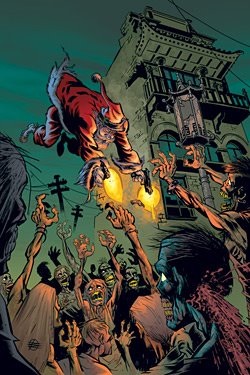
The Last Christmas #3 (Image Comics) Santa finally starts to get his shit together, but it may be too late to save the few human survivors left in San Francisco, let alone Christmas. This issue is most notable for the disturbing detail writers Gerry Duggan and Brian Posehn add to zombie lore. Everybody knows that the only way to kill a zombie is to destroy their brains, but did you know that zombies feared images of Dr. Phil with breasts? Now you do.

Lost Girls (Top Shelf Productions) I’m not even done reading this thing, let alone thinking about enough to review it here yet. All I can say at this point? The packaging is gorgeous, it’s as wonderfully complex and challenging as Alan Moore’s best work, and even though it’s by far the most expensive comics-related purchase I’ve ever made, I don’t feel ripped-off in the least.

New Avengers #23 (Marvel) God, I hate this book. So why can’t I stop reading it? Anyway, despite the title, the only Avenger to actually appear is Spider-Woman, unless you count Iron Man, who appears in a few panels being a total dick. Nothing terribly pertinent or interesting really happens, other than we find out which side Jessica Drew lands on (Cap's; there, I saved you three bucks). The thrust of the issue is simply Brian Michael Bendis un-building the build up he had built up in New Avengers #14 amd #15. His artistic collaborator this time out is Olivier Coipel, whose line work is wonderful, but he and Bendis completely lost me on two separate occasions in this same issue, the confusing battle spiral on pages five and six and the conversation on pages 17 and 18 (I followed the top tier all the way across).

Ultimate Spider-Man #99 (Marvel) God, I love this book. Brian Michael Bendis has written 98 issues of it already, and yet this one has more “Holy shit!” moments than all of them combined. His willingness to stay on this title so long repeatedly pays off, as it does again in this issue—when a twist has been building for this long, it hits you that much harder. If he can end this story arc on the same high notes that he started it, the words “Clone Saga” may not be dirty ones to Spider-Man fans for much longer.

Wonder Woman #2 (DC) Oh yeah, DC has this superheroine named Wonder Woman with her own title, don’t they? I’d nearly forgotten, it’s been so long since #1. This issue is jam-packed with action and guest stars, as Batman, Robin and Wonder Girl join Wonder Woman, “Diana Prince” and Nemesis to do battle with amped-up Wondy rogues Dr. Psycho, The Cheetah, Giganta, Dr. Posion, Osira and Dr. Cyber. Whew! Plus, there’s a totally out of left field guest-star appearing at the end, one wearing a fantastic costume redesign. Terry Dodson’s design work and wonderful rendering (inked by Rachel Dodson) continue to be the selling point here. As for the story, it’s surprisingly simple, and requires perhaps too much suspension of disbelief even for a Wonder Woman comic book (Diana, one of the most well-known superheroes and political figures on the planet, adopts a secret identity and a Clark Kent-simple disguise to go to work for a federal government agency whose sole job is to study metahumans…like Diana).

Wednesday, August 23, 2006

"We hope your holiday is ruined whenever you read it."


So says Gerry Duggan, who, with Brian Posehn, has written the completely crazy post-apocalyptic Christmas tale The Last Christmas. To read an interview with Duggan, and TLC penciler Rick Remender, be sure to click to bamkapow.com. It goes kinda like this:

And speaking of "Christmas" vs. "X-Mas," why didn't you go with the latter? Comics with "X’s” in the title have always sold better than comics with the word "Christ" in them.

I just decided that any sequel will be titled: "X-Mas Men"…everybody knows that Gary the Snowman is the new Wolverine. I read it on a message board.

Fred Van Lente, man of action...and philosophy


Get thee to bamkapow.com to read my interview with Fred Van Lente, the writer behind the hilarious Action Philosophers! comic. I was pretty bummed when I learned it's winding down, ending with #9. At least until I learned what Van Lente and his AP! co-creator Ryan Dunlavey have up their collective sleeve. Be sure to check it out. Here's a sample exchange to whet your interview-reading appetite:

This week's issue is the "People's Choice," in which the most requested philosophers to get the Action Philosophers' treatment. When you were collecting suggestions and votes for it, did you get any that really threw you?

Oh yeah, like every week—still! (laughs) Somebody writes in recommending someone who I guess turned them on in college but Ryan and I have never heard of before, usually obscure lefties. People have also suggested we do an All-Vegetarian Issue and an All-Feminism Issue, but it doesn't look like that's going to happen.

The one name that keeps coming up is the Marquis de Sade … Jesus, I'm like, people, people: Wanting to fuck everything that moves is NOT a philosophy!

It's an important life goal.

Delayed Reaction: Batman: Under the Hood


Batman: Under the Hood (DC Comics), by Judd Winick, Doug Mahnke, Tom Nguyen and others

Why’d I Wait?: Writer Judd Winick has been responsible for some great creator-owned work, particular Pedro and Me and The Adventures of Barry Ween, Boy Genius, but his DC work all seems to fall somewhere between mediocre (Blood and Water, Green Lantern), bad (Green Arrow, most of Outsiders) and downright repulsive (“Lightning Strikes Twice,” the John Walsh-guest starring issues of The Outsiders). So despite the stellar art team inside and out, this seemed like a story to avoid—particularly once rumors started circulating that it would be about the resurrection of Jason Todd, perhaps the one character in the entire DC Universe that should never be resurrected for any reason.

Why now?: Since they really went ahead and resurrected Jason Todd (I was so sure they wouldn’t actually go through with it), morbid curiosity made me want to find out exactly how well executed The Worst Idea In DC Comics History actually was. Plus, I’d just put down the first volume of The Winter Soldier, which I guess put me in the mood to read about resurrected boy sidekicks.

Well?: This is a hard book to read, and a harder book to review, because the central idea—Jason Todd, back from the dead!—is so hard to get past. It’s just so wrong on so many levels, from the fact that he suffered the most unequivocal death in comics (beaten to near-death by a crowbar, then dynamited), to the fact that Batman comics don’t have the sort of science fiction or supernatural underpinnings that so many other comic books do, to the fact that Todd’s death was the result of a 1-900 phone poll (making Jason Todd’s death perhaps the only one in comics history that the fans decided on, rather than the writers and editors) to the simple fact that the death of the second Robin has been a pivotal event in Batman’s history, leading to some 20 years worth of character development.

Well, putting all of that aside, Winick does weave a fairly dramatic reveal here. The volume opens with Batman fighting a new Red Hood, who unmasks off-panel, and then we flashback to what lead up to the battle.

There are an awful lot of unanswered questions here, including why Jason Todd is still alive, why he’s a grown man instead of the age he was when he died and why he’s suddenly become evil. He sets himself up as a relatively nice crime boss (You can sell drugs, but not to kids), but he has a savagery that makes him seem as bad as, if not worse than, the villains. When he takes over a racket, for example, he does so by handing the old bosses a duffle bag full of the severed heads of their associates.

Winick writes some fairly exceptional character moments between Batman and Nightwing, particularly during their fight with an Amazo android, and there are some wonderfully sharp exchanges between Batman and members of the so-called “Power Pact” that mindwiped him in Identity Crisis.

Winick’s Black Mask has a nice, rhythmic sense of black humor in his back-and-forths with his underlings, even if his character is simply Winick Stock Villain Boss. And his use of Mr. Freeze is criminal. He writes him as Winick Stock Mercenary Villian, which is a damn shame, considering the character’s potential (The best use of which was in the first season of Batman: The Animated Series).

The main problem with this graphic novel as a whole, however, is that it relies too much on other stories. If you haven’t read at least “Hush,” Identity Crisis and Batman: A Death in the Family, little of this story will make sense. What separates a decent story arc from a great one will always be how readable it is on its own, and Under The Hood just doesn’t stand up by itself.

Regarding the art, the team of Doug Mahnke and Tom Nguyen (responsible for a fine run on JLA and the underappreciated Justice League Elite) have simply done the work of their careers here, and Matt Wagner’s covers are all exceptional.

Confidential to DC: Ever put any thought into a Matt Wagner omnibus? Maybe “Faces,” Trinity, his Demon miniseries, his random Batman short stories and all the covers he’s done over the years? Think about it.

Would I travel back in time to buy the original issues off the shelf?: Oh, hell no.

Monday, August 21, 2006

Don't cry for Booster Gold


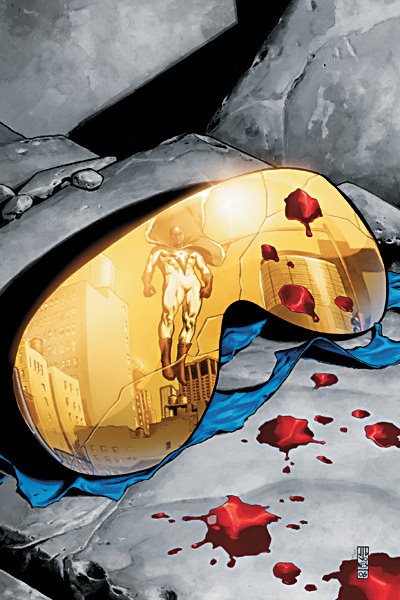
You’ve probably already heard about what happened to Booster Gold last week. In an attempt to save countless innocent lives in downtown Metropolis (and/or his own flailing reputation), Booster pushed his power suit to its absolute limit, lifting a nuclear sub high into the air where it detonated.

When his rival Supernova flew up to rescue him, all he found was a skeleton.

According to DC’s Dan Didio, dead really does mean dead this time. Booster Gold is really, permanently dead, he told Newsarama.com last week.

I don’t buy it. Maybe I’m just experiencing the first stage of grief over a beloved B-List character, but I don’t think Booster Gold’s really dead, and, if he is, I don’t expect him to remain dead very long.

For starters, he died in the fifteenth issue of a 52-part story, and there are plenty of unknowns swirling around him within that huge story, including how he has apparently damaged the time stream and who exactly the guy calling himself Supernova is (Popular speculation: He’s another version of Booster Gold).

But assuming Didio’s being straight up and that really was the end of Booster Gold we saw last week, Booster’s eventual return isn’t just likely, it’s inevitable.

For starters, he’s a fictional character in a fictional universe, the laws of which are constantly being written and revised by scores of writers. As Grant Morrison pointed out in the brilliant climax of his Animal Man run, the killing and un-killing of people in the DCU is a piece of cake, even if the resurrection scenarios aren’t always the most believable (“Why can’t you just say…I don’t know…say it was all a dream or something?” Animal Man pleads with Morrison when he asks him to bring his family back to life. Morrison responds, “Are you joking? That old cop-out went out with the ark,” before he eventually does just that).

Secondly, DC seems to have a major problem with killing characters off. Though the current crop of writers and editors seem downright eager to kill characters these days, the very same writers and editors are constantly resurrecting characters that other writers have already killed off. It’s not just those of Hal Jordan and Oliver Queen’s popularity. The most minor villains, from Major Force to Copperhead, can die and return to life without so much as an explanation (My favorite totally haphazard resurrection was that of minor Robin rogue Lynx, who died in “War Games,” only to return to life in a recent issue of Robinand die all over again).

And as for Booster Gold, perhaps no death in comics history has looked so easily reversible. When it comes to our suspension of disbelie as readers, there are degrees of how much we’re willing to buy. Some resurrections are fairly easily accomplished, such as Firestorm’s in Identity Crisis, Zauriel’s in “World War III,” or any of Red Tornado’s several dozen deaths over the decades. Others are more difficult, but they merely require more plot contortions on the writer’s part, like Jordan’s in Green Lantern: Rebirth or Queen’s in Green Arrow: Quiver. And of late, DC has even shown a willingness for extremely lazy resurrections, of which Jason Todd’s takes the cake—he simply came back to life, and if you want to know why, well, it was a continuity error (Um, caused by Superboy-Prime. Punching the walls of the multiverse. Swear to God).

Booster Gold was a time traveler; he was born in the 25th century and traveled back to the 20th with advanced technology to try to become a superhero and make a killing on self-marketing (lottery fraud might have proved safer). So, if he died last week, is he really dead? After all, if time’s linear, he still hasn’t been born yet. He’s traveled back and forth from the present to the future before, and there was some speculation that the Booster Gold who said he was leaving the 21st Century at the end of The OMAC Project wasn’t the same one who returned in the pages of 52.

With access to time travel technology, it’s very easy to avoid one’s own death, at least in DC Comics. Parallax pulled that trick in “Emerald Knights” (I never understood while he only pulled that trick once), and Bary Allen, one of the few DC superheroes to stay dead more or less permanently so far, has repeatedly returned for adventures set long after his death through the magic of time travel.

While some resurrections are so complicated they need a whole story arc (Hourman I, Green Arrow I) or miniseries (Jordan, Donna Troy) to explain, a time traveler’s death can be done in a sentence or two.

In fact, it’s been done. In Brad Meltzer’s Identity Crisis #2, Merlyn notices the recently deceased Chronos over at the next table.

“Don’t ask,” the Monocle responds. “He says he’s the one from twenty-seven seconds pre-his-own-death.”

“I hate time travelers,” Merlyn says. But love ‘em or hate ‘em, you can never really kill ‘em.

Thursday, August 17, 2006

Actually Essential Storylines: Steel


This week’s 52 back up feature told the origin of Steel, in eight panels drawn by the character’s co-creator Jon Bogdanove (Man, when was the last time you saw him draw anything?). Writer Mark Waid uses necessarily broad strokes, but seems to have left out some of the most key elements of Steel’s character and history, including his pivotal role in the “Reign of the Supermen” arc and his years with the Justice League.

Perhaps most disturbing was the last panel, which summarizes Steel’s current state—rather than a normal man wearing a suit of super-armor of his own design, he currently has the ability to transform his skin into stainless steel. This is a plot point in 52, but one I had hoped would be resolved before the maxiseries ends. Not only was his armored, caped look much more distinctive, but it seems quite key to his character.

It’s no coincidence that his creators Louise Simonson and John Bogdanove named him after the steel-driving American tall tale hero who died striving to defeat a machine. As a normal man fighting among supermen, John Henry Irons was, like his namesake, a symbol of the awe-inspiring potential within the human body and will. As a normal man wearing technologically advanced armor, he seems to have bettered his namesake—he isn’t competing against a machine, he’s conquered machinery, and it now serves him.

What troubles me about that last panel is that when DC eventually collects 52 into a trade (and oh, what an ugly graphic novel it will make, with the constant shifts in art style and quality), they’ll leave these back-ups out, probably publishing them in their own Secret Origins or Who’s Who trade (With “The History of the DCU” being a feature kicking the book off). It would certainly make for a nice reference guide to the current state of the DCU’s characters (or at least 42 of them). But if they’re thinking that far ahead (and they should be) then that means they’re thinking Steel will still be like this then, right?

Regardless, let’s get to the point of this piece, the ruminating over whether the “Essential Storylines” listed are actually essential.

Here’s what DC lists:

The Return of Superman: No arguments there; this is reallytheSteel story, including his first appearances, his origin and his alliance with Superman. In the wake of Superman’s “death” at the hands of Doomsday, he was one of the four men who stepped up to take Superman’s place, and was easily the most heroic. If you read one story about Steel, this should be it.

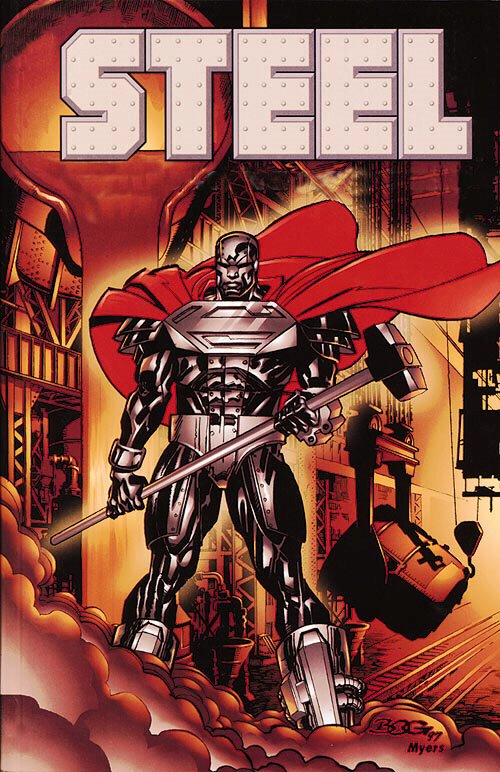
Steel: The Forging of a Hero: I wouldn’t really recommend this trade paper back collection (the cover of which is above), but I can understand why it’s on the list. It’s the only trade collecting any solo Steel stories. I’ve read his monthly sporadically, and while I liked some single issues, it’s hard to recommend any particular storyline from it (The Christopher Priest run, which closed out the monthly series, however, was probably the best). The Steel monthly suffered the same fate as its sister books Supergirl and Superboy: constant reinvention. Steel repeatedly changed villains, supporting casts, settings, costumes, missions and his very reason for being; he would gain powers and lose them. This trade was released to coincide with the release of the film featuring the character, and, were it not for the film, I doubt this trade would have ever even been considered.

52: Well, obviously this is an essential storyline starring Steel. But it seems rather odd to list it as such, in the back of 52, doesn’t it? Obviously Steel fans who want to follow the advice listed in the title’s “Essential Storylines” feature are already reading this particular storyline, right?

And here’s what they missed…

Team Superman: This is the name that Superman’s three S-wearing allies occasionally went by for a time. In The Mark Millar-written Team Superman #1, Steel, Superboy and Supergirl help save Supes from an alien hero-killer. In the “Trial of Superman” storyline, they form a “Superman Rescue Squad” to help save him from aliens who have put hi on trial for the destruction of Krypton. In four-part “Critical Condition”, they shrink down to microscopic size (with help from the Atom) to go inside Superman and save him, Fantastic Voyage-style.


The JLA: I consider all of Grant Morrison’s JLA run—the trades, DC One Million, JLA: Earth 2 and JLA/WildCATS—essential reading, but as far as Steel goes, he joins the team in JLA #16, and stays with it through the end of the Morrison, Howard Porter and John Dell run in JLA #41 (Volumes 4, 5 and 6, in terms of trades). Of those, perhaps the most Steel-centric single story is the lead feature from JLA Secret Files & Origins #2, by Christopher Priest. It features Steel’s niece Nat and her friend “Boris” climbing into Steel’s League transporter and helping themselves to a tour of the Watchtower, eventually convincing John Henry he belongs on the League. I agree, and it’s a shame he ever left it. I hope once 52’s over, he gets his seat at the table back again—the League needs a tech guy, and Blue Beetle’s dead and the Atom’s missing. Outside the main monthly, Steel also appeared in Mark Waid and Brian Hitch’s wonderful over-sized graphic novel JLA: Heaven’s Ladder, and in Len Kaminski, Val Semieks and Prentis Rollins’ weird but fun JLA: Foreign Bodies, a Freaky Friday riff in which John Henry Irons and Kyle Rayner trade bodies (as does the rest of the League).

Crises: In Zero Hour, Steel teams up with Guy Gardner (revealed to be an old college buddy), time lost Barbara “Batgirl” Gordon and Supergirl. He teams with the Teen Titans, Aquaman and other heroes who had low-selling books at that point to help Superman Red and Superman Blue defeat the Millennium Giants near the conclusion of the much-maligned “Electro-Supes” storyline. He plays a somewhat more important role in DC One Million, which is essentially just a JLA story that sucked the rest of the DCU into it. When the Big Seven travel to the future, their counterparts attack the Watchtower, and Steel leads the rest of the League’s JV squad against them. In Our Worlds At War, John Henry Irons is slated to die and death actually comes for him (in the form of the Black Racer, the Grim Reaper as a skiing Black Knight), and ends up in Apokalyptian armor. Steel continuity goes goofy after this storyline, which is probably why DC didn’t list it as “essential;” they pretty much just ignored it at the outset of 52 anyway.

Other Universes: In Mark Waid and Alex Ross’ Kingdom Come, Steel has switched alliances between Superman and Batman. How or why isn’t ever explained, and Steel’s role is nothing more than a cameo, but he gets new Bat-shaped armor and a Bat-shaped battle axe in place of his hammer. The switch in loyalty makes sense from the perspective that Steel is more of a Batman-type hero than a Superman-type; that is, he’s just a normal, powerless joe who uses his mind and body to elevate himself to the level of a natural born superman. Darwyn Cooke also includes Steel in his New Frontier story set in the late ‘50s, and that particular time period in American history results in Steel being a very, very different sort of hero.

Other media: John Henry Irons met Superman in Superman: The Animated Series, and was a member of the JLA in Justice League Unlimited. There was also a 1997 Steel movie starring Shaquille O’Neal, but don’t you dare watch it. I’m serious, no matter what—don’t watch that movie!

Hard knock lives


This week's column looks at three biographical graphic novels (biographic novels?) whose protagonists deal with reality at its harshest: War Fix and Brownsville from NBM and Soft Skull Press' Siberia.

Wednesday, August 16, 2006

Weekly Haul: August 16th


52 #15 (DC Comics) As the cover of this week’s issue spoils, Booster Gold doesn’t seem like he’ll live to see week sixteen. Is this the final nail in the coffin of the Giffen/DeMatteis Bwa-Ha-Ha League? I wouldn’t bet on it. There’s little DC could do that would surprise me at this point, after watching Jason Todd get resurrected and Batgirl II turn evil on a dime, but 3/4 of the writers involved with this story are just too damn good as storytellers to have ended Booster Gold’s storyline with so many dangling plot threads. And, though we do see a body—a skeleton, actually—there are just too many outs left for Booster to come back, including another version of himself stepping out of the timestream (he may have “died” this issue, but he won’t be born for hundreds of years yet) or Supernova unmasking to reveal himself as the Booster Gold from the past, future or an alternate Earth. Other than the big, splashy death, this particular issue is notable for having perhaps the best art of the series so far, provided by penciler Shawn Moll and inker Tom Nguyen. This team’s a real keeper. The back-up art comes courtesy of Jon Bogdanove, the perfect guty to draw the origin of Steel, though this seems like the wrong issue to run this feature. Steel doesn’t even appear this week; wouldn’t the origin of Booster Gold have been more appropriate?

The Boys #1 (WildStorm/DC) The teaming of Garth Ennis (co-creator of Vertigo’s Preacher) and Darick Robertson (co-creator of Vertigo’s Transmetropolitan) is an inspired one, as is the concept: An elite team who’s job it is to keep track of and administer beatdowns to all of the world’s super-people when they need it. Unfortunately, there’s nothing in here that we haven’t seen from Ennis before. If you’ve read any of his Kev stories—and/or The Pro, Hitman and the Marvel Knights Punisher—then you’ve bloody well already read this issue too.

Conan #31 (Dark Horse Comics) And speaking of repetitive, Conan and another, less taciturn thief break into a temple, steal a magical phallic object and fight some undead treasure keepers. Ho hum.

The Drifting Classroom Vol. 1 (Viz) The title and the first eleven words on the back cover are all it took to sell me on Kazuo Umezu’s early-‘70s horror series: “In the aftermath of a strange earthquake, an entire elementary school vanishes.” This is the exact sort of thing I used to fantasize about when I was in elementary school, though my fantasies just weren’t as gritty, visceral and dark as Umezu’s. I eagerly await the second volume. Love the way Sho runs, too. That kid’s got a sweet stride.

Marvel Adventures Avengers #4 (Marvel) Spidey says “Pwned!” at the end of a fight. What else can you ask for from a comic book?

Phonogram #1 (Image Comics) I picked this up on a whim, as it was a pretty light week, expecting another pretentious hipster indie rock wankfest of a script with decent black and white art, by Kieron Gillen and Jamie McKelvie actually have something much more interesting up their sleeves, regarding the intersection of pop music and magic. And they mean that literally, not figuratively. This series could go either way, but based on the first issue, it definitely has the potential to go somewhere pretty awesome.

Robin #153 (DC) I sincerely meant to drop this title last issue, but I forgot to inform my comics shop, so it was in my pull file this week anyway. This is the team-up issue between Robin and Captain Boomerang Jr., whose fathers killed each other in one of the more ludicrous parts of Identity Crisis (Um, how did Jean Loring know Robin’s secret identity was Tim Drake, exactly?) Writer Adam Beechen repeats that exact same ludicrous mistake here, having Cap Jr. know Robin’s secret identity as well, but Robin doesn’t seem to even notice that). Together the pair search the abandoned hideouts of Bat-villains seeking a nuclear bomb to diffuse, and these scenes are pretty fun, as each villain leaves themed booby traps, and Beechen reaches pretty deep into Batman’s rogues gallery (Dr. Double X, The Cavalier and The Glass Man, anyone?) Beechen writes Robin as a pretty unlikable prick—he comes across more Dark Knight than the Dark Knight here—but some of the traps are pretty fun, and I do like artist’s Freddie E. Williams II’s interpretation of the Boy Wonder. Not enough to get this added back into my pull list though.

Runaways #19 (Marvel) Geez, what is it with female magic users and androids in the Marvel Universe? Gravity artist Mike Norton fills in for Adrian Alphona, and though things don’t seem the same without Alphona, Norton’s a good choice for a fill-in (Hmm, a Gravity/Runaways crossover could be pretty cool…). In this issue, we check in with each of the Runaways to see how they’re dealing with Gert’s death last issue, and none of them seem to be doing so hot. Luckily, a giant demon monster is going around destroying Starbuckses (Starbucki?), so maybe they can take out some of their negative emotions on it next issue. Line of the week: “Yes! It’s cobblering time!” That’s probably just what Ben Grimm’s great-great-great grandfather said when he sat down at his workbench to make a pair of shoes…

Strange Westerns Starring the Black Rider #1 (Marvel) Well, they sure named this title well—It just doesn’t get any stranger than a vigilante gunfighter who disguises himself as a meek, Clark Kent-like bespectacled milquetoast and who rides a horse that similarly disquises itself as a meek, broken down old nag. That’s the title character, who stars in the main feature by Steve Englehart, Marshall Rogers and Al Vey. It’s not bad, but I preferred Joe R. Lansdale and Rafa Garres’ much shorter, creepier, cooler tale of a man who sold his soul to the devil to be the fastest gun in the world going up against Gunhawk. The two original tales are followed by two Stan Lee/Jack Kirby back-ups featuring the Rawhide Kid. The first one, in which everyone in town is prejudiced against the Kid (presumably because he’s a gunfighter), takes on a different meaning entirely now that the Kid’s been officially outted by Marvel.

Testament #9 (Vertigo/DC) Liam Sharp sure draws some scary-ass “lean” cows, doesn’t he?

Transformers: Evolutions #2 (IDW) This second chapter of “Hearts of Steel,” a period piece which posits what would happen if the Transformers were active on earth during the late 19th Century (and if John Henry Irons was a real man and Mark Twain and Jules Verne were involved) is better than the first, but I still prefer artist Gudio Guidi’s awesome re-design sketch covers better than the actual story inside the book.

Ultimate Fantastic Four #32 (Marvel) Oh, thank God it’s finally over. It’s too bad Mark Millar’s off the book already, considering how troubled this book has been in terms of keeping creators and a consistent look, feel and story, but it also means I won’t have to sit through Greg Land’s weird, out-of-place, poorly “acted” artwork each month anymore. Confidential to Land: Ultimate Wasp is Asian, not Caucasian, and she has short, spiky black hair rather than a brunette bob.

Tuesday, August 15, 2006

Who's Your Founding Father?


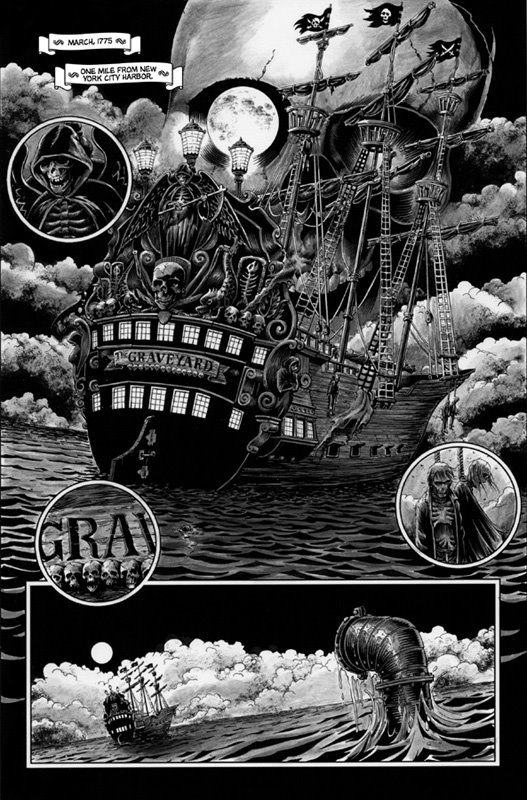
Click to Bam!Kapow! to read my Q and A with Ben Lichius, the co-creator and co-writer of the just-concluded miniseries The Black Coat: A Call to Arms. It's a straightforward swashbuckler set in 1775 New York, starring a masked hero who is one-part Thomas Jefferson, one-part Batman. The lavish black and white art by Fracesco Francavilla is worth the price of admission alone (That's the first page of the first issue posted above).

Delayed Reaction: Batman: War Games Act One


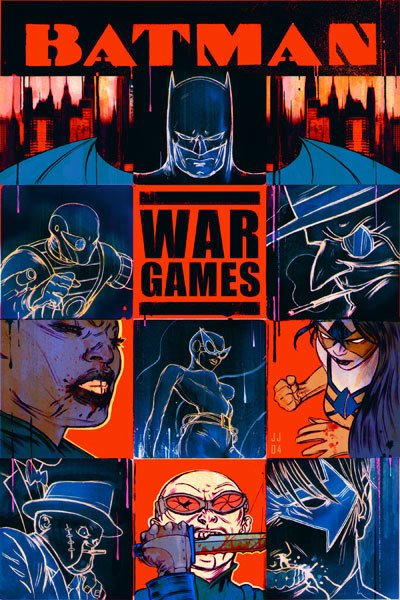
Batman: War Games Act One (DC Comics), by Various

Why’d I Wait?: I didn’t exactly wait, at least not on every single page of this trade paper back collection. I read some of the issues contained herein—Batman: The 12 Cent Adventure, Robin #129, Batgirl #55—but was unimpressed with the kick-off and overall concept of this Bat-book crossover, and decided I’d just read the chapters that are contained in books I was already reading anyway.

Why Now?: After seeing how radically different the Batman family’s status quo is “One Year Later”—Batman and Robin Gotham’s only heroes, Cassandra Cain an insane villain, Oracle and her team totally estranged, Nightwing in New York being messed with by an absurdly resurrected Jason Todd—it seemed like a good time to revisit the previous status quo, when Batman was a sort of general commanding a vigilante army.

Well?: My reservations about this story were only confirmed with reading the entire first act at once. In a very real way, it was a perfect illustration of everything that was wrong with such crossovers, making for a particularly uninviting read.

First and most glaring was the vast differences in the styles of the artists involved. And there are a lot of artists involved—nine pencillers, ten inkers. All of them are competent artists, with Paul Gulacy, Sean Phillips , Pete Woods and the Brad Walker and Troy Nixey team topping the list, but few of the styles mesh well, and each penciller seemed to be free to do whatever they wanted with character design, as if no one were even editing the book.

Just look at the Penguin throughout this book—in one chapter he’s an enormously fat, long nosed monster in the Batman Returns mold, in the next he’s just a slightly overweight looking joe, in the next he’s a tiny little midget; his hair is long, his hair is swept back into rockhopper penguin style, his hair is clipped short.

Six different writers contributed to this “Act” of the story, but again, there’s little consistency—sometimes Stephanie “Spoiler” Brown narrates, sometimes Batman narrates, sometimes Nightwing narrates, sometimes Catwoman narrates, sometimes no one narrates. Sometimes Batman’s narration is in one color box, sometimes in a different colored box. Read as a trade, it’s quite schizophrenic.

Also, there is a lot of past continuity going into this. The beauty of the Batman family of characters in general is that everyone knows the story in broad strokes; you can pick pretty much any trade off the shelf and know who Batman, Robin, Catwoman and maybe even Nightwing are and what they’re all about. This story, however, involves a lot of complicated and pretty specific continuity, and demands that you were paying attention to Robin’s monthly title, Nightwing’s monthly title and that you had read the miniseries Batman: Orpheus Rising. Spoiler, the Trantula II, Orpheus, Onyx and Hush all pop up and bring bits of their backstory with them. I've been reading Batman books for about 15 years now, and I was still confused by some of the characters.

As for the story itself, it involves a gang war breaking out in Gotham City. Basically, every crime boss in the city is called to a meeting anonymously, and each one stupidly shows up, each with one body guard a piece, coincidentally. Unlikely as this sounds, they all mill around until tensions get high enough that they all kill each other, leaving a power vaccum in the city that sends the various gangs, syndicates and supervillains into open warfare with one another.

This initial spark to the war involves some pretty hardcore suspension of disbelief—you’d think guys smart enough to run criminal empires would be smart enough not to accept anonymous invitations to shady areas in the middle of the night, and that simply putting enough bad guys in one place at one time wouldn’t be enough to simply make them fall down dead like dominoes. But the late in the volume revelation as to what they were all doing there and why, which comes during the Catwoman issue included within, doesn’t make a lick of sense—the narration in the first chapter seems to directly contradict the revelation of who the “mastermind” behind the criminal extermination really was.

It’s too bad this crossover was so bad, because there are a lot of talented folks involved with it, and it has the ring of historical importance, given the significant changes to the Gotham setting it ushers in—Batman, Batgirl and Nightwing are seen on the TV news, for example, ending the Batman-as-urban legend status quo that’s existed since at least Batman: Year One. Plus, a supporting character is about to die and another is about to become a villain, though not until future "Acts," which I'll get to as soon as I can get them from the library.

Would I Travel Back In Time And Buy The Books Off the Racks?: God no. In fact, if I hade access to time travel tech, I’d probably use it to go back in time and stop myself from buying any of the issues I had previously read; but I don’t think my past self would believe my self from the future, and would have gone ahead and bought them anyway. Which just goes to show that you can’t change the past. Unless you're Superboy-Prime.

Friday, August 11, 2006

Fairytales That Are Merely Fair


This week's column takes a look at two new continuiations of fairy tales you enjoyed in your youth, The Oz/Wonderland Chronicles #1 and Return to Labyrinth Vol. 1. Neither was anything better than average (with the former being quite below average), but they both feature gorgeous covers, particularly Labyrinth, posted above for the David Bowie fans in the audience's viewing pleasure