Monday, August 18, 2014

On Batman: The Cult

Batman: The Cult was a four-issue, "prestige format" miniseries published in 1988, veritably on the heels of 1986's Batman: The Dark Knight Returns (another prestige format miniseries) and 1987's "Batman: Year One" story arc. The Cult was released the same year as Batman: The Killing Joke and "A Death In The Family," and the year before the original graphic novel, Arkham Asylum. It was therefore one of DC Comics' major Batman projects to see release during a creative peak in the character's history, during a time when mainstream superhero comics were completing their rather seismic shift from kid-oriented, all-ages fare to mature entertainment for primarily adult readers.

Obviously, The Cult wasn't as popular or influential as the other stories in the previous paragraph, as it didn't generate any sequels or direct-to-DVD animated adaptations, despite its impressive creative team of Jim Starlin (writer of the aforementioned "Death In..."), pencil artist Bernie Wrightson and colorist Bill Wray and despite its tonal similarities to some of those other books. (Although it occurs to me now that some aspects of it may have influenced the makers of feature film The Dark Knight Rises, although many of those aspects do overlap with aspects of the more obvious "No Man's Land" storyline).

As many Batman comics as I've read since I picked up the comics-reading habit in the early '90s, I've never read The Cult, nor felt compelled to pick it up by its reputation or references to its events in other comics. Until recently, my only relationship with the book was the memory of its very striking first issue cover, which I remember seeing hanging in plastic bags on the walls of the first comic shop I ever entered:
Like just about every other one of those Batman stories I've mentioned, save maybe "Year One," The Cult was remarkable for what exactly was in it; it's the sort of thing that read decades later, it's kind of hard to believe DC Comics actually published, let alone so long ago.

It's extremely bloody, maybe featuring more on-panel blood then any other Batman comic I can recall reading (and unlike some of the gorier affairs of recent years, it's extremely well-drawn, so if Starlin and company were going for cheap thrills, Wrightson and Wray sure made them look expensive). There's an awful lot of gunplay, with Batman and Robin taking up rifles (that shoot tranquilizer darts) and mounting a machine gun (ditto) and a missile launcher (no, these are real, explodey missiles) on their new Batmobile. Batman fantasizes about machine-gunning down Two-Face, and it turns out he was actually totally murdering a mobster with a gun—he was brainwashed at the time, but still.

Someone says "shithead." That's not a word you hear a lot in Batman comics.

The storyline is fairly insane. Batman has been captured, starved, deprived of sleep, drugged and lectured to by cultists in the thrall of Deacon Jospeh Blackfire, an extremely buff, cryptic Christian preacher with long white hair pulled back in a pony tail. The details of his invented religion are all pretty vague, with terms like light, dark, sin, redemption and truth thrown around, but he is dressed all in black, with a white collar and, of course, goes by the title of "deacon."

He is either an extremely gifted and charismatic con man, or an actual agent of the supernatural. He claims to have lived for centuries, and to have gained his immortality through a ritualistically bathing in blood once a month. The comic equivocates on which telling is true, presenting evidence to back up he latter, but not so much as to make it definitive.

This cult that Blackfire—subtle name, that—has assembled consists mainly of the homeless and downtrodden of Gotham, yet slowly grows to a huge size, and gains a degree of sympathy from Gotham's populace, conveyed through the very Dark Knight Returns means of talking heads on television shows, excerpted ad naseum throughou Starlin's script. These sewer-dwelling faithful fight crime in Gotham, by emerging from manholes and stabbing, chopping and bludgeoning criminals of any kind with knives, axes and clubs.

They eventually break Batman's will, and he joins Blacfire's murderous mob, until Robin Jason Todd is able to find and help Batman break his programming, a scene that culminates with a two-page splash page of the Dynamic Duo in a cavern filled with corpses (slowly revealed by a three-page build-up of many-paneled lay-outs of dialogue bubbles over all-black panels, gradually giving way to a twelve-panel page in which Todd's flashlight plays over the dead bodies. It's as grand guignol a moment as anything the more adult-oriented, death and dismemberment-filled DC comics of today offers—in fact, Batman: Earth One has a fairly similar scene—but it's so carefully constructed and meticulously dramatized that as over-the-top as the imagery may be, the comic and its makers earn the shock it brings with it.

Things spiral further and further out of control, Blackfire's cult doing to Gotham what it took the earthquake of "Cataclysm" to do to the city in the late '90s. They kill the mayor and assassinate the entirety of the city council. Commissioner Gordon catches a bullet that lands him in the hospital for the rest of the narrative. The police try to challenge the cult, and are mostly killed. The governor declares martial law, the city is evacuated and the National Guard get sent in...and they die in the sewers as well.

It eventually comes down to Batman, Robin and the new Batmobile, a sort of tank on wheels so gigantic that calling them monster truck wheels is an understatement; they're kaiju truck wheels (Batman tooled around in a similar vehicle during "Cataclysm," but the wheels of this Bamobile are the size of the entirety of that Bat-monster truck).
With this Batmobile's missile launcher, tranq dart machine gun and their rifles, Batman and Robin storm the city, taking out an army of hobos.
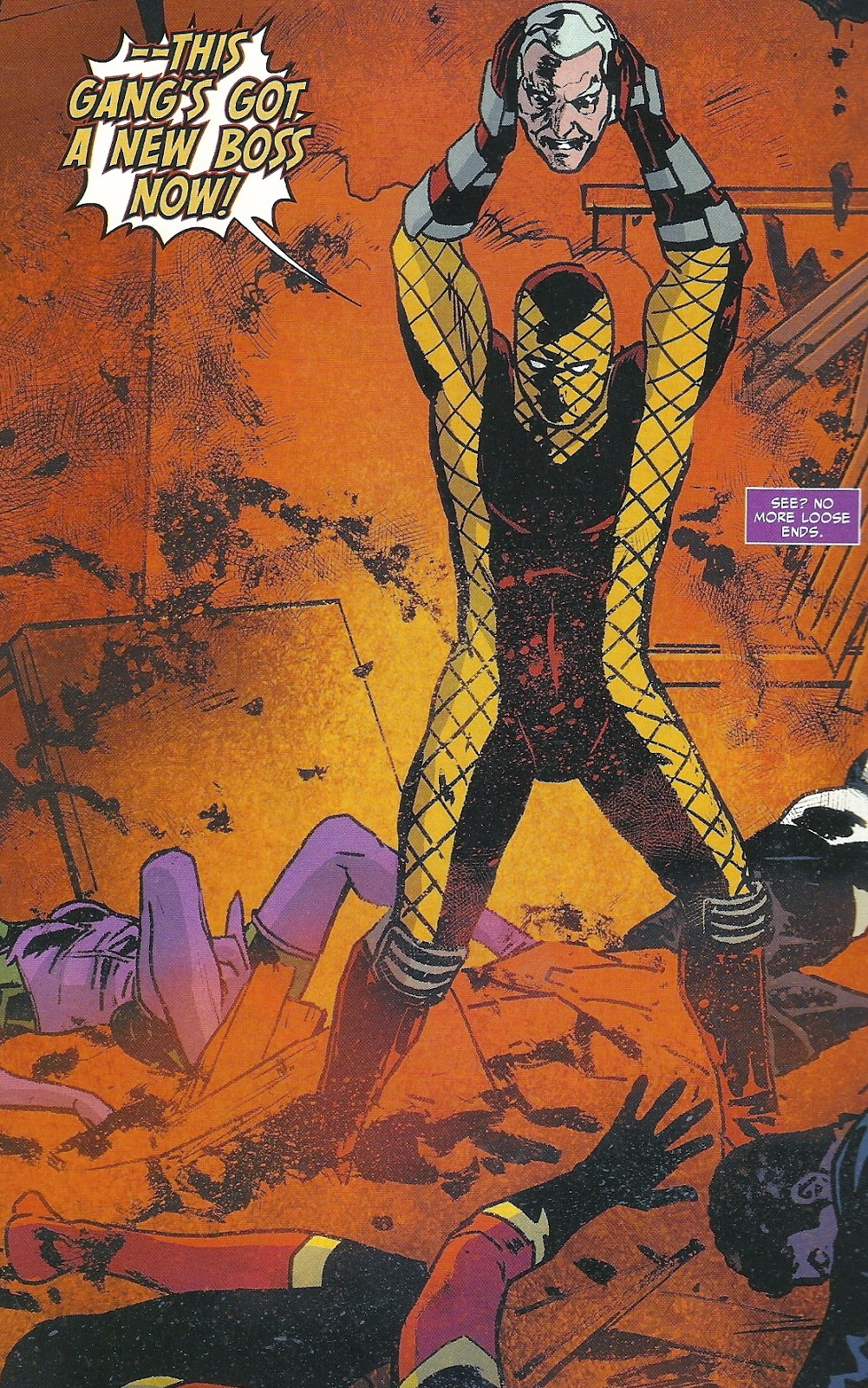
When Batman finally descends from the driver seat of his three-story tall truck, he does so on a long gangway that looks like something that would descend from a UFO. There he faces the last conscious hobo soldier, and tells him to warn Blackfire that he's coming for him (That's the splash page atop this post).

It all comes down to a fight to the finish between Batman and Blackfire, and, when Blackfire's followers see him laid low in physical combat by the Dark Knight, the cultists turn on their leader and kill him.

The end.

*****************

An appearance as a Black Lantern in 2009's Blackest Night: Batman aside—Batman has so few dead enemies that actually stayed dead—that was all we heard of Deacon Blackfire until this year's weekly series plotted by Scott Snyder and James Tynion IV, Batman Eternal.

In the second issue of the series, drawn by artist Jason Fabok, a skeletal specter wearing the garments of a priest appears within a cell at Arkham Asylum, and is identified by the inmate it approaches as "Blackfire."

The ghost of Deacon Blackfire is one of several major antagonists from throughout Batman's history that Snyder, Tynion and their co-writers have introduced into the series, and Blackfire is the villain of the supernatural sub-plot in which Batwing and Jim Corrigan struggle against worshipers, possessed victims and demons apparently serving a now out-and-out, unequivocally supernatural Blackfire.
The seventeenth issue of the series, scripted by Ray Fawkes and drawn by Dustin Nguyen and Derek Fridolfs, includes a flashback to Snyder and Tynion's "New 52" version of the events of The Cult. In their rebooted version, they seem to have kept only the beginning and an element of the end of the story. It still begins with Batman starved, drugged and sleep-deprived, hanging from a pipe with his bat-symbol torn from his costume, but he rallies and escapes as soon as Blackfire comes within kicking range, and Blackfire's followers turn on and kill him immediately.
The whole bit with the taking over the city, killing hundreds and Jason Todd and the missile-launching super Bat-truck was apparently rebooted away.

It's one of the peculiarities of the New 52 DC Universe that the publisher and its editors and writers want to make near-constant use of the stable of characters and the elaborate backstories and history of the DC Universe, but they don't want to be beholden to those stories. So, in general, there exists this weird, quasi-secret crypto-continuity, where everything that happened before the reboot maybe/probably still happened in some form or another, just not the way you remember it, and not the way it happened in any of the many collections of older series DC would be happy to still sell you. The hows are generally ignored and glossed over unless they are meant to play a prominent role in the events, in which case they are dramatized, as they are here, but in a way that manifests the differences.

So I guess Snyder and Tynion and company wanted to use Blackfire, and some events of The Cult, and so reduced the story in size, scope and scale, to just two story beats of the original? It's a shame. Because The Cult is, as I said, insane, and Batman Eternal could and should draw attention to it. It's the reason I read it this month. I just find it peculiar that DC would drive readers to an old story, one that is likely still readily available at your local comic shop and library thanks to a 2009 reprinting of the collection, where they will only discover how drastically different it was from what the new, canonical version.

*******************

The trade collection opens with a three-page foreword by Starlin, originally penned in 1990, and sounding like it (he specifically mentions televangelists, Tipper Gore, Jesse Helms, the movements to defund the National Endowment for the Arts and to ban or censor rap albums). He writes about his history with the character and with comics, and how Baman comics have been negatively effected by public moralists seeking to control the contents of comics (i.e., the Seduction of the Innocent era scrutiny and the resulting Comics Code Authority, which kept words like "shithead" and scenes set in caverns of corpses out of Batman and Detective Comics, forcing the Caped Crusaders to do battle with aliens and robots).


I like introductions in my collections. If a comic book story isn't worthy of the writer or someone else writing a few hundred words about it, it probably isn't worth collecting in the first place, I say.


The very first words of the script are "This is insane!" So Starlin wasn't unaware of how crazy this story is. Those words are narrated by Batman, and appear in a narration box of an establishing shot of a gothic looking Wayne Mantor, high atop a steep hill and shaded mostly black, with a red, blood-splattered looking sky behind it, and the tiny figure of a boy also colored in red at the foot of the hill. This is Bruce Wayne as a boy, and before the page ends, he'll repeat "It's crazy...almost unreal."

It's a dream sequence, and Starlin and Wrightson send young Bruce Wayne wandering through the halls of his parents house until he meets The Joker, who offers one of those uncomfortably suggestive remarks he sometimes makes towards young boys, "My! What have we got here? Such a cute little boy! Just my type!"

"Ol' Uncle Joker" reveals a vest of dynamite, which he proceeds to light, and after a tense 13-panel page, it explodes, showering them in flowers. Young Bruce Wayne morphs into a full grown, long-eared, red-eyed, sharp-toothed Batman, looking a bit like a less exaggerated version of Kelley Jones' vampire Batman (Jones' Batman, I see, owes a lot to Wrightson).

Batman then proceeds to hack the Joker to pieces with an axe.
This is mere pages after Starlin's intro complained of the Comics Code stripping away Batman's "fearsome anger" and forced the character "to be something he wasn't: A happy, smiling father-figure chasing aliens around a Day-Glo Gotham City." Apparently, this is what Batman should be doing: Hacking his archenemies to death with axes. (Has DC Direct ever released an Axe-Murderer Batman action figure...?)

This was all in Batman's head, of course; we find him chained to a drain pipe underground, covered in blood, which is probably mostly his own, with his bat-symbol torn off his costume. One of the cultists tells him the story of Blackfire, which begins "over a thousand years ago" with "these Indians" that called themselves "The Miagani...The people."

I honestly thought they were an invention of Grant Morrison's, as he used them in his Batman run, specifically during the Return of Bruce Wayne stretch of it, making them into a sort Native Americans who have special reverence of the bat. Snyder has also mentioned them, in reference to the cave system that connects under Wayne Manor. I guess I shouldn't be surprised that they predate Morrison's story, as so much of it was devoted to synthesizing various detritus from throughout Batman's 75 years of comics history into one big, mega-story.

The Miagani were the first people to meet "Shaman Blackfire," but they didn't believe in him, instead trying unsuccessfully to kill him and then sealing him away in a cave, where he waited, never dying rom the many arrow and spear wounds he suffered. Bad fortune then befell the Miagani. Blackfire was released centuries later by Dutch colonists, and the same pattern was repeated.

During the course of these events, Batman flashes back to how he wound up in these circumstances, how he first became aware of Deacon Blackfire and the mysterious murdererous that emerge from the sewers, massacre criminals, and descend back to whence they came they find a badly wounded Batman, and take him down with them, for conversion.

Gordon and Robin consult about Batman's disappearance, when he's been MIA for over a week. It's interesting how they solve the "problem" of Robin, this one still wearing the original yellow, red and green costume with shorts and pixie boots, for the dark, grim, gritty 1980s. Wray simply colors the panels extremely darkly; when Robin first appears, its in a dark office lit only by a desk lamp and a burning pipe, so he's all shadow, tinted in either yellow or blue.


Meanwhile, Blackfire debates with the now quite-rattled Batman, at one point injecting him with a powerful hallucinogenic drug. It's really rather hard to imagine this comic drawn by someone other than Wrightson. Check out this panel, as Batman is carried by two men while freaking the fuck out:

Here are some more of Wrightson and Wray's great Batman-out-of-his-Batmind images:


Gradually, the cultists start targeting less and less evil criminals, like teenager Don Perry, who simply works as a bagman for a numbers guy. He dreams, the narrator tells us, of becoming "a famous comic book artist. Just like Jack Kirby."

I don't know why, but that struck me as super-weird, seeing a real comic book artist name dropped like that, and as an artist a teenager in 1988 would aspire to emulate. Kirby's career wasn't exactly ideal, despite his titanic creative achievements and the regard his peers held him in. If Don really wanted to make money, he should be seeking to emulate Stan Lee or, I don't know, in the late '80s? Frank Miller? Kevin Eastman and Peter Laird? Alan Moore....?
It ultimately doesn't matter, as he's brutally killed. Off-panel. If you look at his sketch on the far right there, you can see he does a pretty good Kirby-style hand.

Here's another odd scene, in which the character Batman knows only as Ratface introduces him to a neighbor of his, and tries to convince Batman that the character is a pimp. It feels odd in 2014 for how blunt and unequivocal the racism on display is, not only in Ratface's confessed motive ("I've seen him with white girls!"), but the way Wrightson draws the cartoon pimp, and way Wray colors the the "real" panel vs. the suggestive, hallucinatory panel.
The man is a black man, but you can't tell in the more realistically colored ones, where his skin is the same shade of shadow as his clothes and car, as the white skin of Batman and Ratface, where his skin pops as brown in the cartoon-colored hallucination.

Batman's not convinced entirely. Ratface kills his neighbor, and when a police officer arrives, Batman sees Ratface as a little red devil. He knocks him out, but then also knocks out the police officer, and then runs away to the park, where what is probably my favorite part of the whole crazy story occurs.

The part where Batman turns into Yogi Bear, stealing picnic baskets:


Eventually, Batman and Robin reunite in the sewers, discover what goes on behind the scenes of Blackfire's cult, including the aforementioned cavern of corpses, and they make their escape. The Boy Wonder, who Wray still colors in a very muted palette, so even when his more garish colors are on display, they're not bright primary colors, but reddish-brown, green-ish brown and yellow-ish brown, helps Batman keep it together:

Finally, Robin gets his revenge for all those slaps Batman's delivered via meme over the years!

Things get worse and worse for the city, until Batman and Robin gear-up, and things get less horror movie, and more 1980s action movie.


It is, as I said, insane, culminating with Batman and Robin running through the sewers, gunning down their opposition, until Robin takes a slug to the leg. Batman picks up a revolver—a real, bullet-shooting kind—and goes to face a Blackfire who is intent on being martyred. Batman decides not to shoot. He beats the living hell out of Blackfire and takes his knife, ultimately deciding not to kill Blackfire at all. Blackfire's followers do the job instead, in a decidedly bloodier way than its staging in Batman Eternal:
The death of Blackfire, in The Cult #4.

The death of Blackfire, in Batman Eternal #17.
(One strange aspect of the stating of the rebooted version of Blackfire's death is the fact that Batman makes no move to save his foe, despite being mere steps away from him, and in apparently in much better shape then he was in The Cult. In the first version, he at least makes an excuse for not attempting to save Blackfire from his followers.)

All in all, it's as weird a Batman story as I've ever read, if not the weirdest, and that weirdness is in large part what makes The Cult awesome, and probably well worth revisiting and reconsidering.

I remain puzzled by semi-reboot aspects of The New 52, as both a business model and a mode of creating good comics, but as puzzling as the decision to make Batman Eternal at least partially a sequel to The Cult while rewriting the events of The Cult may be, at least Snyder, Tynion and company are potentially driving a new generation of readers to Starlin, Wrightson and Wray's demented should-be classic.

Sunday, August 17, 2014

Reading (and reviewing) my way through that package from Mirage Publishing

As previously mentioned, I recently-ish secured a pretty fat stack of Mirage-published Teenage Mutant Ninja Turtles comics which I ordered directly from the publisher online; they are apparently in a "ramping down" phase, according to their site, but they still have plenty of pretty good deals.

For example, a collection of Mark Martin's three issues of Teenage Mutant Ninja Turtles, in their original black and white, sells for $7, whereas the IDW collection featuring the exact same contents only (poorly) colorized will run you $17.99.

Here's what I got, and, as always, what I thought...

Teenage Mutant Ninja Turtles #45: The sewer-dwelling mutant alligator Leatherhead should be something akin to a cousin of the Turtles. Not only is he a reptile, but he became an anthropomorphic one thanks to exposure to the same mutagenic compound of the TCRI aliens that mutated the Turtles and Splinter.  The character made his first appearance in a 1987 issue of the original volume of Tales of The Teenage Mutant Ninja Turtles, and in this one-off issue by Dan Berger, he returns.

Like a lot of the issues of TMNT from this period—this was 1992, and still five issues away from the epic, 13-part "City At War" mega-arc that closed out the first volume of the series—how and where this particular story fits into the greater Turtles story is ambiguous, as our heroes are in New York City, and fighting remnants of the Foot Clan when the story begins.

Berger opens with a quite conscious three-page homage to Eastman and Laird's Teenage Mutant Ninja Turtles #1, including a two-page splash in which he "covers" that from the characters' first appearance. His Turtles are big and blocky, and have a great deal of texture and shadow about them (Leatherhead's creator, cartoonist Ryan Brown, is credited with tones on the book). His most notable innovation is in Raphael's teeth. I suppose he was going for an evil grin of some sort ("I feign insanity," he narrates the opening fight scene, "Makes it more fun for me, an' it gives Leo justification for my..."BEHAVIOR"), but he gives Raphael about ten times too many teeth (well, it was the '90s), so he looks like he's got the mouth of a mutant baleen whale).

The opening scene is a deliberate echo of the Turtles' fight with The Purple Dragons, but here they are fighting Foot ninja. As is explained afterwards, the Foot are in disarray after the (second) death of The Shredder, and there's something of a ninja crime wave currently effecting the city. One of the Foot soldiers then takes over narrating, and we get the story of four Foot (these ones wearing different and differentiated costumes), as they flee the Turtles only to end up in Leatherhead's clutches.

They agree to help the alligator man complete his "Transmat Device," with which he hopes to teleport himself to his human family (he need nimble human fingers to perform some of the work). Together, the Turtles and Foot help him, but it's all for naught: His machine blows up, leaving Leatherhead swearing vengeance on everyone involved.

It's an extremely talky, and somewhat silly story, but it fits in nicely with the ongoing Foot plot, and, as is always the case with the Turtles comics of t is period, it's interesting to see different artists offer their own interpretations of the characters.

Teenage Mutant Ninja Turtles #46-#47: This two-part story is by frequent TMNT contributor Michael Dooney (#13, #27, a four-part contribution to the Turtle Soup mini, etc), and is, according to the introduction by publishers Eastman and Laird, inspired by Dooney's contribution to the Teenage Mutant Ninja Turtles Portfolio, which included nine color plates. Dooney's was of Leonardo dressed like a samurai, the ditzy timelord-in-training Renet  (from #8, the Cerebus crossover) slung over his shoulder.

In fact, this story has an awful lot of continuity in it for a Turtles comic, as it not only features Renet and the evil time lord Savanti Romero, but also Hattori, from TMNT #7 (the "Pre-Teen" Mutant Ninja Turtles issue, where the characters had different masks and used different weapons).

The plot of the story, "Masks," involves Hattori coming to the Massachusetts farmhouse, suffering from   something that Splinter's mystic ninja arts tells him involves someone attempting to change the past in a way that effects Hattori's ancestors. Enter Renet, who Dooney draws sans cape or funny helmet (so basically just in a bathing suit), and writes in her original, more Valley Girl conception. She takes the Turtles back in time to set things right and what, exactly, was setting things wrong?
Another time-displaced, reptile-man: An anthropomorphic dinosaur samurai named Chote, who serves a mysterious lord whose identity I've already spoiled.

Dinosaur samurai vs. regular samurai! Ninja turtles vs. samurai! Ninja turtles vs. dinosaur samurai! Renet and Romero, the latter dressed in a new, 14th century Japanese costume for much of the proceedings! All drawn by Dooney, one of the all-around better TMNT artists, as he had his own distinct style, but not one that was so radically different from that of Eastman and Laird that the style overwhelmed the story and took focus from the characters.

And, on the subject of samurai, these issues must have been published just as Mirage was gearing up to publish Stan Sakai's Space Usagi miniseries, as #46 included four pages of Sakai's sketches and design work, and #47 included an eight-page story entitled "Hare Today, Hare Tomorrow," in which a scientist friend of the Usagi of the future's machine accidentally pulls the original Usagi Yojimbo out of a battle with ninjas and into the present...temporarily.
Reading "Masks," I was reminded of reading something one of the Turtles' two creators said around the time that the computer-animated TMNT movie came out (so I'm assuming it was Laird), how they never intended for The Shredder to become the sort of Darth Vader of the Teenage Mutant Ninja Turtles universe. Which makes sense; they did kill him off in the very first issue (Although he returned, sort of, in Leonardo #1, and that return explained in the "Return to New York" storyline and...that was pretty much if for The Shredder in the original volume of the Mirage series and related publications, right? Three stories? Only one of which featured the real Shredder, the other two bizarrely created worm-colony clones?).

By contrast, Savanti Romero appeared in TMNT #8, Tales of the TMNT #7 and this two-issue storyline. That's three times as many appearances as that of the "real" Shredder (He would also appear in the next volume of Tales of... too, but then, so to did worm-colony clone Shredder). I found myself wondering, given his more frequent appearances, why Romero was never a villain of any great import in later or extra-comics appearances of the Turtles—there have now been five feature films, for example, three of which feature The Shredder and zero of which feature Romero—but, just as I was wondering, I answered my own question. Because The Shredder was the guy in the cartoon, duh.

Teenage Mutant Ninja Turtles #48: This issue marks a pretty major turning point in the story of the original Teenage Mutant Ninja Turtles story, being the first part of a two-issue prelude to the 13-part "City At War" storyline that closes out the original volume of the series, and finds a more-or-less stable creative team in place, with Kevin Eastman and Peter Laird once again heavily involved. Here they're credited with the story, while Laird and pencil artist Jim Lawson share the script credit, with Keith Aiken inking (and A.C. Farley providing the cover).

The characters are doing something of a routine training mission. Casey Jones gets a three-hour head-start to hide somewhere in the nearby city of Springfield, Massachusetts, while April drives the Turtles into town and drops them off. An elaborate game of ninja hide-and-seek, they have until 1 a.m. to find Casey and get a ride home and, if they lose, they have to hike all 20 miles back.

Things go really, really wrong when a trio of young thugs try to mug him in a playground (why they chose to pull a knife on a big guy wearing a hockey mask and a golf bag full of sporting equipment with which to hit them, I don't know). Casey accidentally hits one of the kids a little too hard, and kills him, something that should happen in superhero comics on a fairly regular basis, but pretty much never does, one of those little conceits of the genre readers just have to learn to accept if they're going to read the damn things (Casey in particular should probably being killing people left and right, given he's an untrained vigilante whose weapons of choice include hockey sticks, baseball bats and golf clubs; bashing in the heads of ninja assassins seems a little more acceptable than street criminals).

Local vigilante Nobody, a costumed vigilante who is a police officer by day and who previously met the Turtles in an issue of Tales of..., tries to bring Casey down for the crime, but the Turtles intervene. The pay-off for all of this, and a few panel interlude in which April's truck breaks down and a stranger offers to help, will come in the next issue, where the makeshift family unit of the Splinter, The Turtles, April and Casey will break apart, drifting into four different directions for "City At War."

Teenage Mutant Ninja Turtles/Flaming Carrot Crossover #2-#4: I read the first issue of this series in 1993, and then the comic shop in my home town either folded or didn't order the rest of the story, so I never found out what happened next. Until now!

Despite the title, The Flaming Carrot plays a relatively small role in the proceedings, as he is just one of the many Mystery Men characters who appear in the story, characters who would go on to get their own bad movie with a great cast in 1999 (Beating the X-Men to the silver screen by a year!).

The first issue of the story, entitled within as "The Green Flame," featured the two teams journeying to South America independently to investigate strange goings-on in the jungle. Bizarre little creatures made entirely of green fire were sighted, and a team of scientists went missing. The Turtles are here working with the U.S. military, which is obviously pretty weird, but presented in a purely matter-of-fact way, while the Mystery Men are of independent superhero team, like a highly-dysfunctional Justice League.

The story is...well, it's not much good, to be honest. I enjoyed the first issue in large part because it was my first introduction to the weird-ass Mystery Men characters—The Shovelor, The Spleen, Screwball (who scans an awful lot like the modern Deadpool without guns), Star Shark, Mister Furious, etc—but once the story gets going in earnest, it's fairly random and meandering in its plot, and the Turtles are for the most part superfluous to the story, and play roles that any of the other Mystery Men easily could have played.

The plot basically boils down to this: A bunch of crazy shit happens for four issues. Which, fair enough, the comic does have "Flaming Carrot" in the title, so that's works well enough. But having waited over 20 years for the conclusion, it obviously didn't live up to what I was expecting (That said, if IDW republished this, and included the original TMNT appearances from Flaming Carrot's own comic, I would totally buy that trade).

The creative team for the first issue was a pretty much ideal one for the endeavor: Flaming Carrot creator Bob Burden wrote it, and TMNT artist Jim Lawson drew it, with Mary Woodring coloring the art (and doing a damn site better than whoever colorizes those IDW collections does).  By the second issue, however, artist Neil Vokes takes over some of the drawing, and Eric Vincent the coloring, with Vokes and Vincent handling all of issues #3 and #4.

I like Vokes' work just fine, but it's a pretty jarring change from that of Lawson, and it seems unusual to find this sort of thing on a small-press book like this, as, in my mind at least, I tend to associate it with DC Comics' recent attempts to never miss a shipping date (unless its a Jim Lee-drawn book), no matter how many different artists have to draw a single issue (Say, did anyone read New Suicide Squad #2 this week? One artist did layouts, and four others did finishes; and that's a 20-page comic!).

The Collected Teenage Mutant Ninja Turtles Vol. 2:
The specific issues of the original  TMNT run collected in this book—#12, #13 and #14—were among Holy Grail-like ones to me when I was a teenager, just setting out reading and collecting comics. These issues were among the few that were new enough that they weren't collected in the fairly massive Vol. 1 (which collected the first 11 issues, plus the four "micro-series" one-shots), but were old enough that I could never, ever find them in back-issue bins.

It was therefore quite a pleasure to finally get my hands on this collection, which included those early but not that early issues of the series. Plus I've always dug that evocative A.C. Farley cover, of the Turtles scaling a building, Raphael already at the top, with his mask down.

The first of these is an all Peter Laird issue (with Steve Lavigne providing the lettering), in which Splinter, April, Casey and the Turtles are enjoying a picnic in their still-new, rural, post-Leonardo #1 farmhouse existence. They're interrupted by a lost and hysterical grad student, who manages to sputter enough about his crazy, survivalist militia captors before being shot by one of them to put the fear of nuclear armageddon into our heroes: Apparently, he has been forced to build a crude nuclear bomb for the bad guys.

The bulk of the issue is thus devoted to the survivalist hunting Splinter and the Turtles, who get to show off their ninja skills taking them down, before the bomb can be set off.

That's followed by Michael Dooney's #13, "The People's Choice," the first Eastman-less, Laird-free fill-in issue of the series (Lavigne once again provides the letters). I just recently wrote about this story when discussing IDW's collection of early Turtles comics in their colorized Teenage Mutant Ninja Turtles Comics Classics #1. This is the one where the guys encounter a female politician/warrior from another planet who is pursued by another politician/warrior from another planet, where elections are settled by battle. As the second lady has four aliens to help her kill the first, the Turtles join in to even the odds. Unsurprisingly, it reads much better in black and white than the rather hurried, poorly done re-coloring job of the IDW collection.

The final issue is by Eastman and Talbot, and is a sort of gangster movie pastiche set in Northampton. Casey Jones, wearing a fedora and trench coat with his hockey mask, assigns himself a case: To find the missing cow statue torn from atop a local business. The case gradually involves April, who we learn is working as a waitress in town now (I always wondered what they did for money in the country; if they were just living off April's savings account or what) and the Turtles, who, before all is said in done, wear human clothes and hold guns...although they never actually seem to shoot them at anyone.

It makes for a pretty fun genre mash-up, as so many of the comics from this period seem to be interested in, and has a lot of characters, a lot of players and a lot of moving parts, making for a particularly meaty single-issue story.

Not included in the collection?

This pretty swell, if not exactly centered, wrap-around cover featuring the characters in gangster movie drag.

The Collected Teenage Mutant Ninja Turtles Vol. 3: Say, is this cover image by A.C. Farley what inspired 1993 film Teenage Mutant Ninja Turtles III? It sure looks like a more detailed, more serious version of the Turtles-as-samurai image from the movie's poster.

This slim trade collects three extremely different comics of the original series, by some rather different artists. Within are 1988's #15 and 1989's #17 and #18, each of which features a different setting and a different genre for the Turtles characters to rub up against and become enfolded by.

The first of these is Peter Laird's "Dome Doom," featuring inks by Jim Lawson, which is an honest-to-goodness, straightforward superhero story, the first of the series, predating Michael Dooney's one-issue story of Radical and Carnage in #27 by a year or so.

In it, Casey and a poorly disguised Raphael and Michaelangelo are in a comic book store, shopping and discussing other Mirage Comic Puma Blues, when some robots attack the joint: It seems the store is run by two former, retired superhereos, who used to run with the team Justice Force: "Stainless" Steve Steel and Metalhead.

The robots were sent by their old, aged enemy Dr. Dome, and the heroes convene their similarly retired teammates as Mike, Raph and Casey call up their teammates, and soon the action shifts to a house full of superheroes and vigilantes besiege with his robots.

The Turtles seem sort of out of place in the story, but they are meant to be. Aside from Metalhead, Laird's hero creations aren't terribly original or interesting—there's a stretchy guy, a speedster, etc—but the idea of a couple of former superheroes managing a comic book shop is rather inspired, and the friction between the most prevalent genre of American comics with the Turtles comic is just as fun as it's meant to be.

One neat thing about the book at this point, when Eastman and Laird were still contributing to various extents, was how different it would look from issue to issue, depending on who was penciling and who was inking. This issue stands in extremely sharp contrast to the next one collected here, as Laird and Lawson use relatively few lines, and the art looks very open, bright and airy, particularly considering that it's in black and white.

That next issue is drawn by Eric Talbot, and written by Talbot and Kevin Eastman. Entitled "Distractions," for a reason that will be obvious on the last page, it is essentially just a weird goof of a comic, in which a lone Teenage Mutant Ninja Turtle—who turns out to be Michaelangelo—finds himself in a high-fantasy samurai narrative, complete with a wizard, in a land that evokes feudal Japan. It reads like a rather feverish mash-up of Lone Wolf and Cub and Conan, and while I loved it upon first reading some 20 years ago now, the story seems weaker and weaker with each subsequent reading.

Not that it necessarily needs to be all that strong, given the premise: The last page, a splash, features Mikey in his room at his desk, a stack of papers full of hand-writing next to him, a pen in his hand, as he rubs his head and asks his cat, "Well, that's the story so far, what do you think, Klunk—too corny?"

Talbot's artwork on the story, on the other hand, seems just as good, gritty, imaginative and exciting now as it did when I first read it. His art remains among my favorite of the series after Eastman and Laird's own, and this story in particular is full of meticulously inked and shaded imagery. It would be harder to imagine a story that visually contrasts more strongly with the previous superhero story. Without one of them being in color, of course.

The final issue is credited to Kevin Eastman and Mark Bode, though the credits go into no greater detail than that. The artwork is definitely that of Bode, and, according to comics.org, Eastman and Bode co-wrote the script, while Eastman and Talbot inked Bode's pencils.

A sort of unofficial Turtles/Bruce Lee team-up, this story, entitled "Shell of the Dragon," finds our four heroes traveling to China, where they immediately witness a restaurant being vandalized as part of the villainous gangster Beancurd's plan to force all of the area restaurants to use his dangerous and unnatural ingredients. The turtles intervene, just when Bruce Lee stand-in Chang Lee, the nephew of the restaurant's owner, appears.

Together the five of them take on the gang and, obviously, ultimately arise triumphant.

Bode's art is somewhat unusual for the series, although we are by now entering a point where "unusual" starts to become "usual" in the Teenage Mutant Ninja Turtles ongoing. Most of the characters who aren't Lee are extremely cartoony in design—just as much so as the title characters, really—and Bode does this neat thing where all of the sound effects and dialogue bubbles appear in the white space above each panel, so none of the words obscure any of the art.

It's a great deal of fun to see the Turtles in a setting, starring in what is essentially a comic book version of a kung fu movie. Bode would return to the title again in about a year's time, for 1990's #32, in which the Turtles journey to Egypt and do battle with Egyptian gods.

This single issue was also released as a color special, which is how I first read it.

The Collected Teenage Mutant Ninja Turtles Vol. 5: This volume also includes three issues of the original Mirage volume of Turtles comics, which are among the weirder of those from the anthology-like era of the title. What binds the three issues—1988's #17 and 1989's #22 and #23—together is that all three are the work of Mark Martin, one of the more singular creators to have offered his own particular version of the Eastman and Laird's creations over the years.

In fact, the only bit of this collection not by Martin is the cover, which like all of those for the collected books, is drawn by A.C. Farley. It's interesting to see Farley's very particular, very realistic take on the turltes and Splinter sharing space with Martin's creations Dale Evans McGillicutty and Gnatrat on the cover, neither of whom look particularly close to Martin's designs for them (particular Dale).

All three comics are rather closely related, and all three are ones I had never yet read before, despite really loving the covers for all of them:


The first is narrated by little girl Dale Evans McGillicuty, who uses a rather neat looking time machine that resembles a flexible white cube to tell a fast-paced, light-hearted time travel story that cycles around a few times in a pretty fascinating way, and which the Turtles get swept up in. Martin draws them for the first time almost exactly as they appear on the cover Teenage Mutant Ninja Turltes #1 (complete with Donatello having a katana tucked into his belt wile holding his bo staff), and, after that first appearance in a large panel, their designs vary only rather slightly. In a way, Martin's Ninja Turtles are truer to Eastman and Laird's designs in the original comic than Eastman and Laird's are in the comics that followed it.

The following pair of stories more heavily involve the Turtles, as well as Splinter, Dale and Martin's own creation Gnatrat, a Batman parody who is an anthropomorphic rat who dresses in a gnat-themed costume (He's appeared in a handful of comics beyond these ones, none of which I've been able to track down).

In the far-flung future of 1995, a strange, floating alien called a Skwal approaches Dale and tells her that the only way she can save Earth is travel back in time 2 million years to make life easier for Homo Habilis, which leads to an un-PC joke it might be harder to get away with today—
The Skwal's theory is that if life was easier for the humanity at the dawn of man, Earth might turn out to be a bettter, more peaceful, more paradisical world. Dale complies, and it turns out the Skwals were right, but their motivation was sinister: With Earth a peaceful paradise, it will be much easier for them to conquer. Dale then recruits The Fannywhacker, Gnatrat's truant officer identity in the new world (as truancy is the worst crime left to fight) to go back in time and un-pamper that homo.

Meanwhile, April receives a bomb-threat, and the Turtles tear the house apart looking for it, but to no avail...their bodies are destroyed in the blast. Splinter, who is a much more light-hearted, acidic and funny character here than usual, stores their brains in robot bodies while he repairs their physical bodies using his secret Eastern mystic arts, and they must fight a little crime while in those cobbled-together robot bodies.

They also spend some time reverted back to normal turtles, after Dale "fixes" Earth for the Skwals to invade, and before Gnatrat can un-fix it.

Much of the second half of the story involves Gnatrat recruiting his friend Splinter—independent comics anthropomorphic rat characters apparently all knew each other in the late-eighties—to help him return to his own time.

It's all pretty silly stuff, but still well within the acceptable level of silliness of your average TMNT story of the time. Those last two issues featuring Gnatrat are a pretty interesting example of a very organic Turtles crossover with a relatively minor character from the indie comics of their day. Everyone remembers Dave Sim's Cerebus and Stan Sakai's Usagi Yojimbo, but the likes of Martin's Gnatrat and Matt Howarth's Those Annoying Post Bros seem to slip through the cracks.

The Collected Paleo: Tales of the Late Cretaceous: There are no turtles in this trade paperback collection, unless one counts the archelon in book four, but this is nevertheless the work of the Mirage family of creators. It's the work of Jim Lawson, who has probably produced more pages of Teenage Mutant Ninja Turtle art than any other creator in the characters' 30-year-existence. He writes and draws every panel of every issue. But, in addition, Peter Laird assisted on inks on two of the six issues collected here, A.C. Farley designed the book, Laird and Farley lettered it and Michael Dooney painted over Larson to help provide the cover of the collection (and the usually quite beautiful individual covers of the series, which only appear in black and white within this all-black-and-white collection).

A dinosaur comic in the tradition of Ricardo Delgado's Age of Reptiles or S.R. Bissette's Tyrant, each issue of Lawson's Paleo tells the story of a different dinosaur—or prehistoric dinosaur contemporary—in a dramtic fashion, while trying to keep the temptation to anthropomorphize the characters at bay as much as possible. The "characters" have no names, no motivation beyond survival and no emotions or feelings beyond the more primal, animal ones of hunger, fear, pain, frustration, exhaustion and so on. Each issue is basically a sort of dinosaur documentary, necessarily extrapolated and dramatized rather than based on direct observation, but seemingly hewing fairly closely to more modern paleontological thought as it existed at the beginning of the 21st century.

In the first issue, a young female triceratops becomes separated from her herd by large Daspletosaurs and flees into the forest, where she encounters a series of dangers, and, at the climax, she faces one of them, and is saved by an unlikely "ally." The second focuses on a pack of raptor-like Dromeosaurs as they hunt and are hunted. The third features a young, bone-headed Stegoceras' short, tragic relationship with a Quetzalcoatlus following the death of his mother at the hands, foot-claws and jaw of a pack of Dromeosaurs. Book four stars a Plotosaurus, a huge sea-going mososaur, as it seeks prey in the shallows of the coast and the deep of the ocean, constantly competing with other large predators for every kill. Book five stars an aging Albertosaurus, who finds himself in a due-to-the-death with a fellow predator, a younger Tyrannosaurus. And, finally, in book six, we hear the entire life story of one of the era's most successful if smaller predators, a dragonfly (Lawson gets all of the protagonist species on to the cover of the book, though you'll have to look closely to see the dragonfly and the Plotosaurus).

With the exception of the final story, which gets some mileage out of the breathless narration suggesting a bigger, badder predator than the dragonfly that eventually emerges, and mmmaaayybe the fifth issue, which features some of the best writing, the stories could probably due without Lawson's narration, and the only thing that would really be lost would be the specific names of the specific species.

The storytelling, and the art, is that good.

Those who have only see Lawson's art on his Ninja Turtles books might be surprised by how it looks here, given the great degree of detail he invests in all of his prehistoric creatures, and the world they move through. It's really quite incredibly detailed, full of rich linework which, when paired with the lack of human and/or anthropomorphic character, removes it quite far from Lawson's usual work (The dinosaurs here are even more richly designed and rendered than other Lawson dinosaurs I've seen, like those in his illustrations for the Palladium RPG source book, Transdimensional TMNT).

These stories (the first five of which you can find serialized online here) are book-ended by two really great features.

There's a ten-page essay serving as an introduction to the book entitled "The Paleo Path: Paleo and the History of Dinosaur Comics" by Bissette, who knows a thing or two about dinosaur comics (and has the issues of Tyrant to prove it). In addition to singing Lawson's praises, he also offers a very thorough history of dinosaur comics, carefully separating comics with dinosaurs in them (in Lawson's case, that would include his early-nineties two-issue Dino Island and his kickstarted Dragonfly) from true dinosaur comics, featuring dinosaurs in realistic, human-free comics devoted solely to dinosaurs (Sticking with Lawson, Paleo).

And, in the back and labeled as "bonus material," is a short, six-page, wordless story in which two predatory dinosaurs, with the basic features of raptors, only of very small stature, fight. It's beautifully rendered, and much differently than all that proceeded it. It's told in reverse silhouette, with the figures and plant life all solid white, and the black ground all black.
It's a really beautiful piece.

Saturday, August 16, 2014

Comic shop comics: August 13

Batman Eternal #19 (DC Comics) Artist Emanuel Simeoni joins script-writer Tim Seeley and the regular writing team for this issue. His is a rather detailed style with a lot of gritty texture to it, and patches of black ink. I like it okay, but, in general, the less detailed the style, the better it tends to look with some of these New 52 costumes (Batgirl in particular looks pretty dumb in her black and gold suit of armor, although I do like the way Simeoni plays with the shape of her cape).

Various storylines get touched on this issue, none of which involve the swarm of demons we saw exiting Arkham an issue or two ago.

First, Batgirl, Batwoman and Red Hood pursue their perp, who has the ability to make people see what he wants them to see, and thus played a part in Gordon's frame-up. Second, Batman, Bard and Croc seek...whatever's going on underground. I'm not sure if its meant to be related to the goings-on under Arkham or not, but as it is supernatural and underground, I'm assuming so. The Ten-Eyed Man is here too, having previously appeared beneath Arkham; I don't know if it's just the style of the two artists to have drawn him so far or what, but his is a pretty dull design. He doesn't even have eyes in his fingers!

Thirdly, there's a prison riot in Blackgate between Penguin and Falcone factions, which gives James Gordon the opportunity to be a hero. And, finally, there's a page devoted to Red Robin and Harper Row, the former of whom seems to be agreeing to train the latter.

It's been over four months now, and I still really like having a decent Batman comic book to read. The quality vacillates, obviously, but even at it's absolute worst, Batman Eternal has remained pretty good. I know it doesn't help DC achieve its stated branding goal of publishing 52 titles a month (this is still only one title, even if they publish it four times a month), but I think this makes a lot more sense than publishing Batwing, Batman: The Dark Knight and a Red Robin title, too. Hell, I'd be all for them canceling a few more books—Red Robin's version of Teen Titans, Red Hood and The Outlaws—to make room for other, better books in "The New 52," and giving those characters a place here in a Gotham weekly (Reds Robin and Hood that is, not, like, Raven and Wonder Girl and Starfire and so on).

The New 52: Futures End: #15 (DC) Still reading! Pencil artist Sot Eaton and inker Drew Geraci join the four writers of this book, which features six issues of the masked and pretty much definitely not Clark Kent Superman and Lois Lane, five pages of Hawkman and Amethyst flirting in an alien jail while Frankenstein has a nightmare (he dreamt he read Futures End #0, I think), some Grifter/Deathstroke stuff (which oddly fails to mention that the last time we saw Deathstroke, he had blood pouring out of a wound caused by an arrow sticking out of his throat; I don't know if the dude has Wolverine-healing powers in the New 52 or not, and this is my fifteenth issue of the series), a bit about how super-escape artists Mister Miracle has been super-escaping (a little), and a brief check-in with Constantine (who I actually forgot was in this series, it's been so long) and his unidentifiable-to-me hangers-on, and that robot that's painted like Parasite and who tore off some limbs.

It's...still on my pull-list, which is about the best I can say about it. I find it kind of confounding that they're doing a new, New 52 version of 52 and setting the whole thing in a this-doesn't-count possible future that will never come to pass. Given that many of these characters are pulled from canceled or somewhat fringe books, it's not hard to imagine the same cast being used in a story of similar scale and size in the present, "real" DC Universe.

It will be interesting to see what DC's line looks like next month, when (almost) all of their titles are set in this possible future for the space of one issue.

SpongeBob Comics #35 (United Plankton Pictures) The big story here is the continuing, multi-part, Jerry Ordway-drawn epic pitting Mermaid Man against Viro Reganto, the first story-arc in the gag anthology-format book. Well, it retains it's anthology feel, as each issue has been made up of a bunch of short gag stories, with just the one story—"Showdown at the Shady Shoals" by Derek Drymon and Ordway—continuing from issue to issue.

This issue contains the fourth chapter of "Showdown," and it is set mostly in the present, at which point Mermaid Man and Vigo Reganto are both old, and drawn in the style of the SpongeBob cartoon (by Drymon). Ordway has been drawing the "flashback" portions, which here applies only to the opening page, two figures and several panels of a talking sea cucumber (In fact, the credits for the story list Ordway and responsible for the pencils and inks for "flashbacks and sea cucumbers").

The rest of the book consists of offerings from many of the regular contributors. Maris Wicks' educational "Flosam and Jetsam" feature on ocean facts stars the "tardigrade" or "water bear," the scariest-looking motherfucking creature in the whole fucking world; those things make Aye-Ayes look like kitty cats (Wicks manages to make the look cute though, which is nice, as I wouldn't have been able to read a whole page full of realistic water bears, but is maybe doing readers a disservice too, as they won't realize that the water bear is a horrifying hell beast, by which I mean if you die and go to hell, you will find bear-sized water bears everywhere. I'm sure of it. I know we shouldn't judge books by their covers, but I must make an exception for the tardigrades).

There's also your regular page of a James Kochalka weirdness, a Joey Weiser-written, Rob Leigh-drawn one-note one-pager that actually made me laugh, and two longer stories, one by David DeGrand and the other by artist Scott Roberts and writer Chuck Dixon, who I coulda sworn was just complaining about being unable to find work because no one will hire conservatives or some such.

Friday, August 15, 2014

Meanwhile...

If you haven't seen Teenage Mutant Ninja Turtles yet—and, trust me, there's no real reason to run out and do so—then you might think I am joking, but see that image above? That is the point in the movie where the Teenage Mutant Ninja Turtles ride an elevator to the top of a very tall building to fight The Shredder and save the city from poison gas, and where they literally start beat-boxing and using their weapons as percussion instruments, providing their own elevator music.

For a full review of the movie, well, there are a lot of places you could probably go. But for a full review of the movie by me personally, you'll have to head over to this post on Comics Alliance.

I also have a review of Emily Carroll's new-ish—it was release a few weeks ago—collection of scary short stories, Through The Woods, an all-around, legitimately awesome comic book, and one whose title I've already added to my list of comics to consider when "best of the year" time rolls around in four more months (With Andre The Giant, Ant Colony, Beautiful Darkness, Benson's Cuckoos, Noah, Seconds, The Shadow Hero and White Cube). That piece is at Robot 6.

Thursday, August 14, 2014

Halloween 2014 just got a whole hell of a lot scarier

This was one of the many Guardians of the Galaxy-related ads to appear in Marvel books from the last batch of comics I bought. As you can see, there are Guardians costumes for the whole family! Star-Lord costumes for men and boys! Gamora costumes—dabs of green paint, I guess—for women and girls! And a Rocket Raccoon costume for anyone small enough to wear it!

If you want a Groot costume, well, you've gotta make that yourself. And if you want to dress up as Drax, I suggest you start working out right now.

...

Say, wait a minute. Now that I look a little closer at that Rocket...
Gah! That thing is horrifying! It's stiff, frozen, unmoving face! It's strangely uniform, manufactured pelt covering everything but it's human hands. Oh God, I'd hate to wake up in the middle of the night and see a couple of these things foraging in the dumpster outside my apartment complex through the window, or scurrying in and out of the drain by the curb at the end of the street...

Wednesday, August 13, 2014

Comic shop comics: August 6

Batman Eternal #18 (DC Comics) Aw man, it's a Dustin Ngyuen-less issue. He didn't even draw the cover, a very slick-looking one featuring Killer Croc sneaking up on Batman and his new cop bro Bard, who is basically drawn like New 52 Commissioner Gordon without a mustache. That's why Batman doesn't trust him! He knows that a police officer stores all of his virtue in his mustache!

This issue is scripted by Tim Seeley and drawn by Andy Clarke, who inks his own work. It's a bit of a jarring transition from the previous few issues, but I like Clarke's art well enough, and the transition to different plotlines than those that have been the focus of the last few issues smooths the transition a bit.

We check in with the away team of Batgirl, Batwoman and Red Hood in Brazil, as they go after a bad guy whose office is in the back of a factory that forces Brazilian children to make Batman toys. I bet there's an unflattering thing to say about that and the publisher, but I can't think of the exact wording off the top of my head. Meanwhile, Batman and Bard follow some people in trouble into a sewer and, after a brief scuffle, team-up with Croc to find the real perpetrator. There's also a brief check-in at Blackgate, where we get to see how different another artist's design of Oswald Cobblepot is from all the other artists who have their own personal designs.

Red Hood has a nice little speech about what makes Batgirl so special, and how she differs from the rest of the Bat-Family in that she wasn't into it for vengeance or for a dead person, but because she wanted to be in this business, and she fought for a living person. Part of it sounded an awful lot like what I've heard Chris Sims say about Batgirl before, actually. The bit about all the Robins knowing that Batgirl was better than all of them was a bit hard to swallow in the New 52 though, where Batgirl's only been Batgirl for somewhere between two and three years now.

Oh, and "Cannibal Croc" is a decent name for a crocodile monster man; if Killer Croc were created today instead of in 1983, that might actually have been his name. Good turn of phrase, scripter Tim Seeley!

New 52: Future's End #14 (DC) Pencil artist Aaron Lopresti and inker Art Thibert have the sad duty of drawing the next installment of this collection of mysterious plotlines of little import or interest.

First, Deathstroke and Fifty Sue fight Big Barda and the girl with Big Barda who turns out to be Green Arrow's sister; I learned this via extremely clumsy, expositional dialogue ("My brother, Green Arrow, told me you were a degenerate scumbag," she says to Deathstroke during the fight; it took four writers to write that!). I'm glad to see that Barda wasn't taken out as easily as I feared she would be, in an effort to badass-ify Deathstroke; rather she punches him across the street, and the ladies get away after a brief, brutal fight.

Then Batman Beyond and the criminals he's teaming up with to Ocean's 11 Mr. Terrific fight for absolutely no reason at all (the same lady who started the fight last issue then stops the others from fighting, because she doesn't want any fighting...?).

Then Tim Drake lies to his girlfriend some more, his beard changing sizes between panels due to a coloring error. Then Grifter and Lois Lane both narrate scenes, which is weird in that there generally isn't any narration in this series at all (I think Grifter narrated one or two scenes of his in previous issues?). Lois Lane's narration boxes are, of course, pink, because she is a girl.

She-Hulk #7 (Marvel Entertainment) Regular (?) artist Javier Pulido returns for a done-in-one issue in which She-Hulk and Patsy Walker, Hellcat are hired by one of the super-scientists in their office building to rescue his scientist, who has shrunk himself using a cheaper shrinking process than the one invented by Hank Pym (and, it turns out, a less safe one). The ladies get some help from Ant-Man, and ants, sparrows and cats are all fought.

It's a pretty fun issue, made more so by Pulido's crisp, clear, simple-but-never-simplistic artwork and Munsta Vicente's bright, flat colors.

There was at least one art mistake (the scientist refers to having cut a chunk out of his little finger in the dialogue, but it's his forefinger drawn in a bandage), and it takes some extra-scriptular, No-Prize thinking to figure out why She-Hulk is even in this story (aside from the fact that it appears in a comic called She-Hulk) if the scientists already knew Pym, but otherwise, it's another nice issue.

Oh, and the last page reveals a person who I assume will guest-star in the next issue, a person who is old now...? I guess that happened in Original Sin or somewhere...? I haven't read Infinity yet, so I'm a crossover behind on the goings-on of the greater Marvel Universe...

Superior Foes of Spider-Man #14 (Marvel) This issue is, our always unreliable narrator Boomerang tells us, devoted to answering unanswered questions and filling in gaps in the story so far. For the purposes of this issue, that mainly means explaining how Overdrive and Beetle came to be coming off of that school bus with ninja swords sticking out of it previously, which also entails telling the secret origin of Overdrive (I'm assuming it's secret, given that writer Nick Spencer seems to be providing new information, as it's funny information, but surely much of this would have had to be covered in the Spider-Man comics the character first appeared in, right?).

There's a pretty great spread on pages 9 and 10 detailing a car chase from afar, somewhat akin to those Family Circus Sunday comics where Billy runs all over the place, making a dotted line behind him. As the chase occurs in the New York City of the Marvel Universe, it guest-stars teensy tiny little versions of Spider-Man and Daredevil (who are apparently uninterested in Overdrive being chased by Mister Negative's goons) and The Fantastic Four, who are busy fighting some sort of aliens that have emerged from a rocket ship that crashland-ed on the side of the road, and is here only part of the everyday scenery.

And, at the climax, Shocker asserts himself.
Say, if he disembodied-but-still alive head of Silvermane counts as a person and is stuck with Shocker, Boomerang, Overdrive, Beetle and Speed Demon for a while, then this version of the Sinister "Six" will finally have six members!