Showing posts with label tomine. Show all posts
Showing posts with label tomine. Show all posts
Thursday, October 20, 2011
Meanwhile...
I have a short review of Frank Miller's new graphic novel, Holy Shit, Frank Miller Has Lost His Goddam Mind, in this week's Las Vegas Weekly, and I have a long-ish essay on the value of the continued existence of alternative floppies/pamphlets/comic book-comic books inspired by Adrian Tomine's Optic Nerve #12, if you would like to go read them. I would like to discuss the further at some greater length here in the near future, as there's an awful lot that can be said about it, and almost all of it bad.


Wednesday, January 26, 2011
Meanwhile, at Blog@Newsarama...
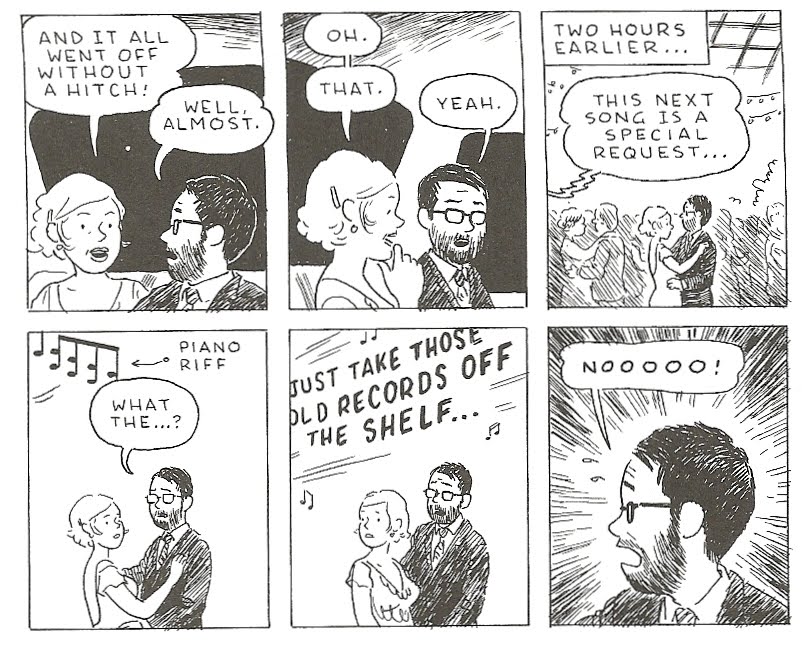 I have a review of Adrian Tomine's Scenes From an Impending Marriage posted at Blog@ today, should you want to go read it. Spoiler alert: Scenes is really good.
Sunday, October 14, 2007
The blurbs of Jonathan Lethem: A long, vague, meandering post about talking about comics
There's been plenty written about Jonathan Lethem's comics writing so far, the first issue of his Omega The Unknown remake/reimagining for Marvel. And there's been much more written about his prose fiction writing over the years. But today, I'd like to focus on another, very specific type of writing that Jonathan Lethem does, one that doesn’t get nearly as much attention—his blurb writing for the backs of other people's comics.
Here’s what Lethem wrote of Adrian Tomine, the Optic Nerve cartoonist currently being written about everywhere for his brilliant graphic novel Shortcomings:
Tomine's genius is to strip his medium of every possible type of grandiosity or indulgence, and the result is that life itself floods in. His mise-en-scene rivals Eric Rohmer's in its gentle precision, and his mastery of narrative time suggests Alice Munro. Shortcomings, as near as he'd get to a grand statement, is as deceptively relaxed and perfect as a comic book gets.
—Jonathan Lethem
I’m not sure I entirely agree with the first two sentences.
 What I found most remarkable about Tomine’s Shortcomings work wasn’t how it was filled by real life reacting to a vacuum of filigree, but that it so thoroughly simulated real life in its realism, both in the art and the writing (I’m not quite sure how Tomine could strip the entire medium either; is Lethem saying that comics/comix/sequential art is predisposed towards grandiosity or indulgence?)
And as for the second sentence, well, it’s been a while since I’ve sat down and paid attention to the mise-en-scene of any French New Wave directors, and I freely admit to never having read a single Alice Munro story (That I know of. Do they teach her in school? If so, I might have read her and forgot her name—I was forced to read a lot of things I don’t remember in school).
So I can’t really agree or disagree, but I know when I was reading Shortcomings, I wasn’t thinking, “Day-umn, check out that mis-en-scene!” or “Oh snap! This guy’s mastery of narrative time is the bomb!” And noticeably strong mise-en-scene and mastery of narrative time seems to contradict the statement that Tomine’s comic is stripped down to an indulgence-free negative space which real life may more easily occupy.
But “deceptively relaxed?” Yeah, I’ll second that. And “as…perfect as a comic book gets?” I’d second that too, as long as Lethem means it literally, as in “this is as good as it gets” and not “this is as good a comic book gets.”
But whatever, my intent here isn’t to argue with what Lethem said or the way he said it (Because he’d win easy; I mean, his job is to say things well, and his business is good). Rather, what interested me was this brief piece on The Quill blog, the blog supplement to Canada’s Quill & Quire, which uses Lethem’s blurb as a starting point for what may be a completely imaginary conflict between Tomine and Lethem.
Under the heading “Tomine to Lethem: butt out, smartypants,” the blog entry refers to an interview in The Believer in which the introduction mentions the praise Tomine has gotten from Lethem and Charles McGrath, and runs this quote from Tomine:
I also am trying to think —and I hope other people will start to see it this way —that sometimes a comic can be a great thing because it’s a comic, not because it’s almost as good as a movie, or as good as a prose novel, which I think is the way a lot of people are now trying to process it …. You start to get nervous when the value of a comic book or graphic novel is relative to the achievements of some other medium.
The blog post also says that Tomine “raises doubts that long-form graphic novels are the ne plus ultra*of comics art, and says that comparisons to masterworks in other mediums are implicitly degrading” and that the extended quote from Tomine “could be a veiled reference to the immodest praise of Jonathan Lethem.”
Yeah, it could be, but the post kinda makes it sound like it is doesn’t it? (I first noticed this article after Tom Spurgeon pointed it out on his blog, with the smart-ass link “Maybe He Simply Meant What He Said.” Reading the Believer interview Tomine’s statement isn’t prompted by anything…what the ellipsis in the quote cuts out is the part where he says he wishes people would equate comics to other visual arts as much as movies or prose, because the time it takes to produce a graphic novel is so much longer than it takes to read it. That is, paintings we can go back and look at over and over and see new things in, whereas novels are something we think of as to be plowed through, with each page a part of a whole rather than a work to be regarded on its own (I am, by the way, super-generalizing).
But what Tomine says and what Lethem said, whether the former was responding to the latter or not, is interesting in any case, because I think it speaks to the way people think and talk about comics and, since I spend so much time thinking and talking about comics, well, that sort of thing interests me.
If you boil criticism, comics or otherwise, down to its base essence, it amounts to little more than a series of comparisons—this is good (defined only when compared to bad), this is bad (defined only when compared to good), this is better than that, this is worse than that, here's why.
So comparisons are absolutely necessary in comics criticism. Whether comparisons to other media are necessary depends on large part to who is writing the criticism, and who they are writing it for.
There's definitely a great deal of freedom that comes in knowing your audience as completely as you can. When I review a comic book for Newsarama.com, or here on EDILW, I know this much about just about everyone reading—they also reads comics regularly, and will know the terms and lingo used in discussing comics, as well as just about all of the names or works I could possibly cite when making a comparison.
In that regard, I think a place that hosts writing about comics exclusively, by someone who knows a lot about comics, for an audience of people interested in comics, is probably going to give a review that matters most to someone like Tomine, one that won’t ever need to think too hard about works in other media in order to discuss his comics.
To use an example of someone I read about 400 reviews by today, if Tom Spurgeon were to review Shortcomings at The Comics Reporter, for example, he's free to compare it exclusively to Tomine's past work, cartoonists whose work it resembles and/or other Drawn and Quarterly publications, knowing (or at least feeling fairly certain) that his audience will be familiar with Optic Nerve, Summer Blonde, Los Hernandez Brothers, James Sturm or Rutu Modan and whatever else might come up in the review. Spurgeon can write about Tomine's work without having to compare it to other media because of his depth of experience with the comics medium, and the assurance that most of the people reading his site share a certain degree of interest and experience with the field.
But when you're writing about comics for a more general audience, a phenomenon that’s been ever increasing ever since publishers who aren't exclusively comics publishers have started publishing graphic novels, you can't always assume that the reader knows all the terms. Thankfully we're past a point where we need to explain the word "graphic novel" or "manga" or point out that comics, in fact, aren't just for kids anymore (At least, I like to think we are, and all those local newspapers still writing a "Bam! Pow! Holy Voltron Batman, Manga Is Kinda Popular, Isn't It?" articles are simply way behind the times), but a writer for a venue outside the comics press can’t as easily assume everyone of their readers is an afficianado.
It's in those instances when comparisons to other media are invaluable. When I write comics reviews for Las Vegas Weekly, for example, I write them for a more general audience then I write for here or at Newsarama, and I don’t assume that everyone reading it is exactly like me (as I do when I write about comics here or for Newsarama.com...where, increasingly, I find not everybody is exactly like me...or even all that much like me at all). But the more I think about it, wherever I’m writing about comics, I constantly compare them to works in other media.
Brad Meltzer writes JLoA like it's a novel. DC has a tendency to treat its superhero properties like they were 10 p.m. cop dramas. Marvel's Max line is basically R-rated versions of their formerly PG characters. The characters in Black Metal are designed like those in a Cartoon Network original series. Scott Pilgrim and Sharknife read like video games play. And on and on.
Now, Tomine's certainly right about value judgments—in assessing his work, we're better off comparing it to the comic book canon and what's currently on the shelves now than against works, good or bad, in other media to figure out or communicate how good or bad it is. Because if you start saying things, like "this is so good it's practically a movie," then that's ranking the media, and I would like to think we're well past that point as a society, although comics history itself is littered with stories of that prejudice, of the grand masters of the Golden Age being ashamed of what they were doing, and hoping they could get into something more respectable, like newspaper strips or advertising. Even today, there seem to be a lot of (or, at least, too many, with one being "too many") creators who look at comics as something that movies are adapted from, and I know I've read far too many comics that read like someone's screen play broken up into four or six issues for a miniseries. So perhaps that sentiment is still present in comics to a certain extent, but hopefully confined to a handful of creators, and doesn't exist at all among comics critics.
But there's nothing wrong with comparing a particular comic to a particular work in another media, as long as we're not weighing the media against one another**, and in fact not ever comparing works of one media to works from another would likely make criticism kind of hard to do, not to mention less effective. Consider the influence the works of non-comics media may have on comics writers and artists, for example. I can't imagine talking about Kelley Jones work as a writer/artist without mentioning Hammer films, discussing the art work of Osamu Tezuka without mentioning Disney films (Just to pick two wildly divergent examples, based on my current To Read piles).
While thinking about all that stuff, prompted by the Lethem quote on Tomine and where that lead, I saw this on the back of a copy of James Sturm's America, which I was preparing to review:
Sturm's America is the one glimpsed through the holes in the flag: rooted, grim and enduring. The line of his drawings has a pure grain like that of the voice in William Carlos Williams' epic poem
Paterson, or the singers on Harry Smith's Anthology of American Folk Music. Fables like these are an antidote to
cultural amnesia."
—Jonathan Lethem
 Oh, Jonathan, what are we going to do with you! So, here's another three-sentence blurb from Lethem on a D+Q book, one that also compares a comic book to two different works of other media. It sounds like a very nice quote, but again, if I stop to think too much about it, it ultimately sounds meaningless to me.
The first sentence, as gripping a visual image as looking through the holes in a flag might be, is really just nonsense—having read the three tales in Sturm's book now, I suppose you could say it presents a country that is rooted, grim and enduring, but what does that have to do with the visual image Lethem starts that statement off with?
Then it just gets crazy, as he extends metaphors to their breaking points. He compares Sturm's line work to the voice in a William Carlos Williams poem and the sound of the voice of singers I've never heard of…? But regardless, what does it even mean? A case could be made for the ways in which linework evokes sound, or the same feelings that the sounds might evoke, but Lethem doesn't really go into it here, so it just seems like namedropping, and it's namedropping to the same effect as his Shortcomings quote…which the Quill & Quire blogger interpreted as something that Tomine didn’t like…which sent me on the weird, rambling tangent that comprises most of this interminably long post.
As for that last sentence in the America blurb, I don't agree with it. If you use a broad definition of fable, broad to the point where it doesn’t strictly mean “fable” but could be applied to other literary terms just as easily, like “a fictional narrative used to enforce a useful truth,” then it could certainly apply to these stories to a certain extent, but Strum doesn't bluntly lay out "useful truths" in the manner of a fable. Maybe Lethem's reading just varied greatly from mine, but it seems to me that Sturm suggests vague truths and leaves it to the reader to contextualize them, rather than making straightforward pronouncements along the lines of "Racism is bad, but inherent to the American spirit," or "Faith is for crazy people" or "killing Chinese people for gold is bad."
Nor do they really do much in the way of addressing cultural amnesia, since they're fictional stories. Based on and inspired by history, yes, but they're not reminding us of things we've forgotten so much as introducing us to stories that haven't yet been added to our cultural memory.
So, Jonathan Lethem—Reportedly a great prose fiction writer, seemingly a pretty good comic book writer, but not so hot at blurb writing.
*Is there a superhero called Ne Plus Ultraman yet? If not, I’m calling it right now.
**And I don't know that anyone actually does that, but apparently Tomine's heard enough of it to make the statement he did to The Believer; given the circles he runs in, he'd be much more likely to hear that sort of thing than I ever would.
Here’s what Lethem wrote of Adrian Tomine, the Optic Nerve cartoonist currently being written about everywhere for his brilliant graphic novel Shortcomings:
Tomine's genius is to strip his medium of every possible type of grandiosity or indulgence, and the result is that life itself floods in. His mise-en-scene rivals Eric Rohmer's in its gentle precision, and his mastery of narrative time suggests Alice Munro. Shortcomings, as near as he'd get to a grand statement, is as deceptively relaxed and perfect as a comic book gets.
—Jonathan Lethem
I’m not sure I entirely agree with the first two sentences.
 What I found most remarkable about Tomine’s Shortcomings work wasn’t how it was filled by real life reacting to a vacuum of filigree, but that it so thoroughly simulated real life in its realism, both in the art and the writing (I’m not quite sure how Tomine could strip the entire medium either; is Lethem saying that comics/comix/sequential art is predisposed towards grandiosity or indulgence?)
And as for the second sentence, well, it’s been a while since I’ve sat down and paid attention to the mise-en-scene of any French New Wave directors, and I freely admit to never having read a single Alice Munro story (That I know of. Do they teach her in school? If so, I might have read her and forgot her name—I was forced to read a lot of things I don’t remember in school).
So I can’t really agree or disagree, but I know when I was reading Shortcomings, I wasn’t thinking, “Day-umn, check out that mis-en-scene!” or “Oh snap! This guy’s mastery of narrative time is the bomb!” And noticeably strong mise-en-scene and mastery of narrative time seems to contradict the statement that Tomine’s comic is stripped down to an indulgence-free negative space which real life may more easily occupy.
But “deceptively relaxed?” Yeah, I’ll second that. And “as…perfect as a comic book gets?” I’d second that too, as long as Lethem means it literally, as in “this is as good as it gets” and not “this is as good a comic book gets.”
But whatever, my intent here isn’t to argue with what Lethem said or the way he said it (Because he’d win easy; I mean, his job is to say things well, and his business is good). Rather, what interested me was this brief piece on The Quill blog, the blog supplement to Canada’s Quill & Quire, which uses Lethem’s blurb as a starting point for what may be a completely imaginary conflict between Tomine and Lethem.
Under the heading “Tomine to Lethem: butt out, smartypants,” the blog entry refers to an interview in The Believer in which the introduction mentions the praise Tomine has gotten from Lethem and Charles McGrath, and runs this quote from Tomine:
I also am trying to think —and I hope other people will start to see it this way —that sometimes a comic can be a great thing because it’s a comic, not because it’s almost as good as a movie, or as good as a prose novel, which I think is the way a lot of people are now trying to process it …. You start to get nervous when the value of a comic book or graphic novel is relative to the achievements of some other medium.
The blog post also says that Tomine “raises doubts that long-form graphic novels are the ne plus ultra*of comics art, and says that comparisons to masterworks in other mediums are implicitly degrading” and that the extended quote from Tomine “could be a veiled reference to the immodest praise of Jonathan Lethem.”
Yeah, it could be, but the post kinda makes it sound like it is doesn’t it? (I first noticed this article after Tom Spurgeon pointed it out on his blog, with the smart-ass link “Maybe He Simply Meant What He Said.” Reading the Believer interview Tomine’s statement isn’t prompted by anything…what the ellipsis in the quote cuts out is the part where he says he wishes people would equate comics to other visual arts as much as movies or prose, because the time it takes to produce a graphic novel is so much longer than it takes to read it. That is, paintings we can go back and look at over and over and see new things in, whereas novels are something we think of as to be plowed through, with each page a part of a whole rather than a work to be regarded on its own (I am, by the way, super-generalizing).
But what Tomine says and what Lethem said, whether the former was responding to the latter or not, is interesting in any case, because I think it speaks to the way people think and talk about comics and, since I spend so much time thinking and talking about comics, well, that sort of thing interests me.
If you boil criticism, comics or otherwise, down to its base essence, it amounts to little more than a series of comparisons—this is good (defined only when compared to bad), this is bad (defined only when compared to good), this is better than that, this is worse than that, here's why.
So comparisons are absolutely necessary in comics criticism. Whether comparisons to other media are necessary depends on large part to who is writing the criticism, and who they are writing it for.
There's definitely a great deal of freedom that comes in knowing your audience as completely as you can. When I review a comic book for Newsarama.com, or here on EDILW, I know this much about just about everyone reading—they also reads comics regularly, and will know the terms and lingo used in discussing comics, as well as just about all of the names or works I could possibly cite when making a comparison.
In that regard, I think a place that hosts writing about comics exclusively, by someone who knows a lot about comics, for an audience of people interested in comics, is probably going to give a review that matters most to someone like Tomine, one that won’t ever need to think too hard about works in other media in order to discuss his comics.
To use an example of someone I read about 400 reviews by today, if Tom Spurgeon were to review Shortcomings at The Comics Reporter, for example, he's free to compare it exclusively to Tomine's past work, cartoonists whose work it resembles and/or other Drawn and Quarterly publications, knowing (or at least feeling fairly certain) that his audience will be familiar with Optic Nerve, Summer Blonde, Los Hernandez Brothers, James Sturm or Rutu Modan and whatever else might come up in the review. Spurgeon can write about Tomine's work without having to compare it to other media because of his depth of experience with the comics medium, and the assurance that most of the people reading his site share a certain degree of interest and experience with the field.
But when you're writing about comics for a more general audience, a phenomenon that’s been ever increasing ever since publishers who aren't exclusively comics publishers have started publishing graphic novels, you can't always assume that the reader knows all the terms. Thankfully we're past a point where we need to explain the word "graphic novel" or "manga" or point out that comics, in fact, aren't just for kids anymore (At least, I like to think we are, and all those local newspapers still writing a "Bam! Pow! Holy Voltron Batman, Manga Is Kinda Popular, Isn't It?" articles are simply way behind the times), but a writer for a venue outside the comics press can’t as easily assume everyone of their readers is an afficianado.
It's in those instances when comparisons to other media are invaluable. When I write comics reviews for Las Vegas Weekly, for example, I write them for a more general audience then I write for here or at Newsarama, and I don’t assume that everyone reading it is exactly like me (as I do when I write about comics here or for Newsarama.com...where, increasingly, I find not everybody is exactly like me...or even all that much like me at all). But the more I think about it, wherever I’m writing about comics, I constantly compare them to works in other media.
Brad Meltzer writes JLoA like it's a novel. DC has a tendency to treat its superhero properties like they were 10 p.m. cop dramas. Marvel's Max line is basically R-rated versions of their formerly PG characters. The characters in Black Metal are designed like those in a Cartoon Network original series. Scott Pilgrim and Sharknife read like video games play. And on and on.
Now, Tomine's certainly right about value judgments—in assessing his work, we're better off comparing it to the comic book canon and what's currently on the shelves now than against works, good or bad, in other media to figure out or communicate how good or bad it is. Because if you start saying things, like "this is so good it's practically a movie," then that's ranking the media, and I would like to think we're well past that point as a society, although comics history itself is littered with stories of that prejudice, of the grand masters of the Golden Age being ashamed of what they were doing, and hoping they could get into something more respectable, like newspaper strips or advertising. Even today, there seem to be a lot of (or, at least, too many, with one being "too many") creators who look at comics as something that movies are adapted from, and I know I've read far too many comics that read like someone's screen play broken up into four or six issues for a miniseries. So perhaps that sentiment is still present in comics to a certain extent, but hopefully confined to a handful of creators, and doesn't exist at all among comics critics.
But there's nothing wrong with comparing a particular comic to a particular work in another media, as long as we're not weighing the media against one another**, and in fact not ever comparing works of one media to works from another would likely make criticism kind of hard to do, not to mention less effective. Consider the influence the works of non-comics media may have on comics writers and artists, for example. I can't imagine talking about Kelley Jones work as a writer/artist without mentioning Hammer films, discussing the art work of Osamu Tezuka without mentioning Disney films (Just to pick two wildly divergent examples, based on my current To Read piles).
While thinking about all that stuff, prompted by the Lethem quote on Tomine and where that lead, I saw this on the back of a copy of James Sturm's America, which I was preparing to review:
Sturm's America is the one glimpsed through the holes in the flag: rooted, grim and enduring. The line of his drawings has a pure grain like that of the voice in William Carlos Williams' epic poem
Paterson, or the singers on Harry Smith's Anthology of American Folk Music. Fables like these are an antidote to
cultural amnesia."
—Jonathan Lethem
 Oh, Jonathan, what are we going to do with you! So, here's another three-sentence blurb from Lethem on a D+Q book, one that also compares a comic book to two different works of other media. It sounds like a very nice quote, but again, if I stop to think too much about it, it ultimately sounds meaningless to me.
 The first sentence, as gripping a visual image as looking through the holes in a flag might be, is really just nonsense—having read the three tales in Sturm's book now, I suppose you could say it presents a country that is rooted, grim and enduring, but what does that have to do with the visual image Lethem starts that statement off with?
Then it just gets crazy, as he extends metaphors to their breaking points. He compares Sturm's line work to the voice in a William Carlos Williams poem and the sound of the voice of singers I've never heard of…? But regardless, what does it even mean? A case could be made for the ways in which linework evokes sound, or the same feelings that the sounds might evoke, but Lethem doesn't really go into it here, so it just seems like namedropping, and it's namedropping to the same effect as his Shortcomings quote…which the Quill & Quire blogger interpreted as something that Tomine didn’t like…which sent me on the weird, rambling tangent that comprises most of this interminably long post.
As for that last sentence in the America blurb, I don't agree with it. If you use a broad definition of fable, broad to the point where it doesn’t strictly mean “fable” but could be applied to other literary terms just as easily, like “a fictional narrative used to enforce a useful truth,” then it could certainly apply to these stories to a certain extent, but Strum doesn't bluntly lay out "useful truths" in the manner of a fable. Maybe Lethem's reading just varied greatly from mine, but it seems to me that Sturm suggests vague truths and leaves it to the reader to contextualize them, rather than making straightforward pronouncements along the lines of "Racism is bad, but inherent to the American spirit," or "Faith is for crazy people" or "killing Chinese people for gold is bad."
Nor do they really do much in the way of addressing cultural amnesia, since they're fictional stories. Based on and inspired by history, yes, but they're not reminding us of things we've forgotten so much as introducing us to stories that haven't yet been added to our cultural memory.
So, Jonathan Lethem—Reportedly a great prose fiction writer, seemingly a pretty good comic book writer, but not so hot at blurb writing.
*Is there a superhero called Ne Plus Ultraman yet? If not, I’m calling it right now.
**And I don't know that anyone actually does that, but apparently Tomine's heard enough of it to make the statement he did to The Believer; given the circles he runs in, he'd be much more likely to hear that sort of thing than I ever would.
Thursday, October 11, 2007
October 11th's Meanwhile in Las Vegas...

Man, I can't tell you how many times I've had that exact conversation. This week's Las Vegas Weekly comics column features an actual reveiw of Adrian Tomine's Shortcomings, after last week's gut reaction. Check it out. The column that is, not the book. Well, actually check the book out to, because it's pretty great. So check out the column, then the book. If you haven't already read it. If you have, then just check out the column. Thanks.
Thursday, October 04, 2007
October 4th's Meanwhile in Las Vegas... plus three other things
This week's LVW comics column features reveiws of

and

So go read it. If you want. No pressure. I don't care one way or the other, really. Seriously, if you don't want to go read it, that's fine. Don't.
Meanwhile, in other, less self-obsessed news...

1.) So I read Shortcomings Monday night, and my initial reaction was this: “Fuck you, Adrian Tomine!”
Yeah, yeah, yeah the art is really incredible and it tells a compelling story and blah blah blah, but Jesus God did it bring me down.
I don't know if I was just feeling particularly bummed out or lonely that night or what, but man was I depressed by the time I closed the covers.
And I blamed Tomine, for subjecting me to his unsympathetic protagonist and all the unsympathetic people in his life, none of whom seem like they should be in relationships, and yet all of whom are in them, gradually breaking one another's hearts and ruining one another's lives.
And the worst part of it all? The characters are all so sharply realized and realistic they're bound to remind you of yourself and people you know and the real world relationships you've experienced, either firsthand or among your friends and aquaintances.
Of course, the fact that Shortcomings was strong enough to effect my mood and mental state at all is a pretty strong reccomendation for how effective it is alone.
But Monday night, I was all "Fuck you, Adrian Tomine! Thanks for ruining my night, jerk!"
Luckily I had a trade collection of Doug Moench and Paul Gulacy’s 2002 series Shang-Chi: Master of Kung Fu on hand, and its mindless escapism offerred a welcome distraction from the dark mood Shortcomings left me in.
It didn’t occur to me at the time, as Tomine’s book was just the next one I needed to read to review and the Marvel trade was just the next one on my escapist-comics-to-read-before-bed pile, but now, a few days later, it strikes me what an odd double-feature that is.
I’m sure reading Shortcomings, which deals with Asian-American race issues through the prism of relationships between Asians and Caucasians, and Master of Kung-Fu, a story about a stereotypical martial artist hero fighting fucking Fu Manchu, back to back says something about me as a reader and the American comic book industry in general.
I’m just not sure what.
Anyway, a real review of Shortcomings—which in all seriousness is a great read—is in the works for next week.
2.) Speaking of graphic novels, Columbus writer Dara Naraghi’s Lifelike is in the latest issue of Previews. (Page 300, Diamond order code OCT07 3596).
If you live here and read comics, chances are you already know Dara, who’s been heavily involved in local mini-comic collective Panel and is a regular fixture at SPACE. He’s also probably the most often drawn man in Columbus, Ohio.
I’m not exactly sure why, but his fellow Panel-ists are always drawing Dara here and there. I think I’ve seen more drawings of him then I have of ex-Governor Bob Taft, and considering the latter appeared regularly in political cartoons for almost a decade, that’s saying something.
Anyway, the book is called Lifelike and IDW is publishing it. It’s a series of slice-of-life vignettes written by Dara and illustrated by 11 different artists, including fellow Columbusites Tim McClurg, Andy Bennett and Tom Williams.
You can read more about Lifelike here, and read much of it in its original webcomic format here.
3.) Not specifically comics, but close enough for linkage, is the documentary film Strange Culture, which is playing this weekend here in Columbus (You can read my review of it here). The subject matter of the film is the sad, scary, infuriating case of Steve Kurtz, a long-haired college professor, artist and activist who was investigated for bioterrorism when Petri dishes and lab equipment were found in his home when his wife died. (Completely coincidentally, as it turned out, although the authorities seemed to think the two things connected at first).
Because the case is still ongoing, there’s a lot Kurtz can’t talk about, and to help fill the screen with images, director Lynn Hershman often pulls panels from a comic book/sequential art story written by Timothy Stock and illustrated by Warren Heise.
It was called “Suspect Culture” and appeared in 2005 small press multi-media book Supsect (which contains comics, drawings, essays, fiction and more on the subject of “the suspect in a post-9/11 world.” Heise has a an incredibly bold, detailed style, with his individual panels resembling blocky woodcuts.
That’s a page of it above. You can see seven more at his site (Click on “Suspect Culture” on the menu on the right).

and

So go read it. If you want. No pressure. I don't care one way or the other, really. Seriously, if you don't want to go read it, that's fine. Don't.
Meanwhile, in other, less self-obsessed news...

1.) So I read Shortcomings Monday night, and my initial reaction was this: “Fuck you, Adrian Tomine!”
Yeah, yeah, yeah the art is really incredible and it tells a compelling story and blah blah blah, but Jesus God did it bring me down.
I don't know if I was just feeling particularly bummed out or lonely that night or what, but man was I depressed by the time I closed the covers.
And I blamed Tomine, for subjecting me to his unsympathetic protagonist and all the unsympathetic people in his life, none of whom seem like they should be in relationships, and yet all of whom are in them, gradually breaking one another's hearts and ruining one another's lives.
And the worst part of it all? The characters are all so sharply realized and realistic they're bound to remind you of yourself and people you know and the real world relationships you've experienced, either firsthand or among your friends and aquaintances.
Of course, the fact that Shortcomings was strong enough to effect my mood and mental state at all is a pretty strong reccomendation for how effective it is alone.
But Monday night, I was all "Fuck you, Adrian Tomine! Thanks for ruining my night, jerk!"
Luckily I had a trade collection of Doug Moench and Paul Gulacy’s 2002 series Shang-Chi: Master of Kung Fu on hand, and its mindless escapism offerred a welcome distraction from the dark mood Shortcomings left me in.
It didn’t occur to me at the time, as Tomine’s book was just the next one I needed to read to review and the Marvel trade was just the next one on my escapist-comics-to-read-before-bed pile, but now, a few days later, it strikes me what an odd double-feature that is.
I’m sure reading Shortcomings, which deals with Asian-American race issues through the prism of relationships between Asians and Caucasians, and Master of Kung-Fu, a story about a stereotypical martial artist hero fighting fucking Fu Manchu, back to back says something about me as a reader and the American comic book industry in general.
I’m just not sure what.
Anyway, a real review of Shortcomings—which in all seriousness is a great read—is in the works for next week.
2.)
 Speaking of graphic novels, Columbus writer Dara Naraghi’s Lifelike is in the latest issue of Previews. (Page 300, Diamond order code OCT07 3596).
 If you live here and read comics, chances are you already know Dara, who’s been heavily involved in local mini-comic collective Panel and is a regular fixture at SPACE. He’s also probably the most often drawn man in Columbus, Ohio.
I’m not exactly sure why, but his fellow Panel-ists are always drawing Dara here and there. I think I’ve seen more drawings of him then I have of ex-Governor Bob Taft, and considering the latter appeared regularly in political cartoons for almost a decade, that’s saying something.
Anyway, the book is called Lifelike and IDW is publishing it. It’s a series of slice-of-life vignettes written by Dara and illustrated by 11 different artists, including fellow Columbusites Tim McClurg, Andy Bennett and Tom Williams.
You can read more about Lifelike here, and read much of it in its original webcomic format here.
3.)
 Not specifically comics, but close enough for linkage, is the documentary film Strange Culture, which is playing this weekend here in Columbus (You can read my review of it here). The subject matter of the film is the sad, scary, infuriating case of Steve Kurtz, a long-haired college professor, artist and activist who was investigated for bioterrorism when Petri dishes and lab equipment were found in his home when his wife died. (Completely coincidentally, as it turned out, although the authorities seemed to think the two things connected at first).
Because the case is still ongoing, there’s a lot Kurtz can’t talk about, and to help fill the screen with images, director Lynn Hershman often pulls panels from a comic book/sequential art story written by Timothy Stock and illustrated by Warren Heise.
It was called “Suspect Culture” and appeared in 2005 small press multi-media book Supsect (which contains comics, drawings, essays, fiction and more on the subject of “the suspect in a post-9/11 world.” Heise has a an incredibly bold, detailed style, with his individual panels resembling blocky woodcuts.
That’s a page of it above. You can see seven more at his site (Click on “Suspect Culture” on the menu on the right).
Subscribe to:
Posts (Atom)