Showing posts with label links. Show all posts

Friday, May 15, 2026

Three interesting scenes from Don Rosa's "A Little Something Special"

The title story of Fantagraphics' new collection Uncle Scrooge: "A Little Something Special" and Other Tales of Fiendish Foes is by Don Rosa and was created in 1997 to mark the occasion of the 50th anniversary of Carl Barks' creation of Scrooge McDuck. It's an all-around great story, a celebration and summation of Uncle Scrooge comics, containing the character's family, friends and foes, as well as references to his biography and the history of Duckburg. 

Is it the ultimate Uncle Scrooge story? Perhaps.

Thes reason it is one of the 15 stories collected in this particular book is, of course, because it contains an alliance of Scrooge's greatest villains. Though I think Rosa's "A Matter of Some Gravity", a Magica De Spell story, is probably the most inventive and technically interesting of his work in this collection, there are some really great bits of storytelling and cartooning in "A Little Something Special," which I wanted to take a moment to point out here on the blog.(You can read my full review of the book at Good Comics For Kids.)

1.) The villains gather. Though Magica De Spell, The Beagle Boys and Flintheart Glomgold are Scrooge's greatest foes, and each has their own longstanding conflict with him, Rosa details here that each villain's desires differ greatly from one another, so much so that they can all play a part in a coordinated attack against Scrooge.

Also, I thought it notable that their alliance doesn't fail for the same reason similar groupings of supervillains generally fail in superhero comics. That is, while they don't necessarily like or respect one another, they aren't done in by infighting or betrayal...at least, not until a panel that acts as a sort of coda to that aspect of the story, perhaps suggesting why these guys didn't make such a team-up a regular thing. 

2.) Scrooge puts two and two together. The bad guys' plan involves keeping Scrooge away from his money bin by having him sit through an interminable ceremony in his honor, and another part of the plan involves the various villains taking on magically created disguises, these generated by a transmutation wand that Magica purchased with Glomgold's money. 

There is apparently one flaw in the disguises though: Transmuted or not, a person's shadow remains the same. That's how Scrooge, with an assist from a nephew, realizes that the speaker is actually Glomgold in disguise. 

The last panel in the above sequence, in which Scrooge realizes that Glomgold must be working with Magica and that means trouble for him, is a great one, one of those "only-in-comics" bits of storytelling.

3.) The disguises break down. During his mad dash back to his money bin, Scrooge runs headlong into Magica, damaging her transmutation wand. The result? The disguises that the Beagle Boys had adopted, each of them appearing to be a different one of Scrooge's friends or family, start to fall apart. They don't disappear entirely, but the Beagle Boys suddenly look like hybrids of themselves and a duck character, and Rosa gives them each a unique form, as you can see above (Unfortunately for Donald and one of the Beagle Boys, Donald was in the process of kissing "Daisy" when Scrooge accidentally damaged the wand).

The Beagle Boys would remain in this weird state for a few more pages, giving us a few more fun images of a Beagle head atop Daisy's body or a nephew's torso atop a Beagle's legs. 

Not pictured here are the Beagles who were disguised as Gladstone Gander and Gyro Gearloose. The former resumes his Beagle body, but he is now dressed in Gladstone's far too small clothes (Rosa never draws him from the waist down; the Beagles wear pants, remember, while the ducks don't). The latter is bisected vertically, so that he looks like a Beagle Boy on the right half of his body, while the left half of his body is that of Gyro.

Monday, December 22, 2025

Announcing Giant Monster Movies: 100 Years of Big-Screen Behemoths

We interrupt our regular comic book talking about for breaking news: I have a book coming out in 2026. 

As you can see from the cover image above, it's entitled Giant Monster Movies: 100 Years of Big-Screen Behemoths. It will be published by McFarland. 

The book reviews the entirety of the giant monster movie genre, from 1925's The Lost World, the climax of which established a basic template that all giant monster movies followed, to 2024's Godzilla x Kong: The New Empire, the latest in the Warner Bros./Legendary Pictures string of "Monsterverse" blockbusters.

That's 92 films total, including the King Kong, Godzilla, Gamera and Mothra franchises, 1950s giant bug movies (Tarantula!, The Deadly Mantis, The Black Scorpion), international attempts by countries trying to create their very own Godzilla (Yongary, Reptilicus, Gorgo), some oft-overlooked oddball movies (The Giant Claw, The X From Outer Space, Gappa: The Triphibian Monster, Space Amoeba) and many more.

If you enjoy reading my reviews of things—and, given the fact that you are reading this post on my comics review blog, I suspect you might—then you should enjoy my reviewing my way through the history of the giant monster movie genre.

I will be happy to share more details when they become available—chances are, you will be quite sick of me talking about the book before too long—but for now, here's what McFarland has on their site at the moment. If you haven't yet followed me on Bluesky, please do so, as that's probably the best place to keep up to date on various Caleb-related goings-on.

And if you guys have any questions in the meantime, feel free to ask in the comments below or via email. Thank you, as always, for reading. 

Wednesday, December 17, 2025

Another Mothman

This week I received an early Christmas gift from my co-worker, the talented artist (and fellow cryptid enthusiast) Gillian DiPofi. 

It is, as you can see, a framed watercolor painting of our favorite cryptid, Mothman, looking somewhere between creepy and socially awkward, as the best Mothmans should.

She also gave me a smaller, more festive Mothman painting, in which the big guy looks ready for the holiday:

To see more of her work, check out her Instagram page here. 

Thursday, December 04, 2025

Another Mothman

If you're reading this blog, then you are almost certainly an adult, in which case you are not the target audience for writer Heather Alexander and illustrator Sam Kalda's Haunted USA: Spine-Tingling Stories from All 50 States (Wide Eyed Editions; 2025). But if you, like me, appreciate great art and spooky stories, you will probably enjoy flipping through it and reading the entries that strike your fancy. 

As the title says, it's a collection of scary stories from each of the 50 states (plus one for Washington, DC), presented in two-page spread, a three-to-five paragraph story on one page, a gorgeous illustration of that story by Kalda on the facing page. Most of these are ghost stories, an aspect of the paranormal which I am not particularly interested in, and that includes the Ohio story (That of a "Racer Boy", a ghost said to appear on the tracks of a roller coaster at Kings Island).

 A few of the stories involve cryptids though, a subject which I am quite interested in. What grabbed my attention was the appearance of Mothman in the upper left corner of the cover. 

(You can't tell by looking at a picture online, but the cover has shiny silver elements on it, including the creators' names, the spots on Mothman's wings, the cat's whiskers and so on).

The story of Mothman is the West Virginia's entry in the book. Alexander's five-paragraph retelling includes the first sighting as that of the gravediggers who saw something large with wings and the most famous one, that of the Scarberrys and Mallettes in the TNT area, which lead to the newspaper report that seemingly kicked off the flap of sightings and its media coverage. 

The only mistake I noticed was in this sentence: "Some locals wondered if the Mothman was living in the nearby nuclear power plant, but police found no evidence of the creature or anyone there." West Virgina does not actually have any nuclear power plants, nor has it ever. Alexander probably meant the TNT area, a series of World War II-era concrete, igloo-like structures in which explosives were once stored. It is now the McClintic Wildlife Management Area, a locale Alexander mentions when telling the story of the Scarberry/Mallette sighting. 

But what we're most interested in here is the image of Mothman. As you can see, Kalda leans on the "moth" in the name, as so many artists do. Note the moth-like wings and the long, fuzzy antennae-like structures on its head. In this, Kalda seems to be following in the footsteps of Frank Franzetta, who painted a moth-man of a Mothman on the cover of High Times, and sculptor Bob Roach, who created the shiny statue of the cryptid that now stands in Point Pleasant.

No witnesses actually reported anything moth-like about Mothman, of course, aside from wings and nocturnal habits. Despite the spots, Kalda does get the creatures two most notorious features into his image: Big, black wings and staring red eyes (I like also the way he depicts Mothman as essentially face-less, no witness ever being able to articulate what its face might have looked like).

I also like how Kalda gives his Mothman such long, creepy fingers...and even long toes. It's a really gorgeous image.

The other handful of crytpids covered, each of which is also beautifully rendered, are Alaska's humanoid otter creatures the Kushtaka (Alexander's clever title? "Otterly Terrifying"), Massachusetts' Pukwudgies, a handful of different lake monsters from Michigan and Missouri's hairy humanoid Momo (who looks a bit like a cross between Chewbacca and Cartoon Network's Brak, I thought).

The Pukwudgie image is particularly potent, and I can imagine it scaring the hell out of me had I encountered it as a little kid, monsters scraping their claws on my bedroom windows being a particularly vivid fear of mine (elicited by the sound of utility wires creaking against the tree branches outside my window).

Perhaps also of note is Iowa's chocolate-eating ghost, star of an urban legend in which, if one leaves a candy bar on a particular bridge at a particular time, the chocolate will disappear, leaving only an empty wrapper. Though presumably a ghost, Kalda's brilliant illustration suggests a sort of red-eyed giant monster...while simultaneously looking like it might just be the shape of the trees and shadows on the bridge. 

Anyway, next time you're in the library, do take the time to check this book out. You can see more of Kalda's work on his website and his Instagram account. 


Monday, April 28, 2025

Tuesday, February 11, 2025

A brief DC Versus Marvel interlude

In my review of 1982's Marvel and DC Present Featuring the Uncanny X-Men and the New Teen Titans #1, and probably elsewhere throughout my series reviewing the history of DC/Marvel crossovers, I talked a bit about how the publishers stopped cooperating on crossover comics after that particular book was published. 

It would be 12 more years before DC and Marvel would work on a crossover of their characters again, not resuming them until 1994's Batman/Punisher: Lake of Fire #1. 

From the outside looking in, suspending the crossovers didn't seem to make much sense. Those first four were all pretty solid comics; a couple of them even great comics. They seem to have sold like gangbusters, and both the fans who read them and the pros who made them seemed to enjoy the relatively rare opportunity of seeing the rival publishers' characters interacting.

Whatever exactly happened, it seemed to center on the proposed fifth crossover, a George Perez-drawn pairing of the Justice League of America and the Avengers. I did a little Googling and found at least one player's version of events as to what exactly happened on his blog, but I didn't comment or even share a link to it here, not wanting to wade into 40-year-old dispute that occurred when I was in kindergarten.

Well, just this week I found a very thorough accounting of the collapse of the original JLoA/Avengers crossover, one that was based on reporting in the fan press at the time, public statements from many of the participants and apparently original interviews with some of the men involved. 

That would be the late KC Carlson's oral history of the project, which he apparently put together after being asked to write a piece for the collection of the 2004 JLA/Avengers crossover. 

Carlson's piece didn't end up appearing in that collection, however, and, once you read it, you'll see why: No one comes out looking particularly good. Rather than one actor or another being the villain in the story, the book seems to have been doomed by a series of bad decisions, miscommunication, some unprofessional behavior and a lot of hard feelings. And the damage done was apparently significant enough to put a stop to DC and Marvel's cooperation with one another for over a decade.

While Carlson's piece didn't end up in a JLA/Avengers book, The Beat eventually published it in a series of two posts in 2022. You can read the first one here. 

If you've been reading the DC/Marvel crossovers as I have lately, it seems like a pretty valuable piece of the behind-the-scenes story, one that explains not only what happened to that particular crossover but also answers the question as to why the two publishers stopped working together for so long. (Also? The Beat posts are illustrated by some great Perez art originally produced for the crossover, like the image atop this post.)

Now if only someone would do all the necessary interviews to write a piece explaining why DC and Marvel ceased publishing crossovers again after 2000's Batman/Daredevil: King of New York, and then why they temporarily resumed cooperating just long enough to finally publish JLA/Avengers...

Tuesday, April 28, 2020

A funny story about Mark Russell and Second Coming (and/or about my own failing memory)

I was reading the trade paperback collection of Mark Russell, Richard Pace and Leonard Kirk's Second Coming for a Comics Journal review last week, and, just a few pages in, I got a nagging feeling of deja vu, as if I had already read passages of it before, or at least read different versions of some of the same jokes before, like the idea of a Superman-like character tearing apart robot bank robbers, only to discover later that they were actually just regular people who had disguised themselves as robots.

The premise of Second Coming involves Jesus Christ returning to Earth and moving in with a Superman stand-in character named Sunstar, initiating an Odd Couple-like clash of personalities and worldviews. Jesus does so at the insistence of his dad, God, who wants to try and toughen up Jesus, since the last time Jesus came to Earth, things didn't seem so great for him. That too seemed to ring a bell, at which point I remembered The Superman Stories, a 48-page, self-published, prose pamphlet in which a purposefully, amusingly non-canonical version of Superman navigates the day-to-day stresses of being a volunteer freelance policeman with god-like powers.

In one of the later chapters of The Superman Stories, Superman goes to Heaven and talks with God and Jesus.

I remembered interviewing the writer of The Superman Stories shortly after I read it, but couldn't remember his name. It couldn't have been Mark Russell himself, could it, back before he became a famous comic book writer...? So I checked my blog, and discovered that the guy who wrote The Superman Stories was a man named...Mark Russell!

So despite having read several of Russell's DC Comics over the course of the last few years—Prez, The Flintstones, some Harley Quinn—and despite having had his Second Coming on my radar since it was first announced as the most promising of a new batch of Vertigo titles, only to be canceled, I somehow never realized that this Mark Russell guy who has been writing weird parody comics for DC was the same guy who wrote that awesome Superman Stories zine I read forever ago.

You can read my interview with Russell from 2006 here, if you like.

It was only after I re-read my own interview with Russell that I realized just how much DNA Second Coming shared with The Superman Stories, and it goes away to explaining the particular version of Superman/Sunstar that appeared in the comic; Sunstar isn't so much a straight analogue of DC Comics' Superman as he is an analogue of Russell's Superman Stories Superman.

I addition to the bit with the robots, which Russell mentions in the interview, and the interactions between Superman, God and Jesus, Second Coming also features a villain named Dr. Simius, who is a character in The Superman Stories too.

Re-reading it some 14 years later and after having just finished reading Second Coming, I found this to be the most interesting part of my interview with Russell though:
You mentioned that you’re working on a sequel? Can you tell me anything about that?

Superman’s relationship with Lois Lane undergoes some changes. Lex Luthor starts working out in order to compensate for his lack of hair. The supernatural storyline continues. God, who sees Superman sort of as the popular, good-looking, varsity-quarterback son he never had, asks Superman to take Jesus under his wing in hopes that Superman’s manliness and derring-do will rub off on him a little.
I think it's safe to say that Russell has been living with many of the ideas in Second Coming for a while now, then. In addition to the above, there's a dedication to a Lucas McCain immediately following the conclusion of the story in Second Coming, which notes that McCain played the character Night Justice in a play that Russell wrote entitled Group Therapy. The scenes of Sunstar, Night Justice, Lady Razor and other characters were based on Russell's play.

Friday, November 22, 2019

Climate change in recent kids comics

Writer Ridley Pearson's comics debut Super Sons, one of the first of DC Comics' new lines of original graphic novels for younger readers, contained many rather unexpected creative choices. Among them was his decision to set the story in a near-future world facing an apocalyptic threat. That threat was that of cataclysmic climate change, in which a warming globe had severely flooded the continents, creating a refugee crisis within the borders of his version of the United States.

The first volume's sub-title, The PolarShield Project, referred to one of the ideas scientists have considered to try and save society as we know it from the climate crisis, seeding the atmosphere with material that will block the sun's rays, keeping the temperature from rising much more than it already has. That is a controversial idea, in large part because it's impossible to know with any certainty what the side-effects of such radical, sci fi-sounding geoengineering might be, and also because, as impossible as it might sometimes seem, it's still going to be easier to radically restructure our fucked-up energy system and economy to move towards zero carbon dioxide emissions and avoid apocalyptic tipping point situations from burning too much rain forest or screwing up the ocean. In Super Sons, the idea of finding an artificial way to block the sun's rays is a little less controversial, though, because that particular rapidly warming Earth has got Superboy's dad Superman to help them out.

I read the book with some interest upon its release, in part because I'm a fan of those characters, in part because I was curious about DC's emergent Zoom and Ink lines and in part to prepare for an interview with Pearson. I was pretty surprised by the climate crisis backdrop, particularly since the usual Superman and Batman milieu doesn't lend itself to environmental science subject matter as strongly as those of some other DC superheroes might, but I was kind of glad to see Pearson and DC attempting to engage young readers on what is going to be the most important challenge of their lives.

If that surprised me, though, I was still more surprised by the fact that in the following six months, I've read two more comics directed at young readers that also dealt with the climate crisis. Three examples makes a trend—if I've ever learned anything from New York Times trend pieces, and I haven't, it's that—so I thought it worth pausing a moment to look at how these various books deal with the subject.
Regarding Super Sons, climate change presents a backdrop more than anything (At least as far as the first book goes; I haven't yet read Pearson and artist Ile Gonzalez's next book in their Super Sons series, The Foxglove Mission). It's a catalyst that provides a rationale for Bruce Wayne and Superman to be absent from the lives of their sons, and one that removes Damian and Jon from their traditional Gotham City and Metropolis settings into a new one where they are on equal footing. Although Gonzalez's art has a clarity and brightness to it that makes this future seem not quite so bad, perhaps in part because the people in the world of Super Sons have started to embrace alternative energy like wind power on a greater scale, the stories do address one of the many, many little-discussed impacts of climate change: Huge numbers of refugees and internally displaced people caused by environmental degradation.

(I don't want to get too off-topic here, but arguments can and have been made that climate change has in part influenced the recent influx of migrants from the southern triangle countries seeking asylum in the U.S. and that climate change may have been a factor in the Syrian civil war and the waves of refugees it created. While studies have been published and analysis see-sawed over those assertions, as the globe heats up and the equator gets hotter, we can expect more and more people from southern climates moving northward...and that's before we even get into sea level rise displacing people on coasts and islands).

I recently heard something quite sobering, even chilling: The scariest part of the climate crisis might not be what we do to the Earth and what nature does to us as a result of its systems breaking down or transforming, but what we do to one another as we try to cope with those changes. I mean, the U.S. is handling an immigration crisis at the current scale all that well right now; one hopes that's because of the monsters currently running immigration policy, but one can also fear that it's going to get worse, not better, as the numbers increase.
An even more unexpected discussion of the climate crisis appeared in Jon Scieszka and Steven Weinberg's AstroNuts Mission One: The Plant Planet. This is a book about four super-powered mutant animals astronauts with cool names like AlphaWolf and LaserShark exploring alien planets on behalf of a super-secret space exploration organization. While the overall tone of the book is fun and funny, there's a barely sublimated, let alone disguised, darkness to it.

The very premise of the book is couched in how much danger we've put the world in. Our heroes were only awakened from their cryogenic slumber and sent on their mission because humanity crossed "the BIG RED LINE" of putting more than 440 parts per million of carbon dioxide into the planet's atmosphere, setting off the current cascade of catastrophic events we're currently dealing with. See, our heroes in this series are scouting for a new planet that humanity can inhabit, since we may have rendered this one uninhabitable (for humanity as we know it, and most of the animals that are currently living on it, that is).

AstroNuts is extremely direct about all of this. In fact, the book begins with a big countdown to blastoff, at which point the narrator, Earth itself, comes in to provide some real talk:
Yes, blastoff. How exciting.

Usually. But not this time.

This time, blastoff was scary and awful. Because this blastoff was a deadly emergency.
The AstoNuts' first scouting mission takes them to the so-called Plant Planet, where they find an environment also out-of-whack, but in a different way. Amid all of the jokes and action and tidbits of real science, there's a refreshingly direct passage where the Earth stops telling its story of the AstroNuts to explain the climate crisis to the readers...and the Earth does it in such a simple way that it should be easy enough to share with any skeptical relatives you may have sitting around your Thanksgiving table (particularly if you are related to any Republican lawmakers and/or fossil fuel industry lobbyists).

I normally wouldn't want to excerpt so many pages in a row from a work, but I didn't think I could summarize in a way that would do it justice. That's how simple and direct the explanation is; it can't really be broken down any further without ruining the elegance of its presentation:


That last page above, in which Earth presents us with the two options of how to deal with the problem, reveals that while this story is premised on actualizing Plan B, finding another planet exactly like Earth and then transporting all 7.7 billion people there, that plan is no more realistic than AlphaWolf and his crew of super-powered mutant animal astronauts astronuts exploring the known universe in a rocket ship that was hidden in plain sight on Mount Rushmore as Thomas Jefferson's nose.

That really only leaves Plan A: Burn less fossil fuels.
Finally, one of the most recent kids comics I've read was cartoonist Abby Howard's Mammal Takeover, the third (and final) book in her Earth Before Us series. The first two books, Dinosaur Empire and Ocean Renegades, covered the Mesozoic and the Paleozoic Eras, while Mammal Takeover has 10-year-old Ronnie and her mentor Miss Lernin use the power of science magic to time-travel throughout the Cenozoic Era.

In all three books, the pair tour time and space to meet an encyclopedia's worth of animals and plants, learning about other concepts like geology, evolution, taxonomy and so along the way. These books are all a blast, for anyone interested in the amazing animals of the past of any age, and this one is in some ways the most compelling.

It's not just that it covers the bizarre and fascinating mammals of prehistory, animals that I've been particularly intrigued with since childhood on account of the fact that I learned of most of them so long after having been familiarized with dinosaurs. Glyptodons, short-faced bears, Megatherium and Paraceratherium had the mystique of "secret dinosaurs" to me, and, later, as an adult, I kept learning about "newer" and crazier animals from these epochs, like chalicotheres and gigantopithecus and various terror birds and all the crazy animals of prehistoric Australia. That the existence of so many of these now-extinct animals overlapped with human history made them all the more appealing, particularly as I've always been interested in stories of monsters and cryptozoology, and many of the megafauna that crossed paths with the earliest humans seemed to persist in at least folkloric form right up until today, when it's not entirely impossible to think there might be at least one species of giant ground sloth yet to be discovered in the Amazon, or that we might some day find a tiny population of relict gigantopithecus in Asia or that some species of mammoth or mastodon lingered on in Siberia or Alaska until about the time that the last auroch died or the last Stellar's sea cow was eaten.

This volume also covers the emergence of humanity in the Pleistocene, as Ronnie walks into a camp of Homo sapiens and a Neanderthal or two and shouts, "Oh my gosh, they're us!" Miss Lernin breaks down the origin of humanity, from Homo ercectus in Africa to three different species of humanity: Homo sapiens, Neanderthals and "the mysterious Denisovans," as well as "other, stranger species of humans that we may or may not have encountered, like the short species Homo naledi... ...and the much shorter Homo floresiensis."

That six-page history of human evolution leads to a triumphant two-page spread of "the mammals of the Holocene," which contains Howards drawings of "all the incredible creatures we share the world with, which are just as amazing and strange as those that came before them!" These animals are grouped into the various types Ronnie (and readers) learned throughout, from monotremes to marsupials, to primates, to afrotheria and so on (If you follow Howard on Twitter, you likely recognize her cat, Spoons; look for Spoons among the carnivora crowd).

And then, of course, there's the reason I'm talking about this book here on my blog, in this particular post, instead of elsewhere. After hundreds of pages on the rise and fall of various species of animal life throughout Earth's history, Howard ties the concept of mass extinction into our current moment.

Miss Lernin reminds Ronnie that such eras usually end with big extinction events, "like the K-T extinction that wiped out most of the dinosaurs... or the Permian-Triassic extinction, which was the largest mass extinction that ever happened."

Ronnie then provides a pretty perfect set-up:
I remember talking about those.

They were big bummers! Glad we don't have to talk about anything like that now that we've caught up with modern day.
While Ronnie immediately thinks of the causes of those two previous mass extinctions, Miss Lernin shrugs, "Nah, this ones on us," and explains how humans are the cause of the sixth mass extinction.

In the pages that follow, Miss Lernin explains that much of modern human society is driven by power made from teh burning of feuls like coal and gas, which creates carbon dioxide and other gasses that trap heat in the atmosphere. While AstroNuts' Earth talked about having a fever that must run its course, Howard draws an anthropomorphic Earth sleeping blissfully under a big comforter, right next to a worried and sweating globe, fitfully tucked into a gigantic, over-stuffed comforter. "This makes it harder for creatures to survive, because they haven't evolved to deal with this climate, and evolution is much slower than the rate that the climate is changing."

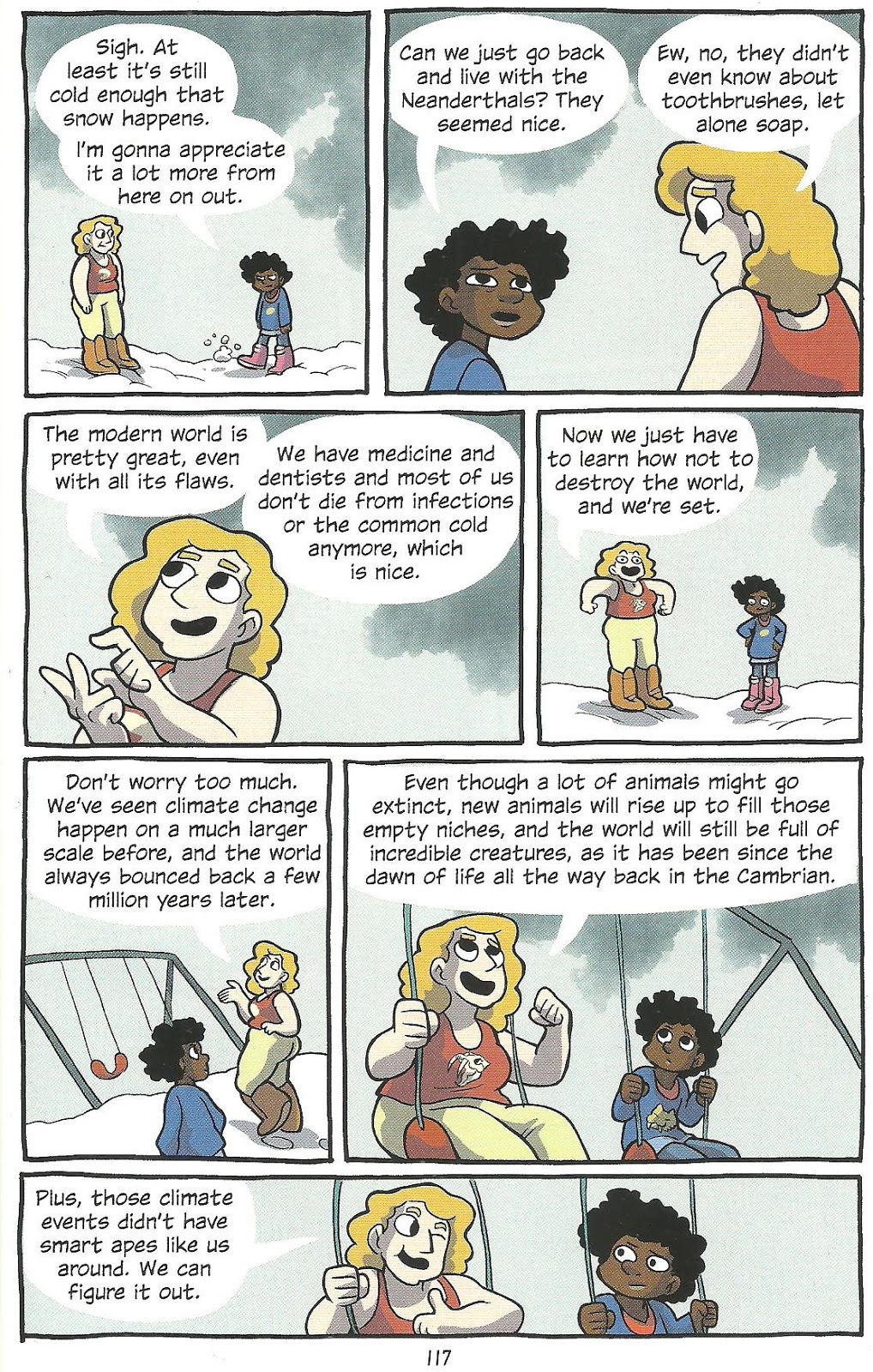
She details the effects and sources of methane, particularly animal agriculture, as well as deforestation and tackles the "But it still snows" argument head on. (In the background of a snowy panel, a small, bundled-up figure laughs, "Sure could use some of that 'climate change' right about now, ha ha!", while Miss Lernin explains how a warming Earth will mean more precipitation, including snow, and the obvious fact that just because it still snows, that doesn't mean the world's climate isn't warming; "It snowed in the Cretaceous, too, and that was a much warmer time than ours," she shrugs.) (Despite my earlier swipe at the New York Times, their weekly Climate Fwd newsletter is a pretty solid resource. This week, in preparation for Thanksgiving table arguments, they shared links to sources featuring arguments employed by climate deniers—or the simply skeptical—and counter-arguments. Click here and here and here, if you don't subscribe to Cimate Fwd or don't want to deal with the paper's dumb paywall thing).

And she tells Ronnie about the extinctions modern humans have caused more or less on purpose, like that of the thylacine, the passenger pigeon and Stellar's sea cow, before circling back to the climate crisis:
If it makes you feel any better, these days humans have mostly stopped wiping out animals just because they feel like it.
Now most extinctions are caused by the fact that the environment is quickly becoming unsuitable for many animals that are used to a certain climate...
All the bad news really gets to Ronnie, who is alternately scared, sad, angry, defensive and, of course, feeling helpless.
Miss Lernin relates: "Even for me, a grown-up, it's scary stuff, and I sometimes feel like there's not much I can do!" She tells Ronnie of all the little things she and the grown-ups in her family can do to try to help, from changing to more efficient light-bulbs to driving less to recycling to trying to eat less meat to trying to support politicians and leaders "who want to help the environment by using clean energy and making corporations quit doing bad stuff." (Lernin doesn't say so, of course, but what Howard likely means here is Democrats; I mean, it would be great if Republicans also started giving a shit, but the last few decades of American history have shown that they don't, and, at this crisis point, it may actually be more effective to ignore Republicans and try to fix the world as a Democrats-and-independents-only coalition, hoping the GOP comes around at some point in the future, without planning on their doing so.)
I like the bit above, where Miss Lernin addresses Ronnie's understandable sense of hopelessness that her doing something small like planting a tree can't possibly make up for wide-scale deforestation.

"It can feel a little hopeless sometimes, but think about it this way," she starts.
They were going to tear down those trees anyway, whether you planted yours or not. 
So you've still made a difference. There's one more tree than there would have been in the world.

An if more people are doing the same, then there are many, many more trees than there would have been.
 
Just because there are a lot of people out there doing bad things doesn't mean that small good things don't matter.

Together, we could plant a forest.
Throughout this entire sequence, which accounts for the last 12 or 13 pages of the book (depending on how you want to count the last page, which mostly sets up a weird but effective call-back to one of this volume's running gags), Howard communicates complex information in a pretty simple, straightforward way, her panels sometimes serving as something between an illustration and a diagram. As serious as the subject matter gets—and the only thing more serious than extinction of so many animal species is the threat of the extinction of our own species—the comic remains funny, with Howard's gags serving as much-needed pressure valves.

While discussing how carbon dioxide and greenhouse gases affect the world, for example, Miss Lernin turns our attention to the sea, and Howard has various sea animals talking to one another about how badly things are going for them. In one panel, a polar bear says to himself, "Dang, where's all the ice? I need that stuff so I can hunt for seals," while a seal just off the coast sticks its head out of the water and laughs, "Heh heh!" In the next panel, though, the seal finds itself in a discussion of how climate change affects the ocean, and changes its tune: "Wait, I'm affected by this, too?!"

Throughout the discussion, humans and animals appear to offer their own two cents, or dramatize various arguments.

So a business man wearing a monocle might clench his fists and shout, "Curse you, hippies! I'm too old and rich to change my ways!" in a panel about how we already possess clean energy technology, we just need the political will to change to its wide-scale usage.

Or in a panel in which Miss Lernin mentions the virtues of recycling, we see a deer staring somewhat creepily through the kitchen window of a woman who is placing a can in a green recycling bin rather than the garbage can, and the deer says aloud, "Yo, thanks I appreciate that."
The penultimate page, above, gives the book a hopeful note to end on, and one that also happens to capture the amusingly seemingly-insane enthusiasm that Miss Lernin radiates throughout the trilogy. Oddly enough, the sequence echoes that of the Earth's brief climate crisis interlude in AstroNuts, in which Earth points out that it will be fine, it's a planet; it's just humanity or, perhaps, humanity enjoying life-as-we-now-know-it, that is in danger.

It's...not really that comforting, but then, trying to find the balance between getting everyone the proper amount of freaked-out about climate change, you know, freaked-out enough to actually do something about it, but not so freaked-out that they become paralyzed with fear and anxiety and hopelessness, well, that's not an easy balance to strike. I think Howard, like Scieszka and Weinberg, finds it though.

I'm glad these comics exist, and I'm glad that they are so good at achieving their primary objectives of providing entertaining, educational content to kids of all ages, while still finding room to so effectively explain the problem of the climate crisis and suggest solutions.

It's the kids in the target audience for these books, after all, who are going to inherit a world ravaged by the problems we failed to slow, curb or solve. And it's up to us grown-ups to do as much as we can to try and care for that inheritance. Who knows, maybe Miss Lernin is right, and we smart apes really will learn how not to destroy the world.

Personally, I think we already know how, and it's more a matter of enough people in enough positions of power to find the will to not destroy the world.

We'll see.


**********************

•My interview with Ridley Pearson on Super Sons Book One: The PolarShield Project

•My review of Jon Scieszka and Steven Weinberg's AstroNuts Mission One: The Plant Planet

•My interview with Abby Howard on Mammal Takeover and her Earth Before Us series

Tuesday, August 21, 2018

Batman on a horse. A carousel horse.

Have you been perusing #visiblewomen on Twitter the last few days? I hope you have, as there's a lot of great art to be seen, and a lot of great artists to discover. I found this image by Mindy Lee particularly striking, as it features a unique (to me) variation on perhaps my favorite way to see Batman drawn--on a horse.

Saturday, July 14, 2018

These Marvel reprint anthologies seem a lot less controversial.

I have a write-up of Marvel Comics Digest #7, featuring The Avengers and Ant-Man and The Wasp, up at Good Comics For Kids today. The featured characters, the stars of the latest Marvel movie, made it more timely than some of the previous issues, and it seemed well past time to check the Marvel/Archie Comics alliance out. Admittedly, much of my interest was driven by the fact that repackaged Big Two super-comics content for sale outside of the direct market has been such a subject of conversation in certain corners of the Internet of late.

Why was there such upset over DC's Walmart exclusive anthologies, whereas Archie has been publishing these digests for over a year now...? If the same folks gnashing their teeth over the DC/Walmart books noticed these, they sure don't seem to talking about them as much...

Well, they are obviously pretty different books. The DC Walmart books are larger, akin to the size of regular comic books, whereas the Marvel ones are the same size as the other Archie digests; you can tell they are aimed specifically at kids because it likely helps to have tiny hands and small, healthy eyes to read the tiny, tiny, Ant-Man sized lettering of the digests (particularly in those super-wordy, Silver Age Stan Lee-scripted stories). The DC comics seems to be serializing their stories issue-to-issue, whereas the Marvel digests are just grab-bags of content unified under a particular character (and the stories chosen really did feel rather grab-bag-ish; they are not the stories one would choose if one wanted to, say, appeal to new, young readers with little or know previous comics exposure to the characters, nor are they the stories one would choose to try to point readers to the current Marvel line, or particular trade paperback collections).

And, of course, the Marvel digests don't have any brand-new content (although much of the brand-new content in the DC books seems pretty lackluster so far), nor are they being sold exclusively to a particular retailer. That is, comic shops can order the Marvel Comics Digests too, if they want, whereas only Walmart is carrying the DC/Walmart books.

So it's not at all an apples-to-apples kind of comparisons. Maybe not even apples and oranges. More of an apples and pineapples kind of thing, maybe...?

I got the copy I reviewed at a Barnes and Noble last weekend. I was pacing around the magazines, waiting for my coffee from the cafe, and noticed they had moved and massively reduced the number of comics they sell. See those above? That was it, and they are now racked on a shelf closest to the floor, amid kids magazines (The last time I looked, which was admittedly a year or so ago, they were in another section, at eye level, and there were many more of them, including DC super-comics). Now it's just a pair of Simpsons comics, SpongeBob Comics (which is distributed by Bongo), Archie and The Archies, and then the Archie digests.

I would think retailers would regard Barnes and Noble as a far greater threat than Walmart. I have never, ever bought any thing at a Walmart that I could have bought from a comic shop before, but I have given my local Barnes and Noble money for stuff I could theoretically have ordered from my local comic shop.

Me, I am lucky enough to live just a short, five-minute walk away from the closest comic shop, but I am also lucky enough to live an even shorter, one-minute walk away from the nearest Barnes and Noble. I generally try to buy comics from specialty shops when I can and, obviously, shops are really the only way to buy serially-published comic books easily, but one can buy trade paperback collections from either a comics shop or a Barnes and Noble, and the latter is a far better source for manga (as was Borders). I mean, all of the comics shops I have shopped at have stocked manga, and all of them would generally order me whatever manga I asked for when I knew ahead of time to ask for it, but with the big box book stores, more often than not, it was all just there already, you know? Just about every time I have impulse bought a volume of a new manga series, it has been from the aisles of a big-box retail store.

Finally, Barnes and Noble has an Amazon-esque website with free shipping for members, which means if one wants to a trade that they don't have in stock, one can get it pretty quickly, without having to deal with the vagaries of Dimaond.

So, were I a retailer, I would consider Barnes and Noble a real rival, especially since one can return to the same place they picked up that digest full of Antman and Wasp comics, head to the back of the store, and then buy all the Ant-Man or Avengers trade collections they want, or go online and order them from bn.com, without ever even considering setting foot in a comic book store. Walmart? They've just got a coupla dumb DC anthologies racked next to the Pokemon cards.

But then, I am not a retailer. My only participation in the comics market is as a consumer, which is a much, much easier job than that of the retailers.

Anyway, Marvel Comics Digest seems like a pretty okay gateway comic, and I'm glad it exists, even though it's definitely not for me, and my huge, clumsy man-hands and failing adult eyes.

Thursday, May 24, 2018

That you, Mothman?

This is the right half of one of the illustrations in Tove Jansson's picture book The Dangerous Journey (recently released in North America by Drawn and Quarterly). In the story, a young girl puts on a mysterious pair of glasses that changes her ordinary world into an extraordinary one, and the text accompanying this illustration includes the words "The sky was full of red hot clouds. Birds flew without a sound."

I was struck by how...familiar those birds looked. In the distance, we see some cranes, but flying roward the reader are what look like red-eyed, white owls that look an awful lot like a particular Ohio Valley cryptid. Did the little girls (sandhill?) cranes morph into a flock of Mothmans...?

Monday, February 05, 2018

Meanwhile...

I reviewed Papercutz's translation of French comics creators Arnaud Plumeri and Bloz's Les Dinosaures series for Good Comics For Kids the other day. The resultant four books--now entitled Dinosaurs--is far from perfect. Like so many of Paperctuz's translated works, I would personally prefer a larger size, since I have big man hands and an enfeebled, middle-aged mind, but I suppose the reduced size of what were presumably once European-sized comics are just fine for the hands, eyes and brains of children. And as I mentioned in the review, not all of the gags land, sometimes because of what seems like awkward translation--or the simple fact that humor doesn't always translate from culture to culture--and sometimes because the jokes just aren't funny. The above one, which is the climax of a strip which began with the two little green dinosaurs laughing at Carnotaurus' tiny little arms when they saw him waving at another dinosaur, isn't necessarily the best or most funny of the gags, but it's probably the one that surprised me most.

If you like comics and dinosaurs as much as I do, then you'll definitely want to check the series out.

Monday, January 15, 2018

What If...Marvel sees comic book stories as a byproduct of comic book cover production?

I recently read one of the dumber posts on The Beat that I can recall reading, of the sort that I found so irritating that I probably would have quit looking at the site over it a few years ago, but seeing as how degraded the comics press has become in the last few years, well, there aren't a whole lot of options for other places to see DC Comics press releases like that. Plus, I do enjoy reading The Beat's sales chart pieces.

The latest one about Marvel's sales was particularly interesting, and not simply because it traced the effect of the publisher's insane-looking "Legacy" variant scheme, where retailers were being asked to pump up their orders of books by ludicrously high, completely un-sellable percentages in order to unlock permission to order special variant covers that signaled the launch of Marvel's best jumping-off point in years (Instead of relaunching books with new #1 issues, or just not monkeying with the numbers at all, they moved to random-looking high numbers arrived at by adding the issues of all the relaunches over the decades together. These are numbers only appreciable to devoted comics historians and Marvel super-fans of a certain age.)

This passage by writer Xavier Lancel made me think about Marvel's scheme--in fact, their whole publishing strategy--in a different way:
Marvel is pretty happy about the situation. They sell their comics to the shops, after that be they read or not, that's not their problem. The advantage of not having a customer reading it is that he or she will not be disappointed. People buying comics mostly for their covers, they know exactly what they're gonna have: a cover they already saw in the Marvel Previews catalogs or solicitations. Readers are way more difficult to keep. So Marvel is still and again putting a large chunk of their efforts to sell their covers.
In other words, maybe Marvel is not so focused on the business of selling comic books to comic book readers now as they are as selling comic book covers to comic book collectors and, if viewed in that light, a lot of their moves start to make an awful lot of sense.

To a degree Lancel is joking about a lot of stuff, but he's pretty much on the money here, particularly as he goes on to emphasize that it is the comic book retailers who assumed all the risk in this endeavor, and who Marvel has to thank for it's success...or, as the numbers show, "success."

In almost every instance, it seems to have worked, at least looking at these sales estimates. For the most part, participating title saw their sales shoot up two or three times higher for the goofy "Legacy" cover issue, and then crash back down for the following issue to either exactly where they were the issue before, or slightly worse. Is the slightly worse a matter of standard attrition, or did this stupid sales initiative actively drive readers away in sizable numbers?

In either case, it certainly seems that Marvel's scheme worked...for all of one issue. It would seem to be a case of the publisher taking ten steps forward one month, only to take 10-15 steps back the next month. And it didn't cost them anything aside from the good will of many of the people who form the cornerstone of their current business model.

It's a damn shame too, because as far as I as a Marvel comics reader--well, at least via trade; Marvel's sales practices drove me from their serially-published wares years ago--the comics under those many variant covers are just as good as they have ever been, featuring a rather wide variety of genres, tone, art style and types of (admittedly all superhero-ish) characters. I may skip plenty of books featuring characters or concepts I have zero interest in--Captain Marvel, Inhumans, Deadpool and some of the too-many X-books and Spider-books--but the books I do read? I rarely if ever actively dislike any of them. I can't say the same for Marvel's Distinguished Competition, which genuinely seems to be focused on selling comic books to readers, rather than covers to collectors.

Friday, September 22, 2017

Miscellaneous:

September is drawing to a close, which means there are just three short months left in this year, which means a whole lot of people who write about comics are going to be writing and publishing their best-of-the-year lists before long. If you are one such person, I would like to offer you a piece of advice: Be sure to read Hamish Steele's Pantheon: The True Story of The Egyptian Deities before you begin compiling your list.

It is probably the best comic I've read so far this year. At the very least, it was the funniest, and also my favorite. It is exactly what it says it is in the sub-title, and it manages to read simultaneously straightforward and like something akin to a parody, with the characters themselves sometimes offering sarcastic exegesis in their dialogue to their own fairly fucked-up actions. And comics proves to be the ideal medium for stories that were famously told in hieroglyphics (Here's a review, in blurb form: "Hamish Steele's Pantheon is as good a comic as Gods of Egypt is a bad movie!").

Given that the only place currently paying me money to write about comics is School Library Journal's Good Comics For Kids blog, and Pantheon is most definitely not appropriate for kids, there's a very good chance I won't actually formally review it anywhere, because it is so good, and it will be, well, like work to try and write a decent review of it. So instead, I will just offer my endorsement: Hamish Steele's Pantheon is the best comic, and you should all read it.


I reviewed Abby Howard's Dinosaur Empire here. I was genuinely surprised by how great it was.


I reviewed Man-Thing by R.L. Stine here. I was genuinely surprised by how bad it was.


Namor tries to explain the diminishing returns of relaunches to a Marvel executive.
The other day Tom Spurgeon linked to this essay at Paste, explaining how the nebulous "Legacy" initiative wasn't going to fix whatever it is exactly that has gone wrong at Marvel Entertainment's comics division of late. I say "whatever," but the real answer seems pretty obvious to me: For years and years and years now Marvel has increasingly relied on marketing and publishing strategies that offered fairly enormous short-term gains, but risked long-term damage to the market and their own brand. It seems like the short-term of all those strategies is now over, Marvel has entered the point that used to be long-term, and now the chickens have come home to roost, it is time to pay the piper and other such similar such metaphors.

I think Marvel still regularly publishes a lot of great comics, and, in truth, I read pretty much as much of the line as I possibly can, excepting the corners of the Marvel Universe that bear little to no interest for me--The Inhumans, The X-Men, Captain Marvel Carol Danvers, Deadpool--and the series I do genuinely like, but often get lost trying to read. (Of course, I do read them in trades that I borrow from the library, so Marvel gets almost no money directly from me: I still buy the Unbeatable Squirrel Girl trades, and I bought the R.L. Stine's Man-Thing trade mentioned above, but for the most part, I spend hardly any money at all on Marvel Entertainment products anymore).

Anyway, while reading this latest of think pieces and explainers about what the heck is wrong with Marvel on a Wednesday, the day I generally re-visit Midtown Comics's website to look at the week's new releases, I was reminded of something I notice every time I do so. Because I don't buy Marvel in serial format, I always just scroll quickly through their section of the shipping list. And it always takes forever compared to the time it takes to scroll through the sections devoted Dark Horse, DC, Image and Dynamite. Sometimes it's even longer than the time it takes to scroll through the section devoted to "Independents," which is basically "Everything Else," including sizable publishers like Archie Comics and Boom Studios.

This week, I thought I'd count, just out of curiosity. For the week of September 20th, DC had 36 entries in their section, a full 17 of which were variants, so that's actually just 19 new comics DC published this week, in all its imprints and sub-lines. Marvel had 44 entries, of which 16 were variants, so that's 28 new comics that Marvel published, and their line isn't broken up to the degree DC's is--it's mostly just Marvel Universe stuff and Star Wars licensed comics. There were only 81 comics in the non-Big Five category, to give you a sense of how many comics DC and Marvel published this week.

I was actually surprised they were so close, as Marvel always feels like they dwarf everyone else so much more dramatically with their weekly releases. So I looked ahead to next week, September 27th. There I see DC had 44 listings, while Marvel had 62, and 35 of those are variant covers, a hell of a lot of which are for a Legacy #1, which seems to be the start of a crossover event series of some kind...? So in addition to the gimmick covers and the re-numbering, Marvel is also doing a series to go along with the more cosmetic aspects of the initiative, and they are promoting it with...let's see...17 covers.

Anyway, in short, Marvel seems to publish too many damn comics every week. I think they've gotten better, and corrected the more obvious problems, like publishing two Doctor Strange books instead of just one, or three Black Panther books instead of just one, and actually even reducing their Avengers line to just two books (In December's solicits, Avengers and Uncanny Avengers are the only Avengers books; and even if you count Champions, which is written by Avengers writer Mark Waid and was built as a spin-off of his All-New, All-Different Avengers line-up, that's still three...the lowest number of Avengers titles in a while).

There is still room to cut though, and I don't think it needs to be (or should be) the more out-there low-selling titles, which are obviously meant to appeal to niche audiences and to sell in trade paperback form in other markets.

For example, come December there will be eight ongoing X-Men books: X-Men: Blue, X-Men: Gold, Astonishing X-Men, All-New Wolverine, Old Man Logan, Iceman, Jean Grey and Weapon X. That's a lot of X-Men books, particularly at a time when the franchise isn't selling so hot. Were I Marvel, I would probably start by cutting two--Astonishing, probably, since three books starring X-Men teams seems pretty excessive in the best of times, and Old Man Logan--and then maybe go from there, with Weapon X next on the chopping block and then maybe another solo title.

The Spider-Man franchise is even more crazy. Sure, they canceled Silk and Spider-Woman, so there's now just one book starring a female version of Spider-Man instead of three books starring a female version of Spider-Man, but there's still eight books: Amazing Spider-Man, Peter Parker: The Spectacular Spider-Man, Spider-Man/Deadpool, Spider-Man (starring Miles Morales), Venom, Ben Reilly: The Scarlet Spider, Amazing Spider-Man: Renew Your Vows (set in an alternate reality) and Spider-Gwen (ditto, although she seems to cross over a lot with the "real" Marvel Universe). There is a lot of room to cut here, and if the majority of your Spider-books are selling super-low, and they are all serving the same audience anyway, why give the Peter Parker version two ongoings, plus one for his clone (I think?) and another for an alternate reality version of Parker?

I am far from an expert, but these are the first things I would suggest Marvel try: 1)Publishing fewer titles per franchise, 2) Quite relaunching with new #1 constantly and 3) Knock it off with all the variants.

As I said, they do seem to be starting to put some of this into practice already, although not always in the best ways possible (as I've complained frequently, the new "Legacy" numbering is basically the same as relaunching with a new #1, only more confusing). And if variant covers are a problem, and I think they probably are, well, they don't seem to be backing away from them, as the number of them on next week's shipping list attached to Legacy #1 attests...


This is just one of the three covers for this issue, naturally.
Marvel's Generations time-travel team-up one-shots aren't directly related at all to Marvel's upcoming Legacy series, but I keep forgetting that, because the names are so similar. The Ms. Marvel one is the first I've actually read. There are actually a few that they've published so far that I was at least somewhat interested in, but I was, of course, trade-waiting (I assume they will all end up in a big Generations collections, or in the trade collections of the most relevant titles or, hell, maybe even both). My friend Meredith purchased this one though, so I read her copy.

The weirdest thing was that there isn't even a the barest attempt to explain why Ms. Marvel Kamala Khan has traveled back in time from the year 2017 to the 1970s. She just does, and everything else having to do with it comes via narration, based on her own understanding of genre conventions. It reads an awful lot like a tie-in to an event series or, perhaps, like an annual from an old-school thematic crossover, but, as far as I can tell, there is no one-shot or book-ending miniseries explaining why a bunch of the modern marvel characters like Ironheart and The Totally Awesome Hulk and Thor Jane Foster are travelling back in time to meet the original heroes that they are legacy versions of (Also, what, no Moonboy and Moon Girl?). That seems really fucking weird to me. At one point, Kamala does mention a cube, so maybe I'm just missing the tie-in...maybe they all spin out of a scene of Secret Empire...?

The comic is written by regular Ms. Marvel writer G. Willow Wilson, and drawn by Paolo Villanelli ; there's a kind of cute effect where the scenes set in the past are colored so as to suggest time-faded, old school comics paper. It's pretty disappointing though, at least given the premise. Kamala randomly travels back in time to 1970s New York City, wherein her namesake Carol Danvers was running a women's magazine--called simply Woman Magazine--for J. Jonah Jameson. Meredith has repeatedly texted me pictures of panels from the Essential Ms. Marvel trade collected those original comics, and they are awesome. I would have loved nothing more than a teenage girl from the year 2017 being inserted into the angry conversations about women's lib that Jameson and Danvers were having and shutting Jameson up (and while it's not like sexism is over or anything today, not by a long shot, it is certainly the case that Kamala grew up in a world where she didn't have to have as many of the fights that Danvers and her generation did, because those fights were already fought and won and popular opinion shifted so far away from the 1970s Jameson position and towards that of 1970s Danvers).

Alas, it was not to be. Jameson's in it, but it's little more than a cameo, and he barely screams about ladies, being more concerned with Kamala--who he mistakes as a new intern--being late, than whether women should work or be stay at home moms and so on. In that respect, I don't know that there's anything in the entire issue that's as funny as some of the random panels in Essential Ms. Marvel (The best gag is Kamala's shock at how far $20 goes in the 1970s, but then, I just saw that gag a few weeks back when Jughead discovered how much food he could buy in the 1970s when he and The Archies traveled back in time to meet the Ramones).

The thing that really struck me about this issue though? Guys, it is is sent in the 1970s. I was born in 1977, and I turned 40 this year. Let's be really, really generous and say that Carol Danvers was as young as 20 in the the 1970s, and that "the 1970s" is 1979. That would make Carol Danvers 58-years-old in the present day, but, more likely somewhere in her early-to-mid-sixties. Based on the way most artists draw her, I don't think she's really meant to be that old.

No variants, but the cover is "foil-stamped" with shiny Nth Metal ink or whatever.
I also read Batman: The Red Death #1 this week. That's the one-shot Metal tie-in detailing the origins of one of the seven bad Batmen from the Dark Multiverse, specifically The Flash/Batman amalgam. It was by the/a regular Flash creative team of Joshua Williamson and Carmine Di Giandomenico.

I was honestly a little confused at the beginning, as it is said to be occurring on "Earth-52," which I at first mistook to be the central Earth of the current DC Multiverse, but it featured Batman and The Flash fighting. The action will later move to "Earth-0," at which point I remembered that the 52 Earths of the DC Multiverse are numbered from Earth-0 to Earth-51; Earth-52 must therefore be the first Earth of the Dark Multiverse, that on the back of Grant Morrison's map of the Multiverse. Weird that the numbering would continue though, rather than there being 52 "Dark Earths" or whatever...although if the idea of the Dark Multiverse is that it is full of Earths that are always being destroyed, maybe there shouldn't be numbers there at all...?

As for The Batman vs. The Flash fight, the former was using the weapons of The Rogues, and wearing Captain Cold's glasses, for some reason. The idea is kinda cool, but also ridiculous; there's no way a Batman/Flash fight lasts longer than a few seconds, unless Batman has done some serious prep work, and having a freeze ray, weather-controlling staff and the ability to jump in and out of mirrors doesn't really cut it.

The Red Death's origin is pretty straightforward: Batman chained The Flash to the roof of a Batmobile and then drove into the The Speed Force, until he amalgamated himself with The Flash.

The story did not answer one question I have about The Red Death: Why is it that when he runs, he turns into a flock of glowing red bats? I mean, it looks cool as hell, but I'm not really sure why or how laser bats are the equivalent of lightning bolts when he uses super-speed.

Oh, and I suppose it is worth mentioning--if only because I personally find DC's obsession with the work Alan Moore did for them in the 1980s so fascinating--that there's a pretty direct and dramatic call-back to The Killing Joke in the script, as The Batman Who Laughs quotes from it.


There were three different covers for this issue too, one of which was blank. Seriously.
I also also read this, the first issue of a six-issue crossover being written by Gail Simone, pencilled by Aaron Lopresti and inked by Matt Ryan. This isn't that particular creative team's first crack at Wonder Woman, either; Simone had a 30-ish issue run on the Wonder Woman book between and 2007-2010, with the Lopresti and Ryan team  providing art for much of it (This fell between Allan Heinberg's aborted run and J. Michael Straczynski's aborted run, if you're trying to remember exactly where to place it).

I wasn't a particularly big fan of Simone and company's Wonder Woman, and I only lasted about an arc and a half or so, with occasional check-ins for interesting-looking issues (the return of Etta Candy, a Black Canary team-up, etc). That said, this miniseries by that particular old Wonder Woman team is remarkably well-timed. 

With the regular Wonder Woman title about to be temporarily turned over to writer James Robinson for a story that fans seem to have rejected upon hearing its synopsis--it's a follow-up to "The Darkseid War" and will feature Wonder Woman's brother--I imagine there will be plenty of Wondy fans dropping the main title. This could provide a pretty good home for them until DC finally figures out what to do with Wonder Woman again.

How good a Wonder Woman comic Wonder Woman/Conan actually ends up being will remain to be seen, of course. This first issue is really more of a Conan comic than a Wonder Woman one, and Diana's presence in his regular milieu isn't quite explained just yet. She's suffering from amnesia, apparently somewhat de-powered and missing her lasso and costume, although she's refashioned a crude likeness of her costume out of mud and rags.

Simone's take on Wonder Woman always seemed to accentuate her warrior aspect over every other aspect, which I found kind of grating and boring, but I suppose that will prove perfectly appropriate in a Conan comic, which Simone nails the language and rhythms of. Lopresti's art looks pretty great, but I can't help but wish one of the cover artists--Darrick Robinson and Liam Sharp--were drawing the interiors instead, or perhaps someone more completely over-the-top, like Kelley Jones or Simon Bisley.

At any rate, if you're a Wonder Woman reader distressed by the upcoming new direction of Wonder Woman, there's a pretty good chance that Wonder Woman/Conan will provide a solid substitute.


Speaking of not liking the sound of the upcoming Wonder Woman arc, I dropped the title from my pull while I was in the shop this week, and as long as I was dropping one book, I went ahead and dropped a second as well: Lumberjanes. 

My local comic shopkeep informed me that I was one of only two customers who had Lumberjanes on my pull, and now that I had dropped it, there was just one customer left. I didn't ask how many they were pulling at the high-point of Lumberjanes' popularity--I probably should have--but he did indicate that they had lost a lot over the years, and congratulated me for making it 42 issues. I outlasted everyone who patronizes my local comic shop, save one person!