Showing posts with label hawkgirl. Show all posts

Wednesday, April 03, 2013

Review: Hawkgirl: Hath-Set

Hawkgirl: Hath-Set collects Hawkgirl #61-#66, and thus completes the three-trade collection of writer Walter Simonson's short-lived Hawkgirl monthly, a 2006-2007 book I think has some relevance to some important (or at least important-ish) discussions of mainstream, superhero comics today for a couple of reasons.

First, because it's "One Year Later" launching point looks, in retrospect, like a sort of smaller-scaled, practice run at DC's 2011 "New 52" initiative, which similarly reinvented the entire DCU line at once. Secondly, because it was a pretty honest attempt at getting another comic with a female, headlining protagonist on the stands that didn't quite take, and that the publisher could then use as an example to justify not trying other ones like it in the future (I don't think DC has done that in the intervening years, though). Thirdly, it was a pretty honest attempt at a "trans-media" approach of making one of their paper comics better reflect their animated properties, with Hawkgirl being part of the seven-hero ensemble starring in the Justice League cartoons (In general, and to this day, DC Comics generally only publishes special tie-in comics that reflect the characters or contents of their the TV shows and movies based on their comics, and continues to do whatever they like with their DCU line).

And, finally, it was at its conception at least, a modern comic book by two talented, old-guard pros, veterans of the comics industry with massive bodies of great work behind them who, for whatever reason, don't command the same amount of market force they once did, and age-ism and this particular publisher's occasional reluctance to hire vets has become something of an online conversation, thanks to the efforts of Jerry Ordway. Here's a particular example from the very recent past of DC hiring guys with Ordway-like resumes, and it didn't really work out for anyone, did it? (Although if DC had put Ordway on Hawkgirl when Chaykin left after six issues, maybe it would have lasted longer? Arlem's contributions could not have helped the book. Similarly, I can't help but imagine what a New 52 Hawkman by Ordway might have been like, if they hired him to remake the character instead of Tony Daniel and Philip Tan and then a rapid succession of ever-changing creative teams).

This final volume is all Arlem, save for the guest-star filled issue #64, which features art by Dennis Calero. The rest of the book is done in the tedious, lazy style Arlem demonstrated on Hawkman Returns and that undreadable Freedom Fighters miniseries he "drew."

The artwork hasn't improved any.

Here's an image of Batman, wearing his old, blue cape and cowl for some reason, swinging above Gotham City:
Looks alright, right? Look a bit closer, though. Why is Batman swinging horizontally over the city like that, as if the end of his bat-rope was tied to a rotating helicopter blade or something? Could Arlem not find a non-aerial photograph of a cityscape to drop into the background? Or could he not be arsed to draw Batman in a more vertical position?

Here's a particularly lazy example of Arlem's work.

The cliffhanger ending of one issue, a splash page, no less:
And the first page of the following issue, also a splash:
Talk about picking up where you left off!

I could scan almost any image from this and point at it to demonstrate how lifeless and obviously pieced-together using photo-reference Arlem's artwork is here. It's particularly galling in the opening chapters of this volume, however, as that's when Simonson's script calls for the introduction of various Fourth World characters and concepts.

The first issue opens with a pair a Parademons on a satellite orbiting Apokolips, and the entrance of The Female Furies. Arlem draws them all with the same supermodel body and face, and only their costumes suggesting who they are supposed to be. If you've ever seen The Female Furies, you know how weird and wrong that is.

Here, for example, is a Kirby drawing of Bernadeth, and a Byrne drawing of the same character:


And here's Arlem's version:
His Mad Harriet is also particularly off-model, her crazy, bestial face and knotted muscles disappearing, replaced by a particularly toothy grin on the same face on the same head on the same body and her fellow Furies (Stompa, the biggest and most distinctly-shaped of the Furies, is MIA).

In this volume, Simonson seems to be doing a bit of a last hurrah, taking a victory lap that allows him to play with some DCU toys before bringing the Hawkgirl (and Hawkman) vs. Hath-Set conflict that's been running throughout his time on the book (and was actually introduced by Geoff Johns in JSA and the Hawkman monthly that Hawkgirl spun out of) to a climax, with the Hawks finally defeating their reincarnating warlock foe for the final time.

So: The Female Furies come to Earth to recover a cosmic weapon that ended up in ancient Egypt (It's a weapon that grows a giant Hawkgirl robot, which lead to an awesome cover so awesome I remember buying the serially-published issue it was on simply because of that cover.
Then Hawkgirl goes to Gotham City, where she fights a mind-controlled Batman in a burning museum.

Then she goes to Metropolis, where she teams up with Superman and then Oracle (Oracle was then living in Metropolis; if I remember correctly, that move and the addition of a rotating third teammate joining Huntress and Black Canary in the field was the "One Year Later" change of direction for Birds of Prey) (UPDATE: Please see comments for clarification on the actual "One Year Later" changes to Birds of Prey, by someone with a much better memory than I).
Then she's taken to a pyramid in Egypt in a coffin on a boat—which necessitates her wearing a bandage bikini for one scene—where she and Hawkman battle with Hath-Set and his many mummified sons.

Then the pyramid collapses and we get one of those egregiously shitty pages Arlem is so fond of assembling, the ones that make it clear he's not really intersted in drawing comics at all—
—and the title ends, with the super-couple flying off to live happily ever after.

I forget what happens next, exactly. I think the Hawks don't show up again until they get killed in Blackest Night, and become part of the ensemble cast of Brightest Day. And then DC New 52-boots the DCU, Hawkman appears in the almost-but-not-quite-as-quickly-canceled Savage Hawkman and Hawkgirl is relegated to an alternate dimension version of herself in James Robinson and Nicola Scott's Earth 2 title.

Monday, April 01, 2013

Review: Hawkgirl: Hawkman Returns

The seventh issue of 17-issue existence of Hawkgirl, the one that makes up the first chapter of the second collected volume, is where the series started to crumble visually, as that's the point at which artist Howard Chaykin the interiors, never providing anything more than cover art for the rest of the series' short run.

Why did Chaykin leave after only one arc? Was the book not selling well enough that DC could afford to pay someone of Chaykin's stature the page rate he demanded and/or deserved? Did the return of Hawkman mentioned in the second collection's title threaten fewer opportunities to draw the title character fighting crime in her lacy black bra? We may never know.

Well, I suppose we could ask Chaykin or someone, but that would assume we care to go to the trouble, and we don't. The fact of the matter is, Chaykin left after six issues, and the quality (as well as the noteworthiness of Hawkgirl as a 21st century super-comic by two legendary creators of the 1980s) took a swan dive.

For issues #7 and #8, 52 contributor Joe Bennett took over art chores (Bennett would later be one of the several artists drawing Hawkman in the just-canceled New 52 Savage Hawkman series), and then Renato Arlem would take over art chores for the remainder of the book. This second collection also features artwork by Simonson himself, however; sandwiched between issues of Hawkgirl are two issues of JSA: Classified written and drawn by Simonson, dedicated to following what exactly Hawkman was up to in outer space while he was MIA from this book (Short answer? Space stuff).

Visually, this collection is all over the map, then: 44 pages of Bennett, 22 pages of Arlem, 44 pages of Simonson and then another 22 pages of Arlem. Additionally, much of that artwork is fairly terrible.

Simonson's clearly the best pencil artist and the best visual storyteller of the three. His figures are big and muscular and always in movement; even in conversation, they're tilting or at least emoting like crazy. It's the sort of over-the-top artwork that makes for pages of story that could be just as easily read were all of the dialogue and narration boxes stripped from them, with nothing but the characters' actions and expressions to go on.
His action scenes are naturally explosive, full of big, violent John Workman sound effects and whirls, whorls and diagonal lines shooting across the pages as explosions, beams, rays and arcs of energy.

I'm not terribly fond of Bennett's work, but there's nothing terribly wrong with it, either. I think it's perfectly acceptable super-comic art, getting the job done without calling much attention to itself either positively or negatively.

Arlem's art on the other hand...

It's not impossible to envision how an editor might have looked to Arlem as a decent replacement for Chyakin. Like Chaykin, Arlem uses a lot of photo reference and seems to incorporate photos and/or filtered versions of photos into his work to add texture to it. Arlem goes much, much further than Chaykin though; while Chaykin draws his figures and uses effects occasonally for their clothing, or to, say, put the bricks on a brick wall or the grooves on an ancient column, Arlem uses such effects for everything, and the characters and figures look like altered photos themselves.

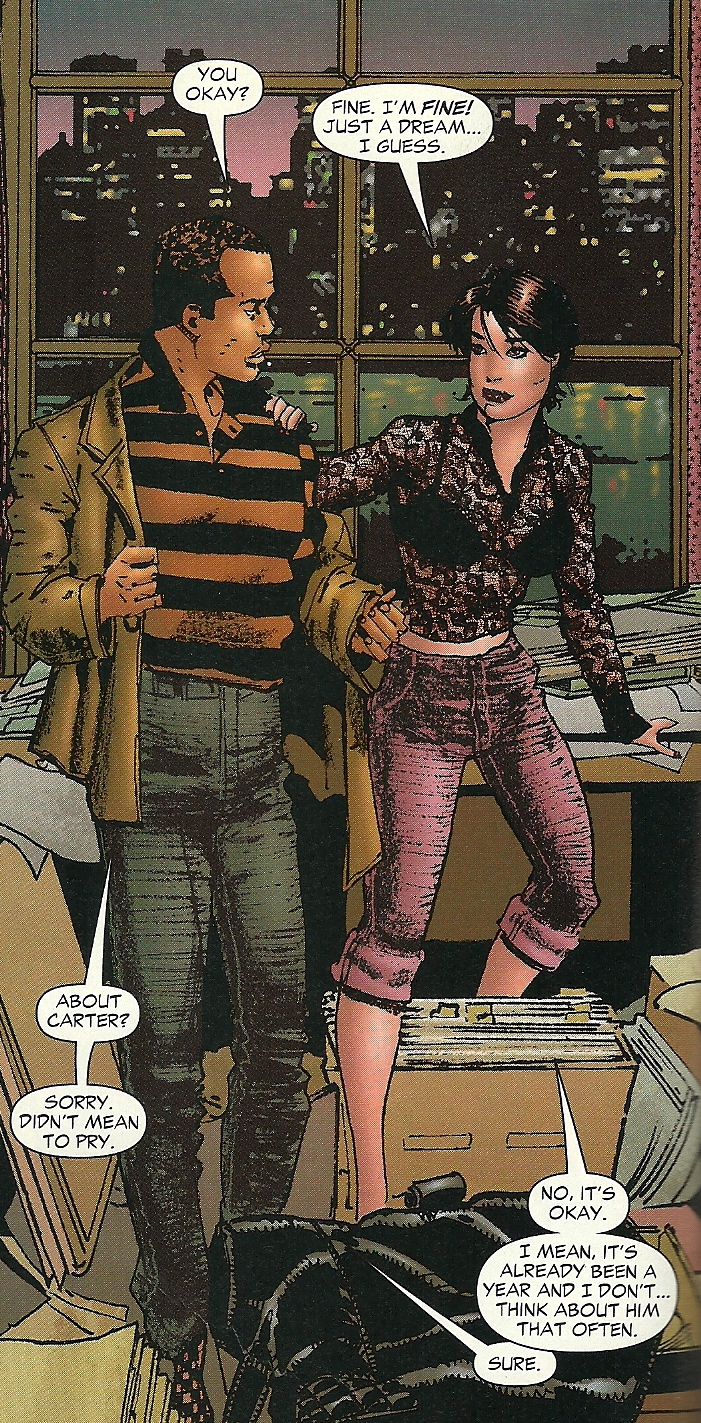
Look at this panel, of Kendra "Hawkgirl" Saunders having dinner with a friend:
Nothing in the whole image seems to have been drawn by human hand, and using photos and computers doesn't even seem to have gained anything in terms of versimilitude—it actually looks less real. See those "drawings" of glasses in the foreground...?

I don't really like comic book art that uses all these little tricks or shortcuts, but Arlem compounds that by using them badly and, apparently, extremely lazily.

Here's a climactic scene from this volume, where Kendra tells Hawkman they are never ever getting back together again (because of an ancient curse generated by their foe Hath-Set, who murders them each time the two constantly reincarnating lovers find one another in new lives):
Hawkman's in four panels, but Arlem only had to draw him twice! Hawkgirl's in five, but Arlem got away with only drawing her three times. He got a lot of use out of that first panel; by cropping it differently, he used it three times on the same page. So what if it implies that Hawkman was frozen in a single gesture for the entire length of a conversation?
Arlem keeps Chaykin's sexualization of Hawkgirl going, but, like everything else about his art in this volume compared to Chaykin's in the first, it looks lazier and less elegantly.

For example:
Did he draw some somewhat saucy cheesecake, or Google Image "lady with not pants," cut-and-pasted a favorite result and have her butt colored green and throw in some shading...?

Simonson's plotting remains fine, but now that we get to the solution part of the "Where's Hawkman?" riddle, it gets a bit more needlessly complicated and confused. This volume is mainly about problems form outerspace visiting Kendra in various ways.

Blackfire, the evil sister of former Teen Titan Starfire, sics a Thanagarian killer on Hawkgirl and, when our hero kills her would be killer, Blackfire arrives herself, wearing Hawkman's wings and boasting that she's killed Hawkman and will do the same to Hawkgirl!

Then we backtrack to the JSA: Classified issues, and learn that Hawkman's been hanging out on Rann, trying to get enough legal proof that Blackfire is evil to present to some space cops or whatever and bust her, and then he rejoins Hawkgirl on Earth to finish off Blackfire (Well, they let her live, but Hawkman depowers her).

The final chapter is the talky one, in which the Hawks have conversations with the supporting cast and one another, essentially deciding who will continue to star in the book, which used to be called Hawkman but was changed to Hawkgirl as part of DC's "One Year Later" promotional effort. There's also a bit of set-up of a conflict that will come into fruition in the third and final collection of Hawkgirl: A Parademon from Apokalips escases to ancient Egypt with a weapon of mass destruction, which Hath-Set puts in a jar and then forgets about.

The third volume, Hawkgirl: Hath-Set, features guest-stars galore—Batman! Superman! Oracle! The Female Furies!—and has lots of full-on crazy superhero madness, but even more poorly drawn than this volume (It's all Arlem, save for about an issue's worth of Dennis Calero art). We'll discuss that tomorrow night, though.

Tuesday, March 26, 2013

Review: Hawkgirl: The Maw

It was so odd, so unusual and so brief that it seems a little like a dream: Did DC Comics really have Walter Simonson writing and Howard Chaykin drawing a Hawkgirl monthly series? The answer is, of course, yes; but only briefly.

It began in May of 2006, during a one-month, line-wide gimmick/promotion that, in retrospect, looks like one of several earlier attempts at a reboot that current co-publisher Dan DiDio had made on the road to fall of 2011's "New 52" reboot. This one was dubbed "One Year Later," and the idea was that after the multiverse-shaking events of Infinite Crisis, all of DC's books would jump one year ahead in time, giving creators an opportunity to do something fresh and new (and not dependent on the fallout of the just-completed crossover storyline) and readers the opportunity to jump on to any book in the line without worrying about joining a story already in progress.

For the most part, this meant new creative teams, new costumes, new team line-ups, new status quos, and so on. The Hawkman monthly received one of the most dramatic overhauls: It's title would be changed to Hawkgirl (although the numbering would start with #50, the month after Hawkman #49), it would now star Hawkgirl, the aforementioned creative team of Simonson and Chaykin would take over for the departing Justin Gray, Jimmy Palmiotti and Chris Batista, and as Hawkman's exact whereabouts would be a mystery; he was simply MIA after the events of Infinite Crisis).I read the first issue, maybe first two issues, and then abandoned it.
I remembered liking it okay, but I was trying a lot of DC comics that month, and it didn't strike me as one of the better ones. But given the rather quick cancellation of the latest Hawkman title, the New 52's The Savage Hawkman, which lasted only 20 issues, I thought I might revisit the series in trade paperback, given that it was almost as successful as the last Hawkman series, despite not starring Hawkman an not having the unprecedented PR push that The New 52 received (Hawkgirl lasted 17 issues).

What is immediately apparent about Hawkgirl, what differentiates it from Hawkman comics before and after, and from most of what one could find on the stands in terms of super-comics in 2006 was, of course, the presence of Chaykin's artwork. His big, expressive, cartoony faces, his blocky figures often half-frozen in hulking, Kirby-like poses, his obvious delight in rendering textures to the point of rarely letting a scene go by without including black lace in it somewhere...Hawkgirl had it's own, distinct visual look and hook.
Chaykin also drew his title character with clearly visible, apparently hard nipples straining against the fabric of whatever top she was wearing almost constantly, which seems like it must have been been pretty daring in DC's pre-rating system, 2006 line—hell, it's rare one see the outline of a nipple or the shapely bulge of a superhero's crotch through a costume in the T+ or M-rated books of 2012 or '13, this despite the fact that so many panels of so many comics seem composed around a female character's mostly-exposed, clothed only in spandex or silk breasts (I'm thinking specifically of New Guardians, at the moment).

Chaykin draws Hawkgirl Kendra Saunders as a cheesecakey heroine, and it works. Simonson's narrative is as pulpy as any involving the Hawks I can recall—she battles cultists, mummies and Lovecraftian space-gods, she explores hidden temples and shares panels with Egyptian deities. She sleeps in tiny, black lace nightgowns...
...takes showers...
...sometimes has her top torn off in battle...
...and wears a uniform so form-fitting it reveals her nipples. The sexual nature of Chaykin's artwork compliments rather than conflicts with Simonson's scripts.

One could argue if that's the best direction to go in with Hawkgirl, who as a star of Justice League Unlimited was, like Green Lantern John Stewart, a better known hero than the one she was technically a derivation from, and also a potential gateway hero for young would-be DC readers, but it's not a wrong direction, either and, unlike, say, Ed Benes' run on Justice League of America around the same time, he wasn't violating the spirit of the script with cheesecake.

That script finds Kendra Saunders working at the Stonechat Museum in St. Roch, Louisiana (which is to New Orleans as Gotham City once was to New York City), which she protects by night as Hawkgirl. In both identities, she has dealings with handsome men, like a museum co-worker (the son of the institution's director) and a police detective.
Some particularly brutal killings are afflicting the city, committed by a huge warrior woman covered in ritual tattoos and wearing only brass breast petals and whatever the crotch equivalent, something weird is going on in the basement of the museum and Kendra's not getting much sleep, which makes it difficult to determine what's real and what's not.

Meanwhile, Hawkman is still lost in space somewhere, and she's torn between holding a candle for him—something that makes her uncomfortable, because they were lover's in past lives, which he remembers more clearly than she does—and the attention of that handsome detective.

The immortal bad guy who is always hounding the Hawks is hanging around, and there's a e thingee in the basement that wants to devour her.

It's pure, unambitous genre stuff, but it's successful, and it all looks really great. Without Chaykin, this could easily prove tedious—as later volumes, collecting issues from after Chaykin's short run, will demonstrate—but for this volume at least, Hawkgirl is effective pulp heroine as old school superhero. Good writing, good art, good comic.

Friday, December 18, 2009

Roy Harper's secret superpower is...

...his ability to put on his costume really, really quickly. He got his shirt, arm stockings and gloves on all in the space of a second! No wonder he used to go by the codename Speedy. (Well, he either put his costume on really fast between that second and third panel, or else he spent a really long time thinking of a retort to Hawkgirl's unfinished statement in the second panel).


(Panel from Justice League of America #27, written by Dwayne McDuffie, pencilled by Ed Benes and inked by any one of four different inkers)

Thursday, September 17, 2009

And here I thought all the weird tension between them was because of their political differences.

So what I get from this panel is that Hawkman wants Green Arrow's ass, but he'll settle for Hal Jordan's...?

Oh and also Hawkgirl likes to watch.


(Panel from DC's Blackest Night #3 by Geoff Johns, Ivan Reis and Oclair Albert)

Thursday, December 13, 2007

Monday, July 16, 2007

HAWKGIRL


stopped for ice cream during a JSA mission once. Once.