Showing posts with label legacy-itis. Show all posts

Wednesday, April 14, 2010

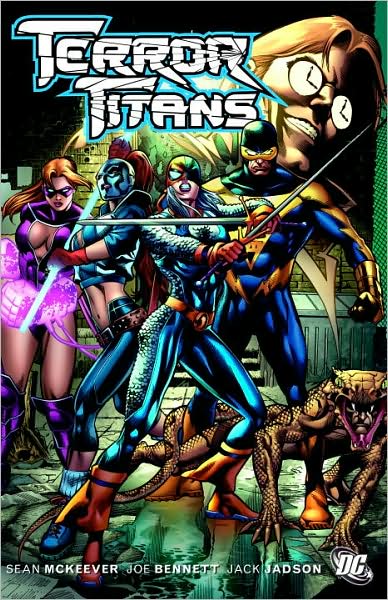
Some thoughts on Terror Titans

Having recently read a couple of collections of Sean McKeever’s run on Teen Titans, I figured I might as well read the trade collection of his spin-off miniseries Terror Titans as well, and thus finish off all of the trades produced during McKeever’s Titans.

The book follows Rose “Ravager” Wilson, who had just quit the Teen Titans team, infiltrating the ranks of new Clock King’s team of teenage legacy villains, the so-called Terror Titans.

Clock King uses them to help him capture and sell teenage super-people to The Dark Side Club, a place where bad guys organize and bet on gladiatorial death matches between superheroes.

It’s not a very good work, but I didn’t find myself necessarily incensed about its poor quality in such a way that I felt motivated to give it a formal review either.

So instead, here are some random thoughts on it.


—Aside from a few weak points, including an unclear beginning (borne of this book being a spin-off, no doubt) and a somewhat nonsensical climax (more on that later), the series is plotted very well. Almost every issue opens with an eight-panel, silent sequence featuring the life story of one of the Terror Titans, which does a fair job of showing up that they’re all life-long psychopaths in a quick, efficient manner, and writer Sean McKeever manages to demonstrate The Clock King manipulating each of the four title characters somewhat subtly. By the book’s climax, it’s made clear that the various conflicts between the main characters have all been engineered by the Clock King for a purpose.

Additionally, McKeever does a good job of sketching out the characters of the Terror Titans, although the series’ hero and its villain remain ciphers.


—The violent content that was so off-putting in a book featuring Robin, Wonder Girl and Marvin and Wendy works much better here in a more standalone title than it did in Teen Titans. Like Secret Six, this is a book consisting mostly of bad guys and worse guys (and a bunch of mind-controlled victims, I guess), so depravity of any kind is a lot more at home here.

I personally don’t like DC’s often juvenile, trying-to-have-it-both-ways approach to mature content, in which they neither commit to actual mature readers content, but don’t produce all-ages material either. Terror Titans, like the Teen Titans series about the time this spun out of it (and plenty of other DC Comics of the last few years), reads a bit like an R-rated movie in which the studio kept making one tiny edit after another until they had snipped away enough content that the MPAA granted them a coveted PG-13 rating.


—While his motivations are never made clear and his plans don’t make a whole lot of sense, McKeever’s Clock King is certainly built up as a formidable, scary villain. The fact that McKeever manages to do so without any of the usual cheap tricks—like, say, having Clock King defeat The Joker or Prometheus off-panel to prove what a bad-ass he is—but instead by spending time revealing his brutal nature slowly, action by action, line by line, the old-fashioned way, makes him doubly so.


—I’m of two minds about the art, which is penciled by Joe Bennett and inked by Jack Jadson. I don’t think it looks very good, personally, but I’m unsure of whether or not it’s good.

Like Eddy Barrows, who was occasionally drawing Teen Titans during the time this spun out of it, they draw muscled human bodies in tortured, agonized poses pretty well, so a great deal of the book is appropriately ugly and painful looking. I could feel stress emanating from the pages, and that’s a good thing, given the content.

It’s not unreadable, and, sadly, “not unreadable” actually qualifies as a positive when talking about current Big Two super-comic art, although it could certainly be more clear. Particularly during the fight scenes, of which there are many, it is difficult to tell who is doing what to whom, and who actually wins and loses the fights (Of course, these end with boxes declaring the winner, which helps in cases where the poses and rendering simply show two identical super girls in similar, painful-looking, eyes-squinting, mouth-open poses).

They draw awful clothes though. There’s a scene where Ravager and the Terror Titans are all wearing street clothes, and…and there was a blazer over a t-shirt tucked into jeans…and- and an off-the-shoulder peasant blouse belly shirt…and a micro tank top and tiny shorts with white piping and…

Well, let’s just say if there were a DC superhero named Fashion Police Woman who caught the villains in the lair, she would have been more than justified in using lethal force on the team.


—That said, I do like the character design of The Clock King. And… No actually, that’s the only nice character design in this book.


—I can’t think of a better illustration of how out of control DC’s legacy-itis has gotten than this book. The very first scene of the book features our villainous protagonists Disruptor II, Copperhead II, Persuader III* and Dreadbolt (son of Bolt) attacking a group of teen heroes consisting of Aquagirl II, Terra III**, Star-Spangled Kid III, Zatara II, Offspring (son of Plastic Man) and Molecule, the only non-legacy character of the bunch.


—I had to eventually throw my hands up and give up on trying to figure out how this fit in with Final Crisis. The Dark Side Club is, at the series’ opening, run by characters with names familiar from Jack Kirby’s Fourth World mythology—Desaad, Steppenwolf, Bernadeth and so on. They are all in mundane human forms though, similar to the way Grant Morrison imagined them in Seven Soldiers: Mister Miracle and the early parts of Final Crisis.

I couldn’t tell if this series was set before or after Final Crisis though, as the characters refer to “Boss Dark Side” and Granny Goodness having died, and the prophecy concerning the dark gods arriving on Earth having failed to come to pass.

Oh, and Clock King kills two of the New Gods, too.


—There’s a strange bit of dialogue during a meeting between Clock King and the evil New Gods about the direction of the Club which I’m not sure I understood, but it seems like McKeever either used the wrong word or someone in editorial should have spiked that word.

“I realize you feel your Caesar act is in some way, engaging, Vundabarr,” Clock King says to Vundabarr, “But you and your co-chair have to accept that you aren’t packing in the sodomites like you used to.”

The next few sentences, if that helps provide context: “The crowds you’ve managed to keep, they don’t spend. They don’t bet. They don’t get terribly excited anymore.”

So, um, what was that about sodomites, and what on earth does that have to do with anything here?


—A couple of super-nerdy nitpicks: How does Dreadbolt punch out Offspring in the opening scene, if the latter is made out of living plastic? And how is Miss Martian able to retain her shape-changed disguise when Fever defeats her by bathing her in fire?


—That said, hoo boy is this a pretty gory comic. In addition to all the blood-spitting face punches and broken necks and bones, there’s a panel of two people having their heads bisected by Clock King’s little Phantasm balls (one vertically, one horizontally), there’s a sequence of the character Hardrock (What if the Thing were a teenager, with a dumb name?) tearing Young Frankenstein (Get it? Like the movie) into three pieces, a character having her flesh melted off while being blown apart with her entrails flailing about, and, in the scene that surprised me the most, a character with explosive fingertips having all ten of her fingers chopped off…by our hero Rose Wilson…the only character fighting in the tournament who’s not being mind-controlled into fighting.

It is, or course, not marked mature readers, because no one says “the F-word” and all of the nipples remain covered by spandex or clingy cotton.


—There are an awful lot of characters killed for such a short span of issues. Not counting civilians, New Gods in human forms and characters created specifically for this series (Pristine and TNTeena, I think). These include Molecule, a “missing year” Teen Titan only seen in 52 (and Tiny Titans!), who gets chopped in half; Bolt, a late-eighties Blue Devil villain, who gets teleported into a stone chimney; and Fever, a new hero created for John Arcudi and Tan Eng Huat’s short-lived 2001 Doom Patrol series , who gets shot with a shotgun after our heroine Rose Wilson knocks her unconscious in a tournament bout.


—Clock King’s big plan doesn’t really make a whole lot of sense. As the series draws to a close, we learn that the scheming villain hasn’t just been brainwashing the captured teen heroes to fight one another in the arena, but he’s been programming to serve as his own personal army in some undefined, goal-less terror campaign (Other than mentioning unleashing chaos a few times, he doesn’t seem to have any concrete political or personal goals for his plot).

He calls them “The Martyr Militia,” and he sets them loose in LA to tear up the street, attacking empty vehicles and buildings for a few pages…? There’s nothing to it other than random, victimless violence, and since there doesn’t even seem to be any casualties, it doesn’t even seem like terrorism.

In our world, it would probably be kind of scary, but in the DCU, unleashing a dozen Y-List teenage heroes to tear up a city block seems kind of small potatoes, doesn’t it? Something Superman or The Flash or Green Lantern could take care of between the panels of their own, regularly scheduled adventures?


—Who on Earth thought the ideal way to introduce Milestone’s Static into the DCU was to have him show up in the second half of a violent Teen Titans spin-off in which Ravager is the biggest name character?


*Well, I’m going to go ahead and call her Perusader III, because she’s the third character with that name and schtick in DC’s comics, but chronologically along the DCU timeline, she’s Perusader II. The original Persuader is a Legion villain, so he exists a thousand years in the future, making the second and third Perusaders more “pre-gacy” than “legacy” characters. Ah, comics!


**Or Terra II, depending on whether or not the Team Titans Terra was Terra II or Terra I who temporarily thought she was Terra I…I lost track of that plot point

Saturday, November 22, 2008

Don't let the door hit your carapace on the way out: Way too many words on Blue Beetle and the singles I read and don't read


I’ve been thinking about the current DC/Marvel direct market sales model a lot lately, due to the fact that the companies both seem to be flirting with drastic price increases on their single issues—Marvel has started charging an extra dollar for not only their mature readers Max books, but also their “Marvel Knights” continuity-light books and new miniseries, while DC recently charged an extra dollar for a 23-page one-shot—and the recent failure of a particularly resilient ongoing of DC’s.

You’ve probably already heard that DC Comics' Blue Beetle has been cancelled, right?

This is actually a surprise to me, at least it is this week.

When they first announced a brand-new Blue Beetle comic starring a brand new Blue Beetle in 2006 or so, I just kind of assumed it would be cancelled within a year, 18 months tops. That's just logic: Take a mildly unpopular character unable to sustain his own title, kill him off and give his name, costume and powers to a brand-new version of the character, and you've done the neat trick of finding a way to make an unpopular character even less popular by alienating the 15 to 45 fans they actually still had (See the quick cancellations of Aquaman: Sword of Atlantisstarring Aquaman II and Firestorm starring Firestorm II for good examples of this phenomenon).

Hell, I had no interest in the title after reading the character's first few appearances, and I'll read pretty much anything. It wasn't until the steady drumbeat of online praise got so overwhelming that I eventually tried out an issue and found out that, hey, after a rocky start, this title actually kind of kicks ass (The John Rogers solo-written issues, from the Blue Beetle/Lonar team-up through #25, were all pretty great super-comics).

At that point, I still wouldn't have been surprised at all if DC pulled the plug. The book didn't seem to be selling all that well, and Rogers—i.e. the reason the book was any good—was leaving. But DC planned to soldier on with it. Surely it must be selling somewhere, right?

That somewhere, I guessed, was libraries. Whether it was the fact that the new Blue Beetle was Hispanic or a teen or that he was a superhero in a book that wasn't total shit, teen librarians seemed to dig Blue Beetle. The first two volumes were on a YALSA (Young Adult Library Services Association ) best of the year list, and it was one of the few DC superhero books on the shelves in the teen section of one of the libraries I go to (not Columbus Metropolitan Library, which seems to get almost everything in trade—everything except Uncle Sam and The Freedom Fighters, those bastards—but a smaller, suburban library).

So that must be where Blue Beetle is finding its market, I thought. Maybe it's doing respectably enough in trades that it offsets the relatively low sales of the singles (This is supposedly the case with the low-selling but still-not-cancelled Jonah Hex and pretty much every Vertigo book). Once I realized that, I didn't expect the book to be cancelled any more.

And then they cancelled it.

And the timing of the decision was, in keeping with most decisions at DC Comics these days, completely hilarious. It was the same week that the cartoon watching kids of the world were introduced to this version of Blue Beetle via a new Batman cartoon, Batman: The Brave and the Bold and, even if they aren't going to be storming their local comics shops one Wednesday a month for a new Blue Beetle adventure, I'm sure more plugged-in teen librarians are going to be ordering more Blue Beetle trades, and kids are going to be a lot more likely to have their eyes caught by trades on the shelves of their local libraries and big box bookstores their parents take them to.

Would a higher Q rating for Blue Beetle III have helped move more single issues and trades? Maybe. Enough to make it a bestseller all of a sudden? God, no. But it sure wouldn’t have hurt. (I don’t think the cancellation is necessarily a dumb move by DC, or a missed opportunity, it’s just kind of ironic coming when it did).

Now I suppose I should apologize to the Blue Beetle fans, as the cancellation is actually kinda sorta my fault. Or at least partially. I dropped the book after #26. That was June’s gimmicky (almost) all-Spanish issue, written by Jai Nitz. I liked it quite a bit, but DC was slow too slow to replace Rogers, following his final issue with that fill-in by Nitz and then two more fill-in issues by Will “Wrote Amazons Attack” Pfeifer before finally getting around to the actual next “regular” writer Matt Sturges, whose plans for the series included…Dr. Polaris II.

The couple month lag wass a real momentum killer, and it gave readers (like me!) a chance to get used to not reading Blue Beetle during a natural jumping-off point. By the time the new writer started writing, I had not only gotten into the habit of not reading Blue Beetle, but I had gotten a sense of where the title would be going in the near future, and it didn’t seem to be anywhere particularly creative (Dr. Polaris was a Magneto knock-off killed in a Geoff Johns companywide crossover series just to demonstrate how totally serious the story was, so Sturges was planning on using a legacy version of a knock-off whose knocking-off was demonstrative of everything tired about DC Comics).

While not giving readers months to consider dropping titles between runs seems kind of logical, DC seems to do this pretty often—I’ve also dropped Booster Gold and Brave and the Bold when the titles went into four-to-six-month stalling mode.

Well, with another low-selling DC super-title biting the dust, and the fear of a $3.99 industry average haunting me, I thought I’d take a closer look at what I’m still reading in single issues, and whether I’d keep reading ‘em at four bucks a pop or not.

I doubt this is of all that much value to anyone as, like, a case study or anything, as I’m only a single reader and maybe not that representative of the average DC and Marvel super-comic consumer. But I am a example, someone who goes to the shop every Wednesday to buy a handful of superhero comics to read that evening. And I find myself getting increasingly selective of what I buy, due to general destitution (the first sentence of the “About Me” paragraph in the upper right hand corner should explain why I’m not exactly rolling in disposable income), and what I read in single issues versus the usually cheaper trade format (even when prices of the trades are the same as that of the price of the individual books they collect added up, Amazon discounts will shave some cost off, and the well-stocked local libraries make reading a lot of trades free).

So here’s my system of storing comics. The regular, ongoing series I read each have their own little stacks on these bookshelves, in some cases grouped by character or franchise (Green Lantern Coprs, miniseries and specials are in the Green Lantern stack, for example).
(Above: My piles of series I'm currently reading; not pictured, a coupla more piles)

Miniseries or new series I’m just trying out are all in a big miscellaneous stack. When I drop a title, or when it’s canceled, they go into longboxes or huge pile of books that need to be put in longboxes some day).
(Above: I decided a better use of my time would be to photograph the stacks of comics I need to organize and post that picture on the Internet, rather than organize them. There an equal number of comics in a cardboard box shoved underneath that desk by the way, supporting the album leaning up against it)

This week I poked around these stacks, and wrote some thoughts on the books I’m still reading in singles…

So these are the comics I still read in single issues…

Action Comics I like Superman as a character in general, and am quite enamored of his whole corner of the DCU—the supporting cast, the villains, the settings—but I'm a fair-weather fan. I follow the creators and/or the direction of Superman comics, so I'll read them for an arc or a run, drop them, pick 'em up again, and so on.

I think the Superman franchise was one of the few that came out of the "One Year Later" jump in good shape, and probably the only one that maintained its quality since then (The hiring-of-Adam Kubert-mistake and the subsequent Chris Kent continuity fuck-up aside). I've been reading Action monthly since OYL, save for the last few chapters of the Richard Donner/Geoff Johns/Kubert arc.

Superman As with Action, I've been reading this monthly since OYL, and it's been the better of the two Superman books, in my opinion. I kind of hope James Robinson's rumored (by Rich Johnston) fall-out with DC was simply baseless gossip, as I'm interested in where Robinson's taking the title. He gets Superman's voice kind of weird sometimes, but he's obviously been laying a lot of groundwork for a big, long-term story plan and, more importantly, he uses Krypto the Superdog a lot.

Batman I hate, hate, hate, hate, hate Tony Daniel's artwork. It's just awful stuff, and every page of it I see surprises me anew that this is the guy drawing Batman. I can stand in my comics shop, scan the shelves of DC books, and pick out just about any of them that features vastly superior art better suited for DC's flagship book featuring its flagship hero (The guy doing JLoA and the guy doing Teen Titans are probably the only two that I think might not be an improvement over Daniel). Still, Grant Morrison scripting, and telling probably the most interesting Batman story I've read since, I don't know, "Lonely Place of Dying," maybe...?

Like Superman books, the Batman franchise is one I'm generally interested in, but only read when I like the creative team. The Moench/Jones/Beatty run was the last time I read Batman regularly month-in and month-out for any length of time. I've been reading Batman since the OYL direction-shift though, only for Morrison's script at this point (I skipped a few non-Morrison fill-ins).

Daniel's art is so bad though, I'm really on the fence about continuing. I may end up dropping this after the Denny O'Neil and Neil Gaiman stunt arcs, depending on the post-"Batman R.I.P." direction and who will be responsible for it. (Any of the likely candidates to take over being Batman if Bruce Wayne "dies" sound pretty boring to me, but even if no curveballs are thrown—like The Knight or Chief Man-of-Bats becoming the New Batman—if Morrison and someone who can draw a comic are involved, I might stick around).

Green Lantern I really despise Hal Jordan. I used to dislike him because he was just an exceptionally boring empty set of tights, but after Geoff Johns started writing him, I came to dislike him because he seems like such a dick. Cocky, mean and dumb, Johns has made him into a toned-down version of the Giffen/DeMatteis Guy Gardner, only John plays the asshole with a ring characterization straight rather than for laughs.

I think that's a good thing by the way—Johns has given Hal Jordan a personality, even if he's not the sort of person I would want to be around in real life, or even think is particularly heroic sometimes. That, coupled with the fact that Johns is more of a comics script builder than an comics storyteller, would seem like reason enough to have dropped this book long ago, and yet I'm still reading.

It's not always good, but it's never that bad, and Johns seems to have been afforded his pick of DC artists (or at least, he never gets stuck with a bum one), and the fact that he's writing most of the rest of the DCU means that GL always seems particularly plugged into the shared setting. It's one of the DCU-iest DC titles, if that makes any sense.

Justice Society of America I've been reading this for longer than Geoff Johns has been writing it now, when it was first launched by James Robinson as a JLA-like book. The current storyline—all 20 chapters and counting of it—is pretty damn tedious, and I'm not quite convinced that the sequel to Kingdom Come needs to exist nor needs to involve the Justice Society, but this seems like the only competent DC team title at the moment. A writer who gets the characters and seems to be telling his own stories rather than working off a memo from company execs? Check. An artist/s who can draw well, stay on-model, serves the story and know the difference between drawing a comic and drawing three pin-ups per page? Check. A coherent, seemingly long-term plan or direction, rather than a string of event stories alluding to other event stories? Check. I can't say that about JLoA, The Titans, Teen Titans or Batman and The Outsiders. All of which makes JSoA seem like a masterpiece, even if it's just pretty okay most of the time.

The Secret Six Writer Gail Simone sometimes tries a little too hard when it comes to infusing her stories with humor, but there's a lot of humor that's inherent to this group of characters that come across organically, and the Nicola Scott/Doug Hazelwood art team just really know their stuff. I suppose there will come a point where this book might really get on my nerves, as Simone's super-long run on Birds of Prey did in its last year or so, but three issues I'm still liking this and looking forward to the next issue.

Trinity I'm not sure what the right word for this 52-part limited series is...it's going to have a lot more issues than a lot of cancelled series ever get, but it's so big that even the word "maxi-series" doesn't seem quite big enough. Visually, this is probably the strongest of DC's three weekly series. As for the story, it has the same grand scale as 52 and does a lot of the connection-drawing and idea-generating that 52 did so well, although those ideas usually aren't as grand as those in 52. It's almost always a good read though, and I'm going to be sad to see it end, in large part because it's a nice place to read about characters you like whose own books are so bad you can't stand them anymore (For me personally, the JLA, Wonder Woman and Flash, although Trinity also gives plenty of panel-time to book-less second-stringers like John Stewart, Hawkman and Firestorm II). While this won't be around too much longer, a DC weekly of this caliber quality would be exactly the sort of book I'd keep reading in single issues in the event of all $2.99 books becoming $3.99 books (In fact, it might be the only kind of book I'd keep reading then).

Tiny Titans I had no intention of reading more than an issue of this just out of curiosity, but it is really cute and really funny, and my curiosity's been replaced with affection. If it were printed on slicker paper and DC started charging more for it (right now it's only $2.25), I might drop it, but other than that I can't see stopping reading it any time soon.

The Incredible Hercules I'm running out of ways to say how much I dig this book; suffice it to say it's my favorite ongoing monthly super-comic. An issue has yet to pass that I didn't love, I usually laugh out loud—or at least giggle—at least once an issue, and it's solidly entertaining from the recap page through the cliffhanger ending. And as fun as it is, it's not mind-less fun—there's actually stories being told in here, character development and everything. It would probably be possible for me to trade-wait this book, but man, it would be hard.

Avengers: The Initiative The only Marvel Universe Avengers title I'm still reading, having dropped Brian Michael Bendis' New and Mighty books when they stopped having anything at all to do with the Avengers, and became Secret Invasion: Front Line and Brian Michael Bendis' Secret Invasion Outtake-O-Rama. The plots have generally tied in to whatever big things going on in the Marvel Universe at the time—it launched out of Civil War, got involved with World War Hulk, is currently detailing the Secret Invasion hero vs. Skrull war that SI sort of suggests is going on—but writers Dan Slott and Christos Gage manage to tell their own stories using their own sprawling cast of characters using those events as backdrops. So rather than interruptions, the tie-ins seem essential to the plot. This could change when Slott leaves the book, but at the moment The Initiative really feels like the "spine of the Marvel Universe," the only book you really need to read to know what's going on universe-wide.

More importantly, though, it's one of the few super-comics that seems to be adding something to its fictional universe, rather than subtracting things: Slott, Gage and company not only dust off minor Marvels by the handful to use, they are continually inventing new characters to inject into company's expansive character catalogue. There's something terribly exciting about this. It's not just the drama of knowing that Cloud-9 or Trauma could get killed or turn out to be Skrulls or traitors or get married or join religious cults or go to jail for cocaine possession or whatever because the company isn't as heavily invested in them as they are in Iron Man, Spider-Man and Captain America, but the vitality inherent in a stream of new character creation. It gives the sense that the Marvel Universe is still expanding rather than contracting as opposed to the DC Universe, where "new" characters too often means Blue Beetle II or The Question dying so Blue Beelte III and Question II can take over.

Ultimate Spider-Man Sometimes it's hard to believe that the guy who writes all those shitty Avengers comics and crossovers is the same guy who writes this engaging teen melodrama/superhero coming-of-age story, that rare corporate owned superhero comic that does and continues to do everything right in terms of being new reader friendly/potentially appealing to people who don't already read new superhero comics every Wednesday, as they have for the last 10-20 years.

Brian Michael Bendis' bad habit of decompression is sometimes still in full effect with the book (moreso in the first 50 issues than the last 75 or so), but when Mark Bagley was cranking these things out every three weeks, it didn't seem to matter so much. On a few occasions I've been tempted to drop the singles—during weaker arcs like the Deadpool/X-Men crossover and a couple of the Goblin stories, and when Bagley passed the torch to Stuart Immonen—in part because of the book's consistency. After a certain point, it became clear that this would continue to be pretty consistent in terms of quality, and that it would always be collected (a few years ago, that every series would eventually be collected wasn't a certainty, and I think there was a stronger motivation to buy riskier, more random titles like, say, Uncle Sam and The Freedom Fighters or The Omega Men miniseries, because it seemed reasonable that if the monthlies tanked, they wouldn't be trade-collected).

I can never quite bring myself to drop this though, as much as I'd prefer to have a shelf full of it in trade instead of the unwieldly stacks of singles I've amassed of it at this point.

Wolverine First Class God, I hate the X-Men. I've tried and tried to read X-Men comics from all eras and by all kinds of different creators, but it almost always seems like I'm trying to read a book in a different language or something. And yet this is a whole lot of fun, thanks mostly to writer Fred Van Lente following Jeff Parker's X-Men: First Class example of telling short, all-ages stories more concerned with entertaining the reader than winning a theoretical argument over whether comics are serious or mature enough for adults. The wait between trade collections of this title wouldn't necessarily drive me crazy, so this is one I could pretty painlessly stop reading singles of some day, but the done-in-one formula—which all but two stories in the short run have adhered to—makes the single-issue reading experience preferable to a trade.

Marvel Adventures Avengers This title is Marvel's best-kept secret. The line-up is essentially the A-List of Marvel's superheroes—the Avengers as Marvel's JLA—and more often-than-not writer Jeff Parker managed to turn it into a comedy book somewhere along the way. Parker left for a while (and I dropped it for a while), but he's come and gone since, sometimes with Paul Tobin in tow. The last issue was Tobin solo, but Tobin's style is quite close to Parker's.

This would be relatively easy to drop and read in trade—I read the rest of the Marvel Adventures line in trade, as the digests often end up being cheaper than the singles (and are easier to store).

Captain Britain and MI13 I'm on the fence with this title; I've passed it by on a few occasions now, although I go back and get the back issues on slow weeks. I recently dropped Nightwing, Invincible Iron Man, Green Lantern Corps, Runaways and Guardians of the Galaxy; if I need to make any more cuts to my monthly purchases, this one will probably be it. It seems like it will just fine in trade, and while the first two story arcs have been entertaining enough, there’s no real urgency about them.

These are the limited series I’m currently reading in singles: Age of The Sentry, The Twelve, Avengers/Invaders (I hope Ross and company’s next Marvel project is a Twelve/Invaders crossover), Secret Invasion (I really should have known better after House of M; I thought Bendis had changed), Batman: Gotham After Midnight (I’ll read anything by Kelley Jones), Ambush Bug: Year None, Vixen: Return of the Lion, Final Crisis (The most disappointing Grant Morrison comic since his Authority and WildC.A.T.s relaunches!), Final Crisis: Legion of Three Worlds (I’ll read anything by Perez)

And these are the comics with weird schedules I get in singles whenever they come out: All-Star Batman and Robin, The Boy Wonder, Billy Batson and the Magic of Shazam!, Special Forces (Kyle Baker), Rasl, Comic Book Comics, Johnny Hiro, Superior Showcase, Doc Frankenstein and Shaolin Cowboy (Whatever happened to these Burly Man series, by the way…?)

Thursday, September 04, 2008

Weekly Haul: September 4th

Amazing Spider-Man # 570 (Marvel Comics) We all know that Big Two press releases announcing a particular issue has “sold out” like this one are just meaningless bullshit, right? Because, if I understand the way the way the direct market works, local comic shopkeeps tell Marvel exactly how many copies of a particular comic they’d like, Marvel prints out about that many (usually more, but they never tell anyone how many are actually printed) and they are thus distributed to the local comic shops. Therefore, “sold out” just means “the distributor has distributed all the copies” and there could still be thousands of (non-returnable) copies on the shelves of stores all across North America, waiting to be sold.

I’ve heard plenty of folks explain why Marvel and DC bother with press releases announcing when books are sold out, since it tends to discourage those who might be interested from assuming they can even buy copies, and really only amounts to the company announcing that they failed to properly meet the demand for a book they were publishing. The consensus explanation seems to be that the companies think this illusion of rarity generates “buzz” and “heat,” which is valuable in that it gets potential consumers interested in future issues, trades or second printings of the “sold out” issue.

Why do I bring this up? Well, the first two parts of the latest Amazing Spider-Man arc, “New Ways To Die,” were proclaimed as “sold out” via Marvel press releases. And, guess what? The actually are!

Or, at least, ASM #569 is really and truly sold out at my local comic shop here in Columbus, Ohio.

This is good news for Marvel (maybe?) and my shop (I guess?) but bad news for me, as I kinda wanted to read last week’s issue, but missed it in the avalanche of ten thousand new releases Marvel and DC both sent to the shelves last week.

So I have no way of knowing what transpired in part two—er, book two of this story arc, unless I read the recap page in “book” three, but, well, it’s in prose, and if I wanted to read prose, I probably wouldn’t have an issue of ASM on my lap, now would I?

I can guess what happened though! The Thunderbolts failed to capture or kill Peter Parker and/or Spider-Man, Norman Osborn got his haircut to make it look slightly worse than usual, and the most obvious suspect for turning into Anti-Venom has actually turned into Anti-Venom.

He’s a kinda sorta good Venom, who has an additional power that allows him to eat Venom, thus curing Mac Gargan of his parasitic host. In this issue, the two Venoms and Spider-Man fight each other for a while and, near the end, the new Fauxblin “Menace” confronts Norman Osborn, the original Green Goblin. And, because it’s drawn by John Romita Jr. and Klaus Janson, it looks pretty great (and perfectly Spider-Manly), and, because it’s written by Dan Slott, Spidey’s quips aren’t as completely annoying as they sometimes are in his Marvel Universe appearances.


The Batman Strikes! #49 (DC Comics) This was a total impulse grab today, based solely on the fact that I just watched season four and then season three of The Batman on DVD, and loved it. I watched a few episodes of season one, and I think I was too freaked out by how different it was from any Batman I knew to get into it (dreadlocked, capoeira Joker alone would take some serious getting used to).

I don’t know if the show just got much, much better as time went on, if the introduction of his sidekicks changed the dynamic, or if this time I was just properly braced for how radically different the show’s takes on the characters would be (I really dig its version of the Penguin, as more of a silly thug instead of a mafia kingpin type, for example), but I loved those two seasons—the character design, the voice work (including stunt casting like Adam West and Frank Gorshin from the original live-action TV show, and Kevin Conroy from Batman: The Animated Series playing Robin’s father), the fact that The Joker has a thug named Judy, the animation of the fight scenes—this time I took to it immediately.

(I’m now working my way backwards through the series, to see if it’s the show or me who changed since my first exposure; what you guys think of this show?).

Anyway, one of the things I really dug about the show was Batman’s sidekicks, and how integrated into his life they are (Plus, I think this is my favorite Batgirl costume). In the previous cartoon, as in the comics (since at least as long as I’ve been reading them), Robin, Batgirl and/or anyone else hanging around Gotham kind of seemed to work with Batman in a parallel type of way; in the cartoon, only occasionally teaming up and, in the comics, more often than not just checking in every once in a while (probably, in large part, because they all have their own books).

I liked that Batgirl was an actual teenage girl, and that Robin was an actual kid—he’s freaking tiny, but since we first meet him at the circus, it’s pretty clear that he’s well suited to sidekicking with Batman, despite his tender age (Additionally, the villains seem to be more interested in robbery than serial killing and terrorism in this series, so the stakes seem lower, and making kids fight for you less like child abuse).

So today when my eyes were scanning the new book shelves and fell upon The Batman Strikes!, and I saw Robin battling Killer Moth beneath a tag reading “How I spent my summer vacation…”, instead of passing it over as I had before rediscovering the cartoon upon which the book was based, I added it to my haul.

Which (finally) brings me to the review: This book was pretty good.

Like all of the Johnny DC based-on-cartoons-that-are-based-on-our-comics comics, this is designed as a no experience necessary, done-in-one all-ages adventure. It was also probably the most enjoyable Robin story I’ve read since, God…1996?

In the DCU comics, Robin is all-too-often simply written as Batman in a different costume, but writer Matthew K. Manning actually writes him as a kid, with kid conflicts to deal with on top of his sidekick duties; this story is closer to a lighthearted issue of Ultimate Spider-Man than an issue of Nightwing.

Batman, Robin, Batgirl and Commissioner Gordon are trying to takedown Poison Ivy, but, in a pause in the action, Robin gets sent home early, as it’s a school night. The next day, he’s can’t stay awake in class because he was up so late and, then, when he discovers a supervillain about to commit a crime outside his school, he desperately has to find a way to get out of Geometry and change to Robin without arousing suspicion. It’s fun stuff, as is artists Christopher Jones and Terry Beatty’s depiction of lovable loser Killer Moth (here in his Charaxes-like monster moth form), trying to stuff stolen dollar bills back into a sack while his flitting wings keep blowing them away.

Man, I wish every issue of Robin was as good as The Batman Strikes! #49…


El Diablo #1 (DC) Hey, I’ve got a great idea! Let’s take an obscure character from our extensive catalogue that nobody seems to be using, and assign his name and powers to a new legacy character, preferably a minority of some sort, and watch the money roll in! It didn’t work out so great with Firestorm, The Spectre, The Question, The Atom, Blue Beetle or Batwoman (not that we’ve tried too hard with Batwoman, granted) but this time, I just know it will work! Or, at the very least, we’ll renew our trademark.

Surely that’s the secret origin of the new El Diablo, El Diablo III. (Or is it IV? I forget if the one from Gerard Jones’ Justice League America run was a new E.D., or the second version merged with a new demon. Confusing! That’s always a great quality in these endeavors!)

This effort to revive DC’s diabolical desperado character has a few things going for it that some of the other flailing attempts at new legacy characters (a list to which we can add the Bart Allen-as-Flash and Some-Kid-as-Aquaman attempts) didn’t. For one, this is a six-issue miniseries, so DC’s never going to have to cancel it. And for, uh, two, it’s got the superior art team of Phil Hester and Ande Parks on it, and generally anything those guys do is well worth at least a first issue looksee.

Here, the originally, scary version of El Diablo, Robert Kanigher and Gray Morrow’s Lazarus Lane, is still alive in the present, slumbering in a coma underneath a Rip Van Winkle-sized beard. He passes on his Ghost Rider-like powers, including a flaming whip and big scary horse to another, new El Diablo—a criminal kingpin with a heart of gold (or at least silver; maybe bronze) who the police are pressuring to testify against the rest of his gang.

Much of this first issue is a pretty hard-edged crime drama, with the boss of our crime boss protagonist ordering him killed, and telling his assassins to “bring me his balls,” although it’s elevated above a lot of the ten o’clock cop drama wannabe type of writing that occasionally plagues super-comics by Hester and Parks’ art; this isn’t a comic book that wants to be a TV show, it’s a comic book that wants to be a comic book (albeit a rather hardcore one for the DCU…or at least the DCU of the ‘90s).

The new El Diablo gets a new costume design and I may need a few issues to see if it grows on me. It’s certainly a step up from El Diablo II’s Wonder Man-of-the-Wild-West look, but it’s not anywhere near as bad-ass as L.L.’s. Hell, even as an old man, with his wizard-beard hanging out of the shadow of his cowboy hat, the original looks pretty sweet.

I think E.D.III’s mask is supposed to be Mexican wrestler-like, but the skull motif doesn’t look too terribly Mexican, especially considering how elaborate and unique Mexican skulls can be or hell, even luchadore masks (like the guy in the mask that J.H. Willaims III drew in his Batman arc? That was a cool mask). This mask calls to mind Silver Banshee and That Guy From That One Super-team Who Fought Spawn (Chapel?).

All that said, writer Jai Nitz (responsible for the darling all-Spanish issue of Blue Beetle) does a perfectly adequate crime story in this first issue, and if the direction isn’t terribly original (The Spectre, Ragman and Crimson Avenger II all fulfill a similar function in the DCU alone), nor does it look to be going anywhere any more original next issue (the cliffhanger involves an unseen, evil force making an evil opposite to fight El Diablo), Nitz doesn’t do anything wrong here either.

So if you were looking for another super-comic to read because you were feeling starved for choices, what do you know, here’s another one.


Green Lantern # 34 (DC) Part six of Geoff Johns and Ivan Reis’ 3,000-part origin of Hal Jordan! In this chapter, Hal learns some things about emotional maturity, and also fights a big red alien alongside his pink-skinned, mustachioed mentor Sinestro. Also, in a burst of determination, he retcon-tastically overcomes his weakness against the color yellow. Thank God this was only a one-time event, as Hal Jordan’s weakness being the color yellow is the only thing that made most Green Lantern appearances before 1980 or so completely hilarious (Well, that and when middle-aged black dudes would tell him off about helping out purlple-skinned aliens more than his fellow earthmen who just so happened to not be born as white as Jordan).

Is next issue the last in the origin story? Because by that point we’ll be pushing the 154-page mark, and that’s a lot of pages devoted to the origin of Hal Jordan. I mean, the Batman: Year One trade is only 144-pages...


Marvel Adventures Spider-Man Vol. 10: Identity Crisis (Marvel) Another $12 worth of a book that might as well be called Marvel Team-Up Featuring Spider-Man for only $7.99! In each of these four issues, high-schooler Spider-Man teams up with and/or faces off against a Marvel character in well-constructed, done-in-one adventures. First up, to prepare for a fight against Flash Thompson, Peter takes a self-defense class that’s secretly being taught by The Taskmaster. Then it’s Spider-Man vs. the greatest villain in the Marvel pantheon, Swarm (That’s the swarm of bees that share a hive-mind of a Nazi and wears a purple cape). Then Peter Parker must deal with a Latverian foreign exchange student and the Fantastic Four. Then the Enchantress uses him as a pawn to help her conquer Asgard, outfitting him sorta like you see him on the cover, until Thor finally says nay.

Marc Sumerak writes all of the scripts save the Swarm story (which is by Chris Kipiniak), and art chores are handled by pencilers Ale Garza, David Nakayama and Ryan Stegman.


Marvel Apes #1 (Marvel) So, here’s probably all you need to know about Marvel Apes to determine if its your cup of tea or not: The very first panel features The Red Ghost and his Super-Apes, and the third-to-last panel features a gorilla dressed like Captain America punching out a gorilla dressed like Hitler, including the Hitler combover and moustache.

Me, I like the taste of that sweet, sweet stupid simian joke tea.

Karl Kesel’s story starts out in the Marvel Universe, making this story canon (so you can’t ignore it, kids!). One of Spider-Man’s many millions of lame animal-themed villains, The Gibbon, happens upon a bank robbery being committed by The Red Ghost and his Super-Apes (man, I love typing that phrase), which some Mighty Avengers show up to break up, and he waxes about how he’d really like to be a superhero and how miserable his life is and so on.

He volunteers for a research project at a university, and both he and a comely scientist lady find themselves transported to an alternate universe, which is just like the Marvel Universe, except everybody is—surprise!—some form of monkey or ape, and many have dumb-ass monky pun names (Spider-Man is Spider-Monkey, Iron Man is Iron Mandrill, Dock Ock is Doc Ook). Oddly, some don’t, however. For example, Captain America is still Captain America, and Speedball is still Speedball.

So the doctor lady visits the Fantastic Four to see if Reed Richards can find a way to send them back to their world, while The Gibbon meets the Apevengers and is tempted with the opportunity to become the hero on this world he couldn’t on ours.

There’s really only one joke here, and while it’s hardly inspired or even funny, it’s funny how Kesel keeps telling it over and over again. In other words, it’s like one of those bad jokes that are funny not because it’s actually funny, but because its teller thinks it is—or pretends to think it is.

Ramon Bachs’ art is pretty decent—the story telling is easy-to-read—but it’s rather unremarkable, and some of the characters didn’t quite look right to me. (Red Ghost’s skullet seems like it should be longer and more flowing, The Gibbon didn’t look terribly Gibbonly, etc.)

There’s also a back-up by Tom Peyer and Barry Kitson, the first part of “The Official History of the Marvel Apes Universe,” narrated by The Watcher. He tells a pretty straightforward version of the Marvel creation myth (Celestials, Eternals, Deviants), then a tale of the Old West in which The Rawhide Chimp flirts with the Two-Gun Chimp.

I just wish I was patient enough to wait for the trade, which is likely to include all those great-looking monkey variant covers (I particularly like the Spider-Man Loves Mary Jane one, which my shop was selling for $6.95 for some reason).


Nightwing #148 (DC) Writer Peter J. Tomasi seems to dwell on his plots on this title for an awfully long time, and while that can lead to the book seeming sort of repetitive, it an also lead to nice character pieces that are a lot more interesting than Nightwing fighting whatever bad guy he’s up against.

Here Nightwing, badly wounded from sniper fire he received last issue, takes the woman he’s protecting to a safehouse, and returns to the Batcave to have Alfred stitch him back together. There’s probably not much danger of Nightwing actually dying—particularly like this—but the nine-page sequence that begins with Alfred noticing the wounded hero’s arrival and his sudden retreat is infused with drama anyway, particularly in Alfred’s silent mourning.

Pencil artist Rags Morales’ gift for facial expressions, gestures and postures really pay off here (although, he has two inkers on the book, and some of the earlier scenes look a little rougher than usual). Tomasi also provides Morales the opportunity to draw most of Batman’s big-name rogues in a last-page splash, and it’s always a treat to see an artist like Morales get his pencils on so many constantly redesigned characters. His Penguin looks pretty awful, but the others are all very sharp. Hopefully Morales will be around next issue, too; Nightwing’s biggest drawback is how often its two main art teams seems to trade off, often in mid-story arc.


Secret Six #1 (DC) The former Birds of Prey creative team of Gail Simone, Nicola Scott and Doug Hazlewood return to the new-ish version of The Secret Six which Simone popularized in the lead-up to Infinite Crisis, and this time, it’s an ongoing.

The pleasures of Simone writing these recurring characters—Catman, Deadshot, Ragdoll and Scandal are all back, plus “new guy” Bane and a yet to be revealed sixth member—are all in full-evidence again, from the hardly subtle sexual tension between Deadshot and Catman (which Simone seems to be deliberately baiting readers to respond to), to the polite weirdness of Ragdoll. In fact, this seems to be a much, much stronger outing than her previous ones, no doubt due to the fact that she’s not having to work too hard to connect the tale to other goings on in the DCU.

She and her collaborators introduce an extremely creepy new (?) villain in the opening scene, a villain who wants the same maguffin that the Secret (Five-to-)Six are set to escort across country, after breaking villain Tarantula II out of Alcatraz. Apparently this creepy villain is a very scary customer, scary enough that The Huntress and Batman are worried about Catman and company making it out alive.


Trinity #14 (DC) Twelve-pages of the JLA in the anti-matter universe, followed by ten pages of a pretty random assemblage of DC heroes fighting the sun-powered tattooed guy with the hyphenated name, as penciled by Tom Derenick. The back-up, narrated by a supremely arrogant Hawkman (“In seconds, half our numbers are incapacitated. A loss offset by the fact that…I’m back in the battle.”), has a few moments of silly fun, like Hawkman hurling the coffin of Max Lord into the bad guy's back, or Oracle casually informing Nightwing that, “We both know it takes almost eighteen hundred degrees Fahrenheit to cremate human remains.” Comics are educational.

Sunday, September 09, 2007

Fine Internet, you win: I'm reading Blue Beetle


After a few months of hearing everyone on the Internet talking about how awesome DC’s Blue Beetle was, I decided to give the series a third try with Blue Beetle #18, the Teen Titans crossover issue, and as I said here at the time, it was a whole lot of fun. I also reviewed that issue for that week’s installment of Best Shots at Newsarama, asking rhetorically if the series was always that much fun, or if #18 represented some kind of crazy but fortuitous fluke.

The Newsarama posters, as fickle a lot as exists anywhere on the Internet, pretty much unanimously responded that Blue Beetle is indeed a great read month in and month out, particularly after co-writer Keith Giffen left John Rogers to his own devices (something that struck me as odd, as I’ve enjoyed just about everything I’ve ever read with the name “Keith Giffen” attached at least a little bit, up until I tried BB #1 and #7, anyway, neither of which was at all interesting, and all I took away from either was the sense that damn, that’s a neat superhero costume).

Further encouraged, and seeing as the last two weeks were pretty light on new comics, I decided to give a few more Rogers-only back-issues a try.

And now, having done so, I think it’s high time I start reading this book regularly, because it turns out the enjoyability of Rogers’ Blue Beetle is one of the things the Internet is actually right about.

There were only two pre-#18 issues at my local comic shop, so I didn’t actually have much in the way of choice regarding how far back to start.

First up was Blue Beetle #16, which, from the cover, appeared to have a perfect storm of Things Caleb Doesn’t Like About The Current DCU.

Not only was there a legacy hero created to replace a hero killed off specifically to be replaced with a legacy hero, but he was apparently going to do battle with my least favorite villain at the moment, the suddenly evil for no reason character from Identity Crisis with the crazy-ass plan that made no sense whatsoever who is now suddenly Eclipso for some reason, but now is immune to sunlight and can’t simply possess people via contact with black diamonds and thoughts of revenge ala Eclipso: The Darkness Within, The Spectre and Eclipso (Why did you make me buy all those annuals if you weren’t going to make any one else read them ten years later, DC?!).

In other words, this is a book that I was primed to hate, and thus easily passed it over when I originally saw it on the shelves two months ago.

And the first page is pretty awful, as Eclipso wanders through a burning building looking at corpses and talking to an unseen victim she’s apparently stalking towards.

And then I got to the second page, where it turns out she’s after a baby (Ooh, grim! Gritty!), and things still weren’t looking so hot. And then I got to the bottom of the page, and saw the title of the story: “Total Eclipso: The Heart.”

How do you hate a story with a title like that?


(If you haven’t read Blue Beetle #16 yet either, I’d recommend you do so. In front of the computer. While the above video plays. It makes for a pleasant soundtrack)

The “rules” of Eclipso still seem off—there’s mention of “her” having been in orbit of the sun, which used to drive Eclipso out of his host bodies, and the plot involves her trying to inhabit a baby because being in a guilt-free body will make her more powerful (Although a baby is, you know, a baby, and they’re not really known for their strength).

She runs afoul of Traci 13, a character I had managed to have never read a story featuring before (save the Day of Judgement Infinite Crisis Special, which was nicely drawn and cameo-tastic, but otherwise nothing special), and I just assumed she was a Jack Hawksmoor knock-off with the worst anti-costume costume ever. (Consulting my DC Comics Encyclopedia I see she’s both the daughter of Dr. Thirteen, which is awesome, and was raised by the Dibnys somewhere along the line, which is also awesome, and is now a freelance magical detective, which is super-awesome. Man, that DC Comics Encyclopedia is an invaluable resource; I think everyone should have one on their bookshelves…especially Tony Bedard).

It turns out she does have some clothes beyond the pair of panties and collared short-sleeve shirt she wears in the IC Special and her Encyclopeida illo and that she’s a pretty neat character, appearing in Jaime and Paco’s presence as soon as they give her a perfect cue.

Together the trio team-up against Eclipsa to save the baby, and, in addition to some sweet teen romance and light-hearted superhero fun, Rogers gives us one great scene, in which Jaime’s deepest, darkest power fantasy is unleashed to battle Paco. (It gets even more hilarious when Paco and Eclipsa challenge the power fantasy for being so tame, and it tries to justify its existence).

Like the Titans team-up, this issue was a highly accessible, highly enjoyable done-in-one, and I loved it despite the presence of one of my greatest sources of irritation in the DCU (Seriously, the only character who bugs me more than Eclipsa is Jason Todd.)


Next up was Blue Beetle #17, in which our young hero struggles against minor villain Typhoon, a “giant naked bad man” who wields storm powers and is threatening the lives of innocent civilians on the coast of Mexico. This ish didn’t have as many big laughs as the last one, but the teen melodrama was stronger (serious without being irritatingly angsty) and Jaime’s running crew of Paco and Brenda get some nice panel-time (As in #18, Brenda gets the best line: “Do not try to conjugate ‘Antonio Banderas’ as a verb.”) Additionally, the presence of Ted Kord is felt in a subtle but effective, and there’s a neat Batman cameo that isn’t really a Batman cameo at all.

So as far as I can see, Rogers and artist Rafael Albuquerque are three for three now. There are five more Giffen-less issues preceding #16 that I’ll need to hunt down yet (although one seems to also be Rogers-less), but as reluctant as I was to embrace the callous replacement of Blue Beetle Ted Kord with a brand-new character, this is definitely a super-comic that begs to be embraced, and rewards one for doing so.

Thursday, September 06, 2007

Weekly Haul: September 6th


Action Philosophers!: The Lightning Round (Evil Twin Comics) I’ve long ago used up every nice thing I can think to say about this series by Fred Van Lente and Ryan Dunlavey, as I’ve exploited every opportunity to write about it and encourage folks to read it. Pretty much any publication/website I’ve written about comics for in the past few years has carried a glowing review of at least one issue of this series. So, with the final issue, I’ve got pretty much nothing left. If you haven’t read this brilliant, hilarious series yet, that you’re just a bad person, and that’s all there is to it.

While previous issues were all broken down along themes and featured three different Action Philosophers, this final one includes eleven different philosophers, as the pair apparently rush through the rest of the philosophers they wanted to cover before calling it quits (Sure, it seems too soon to me to do so, but when I hear about their next books—Comic Book Comics and Action Presidents, giving the AP! treatment to the luminaries of the comics field and our past commander-in-chief—I realize I’ll cope just fine).

While Dunlavey and Van Lente have always done an amazing job of boiling the biographies and life’s works of some of history’s greatest thinkers down into short stories jam-packed with sight gags, part of the fun of previous issues was seeing just what form the stories would take. Here that fun is cranked up to 11, as there are so many philosophers covered, the creators have to employ all sorts of different forms. And so we get Micel Foucault as a Family Circus parody, Confucius as King Kong, a game of “Six Degrees of Francis Bacon” and Rousseau as a bad television sitcom, among others.


Amazing Spider-Man #544 (Marvel Comics) Today’s the day! The day the “One More Day” storyline, which was years in the making and even more years in the hyping, finally hits shelves! As I mentioned last week, Marvel’s pretty much guaranteed that this story is going to piss off every single fan who reads it, as Editor-in-Chief (and this story’s penciler) Joe Quesada has so primed the audience that this is totally going to be the end of the Spider-marriage that if it’s anything other than a flawlessly executed accomplishment of that, the Internet will break into sixteenths, and Quesada’s blood will be loudly bayed for.

After having read the first issue, and thus 1/4th of the story, it’s pretty clear that whether this story ultimately resolves the Spider-marriage or not (thus far, it seems to be about May’s death…at least, that’s what the title is referring to), it’s not going to be flawlessly executed.

On just about every level, this is a pretty terrible comic book, a surprisingly terrible comic book actually, considering the past accomplishments of the creators.

Let’s start with that cover, shall we? I like the retro motif of it, personally, but Quesada is one of the worst artists Marvel could have pencil such a cover, as his expressive, 90’s Image-looking style is pretty much the antithesis of comics with a little picture of the hero in a bar in the upper left-hand corner. And the “Still only 399 cents” joke? That only works if the book is always $3.99. But Amazing Spider-Man is a $2.99 comic, or “299 cents.” So there you’ve got a poorly told joke right on the cover; never a good sign.

Now, let’s flip this bad boy open and… Oh God, it doesn’t get any better, does it? It only gets much, much worse. I’ll stick with Quesada for a moment. I haven’t seen much in the way of pencil art from him in a good long time. I missed his Daredevil: Father (although I understand there was a delay or two associated with it’s shipping schedule?), and haven’t really read any interior work of his since…Batman: Sword of Azrael, maybe? I remember liking that, and the few other Batman covers he did for DC around that time, but either he’s gotten much, much worse in the last 15 years or so, or my tastes have changed a lot more than I realized (Or maybe Danny Miki’s inks aren’t doing Quesada’s pencils any favors?)

Now, I’m not one of those Internet voices that despises Quesada. While he does seem to try a little too hard and occasionally comes across looking like a douche, I appreciate his willingness to try and play Stan Lee 2.0, and to be as chummy as humanly possible with comics readers (I mean, he ventures onto Newsarma.com to face the wrath of its posters almost weekly). And I think he’s done a lot more good for Marvel’s comics line than he’s done bad; it wasn’t until he became EIC that I even began reading Marvel comics regularly, because all of a sudden some of my favorite creators were working on new reader friendly projects. Rather than constantly feeling repulsed by the whole Marvel Universe, I felt myself being welcomed into it.

But at the risk of reducing the likelihood of Quesada ever looking at my pitch for The Ultimates spin-off Ultimate Freddie Prinze Jr. from 4% to 0%, this is one incredibly ugly-looking book. Quesada does draw a damn fine Spider-Man, I’ll give him that, but not until the very last panel of the book. The rest of it is filled with images of Peter, MJ, May, Tony, Jarvis and hospital personnel, and Quesada’s style hasn’t gotten any more appropriate for rendering anatomically correct, realistically emotive human beings over the years, in fact, I’d guess it’s gotten worse. Considering that most of this issue deals with the melodrama of more or less regular people in a real-life situation—an elderly loved one on their deathbed in a hospital—that’s a pretty major weakness, and if this story is really half as important as Marvel’s been making out, than why not get a great, classic Marvel artist who excels at this sort of thing to draw it?

I would think John Romita Jr., for example, would be absolutely perfect (he would also be reuniting with writer J. Michael Stacyznaki, who kicked off his run on AMS with Romita six years ago), and even the previous few story arc’s artist, Ron Garney, would have been preferable. But with Quesada at the drawing board, the characters don’t really look like themselves, and they’re awfully hard to read in some scenes, and just look silly in others (Like on the cover…who is that beneath Spider-Man’s spread legs? Is that supposed to be Petere? What is he doing, exactly? Greiving? Expressing frustration? Getting hit with nunchucks in the crotch? Suffering a devastating psychic attack from Professor X? What?)

Of course, the one undeniable benefit of having Quesada pencil the thing is that it clearly telegraphs how important this book is supposed to be. I can’t think of anything else Marvel could do to imply that a story was going to be terribly important as strongly as having their EIC hunker down and draw the damn thing himself.

That this isn’t a very good read is hardly all Quesada’s fault though. JMS certainly didn’t bring his A-game here. Now, I know the writer’s run has been pretty controversial among a lot of fans. Personally, I’ve liked it and what he’s done with Peter professionally and romantically, and I particularly welcomed his introduction of May into Spider-Man’s world by having Peter finally let her in on his secret identity. However, I haven’t read every issue of JMS’, having only read the JRJR portion at the beginning, and then from about the induction into the New Avengers on. I missed the whole “Sins Past” story, which sounds too stupid for words, but having not personally experienced it, I’ve thus far been able not to hold it against JMS.

Lately JMS has been turning in some surprisingly bad scripts though, and I dropped ASM again midway through the godawful Spider-Batman arc immediately preceding this one. I like that story even less now that I’ve read the first chapter of this story, as it seems out of place, like Peter’s spent months (although I guess it was just days his time) pursuing vengeance for May’s shooting and now all of a sudden is super-concerned about her getting medical treatment. The priorities seem a little out-of-whack, and considering how bad the “Back In Black” vengeance quest story was, there seems to be even less reason to have delayed this story for it.

As the Best Shots team’s leader Troy Brownfield pointed out in his review for Newsarama.com, JMS has provided a very Spider-Man sort of conflict for Spidey. On the lam and using assumed names, the Parkers can’t use health insurance or cash to help May, giving Peter financial problems and plenty of guilt/responsibility angst.

But good God do things get off to a bad start. JMS has been getting increasingly overblown in his prose and dialogue of late, and this issue kicks off with a passage so purple, so pretentious that I felt embarrassed just reading it; I can’t imagine how he must feel for having written it.

Check it out:


Tune your ear to the frequency of despair, and cross reference by the longitude and latitude of a heart in agony.

Listen.

Listen.


That’s just bad writing, any way you look at it. But ultimately, none of that matters. Because this book is going to sell like gangbusters, no matter how bad the first issue is, or how badly received its quality might be by fandom. Because this issue has been hyped as so important, and because it’s so clear that Marvel views this as a jumping on point for their future Spider-Man franchise (there’s a full eleven pages of supplementary material about Spidey in the back, including his official Handbook-style write-up), that like Civil War and Identity Crisis, this is going to be one of those bad stories that everyone who follows the company’s fictional universe is going to feel compelled to read, no matter how much they dislike it (And while Civil War and Identity Crisis started off great and took a few issues to start falling apart, this story starts off bad).


Black Canary Wedding Planner #1 (DC Comics) I suppose I should kick this review off with a disclaimer: I’ve previously interviewed writer J. Torres and editor Jann Jones about this very issue for Newsarama. I don’t think that fact does anything to cloud my judgment of the issue itself after having finally actually read it months later—it’s not like I’m going to go extra-easy on it because Torres made for pretty good copy or extra-hard on it because Jones didn’t agree with me that Wonder Woman and Aquaman would make the greatest couple ever—but I just thought I’d point it out going in.

This book’s very existence points to an unfortunate tendency among superhero “universe” comics, and that’s the telling of the same story over and over again. I mean, it’s not often that two superheroes get married to one another*, so the fact that Green Arrow and Black Canary are finally going to tie the knot after a 30+ year relationship (our time) is pretty exciting stuff, and opens up the possibility for pretty exciting stories, the sorts of stories we haven’t seen the DCU before. This one issue is devoted to telling those kinds of stories, and it’s disappointing it’s only the one issue exploring things like what happens when two superheroes get married, while DC devoted four issues to getting Black Canary from her Birds of Prey status quo to her new ready to get married status quo, six issues to telling Green Arrow’s origin for the seventh or eight time and a whole 52-part series to futzing with their messy new multiverse.

Initially, I was all set to be disappointed with the art. Stephane Roux’s cover is decent but not spectacular, and it was frustrating to know that the stellar Christine Norrie would be contributing to the book, but not drawing the whole thing—pencil art would be provided instead by Lee Ferguson.

But I’ve got no real complaints. I would still rather have seen Norrie on pencil chores, simply because I would love to see Black Canary and Green Arrow drawn by the creator of Cheat, but Ferguson, whom I’m not familiar with, really is quite great (I’m sure the excellent Karl Story inking doesn’t hurt any). His lines are all smooth and clean, his characters emote the way real people would, and the art is crisp and easy to read.

The story is essentially about Dinah “Black Canary” Lance, whom we’re used to seeing as an invincible ass-kicker, running headlong into a problem she can’t beat with a kick, scream or judo toss—wedding planning. It’s supposed to be funny, and I found it to be, but in the back of my head while reading I was already wondering if those fangirls prone to attack would make with the attacks, claiming it makes Canary look like an idiot who can’t do anything as well as Ollie, not even plan her own wedding (Torres certainly opens the story up for that reading, and, taken in isolation, I can see where one could get that from the story, but previous familiarity with Canary makes this a less likely reading than). This is extra ironic when you consider Canary’s day job is a florist; I’m pretty sure that makes her the only superhero in the whole world who has practical experience in any field associated with the throwing of weddings.

Norrie’s contributions are more or less just filler, as she designs and draws full-page splashes of bridal magazine covers, lingerie catalogs and the like. Some of these are kind of fun, particularly a Post-It note from Roy, but others seem out of place, and a waste of space, like the full-page devoted to the two lovers in super-deformed joke mode (That kinda works in Teen Titangs Go!, but here just seems totally random).

Torres’ script is a lot of fun overall though. His characters all have the lived-in feel of real people, particularly in the way they talk to one another, and I certainly enjoyed the glimpses we got into the two heroes’ lives beyond fighting Brick or Dr. Light or whoever.

Now give Norrie a shot to draw some sequential art for DC, Jones! At not just the Johnny DC stuff!

Nitpick-o-Rama: So, Ollie’s a redhead now, is he? What’s Ollie have against Snapper Carr all of a sudden? Didn’t anyone mention to them that their friend Aquaman died and won’t be coming to the wedding? Barbara doesn’t speak to Bruce anymore, does she? Anton Allegro is a supervillain again? That’s odd, because the last time I saw him, he was heroically saving the lives of the Justice League of America…and, um, dying in the process.


Detective Comics #836 (DC) John Rozum and Tom Mandrake wrap-up their two-part fill-in story. In a lot of ways, it was just your average Batman vs. one of his rogues stories, with a rogue breaking out of Arkham Asylum, terrorizing Gotham, and then getting captured again. It was perhaps a little better written, but being slightly above average really isn’t much better than being average, and this story ended the exact same way that every single Scarecrow story to precede it: In the end, Batman proves he’s the real mast of fear in Gotham, scaring Scarecrow into defeat. I likely would have passed all together if I didn’t like this particular rogue and this particular artist so much. Another great cover by Simone Bianchi.


Infinity Inc (DC) If you were to ask me to compile a list of all of the DC characters and concepts not currently being featured in a monthly of their own, beginning with most likely to succeed in today's direct market and ending with the least likely, I would say, "Why on Earth would you want me to do that?"

And then, if you convinced me to go ahead and make such a list anyway, I think Infinity, Inc. would be somewhere very near the bottom, perhaps wedged between Chain Gang and Sonic Disruptors.

Infinity, Inc. was a title of the mid-1980s, featuring the children of the original Justice Society members of Earth-2, though halfway through their series they were folded into the DCU proper after the first Crisis. I was way too young to read the series the first time around, although when I met them years later, I liked a lot of the characters individually—their names, their powers, their costumes. But it's hard to deny that there were some extremely stupid characters involved, with Nuklon being by far the worst, and that it's a rather stupid name for a comic book and/or superhero team.

I've since seen the "Infinitors," as they're called, pop up in JLoA and All-Star Squadron and read an issue of two of their series from back issue bins, and I sure didn't like what I saw. Few others must have liked the team either, since their book sure didn't last all that long, although the characters themselves were diffused widely throughout the DCU, popping up in some of the oddest places over the years—Fury in Neil Gaiman's Sandman, Jade dating Kyle Rayner in Green Lantern, Obsidian and Nuklon joining the Justice League that preceded the Morrison/Porter/Dell relaunch, and so on. (Of course, the cessation of the series may have had as much to do with the team's irrelevancy in the DCU proper as any form of unpopularity; they were no longer the heirs to the JSA, a role filled on the new shared Earth by the JLA, and were instead just one of a half-dozen superteams kicking around the DCU).

While some sort of series reuniting the Infinitors might have a fighting chance in the direct market (I mean, hell, DC tried an Omega Men mini recently…they’ll give anyone a chance), it would be really, really hard to do, and probably not worth while. Hourman II, Obsidian and Atom-Smasher are all kinda sorta on the JSA now, Jade's dead (for now), Northwind's been mutated into Kingdom Come Hawkman for some stupid reason, and on and on.

The name can always be repurposed of course, which is what DC did in 52, when they had Lex Luthor buy the rights to the name and assign it to his own team (as in Peter Milligan's X-Force and John Arcudi's Doom Patrol). It made sense in the context of 52, a series that was all about the little shout-outs and nudges to long-time fans who would recognize and delight in such references, but does it make sense in the comics market? I mean, you'd buy a book in which a team called Infinity Inc. appears, but would you buy a book called Infinity Inc? DC's betting on it, with a new monthly; I'm thinking it sounds like they're simply repeating the mistake of Blue Beetle, Firestorm, Manhunter and All-New Atom, re-using a name/title that wasn't terribly popular in the first place, while straining out the element that would attract what few fans of the name/title there actually are. In this case, if you loved Infinity, Inc., it was probably because of the characters in it, not just because you kind of like the name of the book. This relaunched version doesn't include any of the original Infinitors, although some of their names are reused (And if the existence of Nuklon II isn't the worst symptom of DC's terminal legacy-itis, I don't know what is. Nuklon II? Nuklon I didn't even like the name Nuklon, that's why he changed it...along with his costume, which Nuklon II is now wearing).

This new series thus doesn't hold a lot of promise, and I find myself wondering why it was even green-lit. It's telling that the Steel vs. Luthor/Everyman Project/Infinity Inc storyline was the one that the writers of 52 most often ignored for the longest. Sometimes a whole month of issues would stretch by without a check-in on the plot line. As a spin-off attempting to capitalize on 52's popularity, it seems like an odd choice...why not a Steel monthly instead? Sure, Steel couldn't keep his own title going, but at least it was cancelled within the last 20 years.

The pitch is that Steel is going to take responsibility for the Everyman Project's survivors, apparently putting together a new version of Infinity Inc from the ashes of Luthor pay-to-play-superhero program. The sole connection Steel has to the concept is what transpired in 52, and taking a Superman/Justice League supporting character and making him the anchor of a new Infinity Inc seems a little awkward. But then, reuniting some old Infinitors to train new ones would have made for an extremely tedious pitch (that's exactly what the last few versions of the JSA and Titans have used as their mission statements), so I suppose it could be worse.

The big x-factor? The writer handling the series had nothing to do with 52, and his Big Two universe writing has lately tended to be pretty terrible. (Seriously, what happened to Peter Milligan? I don’t even mean Vertigo Peter Milligan, but the guy who had that awesome, overlooked run on Detective Comics, and who turned out X-Force/X-Statix and a great Spider-Man: Tangled Web arc? I’d like to read more super-comics from that guy).

His first issue is of the written-for-the-trade variety, which seems awfully risky for a first issue in a series that has as big an uphill battle as this one does. Months have passed since Luthor’s Infinity Inc. have lost their powers and resumed their civilian lives…or at least have tried. As Dr. Irons, better known as Steel (although don’t expect to see him suiting up or Steel-ing around in this story) knows from his own neice (the former Steel III turned Starlight turned Steel III again), some of the kids are having a hard time of it. He checks in on some of them, allowing us to check in on Fury II, Nuklon II and a goth-dressed kid named Dale Smith, whom I don’t recall from 52.

Relatively little happens, and Milligan indulges in a great deal of psychobabble, as all of the characters seem to be in some sort of therapy. There’s a clumsiness to all the talk of psychology, but a charming clumsiness—it reminded me of the old Alan Grant Batman stories, where it seemed clear Grant spent a weekend in a library researching a particular topic, and then just unloaded everything he learned about that subject into a story.

But because so little happens here, it’s hard to say how good or bad any of it is. As a first issue, it strikes me as an incredibly weak one, as I have no real desire to check out #2. The art is by Max Fiumara, and it’s fine. It has an early Vertigo-ish look, from back in the days when Milligan was doing things like The Minx there, but it’s nothing extraordinary, and certainly doesn’t sell the book all on it’s own.

I’d imagine this book won’t last to see fifteen issues, but I would have said the same thing about Shadowpact, and it’s still going, so what do I know.


Lobster Johnson: The Iron Prometheus #1 (Dark Horse Comics) I have a confession to make: I’m not really all that into Mike Mignola’s Hellboy. Now, don’t get me wrong, the concept is solid, Mignola’s art is great and always a treat to read, and I’ve enjoyed most of the Hellboy stories that I’ve read, but as fun and good-looking as they are, there’s not a whole lot to ‘em, and the more I read the more I get the sense that if you’ve read four of ‘em you’ve read ‘em all. Agency with a weird staff fights Nazis who use the occult. Got it. Now, the fact that so many of the elements that are omnipresent in Hellboy stories—Lovecraftian horrors, evil Nazis, evil magic Nazis—are so tired isn’t entirely Mignola and company’s fault. Sure, they tend to tell the same stories over and over, but then, the comics industry in general keeps going to the magic Nazi and H.P. Lovecraft wells over and over, so often that my eyes tend to glaze over just looking at the covers of a lot of the Hellboy-related books, and I tend to pass on a great deal of them, despite the fact that I always enjoy Mignola’s scripts and love Guy Davis’ artwork.

That said, of all the characters Mignola’s introduced in Hellboy (which I’ve follwed on and off in trade) and its spin-offs (which I haven’t at all), the one I’ve always found most fascinating is Lobster Johnson. I mean, Jesus, his name is Lobster Johnson. And he’s not, like, a lobster, or a guy who dresses like a lobster, he just uses the lobster claw as a symbol. That’s…that’s a weird-ass character right there. Even if he’s your average mystery man from the late-pulp/early-superhero era, his name and chosen animal symbol are enough to make him stand out.

So while I usually pass on these things, I couldn’t resist picking this one up. There’s absolutely nothing out of the ordinary or unexpected in here at all. Set in the late ‘30s, it’s about a mystery man with an underground base and shadowy network of fellow operatives trying to protect a Vril-powered suit from the Nazis and magical bad guys who want to use. In other words, it’s the same thing you’ve seen a thousand times.

But still, it’s got Lobster Johnson in it. Not The Lobster, or Dr. Lobster, or The Black Lobster, or Lobster Man, but Lobster Johnson. And that’s brilliant.

Mignola writes, and art comes courtesy Jason Armstrong. Brimming with period details, bold design and a constantly surging energy, it’s great stuff. More than once I thought of Darwyn Cooke and J. Bone’s Spirit while drinking in Armstrong’s lines.


Metal Men #2 (DC) The first issue of Duncan Rouleau’s limited series left me a little confused as to when exactly the various story threads were happening in relation to one another, and the month between those first three chapters and “Chapter 4,” which begins on the first page of this issue, sure didn’t help any. I am now completely and totally lost here. Part of that is on Rouleau, who’s always put design over readability in his artwork, and the weird insistence on giving just about every character their own special font and color-coded dialogue balloon, and part of it may just be how hard it is to keep track of so much information between months (I expect this to read better in trade in that respect). It’s still a very fun kind of lost though, with a complete adventure amid two ongoing storylines. There’s a more-or-less classic Metal Men adventure in which they take on “The Baloonatic,” a flashback to the secret origin of Magnus (I think), and then Magnus’ teaming up with U.N.I.O.N. and the Robot Renegades (including some familiar faces—Hi there, neatly re-designed L-Ron!) to rescue his Metal Men. Given the story’s focus on the man with the pipe, I think a better title would have been Doc Magnus and the Metal Men. Two issues in, I’m kinda wishing I would have just waited for the trade on account of how hard a time I’m having keeping everything straight, but this remains a great-looking, very Morrison-esque adventure starring some of DC’s most awesome characters. And given the last panel appearance of “The Death-Meal Men,” I can only assume it’s only going to get better from here.


She-Hulk #21 (Marvel) Woah, the solicitation said “this is the issue that fixes 90% of Marvel's continuity problems—from NOW ON!” and they weren’t lying. Dan Slott, assisted once more by Ty Templeton, brings his She-Hulk to a close with this issue, which really does solve all of Marvel’s continuity problems, in a way that allows Slott to take some stinging jabs at the rest of Marvel’s writers (and editiors) through the mouths of Shulkie’s firm’s resident comic book nerds, essentially calling them all assholes. And he finally answers the burning question of did She-Hulk sleep with Juggernaut or not, and, if not, why does everyone think she did? It’s a fun solution that plays to Slott’s strengths, and the strengths of this particular book, as it ties into (ancient) Marvel history and is as simple and straightforward as possible (and a much better solution than saying everyone who was out of character was really a Skrull all along). I hate to say any more, for fear of spoiling any of the delightful surprises herein. I will say that I laughed out loud at one panel (One nerd says “Wow! Two Star Trek references in one day? It’s like we’re in a Peter David Comic!,” while the other responds, “I wish!”), and I started to tear up in that second-to-last panel. Which means one of two things. I’ve either forgotten to take my medication for a few days now and the weird mood swings are setting in, or this was an absolutely fantastic last issue to an absolutely fantastic series**.

Now, what will become of Rick Burchett? Because I loved his work on this title, and will really miss getting a monthly-ish dose of his art.


Super-Villain Team-Up/MODOK’S 11 #3 (Marvel) Pretty much worth three bucks just for page 20.


*Are Mr. Miracle and Big Barda currently the only hero/heroine married couple in the DCU? Oh, and there’s Hourman II and Liberty Belle II. And…is that it? Tempest and Dolphin seem to be split-up due to the latter having been killed by The Spectre, or at least gone missing during his attack and never heard from again, and I can’t think of any others…

**Yeah, yeah, I know the title’s not cancelled or anything, but with a whole new direction and a whole new creative team, it might as well be. This would be one of those times where a new #1 is actually appropriate.