Saturday, May 12, 2012

Pre-New 52 review: Green Lantern: Emerald Warriors

Even coming off the high of the Blackest Night line-wide crossover in fall of 2010, adding a third Green Lantern monthly series seemed a little overzealous on DC’s part. Superman and Batman only sustained two ongoing monthlies apiece the first 40 years or so of their existence, after all, and the Green Lantern franchise was only a hot one for about five years at the point that they launched Green Lantern: Emerald Warriors, written by Green Lantern Corps’ Peter J. Tomasi and drawn by Fernando Pasarin.

That they launched it at the Marvel-established $3.99 for 22-pages of story price point (Exhibit Y of DC stealing only Marvel’s worst ideas) seemed like market suicide.

Well, as it turned out, the price was quickly adjusted, with #6 dropping down to DC’s $2.99/22 price point, and yet the book was still rather quickly canceled, with #13 being the last issue shipped.

The cancellation, however, seemingly had little to do with there being too many Green Lantern books on the market, but rather with the “New 52” reboot. This particular title didn’t survive, but post-reboot there were four Green Lantern books (GL, GLC, Green Lantern: New Guardians and Red Lanterns, if you’re curious), and the characters and plotlines all survived un-molested.

This collection includes the first seven issues of the series, a storyline that spins directly out of Blackest Night and directly into the “War of The Green Lanterns” crossover series, as Tomasi takes Green Lanterns Guy Gardner, Arisa and Kilowog right where he left them at the end of the “Blackest Night” arc in GLC, teams them up with the goofiest looking Red Lantern, and sends them off to investigate a mysterious event that leads to the villain of the next crossover.

(I’m curious to see how the rest of the series gets collected, as #8-#10 are chapters of “War of The Green Lanterns,” and will therefore likely be collected interspersed with the rest of the comics hosting the other chapters, and then there’s only three issues left of the series, which isn’t enough to fill a trade collection).

I haven’t read any of the post-“Blackest Night” issues of GLC, so I’m not sure if it managed to sustain the intense level of insanity that it had during that story arc (although I sincerely doubt it, given that the stakes would necessarily have to stop escalating at that point), but Tomasi certainly seems to have focused a lot of the bizarre gore and aggressive gross-out moments that characterized that storyline into this new book.

The pacing is much more leisurely, as the trio of Lanterns fly off on a journey into the lost sectors of the universe, where they investigate the presumed death and/or resurrection of one of their own, and a gradual drain on their power rings.

The villain responsible, a sub-villain who gets defeated in this story arc, who serves the villain of “War of the Green Lanterns,” is a big, tall alien with three eyes, long white hair, clothes that look like they were stolen from the closets of an Aztec high priest and Shiva, and a flaming sword made out of bad memories (I think he’s an old Green Lantern character, but I couldn’t tell for sure). He’s also got a bunch of snakes of various sizes, furthering his resemblance to a living version of the sort of idol Indiana Jones might come across.
He’s psychic, and captures and imprisons other psychic aliens in a bizarre but visually arresting manner in order to increase his psychic powers. His plan is to take over the minds of a bunch of Green Lanterns.

I mentioned that the Green Lanterns are teamed up with a Red Lantern in this story (Also, the Blue Lantern who is basically just Ganesh with a trunk tattoo makes a brief but welcome appearance). She’s Bleez, and she’s the one who looks like a pale Barbie doll with skeletal batwings growing out of her back and, for reasons unclear to me, dresses in a Red Lantern uniform that consists of a fetish mask (with little batwings on the side), thigh high, high-heeled boots, and garters.

Being a Red Lantern, she’s full of rage, talks a like the Tasmanian Devil, and vomits burning blood-vomit. It’s hard to tell if you only see her on covers, like the one where she’s showering in blood, where she just seems like an overly-sexualized fantasy that some heavy metal-loving teenager drew in the corner of his spiral ring notebook in 1986 when he should have been taking notes in social studies class, but she’s actually funny.

Like, you have to invest in spending time with these seeming dumb-ass characters to get to the point where you enjoy them, but Bleez, like so much of the Geoff Johns era of Green Lantern comics, is so ridiculous it’s impossible to tell if she’s being presented seriously, or if DC and its writers are making fun of you for reading the comics, or if she’s a self-aware parody or…what exactly. Tomasi’s work on this book, like Johns’ on Green Lantern (and Brightest Day, which was published at the same time as this) is beyond ridicule. Because anything you can imagine as a mildly exaggerated thing they might create or right in order to make fun of their past oeuvre, they have already done it themselves, and to a much greater degree than you thought of (Tucker Stone describes this phenomenon much more succinctly in his review of the latest issue of John’s Green Lantern here; I need to think of a nice, short term for that aspect of Johns’ writing, as I usually simply resort to “stupid/awesome,” which seems to vague).

But how about some examples?
After two issues or so of getting the team together, we get to the gross stuff like snakes eating the eyeballs out of aliens, or the villain puking snakes (Vomitting plays a huge part of the action in this book), or the first battle with Bleez, in which Guy Gardner attempts to capture her in a ring-generated green energy orb and she breaks out by continuing to vomit so much red rage blood puke that she fills the entire orb up and keeps vomiting until it pops like an overfilled water balloon.

Later, there’s a scene where Guy, still somewhat infected by “red” from the previously discussed Blackest Night: Green Lantern Corps, vomits up a few bathubs full of blood, which transforms into a sphere, which then takes the shape of the leader of the Red Lanterns, who delivers a message, before turning back into a sphere (This is apparently how Red Lanterns communicate: talking coughed-up blood sculptures…?)

Then Bleez humps the sphere:
The climactic battle involves Guy and Bleez wrestling the villain in pool filled with snakes, everyone vomiting on each other until the snake guy has two anaconda-sized snakes swallow Guy and Bleez, John Voight-style.

The snakes begin to not so much digest our heroes as integrate them into their own interiors. Guy’s not having that though! He uses his last ounce of willpower to take control of the snake, shove it down the throat of the other snake, the one containing Bleez, pry open it’s jaws from the inside, crawl into Bleez’s snake, swallow her blood-vomit (!!!), push his arms through the eye sockets of their shared snake, grab it’s jaws, and then rip that motherfucking snake to shreds with a burs of blood vomit power! (!!!!!)

I am not making any of that up:
By the time he re-engages the villain, taking a ring-generated ice scream scoop to his third eye, it seems like no big deal.

This book, and particularly that climax, pretty much blew my mind. It’s not as well-drawn as the ultraviolence and Johnny Ryan-level of puke and blood you might find in the other Green Lantern books of the time (The Doug Mahnke-drawn Green Lantern and the Patrick Gleason drawn GLC), but good God, what do you really say to a scene like that, beyond “Bravo.”

Is it decadent and depraved? Is it wildly inappropriate for children? Is it downright bizarre to be appearing in a more-or-less all-ages book? Yes, yes, yes, yes. But once the decision has been made that the best thing to do with the Green Lantern characters is to use their magic wishing rings in order to effect as much gore and violence as would be impossible to do with traditional, non-wish-powered weapons, you kind of have to give Tomasi and Pasarin and everyone involved credit for going as far with an ill-considered decision as they can.

I mean, we’re really only a few years away from an “MR”-rated, Johnny Ryan Green Lantern comic published in a sealed, black plastic slipcover to protect the eyes of any children you accidentally come into a comic book shop and think they see a character they recognize from a Cartoon Network cartoon and want to look at the book, right?

(The blood vomit guys are starring in the Green Lantern cartoon right now, right?)

I end up enjoying this a lot more than I thought I would, as I assumed I would not enjoy it at all. I’m glad I didn’t buy it, but borrowed it form a library. If I had money invested in it, it might not have struck me as quite as enjoyable. There’s a gob-smacking, “I can’t believe this got published” sort of humor to the endeavor, but it’s not the sort of pleasure that’s worth $3, let alone $4 bucks, per 22-page installments of. (And you would have had to invest $26 to get to the climax seven months later anyway).

Even as a trade, this hardcover cost $23, and while I took pleasure in seeing a Green Lantern comic in which the hero drank the vomit of gothed-up alien dominatrix (while calling her a bitch!) while inside a snake choking on another snake, getting powered up by the blood-vomit and/or misogyny like Popeye gets from spinach, I’m not sure it was $23 worth of pleasure. I mean, that’s a two, maybe three days worth of groceries.

Still, Green Lantern: Emerald Warriors: Fucking insanity.

******************

Bonus What The Hell Is Wrong With These People (Me Included) Scene!

When the mind-dominated Green Lanterns attack our protagonists, they capture them in Green Lantern logo cells.
This necessitates Pasarin drawing Aris and Bleez’s breasts pressed up against the “glass” of the cells. Oddly, there aren’t any panels of Guy and Kilowog’s asses or crotches pressed against the glass, just their faces. I guess only the girls though to try breaking out of the traps using their bathing suit areas…?

******************

Zardor. The villain’s name is Zardor. I guess I couldn’t remember it while writing up the review because it is the most generic evil alien name ever.

A few minutes of Internet research reveals that he is an original creation of these particular creators (unless the Internet is wrong, which would be unheard of). So good job guys; he’s actually a pretty cool villain, and a good foil for these characters, given his vomit-based powers.

Thursday, May 10, 2012

Meanwhile...

Today at Robot 6 I have a review of The Lake Erie Monster #1, a pretty awesome horror anthology set in Cleveland. The artwork reminded me a lot of early Eastman and Laird Teenage Mutant Ninja Turtles and that era's indie books, and the subject matter is monsters, including imagined and "real" (or at least folkloric-ly real) monsters in and around Lake Erie. (The final story in the first issue involves a hobo-killing Bigfoot that is itself a hobo, and is thus maybe the best story ever).

The above image isn't the cover of the comic, but the cover of this week's Scene, Cleveland's last-standing altweekly newspaper, which Lake Erie Monster creators Jake Kelly and John G. created to go along with a feature story within the paper profiling them and their work.

And hey, speaking of comics coverage in altweeklies, I have a review in this week's Las Vegas Weekly, of Guy Delisle's Jerusalem: Chronicles of The Holy City. I only had a few paragraphs to extoll its virtues, which is kind of a bummer, given its many virtues, but, on the other hand, what more is there to say than "Hey, new Guy Delisle"...?

Wednesday, May 09, 2012

Comic shop comics: May 9

Captain America and Hawkeye #630 (Marvel Entertainment) Here's another potential downside to Marvel's accelerated publishing schedule for their "monthly" books: If you plan to drop a title from your pull list and forget to do so one Wednesday while in your shop, by the next time you visit the shop, there may already be a new issue sitting there waiting for you! Such was my fate, and so I bought and read Captain America and Hawkeye #630, featuring the second part of a pretty generic story by Cullen Bunn and Alessandro Vitti that I did not like the first part of at all (This installment doesn't even have the many instances of the two characters exchanging meaningful, silent glances that the previous chapter did, so the only real indication of their unspoken lust for one another remains the fact that their logos are totally doing it on the cover).
Above: See? Totally doing it.

This issue is pretty much all fighting, our heroes vs. what are supposedly resurrected lizard men, but just look like slightly more reptilian versions of Carnage and Venom-type symbiotes. Stegron appears, although he too is all sticky and tendril-covered, and thus doesn't look as awesome as normal.

Stegron, by the way, is a Stegosaurus man with psychic powers—that's a hard design to not make awesome, but the Vitti's interior art doesn't look as clear, bright or sharp as cover artiss Patch Zircher and Matt Hollingsworth's art is, and thus Stegron just looks like Killer Croc with Lady Gaga mascara (in a bad way).

By the way, having now seen the film The Avengers, I like Hawkeye's recent redesign even less. The costume seems like a compromise between something comic book Hawkeye and Jeremy Renner's movie Hawkeye would wear, but from the neck up Hawkeye looks like Smallville Green Arrow, with a fuller head of hair than Renner's military cut, and with Cyclops-like sci-fi style sunglasses apparently embedded in his face. Maybe it will grown on me. It's not like it's the worst superhero costume redesign I've seen in the past few months or anything.


Green Lantern #9 (DC Comics) This cover is notable for having almost nothing at all to do with the actual contents of comic beneath it, save for the fact that all three of the characters pictured do a appear within it (although Black Hand, whose giant head dominates most of the cover and whose MADNESS Green Lantern is DROWNING IN, only briefly cameos).

In this issue, Sinestro gets Indigo Tribalized, Hal Jordan uses his power ring in a series of gee-whiz, neat-o wish fulfillment ways for like the first time ever (Grappling hook! Racecar! Hang glider!), then he meets Yoda and has the whole Indigo Tribe thing explained pretty thoroughly to him, and, on the last page, artist Doug Mahnke and one of his four inkers draws a giant bat wearing a bondage mask:
That was my favorite part.


Hulk Smash Avengers #2 (Marvel) Joe Casey and Max Fiumara, extremely aggressively colored by Jean-Francois Beaulieu, pit a 1970s squad of Avengers against The Hulk, only this time much of the story is devoted to who's joining the team, who's leaving the team, who they would like to join the team, why the people leaving are leaving, and government liaison Henry Gyrich generally grinding The Avengers' gears.

Fight-wise, it's Iron Man, The Vision, The Beast and The Wasp vs. The Hulk, with Scarlet Witch, Captain America, Hawkeye and Jarvis making appearances around the mansion. As with the first issue, it's another fine throwback issue to a particular era, although with Fiumara's more highly idiosyncratic art—cartoony head shapes, long limbs and necks, expressive, slightly pinched faces—it doesn't visually reference its era of inspiration, and does a good job of looking very different than all the other comics on the shelf with the word "Avengers" in the title.

That's really something.


Mystery In Space (DC/Vertigo) This here is an $8, -page one-shot anthology borrowing the name of and old DC sci-fi comic to use as an organizing principal for the contributors' submissions. The quality varies from inspired to tedious, but each of the short stories is fairly well constructed around a stinger of an ending, and any comic boasting artwork from Michael Kaluta, Kyle Baker, Mike Allred and Ming Doyle is pretty much the definition of "worth a look."

I liked the premise of Duane Sweirczynki and Ramon Bachs's humorous story, if not where they went with it, and Doyle's story was nicely understated and sweetly effective. Allred's story was a little on the scary and depressing side, but beautiful as ever. The Kevin McCarthy and Kyle Baker story is most notable for the latter's artwork, which here includes a heroine who bears a striking resemblance to a Temuka heroine (although Baker's been headed in that direction with some female designs for a while now). The Nnedi Okorafor-written, Kaluta-illustrated story is full of lush visuals and awesome creature designs and conceptions, although the story left me a little cold. Andy Diggle and David Gianfelice's was probably my least favorite, with it's Ugh-generating ending.

One neat thing about this collection, however, is that it contains a story (Robert Rodi and Sebastian Fiumara) in which a gay couple of three dudes take a job on a sort of orbital garbage spaceship that collects and atomizes space-junk and (maybe) involves space madness, and that is nowhere near the weirdest story here.

That honor probably goes to Steve Orlando and Francesco Trifogli's story about a pair of centaurs who buck their caste system in order to do it and give each other wicked hickies, but not until one of them takes a drug-inspired vision quest that involves him imagining himself as a normal dude on a horse fighting to the death against a horse-headed horseman riding on a big dude. It's a fucked up story about centaur kids getting fucked up on drugs in order to...fuck, I guess? It wasn't necessarily a good comic story or anything, but it was a damn weird one, and that's something.

*********************

Captain America was created by Joe Simon and Jack Kirby. Hawkeye was created by Stan Lee and Don Heck. Stegron was created by Len Wein and Gil Kane. Green Lantern was created by Martin Nodell (and Hal Jordan was created by John Broome and Kane—and maybe Julius Schwartz, I think?). Sinestro was also created by Broome and Kane. The Hulk, The Wasp, Scarlet Witch and Beast were created by Lee and Kirby. Iron Man was created by Lee, Kirby and Larry Lieber. Vision (this version) was created by Roy Thomas and John Buscema.

Of the four books above, three of 'em star and are named for characters created no later than 1964 by writers and artists other than the ones currently working on them, characters who are corporately owned. Of those three, the only one with a "created by" credit is Captain America and Hawkeye, and that credits Simon and Kirby for Captain America, while there's no credit assigned to Lee and Heck for Hawkeye.

Tuesday, May 08, 2012

And now it's time for Toy Talk...

1.) Spotted on the shelf at Wal-Mart, and photographed before I was dragged away to look at Lalaloopsies. I did a doubletake when I first saw it, because The Hulk wearing khaki shorts instead of purple ones looks so wrong to me, akin to seeing Superman with a blue cape on. It's funny though; I just saw the movie the movie that this toy is associated with this past weekend, and I have no memory of what color pants Mark Ruffalo was wearing as Bruce Banner, or what color pants The Hulk was wearing during his two scenes.


2.) I spotted this poor bastard in a dollar store; I'm pretty sure it was a Family Dollar, but don't quote me on that. As you can see, he's a piece of sky-blue construction equipment allied with the Evil Decepticons, and looks like he may be a smaller cousin to the Constructicons. In vehicle mode, he' s a combination loader and excavator, so does he have a tough guy name like original, "G1" Constructicons Scrapper, a loader, or Scavenger, an excavator?

No. His name is "Pan-Handler."

Other Constructicons are named Hook, Bonecrusher, Long Haul and Mixmaster, but this poor guy is Pan-Handler, a term that refers to someone who begs for spare change on the streets. On the back of the box, you can see his robot form—
—he lacks hands, instead having big, scoop-shapes that would be impossible to hold a laser gun with, or push a button with, or hold the hand of the bot he loves with, and are suitable only for digging or holding out, upraised, awaiting spare change. Or spare energon coins, or whatever they use for currency on Cybertron.

I'm not very well steeped in Transformers lore anymore, certainly not like I was in fourth grade, so I can't be certain, but I think that, if his name indicates his role, Pan-Handler may be the first hobo Transformer. Which is strange, as I assume any hobo transformers would transform into a boxcar instead of a piece of construction equipment.

Perhaps Pan-Handler is a Transformer for the Recession? He has the ability to work, and work hard—his other self is, in fact, a vehicle that can only be properly used in the construction industry—and yet he can't find any work, and thus is forced to beg on the streets...?

UPDATE: Apparently Transformers, like Star Wars, is one of those things that's so thoroughly detailed on the Internet that there's no aspect of it that someone hasn't written more than you would reasonably expect to find out about it. For example, here's Pan-Handler's entry on tfwikilnet.

Apparently, Pan-Handler is:

as brave as they come. More, he's got the strength, durability and firepower to be a major force in any battle. Yet there must be a reason he remains at the bottom of the Decepticon ranks, homeless and unemployed.

Is it his hand deformity? And or his lack of thumbs?

No.

One probably doesn't need to look much further than his profound lack of skill, ponderous slow speed, and aboslute abysmal stupidity.

Poor Pan-Handler. I didn't realize he was actually homeless. I should have bought him from that dollar store, and brought him back to my apartment to live with me.

UPDATE 2: Although, now that I stop and think about it, is it strange that a robot that can transform into a piece of building equipment should be homeless? Couldn't he, at least, excavate his own cave or sod house or hobbit-house to live in?


3.) Finally, here are two Transformers toys that my sister and nieces got me for my birthday (Please pay no attention to Playmobil Saint Nicholas in the background there). They're from McDonald's, and came in HappyMeals sometime around March 11th. I assume they're tied to the Transformers: Prime cartoon, and that the gray, Decepticon space-ship looking vehicle is Megatron, while the red and blue semi is obviously Optimus Prime.

I was shocked—shocked I say!—when I discovered that neither of these vehicles actually transform into robots, however. That is, like, the bare minimum of what a Transformers toy must do in order to be considered a Transformer toy, isn't it? Transform? They need not be overly complicated. I remember getting a few Beast Wars Transformers from HappyMeals when I was in college, and those only had, like, three points of articulation, but they did technically transform from robot animals to human-shaped robots ("Point of articulation," by the way, is Nerd for "a piece of the toy that moves").

These do each performa special function, though.
If you push Optimus' environmentally unfriendly-looking exhaust pipe thingees forward, his headlights, Autobot badge and the interior of his cab all light up red. And if you push Megatron's gun or jet thingee mounted on top of him forward, it lights up green (pyew! pyew!) and if you push the button right in front of it, the purple bit at the front of him fires off.

Monday, May 07, 2012

Another depiction of Mothman, this one in prose

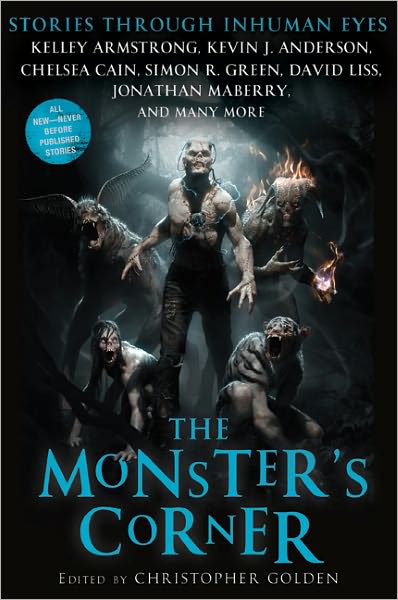
The Monster's Corner: Stories Through Inhuman Eyes (St. Martin's Griffin; 2011) is a prose anthology edited by Christopher Golden containing 19 short stories from different writers.

One of these is "Rattler and Mothman," written by Sharyn McCrumb, an author probably best known for The Ballad of Frankie Silver and She Walks These Hills. As the title indicates, Mothman is in it.

The story is told in the first person, presumably from the point of view of the title character, and old, loner type who lives far away from civilization, resents city folks and apparently has some sort of extraordinary ability to communicate with the dead and/or paranormal entities.

One night, while Rattler is sitting in his front yard, looking up at the stars, he sees a large shape circling him, and he signals for it to land. It turns out to be the Mothman, although Crumb is somewhat coy in actually using that name, holding off for a few pages.

The being is described as being seven fee tall, with leathery wings. Here's how McCrumb envisions her Mothman:

He was roughly human shaped, standing upright on long legs that ended in bird claws. Those red eyes flashed and glowed, seeming to take in everything around him. They were set far apart, on the outer edges of a round face with a sharp beak of a nose and a lipless mouth that made me think of a cave entrance: Just a way into darkness. I was wondering if he had teeth, and not particularly eager to find out.

The whole cast of his countenance would cause you to think "insect," by way of classification, except that his expression and bearing said that there was somebody at home. He was a lot smarter than a housefly. You could tell.

His body was covered with a fine fluff (Gray or blue—I couldn't tell in the dim light)—that might have been fur or the sort of down feathers you see on baby birds.

McCrumb's Mothman talks, and quite intelligently, "in a guttural voice with an accent I couldn't place."

The nature of the creature begins to emerge during the course of their conversation. Both the narrator and Mothman use the word "garuda" when describing Mothman, a garuda being a mythological, divine giant bird or bird-man creature in Eastern religions Hinduism and Buddhism. John Keel, author of The Mothman Prophecies and the creatures #1 press agent, used the term to refer to Mothman repeatedly, often referring to the creature's 13-month flap in West Virginia as "the year of the garuda."

In this story, garudas like the Mothman are powerful beings that live outside of time and protect the land upon which they dwell, by destroying the "nagas" that threaten it ("Nagas" being snakes, again in Eastern mythology).

Rattler pieces together that this particular garuda has been around the area that is presently West Virginia for millions of years, and is at least partially responsible for the extinction of the dinosaurs (dinosaurs being the "naga"). It would periodically go to sleep for millions of years and awake to find its land different and populated by different creatures, some of which it would kill as well.

The garuda have a sort of mind-reading technique and, if it feels or "hears" enough human beings all expressing the same fervent wishes or prayers, it acts upon them, as it did on behalf of the Native Americans a few times. The Silver Bridge disaster was one such answer to one such prayer, which may not sit well with my fellow Ohioans.
"Okay, tell me about the bridge," I said. That's almost all anybody remembers about Mothman: That in December 1967 he was seen in the vicinity of the Silver Bridge at Point Pleasant, and that a short time later, the bridge collapsed, killing forty-six unfortunate people whose cars ahd been crossing over at the time.

"It was a small gesture," said Mothman.

Well, I guess it was, compared to wiping out dinosaurs and sending the Ice Age mammals into extinction, but I was still wondering why he'd pick on a bridge.

He heard my question in his head. "Because...that bridge led to a land of nagas."

Oh. Right. Sure, it did. Ohio.

Hey, who are you calling a naga, Mothman?

Unfortunately, the book isn't illustrated, so the only pictures of the various monsters are the ones the writers form in the heads of the readers.

Well, those and the ones on the cover. I'm not sure if they match, one for one, the monsters that star in the stories in the book, but there is a monster on that cover with pretty big, moth-like antennae, so I suppose it's possible that is meant to be Mothman (although it's lack of wings or red eyes makes me think that's probably not the case).

I didn't read the other eighteen stories, as they did not appear to be about Mothman, but the names of some of the contributors should be familiar to some comics readers, including David Liss (Black Panther: The Man Without Fear, Mystery Men), Kevin J. Anderson (JSA: Strange Tales, Star Wars: Tales of the Jedi) and Jonathan Maberry (Black Panther, Doomwar, Captain America: Hail Hydra).

And now here's a crappy sketch I did of the Mothman, as described in the passage above by Rattler:

Monday Morning (Wo)Man vs. Cephalopod Moment

(Judy Drood take on Aunt Azalea's pet killer octopus in the pages of Richard Sala' Mad Night, published by Fantagraphics in 2005. And yes, it's the same octopus that previously killed that poor pirate gal)


Sunday, May 06, 2012

(links)

Hey look, Parademons on a 4x4:
That's from Earth 2 #1, penciled by Nicola Scott and inked by Trevor Scott, and taken from a preview of the book that DC Comics posted on their blog. It's a pretty neat image. Not as neat as a Parademon riding a motorcycle with a second Parademon in a sidecar, or as neat as two Parademons on a tandem bike, but neat nonetheless.

Ugh, but how about that narration, huh? Those two narration boxes are pretty much all I need to read of this book to know it's not for me...

****************

I gave Earth 2 #1 and Worlds' Finest #1 pretty thorough flip-throughs in the comic shop this past Wednesday, and I am pretty intrigued by the set-up. I would like to see those Golden Age characters retooled for the 21st century, which seems to be one of the prime objectives of the book, but the 20 or so pages of the Trinity fighting Parademons with all those annoying Identity Crisis/Justice League of America-style color-coded narration boxes didn't exactly sell me on the book (Couldn't they have started the story after the Trinity fell before the forces of Apokalypse...? Or was it necessary to show that battle occurring in order to set up sister book Worlds' Finest....?)

I was eager to read reviews of it though, to see if it turned out to be better than it looked (I'm sure I'll read it, in library-borrowed trade, someday). Here's Don MacPherson's review; he gives it a rating of six-out-of-ten, which isn't great, but isn't horrible either.

I agree with MacPherson about the tittle. "Earth 2" is just too specific of a thing right now, having referred to a particular setting for so many decades: The people who understand the reference and have warm feelings toward it may be put off that this is not at all the old Earth-Two, and to everyone else its just a generic, meaningless term. Additionally, DC's mutliverse is a little confused at the moment, given their still-emerging Earth-One line of graphic novels, which have nothing to do with this title.

That said, I'm not sure what a better title for the book would have been, though, aside from the obvious Justice Society, or something new but with the word "Justice" in the title. Maybe just Elseworld, singular, as this is more of a random Elseworlds setting than an "Earth 2" setting...? Or maybe even Elseworlds plural, if alternate Earths become a big part of the series, as some of the earliest promotional material suggested...?

I'm pretty curious to see how deep into DC's Golden Age writer James Robinson goes with the cast of this book, too. Flash and Green Lantern are somewhat interesting in that they're alternate versions of the "real" and "official" characters of the New 52iverse, but whaten you remove the specifics of their home setting—that is, taking them away from both the post-Crisis DCU and the pre-Crisis Earth 2—and then proceed to remove the specifics of their costumes and origins and so on, you take away just about everything there is specific to those characters, and thus Robinson and Scott have to essentially invent new characters to go with the old names, which is a pretty tall order.

I would love to see the 21st century version of Golden Age characters of more of the super-obscure characters Robinson so delights in writing that aren't present in the New 52iverse, as well. Are we just going to see new versions of the character that Julius Schwartz revamped into Silver Age stalwarts, or will we be seeing a new Vigilante and Crimson Avenger and Airwave and Robotman and so on? (Please don't do a Red Bee please don't do a Red Bee please don't do a Red Bee please oh please oh please don't do a Red Bee!)

As for Huntress/Worlds' Finest/Power Girl, that logo sure is awful, isn't it?
The title is actually just Worlds' Finest, but that's not what it looks like on the cover (Like Earth 2, that's another terrible title—just try saying it out loud in conversation—but I'm hard-pressed to think of a better title for the book, beyond the simple and obvious Huntress/Powergirl).

I also really, really hate the post-redesign redesign of Power Girl's costume too. When images from the book first surfaced, her costume was a Supreme-like white union suit with a simple red triangle icon on the chest, vaguely suggesting a "P" for Power
Now the red triangle has been moved over to cover her right breast, and it has a stylized "P" for Power half-hidden in it.
(Note the other tinkering that went on, including giving PG a new 'do, messing with the colors of her accessories, and the addition of a blue racing stripe on her pants).

It's pretty ugly, and it also reminds me of Jesse Quick's short-lived and awful costume which featured a circle around one of her breasts:

Here's some more discussion of the books, from people who actually read 'em:

—Johanna Draper Carlson

—Tom Bondurant

—DC Women Kicking Ass

—Brian Hibbs

******************

Oh SNAP!

******************

I thought this was a good idea, and sending in a $9 check to the Hero Initiative as soon as I got home from the theater sure helped me feel less like a total asshole wile watching the film. In fact, the only part that really made me fee a little sick about how insane it is that millions were spent on the creation of that movie and billions more were and will be made by it while the men who created all those extremely lucrative characters and concepts don't even get credit, let alone a meager share of the profits, was the appearance of the title, as "Marvel's The Avengers" instead of just "The Avengers."

(I'll share some thoughts about the movie itself later in the week, I think).

While charities like The Hero Initiative and Comic Book Legal Defense Fund getting a huge influx of movie ticket-sized donations all week can't really be seen as a bad thing by anyone, it's also worth noting that matching any money you spend seeing that movie with a donation to something other than Disney/Marvel is a solution to assuaging a fan's personal guilt over seeing a big summer movie while knowing that Disney/Marvel aren't behaving in a way that would make Captain America proud of the companies that have his likeness trademarked. It doesn't solve the problem in a way that, say, Disney/Marvel deciding to give the money they made in the course of, say, two hours this weekend on The Avengers movies to creators and their families.

I don't really know how to solve that problem, as it's hard to make someone do the right thing if they don't want too, and infinitely more so if that "someone" is an immortal corporate entity rather than an actual person.

I sincerely hope that the many, many folks currently profiting off of the "Intellectual Property" that Jack Kirby, Stan Lee and a bunch of other late, elderly and often uncredited and uncompensated—or under-credited and under-compensated—men will continue to be asked questions and generally shamed until they do the right thing.

********************

In a better world, this will be made enough of an issue that in a few years, Avengers 2 will have a "Based on the comics and characters created by Jack Kirby and Stan Lee" in the opening credit sequence. And Namor will be in that movie, too.

********************

Yesterday was Free Comic Book Day, as hopefully all of you already know, having participated in it. I had to work, and didn't get to my shop until about 5:45 p.m., at which point most of the free books were pretty picked over. And by "pretty picked over," I mean "devoured, as if by locusts". That was bad news for me, as I didn't have many to choose from, and I didn't get the one I most wanted, Fantagraphics' Donald Duck Family Comics, but I did get Fantagraphics' Barnably and Mr O'Malley, which ain't bad as far as consolation prizes go.

I also picked up Showcase Presents: Superman Family Vol. 3, which was not free, but at 500,000,000-pages for $16 bucks, is probably as close to free as a comic book of that size can be.

*******************

I participated in this week's What Are You Reading? column at Robot 6, which I really should do more often, though I sometimes think it's redundant of me, given have I obsessively write about every thing I read. I did cover a trio of books there that I haven't written about here on EDILW previously however, so that's fresh content! Plus, plenty of capsule reviews of plenty of comics from five other Robot Sixers and a special guest David Harper of Multiversity Comics.

Saturday, May 05, 2012

Pre-New 52 review: Secret Six: Cats in the Cradle

This trade collects issues #19-#24 of Secret Six, which includes the four-issue story arc it takes its title from, and two done-in-one, space-filler stories. "Cats in the Cradle" refers to a 1974 folk rock song by Harry Chapin about a father's poor relationship with his son, and how such prioritizing work over family can be passed down like other genetic traits or family traditions. Writer Gail Simone apparently chose it because Taken was already taken.

If you've not read Secret Six, it's a comic book about a six-person team of mercenary villains including Batman villains Catman and Deadshot, an original version of Ragdoll, Scandal Savage (the daughter of Vandal Savage) and other characters who come or go to replace the ones that get killed off or betray the team.

It was written by Gail Simone, who introduced the team in the 2005 Villains United miniseries, and it lasted until 2011's thirty-sixth issue. When it launched, it featured art by Nicola Scott, but J. Calafiore took over at one point, the point at which I stopped reading the book, not being a fan of Calafiore's artwork, which I find, rough, ugly and full of way too many lines.

In this story, the Secret Six—of which there are actually seven, including Bane and Simone creation Black Alice—attempt to destroy Brother Blood's cult at the behest of a rich, eccentric old man. Said rich, eccentric old man also hires a team of killers to kidnap Catman Thomas Blake's infant son from his supervillain mother Cheshire (the fertile supervillain who is also Roy Harper/Speedy/Arsenal/Red Arrow's baby mama), and, over the phone they threaten to delay killing the boy for one year for each and every member of Blake's team that Catman is able to kill.

Catman thinks a moment, remembers Taken (or at least its trailer), and responds as Liam Neeson did to the captors of his daughter:
Catman then goes AWOL, tracking the three men who took his son in order to brutally murder the fuck out of them, while his fellow killers-for-hire track him in order to help him or stop him or something. During the course of this, Simone flashes back to Catman's "secret origin," in which we learn his abusive, big game-hunting father was a huge asshole who killed his mom, and who Catman then killed in retaliation.

Secret Six has always been one of the modern DC Comics' most violent and decadent series not written by Geoff Johns, but it's also been the one where all that violence and decadence fits best, rather than feeling inappropriately grafted on, like some kind of debilitating tumor, as the very premise of the series is that it's about some of the worst supervillains regularly fighting the absolute worst supervillains. The book should wallow in darkness; the characters should be fairly unlikeable, even morally abhorrent.

That said, darkness and decadence and amoral protagonists aren't exactly what I want to read about in the DC Universe, so I tired of the book pretty quickly, especially when its main redeeming quality—Scott's art—was stripped away. Simone can be a pretty funny writer at times, but at other times she can take a good joke too far by simply telling it over and over again. A good example in this storyline comes at the beginning, when Ragdoll is asked what he's thinking, and he delivers a few-sentence long monologue about how devastating the abuse he suffered as a child was, and then non-sequitirs into "But then I thought...'I wonder what it's like to ^%$# a butterfly?'"...and then he keeps talking about fucking a butterfly long after the surprise has worn off (And yeah, they can't say "fuck" in the book, although a naked Cheshire can bite a man's lips off and, later, Catman can bite a guy's eyeballs out of his head).

Call me crazy, but I prefer a Catman who is a bored wealthy socialite big game hunter who one day decided to dress up in a cat costume to fight Batman for kicks and who also wore a magic luck cape, or even one who simply commits cat-themed crimes and occasionally uses a giant robot cat, to one who is a sadistic killer with a fucked-up childhood.
I was rather pleasantly surprised by Calafiore's artwork in this storyline. It seemed a lot smoother and more accomplished than the last time I had seen it—Gotham Underground—and the ugly character designs and over-usage of lines and the shadows they create actually seems appropriate for the content of a book like this, telling a story like this.

The final two stories of the book are pretty weird. One is "Predators," which is basically "The Most Dangerous Game," featuring the Secret Six as the prey, and it reads, looks and feels like the inventory story it no doubt was. It was written by John Ostrander, and drawn by R.B. Silva and Alexandre Palamaro. I read it when it was originally published in comic book form, and wrote about it the night I read it here.

The final story is by the Simone and Calafiore creative team, back after their one-issue break, and it's called "Unforgiven", so apparently Simone didn't even bother to disguise this one's film inspiration. It's essentially a done-in-one Elseworlds story, in which the members of the team appear as Old West versions of themselves, in the Old West. Also, The Trigger Twins are in it. It's interesting enough, but pretty random, and I'm not sure what point it served, beyond killing another issue.

My absolute favorite aspect of this entire collection, however, is the cover of the trade, which was taken from the cover of Secret Six #21. Catman is triumphantly holding a dead mouse...but he's all beat to hell himself. I like the way the cover implies that there was just an epic battle between Catman and the mouse and, while Catman ultimately defeated the mouse, the mouse put up a terrific fight, and kicked six kinds of shit out of Catman before finally falling to Catman's superior size and strength.

Secret Six was one of several DC titles that didn't survive the New 52 purge of September 2011. Sales on the title were always fairly low, based on the estimates those of us who aren't DC Comics have access to, and it was at cancellation level, but the gigantic boost the New 52 gave all of the titles might have kept it alive longer, essentially resetting it's dial from the cancellation level it was shipping at in the summer of 2011 to the hit levels of so many New 52 books.

I suppose it's possible it was cut on account of continuity—I'm not sure how Bane has been changed by the reboot, for example, or if Deadshot and Catman still have their ex-Batman villain cache in tact—but it's also possible that Suicide Squad was designed to take Secret Six's place as the darkest and most violet DCU book, the one dealing with bad guys fighting worse guys, so having Suicide Squad di>Secret Six running simultaneously might have seemed redundant.

It's also possible Simone gave it up in order to take on new assignments too, and they thought it wouldn't be worth doing without Simone. When the New 52 launched, she was moved to the new Batgirl and was co-writing The Fury of Firestorm, although she's no longer working on the latter title.

I don't think Calafiore is currently drawing anything for DC, but I'm not positive about that.

Thursday, May 03, 2012

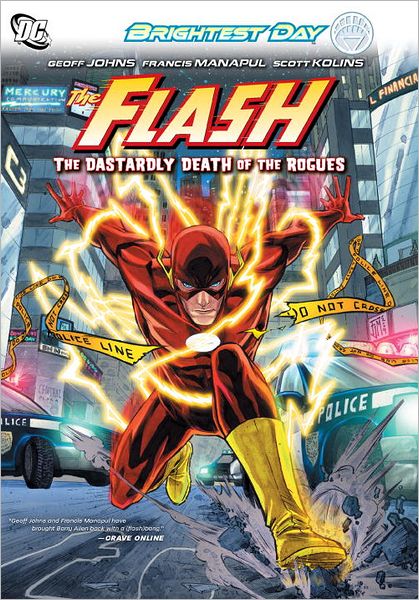
Pre-New 52 review: The Flash Vol. 1: The Dastardly Death of The Rogues

It may just be a coincidence that Geoff Johns seems to do his best writing when working with artist Francis Manapul, perhaps Manapul is simply the artist he chooses to work with when doing his lighter, brighter, less decadent and deconstructionist superhero work, but the fact remains: The Flash: The Dastardly Death of The Rogues is among Johns’ better comics in a good long while, on par with his brief run with Manapul on the Superboy character.

The bulk of this collection contains the title story, which began in the post-Flash: Rebirth Flash #1 from 2010.

With the various plot and continuity gymnastics done in Rebirth, and thus already well out of the way, Johns and Manapul are free to focus on the title character as a traditional superhero, and put him in the middle of a traditional superhero narrative, one distinguished by it’s old-fashioned, Silver Age-infused plot and Manapul’s beautiful, suggestive artwork, which is full of pretty and clever ways of depicting The Flash’s universally-undestood superpower. Speed is cool, and super-speed is super-cool.

Johns introduces us to Barry Allen, medical examiner for the Central City Police Department, and his significant other, reporter Iris Allen. We meet the police procedural supporting cast at Barry’s work, and Johns spends time establishing the unique character and “feel” of Central City, something he’s done with the settings of each series he’s written.

While Allen is considered a dated and old-fashioned character—because he is—Johns has him texting Iris constantly throughout the story, and it works surprisingly well. Of course The Flash texts, while running or fighting, because he’s so fast he can easily take the time fire off a message.

The plot is a typically Flash one, in fact, it's more typically Flash than it is Geoff Johns, which is kind of striking when one considers how long Johns wrote The (Wally West) Flash, with a few sub-plots involving building up the character’s new status quo and cast occurring around its edges.

A body is found dressed like Mirror Master, but it’s not the Mirror Master Barry Allen knows. Badge-holding time-cops with the costumes and powers of various Flash rogues appear and explain that it was actually Mirror Monarch, a good guy from their era, and that The Flash is the murderer, so they’ve come to arrest him before he can commit the crime.

This, of course, leads to a lot of running around and fighting, as Flash tries to solve two murders to keep two innocent men from being punished for crimes they didn’t commit: One is the case he’s working on in his day job, and the other, of course, is the one he's being preemptively arrested for. Meanwhile, the present era’s rogues show up to let the futuristic good guy “rogues” know how they feel about copycats, and to use a seret weapon developed by the original Mirror Master in the off-chance that original Flash Barry Allen should ever return form the dead: A giant mirror reading “In Case The Flash Returns Break Glass.”

It all ties together neatly, and the only real rough edges to the story are those involving Captain Boomerang, as there’s a Brightest Day tie-in that seems to come completely out of nowhere. If one encountered it in the comic book as it was originally, serially published, it likely would have made sense, as it tied into the then-current Brightest Day biweekly series, and similar, seemingly random events were occurring throughout the DC Universe line of books at the time, but, at this point, it just seems weird and out of place, akin to Captain Boomerang’s suddenly developing a new and awfully convenient superpower (Which he also does in the course of this volume).

As an extremely high-quality DC book from 2010-2011, its another strong example of the DC Universe and line of books not being broken, but heading for a fix anyway.

In addition to the title story, this volume contains Flash #7, which featured a story a spotlighting Captain Boomerang, his origin, history and the story from the previous six issues as he experienced it, featuring artwork by Scott Kolins, and Flash Secret Files & Origins 2010 #1, also drawn by Kolins, featuring an overly precious recounting of Barry’s childhood, a later trauma and his current angsting about it, relieved by an appearance by the extended Flash Family (introduced in Rebirth and discarded in the New 52 reboot), with a somewhat clever last-panel reveal.

Despite the relatively high quality of this series, it would only last five more issues, at which point the entire DC Universe/line of books would be rebooted during. Johns left the character at that point, in order to write Justice League and Aquaman, while Manapul remained as artist and writer, colorist Brian Buccellato joining him as co-writer.

I haven't read any issues of the new series yet, but from what I've heard, it's been very good, and among the better of the new New 52 books. Having not read it yet, I can't say how much the set-up has changed—the fact that Johns put so much work into setting up a book for what seemed like a long haul only to have the work discarded a year later seems to speak to how sudden the decision to reboot was—but, at the very least, Iris and Barry's marriage was editorially annulled, Jim Lee added a chin strap to The Flash's costume and characters like Jay Garrick and Wally West no longer exist.

Meanwhile, at Robot 6...

Today at Robot 6 I have this month's installment of my "A Month of Wednesdays" column, in which I review every graphic novel released in April that I happened to read in April. This time around, that means Archie Meets Kiss (from which the above image of Sabrina The Teenage Witch's talking cat Salem wearing Kiss makeup was taken), Athos in America, Pterodactyl Hunters in the Gilded City, Rohan at the Louvre and Showcase Presents: All-Star Squadron.

Pre-New 52 review: Blackest Night: Green Lantern Corps

The phrases in the title of this 2011 trade collection seem like they should maybe be flipflopped, as it collects issues #39-#47 of the series Green Lantern Corps, while Blackest Night is the name of the inter-book storyline/event these issues are tie-ing in to, either directly or indirectly.

They are all written by Peter J. Tomasi and penciled by Patrick Gleason, the then-regular creative team of the since rebooted Green Lantern Corps series. In keeping with the apparent creative process of parent title Green Lantern, each issue of this series has multiple inkers, sometimes a comically large number of inkers, so it must have always been on the brink of shipping late.

The series stars Guy Gardner, the Green Lantern of the 80s, and Kyle Rayner, the Green Lantern of the 90s, and is set on the Green Lantern homeworld of Oa, featuring a big ensemble cast filled out by various alien Green Lanterns and functionaries within the organization.

While Green Lantern was more or less a standard superhero book, with the title character doing superheroic stuff by himself, GLC was written as more of a team book or, in Tomasi’s hands, something between a comic book version of a police procedural and a war movie. It also focuses on all the weird and fun little details of the Green Lantern Corps concept: Where do they put prisoners, where do they bury their dead, how do the rings work, what are the rules of being a Green Lantern, what do they do in their time off, and so on.

During the course of the comics contained in this volume, it also completely insane.

Blackest Night was, of course, a simplistic but somewhat irresistible concept, already mined to death by Marvel—superheroes + zombies—but more immediate in practice because it was set in the “real” DC Universe. And, of course, it was conceived of and written by Geoff Johns, the foremost practicioner of modern superhero decadence and ultra-violence. Who better for a DC Comics superhero horror mash-up on an epic, Crisis-level scale?

While Johns wrote Blackest Night and Green Lantern, and thus told the main story of the event, and while most every DC book dealt with their protagonists’ personal fronts in the so-called “War of Light” (that is, the variously-colored Lantern armies vs. the undead Black Lanters), Tomasi had a task somewhere in between. His was a Green Lantern book, but not the Green Lantern book, the one with the star Lantern.

He got to write about what was happening in outer space rather than on Earth, and was apparently happening there was, as I said, completely insane.

Guy and Kyle are flying back to Oa after their appearance in Blackest Night #1, for “Tribute Day,” one of those neat little faux-cultural details Johns made up for the DCU that DC Comics lost in their reboot, when swarms of black rings attack their home planet, reanimating dead Green Lanterns as undead Black Lanterns, who then proceed to kill their fellow Lanterns, who are then also reanimated as Black Lanterns, zombie plague-style.

Our heroes are confronted by Black Lantern versions of their fallen loved ones.

Then, when they are strong enough, having charged their rings by feasting on the emotions they drained from the living by fucking with their heads for a issue or three, the Black Lanterns attack the central power battery, the giant green lantern thing that powers all of the Green Lantern rings in the universe.

Then Kyle Rayner obliterates most of them in a suicide attack. And then, sick with rage, Guy becomes infected with a Red Lantern ring, which replaces one's blood with burning napalm super-blood that is projectile-vomited out and fills you with a berserker, kill-crazy rage.

And then Kyle comes back to life. And then Mogo, the entire planet that is also a Green Lantern, attacks the Black Lanterns.

Tomasi and Gleason just pile on the crazy imagery of this battle of Oa. It helps, certainly, that the various Lantern Corps are filled with crazy-looking aliens of all shapes, sizes and forms, and that Gleason has a particular faculty for designing and rendering them, but the pair are incredibly imaginative in their conception of mayhem, and I found myself repeatedly shaking my head in enthused appreciation of their flashy, inspired decadence.

Like when characters are cut in half, but their top half continue to fly, dragged along by their power rings.
Or the scene where Green Lantern Soranik finds the gigantic head of destroyed Black Lantern healing and reforming around her, trapping her inside it.
Or Guy’s blood-crying, -vomiting and -oozing annihilation of everything in his path while wearing his red ring.
(I don't know if you can tell from those panels, but Guy Gardner rips the arm off of the Yellow Lantern he's fighting, and then shoves it down her throat!)

Or Mogo’s cure for that condition, which involves millions of space-leeches.
Or the Star Sapphire’s shojo-like super-love powers.
Or any of the many, many scenes of sky filled with dozens of Lanterns of various colors fighting one another.
After the battle is won, the book enters a rather strange territory, as it’s clear that it starts to pick up story threads from Blackest Night and then lead into issues of Blackest Night, so that at a certain point it stops reading like a graphic novel, and instead reads a bit like scenes from a movie, or perhaps random episodes of a TV show, playing chronologically, but with the episodes between them missing.

Of course, even the most narratively isolated of the issues, entitled “Black Dawn,” is suitably insane, including a scene where Kyle Rayner battles Black Lantern Alex, the original woman in a refirigerator, inside a refirigerator (a black, flying refrigerator, comlete with a Black Lantern symbol magnet), and a battle with dying Anti-Monitor that involves putting the superhero Dove inside a giant bullet, and shooting her out of a giant yellow sniper gun operated by a space hermit crab, and each Lantern Corps shooting the bullet with different colors as it passes for maximum rainbow power.

I’ve read issues of this series in smaller chunks in the past, but the Blackest Night storyline, with its battles of epic scale—whole armies of thousands of super-powered combatants are involved—and compressed time line necessitating accelarted action really transformed it. Instead of a space soap opera, it became a brightly-colored, operatic (by way of melodramatic) horror-war.

The final issue is set after the events of Blackest Night, the conflict having been resolved between the end of the “Black Dawn” story and the beginning of “Goodbye Darkness,” a breather, check-in issue where we learn the new status quos of the various characters after the big events.

I read a lot of Blackest Night tie-ins while DC was originally publishing them, but this is probably the first one that I was glad to have read, and wished I would have read earlier. Although I suppose it’s possible that a lot of the pleasure I got from it was in getting it in one big chunk, like this. The scale of the lunatic war is harder to appreciate in 22-page chunks—certainly the first issue or two, in which Kyle confronts Black Lantern Jade differs little form the bulk of the Blackest Night tie-ins—but this particular dosage, nine issues and around 200 pages, is big, almost too big, as is just about everything else in the book.

I'm not sure it's a book for everyone, and it's quite possible it will read like gibberish to anyone not already somewhat acquainted with the Lantern-studded corner of the DC Universe, but I thought it was a blast.

DC was obviously pleased with the work that Tomasi and Gleason produced, as when the New 52 launched, the creative team was promoted from the publisher's second most popular franchise to their first most popular franchise, taking over Batman and Robin, the book created to be Grant Morrison's own personal Bat-book, which DC declined to cancel when Morrison departed, because neither DC nor Marvel will ever cancel a successful title, even after it's reason for being has evaporated (For about 50 good examples of this phenomenon, please see Marvel's X-Men line of books).

Green Lantern Corps survived the reboot, of course, with one big change to the cast, with Green Lantern John Stewart replacing Kyle Rayner, and with former Green Lantern: Emerald Warriors artist Fernando Pasarin replacing Gleason on artwork. I haven't read it at all, as I don't really care for Pasarin's artwork.

Wednesday, May 02, 2012

Comic shop comics: May 2

There was a new Skeleton Key comic by Andi Watson out today, but I did not purchase it, because I did not pre-order it, because I did not know about it, and my shop sold out before I got there. That is sad.

So I've only purchased two comic books today, which I will now proceed to tell you about.

Daredevil #12 (Marvel Entertainment) Hey, it's another issue of the apparently now weekly Daredevil series. There seems to be a new issue at the shop every time I go in there. This one, at least, has pretty strong artwork in it, as incoming artist Chris Samnee handles the interior art.

It's a nicely full and complete story by Mark Waid, in which Matt Murdock goes on a date with that lady he's been flirting with off and on for the last 11 issues and, in the process, he tells her a story about he and Foggy's adventures in law school, which is actually a lot more interesting that it likely sounds in my description of it.

It ends with one of the "Megacrime" organizations attacking Murdock because of the Omega Drive he possesses, which Marvel just published a three-issue crossover story about that didn't resolve anything. It's damn weird, really; this issue could just as easily have taken place before "The Omega Effect" storyline, that's how meaningless it was.

Anyway, good script, great art, super-great cover: Daredevil remains at the top of the super-comic heap.


Hulk Smash Avengers #1 (Marvel) I like weekly comics, and I like comics with the words "Hulk Smash" right there in the title, so I pre-ordered this a few months back on a whim.

The premise is delightfully simple: Each issue, a different creative team will offer a tale of The Hulk fighting the Avengers, each battle set during a different decade of Marvel history. This being the first issue, it's set in the '60s, somewhere after the seventh issue of the original volume of The Avengers book and the fourteenth issue (at least according to the "True Believer Note" on the recap page).

It's from the creative team of Tom DeFalco and Ron Frenz, with Sal Buscema finishing Frenz's pencil art, and it's an extended nostalgia act. How much like Jack Kirby and other early 60s Marvel artists can Frenz and Buscema drawn? How closely can DeFalco imitate the always-alliterating Stan Lee, without so overloading the panels with verbiage that they panels might assault the eyes of today's younger readers?

I thought they pulled it off quite nicely. It's essentially the Marvel comic book equivalent of a rock band covering a popular song from The Beatles or Rolling Stones, and Frenz and company hit all the right notes and pull it off admirably. No, there's nothing new here, but that was a pretty great song, wasn't it?

The plot? The Avengers—Iron Man, Giant Man, The Wasp, Thor and Captain America—track down The Hulk in order to try talking him into rejoining the team. He just beats them all up. They decide to try again but, in the meantime, Baron Zemo, The Executioner and The Enchantress convince The Hulk to let them help him beat up the Avengers. Then there's a big fight.

The dialogue is affected, but it's still campy, and I liked seeing the word "Killbot" in print. Also, this is the first time I've heard Baron Zemo's origin explained. I had no idea it was so funny! If he can't take his mask off, how does he eat...?

*********************

Daredevil and Foggy Nelson were created by Stan Lee and Bill Everett. The Hulk, Rick Jones, Baron Zemo, The Wasp, Thor, The Executioner and The Enchantress were created by Lee and Jack Kirby. Iron Man and Henry Pym were created by Lee, Kirby and Larry Lieber. Captain America created by Kirby and Joe Simon.

Tuesday, May 01, 2012

Pre-New 52 review: Huntress: Year One...and Paul Levitz's introduction of the same

When DC originally started publishing Huntress: Year One as a serial miniseries in 2008, it seemed spectacularly unnecessary.

The version of the character under the mask at that point was a post-Crisis recreation, having her fairly simple origin told in a short-lived 1989-1990: She was a mafia princess orphaned as a little girl by the mob, who grew up to fight them. Her Italian-American ethnicity and Catholic faith being the main things separating her from the dozens of other similar characters.

She’s appeared fairly constantly in Batman books since the early ‘90s, was a member of the JLA during Grant Morrison’s widely-read run on the book, and has been a member of the Birds of Prey team for years. And, of course, Greg Rucka and Rick Burchett had retold her origin in a six-part miniseries in 2000, Batman/Huntress: Cry For Blood.

Unlike many of the characters and franchises that had parts of their fictional histories erased, added to or otherwise rejiggered by DC’s 21st century, time-and-space altering events—Infinite Crisis, 52 and Final Crisis—the Huntress was unchanged.

So why, I thought, was DC bothering with Huntress: Year One in 2008 instead of a new Justice League: Year One or Wonder Woman: Secret Origin or something…?

They never really made a case for the book’s existence back then, but read today in its collected format—which first became available in 2009—it’s worth noting that it’s actually pretty good. I guess it’s possible that maybe DC decided to go ahead and greenlight this strangely timed project simply because it was a pretty good story…?

That story, by the way, is from Ivory Madison. It features serviceable but unspectacular pencil art by Cliff Richards, who is inked by Art Thibert, Norm Rapmund or Rebecca Buchman, depending on the issue or page (Thibert inks the first half of the series, and then things get a little chaotic, with more inkers joining him more frequently toward the back end of the series).

It’s been long enough since I’ve read the other, older, Rucka-written Huntress miniseries that I’ve forgotten a lot of the details, but Madison seems to be keeping them—and/or events from the 1989 series—more or less in tact, as there are a lot of names and a few events that are thrown around as if they are ones a readers should be acquainted with. Madison doesn’t exactly hold a reader’s hand here.

She does play up the hunting part of The Huntress’ name, although the vigilante doesn’t officially adopt that codename until the very last panel of the book.

When we first meet here, she is twenty years old and living alone on a farm in Sicily, hunting with a crossbow for food and sport. Her real family were all killed by an assassin in Gotham City when she was just a little girl, and the family of assassins who raised and trained her in Italy are now either all dead or in jail.

We follow her as a member of her larger mafia family finds her and brings her back into the fold, as she visits with the man who served as her older brother and protector, as she readies to receive her massive inherited fortune on her 21st birthday, and as she runs afoul of mysterious and powerful criminal organization The Hand (It’s in Italian though, to differentiate it from Daredevil’s ninjas), and learns the names of the man who ordered her family’s murder and the man who pulled the trigger.

Madison’s tale is rather plot heavy, and while the Huntress remains a more-or-less generic character type that's too-familiar fromm action comics and movies, Madison does gradually add pieces of characterization to make her seem increasingly individualized.

The exotic setting and mafia trappings and Catholic rituals further distances the character from the rest of Batman’s sidekicks and the other female vigilantes of the DC universe. She doesn’t arrive in Gotham until the book reaches its climax, and, for the most part, she stands as her own character with her own goals, conflicts and agenda, independent of the Batman franchise that so quickly re-abosorbed her after her post-Crisis re-introduction.

There are a few things in the book I wanted to call special attention to.

As my last name may indicate to you, I’m Italian-American, and while my Italian blood is diluted by that of three other nationalities, my Italian-American ancestors were the dominant ones in my family, and I was raised in Italian and Catholic traditions.

Depictions of Italian-Americans in pop culture always make me feel…weird, I guess. I don’t identify as Italian-American enough that I ever find mafia stereotypes or talk of Latin passions or appetites offensive, per se, but seeing such depictions do make me wonder if this is what people of other nationalities or ethnicities must feel when they see their cultural identities portrayed in comics.

There are, of course, negative and positive Italian-American characters here, the hero and the villains are all Italian-American and, to varying degrees, Catholic. I can’t say how accurate Madison’s portrayals are. I’ve never been to Italy, and I don’t know anyone in organized crime.

I do note that I never see Italian-Americans in comics or movies that aren’t involved in organized crime, though, and I have trouble thinking of positive portrayals of Catholics, either. Daredevil is Catholic, although for most of the last 30 years or so, he hasn’t exactly been a positive character, despite being the star of his comic book.

I’m just rambling. I’m not offended by anything in this book, I’m just noting, “Hey, a bunch of Italian and Italian-American characters! And they are associated with organized crime!” I guess.

The one scene I thought was kinda weird in that regard, although I found it funny rather than offensive, was the scene of Helena’s family shown gunned down at dinner around her, the spaghetti sauce and blood mixing into a huge pool of red, so it’s impossible to tell if its blood or tomato sauce or both. Visually, it suggests if you perforate an Italian family, spaghetti sauce pours out.
I’m sure that wasn’t the intent, but that’s what it looks like.
I hadn’t noticed until actually reading it, but the Huntress gets a new costume in this series. It looks a lot like the one that debuted during the Batman crossover event series Contagion, which was basically a black bodysuit under the purple bathing suit her creators outfitted her with.

But it’s a sleeker one, with the purple bits now looking functional, like something there to support her Barbie doll breasts, and/or provide armor, and the lack of gloves and boots give her a sleeker appearance.

It’s the best Huntress costume I’ve ever seen, I think, head and shoulders (and torso, legs and feet) above the one Jim Lee designed in “Hush” and that Ed Benes so enjoyed drawing during his Birds of Prey run, and far better than the heavily armored look she has in her “New 52” incarnation.

**********************

A brief history of Huntress costumes...

Her original costume, as drawn by Brian Bolland

Joe Staton's post-Crisis costume, as drawn by Staton

Her 1996 costume from the Batman books, drawn by...I wanna say Graham Nolan...?

Jim Lee's redesign, as drawn by Mark Texeira

The New 52 costume, as drawn by Guillem March

********************

I liked this bit a lot, where we learn where she got her costume:
Is she the only, or at least one of the few, superheroes to have a designer costume?

The book loses a bit of steam as it reaches its climax; more is happening faster, but it's too much and too fast, and nothing feels to have the same weight of emphasis as the events of the earlier scenes. By the final issue, it seems like the series was cut short, and Madison had to jam two or three issues worth of plot into a single issue and wrap things up quickly.

When the Huntress gets to Gotham and meets its famous residents while pursuing vengeance, the narration boxes get bigger and wordier, the dialogue gets more obvious and explanatory, and action scenes become overly compressed.

Madison writes the Bat-characters really well, though. There’s a neat little scene where Batman fights the Huntress (after she clobbered him while he was out of costume as Bruce Wayne), and Catwoman rattles off a list of observations about Batman’s fighting styles and habits that seems…just right.

Madison’s take on Catwoman is kind of cute too. Her interest in The Huntress seems a bit forced, but Madison gets the character, particularly at this phase of her career where she’s most concerned with having fun, stealing things because she wants ‘em, and flirting with Batman.

I was pretty surprised to see her smoking though:
I didn’t know Catwoman smoked, but then I never read Mindy Newell’s 1989 miniseries about the Year One era Catwoman, and I can’t remember if Selina Kyle lit up in Frank Miller and David Mazzucchelli’s Batman: Year One or not. Where does she keep her cigarettes and lighter in that suit though? Maybe she just has ciggies and lighters stashed on rooftops all over Gotham…?

I was also surprised to see Madison was so specific with ages. In addition to letting us know that Huntress is 20-21 throughout this story, Catwoman reveals that she’s “only 29.” This being sometime during Batman’s second or third year (Catwoman says she’s been being chased by Batman for two or three years now, and Robin hasn’t yet been introduced), and DC’s pre-New 52 timeline being at least 11 years long (The post-Zero Hour 10-year timeline, plus the 52/"One Year Later" time jump), that would mean that Catwoman was 38 or 39 by the time Flashpoint saw print. Huntress would have been 29 or 30, and Barbara Gordon would have to be somewhere in that neighborhood, too.

Gordon appears in the story, as both a legal librarian with the U.S. Attorney’s Office (so, she’d have to be around 23 at that point) and as Batgirl.

The continuity is wonky here though, as Gordon is already Batgirl and working with Batman before Bruce Wayne has even met Dick Grayson, let alone debuted a Robin (Another cute moment is when Batgirl hears Batman refer to his friend Bruce Wayne for the third or fourth time and says, "I think it' sfunny how you talk about 'Bruce' as if he isn't you").

The book contains an introduction, by Huntress co-creator Paul Levitz. I love introductions in collections, and think they should be required. This one is pretty funny though, given that Levitz wrote t in 2009 and, starting in fall of 2011, he was once again writing the Huntress character, not the new, Helena Bertelinni version, but the “Earth-2”, Helena Wayne version Levitz and artist Joe Staton created way back in 1977.

Listen to Levitz:

Comics often demonstrate one of the magical characteristics of folk tales: the ability to tell and retell a story, changing with the times and circumstances of the listeners, and of the storyteller, until only the essential kernel remains intact. In the process, the tale is kept alive and relevant to new generations of listeners…

...

It’s good to see my old character, suitably transformed, in the hands of a writer whose skills should make her one of comics’ most talented new voices. Ivory’s version is far from the story I imagined in Greenwich Village last century, and that’s as it should be. For a folk tale to live on, it needs to evolve through the centuries, and here, then, is the first definitive version of the origin of the Huntress for the twenty-first century.
Two years later, Levitz was once again writing the character he imagined in Greenwich Village last century, devolved backwards and reusing her origin for the twentieth century audience, in Worlds’ Finest, a new title teaming the late seventies version of the Huntress with the late seventies version of Power Girl.

So much for keeping things relevant for new generations, huh?

I’m also stuck on what Levitz said about Madison, how this story demonstrates that she should be “one of comics’ most talented new voices.”

What happened to Madison after this? The only other comics credit I can find for her is a short story in Batman: Eighty-page Giant 2010 #1.

I wonder why DC didn’t give her one of those 52 new series they launched in 2011, with Birds of Prey or Catwoman being some obvious choices.

The former, of course, went to crime novelist-turned-comics writer Duane Swiercyznski (it excised Huntress and Barbara Gordon from the cast, of course, but the Huntress fan behind DC Women Kicking Ass seems to like it okay) and the latter went to Judd Winick, a comics writer whose work no one seems to like and whose name stopped generating noteworthy comics sales years ago, but who nevertheless keeps getting high-profile books from DC.

Given the lack of female creators working on the New 52 books (It’s been a while since I’ve seen the math; it was just Gail Simone writing Batgirl and co-writing the early issues of Fury of Firestorm, right?), Madison would have seemed like a good person to have pitching Bat-adjacent books.