Monday, March 17, 2008

DC's June previews reviewed


I know the words "Pekar" and "cute" don't often appear in the same sentence but, man, did Darwyn Cooke just draw the cutest image of Pekar ever for this American Splendor cover or what?


Introducing The Atom III’s new villain, Chronos III, the one that’s female!


ARMY@LOVE VOL. 2: GENERATION PWNED TP Written by Rick Veitch. Art by Veitch & Gary Erskine. Cover by Veitch. Collecting issues #6-12 of the incisive ARMY@LOVE, a series writer Rick Veitch describes as Desperate Housewives meets the war. This volume, leading into the upcoming ARMY@LOVE SEASON 2, follows the exploits of rivals Loman and Flabbergast, as well as Switzer, the woman they both love.

I’d have to check my records to be sure, but I’m fairly certain that the above is the greatest name for a trade paperback collection ever.


BATMAN: FACES TP-new edition Written by Matt Wagner. Art and cover by Wagner. Batman must prevent Two-Face from creating an army of deformed, super-powerful slaves in this collection by Matt Wagner!

Just a heads up in case you missed it the first time around when in ran in Legends of the Dark Knight, which was actually quite a while ago, this is a really, really solid Batman vs. Two-Face story by Wagner. Some of the story elements are pretty played out, but one of the unique aspects of Batman comics is that even the played out can be given new life when applied to the stylish milieu, provided they’re executed and rendered good enough. And since it’s Wagner we’re talking about, you can be fairly certain everything is executed and rendered good enough.

Thinking back to when I originally read this story, I remember being struck by the fact that Wagner’s Two-Face had a red scarred face. It was the first time I’d seen his ugly half anything other than green, and I remember thinking how great it was in red.

Also, Legends of the Dark Knight is a much better title than Batman Confidential, isn’t it?


Just a reminder: Kelley Jones rules.


FINAL CRISIS #2
Written by Grant Morrison
Art and covers by J.G. Jones
Meet Japan's number one pop culture heroes, the Super Young Team and their languid leader, Most Excellent Superbat! Join legendary wrestler Sonny Sumo and super escape artist Mister Miracle as they team to face the offspring of the Anti-Life Equation! See Earth's superheroes mourn one of their oldest allies! Witness costumed criminals sinking to new depths of cowardice and depravity as Libra takes things too far! Uncover the doomsday secrets of the poisoned city of Blüdhaven! Learn the shocking identity of the prime suspect in the murder of a god! And read on if you dare as Batman becomes the first of Earth's champions to face the Fallen of Apokolips. All this and a spectacular return from the dead...
Grant Morrison and J.G. Jones' multiverse-spanning epic continues with bombshell after bombshell in FINAL CRISIS #2 — "Ticket to Blüdhaven"!


Well, the solicitation copy sure is exciting! I mean, that's a lot of very excellent sentences there, almost each of which ends with a well-earned exclamation point.

Also, "Superbat"? Pretty much the best name ever...and that's before you add the "Most Excellent" even. Has DC really never had a Superbat before? I mean, if "Super-" and "Bat-" are you're two most popular and marketable adjectives, why aren't they on the cover of a comic yet? Likewise, Marvel really ought to have a Spider-X book by now.

I don wonder how Countdown counted down to this series though. Based on the solicitation, this sounds like it picks up from where the New Gods were at in Seven Soldiers: Mister Miracle more so than Countdown/Death of the New Gods, but obviously I'm just basing that supposition on a half dozen vague sentences about a book I can't read for three months yet...


GREEN ARROW/BLACK CANARY #9 Written by Judd Winick. Art by Mike Norton & Rodney Ramos. Cover by Cliff Chiang. Green Arrow and Black Canary follow the trail of Connor Hawke's missing body to the heart of the League of Assassins — and face the resurrected Ra's al Ghul himself!

How great is my disdain for Winick? He can put one of my absolute favorite characters in the book, it can have a cover drawn by an artist as awesome as Cliff Chiang featuring that very character, and I still won’t buy it. Woe is the DCU, when it makes me sad to see Plastic Man appearing in it, for fear of what’s being done to him in it…

And speaking of Plas, you can read Art Spiegelman's 1999 New Yorker cover essay on Jack Cole and Plastic Man here. See, this is one of the reasons I think Plastic Man always oughta be on the Justice League, if the League is the fictional DCU's way of honoring the greatest superheroes DC happens to own the rights to at the moment. How many essays about Geo-Force, Red Tornado or Roy Harper has Spiegelman penned? How many times has Hawkman, Green Arrow or Black Canary made the cover of The New Yorker? Exactly.


SUPER FRIENDS #4 Written by Sholly Fisch. Art by Dario Brizuela. Cover by J. Bone. One villain is bad enough. But the Super Friends are in for a real struggle when they face six villains — secretly known as the Jester’s League of America! Plus, puzzles, fact files and more!

Hey, “Jester’s League of America” is a pretty clever name for a group of DC villains who want to take on the League. The Joker, The Prankster, Punch and Jewlee, Harley Quinn, maybe Toy Man or Rag Doll…it’s an idea with potential. Too bad it’s being wasted on this book.


JUSTICE LEAGUE OF AMERICA #22
Written by Dwayne McDuffie
Art by Ed Benes
An all-out action issue as Red Tornado is given another chance at life! The problem is that the dormant Amazo program within him wants the death of all League members! Plus, Zatanna and Animal Man come to aid Vixen with her power problem.


On the plus side, McDuffie...and not writing a tie-in to a dumb-ass story I have no interest in. On the minus side, Benes is back.

Also on the plus side, Animal Man guest-stars. But then, also on the minus side, this is that story where the robot member's programming forces him to betray the super-team he's a member of, and I think I've read that a few hundred times now.

It looks like someone's talked to Benes about the inappropriate exploitive imagery however, since he has four female characters laying down on the cover, and not a one of 'em is splayed out butt-first. That’s something.


JUSTICE LEAGUE UNLIMITED #46 Written by Matt Wayne. Art by Carlo Barberi & Bob Petrecca. Cover by Zach Howard. Say goodbye to the League as John Stewart and the Green Lantern Corps. take on a universe-threatening mission. Who is the force behind it all? And who is the traitor within the ranks?

This is the final issue of DC’s all-ages, entry level superhero book, which was cancelled to apparently make room for the kids’ book based on a toyline Super Friends, which is not all ages. So now would-be DC super-comics readers who want to read about the Justice League have nothing between a children’s book that contains puzzles and the one with all the bare-asses, crying androids and stuff like this in it. That…makes…sense?


THE LEGION OF SUPER-HEROES IN THE 31st CENTURY #15 Written by Jake Black. Art by Robert Atkins & Rick Ketcham. Cover by Alexander Serra. Bouncing Boy and Triplicate Girl finally get their second date, but the trend of nothing ever going as Chuck plans continues when they get hopelessly lost in virtual reality…with a fast-talking, impulsive brat named Bart as their guide! Can they put their differences aside to stop a virtual threat that gets very real, threatening the existence of New Metropolis?

Please note: Bart Allen is in this comic book. As Impulse.


MANHUNTER #31
Written by Marc Andreyko
Art by Michael Gaydos
Cover by Liam Sharp
The fan-favorite series returns! New series artist Michael Gaydos (New Avengers, Alias, Nightmare Factory) and cover artist Liam Sharp (COUNTDOWN PRESENTS: LORD HAVOK AND THE EXTREMISTS) deliver a stunning new look for the continuing adventures of the DCU's most human hero! Los Angeles is Manhunter's town — so when Kate Spencer learns of the disappearance of hundreds of women along the Mexican border, she's on the case both as law-breaking D.A. and costumed vigilante. Meanwhile, Kate's bloodline tie to the JSA returns to haunt her — and it looks like her sidekick's most notorious supervillain ex-boss is doing the same to him.


Well it's about freaking time. I've started this in trade, and will probably keep reading it as such, so the wait has been excruciating, knowing that it would be Whenever They Actually Decide To Start Publishing + 6 months or so.

Nice to see Michael Gaydos joining up, too; he should be a great fit, and, hopefully a boost to the book. I think it's fair to say that if you like the bitter, kinda sorta superheroine Jessica Jones in Alias, then you'll like the bitter, kinda sorta superheroine Kate Spencer.

Even if there is less anal sex in Manhunter.


ROBIN/SPOILER SPECIAL #1
Written by Chuck Dixon
Art by Rafael Albuquerque and Victor Ibáñez
Cover by Albuquerque and Cris Peter
From the rooftops in Robin to Gotham Underground, Spoiler's identity has remained a mystery — until now. All is revealed in this special when Robin and Spoiler team up to take down a kidnapping ring, hit up an illegal warehouse party and finish Tim's algebra homework; just another day in the life of a teenaged vigilante super-hero! Plus, even more Robin doesn't know: Spoiler's secret identity in another country, in another life - one she can never leave behind


Hmmm...did Stephanie Brown fake her own death? Or have her death faked by Dr. Thompkins and maybe even Batman?


I like this cover. I think DC would be better off employing Alex Ross on titles that could use the extra boost his presence likely brings—Flash, Wonder Woman and Supergirl for example, as I can't see him being jazzed about painting Blue Beetle III or the current cast of Checkmate—instead of JSoA, Superman and Batman, but what do I know?

Sunday, March 16, 2008

I am going to talk a lot about Tubby now

It may have taken me a while to get around to actually trying out the John Stanley and Irving Tripp Little Lulu comics (which Dark Horse has been handily reprinting the hell out of) but man, once I did, I was hooked.

I know I sung their praises a bit in that previous post, but I thought maybe it would be a little more helpful to show how good they are here. So tonight I’d like to take a little time to talk about what exactly it is that makes Stanley and Tripp’s version of Little Lulu so great.

It’s Tubby. Tubby Thompkins. He’s Lulu Moppet’s neighbor and best (boy) friend, a clever little boy who plays at detective, is something of a master of disguise and is a greedy little glutton, which accounts for his…expansive physical appearance, which is made even funnier by his little coat, his tiny little sailor cap and the fact that he is named “Tubby.”

It’s not a nickname—it’s his name. His parents, his friends’ parents, his teachers, his principal, cops, local shopkeepers, they all call him “Tubby.”

Now, not to try and get all deep on you or anything here, but one of the things I like about the Little Lulu-iverse is it’s a fictional world in which there no clear winners and clear losers. Like, Charlie Brown is always getting dumped on; his sad-sack, never-gets-to-kick-a-football, always-loses-his-clothes-on-the-pitcher’s-mound, can’t-fly-a-kite, rejected-by-the-little-red-haired-girl lot in life is his whole deal.

But Tubby, like most of the Little Lulu characters, is neither a winner nor a loser. Sometimes he gets the better of his friends and foes—and everyone in the comic is both Tubby’s friend and his foe, depending on the story and situation—and sometimes they get the better of him. Often times he’ll bust Lulu’s dad Mr. Moppet for some petty domestic crime, getting him in hot water with his wife and daughter, but sometimes Mr. Moppet calls Tubby’s parents to get special permission to spank the little so-and-so.

And then there’s the art. Tripp, who provides the finished art over Stanley’s layouts, is one of those fantastic cartoonists who can do so much with so little. Each panel is full of simple designs, and the characters themselves are but two dots and a dozen lines or so, but they are so vibrant and expressive.

Especially Tubby. Here are some of Tubby’s many moods, as delineated by Tripp…


...happy...


...angry...


...psychotically angry...


...self-satisfied...


...in a drawer, and so on.

Let's take a look at what you could call a Tubby solo story (True fact: If Lulu wasn't even in Little Lulu, it would still rule). This one appears in Little Lulu Vol. 18: The Expert, the most recent of the Dark Horse trades.

Behold, comedy genius:


What the hell? Tubby's just sitting on his stoop, (angrily) minding his own business, and Wilbur and Gloria just walk up, look at him, and bust out laughing? Damn, that's weird.

Having enjoyed their context-free laugh at Tubby's expense, the curly-haired couple are off to their next stop, which gives Tub a clue as to why they might have been laughing at him...


Iggy thinks that's a good idea for a baby hippo's name.

Tubby, obviously, disagrees, and sees a real problem here:


It leaves him with but one recourse:

I love that second panel, in which the tubby kid named Tubby expresses that he never liked the name "Tubby" and never thought it suited him. See, I've wondered just why on earth his parents named him "Tubby"—was he a giant baby or what?—and it's nice to see him thinking about the issue for himself at long last.

Now, I'm not sure why he wants a "fancy" name, particularly that of "Lancelot," but it was the '50s, so maybe boys considered "fancy" to be a good quality in boys' names back then.

Now, the biggest hurdle in changing one's name is in getting everybody who knew you by your old name to quit calling you y it, which is never easy. Tub's first stop is to visit the fellows in his club, whom everyone refers to as the fellers, which I find charming.

Anyway, the respond exactly the way a group of little boys would respond if their portly friend told them he's chaning his name to Lancelot:


Please note the fits of hysterics this causes among the fellers and, in panel three, Tubby's perfectly cool, zen-like calm in reacting to their jeers...

...with persuasive violence.


He only relents when they've learned their lesson and start addressing him as Lancelot. However, Annie missed out on the lesson, and has the same reaction as the fellers:

When he finally heads home, he sees the kids have all done his bidding well, even if children struggle with the pronuciation a bit.


Heh. "Empty-lot." That kills me.

Well, regardless, at least everyone knows not to call Tubby "Tubby" any more. I guess he sure showed Gloria and Wilbur, huh? I can't wait until he sees them again. Oh hey, here they come now...

Ha ha! And thus Tubby suffers the very fate he spent the entire story hoping to avoid! And, on top of that, he loses his ice cream.

But the very best part about the ending? It means that the scene at the beginning, in which Wilbur and Gloria just strolled up, regarded Tubby, and pointed and laughted at him...

...they really were just laughing at him for absolutely no reason.

NPR on Catwoman

NPR's ogoing "In Character" feature spotlights Catwoman today. You can read the story here, and the audio should be posted later this evening, if you prefer listening to radio stories as opposed to reading them. Julie Newmarr, Eartha Kitt and Adam West are all asked for quotes, of course, but comic book Catwoman's earliest and latest writers, Jerry Robinson and Will Pfeifer, also offer some thoughts.

Saturday, March 15, 2008

Review: Kean Soo's Jellaby Vol. 1


I've read some online invective regarding the Flight anthologies, the sharpest cut I remember being (and I paraphrase, because I don't remember where exactly I read it) that just because you can draw, that doesn't mean you can tell a story. I haven't dug every single story in ever single Flight volume, and yeah, some are even what I'd consider bad stories (although not a one is what I'd call poorly illustrated), but certainly the ratio of great to bad stories inthe accolade-accruing anthologies (alliteration!) has favored the good. One of my personal favorite contributions has been the one in Volume 3 about the big purple dragon monster with the giant head named Jellaby having a tea party with two little kids, by Kean Soo.

Last month, Soo delivered a new Jellaby story, this one much, much longer than his Flight shorts, and devoid of anyone else's work around it. That is, Soo is flying solo with Jellaby (Hyperion), the first in a multi-volume story about the title character whose name I have no idea how to pronounce (I want to say it like "jellybean" without the "n;" is that right?).

The story reads like the opening chapters of a piece of a children's novel, with a plucky young girl with some common but oppressive problems—her father is missing, she's too smart for her classmates and teacher, she's picked on by bullies—discovering a sad monster in the woods by her house, keeping him a secret from (almost) everyone, and deciding to go on a journey to return said sad monster to his rightful home.

Will she learn a bit about herself, solve some of her problems and discover her own true home in the process? Oh, I have a feeling she will.

If I were reading a prose version of this story, my eyes would likely have glazed over quite quickly, and I probably would have spent most of the seconf half fighting off sleep. But this isn't prose, its a graphic novel, and so any cliched elements of the story exist mostly in the reader's own memory (and, since it's targeted toward younger readers, they've likely experienced far fewer similar stories than bitter, cynical old men like me). And Soo's visual story-telling is simply top-notch. The passages that pass with no words—protagonist Portia's first meeting with Jellaby, her seemingly prophetic dream sequence—are just as clear as those with dialogue.

What most charmed me about the book, however, was Soo's skill at character design. There's a very Bill Watterson-ness to his human characters, with their blank eyes and, in particular, the goonish-ness of his children. Portia, her pal Jason, who also befirends Jellaby, and their classmates are tiny. They look a bit like kneehigh adults, only with giant heads. The older kids who bully them look the same, only bigger. It's a bit like in the world of Jellaby, humans are born as heads, and then their bodies grow out of the bottom of their heads until they reach adulthood and everything is then properly proportioned.

And then there's the title character, who is just an absolutely perfect design. A giant head, comically tiny horns and bat-wings, a bit of an underbite, a pattern of red stripes along his top (one of which forms a sorta nose on his bulbous face) and huge, watery anime eyes. He's fun and funny to look at, and, through him, Soo shows off what an incredible actor he is. The emotions channeled through Portia and Jason are a little harder to read, but Jellaby comes off as a genius silent film star. With nothing more than nods, headshakes, changes in his simple expression, and the way he holds his hands and tail, Jellaby conveys the whole rainbow of human emotion. Jellaby is the Charlie Chaplin of comic book dragons.

The entire book is designed to be something of a reflection of the Jellaby design, rendered not in black and white but almost entirely in different shades of purple, with a red logo on the book's purple spine just like the red stripes on Jellaby's own spine. One of the few exceptions to the purple and ligh-lavendar world of Jellaby are the bits of red and the orange shirts featuring carrots favored by Jason, who, like Portia, seems to have a lot of problems for someone so small. Maybe even more so than Portia but, like the situation with her father, these problems are alluded to without being laid out in the first volume.

There are only two parts I didn't care for.

Here's one:


In the first three panels, Soo keeps the lines solid around Portia and whatever's immediately to her left, with everything else getting soft, like a the background in a movie going out of focus as the camera follows a character in the foreground. Of course, Portia's not moving on an axis that links up with the reader's eyes, but on one that's perpendicular to what we're looking at. It's not really the way a movie camera works. I'm not positive that's teh effect that Soo was going for, but it it was, it's off. If it wasn't what he was going for, then I have no idea what he was.

He uses the technique one other time later in the story, and it works much more closely to the way a it would work in a movie, and thus isn't as noticeable.

The other part I didn't like occurs in the second and third panels on this page:


I'm not sure I understand it. The dark part is apparently the shadows of tree branches, getting all menacing in the next panel, but I'm not sure what that rectangular object on the floor was. I stared at this page for a while, and flipped back to rearead the previous few pages for a clue, but I still don't get it.

Other than those five panels, though? This is a great little suburban adventure story that I'd reccomend to just about anyone of any age. All-ages in the best sense of the word—the literal sense of it. I'm looking forward to volume 2, maybe even more so than the next volume of Flight.


Related: You can read short Jellaby strips and the first sixty pages or so of this volume here.Kean Soo's website can be found here. And you can read Chris Arrant's chat with him about his book for Newsarama here.

Thursday, March 13, 2008

Please update your dictionaries...

I really liked the word “JephLoeberizing,” as Savage Critic Jeff Lester uses it in his review of the very expensive and, apparently, not very well-regarded first issue of Brian K.Vaughan and Eduardo Risso’s Logan miniseries.

In fact, I liked the word so much that I thought I'd contact Lester and, since he had already used it in a sentence, see if he could provide a dictionary-style definition of the term to make its future usage easier.

He responded that JephLoeberization is " a symptom in today's comics that will likely only increase.  Future generations should know that we were, at the least, aware of, although almost helpless against, this phenomenon."

So let's start by naming and defining said phenomenon, huh?

Here's the definition of the term Lester provided:


JephLoeberize (Jeph'·Loeb'·er'-ize)  [Jehf-Lobe-uh-rahyz] verb (used with object). (-ized, -iz'·ing). 1.) To take real-life people or historical events and fictionalize them for the purposes of a "shocking" page reveal: Vaughan really JephLoeberized that last page of Logan #1 by putting Wolverine at Hiroshima just before the bomb. 2.) To reduce a story to a sequence of "shocking" page reveals, usually single- or double-page splashes, to maximize fan appeal while minimizing story's ability to have any impact on its own terms: OMG, Fraction really JephLoeberized that last issue of Punisher: War Journal by making Frank's new assistant turn out to be Jigsaw's sexy sister, and having Bridge turn out to be a time-traveling Uncle Ben in blackface.
noun. (-ization). 1.) The process by which one JephLoeberizes a comic book story: The JephLoberization of Marvel required a full-page reveal of Black Panther and Storm be injected into your already-nonsensical story of a sentient race of immortal cat-people. 2.) The process by which one JephLoeberizes a standard for telling a comic book story: Oh, great. Thanks to JephLoeberization, every comic now reads like Ultimates V3 #1.

The week in links

—The phenomenally talented artist Dave Stevens, best known for creating The Rocketeer has passed away. As usual, Tom Spurgeon has one of the better obituaries, as well as a collection of other remembrances and tributes.


—For lighter Comics Reporter reading this week, I highly recommend Spurgeon’s hilarious take on Superman Confidential #8-#9. Don’t expect to see this blurbed on the back of any future trade collections of the highly maligned third Superman monthly…

“Confidential to Superman: your comics made me sad.”

—Tom Spurgeon, Comicsreporter.com


—Spurgeon has also noted more than once in the past week that while prose publishing has seen so many fake memoir scandals of late, it’s kind of odd that there hasn’t been a comics-related one, considering how popular the autobio comics genre has gotten.

It is a shame that so many prose memoirists have been able to trick their way into book deals lately. It must be frustrating be a publisher, thinking you’ve got some great story, only to learn later you’ve been had.

I’m sympathetic to their plight. And, in fact, I’d like to help. Any publishers in the reading audience who’d like to take a look at my manuscript From White Horse to the White House on the Back of a White Horse With a Single Horn, shoot me an email. It’s the touching—and 100% true!—story of how I overcame my heroine addiction one day when I went to shoot up, and accidentally injected my vein with the horn of a unicorn, which then carried me on its back to then President George H.W. Bush, who nursed me back to health and helped me overcome my addiction, which is how I became the first comics blogger/astronaut.


—I was pretty disappointed to see Heidi MacDonald, Publisher Weekly’s comics blogger (who is both one of the few professional comics bloggers and, according to Entertainment Weekly, the source of one of Internet’s greatest websites) report the PR on Marvel EIC Joe Quesada’s MySpace availability and then follow it up with an unsourced and, as far as I know, untrue rumor.

She wrote: “Cup o’ Joe was long a regular feature at Newsarama, but word on the street has it that Marvel and the comics news giant had a falling out over a broken embargo.”

As is pointed out in her comments section, although it goes uncorrected, “Cup o’ Joe” isn’t the regular feature at Newsarama in which Quesada took and answered questions; that feature was called “Joe Fridays;” “Cup o’ Joe” is what his convention panels usually go by.

“Word on the street” isn’t a terribly solid source, and it’s disappointing coming from MacDonald, since it would take about five minutes of her time to shoot Newsarama and Marvel’s PR folks a couple of emails asking about it, and then reporting what they said, even if it ended up just being “Newsarama declined to comment, and Marvel said the decision to start the feature on MySpace had nothing to do with previous features at Newsarama or anywhere else” or whatever they come up with.

Without the bare minimum effort, what good does the rumor relaying do? None I can think of, particularly when, on its face, it seems so wildly unlikely to be true. After all, “Joe Fridays” hasn’t been on Newsarama for a good six months now, and it was originally discontinued because Quesada was busy drawing “One More Day” on top of his usual duties (for several weeks, other editors filled in for Quesada, until the feature petered off completely).

What harm does reporting untrue, unsourced rumors do? Well, a lot of people read The Beat, so when MacDonald makes a mistake, a lot of people are subjected to it, whether its something small like a misspelling or mixing up a centaur and a Cyclops, or something like relaying a rumor.

For example, MacDonald posted the bit asserting a connection between Quesada on MySpace and Quesada on Newsarama on Tuesday morning, and it was then cited elsewhere.

Johanna Draper Carlson also posted the Marvel PR on the new MySpace feature, and, after having some fun at the wording of the original release, she repeats and links back to what MacDonald said, with the words, “Heidi has the rumor that ‘Marvel and the comics news giant had a falling out over a broken embargo.’” So there’s the rumor reported twice; this time it’s third hand, and still unsourced (and, like I said, untrue; if the two entites had a falling out, you can’t tell by looking at their coverage; a few hours before Carlson’s post, Tom Brevoort was on Newsarama talking about Civil War).

She follows her rumor repetition with both an astute observation (“Newsarama preaches to the converted, but MySpace provides the not-yet-customers who might be convinced to start buying those hip comic things”) and a bizarre statement she doesn’t support, and I don’t think can be supported (Newsarama is “no longer the big kid on the online block.”)

The next day, Spurgeon briefly mentions “some superhero board chatter” regarding Quesada moving the feature from Newsarama to MySpcace. Of course, he does so with healthy skepticism:

Marvel doesn't have a history of making strong distinctions between types of press, so I don't automatically see this as some sort of dismissal of hardcore comics culture, as much as it's probably just a feature that interested its new home whereas other potential features didn't. There are also rumors that Newsarama and Marvel are semi-feuding and that this new venue for Quesada is a result of that frostier than usual relationship. That could be true—for all anyone tells me anything these two entities could be wearing straw hats and overalls and firing buckshot at one another in convention parking lots —but in this case it seems to me that this is the kind of move that might have been done no matter what the relationship is like right now.

But he still links back to Carlson.

So, to recap, MacDonald posts a rumor. Carlson posts a link to MacDonald’s post about a rumor. And then, even while striking a suspicious note, Spurgeon posts a link to Carlson’s link to MacDonald’s rumor.

So how many posts does it need before it becomes Internet conventional wisdom, if it isn’t already?

(Disclaimer: Yes, I do contribute reviews to ShotgunReviews.com/Newsarama.com partner column “Best Shots @ Newsarama.com. So take the above with the appropriate grain of salt. But I don’t get paid for my contributions to ‘rama, so that grain of salt should be a pretty small one).


—ICV2.com columnist and fellow Ohioan Steve Bennett has a piece about the rumor of DC insisting on speedier pencillers (as originally relayed by Rich Johnston’s Comicbookresources.com column).

In Bennett’s story, he mentions the manga studio system, in which a single manga-ka usually gets credit for their often weekly work, despite the fact that they have plenty of assistants.

Which got me thinking: Why does the studio system seem to work so much better in Japan on manga than in the U.S. in mainstream comics? No matter how many folks work on a manga, it always looks like the work of one artists. But take a U.S. comic like, say, Countdown, in which multiple pencillers and inkers work, and there’s little to no consistency from artist to artist, and no attempt to disguise the fact. (So as not to pick on Countdown, I should note that any time there are multiple artists, even just inkers, on an American super-comic, the transition from creator to creator is often quite obvious; take that recent issue of Wonder Woman, the one Johnston cited as one of the post-New Rule books, in which Ron Randall split the work with the Dodsons).

Are all Japanese manga artists just better than all American super-comics writers? Or do American editors simply not insist on the sorts of visual consistency you see in manga franchises, or…what, exactly?


—Not too long ago, Panel-ist and Columbusite Tony Goins posted something on the group’s group blog about his comics collection (sorry, I can’t find the link right now), and he illustrated the post with this image:


I love that image, for a couple reasons. Not least of which, is that it reminds me of my favorite Justice League cover:


(The elephant has a flail...that it's holding with its trunk! I can't wait for this issue to get Showcase-ed. Between posting, I'm pacing around my apartment, looking at my watch, waiting for it to get Showcase-ed)

And then there’s the whole, you know, animals in body armor fighting thing. I’ve never heard of this Brute Force series, but it looks awesome. (Here’s what Scott Shaw has to say about one-fourth of the series).

Just based on the covers, it looks a little like We3 meets Captain Planet. Hmm…hey, Marvel Max editors, I just got a great idea for a new series!


—There’s just no making a live-action Hulk look good, is there? The casting and the acting in the trailer for The Incredible Hulk film look decent, but man, The Abomination and Hulk just look awful. I’m still looking forward to it though. I didn’t mind the original much, although I think it could have used another 45 minutes to end in a way that made sense, but I’m assuming this one will have a great deal more smashing, hopefully more liberally spread out throughout the run time.

I woulda preferred The Leader over The Abomination, but I realize I may be the only person in the whole world with that preference. Wendigo would be nice too, if only because some shaggy fur would better hide how rubbery the big muscle-bound CGI flesh of your Hulks and Abomination types looks. But maybe they’re saving him for a Hulk/Wolverine crossover movie.


—Speaking of trailers, I can’t believe it took this long to make a Jet Li/Jackie Chan movie. I do hope it’s better than the last, oh, couple dozen Jackie Chan movies…


—It’s time again for Marc-Oliver Frisch’s reporting of the numbers for DC sales at The Beat.

What jumps out at me? Well, DC had only a single title selling at 90K plus, and that’s JLoA, sales of which I expect to see shrink significantly more over the next few months, as there’s one or two more Salvation Run tie-ins left to go before the title’s “writer” Dwany McDuffie gets all 22 pages back to himself.

The next highest selling book was Countdown, which has fallen all the way down to 68,099, meaning it’s not only selling less than 52, but its now down to selling 2/3 of the worst issues of 52.

All in all, it seems like a bunch of bad news for DC, but for me? The worst news is that Shadowpact is getting cancelled, with its last charted issue moving 16,014. I actually won’t miss Shadowpact (I tried it for a half-dozen issue, and did not care for it), but if it’s being cancelled at that level, how long for this world is Blue Beetle, which charted at 14,961 (and which is losing its writer).

Oliver Infinity Inc. is at 13,951 already (that’s only the fifth issue on the chart), and All-New Atom, which also recently lost its original writer, is at 13,861.

I was pleased to see Amy Wolfram, Karl Kerschl and company’s Teen Titans: Year One mini doing not much worse than the inferior Teen Titans parent book (43, 057 vs. TT’s 55, 376; that’s dynamite for an origin story set in the Silver Age by a pretty much unknown writer, isn’t it?)

Oh, and Judd Winick’s bizarre Captain Marvel revamp, which changes just about every single aspect of the franchise in unusual and, to my tastes, unpleasant ways, has dropped from the 50,621 it debuted with all the way down to 24,606. For comparison’s sake, Jeff Smith’s revamp, which stayed truer to the spirit of the original Golden Age concept while making some still sizable alterations, sold 37,970 and only dropped to 28,712 by number four. And I think it’s fairly safe to say the Smith trade will outsell the hell out of the Winick one.


—While Tim O’Neil has an interesting take on the Watchmen movie adaptation (“It's not enough to say that Hollywood is missing the point, because they always miss the point, it's their job to miss the point. They don't make money if they don't miss the point.”), The Comics Journal’s Dirk Deppey tried to talk sense to all of us who have complained about them (including yours truly):

Can I just point out one thing to everyone? With the possible exception of Rorschach, the original costumes from Alan Moore and Dave Gibbons’ Watchmen would look really fucking stupid on grown adults projected onto a big screen — you know, the way the Daredevil costume looked really fucking stupid on Ben Affleck? Of course they’re being modified for the film version. They need to be modified. Calm down.

I don’t disagree that they may need some modification (I fully expect Dr. Manhattan’s modesty to be covered, for example), and
I like the theory that maybe, just maybe the film version is meant to comment on the film medium as applied to superheroes in the same way that the comic version is meant to comment on the comic medium as applied to the superhero genre, but I need to take exception to the Daredevil example Deppey used.

The costume Affleck wore was not the one from the comics; it was a deep maroon combination between a Batman movie-like costume, biker gear, and a couch my grandparents threw away in 1979. It was substantially different than the tight red body stocking of the comics.

In fact, now that I think about it, comic book movies almost always vastly redesign superhero costumes when they put them on the screen, don’t they. Other than the original Superman movie cycle, I’m having trouble thinking of a film costume that resembles the comic book one closely. Maybe The Punisher or Ghost Rider…?


—Wow, Valerie D’Orzaio is mean. A recent multi-topic blog entry mentioning in passing longtime Justice Leaguer Beatriz “Fire” Da Costa and two-year (our time) Justice Leaguer Faith as a wrong and a right way to portray Latina women in the DCU (I didn’t even know Faith was Latina) leads to one of those epic Occasional Superheroine comments threads with lots of fighting.

In the comments, a poster asks D’Orazio, "Are you capable of responding to an argument without a personal insult?"

She responds:

If you come on my blog with a pissy complaining attitude, with nothing positive to say, then expect to reap what you sow. You are not a not a "darling" to be coddled and apologized to when you come on here doing the equivalent of wiping your muddy feet on my floor. Got that? You don't like what I write? Don't come on here and whine about it like a 13-year-old. Go read another f**king blog. See if they tolerate your negativity. I owe you NO respect when you disrespect this blog. It isn't a democracy, where you can come in here and bitch and insult me and my intelligence and I'm going to bend over backwards to make sure your rights as a debater are preserved. Got that? And if you don't like it, please please please take you and your self-righteous whiny comments elsewhere. I won't feel hurt. You can even blog about how unfair I am. I mean, I won't link to you to give you more exposure, but you are free to do it. So please go, and f**k you. Really, I had enough of s**ts like you and the negativity you drag into this realm like a stinking sack of crap. Take it to the other boards.

Again: Wow.

Anyway, the result is that she’ll be moderating comments in the future, which sure seems like an awful lot of work as compared to, say, just ignoring comments she doesn’t like (and deleting any that seem crazy-offensive). But I suppose if it spares her readers from future “I owe you NO respect when you disrespect this blog” lectures, than it’s a good thing.

(UPDATE: On the downside, she can now call former fellow "Best Shots @ Newsarama.com" contributor and former prolific Newsarama poster Kevin Huxford a crazy person she fears will attack her at cons, and he can't respond, nor can anyone who wants to say that's not cool.)


—Some more on Gygax:

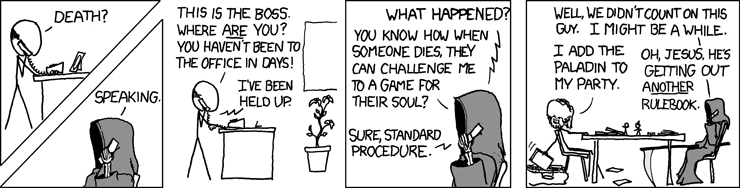
This strip is hilarious; by pulling that move on Death, you could essentially earn your self eternal life, with the downside being you have to play Dungeons & Dragons the rest of your life.

I’m not one to laught out loud when reading the Internet alone in my apartment, but the final bit of The Onion’s “American Voices” response to Gygax's death sure got me.

Finally, a rather thought-provoking piece from Slate about the moral underpinnings of the D&D experience points system, which promotes greed and violence as the only ways to advance in the fictional world. It’s been so long since I’ve played, I can’t personally recall, but that does sound right. I spent more time playing Palladium games than TSR ones during my role-playing years, and I thought in that system the game master awarded points based on things like how well players adhered to their alignments…?

Heh. I haven’t used the word “alignment” to refer to anything other than my car in years…


—The image on the left horrifies me:


It’s even scarier when you’re walking through a grocery story and you turn a corner and BAM! He’s all up in your grill in his rabbit snout costume. Where are his ears? Who dresses up as a rabbit from the eyes down? What the hell Pillsbury?

Wednesday, March 12, 2008

Weekly Haul: March 12th

Did anyone read Avengers Fairy Tales this week? I was sorely, sorely tempted to buy it, despite thinking it was an incredibly stupid idea and not being a big fan of C.B. Cebulski’s writing, but Joao M.P. Lemos’ art sure looked fantastic. Even something as stupid as a little Iron Man kid in a fluffy bear-eared hood turned out cute.

Anyway, the reason I ask is I noticed an elongated Clockadile, and was trying to figure out what the Avengers analogue would be—was it Fin Fang Foomadile?

Also, I think I’m done with Mike Allred’s current iteration of Madman. I was able to read the whole wordless issue while flipping through it in the shop, so buying it seemed kind of superfluous at that point. It sure is nice-looking though.

Well, enough about comics I didn’t buy and read this Wednesday. Here’s what I did haul home from the shop, as well as my hastily-written thoughts on ‘em…


Avengers: The Initiative #10 (Marvel Comics) So I see Marvel is still publishing that New Warriors comic featuring Night Thrasher and a bunch of mutants by Kevin Greivoux, sales of which seem to be on the decline, but I hope fans of the original series are checking out The Initiative instead. Not only is it chockfull of old New Warriors, but with this issue they’re all getting on the same page, leading to a last page revival (complete with Justice saying their old team name in a big, red logo font).

Despite the new development, this is the third chapter of writers Dan Slott and Christos Gage’s “Killed In Action” story arc, pitting a rogue Camp Hammond science experiment against a slew of campers, consisting of old Marvel characters and newer creations. Despite some killings (at least one character on the cover gets decapitated, another loses some limbs, if not his life), there’s more humor in this issue than in a lot of those past.


Batman Confidential #14 (DC Comics) With part two of Tony Bedard, Rags Morales and Mark Farmer’s “Wrath Child,” how exactly this ties into the original 1980’s Wrath story, and who’s under the gaudy purple W costume, begins to become clear. A solidly constructed, old-school Batman story with pretty decent characterization and wonderful art.

Of particular interest is the fact that this story absolutely dates Batman’s age. This story is set exactly 25 years after the murder of his parents, when he was eight. That would make him at least 34 (8 +25 +1 for the “One Year Later” jump), but probably a few years older, given that this is back when Batman had an oval on his chest, Dick Grayson just became Nightwing, and Tim Drake hadn't made the scene yet.


Booster Gold #7 (DC) Another great dose of nostalgia, for an era long past and only recently passed. We have the JLI team of Blue and Gold, JLE liaison Catherine Cobert, Power Girl’s mangy yellow cat, Beefeater’s power staff, but we also have the Evil Max Lord and his OMACs vs. the DCU plot form the “Countdown to Infinite Crisis” period of comics. I’m not entirely sure how much fun this will be for folks who don’t remember periods of the last twenty-some years worth of DC comics, but I think it’s a blast, despite the fact that so much of it seems so familiar. (The next issue box, for example, promises a plot point shared with one of Jeph Loeb’s Superman/Batman story arcs).


The Last Defenders #1 (Marvel) Writer Joe Casey and co-plotter/breakdown artist Keith Giffen give us what,at first glance, looks like a Defenders comic in name only, because, really, Former Defender Nighthawk, plus She-Hulk, Colossus and Blazing Skull would fill up the whole cover. After reading though, particularly by the last page, the fact that this ties in rather deeply to the history of Marvel’s most famed non-team becomes more readily apparent.

Nighthawk tries to pitch a Defenders-branded Initiative team to Tony Stark, who thinks it’s a great idea—in fact, he already thought of it. He handpicks the weird-ass team line-up and simply stick the bird-nosed battler at the head of the all-new New Jersey Defenders. Meanwhile, we see the makings of what could be evil versions of two of the “Big Four” Defenders.

The story is richly textured with Marvel history and trivia, and the plot is somewhat intriguing, whether you’re a Defenders fan or just a super-comics fan. The art work, penciled by Jim Muniz and inked by Cam Smith, is dominated by some extremely thick figures, and it’s not a style I’m particularly fond of, but the storytelling is solid enough that it’s more a matter of my taste than Muniz’s talent.

The best part? Skull comes up with the Defenders version of the “Avengers Assemble!” battle cry. And it’s awesome.


The Mighty Avengers #10 (Marvel) The Sentry, Doctor Doom and Iron Man have been shot back in time, and in his ongoing attempts to not get bored telling meaningless Avengers story, writer Brian Michael Bendis tells this tale in the style of an old Marvel comic, using not only thought bubbles, but box narration cajoling the reader, and the artists and production team work to make the illusion more complete, with period lettering on the title, old-school sound effects and, most noticeably faux “dot” coloring and adverts for old Marvel comics at the bottom of the pages.

The illusion is hardly complete though, making it seem more odd than affecting. The layouts are no different than the last few issues of Bendis’ two Avengers books, for example, and characters from the ‘70s or ‘80s or whenever this is set still talk like millennial Bendis extras:

“Really?”

“Yeah, really.”

“Latveria? What is that? In Jersey?”

“It’s another country.”

“I think it’s in Jersey.”

“Well, it’s not.”

It’s basically a pointless digression from Bendis’ overarching “Secret Invasion” story, a time-killling story with a few diverting bits which offers nothing new or horribly interesting, culminating in a false, two-page splash cliffhanger. Oh no! Iron Man is caught in an explosion! Has the hero been killed?! And so close to his movie…what a tragedy!


Spider-Man Family: Untold Team-Ups (Marvel) In theory, Marvel’s Spider-Man Family is an insanely good value. You get at least one original Spider-Man story with about 1,000 different back-ups from various eras and takes on the character for something like $6 or $7 bucks. It’s a downright Spider-Man feast each issue.

That advantage can also be the problem with the title, though—sometimes you just want a Spider-Man snack rather than a seven course Spider-Meal, you know?

Which is why I was so excited to see this particular digest collection, as it gathers a few of the Spider-Man Family tales from past issues in one place, without all the filler (much of which, bear in mind, is actually quite killer). Behind a nice Mike Wieringo cover we get a short Puppet Master/Spider-Man team-up (of sorts) by Chris Eliopoulos, and then some more substantial tales.

There’s an Agents of Atlas team-up by the AoA creative team of Jeff Parker, Leonard Kirk and Kris Justice that functions as a sort of coda to the miniseries (and man, Parker is just born to write Spidey, and not simply because they share the same last name). Enjoy this tale of Peter Parker and Mary Jane taking in a Lion King-like Brodway show in which the puppets become monsters…because now it never happened!

(Note: This will absolutely never get old)

That’s followed by a Kevin Grevioux/Clayton Henry story that teams Spidey up with Dr. Strange. It’s probably the most straight story in the book, with more focus on standard super-business than humor, but Grevioux writes nice Spidey dialogue, and it all passes pretty quickly (I do wonder how Neilalien would weigh in on some of the hocus-pocus in the story, though).

That’s followed by a story featuring both Kraven and the Man-Wolf, well a Man-Wolf, written by Dana Moreshead and penciled by Eduardo Garcia. I’ve never heard of either of them, but they spin a pretty fun story.

But wait, there’s still two more to go!

Next up is Eliopoulos’ Frog Thor story (According to the introduction, “Hundreds and hundreds of day ago, in the land of 1986, there was a man named Walt. Walt decided he wanted to take a god named Thor… and turn him into a frog. It was one of the best Thor stories ever”). Here, Loki turns Thor into a frog slated for dissection by Peter Parker but, once he gets frog and Mjolnir together, the frog is wearing an adorable little Thor get-up and beating the holy hell out of Loki with a frog-sized hammer. It’s great stuff, and it’s great to see Eliopoulos drawing Spidey and Thor.

Finally, Tom Belland and David Hahn tell the story of that one time Ka-Zar came to New York and had Spidey cat-sit his sabre tooth tiger Zabu while he gave a speech at the UN. Heart-warming hilarity predictably ensued.

And all that for just $9.99!


Superman #674 (DC) Hey, have you ever read 1984’s Justice League of America #224? No? Well, it’s not easy to do so, as the Showcase Presents series is still a way’s off from getting that far, and most of that era of JLoA hasn’t been collected. It was a one-issue fill-in story scripted by a young Kurt Busiek, pitting new, puffy-sleeved character Paragon against the whole Justice League. It was pretty good. In fact, I kinda wanted to do a “Satellite Spotlight” feature on it, but I couldn’t find enough things to make fun of in it to justify doing so (At least, not beyond Paragon’s costume and the first scene, in which Clark Kent, Oliver Queen and Hal Jordan meet up for drinks and get ogled by a waitress).

Well, Paragon’s back! With a new beard and a new costume, and with less puffy sleeves on his original costume in the flashback!

The story’s not actually about him though, at least not entirely. He seems to be only an element of it, with Superman’s apparently decades-long attempt to heal Mon-El of his lead poisoning and some Daxamite religious conservatives coming to Earth.

This is the first issue drawn by new penciller Renato Guedes, and it’s great looking. Not sure who the hero on page one is supposed to be though…


Tiny Titans #2 (DC) You know, when editor Jann Jones first announced this title, she specifically cited the fact that JLU and Teen Titans Go! were a little too violent and tense for little kids, and she didn’t feel comfortable giving them to her nephews to read. So I was surprised to see how many kids get hit in the forehead with rocks in this issue, given the fact that throwing rocks at your friends’ heads is an act much more easily imitated than, say, shooting the sonic weapon embedded in your cyborg arm at a giant demon, you know? Anyway, another batch of short, mildly amusing comics made worthwhile (for us grown ups, anyway) by Art Baltazar’s darling character designs and art. I love his Kid Devil.


Wonder Woman #18 (DC) Artist #500 or so joins writer Gail Simone for the start of her second story arc on DC’s most troubled title, this one dealing with Wonder Woman apparently suddenly developing feelings for Nemesis (?), and Wondy and her now-partner (Yeah!) Etta Candy journey to the Khund homeworld.

Thanks to Simone’s scripting, in the broadstrokes, this title is in the best shape it’s been in since its unneeded relaunch, and artist Bernard Chang’s work is fine, if not great (I don’t much care for his bosomy version of Wondy, although I must admit he gives her a great face with very expressive eyes).

I just have two complaints, and they’re pretty nitpicky, so you might just want to quit reading here if that sort of thing bothers you.

The courting is troublesome for two reasons. First, because Diana’s doing it as Wonder Woman, aware of the fact that Nemesis is hot for her in her superhero identity, but doesn’t like her in her secret identity as Diana Prince, who works with him. That sort of this was quite charming in the olden days, but when every other element of the comic is treated realistically, it becomes kinda creepy—particularly when it’s ex-Goddess of Truth Wonder Woman, who’s only had a secret identity for about 20 minutes, and only has it for selfish reasons (to relate to humans personally, not to protect loved ones or whatever).

And part of that courting is the fact that Wonder Woman performs a little ritual, telling him that it’s “in the manner of her people.” Now, I don’t think it’s any secret that Paradise Island is a place where Sappho would hardly be suffering, but can we at least be a little subtle about the rampant lesbianism? Must everything in the DCU be so head-hammeringly blunt these days? There’s a certain magic to implication and mystery, a magic that’s lost when the characters have a converstaion that includes lines like this: “But your ‘people’ are all of the female persuasion…!…does all this stuff still count with a guy involved?”

Secondly, Simone has Candy face the cliffhanger opponent’s appearance with the words Woo-@&#%ing-woo..

So, beyond the obvious question of what the hell that means—Is she expressing excitement, as her traditional use of the expression? Is it sarcastic, and she’s expressing how unimpressed she is? Is it a knowing parody of herself, not meant to be expressed by the character, but as a wink from the writer to the reader?—there’s the addition of the “@&#%-ing” to the Golden Age catchphrase.

Now, if we think about the four-letter swear words that would fit in that contest, it’s obviously supposed to be “fuck.” So, we have Etta Candy saying “Woo-fucking-woo” in the face of an opponent bragging about how she and Wonder Woman are about to face his wrath. But since this is a DCU comic, it can’t actually feature that word, so Simone resorts to “@&#%” to stand in, so all of her adult readers will translate it to “fuck” in their mind while reading it in her head (And of the tens of thousands of readers on the book, I imagine some ninety-some present of those readers are adults).

This type of swearing, particularly in these sorts of mainstream universe superhero books, always irritates me, as it’s such a visible revelation of the tension the writer feels toward the characters and the tropes they’re using, a sort of simultaneous desire to express the classic catchphrases and the embarrassment at them, going out of their way to let us know that they’re going to be ironic about it.

It’s like when Bendis has Luke Cage shout “Sweet @&#%-ing Christmas!” in a fight, you know? Additionally, the fake swearing underlines the tension inherent in the comics these days, where adults are writing for adults, and lean towards writing that way, but must still bow to the perception that it’s a medium for children, with that fake swearing. Now, I’m no saying that Etta Candy should be able to drop F-Bombs in the pages of Wonder Woman; I’m saying that because she cant’ and shouldn’t, Simone should just avoid swearing like that. (And I don’t mean to single her out, because I thought the same thing while reading Bendis’ Mighty Avengers this week, in which Iron Man tells Doom to “Cut the @#$%” repeatedly. Does anyone even say “cut the shit?” Why not just say “cut the crap,” huh? Bendis does this swearing thing more than any other popular writer I can think of).

Delayed Reaction: Cat Getting Out of a Bag


Cat Getting Out of a Bag and Other Observations (Chronicle Books), by Jeffrey Brown

Why’d I wait?:“Wait, $12.95 for a 100-page, hardcover book full of wordless strips about Jeffrey Brown’s cat, plus some splash-page portraits of his cat? That’s not too bad a price for a hardcover, but that just means if this were a softcover it could have been even cheaper. I’d definitely buy this for $10, but $12.95? I don’t know…”


Why now?: “Oh sweet, the library has that Jeffrey Brown cat book I never got around to buying!”


Well?: So, are you a cat person? Because the answer to that question will likely tell you everything you need to know about his book.

Personally, I’m not (Allergic, grew up with dogs and could never quite wrap my head around the litter box concept). I do, however, have friends who have cats, and I’ve spent an awful lot of time with those cats, which gave me the necessary bare minimum amount of cat familiarity I needed to enjoy the book.

The crazy-ass things your cat does, like wiggling its butt before a running pounce, or doing laps around the house for no reason, or going crazy for the plastic rings around milk jugs, or falling off a ledge after having fallen asleep on it are, it turns out, the exact same things Brown’s cat Misty does (and, I imagine, all house cats everywhere).

One of the chief joys of reading the book is seeing these things performed for your enjoyment. The bulk of the little square book are nine-panel, page-long strips involving Misty going about her strange, cat-like business. Brown and/or other characters appear and talk to each other or Misty, but we never see their faces, giving readers a cat’s eye view.

And as common as the cat-behavior is, it’s still mysterious and alien; cat concerns have almost always struck me as trivial, and yet they clearly take this stuff deadly seriously. I have a hard time relating to a lot of what cats do beyond the obvious, and at times it seems to me as if the whole species had some form of OCD.

And it’s this sort of behavior that seems to fuel some of the best strips. For example, in one,


Misty is atop a desk. She swats a pen off of it in one panel, and then, in the next, she looks at its new resting place on the floor. Then she paws at a stack of papers for a panel. Then she goes to sleep. In the next panel, here eyes snap wide open. And then she puts one paw on a piece of paper. And then she closes her eyes, the paw still resting on the piece of paper. In the final panel, she begins purring. Apparently, she had to rearrange herself and the desk just so to reach that perfect, purring state.

Brown draws a wonderfully cute, highly abstracted cat, a cartoon version of a cat obviously refined from a lot of attempts at drawing cats. The panels look like a lot of Brown’s work, but he seems to use a lot more shading and a thicker line throughout. The choreography seems a lot tighter than in his “girlfriend” books too, perhaps due to the fact that the stories he’s telling here are wholly dependent on the actions of the figures, rather than their dialogue.

The one nine-panel strip per page rhythm is broken only rarely. There are three strips on the first page that serve as an introduction, two of which feature the Brown avatar his readers are familiar with from the neck up. The other breaks come from the aforementioned full-page cat portraiture, which sees Brown working in a realistic style, pictures seemingly there just to let cynical readers who hate his style know that he can draw for real too, thank you very much.

While Brown’s working with a bigger publishing outfit than usual here (not to mention one that’s focused on publishing book-books in addition to graphic novels), the production and design don’t really vary from his Top Shelf releases. The lettering of the entire book—the cover, the about the author page, the small print on the title page—is all done in Jeffrey Brown hand-writing style, and the package has the same intimate, one-man show feel of his girlfriend books.

It struck me while reading this that it’s too bad newspapers are so rigid in their strip format these days, as a weekly or daily cat strip by Brown of this sort would no doubt kill a regular newspaper audience. The universality of the subject matter, coupled with the charming way Brown renders it and the endless well of inspiration available to him as a cartoonist (so long as he has a cat to follow around the house) make this not only Brown’s most accessible work, but also seem to indicate it could be one he could do forever and find a market for.

Truly Brown is now the reigning champ of cat-based sequential art humor. Although, to be fair, the competition isn’t exactly stiff.

You can see previews of some of the strips here.


Would I travel back in time to buy it off the shelf the week of release?: Hmm, can I take $12.95 back into the past with me to buy it with?

At the very least, I think this would make a perfect gift for my friends with the cats—in fact, this seems like a good comics evangelism type of book, so long as the recipient is a cat person—and then I could borrow it whenever I wanted to reread it.

Monday, March 10, 2008

I know Batman isn't gay, and...

I'm sure lugging him and Aquaman into battle can sometimes be a rather awkward task for their flying Justice League peers...


...but surely there's a less homoerotic—not to mention more dignified—way to transport the Caped Crusader, isn't there?

Or, at the very least, a way that affords him a better view?

Sunday, March 09, 2008

Dream Trades: The Silver Age


Like Invasion! and the DC Presents Julius Schwartz tribute series, 2000 event miniseries The Silver Age seems like it merits the trade treatment for its creators alone, and that the popularity of those creators would produce the sales needed to justify the effort.

If you missed it, The Silver Age was a millennial series of one-shots set during the titular time frame, featuring the Justice League of America and their many allies—just about every character DC was publishing in the ‘60s, in fact—battling against the menace of The Secret Society of Super-Villains and their alien ally.

Mark Waid, who has an obvious affection for the era, spear-headed the event, writing the opening and closing chapters, with a slew of his friends and colleagues pitching in on scripts and art. Two of them were just starting to make a name for themselves in the industry, but have since become two of its most bankable stars—Mark Millar and Geoff Johns.

In addition to the epic story, which would have run somewhere in the neighborhood of pages, the book had the added thrill of a pretty consistent Silver Age aesthetic, from the logos to house ads to the cover prices listed in cents, and seeing many of the great artists from the period who were still around contributing covers.

Was it a great story? Not especially. It was a lot of fun the first time through, if only to get such an extended look at the post-Crisis Silver Age that Waid himself had just established in JLA: Year One and to see so many interesting talents tackling some fairly rarely seen characters.

The art was a little spotty in terms of style. Every artist involved was a fine draftsman, but some worked in a style that was congruent with that of the Silver Age comics, and other drew it like any other book.

But great or merely serviceable, I think a trade collection would be fairly well received.

It’s written by Mark Waid, Mark Millar, Geoff Johns, Kurt Busiek, Tom Peyer, Marv Wolfman and others.

The interior artists include Terry Dodson, Barry Kitson, Scot Kolins, Kevin Maguire, Dick Giordano, Eduardo Barreto and others.

The covers for the series are by Brian Bolland, Gil Kane, Carmine Infantino,Joe Kubert, Ramona Fradon, Jim Mooney, Nick Cardy, Dick Giordano, Jim Aparo, Alan Davis, Brian Bolland, and Ty Templeton.

And, last but not least, there’s the characters. It stars The Silver Age Justice League (with Black Canary in for Wonder Woman), the original Teen Titans line-up, the GL Corps, the Challengers of the Unknown, Deadman, Batgirl, The Doom Patrol, The Metal Men, Adam Strange, Metamorpho, Blackhawk, Robby Reed (the original holder of the H-Dial) and a cadre of villains that includes Lex Luthor, Sinestro, Dr. Light, Catwoman and Brainiac.

I think it’s safe to say that most of DC’s currents readers are pretty into most of those guys, and the appeal of many of them, particularly in their Silver Age incarnations, have been significantly increased over the course of the last few years thanks to the Showcase Presents trade line.

In fact, a fantastic way to collect the series would be to do so as a Showcase Presents: The Silver Age trade. While there’s not enough material from the series to reach the 500-page mark of the phone book-sized Showcase volumes, even if you include the newly created profiles, Flash facts, Metamorpho and Metal Men science strips and Jimmy Olsen, Wonder Girl and Super Turtle back-ups that filled up the Silver Age Secret Files and Origins #1 and the back half of Silver Age 80-Page Giant #1, it shouldn’t be too hard to find either newer stories similarly set in the Silver Age from all those other 80-Page Giants and Secret Files specials or from actually back in the day.

Anyway, just an idea Mr. Whoever It Is Who Decides What Gets Trade-Collected At DC.


*Or Ms. Whoever It Is Who Decides What Gets Trade-Collected At DC.

Saturday, March 08, 2008

A Saturday evening post about a Saturday morning cartoon


After finally getting a taste of the new animated version of The Legion of Super-Heroes via their Johnny DC comic with the ridiculously long title a few weeks back, I picked up a DVD containing the first four episodes of the first season of the cartoon from the library.

I’m not much of a Legion fan, and find that the whole concept tends to get on my nerves, mostly because of all the reboots and time-traveling nonsense that makes the cast of thousands hard for even my superhero trivia focused brain to process (I know some of you have explained that they’re actually a lot less complicated than they look, so maybe I’ve just never had sufficient motivation to conquer that particular corner of the DC Universe).

Anyway, I can honestly say that the experience of watching those few episodes of the cartoon was the most excited I’d ever been about the Legion. I really liked the character designs, and the way in which the uniforms visually echoed one another while never seeming too realistic (like Mark Waid and Barry Kitson’s current incarnation of the team) or too dated (the original LOSH) or too Hollywood futuristic (the current Action Comics version of the team). And The Fatal Five looked great; a lot more scary than goofy, which is how they usually look in the comics.

The animation and design on a whole looked like a compromise between that of Teen Titans show, which I loved, and JLU, which I also loved. And they sure did pack the backgrounds with lots of little in-jokes. One episode I saw had the JLU version of Skeets, one of those crazy crystal orb guys with tentacles and Mohawks from the Green Lantern Corps, and a woman from whatever Tomar Re’s race is called walking a giant egg in a hovering baby carriage.

I do have some questions though, for any Legion experts in the reading audience.

Ready?


—This Brainiac 5 was a shape-changing robot with telescoping limbs. Is there any precedent for this in the comics, beyond the Superman villain with the same name sometimes being a robot? I thought the Legionnaire Brainy was just a green-skinned alien who also happened to be an arrogant prick no one really liked?


—Bouncing Boy turns into an actual giant bouncing ball here. In the comics, I assumed he was just a fat boy that bounces—is his ability to turn into a ball that bounces unique to the show? And wasn’t he always a sub rather than a member of the team in the comics?

—Has there ever been any explanation for why they keep names like –Lad, -Lass, -Boy and –Girl? (And lad? Did they just revere the hell out of Aqualad or what?) I know that seemed appropriate in the ‘60s, when all teenagers in DC comics looked like they were 35, but it really seems dated now, and the Legion stories are all set a thousand years from now, so “dated” is something you would think they’d try to avoid. Especially since they seem to keep trying to reinvent the team every few years.

I think the normal teenage impulse would be to use a more adult name, kinda like when Superboy debuted in “Reign of the Supermen,” he demanded to be called “Superman” rather than “Superboy.”

Particular to the show, it seems odd that teenage Superman goes by Superman, while everyone else goes by a juvenile name, although I understand that likely has more to do with the legal problems of the name “Superboy” than anything else.


—Was there ever a Luthor descendent in the Legion comics, or did the cartoon create theirs out of whole cloth?


—All I’ve seen of season two is the opening sequence, in which everyone looks grungier—longer hair, more facial hair. Is it sometime after the first season? Also, why are there two Supermans all of a sudden?


—How do you guys rate the cartoon? Is it acceptable in terms of a Legion adaptation, or is it seen as a complete travesty?

Friday, March 07, 2008

Did plastic do more for Plastic Man than Plastic Man did for plastic?


I’ve read repeatedly about Jack Cole’s Golden Age Plastic Man comics, and one fact that comes up in many of the tellings of the character’s real-life origins is that Cole was originally thinking of calling him India Rubber Man or Rubber Man. Police Comics publisher Busy Arnold suggested that instead of rubber, the stretchy, bouncy, shape-changing hero be named after that new miracle substance, plastic.

While Plastic Man remains one of those characters better loved by cartoonists, artists and Golden Age comic book fans rather than the general public, I think it’s fairly safe to say that if he didn’t get the snappier, mid-20th century zeitgeist-grabbing name of Plastic Man, he probably still wouldn’t be around in any form today, and just be one more footnote in Cole’s early comic book career. “India Rubber Man” just doesn’t quite roll of the tongue like “Plastic Man” does, you know?

Cole and Arnold’s foresight to name their character after a futuristic material, to essentially get in on the ground floor of the pop perception of plastic, is often credited with why Plas caught on like he did. Well, that and Cole’s incredible skills, of course.

But if plastic has done a lot for Plastic Man over the years, what’s Plastic Man done for plastic? According to writer Jeffrey Meikle, not much.

Meikle wrote American Plastic: A Cultural History (Rutgers University Press; 1997), and Eel O’Brien’s alter-ego comes up in the discussion of America’s slow acceptance of plastic.

“Alternately desired and despised, plastic never enjoyed the near universal acclaim of its upscale cousin nylon,” Meikle wrote. During the ‘40s and into the post-war period, the “cultural perception of plastic remained ambiguous.”

Enter Cole’s creation:


Plastic Man, a crime-fighting comic book superhero who debuted in August 1941, seemed more elastic than plastic as he bounced and stretched through adventures that left dazed gangsters jabbering about “a-a man rubber!…a Plastic Man!”

If comic books insisted on presenting plastic as a glorified chewing gum, then the public could be forgiven its uncertainty.


He may have been a hell of a crook-catcher, but as a spokesman for his namesake, Plas was a bust.

There are two other mentions of a “Plastic Man” in Meikle’s book, neither of which refers to the goggled super-hero.

One is from an article by two British chemist entitled, “Life of Plastic Man,” which ran in the December 1941 issues of Science Digest. It describes Plastic Man as a generic example type person, John Doe or Joe Sixpack or Weldon Whatever, “a dweller in the ‘Plastic Age’ already upon us.”

I wonder if Cole or Arnold ever saw that article? The dates of the two publications would indicate that comics’ Plastic Man predated the science journal’s Plastic Man, so perhaps the Brits got the name from the American newsstand instead, but if it’s a coincidence, it’s a rather odd one, isn’t it? At the very least, it demonstrates how on top of things Arnold was when he suggested the name.

I also wonder if Bob Haney ever read that essay, as his 1968 Brave and the Bold #76 featured Plastic Man and Batman teaming up against a villain named The Molder, who spent the whole issue ranting and raving about the “New Age of Plastic” and the “Plastic Age.”

The other Plastic Man to appear in Miekle’s book is artist Les Levine, who was popularly known during the ‘60s as Plastic Man due to his preferred materials. I wonder if there’s a Les Levine in the DCU, and, if so, did that Levine have the same nickname?