Civil War was a seven-issue, 2006-2007 limited series by Mark Millar, Steve McNiven and Dexter Vines that attempted to capture the zeitgeist of post-9/11, Bush Era America by thrusting the debate over the proper balance between security and liberty into the fantasy world of the Marvel Universe, with the various superheroes and supervillains all lining up on one side or the other of the debate, and then proceeding to fight one another to the death over it. The series didn't really work, and Millar's themes fell apart if you looked too closely at them (or even just read the comic), but it had at least a patina of relevance about it, the story could be more-or-less understood by reading its seven issues (and/or its later collected edition) and, like so much of Millar's comics work, could be boiled down into a particularly simple pitch. In the case of Civil War, it was a pitch that Marvel used to market the book and its many, many tie-ins, a five-word tag-line: "Whose side are you on?"
Civil War II was a 10-issue, 2016-2017 limited series by Brian Michael Bendis, David Marquez, Oliver Coipel, Jim Cheung and John Dell that dealt with thought crimes, or pre-emptive warfare, or judicial bias, or, implicit bias, or Minority Report or, perhaps, profiling, or various combinations of that list of those themes, depending on the scene and the issue.
If profiling is the main subject matter, which is something I suggest as a possibility because at one point near the end of the series, Iron Man Tony Stark declares, "It's profiling...profiling our future...profiling individuals." And in the last issue of the series, Dr. Henry McCoy, AKA The Beast, further underlines the theme as that of profiling being bad: "[Tony Stark] knew once you made profiling--and that is what it was--the norm... ...how long until it was used by someone less noble?" Then it is easy to see that Bendis was shooting for the sort of crypto-relevance of Millar's original series, attempting to address the mood in a post-Ferguson United States, where "Black Lives Matter" and "All Lives Matter" are phrases of great power and import (although without any racial component in the pages of his comic, that kinds of defeats that purpose...although it might be worth pointing out that a few times Inhumans and mutants are raised as classes of people that other Marvel Universe people might be prejudiced against and, well, the whole climax hinges on Captain Marvel suspecting a black teenager of killing the symbol of America, so there's that).
It doesn't work at all, though, and Bendis' ostensible sequel lacks Millar's elegant distillation of a premise-cum-tagline, and even much in the way of the simple, primal pleasure of superheroes fighting superheroes, which the original at least provided more regularly.
Certainly, a decade after the original Civil War, readers are rightly sick of Marvel's superheroes fighting one another, as they've been doing pretty much constantly since then, but Bendis' "fights" are mostly arguments, with the various characters only choosing sides near the end of the fourth issue, spending much of the fifth on the series' one big battle, and then everyone more-or-less goes home to let the leaders of the two factions fight it out themselves...again, to the death.
Despite the title, it doesn't really function as a sequel to Civil War at all, actually. In the original, Iron Man lead a team consisting of Mister Fantastic, Hank Pym and other establishment-minded superheroes to work hand-in-hand with the Bush Administration to enforce a Superhero Registration Act, which functioned either as a mandatory registering of all super-people and/or an actual superhero military draft, depending on the issue or tie-in. Team Security were opposed by Captain America, Spider-Man and the others on Team Liberty, but they went to laughably heavy-handed extremes to enforce the will of the U.S. government, including using lethal force and extraordinary rendition of the non-compliant into a superehro Guantanamo Bay. The series only ended when Captain America surrendered in order to stop the fighting, when he realized that he was causing property damage and that New York City's first responders were opposed to him (Like I said, it didn't really work).
In this series, it is Captain Marvel Carol Danvers who serves as the tool of the government (artist Marquez, unlike Civil War's McNiven, doesn't draw the president and his cabinet on the page, but the president is presumably Obama; he only appears in silhouette or in darkened rooms, and so this is less explicitly tied to a particular presidential administration than the original). Danvers gets her hands on a new superhero named Ulysses whose power is the ability to foretell disasters, and she uses that knowledge to assemble teams of superheroes to prevent said disasters before they occur...more often than not, however, she actually just causes them to happen, or simply alters what happens slightly, with the visions coming "true" in vague senses. Relatively few heroes support her, particularly as the series progresses, and, just as Millar manipulated the reader by putting all the "cool" heroes on the Captain America side and the lamer ones on Iron Man's side, Bendis has Carol's allies consist only of those working with her already, and some of them only conditionally. Tony Stark eventually gets most of the cool heroes on his team, but, for the most part, this "war" isn't fought with armies. It's just Carol and Tony fighting, usually verbally rather than violently.
Though there aren't really any factions in this conflict, aside from in the aforementioned battle, and a great many of the publisher's more prominent characters quite pointedly sit it out--Spider-Man Peter Parker, Daredevil, Hawkeye Clint Barton--the essential conflict boils down to the use of Ulysses' visions to fight supervillains and various forms of super-crime. Is it right to arrest, fight or otherwise punish someone for something they haven't done yet? Despite how obvious the answer is there--"innocent until proven guilty" is a pretty universally accepted precept of the American justice system--Bendis' focus on it is quite soft, as Ulysses' ability to even accurately predict the future is constantly called into question. The fight isn't about "Is it right to try and preemptively fight crime and disaster?" so much as "Is it right to try and preemptively fight crime and disaster based on a faulty data?" The source of the conflict isn't as solid, the line isn't as bright as in Civil War.
So with nothing in common with the original, why is it even called Civil War II? I've read a Bendis quote promoting the series where he said that as the storyline was taking shape, he turned to an editor or collaborator and asked if they realized that what they were really creating was another superhero civil war. It's far more likely that it had something to do with the strong sales of the original Civil War, which had a long, long life of doing gangbusters in its various trade-collections in bookstores and libraries. And it's more likely still it had something to do with the release of Marvel Studios' Captain America: Civil War, the feature film that took a few images and plot-points from the Civil War comic to extrapolate into an original storyline...but nevertheless marketed the hell out of the phrase "Civil War" as it related to Marvel super-comics.
In an attempt to add gravity to the series, several secondary characters are killed, and several others have their status quos radically changed. War Machine James "Rhodey" Rhodes, Tony's best friend and Carol's boyfriend, is killed (as the trailers for the Captain America movie implied he might be, although he survived in the film). The original Hulk, Bruce Banner, is also killed off, and by a fellow Avenger. She-Hulk is put in a coma, and comes out of it seriously changed into a Gray She-Hulk (Although they're just calling her new, serious series Hulk). And Stark himself ends up in something of a coma, interacting with a new Iron Man, operating under the codename "Ironheart," via a holographic operating system version of himself.
Additionally, in addition to the above, the visions of Ulysses lent themselves to essentially rolling out a long sequence of "coming attractions" in the final portion of the book, as he envisioned scenes from the next Marvel event Monsters Unleashed, Bendis' own upcoming Defenders series and so on.
But as a story unto itself, Civil War II just doesn't really work at all. That fact is both surprising and unsurprising at the same time. It's surprising because Bendis has more experience than anyone else when it comes to writing these sorts of series for Marvel, having previously written 2005's House of M, 2008's Secret Invasion, 2010's Siege and 2013's Age of Ultron, and one imagines that he would eventually get the hang of it (the best of Marvel's crossovers that he had a hand in was Avengers Vs. X-Men, in which he was one of several writers). It's not surprising because none of those stories really worked either, and, in fact, some of them didn't even qualify as stories in any way other than the fact that Marvel published them as if the were.
This isn't because Bendis is a particularly bad writer, it's just that he does a very poor job with big stories of this sort, involving large casts, big events and "historical" changes (at least in so far as the word "historical" can be made to apply changes in the Marvel Universe's ever-fluid status quo). Part of that is because of his own atomized form of storytelling, which consists of large collections of sometimes loosely-tied scenes that may or may not lead into one another directly. There is a benefit to this approach, given the nature of company-wide crossover series in which there will be literally scores of chapters of varying degrees of relevance, and perhaps it is Bendis' (and Marvel's) intent that Civil War II be read either in its entirety (that is, all the crossovers), or that readers self-curate their reading experience, choosing the scenes they want to read and ignoring the rest.
The problem with that approach, of course, is who knows what the important parts are and which are unimportant until after they've actually read them? And, at the very least, the eight official chapters of Civil War II should all be important ones (they are not) and tell a complete story unto themselves, which can then either be expanded upon by reading more tie-ins voluntarily (They do not, hence the presence of two other comics, Civil War II # 0 and Free Comic Book Day Special 2016 in the hardcover collection of Civil War II.)
I can guess at what Bendis might have been attempting as a writer, then, but, as a reader, I have no choice to evaluate the comics by what is on the page, or, in the case of the collection, what is between the covers, which is what I'm doing here.
That atomized approach to event story-telling is particularly evident in the gradual, casual beginning of this story (which, as I mentioned previously, did not spring organically from an ongoing storyline in any particular book or family of books in the way that, say, Secret Wars or Secret Empire grew out of Jonathan Hickman's Avengers books or Nick Spencer's Captain America books). In fact, Civil War II actually has three different and distinct beginnings. (Did you read Abhay Khosla's series on Civil War II at The Savage Critics? Quoth Abhay: "I just figured 'I can't figure out how to buy the first issue of your comic book' was as good an omen as a person could ask for to avoid a thing.")
So let's look at the series three beginnings, one at a time, before we look at the series as a whole.
First issue #1: Civil War II #0
This 23-page chapter is drawn by Olivier Coipel, with color artist Justin Ponsor, who colors every page of every issue in the hardcover collection I am reading. It introduces two major player in the story to come, Captain Marvel and Ulysess; two characters whose deaths or injuries will provide a catalyst to a stage of the civil warring, She-Hulk and War Machine; and one character who won't appear at all in the the rest of the series, Doc Samson.
She-Hulk is introduced in a New York City courtroom, where in her day job she is defending former (and apparently reformed) Daredevil villain The Jester from a case brought against him that she claims is entrapment. Her argument is that he is being prosecuted not for any actual crimes, but for his criminal history and his speech about that criminal activity. This is where thought crimes come up. We witness her closing statement, but will find out before the end of this issue/chapter that it was all for naught: The Jester is found guilty, is sent to prison and then gets accidentally killed by a prison guard ("He was innocent," She-Hulk says when hearing the news, "He went to jail before he did anything wrong.")
War Machine is introduced War Machine-ing in Latveria in his costume, and then we see him in the White House Situation Room, where President Obama spends two pages telling Rhodey that he wants him to be his successor (Surprise, Hilary Clinton!). He wants to appoint Rhodes as his new Secretary of Defense, as a stepping stone to being president. None of this dialogue sounds much like Obama at all, but presumably the point of this scene is to build Rhodey up as a Pretty Big Deal so that when he dies it will seem like a big deal.
Next stop is Ohio State University, where a couple of students get caught in the Terrigen Mist cloud (it is assumed one knows what that is; I am going to assume it too because this post is already destined to be long enough without getting into that nonsense) and they end up enveloped in Inhuman cocoons.
And then to The Triskelion, "Headquarters and Home of The Ultimates," where Captain Marvel is presented as a harried leader of, like, a bunch of superhero teams. SHIELD Agents do walk-and-talks with her, while she asks about Alpha Flight and A-Force. Doc Samson is there to visit, and he psychoanalyzes her during the course of their conversation. At one point, she mentions that the point of her Ultimates team is to try to stop disasters before they happen, and how she wishes there was just one thing that could help her in her mission of proactive defense of the world. (She also talks about how overwhelming her current life is, and I had a sinking feeling that Captain Marvel is going to end up being portrayed as a woman in way over her head, with so much going on in so many different parts of her life that she's totally going to fuck up the world for everyone by going to war against Iron Man over something stupid).
But funny she should mention that one thing that could change the whole game for them, because back in Columbus, the cocoons open--again, you're supposed to know how Inhumans work, and if you don't, well, maybe this isn't for you--and we find that one of the new Inhumans has emerged as a scary, mindless monster lady, while the other one, Ulysses, looks unchanged. But then his eyes go red, he stumbles around and finds himself looking at a two-page spread of a ruined cityscape, with a red sky, clouds of smoke or dust or ash and smashed-up buildings.
No one tell Captain America Steve Rogers! There's nothing he hates more than smashed-up buildings!
First issue #2: Free Comic Book Day 2016 (Civil War II)
This second of the first issues is drawn by pencil artist Jim Cheung and inker John Dell. In retrospect--that is, after you read Civil War II #1--it will be clear that this issue consists of a key scene more-or-less taken out of #1 and presented as its own comic book. It's pretty integral to the plot, which makes it strange that Marvel decided to present it outside of anything entitled Civil War, but, on the other hand, at least they gave it away for free, so potential readers had little excuse to skip it...unless they just weren't sure they had to read it to make heads-or-tails of Civil War II #1.
War Machine lands at The Triskelion to be greeted by Captain Marvel, who it turns out he is in an "On-again, off-again long-distance thing" with (Huh. That was news to me.) He just showed up to visit because he missed her, but it turns out he's chosen an auspicious time to visit, as The Inhumans Medusa and Crystal Lockjaw themselves there, with new Inhuman Ulysses in tow. He has the power to see the future, but it's more than that, he says, he "experiences" it, as if his body itself visits the future during his episodes. Medusa brought him to the Triskelion where The Black Panther could run some tests, and hopefully help him figure out how to master his new power, but then--"AGH! NNNAAGH!"--Ulysses sees Thanos coming!
With this knowledge, Captain Marvel assembles a rag-tag group of heroes from her various super-teams and invites along the visiting War Machine and the Inhumans to lay in wait for Thanos, who Ulysses predicts will appear at Project PEGASUS to steal the/a Cosmic Cube.
"Thanos, you are under arrest!" Captain Marvel shouts, as Ms. America, Medusa, Spectrum, Crystal, She-Hulk, The Human Torch, Black Panther, Blue Marvel, Dazzler (Dazzler?) and War Machine all dog-pile on him. The fight goes poorly for our heroes, in the main because Medusa is there at all (Captain Marvel didn't exactly pick an ideal Thanos-fighting squadron here). Medusa gets thrown into War Machine, one of his missiles goes off and hits She-Hulk in the sternum (which I wouldn't think would actually hurt her, let alone put her in a coma, but whatever; I guess Bendis and Marvel reasoned she was a bigger hero to have badly hurt than Dazzler or Spectrum). Distracted by having rocket-launched a rocket into the wrong person, War Machine isn't prepared for Thanos' sucker-punch. It is not clear from this issue, the last panel of which is Captain Marvel cradling him in her arms and sobbing, "Oh, God! Somebody help me!" but he's totally dead. Thanos punched him...to death! With one blow!
First issue #3: Civil War II #1
Finally, it's the first issue of Civil War II, which comes 34 pages into the collection. David Marquez now assumes the art duties, and he will perform them the rest of the series, save for a handful of special guest-artists who get strategically deployed later in the series, mostly for the purposes of advertising future comics.
In this beginning of the series, the opening comes between #0 and FCBD 2016, with Ulysses running through the woods in Columbus until he stumbles upon a splash page of Inhumans...a "team" that now includes x-iled X-Man The Beast and former Fantastic Four member The Human Torch.
"Weeks later" we're in Manhattan, where The All-New, All-Different Avengers are facing what Ms. Marvel calls "a freaky, giant, big, giant celestial giant," and what Nova describes as its "little soldier things." Then Thor leads a splash page full of almost 40 heroes into the fight (She-Hulk and War Machine are among them, so this is still set before FCBD 2016...or they healed from it already. I guess it would be unclear at this point in the book). While the heroes distract the Celestial and its soldier guys, a team of sorcerers lead by Dr. Strange appear and send "The Celestial Destructor...to the dimension from which it came."
This leads to a 12-page after-party at Stark Tower, where Tony Stark and Carol Danvers toast The Inhumans for giving them the heads-up about the Celestial Destructor, with enough time to prepare pretty much the whole Marvel Universe to fight it. When they ask Medusa where she got that info, she calls a handful of the heroes into the darkened kitchen, and introduces them to Ulysses, the Inhuman who can see the future. When Tony and She-Hulk press him for how exactly he sees things, they call in "little Jean Grey" and she tries to set-up a limited hive mind or something between everyone there, but it turns out his mind is unreadable: It is a closed system.
Nevertheless, Carol tries to recruit him for The Ultimates, and Tony immediately starts throwing cold water on the idea, with logic. When it's pointed out that he correctly saw the Celestial Destructor, Tony shoots back that his vision "didn't happen because we stopped it...so it wasn't the future he saw, it was a possible future." After telling Carol and the others to be careful with what they do with these visions, he walks off.
Then the book seems to catch-up to the events of FCBD 2016; Ulysses has his Thanos vision (in a different time and different place than in the previous comic, which, remember, Bendis also wrote), and then we skip that whole fight scene to deal with its aftermath (In retrospect, I do kinda wonder why the scene wasn't inserted in between scenes of this issue, so that the story could occur chronologically).
At that point, what began as a differing set of opinions becomes a heated argument, when Tony finds out the chain of events that lead to Rhodey's death, he accuses Carol of murdering him and yells at her a bunch. He demands to know where Thanos is, and then storms off...but not to kill the guy who killed his best friend, but rather, "To make sure none of you ever play God again!" by going after Ulysses.
Carol is about to go after him, when She-Hulk wakes up just long enough to say, "Fight for it. It's out future, Carol. Not his. Fight for it."
I literally have no idea what this means in this context. The "his" refers to Tony Stark, I guess? But she was in a coma, did she hear any of that? Or was she talking about the future not belonging to Ulysses? Seriously, no idea.
From this point on, with the many beginnings out of the way, the series devolves into a story-shaped series of big moments.
Civil War II #2: Everyone is mad at Tony!
Tony abducts Uylsses from his bed in New Atillan, despite The Inhumans attempting to stop him, with violence. No idea what the legal ramifications are here. Ulysses would have been a U.S. citizen, but Attillan is a foreign country. By virtue of being Inhuman does that make him a citizen of Inhumans-ville? Does he have dual citizenship? If he's not a U.S. citizen, I guess Tony has a little more wriggle room in terms of abducting him and taking him to a secret science bunker to threaten him and run a brain scan on him, but since I don't know what Stark's status is with the U.S. government anymore, who knows? At any rate, the whole capture seems silly in retrospect, because presumably the very tests Tony runs on Ulysses' brain are the same ones, or the same kinds of ones, that The Black Panther would have been talking about running earlier. Tony and T'Challa are science bros.
This leads to the Inhuman Royal Family and their hangers-on storming Stark Tower, and then The Ultimates and Avengers arriving there to stop them, and then everyone finding Tony Stark and rescuing Ulysses from him. Despite some severe damage to a wall, there's no fighting yet, just some more arguing. If fighting was about to start, it is interrupted by Ulysses' latest vision, that of a gigantic, nude, drooling Hulk with glowing green eyes, standing over some kinda dead looking Steve Rogers, Thor and Hawkeye, with a limp Iron Man in one hand and a limper Captain Marvel in his other hand.
Civil War II #3: The death of Bruce Banner, and the trial of the century!
This is maybe the nadir of the series...up until it reaches a lower nadir at the end, I guess. Deciding all of a sudden to write this single chapter all artsy and out of sequence and shit, Bendis opens with a trial in a Manhattan federal court house, jumping between the trial and the events that lead to the trail, so there are flashbacks within flashbacks, and narration coming in the form of testimony from players like Carol, Tony, Hawkeye and others.
Matt Murdock is the only lawyer shown talking to anyone, and I guess he would be for the prosecution, since he works in the city's District Attorney's office, but then the thing they are talking about took place in Utah, so I don't see how a city ADA would get involved. If he's defending Hawkeye Clint Barton, well, that doesn't make sense, since Murdock's not allowed to practice law in New York anymore in such a capacity. If I had to guess, I would imagine there are only two lawyers in the whole Marvel Universe, and the other one is in and out of a coma, and Bendis doesn't have time to read Charles Soule's Daredevil, so who cares.
Here's what happened. Because Ulysses saw a giant Hulk killing some Avengers in a big city, Carol, an armor-less Tony and like all the super-heroes and SHIELD fly out to Doctor Bruce Banner's secret lab in a barn in rural Alpine, Utah and ask him to not freak out or anything. He says he's been experimenting on himself, but those experiments have kept him from becoming The Hulk for over a year now. How does this square with the events of The Totally Awesome Hulk Vol. 1? It doesn't, as far as I can tell!
And then Hawkeye shoots Banner to death with a special arrowhead given to him by Banner himself, who at some point in the past had asked Hawkeye to kill him if he ever Hulked-out again. He didn't Hulk-out, of course, but Hawkeye said he thought he was about to, and that was good enough: Hawkeye walks, since it was really more of an assisted suicide than it was a murder (Fun fact: Assisted suicide is illegal, but it's not like Bendis spent a lot of time in thinking about how trials or law works or anything. I don't even think he watched any Law & Order to research this issue). Tony is now super-pissed with Carol, as that's two superheroes who have gotten killed on account of her acting on Ulysses' visions, and doing so kind of stupidly (Like, this group would have been a good one to send after Thanos, while a smaller group of like, three or four people would have been a better one to send to visit Banner).
Civil War II #4: It's almost time to start to get ready to maybe rumble soon!
In an in-story ad for the new She-Hulk series, Hulk by writer Mariko Tamaki and artist Nico Leon, She-Hulk gets mad when Carol tells her that her cousin Bruce it totally dead now. In another jumbly timeline issue, a bunch of the grown-ups meet in a dark, dingy room to listen to Tony and Carol's "sides" of the arguments.
Tony's brain scans revealed that Ulysses, who is off having his face-painted by Karnak during this sequence, doesn't really have visions of the future, which are impossible to have, but his brain produces images of possible futures based on algorithms. Carol's argument is that if someone tells you there's a guy over there with a gun who said he's about to open fire, do you go over there and check it out, or do you wait until he opens fire? Tony counters that the percentage of the probability of him actually opening fire is relevant, and wouldn't you act differently if it were eighty percent or ten percent? Carol rolls her eyes.
Doing the mediating, sitting around what looks like one of the Illuminati's old tables, are Steve Rogers, Doctor Strange, Medusa, Blackbolt, Black Panther and Beast.
Carol doesn't sit around to talk with any of these folks, but just peaces out in the most dickish move possible: Flying straight up through the ceiling, leaving a huge pile of rubble in the middle of the floor.
She doesn't have time to talk; there are civil rights that need violating! One of Ulysses' recent visions was that some banker lady was a Hydra agent, so Carol has her in a freezing interrogation cell at the Triskelion, and is adamant on holding her without evidence forever. At this point, Maria Hill, the head of a super-CIA who like two crossovers ago was kidnapping villains and mind-wiping them with a reality warping device outside of any government mandate, and The Black Panther, an actual king of an actual monarchy, are like, "Carol, this is maybe going a little far, don't you think?"
And that's when Tony Stark sends Nightcrawler to Bamf! the woman out of the cell, and lands with his posse on the Triskelion roof, ready to fight Carol. Marquez and Bendis stack two long, horizontal panels that stretch across a two-page spread to reveal the "sides" (which, holy shit, it took until the fourth issue to get to?) in this so-called civil "war."
I'd scan the images, but they are too long to do so, so I'll just have to tell you who's in which panel.
Iron Man has got both Captains America, Doctor Strange, Luke Cage, Hawkeye Kate Bishop, codename-less Riri Williams, The Avengers (Ms. Marvel, Nova, Spider-Man Miles Morales, The Vision and the current Thor) and the cool X-Men (the cast of All-New X-Men: Teenage Cyclops, Iceman, Beast and Angel, plus Genesis and Idie).
Captain Marvel has got SHIELD, Alpha Flight (Sasquatch, Aurora and Puck), The Ultimates (Blue Marvel, Black Panther, Spectrum and an Ant-Man, I think...?) and the lame X-Men (from Extraordinary X-Men: Forge, Magick, Little Jean Grey, Storm and Old Man Ice Man).
So, just looking at who's on who's side, the deck is pretty clearly stacked: Iron Man is right. He is now officially the good guy, if there were any doubts before. He's got the moral authority that comes with having two Captains America! Carol doesn't even get a Bucky! The best she's got is Black Panther, and he was just telling her to chill like a few panels ago.
But just to throw a monkey wrench in things, Carol says "I have friends all over the place" on a two-page splash, and out of the sky fall the Guardians of The Galaxy! These are the ones that were in the original movie, plus Kitty Pryde, Angela, Venom and Ben Grimm.
Finally, a fight! Next issue!
Civil War II #5: At long last, superheroes punching one another over moral differences!
There's a big, two-page splash-page showing the two sides running at one another, ready to engage in combat over the dubious principle that Carol Danvers can hold that banker lady without charging her indefinitely, or maybe that she should be allowed to keep prompting conflicts that get Avengers killed or...whatever.
I confess it's an interesting spread, as it invites readers to wonder about, imagine or perhaps just rationalize why each character is on each team. I can see this being very appealing to a certain kind of reader, like, say, the one I was as a teenager, when I would read very few comic books, and always had to wait a month between each issue, because trade-waiting wasn't yet an option.
For example, Extraordinary X-Man "Old Man" Logan shows up in this spread, on Tony's side. Why's a guy from a possible nightmare future siding against the lady trying to stop possible nightmare futures, and how did Tony get him (and Nightcrawler) away from the other grown-up X-Men, who are all on Team Carol?
What is the difference that makes two versions of the same guy, Iceman, take completely different positions on the issue, and to hold them so strongly they are literally willing to fight himself/themselves over it?
Why did Peter Quill and his Guardians team choose to side with their space-faring pal Carol over their space-faring pal Tony? (Tony asks the same question, and it seems to amount to Peter likes Carol better...maybe it's a romantic/sexual thing, as there's one-panel later showing a pouting Kitty looking on as Peter and Carol hug.)
Why did Ben Grimm, who pointedly sat out the first Civil War, going so far as to move to France to avoid having to take a side and potentially punch on some of his pals, decide he was cool fighting in this one, which doesn't even have something tangible to fight about (the Registration Act), and in which he has no personal stakes in (Reed was on Team Security, Sue and Johnny were on Team Liberty)?
Why do any X-Men really care about this nonsense, especially since they have spent so much time on the receiving end of things like the government taking pre-emptive action against super-powered people, based on their potential to cause disaster?
I suppose that is the, or at least a, function of the various tie-ins (Of the two I've read so far, All-New Wolverine Vol. 2 and Power Man and Iron Fist Vol. 2, the stars basically decided to announce Carol is dumb, this whole fight is dumb and they don't want to be in this crossover at all...although Luke and Danny do appear to be working with Carol earlier in the story, and in this fight, Luke at least is on Team Tony).
Of course given that the "war" really only amounts to this issue's fight scene, I don't know that the answers really justify whole issues of comic books about Iceman debating his teenage self or whatever.
As for the specifics of the fight, it is mostly very lame, and, at some points, difficult to even read or make sense of. The Miles Morales version of Spider-Man apparently meeting (a) Venom is kind of interesting, but for the most part the issue's main consequences seem to be only to show that, first, Carol is increasingly willing to hit Iron Man super-hard, and, second, to destroy the Guardians' ship, essentially grounding them on Earth temporarily (the focus of a story arc in their own book/s that followed Civil War II).
It ends when another Ulysses vision shows a bloody-fisted Miles holding a limp and impaled Steve Rogers, on the steps of the U.S. Capitol building. The sobering image gets everyone to stop fighting and turn to this Spidey and Cap. Carol immediately wants to arrest Miles, but that is more than enough action for one issue!
Civil War II #6: Everyone returns to their corners, to plot and/or cry!
Carol's decision to preemptively arrest teenage Spider-Man finally causes Black Panther to turn on Carol, and after he briefly tells her off, he and Team Iron Man all teleport away to a safe house. The Inhumans take their maguffin and go home. Teen Spidey has Thor drop him off in the city, where he can have a proper panic attack.
Carol has something approaching a panic attack herself, sitting on the edge of the rooftop, crying and cradling her hand while thinking about--or having flashbacks to?--the deaths of Rhodey and Banner. Starlord, Maria and some X-ladies come out to comfort her and tell them they found Spider-Man--standing on the steps of the Capitol building, just like in the vision!
Wow, hardly anything happened in this issue at all!
Civil War II #7: Carol and Tony war, civilly!
Ulysses continues to get weirder and weirder, having now completely tuned out his fellow weirdo Inhumans, and he is growing glowing tentacles out of his back. He goes to visit Old Man Logan in the pages of Old Man Logan, which gives Old Man Logan artist Andrea Sorrentino a reason to appear and draw about a half-dozen pages, presumably to give Marquez a break as he tired near the finish line of this particular marathon (Otherwise, there's not really a reason to include the scene, as all that basically happens is that OML tells Ulysses that Tony Stark pushed someone with a feminine pronoun too far, and caused all the Old Man Logan sequels. That would also explain the decision to re-run the two-page spread of Miles over Captain Steve, so close on the heels of its initial usage).
Back in the real world, Captain America, like Spider-Man, for some reason decided the very best course of action to avoid Ulysses' vision of one of them killing the other is to meet at that place and have Spider-Man pointedly not kill him. This leads to a conversation, which only adds to the excitement of the Ulysses/Old Man Logan conversation. So much conversation!
Carol then decides the very best thing to do at this point, given that two of the three visions she had tried to stop in this series have lead to the deaths of Avengers, is to swoop in and try to take Spider-Man into custody. That's when a force field appears over him and Tony swoops in wearing a huge, Hulkbuster-esque suit of armor bristling with missile launchers and painted gray, probably in memory of Rhodey. They fight...for a whole four pages! Of course, two of those pages are a spread consisting of only three panels, so it's not, like, a real fight or anything.
The most hilarious part of this is that Tony shoots a missile at Carol, and she bats it away...and it detonates right in front of Captain America, who is only saved by the fact that he has a shield and is, you know, Captain America! It took her like one minute on the ground to almost kill Captain America herself, when the whole reason for her coming there was, because as she told Starlord and her gal pals, that if the vision comes to pass "and we do nothing, we basically killed Captain America ourselves."
Then she punches the guy in the gun metal-gray super-armor in the abdomen super-hard, which is exactly how Thanos killed Rhodey! Irony?
Civil War II #8: The extra-length, ad-fortified conclusion!
This final chapter is 38-pages long, but don't worry too much about Marquez's drawing hand; there's less drawing involved than you might think, and a solid eight pages are devoted to ads for other Marvel comics, drawn by guest-artists. Plus, there are more repetitions of pages from previous issues of this very series, which a theoretical reader has already read and paid for (I can't decide what is more frustrating. If you read this in single issues, then you are paying for the same content twice, but there is at least likely a month between the time you read it originally, in case you forgot that Carol punched Tony really hard, and Cap and Spider-Man looked on. If you're reading it in a trade format, as I am, then it really calls attention to its laziness, because I just read that exact same series of three giant panels, like, seconds ago.)
So! Two-page spread of a longshot of Carol and Tony, locked in moral/mortal combat in the skies over Washington, D.C.! Carol is firing her power-blasts at Tony, and he's shooting a Robotech episode's worth of little shoulder-mounted missiles at Carol. It is a nice drawing. Then! The same two-page spread from the previous issue, completely unchanged!
The fight lasts a few pages, during which Captain America is almost killed by missiles for a second time, and then a whole bunch of people try to get involved to stop the fight. Maria Hill sends Team Carol down to stop the fight, The Inhumans appear and attempt to stop the fight (I guess this fight is what Ulysses thinks Old Man Logan was talking about when he said Tony and "her" caused the Old Man Logan-iverse?), and Nova, Spider-Man's teenage pal from All-New, All-Different Avengers, human-rockets onto the scene.
But after Tony lands one more good punch on Carol, his systems shut down, and there's this montage in which Carol just seems like a maniac, pounding on Tony after he's stopped fighting back, repeatedly trying to peel off his helmet or armor and, eventually, in another two-page spread, she punches him so hard his armor explodes, he flies out of the back of it, and all of the various heroes who were flying or swinging to get to them in time are sent reeling by the shock waves of the hit.
As the bloodied Tony falls out of the sky, Ulysses sucks everyone into another weird vision, this one of "The Futures..." (plural). And so begins a sequence of silent splash pages, some single-page splashes, others double-page splashes, all by guest artists and revealing either a future Marvel comic or story (The first is apparently the events of Monsters Unleashed, the big Marvel event comic that immediately followed this one and is, in fact, already over, and there are similarly images showing Inhumans Vs. X-Men, the Miles and dead Cap image which may, in retrospect, be part of the in-progress Secret Empire, something having to do with Boy Thor and Loki) or past and/or standard Marvel futures (Age of Ultron, a Days of Future Past riff, Kilraven fighting the War of The Worlds' Martians).
And now it's time for the ending, or at least the denoument, which Brian Michael Bendis is notoriously terrible at writing!
Tony is not dead, but Beast, the only surviving Science Guy, puts him in some kind of weird iron lung thing and says he can't figure out exactly what Tony did to himself, but he doesn't wanna mess with it, as doing so might really kill him (He's a holographic AI in the rebooted and renumbered Invincible Iron Man that started coming out before this series was ever even finished, so that probably explains some of this). Beast tells Carol that Tony was her secret best friend all along, and he wasn't really fighting her to the death, because he trusted her; in actuality, he was fighting her to the death because he feared what the person who followed Carol might do with the powers she was already pretty severely abusing. This is pretty much the most unconvincing part of the whole book, but I guess Bendis wanted to take a stab at not making Carol look like one of the Marvel Universe's worst villains after months of doing the opposite...?
Ulysses just evolved into a Celestial and flew away or something. This was never his story; he was just a convenient maguffin, something to fight over that needed to be taken from the grasp of the victor at the end of the story.
Hawkeye confronts Carol and asks her not to read Occupy Avengers. Like most Marvel readers, she doesn't.
And, finally, the shadowy president who is totally Obama (this final issue was released after the election, but before Trump was sworn in and, anyway, as much as this guy doesn't sound at all like Obama, he does talk in complete sentences that conform to English standards). He asks Carol what's up, she previews coming attractions--The Champions, The Hulk, The Defenders, etc--and then he asks her what he can do for her.
She makes a very serious face and has she has some ideas "about the future," which I don't think is meant to be a joke, but sounds like one.
THE END!
And then there are 30 pages worth of variant covers, which remind one that something good did come out of this series: Michael Cho's great fight card-style variants.
Although, perusing those and the other variants, it's weird how many of them promise or depict fights that never actually happen in the story at all...
Sunday, May 07, 2017
Thursday, May 04, 2017
Comic Shop Comics: May 3rd
Bane: Conquest #1 (DC Comics) Well, let's get this out of the way first:
Yes, Bane's new costume, which I am told was designed by series artist and Bane creator Graham Nolan himself, is indeed dumb. I can understand the desire to update the original design--of late, DC has tended to go for a combination of Nolan's original '90s design with the coat and pants of the Dark Knight Rises version, but I would have preferred more subtle tweaking. At the very least, I wish Nolan would have kept his nose hidden. Seeing Bane's nose all of a sudden like this just seems...weird, and wrong. Like if Spider-Man's latest costume had a nose cut-out in it, I guess. (I suspect that's why the cover of the first issue is a tight close-up of Bane's recognizable eye, rather than a reveal of his nose-baring new costume.)
And yes, original Bane henchman Bird is back too, and he has a dumb redesign as well, and he's upgraded from actual birds to mini-drones, apparently. I found this a little surprising, if only because writer Tom King and artist David Finch just reintroduced Bane's original henchmen in the previous Batman story arc, "I Am Bane," and they looked more-or-less similar to their original appearances. Bird had long hair, a bird and he did not dress like a G.I. Joe action figure, at least (Zombie's redesign is more thematic; he has Day of the Dead face painting or a tattoo, and his lips apparently sewn together; Trogg is unchanged).
None of that really matters though. Why?
Because Osoito, Bane's teddy bear from Pena Duro whose name should really be "Osito", returns as well!
And best of all, it turns out that he did not disappear into the shark-filled ocean along with the prison's warden as he appeared to near the end of the second act of Vengeance of Bane, but rather he survived!
And now Bane keeps him in a special glass enclosure, like the magic rose from Beauty and The Beast, and calls him brother.
That is fantastic.
So this is the first issue of a 12-part series starring Bane, written and drawn by the character's creators, Chuck Dixon and Graham Nolan. I'm assuming it's not going to do super-great in the current market, but it's still nice to see Dixon and Nolan working for DC again. Yes, the former's politics may be fairly odious (although on today's scrambled spectrum where Donald Trump is president of the United States of America, what seemed like fringe, right-wing weirdness now seems acceptable by comparison), but that guy sure can write Batman comics, and as long as Bane's conquest doesn't take him to Kenya searching for Barack Obama's secret birth place or have him breaking down the walls of Planned Parenthood clinics with his bare hands, I am willing to actively forget some of the dumber things Dixon might have said in public before.
It's somewhat unfortunate that this follows so close on the heels of "I Am Bane," though, not only because the characters are all so radically re-designed, as I confess I've no idea when exactly this is supposed to be happening, or even where. When Bane talks about "his" city, I wasn't entirely sure if he meant Gotham or somewhere on Santa Prisca, which in the New 52 he is apparently the warlord ruler of. I'm pretty sure it's Gotham, but man, I coulda used a dateline box and, if this is meant to be years ago, a narration box saying "years ago" at some point.
Dixon doesn't seem to have lost a step since the last time he wrote any Gotham or Batman characters at length, nor has Nolan, who is here inking himself and colored by Gregory Wright. The book does seem remarkably slight--it's only 20, rather than 22 pages--and relatively little seems to happen, aside from reintroducing the star and his supporting cast, which, on the heels of "I Am Bane," is perhaps more of a reminder than a reintroduction.
I'm curious to see where Dixon takes the character given the 220 pages left to go in the story, and it's hard to overemphasize how great it is to see Nolan's art on a comic book page again. I didn't always appreciate his work as much as I should have as a teenager, but that guy just has a really great line, and beyond reading his comic, I'm enjoying just opening it up again as I write this and taking in the way he draws cocked eyebrows, frowning faces and differing postures. It's a damn shame he's on a side book like this, instead of Batman or Detective, really.
That said, I'm going to trade-wait this one. It's a $3.99/20-page book, and as I said on Twitter the other day, I understand that a company like DC probably made a decision on pricing their monthly books a long time ago, but it's kind of too bad they moved to the $3.99/20 format for so much of their line just as Marvel's sales woes were becoming a thing, you know? Marvel's insane pricing isn't the sole factor for their current state of affairs--as I see it, it seems like an accumulation of a half-dozen different strategies that offered short-term benefits for the publisher all finally stopping working--but I do think it is a factor (It's why I moved to trade-only with Marvel comics). And now just seems like it would be a really great time for DC to be able to say they're "holding the line at $2.99," you know?
So rather than drop another $43.89 on a series that I know is going to end up in trade collection that can't possibly cost that much, I think I'll wait for the book shelf-ready version.
Plus, this first issue has a Kelley Jones cover...
...which I didn't get, and it's just not fair to ask a guy to choose between Kelley Jones and Graham Nolan covers. The trade will almost certainly have both.
Batman #22 (DC) Quick question: Does anyone, and I mean anyone–not you personally, per se, but like maybe someone you know, or at least know of–understand what the fuck is going on with DC's continuity...? Like, at all?
I know it's supposedly in flux at the moment, and that thsi story "The Button" is part of that, but this issue is set primarily in the temporary universe of Flashpoint, which the script helpfully reminds us wasn't an alternate reality, but a "real" reality re-written by The Flash and The Reverse-Flash when Barry Allen attempted to stop his mother's murder happening via time travel. But! That universe, or at least the part with Batman in it, was also "bottled" by Telos in Convergence, before Barry and Pandora and now I guess Doctor Manhattan smooshed a couple of realities together to reboot the DC Universe into the New 52-iverse. And yet here's the world as it existed during Flashpoint, a visit-able place.
As Barry notes, that shouldn't be possible, and that apparently someone is "holding" it and other points of DC's ever-rewriteable continuity (the original version of the Justice League's founding, the events of Identity Crisis) in place for nefarious purposes, but that doesn't really make any sense at all, does it?
And, of course, as soon as Barry and Batman cosmic treadmill their way out of the Batcave of Flashpoint's Dr. Batman, the Flashpoint-iverse seemingly dissolves into white nothingness, like frames of film being burned away into the white-ness of Zero Hour's un-made reality.
Anyway, this penultimate issue of the four-part storyline that quite clearly isn't going to resolve the current state of affairs but just provide one more puzzle piece, is scripted by Joshua Williamson from a plot by Williamson and King, and penciled and inked by Jason Fabok (whose art looks better here than I've ever seen it....maybe colorist Brad Anderson deserves some of the credit?). It features Batman and The Flash hanging around with Dr. Batman in the Batcave for no real reason, occasionally fighting an alliance of Amazons and Atlanteans who are coming to kill Dr. Batman for reasons. Then they see REverse-Flash running through time and space holding the button from Watchmen the end.
DC Comics Bombshells #26 (DC) This issue feels much more like an anthology of short, digital-first chapters than many of the previous ones. The first ten pages, which I am going to guess are drawn by Carmen Carnero and Richard Ortiz, is simply a silent check-in with almost all of the characters introduced so far. Some are given only a panel apiece, while others are given a whole page. These panels are all set to "music," which is really just lyrics about the characters appearing as lettering with music note icons around them. It's pretty weird, actually, but a nice sequence in terms of taking stock of the various characters, many of whom have been off-panel for the entire length of the previous story arc, set in North Africa.
That's followed by ten pages that I assume are drawn by Racael Stott, showing various characters leaving Atlantis and heading for a new, Russian front in the Bombshells-ivere's version of World War II, and, finally, a ten-page sequence in which Supergirl meets Lex Luthor, by regular Bomshells contributor Mirka Andolfo. That middle section has a panel of Raven making out with a sinister twin version of herself. I'm curious to see what that's all about; I really like Marguerite Bennert and character designer Ant Luca's version of that particular character, and the folktale/fairy tale Beauty and The Beast origin that Bennett gave her upon her initial introduction.
Deathstroke #18 (DC) Pencil artist Joe Bennett and Norm Rapmund join writer Christopher Priest in almost wrapping up his 18-issue portrait-by-way-of-story arc of DC Comics' most famous assassin, in a chapter that I assumed would be a conclusion of sorts, one that ties together plot points and elements that go all the way back to the first of the book's two first issues (Rebirth, remember). Priest has been more-or-less masterful in his plotting on this book; if anything, he has been maybe too intricate in that plotting, as everything seems to tie together.
That said, the issue does end with a cliffhanger, suggesting that an enraged Jericho has perhaps killed both his father Deathstroke and his sister Rose (he hasn't) and featuring a next issue box reading "TITANS, FINALLY: THE TRUTH REVEALED!"
That would seem to suggest that the conclusion of this storyline will play out in the upcoming Deathstroke/Titans/Teen Titans crossover and, man, I don't know that I've got time, interest and money for all that noise...
Dragon Ball Super Vol. 1 (Viz Media) Hey, there's a new Dragon Ball manga! It's by Toyotarou, who is credited with the art while creator Akira Toryiama is credited with the story. I am assuming this ties in to parts of the Dragon Ball story that went on after I stopped reading the manga and paying attention to the cartoon (the end of the Boo saga), as I recognize one of the characters from a newer DVD I've seen at the library, and there's a point at which an editor's note says "If you'd like to enjoy the party in full, check out the Battle of Gods movie!" Also, there are two, possibly three more phases beyond "Super Saiyan Three" achieved.
I'm only about halfway through it, and will likely write a full review of it elsewhere later, but for now I just wanted to mention one aspect of the manga (and Dragon Ball in general) in relation to a certain Marvel comic book series I've spent most of my blogging time over the past week writing about (and I promise I'll finish and post soon-ish).
That would be Civil War II, written by one-time cartoonist Brian Michael Bendis and drawn by David Marquez. There's this one sequence in the series' one big superhero brawl that I had to read three times or so to make sense of. Here it is:
I stole that image from Abhay's Khosla's multi-post grappling with the series at The Savage Critics. He wrote about the problems with the above action scene in this post if, for some reason, you haven't read his series yet.
One thing that happens all the time in various Dragon Ball comics and cartoons is that a super-powerful character will punch or kick an opponent really hard and send them flying, and the puncher or kicker will, because they are super-fast and can fly, will then chase the body they sent reeling, following up with a series of blows or, in some cases, out-running them completely in order to catch them with another blow. It's pretty cool, and there are literally scores of examples that any artist or artist/writer team could steal and plunk down in their superhero comics (reading Akira Toriyama comics in general, and trying to steal some of his moves, would vastly improve the work of just about any American comics artist trying to draw superheroes fighting one another).
Marquez does not do that here, although I think he's trying to do something similar. In that first panel, Blue Marvel has just backhanded teenage superhero Nova into the sky (in an effort to prevent Nova and others from infringing on Captain Marvel Carol Danvers' right to illegally imprison and detain an American citizen for literally no reason at all, although that's really neither here nor there, mechanically).
Blue Marvel then flies up in pursuit of Nova (in panel two) and in panel three, those two talking streaks of blue light are presumably the pair of them, although what happens in space (like, if Blue Marvel does a full Dragon Ball on Nova or not) doesn't come up. Those three panels are all that are spared for that match-up.
It is so bad. Like, just in terms of story-telling mechanics.
Wait, you know what? Maybe Blue Marvel doesn't hit Nova. Because he did have Luke Cage by the throat in the preceding panel (that's Cage's body being flung away in the first panel, and being tackled by Sasquatch in the final panel of the sequence above). I had assumed Marvel back handed Nova, or hit him with Cage's body, sending Nova flying, but maybe Nova is just rocketing away to escape Blue Marvel, and Blue Marvel is casually tossing Cage aside in order to pursue him...?
I have read these panels so many times and still can't make sense out of what, precisely, is happening in them!
Anyway, Dragon Ball comics, even when not drawn by Toriyama himself, sure do have a lot of great action scenes involving super-powered combatants hitting one another. Marvel's Civil War II does not.
Empowered and The Soldier of Love #3 (Dark Horse Comics) The thrilling–well, entirely predictable but still fun–conclusion of the first Empowered miniseries, drawn by the amazing Karla Diaz, a name everyone should remember (and an artist writer Adam Warren will hopefully call on again at some point, as she's perfect for his characters, their world and the general tone of Empowered).
Nightwing #20 (DC) Aw, there are a couple of incredibly, surprisingly sweet moments in this issue of writer Tim Seeley's Nightwing, this issue drawn by Javier Fernandez. Like all the best Nightwing stories, this one is about Dick Grayson, Robin and Batman–not necessarily all of the individuals currently in those roles (although in this case it is), but those roles themselvs, since Dick Grayson has always been Dick Grayson, and has also been Robin, Batman and, most often, Nightwing.
The specifics of the story involving Dr. Hurt and his "Blade of Nothing," as well as his prep work for some coming disaster (presumably the Watchmen thing, as about half of the DC Comics I read are constantly talking about something terrible coming, often involving alternate realities on some level) are left necessarily vague, but there are nice, heroic moments for Nightwing, Robin, Shawn and even Deathwing and some all-around great character work. Tomasi gets a lot of well-deserved credit for making Damian Wayne a lovable little bastard, but Seeley also does a pretty fantastic job of playing up the character's insufferable bravado as a little kid's mask of his own vulnerability and genetic allergy to expressions of genuine emotion.
I honestly thought the reboot was going to put me off Nightwing forever, in the same way it seemed to ruin Tim Drake and much of the broader Batman family, but it's been 20 issues now, and after the somewhat rocky first story arc, Seeley's Nightwing has been pretty damn good...even surprisingly so.
Reggie and Me #5 (Archie Comics) Oh thank God Vader survives! He does have an out-of-body, near-death experience where he floats around Riverdale talking to Hot Dog, who is also outfitted with wings and a halo...despite not being dead or near-dead, as Vader himself is.
Sorry to spoil that aspect of the ending, but, if you're like me, then you were pretty damn worried about it. It's not like "Will Captain America be the Nazi dictator of Marvel's version of the United States of America when the miniseries is over...?" kind of un-suspenseful, non-cliffhanger cliffhanger; Vader was a brand-new character introduced at teh beginning of the series who got hit by a car in the penultimate issue upon realizing the truth about his owner/master/human–he could have totally died!
While writer Tom DeFalco and artist Sandy Jarrell's Reggie and Me has been my least favorite of the new Archie series (except for maybe Betty and Veronica, which just sort of disappeared into the ether, like that scary Sabrina comic or Afterlife With Archie, only more quickly), in large part because it was the least funny. Credit where credit's due, though, they do a good job with the one-two-three emotional punch at the end of this series, only one aspect of which I've spoiled.
I mean, I like funny, evil Reggie Mantle--well, lovable jerk Reggie Mantle, I guess is most accurate--more than troubled Reggie, but this was still rather satisfying.
Superman #22 (DC) The title character, the guy with his name and picture on the cover*, only appears on the last two pages of this issue, which mostly features Lois Lane encountering...difficulties. She does a combination of battling and investigating, aided by a souvenir from her trip to the secret Batcave on the moon in the series' first story arc and Batman's abandoned Batmobile, as she discovers that Farmer Cobb, Kathy and their cow aren't the only ones around who aren't quite what they seem.
There's a neat, paranoid twist to the story, which I don't want to mention here, as Lois' dealing with it fills 18 of the book's 20 pages, but I guess it's becoming increasingly clear why the Kents will be moving from Hamilton County to Metropolis in the near future. It has nothing to do with the long commute to the Daily Planet's offices.
Doug Mahnke penciled this issue, and he only had two inker this time: Jaime Mendoza and Ray McCarthy.
*Unlike poor Patrick Gleason, who co-wrote the issue with Peter Tomasi, but whose name got left off the cover.
Wednesday, May 03, 2017
Bane and Osoito, brothers
Chuck Dixon and Graham Nolan return to their greatest creation, and also Bane, in Bane: Conquest #1
Thursday, April 27, 2017
Comic Shop Comics: April 26th
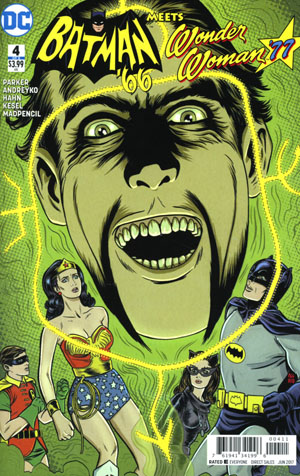
Batman '66 Meets Wonder Woman '77 #4 (DC Comics) As I've mentioned previously, one of the cool parts of this particular miniseries is that writers Jeff Parker (Batman '66) and Marc Andreyko (Wonder Woman '77) have taken advantage of the immortality of Wonder Woman, as well as Batman villain Ra's al Ghul, and the various settings of the TV shows it serves as a crossover of (note the years in the title) to present an adventure that spans decades, and thus various points in the characters' lives.
So we've already seen Wonder Woman and Ra's meet a pre-parents' murder Bruce Wayne back in the 1940s, and in this issue we wrap up the "'66" portion of the story, with the next two issues being set in 1977...long after the conclusion of the TV show that spawned these versions of Batman, Robin and Catwoman. It promises to be both a Wonder Woman crossover and a paper version of a Batman TV show reunion special that never happened.
But back to the "present" of the late 1960s. Batman, Wonder Woman, Robin and Catwoman have tracked Ra's and Talia to the Lazarus Pit hidden in a labyrinth near Paradise Island, and the resulting encounters lead to nods to the comics (Batman and Ra's having their first scimitar fight...shirts on, of course; Ra's calling Batman "Crusader" instead of "Detective" and to the TV shows (the heroes ending up in a death trap rather than being killed outright; the appearance of Wonder Girl Drusilla; Amazonian scuba gear).
Parker and Andreyko straight kill it with the jokes in this issue. I do so love Catwoman's puns, and this Batman's stick-in-the-mud, nerd adhesion to law is funny, particularly when framed as well as it is in a few sequences here near the end. Additionally, I really liked the idea that Wonder Woman's heroic example helped inspire the young Bruce Wayne to become a superhero in the first place. I'm getting off-topic here, but I was actually thinking about how unusual a Golden Age-less DC Universe is when it comes to Batman's mental health and life choices. For some reason, I was thinking of the various "takes" on Batman's becoming a bat at all, the "Batman's a crazy, broken person who decides to dress up like a bat and maniacally fight crime, because he's crazy" take vs. the Grant Morrison-articulated rationale that he suffered a trauma as a child and came up with a child's solution: "He became a superhero." I was thinking of it in regards to the fact that the current DC continuity lacks a Golden Age, and Batman was its first superhero, meaning he would be basing his idea on...pretty much just Zorro, I guess. James Bond? Robin Hood? Some pulp heroes? He didn't have Green Lantern Alan Scott, Sandman Wesley Dodd, Dr. Mid-Nite and the like to look up to.
Anyway, back to this comic: I can't say enough good things the art team of David Hahn and Karl Kesel. They have a truly remarkable ability to draw the characters from the TV show in such a way to resemble the actor's playing them, but no so faithfully that they look off when mixed in with all of the original characters, or when thrust into such super-crazy situations as we find here, the likes of which would have (could have) never appeared on network TV back in the 1960s or 1970s.
I know DC plans to keep doing various Batman '66 comics--the Legion of Super-Heroes crossover looks especially promising--but I'm going to miss this one when it ends. Luckily that's not for two more issues and at least one more decade.
Detective Comics #955 (DC) The hopefully penultimate chapter of writer James Tynion's current "Fists of Fury"* story arc (which I'm pretty sick of at this point, to be honest) finds an injured Cassandra Cain being read a story by the ballerina she was stalking, a fictional children's story called "The Girl Who Was a Shadow." The ballerina then offers an extensive piece of extemporaneous literary criticism of the story, which just so happens to perfectly mirror Cassandra Cain's origin story and current predicament!
Inspired, Cass goes on to fight and defeat a million ninjas and rescue her team. Meanwhile,The General Ulysses has developed a way to defeat The League of Shadows and save Gotham City, but it's a way that will mean the death of Team Batman.
Artist Marcio Takara's artwork is pretty decent here, and the attempts to make Cass' fight with the entire League of Shadows are admirable, including a sideways spread with lots of tight close-ups of her masked face and the blows she lands. Part of it is Takara's realistic style and part of it is likely colorist Marcello Maiolo's palette, but the action in this action comic just isn't very striking. The pages don't move, and the kung fu is unimpressive.
I'm really super-confused about Tynion's new take on Shiva, in which she is a terrorist rather than a connoisseur of martial arts battles--she even passes up the chance to duel Batman in order to make sure her destruction of Gotham City happens in time to get covered on The Today Show and Fox and Friends!--although there was a suggestion of an interesting dynamic here when she faces Cass for the second time this arc.
"It does not impress me to see a knife that refuses to stab, a gun that refuses to fire," Shiva says, referring to Cass' refusal to kill.
"Yes," Cassandra replies simply. "It does."
Tynion doesn't explain, and it's not like Cass is the sort of explain anything at any length, but I suppose the implication here is that it's much, much harder for a fighter like Cassandra to incapacitate a few dozen ninja without killing them than to take their lives (In the same way Superman has to try really hard not to pulp someone when he hits them, when it would be much easier for him to just throw a punch without calibrating exactly how much to pull it, you know?)
There was a promising moment where Cassandra almost tells the ballerina her name is "Orphan," and then decides to say "Cassandra Cain" instead. It gave me hope she'll be abandoning her stupid "Orphan" code name by the end of the arc (much of which has dealt with the fact that she's not an orphan, and that she need not be ashamed of her biological mother and that she has a family in Batman, Batwoman, Clayface and the others). I suppose if she's not going to go back to Batgirl or Black Bat, or take on a new, bat-oriented name (Bat? The Bat?), she could just go with Shadow or The Shadow or Shadow Girl...it would have been appropriate if she chose it during this issue, actually.
The Flash #21 (DC) Part Two of "The Button" is...button-less, but it picks up right where the previous chapter left off. The Flash Barry Allen is investigating the crime scene of The Reverse Flash's brutal beatdown of Batman in last week's Batman #21, as well as the subsequent murder of said Reverse Flash off-panel (presumably by Doctor Manhattan...or maybe Hillary Clinton).
Writer Joshua Williamson has some nice bits in here about how Barry Allen and Bruce Wayne bond over criminal science, and Barry's narration of the earlier portions of this issue really seem like the one point where he gets to inject some of himself into a script that otherwise is almost certainly just checking off boxes laid out by Geoff Johns and editorial-types at DC.
Just as last issue featured a reappearance by one of the figures from Johns' DC Universe: Rebirth special (hockey fan Saturn Girl), this chapter opens with a reappearance by Johnny Thunder, futilely calling for the original version of his Thunderbolt and screaming about the Justice Society. I wonder if we'll see similar appearances in the next two chapters?
The most relevant portion of this, in terms of the ongoing "Jesus God, what the fuck is DC doing with its continuity?!" storyline is that A) The Justice League has secretly been collecting artifacts from pre-Flashpoint continuity and have a fucking warehouse full of them (J'onn's old costume! Blue Devil's pitchfork thing! Hourman III's time ship! The Worlogog...? Etc!). Among these are The Cosmic Treadmill, and Barry runs the two heroes through the time stream, where the original founding of the Justice League, a scene from Identity Crisis and I want to say either Crisis On Infinite Earths or Flashpoint or Final Crisis (Aaa! Even I can't keep up anymore!) whiz by, and then they hit some turbulence and end up in the world of Flashpoint.
The end! Until next week.
Not sure what is meant to be going on, or where this is all headed, but if it was this easy to get back to The Flashpoint all along, I have to assume that DC is going to do for the rest of the DCU what they did for Superman and Lois in the pages of their recent "Superman Reborn" story arc...during some sort of event that will bring back post-Crisis, pre-Flashpoint continuity, with the stuff from The New 52 all having "happened," but just differently, and with a handful of changes (Like, I assume Barbara Gordon will still have the use of her legs and be Batgirl). In other words, there's another reboot coming.
In the mean time, I liked seeing Howard Porter on these characters again--I really liked what he and the colorists at Hi-Fi did with Flash's running-effects in a few scenes, where in addition to the lightning there's a weird, warping ribbon of red--and it's fun to stare at the super-detailed panels and pick things out. Not only is there the scene in the room where the League keeps the Ark of of the Covenant, the H-Dial and a Prometheus costume, but also a nice two-page spread of the Bat-Cave.
Like, for example, there's a pope costume in there. I don't know if Porter just through that in for fun, or if it is some reference to a story involving a pope, or possibly bishop, that I can't think of at the moment.
Lumberjanes #37 (Boom Studios) Regular writers Shannon Watters and Kat Leyh are joined by a new artist this issue, Ayme Sotuyo. On the one hand, it's nice that Boom allows different artists to take stabs at Lumberjanes (and its occasional spin-off one-shots or crossovers), as it undoubtedly helps introduce newer, younger artists to a wider audience. On the other hand, even if many of these artists have styles that are similar enough that no one's likely to ever get aesthetic whiplash, it does prevent Lumberjanes from developing a strong visual identity. My main concern with Sotuyo's presence here, however, is that I just don't like her art, at least not applied to these characters and this milieu, at least not yet (I may get used to it after a few issues worth of exposure, I suppose).
Her characters all have very big heads, faces and noses and, when one factors in the beady little eyes, they all look like Muppets. Oddly, not all of the characters have those little black dots for eyes. For example, April and Mal's mom both have full eyes, with irises and pupils and whites around them everything. I'm not sure why certain characters get whole eyes and others just get pupils embedded in their flesh (um, which is the way that I draw eyes), but it bugs me when it's not consistent.
Like, the original Flintstones cartoon? I can't tell you how much it used to bug me that Fred and Betty had whole eyes while Wilma and Barney just had dots-for-eyes. I used to wonder if Fred and Betty were brother and sister, and Wilma and Barney the same.
As for the storyline, which kicks off this issue, it's promising. It's Parents' Day, and so the parents of all the campers--except Molly--show up to get a tour of the camp. Which presents a difficulty for everyone at camp, what with all the Yeti and dinosaurs and monsters that tend to hang around.
Scooby-Doo Team-Up #25 (DC) Ha ha, it's funny because it's true! That third tier is just priceless. For what it's worth, Green Arrow does overhear them talking about his lack of villains, and shouts back some suggestions, including, Count Vertigo and The Clock King.
As you can likely tell by the characters as they appear there, the specific iterations of Green Lantern and Green Arrow that team-up with Scooby and the gang in this issue of Scooby-Doo Team-Up are those specific to the characters' "Hard-Traveling Heroes" iteration, in the early 1970s when the teamed-up and traveled around the country together having socially relevant adventures written mostly by Denny O'Neil and penciled mostly by Neal Adams. Heck, when the pair first appear here, they even refer to themselves as "a pair of hard-traveling heroes."
This particular issue of Scooby-Doo Team-Up, by the regular creative team of writer Sholly Fisch and artist Dario Brizuela, is maybe the best in a long while. At the very least, it has the most jokes per page in it. Check out this preview on Good Comics For Kids, which consists of the first five pages. Just the first three panels has a few particularly strong gags, ones that aren't at all dependent on the guest-stars.
The jokes that follow are mostly dependent on the heroes, of course, and some rather specific, even dated portrayals of them. This book is generally very good at being all-ages, but I have to confess that this issue was one in which I kinda wish I had a little kid who I could run it by to see if they dug it as much as I did (alas, the only very young superhero and Scooby-Doo fan I know can't yet read). Certainly a child wouldn't enjoy the exact same jokes in the same way I did, such as when Green Arrow suggests aloud that maybe he'll go check in on his former sidekick Speedy and see what he's been up to. (This. This is what he's been up to.)
This is a great, great issue.
Wonder Woman #21 (DC) Greg Rucka takes another slow step towards the conclusion of the 25-issue story arc he's been telling since returning to the character. This one at least feels like it's approaching a climax, as several of the players in the modern end of the story arrive at what they think is the portal to the true Themyscira. I like artist Liam Sharp's artwork a whole lot, but I thought he kinda fell down on at least one sequence, where Veronica Cale apparently follows her falling daughter into said portal.
The big cliffhanger from the previous installment of this section of the storyline, "The Truth," turned out to be glossed over in the manner of a particularly cheesy movie serial, as being shot through the chest didn't do much more than stagger and annoy Wonder Woman rather than hurt her. I guess that's because of her Amazonian healing factor...?
*Original title, that.
So we've already seen Wonder Woman and Ra's meet a pre-parents' murder Bruce Wayne back in the 1940s, and in this issue we wrap up the "'66" portion of the story, with the next two issues being set in 1977...long after the conclusion of the TV show that spawned these versions of Batman, Robin and Catwoman. It promises to be both a Wonder Woman crossover and a paper version of a Batman TV show reunion special that never happened.
But back to the "present" of the late 1960s. Batman, Wonder Woman, Robin and Catwoman have tracked Ra's and Talia to the Lazarus Pit hidden in a labyrinth near Paradise Island, and the resulting encounters lead to nods to the comics (Batman and Ra's having their first scimitar fight...shirts on, of course; Ra's calling Batman "Crusader" instead of "Detective" and to the TV shows (the heroes ending up in a death trap rather than being killed outright; the appearance of Wonder Girl Drusilla; Amazonian scuba gear).
Parker and Andreyko straight kill it with the jokes in this issue. I do so love Catwoman's puns, and this Batman's stick-in-the-mud, nerd adhesion to law is funny, particularly when framed as well as it is in a few sequences here near the end. Additionally, I really liked the idea that Wonder Woman's heroic example helped inspire the young Bruce Wayne to become a superhero in the first place. I'm getting off-topic here, but I was actually thinking about how unusual a Golden Age-less DC Universe is when it comes to Batman's mental health and life choices. For some reason, I was thinking of the various "takes" on Batman's becoming a bat at all, the "Batman's a crazy, broken person who decides to dress up like a bat and maniacally fight crime, because he's crazy" take vs. the Grant Morrison-articulated rationale that he suffered a trauma as a child and came up with a child's solution: "He became a superhero." I was thinking of it in regards to the fact that the current DC continuity lacks a Golden Age, and Batman was its first superhero, meaning he would be basing his idea on...pretty much just Zorro, I guess. James Bond? Robin Hood? Some pulp heroes? He didn't have Green Lantern Alan Scott, Sandman Wesley Dodd, Dr. Mid-Nite and the like to look up to.
Anyway, back to this comic: I can't say enough good things the art team of David Hahn and Karl Kesel. They have a truly remarkable ability to draw the characters from the TV show in such a way to resemble the actor's playing them, but no so faithfully that they look off when mixed in with all of the original characters, or when thrust into such super-crazy situations as we find here, the likes of which would have (could have) never appeared on network TV back in the 1960s or 1970s.
I know DC plans to keep doing various Batman '66 comics--the Legion of Super-Heroes crossover looks especially promising--but I'm going to miss this one when it ends. Luckily that's not for two more issues and at least one more decade.
Detective Comics #955 (DC) The hopefully penultimate chapter of writer James Tynion's current "Fists of Fury"* story arc (which I'm pretty sick of at this point, to be honest) finds an injured Cassandra Cain being read a story by the ballerina she was stalking, a fictional children's story called "The Girl Who Was a Shadow." The ballerina then offers an extensive piece of extemporaneous literary criticism of the story, which just so happens to perfectly mirror Cassandra Cain's origin story and current predicament!
Inspired, Cass goes on to fight and defeat a million ninjas and rescue her team. Meanwhile,
Artist Marcio Takara's artwork is pretty decent here, and the attempts to make Cass' fight with the entire League of Shadows are admirable, including a sideways spread with lots of tight close-ups of her masked face and the blows she lands. Part of it is Takara's realistic style and part of it is likely colorist Marcello Maiolo's palette, but the action in this action comic just isn't very striking. The pages don't move, and the kung fu is unimpressive.
I'm really super-confused about Tynion's new take on Shiva, in which she is a terrorist rather than a connoisseur of martial arts battles--she even passes up the chance to duel Batman in order to make sure her destruction of Gotham City happens in time to get covered on The Today Show and Fox and Friends!--although there was a suggestion of an interesting dynamic here when she faces Cass for the second time this arc.
"It does not impress me to see a knife that refuses to stab, a gun that refuses to fire," Shiva says, referring to Cass' refusal to kill.
"Yes," Cassandra replies simply. "It does."
Tynion doesn't explain, and it's not like Cass is the sort of explain anything at any length, but I suppose the implication here is that it's much, much harder for a fighter like Cassandra to incapacitate a few dozen ninja without killing them than to take their lives (In the same way Superman has to try really hard not to pulp someone when he hits them, when it would be much easier for him to just throw a punch without calibrating exactly how much to pull it, you know?)
There was a promising moment where Cassandra almost tells the ballerina her name is "Orphan," and then decides to say "Cassandra Cain" instead. It gave me hope she'll be abandoning her stupid "Orphan" code name by the end of the arc (much of which has dealt with the fact that she's not an orphan, and that she need not be ashamed of her biological mother and that she has a family in Batman, Batwoman, Clayface and the others). I suppose if she's not going to go back to Batgirl or Black Bat, or take on a new, bat-oriented name (Bat? The Bat?), she could just go with Shadow or The Shadow or Shadow Girl...it would have been appropriate if she chose it during this issue, actually.
The Flash #21 (DC) Part Two of "The Button" is...button-less, but it picks up right where the previous chapter left off. The Flash Barry Allen is investigating the crime scene of The Reverse Flash's brutal beatdown of Batman in last week's Batman #21, as well as the subsequent murder of said Reverse Flash off-panel (presumably by Doctor Manhattan...or maybe Hillary Clinton).
Writer Joshua Williamson has some nice bits in here about how Barry Allen and Bruce Wayne bond over criminal science, and Barry's narration of the earlier portions of this issue really seem like the one point where he gets to inject some of himself into a script that otherwise is almost certainly just checking off boxes laid out by Geoff Johns and editorial-types at DC.
Just as last issue featured a reappearance by one of the figures from Johns' DC Universe: Rebirth special (hockey fan Saturn Girl), this chapter opens with a reappearance by Johnny Thunder, futilely calling for the original version of his Thunderbolt and screaming about the Justice Society. I wonder if we'll see similar appearances in the next two chapters?
The most relevant portion of this, in terms of the ongoing "Jesus God, what the fuck is DC doing with its continuity?!" storyline is that A) The Justice League has secretly been collecting artifacts from pre-Flashpoint continuity and have a fucking warehouse full of them (J'onn's old costume! Blue Devil's pitchfork thing! Hourman III's time ship! The Worlogog...? Etc!). Among these are The Cosmic Treadmill, and Barry runs the two heroes through the time stream, where the original founding of the Justice League, a scene from Identity Crisis and I want to say either Crisis On Infinite Earths or Flashpoint or Final Crisis (Aaa! Even I can't keep up anymore!) whiz by, and then they hit some turbulence and end up in the world of Flashpoint.
The end! Until next week.
Not sure what is meant to be going on, or where this is all headed, but if it was this easy to get back to The Flashpoint all along, I have to assume that DC is going to do for the rest of the DCU what they did for Superman and Lois in the pages of their recent "Superman Reborn" story arc...during some sort of event that will bring back post-Crisis, pre-Flashpoint continuity, with the stuff from The New 52 all having "happened," but just differently, and with a handful of changes (Like, I assume Barbara Gordon will still have the use of her legs and be Batgirl). In other words, there's another reboot coming.
In the mean time, I liked seeing Howard Porter on these characters again--I really liked what he and the colorists at Hi-Fi did with Flash's running-effects in a few scenes, where in addition to the lightning there's a weird, warping ribbon of red--and it's fun to stare at the super-detailed panels and pick things out. Not only is there the scene in the room where the League keeps the Ark of of the Covenant, the H-Dial and a Prometheus costume, but also a nice two-page spread of the Bat-Cave.
Like, for example, there's a pope costume in there. I don't know if Porter just through that in for fun, or if it is some reference to a story involving a pope, or possibly bishop, that I can't think of at the moment.
Lumberjanes #37 (Boom Studios) Regular writers Shannon Watters and Kat Leyh are joined by a new artist this issue, Ayme Sotuyo. On the one hand, it's nice that Boom allows different artists to take stabs at Lumberjanes (and its occasional spin-off one-shots or crossovers), as it undoubtedly helps introduce newer, younger artists to a wider audience. On the other hand, even if many of these artists have styles that are similar enough that no one's likely to ever get aesthetic whiplash, it does prevent Lumberjanes from developing a strong visual identity. My main concern with Sotuyo's presence here, however, is that I just don't like her art, at least not applied to these characters and this milieu, at least not yet (I may get used to it after a few issues worth of exposure, I suppose).
Her characters all have very big heads, faces and noses and, when one factors in the beady little eyes, they all look like Muppets. Oddly, not all of the characters have those little black dots for eyes. For example, April and Mal's mom both have full eyes, with irises and pupils and whites around them everything. I'm not sure why certain characters get whole eyes and others just get pupils embedded in their flesh (um, which is the way that I draw eyes), but it bugs me when it's not consistent.
Like, the original Flintstones cartoon? I can't tell you how much it used to bug me that Fred and Betty had whole eyes while Wilma and Barney just had dots-for-eyes. I used to wonder if Fred and Betty were brother and sister, and Wilma and Barney the same.
As for the storyline, which kicks off this issue, it's promising. It's Parents' Day, and so the parents of all the campers--except Molly--show up to get a tour of the camp. Which presents a difficulty for everyone at camp, what with all the Yeti and dinosaurs and monsters that tend to hang around.
Scooby-Doo Team-Up #25 (DC) Ha ha, it's funny because it's true! That third tier is just priceless. For what it's worth, Green Arrow does overhear them talking about his lack of villains, and shouts back some suggestions, including, Count Vertigo and The Clock King.
As you can likely tell by the characters as they appear there, the specific iterations of Green Lantern and Green Arrow that team-up with Scooby and the gang in this issue of Scooby-Doo Team-Up are those specific to the characters' "Hard-Traveling Heroes" iteration, in the early 1970s when the teamed-up and traveled around the country together having socially relevant adventures written mostly by Denny O'Neil and penciled mostly by Neal Adams. Heck, when the pair first appear here, they even refer to themselves as "a pair of hard-traveling heroes."
This particular issue of Scooby-Doo Team-Up, by the regular creative team of writer Sholly Fisch and artist Dario Brizuela, is maybe the best in a long while. At the very least, it has the most jokes per page in it. Check out this preview on Good Comics For Kids, which consists of the first five pages. Just the first three panels has a few particularly strong gags, ones that aren't at all dependent on the guest-stars.
The jokes that follow are mostly dependent on the heroes, of course, and some rather specific, even dated portrayals of them. This book is generally very good at being all-ages, but I have to confess that this issue was one in which I kinda wish I had a little kid who I could run it by to see if they dug it as much as I did (alas, the only very young superhero and Scooby-Doo fan I know can't yet read). Certainly a child wouldn't enjoy the exact same jokes in the same way I did, such as when Green Arrow suggests aloud that maybe he'll go check in on his former sidekick Speedy and see what he's been up to. (This. This is what he's been up to.)
This is a great, great issue.
Wonder Woman #21 (DC) Greg Rucka takes another slow step towards the conclusion of the 25-issue story arc he's been telling since returning to the character. This one at least feels like it's approaching a climax, as several of the players in the modern end of the story arrive at what they think is the portal to the true Themyscira. I like artist Liam Sharp's artwork a whole lot, but I thought he kinda fell down on at least one sequence, where Veronica Cale apparently follows her falling daughter into said portal.
The big cliffhanger from the previous installment of this section of the storyline, "The Truth," turned out to be glossed over in the manner of a particularly cheesy movie serial, as being shot through the chest didn't do much more than stagger and annoy Wonder Woman rather than hurt her. I guess that's because of her Amazonian healing factor...?
*Original title, that.
Sunday, April 23, 2017
Some recent Marvel trades I read, um, recently:
Daredevil: Back In Black Vol.3--Dark Art
After a really rather rough second volume (discussed in this post), the current, Charles Soule-written volume of Daredevil is back to the level of quality of the first volume. This likely has a lot to do with the fact that pencil artist Ron Garney is back, drawing all five of the issues collected herein. It may also have a lot to do with the fact that, like the first volume and unlike the second volume, Soule apparently wrote these issues as a single arc. It's not quite complete enough to read like a distinct graphic novel, as it does pick up on at least one event from volume two (Elektra having broken Blindspot's arm), and there's a pretty dramatic cliffhanger ending regarding the fate of Daredevil's new sidekick, but otherwise this is a pretty self-contained comics story.
Our heroes are doing their thing, lawyering and/or law assistancing by day, fighting crime by night, and they are forced to face a sinister new villain. The papers have dubbed him "Vincent Van Gore," which is pretty good, but he personally prefers "Muse," which isn't quite as good. He's a serial killer/artist, and his first major piece being a gigantic Guernica-esque mural painted with the blood of dozens of different victims. He's also got some weird and, frankly, ill-defined powers that make him a match for Daredevil in a scrap, particularly since Daredevil can't "see" him.
And that's pretty much that: Hero vs. villain, with the latter being a brand-new villain. There's something you don't see much anymore!
Complicating matters is that Muse's second piece involves killing of several Inhumans*, and so Daredevil and Matt Murdock try to work with Medusa and New Attilan. There's another new character introduced here--a former New York City Police Department detective who got Inhuman-ized, given a neat but subtle power and who now works as a liaison between the country and the city's police--who spends the most time with DD and/or MM, but the climax of the Inhumans' involvement seems to be to have Medusa be kind of a jerk and let Karnak and Daredevil fight. As I was reading one scene, in which neighborhood toughs attempt to murder an Inhuman, it occurred to me that this story arc may seem quite dated in a few years' time, as the scene is written almost exactly as if Soule had simply replaced the word "mutant" with "Inhuman."
I'm not crazy about Muse's mask, which appears to include a tight-fitting knit cap like the kind of a cartoon burglar might wear, and his tiny little backpack, but otherwise his design is visually striking, and of the sort that fits into the book's unusual coloring scheme (which color artist Matt Milla manages).
I can't say I'm terribly excited about what I imagine may dominate the fourth volume, based on the last, climactic pages of this arc, in which Blindspot is forced to take on Muse solo in order to save many lives, but it's quite possible that Soule will end up zagging instead of zigging.
Again, after a choppy second volume, Daredevil is again pretty tightly written super-comics, with great art and a somewhat unique visual hook to its telling that separates it from the scores of other superhero comics on the shelves at the moment (the vast majority of which are also published by Marvel).
Deadpool: Too Soon?
If Deadpool's current state of popularity is such that his presence can not only goose interest and sales in books he appears in, than this four-issue miniseries operated on almost reverse logic. This is a Deadpool comic filled with a large cast of guest-stars, most of them relatively minor characters, but ones with strong fan bases.
Writer Joshua Corin (whom I have never heard of**) sends The Forbush Man, The Unbeatable Squirrel Girl, The Astonishing Ant-Man, Rocket and Groot, Howard The Duck, The Punisher and Peter Porker, The Amazing Spider-Ham and, um, The Punisher to a mansion, each following a similar mysterious letter. There they are greeted by Deadpool and his apparent wife, a demon named Shiklah (I had heard he was married, although this is the first time in my extremely sporadic reading of Deadpool comics that I learned to who).
Deadpool has invited them all there to pose for his Christmas card photo with him, and has dug up enough blackmail material on each of them to force them to comply. Why this particular assortment of characters? Because, he explains, they are the funniest characters in the Marvel Universe. If The Punisher seems particularly out-of-place among this group, I suspect that is the joke regarding his presence.
This set-up leads to a locked-door sort of mystery, as when the lights briefly go out and come back on, Forbush Man is found decapitated! Is this the end of the Forbush Man, the most expendable of the guests, in that he's not currently starring or co-starring in a comic book? Looks like! At his funeral, attended by all (dig Tippy-Toe's little black ribbon), Deadpool vows to find the killer, criss-crossing the country to investigate the other suspects in the room that night (he naturally dismisses himself and his wife).
Joined against his will by Squirrel Girl, he travels to California, to Miami and then back to New York City, pursued by "Squirrelpool," a hideous clone monster created accidentally when he and Squirrel Girl share an old teleporter (I was pretty disappointed in this design by artist Todd Nauck; it suits the purposes of the story fine, although I'm not sure why it's a hulking monster-sized creature instead of being Deadpool-sized, or even just Deadpool-plus-Squirrel Girl-sized, but man, it would be so easy to amalgamate those two characters into a cool design).
When the beheadings start to pile-up, and include clearly-not-going-to-get-killed-off-for-long characters like Rocket and Groot (and, a little more shockingly, Squirrel Girl's besties Nancy Whitehead*** and Tippy-Toe), the stakes are lowered and, when the murderer is revealed and defeated with some help of Marvel's latest movie star Dr. Strange, it should come as no surprise that everyone is restored to life in some particularly random deus ex machina. (To be fair to Brad Meltzer, whose Identity Crisis is pretty much the worst murder "mystery" in comic book history, I should note that the killer is not a suspect introduced at any point in the comic, and so as a mystery, this doesn't work...not that the mystery set-up was ever meant to be anything more than a premise, of course).
Nauck is an artist I sometimes have some trouble evaluating entirely impartially, given the amount of affection I have for his work on account of his years on Young Justice. His ability--and tons of experience--balancing light-hearted supehero comedy with concinving superhero action serves him well in this particular series, though, and it's certainly interesting to see so many diverse characters translated though his particular visual style, even if they don't all seem to work (Squirrel Girl, for example, is a character that some artist seem to nail a particular take on, while others flounder a bit, sometimes for reasons I have a hard time pinning down. Nauck's version just looks like a typical super-girl character with a few Squirrel Girly features, rather than looking like Squirrel Girl.)
I was a little surprised to find a back-up, the story "Deadpooloween" taken from the Gwenpool Holiday Special: Merry Mix-Up #1, and I was more surprised still to find that it was both written and drawn by Chynna Clugston Flores. I guess it was included because it prominently features Squirrel Girl, as does the Too Soon?. It's been a good long time since I've read a Chynna comic, although I can hardly overstate how much I loved her Blue Monday in Action Girl and then from Oni (Image is currently reprinting it, and you should buy it and read it). While I'm sure she's done something for Marvel since, the last Marvel comic she drew that I read was that issue of Ultimate Marvel Team-Up from the earliest years of the Ultimate line, when Brian Michael Bendis had Peter Parker and pals run into the X-Men at the mall.
In her story, Deadpool belatedly realizes it Halloween, and suits up to cruise the town near Empire State University. There he finds that Squirrel Girl is hosting a Deadpool costume contest, which he angrily enters, irritated that the success of his movie has spawned so many college bros dressing up like him this Halloween.
Remember what I said about certain artists seeming to do a better, truer Squirrel Girl than others? Chynna nails hers. Her style is so different than that of Erica Henderson, but Chynna is just an all-around expert when it comes to drawing geeky young people, I guess. I would love to see more Chynna Clugston Flores Squirrel Girl somewhere in the future.
Doctor Strange Vol. 3: Blood in the Aether
With Doctor Strange's magical powers and resources utterly exhausted by his two-volume battle against the magic-destroying interdimensional entity The Empirikul, he is at one of his lowest, weakest points in Doctor Strange #11, by writer Jason Aaron and guest-artists Kevin Nowlan (who draws the scenes set during Strange's origin) and Leonardo Romero (who draws the scenes set in the present). That means there's blood in the water and the sharks are starting to circle.
And by "the water" I guess we mean "the aether," and by "the sharks" I guess we mean an assortment of villains, including Doctor Strange's arch-enemies and a few newer or more random threats.
So after the prelude chapter that the 11th issue serves as, the rest of the collection is a sort of week-in-the-life story, in which Doctor Strange runs a gauntlet of foes new and old, all the time being forced to rely on his wits, his allies and what new sorcery he can invent on the fly to save himself...and everyone else.
So in rapid succession Strange faces Mister Misery (the name the thing from his basement assigned itself), Baron Mordo, Nightmare, Satana and Master Pandemonium**** (and Pandemonium's hands), the post-Original Sin version of The Orb and, of course, the dread Dormammu. Their motives range from the dire to the petty to the idiosyncratic, and if you're at all familiar with any of these characters you can probably assign each of them to those categories without any help from me, but it all adds up to a pretty dramatic, almost arcade-like fight, with a few lighter moments to stop and exhale.
Regular pencil artist Chris Bachalo manages the bulk of the five issues that make up the actual "Blood in the Aether" story arc (with a pair of pencilers getting "with" credits on the last two issues, and eight different inkers credited on these issues...speaking of credit, it's to Bachalo and company's credit that the story actually looks pretty great, and all those different artists work together well enough that their collaboration is, if not seamless, than relatively seam-light).
It's really difficult to overstate how well-suited Bachalo is to the material, and not just to the Steve Ditko-conceived world of Doctor Strange in general, but to writer Jason Aaron's world-weary, joke-heavy conception of the character and his story specifically. As I've said before, Bachalo handles weird well, and he manages to make old characters like Dormammu, Mordo and Nightmare his own, while the characters that are his own, like Mister Misery, are hard to imagine under anyone else's pens.
Probably the best example of his work is the issue devoted to Satana, however. She plans to open up her own hell, one in which the damned can spend time with "cool" dead people, like dead rockstars and superheroes, like Doctor Strange. She pitches him over a bizarre meal in a bizarre diner (Pandemonium is both her short order cook and her muscle), filled with elaborately, cartoonishly designed creatures. To save himself, Strange must use his astral projection form in a pretty unusual way, which I'm not sure if he's ever done before, in order to achieve a particular goal I'm quite positive he never has.
I'm not sure if Bachalo has completely redesigned Satana here, or if his and colorist Antonio Fabela's version is just strikingly rendered, but this is maybe the coolest I can remember her looking. I think Bachalo draws Pandemonium's hand demons a little too gitancially, but, like Swarm, there's really no way to screw up the drawing of this crazy-ass Marvel villain.
Bachalo's Orb is another pretty great character. I don't believe I've seen him since Original Sin, nor do I quite understand how either he or Nick Fury Sr. "work" in the Marvel Universe anymore, but Aaron's conception of The Orb works well here for the purposes of a Doctor Strange comic, and Bachalo seems to have a lot of fun selling this new life of the character's menace as well as inherent humor.
This volume is really strong enough to stand on its own, independent of the two preceding it, as the only things one really needs to know from the previous ten issues get summarized in the three sentences following the Doctor Strange logo on the title page.
Power Man and Iron Fist Vol. 2: Civil War II
Here's another in the too-long line of pretty good books that got derailed and/or destroyed by Civil War II. In the case of the David Walker-written Heroes For Hire revival, I say "and/or destroyed" because the book is no longer around. That may have simply been Marvel trying to more closely tie their comics to the various Netflix series, as after this book's cancellation Walker went on to write a Luke Cage solo title sharing the name of his TV show, and a new Iron Fist series launched. Or it could have been because of this dumb-ass story arc, that takes over issues #6-9 of the then-new book, almost the entirety of this second collected volume of the series (there's also a fun, holiday annual included in this collection).
For trade-waiters like me, the other unfortunate aspect of Civil War II? Because that book was so delayed, and expanded after solicitation, it meant I couldn't read any of the tie-in trades like this until I read the main series, but so many of the tie-ins were published prior to the Civil War II collection, that basically meant holding off on reading any (or at least many) Marvel collections for a few months longer than I might have otherwise. (As it turns out though, one really only needs to have read the first few issues of Civil War II to understand what's going on here; War Machine's dead, She-Hulk is in a coma and Carol Danvers is a big, stupid immoral idiot and...that's it, really).
Now, this arc is bad, but it's still fun, and maybe as good as a tie-in to such a dumb event series could be if it really did try to honestly engage with the event instead of simply side-stepping it as fast as possible. Walker writes these characters extremely well, and has a lot of fun with Luke's refusal to swear and in recovering the often very goofy characters from Cage's deep past, and other failed or half-forgotten street-level characters from Marvel's past, and reintroducing them, often portraying their past portrayals as youthful indiscretions, or perhaps trying to be something they weren't...or, in at least one case, trying to hang on to something they never were in the first place.
The artwork by Flavianao and Sanford Green is great, and I could look at those two guys' drawings of the two guys in the title all damn day; I particularly like, as I believe I mentioned when discussing the first volume, how huge this Luke Cage is drawn, in relation to Danny, Jessica, Danielle and the whole world around him. He's a literally bigger-than-life character.
Walker's way of dealing with the Civil War II plot is interesting, and I find myself wondering whether the plot for this arc, which isn't quite concluded in this volume, is one he would have written anyway, and he was just forced to fold Carol Danvers in, or if his non-Civil War II plot was an intentional echo of Civil War II, inspired by its plot.
So the first issue opens with Luke Cage, Danny Rand, Jessica Jones and a clueless Danielle watching news footage of the battle with Thanos that took place in Free Comic Book Day 2016, which the Civil War II collection puts between Civil War II #0 and Civil War II #1 (That event series, by the way, makes an excellent case for trade-waiting, as it's really hard to tell where and when it actually starts; there are basically three different starting points, one of which isn't terribly relevant. Better to let a collections editor curate it, I think). This is the battle that ends with War Machine James Rhodes dead and She-Hulk in a coma, and the two heroes are pretty shaken for obvious reasons, with flashbacks giving less-obvious, more personal details: Cage and Rhodey's last conversation was an intense argument, and Danny thinks about the time he kissed She-Hulk. Four more pages are devoted to Civil War II: They attempt to visit Shulkie at the Tri-Skelion but are turned away, and they are warmly greeted by Carol, who then asks if they can give her a minute of their time so she can explain what's going on.
Jump to the two of them walking to their car, reiterating that Civil War II is dumb and they hope they can avoid being in it (they can't!).
"What was all that 'predictive justice' stuff Carol was talking about?" Danny yells. "Sounded like a bunch of fiddle-faddle to me," Luke says, and they agree to sit this one out, as they are also sick of hero vs. hero fights. On a two-page spread, between two tiers of them talking about it, there's a nice big spread of the Luke Cage-lead Avengers (from the second volume of the Bendis-written New Avengers, I want to say) fighting the Carol Danvers and Iron Man-lead Avengers (from the pages of the Bendis-written Mighty Avengers). Cage, who sided with Captain America in the pages of the first Civil War, was basically in a kinda cold war with the government-sanctioned Avengers between the end of Civil War and the post-Secret Invasion "Heroic Age," I think.
Walker then returns to matters related to his book, as a bunch of reformed criminals and their family members attempt to hire the Heroes For Hire to find a bunch of ex-cons who have since gone straight but disappeared shortly after encountering a group of mysterious vigilantes. And then those vigilantes attack! Followed by the police!
This ends with Danny Rand in jail for assaulting some officers, where he tries to figure out the disappearances. Many of those who have disappeared are also in jail there, and they ended up there without officially being charged or getting trials. Outside prison, Luke calls in favors from many friends to try to figure out the one clue they have, a mysterious device that mixes facial recognition software with the ability to manipulate and falsify criminal records. This is what the vigilantes were doing to bust their victims.
So you can see how this thematically kinda sorta ties in to Civil War II, as innocent--or at least innocent-until-proven-guilty--people are being attacked, arrested and punished for crimes they didn't actually commit. Civil War II comes back to the fore when Ulysses--the prophesying Inhuman that Carol Danvers is using to predict possible future crimes to prevent before they happen--has a vision of Luke Cage leading a break-in at Ryker's to free the incarcerated Danny.
In fact, a confused and frustrated Cage calls Songbird and Centurius to join him as he looks at Ryker's, in the hopes that they can talk him out of doing something stupid and figure out this whole mess, and then "Sweet Christmas, Easter and Hanukkah," in swoop Danvers, Mockingbird, Puck, Spectrum, Storm, Deathlok and a whole bunch of SHIELD troops. They are there to stop Ulysses' vision from coming to pass by arresting Luke first and, just as in All-New Wolverine Vol. 2: Civil War II, Carol's intervention is exactly what causes the vision to come to pass (slow learner, I guess).
Luke's not having it, of course, he tells off Carol in such a way to piss her off, and everyone fights, with the fight eventually spreading inside the prison after Carol punches Luke through its walls and a couple of errant energy blasts and explosions continue to escalate the situation.
There's a lot of fighting between all parties. I particularly liked the fight-then-team-up sequences involving Mockingbird, who Walker writes close enough to Chelsea Cain that she sounds like the same character, and Songbird, because they have similar names. And I'm always calling Songbird Mockingbird by accident.
It ends with Cage making a couple of speeches in Carol's direction, and then Danny making another one, and she's eventually shamed into dropping it and they help round up the prisoners and clean up the jail. (I'm not sure this all lines up perfectly well with Civil War II, by the way. In that book's third issue, Luke and Danny appear to be working with Carol and SHIELD, at least according to one big panel of a series of three images that run across a two-page spread while New York City Assistant District Attorney examines Carol Danvers, but in issue #4, Luke is allied with Iron Man on the "cool" team that shows up at the Triskelion to fight Carol's lame team.)
But just as in the pages of Civil War II, the tie-ins seem mostly designed to demonstrate that Carol is dumb and keeps making the same mistakes over and over and over again.
As for the A-plot, which becomes the B-plot, Luke's team is just about to crack where the doohickey being used to find and incarcerate people came from, when a very powerful person in a hoodie teleports to his safehouse and steals it from the hands of his allies.
As I mentioned earlier, the rest of the collection is devoted to an annual, or, to be specific, Sweet Christmas Annual #1. Walker writes this as well, but Scott Hepburn provides the art. It's Christmas Eve, and Luke, Danny and Danielle visit a toy store to find the Pokemon-like hot toy of the season. Also there is Spider-Woman Jessica Drew and her baby. And Daimon Hellstrom, Son of Satan, in an open-coat Santa suit. And The Krampus. And the real Santa Claus. It is every bit as awesome as it sounds, and Hepburn draws a hell of a Krampus, as well as a pretty sweet warrior version of Santa that isn't as over-the-top as the one in the Grant Morrison-written Santa vs. Krampus comic, Klaus.
I'm really glad it was collected here, even though the storyline preceding it didn't really reach its conclusion, because it at least means the book ends on a high note, rather than being another example of the Civil War II storlyine stumbling into an already perfectly strong title, upsetting all the furniture and then stumbling back out.
The Unbeatable Squirrel Girl Vol. 5: Like I'm The Only Squirrel In The World
This volume takes for its cover that of Unbeatable Squirrel Girl #13, i.e. the one where Squirrel Girl is hauling back to throw Tippy-Toe, who is herself hauling back to throw Ant-Man, who is all curled up like a ball in her tiny squirrel fist. Is this modified Fuzzball Special just something for the cover, or does it actually occur within the pages of the comic itself?
It does!
The Squirrel Girl/Ant-Man team-up takes place during a story arc that dominates this trade, occupying the first three of the five issues collected herein. Doreen, Nancy and Tippy-Toe join Doreen's mom at a cabin in Canada for a rather boring vacation, which is interrupted by a bid to conquer the world by a character who can split himself into many different versions of himself. His name is Enigmo, and he is apparently a pre-existing Marvel villain (The Internet said he debuted in 1994 issue of Avengers). Brain Drain, the disembodied brain in a jar atop a powerful robot body that has been hanging around with Doreen and friends for a while, teleports to Canada to help her, and he does so with the only hero he could find who was small enough to fit in the teleporter at the same time as him: The Astonishing Ant-Man, Scott Lang.
As per usual, Squirrel Girl is able to save the day, with the help of her many friends and the help of science knowledge, which writer Ryan North applies to the comic book world of the Marvel Universe as charmingly as ever. For example, there is a flashback to physics class, where in Doreen and Nancy remember their teacher's lecture on "Galileo's Square-Cube law," which explains why giant mice are impossible.
"And yes, you can get around this restriction with certain cosmic rays or other exotic particles. I am aware of Pym's work, thank you," the professor continues. "It's hard not to be when he published journal articles like 'Ha Ha, I'm Giant-Man Now: Screw You, All Other Physicists.'"
That sounds like a fantastic journal article! Should I be reading scientific journals, for laughs?
This very full arc, which actually feels a lot longer than three issues, contains not only a team-up with a very grumpy Ant-Man--who was kidnapped into participating--but lots of jokes based on Brain Drain's nihilistic view of the universe and the humor inherent in Canada, and how it is different than America.
I mention that the arc felt longer than it actually was, not as a criticism, but as a compliment. Not only does artist Erica Henderson draw lots of panels per page when called on to do so, but North clearly spends a great deal of his writing-time think of how to pack as many jokes into each page as possible. Not just the bonus jokes that come in the alt-text like sentences below most of the pages, but, for example, this panel, in which Doreen surveys her choices for magazines to read in the cabin:
North easily could have stopped at the titles of the magazines themselves, but he went above and beyond, to include several jokes on each cover, detailing the contents of those magazines.
Unbeatable Squirrel Girl has got to have set some kind of record for the most jokes per square centimeter of page-space.
The remaining two issues of the collections are done-in-ones. The first of these is a comic told entirely from the perspective of Nancy's cat Mew, which I believe the solicitation for blamed on Matt Fraction and David Aja doing that Pizza Dog issue of Hawkeye a few years back (In fact, there's a dog that appears in this that I'm fairly confident is supposed to be Pizza Dog, although he's not named, and I didn't see either of the Hawkeyes among the many super-heroes running around). In the background, The Taskmaster is using his awesome skills to take on a whole mess of superheroes--Iron Man! A The Hulk!***** Captain America! Spider-Man! Ms. Marvel! Ms. America! Hellcat!--in addition to Squirrel Girl, but she ultimately proves unbeatable, thanks to the fact that she has something Taskmaster can't master. This issue contains several pages by Zac Gorman, in which he draws comic strips that replicate Mew's dreams. Apparently cats dream in comic strips? Who knew?
The final issue is devoted to celebrating the 25th anniversary of Squirrel Girl's introduction by creators Will Murray and Steve Ditko in 1991's Marvel Super-Heroes Winter Special #8. It's a kinda sorta origin of the character, although not in the "how she got her powers and became a super-hero" kind of way as much as a "where, specifically, she came from" kind of story (That is, it opens with her parents meeting, and the title page is her mom holding her just after giving birth). From there it jumps around in five year increments, and we meet the late Monkey Joe, watch 15-year-old Squirrel Girl help The Hulk take down The Abomination and, finally, enjoy a birthday party with her pals and some Avengers, a party which The Red Skull foolishly attempts to crash.
While the issue is mostly another North and Henderson joint, Murray writes the 15-year-old Doreen sequence, and a piece of Ditko art is repurposed to get something from the great artist into the issue.
*Oh hey, in all those recent discussions of the source of Marvel's current sales woes--you know, whether it was diversity of characters or event exhaustion or them renumbering their books twice a year or whatever--did anyone theorize that maybe it was just that everyone hates the Inhumans, yet Marvel seemed to go ahead and keep publishing Inhumans books constantly, while shoehorning them into pretty much everything they publish? Could that have been a factor? Did Marvel comics readers so hate the Inhumans that they stopped buying Marvel comics to avoid reading about the Inhumans?
**At least not until googling him. He's a prose writer and playwright, and this was his first comics work, which would explain why I had never heard of him. It should be noted that he writes like a comic book writer here, and doesn't display any of the typical flaws one sees when writers fluent in another medium tackle comics-scripting for the first time.
***I was a little surprised that Corin didn't include a joke of any kind referring to Nancy Whitehead as Nancy Whiteheadless. He is a stronger man than I am, I guess.
****I just went to check the table-of-contents of Jon Morris' The Legion of Regrettable Super Villains, the companion book to his earlier League of Regrettable Super Heroes and, to my surprise, Master Pandemonium was not included. Nor was The Orb. Swarm was however, and there's actually a pretty good showing from Marvel villains overall: Stilt-Man, MODOK, Angar the Screamer, Black Talon, The Headmen and others.
*****Not a typo! I'm just not sure which The Hulk it is, Amadeus Cho or Bruce Banner, the latter of whom I'm fairly certain wasn't temporarily dead-ish at the time that issue of Squirrel Girl was pubished.
Subscribe to:
Posts (Atom)